3rd Edition
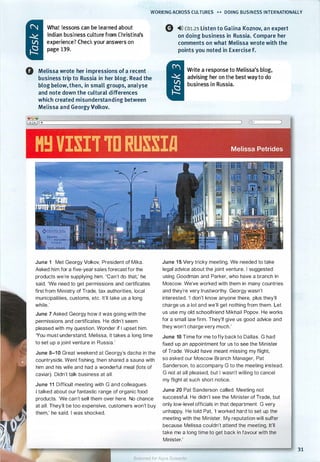
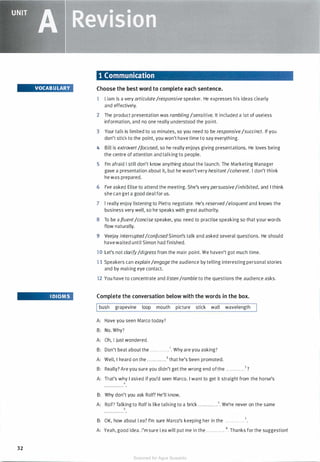
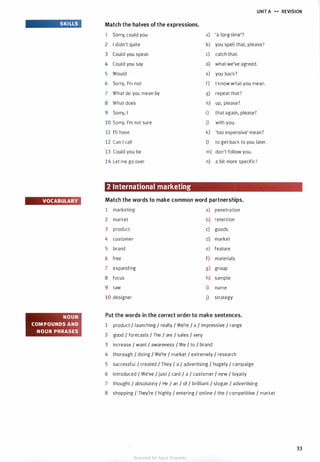
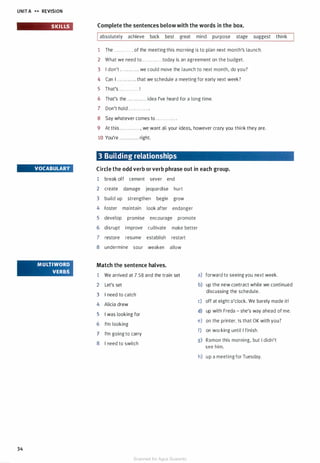
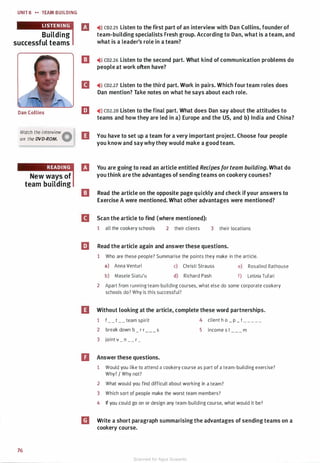
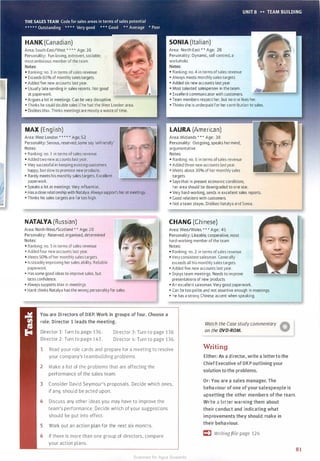
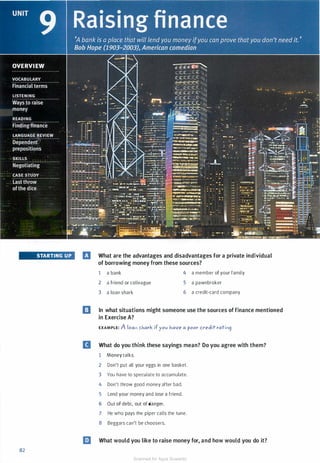
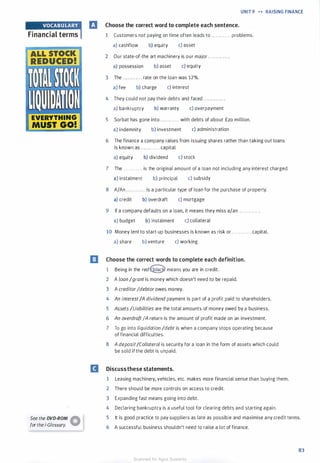
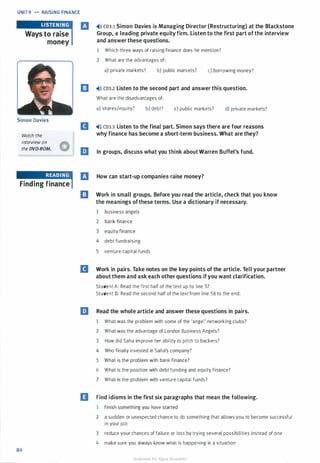
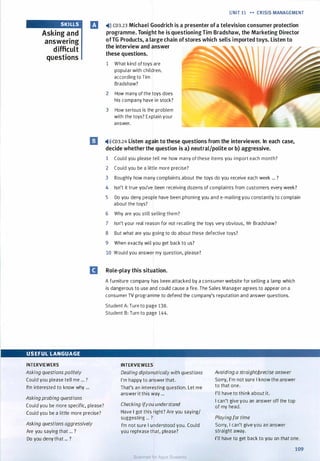
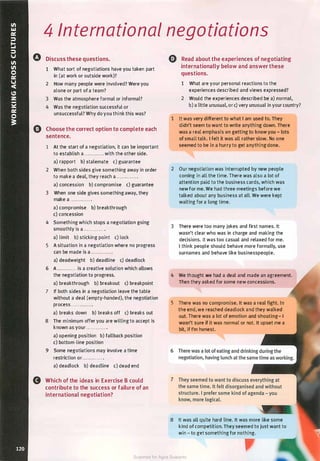
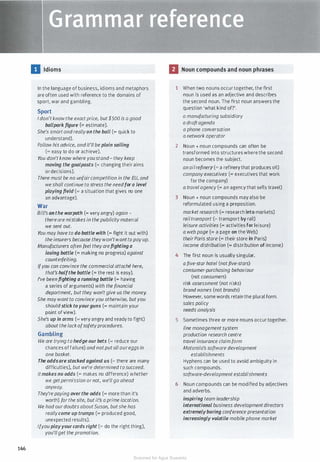
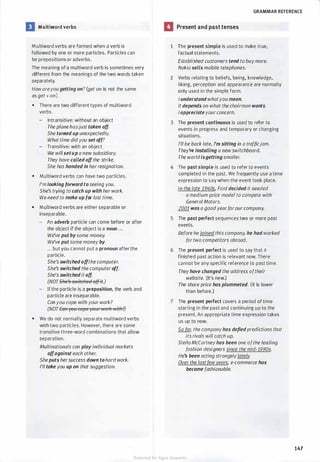
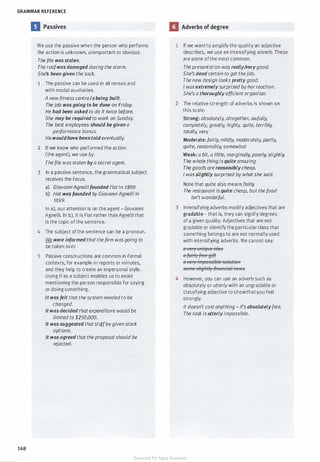
Upper Intermediate
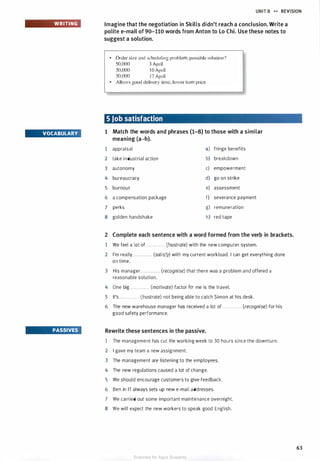
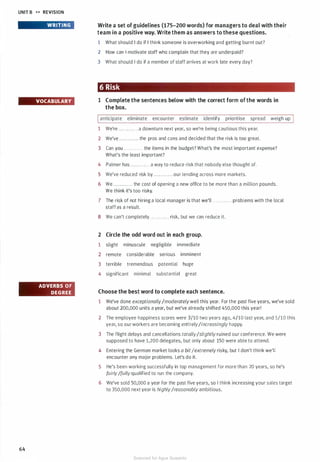
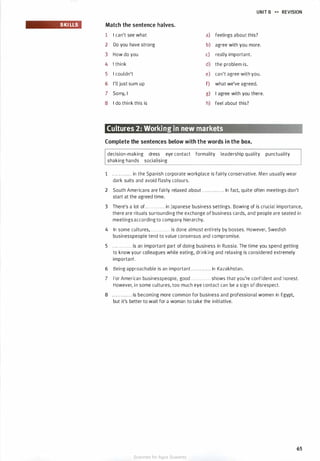
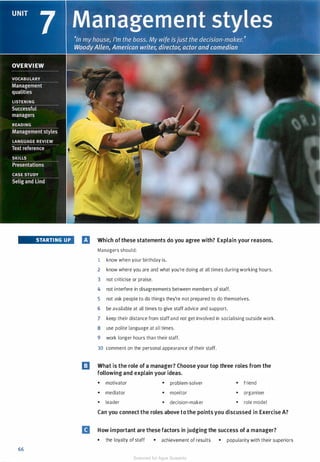
David Cotton David Falvey Simon Kent
Scanned for Agus Suwanto
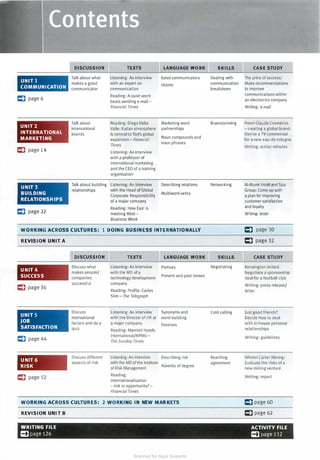
UNIT 1
COMMUNICATION
C) page 6
U N IT2
INTERNATIONAL
MARKETING
C) page 14
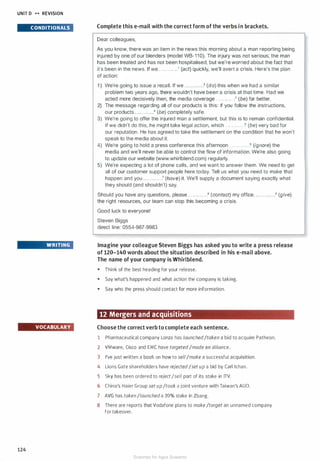
U N IT3
BUILDING
RELATIONSHIPS
C) page 22
DISCUSSION
Talk about what
makes a good
communicator
Talk about
international
brands
TEXTS
Listening: An interview
with an expert on
communication
Reading: A quiet word
beats sending e-mail -
Financial Times
Reading: Diego Della
Valle: Italian atmosphere
is central toTod's global
expansion - Financial
Times
Listening: An interview
with a professor of
international marketing
and the CEO of a training
organisation
Talk about building Listening: An interview
relationships with the Head of Global
Corporate Responsibility
of a major company
Reading: How East is
meeting West -
Business Week
LANGUAGE WORK
Good communicators
Idioms
Marketing word
partnerships
Noun compounds and
noun phrases
Describing relations
Multiword verbs
SKILLS
Dealing with
communication
breakdown
Brainstorming
Networking
WORKING ACROSS CULTURES: 1 DOING BUSINESS INTERNATIO NALLY
REVISION U NIT A
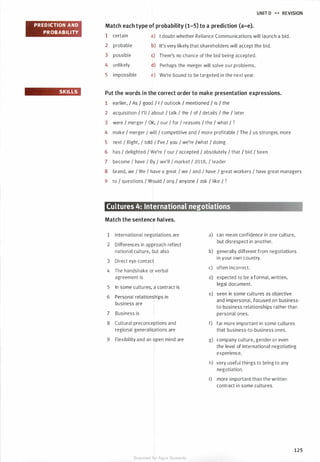
U N IT4
SUCCESS
C) page 36
UNITS
JOB
SATISFACTION
C) page 44
U NIT6
RISK
C) page 52
DISCUSSION
Discuss what
makes people/
companies
successful
Discuss
motivational
factors and do a
quiz
Discuss different
aspects of risk
TEXTS
Listening: An interview
with the MD of a
technology development
company
Reading: Profile: Carlos
Slim - The Telegraph
Listening: An interview
with the Director of HR al
a major company
Reading: Marriott Hotels
lnternational/KPMG -
The Sunday Times
Listening: An interview
with the MD of the Institute
of Risk Management
Reading:
Internationalisation
- risk or opportunity? -
Financial Times
LANGUAGE WORK SKILLS
Prefixes Negotiating
Present and past tenses
Synonyms and Cold-calling
word-building
Passives
Describing risk Reaching
Adverbs of degree
agreement
WORKING ACROSS CULTURES: 2 WORKING IN NEW MAR KETS
REVISION UNIT B
CASE STUDY
The price of success:
Make recommendations
to improve
communications within
an electronics company
Writing: e-mail
Henri-Claude Cosmetics
- creating a global brand:
Devise a TV commercial
for a new eau-de-cologne
Writing: action minutes
Al-Munir Hotel and Spa
Group: Come up with
a plan for improving
customer satisfaction
and loyalty
Writing: letter
C) page 30
C) page 32
CASE STUDY
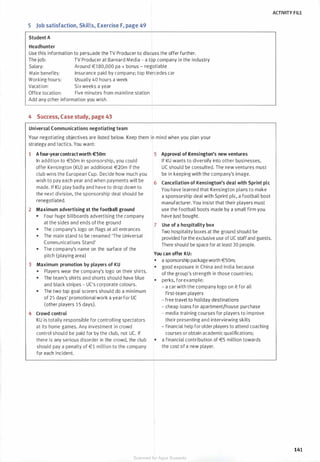
Kensington United:
Negotiate a sponsorship
deal for a football club
Writing: press release/
letter
Just good friends?
Decide how to deal
with in-house personal
relationships
Writing: guidelines
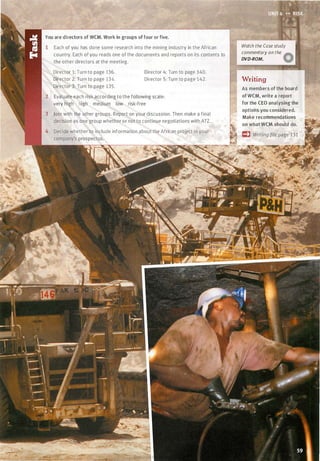
Winton Carter Mining:
Evaluate the risks of a
new mining venture
Writing: report
C)page 60
C)page 62
WRITING FILE ACTIVITY FILE
=page 126 =page 132
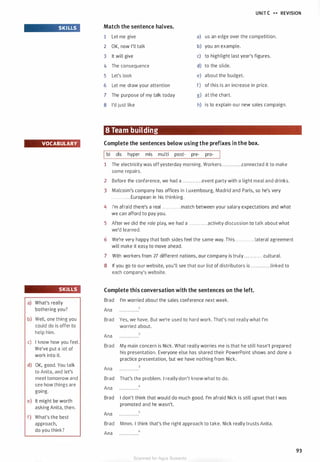
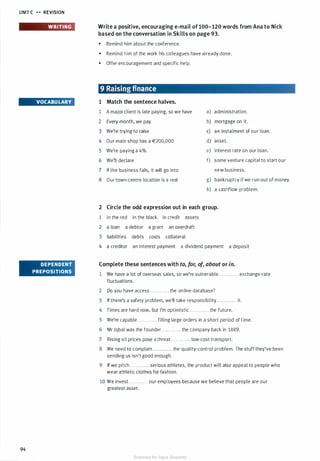
Scanned for Agus Suwanto
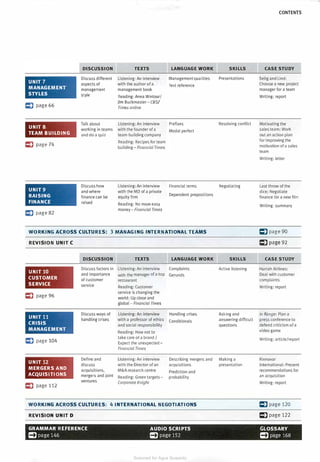
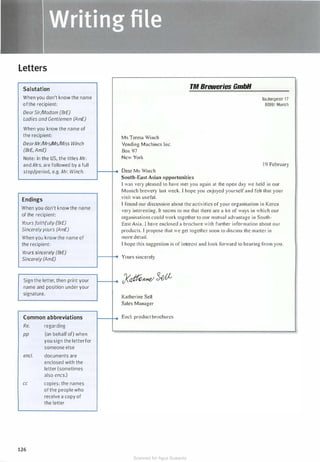
U N IT7
MANAGEMENT
STYLES
c:) page 66
U N ITS
TEAM B U I LDING
c:) page 74
UNIT9
RAISING
FINANCE
c:) page 82
DISCUSSION
Discuss different
aspects of
management
style
Talk about
working in teams
and do a quiz
Discuss how
and where
finance can be
raised
TEXTS
Listening: An interview
with the author of a
management book
Reading: Anna Wintour/
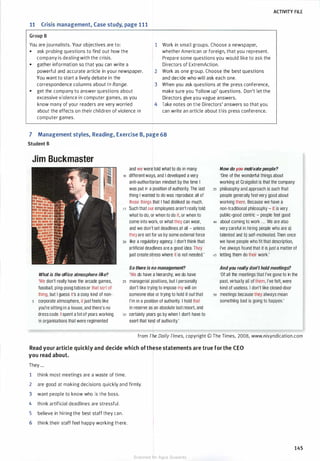
Jim Buckmaster - CBS/
Times on/ine
Listening: An interview
with the founder of a
team-building company
Reading: Recipes for team
building- Financial Times
Listening: An interview
with the MD of a private
equity firm
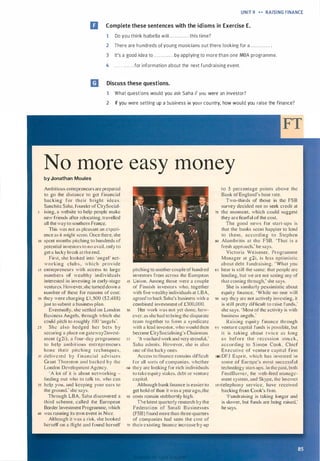
Reading: No more easy
money - Financial Times
LANGUAGE WORK SKILLS
Management qualities Presentations
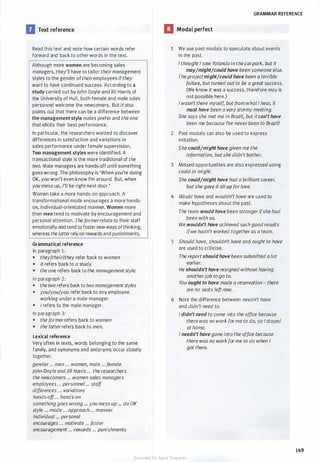
Text reference
Prefixes Resolving conflict
Modal perfect
Financial terms Negotiating
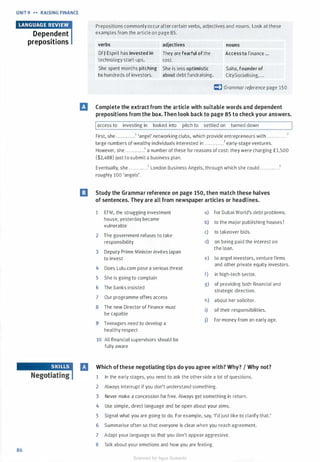
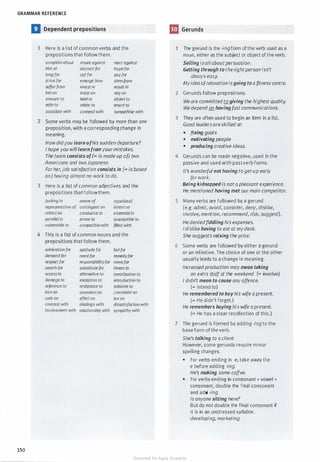
Dependent prepositions
WORKING ACROSS CULTURES: 3 MANAGING INTERNATIONAL TEAMS
REVISION UNIT C
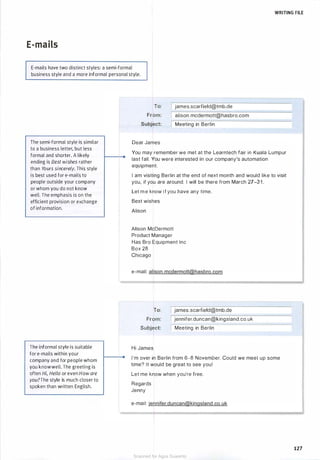
UNIT10
CUSTOMER
SERVICE
c:) page 96
UNIT11
CRISIS
MANAG EMENT
c:) page 104
U N IT12
MERGERS AND
ACQUISITIONS
c:) page 112
DISCUSSION
Discuss factors in
and importance
of customer
service
Discuss ways of
handling crises
Define and
discuss
acquisitions,
mergers and joint
ventures
TEXTS LANGUAGE WORK
Listening: An interview Complaints
with the manager of a top Gerunds
restaurant
Reading: Customer
service is changing the
world: Up close and
global - Financial Times
Listening: An interview Handling crises
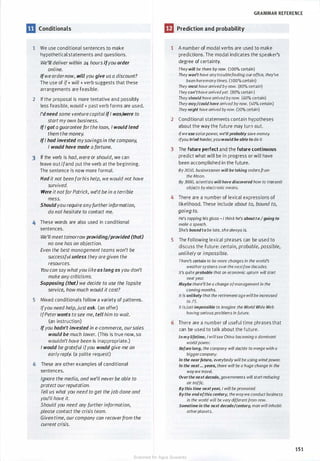
with a professor of ethics Conditionals
and social responsibility
Reading: How not to
take care ofa brand I
Expect the unexpected -
Financial Times
Listening: An interview
with the Director of an
M&A research centre
Reading: Green targets-
Corporate Knight
Describing mergers and
acquisitions
Prediction and
probability
WORKING ACROSS CULTURES: 4 INTERNATIONAL NEGOTIATIONS
REVISION U NIT D
SKILLS
Active listening
Asking and
answering difficult
questions
Making a
presentation
CONTENTS
CASE STUDY
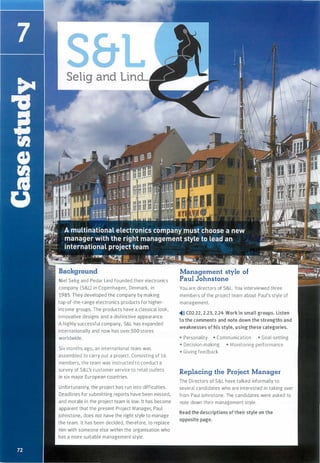
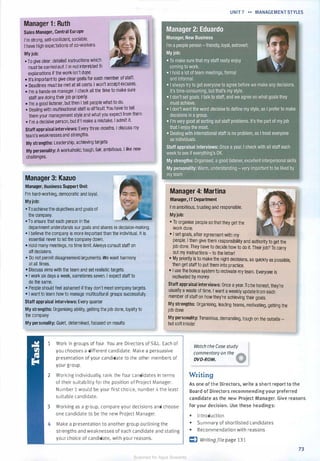
Selig and Lind:
Choose a new project
manager for a team
Writing: report
Motivating the
sales team: Work
out an action plan
for improving the
motivation of a sales
team
Writing: letter
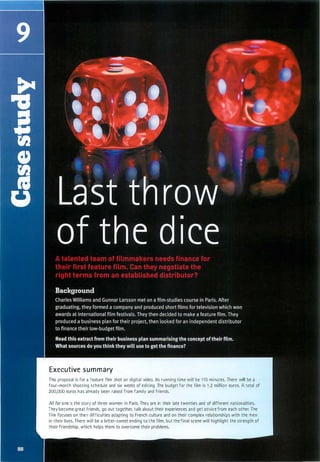
Last throw ofthe
dice: Negotiate
finance for a new film
Writing: summary
c:) page 90
c:) page 92
CASE STUDY
Hurrah Airlines:
Deal with customer
complaints
Writing: report
In Range: Plan a
press conference to
defend criticism of a
video game
Writing: article/report
Rinnovar
International: Present
recommendations for
an acquisition
Writing: report
c:) page 120
c:) page 122
GRAMMAR REFERENCE AUDIO SCRI PTS GLOSSARY
c:) page 146 c:) page 152 c:l page 168
Scanned for Agus Suwanto
4
What is Market Leader, and who is it for?
Market Leader is a multi-level business English course for businesspeople and students of business
English. It has been developed in association with the Financial Times, one of the leading sources of
business information in the world. It consists of12 units based on topics ofgreat interest to everyone
involved in international business.
This third edition ofthe Upper Intermediate level features completely updated content and a
significantly enhanced range of authentic resource material, reflecting the latest trends in the
business world. If you are in business, the course will greatly improve your ability to communicate
in English in a wide range of business situations. If you are a student of business, the course will
develop the communication skills you need to succeed in business and will enlarge your knowledge of
the business world. Everybody studying this course will become more fluent and confident in using
the language of business and should increase their career prospects.
The authors
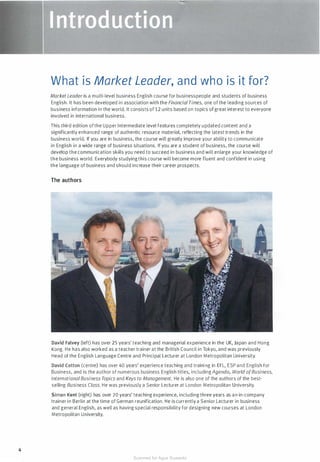
David Falvey (left) has over 25 years' teaching and managerial experience in the UK, Japan and Hong
Kong. He has also worked as a teacher trainer at the British Council in Tokyo, and was previously
Head of the English Language Centre and Principal Lecturer at London Metropolitan University.
David Cotton (centre) has over 40 years' experience teaching and training in EFL, ESP and English for
Business, and is the author of numerous business English titles, including Agenda, World ofBusiness,
InternationalBusiness Topics and Keys to Management. He is also one of the authors of the best­
selling Business Class. He was previously a Senior Lecturer at London Metropolitan University.
Simon Kent (right) has over 20 years' teaching experience, including three years as an in-company
trainer in Berlin at the time of German reunification. He is currently a Senior Lecturer in business
and general English, as well as having special responsibility for designing new courses at London
Metropolitan University.
Scanned for Agus Suwanto
STARTI NG U P
VOCABU LARY
READING
LISTEN I N G
LANGUAGE REVIEW
SKILLS
CASE STUDY
WORKING ACROSS
CULTU RES
REVIS ION U N ITS
INTRODUCTION
What is in the units?
You are offered a variety of interesting activities in which you discuss the topic
of the unit and exchange ideas about it.
You will learn important new words and phrases which you can use when you carry
out the tasks in the unit. You can find definitions and examples, and listen to the
pronunciation of new vocabulary in the i-Glossary feature on the DVD-ROM.
The DVD-ROM also contains further practice exercises. A good business dictionary,
such as the Longman Business English Dictionary, will also help you to increase
your business vocabulary.
You will read authentic articles on a variety of topics from the Financial Times and
other newspapers and books on business. You will develop your reading skills and
learn essential business vocabulary. You will also be able to discuss the ideas and
issues in the articles.
You will hear authentic interviews with businesspeople and a variety of scripted
recordings. You will develop listening skills such as listening for information and
note-taking. You can also watch the interviews and find further practice exercises
on the DVD-ROM.
This section focuses on common problem areas at Upper Intermediate level. You
will become more accurate in your use of language. Each unit contains a Language
review box which provides a review of key grammar items. A Grammar reference
section can be found at the back of the book and on the DVD-ROM. The DVD-ROM
also provides extra grammar practice.
You will develop essential business communication skills, such as making
presentations, networking, negotiating, cold-calling and dealing with communication
breakdown. Each Skills section contains a Useful language box, which provides you
with the language you need to carry out the realistic business tasks in the book.
The DVD-ROM supplements the Course Book with additional activities.
The Case studies are linked to the business topics of each unit. They are based
on realistic business problems or situations and allow you to use the language
and communication skills you have developed while working through the unit.
They give you the opportunity to practise your speaking skills in realistic business
situations. Each Case study ends with a writing task. After you've finished the Case
study, you can watch a consultant discussing the issues it raises on the DVD-ROM.
These four units focus on different aspects of international communication.
They help to raise your awareness of potential problems or misunderstandings that
may arise when doing business with people from different cultures.
Market Leader Upper Intermediate third edition also contains four revision units,
each based on material covered in the preceding three Course Book units.
Each revision unit is designed so that it can be completed in one session
or on a unit-by-unit basis.
5
Scanned for Agus Suwanto
6
STARTING U P
Good
communicators
IJ Think of a good communicator you know. Explain why he/she is good
at communicating.
[] What makes a good communicator? Choose the three most important
factors from this list.
• ftuency in the language
• grammatical accuracy
• an awareness of body
language
• an extensive vocabulary
• being a good listener
• not being afraid of
making mistakes
B What other factors are important for communication?
EJ Discuss these questions.
• a sense of humour
• physical appearance
• no strong accent
1 What forms of written and spoken communication do you like using? Why?
2 What problems can people have with the different forms of communication?
3 How do you think those problems can be solved?
Which of these words apply to good communicators and which apply
to bad communicators? Add two adjectives of your own to the list.
articulate
focused
reserved
coherent
hesitant
responsive
eloquent
inhibited
sensitive
extrovert
persuasive
succinct
fluent
rambling
vague
Scanned for Agus Suwanto
Seethe DVD-ROM �
for the i-Glossary. V
Improving
communications
Alastair Dryburgh
Watch the
interview on
the DVD-ROM.
UNIT 1 •• COMMUNICATION
m Which of the words in Exercise A have these meanings?
1 concise 5 clear and easy to understand
2 reluctant to speak 6 good at influencing people
3 talking in a confused way 7 outgoing
4 able to express ideas well 8 eager to react and communicate
II Complete the extract below from a talk by a communication expert with
the verbs from the box.
Iclarify confuse digress engage explain interrupt tt5teft ramble
'Good communicators really . .
!i.�f.en .. 1 to people and take in what is said. They maintain
eye contact and have a relaxed body language, but they seldom ............7 and stop
people talking. If they don't understand and want to ............3 something, they wait for
a suitable opportunity.
When speaking, effective communicators are good at giving information. They do not
. . . ..... . ...4 their listener. They make their points clearly. They will avoid technical terms,
abbreviations or jargon. If they do need to use unfamiliar terminology, they........ ... . 5 by
giving an easy-to-understand example. Furthermore, although they may . .. . . . . . . . . . 6 in order
to elaborate a point and give additional information and details where appropriate, they
will not ..... ... . ...7and lose sight of their main message. Really effective communicators
who have the ability to............8 with colleagues, employees, customers and suppliers
are a valuable asset for any business.'
E �l» cou Listen to the talk and check your answers.
D Think of a poor or bad communicator you know. How could they improve
their skills? What advice would you give them?
IJ �ll) co1.2 Listen to the first part of an interview with Alastair Dryburgh,
an expert on communication. Does he think technology makes good
communication easier?
E) �ll) CDl.2 Listen again. What four key points does Alastair make about
communication?
II �ll) CD1.3 Listen to the second part of the interview. Alastair gives an example
of a company which has used technology to change the way it communicates
with customers. Give reasons why it communicates well.
E �ll) CD1.4 Listen to the final part, where Alastair is describing a bad customer
experience. What mistakes did the company make, and how could they have
improved the customer experience?
D Discuss an example you know of a company which communicates well with
its customers or a company which communicates badly. What advice would
you give to the bad communicator?
7
Scanned for Agus Suwanto
UNIT 1 ... COMMUNICATION
8
E-mail: for and
against
What irritates you most about these forms of communication?
e-mail
mobile phone
conference calling
voicemail
BlackBerry
web presentation
l!J What are the advantages and disadvantages of using e-mail?
B Read the article on the opposite page quickly and choose the best title.
1 Time to switch your BlackBerry off
2 How to deal with your inbox
3 A quiet word beats sending e-mail
l:J Read the article again and list the advantages and disadvantages of using
e-mail. Does the writer mention any that you listed in Exercise B?
II Find expressions in the article which mean the following.
1 looking at another person (paragraph 2)
2 upsetting or embarrassing someone by being rude or tactless (paragraph 2)
3 not be caught or punished when you have done something wrong (paragraph 4)
4 pretend something is true in order to deceive people (paragraph 4)
5 keeping writing or talking to someone, even though you do not see them often
(paragraph 8)
6 aiming an idea or product at someone (paragraph 8)
D Complete this text with the expressions in Exercise E in the correct form.
I don't have a problem with him ........... .1 his family whilst he's posted overseas and
sending e-mails in office time. That's not the main issue. However, if he thinks he can
....... . . . ..2 sending such abusive e-mails to colleagues, he is sadly mistaken and he'll have
to face the consequences of his actions later. He is clearly ............3 about his colleagues
and spreading nasty rumours. He'd be betteroff speaking to colleagues . . . .. .. .... .11 if he has
problems with them. He's slightly better when speaking with customers, but he needs to
think about who he's speaking to when he's...... . .. . ..5 our products to them. And he just
doesn't know how to say no to people without .... ..... ...6•
m Discuss these questions.
1 'Business is best done face to face.' Do you agree?
2 How could communication be improved in your organisation?
3 How will communication change in the office of the future?
4 What do you do when you receive a nasty e-mail?
5 Is communication better these days with all the new technology?
Scanned for Agus Suwanto
UNIT 1 � � COMMUNICATION
. . . . . . . . . . . . . . . . . . . . . . . . . . . . . . . . . . . . . . . . . . . . . . . . . . . . . . . . . . . . . . . . . . . . . . . . . . . . . .
by Luke Johnson
E-mail might just be responsible for
t h e productivity incrcases that
economists tel l us are the key to
rising prosperity. But it could also
5 be sending us all mad.
The truth is that business is gener­
ally best clone face to face. and if that
is impossible. then speaking via the
phone. But too many of us now hide
10 behind silent, typed communica­
tions.The trouble is that the recipient
of an e-mail does not hear a tone of
voice or sec a facial expression; nor
can the sender modify their message
15 halfway through, sensing that it is
causing offence. When you read an
e-mail, you cannot tell the mood of
the e-mailer.
A permanent written form is
2 0 deadly if you arc reeling impetuous
and emotional. Too often l have
made the mistake of sending an
irritable response. which will have
festered and angered the other encl
2s much more than a difficult telephone
exchange. Spoken words fade, but
e-mail is forever.
lt is so much easier to be tough via
e-mail. or to get away with weak
30 excuses. or to make things up, or
to say no. Almost invariably. it is
more human and serious to have
a real d iscussion rather than a
bizarre online conversation. I know
35 employees who have been fired for
sending abusive e-mails, or who
have faced severe legal conse­
quences for writing something they
should have just said verbally.
40 Everyone in business finds their
inbox is almost swamped every clay
with spam. I notice I spend longer
and longer sorting out the e-mails
that mailer from all the junk. It has
45 become, I'm afraid, a dangerously
corrupted medium. Large companies
suffer chronic overuse of ·reply to all'.
Moreover. e-mail can be a terrible
distraction, especially if you use
so a BlackBerry. l was recently
reprimanded for peeking at mine
during a board meeting - a gross
form of' hypocrisy on my part.
because I once threatened to sling
55 out of the window any PDA-type
devices being used in meetings
I chaired. I have now vowed to
switch off both BlackBerry and
mobile in all meetings - anything
GO less is uncivi l .
Tt must b e admitted that e-mail
is hard to beat as a transmitter of
documents and data. It forces the
sender to carefully think through
65 t h e i r arguments and express
themselves logically. It allows you to
reply swiftly to a host of di fferent
questions when time is short. You
don't have to worry about journey
70 times or travel costs, unreliable post­
age or engaged phones or voicema.il.
E-mail is a marvellously economi­
cal tool for keeping in touch with
far-flung commercial contacts; you
75 can send them a note at your leisure,
24 hours a day. It is also a terrific
method of discreetly and directly
pitching to someone powerful. It
certainly beats trying to get a meet-
so ing or even reach them on the phone.
Like it or not. I could not do my
job without e-ma i l . Meanwhile, I
know a senior financier, an ex-chair
ofa FrSE company, who still has his
RS secretary print out his e-mails for
him to read so he can then dictate
replies for her to e-mail back. Now
that really is mad.
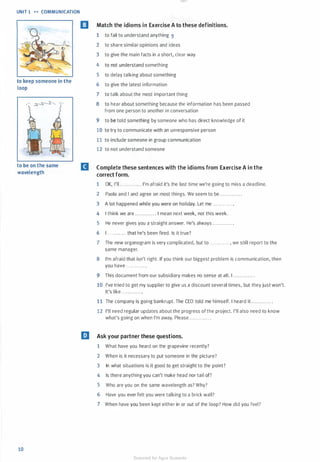
•eaa1ma1rrnwi a Complete the idioms below with the words from the box.
Idioms bush grapevine loop
point purposes stick
mouth nutshell picture
tail wall wavelength
a) to put it in a . . . . . . . . . . . .
b) to get straight to the . .. .... . . . . .
c) to hear it on the . . . . . . . . . . . .
g) can't make head nor . . . . . . . . . . . . of it
h) to talk at cross-. . . . . . . . . . . .
i) to beat about the . . . . . . . . . . . .
d) to put someone in the . . . . . . . . ... . j) to get it straight from the horse's . . . . . . . . . . ..
e) to get the wrong end of the . . . . . . . . . . . .
f) to be on the same . . . . . . . . . . . .
k) to be like talking to a brick . . . . . . . . . . . .
I) to keep someone in the . . . . . . . . . . . .
9
Scanned for Agus Suwanto
UNIT 1 .. COMMUNICATION
to keep someone in the
loop
to be on the same
wavelength
10
EJ Match the idioms in Exercise A to these definitions.
1 to fail to understand anything 9
2 to share similar opinions and ideas
3 to give the main facts in a short, clear way
4 to not understand something
5 to delay talking about something
6 to give the latest information
7 to talk about the most important thing
8 to hear about something because the information has been passed
from one person to another in conversation
9 to be told something by someone who has direct knowledge of it
10 to try to communicate with an unresponsive person
11 to include someone in group communication
12 to not understand someone
B Complete these sentences with the idioms from Exercise A in the
correct form.
1 OK, I'll............ . I'm afraid it's the last time we're going to miss a deadline.
2 Paola and I and agree on most things. We seem to be ............ .
3 A lot happened while you were on holiday. Let me . . . . . . . . . . . . .
4 I think we are ............ . I mean next week, not this week.
5 He never gives you a straight answer. He's always ............ .
6 I . . . . . . . . . . . . that he's been fired. Is it true?
7 The new organogram is very complicated, but to ............ , we still report to the
same manager.
8 I'm afraid that isn't right. If you think our biggest problem is communication, then
you have. . . .. . ...... .
9 This document from our subsidiary makes no sense at all. I ............ .
10 I've tried to get my supplier to give us a discount several times, but they just won't.
It's like ............ .
11 The company is going bankrupt. The CEO told me himself. I heard it . . . . . . . . . . . . .
12 I'll need regular updates about the progress of the project. I'll also need to know
what's going on when I'm away. Please . . .......... .
liJ Ask your partner these questions.
1 What have you heard on the grapevine recently?
2 When is it necessary to put someone in the picture?
3 In what situations is it good to get straight to the point?
4 Is there anything you can't make head nor tail of?
5 Who are you on the same wavelength as? Why?
6 Have you ever felt you were talking to a brick wall?
7 When have you been kept either in or out of the loop? How did you feel?
Scanned for Agus Suwanto
SKILLS
Dealing with
communication
breakdown
USEFUL LANGUAGE
ASKING FOR REPETITION
Sorry, could you repeat that?
I didn't (quite) catch that.
Could you speak up, please?
Could you say that again,
please?
ASKING FOR CLARIFICATION
What do you mean by ...?
What does ... mean?
Could you clarify that?
UNIT 1 H COMMUNICATION
What expressions can you use in these phone situations?
a) the person speaks toofast or too quietly
b) you want someone to stop talking while you do something
c) you don't understand a word/expression the other person uses
d) you want to make sure of the spelling of something
e) you want more information about a subject
f) the connection is not good and you can't continue the conversation
g) you want to confirm some information
El �>)) co1.s Listen to a telephone conversation between Bernard Klebermann
and Koichi Sato. Which ofthe problems mentioned in Exercise A do the
speakers have when communicating?
11 �>» CDl.6 Listen to the same two speakers in a similar conversation. Explain
why the second conversation is better. Give as many reasons as you can.
m �>)) CDl.6 Listen to the conversation again and complete these extracts with
words or expressions from it.
1 That's good. Could you . . . . . . . . . . . . . . . . . . . . . . . . . . . . . . . . . . . . . . . . . . . . . . . . while I get a pen?
2 Sorry, Bernard, I . . . . . . . . . . . . . . . . . . . . . . . . . . . . . . . . . . . . . Could you . . . . . . . . . . . . . . . . . . . . . . . . a little,
please? I need to take some notes.
3 Let me . . . . . . . . . . . . that: 200 posters, pens and pencils and 50 bags. ............ it.
4 Seel- ... sorry, could you ............ ............ . . . . . . . . . . . . me, please, Bernard? I don't
think I know the company.
5 'They've placed an order for 518 of the new lasers ...'
'Sorry, .......... . . ............ ............ 580 lasers?'
6 Sorry, I don't follow you. What ............ 'roll-out' ............ ?
7 But I need details about the company ... Sorry, it's . . . . . . . . . . . . ............ ............ .
Could you . . . .. . . . . ... ............ , please? I can't hear you very well.
8 Sorry, I still can't hear you. I'll . . . . . . . . . . . . . . . . . . . . . . . . . . . . . . . . . . . . , maybe the line will be better.
D Match each extract in Exercise D to the situations you discussed in
Exercise A. Two ofthem correspond to the same situation.
D Work in pairs. Role-play two situations.
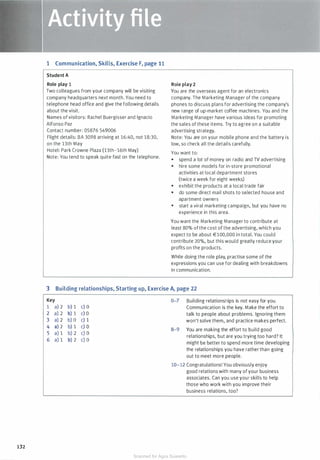
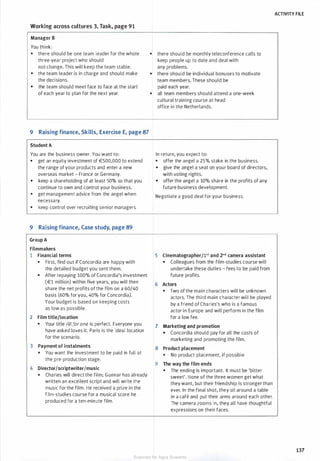
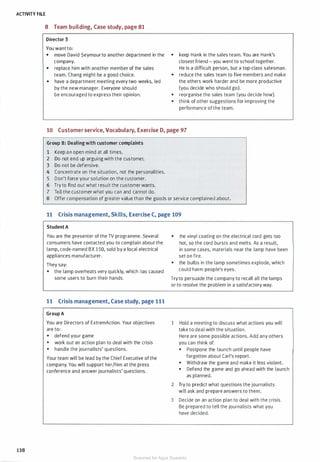
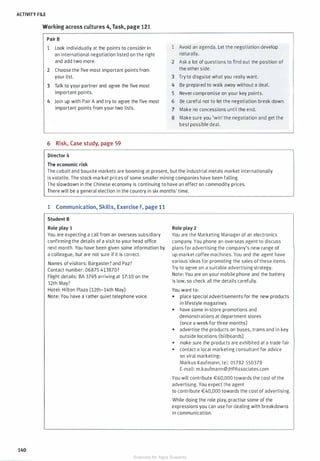
Student A: Turn to page 132. Student B: Turn to page 140.
CHECKING INFORMATION ASKING FOR FURTHER TECHNICAL PROBLEMS
Would/Could you spell that, INFORMATION Sorry, it's a bad line.
please? Could you give me some Can I call you back?
Can I �ad that back to more details, please? It's a terrible connection.
you? Could you be a bit more I'm afraid I'll have to get
specific? back to you later.
PROBLEMS WITH Could you explain that in Sorry, we were cut off.
UNDERSTANDING more detail?
Sorry, I'm not with you. SUMMARISING THE CALL
Sorry, I don't follow you. Let me go over what we've
Sorry, I'm not sure I know agreed.
what you mean. Let me just summarise ...
11
Scanned for Agus Suwanto
A product defect
Aweakness in the company's communications
was highlighted by the following incident. What
mistakes do you thinkwere made in the way
this problem was handled? How could they be
remedied?
About three months ago, a customer found a fault in
WCH's most up-to-date, multi-functional cell phone.
Her phone became very hot after being recharged
and it burned her hand. 'It was so hot, I thought it
would explode,' she said. The customer complained
to the Customer Service Department, who sent her
a replacement phone. The employee dealing with
the complaint did not inform either the Marketing or
R&D Departments about the fault. After this incident,
there were a number of similar complaints. As a
result of bad publicity, the phone was withdrawn
from the market.
Lawrence Discount Stores
Another incident a fewweeks ago showed that
internal communications in the company were not
working well. Read about the problem and discuss
the reason(s) whyWCH lost an important customer.
Richard Lawrence, one of WCH's best and oldest
customers, phoned William Hooper about
the company's new digital camera, the EX-120.
He told Hooper that he'd probably be placing an
order for 5,000 of the products in the next few
weeks. Hooper passed on this information by
phone to the Sales Manager. When Lawrence sent
in the order five weeks later, the Sales Manager
sent him an e-mail saying that unfortunately
the new product was out of stock. Lawrence
complained to Hooper, who asked the Sales
Manager why he hadn't given priority to Lawrence's
order. The manager replied, 'I was waiting for him to
confirm his order. I didn't realise that his order had to
be given priority.'
Scanned for Agus Suwanto
The new Communications Director
Betty Friedman, the new Communications Director, hired a firm
of consultants, Ward Associates, to analyse the communications
problems in the company and to come up with recommendations
for improvement. Read this extract from the report.
1 Internal communications
Problem:
Communications between Directors and Heads of
Department need to be improved.
Recommendations:
• Heads of Department should send weekly reports to
the Board of Directors. This would enable Directors to
keep in touch with key developments in the company.
• A new manager should be appointed to be in charge
of key accounts, such as the Lawrence Discount
Stores account. He/She would ensure that key
customers were given personal attention.
2 Sales reps/Head Office
Problem:
Head Office is not receiving information quickly from sales
representatives. This has resulted in delays in processing
orders and insufficient information about customers.
Recommendation:
Issue all sales reps with BlackBerry devices and instruct
reps to send daily reports to the Sales Department.
3 Customer Services Department
Problem:
The department needs a new procedure for dealing with
product complaints.
Recommendation:
Any complaint about a product which has health and
safety implications should be forwarded immediately to
the following departments: Marketing, Research and
Development, Public Relations.
"4>»CDl.7 William Hooper is talking to Betty
Friedman. Listen to his reaction to the consultants'
recommendations and summarise his attitude
to weekly reports, appointing a new account
manager, and defective products.
"4>l) CDl.8 Listen to Joanna Merkowitz, a sales
representative, talking to Betty Friedman about
the consultants' recommendations. Why is she
against giving daily reports? Why does she enjoy
her job so much?
1 Work in small groups. You are members of the Board of Directors.
Discuss each of the consultants' recommendations. Decide
whether you agree or disagree with each recommendation, noting
down your reasons.
2 Consider any other ideas that your group has to improve
communications in WCH.
Watch the Case study commentary on the DVD-ROM.
Writing
As Communications Director at WCH, write a follow-up e-mail to the Head of
Ward Associates, summarising the decisions you have taken, with your reasons.
c:) Writing file page 127
13
Scanned for Agus Suwanto
STARTING UP
14
fJ What brands do you know that are marketed internationally? Think of one
brand in each ofthese categories which is marketed internationally.
Icars clothing cosmetics electrical equipment soft drinks I
[I Answer these questions for each brand you listed in Exercise A.
1 What is its country of origin?
2 What is its brand image?
3 What is the target market/segment?
4 What sort of advertising campaigns does the brand use? (Are they standardised or
adapted to local markets?)
5 What is the current slogan?
II What are the most famous international brands in your country? What sort
of image do they have a) at home, and b) abroad?
Scanned for Agus Suwanto
Marketing word
partnerships
1
2
3
4
5
6
7
a) growing market
a) questionnaire
a) market sector
a) international market
a) launch a product
a) special offer
a) retailer
Seethe DVD-ROM �
for the i-Glossory. W
UNIT 2 H INTERNATIONALMARKETING
IJ Complete each group of word partnerships (1-5) with the correct word from
the box.
Ibrand customer market marketing product
1 . . . . . . . . . . . . mix
strategy
plan
2 . . . . . . . . . . . . adaptation
penetration
segmentation
3 . . . .. . . . . . . . placement
portfolio
feature
4 . . . .. .. . . . . . profile
retention
base
5 . . . . . . . . . . . . positioning
identity
extension
l!I Choose the correct word partnership from each group in Exercise A to
complete these definitions.
1 When entering a new market, a SWOT analysis (strengths/weaknesses/opportunities/
threats) is conducted on a product, service or company before deciding on a . . . . . . . . . . . . .
2 It may also be necessary to carry out a STEP analysis (sociological/technological/
economic/political) of a new geographical market in order to decide if changes are to
be made for ............ .
3 The USP (unique selling point) is the . . . . . . . . . . . . which makes it different from its
competitors.
4 Part of building up a . . . . . . . . . . . . is analysing the buying habits of consumers.
5 . . . . . . . . . . . . is how a product is placed (up-market, mid-market, budget) in relation to
rival products.
D Look at these groups of words and phrases. Find the odd one out in
each group.
m
b) developing market c) expanding market d) declining market
b) focus group c) promotion d) survey
b) market research c) market segment d) market niche
b) overseas market c) domestic market d) worldwide market
b) introduce a product c) bring out a product d) withdraw a product
b) free sample c) discount d) slogan
b) distributor c) wholesaler d) exporter
Discuss these questions.
1 What are some of the problems companies may face when they try to internationalise
a brand? (For example, brand names)
2 What are some of the advantages/drawbacks of standardised global advertising?
3 Why do some brands/products fail in other countries? Can you give any examples?
4 Give an example of an expanding market in your country.
5 Give some examples of products or services which are targeted at niche markets.
6 What's the difference between a retailer and a wholesaler?
15
Scanned for Agus Suwanto
UNIT 2 .... INTERNATIONALMARKETING
fl Answer these questions.
Italian luxury 1 What do the following have in common: Gucci, Chanel, Calvin Klein, Louis Vuitton,
Christian Dior, Versace, Giorgio Armani, Ralph Lauren, Prada, Yves Saint Laurent?
2 Which countries tend to make the world's most desirable luxury brands?
3 What would you buy if money was no object?
EJ Read the article below quickly and complete this information.
Tod's group HQ - where?
Key products
Chairman
Competitors that Chairman admires
New markets
Objective in next five years
6
Diego Della Valle: Italian atmosphere
is central to Tod's global expansion
by Vincent Boland
It is not too difficult, in the high­
ceilinged elegance of Palazzo Della
Valle on the Cor o Venezia in Milan.
to be seduced by the charms of a
5 certain kind of Italian life tyle. Here
is the headquarters ofTod"s Group.
which has become a powerhouse in
the marketing of that vision to the
world's wealthy and discerning.
10 The atmosphere is delibcra1c: where
some Italian fashion houses have
expanded ever further into the realms
of celebrity and glamour. Tod's is
anchored as firmly as it can be to
15 its family roots and its traditional.
hand-made, century-old heritage.
Its signature products - hoes and
bags - are made of leather. a raw
material that has remained almost
20 unchanged since it was first discov­
ered.A new advertising campaign
will take the company back to basics.
with a focus on Italian families and
their lifestyles - actual Italian fami-
25 lies. however rich and privileged
- rather than on celebrities.
"The Italian lifestyle is in our
DNA, and in our group, we believe
in our DNA,' says Diego Della Valle.
30 the Chairman and Chief Executive
ofTod's Group.
This image is especially important
in new markets, such as China and
India. he says. In common with other
JS luxury-goods makers, he i intent on
capturing consumers in tho e markets
16
who aspire to the same sense of the
Ltalian lifestyle as do customers in
more mature market . 'A luxury-
40 goods company has tohavecontrol of
its image." he say . ·For Tod·s. the
thing istocommunicate thi tradition,
the generations of work that have
gone intoour products. For us, it"s an
45 absolute priority.'
To achieve it, one must put qualily
before quantity. and one must main­
tain the group's traditions even as it
globalises. which it has been doing
so fairly relentlessly in 1he past decade.
The challenge is to marry 1radi1ion
with modernity in a way that not all
Italian luxury-goods and fa hion
producers have managed. Tocl"s has
55 done it. Mr Della Valle says. by
maimaining one key vision: 'We're a
luxury-good company. not a fashion
company.·
This distinction between fashion
60 and luxury is central to Mr Della
Valle's global ambitions. The two
have different product and ought to
have different stra1egies, he says.
The compe1itors he admires most,
65 he says, are Louis Vuillon, Hermes
and Chanel.
Mr Della Valle says that the goal in
the nexl live years is 'to comple1e the
globalisation·ofTod's, forwhichhehas
70 been laying the groundwork. Td like
Tod"sto be much bigger than it is now.
without diluting the brand.' he says.
He expects China and India to
account for as much as 25 per cent of
75 revenues by then. because the growth
potential is much higher than in more
traditional markets. 'There is a much
bigger appetite for luxury goods
in those markets than in mature
so markets.andclay byclaymore people
are coming into this market.·
Bur as for China as a competing
producer. Mr Della Valle is sceptical
about its ability to produce luxury
ss goods.·Jt lacks the structure of small
companies. rhe tradition. the concept
of excellence· that Italian luxury­
goods producers have inherited and
which they must maintain as a com-
90 petitive advantage. he say�. ···Made
in Italy"
.
doesn"t necessarily mean
expen ive goods." he says. ·1t means
excellent goods."
Scanned for Agus Suwanto
How to market
internationally
Svend Hollensen
Darrell Kofkin
UNIT 2 .... INTERNATIONALMARKETING
II Read the article again and correct this summary.
Tod's Group wishes to convey the charms of the Italian lifestyle to the world's rich. To do
this, it focuses on celebrity and glamour, and its new advertising campaign will feature
Italian celebrities. The Chairman says he wants to expand into India and China to capture
consumers there who appreciate the Italian lifestyle. To enter such big markets, Tod's will
need to think about quantity as well as quality.
Tod's is primarily a fashion company and needs to be much bigger. China and India have
more possibility for growth than Tod's traditional markets. The Chairman is worried
because China will be able to produce luxury goods more cheaply. In future, Tod's will
look to lower production costs by manufacturing in low-cost countries.
l:J Match words from each column to make word partnerships. Then check your
answers in the article.
II
1 competitive a) markets
2 traditional b) markets
3 raw c) advantage
4 mature d) materials
5 global e) ambition
Discuss these questions.
1 What products do you know that rely on their heritage and cultural background?
2 In a recession, do you think companies such as Tod's should manufacture in low-cost
countries rather than at home? What are the advantages and disadvantages of this?
3 Would you ever buy a fake luxury product?
4 Do you agree that designer luxury goods are always higher quality than non-designer
goods?
IJ �>l) co1_9 Listen to Svend Hollensen, Professor of International Marketing at
the University of South Denmark, and answer these questions.
1 Which two marketing strategies does he mention?
2 What does he say about a) the OneCafe company, and b) Lux?
I] �>» couo Darrell Kofkin is Chief Executive ofthe Global Marketing Network,
a training organisation which offers qualifications in international marketing.
Listen to the interview and complete the gaps in these two extracts.
... a new curriculum that enables . . . . . . . . . . . .1 worldwide to have the latest . . . . . . . . . . . .2, the
latest . . . . . . . . . . . .3 and . . . . . . . . . . . .4, to enable them to become . . . . . . . . . . . .5 marketers.
So our students are asked to write a . . . . . . . . . . . .6, develop a . . . . . . . . . . . . . . . . . . . . . . . .7, develop a
. • . . . . . . . . • •8, write a . . . . . . . . . . . .9, present an . . . . . . . . . . . . . . . . . . . . . . . . . . . . . . . . . . . .10 - just as they would
do in the workplace. Because we know in talking to employers . . . . . . . . . . . . 11 that they want
marketing professionals that have the . . . . . . . . . . . .12 and skills required of today's demanding
. . . . . . . . . . . . . . • . . . . . . . . .13 environment.
Watch the
interviews on
the DVD-ROM.
17
Scanned for Agus Suwanto
UNIT 2 .... INTERNATIONALMARKETING
LANGUAGE REVIEW
Noun
compounds and
noun phrases
18
• A compound noun is two nouns together. Noun compounds are common in
business because they are shorter and more convenient than noun phrases.
For example:
a marketsurveyrather than asurveyinto the market
aproductdesign briefrather than a briefforthe design ofa product
• Longer noun phrases are also common. They may consist of adverbs, adjectives
and compound noun. This pattern is typical:
adverb adjective/-ing participle noun head noun
highly confidential sales report
excellent sponsorship deal
expanding customer base
Cl Grammarreference page 146
IJ Find noun phrases in the article on page 16 which have similar meanings
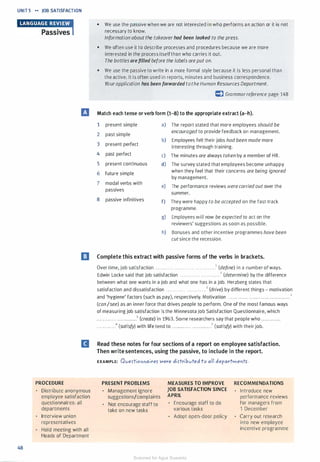
to these phrases.
1 a programme of activities over a period of time with the aim of persuading the public
to buy a product (paragraph 3)
2 the person who has the highest position in a company (paragraph 4)
3 the makers of clothes, shoes, etc. in new and changing styles (paragraph 7)
4 an organisation that makes expensive things bought for comfort and pleasure,
not for basic needs (paragraph 7)
5 possibility for future development and expansion (paragraph 10)
l!I Cross out the word in each group which does not make a compound noun
with the word in bold.
1 marketing campaign I budget I leader I strategy
2 market leader I survey I check I sector
3 product market I range I features I launch
4 advertising campaign I exchange I agency I slogan
5 brand awareness I loyalty I image I contract
6 sales figures I conditions I forecast I targets
7 price promotion I rise I product I range
II Write the words in each ofthese noun phrases in the correct order.
1 advertising impressive campaign really
2 customer department new relations
3 competitive mobile highly market phone
4 successful product incredibly launch
5 customer base loyal
6 thorough extremely report sales
7 brilliant absolutely campaign global
8 competitive increasingly marketing environment
m �i» CD1.11 Listen and check your answers.
Scanned for Agus Suwanto
Brainstorming
USEFUL LANGUAGE
STATING OBJECTIVES
The purpose of the meeting
this morning is to ...
What we need to achieve
today is ...
Our objective here is to ...
UNIT 2 �� INTERNATIONAL MARKETING
IJ Brainstorming is a useful way of generating creative ideas in meetings.
Decide which ofthese tips are good advice and which ones you disagree
with. Then compare your answers with a partner.
1 Explain the purpose of the meeting clearly.
2 Ask each person to speak in turn, starting with the most senior.
3 Announce the time limit for the meeting.
4 Avoid criticising or judging ideas during the session.
5 Encourage ideas, however unusual they may be.
6 Don't interrupt when people are offering suggestions.
7 Make sure everyone keeps to the point.
8 Don't spend time on details.
a �ll) CDl.12 Listen to the first part of a brainstorming meeting between Martin
Thomas, the Marketing Director, who chairs the meeting, and three other
members of the Marketing Department at Business Solutions Limited:
Carol Rueckert, Caroline Holloway and Guillem Rojas. Then answer these
questions.
1 What do they want to achieve at the meeting?
2 What three locations are suggested?
II �'» co1.n Now listen to the rest of the meeting and answer these questions.
1 What types of accommodation does Carol suggest?
2 What suggestions are made concerning the free time of delegates?
m Match the comments made by the participants to the headings in the Useful
language box below. Some comments can be put under more than one heading.
1 ... so the purpose of the meeting this 6 I think it's a great city ...
morning is to ...
7 Good idea, yeah.
2 Yeah, it sounds great.
8 That's an excellent suggestion, yeah,
3 ... have you got any ideas for where we that's great.
can have this?
9 Yeah, any other ideas about what
4 OK, anyone else? we ... what we can do?
5 That's great. Any other ideas, any options? 10 That's true.
II Choose one ofthese situations and hold a brainstorming meeting.
1 Your company has developed a new sports or music magazine. Brainstorm ideas
for an advertising campaign.
2 Your company will shortly be receiving a visit from some important Chinese
businesspeople who wish to set up a joint venture with your firm. Brainstorm
ideas for a suitable programme for the three Chinese visitors.
EXPRESSING ENTHUSIASM
That's great!
That's the best idea I've heard
for a long time.
That's an excellent
suggestion.
ENCOURAGING CONTRIBUTIONS
Don't hold back.
Say whatever comes to mind.
Any other ideas?
At this stage, we want all your
ideas, however crazy you
think they are.
AGREEING
Yes, that's a good idea
because ...
Absolutely, because ...
Exactly, because ...
You're (absolutely )
right because ...
19
Scanned for Agus Suwanto
Creating a
global brand
A successful French cosmetics company plans to go global
Background Key features of Physique
Henri-Claude Cosmetics (HCC), a French cosmetics
and personal-care company, has created a highly
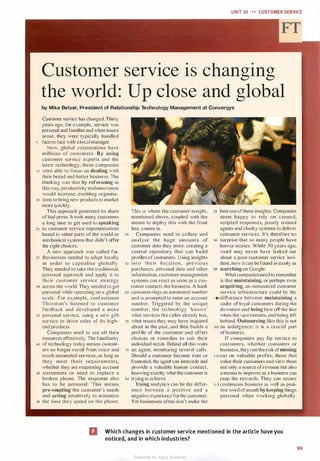
successful eau-de-cologne for men under the brand
name Physique. This is the company's best-selling
men's fragrance and the best-known brand in
Based on redwood and cedar, with citrus and spices,
Physique has a fresh, woody, long-lasting aroma.
• IL has five other secret ingredients, known to
only a small number of senior managers.
their product portfolio. HCC is now planning an
international campaign for Physique early next year.
It intends a high-profile launch in 10 countries,
which will enable the brand to achieve international
recognition. The theme of the campaign will be
'Physique for the Urban Man'.
• The scent is very appealing to women. Men who
use Physique say they feel confident, attractive
and sophisticated.
• Its target audience in France is ambitious, career­
minded men in the 30--40 age range.
A global ambassador - a celebrity in the arts world -
will be chosen to lead the campaign.
The eau-de-cologne is positioned as a premium
fragrance. lt is priced at the top end of the market.
,.>» CDl.14 Listen to a conversation
between Carla Fernandez, Global
Marketing Manager, and Pierre
Martin, Chief Executive of HCC.
They are talking about the results
of research carried out in overseas
markets concerning the international
launch of Physique. Make notes on
the following aspects of the product:
• target audience
• brand image
• name
• positioning
• packaging
• slogan
PRODUCT DETAILS
PHYSIQUE
Product shape: Tall, rounded
bottle, solid appearance. Black,
with the brand name in the
centre. Silver top. Screw top
or spray.
Average retail prices:
40ml $60
75ml $75
1 00ml $95
125ml $1 1 0
The price places Physique in
the top ten most expensive male
fragrances.
Distribution in France: sold
exclusively in parfumeries
(specialised stores for cosmetics
and toiletries) and in shops in top
hotels.
Promotion: Commercials on
French television; radio spots;
full-page advertisements in
prestigious magazines, e.g.
Paris Match, Marie Claire, etc.
Special promotions at high-class
events such as Longchamp
racing stadium, and in embassies
and duty-free shops at the
airports.
Words associated with
Physique by consumers
(in order of frequency): masculine,
sensual, sophisticated, elegant,
energetic, alluring, spicy,
glamorous, individualistic.
Quotation from sales literature:
'Physique man is confident,
ambitious and resilient. He is at
home in any city and enjoys the
challenge of urban life. He has
a lot of creative energy, travels
widely and is optimistic about
the future.'
Scanned for Agus Suwanto
Preparation for the international marketing launch
Having received the results of research in a number of potential overseas markets,
the Marketing Department of HCC has organised a meeting to brainstorm ideas for
the global marketing strategy of Physique.
You are members ofthe Marketing Department of HCC.
UNIT 2 •• INTERNATIONAL MARl<ETING
1 Work in groups and brainstorm the points listed in the rough notes. One person in
each group should take notes. Then meet as one group and select some of the best
ideas for further study.
2 In your groups, devise a one-minute television commercial for the international
launch. Using a storyboard*, present the ideas of your group to your colleagues.
Then as one group, choose the best commercial. If necessary, take a vote.
* A series of pictures showing the sequence of scenes (setting, action, dialogue) of
a TV commercial. A storyboard helps marketing staff to visualise the concept for the
commercial.
BRAINSTORMING SESSION
1 Which 1 0 countries should be chosen for the launch?
2 Does Physique need a new name? If so, what?
3 Should Physique continue be targeted at the 30-40
age group? If not, what age group should it target?
4 Should Physique continue to be positioned as
a premium fragrance, or should HCC market it
as a mass fragrance, with a different pricing
structure?
5 The container of Physique must be changed.
How should the new container look? Plan the
new packaging (shape, design, materials).
6 Price: Are the present pricing levels
appropriate? Should HCC offer a cheaper
version of Physique for emerging markets?
7 Distribution: Should HCC continue to sell the fragrance
in exclusive outlets in overseas markets, or should it
use a wider variety of outlets? If so, what sort of outlets
should it choose?
8 Promotion: Who should be the international
ambassador(s) for the brand? What special promotions
could HCC organise in the overseas markets?
9 Physique needs a new slogan. Ideas?
1 0 Manufacture: Is it now time to manufacture the
fragrance in low-cost countries? If so, which countries
would be suitable?
Watch the Casestudy commentary on the DVD-ROM.
C)
Writing
As a member of the Marketing Department of HCC, write the
action minutes for the brainstorming session you attended.
Cl Writing file page 130
Scanned for Agus Suwanto
1
2
22
STARTING UP IJ Work in pairs. Ask each other the questions in the quiz. Then turn to
page 132 to find out how good you are at building relationships.
YOU ARE IN A ROOM WITH A 3 ON FESTIVE OCCASIONS, 5 DO YOU PREFER:
GROUP OF PEOPLE WHO DON'T E.G. NEW YEAR, DO YOU: a) to socialise with colleagues only
KNOW EACH OTHER. DO YOU: a) send greeting cards to everyone if you have to?
a) introduce yourself? you know? b) to socialise often with
b) introduce a topic of b) reply only to cards received? colleagues?
conversation? c) send e-mails? c) not to socialise with colleagues?
c) wait for someone to say
4 DO YOU THINK 6 DO YOU LIKE TO HAVE
something?
SMALL TALK IS: CONVERSATIONS WITH:
WHEN YOU ARE INTRODUCED a) enjoyable? a) people who share your
TO PEOPLE, DO YOU
REMEMBER THEIR:
a) name?
b) face?
c) clothes?
b) a waste of time? interests?
c) difficult to do well? b) almost anyone?
c) people who are your social
equals?
I] You are going to listen to Gillian Baker, Business Relations Manager with an
international training organisation, talking about how companies can build
strong business relationships. What factors do you think she will mention?
D �l)} cous Listen to the interview and check the predictions you made in
Exercise B.
liJ What are the most important relationships for you a) at your place of work/
study, b) outside your place ofwork/study? Why?
Scanned for Agus Suwanto
Describing
relations
See the DVD-ROM �
forthe i-Glossary. V
UNIT 3 H BUILDING RELATIONSHIPS
IJ Complete the table below with these verbs, which are often used with the
word relations.
breakeff buildup cement cultivate cut off damage develop disrupt
encourage establish foster improve jeopardise maintain promote
restore resume sever sour strengthen undermine
Positive meaning
build up relation�
Negative meaning
break off relation�
[I Choose the correct verb in each sentence.
1 Sales staff who are impolite to customers disruptIdamage the reputation of a
company.
2 We are planning to promote /establish branch offices in Spain next year.
3 By merging with a US company, we greatly strengthened /maintained our sales force.
4 Relations with customers have been fosteredIundermined recently by poor a�er-sales
service.
5 Thanks to a new communications system, we are souring /improving relations
with suppliers.
6 A strike at our factory last year resumedIdisrupted production for several weeks.
7 We could not agree on several points, so we broke off/cut offtalks regarding a
joint venture.
8 The success of our new product launch was cemented/jeopardised by an
unimaginative advertising campaign.
9 In order to gain market share in China, we are building up Icutting offrelationships
with local agents.
10 Business relations between the two countries have been severed/fostered by official
visits and trade delegations.
II Match these sentence halves. Then make five more sentences with the verbs
in Exercises A and B.
1 Widespread rumours of a hostile
takeover bid are certain
2 The Accounts Department's very
slow payment of invoices
3 The long-term contracts, which will
run for the next five years,
4 The excellent relations the company
enjoys with the local community
5 As a result of the government's
imposition of currency controls,
a) are a credit to its highly effective
PR Department.
b) have cemented relations between
the two companies.
c) its close relations with several
major foreign investors have been
jeopardised.
d) is causing stormy relations with
some of the company's suppliers.
e) to strain relations between the
two leading French software
companies.
liJ Give an example of a company you know which is good at building
relationships with its customers. How do they do this?
23
Scanned for Agus Suwanto
UNIT 3 ... BUILDING RELATIONSHIPS
Business
partnerships
Alison Ward
Watch the
interview on
the DVD-ROM.
24
READING
Business
networks in
China
El �l» co1.16 Alison Ward is Head of Global Corporate Responsibility at Cadbury,
the chocolate maker. Listen to the first part ofthe interview and complete
this information about Cadbury's Cocoa Partnership.
Launched
% Cadbury cocoa beans from Ghana
% yield from the land
Average age of farmers
Cadbury partners in Ghana
�l» CD1.17 Listen to the second part and complete these extracts with up to
three words in each gap.
1 Well, we're really proud that we've achieved . . . . . . . . . . . . for our Cadbury Dairy Milk
brand ...
2 So it means that people around the world can now make an . . . . . . . . . . . . and ...
3 Fairtrade's an interesting marque in that it's not only ............ in consumer markets -
it's very well . ...........- but it also has great power back in ............ .
II �l» co1.1s Listen to the final part and answer these questions.
1 What other partnership does Cadbury have?
2 What does Alison say about the changes in the supply chain with that partnership?
EJ Think of any other partnerships similar to that of Cadbury and the farmers
from Ghana. Tell your colleague about it.
El Where can you meet people to build good business relations?
ll Read the article on the opposite page quickly and say who these people are.
1 Li l<a-shing 2 Gary Wang 3 Helen Wong
II Read the article again. Which paragraph:
1 begins by talking about the origins of guanxi?
4 Zhou Junjun
2 gives examples of what can be achieved if you have connections?
3 talks about howguanxiis changing?
4 talks about top connections made at M BA programmes within China?
5 Andrew Grant
5 talks about how a business started through connections made at a European
business school?
6 talks about networking through multinational companies?
7 talks about Chinese businesspeople wanting something in return for connections?
8 suggests that making connections might take time and effort?
EJ Answer these questions.
1 What is guanxi?
2 What examples are given of things you can achieve if you have good guanxi?
3 What can Western companies do if they are involved in informal groups?
4 How is guanxi changing?
5 Why does Ogilvy Public Relations Worldwide hold annual parties for previous employees?
Scanned for Agus Suwanto
UNIT 3 ... BUILDING RELATIONSHIPS
IJ Find words or phrases in the article which mean the following.
1 using or taking what you need from a supply of something (paragraph 2)
2 when someone always supports someone or something (paragraph 3)
3 being responsible for what you do and willing to explain it or accept criticism
(paragraph 3)
4 a moral or legal duty to do something (paragraph 3)
5 people you know who can help you, especially because they are in positions of
power (paragraph 4)
6 talking to other people who do similar work in order to help each other (paragraph 6)
7 determination to keep trying to do something difficult (paragraph 7)
D Discuss these questions.
1 What advice would you give to someone trying to develop business relationships
in China?
2 A foreign company is opening a branch in your country. What factors should it consider?
3 In your experience, are certain nationalities better at building relationships than
others? If so, which ones?
How East is meeting West by Frederik Balfour
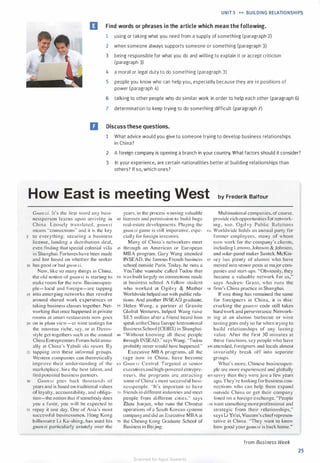
G11a11.ri. It's the first word any busi­
nessperson learns upon arriving in
China. Loosely translated. g1w11.ri
means "connections" and it is the key
5 to everything: securing a business
license. landing a distribution deal.
even finding that special colonial villa
in Shanghai. Fortunes have been made
and lost based on whether the seeker
10 has good or bad g11r111.ri.
Now, like so many things in China,
the old notion of g11a11.ri is starting to
make room for the new. Businesspeo­
ple- local and foreign-are tapping
years. in the process winning valuable
•o licenses and permission to build huge
real-estate developmems. Playing the
g11c111.ri game is still imperative. espe­
cially for foreign investors.
Many of China's networkers meet
45 through an American or European
MBA program. Gary Wang attended
INSEAD, the famous French business
school outside Paris. Today, he runs a
YouTubc wannabe called Tudou that
50 was built largely on connections made
at business school. A fellow student
15 into emerging networks that revolve
around shared work experiences or
taking business classes together. Net- 55
working that once happened in private
who worked at Ogilvy & Mather
Worldwide helped out with public rela­
tions. And another JNSEAD graduate,
Helen Wong, a partner at Granite
Global Ventures, helped Wang raise
rooms at smart restaurants now goes
20 on in plain view-at wine tastings for
the nouveau riche. say. or at Davos­
style get-togethers such as the annual
China Entrepreneurs Forum held annu­
ally at China's Yabuli ski resort. B y
15 tapping into these informal groups.
Western companies can theoretically
improve their understanding of the
marketplace. hire the best talent. and
find potential business partners.
JO G11a11.ri goes back thousands of
years and is based on traditional values
of loyalty. accountability. and obliga­
tion-the notion that if somebody does
you a favor, you will be expected to
$8.5 million after a friend heard him
speak at theChina Europe International
Business School (CEIBS) in Shanghai.
m "Without knowing all these people
through INSEAD.
..
says Wang. "Tudou
probably never would have happened."
Executive M B A programs. all the
rage now in China. have become
<>5 G11a11xi Central. Targeted at senior
executives and high-powered entrepre­
neurs. the programs arc al!racting
some of China·s most successful busi­
nesspeople. " I t 's important to have
10 friends in different industries and meet
35 repay it one day. One of Asia's most
successful businessmen, Hong Kong
bill ionaire Li Ka-shing, has used his 15
g11a11xi particularly astutely over the
people from di fferent cities." says
Zhou Junjun, who runs the Chinese
operations of a South Korean systems
company and did an Executive MBA at
the Cheung Kong Graduate School of
Business in Beijing.
Multinational companies, of course,
provide rich opportunities for network­
ing. too. Ogi l vy Public Relations
so Worldwide holds an annual party for
former employees. many of whom
now work for the company's clients,
including Lenovo. Johnson & Johnson,
and solar-panel maker Suntek. McKin-
85 sey has plenty of alumni who have
moved into senior posts at major com­
panies and start-ups. "Obviously, they
became a valuable network for us,"
says Andrew Grant, who runs the
•x> firm's China practice in Shanghai.
If' one thing has remained the same
for fore igners in China, it is this:
cracking the g11a11xi code still takes
hard work and perseverance. Network-
95 ing at an alumni barbecue or wine
tasting goes only so far when trying to
build relationships of any lasting
value. After the first 30 minutes at
these functions. say people who have
llMl attended. foreigners and locals almost
invariably break off into separate
groups.
What's more. Chinese businesspeo­
ple arc more experienced and globally
10s savvy than they were just a few years
ago. They're looking for business con­
nections who can help them expand
outside China or get their company
listed on a foreign exchange. "People
1 10 want something more professional and
strategic from their relationships,"
says Li Yi fei. Viacom's chiefrepresen­
tative in China. "They want to know
how good your gua11.ri is back home."
from Business Week
25
Scanned for Agus Suwanto
UNIT 3 H BUILDING RELATIONSHIPS
26
Multi-word
verbs
Multi-word verbs are particularly common in spoken English. They are made with a verb
and particles such as at, away, down and off. Four types are:
1 Without an object
Networking nowgoes on inplain view.
2 With an object - separable
We'll draw up a newcontract. I We'll draw a newcontract up.
3 With an object - inseparable
They're looking for business connections.
4 With two particles
I'm reallylooking forward to meeting younext week.
C) Grammarreference page 147
El �>» co1.19 Two executives are talking about building relationships with clients.
Put the conversation in the correct order. Then listen and check your answers.
0 a) They were both annoyed. My contact thought I had let him down, and his boss
simply decided not to turn up at the meeting. We'd set up a meeting in Brussels
by e-mail, but he called it offat the last minute. I'd already checked in at the hotel.
0 b) Oh, what went wrong?
0 c) Well, I'm going to carry on working until about six. We could meet after that.
0 d) How did you turn it round?
0 e) It's fine now, but at the start of the year, it was disastrous.
[I] f) So, how's the relationship with Toyota going?
0 g) Well, I went over my contact's head and went directly to his boss at Toyota Motors
Europe. I was really trying to clinch a deal.
0 h) Glad it worked out. Anyway, are you free for a drink later?
0 i) Well, I had to build up my relationship with my original contact again. At first, he
kept putting me off. But eventually we met up and I focused on our relationship,
not the next sale. Now we get on reallywell and sometimes play golf together.
0 j) Was he annoyed?
l!J Underline all the multiword verbs in the conversation in Exercise A. Then
decide which of them has a similar meaning to each of these verb phrases.
1 have a friendly relationship 6 appear/arrive somewhere
2 registered 7 disappoint
3 make stronger 8 arrange
4 change something into something successful 9 continue
5 postponing/delaying 10 cancelled
II Rephrase these comments using the multiword verbs from Exercise B.
1 We can't hold the meeting tomorrow.
We'll J-.ave to call off tJ-.e meetin9 tomorrolN.
2 They've postponed the presentation until Thursday.
3 I'm sorry I've disappointed you.
4 She's arranged the conference call for nine o'clock.
5 This is a crucial meeting. Make sure you arrive on time.
6 Everyone continued working as if nothing had happened.
7 You'll need to register at the Hilton around four o'clock.
8 I have a good relationship with my new boss.
Scanned for Agus Suwanto
USEFUL LANGUAGE
MENTIONING PEOPLE
YOU KNOW
I was given your name by
Judy Masters.
Anna Kaufmann suggested
I gave you a call.
A colleague/friend/
acquaintance mentioned
your name.
UNIT 3 ... BUILDING RELATIONSHIPS
�>)) co1.20 Networking is an essential way of establishing good business
relationships. Listen to the first conversation and say whether these
statements are true or false. Correct the false ones.
1 Howard Clark's company is probably less successful this year than last year.
2 Howard's company does not have time to redesign the website itself.
3 Judy Masters thinks that Howard will have no problems contacting Martin Englemann.
l!I �>l) CD1.21 Listen to the second, telephone conversation, then answer these
questions.
1 Why does the website need redesigning?
2 How does Martin Engelmann react to Howard's offer to redesign the website?
B Now listen to both conversations again and complete these extracts.
�>» CD1.20
1 Hello. Haven't we . . . . . . ...... somewhere before?
2 Maybe I could . . . . . . ...... ............ . . . . . . . . . . . . there. I know someone who's a top-class
web designer [...] I'm sure he'd be interested. Why . . . . . . . . . . . . ............ . . . . ........ him?
3 Great. You haven't got his phone number, . . . . . . . . . . . . . . . . . . . . . ... . . . . . . . . . . . . ?
4 Yep ... 07825 300646. Can I . . . . . . . . . . . . your name when I call him?
5 01<, I'll . . . . . . . . . . . . . . . . . . . . . . . . . . . . . . . . . . . . him. Thanks very much . . . . . . . . . . . . . . . . . . . . . . . . . . . . . . . . . . . . .
�>)) CD1.21
6 I was ............ your name by Judy Masters.
7 I was wondering ... well ... would you be ............ in helping us to redesign it?
8 Can I suggest . . . . . . . . . . . . at our office, say, at the end of the month?
liJ Work in pairs and role-play these two situations.
1 The US owner of an up-market chain of restaurants phones a Canadian supplier of
shellfish. The supplier was recommended by a friend of the owner.
2 A conference entitled 'Entry strategies for overseas markets' gives participants an
opportunity to do some networking.
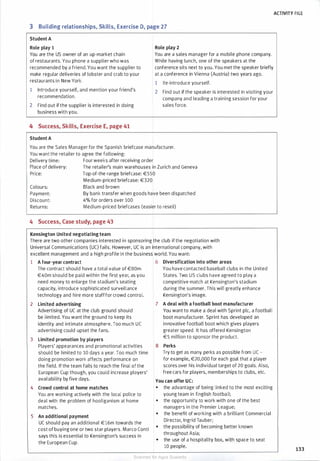
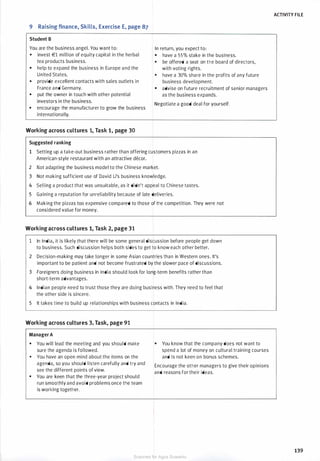
Student A: Turn to page 133.
Student B: Turn to page 142.
GIVING ADVICE
Why don't you give him a call?
You could meet our Systems
Manager.
REFERRING TO PREVIOUS
MEETINGS
Haven't we met somewhere
before?
We both went to that
presentation.
I think we met some time ago.
ASKING FOR HELP/CONTACTS
Can I mention your name
when I call him?
She mentioned that you
might be able to help me.
Haveyou got his phone
number, by any chance?
Do you have his contact
details?
ESTABLISHING COMMON
INTERESTS
We have something in
common. We're both
interested in ...
I see we're in the same line
of business.
We both do similar work. /
We have similar interests.
Are you in sales or product
development?
27
Scanned for Agus Suwanto
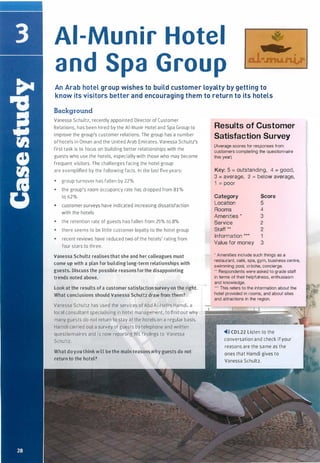
Al-Munir Hotel
and Spa Group
An Arab hotel group wishes to build customer loyalty by getting to
know its visitors better and encouraging them to return to its hotels
Background
Vanessa Schultz, recently appointed Director of Customer
Relations, has been hired by the Al-Munir Hotel and Spa Group to
improve the group's customer relations. The group has a number
ofhotels in Oman and the United Arab Emirates. Vanessa Schultz's
first task is to focus on building better relationships with the
guests who use the hotels, especially with those who may become
frequent visitors. The challenges facing the hotel group
are exemplified by the following facts. In the last five years:
• group turnover has fallen by 22%
• the group's room occupancy rate has dropped from 81%
to 62%
• customer surveys have indicated increasing dissatisfaction
with the hotels
• the retention rate of guests has fallen from 25% to 8%
• there seems to be little customer loyalty to the hotel group
• recent reviews have reduced two of the hotels' rating from
four stars to three.
Vanessa Schultz realises that she and her colleagues must
come up with a plan for building long-term relationships with
guests. Discuss the possible reasonsforthe disappointing
trends noted above.
Look at the results of a customer satisfaction survey on the right.
What conclusions should Vanessa Schultz draw from them?
Vanessa Schultz has used the services ofAbd Al-Halim Hamdi, a
local consultant specialising in hotel management, to find out why
many guests do not return to stay at the hotels on a regular basis.
Hamdi carried out a survey of guests by telephone and written
questionnaires and is now reporting his findings to Vanessa
Schultz.
What doyou think will be the main reasons why guests do not
return to the hotel?
Results of Customer
Satisfaction Survey
(Average scores for responses from
customers completing the questionnaire
this year)
Key: 5 = outstanding, 4 = good,
3 = average, 2 = below average,
1 = poor
Category Score
Location 5
Rooms 4
Amenities * 3
Service 2
Staff ** 2
Information *** 1
Value for money 3
• Amenities include such things as a
restaurant, cafe, spa, gym, business centre,
swimming pool, creche, concierge.
.. Respondents were asked to grade staff
in terms of their helpfulness, enthusiasm
and knowledge.
... This refers to the information about the
hotel provided in rooms, and about sites
and attractions in the region.
�>» CD1.22 Listen to the
conversation and check ifyour
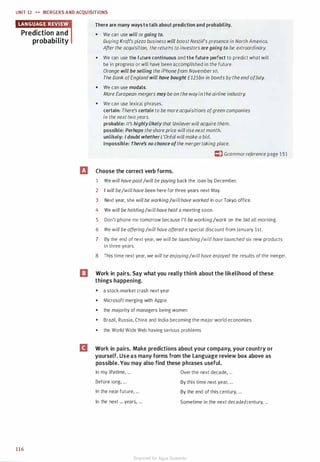
reasons are the same as the
ones that Hamdi gives to
Vanessa Schultz.
Scanned for Agus Suwanto
Vanessa Schultz has
called a meeting which
will be attended by
members of the Guest
Relations and Marketing
Departments. This is the
agenda for the meeting.
UNIT 3 H BUILDING RELATIONSHIPS
How can the Al-Munir Group make guests feel 'special' and 'highly valued'?
2 What can the group do to a) reward loyal customers, and b) persuade guests
who have stayed once t:o return?
3 What can be done to make staff more motivated and customer-orientated in
their approach to their work?
4 What questions should the management be asking in order to gather
information for an accurate, up-to-date profile of each guest? For example:
How did the guest find out about the hotel?
5 How can the group maintain its relationship with guests once they have left
its hotels?
6 What other actions can the group take to i mprove customer loyalty, increase
the average scores in the next customer satisfaction survey and get back its
four-star rating?
Work in small groups.You are members of
either the Guest Relations or Marketing
Departments.
Watch the Case study A
commentaryon the DVD-ROM. V
1 Prepare for the meeting by discussing each
item on the agenda. One of you should lead
the discussion and note down your ideas.
2 Meet as one group. One person should play
the role of Head of Guest Relations.
3 Share your ideas on each item of the agenda.
4 Agree on an action plan which you will
present to the Board of Directors of the
Al-Munir Group at their next meeting.
Writing
Write a sales letterto Marion Wise, a businesswoman who
has stayed frequently at Al-Munir hotels and is one of the
group's most loyal customers. Describe a special offer which
you are making to a small group ofyour priority customers.
Make the letter as personalised s itossible.
I:) w
�
�
g
-
e
-
1
-
26
------�
Scanned for Agus Suwanto
1 Doing business internationally
Drew Corporation, based in Dallas, USA, is an international group supplying food products
to the retail trade. It is currently holding its annual planning conference in Mauritius. One of
the discussion sessions, entitled 'Succeeding in new markets', is attended by some ofthe
company's top executives. The leader ofthe session has asked participants to work in small
groups and either talk about or provide notes on a recent overseas assignment, focusing on
any cultural problems they encountered in their work. In one of the groups, Bob Hewitt talks
about an assignment in China, Christina Novak provides notes about her work experience in
India and Melissa Petrides writes about a business trip to Russia.
0 ,.,» co1.23You are going to hear Bob Hewitt
talking about a recent new venture in
China. Listen and answer these questions.
1 Why didn't Bob make more use of David Li's
business experience?
2 What does Bob mean when he says, 'we
expected to get a foothold in the market
pretty quickly'?
3 What conclusion did Bob come to concerning
the future of Munchem restaurants in China?
0 ,.,l) co1.23 Listen again and note down the
mistakes Bob made because of his lack of
knowledge ofthe Chinese market.
Rank the mistakes you noted
in Exercise B according to how
important you think they were
(1 = the most important). Check
your answers with the suggested
ranking on page 139.
G How would you prepare for a business trip
to a country you had nevervisited before?
Q ..ll) CDl.24 You are going to hear Christina
Novaktalkingabout a recent trip to India.
She had neverdone business there before.
Listen and answer these questions.
1 Why did Christina go to India?
2 What do you learn about Mumbai Enterprises?
3 What event helped to improve relations
between Christina and the President of
Mumbai Enterprises? Explain your answer.
0 ,.,l) co1.24 Listen again and note down the
cultural mistakes that Christina made.
Scanned for Agus Suwanto
WORKING ACROSS CULTURES H DOING BUSINESS INTERNATIONALLY
What lessons can be learned about
Indian business culture from Christina's
experience? Check your answers on
page 139.
0 Melissa wrote her impressions of a recent
business trip to Russia in her blog. Read the
blog below, then, in small groups, analyse
and note down the cultural differences
which created misunderstanding between
Melissa and Georgy Volkov.
June 1 Met Georgy Volkov, President of Mika.
Asked him for a five-year sales forecast for the
products we're supplying him. 'Can't do that,' he
said. 'We need to get permissions and certificates
first from Ministry of Trade, tax authorities, local
municipalities, customs, etc. It'll take us a long
while.'
June 7 Asked Georgy how it was going with the
permissions and certificates. He didn't seem
pleased with my question. Wonder if I upset him.
'You must understand, Melissa, it takes a long time
to set up a joint venture in Russia.'
June 8-1 0 Great weekend at Georgy's dacha in the
countryside. Went fishing, then shared a sauna with
him and his wife and had a wonderful meal (lots of
caviar). Didn't talk business at all.
June 11 Difficult meeting with G and colleagues.
I talked about our fantastic range of organic food
products. 'We can't sell them over here. No chance
at all. They'll be too expensive, customers won't buy
them,' he said. I was shocked.
0 �)» co1.2s Listen to Galina Koznov, an expert
on doing business in Russia. Compare her
comments on what Melissa wrote with the
points you noted in Exercise F.
Write a response to Melissa's blog,
advising her on the best wayto do
business in Russia.
June 1 5 Very tricky meeting. We needed to take
legal advice about the joint venture. I suggested
using Goodman and Parker, who have a branch in
Moscow. We've worked with them in many countries
and they're very trustworthy. Georgy wasn't
interested. 'I don't know anyone there, plus they'll
charge us a lot and we'll get nothing from them. Let
us use my old schoolfriend Mikhail Popov. He works
for a small law firm. They'll give us good advice and
they won't charge very much.'
June 18 Time for me to fly back to Dallas. G had
fixed up an appointment for us to see the Minister
of Trade. Would have meant missing my flight,
so asked our Moscow Branch Manager, Pat
Sanderson, to accompany G to the meeting instead.
G not at all pleased, but I wasn't willing to cancel
my flight at such short notice.
June 20 Pat Sanderson called. Meeting not
successful. He didn't see the Minister of Trade, but
only low-level officials in that department. G very
unhappy. He told Pat, 'I worked hard to set up the
meeting with the Minister. My reputation will suffer
because Melissa couldn't attend the meeting. It'll
take me a long time to get back in favour with the
Minister.'
31
Scanned for Agus Suwanto
' .�'
_..�- �:
UNIT
A �eMisiam
VOCABULARY
I DIOMS
32
1 Communication
Choose the best word to complete each sentence.
1 Liam is a very articulate/responsive speaker. He expresses his ideas clearly
and effectively.
2 The product presentation was rambling /sensitive. It included a lot of useless
information, and no one really understood the point.
3 Your talk is limited to 10 minutes, so you need to be responsive/succinct. If you
don't stick to the point, you won't have time to say everything.
4 Bill is extrovert/focused, so he really enjoys giving presentations. He loves being
the centre of attention and talking to people.
5 I'm afraid I still don't know anything about the launch. The Marketing Manager
gave a presentation about it, but he wasn't very hesitantIcoherent. I don't think
he was prepared.
6 I've asked Elise to attend the meeting. She's very persuasive/inhibited, and I think
she can get a good deal for us.
7 I really enjoy listening to Pietro negotiate. He's reservedIeloquent and knows the
business very well, so he speaks with great authority.
8 To be a fluent/concise speaker, you need to practise speaking so that your words
flow naturally.
9 Veejay interrupted/confused Simon's talk and asked several questions. He should
havewaited until Simon had finished.
10 Let's not clarify/digress from the main point. We haven't got much time.
1 1 Speakers can explain /engage the audience by telling interesting personal stories
and by making eye contact.
12 You have to concentrate and listen /ramble to the questions the audience asks.
Complete the conversation below with the words in the box.
Ibush grapevine loop mouth picture stick wall wavelength
A: Have you seen Marco today?
B: No. Why?
A: Oh, I just wondered.
B: Don't beat about the . . . . . . . . . . . . 1• Why are you asking?
A: Well, I heard on the . . . . . . . .. . . .2 that he's been promoted.
B: Really? Are you sure you didn't get the wrong end ofthe . . . . . . . . . . . .3 ?
A: That's why I asked if you'd seen Marco. I want to get it straight from the horse's
4
B: Why don't you ask Rolf? He'll know.
A: Rolf? Talking to Rolf is like talking to a brick . . . . . . . . . . . . 5. We're never on the same
6
B: OK, how about Lea? I'm sure Marco's keeping her in the . . . . . . . . . . . .7•
A: Yeah, good idea. I'm sure Lea will put me in the . . . . . . . . . . . .8. Thanks for the suggestion!
Scanned for Agus Suwanto
SKILLS
VOCABULARY
NOUN
COMPOUNDS AND
NOUN PHRASES
UNIT A H REVISION
Match the halves of the expressions.
1 Sorry, could you a) 'a long time'?
2 I didn't quite b) you spell that, please?
3 Could you speak c) catch that.
4 Could you say d) what we've agreed.
5 Would e) you back?
6 Sorry, I'm not f) I know what you mean.
7 What do you mean by g) repeat that?
8 What does h) up, please?
9 Sorry, I i) that again, please?
10 Sorry, I'm not sure j) with you.
11 I'll have k) 'too expensive' mean?
12 Can I call I) to get back to you later.
13 Could you be m) don't follow you.
14 Let me go over n) a bit more specific?
2 International marketing
Match the words to make common word partnerships.
1 marketing a) penetration
2 market b) retention
3 product c) goods
4 customer d) market
5 brand e) feature
6 free f) materials
7 expanding g) group
8 focus h) sample
9 raw i) name
10 designer j) strategy
Put the words in the correct order to make sentences.
1 product I launching I really I We're I a I impressive I range
2 good I forecasts I The I are I sales I very
3 increase I want I awareness I We I to I brand
4 thorough I doing I We're I market I extremely I research
5 successful I created I They I a I advertising I hugely I campaign
6 introduced I We've I just I card I a I customer I new I loyalty
7 thought I absolutely I He I an I of I brilliant I slogan I advertising
8 shopping I They're I highly I entering I online I the I competitive I market
33
Scanned for Agus Suwanto
UNIT A ... REVISION
34
SKILLS
VOCABULARY
MULTIWORD
VERBS
Complete the sentences belowwith the words in the box.
Iabsolutely achieve back best great mind purpose stage suggest think
1 The . . . . . . . . . . . . of the meeting this morning is to plan next month's launch.
2 What we need to . . . ......... today is an agreement on the budget.
3 I don't ............ we could move the launch to next month, do you?
4 Can I ............ that we schedule a meeting for early next week?
5 That's . . . . . . . . . . . . !
6 That's the . . . . . . . . . . . . idea I've heard for a long time.
7 Don't hold . . . . . . . . . . . . .
8 Say whatever comes to ............ .
9 At this ............ , we want all your ideas, however crazy you think they are.
10 You're ............ right.
3 Building relationships
Circle the odd verb orverb phrase out in each group.
1 break off cement sever end
2 create damage jeopardise hurt
3 build up strengthen begin grow
4 foster maintain look after endanger
5 develop promise encourage promote
6 disrupt improve cultivate make better
7 restore resume establish restart
8 undermine sour weaken allow
Match the sentence halves.
1 We arrived at 7.58 and the train set a) forward to seeing you next week.
2 Let's set b) up the new contract while we continued
3 I need to catch
discussing the schedule.
4 Alicia drew
c) off at eight o'clock. We barely made it!
5 I was looking for
d) up with Freda - she's way ahead of me.
6 I'm looking
e) on the printer. Is that OK with you?
7 I'm going to carry
f) on working until I finish.
8 I need to switch
g) Ramon this morning, but I didn't
see him.
h) up a meeting for Tuesday.
Scanned for Agus Suwanto
WRITING
UNIT A .... REVISION
Read the note and the background information. Write an e-mail of 75-100
words from Tom Jordan to Joao Pereira. Say who advised you to e-mail and
why you're writing; explain yourwork and suggest a meeting.
Tom.
If you want to talk to someone about Brazil's petroleum industry, e-mail Joao
Pereira Udp44@brazchem.com). He can probably give you some facts and figures.
Tell him that Judy Milligan suggested you get in touch. I worked with Joao in
Dubai a few years ago.
Best,
Judy
Information about you:
• job - a business journalist
• current project - research on how various industries are coping with the current
economic climate
• plan - produce a documentary film for TV
• Judy Milligan - old friend of yours
• travel plans - you'll be in Sao Paulo next month
Cultures 1: Doing business internationally
Complete the sentences below with the words in the box.
Idirect flexible local patient product relax reliable rip-off
1 It's important to listen to people who have . . . . . . . . . . . . knowledge.
2 The ............ has to be right for the market.
3 You have to get the price right. Having a product that's high-end is OK, but if people
think it's a . . . . . . . . . . . . , that's a real problem.
4 If you want to have a good reputation, you have to be . . . . . . . . . . . . and do what you say
you'll do.
5 It's important to be . . . . . . . . . . . . when you're negotiating. In many cultures, it takes time
build a relationship before you can talk business.
6 When you do business in Russia, it's important to . . . . . . . . . . . . and socialise.
7 The extent to which people are . . . . . . . . . . . . varies considerably across cultures. In some
places, you have to pay careful attention even to understand if the person is saying
yes. In other places, people may seem very abrupt when they say what's on their mind.
8 It's extremely important to be . . . . . . . . . . . . when doing business internationally.
35
Scanned for Agus Suwanto
STARTING UP
charisma
dedication
discipline
drive
imagination
looks
luck
money
nepotism
ruthlessness
brand
customer
headquarters
innovation
leader
people
profit
shares
subsidiaries
workforce
36
IJ What makes people successful? Add four more words to the list in the box
on the left. Then choose the five most important.
El Talk about a person you know who is successful. Why are they successful?
II What are the best indicators of an individual's level of success?
How important are the following in your culture?
exotic holidays
designer clothes
pedigree pets
trophy partner
cosmetic surgery
expensive jewellery
luxury home(s)
domestic help
chauffeur-driven car(s)
mixing with famous people
exclusive club membership
having your name in the media
EJ Complete these statements with the words from the box on the left.
Then discuss with a partner which three statements are the best indicators
of a successful business.
A successful business ...
1 is always making money and increasing its . . . . . . . . . . . . .
2 is often the market ............ .
3 is moving forward and interested in ............ .
4 has a motivated ............ .
5 has a loyal ............ base.
6 has a world-famous ............ and an instantly recognisable logo.
7 issues ............ which are worth millions on the stock market.
8 has its . . . . . . . . .... in a prestigious location.
9 has branches and ............ all over the world.
10 treats its employees well and is ............-orientated.
Scanned for Agus Suwanto
UNIT 4 H SUCCESS
Read this news report and identify nine common prefixes.
EXAMPLE: multinational
Rabbit, the successful mobile phone
company, has renamed itself
ChirChat Media as part of its effort
to establish itself worldwide.
Although some industry
commentators see the name change
as risky and an indication of their
overconfidence, the company
continues to outperform all its rivals
in the competitive telecoms market.
In a statement, co-founder and CEO
Markus Danton said that it was an
exciting time for the company and
that its achievements had been
underestimated in the past. He went
on ro say, 'We are an ultramodern
company taking the next logical
step ro achieve our aim of becoming
the leading company in the sector
worldwide.'
He denied reports of problems in
the recently entered Asian markets,
claiming journalists had been
misinformed. His ex-business
partner Darius Schnell, who left the
company less than three months
ago, was nor available for
comment. Many experts feel Mr
Schnell's contributions ro the
success of the company have been
devalued in recent press reports
since his hasty exit last November.
I] Match the prefixes in Exercise A to these meanings.
1 too much
2 better / more than
3 badly
4 extremely
5 former
6 opposite
7 with
8 too little
9 again
D Cross out the word in each group that does not follow the prefix in bold.
1 under perform I rate I charge I j7fflftf
2 co producer I worker I boss I author
3 re launch I engineer / locate I decide
4 over spend I lose I estimate I supply
5 mis manage I judge I look I calculate
6 out win I produce I bid I class
7 ultra efficient / cautious / modern I big
8 ex boss I director I employee I staff
9 de merge I grow I nationalise I regulate
liJ Complete these sentences with words from Exercise C in the correct form.
1 Several sales staff.<:'.'l�.err.e.rfr.r�. ��. last year and didn't meet their targets.
2 Smith and Turner were the two . . . . . . . . . . . . of the report.
3 We will . . . . . . . . . . . . our product as soon as we have finished the modifications.
4 Sales were very disappointing. We . . . . . . . . . . . . the number of people who would buy our
product in Asia.
5 Because the company has been . . . . . . . . . . . . for years, we are close to bankruptcy.
6 It was an expensive acquisition. They had to . . . . . . . . . . . . their rivals to take over the
company.
7 Our . . . . . . . . . . . . factory has state-of-the-art machinery.
8 My . . . . . . . . . . . . was impossible to work with, so I left the company.
9 There is much more competition in . . . . . . . . . . . . financial markets.
37
Scanned for Agus Suwanto
UNIT 4 H SUCCESS
See the DVD-ROM �
for the i-Glossory. W
Successful
businesses
Tom Hockaday
Watch the
interview on
the DVD-ROM.
38
II Discuss these statements.
1 Outselling your rivals is the best indicator of success.
2 Mismanagement is the biggest cause of business failure.
3 Rebranding is often a pointless exercise.
4 Underfunding and overstaffing are the quickest way to failure.
5 Undercutting the competition is a dangerous business strategy.
IJ �>» CD1.26 Isis Innovation is a technology development company owned by the
University of Oxford. Listen to Tom Hockaday, its Managing Director, talking
aboutthe essential qualities of a successful business and complete the gaps
in these two extracts.
I think that the absolute essence of a business, or a . . .. .. ..... .1 business, is one that
manages to . . . . . . .. . . . .2 and . . . . . . . . . . ..3 something, whether that is a . . .. . .. . .. . . • or a . . . . . . . . . . . .5,
but manages to . . . . .. . .. . . .6 it for more than it . . . . . . . . . . . .7 to . . . . . . . . . . . .8 it.
... we are investing in the . .. . .. . . . . . .9 to take it through various stages of development, so
that we can demonstrate it has . . . .. . . ..... . . . . . . . . . . . .10, so that we might be able to attract
more rounds of. ....... . .. . . .. .... .... .11 investment or finance from other sources.
m �)» CD1.27 Listen to the second part of the interview and summarise in a short
paragraph what Tom says about Natural Motion - the type of company it is,
what it does and the reasons for its success.
II �>» co1.2s Listen to the final part of the interview and answer these questions.
1 Which types of business does Tom expect to succeed in the near future?
m
2 Which four examples does he give?
Read the article on the opposite page and correct the six mistakes in this
paragraph about Carlos Slim.
Carlos Slim is probably the richest man you have ever heard of. The major influences on
his life were his father, Julian, who was born in Mexico, and Jean Paul Getty. He studied
finance at Harvard University and on graduating set up as a stockbroker. He made a lot
of money in the Mexican recession of 1982, selling his assets in the middle of the crisis.
In 1990, Slim gained control ofTelmex, which owns 90% of Mexican telephone lines
and is the largest part of Slim's empire. Slim is also involved in charity through his
Carso Foundation.
Match the words on the left with words on the right to form word
partnerships. Then check your answers in the article.
1 business a) spree
2 economic b) acumen
3 annual c) recession
4 retail d) point
5 turning e) sales
6 buying f) outlets
7 global g) crisis
Scanned for Agus Suwanto
UNIT 4 .. .. SUCCESS
II Complete this text with the word partnerships from Exercise B.
In 2008, influenced by China's success and its appetite for commodities, shipowners went
on a . . . . . . . . . . . .1, and . . . . . . . . . . . .2 ofvessels reached an all-time high. The . . .. . . . .. . . .3 came the
following year with the housing crisis, credit crunch and . . . . . . . . . . . .• in the United States,
which led to a . . .. . . . . .. . .s. Orders for ships dried up, and department stores and . . . . . . . .. . . .6
throughout the world had empty shelves. However, business is recovering and there
has been a transformation of the industry from one that relied almost exclusively on a
shipowner's innate . . . . . . . . . . . .7 to today's highly sophisticated finance-based industry.
EJ If you had Carlos Slim's money, what kind of businesses would you buy?
What kind of lifestyle would you lead?
Profile: Carlos Slim
by James Quinn
Carlos Slim is eitherthe world's richest
or second-richest man, with a fortune
estimated to be in excess of$67bn. Pos­
sibly the richest man you ' ve never
25 and to American oil billionaire Jean
Paul Getty. Slim learned of Getty's
business arnmen as a young boy and
has gone on to mirror his ability to
5 heard of, until recently his influence
had largely been restricted to his native JO
Latin America, where his sprawling
family empire controls more than 200
companies, spanning everything from
10 banking and retail to telecoms, roacl­
building and restaurants. But given the J5
size or his fortune, he was unlikely to
stay local for long. In recent years, he
has begun to stretch his increasingly
15 long tentacles north of the border and
into the United Stales. and this week �a
20
took the American intelligentsia some­
what by surprise by revealing plans to
inject $250m into the New York Times.
Slim puts his success clown to h is
admiration for his father Julian - who 45
emigrated from the Lebanon aged 1 4
and made his fottune investing in prope1ty
in the 1 9 1 0- 1 7 Mexican revolution -
make money.
Aged 1 1 , he invested in government
saving bonds, keeping a detailed ledger
to track all of his purchases. By 1 5 , he
had bought a very small shareholding in
Banco Nacional de Mexico - then the
largest bank in Mexico, and one to
which he has recently been linked with
buying, as the current owner Citigroup
looks to divest some of its assets.
While studying civil engineering at
university in Mexico City, he realised
the way to make money was from
investing in companies. and so set up
on his own as a stockbroker on gradua­
tion, working 14-hour clays.
It was not until the Mexican reces­
sion of 1 982 that Slim really began to
make some money, taking advantage of
a nationwide ' fire sale' of assets by
local and foreign investors alike, looking
50 to sell in the midst of one of the coun­
try's worst economic crises.
The period led to the formation ofone
ofthe key pai1sofSlim'sempire- Grupo
Carso, which today has annual sales of
55 $8.Sbn a year and owns retail outlets
such as Sanborns and Sears, as well as a
wide range of manufacturing businesses.
Eight years later, in 1 990, came the
second major turning point in Slim's
60 career when Mexico decided to priva­
tise its national telecoms company.
Slim went head to head with America's
Southwestern BelI, France Telecom and
as many as 35 other domestic investors,
65 but managed to seize control ofTelmex.
Some 90 per cent of the telephone
lines in Mexico are today operated by
Telmex. But it is the low-cost mobile
phone network America M6vil, which
10 he also controls, which has grown to be
the most substantial part of his empire.
opening up other parts ofLatin America
to mobile telephony. It now operates in
1 1 countries, including Brazil, Ecuador
75 and Guatemala.
Many commentators believe that his
recent buying spree is part of'a desire to
replicate what he did in Mexico in the
1 980s on a world stage, taking advan-
80 tage ofthe global recession by investing
in distressed assets al knock-down
prices while he can.
In spite of his obvious wealth, he
remains frugal in his tastes, and is often
85 seen wearing a plastic-effect wrist­
watch which doubles as a calculator.
His clothes tend to be bought from the
many retailers his empire owns.
Over the next fouryears. he has com-
90 mitted to spend $ 1 0bn through his
charitable Carso Foundation, whose
main aim is to fight marginalisation and
poverty by investing in health, educa­
tion and employment.
from The Telegraph
39
Scanned for Agus Suwanto
UNIT 4 H SUCCESS
40
Present and
past tenses
Complete the rules with the words presentsimple, presentcontinuous, present perfect,
pastperfect or past simple.
1 We use the ............ to describe actions and situations which are generally true.
Carlos Slim is worth about$67bn.
2 We use the ............ to describe completed actions or events which took place at a
particular time or over a period of time in the past.
Slim bought Telmex in 1990.
3 We use the ............ to describe current or temporary situations.
Petrol is getting more expensive by the week.
At the moment, Slimis writing a book abouthisfamily.
4 We use the ............ to describe life experiences, the present results of past actions
or to announce news.
The companyhos done well recently.
In recent years, Slim hos devolvedpowerto hisfamily.
5 We use the ............ to describe an action which is completed before a time in
the past.
The office hod closed bythe time wegot there.
Cl Grammarreference page 147
Ill Label the tenses in these sentences based on the article on page 39 and say
why those tenses are used.
1 In recent years, Slim has begun to stretch his tentacles north.
2 Aged 11, he invested in government saving bonds.
3 He remains frugal in his tastes.
4 By 15, he had bought a very small shareholding in Banco Nacional de Mexico.
5 Slim is currently looking at investing in distressed assets.
a Write an article about Apple for a business magazine. Use these notes,
putting the verbs in brackets into appropriate tenses.
THE COMPANY RECENT EVENTS
• (reinvent) the personal computer
with the Macintosh in 1 980s
• (have) highest brand loyalty of any
computer manufacturer
• (operate) more than 250 retail
stores
• (have) informal culture
HISTORY
• (start) in Cupertino, California,
April 1 , 1 976
• October 23, 2001 : (introduce) the
iPod digital music player
• Since it was formed 1 976, (employ)
over 75,000 people worldwide
• Recently (rank) first as most
admired company overall in
Fortune survey
• People in survey by CoolBrands
recently (vote) the iPhone as
world's coolest brand
• September 28, 2009 downloads
from App Store (surpass) 2 billion
WHAT IT IS DOING NOW
• Currently (experience) the greatest
expansion in its history
• Now (focus) on its software more
than ever
• At time of writing, (offer) students a
free iPod Touch with the purchase
of a MacBook
D Research Carlos Slim on the Internet and write a final paragraph for the
article on page 39 saying what he is doing now.
Scanned for Agus Suwanto
USEFUL LANGUAGE
BARGAINING
Three key skills in negotiating are:
1 bargaining
2 checking understanding
3 signalling (drawing attention to what you're about to say).
UNIT 4 H SUCCESS
Study the examples of each in the Useful language box below.
[I �>» CDl.29 Listen to a negotiation between an exporter of Turkish rugs and
the Head Buyer of a chain of department stores. Answer these questions.
1 What agreement do the exporter and buyer reach concerning a) quantity, and
b) discount?
2 What delivery date does the buyer want? Is she sure to get what she wants?
II �>l) co1.29 Listen again and complete these sentences.
1 If you place an order for only 50 rugs, we can offer you a . . . ......... of 5% ...
2 'Supposing we increased our order for your . . . . . . . . . . . . rugs, what discount would
you give us?'
'Well, what sort of quantity do you have . . . . . . . . . . . . . . . . . . . . . . . . ?'
3 'OK, if we ordered 100 rugs, made in Esme, would you . . . . . . . . . . . . the discount?'
'No, not double it, but we'd be . . . . . . . . . . . . to increase it to 7%.That's pretty generous
I'd say.'
'That sounds fairly . . . . . . . . . . . . .'
4 'Could you get the rugs to us by the end of this month?'
'Mmm, that's . . . . . . . . . . . . . . . . . . . . . . . . . . . . . . . . . . . . - I honestly don't know.'
5 I'd like to make a .......... . . . I'd be . . . . . . . . . . . . to place an order for 150 standard rugs
if you could give us a discount of 10% ...
6 OK, if I'm certain we can supply you that quantity by the end of the month, you've got
. . . . . . . . . . . . ............ . We'll give you 10% off............ ............ ............ for
that amount.
liJ Look at the audio script on page 157 and find an example each of checking
understanding and signalling language.
D Role-play this situation.
A Spanish manufacturer has produced a new range of expensive leather briefcases.
A Swiss retailer is considering placing an order for 300 of each design. The Sales Manager
and Chief Buyer negotiate the contract.
Student A: Turn to page 133.
Student B: Turn to page 142.
SIGNALLING
If you increase your order, we'll
give you a bigger discount.
CHECKING UNDERSTANDING
Sorry, could you repeat that?
Are you saying you don't have that
quantity in stock?
I'd like to make a suggestion. I think
we should leave this point and come
back to it later.We can deliver by that date,
providing we have the goods in stock.
lfwe lowered the price, would you
be prepared to increase your order?
So what you're saying is you'll ... I want to ask a question. How are
we going to pay for this?
41
Scanned for Agus Suwanto
Kensington United is one of the great success
stories in English football. Today, it is in second
place in the Premier Division and has reached the
third round of the European Champions League
competition. The club regularly attracts over
40,000 spectators at its home matches, and its
Italian manager, Marco Conti, is adored by fans.
Kensington United is also a commercial success
and is very profitable.
What has brought about its success? Firstly,
Marco Conti had a clear strategy for the team from
the start. He developed young players who had
� come through the club's youth training scheme.
The team was also strengthened by one or two
carefully chosen foreign players.
�>» CDl.30 Listen to an interview on
Sportsline, a weekly TV programme focusing
on football. The presenter talks to a football
manager about Kensington United. Take
notes of the key points.
Current
situation
Kensington's
current
four-year
sponsorship
deal with an insurance company is about to finish.
Ingrid Tauber, the club's Commercial Director, is
-.. considering a new and better deal with Universal
Communications pie, the powerful media group. It
is not only the increased money from sponsorship
which appeals to Kensington United, however.
Universal Communications' broad range of business
activities would offer many other opportunities to
increase revenue.
Universal Communications is interested in
Kensington because the club's success has brought
it over four million fans in the UK and 40 million in
Asia. Kensington played a friendly match recently
in India, which was shown on television. Another
' friendly match in China attracted a TV audience of
over 250 million. The team's popularity in those
countries would help Universal Communications to
boost sales ofits mobile phones in Asia.
Representatives of Kensington United and Universal
Communications are meeting shortly to discuss a
possible sponsorship deal.
Scanned for Agus Suwanto
• • , . . . . .
•
AGENDA
You are members ofthe
negotiatingteam of either
Kensington United (turn to
page 133) or Universal
Communications
Date: 10 May Time: 1 0 a.m.
Venue: Conference room, Kensington Football Ground
(turn to page 141).
Read your role card and
prepare for the negotiation.
Work out your objectives,
priorities, strategy and tactics.
Think carefully about what
concessions you are willing
to make. An agenda has been
prepared (see right).
Do the negotiation.
�>»CDl.31 Listen to the excerpt from the radio
programme Sporting World. How does it affect the
result of your negotiation?
1 Total value of the contract
2 Timing of payments
3 Advertising
4 Control of players and club activities
5 Control of spectators
6 Official supplier of Kensington football boots
7 Other commercial opportunities
8 Fringe benefits for players
9 Other points
Ifthe negotiation was successful, write a press release from the point ofview of
either Kensington United or Universal Communications outlining the main points
of the agreement and the benefits to the organisation you represent. The tone and
style ofthe message should express pleasure and optimism.
If the negotiation was unsuccessful, write a letter to your opposite number in the
negotiation expressing your regret that you were unable to make a deal. However,
you should indicate that you might be willing to reopen negotiations in the future,
' as clearly there could be areas of mutual benefit.
Writing file pages 126 and 128
Scanned for Agus Suwanto
STARTING U P
44
m Which of these factors would motivate you to work harder? Choose your top
five and rank them in order of priority. Explain your priorities.
bonus more responsibility working for a successful company
bigger salary threat of redundancy better working environment
commission hard-working boss promotion opportunities
praise supportive colleagues more time off
important job title perks more flexible working hours
a �>» CD2.1, 2.2, 2.3 Listen to three people talking about their motivation at work.
Which ofthe factors in Exercise A do they mention? Who do/would
you agree with?
II Discuss these questions.
1 For what reasons might you change jobs? How often do you expect to do so in your
lifetime? Is changing jobs often a sign of success in your culture?
2 A recent US survey showed children preferred parents to go out and earn money rather
than spend more time with them. What does this show, in your opinion?
3 Would you prefer a male or female boss? Why?
llJ Turn to page 134 and do the quiz 'Are you in danger of burning out?'.
Scanned for Agus Suwanto
Synonyms and
word-building
UNIT 5 .... JOB SATISFACTION
fl Look at the sentences below. Underline the words or phrases which can
be replaced with an item from the box without a change in meaning.
assessment breakdown empowerment fringe benefits red tape remuneration
severance payment takeiRcJustrialaetieR
1 If employees become too discontent, they may go on strike. take i"dv�trial actio"
2 Most people like to have control over their work and therefore put autonomy near
the top of their list of motivating factors.
3 Dealing with bureaucracy is a very time-consuming, demotivating problem which
affects large businesses and organisations.
4 Overwork can lead to burnout if not spotted early.
5 Many job satisfaction studies, perhaps surprisingly, have found that often a
compensation package is not the most motivating factor for many employees.
6 Offering perks rather than a salary increase can be a way of retaining employees in
traditionally high staff turnover industries.
7 He received a very generous golden handshake when he left the company.
8 One way for managers to monitor and develop staff is by using appraisal interviews.
l!J Complete each of these sentences with a word formed from the verb on the
left. Sometimes you will need to use a negative form.
s A T 1 s F v 1 a) The survey showed that staff working flexible hours were more .�<?.t!�.fi�.�. with
M O T I V A T E
their jobs than those working fixed hours.
b) Low pay and poor working conditions create . . . . . . . . . . . . workers.
c) Small European companies are top of job . . . . . . . . . . . . league tables.
2 a) What are the strongest . . . . . . . . . . . . factors in people's lives?
b) Workers become . . . . . . . . . . . . if they work long hours for low pay.
c) What was your . . . . . . . . . . . . for becoming a salesperson?
IF R u s T R A T EI 3 a) You could see the . . . . . . . . . . . . building up in the workforce.
IR E c 0 G N I s El
b) I find talking to him . . . . . . . . . . . . because he never listens.
c) I felt so . . . . . . . . . . . . with their attitude that I decided to resign.
4 a) Employees are more likely to change jobs if they feel their work is . . . . . . . . . . . . or
that others take credit for it.
b) Because of her people skills, she was able to achieve . . . . . . . . . . . . and respect at the
company.
c) The company . . . . . . . . . . . . his lifelong service on retirement with a formal dinner and
a substantial golden handshake.
D Discuss these questions.
See the DVD-ROM �
for the i-Glossary. W
1 What do you find satisfying and frustrating about your work or studies?
2 How true do you think these statements are?
a) There is no such thing as company loyalty these days.
b) Only successful people can have a good work-life balance.
c) Job satisfaction is about personality, not external factors.
d) Job satisfaction increases with age.
e) Improvements in technology lead to greater job satisfaction.
f) Job sharing and job rotation are not good for motivation.
g) People who work from home tend to work harder than people who don't.
45
Scanned for Agus Suwanto
UNIT 5 .... JOB SATISFACTION
Staff
motivation
Madalyn Brooks
Watch the
interview on
the DVD-ROM.
Working for the
best companies
46
IJ -4)» CD2.4 Listen to Madalyn Brooks, Director of H uman Resources at Procter &
Gamble (UK), and answer these questions.
1 What is the key to a successful business?
2 What are the two main ways in which Procter & Gamble drives job satisfaction?
El '4)» co2.s Madalyn says that job priorities have changed in three areas over
the last 10 years. Listen to the second part ofthe interview and take notes
on what she says under these headings.
1 flexibility
2 the drive for personal learning and growth
3 working for socially responsible organisations
D '4>)) CD2.6 Listen to Madalyn talking about what people want. Do not take notes
while listening. Afterwards, write down in one minute as many things as you
can remember that people want. Compare your answers with a partner.
Who remembered the most things?
IJ You are going to read an article from The Sunday Times survey The 100 Best
Companies To Work For. What would you look for in your ideal company?
El Work in pairs.
Student A: Read Article A on the opposite page.
Student B: Turn to page 135 and read Article B.
Choose five points that you think make the company in your article a good
one to work for. Take notes on those points and then tell your partner,
without looking back at the article.
D Ask your partner questions about their company, so that you can work out
together whetherthese statements are true or false (M = Marriott Hotels
International, K = KPMG).
1 Over 70% of staff at K and M think that their training is of great benefit.
2 M scores lower on opportunities for personal growth than K.
3 Less than half the staff in M and K earn more than £35,000.
4 M and K both offer childcare vouchers and contributory pensions.
5 K has more than double the annual sales of M.
6 K employs a higher percentage of women than M.
7 M and K have a fairly similar-size workforce.
8 More than half the staff in M and K earn fl 5,000 or more.
liJ In pairs, look at Article A to find word partnerships with basic, role,
performance and paternity. Then look at Article B to find word partnerships
with career, childcare, medical and pension.
Scanned for Agus Suwanto
UNIT 5 .... JOB SATISFACTION
Article A
Marriott
Hotels
International
Hospitality and Lodging
Annual sales £550111
S taff numbers 1 1 ,1 57
Male/female ratio 48:52
Average age
Staff turnover
Earning £35,000+
Typical job
3 1
36%
4%
Food and beverage associate
Marriott checks in ten places higher up our list this year
thanks to its five-star treatment of staff. Employees award the
family-run hospitality business the highest positive score in
our survey - 76% - for loving their work here.
It may not be the biggest payer (three-quarters of workers
get a basic salary of£ 1 5,000 or less), but staff have fun (83%).
think thejob is good for their personal growth (77%) and are
happy with the balance between work and home life (66%).
Employees also feel they can make a difference in the organi-
10 sation (73%), make a valuable contribution to its success (76%)
and areexcited about where the company is going (69%).
The worldwide group, which employs more than 1 1 ,000
staff, ranks second out of all 20 organ isations on questions
about what staff think of the company and their colleagues
15 and third for their positive views of managers.
There is a culture of respect and recognition, and there is
training specifically on teamwork, a quality prized by the
company. Marriott even uses psychosometric testing to
assess how well managers align to its nine core organisa-
20 tional competencies. Staffsay that senior managers truly live
the values of the organisation ( 7 1 %), help them fulfil their
potential and motivate them to give their best every day (71 %
and 70%, both top scores). They say the managers are excel­
lent role models and regularly show appreciation, winning
25 positive scores of69% and 75% respectively, results bettered
in both cases by only one other firm.
The company, where the average length of service for gen­
eral managers is 1 7 years, likes to promote from within. Its
performance review process creates a development plan for
30 every member of staff and identifies their training needs. On­
the-job training is a key feature of development, and there are
NVQ programmes for accredited qualifications, with staff
saying this training is of great benefit lo them (72%).
Rewards for outstanding contribution and long service,
35 plus an annual staff appreciation week and quarterly social
activities, reinforce the value Marriott places on its people.
In the year to August 2008, the firm spent £355,000 on fun
events for employees, who go out of their way 10 help each
other (76%).
40 Staff have free use of the hotel leisure clubs and access to
a confidential helpline if they have any personal worries. All
this helps promote a strong sense of wellbeing. Stress isn't a
problem (76%), workers say they are not under so much pres­
sure they can't concentrate (72%) or that they can't perform
45 well (70%. the second-highest score).
Benefits include between 20 and 25 days· basic holiday,
two weeks' paternity leave on 90% of pay, chi ldcare vouch­
ers, dental insurance, critical i llness cover, life assurance and
a contributory pension. Employees say Marriott is run on
so strong principles (75%) by an inspirational boss ( 7 1 %), and
that they are proud to work for it (79%).
from The Sunday Times, copyright © The Times, 2009, www.nisyndication.com
II In pairs, complete these sentences with some of the word partnerships
from Exercise D.
1 You need to compare various . . . . . . . . . . . . . . . . . . . . . . . . policies online.
2 The government's new . . . . . . . . . . . . . . . . . . . . . . . . is designed to prevent widespread
old-age poverty.
3 Ask Human Resources for the proper forms a month before your . . . . . . . . . . . . . . . . . . . . . . . . .
4 Many fathers do not take up their . . . . . . . . . . . . . . . . . . . . . . . . entitlement.
5 . . . . . . . does not include overtime, bonuses, commission or travel
allowance.
II In groups, discuss which company you would prefer to work for and why.
47
Scanned for Agus Suwanto
UNIT 5 �� JOB SATISFACTION
•tma•Mdlih'UW,Passives
• We use the passive when we are not interested in who performs an action or it is not
necessary to know.
48
Information about the takeoverhad been leaked to the press.
• We often use it to describe processes and procedures because we are more
interested in the process itselfthan who carries it out.
The bottles arefilled before the labels are put on.
• We use the passive to write in a more formal style because it is less personal than
the active. It is often used in reports, minutes and business correspondence.
Yourapplication has been forwarded tothe Human Resources Department.
CJ Grammarreference page 148
IJ Match each tense orverb form (1--8) to the appropriate extract (a-h).
1 present simple a) The report stated that more employees should be
2 past simple
encouraged to provide feedback on management.
3 present perfect
b) Employees felt their jobs had been made more
interesting through training.
4 past perfect c) The minutes are always taken by a member of HR.
5 present conHnuous d) The survey stated that employees become unhappy
6 future simple
when they feel that their concerns are being ignored
by management.
7 modal verbs with
e) The performance reviews werecarriedout over the
passives
summer.
8 passive infinitives f) They were happy to be accepted on the fast-track
programme.
g) Employees will now be expected to act on the
reviewers' suggestions as soon as possible.
h) Bonuses and other incentive programmes have been
cutsince the recession.
IJ Complete this extract with passive forms of the verbs in brackets.
Over time, job satisfaction . . . . . . . . . . . . . . . . . . . . . . . . . . . . . . . . . . . .1 (define) in a number of ways.
Edwin Locke said that job satisfaction . . . . . . . . . . . . . . . . . . . . . . . .2 (determine) by the difference
between what one wants in a job and what one has in a job. Herzberg states that
satisfaction and dissatisfaction . . . . . . . . . . . . . . . . . . . . . . . .3 (drive) by different things - motivation
and 'hygiene' factors (such as pay), respectively. Motivation . . . . . . . . . . . . . . . . . . . . . . .. . . . . . . . .. . .. 4
(can/see) as an inner force that drives people to perform. One of the most famous ways
of measuring job satisfaction is the Minnesota Job Satisfaction Questionnaire, which
. . . . • . . . . . . . . . • . . • . • • • . •5 (create) in 1963. Some researchers say that people who . . . . . . . . . . ..
. . . . . • • .. . • .6 (satisfy) with life tend to . . . . ... . . . . . . . . . . . .. . . . .7 (satisfy) with their job.
II Read these notes for four sections of a report on employee satisfaction.
PROCEDURE
Distribute anonymous
employee satisfaction
questionnaires: all
departments
Interview union
representatives
Hold meeting with all
Heads of Department
Then write sentences, using the passive, to include in the report.
EXAMPLE: Oves-tio""aire> Were dis-tribvted to all departmeflt>.
PRESENT PROBLEMS
Management ignore
suggestions/complaints
Not encourage staff to
take on new tasks
MEASURES TO IMPROVE
JOB SATISFACTION SINCE
APRIL
Encourage staff to do
various tasks
Adopt open-door policy
RECOMMENDATIONS
Introduce new
performance reviews
for managers from
1 December
Carry out research
into new employee
incentive programme
Scanned for Agus Suwanto
USEFUL LANGUAGE
COLD-CALLING
Hello, Mr/Mrs/Ms X. My
name's ...
I work for Y. I was given your
name by ...
SOUNDING PEOPLE OUT
Z suggested I call you. He/
She thought you might be
interested in ...
I was wondering if you'd be
interested in ...
Would you like some
information about ... ?
UNIT 5 H JOB SATISFACTION
A headhunter is a person who finds people with the right skills and
experience to do a job, then tries to persuade them to leave their present
job. Headhunting often involves cold-calling. When you cold-call, you
telephone or visit someone you have never met before and try to sell them
something or persuade them to do something. Discuss these questions.
1 What qualities and skills do you think a headhunter needs to be successful in their job?
2 Do you think that headhunting is an ethical occupation?
I] �))) co2.1 Patricia Evans, a headhunter, calls Enid Wong concerning a job
opportunity. Listen to the conversation and answer these questions.
1 What is the purpose of Patricia Evans's call?
2 Was the call successful? Why? I Why not?
D �)» CD2.7 Listen to the conversation again and complete these sentences.
1 I was given . . . . . . . . . . . . . . . . . . . . . . . . by Edward Zhang, I believe you know him quite well.
2 He suggested . . . . . . . . . . . . . . . . . . . . . . . . you. He thought you might be interested in a
............ that's become . . . . . . . . . . . . at KB Financial Services.
3 Would you like to meet to find out . . . . . . . . . . . . . . . . . . . . . . . . . . . . . . . . . . . . about
the job?
4 I don't think there's . . . . . . . . . . . . . . . . . . . . . . . . in us meeting, I'm very happy in this job ...
5 OK, I quite understand. Can you recommend anyone I could contact and . . . . . . . . . . . .
them . . . . . . . . . . . . about the job?
6 Great, . . . . . . .. . . . . . . . . . . . . . . . . that. My number's 020 7644 8981.
llJ �))) CD2.8 Listen to another conversation in which Patricia Evans calls Federico
Gonzalez. What does Patricia say about the position and the company to
interest Federico? What do they decide to do next?
D Look at the audio script of the second conversation on page 158. Underline
the expressions that Patricia uses to a) persuade Federico to consider the
offer, and b) deal with Federico's objections.
II Role-play this situation.
Barnard Media is looking for a television producer to be in charge of its business
programmes. It has hired a headhunter to find a suitable candidate for the job.
Student A: Turn to page 141.
Student B: Turn to page 143.
PERSUADING CANDIDATES
TO CONSIDER THE OFFER
KB is offering a top salary
and great benefits.
It's well over six figures.
It's a very attractive part of
the package.
They give staffa substantial
bonus - well above the
industry average.
Why don't we get together?
If you're still interested ...
DEALING WITH OBJECTIONS
People often say that to me,
but ...
There's another thing you
should bear in mind.
You can look at this in
another way.
I take your point, but ...
SHOWING INTEREST
Perhaps we could discuss
this face to face?
Can you give me some more
details?
I'd like some time to think
about this.
49
Scanned for Agus Suwanto
wt goad
iencl, ?
A software company with a 'long hours' culture needs to ensure
that staff relationships don't damage behaviour at work
Background
Patrick �cGuire, CEO of San Diego-based Techno21, is facing a problem caused by the highly
compet1t1ve nature of the IT industry. Recently, employees have been working much longer hours
than previously and often over weekends. As a result, a number of staff have developed close,
�ersonal relati�nships with each other. Patrick has begun to think that the company may need to
introduce a policy to give these employees guidelines concerning their behaviour at work.
Tec�n�21 is � young company with a very relaxed atmosphere, and staffare encouraged to
socialise during their free time.
Discuss the advantages and disadvantages ofworking in this kind of environment.
Relationships at work: three cases
Patrick McGuire's assistant has prepared notes on three cases in which personal relationships
have affected staffperformance and morale. Read about the cases in preparation for a meeting
on managing relationships at work.
1 Promotion application of
Judith Fisher
Peter Walters, the Chief Financial
Officer, had a close relationship with
one of his staff, Judith Fisher, but
they broke up. A few months later,
Walters had to choose someone to
be promoted to be his deputy. Judith
Fisher was one of three candidates.
She didn't get the job. She claims
now that it was because she'd had
a personal relationship with Walters
which had gone sour. According
to her, this was Walters's way of
taking revenge. Patrick McGuire and
Veronica Simpson (HR Director) took
no action. Judith is now threatening
to take legal action against the
company.
2 The sales conference
At the company's international sales
conference, Brad Johnson, a sales
manager, met Erica Stewart for
the first time. He attended all the
discussion groups she was in and
always sat at her table at lunch.
He texted her repeatedly, inviting
her to have a drink or dinner with
him. He was clearly very impressed
with her.
When they both got back to Head
Office, Brad Johnson asked for Erica
to be transferred to his sales team.
Erica went to see Veronica Simpson
in order to reject Johnson's request.
However, Veronica strongly advised
Erica not to turn down the transfer,
saying: 'Brad thinks you have the
personal qualities to be a brilliant
salesperson. He needs bright young
people to strengthen his team and
he thinks you're the right person to
join his team.' Erica is confused and
cannot decide what to do.
3 The loving couple
About a year ago, two colleagues,
Lisa Davis and Steffan Olsen,
became romantically involved.
They kept their relationship secret
- or so they thought. However,
the other members of their team
suspected something was going on.
The team noticed that, at meetings,
Lisa and Steffan always supported
each other's opinions. Also, they
would give each other loving looks
or be more tactile than was normal
among employees. Their behaviour
upset the rest of the team.
A representative of the group talked
to the team leader and asked her to
do something about it.
..>» CD2.9 Patrick McGuire has come up with a proposal
which he wants to discuss with Veronica Simpson.
Listen and take notes.
Scanned for Agus Suwanto
UNIT 5 • JOB SATISFACTION
To: J IHR Staff
::=:============================================================�
From: ) IKate Mann
�============================================================�Subject: [Tuesday's HR meeting
Did we make the right decision concerning Peter Walters and Judith Fisher?
What further action, if any, should we take?
2 Did Veronica give Erica Stewart good advice? What should Erica do now?
3 How should the team leader deal with the issue of Lisa and Steffan?
She has asked for guidance from HR.
4 Which of Patrick's four options is best for the company?
5 How can we avoid someone gaining an unfair advantage by having a close
relationship with a colleague or boss? What action can we take if this happens?
You are members ofTechno21's HR Department.
1 In small groups, discuss the questions in the e-mail and note down what
action to take in each case.
2 Meet as one group. Try to agree on what decisions to take concerning the
questions. One of you should take the role of Veronica and chair the meeting.
Watch the Case
study commentary
on the DVD-ROM.
0
Scanned for Agus Suwanto
STARTING UP
Describing risk
52
B Are you a risk-taker? What risks have you taken?
l!J Which item in each of the categories below carries the most and the least
risk? Explain why.
Travel Lifestyle Money Shopping
car drinking alcohol property online
plane poor diet stocks and shares mail order
train smoking savings account private sales
ship jogging cash auction
B What sort of risks do businesses face (for example: financial risks,
environmental risks)? Can you give some examples?
B The verbs in the box are used when talking about risk. Check their meanings
and put them under the appropriate heading in the table below.
anticipate calculate eliminate encounter estimate evaluate ffiee foresee
gauge identify measure minimise prioritise reduce spread weigh up
predict meet
face
assess manage
Scanned for Agus Suwanto
See the DVD-ROM �
for the i-Glossary. V
Managing risks
Steve Fowler
UNIT 6 .... RISK
I] Match these sentence halves from newspaper extracts.
1 During the credit crunch, many a) the risks involved when sending staff to work
businesses ... in dangerous locations.
2 We can reduce risk ... b) in order to advise insurance companies.
3 Trying to minimise risk ... c) involved in setting up a new business.
4 It is impossible to ... d) eliminate all risk when entering a new market.
5 It is difficult to foresee the risks ... e) faced the risk of running out of money.
6 Actuaries calculate risk ... f) by spreading our lending across more markets.
7 It is important to consider ... g) is an important part of business strategy.
B These adjectives can be used with the word rislc. Complete them with the
missing vowels.
1 s l _ g h t 6 m m d 11- s _ g n _ f -c -
2 g r _ _ t 7 h _ g _ 12 m m n n t
3 m n s c 8 r m t-
4 c -n s -d -r -b l 9 s -r ---s
5 p _ t -n t --I 10 n _ g l _ g _ b l _
EJ Of the adjectives in Exercise C, which describe:
1 a high level of risk? a low level?
2 a possible future risk? a risk in the very near future?
13 s b s t-
14 t r r- -
1 5 t r m
II I n pairs, talk about the types and levels of risks facing some of the
following.
n t-
b l
n d
1 your company/institution
2 a major company/industry in your country
3 your city/town/country
4 a foreign country
IJ •0 co2.10 Listen to Steve Fowler, Managing Director of the Institute of Risk
Management, and give one example of internal risk and one example of
external risk.
l!I �l» co2.10 Listen again and complete the chart.
information technology
n t
s
fires
. . . . . . . . . . . .]  ___;;········
"'- supply chain
 _
'--�
(
typhoons
changing social and
political pressures
changing customer
demand
non-availability of
reasonably priced credit
/
53
Scanned for Agus Suwanto
UNIT 6 H RISK
Watch the
interview on
the DVD-ROM.
54
Insuring
trade risks
II �i» co2.11 Listen to the second part ofthe interview. What are the five key
steps to risk management?
llJ �>l) co2.12 Listen to the final part. Which three examples does Steve give of
organisations or industries that failed to manage risk? What does he say
about each example?
II Look at the audio scripts on pages 158-159. Underline the key words and
phrases that Steve uses to structure his answers. Compareyouranswers with
a partner.
rJ Answer these questions.
1 What things do you and your family insure against?
2 What sort of things do big international companies need to insure against?
I] Read the article on the opposite page quickly and, in as few words as
possible, say what the main point ofthe article is.
II Read the article again and answer these questions.
1 How did the insurance industry start?
2 What do reinsurers do?
3 How do the two examples of major losses in paragraphs 7 and 8 illustrate this quote?
'Countries with an underdeveloped system of insurance suffer immeasurably more
from major catastrophes than those where a good part of the material losses can be
covered by professional risk carriers.'
llJ In your own words, summarise the key points in the numbered examples
(1-3) in the article.
II Find words in the article which mean the following.
1 when the maker of a product is responsible for any injury that the product causes
(paragraph 4)
2 money that a court orders someone to pay to someone else (paragraph 5)
3 the collection of all policies held by an insurer (paragraph 6)
4 the total combined risks that could be involved in a single loss event (paragraph 7)
5 a terrible event that causes a lot of destruction and suffering (paragraph 9)
D Complete these sentences with words from Exercise E.
1 They are being sued for ............ by clients who they advised to invest in an insurance
company that went bankrupt.
2 The defect in her car caused the accident, and she is suing the company for product
3 The region was devastated by a natural .. . . . . . . . . . . .
4 It's safer to spread your liability by holding a . . . . . . . . . . . . of risks.
5 An . . . . . . . . . . . . of risk happens when there is a concentration of risks that might give rise
to very large losses from a single event.
Scanned for Agus Suwanto
UNIT 6 H RISK
AGENCY
I�.�lEAlA1t1JI
m Without looking back at the article, match the words on the left to the
phrases on the right to make expressions.
1 bear a) the way
;,� �-- ,q"' I�.,..;---,���� u. ��. /� "le� ·
11..�Y ·!IV� �trfi,�Y .,�r
2 spring
3 meet
4 pave
b) the brunt
c) to mind
d) the risks
'fHSURANCECOMPAHY
LIMITED
5 spread e) a need
Qpltal
· £1.soo.000 .··- ·--·-··
CJ Match the expressions in Exercise G to their meanings.
1 immediately think of something
2 make it possible for something to happen in the future
3 suffer the worst part of something unpleasant
4 reduce the chance of a large loss by sharing risks
5 be good enough to do what someone needs, wants or expects
D In the next 30 years, which types of risk do you think will become
a) more significant, and b) less significant?
Internationalisation - risk or opportunity?
by Torsten Jeworrek
The internationalisation of the econ­
omy is not as recent as the buzzword
globalisario11 would have us believe.
In fact. it was internationalisation that
5 paved the way for the beginnings of
the insurance industry back in the
fourteenth century, as shipowners
sought to protect the increasing value
of their ships and cargoes.
10 Even today, the complex nature of
risks emanating from international
trade is one ofthe insurance industry's
most difficult challenges and one that
affects all classes of business. as the
1 5 following examples show:
l More than 90 per cent ofall world
trade is transported by sea or other
waterways. The large t container
ships today, with cargoes of up to
20 1 3 .000 containers. may be worth far
in excess of $ 1 bn. However, even
this concentration of value i s small
compared with that found at the
world's great container ports, such as
25 Singapore or Hamburg, which act as
depots to goods worth tens ofbillions
of dollars every clay.
2 The outsourcing of production
sites to low-wage countries does not
30 just reduce costs. It can also reduce
the quality of the goods produced.
Defective products can result in recall
costs or even product liability costs.
Recentexamples of recalls that spring
35 to mind include toys coated with lead
paint and toothpaste contaminated
with the antifreeze diethylene glycol.
3 Liability losses can reach extreme
proport ions when pharmaceut ical
40 products cause dangerous side effects
in patients. National law in the country
where the products are sold plays a
key role in this connect ion. The US.
in particular, has seen some extremely
45 high awards for damages.
Insurance companies that cover
such large risks need a secondary
market where they can place them.
Rcinsurcrs assume this fu nction.
50 Sharing the load among several
carriers helps to spread the risks.
The diversification effects achieved
by spreading risks across d ifferent
regions and classes ofbusiness allows
55 reinsurcrs to balance their portfolios
and realise a level ofcapital efficiency
that enables them to cover their
clients' risks- and ultimately those of
the insured - at a reasonable price.
60 Extreme losses in the past show just
how important the reinsurer's role is.
One of the biggest loss events in the
history of insurance was on September
1 1 . 200 I . The attack on the World
65 Tracie Center in New York was a
prime example of the complexity of
today's risks. with an accumulation of
losses across a range of insurance
classes such as fire, business intcrrup-
10 tion, liability. l i fe and health. and
compounded by significant capital
market losses.
The insurance oflarge and accumu­
lation risks is a definite advantage for
1s the sustainable development of econ­
omies. l n countries where insurance
is not very far advanced, it is the
vulnerable economics and above all
the inhabitants that have to bear the
so brunt of these losses. The tsunami of
2004 not only brought immense
human suffering but also caused
losses of over US$ I Obn. As the insur­
ance density in the regions affected is
85 still very low. the insurance industry
only covered a small percentage of
these losses. less than USS I bn.
Countries with an underdeveloped
system of insurance suffer immeasur-
90 ably more from major catastrophes
than those where a good part of the
material losses can be covered by
professional risk carriers.
The global economy is increasingly
95 networked and interconnected. Risks
arc becoming ever more complex .
and the insurance industry has to
develop new concepts for its clients in
order to meet their need for risk cover
100 in this changed environment.
Scanned for Agus Suwanto
UNIT 6 � � RISK
56
Adverbs of
degree
Reaching
agreement
• We can use adverbs to strengthen the meaning of adjectives.
The UShasseen some extremely high awardsfordamages.
• We can also use them to soften the meaning.
The report wasslightly critical.
C) Grammarreference page 148
IJ Which of these adverbs strengthen the adjective which follow and which
soften it?
a bit entirely exceptionally extremely fairly fully highly increasingly
moderately quite rather reasonably slightly somewhat totally very
ll Complete these dialogues with a suitable adverb.
1 'What were your sales results like last year?'
'. . . . . . . . . . . . good. I made my targets with two months to spare.'
2 'What's your new CEO like?
'Extremely talented and ............ intelligent. She brings out the best in people.'
3 'Do you really think we should invest in an ............ volatile market?'
'Well, first of all we should stay calm and review what we already own.'
4 'What did you think of the HR Director's presentation?'
'To be honest, I don't think she was . . . . . . . . . . . . prepared. She seemed to be reading it
most of the time.'
5 'Are you confident that the merger will go ahead?'
'............ confident, although we still need a few more meetings to sort out one or two
problems.'
B In pairs, create short dialogues using some of the phrases below.
EXAMPLE: A: LQS't moritl-/5 5ale5 fi9ure5 5eem Wro09.
B: I tl-iirik tl-iey're fairly accurate, but I'll cl-ieck if you like.
fairly accurate
incredibly well-prepared
absolutely awful
severely criticised
badly misjudged
deeply disappointed
slightly damaged
totally unrealistic
superbly presented
thoroughly enjoyed
IJ �>l) CD2.13 Following the brainstorming meeting in Unit 2 (page 19), the
team meets again to finalise plans for the sales conference. Listen to the
authentic meeting and note down what they agreed about these items.
1 Location
2 Workshop activities
3 Dinner
4 Month
Scanned for Agus Suwanto
UNIT 6 •• RISK
l!I Match these expressions from the meeting to the appropriate heading in the
Useful language box below. (Some headings are not used.) Use the audio
script on page 159 to check the context ofeach expression.
1 Now, just to sum up, we've looked at ...
2 ... I think it's a really great place ...
3 So can we all agree, then, that we go with Florence?
4 ... I think that most of the time we'll be spending indoors.
5 Now, what about the activities?
6 What did you come up with, Carol, for the actual workshops?
7 I thought it might be a good idea to use role play ...
8 I think some kind of interaction is a good idea ...
9 OK, so we go with the workshops, then?
10 Well, I don't know about role plays, though.
11 ... I was thinking maybe something like, you know, a simple quiz ...
12 Exactly.
13 ... yeah, that's a brilliant idea ...
II You are managers of a national newspaper. Consider this situation.
USEFUL LANGUAGE
ASKING FOR OPINIONS
How do you feel about this?
One of your top foreign correspondents, Mike Harris, has been reporting on events in a
country at war. To get his story, he went behind enemy lines and was kidnapped. In the
operation to rescue him, one of the rescue team was killed and two were seriously injured.
Harris is known to be one of the best foreign correspondents in the world. However, he has
been widely criticised in the national press because of the 'unnecessary risks' he took to
get his story. He had been advised by local officials that it was extremely unwise to go into
such hostile territory, but he ignored their warning.
Hold a meeting to decide:
a) how to deal with the criticisms, which are harming your newspaper's image;
b) whether to discipline Mike Harris for his behaviour.
DISAGREEING EMPHASISING
I don't want to repeat myself, but ...
Do you have strong feelings about this?
What's your view on this?
Hold on now, don't you think ...
I can't go along with that.
Sorry, I can't agree with you.
I'm sorry to go on about this, but ...
I do think this is really important.
GIVING OPINIONS
Well, I'm sorry to say, I think ...
Well, unfortunately, we're going to
have to ...
I can't see what the problem is.
AGREEING
I think I agree with you there.
I couldn't agree with you more.
Absolutely!/Exactly!
ADDING A CONDITION
I agree, providing we can ...
We can do that as long as ...
That's OK if ...
MAKING SUGGESTIONS
What about ifwe ...
How about ...
I think we should / ought to ...
SUMMARISING
So, we've agreed that ...
I'll just sum up what we've agreed.
OK, let me recap ...
57
Scanned for Agus Suwanto
A mining company assesses the risks
involved in a new joint venture
Background
Winton Carter Mining (WCM) is a dynamic Canadian mining company. It has
announced that it will be going public earlynext year. Valued at C$85 million, the
company has mining interests in Africa and has been highly successful in exploiting
copper, cobalt and bauxite deposits in the more politicallystable countries in the
region. WCM's offer is bound to appeal to those investors who are willing to take
risks in return for high profits.
Discuss the risks and hazards that foreign mining companies could face
when exploiting mineral deposits in Africa - for example, political instability.
Mining groups victim to African uncertainty
by William MacNamara
Under the jungles of countries
such as Guinea. where soldiers
kil ied 1 57 demonstrators last
week, and Congo. struggling to
recover from civil war. lie some
of the richest unexploited min-
A difficult decision
eral deposits. Yet exploiting
those deposit poses problems
that scareoffmost ofthecompa­
nies best able to develop them.
Traditional source of metals
-Australia, Chile, South Africa.
Russia - still have abundant
reserve . But as they are gradu­
ally exhausted. many i n the
industry believe Africa·s volatile
mining frontiers will have to
take over.
When a company goes public, it prepares a prospectus which gives
information about the company to investors. The prospectus aims to
persuade the public to buy shares in the company. WCM has the opportunity
of setting up a joint venture in an African country with the state-run mini�
company, ATZ. WCM is considering whether to sign a contract with ATZ.
The Chief Executive Officer and the Chief Financial Officer of WCM
must decide whether to mention this project in their prospectus.
1 What are the advantages and disadvantages of mentioning
the African project in WCM's prospectus?
2 What do you think they will decide to do?
�>» CD2.14 Listen to the discussion between
Daniel Habersham, CEO, and Denise Couture,
CFO. What do they decide to do? Do you think
they made the right decision?
Scanned for Agus Suwanto
You are directors of WCM. Work in groups of four or five.
Each of you has done some research into the mining industry in the African
country. Each of you reads one of the documents and reports on its contents to
the other directors at the meeting.
Director 1: Turn to page 136.
Director 2: Turn to page 134.
Director 3: Turn to page 135.
Director 4: Turn to page 140.
Director 5: Turn to page 142.
Evaluate each risk according to the following scale:
very high high medium low risk-free
Join with the other groups. Report on your discussion. Then make a final
decision as one group whether or not to continue negotiations with ATZ.
Decide whether to include information about the African project in your
Watch the Case study
commentary on the
ADVD-ROM. W
Writing
As members of the board
ofWCM, write a report
for the CEO analysing the
options you considered.
Make recommendations
on what WCM should do.
Scanned for Agus Suwanto
0
2 Working in new markets
Curtis Knight is a public relations firm,
Gbased in Switzerland. A growing part of
its work involves helping countries to
promote themselves as tourist or business
destinations. For example, it represents
countries at a semi-official level in forums
such as trade conferences and tourism
promotion fairs, handling the way the
country is advertised and promoted.
What would be useful to know ifyou
wanted to do business in Kazakhstan?
�l)) co2.1s An executive from Curtis Knight
is giving a presentation about Kazakhstan
to a group of businesspeople at a trade
conference. Listen to the first part of his
presentation and make notes under
these headings.
General information
• Population
• Land area
e• Ethnicity
• First contacts
Verbal/Non-verbal communication
• Space between speakers
• Eye contact
• Handshakes
• Voice
Read the extract on the opposite page from
a brochure about business in Kazakhstan
and answer these questions.
1 What is the dress code for men and women in
Kazakhstan?
2 What attitude do l<azakhstanis have towards
punctuality? Can you give an example?
3 Who makes the decisions in most companies
in Kazakhstan? Why is this the case?
4 List three qualities that Kazakhstani staff
would look for in an expatriate manager.
5 Which two styles of management would be
effective in Kazakhstan? What kind of manager
would you prefer to work under?
6 What's the best way of developing a personal
relationship with a business contact in
Kazakhstan?
7 List three things that would characterise a
social evening in Kazakhstan.
Discuss these questions.
1 What information in the presentation and
brochure extract surprised you?
2 What would you find difficult to deal with if you
were doing business in Kazakhstan?
3 What questions would you like to ask someone
who is an expert on Kazakhstan?
You have been asked to make a
presentation ofyour own country or a
country you know welt at an international
trade fair in Frankfurt, Germany. Use the
same categories as those in the Kazakhstan
presentation to structure your talk. Present
the country you have chosen to the other
members ofyour group. Answer any
questions the audience may ask.
Scanned for Agus Suwanto
WORKING ACROSS CULTURES H WORKING IN NEW MARKETS
Business culture in l{azakhstan
Dress, punctuality and formality
Men tend to dress conservatively in
business. They usually wear black or
dark trousers and a white or light shirt.
However, Kazakhstani women often
dress very fashionably. They like to
wear the latest designer clothes.
In formal office situations, Kazakhstanis
use first and family names.
Regarding punctuality and meeting
deadlines, they tend to be more
relaxed than in some other countries.
For example. if you want to see an
official, you can just 'drop in' dw·ing
working homs. It is unlikely anyone
would ask if you have an appointment.
Business cards are very important, as
they show your status and position.
Your job title should be on your card.
and it is helpful if the wording is in
Russian on one side and English
on the other.
Decision-making in the workplace
In most businesses, it is true to say that
the boss makes most of the decisions.
This is probably a result of the Soviet
system. where obedience was
considered to be an important quality
in an employee. Ifstaffwant answers
or feedback, they generally go to
their supervisor. Hierarchy is very
important in all businesses, and senior
people are shown great respect.
Qualities of a supervisor or
manager
If you have to manage local
Kazakhstani staff, they will expect
you to have certain qualities and will
respond well ifyou possess them. They
will want you to be knowledgeable, to
show leadership qualities and to be
approachable. The last quality is very
important. If you are approachable,
local staffare muchmore likely to
share their ideas with you.
Relationship-building
Creating good relationships is as
important here as in other countries.
Youneed to get the trust of your
business contact before getting down
to business. Once again, you should
bear in mind the importance of talking
about the right things at the beginning
of your relationship. The things that
matter to most Kazakhstanis are family,
children and health.
Socialising
During a job or after making a deal,
you will probably have a social evening
with your Kazakhstani contact.You
should expect to eat a Jot offood and
to be offered a variety of drinks. There
will also be many toasts during the
meal. Kazakhstanis love to make toasts!
Conclusion
There are outstanding opportunities
for investment in most sectors of the
economy, and now is the time to build
There are two types of manager who up relationships with Kazakhstanis
are likely to be respected by local staff. working in the same area as you.
The first kind is decisive and gives
clear leadership. The second type
is 'people-oriented'.
61
Scanned for Agus Suwanto
VOCABULARY
SKILLS
62
4 Success
Choose the correct prefix to complete each word in bold.
1 We finished building our new multi· /ultra- modern offices earlier this year.
2 The sales team out/underperformed last year. We simply have to sell more, or we're
going to have serious problems.
3 The government is going to exIde regulate the industry next year.
4 We over/mis spent by about €100,000 last quarter, so we need to save money this
quarter.
5 Hiram and I re-Ico- taught a training session last month. He talked about sales, and
I talked about marketing.
6 We're going to re/de name the product so it's more appealing to the new market.
7 I misIco- judged Leon. I thought he was doing a terrible job, but this has been our
most successful year.
8 With its fine workmanship and expensive materials, this range of furniture
under/out classes the competition.
9 The ex-/overdirector predicted the company would fail when he left, but it didn't.
10 We have a truly ultra /multi national company, with staff from over 50 different
countries.
Complete the conversation below with the correct form of the words in
the box.
Iask be deliver give have increase leave lower make plan repeat say
Anton
Lo Chi
Anton
Lo Chi
Anton
Lo Chi
Anton
Lo Chi
Anton
Lo Chi
Anton
Lo Chi
Anton
Lo Chi
Anton
We'd like to place an order for 100,000.
If you . ... . . . . . . . .1 your order, we'll .. . . . . . . . . . .2 you a bigger discount.
By 12 April?
Sorry, could you . . .. . . . .. . . .3 that?
With a bigger order - more than 100,000 - can you make the delivery date of
12 April?
We can . . . . . . . . .. . .• by that date, providing we . . . . . . . . . . . .5 the order today.
I'm not sure.
If we . . . . . . . . . . . .6 the price, would you be able to increase your order to 150,000?
Are you . . . . . . . . . . . .7 you have that quantity in stock?
Well, no, not today.
So what you're saying . . . . . . . . . . . .8 you can have 1 50,000 ready for 12 April, but
you don't have stock today?
Yes, that's right.
I want to . . . . . . . . . . . .9 a question. How are you . . . . . . . . . . . .10to produce and deliver
1 50,000 in time for 12 April? The shipping will take at least three days.
Yes, I hadn't thought of that.
I'd like to . . . . . . . . . . . .11 a suggestion. I think we should . . . . . . . . . . . .12 the question
of quantity and come back to it later.
Scanned for Agus Suwanto
WRITING
VOCABULARY
PASSIVES
UNIT B ,.,. REVISION
Imagine that the negotiation in Skills didn't reach a conclusion. Write a
polite e-mail of 90-110 words from Anton to Lo Chi. Use these notes to
suggest a solution.
• Order size and scheduling problem; possible solution?
50,000 3 April
50.000 I0 April
50.000 1 7 April
• Allows good delivery time, lower item price
5 Job satisfaction
1 Match the words and phrases (1-8) to those with a similar
meaning (a-h).
1 appraisal a) fringe benefits
2 take industrial action b) breakdown
3 autonomy c) empowerment
4 bureaucracy d) go on strike
5 burnout e) assessment
6 a compensation package f) severance payment
7 perks g) remuneration
8 golden handshake h) red tape
2 Complete each sentence with a word formed from the verb in brackets.
1 We feel a lot of . . . . . . . . . . . . (frustrate) with the new computer system.
2 I'm really . . . . . . . . . . . . (satisfy) with my current workload. I can get everything done
on time.
3 His manager . . . . . . . . . . . . (recognise) that there was a problem and offered a
reasonable solution.
4 One big . . . . . . . . . . . . (motivate) factor for me is the travel.
5 It's . . . . . . . . . . . . (frustrate) not being able to catch Simon at his desk.
6 The new warehouse manager has received a lot of . . . . . . . . . . . . (recognise) for his
good safety performance.
Rewrite these sentences in the passive.
1 The management has cut the working week to 30 hours since the downturn.
2 I gave my team a new assignment.
3 The management are listening to the employees.
4 The new regulations caused a lot of change.
5 We should encourage customers to give feedback.
6 Ben in IT always sets up new e-mail addresses.
7 We carried out some important maintenance overnight.
8 We will expect the new workers to speak good English.
63
Scanned for Agus Suwanto
UNIT B .... REVISION
64
WRITING
VOCABULARY
ADVERBS OF
DEGREE
Write a set of guidelines (175-200 words) for managers to deal with their
team in a positive way. Write them as answers to these questions.
1 What should I do if I think someone is overworking and getting burnt out?
2 How can I motivate staff who complain that they are underpaid?
3 What should I do if a member of staff arrives at work late every day?
6 Risk
1 Complete the sentences below with the correct form ofthe words in
the box.
Ianticipate eliminate encounter estimate identify prioritise spread weigh up I
1 We're ............ a downturn next year, so we're being cautious this year.
2 We've . . . . . . ...... the pros and cons and decided that the risk is too great.
3 Can you . . . . . . . . . . . . the items in the budget? What's the most important expense?
What's the least important?
4 Palmer has ............ a way to reduce risk that nobody else thought of.
5 We've reduced risk by ............ our lending across more markets.
6 We ............ the cost of opening a new office to be more than a million pounds.
We think it's too risky.
7 The risk of not hiring a local manager is that we'll . . . . . . . . . . . . problems with the local
staffas a result.
8 We can't completely ............ risk, but we can reduce it.
2 Circle the odd word out in each group.
1 slight minuscule negligible immediate
2 remote considerable serious imminent
3 terrible tremendous potential huge
4 significant minimal substantial great
Choose the best word to complete each sentence.
1 We've done exceptionally/moderatelywell this year. For the past five years, we've sold
about 200,000 units a year, but we've already shifted 450,000 this year!
2 The employee happiness scores were 3/10 two years ago, 4/10 last year, and 5/10 this
year, so our workers are becoming entirely/increasingly happy.
3 The flight delays and cancellations totally/slightly ruined our conference. We were
supposed to have 1,200 delegates, but only about 150 were able to attend.
4 Entering the German market looks a bitIextremely risky, but I don't think we'll
encounter any major problems. Let's do it.
5 He's been working successfully in top management for more than 20 years, so he's
fairly/fullyqualified to run the company.
6 We've sold 50,000 a year for the past five years, so I think increasing your sales target
to 350,000 next year is highly/reasonably ambitious.
Scanned for Agus Suwanto
SKI LLS
UNIT B .... REVISION
Match the sentence halves.
1 I can't see what a) feelings about this?
2 Do you have strong b) agree with you more.
3 How do you c) really important.
4 I think d) the problem is.
5 I couldn't e) can't agree with you.
6 I'll just sum up f) what we've agreed.
7 Sorry, I g) I agree with you there.
8 I do think this is h) feel about this?
Cultures 2: Working in new markets
.··;.� �
Complete the sentences below with the words in the box.
decision-making dress eye contact formality leadership quality punctuality
shaking hands socialising
1 . .. . . . . . . . . . in the Spanish corporate workplace is fairly conservative. Men usually wear
dark suits and avoid flashy colours.
2 South Americans are fairly relaxed about . . . . . . . . . . . . . In fact, quite often meetings don't
start at the agreed time.
3 There's a lot of . . . . . . . . . . . . in Japanese business settings. Bowing of is crucial importance,
there are rituals surrounding the exchange of business cards, and people are seated in
meetings according to company hierarchy.
4 In some cultures, . . . . . . . . . . . . is done almost entirely by bosses. However, Swedish
businesspeople tend to value consensus and compromise.
5 . .. .. . .. ....is an important part of doing business in Russia. The time you spend getting
to know your colleagues while eating, drinking and relaxing is considered extremely
important.
6 Being approachable is an important . . . . . . . . . . . . in Kazakhstan.
7 For American businesspeople, good . . . . . . . . . . . . shows that you're confident and honest.
However, in some cultures, too much eye contact can be a sign of disrespect.
8 . . . . . . . . . . . . is becoming more common for business and professional women in Egypt,
but it's better to wait for a woman to take the initiative.
65
Scanned for Agus Suwanto
STARTING UP
66
El Which ofthese statements do you agree with? Explain your reasons.
Managers should:
1 know when your birthday is.
2 know where you are and what you're doing at all times during working hours.
3 not criticise or praise.
4 not interfere in disagreements between members of staff.
5 not ask people to do things they're not prepared to do themselves.
6 be available at all times to give staff advice and support.
7 keep their distance from staff and not get involved in socialising outside work.
8 use polite language at all times.
9 work longer hours than their staff.
10 comment on the personal appearance of their staff.
El What is the role of a manager? Choose your top three roles from the
following and explain your ideas.
• motivator • problem-solver • friend
• mediator • monitor • organiser
• leader • decision-maker • role model
Can you connect the roles above to the points you discussed in Exercise A?
II How important are these factors in judging the success of a manager?
• the loyalty of staff • achievement of results • popularity with their superiors
Scanned for Agus Suwanto
Management
qualities
See the DVD-ROM �
for the i-Glossary. W
LISTENING
Successful
managers
Laurie Mullins
Watch the
interview on
the DVD-ROM.
UNIT 7 n - MANAGEMENT STYLES
B
E
D
Give the opposite meaning for each ofthese adjectives, using the prefixes
in-, ir-, un-, ii- or dis-. Then provide the noun forms.
1 considerate 5 efficient 10 organised
il)co11>iderate, co11s-ideratio11 6 flexible 1 1 decisive
2 competent 7 inspiring 12 responsible
3 creative 8 logical 13 sociable
4 diplomatic 9 loyal 14 supportive
•O co2.16 Mark the stress on the positive adjective and noun forms in
Exercise A. Listen and check your answers.
Choose the four best qualities of a manager using the adjectives in
Exercise A and rank them in order of importance (1 = most important).
Then choose the four worst qualities and rank them (1 = worst).
Match these pairs of contrasting management styles.
1 autocratic a) collaborative
2 centralising b) controlling
3 directive c) delegating
4 empowering d) democratic
5 hands-on e) people-orientated
6 task-orientated f) laissez-faire
Discuss these questions.
1 Which management style(s) would you like to experience I have you experienced?
2 How would you describe your own management style? If you are not a manager,
what do you think your management style would be?
3 What qualities do you think you possess or lack?
rJ �>l) co2.17 Laurie Mullins is the author of Management and Organisational
Behaviour. Listen to the first part of the interview. Which two factors
influence the managerial function today, and what are the two examples
that Laurie gives ofthese factors?
l!I �>l) co2.1s Listen to the second part. Which six managerial philosophies
does Laurie mention?
II �>l) co2.19 Listen to the final part and complete these extracts.
Some managers believe in the need for . . . . . . . . . . . .1 and control through an . . . . . . . . . . . .2 system
of central control, formal organisation . . . . . . . . . . . .3, systems of. . . . . . . . . . . .4, and the belief that
it's natural for people to try to get away with what they can ...
Other managers believe in the integration of . . . . . . . . . . . .5 and . . . . . . . . . . . .6 goals and that people
can be . . . . . . . . . . . .7 to the goals of the organisation, in which case they will exercise self·
• . . . • . . . • . . .8 and self-. . . . . . . . . . . .9•
l:J In groups, answer this question.
Which management style do you think gets the best out of people?
67
Scanned for Agus Suwanto
UNIT 7 .._ MANAGEMENT STYLES
68
Management
styles
Discuss these questions.
1 What do you like or dislike about the management style in your organisation?
2 What would your ideal workplace be like?
Work in pairs.
Student A: Read the article on the opposite page about Anna Wintour, Chief Executive
of Vogue, the fashion magazine.
Student B: Turn to page 145 and read the article about Jim Buckmaster, CEO of Craigslist,
the Internet company.
Read your article quickly and decide which ofthese statements are true
for the CEO you read about.
They ...
1 think most meetings are a waste of time.
2 are good at making decisions quickly and firmly.
3 want people to know who is the boss.
4 think artificial deadlines are stressful.
5 believe in hiring the best staff they can.
6 think their staff feel happy working there.
II Read your article again. In pairs, compare and contrast the styles ofthe
two CEOs.
EJ Which ofthese adjectives do you think describe Anna Wintour?
approachable demanding perfectionist ruthless volatile
D Match the adjectives in the box to the definitions below.
anti-authoritarian approachable demanding perfectionist
ruthless self-motivated talented volatile
1 not caring if you have to harm others to get what you want
2 not satisfied with anything unless it is exactly right
3 having a natural ability to do something well
4 wanting to achieve something by themselves
5 against forcing people to obey strict rules
6 friendly and easy to talk to
7 expecting a lot of time and effort from others
8 liable to suddenly become angry
II Complete this paragraph with adjectives from Exercise E.
At my last company, the managers were remote and not at all . . . . . . . . . . . .1• They were hard
to get to know. The only one who showed any emotion was the CEO, who had a . . . . . . . . . . . .2
temper. He was completely ruthless and didn't care about his staff at all. He acted like a
dictator. He had a . . . . . . . . . . . .3 management style, insisting that everything was exactly right.
He was also very demanding, making us work really unsociable hours. In my new company,
the managers are good communicators, decision-making is open and transparent and the
style is . . . .. . . . .. . .4. Management is by consensus. All the staffare . . . . . . . . . . . .5 and experts in
their own fields. They are . . . . . . . . . . . .6 and trusted to work without supervision.
Scanned for Agus Suwanto
UNIT 7 .... MANAGEMENT STYLES
Student A
Anna Wintour
60 Minutes' Morley Safer interviews Vogue's
Editor in her first lengthy U.S . T.V. profile.
She is said to be the most powerful woman in
fashion and she does nothing to dispel that belief.
Her name is Anna Wintour, a name that strikes
terror in some and loathing in others. It should
also be said she commands a loyal band of friends
and admirers.
"The blurb on your unauthorized biography
10 reads 'She's ambitious, driven, needy, a perfec­
tionist ' . Accurate?" 60 Minutes correspondent
Morley Safer asked Wintour.
"Well, I am very driven by what I do. I am
certainly very competitive. I like people who
15 represent the best ofwhat they do, and if that turns
you into a perfectionist. then maybe I am ,"
Wintour replied.
Wintour is involved in every detail of the
magazine: the clothes, editing the pictures and
20 articles. She is decis ive, impatient. and bears a
look that says "I'm the boss, and you're boring."
"An editor in the final analysis is a kind of
dictator-a magazine is not a democracy?" Safer
asked.
25 "ll's a group of people coming together and
presenting ideas from which I pick what I think is
the best mix for each particular issue, but in the
end. the final decision has to be mine." Wintour
explained. "We're here to work. There's on-duty
30 time and off-duty time, and we·re drawn together
by our passion for the magazine. If one comes
across sometimes as being cold or brusque. it's
simply because rm striving for the best."
"lt's not Iike a tea party here. We work very
35 hard," Vogue's Editor-at-large Andre Leon Talley
told Safer. Asked what kind of boss she is. Talley
told Safer,"Let's say thatAnna can be intimidating.
I think that's her armor, to intimidate. To give the
people the sense that she is in charge. She is not a
40 person who's going to show you her emotions
ever. She's like a doctor, when she's looking at
your work . i t ' s l i ke a medical analysis."
Vogue Creative Director Grace Coddington
says, "I think she enjoys not being completely
45 approachable, you know. Just her office is very
intimidating. right? You have to walk about a mile
into the office before you get to herdesk, and I'm
sure it's intentional."
from CBS
m Discuss these questions.
1 What are the advantages and disadvantages of each style of management described
in the articles?
2 Would you rather work for a male or female manager? Describe your ideal manager.
3 Do you agree with Buckmaster that most meetings are a waste of time?
69
Scanned for Agus Suwanto
UNIT 7 ... ... MANAGEMENT STYLES
•eM1u11H:miText reference
Presentations
70
• In written English, we often use pronouns to avoid repeating words and phrases
when it is already clear what we are talking about.
We need the report urgently-it'sgotto besentto head office.
• Writers sometimes use we to refer to themselves and the readers together.
As wesawin Episode 1 ...
• We sometimes use itas an 'empty' subject with no real meaning.
It's nine o'clock.
• We can use it, this, that, these and those to refer back or forward to something
in a text, or outside the text itself.
Most French seniormanagement were educatedat the Grandes Eco/es. These
colleges champion an intellectual rigourin theirstudents. Thisproduces a highly
educatedmanagementpopulation.
• We can use theyto avoid saying he or she, especially after indefinite words like
anyone, no one,somebody, etc.
Someone's been trying tophone usallmorning, buttheycan'tget through.
c:) Grammarreference page 149
l'J Look at the Jim Buckmaster article on page 145 and say what all the words
in red referto.
I] Look at the first paragraph of the Anna Wintour article on page 69 and find
an example ofitas an 'empty' subject.
D Look at the Anna Wintour article again and underline all the examples
of text reference. Use this checklist to help you.
• pronouns
• possessive adjectives or pronouns
• it, this, that, these and those
liJ Say what all the words you underlined in Exercise C refer to.
II Read this paragraph and say what theformer and the latter refer to.
Wintour's critics describe her management style as autocratic, whilst her supporters label
it perfectionist. The former believe she is ruthlessly determined, whereas the latter would
rather say she is focused on excellence.
D Write a profile of a manager you know or are interested in.
l'J �>» co2.20, 2.21 Jason Harding, Sales Manager of the drinks company Quench
Products, is giving a presentation to some customers. Listen to both parts of
the presentation and answerthese questions.
1 What is the name of the product?
2 When will it be launched?
3 What are its unique selling points?
4 What will the audience take away with them?
Scanned for Agus Suwanto
USEFUL LANGUAGE
STATING THE PURPOSE
The purpose of my talk
today is to ...
What I want to do today
is to ...
My main objective today
is to ...
INVOLVING THE AUDIENCE
What are its main selling
points?
As I'm sure you all know, ...
As you are aware ...
UNIT 7 •• MANAGEMENT STYLES
l!I �l)) co2.20 Listen to the first part
of the presentation again and
complete these extracts.
1 I'm going to tell you about our new
iced tea that'll be . . . . . . . . . . . . early
next March.
2 What is Quench Iced Tea? What
are its .......... . . . . . . . . . . . . . . ?
3 The fact that we offer it in ........... .
. .. .. . . . . . . . will give it a definite
. . . . . . . . . . . . over the competition.
4 I want to . . . . . . . . . . . . that. In other
words, it's got a . . . . . . . . . . . . ............ .
5 This will undoubtedly appeal to
. . . . . . . . . . . . - . . . . . . . . .. . . . . . . . . . . . .. . . And
that's a major . . . . . . . . . . . . . . . . . . ...... of
our product.
II �)» co2.21 Listen to the second part again and complete these extracts.
1 . . . . . . . . . . . . . . . . . . . . . . . . . . . . . . . . . . . .• the tea itself. As you know, our company uses only
. . . . . . . . . . . .-. . . . . . . . . . . .b tea ...
2 Please take a look at the . . . . . . . . . . . . .
3 What does this . . . . . . . . . . . . "? It. . . . . . . . . . . .b that once again, we're offering customers
c
· · · · · · · · · · · · .
4 You can see from the slide that the bottles are . . . . . . . . . . . . . . . . . . . . . . . .", very
. . . . . . . . . . . .-. . . . . . . . . . . _b and . . . . . . . . . . . .<. They'll really . . . . . . . . . . . . . . . . . . . . . . . .d on the shelf.
5 So to . . . . . . . . . . . .", we're offering customers a unique, delicious, thirst-quenching
product. A product that'll . . . . . . . . . . . _b to different tastes and which has . . . . . . . . . . . .
. . . . . . . . . . . .<. It'll [...) be supported by a . . . . . . . . . . . . . . . . . . . .. . . . . . . . . . . . . . . .d.
IJ Match each extract in Exercises B and C to a heading in the Useful
language box below.
D Prepare a presentation about a product you have bought recently.
Try to persuade your audience to buy it.
PERSUADING CHANGING THE SUBJECT DISCUSSING IMPLICATIONS
It will give us an edge Moving on to ... What this means is ...
over the competition. OK, now I'll talk about ... The consequence of this is ...
This will undoubtedly
appeal to ...
Right, turning now to ... This has resulted in ...
It has many outstanding
REFERRINGTO VISUALS EXEMPLIFYING
features.
Let's look at the chart. For instance ...
EMPHASISING
Let me draw your attention Let me give you an
to the slide. example.
I'd just like to highlight ...
Please take a look at the Let me give you an
I want to stress that ... visual. interesting statistic.
I'd like to emphasise that ...
71
Scanned for Agus Suwanto
Selig and Lin
Niel Selig and Pedar Lind founded their electronics
company (S&L) in Copenhagen, Denmark, in
1985. They developed the company by making
top-of-the-range electronics products for higher­
income groups. The products have a classical look,
innovative designs and a distinctive appearance.
A highly successful company, S&L has expanded
internationally and now has over 500 stores
worldwide.
Six months ago, an international team was
assembled to carry out a project. Consisting of 16
members, the team was instructed to conduct a
survey of S&L's customer service to retail outlets
in six major European countries.
Unfortunately, the project has run into difficulties.
Deadlines for submitting reports have been missed,
and morale in the project team is low. lt has become
apparent that the present Project Manager, Paul
Johnstone, does not have the right style to manage
the team. lt has been decided, therefore, to replace
him with someone else within the organisation who
has a more suitable management style.
Management style of
Paul Johnstone
You are directors of S&L. You interviewed three
members of the project team about Paul's style of
management.
�)» CD2.22, 2.23, 2.24 Work in small groups. Listen
to the comments and note down the strengths and
weaknesses of his style, using these categories.
• Personality • Communication • Goal-setting
• Decision-making • Monitoring performance
• Giving feedback
Replacing the Project Manager
The Directors of S&L have talked informally to
several candidates who are interested in taking over
from Paul Johnstone. The candidates were asked to
note down their management style.
Read the descriptions oftheir style on the
opposite page.
Scanned for Agus Suwanto
UNIT ? •• MANAGEMENT STYLES
Manager 1 : Ruth
Sales Manager, Central Europe
I'm strong, self-confident, sociable.
1 have high expectations of co-workers.
Myjob:
• To give clear, detailed instructions whic�
must be carried out. I'm not interested 1n
explanations if the work isn't done.
• It's importantto give clear goals for each member of staff.
• Deadlines must be met at all costs. I won't accept excuses.
• I'm a hands-on manager. I check all the time to make sure
staff are doing their job properly.
• I'm a good listener, but then I tell people what to do.
• Dealing with multinational staff is difficult.You have to tell
them your management style and what you expect fro� them.
• I'm a decisive person, but if I make a mistake, I admit it.
staffappraisal interviews: Every three months. I discuss my
team's weaknesses and strengths.
My strengths: Leadership, achieving targets
My personality: A workaholic; tough, fair, ambitious. I like new
challenges.
Manager 3: Kazuo
Manager, Business Support Unit
I'm hard-working, democratic and loyal.
Myjob:
• Toachieve the objectives and goals of
the company.
• To ensure that each person in the
department understands our goals and shares in decision-making.
• I believe the company is more important than the individual. It is
essential never to let the company down.
• Hold many meetings, no time limit. Always consult staff on
all decisions.
• Do not permit disagreemenVarguments.We want harmony
at all times.
• Discuss aims with the team and set realistic targets.
• I work six days a week, sometimes seven. I expect staff to
do the same.
• People should feel ashamed if they don't meet company targets.
• I want to learn how to manage multicultural groups successfully.
Staff appraisal interviews: Every quarter
My strengths: Organising ability, getting the job done, loyalty to
the company
My personality: Quiet, determined, focused on results
Manager 4: Martina
Manager, IT Department
I'm ambitious, trusting and responsible.
Myjob:
• To organise people so that they get the
work done.
• I set goals, after agreement with my
people. I then give them responsibility and authority to get the
job done. They have to decide how to do it. Theirjob? To carry
out my instructions - to the letter!
• My priority is to make the right decisions, as quickly as possible,
then get staff to put them into practice.
• I use the bonus system to motivate my team. Everyone is
motivated by money.
Staff appraisal interviews: Once a year.To be honest, they're
usually a waste of time. I want a weekly update from each
member of staff on how they're achieving their goals.
My strengths: Organising, leading teams, motivating, getting the
job done
My personality: Tenacious, demanding, tough on the outside -
butsoft inside!
1 Work in groups of four. You are Directors of S&L. Each of
you chooses a different candidate. Make a persuasive
presentation of your candidate to the other members of
your group.
Watch the Case study
commentary on the
ADVD-ROM. W
Writing2 Working individually, rank the four candidates in terms
of their suitability for the position of Project Manager.
Number 1 would be your first choice, number 4 the least
suitable candidate.
3 Working as a group, compare your decisions and choose
one candidate to be the new Project Manager.
As one of the Directors, write a short report to the
Board of Directors recommending your preferred
candidate as the new Project Manager. Give reasons
for your decision. Use these headings:
4 Make a presentation to another group outlining the
strengths and weaknesses of each candidate and stating
your choice of candidate, with your reasons.
• Introduction
• Summary of shortlisted candidates
• Recommendation with reasons
c:J Writing file page 131
73
Scanned for Agus Suwanto
STARTING UP
a) I consider what I say.
b) I contribute a lot in
discussions.
rJ Think of at least two advantages and two disadvantages of working in teams.
ll For each category in this quiz, tick the three statements that most apply to
you. Then read the explanations on page 136.
a) I often come up with a) I like to think logically. a) Meetings have to be
unusual solutions.
b) I keep emotions out of
prepared for carefully.
b) It's important to be decision-making. b) I like surprises.
c) Action is more important
realistic.
c) I avoid confrontation. c) I hate time-wasting at
than reflection. c) People see me as a
d) I sometimes tread on
meetings.
d) I listen to others before
creative person.
people's toes. d) Too much time can be
I say anything.
e) Discussion gives me
energy and ideas.
f) I don't say a lot at
meetings.
74
d) I like practical solutions.
e) Understanding people
spent on preparation.
e) You shouldn't overlook is as important as e) People say I'm a punctual
details. being right. person.
f) You shouldn't get lost in f) I care about other f) I need a deadline to get
details. people's feelings. me going.
II Work in groups and compare your answers to Exercise B. Then discuss
these questions.
1 Do you think your group would make a good team, based on the results of the quiz?
Why? I Why not?
2 Does a team always need a leader, and if so, should a team change its leader regularly?
3 Does tension between team members make a team more effective?
Scanned for Agus Suwanto
UNIT 8 H TEAM BUILDING
� fJ Match the prefixes of the words (1-10) to their meanings (a-c).
Prefix Meaning of prefix
1 mismatch a) not b) do badly c) former
2 pro-European a) opposite b) in favour of c) before
3 pre-event a) not enough b) against c) before
4 post-activity a) after b) too much c) not enough
5 disconnect a) very b) former c) not
6 ex-military a) opposite b) former c) after
7 bilateral a) against b) after c) two
8 remotivate a) again b) former c) after
9 multicultural a) again b) many c) against
10 hyperlink a) not enough b) very / more than usual c) opposite
a Complete this web advert using the correct form of words from Exercise A.
ESPRIT DE CORPS - the last word in team building
Is your team letting itself and the company down?
• Do you have . . . . . . . . . . . . 1 teams and leaders?
• Do you have team members who feel . . . . . . . . . . . . 2
from each other?
• Do you need to energise and . . . . . . . . . . . .3 a tired team?
We have the solution.
Choosefrom our wide range of team-building activity days and
longer training and development programmes.
Having worked for some of the world's largest and best-known
international companies, . .. . . . . . . . . .4 teams are a speciality.
Staffed by many . . . . . . . . . . . .5 personnel, we know what makes
teams work.
Before making any recommendations, we will visit you for a
. • • • . . • • • • • • 6 consultation to find out your exact requirements.
After completing the event/programme, we will hold a . . . . . . . . . . . . 7
feedback and debriefing session and also supply a full written
report (including expert advice and follow-up strategies).
Click on the . . . . . . . . . . . .8 below to see the full range of events and
programmes.
II Complete the final part of the advert from Exercise B with the verbs in the box.
See the DVD-ROM �
forthe i-G/ossary. W
break down build develop inspire maximise reduce stimulate
Esprit de Corps team-building events and programmes will help you and your company to:
• -�gy�!�P.1 loyalty and trust
• . • • • . • • • • • . • .2 potential
• • • • • . • . . . . . . .3 barriers
• . .. .. . .. . .. ..• communication
• . . . . . . . . . . . . .5 creativity
• ... . . . . . . . .. .6 relationships
• • • • • • • • • . • • • •7 staff turnover
EJ Add prefixes to these words to give their opposite meanings. Then use them
to discuss the questions below.
1 communicative 6 focused 1 1 sociable
2 decisive
3 efficient
4 enthusiastic
5 flexible
7 imaginative
8 loyal
9 organised
10 practical
12 stable
13 tolerant
14 patient
• Who is the best or worst person you have ever worked with? Explain why.
• What qualities could you contribute to a team? What qualities would the other
members need to have to create an effective team?
75
Scanned for Agus Suwanto
UNIT S .. TEAM BUILDING
Building
successful teams
Dan Collins
Watch the interview
Aon the DVD-ROM. W
76
New ways of
team building
l'J ,.J)) co2.2s Listen to the first part of an interview with Dan Collins, founder of
team-building specialists Fresh group. According to Dan, what is a team, and
what is a leader's role in a team?
ll ..>» CD2.26 Listen to the second part. What kind of communication problems do
people at work often have?
II ,.>)) co2.27 Listen to the third part. Work in pairs. Which four team roles does
Dan mention? Take notes on what he says about each role.
[iJ ..>» CD2.28 Listen to the final part. What does Dan say about the attitudes to
teams and how they are led in a) Europe and the US, and b) India and China?
II You have to set up a team for a very important project. Choose four people
you know and saywhy they would make a good team.
B You are going to read an article entitled Recipes forteam building. What do
you think are the advantages of sendingteams on cookery courses?
ll Read the article on the opposite page quickly and check ifyour answers to
Exercise A were mentioned. What other advantages were mentioned?
II Scan the article to find (where mentioned):
1 all the cookery schools 2 their clients 3 their locations
[iJ Read the article again and answer these questions.
1 Who are these people? Summarise the points they make in the article.
a) Anna Venturi c) Christi Strauss e) Rosalind Rathouse
b) Masele Siatu'u d) Richard Pash f) Letizia Tufari
2 Apart from running team-building courses, what else do some corporate cookery
schools do? Why is this successful?
II Without looking at the article, complete these word partnerships.
1 f_ _ t _ _ team spirit 4 client h o _ p _ t _ _ _ _ _
2 break down b _ r r
3 joint v _ n _ _ r _
s
D Answer these questions.
5 income s t m
1 Would you like to attend a cookery course as part of a team-building exercise?
Why? I Why not?
2 What would you find difficult about working in a team?
3 Which sort of people make the worst team members?
4 If you could go on or design any team-building course, what would it be?
m Write a short paragraph summarising the advantages of sending teams on a
cookery course.
Scanned for Agus Suwanto
UNIT 8 ...... TEAM BUILDING
Recipes for team building
by Rhymer Rigby
When cutting-edge co111panies want
to foster team spirit. relax or even
entertain cl ients, breaking bread
together is no longer enough - they
s now bake that bread the111selves.
Corporate cookery courses are the
latest exercise in business bonding.
Venturi'sTable clai111s to be the UK's
only dedicated corporate cookery
10 school. Anna Venturi, the London­
based school's founder, says business
is brisk. as teams from companies
including Abbott Mead Vickers,
Merrill Lynch and eBay head to
15 Wandsworth to cook up a storm.
Ms Venturi says cooking appeals to
companies because it brings people
together: 'It·s not competitive. We
just want everyone to relax and have
20 a good time. In fact, it's al111ost ther­
apy. We get everyone, from directors
to secretaries, from graduates to
retirement dos.'
The tea111 from Cereal Products
25 Worldwide, a joint venture between
Nestle and General M ills, making
111ushroom ravioli, stuffed loin of
pork and sweetened oranges with
profiteroles in the kitchen at Venturi's
30 Table, appears to prove Ms Venturi's
point that cooking can build teams.
The group members are of mixed
culinary abilities: some are dab hands
in the kitchen; others have never
35 caramelised an orange in their lives.
Yet everyone happily pitches in - and
slaving over a hot stove and piping
chocolate custard into a profiterole
helps to break down batTiers. Masele
40 Siatu ' u . CPW's Human Resources
Vice-President. says having your
elbows in flour and eggs brings
together fellow employees who are
dispersed across the world.
45 This is the reason thecompany chose
to send the 1ea111 on a cookery course,
says Christi Strauss, CPW Chief
Executive. 'We look forsomething that
cuts across ages and backgrounds and
50 cultures. If we rplayedl golf, it would
be great forgood golfers, but not neces­
sarily for anyone else.' With cookery,
she says,anyone can take pa11 and they
can pa1ticipate as much or little <L5 they
55 want. Plus there's a tasty meal on offer
at the end of the clay.
Richard Pash, a Marketing Man­
ager at Mars and another Venturi
customer, says cookery feels natural
60 compared to some team-building
activities. Constructing a bridge
across a stream when there is a per­
fectly good one 50 metres away may
seem a little pointless, but cooking a
65 three-course meal you intend to sit
down and eat certainly isn't. 'Unlike
many courses we've been on, it's the
opposite ofcontrived,' says Mr Pash.
Venturi's Table isn't the only com-
10 pany offering corporate cookery
courses.The Cookery School at Lillie
Portland Street in London has an
increasing number of corporate
clients who, says Principal Rosalind
75 Rathouse, comprise about a third of
its business. These include Investec,
B P and Iron Mountain.
Many ofthe better-known cookery
schools offer packages aimed at
so businesses. Mosimann's Academy
allows teambuilders to be taught by
the eponymous Anton, while the
Lavender House in Norfolk and The
Food and Wine Academy also cater
85 for corporate cooks.
The Cookery School differentiates
itself by working with psychologists
who observe the team members as
they cook before feeding back to the
90 group. Organisations that want to see
how teams work under d i fferent
circu111stances can ask for a su·essful
or confrontational k itchen. ' I t
becomes a microcosm o f the work-
95 place,' says Ms Rathouse.
Perhaps the most intriguing use
of places like Venturi, however, is not
as venues for team building but for
client entertain111ent. Ms Venturi's
1oodaughter Letizia Tufari, who worked
at Pfizer beforejoining her mother's
business, says client hospitality is a
growing income strea111 for Venturi .
She says that for cash-rich, time-poor
10s businesspeople, fine dining has
become rather pedestrian. But cook­
ing a three-course meal for oneself is
more unusual.
Scanned for Agus Suwanto
UNIT 8 .... TEAM BUILDING
78
The modal perfect is formed using modal verb + hove + past participle.
His presence might hove boosted the team'sperformance.
Two uses of the modal perfect are:
• criticising or commenting on past actions
You reallyshould hove bockedup the files.
We needn't have hurried to the airport, as the plane was late.
• speculating about the past or present
I think the meeting mayhave finished now.
I've phoned the office three times now. I think they must have gone home.
c:) Grammarreference page 149
Et Answeryes, no or not sure to each ofthese questions.
1 Theyshould have changedthe team leader.
Did they change the team leader?
2 Alicia needn't have spentso much time on the report.
Did Alicia spend too much time on the report?
3 Theycould have prepared betterifthey'd had more time.
Did they prepare as well as they wanted to?
4 The team would have been stronger without him.
Was the team as strong as it could be?
5 The team mayhave made a decision bynow.
Has the team made a decision yet?
6 Carlos shouldn't havespent all the budget on one team-building course.
Did Carlos spend all the budget on one team-building course?
7 The Chairman couldn't have preparedproperly, as we lost the contract.
Did the Chairman do enough preparation?
8 I've lost mymemorystick. I must have droppeditsomewhere.
Did I drop my memory stick somewhere?
[J Which of these statements use the modal perfect correctly?
Suggest alternative modals for the incorrect statements.
1 It's too late to sign the contract. You must have done it last week.
2 I'm a bit angry. You would have told me you had invited the entire team for dinner.
3 His behaviour yesterday could have ruined all the team spirit we have built up.
4 They bought the shares when they were cheap and sold them at their peak, so they
needn't have made a lot of money.
5 Simone wasn't at the meeting. She might have been delayed at the airport.
6 You couldn't have booked a place on the June course because it was completely full.
7 She's made a lot of mistakes. She should have been very careless.
8 Abi was inspirational and a motivator. We must have made her team leader.
II Role-play this situation in pairs. Use as many of these structures as
possible: should haveIshouldn'thave I could haveIneedn't have I
+ past participle.
Student A: You are a sales rep. You have just been on a three-day business trip. You:
• stayed in a five-star hotel
• ordered breakfast in your room
• drank most of the mini-bar
Defend your actions.
• phoned home from your room
• hired a top-of-the-range car
• had your clothes dry-cleaned by the hotel.
Student B: You are the Finance Director. You think the rep's expenses are excessive and
are refusing to pay them.
Scanned for Agus Suwanto
Resolving
conflict
USEFUL LANGUAGE
EXPRESSING YOUR FEELINGS
My main concern is ...
What reallyworries me is ...
What concerns me is ...
MAKING SUGGESTIONS
One thing you could do is ...
It might be worth ...
It could be helpful ifyou ...
UNIT 8 .,. TEAM BUILDING
B Read these suggestions about ways of dealing with conflict. Put each of
them under one ofthese headings: Do or Don't.
1 Delay taking action if
possible.
2 Get angry from time
to time with difficult
members.
3 Try to see the problem
from the point of view of
the team.
4 Be truthful about how you
see the situation.
5 Encourage open and frank
discussion.
6 Try to ignore tensions
within the team.
7 Bring potential conflict and disagreement into the open.
8 Give special attention to team members who are creating problems.
9 Persist with 'impossible people'- you may win them over.
10 Try to find 'win-win' solutions.
[J ,.>l) co2.29 Listen to the conversation between Karen, Head of Department,
and Larissa. Which suggestions from Exercise A does Karen use to deal
with the conflict between Larissa and her colleague, Sophie?
D ,.>l) co2.29 Listen again and note down the phrases Karen uses to deal with
the conflict. Add them to the appropriate sections in the Useful language
box below.
liJ Work in pairs. Role-play this situation. Use phrases from the
Useful language box to discuss the problems.
A team of six multinational staff is managing a number of key accounts at an advertising
agency. However, one of the team is unhappy. The employee is difficult to work with and
uncooperative.
Student A: Turn to page 136.
Student B: Turn to page 134.
EXPRESSING SATISFACTION SHOWING SYMPATHY RESOLVING THE CONFLICT
Yes, that would be very I know how you feel. How do you think we should
helpful. I understand what you're deal with this?
Yes, that's a good idea. saying. What's the best approach,
Mmm. I think that's the right I can see where you're do you think?
approach to take. coming from, but ... What's your solution?
EXPRESSING IDENTIFYING THE REAL REVIEWING THE SITUATION
DISSATISFACTION PROBLEM Let's look at this again in a
I don't think that would do What's really bothering you? few days'/weeks' time.
much good. What are you really worried Let's meet next week and see
I'm not sure that would work. about? how things are going.
I don't think that's the What's the real problem? Let's review this when the
answer. situation's a bit clearer.
79
Scanned for Agus Suwanto
Background
Designer Kitchen Products (DKP) is based in
Leicester, England. It sells a range of high-class
kitchenware to stores across Europe. A year ago, the
company hired a new Sales Manager, David Seymour,
to improve the sales revenue and create a high­
performing team.
However, since David Seymour's appointment, the
sales team has not met its targets, and morale in the
department is low. The management is disappointed
with the results in the UK, as they are planning to
expand into Asia in the near future. In addition, the
management needs a high-performing sales team to
successfully launch several exciting new kitchenware
products early next year.
The sales team consists of a mix of nationalities, but
they are not working well together. David Seymour
is considering various actions to improve the team's
performance. He is well aware that if he cannot
motivate the team to raise its performance, his own
job will be on the line.
Before taking stronger
action to generate more
sales revenue, David
Seymour made some
notes on the team. Read
about David Seymour,
then read the notes on
the sales team on the
opposite page.
David
Seymour
When David
Seymour was
appointed Sales
Manager of DKP,
he was given the
task of increasing
the company's
sales revenue
by at least 20%
and building
up the sales
team for further
expansion in Europe. He has so far failed to achieve
his main objective. To improve the sales team's
performance, he now believes the team needs to be
more motivated and to be set much more challenging
sales targets. He would also like to have tighter
control over the team and to upgrade their training.
�)» CD2.30 Listen to a sales meeting chaired by David
Seymour. He makes a proposal about training for the
team and asks members to comment.
What do you learn about the team's problems?
David Seymour's plans
Read about David Seymour's plans below. Then,
in pairs,discuss which plans you think will benefit
sales or teambuilding.
· To meet the tar9et of
increa>in9 5ale5 by 20%, each
member of the 5ale5 team will
be expected to increa>e 5ale5
by 20% in their area.
· Monthly >ale> fi9ure5 for each
member of the team will
· Staff will attend webinar> (web
)eminar5) about new product>
twice a month. There will al50
be much more u5e of video
conference> run by me.
• CommiHion> will be ba5ed
entirely on the team'> monthly
performance. There will be no
individual commiHion>-
• The 5ale5 repre>entative with
the bi99e>t percenta9e increa5e
i n >ale> over a >ix-month period
will be 9iven a prize.
be po5ted on a board atthe
company'> head office, e.9.
1 = top 5ale5per>on, 7 = lea5t
>ucce55ful performer.
• Each month, I will Choo5e
the 1out5tandin9 5ale5per)on
of the month'. Hid Her photo
will appear in the company
new5letter.
• Staff mu>t >end in weekly
report> about their activitie>.
· I will or9ani>e a n informal
dinner with each member of
the 5ale5 team in the near
future.
Scanned for Agus Suwanto
Area: South-East/West • • • * Age: 36
Personality: Fun-loving, extrovert, sociable;
mostambitious member ofthe team
• Ranking: no. 3 in terms ofsales revenue
• Exceeds 60% of monthly salestargets.
• Added five new accounts last year.
• Usually late sending in sales reports. Not good
at paperwork.
• Argues a lot in meetings. Can be very disruptive.
• Thinks he could double sales ifhe had the West London area.
• Dislikes Max. Thinks meetings are mostlya waste oftime.
MAX (English)
Area: West London * • • * • Age: 52
Personality: Serious, reserved, some say 'unfriendly'
Notes:
• Ranking: no. 1 in terms ofsales revenue
• Addedtwo newaccounts lastyear.
• Very successful in keeping existing customers
happy, but slow to promote new products.
• Rarely meets his monthly sales targets. Excellent
paperwork.
• Speaks a lot at meetings. Very influential.
• Hasa close relationshipwith Natalya.Alwayssupports herat meetings.
• Thinks his sales targets are far too high.
NATALYA (Russian)
Area: North-West/Scotland • * Age: 26
Personality: Reserved, organised, determined
Notes:
• Ranking: no. 5 in terms ofsales revenue
• Added four newaccounts last year.
• Meets 50% ofher monthly salestargets.
• Issteadily improving her sales ability. Reliable
paperwork.
• Has some good ideas to improve sales. but
lacks confidence.
• Always supports Max in meetings.
• Hank thinks Natalya has the wrong personality for sales.
You are Directors of DKP. Work in groups of four. Choose a
role. Director 1 leads the meeting.
Area: North-East ** Age: 28
Personality: Dynamic, self-centred, a
workaholic
• Ranking: no. 4 in termsofsales revenue
• Always meets monthlysales targets.
• Added six new accounts last year.
• Most talented salesperson in the team.
• Excellent communicator with customers.
• Team members respect her, but no one likes her.
• Thinks she is underpaid for her contribution to sales.
LAURA (American)
Area: Midlands * • * Age: 38
Personality: Outgoing, speaks her mind,
argumentative.
Notes:
• Ranking: no. 6 in terms ofsales revenue
• Added three new accounts lastyear.
• Meets about 30% of her monthly sales
targets.
• Saysthat in present economic conditions,
her area should be downgraded to one star.
• Very hard-working, sends in excellent sales reports.
• Good relations with customers.
• Not a team player. Dislikes Natalya and Sonia.
CHANG (Chinese)
Area: West/Wales * • * Age: 45
Personality: Likeable, cooperative, most
hard-working member ofthe team
Notes:
• Ranking: no. 2 in terms ofsales revenue
• Veryconsistentsalesman. Generally
exceeds all his monthly salestargets.
• Added five new accounts last year.
• Enjoys team meetings. Needs to improve
presentations of new products.
• An excellent salesman. Very good paperwork.
• Can be too polite and not assertive enough in meetings.
• He has a strong Chinese accent when speaking.
Director 1: Turn to page 136.
Director 2: Turn to page 142.
Director 3: Turn to page 138.
Director 4: Turn to page 136.
Watch the Case study commentary
on the DVD-ROM.
1 Read your role cards and prepare for a meeting to resolve
your company's teambuilding problems.
2 Make a list of the problems that are affecting the
performance of the sales team.
3 Consider David Seymour's proposals. Decide which ones,
if any, should be acted upon.
4 Discuss any other ideas you may have to improve the
team's performance. Decide which of your suggestions
should be put into effect.
5 Work out an action plan for the next six months.
6 If there is more than one group of directors, compare
your action plans.
Writing
Either: As a director, write a lettertothe
Chief Executive of Dl<P outliningyour
solution to the problems.
Or: You are a sales manager. The
behaviour of one of your salespeople is
upsetting the other members of the team.
Write a letter warning them about
their conduct and indicating what
improvements they should make in
their behaviour.
� Writing file page 126
81
Scanned for Agus Suwanto
STARTING UP
82
B What are the advantages and disadvantages for a private individual
of borrowing money from these sources?
1 a bank
2 a friend or colleague
3 a loan shark
4 a member of your family
5 a pawnbroker
6 a credit-card company
a In what situations might someone use the sources of finance mentioned
in Exercise A?
EXAMPLE: A loal) �J.iark if you J.,ave a poor credit ratil'l9
B What do you think these sayings mean? Do you agree with them?
1 Money talks.
2 Don't put all your eggs in one basket.
3 You have to speculate to accumulate.
4 Don't throw good money after bad.
5 Lend your money and lose a friend.
6 Out of debt, out of danger.
7 He who pays the piper calls the tune.
8 Beggars can't be choosers.
llJ What would you like to raise money for, and how would you do it?
Scanned for Agus Suwanto
Financial terms
ALL STOCK
REDUCED!
fill,WI
JJ I I !'I � I
EVERYTHING
MUST GO!
See the DVD-ROM �
forthei-Glossary. W
UNIT 9 H RAISING FINANCE
lrJ Choose the correct word to complete each sentence.
1 Customers not paying on time often leads to . . . . . . . . . . . . problems.
a) cashflow b) equity c) asset
2 Our state-of-the art machinery is our major . . . . . . . . . . . . .
a) possession b) asset c) equity
3 The . . . . . . . . . . . . rate on the loan was 12%.
a) fee b) charge c) interest
4 They could not pay their debts and faced . . . . . . . . . . . . .
a) bankruptcy b) warranty c) overpayment
5 Sorbat has gone into . . . . . . . . . . . . with debts of about £20 million.
a) indemnity b) investment c) administration
6 The finance a company raises from issuing shares rather than taking out loans
is known as . . . . . . . . . . . . capital.
a) equity b) dividend c) stock
7 The . . . . . . . . . . . . is the original amount of a loan not including any interest charged.
a) instalment b) principal c) subsidy
8 A/An . . . . . . . . . . . . is a particular type of loan for the purchase of property.
a) credit b) overdraft c) mortgage
9 If a company defaults on a loan, it means they miss a/an . . . . . . . . . . . . .
a) budget b) instalment c) collateral
10 Money lent to start-up businesses is known as risk or . . . . . . . . . . . . capital.
a) share b) venture c) working
[J Choose the correct words to complete each definition.
1 Being in the redQ means you are in credit.
2 A loan /grant is money which doesn't need to be repaid.
3 A creditorIdebtorowes money.
4 An interest/A dividend payment is part of a profit paid to shareholders.
5 Assets /Liabilities are the total amounts of money owed by a business.
6 An overdraftIA return is the amount of profit made on an investment.
7 To go into liquidation /debt is when a company stops operating because
of financial difficulties.
8 A deposit/Collateral is security for a loan in the form of assets which could
be sold if the debt is unpaid.
D Discussthese statements.
1 Leasing machinery, vehicles, etc. makes more financial sense than buying them.
2 There should be more controls on access to credit.
3 Expanding fast means going into debt.
4 Declaring bankruptcy is a useful tool for clearing debts and starting again.
5 It is good practice to pay suppliers as late as possible and maximise any credit terms.
6 A successful business shouldn't need to raise a lot of finance.
83
Scanned for Agus Suwanto
UNIT 9 -.. RAISING FINANCE
Ways to raise
money
Simon Davies
Watch the
interview on
the DVD-ROM.
Finding finance
84
IJ �'» CD3.1 Simon Davies is Managing Director (Restructuring) at the Blackstone
Group, a leading private equity firm. Listen to the first part of the interview
and answer these questions.
1 Which three ways of raising finance does he mention?
2 What are the advantages of:
a) private markets? b) public markets? c) borrowing money?
l!I �>l) CD3.2 Listen to the second part and answer this question.
What are the disadvantages of:
a) shares/equity? b) debt? c) public markets? d) private markets?
B �'» CD3.3 Listen to the final part. Simon says there are four reasons
why finance has become a short-term business. What are they?
In groups, discuss what you think about Warren Buffet's fund.
IJ How can start-up companies raise money?
l!J Work in small groups. Before you read the article, check that you know
the meanings ofthese terms. Use a dictionary if necessary.
1 business angels
2 bank finance
3 equity finance
4 debt fundraising
5 venture capital funds
B Work in pairs. Take notes on the key points of the article. Tell your partner
about them and ask each other questions ifyou want clarification.
Student A: Read the first half of the text up to line 57.
Student B: Read the second half of the text from line 58 to the end.
liJ Read the whole article and answer these questions in pairs.
1 What was the problem with some of the 'angel' networking clubs?
2 What was the advantage of London Business Angels?
3 How did Saha improve her ability to pitch to backers?
4 Who finally invested in Saha's company?
5 What is the problem with bank finance?
6 What is the position with debt funding and equity finance?
7 What is the problem with venture capital funds?
IJ Find idioms in the first six paragraphs that mean the following.
1 finish something you have started
2 a sudden or unexpected chance to do something that allows you to become successful
in your job
3 reduce your chances of failure or loss by trying several possibilities instead of one
4 make sure you always know what is happening in a situation
Scanned for Agus Suwanto
UNIT 9 H RAISING FINANCE
II Complete these sentences with the idioms in Exercise E.
1 Do you think Isabella will .. . .. . . . . .. . this time?
2 There are hundreds ofyoung musicians out there looking for a ............ .
3 It's a good idea to ............ by applying to more than one MBA programme.
4 .. . . . . . . . . . . for information about the next fundraising event.
m Discuss these questions.
1 What questions would you ask Saha if you were an investor?
2 If you were setting up a business in your country, how would you raise the finance?
No more easy money
by Jonathan Moules
Ambitious entrepreneurs are prepared
to go the distance to get financial
backing for their bright ideas.
Sanchita Saha. founder ofCitySocial-
5 ising, a website to help people make
new friends after relocating, travelled
all the way to southern France.
This was not as pleasant an experi­
ence as it might seem. Once there. she
10 spent months pitching to hundreds of
potential investors to no avail. only to
get a lucky break at the end.
First, she looked into 'angel" net­
working clubs. which prov ide
15 entrepreneurs with access to large
numbers of wealthy individuals
interested in investing in early-stage
ventures. However.she turned down a
number of these for reasons of cost:
20 they were charging £ 1 .500 ($2,488)
just to submit a business plan.
Eventually, she settled on London
Business Angels. through which she
could pitch to roughly 1 00 'angels'.
2 5 She also hedged her bets by
securing a place on gateway2invest­
ment (g2i). a four-day programme
to help ambit ious entrepreneurs
hone their pitching techniques.
30 del ivered by financial advisers
Grant Thornton and backed by the
London Development Agency.
• A lot of it is about networking -
finding out who to talk to, who can
35 help you, and keeping your ears LO
the ground; she says.
Through LBA, Saha discovered a
third scheme. called the European
Border Investment Programme, which
40 was running its own event in Nice.
Although it was a risk, she booked
herself on a flight and found herself
pitching to another couple or hundred
investors from across the European
45 Union. Among those were a couple
of' Finnish investors who. together
with five wealthy individuals at LBA,
agreed to back Saha's business with a
combined investment of£300.000.
50 Her work was not yet done. how-
ever. as she had to bring the disparate
team together to form a syndicate
with a lead investor, who would then
become CitySocialising's Chairman.
55 •1t was hard work and vc1y stressful,'
Saha admits. However, she is also
one ofthe lucky ones.
Access to finance remains difficult
for all sorts of companies. whether
c�> they are looking for rich individuals
to take equity stakes. debt or venture
capital.
Although bank finance is easier to
get hold or than it was a year ago,the
65 costs remain stubbornly high.
The latest quarterly research by the
Federation of Small B usinesses
(FSB) found more than three-quarters
of companies had seen the cost of
10 their existing finance increase by up
to 5 percentage points above the
Bank orEngland's base rate.
Two-thirds of those in the FS B
survey decided not Lo seek credit at
75 the moment. which could suggest
they arc fearful of the cost.
The good news for start-ups is
that the banks seem happier to lend
to them. according to S tephen
so Alambritis at the FSB. 'That is a
fresh approach.' he says.
Victoria Wcisener. Programme
Manager at g2i. is less optimistic
about debt rundraising. 'What you
ss hear is still the same: that people arc
lending. but we arc not seeing any of
that coming through: she says.
She is similarly pessimistic about
equity finance. 'While no one will
90 say they arc not actively investing, it
is still pretty difficult lo raise funds,'
she says. ·Most or the activity is with
business angels.'
Raising equity finance through
95 venture capital funds is possible, but
i t is taking about twice as long
as before the recession struck ,
according to S imon Cook . Chief
Executive of venture capital firm
100 DFJ Esprit. which has invested in
some of Europe· most successful
technology start-ups. In the past. both
FeedBurncr, the web-feed manage­
ment system. and Skype, the Internet
1ostelephony service, have received
backing from Cook's firm.
'Fundraising is taking longer and
is slower, but funds are being raised,'
he says.
Scanned for Agus Suwanto
UNIT 9 .... RAISING FINANCE
86
Dependent
prepositions
Prepositions commonly occur after certain verbs, adjectives and nouns. Look at these
examples from the article on page 85.
verbs
DFJ Esprit has invested in
technology start-ups.
adjectives
They are fearful of the
cost.
She spent months pitching She is less optimistic
to hundreds of investors. about debt fundraising.
nouns
Accessto finance ...
Saha, founder of
CitySocialising, ...
� Grammarreference page 150
El Complete the extract from the article with suitable words and dependent
prepositions from the box. Then look back to page 85 to check your answers.
Iaccess to investing in looked into pitch to settled on turned down
First, she .......... . .1 'angel' networking clubs, which provide entrepreneurs with . . . . . . . . . . . . 2
large numbers of wealthy individuals interested in . . . . . .. .. . ..3 early-stage ventures.
However, she ............
'' a number of these for reasons of cost: they were charging £1,500
($2,488) just to submit a business plan.
Eventually, she . . . . . . . . . . . .5 London Business Angels, through which she could . . . . . . . . . . . .6
roughly 100 'angels'.
El Study the Grammar reference on page 150, then match these halves
of sentences. They are all from newspaper articles or headlines.
1
2
3
4
5
6
7
8
9
EFM, the struggling investment
house, yesterday became
vulnerable
The government refuses to take
responsibility
Deputy Prime Minister invites Japan
to invest
Does Lulu.com pose a serious threat
She is going to complain
The banks insisted
Our programme offers access
The new Director of Finance must
be capable
Teenagers need to develop a
healthy respect
10 All financial supervisors should be
fully aware
a) for Dubai World's debt problems.
b) to the major publishing houses?
c) to takeover bids.
d) on being paid the interest on
the loan.
e) to angel investors, venture firms
and other private equity investors.
f) in high-tech sector.
g) of providing both financial and
strategic direction.
h) about her solicitor.
i) of their responsibilities.
j) for money from an early age.
Which ofthese negotiating tips do you agree with? Why? I Why not?
1 In the early stages, you need to ask the other side a lot of questions.
2 Always interrupt if you don't understand something.
3 Never make a concession for free. Always get something in return.
4 Use simple, direct language and be open about your aims.
5 Signal what you are going to do. For example, say, 'I'd just like to clarify that.'
6 Summarise often so that everyone is clear when you reach agreement.
7 Adapt your language so that you don't appear aggressive.
8 Talk about your emotions and how you are feeling.
Scanned for Agus Suwanto
UNIT 9 H RAISING FINANCE
l!I Research shows that skilled negotiators often use the techniques listed
below to achieve their negotiating objective. Match the techniques (1-5)
to their definitions (a-e).
1 Open questions a) say what you are going to do before you do it.
2 Closed questions b) modify language so that it does not appear too
3 Softening phrases
aggressive.
4 Signalling phrases
c) go over the points covered to highlight when
agreement is reached.
5 Summarising
d) gather information and explore the opposite
number's views.
e) check understanding and ask for precise information.
D �l)) CD3.4 Listen to five expressions and match each one to the correct
technique in Exercise B.
m �>)) CD3.5 Listen to the dialogue and complete these expressions. Then place
each expression under the correct heading in the Useful language box below.
1 Could I ask you, what other people are . . . . . . . . . . . . . . . . . . . . . . . . for you?
2 Have you . . . . . . . . . . . . any other bank, if I may ask?
3 I'd like to make a . . . . . . . . . . . . . Why don't you revise your business plan?
4 Good. Could I ask what sort of. . . . . . . . . . . . . . . . . . . . . . . . you have in mind?
5 . . . . . . . . . . . . . . . . . . . . . . . . . . . . . . ...... what the money's for. The 250,000 would be for
working capital ...
6 We seem to be getting somewhere now. Let me . . . . . . . . . . . . . . . . . . . . . . . . what we've
agreed so far ...
II Work in pairs. Role-play this situation.
USEFUL LANGUAGE
OPEN QUESTIONS
Why do you need a loan?
What other sources of finance do
you have?
What did you have in mind?
SIGNALLING PHRASES
I'd like to make a proposal. I think
we should ...
Could I make a suggestion: why
don't we ... ?
Let's look at this another way.
The manufacturer of a range of high-quality herbal tea products, sold under the brand
name Quality Leaf, meets a business angel to get additional investment to develop its
business. The business owner has already borrowed €100,000 from a family member,
and in return has given that person a 5% stake in the business.
Student A: Turn to page 137.
Student B: Turn to page 139.
CLOSED QUESTIONS
Do you have any other backers?
Can you transfer the money by next
week?
Could you improve your credit terms?
SUMMARISING
Let's see what we've got so far.
Let's recap before we go on to ...
So, to sum up, ...
SOFTENING PHRASES
I'm sorry, we can't go that high.
We were hoping to pay a little less.
That seems very expensive
87
Scanned for Agus Suwanto
Executive summary
This proposal is for a feature film shot on digital video. Its running time will be 110 minutes. There will be a
four-month shooting schedule and six weeks of editing. The budget for the film is 1 .2 million euros. A total of
200,000 euros has already been raised from family and friends.
All for one is the story of three women in Paris. They are in their late twenties and of different nationalities.
They become great friends, go out together, talk about their experiences and get advice from each other. The
film focuses on their difficulties adapting to French culture and on their complex relationships with the men
in their lives. There will be a bitter-sweet ending to the film, but the final scene will highlight the strength of
their friendship, which helps them to overcome their problems.
Scanned for Agus Suwanto
Target audience
20-40-year-olds. Frequent film-goers who
enjoy sophisticated films, witty dialogue and
the complexities of human relationships.
Older people should also enjoy the film.
Target market
Initially European countries, but eventually
worldwide distribution
Promotion
The film will be shown at European film
festivals (Cannes, Berlin) and also at the
prestigious Sundance Festival in the US. There
will be other marketing initiatives at the
launch and during the distribution of the film.
• Pre-production: one month
• Production: four months
• Post-production: six weeks
• Release of the film All for one in Europe:
in nine months' time
Three-year income projection summary
(gross revenues)
• Low: 1 5 million euros
• Medium: 20 million euros
• High: 40-60 million euros*
• Depends on US distribution
Reasons why All for one will appeal to
audiences
• Outstanding script (Gunnar Larsson)
and brilliant director (Charles Williams)
• Fascinating storyline
• Original film score by Gunnar Larsson
• Cross-cultural appeal of the main
characters and situations
• Dramatic tension
• High-quality photography
• Paris location
Work in two groups. The filmmakers are goingto
negotiate with the distributors.
3 �l)) CD3.6 At the end of the meeting, Charles's
father phones from the United States. He has some
interesting news for the filmmakers and Concordia.
His call is heard by both sides in Concordia's office.
Decide whether you want to revise the terms of
your draft agreement in the light of the news you've
just heard.
Group A (the two filmmakers):
Turn to page 137.
Group B (Directors of Concordia):
Turn to page 144.
Read your role cards and prepare for the
negotiation.
Hold a meeting and negotiate a draft agreement.
Scanned for Agus Suwanto
3 Managing international teams
0 Discuss these questions.
1 Think about a team you have been a member
of. Was it successful? Why? I Why not?
2 What do you understand by an 'international'
team?
3 Have you ever been a member of an
international team, or do you know of one?
If so, how well did the team work together?
0 Which of these descriptions of the role of
a team leader do you most agree with?
Explain your ideas.
The team leader is someone who:
1 has a charismatic personality. They are not only
able to do their job well, but can get other team
members to follow them. Their skills enable
them to get the best from the rest ofthe team.
2 is an older person and is therefore greatly
respected. Their role is to collect information
from the other team members and from
outside, to consider options and then to
make decisions.
3 is simply the boss. They will provide clear
instructions and directions for team members.
They are there to make decisions, which could
be right or wrong but which they must make.
It's what they are paid for.
4 is the most competent person, but no more
important than the others. They will make
proposals, which the other team members are
expected to analyse and question. This wilt
help the decision-making process.
8 Ideas about the role of a team leader vary
from culture to culture. What other cultural
differences do you think international
teams may have? Think about these points.
• methods of communication
• motivation and rewards
• ways of problem-solving
• sharing knowledge
• the role or use of humour
• the purpose/role of meetings
• job titles I position
• social behaviour
(i) �.>» CD3.7, 3.8,3.9 Listen to all three parts
of a radio programme and answer these
questions.
1 Which of the topics in Exercise C do the experts
talk about?
2 Which do they think is the most interesting?
0 �)» CD3.7 Listen to the first part again and
answer these questions.
1 What types of international team are
identified?
2 What expectations of a team leader are
discussed?
3 Why is praising an individual team member
not always a good idea?
0 �l)) CD3.8 Listen to the second part again
and take notes to answer this question.
Howare attitudes to sharing knowledge
different for:
a) individual cultures?
b) collective cultures?
c) mutual debt cultures?
0 �)» CD3.9 Listen to the final part
again and answer these questions.
1 In what ways can meetings
cause problems?
2 What social factors are
mentioned?
3 Why is a handshake
important?
What is the most
interesting or
surprising piece
of information
for you?
Scanned for Agus Suwanto
WORKING ACROSS CULTURES .... MANAGING INTERNATIONALTEAMS
You work for a leading mobile phone company based in Amsterdam in the Netherlands.
Theworking language ofthe company is English. You are managers in charge ofsetting up an
international team of 12 people who are based all over the world. The team will be working on
a major project lastingthree years, building and testing a new networkfor the company's next
generation of products. In the past, there have been both cultural and teamworking problems
in project teams set up by the company. A meeting has been called with fellow managers to
agree the way the team will work.
Work in groups offour. Turn to the correct page and study your role card. Look at the agenda
below and prepare forthe meeting.
Manager A: Turn to page 139. Manager C: Turn to page 143.
Manager B: Turn to page 137. Manager D: Turn to page 135.
Hold the meeting. Discuss the items on the agenda below and come up with recommendations.
Write a list oftips for managing orworking in international teams.
I -4
AGENDA
The team leader and his/her role
2 The role of meetings
3 Communication between team
members
4 Rewards and bonuses
5 Cultural training programmes
6 AOB
Scanned for Agus Suwanto
UNIT
c �eMisiam
VOCABULARY
TEXT REFERENCE
92
7 Management styles
1 Complete this table.
adjective
considerate
negative adjective
incompetent
noun
creativity
diplomatic
8
9
indecisive
10
11 12
flexibility
inspiring
13 14
IS
illogical
16
17 18
loyalty
organised
19 20
21
inefficient
22
23 24
responsibility
sociable
2S
27
unsupportive
2 Choose the best word to complete each sentence.
26
28
1 Byron makes all the decisions himself. He's not at all autocraticIcollaborative.
2 Melanie is really people-orientatedIcontrolling. She's a very good listener, and I think
she really enjoys the social side of work.
3 Pete has a centralising /laissez-faire management style. He doesn't make all of the
decisions, but everything that happens in the office crosses his desk.
4 Alberto's real strength is that he's directive/task-orientated. He loves scheduling,
organising and completing a job.
5 Leyla's a hands-on /empowering manager. She doesn't just tell people what to do,
she really gets involved in the work.
6 Andre's delegating/democratic style means that when we have meetings, he really
listens to everyone's opinion. Consensus is very important to him.
Complete the e-mail below with the pronouns in the box.
Ihe it the one them they we
Dear Mika,
. . . . . . . . . . . .'s1 10 p.m., but I'm still in the office. Mr Chang is in New York today, and
. . . . . . . . . . . .2
asked me to help him finish his two PowerPoint presentations. He wants
to show . . . . ........3 to the New York team first thing tomorrow morning when ............•
start work.
Do you remember Dr Jarvis? He was .. .. . .. . . . ..5 who invited Mr Chang to come to New
York. He's there, and he said if the project goes well, .... . . . . . .. .6 can all expect a rise!
I'd better get back to work.
Irving
Scanned for Agus Suwanto
SKILLS
VOCABULARY
SKILLS
a) What's really
bothering you?
b) Well, one thing you
could do is offer to
help him.
c) I know how you feel.
We've put a lot of
work into it.
d) OK, good. You talk
to Anita, and let's
meet tomorrow and
see how things are
going.
e) It might be worth
asking Anita, then.
f) What's the best
approach,
do you think?
UNIT C H REVISION
Match the sentence halves.
1 Let me give a) us an edge over the competition.
2 OK, now I'll talk b) you an example.
3 It will give c) to highlight last year's figures.
4 The consequence d) to the slide.
5 Let's look e) about the budget.
6 Let me draw your attention f) of this is an increase in price.
7 The purpose of my talk today g) at the chart.
8 I'd just like h) is to explain our new sales campaign.
8 Team building
Complete the sentences below usingthe prefixes in the box.
Ibi dis hyper mis multi post- pre- pro- I
1 The electricity was offyesterday morning. Workers . . . . . . ......connected it to make
some repairs.
2 Before the conference, we had a ............event party with a light meal and drinks.
3 Malcolm's company has offices in Luxembourg, Madrid and Paris, so he's very
. . . . . . . . . . . .European in his thinking.
4 I'm afraid there's a real . . . . . . . . . . . .match between your salary expectations and what
we can afford to pay you.
5 After we did the role play, we had a ............activity discussion to talk about what
we'd learned.
6 We're very happy that both sides feel the same way. This . . . . . . . . . . . .lateral agreement
will make it easy to move ahead.
7 With workers from 27 different nations. our company is truly . . . . . . . . . . . .cultural.
8 If you go to our website, you'll see that our list of distributors is . . . . ....... .linked to
each company's website.
Complete this conversation with the sentences on the left.
Brad I'm worried about the sales conference next week.
Ana
Brad Yes, we have. But we're used to hard work. That's not really what I'm
worried about.
Ana
Brad
Ana
My main concern is Nick. What really worries me is that he still hasn't prepared
his presentation. Everyone else has shared their PowerPoint shows and done a
practice presentation, but we have nothing from Nick.
Brad That's the problem. I really don't know what to do.
Ana
Brad I don't think that would do much good. I'm afraid Nick is still upset that I was
promoted and he wasn't.
Ana
Brad Mmm. I think that's the right approach to take. Nick really trusts Anita.
Ana
6
93
Scanned for Agus Suwanto
UNIT C H REVISION
94
WRITING
VOCABULARY
DEPENDENT
PREPOSITIONS
Write a positive, encouraging e-mail of 100-120 words from Ana to Nick
based on the conversation in Skills on page 93.
• Remind him about the conference.
• Remind him of the work his colleagues have already done.
• Offer encouragement and specific help.
9 Raising finance
1 Match the sentence halves.
1 A major client is late paying, so we have
2 Every month, we pay
3 We're trying to raise
4 Our main shop has a €200,000
5 We're paying a 4%
6 We'll declare
7 If the business fails, it will go into
8 Our town-centre location is a real
a) administration.
b) mortgage on it.
c) an instalment of our loan.
d) asset.
e) interest rate on our loan.
f) some venture capital to start our
new business.
g) bankruptcy if we run out of money.
h) a cashflow problem.
2 Circle the odd expression out in each group.
1 in the red in the black in credit assets
2 a loan a debtor a grant an overdraft
3 liabilities debts costs collateral
4 a creditor an interest payment a dividend payment a deposit
Complete these sentences with to, for, of, about or in.
1 We have a lot of overseas sales, so we're vulnerable . . . . . . . . . . . . exchange-rate
fluctuations.
2 Do you have access ............ the online database?
3 If there's a safety problem, we'll take responsibility . . . . ........ it.
4 Times are hard now, but I'm optimistic . . . . . . . . . . . . the future.
5 We're capable . . . . . . . . . . . . filling large orders in a short period of time.
6 Mr Iqbal was the founder ............ the company back in 1889.
7 Rising oil prices pose a threat . . . . . . . . . . . . low-cost transport.
8 We need to complain ............ the quality-control problem. The stuff they've been
sending us isn't good enough.
9 If we pitch . . . . . . . . . . . . serious athletes, the product will also appeal to people who
wear athletic clothes for fashion.
10 We invest . . . . . . . . . . . . our employees because we believe that people are our
greatest asset.
Scanned for Agus Suwanto
SKILLS
UNIT C H REVISION
Complete the text below with the words in the box.
Iaggressive closed open signalling softening summarising
Skilled negotiators often use several techniques to achieve their negotiating objectives.
They use . . . .. . . . . . . .1 phrases such as I'm sorry, but ... and we were hoping ... to modify
language so that it doesn't sound too . . . . . . . . . . . .2. They also use two types of question.
. . . . . . . . . . . .3 questions gather information and explore the opposite number's views, while
. . . . . . . . . . . .4 questions check understanding and ask for precise information. Phrases such
as I'd like to make a proposal are called . . . . . . . . . . . .5 phrases. Skilled negotiators use them
to say what they're going to do before they do it. Finally, skilled negotiators usually use
. . . . . . . . . . . .6 phrases to highlight when agreement is reached, for example: Let's recap before
we go on.
Cultures 3: Managing international teams -·�;]
1 Read these opinions about managing team dynamics. Tick the culture
type{s) in which you would expect to see the dyamnic operating.
Some dynamics appear in more than one culture type.
team dynamics general culture type
individual collective mutual debt
1 Praising a member of my team is the best
way to motivate them.
2 I often ask a colleague for help, even if I don't
need it. It helps build team spirit.
3 I share knowledge and information only on
a 'need-to-know' basis.
4 I prefer to ask a colleague for help rather
than go to the boss.
5 If someone helps me, I try to find a way to
help them in return.
6 Knowledge confirms status, it's as simple
as that.
7 I praise my whole team for successes and
equally, we all share any blame for failures.
8 In my team, we share knowledge because
that's good for everyone.
2 Choose the best word to complete each sentence.
1 Some team members may expect tasks to be very clearly set out by the manager or
team leader, while others expect to use their own initiative Iempowerment.
2 Team members from different cultures will have expectations /plans about the number
and purpose of meetings.
3 Because of time-zone differences, scheduling /writing minutes ofvirtual meetings can
be difficult.
4 When teams meet virtually/face to face, body language, dress and manners become
very important.
5 A firm handshake can have different connotations Ichallenges in different cultures.
6 In some cultures /people, team meetings are simply for planning.
95
Scanned for Agus Suwanto
STARTING UP
96
El Which of the following irritate you the most when dealing with customer
service departments? Choose the top three and compare with a partner.
on the phone
• Being put on hold
• Speaking to a
disinterested person
• Choosing a series of
options during your call
• Finding the customer
service number is
continuously engaged
• Being cut off
El Discuss these questions.
face to face
• Unhelpful customer
service personnel
• Stressed or indifferent
staff
• Salespeople with poor
product knowledge
• Too few staff at
peak times
• No company policy on
customer service or
complaints
1 How important to a company's success is customer care?
2 Is it possible to have too much customer care?
repairs and refunds
• Delays on repairs
• Delays in getting
money back
• No replacement
equipment while repairs
are carried out
• Poor-quality repairs
• Disputes over credit
notes, 'proof of purchase',
etc.
3 In what situations can too much customer service become a problem? Have you ever
experienced this?
Scanned for Agus Suwanto
See the DVD-ROM �
for the i-G/ossary. V
UNIT 10 • • CUSTOMER SERVICE
Complete the beginnings of the sentences (1-7) with words from the box.
Then complete each sentence with an ending (a-g).
Icompensation complaints guarantee payment rapport refunds standards
1 When you handle . . . . . . ...... , it is
important
2 You can establish a ........... .
with a customer if
3 A money-back . . . . . . . . . . . . if not
completely satisfied is often
4 Companies which do not meet their
. . .. .. . .. . . . of service
5 Giving . . . . . . . . . . . . promptly and without
fuss to dissatisfied customers is one
indicator
6 When a company is at fault, a one-off
goodwill . . . . . . . . . . . . is a useful way
7 Financial . . . . . . . . . . . . for poor customer
service is not the
a) only way to meet customer
expectations.
b) will lose customers.
c) you know about their buying habits.
d) to be diplomatic.
e) to retain customer loyalty.
f) of high-quality customer service.
g) a minimum expectation these days.
ll Match the idiomatic expressions (1-7) to their meanings (a-g).
1 pass the buck a) forget to do something
2 get to the bottom of the problem b) paid far too much for something
3 the last straw c) avoid responsibility
4 slip my mind d) find the real cause of something
5 ripped off e) the last in a series of irritating events
6 talk at cross purposes f) try harder in order to achieve something
7 go the extra mile g) misunderstand what someone else is
referring to
D Use the expressions from Exercise B in the correct form to complete these
sentences appropriately.
1 The helpline person was very good and spent time with me. She started at the
beginning in order to . . . . . . . . . . . . and find a solution.
2 He's the person responsible. He shouldn't try to . . . . . . . . . . . . and blame others for
his mistakes.
3 Several customers have complained about our service contract. They say they're
paying far too much and feel they have been . . . . . . . . . . . . .
4 I meant to send him a brochure, but we were very busy. I got distracted and it . . . . . . . . . . . . .
5 They wanted to place a larger order. I thought they wanted a bigger discount.
We were . . . . . . . . . . . . .
6 They ignored my complaints, but what made me really angry was when they refused
to refund my money. Really, it was . . . . . . . . . . . . .
7 She was extremely helpful and was prepared to . . . . . . . . . . . . to solve the problem,
so I'll definitely use the company again.
m Work in two groups. Choose the five best suggestions from your group's
advice sheet. Then form new groups. Negotiate a single list ofthe six best
suggestions from both sheets.
Group A: Turn to page 144. Group B: Turn to page 138.
97
Scanned for Agus Suwanto
UNIT 10 H CUSTOMER SERVICE
Customer
service
El You are going to hear an interview with Philip Newman-Hall, Director
and General Manager of Raymond Blanc's restaurant Le Manoir aux
Quat'Saisons in Oxfordshire, England. In groups, discuss the best and
worst customer service you have had in a restaurant.
e �>» CD3.10 Listen to the first part of the interview. Would you like to go to
Le Manoir? Why? I Why not?
II �>l) CD3.11 Listen to the second part and complete these extracts.
I would say that we try to exceed ....... ... . . . . . . . .. .. . . .1, [••• ] we have to have ....... .. . . .2 with
the . . . . . . .. . .. .3 and we have to try and judge each client . . .. . . . . . .. .4, so that we sense what
Philip Newman-Hall they are ............s for and try and . . . . . . .... . .6 that service all the time.
We also must provide . . .. . . . .. . . . . . . . . . . . . . . .7 of service.
... 'the standards you set are the . . .. .... ....8 you .. . .. . . . . . . .9'.
m �l)) CD3.12 Listen to the third part and answer these questions.
1 What do all the staff at Le Manoir do, and why is this useful when dealing with
demanding customers?
2 What does Philip say about expectations?
Watch the interview
Aan the DVD-ROM. W D �))) CD3.13 Listen to the final part. How are customers changing, what are
they doing, and how can this be useful?
98
READING
Changing
customer
El Read the article on the opposite page quickly and say if the writer agrees
with these statements. Ignore the words in bold for the moment.
1 Customer service is very important.
Service 2 Good customer service means always being able to speak to a person.
0 Read the article again and answer these questions.
1 How has customer service changed?
2 What did some customers not like at first?
3 What can companies do with customer data?
4 Why do a lot of customers have bad experiences?
II Summarise paragraph 5 in one sentence. Then compare your summary with
a partner. Finally, discuss whether you agree with the position taken by the
author ofthe article.
llJ Find idioms in the first and last paragraphs that mean the following.
1 to say that you support or agree with something without doing anything to prove it
2 while physically close to someone
3 information you get by someone telling you
D Complete these sentences using the idioms in Exercise D.
1 I'd rather explain . . . . . . . . . . . . , not on the phone.
2 . . . . . ....... is one of the best ways of getting business.
3 Some companies don't really care about career development, they just . . . . . . . . . . . . to it.
Scanned for Agus Suwanto
UNIT 10 �� CUSTOMER SERVICE
Customer service is changing
the world: Up close and global
by Mike Betzer, President of Relationship Technology Management at Convergys
Customer service has changed. Thirty
years ago. for example, service was
personal and familiar and when issues
arose, they were typically handled
s face to face with a local manager.
Now. global corporations have
mill ions of customers. By using
customer service experts and the
latest technology, these companies
10 were able to focus on dealing with
their bread-and-buner business. The
thinking was that by refocusing in
this way, productivity and innovation
would increase, enabling organisa-
1 5 lions LO bring new products to market
more quickly.
This approach generated its share
of bad press. It took many customers
a long time to get used to speaking
20 Lo customer scrvice representatives
based i11 other parts of the world or
mechanical systems that didn't offer
the right choices.
A new approach was called for.
25 Businesses needed Lo adapt locally
in order 10 capital ise globally.
They needed 10 take the traditional,
personal approach and apply it to
their customer service strategy
30 across the world. They needed to get
personal while operating on a global
scale. For example, confectioner
Thornton's l istened to customer
feedback and developed a more
35 personal service, using a new gift
service 10 drive sales of its high­
end products.
Companies need to use all their
resources effectively. The familiarity
40 of technology today means custom­
ers no longer recoil from voice and
touch automated services, as long as
they meet thei r req ui rements,
whether they are requesting account
45 statements or need to replace a
broken phone. The response also
has to be personal . This means
pre-empting the customer's needs
and acting intuitively to minimise
50 the time they spend on the phone.
This is where the customer insight,
mentioned above, coupled with the
means to deploy this with the front
line, comes in.
55 Companies need to collate and
analyse the huge amounts of
customer data they store. creating a
central repository that can build
profiles of customers. Using insights
60 i n t o t h e i r location, pre v i o u s
purchases, personal data and other
information, customer management
systems can react as soon as a cus­
tomer contacts the business. A bank
65 customer rings an automated number
and is prompted to enter an account
number. Triggered by the unique
number, the technology 'knows·
what services the caller already has,
10 what issues they may have inquired
about in the past, and then builds a
profile of the customer and offers
choices or remedies to suit their
individual needs. Behind all Lhis waits
15 an agent, monitoring several calls.
Should a customer become irate or
frustrated, the agent· can intercede and
provide a valuable human contact,
knowing exactly what the customer is
so trying to achieve.
Using analytics can be the differ­
ence between a positive and a
negative experience for the customer.
Yet businesses often don't make the
85 best use ofthese insights. Companies
seem happy to rely on canned,
scripted responses, poorly trained
agents and clunky systems to deliver
customer services. It's therefore no
90 surprise that so many people have
horror stories. While 30 years ago,
word may never have leaked out
about a poor customer service inci­
dent, now it can be found as easily as
95 searching on Google.
What companies need to remember
is that maintaining, or perhaps even
acquiring, an outsourced customer
service infrastructure could be the
1oodifference between maintaining a
cadre of loyal customers during the
downturn and being first off the line
when the race restarts, and being left
behind. Outsourcing like this is not
10s an indulgence; i t is a crucial part
ofbusiness.
If companies pay lip service to
customers, whether consumer or
business, they run the risk ofmissing
1 10 out on valuable profits; those that
value their customers and view them
not only a source of revenue but also
a means to improve as a business can
reap the rewards. They can secure
1 1 5 continuous business as well as posi­
tive word ofmouth by keeping things
personal when working globally.
D Which changes in customer service mentioned in the article have you
noticed, and in which industries?
99
Scanned for Agus Suwanto
UNIT 10 .. .. CUSTOMER SERVICE
100
• A gerund is formed from a verb but can behave like a noun.
- It can be the subject of a sentence or clause.
Satisfying the customeris the aim ofeverybusiness.
- It can be the object of a sentence or clause.
I hate listening to computerised voicemail mazes.
- It often follows a preposition.
Theybecame successful by listening to theircustomers.
A useful way to use gerunds is in lists. (See page 96, Exercise A, 'on the phone'.)
• Gerunds are formed by adding -ing to the base form of the verb:
launch - launching; involve - involving; get - getting
• Begin, start, continue and intend can be followed by the gerund or to with little or no
difference in meaning.
• Some verbs can be followed by either a gerund or an infinitive, but the choice can
lead to a change in meaning.
-She rememberedto update the customerdatabase. (She didn'tforget.)
- She remembered updating the customerdatabase. (She has a clearmemory ofthis.)
� Grammarreference page 1 50
rJ The article on page 99 has many examples of the gerund (shown in bold).
a
Find:
1 two examples as the subject of a sentence
2 one example as the object of a sentence or clause
3 three examples following a preposition.
Match these sentences (1-6) to their meanings (a-f).
1 I regret telling you ... a) I am sorry about the bad news I am about
2 I regret to tell you ...
to tell you.
3 We stopped producing the Alpha
b) I told you and I wish I hadn't.
model. c) We stopped the production of something
4 We stopped to produce the Alpha
else in order to produce the Alpha model.
model d) We stopped the production of the Alpha
5 I tried speaking to Customer
model.
Services. e) I couldn't get through to anyone there.
6 I tried to speak to Customer f) It didn't resolve the problem.
Services.
II Complete these guidelines for improving customer service with suitable
gerunds. Add some tips ofyour own.
1
2
3
4
5
6
7
8
9
10
Improving customer service
Recommended ways ofimproving customerservice include:
r�.t�rnir19. calls promptly.
. . . ... . .. . . .. .. research to find out what customers need.
. . . . . . . . . . . . . . . staff training programmes in customer care.
. .. ... . . . . . . . . . quickly with complaints.
. . . .. .. . . . . . . . . the customer is happy with the outcome.
· · · · · · · · · · · · · · · from complaints.
... .. ...... .. .. a rapport with customers.
· · · · · · · · · · · · · · · about customers' buying habits.
.. ... .. .. . . .. .. refunds promptly to dissatisfied customers.
. .. ... .. .. .. . . . customers who are worried.
Scanned for Agus Suwanto
USEFUL LANGUAGE
SHOWING INTEREST
How can I help?
Really?
That's interesting.
Right/OK/Mmm/Yes/No
UNIT 10 .... CUSTOMER SERVICE
El How do you know if someone is not listening to you? How does it make
you feel?
13 Which of the following do you do to show people that you are listening
to them? Can you add any other suggestions?
• Look people directly in the eye at all times.
• Nod your head often to show interest.
• Repeat what the speaker has said in your own words.
• Be aware of the speaker's body language.
• Interrupt the speaker often to show you are listening.
• Think about what you are going to say while the speaker is talking.
• Use body language to show you are attentive.
• Try to predict what the speaker is going to say next.
• Ask questions if you do not understand.
• Say nothing until you are absolutely sure that the speaker has finished.
II �>l) CD3.14, 3.15, 3.16 Listen to three conversations in which people are talking
about customer service and make notes under these headings.
a) The product or service involved
b) Reasons why the customer thought the service was good or bad
EJ �>l) CD3.14, 3.15, 3.16 Listen again. Tick the words and phrases in the Useful
language box below that you hear. Then add other words and phrases of
your own.
IJ Work in pairs. Describe the best thing that you have ever bought and say
whether you were influenced by the service you received. When your partner
is speaking, make an effort to listen actively. Use some of the language from
the Useful language box.
ASKING FOR DETAILS
So what happened?
What did you do next?
How did you deal with it?
SUMMARISING
(So) you think ...
(So) you're saying ...
(So) what you're really concerned/
unhappy about is ...
Mmm, let's hear the full story ...
OK, go on ...
What did you like especially about ... ?
What else impressed you?
REPETITION / QUESTION TAGS
SHOWING EMPATHY
I know what you mean.
How awful!
I'm not surprised you're upset.
I really understand how you feel.
CLARIFYING
Yes, that's right.
Are you saying ... ?
What (exactly) do you mean by ... ?
Could you be more specific, please?
Have I got this right?
A: We've reduced customer complaints
by 30%.
B: 30%? I Have you?
A: Our department gets at least 20
complaints a week.
B: Wow! Twenty complaints a week?
A: We believe the customer's always
right.
B: Always right? Do you really believe
that?
101
Scanned for Agus Suwanto
HURRAH
Background
You are members of the Customer Services Department of Hurrah Airlines, a budget airline
company based at J FI< Airport, New York. Hurrah Airlines offers low ticket prices for flights to
Europe and limited services. It makes up for the low ticket prices by charging for extras like
food, priority boarding, seat allocation, excess baggage, etc. You often receive correspondence,
telephone calls and voicemail messages from customers who are unhappy with your service.
Callers seem to forget that you are a budget airline, so you must keep operating costs low in
order to provide passengers with cheap tickets. However, you have to deal diplomatically and
effectively with these dissatisfied customers and to come up with solutions to their problems.
you is the Customer Service Manager
and the other is the Assistant Customer
Service Manager. Read the written
correspondence on the right and on
the opposite page. Then listen to
the telephone conversation and the
recorded message, and make notes on
the key points made by each customer.
Because you are so busy, decide which
complaints you will handle now as a
priority, and which you will leave until
later.
Discuss how you are going to deal with
the complaints that you have prioritised.
As one group, discuss how you could
improve the service you offer to your
customers.
Customer ServiceSDepartment
From: Martha Gomez
Subject: !Complaint
I'm writing to you because I can't get through
to your helpline. I've been trying all week, but I
get put on hold and then no one answers me.
My problem is, I flew from New York to London
last week on your airline, but when I got to the
airport, I couldn't find my suitcase at baggage
reclaim. I told someone at your desk. They
promised to investigate and call me. Since then,
nothing. I'm Brazilian, a single woman and on
my own in London. I mustget my suitcase back.
It's got some expensive clothes, some important
documents and some jewellery. I've no insurance
for the items. And I don't think I've got any bills for
the things I brought.
Please help me.
Scanned for Agus Suwanto
!customer Services Department
From: !Robert MacKenzie
Subject: j27 June
I'm writing to complain about the poor customer service
you've given me and my family. I called your airline
to change our flights to Indonesia - there was an
emergency there and I was advised to delay my visit.
I e-mailed you several times and called your service
desk, but got no answers. In the end, I had to go to
the airport to change the flights - the journey cost me
$40. I booked new flights for two months' time, and
was amazed when you made me pay a $300 penalty
for the new booking. You said the new booking had to
be within 1 4 days of the earlier booking. I'm disgusted
with the way you've treated me and my family. What
are you going to do about it?
FAX TRANSMISSION
Is this what you call customer service? I pre-booked
seats 328 and 32C for me and my ten-year-old daughter.
I wanted an aisle seat because I'm pregnant and you
often get a little more room in an aisle seat. When we got
on board, someone was already sitting in the aisle seat
and the seat next to it. I had to sit in a window seat, even
though I complained to the stewardess. My daughter
was put in a seat far away from me.
My seat had no cushion, just the bare seat base.
The stewardess wouldn't let me look for another seat.
The flight was turbulent, it was a nightmare for me.
On my arrival in Warsaw, I contacted your desk.
Your representative wasn't interested in my story ­
'What do you expect, we're a budget airline,' she
said to me.
Krystyna Kaminski
..
4) To: ICustomer Services Department
From: IJacques Duperrier
Subject: ISeptember 3
I'm a disabled man. At the airport, your company
charged me $30 for the hire of a wheelchair to get
me on the airplane to Paris. I cannot believe that
a company with annual profits of over $300 million
refuses to provide disabled people with wheelchairs
free of charge. I'm not going to put up with this. I've
contacted the Disability Rights Commission, who are
willing to take this to court on my behalf. I've also
talked to a national newspaper, which is interested in
publishing an article about what's happened to me.
Does your airline really want to be involved in a court
case and to receive unfavourable publicity?
I've flown with your airline several times and have never
had any problems. You have to pay for your food and extras,
but I expect that. You get what you pay for in this world.
However, l didn't expect what happened to me last Sunday.
I got to the airport. went through departures and checked the
departure board for the flight to Philadelphia. Delayed! One
hour later, delayed ! Then the flight was cancelled. r stood in
line with a lot of other unhappy passengers for about three
hours at your desk. When my turn came, you refused to put
me on a later flight. The earliest flight you offered me was
7.30 p.m. on Wednesday. That was too late for me. T tore up
the ticket and went home.
1 've heard nothing from your company about a refund.
I should point out that the taxi to the airport cost $38, the hotel
room near the airport was $ 1 00 and the ticket $220 return.
I look forward to hearing your comments with interest.
Yours sincerely,
Kirk Danson
Watch the Case study
commentary on the DVD-ROM.
Writing
Write a short report for the Director of Customer
Services summarising the problems that customers
have experienced and make recommendations for
improving the service to customers.
Cl Writing file page 131
103
Scanned for Agus Suwanto
STARTING UP
104
El Work in groups. Think of a crisis you have I your country has experienced.
Say what happened and how it was handled.
I] Crisis-management experts have identified 10 key steps for companies
in a crisis. Complete steps 5-10 below using the verbs in the box.
Ianalyse disclose inform practise
1 Work out an action plan to ensure
the crisis does not happen again.
2 Role-play a potential crisis.
3 Find out what happened and how
it happened.
4 Write down and circulate your
crisis-management programme.
predict set up I
5 Try to . . . . . . . . . . . . what crises could occur.
6 . . . . . . . . . . . . a crisis-management team.
7 . . ......... . the directors.
8 . . . . . . . . . . . . as much information as you can.
9 . . . . . . . . . ... the actions you took to deal
with the situation.
10 . . . . . . . . . . . . making decisions under stress.
II Complete this table with the steps in Exercise B. Discuss your answers.
before the crisis during the crisis
l!J Answer these questions.
1 What sort of crises do business managers have to face?
after the crisis
2 How is a business crisis different from a business problem?
3 Can you think of any examples of recent business crises? Which do you think
have been the worst in recent years?
Scanned for Agus Suwanto
Handling crises
See the DVD-ROM �
for the i-Glossary. W
Dealing with
crises
UNIT 11 H CRISIS MANAGEMENT
fJ Match words from Box A with words from Box B to make word partnerships,
adding ofif necessary.
EXAMPLES: action plan, admi>>ion of liability
A
i'lttffift aclmission contingency damage
flow legal loss press press speed
B
action conference confidence information �
limitation pltttt plan release response
I] Complete these sentences with the word partnerships from Exercise A.
1 How quickly management react to a crisis is known as the ............ .
2 In a breaking crisis, a manager may speak to the media at a(n) . . . . . . . . . . . . .
3 Alternatively, there may be a written statement, which is given to the media in the
form of a(n) . . . . . . . . . . . . .
4 During the crisis, management may choose to keep customers, employees and
shareholders up to date with a regular . . . . . . . . . . . . .
5 A(n) . . . . . . . . . . . . is part of a crisis strategy prepared in advance.
6 A backup strategy is a(n) . . . . . . . . . . . . .
7 The risk of being taken to court is the threat of . . . . . . ...... .
8 An acceptance of responsibility in a crisis is a(n) . . . . . . . . . . . . .
9 Following a crisis, a company may suffer a decline in loyalty from its customers,
or a(n) . . . . . . . . . . . . in its product or service.
10 Minimising the negative effects of a crisis is known as . . . . . . . . . . . . .
B Match an expression from Exercises A and B with each of these verbs.
Three of the expressions are not used.
1 implement an action plan
2 issue
3 take
4 hold
5 suffer
6 prepare
7 control
liJ Answer this question, then discuss your ideas in small groups. Can you
give any examples?
Which of the word partnerships in Exercise C do you think are:
a) essential in a crisis?
b) important to avoid?
c) useful but not essential?
fJ In groups, tell each other three things you know and three things you
would like to know about the Toyota crisis of 2009/2010.
I] �ll) CD3.19 Listen to Craig Smith, Professor of Ethics and Social Responsibility
at INSEAD in Paris. Does he make any of your points or answer any ofyour
questions from Exercise A?
105
Scanned for Agus Suwanto
UNIT 11 . . CRISIS MANAGEMENT
Craig Smith
2
3
Watch the
interview on
the DVD-ROM.
Dealing with
crises
How not to take care
of a brand
No way back from
a crisis
106
[I �l» CD3.19 Listen again and complete these extracts using no more than three
words in each gap.
... it's a problem that the company frankly has been very . . . . . . . . . . . . 1 and very . . . . . . . . . . . . 2 to.
... it was only September 2009 that the company really truly acknowledged there was a
. . . . . . . . . . . .3 and said 'we're gonna have a . . . . . . . . . . . .• ' .
... its communication around the causes of the problem has been . . . . . . . . . . . . s. and
consumers have been left . . . . . . . . . . . .6 and ...
The classic advice here is . . . . . . . . . . . . 7 and . . . . . . . . . . . . 8• And the thing to do is to . . . . . . . . . . . . 9
and let people know that you acknowledge that there is a problem, and know that you're
. . . . . . . . . . . . 10 about it.
m �l» CD3.20 Listen to the second part ofthe interview and answer these questions.
1 What is the three-part model?
2 What are the three critical activities or questions for part one?
IJ �l)) CD3.21 Listen to the third part. What three things need to be done during
a crisis?
D �ll) CD3.22 Listen to the final part. What questions does he ask with regard to:
1 the recovery? 2 the auditing of the management of the crisis? 3 rebuilding?
IJ In groups, brainstorm the crises that these companies could have.
B
a) a pushchair (buggy) company b) a mobile phone company
Student A: Read Article A on the opposite page.
Student B: Read Article B on the opposite page.
Read your articles again and take notes on these questions.
1 What crises happened?
2 How did the companies mentioned deal with their crises (if this is mentioned)?
3 What lessons can be learned?
llJ Using your notes, tell your partner about the content of your article.
IJ In pairs, make as many word partnerships as you can by matching the verbs
(1-7) to the nouns (a-g). More than one combination may be possible.
1 handle a) a warning
2 issue b) a problem
3 face c) a crisis
4 announce d) an investigation
5 cope with e) a recall
6 deal with f) the public
7 reassure g) an issue
D Discuss other companies you know who have handled crises well/badly.
Scanned for Agus Suwanto
by John Gapper
Maclaren is a small private company
with a big public problem, one that it
has not handled well.
On Monday, Maclaren announced
s that it was issuing repai r kits for up
to I mill ion pushchairs it had sold
in the US over the past decade
after 1 2 cases in which children·s
fingertips were chopped off in the
10 pushchairs' hinges. By that after­
noon, its website had frozen and its
phone l ines were overwhelmed by
parents. Mean while, the B ritish
company told non-Americans they
15 would be treated di fferently.
by Morgen Witzel
Crises are an inevitable part of man­
agement, and the larger the business
grows, the bigger the crises seem to
become. However robust a business
s seems, it is still fal l ible. Arthur
Andersen, the accountancy firm, and
Marconi, the telecoms equipment
maker, are two once-great businesses
that have disappeared in recent years.
10 Not every crisis can be foreseen.
Sometimes managers will know that
a threat exists, but will not know
when or where it will materialise.
The chances of an airliner crashing,
1 5 for example, are extremely small,
but every airline must still live with
the possibility.
When an Air France Concorde
crashed on take-off from Paris - the
20 first accident involving a Concorde
- Air France was prepared to deal
with the issue.
Managers moved quickly to with­
draw Concorde from service,
Instead of a formal product recall ,
it was simply issuing warnings to
owners not to let children stick their
fingers in the folding mechanism as
20 they opened the pushchairs. Repair
kits to cover the hinges would not be
automatically dispatched to every
Maclaren owner, as in the US.
Outrage ensued, with messages on
25 Twitter such as 'WHAT?! Amputations
from a stroller? ! ' By the time Farzad
Rastegar, C h i e f Execut i v e o f
Maclaren i n the U S and the brand's
controlling shareholder, had lunch
30 with me in New York on Tuesday, he
sounded shaken.
'Did I expect this kind ofcoverage?
No, I did not,' he said. It was hard to
grasp why. The words 'child' and
35 'amputation' in a media release from
the US safety regulator would surely
terrify anyone.
After talking to him, I concluded
that Maclaren does not have a bad
40 story to tell - its safety standards are
2s announce an investigation into the
accident and reassure the travelling
public that it was still safe to fly
Air France. The following clay the
airline·s share price did decline, but
30 not by much and not for very long.
Intel, the world's leading maker of
semiconductors, suffered a huge and
un foreseen crisis when it emerged
that a small proportion of its Pentium
35 microprocessors were faulty. Quickly
assessing the options, the company
took the brave step of recalling and
replacing the entire production run of
the series. The move cost more than
40 $ I bn (£550111) and probably saved
the company. Intel showed that it was
committed to its product, whatever
the short-term cost, and customers
responded positively.
45 Looking back on the incident, Andy
Grove, Intel's Chairman and then
Chier Executive , compared managing
in a severe crisis to an illness. Strong,
UNIT 11 •• CRISIS MANAGEMENT
higher than cheaper rivals. But it has
done a poorjob of telling it.
Therein lie lessons for companies
that face similar crises, of which
45 there are a lot. Nokia has announced
a recall of 1 4 million phone batteries,
while Toyota is still coping with a
recall of 3.8 million cars with floor
mats that can make the vehicles
50 accelerate uncontrollably and crash.
Lesson one: be ready. When the
announcement of the recall leaked
early, Maclaren was left floundering.
Lesson two: empathise. Maclaren is
ss the latest of many companies to fall
into the trap of being inwardly
focused and fai l ing to realise how
customers will react. Lesson three: be
polite. Lesson four: don't discrimi-
60 nate. Maclaren's biggest mistake was
to appear to be treating American
children's fingertips as more precious
than those of chi ldren in the UK and
other countries.
healthy companies w i l l survive,
s o although at a cost to themselves. Weak
companies will be carried off by the
disease and will die. I n Mr Grove's
view, the key to successful crisis man­
agement is preparedness. Forward
55 thinking and planning are essential;
understanding the nature of the crisis
that might occurcan help managers be
better prepared, as the Air France
example shows.
60 However. while forward planning
is necessary for crisis management, it
is not sufficient. Not every crisis can
be foreseen or planned for. Good
crisis management requires the abil-
65 ity to react to events swiftly and
positively, whether or not they have
been foreseen.
Scanned for Agus Suwanto
UNIT 11 .... CRISIS MANAGEMENT
Conditionals
• be prepared
• issue an apology
immediately
• react to the crisis
quickly
• protect your
reputation
• have a crisis
management plan
• recall damaged
products
• act decisively
• give media
interviews
108
There are many different types of conditional sentence.
• 'Zero' conditional
Ifyou operate the pushchairproperly, yourchild is notat risk.
• First conditional
Ifwe actquickly, we'll limit the damage.
• Second conditional
Ifwe recalledthecars, we'dprotect ourreputation.
• Third conditional
IfMaclaren had withdrawn its pushchairs immediately, there wouldn't
have been a crisis.
C) Grammarreference page 151
ill Match the sentences below (1-12) to these headings (a-f).
a) promise c) invitation/request e) speculating about the future
b) bargaining d) reflecting on the past f) advice/warning/threat
1 It wouldn't have been a problem if they'd told the truth immediately.
2 If I were you, I'd give media interviews as soon as possible.
3 We'll tell the truth if you print the entire statement.
4 We'll be able to limit the damage if we pay up now.
5 If you'd fixed the fault, we'd have placed an order.
6 Your money back if not 100% satisfied.
7 If we recall the products, it will be expensive.
8 If you would like a refund, call Customer Services on 020 7711 3420.
9 If you order by the end of the year, we can give you a discount.
10 I wouldn't ignore the media if I were you.
11 If we'd tested the product properly, we'd have known about this problem.
12 I would be grateful if you would print our apology as soon as possible.
l!J Decide whether each of these situations is a) likely or b) unlikely to happen
to you. Then tell your partner what you will or would do.
1 You get a pay rise next year. 4 You travel abroad next year.
2 You win a lot of money.
3 Your computer gets a virus.
5 You have to give a presentation in English.
6 Your company is taken over by a competitor.
II Discuss what went wrong in this situation. Use the notes from the crisis
management advice sheet on the left.
EXAMPLE: If tl-iey� iHved a" apolo9y immediately1 tl-iey Wovld 1-iave
limited tl-ie dama9e.
Hartley Health Group (HHG), the family-owned healthcare products group, faced a crisis
when it was discovered that some tubes of its best-selling toothpaste had been laced with
poison. The toothpaste contributed to 20% of its profit. Withdrawing the toothpaste would
be very expensive. H HG focused inwardly on saving costs, did not give media interviews,
did not recall all toothpastes immediately, did not issue an apology, did not have a crisis
management plan, and have now lost sales, share price and their reputation. Within a
year, it has lost three-quarters of its market share.
Scanned for Agus Suwanto
SKI LLS
Asking and
answering
difficult
questions
USEFUL LANGUAGE
INTERVIEWERS
Asking questions politely
Could you please tell me ... ?
I'm interested to know why ...
Asking probing questions
UNIT 11 .... CRISIS MANAGEMENT
IJ �))) CD3.23 Michael Goodrich is a presenter ofa television consumer protection
programme. Tonight he is questioningTim Bradshaw, the Marketing Director
ofTG Products, a large chain ofstores which sells imported toys. Listen to
the interview and answer
these questions.
1 What kind of toys are
popular with children,
according to Tim
Bradshaw?
2 How many of the toys does
his company have in stock?
3 How serious is the problem
with the toys? Explain your
answer.
El �)»CD3.24 Listen again to these questions from the interviewer. In each case,
decide whether the question is a) neutral/polite or b) aggressive.
1 Could you please tell me how many of these items you import each month?
2 Could you be a little more precise?
3 Roughly how many complaints about the toys do you receive each week ... ?
4 Isn't it true you've been receiving dozens of complaints from customers every week?
5 Do you deny people have been phoning you and e-mailing you constantly to complain
about the toys?
6 Why are you still selling them?
7 Isn't your real reason for not recalling the toys very obvious, Mr Bradshaw?
8 But what are you going to do about these defective toys?
9 When exactly will you get back to us?
10 Would you answer my question, please?
D Role-play this situation.
A furniture company has been attacked by a consumer website for selling a lamp which
is dangerous to use and could cause a fire. The Sales Manager agrees to appear on a
consumer TV programme to defend the company's reputation and answer questions.
Student A: Turn to page 138.
Student B: Turn to page 144.
INTERVIEWEES
Dealing diplomatically with questions
I'm happy to answer that.
That's an interesting question. Let me
answer it this way ...
Avoiding a straight/precise answer
Sorry, I'm not sure I know the answer
to that one.
I'll have to think about it.
Could you be more specific, please?
Could you be a little more precise?
Checking ifyou understand
Have I got this right? Are you saying/
suggesting ... ?
I can't give you an answer off the top
of my head.
Playing for time
Asking questions aggressively
Are you saying that ... ?
Do you deny that ... ?
I'm not sure I understood you. Could
you rephrase that, please?
Sorry, I can't give you an answer
straight away.
I'll have to get back to you on that one.
109
Scanned for Agus Suwanto
LAUNCH PLANS
OF "IN RANGE" HIT BY
PSYCHOLOGY REPORT
Plans to launch the blockbuster video game /11 Range
on October 30 have been up et by a new report on
violence in computer games and its effect on young
people.
Professor Carl Davis. a psychologist specializing
in teenagers' behavior. has just brought out a shock
report based on a three-year study of young people"s
reactions to violent video games. His main findings
are that violent video games do increase the levels of
aggression in young people and they also desensitize
youngsters to death and destruction.
Commenting on /11 Range, Carl Davis says,
"As founder of the Institute ofMedia Studies.
I cannot approve the level of violence and violations
of human-rights law that arc apparent in /11 Range. I
�>» CD3.25 Listen to part of a
conversation between Linda
Thomson, Chief Executive of
ExtremAction (US), and Bob
Morgan, Director of Public
Relations. Discuss what
information they give about
the following:
• the plans for the launch
• the sales projections for the
US and UK
• why the Chief Executive is
think it should be banned or. at the very least,
only available to adults over the age of 2 1 ."
This is a further blow for the creator and
developer of the video game, ExtremAction.
This Japanese-owned company has its head office
here in Los Angeles. /11 Range features a team
of mercenaries who are hired by the government
of a fictitious country,The Republic, to completely
destroy a drugs baron and his private army of
bodyguards.There arc scenes of extreme
violence. including brutal interrogations and
summary executions.
It is expected that there will be record-breaking
sales ofthe game in the U.S. and U.K.
Pre-orders from retailers in both countries have
been enormous.There's liulc doubt that /11 Range
will be the top-selling computer game of the year.
However, there is severe criticism of the company
and its new game from politicians. academics.
community leaders. the police force. and the media.
This threatens the success of the celebrity launch
at the end of the month.
I J
j l I •
t-•_::_ ..,
Scanned for Agus Suwanto
UNIT 11 •• CRISIS MANAGEMENT
Sample of reactions to In Range before the launch on October 30.
Negative comments
U.S. Senator
We need a bill to ban sales of ultra-violent video games
to youngsters under 2 1 . I intend to introduce a bill in
Congress as soon as possible.
State Governor
I'd like to ban sales of In Range in our state. The
publishers of the game have gone beyond the limit. It's a
disgusting, depraved game which will corrupt our children
and desensitize them to violence and death.
Principal of a large international school
It's wrong to advertise the game in bus shelters and movie
theaters near our schools. There should be no adverts or
commercials within the radius of any school or on TV for
that matter.
Police-financed advert in a local newspaper
In Range will make young people more aggressive, more
rebellious, and increase crime in our city. Shouldn't
ExtremAction be showing a sense of social responsibility?
Children's charity spokesperson
In Range is typical of the harmful products of the U.S.
entertainment industry which reflect the increasing
violence in their society.
Positive comments
Spokesperson for the computer games industry
In Range will be an all-time winner. It'll invigorate our
industry, create a lot of jobs, and help us to make more
money than the fat cats in the movie industry.
Game On magazine
What more can you say about In Range? It's exciting,
easy to complete, and can be replayed many times.
Great graphics and sound effects, fantastic action, and
a credible storyline. No wonder people can't wait to get
their hands on a copy.
A champion gamer
What an awesome game! This takes video games into a
new dimension. I hope they'll do a follow-up as soon as
possible.
A teenage gamer
Really thrilling and scary. Best game I've ever played.
Took me ten hours to finish. Killing that drugs baron and
his bodyguards gave me a real buzz.
Because of the severe criticisms that they are receiving from politicians, academics,
community leaders and the media, ExtremAction decide to hold a press conference.
This will enable them to defend the company, explain how they are dealing with the
crisis and answer the questions from journalists. Work in two groups.
Watch the
Case study
commentary on
the DVD-ROM.
Group A: Turn to page 138. Group B: Turn to page 145.
1 Read your role card and prepare for the press conference.
2 Hold the press conference.
Writing
Journalists
Write a powerful article for your newspaper,
reporting on the press conference you have
just attended. You can either strongly criticise
or praise ExtremAction for the way their
company is handling the crisis.
ExtremAction Directors
An influential charity called Media Watch has asked
you to send them a report on the recent crisis regarding the
launch ofIn Range. The report should include the following
information:
• the background to the crisis
• an explanation ofthe actions you have taken to deal with it
• a conclusion, in which you justify your actions.
When you have completed your writing task, exchange
your article or report with a partner. Make suggestions, if
necessary, to improve the document you have received.
Scanned for Agus Suwanto
STARTI NG U P
112
fl What do you understand by these terms?
1 a takeover/acquisition
2 a merger
3 a joint venture
I] ,.>l) CD3.26 Listen to a business expert talking about the terms in Exercise A.
Compare your ideas.
D Think of three reasons why one company might wish to take over another
company.
l:J What do you think the advantages and disadvantages of acquisitions may
be for a company's:
1 employees?
2 customers?
3 suppliers?
4 shareholders?
5 products and services?
Scanned for Agus Suwanto
VOCABULARY
UNIT 12 .... MERGERS AND ACQUISITIONS
rJ Match the terms (1-6) to the definitions (a-f).
Describing
mergers and
acquisitions
1
2
3
4
5
6
joint venture
MBO (management buyout)
merger
takeoverIacquisition
bid
stake
a) money risked or invested in a company
b) two or more companies joining to form a
larger company
c) offer money for shares in a company
d) when a company's top executives buy the
company they work for
e) a business activity in which two or more
companies have invested together
f) getting control of a company by buying over
50% of its shares
I] Circle the noun which forms a word partnership with each verb.
1 take a stake I a bid / an acquisition
2 make a merger I a stake I a bid
3 launch a bid I a share I a stake
4 target a company I a bid I a takeover
5 set up a share I a joint venture I a stake
6 make a merger I a joint venture I an acquisition
7 reject a bid I a stake I a share
8 sell a merger I a bid I a stake
II Choose the correct words or phrases to complete these extracts.
British Airways· planned merger I acq11isitio11
with Spain·s Iberia opens the way for B A lo recon­
sider a tie-up with Qantas, according to Willie
Walsh, the British carrier's Chief Executive. BA
ditched talks with the Australian national carrier
last year after the sides failed to agree terms.
Companhia Siderurgica Nacional, the Brazilian
steelmaker. has launched a €3.86bn ($5.5bn)
takeover bid I share forCimpor. Portugal's biggest
cement group. CS . one of Latin America's larg­
e l fully integrated steelmakers. is offering €5.75
a share for 1 00 per ce111 of Cimpor·s capital. a
premium of 5 per cent on Thursday's closing
price.The offer is conditional on CSN acquiring at
least 50 per cent.
Workspace. the business space provider, has pur­
chased the half of a joi111 ve11111re I merger that it
did not own from HBOS for £83m ($I 35m),
partly through a share placing to raise £ 1 8 .9111.
The stake I acq11isirio11 of the Workspace Glebe
portfolio. which comprises 1 8 properties in 1 1
locations in London, will immediately contribute
to earnings and net asset value.
Turkey's government may launch a second public
offering this year to sell part of its re maining 30
per cent acq11isirio11 I srake in Turk Telekom. the
dominant fixed-Iine operator. Binali Yildirim.
Communications Minister. said yesterday.
See the DVD-ROM �
for the i-Glossary. W
EJ Think of a merger or acquisition you know about. What kinds of businesses
were involved? Were both companies successful before it happened?
What about now?
113
Scanned for Agus Suwanto
UNIT 12 H MERGERS AND ACQU ISITIONS
Making
acquisitions
Scott Moeller
Watch the interview
Aon the DVD-ROM. W
Acquiring a
green business
1 14
B �il) CD3.27 Listen to Professor Scott Moeller, Director of the Mergers &
Acquisitions Research Centre at Cass Business School. What three reasons
does Scott give for the lack of success of some mergers and acquisitions?
a �ll) CD3.28 Listen to the second part ofthe interview and answer these
questions.
1 Why is it sometimes better for the newly acquired company to be:
a) kept separate for a period of time?
b) integrated very quickly?
2 What do you need to determine in addition to the speed of the merger?
3 What other questions does Scott say you need to ask?
�>» CD3.29 Listen to the final part and take notes on why the merger between
Bank of New York and Mellon Bank was eventually successful.
l!J How would you go about making sure that the staff of a company that you
have just acquired feel valued and welcomed?
In groups, look at the table below and answer these questions.
1 What do the companies in column A do?
2 Match the company in column A to the company that it acquired in column B.
Feel free to guess.
3 What do you think all the companies in column B have in common?
A B
Danone Ben and Jerry's
L'Oreal Stonyfield Yogurt
Colgate-Palmolive The Body Shop
Unilever Aveda
Cadbury Schweppes Green and Black's
Estee Lauder Tom's of Maine
EJ Read the first paragraph of the article on the opposite page and check your
answers to Exercise A.
B Read the rest of the article and say if these statements are true or false.
1 Sean Greenwood is more positive about the takeover of Ben and Jerry's than Jerry
Greenfield and Kevin Ranney.
2 Large companies acquire small companies to help them with innovation.
3 The majority of customers shop elsewhere when their favourite brands have been
taken over.
4 Ben and Jerry's shares were doing well just before Unilever bought them.
5 Ben and Jerry's are using more freetrade ingredients than before the acquisition.
l!J Answerthese questions.
1 What do large companies have that smaller companies don't?
2 What problems did Ben and Jerry's have just after the acquisition?
Scanned for Agus Suwanto
UNIT 12 H MERGERS AND ACQU ISITIONS
IJI Find the three expressions in the first paragraph that describe one
company beingtaken over by another company.
D Complete the paragraph below with the words in the box.
conglomerate corporations multinational partnership subsidiary
Toshiba is a large . . . . . . . .. . . .1 that has acquired several . . . . . . . . . .. .2 engaged in different
industries. It is also a . . . . . . . .. . . .3, as it has offices in many d ifferent countries. Toshiba
recently formed a . . . . . . . . . . . . '• with United Parcel Services to design a more efficient
repair process for laptop computers. In 1987, Toshiba Machine, a . . . . . . . . . . . .5 of
Toshiba, was accused of selling parts used to produce submarine propellers to the
Soviet Union.
m Discuss this statement.
Green
targets
by Melissa Shin
It ain't easy being green these
days - especially if you're an
independent green business.
The list of smaller, green companies being
swallowed up by global conglomerates
is growing in both prestige and numbers:
responsible ice-cream producer Ben and
5 Jerry's, now owned by Unilever; organic
yogurt maker Stonyfield Yogurt, now in
partnership with Danone; alternative beauty
companies The Body Shop and Aveda,
now owned by L'Oreal and Estee Lauder
10 respectively; organic chocolatier Green
and Black's, now owned by Cadbury
Schweppes; Tom's of Maine toothpaste,
now owned by Colgate-Palmolive;
personal-care company Burt's Bees,
15 acquired by Clorox in November 2007;
and Husky Injection Molding Systems,
acquired in December 2007 by Onex
Corporation for $960 million.
It's not hard to see why small
The transport of values from a smaller green company to a large multinational that
has taken it over is impossible.
Skeptics of responsible retailing can
easily suggest that small companies have
simply reached their expiration date -
unfortunate hippie victims of corporate
•o Darwinism. But these partnerships can help ss
bring ethical activities into the mainstream.
Kevin Ranney, Managing Partner and
Director of Research at Jantzi Research,
says that positive transfers from the
acquired company to the acquirer are
difficult to quantify.
"That's one of the reasons why we're
not really excited to see these acquisitions
occur," he says. "The reality is that what
Ben and Jerry's was all about is now
"We're fortunate," says Sean
Greenwood, spokesperson for Ben and
Jerry's. "We could have had a lot of
45 businesses that could have bought us
and [closed us down]. But they didn't do
that. And I applaud them for that and for
recognizing and understanding that that
there's a value in keeping the folks who are
oo buried deeply within a massive corporate
structure, and it has relatively little impact
on anyone's assessment of Unilever."
so trying to hold on to what's really important: 95
the essence of Ben and Jerry's."
Sean Greenwood says that while
customers understand there has been a
management change, they still support
the ice cream.
In April 2000, the Anglo-Dutch Unilever
NV announced it would buy flagging Ben
and Jerry's stocks for $43.50 a share, a
55 large premium over the previous day's
closing price of $34.93.
Even though the initial takeover
caused factory closings, job losses, and
management changes, Greenwood says
so that his company has helped change
Unilever.
"There's been a good give and take,
back and forth with the organizations,"
he says. "It feels like this is a good fit."
"I don't think people say, 'Wow, this
pint today in January 2003 is different than
the December pint of 2002.' I think they are
100 saying Ben and Jerry's has continued to be
a Ben and Jerry's organization and product
throughout our years."
The proof is in the pudding - or
ice cream, as it were. Ben and Jerry's
105 announced in 2006 that it would be
expanding its fairtrade ingredients to
include Fair Trade Certified coffee, vanilla,
and cocoa, and it was also the first national
American food manufacturer to move
20 companies are vulnerable - multinationals 65
can offer increased distribution, access
But co-founder Jerry Greenfield told
the UK's Green Futures magazine in 2006
that he doesn't feel that fit with Ben and
Jerry's any more.
110 towards a total transition of its products
to "Certified-Humane" cage-free eggs.
25
to more markets, and most of all, cold,
hard cash. And large corporations often
find it easier to acquire than to innovate.
Consumers are at the very least
surprised to discover that their favourite
brands have become mere subsidiaries
within a large multinational.
A recent poll by the website
30 Treehugger.com (ironically, this once­
independent site is now owned by the
Discovery Channel) found that 35 per
cent of consumers take their business
elsewhere when corporations acquire
35 their once-revered brands.
"I have no responsibility and no
10 authority in the company," he said.
75
"I have my good name. I have an ability
to influence things I want to, and to not
be interested in things I'm not interested
in. That's the extent of my role."
He went on to add, though, that
influence does exist.
"I was skeptical about this supposed
'transport of values' from Ben and Jerry's
to Unilever, but it has happened to some
eo degree," Greenfield observed.
Nevertheless, the Ben and Jerry's
experience has served as a warning sign
to other firms.
from Corporate Knight, The Canadian Magazine forResponsible Business
115
Scanned for Agus Suwanto
UNIT 12 H MERGERS AND ACQU ISITIONS
Prediction and
probability
116
There are many ways to talk about prediction and probability.
• We can use will or going to.
Buying Kraft's pizza business will boost Nestle's presence in North America.
After the acquisition, the returns to investors are going to be extraordinary.
• We can use the future continuous and the future perfect to predict what will
be in progress or will have been accomplished in the future.
Orange will be selling the iPhone from November 10.
The Bank ofEngland will have bought £125bn in bonds bythe end ofJuly.
• We can use modals.
More European mergers may be on the wayinthe airline industry.
• We can use lexical phrases.
certain: There's certain to be more acquisitions ofgreen companies
in the next two years.
probable: It's highlylikely that Unilever will acquire them.
possible: Perhaps theshare price will rise next month.
unlikely: I doubt whether L'Orea/ will make a bid.
impossible: There's no chance ofthe mergertaking place.
El Choose the correct verb forms.
I:) Grammarreference page 151
1 We will have paid/will be paying back the loan by December.
2 I will be/willhave been here for three years next May.
3 Next year, she will be working/willhave worked in our Tokyo office.
4 We will be holding/willhave held a meeting soon.
5 Don't phone me tomorrow because I'll be working/work on the bid all morning.
6 We will be offering /will have offered a special discount from January 1st.
7 By the end of next year, we will be launching/will have launched six new products
in three years.
8 This time next year, we will be enjoying/willhave enjoyed the results of the merger.
EJ Work in pairs. Say what you really think about the likelihood of these
things happening.
• a stock-market crash next year
• Microsoft merging with Apple
• the majority of managers being women
• Brazil, Russia, China and India becoming the major world economies
• the World Wide Web having serious problems
B Work in pairs. Make predictions about your company, your country or
yourself. Use as many forms from the Language review box above as
possible. You may also find these phrases useful.
In my lifetime, ...
Before long, ...
In the near future, ...
In the next ... years, ...
Over the next decade, ...
By this time next year, ...
By the end of this century, ...
Sometime in the next decade/century, ...
Scanned for Agus Suwanto
Making a
presentation
USEFUL LANGUAGE
REFERRING BACK
So, as I said a few
minutes ago, ...
Right, as I mentioned
earlier, ...
LOOKING FORWARD
I'll talk about this later.
I'll outline these later
in my presentation.
ASKING RHETORICAL
QUESTIONS
OK, what were our reasons
for the acquisition?
Right, why did we choose
this hotel group?
UNIT 12 H MERGERS AND ACQUISITIONS
fl ,,.>» CD3.30 Susan Drake, Chief Executive of Eastman Property, an American
hotel group, is giving a presentation to a group of investment fund managers
in the United Kingdom. Her company has recently bought Highview, a
property company which owns 15 budget hotels in the UK. She explains
why they bought the company and their plans for the future development
of Highview. Listen and answer these questions.
1 For what reasons did Eastman Property buy the Highview group of hotels?
2 What are Susan Drake's plans for Highview in the future?
EJ �>» CD3.30 Study the Useful language box below. Then listen again and tick
the phrases that you hear.
II Read the audio script of the presentation on page 167. Add expressions to
the headings in the Useful Language box. Then, in pairs, practise delivering
the presentation.
E You are the Managing Director of Eastman Property. Your company intends
to buy one ofthese businesses located in your country:
• a travel agency
• a shopping mall
• a business equipment store
• a cinema complex
• a sports and leisure centre.
Choose one ofthe businesses. Make a presentation to a group of investors
explaining why you wish to buy the business, and what plans you have for
its future development.
MAKING POI NTS IN THREES
The gap in the market, the
market conditions, the
opportunity for growth.
We have a clear, realistic
and ambitious strategy for
the Highview brand.
SUMMARISING
Right, I've told you why we've
acquired Highview ...
OK, I've talked about our
reasons for acquiring the
company ...
USING EMOTIVE LANGUAGE
We're absolutely delighted ...
This is a fantastic
opportunity ...
TALKING ABOUTTHE FUTURE
By that time, we'll have
developed a portfolio of
budget hotels ...
By 2020, we'll have become
market leader in the budget
hotel sector ...
REPETITION
Highview will be the future
... Highview will lead the way
... Highview will set a new
standard ...
The company has a strong
brand, strong management
and strong cashflow.
ASKING FOR FEEDBACK
And now, any questions?
Would anyone like to ask
any questions?
117
Scanned for Agus Suwanto
Rinnovar
International
Background
Rinnovar International Inc. (RI), with annual revenues of $14 billion, has a 6% share
of the cosmetics, fragrance and skincare market. It is currently seeking to buy
established companies which will add new lines to its range of products. RI has a
strategy of expanding both in its domestic market, the United States, and overseas
by buying companies rather than expanding through organic growth. Its mission is
to be able to compete strongly within five years in the prestige and mass-market
cosmetics and skincare segments with major companies such as Revlon, L'Oreal
and Procter & Gamble.
A recent internal marketing survey revealed the following:
• products: Rinnovar needs to produce more innovative cosmetic products and
to have a wider product range, for example, for health and haircare.
• markets: It currently has low sales in South Asia and South America.
• distribution networks: It uses only exclusive agents in its overseas markets.
• production centres: All its products are made in high-cost US factories.
What are the advantages of companies expanding in domestic and foreign markets
by buying existing businesses rather than by organic growth (setting up their own
branches and subsidiaries)? Are there any disadvantages?
Look at the criteria below that Rinnovar International use to select companies that
they are thinking of acquiring. Ifyou were Chief Executive of RI, which three criteria
in the list would you consider to be particularly important and give priorityto?
Type of business
We seek a company that has:
• a leading or well-established
position in its field
• growth potential driven by
steady demand
• a diverse range of customers
and suppliers
• a reputation for high quality
• excellent customer relations
• a desire to expand
internationally or has already
done so.
Financial
The company should have:
• a record of increasing profits
over the previous three years
• strong cashflow
• turnover between $20 million
and $100 million
• high profit margins on its
products.
Management
We look for a strong,
motivated, experienced,
entrepreneurial team.
Ownership
We prefer 1 00%, but
would consider a majority
shareholding.
Location
Preferably in a fast-growing,
developing country, but all
locations considered.
,.>» CD3.31 Listen
to the news
programme,
Business Focus.
Make notes on each
company's financial
performance a) last
year and b) in the
three previous years.
Scanned for Agus Suwanto
You work in the Corporate Strategy Department of
Rinnovar International. Work in small groups. Analyse
the information you have gained from the Listening
(see audio script page 1 67) and from reading the
company profiles below. Discuss the advantages and
disadvantages of buying each company and note
down your ideas.
Location: Mumbai, India
Type of business
Established: 2004,bytwo Indianwomen,a famousmodeland a film star.
Products: Hair- and skincare. Strong position in bath and shower products.
Very dynamic R&D department creating high-quality, reliable products for
the competitive world market.
Customers: High-profile clients, e.g. airlines, hotel groups, embassies, top
department stores.
Financial
Good record of profits in previousthreeyears, but internationalsales have
slowed down.
Management
Team needs to be strengthened. Its board of directors is dominated bythe
two founder members;othermembers are relatives with little business
experience. Company needs moreexporting. marketing and financial
expertise from outside the company to expand.
Ownership
Owners may not permit 100% ownership by Rinnovar.Theywill probably
want SO/SO share of equity and profits.
Additional information
The market forhair- and skincareproducts is growingfast in India,
but the company faces strong competition in world markets.
Location: Belo Horizonte. Brazil
Type of business
Established: 1992
Products: A wide range of mass-market products in the hair-, skin- and
bodycare segments of the market.
Strong position in cosmetics and fragrances market.
Uses direct selling. Has over 480 sales reps in Latin America, including 265
in Brazil. Is considered a highly ethical company usingnatural ingredients.
Does not test products on animals.
Financial
Expansion seemsalready to be slowing down.Slowgrowth in profits in
previous threeyears. Heavy investment in overseas plants will affectfuture
profits in the short term.
Management
The company is run byGustavo Lopez and his family. Lopez is a
strong, autocratic CEO,while the youngermembers are much more
entrepreneurial.This is creating great tension in their team.The younger
members would like a more decentralised structure for the company.
Ownership
Probably the family would wantto retain a majority shareholding in
the company unless Rinnovar made an offer they couldn't tum down.
Additional information
The market forcosmetics is growingfast in Brazil.
Writing
UNIT 12 •• MERGERS AND ACQUISITIONS
2 Prepare a presentation of your ideas. Rank the
companies in order of suitability and indicate which
company you think is the best choice for
an acquisition.
3 Listen to each other's presentations. Note down any
key points.
4 Meet as one group. Decide which company, at
this stage, seems to be the most suitable as an
Hondo Beauty Products
Location: Seoul. Korea
Type of business
Established: 1982
Products: A range of cosmetics, bath and shower products supplied
to majorcosmetic companies in Korea and to buyers inAsia, the US
and Europe.
Ultra-modern factory in Korea.Exceptionallygood quality control.
Very rtexible. Has many partnerships with foreign companies.
Financial
Fast profit growth in the previousthreeyears, but increasing
competition from China and India could reduce its profit margins.
Management
The members of the board of directors are all Korean.The
managementstyle is very consensual and decision-makingis slow.
Ownership
60% owned bythe Kim family. 40% private shareholders.
The family would consider 100% ownership by Rinnovar International,
but are likely to negotiate hard to get the right price.
Additional information
In the future.Hondo iscertain to experience strongcompetition from
low-cost producers in developingcountries.
Sheen Hair Products
Location:Palm Beach. Florida
Type of business
Established: 1978
Products: Shampoos, hair colours and other haircare products sold
exclusively to beauty salons. Its products include many well-known
brand names.
All its production is located in low-cost developing countries.
Financial
Steady but unspectacular profits growth in the lastthreeyears.
Profit margins have declined due to strong competition.
Management
An experienced team.
All members areAmerican.They have little experience ofsellingin
global markets.
Ownership
Publicly owned company. 100% ownership possible ifthe right price
was offered.
Additional information
Becauseof itsstrongbrands, the company has maintained its share
of the US market in spite of strong competition.
Has received a bad press recently for locating its production
overseas and forpaying local employeesvery lowwages.
Watch the Case study
commentary on the DVD-ROM. Write a report to the Chief Executive of Rinnovar International on the
four possible acquisitions. Giveyour recommendation for acquisition.
c:) Writing file page 131
1 19
Scanned for Agus Suwanto
4 International negotiations
0 Discuss these questions.
1 What sort of negotiations have you taken part
in (at work or outside work)?
2 How many people were involved? Were you
alone or part of a team?
3 Was the atmosphere formal or informal?
4 Was the negotiation successful or
unsuccessful? Why do you think this was?
() Choose the correct option to complete each
sentence.
1 At the start of a negotiation, it can be important
to establish a . . .......... with the other side.
a) rapport b) stalemate c) guarantee
2 When both sides give something away in order
to make a deal, they reach a ....... . .... .
a) concession b) compromise c) guarantee
3 When one side gives something away, they
make a ............ .
a) compromise b) breakthrough
c) concession
4 Something which stops a negotiation going
smoothly is a . . . ......... .
a) limit b) sticking point c) lock
5 A situation in a negotiation where no progress
can be made is a ............ .
a) deadweight b) deadline c) deadlock
6 A ............ is a creative solution which allows
the negotiation to progress.
a) breakthrough b) breakout c) breakpoint
7 If both sides in a negotiation leave the table
without a deal (empty-handed), the negotiation
process ............ .
a) breaks down b) breaks off c) breaks out
8 The minimum offer you are willing to accept is
known as your ............ .
a) opening position b) fallback position
c) bottom-line position
9 Some negotiations may involve a time
restriction or . . . . ........ .
a) deadlock b) deadline c) dead end
Q Read about the experiences of negotiating
internationally below and answer these
questions.
1 What are your personal reactions to the
experiences described and views expressed?
2 Would the experiences described be a) normal,
b) a little unusual, or c) very unusual in your country?
1 It was very different to what I am used to. They
didn't seem to want to write anything down. There
was a real emphasis on getting to know you - lots
of small talk. l felt it was all rather slow. No one
seemed to be in a hurry to get anythingdone.
2 Our negotiation was interrupted by new people
coming in all the time. There was also a lot of
attention paid to the business cards, which was
new for me. We had three meetings before we
talked about any business at all. We were kept
waiting for a long time.
3 There were too many jokes and first names. It
wasn't clear who was in charge and making the
decisions. It was too casual and relaxed for me.
l think people should behave more formally, use
surnames and behave like businesspeople.
4 We thought we had a deal and made an agreement.
Then they asked for some new concessions.
5 There was no compromise. It was a real fight. In
the end, we reached deadlock and they walked
out. There was a lot of emotion and shouting- I
wasn't sure if it was normal or not. It upset me a
bit, if I'm honest.
6
8 Which of the ideas in Exercise B could 7
contribute to the success or failure of an
international negotiation?
8 It was all quite hard line. It was more like some
kind of competition. They seemed to just want to
win - to get something for nothing.
Scanned for Agus Suwanto
0 ,.l)) CD3.32 Listen to a business expert
talking about international negotiations
and answer these questions.
1 What are some of the common
misconceptions she mentions?
2 What are the three areas she focuses on?
0 ,.l» CD3.32 Decide ifthese statements are
true (T) or false (F). Then listen again and
check your answers.
1 It's vital to know about regional differences.
2 Getting a deal is always the main objective.
3 Personal relationships in business are
important all over the world.
4 Signing a contract can be the start
of the negotiating process.
5 It is not always a good idea to
offer gifts.
6 The number and roles of people
in a negotiation is not important.
WORKING ACROSS CULTURES �� INTERNATIONAL NEGOTIATIONS
Work in groups of four made up of two pairs.
Pair A: Read your instructions below.
Pair B: Turn to page 140.
PairA
1 Look individually at the points to consider in an
international negotiation listed below and add
two more.
2 Choose the five most important points from your list.
3 Talk to your partner and agree the five most important
points.
4 Join up with Pair B and try to agree the five most
important points from your two lists.
1 Keep an open mind and be flexible.
2 Propose a strict agenda and keep to it.
3 Anticipate the interests of the other side.
4 Let the other side make the first offer.
5 Be very clear and direct about what you want from
the other side.
6 Pay careful attention to building a rapport.
7 Put pressure on the other side to make an agreement.
8 Have a deadline for getting a deal.
Write some tips for negotiating successfully
with your culture.
Scanned for Agus Suwanto
UNIT
D �eMisiam
VOCAB ULARY
GERUNDS
122
10 Customer service
Complete the text below with the words in the box.
clients compensation complaints guarantee mile payment products
purposes rapport refunds service the bottom the buck the point
When I handle . . . . . . . . . . . .1 , I try to establish a . . . . . . . . . . . .2 with the customer. They're almost
always a little bit annoyed because they're not happy with something they've bought,
so they want to get straight to . . . . . . . . . . . .3. I always try to reassure .. . . . .. . . . ..4 that we have
high standards of. . . . . . . . . . . .5, but if they're feeling that they've been ripped off, it can be
hard to get them to listen, and sometimes we end up talking at cross . . . .. . . . . . ..6 because
they're really expecting to have to fight with me! But all of our products have a money-
back . . . . .. . . . . . .7, and our policy is to replace . . . . . . . . . . . .8 or give . . . . . . . . .. . .9 if that's what people
want. If that's still not good enough, I'm authorised to go the extra . . . . . . . . . . . .10 in extreme
cases and offer a goodwill . .. . .. . . .. . .11• An offer of financial . . . . . .. . . .. .12 shows that we're
serious about keeping customers satisfied. One thing I never do is pass . . . . . . . . . . . .1 3. If a
customer comes to me, I think it's my responsibility to get to . . . . . . . . . . . .14 of the problem
and sort it out. And I'm happy to say that, in the end, I think almost all of my customers
have left feeling happy, or at least happy enough.
Choose the correct verb form to complete each sentence.
1 I regret to tell/telling you that we're cancelling our contract immediately.
2 Luckily, Sharon remembered to tell/telling us all to arrive a little early, so we had
time to discuss the revised budget before the meeting started.
3 We stopped trying to break/breaking into the US market last year because of the
recession.
4 Shazia started her presentation at two o'clock and didn't stop to talk/talking until
after six o'clock!
5 To work/Working overtime is something we all have to do sometimes.
6 We need to focus on to deal/dealing with our cashflow problem.
7 When I tried to speak/speaking to Alphonse about the problem, he listened politely,
but he didn't do anything about it.
8 Yanick asked me to tell/telling you he's going to be late to the meeting.
9 Jurgen admitted stealing /to steal company information from the database.
10 I forgot to send/sending an e-mail to my client to cancel our meeting, so she wasn't
very pleased.
11 Melanie is not very good tomake/at making presentations- I think she should go
on a course to improve her skills.
12 Writing /To write reports is the most boring part of my job.
13 Have you considered to apply/applying for promotion?
14 Florence tried to send/sending the details from her smartphone, but she couldn't
get a signal, so she had to e-mail them instead.
Scanned for Agus Suwanto
SKILLS
VOCABU LARY
UNIT D � � REVISION
Complete the conversation below using these sentences.
a) So what happened?
b) So what you're saying is that Didier was promoted because he handled this 'spy'
complaint really well?
c) Congratulate him?
d) I'm not surprised you're upset.
e) Really? Let's hear the full story.
f) What exactly do you mean by customerservice spy?
A: Did you hear? Didier's been promoted!
B: . . . . . . . . . . . .
A: Well, Didier's been made head of the Customer Service Department. I was
supposed to get that job!
B: . . . . . . . . . . . .
A: Yeah, I am. I just heard this morning.
B: . . . . . . . . . . . .
A: Well, Didier was working on the customer service desk when a really angry
customer came in. Didier managed to calm the guy down and solve the problem,
and he left happy. It turns out the guy was one of those customer service spies.
B: . . .. . . . . . . . .
A: I mean that the guy was only pretending to be a customer. He was sent by the
management to test Didier. And as a result, Didier's been made Head of the
Customer Services Department.
B: . . . . . . . . . . . .
A: Yes, that's it. Well, I'd better get used to it. I guess I'll go and congratulate Didier.
B: · · · · · · · · · · · ·
A: Well, yeah. He's my boss now.
11 Crisis management
Match the sentence halves.
1 An environmental group a) information, because everyone's saying
took legal something different about what's going on.
2 We suffered b) press release as soon as possible, so they don't
3 We're going to hold a
think we're hiding anything.
4 We need to issue a
c) response was pretty good. We started the recall
as soon as we found out about the problem.
5 We have to control the
d) a loss of confidence after the news report
flow of
about the product's safety.
6 Our speed of
e) press conference to explain exactly what's
7 We have to prepare going on.
8 lfwe make an admission f) limitation. The situation is very bad.
9 We've implemented g) of liability, the legal costs could run into the
10 The best we can do now
millions.
is damage h) a contingency plan in case the meeting with
their legal team goes badly.
i) the action plan, which was to start by making
a public apology.
j) action after the accident.
123
Scanned for Agus Suwanto
UNIT D H REVISION
CONDITIONALS
WRITING
VOCABULARY
124
Complete this e-mail with the correct form of the verbs in brackets.
Dear colleagues,
As you know, there was an item in the news this morning about a man reporting being
injured by one of our blenders (model WB-11 0). The injury was not serious; the man
has been treated and has not been hospitalised, but we're worried about the fact that
it's been in the news. If we . . . .. . . .. . ..1 (act) quickly, we'll avert a crisis. Here's the plan
of action:
1 ) We're going to issue a recall. If we . . . . . . .. . . . .2 (do) this when we had a similar
problem two years ago, there wouldn't have been a crisis at that time. Had we
acted more decisively then, the media coverage . . .... . . . . . .3 (be) far better.
2) The message regarding all of our products is this: If you follow the instructions,
our products . . . . . . . . . . . .� (be) completely safe.
3) We're going to offer the injured man a settlement, but this is to remain confidential.
If we didn't do this, he might take legal action, which . . . . . . . . . . . .5 (be) very bad for
our reputation. He has agreed to take the settlement on the condition that he won't
speak to the media about it.
4) We're going to hold a press conference this afternoon. . . . . . . . . . . . .6 (ignore) the
media and we'll never be able to control the flow of information. We're also going
to update our website (www.whirlblend.com) regularly.
5) We're expecting a lot of phone calls, and we want to answer them. We need to get
all of our customer support people here today. Tell us what you need to make that
happen and you . . . . . . . . . . . .7 (have) it. We'll supply a document saying exactly what
they should (and shouldn't) say.
Should you have any questions, please . . .. . . . . . . . .8 (contact) my office. . . . . . . . .. ...9 (give)
the right resources, our team can stop this becoming a crisis.
Good luck to everyone!
Steven Biggs
direct line: 0554-987-9983
Imagine your colleague Steven Biggs has asked you to write a press release
of 120-140 words about the situation described in his e-mail above.
The name of your company is Whirlblend.
• Think of the best heading for your release.
• Say what's happened and what action the company is taking.
• Say who the press should contact for more information.
12 Mergers and acquisitions
Choose the correct verb to complete each sentence.
1 Pharmaceutical company Lonza has launched/taken a bid to acquire Patheon.
2 VMware, Cisco and EMC have targeted/made an alliance.
3 I've just written a book on how to sell/make a successful acquisition.
4 Lions Gate shareholders have rejected/setup a bid by Carl lchan.
5 Sky has been ordered to reject/sell part of its stake in ITV.
6 China's Haier Group setup/took a joint venture with Taiwan's AUO.
7 AVG has taken/launcheda 20% stake in Zbang.
8 There are reports that Vodafone plans to make/target an unnamed company
for takeover.
Scanned for Agus Suwanto
PRED ICTION AND
PROBABILITY
SKILLS
UNIT D .. .. REVISION
Match each type of probability (1-5) to a prediction (a-e).
1 certain a) I doubt whether Reliance Communications will launch a bid.
2 probable b) It's very likely that shareholders will accept the bid.
3 possible c) There's no chance of the bid being accepted.
4 unlikely d) Perhaps the merger will solve our problems.
5 impossible e) We're bound to be targeted in the next year.
Put the words in the correct order to make presentation expressions.
1 earlier, I As I good I I I outlook I mentioned I is I the
2 acquisition I I'll I about I talk I the I of I details I the I later
3 were I merger I OK, I our I for I reasons I the I what I ?
4 make I merger I will I competitive and I more profitable I The / us stronger, more
5 next I Right, I told I I've I you I we're /what I doing
6 has I delighted I We're I our I accepted I absolutely I that / bid I been
7 become I have I By I we'll I market I 2018, I leader
8 brand, we I We I have a great I we I and I have I great workers I have great managers
9 to I questions I Would I any I anyone I ask I like I ?
Cultures 4: International negotiations
Match the sentence halves.
1 International negotiations are a) can mean confidence in one culture,
2 Differences in approach reflect
but disrespect in another.
national culture, but also b) generally different from negotiations
3 Direct eye contact
in your own country.
4 The handshake or verbal
c) often incorrect.
agreement is d) expected to be a formal, written,
5 In some cultures, a contract is
legal document.
6 Personal relationships in
e) seen in some cultures as objective
and impersonal, focused on business-
business are
to-business relationships rather than
7 Business is personal ones.
8 Cultural preconceptions and f) far more important in some cultures
regional generalisations are that business-to-business ones.
9 Flexibility and an open mind are g) company culture, gender or even
the level of international negotiating
experience.
h) very useful things to bring to any
negotiation.
i) more important than the written
contract in some cultures.
125
Scanned for Agus Suwanto
Letters
Salutation TM Breweries GmbH
When you don't know the name Baubergerstr 1 7
ofthe recipient: 80991 Munich
DearSir/Madam (BrE)
Ladies and Gentlemen (AmE)
iWhen you know the name of
the recipient: Ms Teresa Winch
DearMr/Mrs/Ms/Miss Winch Vending Machines Inc.
I(BrE, AmE) Box 97
Note: In the US, the titles Mr. New York
and Mrs. are followed by a full 1 9 February
stop/period, e.g. Mr. Winch. - Dear Ms Winch
South-East Asian opportunities
I was very pleased to have met you again at the open day we held in our
iMunich brewery last week. I hope you enjoyed yourself and felt that your
Endings visit was useful.
When you don't know the name
T found our discussion about the activities of your organisation in Korea
Ir
very interesting. It seem to me that there are a lot of ways in which our Ir
of the recipient:
organisations could work together to our mutual advantage in South-
Ir
Yours faithfully (BrE) East Asia. I have enclosed a brochure with further information about our
Sincerelyyours (AmE) products. I propose that we get together soon to discus the maner in
When you know the name of more detail.
the recipient: I hope this suggestion is of interest and look forward to hearing from you.
Yours sincerely (BrE)
: Yours sincerely iSincerely (AmE)
[I
Sign the letter, then print your y� 3dl
name and position under your
signature.
Katherine Sell
Sales Manager
Common abbreviations Encl. product brochures I,:
Re. regarding
PP (on behalf of) when
you sign the letter for
someone else
encl. documents are
enclosed with the
letter (sometimes
also encs.)
cc copies: the names
of the people who
receive a copy of
the letter
126
Scanned for Agus Suwanto
WRITING FILE
E-mails
E-mails have two distinct styles: a semi-formal
business style and a more informal personal style.
The semi-formal style is similar
to a business letter, but less
formal and shorter. A likely
ending is Best wishes rather
than Yours sincerely. This style
is best used for e-mails to
people outside your company
or whom you do not know
well. The emphasis is on the
efficient provision or exchange
of information.
The informal style is suitable
for e-mails within your
company and for people whom
you knowwell. The greeting is
often Hi, Hello or even Howare
you?The style is much closer to
spoken than written English.
,_____
To: james.scarfield@tmb.de
From: alison. mcdermott@hasbro.com
Subject: Meeting in Berlin
Dear James
You may remember we met at the Learntech fair in Kuala Lumpur
last fall. You were interested in our company's automation
equipment.
I am visiting Berlin at the end of next month and would like to visit
you, if you are around. I will be there from March 27-3 1 .
Let m e know i f you have any time.
Best wishes
Alison
Alison McDermott
Product Manager
Has Bro Equipment Inc
Box 28
Chicago
e-mail: alison. mcdermott@hasbro.com
To: james.scarfield@tmb.de
From: jennifer.duncan@kingsland.co.uk
Subject: Meeting in Berlin
Hi James
I'm over in Berlin from 6-8 November. Could we meet up some
time? It would be great to see you!
Let me know when you're free.
Regards
Jenny
e-mail: jennifer.duncan@kingsland.co.uk
127
Scanned for Agus Suwanto
WRITING FILE
Press releases
The header for a press release
should make clear who it
comes from, what the subject
is and which part of the press it
is aimed at.
The subject should be put in
bold print so that journalists
can see immediately if it is
relevant to them.
The main bodyshould have
a short introduction with
names of people who might be
interesting forthe press, some
description ofwhat is new or
interesting for the public and -
if possible - a good quote which
the newspaper could print.
Press Presse Prensa
: Automatix pie
Semi Conductor Division
For the trade press
21 December
Opening of new production facilities in Johar Fahru, Balanesia
At a ceremony attended by Automatix Chairman, Rocco Truffaldino,
and the British Ambassador to Balanesia, Sir Edward Faulkner,
Automatix pie's new semi-conductor-chip facilities were opened in
Johor Fahru on Wednesday.
'The new facilities represent our commitment to expanding our
production of advanced memory chips. We aim to be the supplier
of choice for the world's leading electronics companies, without
damaging the environment,' said Mr Truffaldino.
A special feature of the plant is the clean, no-waste production
The style should be formal anrlu--+---+-.. process, which aims to have zero impact on the environment.
concise, with nothing irrelevant
to the particular story.
Always include some
information as to how
journalists can get more
information about the subject
if they want it.
128
For additional information, visit our website www.pr.automatix.co.uk
or contact Jerry Turner +44 (0)1792 536012 (phone), +44 (0)1 792
536723 (fax).
Date: 21 December
Title: Opening of new production facilities in Johor Fahru, Balanesia
Addressed to: The trade press
Author: Kylie Dawson
Scanned for Agus Suwanto
WRITING FILE
Summaries
Hispanics are more influenced by advertising than other US consumers, suggesting
that the growth of the Spanish-speaking population could prove beneficial to big
corporate sponsors, according to two studies.
A Nielsen Media Research study released on Wednesday found that Spanish­
language television viewers pay more attention to commercials and are more l ikely
to base their purchasing decisions on advertisements than other US consumers.
The report was issued after Euro RSCG, the marketing communication agency,
released a study that showed Hispanics are more aware of brand names than other
US consumers.
When you summarise
something, you express the
most important facts or points
about something in a short and
clear form.
Writing a summary involves:
• selecting the most important
ideas or facts from a text
Taken together. the reports suggest that growing corporate interest in Hispanic
marketing might involve factors that go beyond the mere size of the Spanish­
speaking population. The US Hispanic population is estimated at about 39m .
• rewriting those ideas/facts in
a short, concise form, using
your own language
The studies also suggest that Hispanic consumers offer big companies the chance
to use the kinds of sales pitches that worked with US consumers in decades past,
but which are now less popular with advertising-weary viewers.
Fifty-two per cent of Hispanics say they frequently get information for making
purchase decisions from watching TY commercials in Spanish, compared with 7
per cent of non-Hispanics watching English-language television.
The Spanish-speaking population in the United States (about 39m) is an important
group of consumers for large companies.
• producing a text which is
shorter than the original
- usually at least half the
number of words.
Here is an example of an
original text and a sample
summary.
This summary is effective
because:
Recent research has found that Spanish TY viewers are very influenced by
television commercials when they buy products, and they also know more about
brands than other people in the United States.
• it contains the key ideas from
the original text
Another finding of the research was that conventional methods of advertising
appeal to Spanish-speaking people, even though other viewers are tired of them.
Some interesting statistics: 52% or Hispanics depend on TY commercials for
information about what to buy. whereas only 7% of non-Hispanics do.
• the language used to express
the key ideas is different
from the original
• the new text is much shorter
in length.
(96 words)
Guidelines
Guidelinesvary enormously
from company to company
and industry to industry. It is
important to distinguish between
guidelines and regulations.
• Regulations are required for
ensuring the legally correct
handling ofa contract, or the
safe operation ofa piece of
machinery, for example. The
language used in regulations is
therefore much more directive.
• Guidelines are also important
for ensuring the smooth
operation of the company,
but they often touch on areas
of human behaviour where
it is not easy to dictate to
people. The language must
therefore be more persuasive
and less directive, or else
staffwill object.
Westpak Ltd
Company Guidelines
Welcome to Westpak, the company that cares!
As a new employee, you probably have many questions that you wish to
ask about your new position. To help you settle in quickly, here are answers
to some of the most frequently asked questions.
1 How does the flexitime system work?
All employees at Westpak are individuals with their own particular
circumstances. We believe that it is your responsibility to work out with
your supervisor a schedule that is fair to both you and the company. As
long as your work is done as efficiently as possible, you can do it when
you like. That is why our offices are staffed 24 hours a day.
2 How should I dress?
Most of you will be in regular contact with customers. It is important
that they should feel confident about the service they will receive from
Westpak. We suggest that you dress in a way which is smart and
business-like as a mark of respect to our clients.
3 How are interpersonal problems dealt with?
Teamwork has always been the key to success at Westpak, and anything
which is likely to damage co-operation between team members has to
be dealt with as quickly as possible. If you feel that efficient . . .
129
Scanned for Agus Suwanto
WRITING FILE
Action minutes
Minutes of the Management Committee Meeting
- Always put the title, date,
time and venue (place) of the
Date: 7 April
meeting, plus the names of the
participants.
Venue: Building B, Room 10-213
Participants: Jim Scarfield, Andrea Hevitsun, Robbie Gibson,
Paul Keown. Apologies: Tony Barton -
! The minutes can be an
important record of what was
Point Discussion Action really discussed at a meeting,
1 Management We agreed changes to the
�
L.-L---" so it is important to make sure
pay review management pay review. AH will
that the summary of each point
include thesewhen the review is ... l
is as accurate as possible.
presented at the next meeting of
the finance committee. Initials are used to refer to
2 Sales We agreed that we need to produce JS and PK participants.
projections better sales figures for the next
I
next quarter quarter after the poorresults so far
this year. JS and PK will spend the
next month personallyvisiting our
top clients to check the reasons for
the business downturn.
3 Recruitment We decided not to do any recruiting RG
and capital over the next quarter. However, The 'action' column is
expenditure we will buy the new accounting
v
important for showing who is
software to increase our efficiency supposed to do what by when.
in invoicing customers, ifwe can
get a bigger discount from the
/software supplier.
/ If you are a participant at a
4 Company bonus Because of the present financial AH 3 May / meeting, always make sure you
scheme situation, a bonus scheme can only check the minutes when they
workif it is linked to productivity. have been written up. If you
AH will review different possibilities I' think something has not been
for discussion with the finance accurately reported, then have
committee and report to us at the it corrected.
next meeting.
li1Next meeting: 3 May 14:00
Venue: Building B, Room 1 0-21 3
130
Scanned for Agus Suwanto
WRITING FILE
Reports
1
2
Parry, Parry & Gibson: s1TE AccmENT REPORT
Executive su:nunary
Damage has been caused to the emergency generator on the Witherby power plant site. It was
caused by a fire started by the electrical contractors Mullet & Sons. Although the packing material
that caught fire was left by another subcontractor, the personnel from Mullet started work before
clearing the waste matter away, in contravention of contract regulation 2.3.8. Mullet & Sons should
therefore pay for the replacement of the damaged equipment.
Introduction
This report will look at:
• the sequence of events;
• the subcontractors involved;
• the responsibilities of the subcontractors;
• the financial compensation from the subcontractors;
• recommendations to avoid future incidents of this nature.
Findings
Fire broke out at 1 7 :30 on Friday 1 3 October in the working area around the emergency
generator. All personnel were cleared from the site, and the fire service was informed by
17:45. The fire service arrived at 18:00, and the blaze was extinguished by 18:30.
2 The electrical contractors Mullet & Sons started the fire accidentally when carrying out the
connection work of the generator to the main power line. Packing material left on the ground
by another subcontractor, Harvest Macdougall plc, caught fire, and this quickly spread.
3 Although Harvest Macdougall are obliged to remove any packaging material they bring with
them, it seems that the electricians from Mullet told them to just leave it. We assume they
wanted to get their own work done as quickly as possible so that they could finish for the
weekend. Starting welding work without first making sure there is no inflammable material
around is in direct contravention of contract regulation 2.3.8.
Conclusion
Mullet & Sons must pay for the replacement ofthe generator (€90,000) as they are solely
responsible for the damage.
Reco:nunendations
Mullet & Sons should not be offered anymore work on site ifthey do not accept these terms.
2 Harvest Macdougall should receive a formal warning.
3 All subcontractors must be reminded of their obligation to follow all fire and safety regulations.
Normal Poole
Site Manager
1 9 October
A report should be well organised,
with information presented in
a logical order. There is no set
layout for a report. The layout
will depend on:
• the type of report;
• the company style.
The format used for this example
is common for many formal
reports:
• Title
• Executive summary
• Introduction
• Findings
• Conclusion
• Recommendations
3 Another possible structure
would be:
• Title
• Terms of reference
• Procedure
• Findings
• Conclusions
• Recommendations
4 The Executive summary is a
summary of the main points and
conclusions of the report. It gives
the reader a very quick overview
of the entire situation.
5 The Introduction defines the
sequence of points that will be
looked at.
6 The Findings are the facts you
discovered.
7 The Conclusion is what you think
about the facts and how you
interpret them.
8 Recommendations are practical
suggestions to deal with the
situation and ideasfor making
sure future activities run more
smoothly.
131
Scanned for Agus Suwanto
132
1 Communication, Skills, Exercise F, page 11
Student A
Role play 1
Two colleagues from your company will be visiting
company headquarters next month. You need to
telephone head office and give the following details
about the visit.
Names of visitors: Rachel Buergisser and Ignacio
Alfonso Paz
Contact number: 05876 549006
Flight details: BA 3098 arriving at 16:40, not 18:30,
on the 13th May
Hotel: Park Crowne Plaza (13th-16th May)
Note: You tend to speak quite fast on the telephone.
Role play 2
You are the overseas agent for an electronics
company. The Marketing Manager of the company
phones to discuss plans for advertising the company's
new range of up-market coffee machines. You and the
Marketing Manager have various ideas for promoting
the sales of these items. Try to agree on a suitable
advertising strategy.
Note: You are on your mobile phone and the battery is
low, so check all the details carefully.
You want to:
• spend a lot of money on radio and TV advertising
• hire some models for in-store promotional
activities at local department stores
(twice a week for eight weeks)
• exhibit the products at a local trade fair
• do some direct mail shots to selected house and
apartment owners
• start a viral marketing campaign, but you have no
experience in this area.
You want the Marketing Manager to contribute at
least 80% of the cost of the advertising, which you
expect to be about €100,000 in total. You could
contribute 20%, but this would greatly reduce your
profits on the products.
While doing the role play, practise some of the
expressions you can use for dealing with breakdowns
in communication.
3 Building relationships, Starting up, Exercise A, page 22
Key
1 a) 2 b) 1 c) O
2 a) 2 b) 1 c) 0
3 a) 2 b) O c) 1
4 a) 2 b) 1 c) 0
5 a) 1 b) 2 c) O
6 a) 1 b) 2 c) O
0-7 Building relationships is not easy for you.
Communication is the key. Make the effort to
talk to people about problems. Ignoring them
won't solve them, and practice makes perfect.
8-9 You are making the effort to build good
relationships, but are you trying too hard? It
might be better to spend more time developing
the relationships you have rather than going
out to meet more people.
10-12 Congratulations! You obviously enjoy
good relations with many of your business
associates. Can you use your skills to help
those who work with you improve their
business relations, too?
Scanned for Agus Suwanto
3 Building relationships, Skills, Exercise D, page 27
Student A
Role play 1
You are the US owner of an up-market chain
of restaurants. You phone a supplier who was
recommended by a friend. You want the supplier to
make regular deliveries of lobster and crab to your
restaurants in New York.
1 Introduce yourself, and mention your friend's
recommendation.
2 Find out if the supplier is interested in doing
business with you.
4 Success, Skills, Exercise E, page 41
Student A
Role play 2
You are a sales manager for a mobile phone company.
While having lunch, one of the speakers at the
conference sits next to you. You met the speaker briefly
at a conference in Vienna (Austria) two years ago.
1 Re-introduce yourself.
2 Find out if the speaker is interested in visiting your
company and leading a training session for your
sales force.
You are the Sales Manager for the Spanish briefcase manufacturer.
You want the retailer to agree the following:
Delivery time: Four weeks after receiving order
Place of delivery: The retailer's main warehouses in Zurich and Geneva
Price: Top-of-the range briefcase: €550
Medium-priced briefcase: €320
Colours: Black and brown
Payment:
Discount:
By bank transfer when goods have been dispatched
4% for orders over 100
Returns: Medium-priced briefcases (easier to resell)
4 Success, Case study, page 43
Kensington United negotiating team
There are two other companies interested in sponsoring the club if the negotiation with
Universal Communications (UC) fails. However, UC is an international company, with
excellent management and a high profile in the business world. You want:
1 A four-year contract 6 Diversification into other areas
The contract should have a total value of €80m. You have contacted baseball clubs in the United
€40m should be paid within the first year, as you States. Two US clubs have agreed to play a
need money to enlarge the stadium's seating competitive match at Kensington's stadium
capacity, introduce sophisticated surveillance during the summer. This will greatly enhance
technology and hire more stafffor crowd control. Kensington's image.
2 Limited advertising 7 A deal with a football boot manufacturer
Advertising of UC at the club ground should You want to make a deal with Sprint plc, a football
be limited. You want the ground to keep its boot manufacturer. Sprint has developed an
identity and intimate atmosphere. Too much UC innovative football boot which gives players
advertising could upset the fans. greater speed. It has offered Kensington
3 Limited promotion by players
Players' appearances and promotional activities
should be limited to 10 days a year. Too much time
doing promotion work affects performance on
the field. If the team fails to reach the final of the
European Cup though, you could increase players'
availability by five days.
4 Crowd control at home matches
You are working actively with the local police to
deal with the problem of hooliganism at home
matches.
5 An additional payment
UC should pay an additional €16m towards the
cost of buying one or two star players. Marco Conti
says this is essential to Kensington's success in
the European Cup.
€5 million to sponsor the product.
8 Perks
Try to get as many perks as possible from UC -
for example, €20,000 for each goal that a player
scores over his individual target of 20 goals. Also,
free cars for players, memberships to clubs, etc.
You can offer UC:
• the advantage of being linked to the most exciting
young team in English football;
• the opportunity to work with one of the best
managers in the Premier League;
• the benefit of working with a brilliant Commercial
Director, Ingrid Tauber;
• the possibility of becoming better known
throughout Asia;
• the use of a hospitality box, with space to seat
10 people.
ACTIVITY FlLE
133
Scanned for Agus Suwanto
ACTIVITY FILE
134
6 Risk, Case study, page 59
Director 2
The security risk
The country has been unstable for many years. There have been civil disturbances in the area recently.
There was a demonstration calling for the release of a rebel leader currently in jail.
In some countries in the region, mining companies have been attacked by gangs of robbers,
and some workers have lost their lives.
5 Job satisfaction, Starting up, Exercise D, page 44
Are you in danger of burning out?
You're turning up formeetings at the right time, but
in the wrong week. You'repouring milk into
the wastepaperbasket ratherthan yourcoffee.
You've Jost yourtemperwith halfofthe office, and
the otherhalfare cowering undertheirdesks. You
could be suffering from burnout, a debilitating
condition caused by working too hardfor too long
and failing to prioritise. Try this quiz to see if
you are in danger ofse/f-combusting.
1 Your boss asks ifyou can work late for the third
night in a row. Do you:
a) say yes without giving it a second thought?
b) laugh politely and close the door on your way
out?
c) say yes, but feel like crying?
2 Some of your colleagues want to play a practical
joke on your boss for April Fool's Day. Do you:
a) organise a brainstorming session to select the
best idea?
b) tell them that there are more important things
to be done?
c) go to your boss and tell them what they are
planning to do?
3 You arrive home one Friday night with a pile of
work only to discover that your partner has
arranged a surprise weekend away. Do you:
a) leave the work behind and take Monday
offto catch up?
b) tell him/her that you're sorry, but you can't
afford the time?
c) agree to go, but insist on taking the work
with you?
Check your score on page 143.
8 Team building, Skills, Exercise D, page 79
Student B
You are a member of the team. You meet your team
leader to discuss your performance at work. You are
unhappy for these reasons:
• You feel you are working harder than everyone
else. You are always the last to leave work.
• Your hard work is not recognised and appreciated
by the team.
• You recently married and are missing your partner
and young child.
4 There is a rumour going around that a proposed
company merger may mean some job losses.
Do you:
a) take a cursory glance at the job adverts
in the paper and look for your CV?
b) bite your nails until your fingers hurt?
c) find yourself hyperventilating?
5 It's bedtime and you are exhausted after a
stressful day at the office. Do you:
a) lie awake for two hours, then make a start
on next week's assignment?
b) lie awake for five minutes, then sleep right
through until morning?
c) lie awake for one hour, then read for a while
until you fall asleep?
6 Some colleagues ask ifyou could help them with
a problem, butyou're in the middle of a project
with a tight deadline. Do you:
a) schedule some time in your diary to work with
them when you're free?
b) agree to help, but become irritated when
they don't grasp the solution straight away?
c) tell them to speak to someone who cares?
7 There are a lot more things on your 'to do' list
than you realistically have time for. Do you:
a) divide the items into 'urgent' and 'important'
and start with the urgent things?
b) pick out the easy tasks and start with them?
c) work overtime until they're all done?
8 An old friend you haven't seen forages asks
you to go out for a meal. Do you:
a) have a fantastic evening of reminiscence?
b) refuse the invitation as you are always too
tired to go out on weekdays?
c) accept the invitation, and spend the evening
telling them all about your job?
from The Guardian
• You do most of the boring paperwork for the
accounts while your colleagues are given more
face-to-face contact with clients. You are not
happy with how the workload is being distributed.
• You think the team leader is too young and
inexperienced, and is not managing the team well.
This is the main reason why you are unhappy.
Scanned for Agus Suwanto
ACTIVITY FlLE
6 Risk, Case study, page 59
Director 3
The health risk
Mining the area could result in workers and inhabitants suffering from skin diseases because
of industrial emissions.
The water in nearby wells is being contaminated, so they can no longer be used for drinking water.
Site waste and debris are contaminating the soil in the area.
These hazards could involve expensive legal costs for WCM, as well as heavy expenditure
to remedy the problems.
5 Job satisfaction, Reading, Exercise B, page 46 Article B
KPMG
Audit, tax and advisoryservices
Annual sales
Staff numbers
Male/female ratio
Average age
Staffturnover
Earning £35,000+
Typical job
f1,607m
11,788
53:47
34
16%
49%
Accountant
'KPMG makes me tee! empowered. I am taken seri­
ously and I can make choices about my own career,'
25 Hamid says. '] am now using my experience proactively
and to the benefit of the organisation.'
Employees say managers help them to fulfil their
potential (a 70% positive score) and agree that the
organisation is run on strong principles (78% - the top
30 score nationally).
With an overall positive score of 75%, opportunities
for personal growth keep staffhappy. The expansion of
KPMG Europe has increased opportunities for staff to
work abroad. Its successful scheme to retain talented
The phrase 'work hard, play hard' could have been 35 women encompasses Reach, a project aimed at cncour-
invented for Sue Day. a high-nyer at financial services
giant KPMG. The Corporate Finance Manager spends
her working clays getting the best out of her talented
team, but KPMG makessure she also has the time avail-
5 able to pursue her sporting career.
'KPMG recognises that if it looks after people. it will
get more out ofthem.' says Day. who has been with the
firm for 1 2 years. ' It is difficult tojuggle the training and
the competition of an international sport with a job. I'vc
10 been here so long because KPMG is so supportive.'
Jt's that kind of caring culture that has seen KPMG
top our list for the third time in four years. And its almost
12,000-strong workforce seems to agree with Day"s
assessment, according to our 66-point employee ques-
aging women to become middle managers. It also has a
programme for its own emerging leaders to help them
move up to the next level.
Staff find their work stimulating (73%), agree training
40 is ofgreat personal benefit (74%) and believe the experi-
cnce they gain is valuable to their future (83%), all top
scores nationally.
When itcomes to giving something back, KPMG has
an impressive record. Last year, more than 4,500 staff
45 contributed 43,000 hours to serve the community, help-
ing it gain a score of 64%, again better than every other
firm. All staff can use half a day of company time per
month to volunteer.
15 tionnaire. The company has top-ten results for 48 50
questions, and ten ofthose are the best scores nationally.
As far as pay and benefits are concerned,KPMG staff
are the most satisfied on our list (67%). The company has
a nexible benefits scheme, including childcare vouchers,
medical insurance for the whole family and the opportu­
nity to buy up to ten days' additional holiday. There are
occupational health and employee assistance pro­
grammes, and an 1 1 .9% contribution by the firm to the
pension scheme. Employees feel they are paid fairly for
the work they do relative to their colleagues, too (62%).
Corporate Citizenship Manager Uzma Hamid wanted
to expand her career options and perhaps work abroad.
She was given carte blanche by her manager and found
20 a four-month secondment with the United Nations Glo- 55
bal Impact initiative, which she says was 'like eve1yone's
dream if you work in corporate social responsibility'.
from The Sunday Times, copyright © The Times, 2009, www.nisyndication.com
Working across cultures 3, Task, page 91
Manager D
You think:
• the team leader should change every six months
in rotation around the team, as this is the fairest
way and will involve the most people.
• the six team leaders should make the decisions.
• there should be one initial face-to-face meeting to
assign roles and videoconferences every time the
team leader changes.
• team members should contact the team leader
by e-mail to resolve any problems.
• any bonus should be for the whole team and
be paid at the end of the project.
• all team leaders (six people) should attend
a cultural training course.
135
Scanned for Agus Suwanto
ACTIVITY FILE
136
8 Team building, Case study, page 81
Director 4
You want to:
• hear the opinions of the other directors before
making up your mind. You are not sure whether
to keep David Seymour or not.
• appoint Sonia as manager if the other directors
think David should go. Sonia is tough, talented
and dynamic, just what the team needs as a
leader. She's also a very good communicator.
6 Risk, Case study, page 59
Director 1
The exploitation risk
• replace Max with one of the other sales reps.
He is not a dynamic person and has a poor record
at getting new business.
• insist that Hank attends a course to improve his
interpersonal skills.
• to think of other suggestions for improving the
performance of the sales team.
The 80-acre Kango site is located in the south-west of the country. Sites near Kango have
previously produced good quantities of copper and basalt.
One site, just 50 kilometres from Kango, has produced large quantities of coltan, a precious
metal used in many consumer electronic products, such as cell phones and DVD players.
Another site, 85 kilometres from Kango, has proved to have diamond deposits.
Geologists reports say that the site has potential, but there is no guarantee the deposits
will be profitable.
8 Team building, Starting up, Exercise B, page 74
Score 1 point for each of the following answers:
Doers vs. Thinkers: a, d, f
Mind vs. Heart:
Details vs. Ideas:
Planners vs. Improvisers:
a, b, d
b, d, e
a, c, e
Score 2 points for each of the following answers:
Doers vs. Thinkers: b, c, e
Mind vs. Heart: c, e, f
Details vs. Ideas: a, c, f
Planners vs. Improvisers: b, d, f
8 Team building, Skills, Exercise D, page 79
Student A
18-24 points
You are definitely a creative type. You value original
ideas over detailed planning. You are likely to show
consideration for others. You can get bored easily and
sometimes need to be under pressure to get results.
12-17 points
Clear thinking and careful planning are of great
importance to you. You are not afraid of challenging
others in order to get results. You are likely to be
ambitious and well organised.
You are the team leader. You meet a member of your team who is uncooperative and unhappy.
Find out what the problems are and try to offer solutions so that the employee performs better
as a member of your team.
8 Team building, Case study, page 81
Director 1
You are the leader of the meeting. You want to:
• get rid of David Seymour by asking him to
resign. You think he has some good ideas for
improving sales, but he is not a suitable person
to manage the sales team. He's not a
'people person'. He's been given more than
enough time to turn things round.
• replace him with a new person from outside the
company. A new manager should be
appointed - someone with good people skills
and better managerial ability.
• discuss David's proposals and find out what the
other directors think about them.
• think of some other ways of motivating the
sales staff and improve team spirit.
Scanned for Agus Suwanto
Working across cultures 3, Task, page 91
Manager B
You think:
• there should be one team leader for the whole
three-year project who should
not change. This will keep the team stable.
• the team leader is in charge and should make
the decisions.
• the team should meet face to face at the start
of each year to plan for the next year.
9 Raising finance, Skills, Exercise E, page 87
Student A
You are the business owner. You want to:
• get an equity investment of €500,000 to extend
the range of your products and enter a new
overseas market - France or Germany.
• keep a shareholding of at least 50% so that you
continue to own and control your business.
• get management advice from the angel when
necessary.
• keep control over recruiting senior managers.
9 Raising finance, Case study, page 89
Group A
Filmmakers
1 Financial terms
• First, find out if Concordia are happy with
the detailed budget you sent them.
• After repaying 100% of Concordia's investment
(€1 million) within five years, you will then
share the net profits of the film on a 60/40
basis (60% for you, 40% for Concordia).
Your budget is based on keeping costs
as low as possible.
2 Film title/location
• Your title All for one is perfect. Everyone you
have asked loves it. Paris is the ideal location
for the scenario.
3 Payment of instalments
• You want the investment to be paid in full at
the pre-production stage.
4 DirectorIscriptwriterImusic
• Charles will direct the film; Gunnar has already
written an excellent script and will write the
music for the film. He received a prize in the
film-studies course for a musical score he
produced for a ten-minute film.
• there should be monthly teleconference calls to
keep people up to date and deal with
any problems.
• there should be individual bonuses to motivate
team members. These should be
paid each year.
• all team members should attend a one-week
cultural training course at head
office in the Netherlands.
In return, you expect to:
• offer the angel a 25% stake in the business.
• give the angel a seat on your board of directors,
with voting rights.
• offer the angel a 10% share in the profits of any
future business development.
Negotiate a good deal for your business.
5 Cinematographer/1•1 and 2nd camera assistant
• Colleagues from the film-studies course will
undertake these duties - fees to be paid from
future profits.
6 Actors
• Two of the main characters will be unknown
actors. The third main character will be played
by a friend of Charles's who is a famous
actor in Europe and will perform in the film
for a low fee.
7 Marketing and promotion
• Concordia should pay for all the costs of
marketing and promoting the film.
8 Product placement
• No product placement, if possible
9 The way the film ends
• The ending is important. It must be 'bitter
sweet'. None of the three women get what
they want, but their friendship is stronger than
ever. In the final shot, they sit around a table
in a cafe and put their arms around each other.
The camera zooms in, they all have thoughtful
expressions on their faces.
ACTIVITY FILE
137
Scanned for Agus Suwanto
ACTIVITY FILE
138
8 Team building, Case study, page 81
Director 3
You want to:
• move David Seymour to another department in the
company.
• replace him with another member of the sales
team. Chang might be a good choice.
• have a department meeting every two weeks, led
by the new manager. Everyone should
be encouraged to express their opinion.
• keep Hank in the sales team. You are Hank's
closest friend - you went to school together.
He is a difficult person, but a top-class salesman.
• reduce the sales team to five members and make
the others work harder and be more productive
(you decide who should go).
• reorganise the sales team (you decide how).
• think of other suggestions for improving the
performance of the team.
10 Customer service, Vocabulary, Exercise D, page 97
Group B: Dealing with customer complaints
1 Keep an open mind at all times.
2 Do not end up arguing with the customer.
3 Do not be defensive.
4 Concentrate on the situation, not the personalities.
5 Don't force your solution on the customer.
6 Try to find out what result the customer wants.
7 Tell the customer what you can and cannot do.
8 Offer compensation of greater value than the goods or service complained about.
11 Crisis management, Skills, Exercise C, page 109
Student A
You are the presenter of the TV programme. Several
consumers have contacted you to complain about the
lamp, code-named BX 1 50, sold by a local electrical
appliances manufacturer.
They say:
• the lamp overheats very quickly, which has caused
some users to burn their hands.
11 Crisis management, Case study, page 111
Group A
You are Directors of ExtremAction. Your objectives
are to:
• defend your game
• work out an action plan to deal with the crisis
• handle the journalists' questions.
Your team will be lead by the Chief Executive of the
company. You will support her/him at the press
conference and answer journalists' questions.
• the vinyl coating on the electrical cord gets too
hot, so the cord bursts and melts. As a result,
in some cases, materials near the lamp have been
set on fire.
• the bulbs in the lamp sometimes explode, which
could harm people's eyes.
Try to persuade the company to recall all the lamps
or to resolve the problem in a satisfactory way.
1 Hold a meeting to discuss what actions you will
take to deal with the situation.
Here are some possible actions. Add any others
you can think of.
• Postpone the launch until people have
forgotten about Carl's report.
• Withdraw the game and make it less violent.
• Defend the game and go ahead with the launch
as planned.
2 Try to predict what questions the journalists
will ask and prepare answers to them.
3 Decide on an action plan to deal with the crisis.
Be prepared to tell the journalists what you
have decided.
Scanned for Agus Suwanto
9 Raising finance, Skills, Exercise E, page 87
Student B
You are the business angel. You want to:
• invest €1 million of equity capital in the herbal
tea products business.
• help to expand the business in Europe and the
United States.
• provide excellent contacts with sales outlets in
France and Germany.
• put the owner in touch with other potential
investors in the business.
• encourage the manufacturer to grow the business
internationally.
Working across cultures 1, Task 1, page 30
Suggested ranking
In return, you expect to:
• have a 55% stake in the business.
• be offered a seat on the board of directors,
with voting rights.
• have a 30% share in the profits of any future
business development.
• advise on future recruitment of senior managers
as the business expands.
Negotiate a good deal for yourself.
1 Setting up a take-out business rather than offering customers pizzas in an
American-style restaurant with an attractive decor.
2 Not adapting the business model to the Chinese market.
3 Not making sufficient use of David Li's business knowledge.
4 Selling a product that was unsuitable, as it didn't appeal to Chinese tastes.
5 Gaining a reputation for unreliability because of late deliveries.
6 Making the pizzas too expensive compared to those of the competition. They were not
considered value for money.
Workingacross cultures 1, Task 2, page 31
1 In India, it is likely that there will be some general discussion before people get down
to business. Such discussion helps both sides to get to know each other better.
2 Decision-making may take longer in some Asian countries than in Western ones. It's
important to be patient and not become frustrated by the slower pace of discussions.
3 Foreigners doing business in India should look for long-term benefits rather than
short-term advantages.
4 Indian people need to trust those they are doing business with. They need to feel that
the other side is sincere.
5 It takes time to build up relationships with business contacts in India.
Working across cultures 3, Task, page 91
Manager A
• You will lead the meeting and you should make
sure the agenda is followed.
• You have an open mind about the items on the
agenda, so you should listen carefully and try and
see the different points of view.
• You are keen that the three-year project should
run smoothly and avoid problems once the team
is working together.
• You know that the company does not want to
spend a lot of money on cultural training courses
and is not keen on bonus schemes.
Encourage the other managers to give their opinions
and reasons for their ideas.
ACTIVITY FILE
139
Scanned for Agus Suwanto
ACTIVITY FILE
Working across cultures 4, Task, page 121
140
Pair B
1 Look individually at the points to consider in
an international negotiation listed on the right
and add two more.
2 Choose the five most important points from
your list.
3 Talk to your partner and agree the five most
important points.
4 Join up with Pair A and try to agree the five most
important points from your two lists.
6 Risk, Case study, page 59
Director 4
The economic risk
1 Avoid an agenda. Let the negotiation develop
naturally.
2 Ask a lot of questions to find out the position of
the other side.
3 Try to disguise what you really want.
4 Be prepared to walk away without a deal.
5 Never compromise on your key points.
6 Be careful not to let the negotiation break down.
7 Make no concessions until the end.
8 Make sure you 'win' the negotiation and get the
best possible deal.
The cobalt and bauxite markets are booming at present, but the industrial metals market internationally
is volatile. The stock-market prices of some smaller mining companies have been falling.
The slowdown in the Chinese economy is continuing to have an effect on commodity prices.
There will be a general election in the country in six months' time.
1 Communication, Skills, Exercise F, page 11
Student B
Role play 1
You are expecting a call from an overseas subsidiary
confirming the details of a visit to your head office
next month. You have been given some information by
a colleague, but are not sure if it is correct.
Names of visitors: Bargaster? and Paz?
Contact number: 06875 413870?
Flight details: BA 3765 arriving at 17:10 on the
12th May?
Hotel: Hilton Plaza (12th-14th May)
Note: You have a rather quiet telephone voice.
Role play 2
You are the Marketing Manager of an electronics
company. You phone an overseas agent to discuss
plans for advertising the company's new range of
up-market coffee machines. You and the agent have
various ideas for promoting the sales of these items.
Try to agree on a suitable advertising strategy.
Note: You are on your mobile phone and the battery
is low, so check all the details carefully.
You want to:
• place special advertisements for the new products
in lifestyle magazines
• have some in-store promotions and
demonstrations at department stores
(once a week for three months)
• advertise the products on buses, trams and in key
outside locations (billboards)
• make sure the products are exhibited at a trade fair
• contact a local marketing consultant for advice
on viral marketing:
Markus Kaufmann, tel: 01782 550378
E-mail: m.kaufmann@JHPAssociates.com
You will contribute €60,000 towards the cost of the
advertising. You expect the agent
to contribute €40,000 towards the cost of advertising.
While doing the role play, practise some of the
expressions you can use for dealing with breakdowns
in communication.
Scanned for Agus Suwanto
5 Job satisfaction, Skills, Exercise F, page 49
Student A
Headhunter
Use this information to persuade the TV Producer to discuss the offer further.
The job: TV Producer at Barnard Media - a top company in the industry
Salary: Around €180,000 pa + bonus - negotiable
Main benefits: Insurance paid by company; top Mercedes car
Working hours: Usually 40 hours a week
Vacation: Six weeks a year
Office location: Five minutes from mainline station
Add any other information you wish.
4 Success, Case study, page 43
Universal Communications negotiating team
Your negotiating objectives are listed below. Keep them in mind when you plan your
strategy and tactics. You want:
1 A four-yearcontractworth €50m
In addition to €50m in sponsorship, you could
offer Kensington (KU) an additional €20m if the
club wins the European Cup. Decide how much you
wish to pay each year and when payments will be
made. If KU play badly and have to drop down to
the next division, the sponsorship deal should be
renegotiated.
2 Maximum advertising at the football ground
• Four huge billboards advertising the company
at the sides and ends of the ground
• The company's logo on flags at all entrances
• The main stand to be renamed 'The Universal
Communications Stand'
• The company's name on the surface of the
pitch (playing area)
3 Maximum promotion by players of KU
• Players wear the company's logo on their shirts.
• The team's shirts and shorts should have blue
and black stripes - UC's corporate colours.
• The two top goal scorers should do a minimum
of 25 days' promotional work a year for UC
(other players 15 days).
4 Crowd control
KU is totally responsible for controlling spectators
at its home games. Any investment in crowd
control should be paid for by the club, not UC. If
there is any serious disorder in the crowd, the club
should pay a penalty of €1 million to the company
for each incident.
5 Approval of Kensington's new ventures
If KU wants to diversify into other businesses,
UC should be consulted. The new ventures must
be in keeping with the company's image.
6 Cancellation of Kensington's deal with Sprint pie
You have learned that Kensington plans to make
a sponsorship deal with Sprint pie, a football boot
manufacturer. You insist that their players must
use the football boots made by a small firm you
have just bought.
7 Use of a hospitality box
Two hospitality boxes at the ground should be
provided for the exclusive use of UC staffand guests.
There should be space for at least 30 people.
You can offer KU:
• a sponsorship packageworth €50m;
• good exposure in China and India because
of the group's strength in those countries;
• perks, forexample:
- a car with the company logo on it for all
first-team players
- free travel to holiday destinations
- cheap loans for apartment/house purchase
- media training courses for players to improve
their presenting and interviewing skills
- financial help for older players to attend coaching
courses or obtain academic qualifications;
• a financial contribution of €5 million towards
the cost of a new player.
ACTIVITY FlLE
141
Scanned for Agus Suwanto
ACTIVITY FILE
142
8 Team building, Case study, page 81
Director 2
You want to:
• keep David Seymour as manager. You are a close
friend of David's. You think he's an excellent
manager of a difficult team. He just needs more
time to put things right.
• send David on a management training course
which focuses on teambuilding.
• get rid of Hank. He is rude and immature, and
upsets the other members of the team.
• have fewer reports, meetings and web
communications, so that the sales reps can focus
on increasing sales and looking after customers'
needs.
• think of some other ways of motivating the sales
staffand improving team spirit.
3 Building relationships, Skills, Exercise D, page 27
Student B
Role play 1
You are a Canadian supplier of shellfish. A US
restaurant owner phones you. You have never met
the caller, so get more information about the person
and his company.
1 Find out how the owner heard about your
business.
2 Do not offer to supply the owner, as you have too
many orders at present and are under-staffed.
However, it may be possible later.
6 Risk, Case study, page 59
Director 5
The financial risk
The exchange rate of the local currency is fluctuating.
Role play 2
You are a speaker at a conference. You sit down
next to one of the participants. You think you may
have met the person before, but you're not sure.
1 Show interest when they introduce themselves.
2 If they want you to give a talk at their company,
find out what date they have in mind and mention
that your fee for an afternoon session is $2,000 +
transport costs.
WCM will need to invest in expensive new machinery to exploit the site. The company will
need to borrow money, in addition to using the proceeds of the share offer to finance the
development of the site.
The transport services within the country are not reliable, which could increase the costs
of mining the site.
4 Success, Skills, Exercise E, page 41
Student B
You are the Chief Buyer for the Swiss retailer. You want the manufacturer to agree to the following:
Delivery time: Two weeks after receiving order
Place of delivery: Individual retail outlets (16 around the country)
Price: Top-of-the-range briefcase: €500
Colours:
Payment:
Discount:
Returns:
Medium-priced briefcase: €270
Black, brown, maroon, pink
Two months after delivery
10% for orders over 200
All unsold briefcases returnable up to one year after order
Scanned for Agus Suwanto
5 Job satisfaction, Starting up, Exercise D, page 44
Are you in danger of burning out?
Key
1 a) 2 b) 3 c) 1
2 a) 3 b) 2 c) 1
3 a) 3 b) 1 c) 2
4 a) 3 b) 2 c) 1
5 a) 1 b) 3 c) 2
6 a) 3 b) 2 c) 1
7 a) 3 b) 2 c) 1
8 a) 3 b) 2 c) 1
5 Job satisfaction, Skills, Exercise F, page 49
Student B
TV Producer
19-24 points
The Olympic flame is more likely to burn out than you.
You glow gently when necessary, but rarely get above
Gas Mark 3. This is because your stress levels are
comfortably low and you know what to do at the first
sign that things are getting on top of you.
11-18 points
You are smouldering slightly, and any spark could set
you off.You may not think that you are a candidate for
burnout, but you are heading in that direction. Try to
develop your life outside work, and if it's the job itself
that's causing the problem, think about looking for a
new one.
8-10 points
It is simply a matter of time before there is a little pile
ofwhite ash on the chair where you used to sit. Take
some positive action to prevent total burnout before
it's too late. Prioritise, delegate, improve your time
management and, above all, ask for help immediately.
You are very happy in your present job and have a great group of colleagues.
The offer must be exceptional to persuade you to change your job.
Your present situation:
Position: TV Producer, Universal Entertainment
Salary:
Main benefits:
€140,000 pa + bonus, depending on company performance
Working in a beautiful building overlooking the river
Big discounts on theatre and cinema tickets
Working hours: Very long: start at 6 a.m., finish late.
Vacation: Four weeks a year
Office location: Office not very accessible; takes one and a half hours to get to work
Working across cultures 3, Task, page 91
Manager C
You think:
• the team leader should change each year (i.e.
three different team leaders). This will help
to motivate the team.
• the whole team should be equally involved in
decision-making.
• the team should meet face to face every six month
to review progress and deal with problems.
• e-mail contact should be encouraged between
team members. Time differences need to be
considered, so replies may take longer.
• there should be different bonus schemes
operating for team leaders and team members.
These should be paid every six months.
• only team members with less than three years'
experience in the company (four people)
need to attend a cultural training course.
ACTIVITY FILE
143
Scanned for Agus Suwanto
ACTIVITY FILE
9 Raising finance, Case study, page 89
144
Group B
Concordia (independent distribution company)
1 Financial terms
• You want to be repaid 120% of your investment
(€1.2 million) within five years of the launch
of the film + a share of the net profits on 70/30
basis (70% for you, 30% for the filmmakers).
Your reasons are:
- the two filmmakers have no experience of
making feature films
- it is essential to use well-known actors in all
main roles
- there are other costs that the filmmakers
have not considered (see below).
2 Film title/location
• You prefer the title Friendsforever. It emphasises
the main theme of the film.
• Berlin is a better location than Paris. The city is
less well known and therefore the sites where
the action takes place will be more interesting
and mysterious.
3 Payment of instalments
• 20% when pre-production begins
• 50% at the start of the production stage
• 20% at the beginning of post-production
• 10% will be reserved for marketing and
promotion
4 Director/scriptwriter/music
• You are happy for Charles to be Director and you
approve Gunnar's script.
• You want to have a highly commercial
soundtrack by a famous band. This will add to
the production costs but also to the profits.
5 Cinematographer/ 151 and 2"d camera assistant
• You want to hire an experienced professional to
be cinematographer, not someone from the film­
studies course. You are willing to use students
from the course as camera assistants. Hiring a
professional will involve extra production costs.
6 Actors
• The main characters should be top film actors
from the countries concerned. You will persuade
them to take low salaries but offer them a share
of the film's profits.
• Hiring top professional actors will add to
production costs but greatly increase profits.
Part of the increased cost will come out of the
film's profits.
7 Marketing and promotion
• 10% of the budget should be retained to cover
marketing costs.
8 Product placement
• This is a great opportunity for you to make
money from the film. You believe you could
persuade at least eight companies to place their
top brands in the film.
9 The way the film ends
• You wantan upbeat, happyending. One ofthe
women, Fabiola, should meet and marrythe
Frenchman ofherdreams.The final shot should
be ofher kissing the bridegroom at the marriage
ceremony.
11 Crisis management, Skills, Exercise C, page 109
Student B
You are the Sales Manager of the furniture company.
The lamp is your best-selling product. It is a beautifully
designed item which costs $60 in the stores.
You know that:
• the lamp could overheat if it was left on for many
hours.
• there is a warning label on the lamp not to leave it
on for more than six hours.
• as far as you know, there have been only two
incidents when users have burnt their hands. This
was because they were careless.
• the vinyl coating of the cord is top quality and
very thick. You are surprised to learn about this
problem and will look into the matter.
• the bulbs in the lamps have been supplied by
a top-quality electrical goods manufacturer.
You believe that a competitor paid a reporter to write
the harmful report.
You have been selling the lamp for two years to
retailers and have had almost no complaints.
Try to make a good impression in the TV programme.
Do not agree to recall the product.
10 Customer service, Vocabulary, Exercise D, page 97
Group A: Dealing with customer complaints
1 Show the customer you are listening by checking that you understand.
2 Allow the customer to show their emotions if they are upset or angry.
3 Say you are sorry that the customer is upset.
4 Admit that the problem was your fault as soon as possible.
5 Make sure you get full details of the problem.
6 Summarise and make sure that the customer understands what you have said.
7 Ask the customer to put the complaint in writing.
8 Be firm if you are sure of your facts.
Scanned for Agus Suwanto
ACTIVITY FILE
11 Crisis management, Case study, page 111
Group B
You are journalists. Your objectives are to:
• ask probing questions to find out how the
company is dealingwith the crisis.
• gather information so that you can write a
powerful and accurate article in your newspaper.
You want to start a lively debate in the
correspondence columns about In Range.
1 Work in small groups. Choose a newspaper,
whether American or foreign, that you represent.
Prepare some questions you would like to ask the
Directors of ExtremAction.
2 Work as one group. Choose the best questions
and decide who will ask each one.
• get the company to answer questions about
excessive violence in computer games, as you
know many of your readers are very worried
about the effects on their children of violence i n
computer games.
3 When you ask questions at the press conference,
make sure you 'follow up' questions. Don't let the
Directors give you vague answers.
4 Take notes on the Directors' answers so that you
can write an article about this press conference.
7 Management styles, Reading, Exercise B, page 68
Student B
Jim Buckmaster
What is the office atmosphere like?
'We don't really have the arcade games,
fussball, ping-pong tables or that sort of
thing, but I guess it's a cosy kind of non-
s corporate atmosphere, itjust feels like
you're sitting in a house, and there's no
dress code. I spent a lotof years working
in organisations that were regimented
and we were told what to do in many
10 different ways, and I developed a very
anti-authoritarian mindset by the time I
was put in a position of authority. The last
thing I wanted to do was reproduce all of
those things that I had disliked so much.
15 Such that our employees aren't really told
what to do, or when to do it, or when to
come into work, or what they can wear,
and we don't set deadlines at all - unless
they are set for us by some external force
20 like a regulatory agency. I don't think that
artificial deadlines are a good idea. They
just create stress where it is not needed.'
So there is no management?
'We do have a hierarchy, we do have
25 managerial positions, but I personally
don't like trying to impose my will on
someone else or trying to hold it out that
I'm in a position of authority. I hold that
in reserve as an absolute last resort, and
30 certainly years go by when I don't have to
exert that kind of authority.'
How do you motivate people?
'One of the wonderful things about
working at Craigslist is that the company
35 philosophy and approach is such that
people generally feel very good about
working there. Because we have a
non-traditional philosophy - it is very
public-good centric - people feel good
40 about coming to work . . . We are also
very careful in hiring people who are a)
talented and b) self-motivated. Then once
we have people who fit that description,
I've always found that it is just a matter of
45 letting them do their work.'
Andyou really don't hold meetings?
'Of all the meetings that I've gone to in the
past, virtually all of them, I've felt, were
kind of useless. I don't like closed-door
so meetings because they always mean
something bad is going to happen.'
from The Daily Times, copyright © The Times, 2008, www.nisyndication.com
Read your article quickly and decide which ofthese statements are true for the CEO
you read about.
They ...
1 think most meetings are a waste of time.
2 are good at making decisions quickly and firmly.
3 want people to know who is the boss.
4 thi nk artificial deadlines are stressful.
5 believe in hiring the best staff they can.
6 think their staff feel happy working there.
145
Scanned for Agus Suwanto
146
II idioms
In the language of business, idioms and metaphors
are often used with reference to the domains of
sport, war and gambling.
Sport
Idon'tknowthe exactprice, but$500 is a good
ballpark figure (= estimate).
She's smartandreallyon the ball (= quick to
understand).
Follow his advice, andit'll beplain sailing
(= easy to do or achieve).
You don'tknow where youstand- they keep
moving the goalposts (= changing their aims
or decisions).
There must be no unfaircompetition in the EU, and
we shall continue to stress the needfor a level
playing field (= a situation that gives no one
an advantage).
War
Bill's on the warpath (= very angry) again -
thereare mistakes in the publicitymaterial
we sent out.
You may have to do battle with (= fight it out with)
the insurers because theywon'twantto pay up.
Manufacturers often feel theyarefighting a
losing battle (= making no progress) against
counterfeiting.
Ifyou can convince the commercial attache here,
that's halfthe battle (= the rest is easy).
I've beenfighting a running battle (= having
a series of arguments) with the financial
department, but they won'tgive us the money.
She may wantto convince you otherwise, butyou
shouldstick to yourguns (= maintain your
point of view).
She's up in arms (= very angry and ready to fight)
about the lackofsafetyprocedures.
Gambling
We are trying to hedge our bets (= reduce our
chances of failure) and notputall oureggs in
one basket.
The oddsare stacked against us (= there are many
difficulties), but we're determined tosucceed.
Itmakes no odds (= makes no difference) whether
we getpermission ornot, we'llgo ahead
anyway.
They'repaying over the odds (= more than it's
worth) for the site, but it's aprime location.
We had ourdoubts aboutSusan, butshe has
reallycome up trumps (= produced good,
unexpected results).
Ifyouplayyourcards right (= do the right thing),
you'llget the promotion.
II Noun compounds and noun phrases
1 When two nouns occur together, the first
noun is used as an adjective and describes
the second noun. The first noun answers the
question 'what kind of?'.
a manufacturing subsidiary
a draftagenda
a phone conversation
a network operator
2 Noun + noun compounds can often be
transformed into structures where the second
noun becomes the subject.
an oilrefinery (= a refinery that produces oil)
company executives (= executives that work
for the company)
a travel agency (= an agency that sells travel)
3 Noun + noun compounds may also be
reformulated using a preposition.
market research (= research into markets)
railtransport (= transport by rail)
leisure activities (= activities for leisure)
a web page (= a page on the Web)
theirParis store (= their store in Paris)
income distribution (= distribution of income)
4 The first noun is usually singular.
a five-star hotel (not five-stars)
consumer-purchasing behaviour
(not consumers)
risk assessment (not risks)
brand names (not brands)
However, some words retain the plural form.
sales policy
needs analysis
5 Sometimes three or more nouns occur together.
line managementsystem
production research centre
travel insurance claim form
Motorola's software development
establishments
Hyphens can be used to avoid ambiguity in
such compounds.
software-development establishments
6 Noun compounds can be modified by adjectives
and adverbs.
inspiring team leadership
international business developmentdirectors
extremelyboring conference presentation
increasingly volatile mobile phone market
Scanned for Agus Suwanto
IJ Multiword verbs
Multiword verbs are formed when a verb is
followed by one or more particles. Particles can
be prepositions or adverbs.
The meaning of a multiword verb is sometimes very
different from the meanings of the two words taken
separately.
Howareyougetting on? (get on is not the same
as get + on).
• There are two different types of multiword
verbs.
- Intransitive: without an object
The plane hasjust taken off
She turned up unexpectedly.
What time did you set off?
- Transitive: with an object
We willsetup a newsubsidiary.
They have called offthe strike.
She has handed in herresignation.
• Multiword verbs can have two particles.
I'm looking forward to seeing you.
She's trying to catch up with her work.
We need to make up for lost time.
• Multiword verbs are either separable or
inseparable.
- An adverb particle can come before or after
the object if the object is a noun ...
We've put bysome money.
We've putsome money by.
... but you cannot put a pronoun after the
particle.
She'sswitchedoffthe computer.
She's switched the computeroff.
She's switched itoff
(NOTShe'ss�·.�tchedeffit)
lf the particle is a preposition, the verb and
particle are inseparable.
Can you cope with your work?
(NOTCerJfBtJCBfJey-BtJrwerkwith?)
• We do not normally separate multiword verbs
with two particles. However, there are some
transitive three-word combinations that allow
separation.
Multinationals can play individual markets
offagainst each other.
Sheputs hersuccess down tohard work.
I'll take you up on that suggestion.
GRAMMAR REFERENCE
II Present and past tenses
1 The present simple is used to make true,
factual statements.
Established customers tend to buy more.
Nokiasells mobile telephones.
2 Verbs relating to beliefs, being, knowledge,
liking, perception and appearance are normally
only used in the simple form.
I understand whatyou mean.
It depends on what the chairman wants.
Iappreciate yourconcern.
3 The present continuous is used to refer to
events in progress and temporary or changing
situations.
I'll be back late, I'm sitting in a trafficjam.
They're installing a newswitchboard.
The worldisgettingsmaller.
4 The past simple is used to refer to events
completed in the past. We frequently use a time
expression to say when the event took place.
In the late 1940s, Ford decided it needed
a medium-price model to compete with
General Motors.
2001 was a good yearforourcompany.
S The past perfect sequences two or more past
events.
Before hejoined this company, he had worked
fortwo competitors abroad.
6 The present perfect is used to say that a
finished past action is relevant now. There
cannot be any specific reference to past time.
Theyhave changed the address oftheir
website. (It's new.)
The share price has plummeted. (It is lower
than before.)
7 The present perfect covers a period of time
starting in the past and continuing up to the
present. An appropriate time expression takes
us up to now.
Sofar, the companyhas defiedpredictions that
itsrivals will catch up.
StellaMcCartneyhas been one ofthe leading
fashion designers since the mid-1990s.
He's been acting strangelylatelv.
Over the lastfewyears, e-commerce has
become fashionable.
147
Scanned for Agus Suwanto
GRAMMAR REFERENCE
148
II Passives
We use the passive when the person who performs
the action is unknown, unimportant or obvious.
The file was stolen.
The roofwas damaged during the storm.
She's been given the sack.
1 The passive can be used in all tenses and
with modal auxiliaries.
A newfitness centreisbeing built.
The job was going to be done on Friday.
He had been asked to do it twice before.
She may be required to work on Sunday.
The best employees should begiven a
performance bonus.
He wouldhave been told eventually.
2 If we know who performed the action
(the agent), we use by.
The file wasstolen by asecretagent.
3 In a passive sentence, the grammatical subject
receives the focus.
a) GiovanniAgnellifounded Fiatin 1899.
b) Fiat was founded by GiovanniAgnelliin
1899.
In a), our attention is on the agent - Giovanni
Agnelli. In b), it is Fiat rather than Agnelli that
is the topic of the sentence.
4 The subject of the sentence can be a pronoun.
We were informed that the firm was going to
be taken over.
5 Passive constructions are common in formal
contexts, for example in reports or minutes,
and they help to create an impersonal style.
Using it as a subject enables us to avoid
mentioning the person responsible for saying
or doing something.
It was felt that the system needed to be
changed.
It was decided that expenditure would be
limited to $250,000.
It was suggested thatstaffbegiven stock
options.
It was agreed that the proposal should be
rejected.
II Adverbs of degree
1 If we want to amplify the quality an adjective
describes, we use an intensifying adverb. These
are some of the most common.
The presentation was really;Verygood.
She's dead certain to get thejob.
The new design looks prettygood.
I was extremely surprised byherreaction.
She's a thoroughly efficient organiser.
2 The relative strength of adverbs is shown on
this scale:
Strong: absolutely, a/together, awfully,
completely, greatly, highly, quite, terribly,
totally, very
Moderate: fairly, mildly, moderately, partly,
quite, reasonably, somewhat
Weak: a bit, a little, marginally, poorly, slightly.
The whole thing isquite amazing.
Thegoods are reasonably cheap.
I wasslightly surprised by what she said.
Note that quite also means fairly.
The restaurant is quite cheap, but the food
isn't wonderful.
3 Intensifying adverbs modify adjectives that are
gradable - that is, they can signify degrees
of a given quality. Adjectives that are not
gradable or identify the particular class that
something belongs to are not normally used
with intensifying adverbs. We cannot say:
e�·erytmiqtJeitiee
eftJfrly{Feegift
e�·er1· impessih.'eseltitfen
sernes/1'-§Ntlffineneielnews
4 However, you can use an adverb such as
absolutely or utterlywith an ungradable or
classifying adjective to showthat you feel
strongly.
It doesn't cost anything - it's absolutelyfree.
The task is utterly impossible.
Scanned for Agus Suwanto
IJ Text reference
Read this text and note how certain words refer
forward and back to other words in the text.
Although more women are becoming sales
managers, they'll have to tailor their management
styles to the gender of theiremployees if they
want to have continued success. According to a
study carried out by John Doyle and Jill Harris of
the University of Hull, both female and male sates
personnel welcome the newcomers. But italso
points out that there can be a difference between
the management style males prefer and the one
that elicits their best performance.
In particular, the researchers wanted to discover
differences in satisfaction and variations in
sales performance under female supervision.
Two management styles were identified. A
transactional style is the more traditional of the
two. Mate managers are hands-off until something
goes wrong. The philosophy is 'When you're doing
OK, you won't even know I'm around. But, when
you mess up, I'll be right next door.'
Women take a more hands-on approach. A
transformational mode encourages a more hands­
on, individual-orientated manner. Women more
than men tend to motivate by encouragement and
personal attention. The formerrelate to their staff
emotionally and tend to foster new ways ofthinking,
whereas the latterrely on rewards and punishments.
Grammatical reference
In paragraph 1:
• they/their/they refer back to women
• it refers back to a study
• the one refers back to the managementstyle.
In paragraph 2:
• the two refers back to two managementstyles
• you/you/you refer back to any employee
working under a male manager
• I refers to the male manager.
In paragraph 3:
• the formerrefers back to women
• the latter refers back to men.
Lexical reference
Very often in texts, words belonging to the same
family, and synonyms and antonyms occur closely
together.
gender... men ... women, male ... female
John Doyle andJill Harris ... the researchers
the newcomers ... women sales managers
employees... personnel ... staff
differences ... variations
hands-off... hands-on
something goes wrong ... you mess up ... do OK
style ... mode ... approach ... manner
individual ... personal
encourages ... motivate ... foster
encouragement ... rewards ... punishments
GRAMMAR REFERENCE
IJ Modal perfect
1 We use past modals to speculate about events
in the past.
I thought I saw Yolanda in thecarpark, but it
may/might/could have been someone else.
Theprojectmight/could have been a terrible
failure, but turned out to be a great success.
(We know it was a success, therefore may is
not possible here.)
I wasn't there myself, butfrom whatI hear, it
must have been a verystormy meeting.
She says she met me in Brazil, but itcan't have
been me because I've neverbeen to Brazil!
2 Past modals can also be used to express
irritation.
She could/might have given me the
information, butshe didn't bother.
3 Missed opportunities are also expressed using
could or might.
She could/might have had a brilliant career,
butshe gave it all up for love.
4 Would have and wouldn't have are used to
make hypotheses about the past.
The team would have been strongerifshe had
been with us.
We wouldn't have achieved such good results
ifwe hadn't worked togetheras a team.
5 Should have, shouldn't have and ought to have
are used to criticise.
The reportshould have been submitted a Jot
earlier.
He shouldn't have resigned without having
anotherjob to go to.
You ought to have made a reservation - there
are no seats left now.
6 Note the difference between needn't have
and didn't need to.
I didn't need to come into the office because
there was no work forme to do, so I stayed
at home.
I needn't have gone into the office because
there was no workforme to do when I
got there.
149
Scanned for Agus Suwanto
GRAMMAR REFERENCE
a Dependent prepositions
1 Here is a list of common verbs and the
prepositions that follow them.
complain about insure against react against
hint at accountfor hopefor
longfor optfor payfor
strivefor emerge from stemfrom
sufferfrom invest in result in
beton insist on re/yon
amount to lead to abjectto
refer to relate to resort to
associate with contend with sympathise with
2 Some verbs may be followed by more than one
preposition, with a correspondingchange in
meaning.
Howdidyou learn ofhis sudden departure?
I hope you willlearnfrom yourmistakes.
The team consists of(= is made up of) two
Americans and twoJapanese.
Forher, job satisfaction consists in (= is based
on) having almost no work to do.
3 Here is a list of common adjectives and the
prepositions that follow them.
lacking in aware of capableaf
representative of contingent on intenton
reliantan conducive to essential to
parallel to prone to susceptible to
vulnerable to compatible with filled with
4 This is a list of common nouns and the
prepositions that follow them.
admiration for aptitudefor bidfor
demandfor needfor remedyfor
respectfor responsibilityfor room for
searchfor substitutefor threat to
access to alternative to contribution to
damage to exception to introduction ta
reference to resistance to solution to
ban on commenton constraint on
curb on effect on tax on
contrast with dealings with dissatisfaction with
involvement with relationship with sympathy with
150
m Gerunds
1 The gerund is the -ing form of the verb used as a
noun, either as the subject or object of the verb.
Selling isallaboutpersuasion.
Getting through to therightperson isn't
always easy.
Myidea ofrelaxation isgoing to a fitness centre.
2 Gerunds follow prepositions.
We are committed to giving the highest quality.
We depend on havingfast communications.
3 They are often used to begin an item in a list.
Good leadersareskilled at:
• fixing goals
• motivating people
• producing creative ideas.
4 Gerunds can be made negative, used in the
passive and used with pastverb forms.
It's wonderful not having to getup early
for work.
Being kidnapped is not a pleasant experience.
He mentioned having met ourmain competitor.
5 Many verbs are followed by a gerund
(e.g. admit, avoid, consider, deny, dislike,
involve, mention, recommend, risk, suggest).
He deniedfiddling his expenses.
Idislike having to eat at mydesk.
She suggests raising the price.
6 Some verbs are followed by either a gerund
or an infinitive. The choice of one or the other
usually leads to a change in meaning.
Increasedproduction may mean taking
on extra staffat the weekend. (= involve)
I didn't mean to cause any offence.
(= intend to)
He remembered to buyhis wife a present.
(= He didn't forget.)
He remembers buying his wife a present.
(= He has a clear recollection of this.)
7 The gerund is formed by adding -ing to the
base form of the verb.
She's talking to a client.
However, some gerunds require minor
spelling changes.
• For verbs ending in -e, take away the
e before adding -ing.
He's making some coffee.
• For verbs ending in consonant + vowel +
consonant, double the final consonant
and add -ing.
Is anyone sitting here?
But do not double the final consonant if
it is in an unstressed syllable.
developing, marketing
Scanned for Agus Suwanto
GRAMMAR REFERENCE
m Conditionals m Prediction and probability
1 We use conditional sentences to make 1 A number of modal verbs are used to make
hypothetical statements and questions. predictions. The modal indicates the speaker's
We'll deliver within 24 hours ifyou order degree of certainty.
online. Theywill be there by now. (100% certain)
Ifwe ordernow, will you give us a discount? They won't have anytroublefinding our office, they've
The use of if+ will + verb suggests that these been heremanytimes. (100% certain)
arrangements are feasible.
They must have arrivedby now. (80% certain)
Theycan'thave arrivedyet. (80% certain)
2 If the proposal is more tentative and possibly Theyshould have arrivedby now. {60% certain)
less feasible, would + past verb forms are used. Theymay/could hove arrived by now. (40% certain)
I'dneed some venturecapitalifI was;Were to
Theymight have arrivedbynow. (20% certain)
startmy own business. 2 Conditional statements contain hypotheses
IfIgot a guarantee forthe loan, I would lend about the way the future may turn out.
them the money. Ifwe use solar power, we'llprobably save money.
IfI had invested mysavingsin the company, !{you tried harder, youwould be able to do it.
I would have made a fortune. 3 The future perfect and the future continuous
3 If the verb is had, were or should, we can predict what will be in progress or will have
leave out ifand put the verb at the beginning. been accomplished in the future.
The sentence is now more formal. By2050, businessmen will be toking ordersfrom
Had it not been forhis help, we would not have the Moon.
By 3000, scientists will hove discovered how to transmit
survived. objects byelectronic means.
Were itnotforPatrick, we'd be in a terrible
mess. 4 There are a number of lexical expressions of
Shouldyou require anyfurtherinformation, likelihood. These include about to, bound to,
do not hesitate to contact me. going to.
4 These words are also used in conditional
He's tapping his glass -I think he's about to Igoing to
make a speech.
sentences. She's bound to be late, she always is.
We'll meet tomorrowproviding/provided (that)
5 The following lexical phrases can be used to
no one has an objection.
discuss the future: certain, probable, possible,
Even the best management teams won't be
unlikely or impossible.
successful unless theyaregiven the
resources. There's certain to be more changes in the world's
You can say whatyou likeas long as you don't
weathersystems over the nextfewdecades.
It's quiteprobable that an economic upturn will start
make any criticisms. next year.
Supposing (that) we decide to use the Topsite Maybe there'll be a change ofmanagement in the
service, howmuch would it cost? coming months.
5 Mixed conditionals follow a variety of patterns.
It is unlikely that the retirementage willbe increased
to 75.
Ifyou need help, justask. (an offer) It isjust impossible to imagine the World Wide Web
IfPeterwants to see me, tell him to wait. having serious problems in future.
(an instruction) 6 There are a number of useful time phrases that
Ifyou hadn't invested in e-commerce, oursales can be used to talk about the future.
would be much lower. (This is true now, so In mylifetime, I willsee China becoming a dominant
wouldn't have been is inappropriate.) world power.
I would be grateful ifyou would give me an Before long, the company will decide to merge with a
earlyreply. (a polite request) bigger company.
6 These are other examples of conditional
In the nearfuture, everybody will be using wind power.
In the next ... years, there will be a huge change in the
sentences. waywe travel.
Ignore the media, and we'll neverbe able to Overthe next decode, governments will start reducing
protect ourreputation. air traffic.
Tell us what you need to get the job done and
By this time nextyear, I will be promoted.
Bythe endofthis century, the waywe conduct business
you'll have it. in the world will be verydifferentfrom now.
Should you need any furtherinformation, Sometime in the next decade/century, man will inhabit
please contact the crisis team. other planets.
Given time, our company can recoverfrom the
current crisis.
151
Scanned for Agus Suwanto
U N IT 1 COMMUN ICATION
C01 TRACK 1
Good communicators really/i;lerr to people and take in what is said. They
maintain eye contact and have a relaxed body language, but they seldom
interrupt and stop people talking. Ifthey don't understand and want to
clarify something, they wait for a suitable opportunity.
Vlhen speaking, effective communicators arc good at giving information.
1hey do not confuse their listener. They make their points dearly. They
will avoid technical terms, abbreviations orjargon. Ifthey do need to use
unfamiliar terminology, they explain by giving an easy-to-understand
example. Furthem10re, although they may digress in order to elaborate
a point and give additional information and details where appropriate,
they will not ramble and lose sight oftheir main message. Really
effective communicators who have the ability to engage with colleagues,
employees, customers and suppliers are a valuable asset for any business.
C01TRACK 2 (I = INTERVIEWER,AO = ALASTAIR ORYBURGH)
1 Howdoyou advise companies tocopewith modern communication?
AO I think the thing to remember is the principles ofcommunication haven't
changed and l don't think there's anything inherent in technologythat
makes good communication easier. It can make it better, but there arc
also many ways it can make it worse. So, I think there's four things that
you need to remember. 1l1e first thing is that you've got to remember
people have limited attention - ifyou like, limited bandwidth - which
puts the onus on you as the communicator to think hard about what it is
exactlyyou're trying to communicate and make sure that you get it down
as succinctly as possible.
Um, second point is, recognise that, you know, communication isabout
meaning. It's not about dumping vast amounts ofdata on people and
expectingthem to deal with something. Now, I went to a presentation
once and someone started of[ He said, well, I've got 41 slides here, but 1
think I'll get through them all in 30 minutes. And theywere reallydense
slides - lots and lots ofgraphs and pictures. Now, I was actually at the
back ofthe room, and these glasses arc not quite what they should be. I
need newlenses. I couldn't readany ofthe slides because theywereso
fine, so that's what you've got to remember: don't dump lots ofdata on
people. You have to distil the meaning into, into a small number ofpoints.
Um, the third point about communication is, it's just as much about
listeningas it is about telling things, and the biggest communication
problems I come across in organisations arcactually failures oflistening
ratherthan failures of, ofoutward communication, particularly the
inability or unwillingness ofsenior management to listen to what other
people arcactually telling them.
And thefourthques-, point is that, um, you know, ifa communication
is going to be effective - ifyou arc actually going to get someone to do
something orstop doingsomething or do something differently - there's
got to be some sort ofemotional connection in it.
Andso, ifyou thinkabout all those fourpoints, there's no obvious reason
why technology would make any of those easier. 111ere arc certainlyways
you can use it to make it easier; there arc certainlyways you can use it to
make it an awful lot worse. So, I think that's what you've got to watch. The
principles remain the same. 1l1e tools could help or could hinder.
C01 TRACK 3 (I = INTERVIEWER, AO = ALASTAIR ORYBURGH)
I
AD
Doyou think that in general companies are nowcommunicatingbetter
with their customers?
Ln general, l wouldsay no, and I think therearc, there arc examples of
excellent communication and there arcexamples ofawful communication.
Ifyou think about two examples, perhaps, ofcompanies who've used
technology to change the way they communicate with customers, one is
absolutely fantastic, the other is complete!)'abysmal,awful.
The fantastic one 1 would say is Amazon. 111e thing aboutAmazon - you
always knowwhere you arc. You order something, you get a confirmation.
Um, as soon as it's been sent, you get another confirmation. So you
alwaysfeel exactly ... you know exact!)'where youare. You know exactly
what's happening, when your thing's going to turn up - which anyone
could do, but most people don't. The other thing about Amazon is they
are, in a sense, listening to you because they'relookingat the things
you've bought in the past and suggesting - well, based on that, there are
other things you might like. l think that's very effoctivc communication.
It certainly resulted in me buying quite a lot more books than 1 otherwise
would. Or things like, you lmO', people who bought, other people who
152
bought this also buy that. That's, that's reallygood because again they
are using the opportunity ofhaving you on this wonderful technological
platformwhere they don't just knowwhatyou bu)) they know everything
you've everlooked at - to tell you useful things. l think it's great because if
I want books on a particular subject, itwillsuggestbooks I've never heard
of. And !'II bu)• them, so it's, it's good for them as well. So that works
really well.
CD1 TRACK4 (AD = ALASTAIR ORYBURGH)
AO Because what they've done is they've builtthis amazing computerised
voicemaiJ maze, which seems to be designed to preventyou everfrom
getting to talk to a real person who could actually answer your question
or solve your problem. So you go through - push one for this, dial onefor
this, dial two for this, dial three for that. Neither option seems to answer
my question, so what do [ do? Sometimes l arrived at points where
literally my options were to hear the message again, which was no use,
or hang up. 111ereare some points where, ifyou just don't do anything
and hang on the line, you will actuallyget to talk to a human being ...
but it takes you a while, you know, many minutes on the phone, repeated
attempts to find out where those are. And so, l don't really know what
they're trying to do. They've obviously put, I suppose, put an emphasis
on efficiency, but, in the process, they'veactually made themselves
almost impossible to deal with.
C01 TRACK5 (KS = KOICH! SATO, BK = BERNARD KLEBERMANN}
l<S Yamashita Electronics, Koichi Sato speaking.
BK Hello, Koichi, this is Bernard Klebermann. How are you?
KS Verywell,thankyou. Howcan l help?
BK We need some more sales literature. We'replanninga big advertising
campaign foryour new laserprinter, the HG903 model. And there's a lot
ofdemand for your other products too, by the way.
KS Good.
BK Could you send some morebrochures - 5,000 would begood - plus
some updated pricelists, thesame amount? Also we need point-of-sales
literature, especially posters - at least 200 - and, um, yes, some ofthose
pens and pencils with the company logo on, also SO or so ofthe bags that
we give out at exhibitions.
KS OK, l don'tknow ifl can remember all that ... can you ...
BK Good. Another thing, you might like to know, we've managed to get a big
new customer, Seelmayer.
KS Seel· ... J don't thinkI know t11e company ...
BK .'le're very excited about it. 1l1ey're a big restaurant chain. 1l1ey've placed
an order for S I8 oft11e new lasers. Please tell your boss, Hideo. He'll be
very pleased, I'msure.
KS An order for 580 laser printers? Great! !'II let myboss know. He'll
probablywant to write to thiscompany ... er ... Seelmund ...
BK Yes, please teU himtowriteto them. 1l1at'd be good PR. 1l1cy're
expanding very fast in Europe and they'll probably order some computers
from us as well. They're planning a big roll-out here in t11e next h•oyears.
Tell him t11at.
KS Um, yes, a big, um, roll-out, yousay, um, interesting. I'll tell him
immediately. I'll need some details about t11e company, an address and
the rightperson to contact and ...
BK Sorr)', Koichi, I can't hearyou, it's an awful line.Anyway, nice talking to
you. Speak to you soon.
C01TRACK 6 (KS = KOICHI SATO, BK = BERNARD KLEBERMANN)
KS Yamashita Electronics, Koichi Sato speaking.
BK Hello, Koichi, this is Bernard Klebermann. Howare you?
KS VerywcU, thankyou. How can l help?
BK We need some sales literature. We're planninga big advertising campaign
foryour new laser printer, the HG903 model. And there's a lot ofdemand
foryourotherproducts, too, by the way.
KS ·n1at's good. Couldyou hold on a second while 1 get a pen? ... OK. What
do you need?
BK Could you send some more brochures - 5,000 would be good - plus
some updatedprices lists, the same amount? Also we need some point­
of-sales literature.
KS Sorry, Bernard, l didn't catch that. Could you slow down a little, please?
l need to take some notes.
BK Oh, sorry. Right- I said, we need more brochures.
KS Right, I've got that so far. Could you give me some more details?
BK Certainly. Um, 3,000brochures forSwit?.erland, 1,000 for France and
Scanned for Agus Suwanto
SOO each forSpain and Italy.Also, I'd like some ofthose posters, pens and
pencils with the companylogo on - a couple ofhundred - :md SO or so of
the bags wegive out for exhibitions.
KS Let me check that: 200 posters, pens and pencils and SO bags. Got it.
Bl< Good.Another thing you might like to know, we'vemanaged to get a big
newcustomer, Seelmayer.
KS Seel- ... sorry, could you spell that for me, please, Bernard? I don't think l
know the company.
BK Certainly, S-E-E-L-J11-A-Y-E-R.
KS 111ank you.
BK We're very excited about it. They're a big restaurant chain. They've placed
an order for S 18 ofthe new lasers. Please tell your boss, Hidco ...
KS Sorry, did you say S80 lasers?
BK No, S l 8 - fiveonc eight.
KS Right, l'll let my boss know. He'll probably want to write to this company
to thank them.
BK Yes, please tell him to write to them, it'd be good PR. They're expanding
very fast in Europe and they'll probably order some computers as well.
They're planning a big roll-out here in the next fewyears. Tell him that.
KS Sorry, I don't follow you. What does 'roll-out' mean?
BK A roll-outiswhen a company plans to expand throughout a country. It's a
nationwide expansion, ifyou like.
KS Ah, l see. l'll tell my boss immediately. But I need details about the
company ... Sorry, it's a bad line. Could you speak up, please? I can't hear
youvery well.
BK Yes, the line's awful. What did you say?
KS Could you e-mail me the details - the address, the right person to
contact, etc.?
BK Sorry, I still can't hear you. I'll call youback,maybe the line will be better.
CD1TRACK7 (WH = WILLIAM HOOPER, BF = BETIY FRIEDMAN)
WH I'm not happywiththis report, Betty. 1 don'tthinkthe consultants
understand how we work. 1 mean, do the directors and 1 have time to read
weekly reports from department managers? It's information overload,
surely.
BF Mm.Well, you do need to keep informed, Bill.
WH Yeah, but there are other ways ofdoing it. Thatisn't the answer. Another
thing, they want us to hire a key account manager. Now, 1 can't sec that's
a good idea. It'll just add to our costs, and we certainly don't want to do
that at the moment. Our most important customers like the personal
approach. They're people I've known foryears and they wouldn't do
business with us if they were dealing with some new person.
BF Mm. >That about their other recommendation - you know, about the
Customer Services Department?
WH CustomerServices should inform the other departments as soon as
someone complains about a product? 1 mean, where will ii all end? We'll
become a bureaucratic company, like a government department. You
know my feelings about paperwork, Betty. 111ere's already loo much
in the company, and for that matte1; too many e-mails Aoating around,
instead ofstaffhaving face-to-face contacts.
BF Mm. OK, Bill, I get the picture.You're not too keen on the
recommendations. Well, we can talk about it at the next board meeting,
sec ifeveryone else agrees with you.
CDlTRACK 8 (BF = BETTY FRIEDMAN, JM = JOANNA MERKOWITZ)
BF So, uh, you've seen the ideas that the consultants have come up with,
Joanna. What do you think?
JM Mmm, I don't know. I'm not too keen on the idea ofsending in daily sales
reports.
BF Oh. What's the problem?
JM Well, I think it could be a distraction. It's diflicult enough to get orders at
the moment, so I want to focus on gettingnewbusiness, not on sending
in reports all the lime. Surely, a monthly report is sufficient - or is it
simply that Head Office wants to keep an eye on us and know what we're
up to each day?
BF No, no, l don't think that's the case. Theyjust want to improve
communications between you people on the road and the admin staff
backat base.
JM Maybe.You know, I think our CEO has got things right. Paperwork
doesn't generate sales, we do. He believes selling is about personal contact
and building relationships, and he doesn't want reports to interfere with
that. I totallyagree with him. That's why I enjoy my job so much here.
UNIT 2 I NTERNATIONAL MARKETI NG
CDlTRACK9 (I = INTERVIEWER, SH = SVEND HOLLENSEN)
I Howcan products be designed to be suitable for international markets?
SH Well,basicall)', there arc two different strategies. 111ere is one strategy
where you have one product and you sell it all over in the same format,
and there is anotherstrategy where you try to adapt your product to the
AUDIO SCRIPTS
different cultures, to different countries that you are in. And I would like
to show one example ofa companywho hasreallymarketed one product
concept for the whole world. And that is the OneCafc company. And
this product is ach1ally selling all over in the same format and, er, it is a
small company, it is based in Denmark and in Sweden. So, it is a company
which is kind of'born global'. 1l1is means that it is getting into the global
markets very fast and it is doing this bysetting up production in Uganda
in Africa and then from there, it tries to sell in other countries ofthe
world. So, by setting up, for instance, a website from where they also
sell these coffee products, they can sell to all kinds ofhotel chains and
to airline companies and to different retail chains. So, this would be an
example ofaglobal product concept.
And ofcourse, then there is the other situation where you have to adapt
to the different cultures thatyou are in. So,you have to adapt to the
culh1ral traditions, er, in China ifyou arcgoing to China, or to India,
and that means that you have to adapt your product and your concept,
your communication, to the culture you arc in and to the different
environmental, er - environment that you face. 111atmeans thatyou have
to adapt all levels of the marketing mix to the different regions and the
diAcrent countries that you are in. And, er, that can be done in different
ways, but, basically, again, two different strategics - one strategywhere
you have one product for all global markets and anotherstrategy where
you go into difforcnt markets with different product concepts.
l like to mention another global company that will do one product
concept and, for instance, the soap brand, Lux, is one example ofa global
brand that will sell all over. But, actually, most brands in the world are
local brands. Um, most people don't realise that, but that is actually the
case. So most brands that you buy in retail stores in global markets are
manufactured for local markets.
CD1TRACK 10 (I = INTERVIEWER, DK = DARRELL KOFKIN)
I Howcan people be trained to be international marketeers?
DK Ofcourse, people can learn on thejob. One minute theymaybe asked by
the Head ofMarketing, 'Go awayand developaglobal marketingstrategy.
We want to enterX country: And, therefore, they may learn by doing. We
wouldn't necessarily saythatis the bestway and certainly, since2007, what
we have done is to workvery closely with Ashcroft International Business
School atAnglia Ruskin University, and with ourglobal facultyandwith
ourglobal advisers in shapinga new curriculum that enables marketers
worldwide to have the latest practices, the latest knowledge and techniques,
to enable them to become international marketers.
And thewaywe have also looked at doing it is to ensure that we enable
real!)'globalrelevance, but realworld learning. So there arc noexamsforthis
programme. It's purelybased upon work-based assignments. So our students
arcasked to write a report, develop a business plan, develop a presentation,
write a wcbcast, present an internal briefing paper- justas theywould do
in the workplace. Because we know in talking to employers worldwide
that they want marketing professionals that have the capabilities and skills
required oftoday's demandingglobal business environment.
CDl TRACK 11
1 really impressive advertisingcampaign
2 new customer relations department
3 highly competitive mobile phone market
4 incredibl)' successful product launch
5 loyal customer base
6 extreme!)' thorough sales report
7 absolute!)' brilliant global campaign
8 increasingly competitive marketing environment
CD1TRACK 12 (MT= MARTIN THOMAS, CH = CAROLINE HOLLOWAY,
GR = GUILLEM ROJAS, CR = CAROL RUECKERT)
MT Hi, good morning everyone, so the purpose ofthe meeting this morning
is to have a look at the international sales conference we're having next,
um, year inJanuary, and our objective here is to come up with location,
activities that we can do in the, um, in the conference and look also at the
accommodation and also some leisure-time activities so ... Vfhat I'd like
is for us to, um, brainstorm some ideas. OK, guys?
CH Yeah, it sounds great.
MT OK. So maybe Caroline, do you want to ... have you got any ideas for
where we can have this?
CH Yeah, um, I was thinking,maybe we should go to Amsterdam andwe've
had a few, um, conferences there in the past and they've been really
successful, the facilities weregreat, so I think that would be a really good
idea.
MT OK, anyone else?
GR Actually, yeah, 1 also tend to like the summer conferences, like in
Amsterdam, it was great, 1 ... I'm just a bit worried about,you know, like
the time ofthe yearbecause it'sJanuary, so it might just aswell be just like
a location more like in southern Europe, maybe like south ofPortugal
153
Scanned for Agus Suwanto
AUDIO SCRIPTS
which wouldbe,you know, it could be interesting like for everybody, you
know.
MT 1hat's great. Any other ideas, any options?
CR Well, I, my ... my suggestion would be Florence. J thinkit's agreatcity,
um, lots ofthings to do there, there's great food obviously, um, and they
have very nice accommodation as well.
MT Mm-hm, OK, that's great. Now, can we think ofsome, um, activities that,
er,we can do in this sales conference?
CH Mm, um, product launches, um, we always have something coming out,
um, ah, at the beginning oftheyear,so, um, that'd be a great, um, session
to have.
CR Mm, and probably following that would be some product training?
CH Good idea, yeah, mm-hm.
CD1TRACK 13 (MT= MARTIN THOMAS, CR = CAROL RUECKERT,
CH = CAROLINE HOLLOWAY, GR = GUILLEM ROJAS)
MT 1hat sounds ... that's an excellent suggestion, yeah, that"sgreat. OK,what
about the accommodation, anybody any ideas on that?
CR Well, I supposewe could do some diflcrent things, um, I mean, we could
just go for a four-starhotel or, um, look at maybe some boutique hotels.
CH Mm, that's a good idea, but, um, yeah, l think it'll end up comingdown
to price, but, um, accommo- um, there's great accommodation in all the
locationswe'vementioned, so ...
GR Definitely, let's see ifwe can get a good deal, you know, like research a bit
on each, on each case, you know?
CH Yeah.
GR And it depends on the deal, l guess thatwill decide.
CH Yeah.
GR l11e budget is always important.
MT Yeah, an)• other ideas about what we ... what we can do with the
participants in their free time, what they - you know, all the delegates -
can do?
CR Well, I think it'll depend on howlongwe're actually going to have the
conference ...
MT Mm-hm.
CR • . . um, but itwouldbe nice to maybe take a halfa d:iyorsomething :ind
go and see some ofthe sights.
MT l11at's a good idea, yeah.
CH Mm, excursions, yeal11 you're right, um, whats always been successful,
I think, is, um, gala dinner, the ... um, it's quite nice in the ... in the
evening to get to know, um, other delegates from all over the world, so
dinner is a great way to interact with other colleagues.
MT l11at's tme.
CR It's a good idea.
GR And finally, you know, ah, maybe like, just like to indicate some time you
know, like doing, like l don't knowhow many cases we'regoing to like to
have the conference, but like for networking, you know, because during
the gala dinner you are not usually like discussing about too mall)' issues
aboutwork. So just that you know there arc no like, ah, an hour, a da)
you know, where the people can meet to discuss about anything.
MT OK, good, that's really great, yeah.
CH Mm-hm, that sounds good.
MT l11anks,guys, that's ... there's some really brilliant ideas, so 0K, we
need to look at the location, then - we've got some ideas ofAmsterdam,
southern Portugal or Florence; we need to look at the ... the timing
more,but we know that we should take a halfdayout for some kind
ofleisure-time activity to do with, um, thedelegates for this. And the
accommodation, we'lllookat depending on price, and also whocan
accommodate these, um, these people, and also we need to lookat the,
um, the workshops that you've suggested and the different sessions. OK,
that's great, thank )'OU very much for some brilliant ideas.
CH No problem,thanks.
CD1TRACK 14 (CF = CARLA FERNANDEZ, PM = PIERRE MARTIN)
CF We've had some interesting results from the focusgroups in the markets,
Pierre. lt seems we may have to change the group we're targeting when we
have the international launch. From the research, it looks as ifwe'll need
to targeta loweragegroup.And perhaps reposition the brand, targeting
the masculine, adventurous, energetic male, rather than the sophisticated,
aspiring urban man.
PM Oh, why's that?
CF It's really about the competition. A lot oftopproducersarc coming
out with premium brands aiming at the urban man. It seems that this
segment ofthe market is well catered for - in fact, it's becoming rather
over-crowded. Givenchy,Jean-Paul Gaultier, Hugo Boss, even Kylie
Minogue - they're all launching male fragrances at the top end ofthe
market.
PM l see. Well, it'll mean changing the brand image ofPhysiq11e. That'll be a
bigstep, and we'll need to think it through.
154
CF Absolute!)'. Another thing that's come outofthe focus groups is, Pliysiq11e
is seen as a French brand, and it seems that won't work in many of
our target markets. We may need to change its name to appeal to an
international audience, especially a younger one.
PM Mmm, docs that mean Pl1ysiq11eshould no longer be a premium product?
Are theysayingwe should market it as a high-volume, mass-market
fragrance?
CF Perhaps it maycome to this. Certainly in the emerging markets - for
example, China - we could make a lot ofmoney ifwe promoted it as a
mass-market fragrance, at an affordable price.
PM OK. Tell me about packaging. What did the research come up with? lt's
essential that we get the packaging right.
CF Not good news, l'm afraid. The packagingwe're using here just isn't
appealing for most ofthe international markets. We'regoingtohaveto
think again, and create a new look that'llhaveuniversal appeal.Andour
creative team isgoingto have to produce a really exciting advertising
campaign that we can use in all the markets, with a fewchanges here and
there.
PM OK. Anything else the research found?
CF You'll havea full report on your desk tomorrow. But one other thing,we'll
definitely need a new slogan ifwe change the audiencewe'retargeting.
So that'ssomething else the Marketing Department must start thinking
about.
U N IT 3 BUILD I NG RELATIONSHIPS
CD1TRACK 15 (I = INTERVIEWER, GB = GILLIAN BAKER)
I Gillian, whatarc the ke)' factors in buildinggood business relationships?
GB I'd say one ofthe best ways ofbuilding a lasting relationship is to give the
customer orsupplier superior value and satisfaction. It's all about not
just meeting the customer's expectations, but trying to exceed them if
possible. Ifyou satisfy and also delight the customer, this will produce
greatercustomerloyalt)', and that in turn will lead to a better company
performance.
Let me give )'OU an example. It was reported in a marketing book written
by the famous American marketing expert, Philip Kotler. He gives tl1e
example ofLexus Cars. It's well known that the manufacturer ofthis
luxurious car makes immense efforts to satisfy their customers and
exceed their expectations. Apparently, a customer bought a new Lexus
car, and while driving it home, he decided to try out the radio. As he
tuned in to some radio stations, he noticed that theywere set to either
his favourite station - music, news orwhatever- or to his daughter's
favourite station - in tl1is case, it was rock music. Everybutton was set
to his or his daughter's tastes. How did it happen? Quite simply, tl1e
mechanic who checked the carhe'd traded in to buy the Lexus noted the
radio settings. He then transferred these to the new car. Ofcourse, the
customer was highly impressed.
I see, so you'resuggestingcustomers will remain loyal to a companyifit
makes that extra effort to satisfyand ifpossible delight them?
GB Exactly.
CD1TRACK 16 (I = INTERVIEWER, AW = ALISON WARD)
I Can you tell us about the Cocoa Partnership and how it came to be
developed?
AW We launched the Cocoa Parh1crship in 2008, and it's a £45-million
investment into cocoa sustainability. But the inspiration for it came from
a piece ofresearch which was done in tl1e UK and in Ghana. And we
looked at what was happening to cocoa farn1s in Ghana, and cocoa in
Ghana accounts forabout 70 per cent ofour cocoa-bean supply, so it's
an important count1·y forus.We found that farmer yields were declining,
and they were actually only getting 40 per cent. So, a 40-per-cent yield
from the land, compared to what they could get - so a realgapbetween
the potential ofthe land and what they were getting now.
We also found that farmers were ageing. So the average age ofa farmer
is SO - )'Oung people don't want to become farmers in Ghana. And we
also found ... l11rough the research, we looked at the social aspect in
thevillage, and it was clear that we needed to take some action in terms
ofhelping people have a sustainable livelihood from cocoa. So, that's
reallywhere the investment came from, um, and, already,we're working
with partners in Ghana, including the United Nations Development
Programme, and tl1en withsocial expertslike Care, VSO andWorldVision,
to actuallylook at howwe create, create action at a farming level in Ghana.
But there's also a real commercial clement to this because, quite simply,
ifwe don't have the beans, we don't have the bars that, for our great
chocolate brands around the world. So, it's really important that thisisn't
just asocial programme, but it'sactually a commercialprogramme aswell.
CD1TRACK 17 (I = INTERVIEWER, AW = ALISON WARD)
I What arc the benefitsforeach side in this relationship, and are there
consumer benefits, too?
Scanned for Agus Suwanto
AW Well, we'rereallyproud thatwe'veachievedFairtradccertification for our
CadburyDairy Milk brand, and that's in the UK and Ireland, and Canada,
Australia and NewZealand. So it means that people around the world
can now make an ethical choice and know that the money, some ofthe
money from their chocolate-barpurchase is going right back to farmers in
Ghana.
I wasprivileged enough, um, to meet some ofthe farmersfrom the
Fairtrade co-operative and reallysaw the empowerment that trade had
brought these women, um, and how that it was trade that was giving them
a helping hand out ofpoverty. Fairtrade's an interesting marque in that it's
not only very powerful in consumer markets - it's very well understood -
but it also hasgreatpower back in cocoa-farming communities. And we're
really proud to be their partner and looking forward to really helping
these farmers in Ghana as well.
CD1TRACK 18 (I = INTERVIEWER, AW = ALISON WARD)
I Are there other examples ofCadbury building long-term business
relationships?
AW Wesee partnership as part ofthe waywe do business and we also have a
greatpartnership with our milk farmers in the UK. We use fresh milk in
our chocolate, and there's a co-operative offarmers who supply only milk
thatmakes our UK chocolate. We've been workingwith them on their
carbonfootprint, so that's the metric that measures howmuch carbon is
produced from, to make milk.
And we found in our Cadbury Dairy Milk bars that60 per cent ofthe
carbon footprint comes from milk. So, by working with this co-operative,
we've begun to help them and help us make some changes in our
supplychain. So that includes different types ofanimal feed, itincludes
investment, so that the lorrythatbrings the animal feed only delivers
once rather than three times, and actually helping them really make some
changes on theirfarms,so it's more efficient.
So our partnership spans not only forfarmers in Ghana, but back into the
UK and our dairy, dairyfarmerpartners in the UK as well.
CD1TRACK 19
A So, how's the relationship with Toyota going?
B Ah. It's fine now, but at the start ofthe year, it was disastrous.
A Oh, whatwent wrong?
B Well, I went over mycontact'shead and went directly to his boss at
ToyotaMotorsEurope. I was really trying to clinch a deal.
A Was he annoyed?
B 1heywereboth annoyed. Mycontact thought I had let him down, and his
bosssimplydecided not to turn up at the meeting. We'd set up a meeting
in Brusselsby e-mail, but he called it offat the last minute. I'd already
checked in at tl1e hotel.
A Howdid you turn it round?
B Well, I had to build up my relationship with my original contact again.
At first, he keptputting me off But eventual!)' we met up and I focused
on our relationship, not the next sale. Now we get on really well and
sometimes playgolftogether.
A Glad itworkedout. An)'way, arcyou free for a drink later?
B Well, I'mgoingto carr)' on working untilaboutsLx.We could meetafterthat.
CDlTRACK 20 (HC = HOWARD CLARK, JM = JUDY MASTERS)
HC Hello.Haven'twe met somewhere before?
JM Yes, it was last year, wasn't it - at the conference in St Petersburg?
HC Right! I remembernow, we were sitting next to each other at the
presentation. Howard Clark, Trustwood Marketing.
JM Hi,Judy Masters, Delta Systems. How are things going? I seem to
rememberyou were having a good year when we last met.
HC Yes, buttl1isyearour online businessisn'tdoingat allwell. We've run into
afewproblemswith ourwebsite. We need to completely rco11>anisc it.
l11ere'vebeen a load ofcomplaints from customers, it's just notworking well.
JM Hmm. I see. Ifyou don't mind me asking, have you got anyone to do the
job for you?
HC No, not yet. We don't have the expertise to do it ourselves. We need
someone really experienced, but we don't really know where to look.
JM Maybe I could help you out there. I know someonewho's a top-class
web designer - he's one ofmy former colleagues, Martin Engelmann.
He's now workingfreelance. I'm sure he'd be interested. Why don't you
contact him?
HC Great. You haven'tgothis phone number, by anychance?
JM Yeah, I can give it to you now. Um, I still see him socially from time to
time, so I've got his number here. Hold on ... it's ... um, 07825 300646.
Got it?
HC Yep .. . 07825 300646. Can I mention yourname when I call him?
JM Ofcourse. You could trycalling him during the week, but he does travel
quite a lot and he's often in meetings or givingpresentations.
HC OK, ['IJ try to reach him. l11anks very much for the contact.
AUDIO SCRIPTS
CDl TRACK 21 (HC = HOWARD CLARK, ME = MARTIN ENGELMANN)
HC Hello, my name's Howard Clark, Trustwood Marketing.
ME Hello.
HC I was given your name byJudy Masters. I met her recently at an
exhibition.
ME Oh, yes?
HC She told me you're a website designer andsuggested I should call you.
l hope you don't mind.
ME Not at all. How can I help?
HC Well, it's our companywebsite. We really need someone to completely
reorganise it. We've had dozens ofcomplaints from customers recently,
saying it's not working properly, it's very hard to navigate, the)' can never
find what they want on it and the product information is insufficient. So
it's clearwe need to do something about it. I waswondering ... um, well
... would, would you be interested in helping us to redesign it?
ME Yes, I'd be veryinterested. I'm really busy forthe next two weeks, but after
that I'd be available and we could discuss it.
HC Good. Can I suggest meeting at our office, say, at the end ofthe month?
You could meet our Systems Manager and one or two ofour staff We
could take it from there.
CDlTRACK 22 (AH = ABO AL-HALIM HAMDI,VS = VANESSA SCHULTZ)
AH 0K, the main reason why most guests aren't returning is pretty clear.
ll1cy don't feel they've had a 'memorable experience' in your hotels
during their stay. ll1ey aren't made to feel special and valued - that was
often mentioned. ll1cywant you to pay more attention to their needs
and tlieyexpect to be treated as individuals. 'Theyare looking for a more
personalised service, I'd say.
VS Can you give me some examples?
AH Yes, one guest said that there was no facility in his room for making
coffee. He often works in his room before attending meetings and, and
he likes to drink a lot ofcoffee. Another said she was a vegetarian, but
couldn't order the food she liked. What else? Yeah. A number ofguests
with families mentioned the lack offacilities for children, no special
menus for them, that sort ofthing. No playarea and so on.
VS Mrnm, OK, interesting. Um, please go on.
AH Well, it seems your staffneed to respond much more quickly and
positively to requests. A businesswoman made this point very well. She
said she needed to use the business centre at all hours ofthe day and
night. But very often when she went there, it was closed. She mentioned
this to the staff; but nothing was done about it.
VS l sec. Any other points you'd like to mention?
AH Well,you need to have more information about guests - more accurate
information - ifyou want to build up good relationships with them and
get them coming back again and again. You don'tknow enough about
them to give them a personalised service.
VS So we've gotta have more information about each guest - at our
fingertips, as it were.
AH Exactly. Staffmust know who arc returning guests and who arc new
ones. Ifthe guest is returning, for example, they shouldn't have to fill
out forms again to use the health-club facilities. Staffshould be able to
greet returning guests warmly, so they feel special. Another thing- many
guests mentioned the staffdidn't seem particularly motivated. 111ey gave
the impression that they didn't really enjoy their job.
VS OK, thanks a lot, Abd Al-Halim - that's plenty offood for thought. I'm
grateful for the work )•ou'vc done to collect this information. I'm sure we
can build much better relationships with our customers in future. Wejust
need to rethink our customer-relations management.
WORKING ACROSS CULTURES 1 :
DOING BUSIN ESS I NTERNATIONALLY
CDlTRACK 23 (B = BOB, M = MELISSA, C = CHRISTINA)
B I spent 1 8 months trying to set up a franchising network in China for our
Munchcm pi·aas. I hired a local guy, David Li, to deal with the details
ofthe business, like choosingsites, getting the necessary documents,
checking agreements - that sort ofthing. But I made it clear to him we
had a successful business model for the pizza restaurants and we'd use it in
China. We were doing really well in the other regional markets like South
Korea,Japan and Malaysia, so we knew we had a winning concept.
M 13ob, was there much competition in the Chinese pizza trade?
B Yes, but we felt our tried-and-trusted marketing approachwould work
well there. And certainly we expected to get a foothold in the market
pretty quickly. 0K, we got on with it, and within six months, we'd opened
I0 outlets in some ofChina's biggest cities. My only problem was that
David Li kept trying to give me advice about our business when I didn't
want it. He reallygot on my nerves. After a while, he seemed to become
very demotivated and I felt he wasn't giving me a lOO per cent effort.
Our relationship got worse, and eventually I fired him.
155
Scanned for Agus Suwanto
AUDIO SCRIPTS
C I see. So ... didyou sell a lot ofpizzas to the Chinese, Bob?
B No, l'm afraid we didn't. Thewhole projectwas an expensive failure.
C Oh really? Too much competition, then?
B Well, therewere a lot ofaggressive pizza businessesspringing up, but
thatwasn't theproblem.Wejust didn't get itright from the start. For one
thing, the product wasn't right. Our thick, I 5-inch pizzas, which were
so popularin the other markets, were much too big for Chinese tastes.
Anotherproblem was, customers weren't able to eat them out ofboxes
as they were walking along. And the Chinese like to do that. Also our
toppings didn't seem to appeal to them. The pizzas just didn't taste and
smell delicious to them. It surprised me, becausepeople loved them in
ourotherAsian markets.
M OK, so the product wasn't right. What about pricing?
B Well, we slipped up there, too.Wewentforthe top end ofthe market
because we thought our pizzas were better qualit)• than the competition,
but the Chinese didn't see it that way. For them, our pizzas were too
expensive and theyweren't value for money. ll1ey thought we were
ripping them off!
M Mm. l suppose you had a home-delivery service, did you, as well as the
take-out business?
B Yes, we did; we thought it was one ofour USPs. We guaranteed to deliver
to any customer within 20 minutes. Unfortunately, we hadn't reckoned
with the traffic problems in the big cities. It was murder to get across the
cities atpeak times. Sometimes it was over an hour before customers
got their pizzas. That reallydamaged our reputation. ll1cword soon got
around we weren't reliable. But our biggest mistake, without a doubt, was
to sell our pizzas through a take-out business. !fthe customers wanted to
cat on our premises, there was only standing room. Nm,;Chinese people
arevery sociable. They like to take their friends and relatives to a restaurant
and stay there fora long time. We should haveoflcred them American·
style restaurants with an attractive decor. ll1ey'd have enjoyed that.
C So ... are therestill anyMunchem restaurants in China?
B Nah, my feelingwastherewas no wayback. Our brand had no credibility
after awhile. I told Head Office we should sell offthe restaurants and cut
ourlosses.
CDlTRACK 24 (B = BOB, M = MELISSA, C = CHRISTINA)
C ·well, my trip to India wasn'teasyeither, but I'd call it a partial success.
I went there to negotiate an agreement with Mumbai Enterprises, to
distribute our products nationwide. It's a well-known company with food
storesall overthe country.
B Ycal1,isn't itowned bytheDuleep Singhs, one ofthe richest families in India?
C Yeah, that's right. Itwasa pretty importantassignment for me. lfl could
get them to be our distributor, it'd really be a feather in mycap, it'd really
raise myprofile in Drew Corporation.
B I can understand that. A deal with MumbaiEnterpriseswould be worth a
lot ofmoney to the company.
C Exact!)'.Well, it started quite well. I met the President and some top
executives and wasgivena tour oftl1eirflagship store in tl1e city. vlhen
the meetingbegan a couple ofdays later, there was a lot ofchit-chat at
the beginning, most!)' about the Indian cricket team. That frustrated
me a little, but I didn't show it.Anyway, we followed the agenda for the
meeting, and the President did most ofthe talking.
At one point, the question ofstorage came up. I told him his stores would
need specialrefrigeratedcabinets for some ofour foodsh1ffs, and that I
couldgive him details ofanAustraliansupplierwe use for this purpose.
'Was that OK?' l asked him. 'We shall see, we shall see,' he repeated,
'everything is possible in India.' And he smiled at me. I took it that he
agreed witl1 this suggestion. At a later meeting, the subject ofstorage
came up again. 'That's no problem,' the President said, 'all our stores have
tl1e latest refrigeration equipment. We'll use the cabinets we have foryour
products.' 'But I thought we'd agreed you'd buy them from our Australian
supplier,' Isaid. 'No, no,' he replied, 'our technology is the best in the
world,we don't need to use foreign suppliers.' He seemed displeased, so I
didn'tpush him on this point.
M Mmm, t11ereseems to have been a bit ofa misunderstanding there.
C Yeah, thatwas myimpression. By the end ofthe week, I was getting very
frustrated by the slow progress. Also l was sullcring from a stomach upset
and I was a little short-tempered. Maybe I showed it.
M Do you thinkyou came across as impatient?
C Yeah, itcouldbe - perhaps theythought I was ratherrude. Itwas just ...
we'd spent hours and hours during the week talking about the long-term
objectives ofthe deal and what sort ofrelationship we would have in the
future. It wasexhausting. To be honest, I was thinkingmoreshort term,
howto get to the point when we could shakehands on the deal.
M So what was the effect ofthat?
C Well, the atmosphere in the meetingsstarted to change. Itwas as ifthey
didn't trust me any more. I had the feeling they didn't think I was sincere.
156
And when I made a mistake with a couple offigures 1 gave them, I had the
distinct impression that they thought I was incompetent.
B So, did the deal fall through, Christina?
C Fortunately, it didn't. There was a turning point at the beginning ofthe
next week. ll1e President invited me to his home fordinner. Wehad a
splendid meal. I brought some lovelyflowers for his wife and toys for his
young children - that went down really well. And we had a fascinating
conversation about Indian art, which I'm really interested in.
B So that's what turned things around?
C Yes, I'd sayso. It all changed afterthat. ll1e meetingsbecame more
friendly. The President's colleagues seemed to take their lead from him
and began to show me a lot more warmth and respect.
M So did you complete the deal? Will Mumbai Enterprises be our
distributor in India?
C I'm not sure, to be honest, but we <lid make progress. I've got to go back
to Mumbai with a team and work on the fo1er details ofthe deal. But I'm
more optimistic now. I think they really like and trust me.
CDlTRACK 25 (GK = GALINA KOZNOV)
GK It's not surprising that Georgy Volkov didn't want to give Melissa a five­
year sales forecastfor the products they were suppl)•ing because there
arc so many pcnnissions and certificates you need in Russia before you
can set up a joint-venture dea.l. Also, Volkovprobably didn't want to give
figures he might have to change at a later stage in their relationship. He
didn'twant to be stuck with tl1ose figures.
Melissa should have known that the joint-venture process was likely to
take longer to set up in Russia than in some other countries.
Relaxingand socialising is important to Russians. So the trip to the rlaclra
at the weekend was a good opportunity for both sides to develop their
relationship.
Melissa shouldn't have been upset about Volkov's comments on the
organic products. He was trying to be helpful and friendlywith his
adviceabout the products. Russians tend to be direct when tl1ey speak
English,just as theyarc in their own language, and foreignersshouldn't be
shocked ifRussians appearratherabrupt at times.
For Russians, personal relationswhen doing business are important.
lhat's whyVolkovwanted tosettle the legal matters by using his
schoolfriend - a person he knewwell and trusted. He would feel more
comfortable consulting a friend in a small legal firm than going to a large
organisation where he knew nobody.
Finall)', Melissa made a big mistake by not delaying her flight back to
Dallas. ll1e meeting with the Minister would have been an important step
in setting up the joint venture. ll1e Ministerwould have expected to meet
someone ofimportance in the American company. When he learned that
Volkov would be accompanied by the General Manager in Moscow, he
probabl)' thought that the lower-level oflicials in tl1c ministrywere more
appropriate to attend the meeting. ll1e right person to be there was either
Melissa or her own boss.
U N IT 4 SUCCESS
CDlTRACK 26 (I = INTERVIEWER, TH = TOM HOCKADAY)
I What are the essential qualities ofa successful business?
TH I think that the absoluteessence ofa business is, or a successful business,
is one which manages to manufucturc and sell something, whetlier
that's a product ora service, but manages to sell it formore than it cost
to produce it. So,you arc generating profit from delivering a product or
service andyou're getting more money in than is going out and that is
absolutelyat the heart ofa successful business.
Now, in our context at Isis, we arc creating businesses which arcbased
on developingvery early-stage technology. So, actually, it's going to
take quite a fewyears for the company to go from those initial phases
to actually having a product orservice to sell. So, at the earlystage ofa
technologybusiness, really what we're doing is we're investing in the
technolog)' to take it tl1rough various stages ofdevelopment, so that we
can demonstrate it has increasing value, so that we might be able to attract
more rounds ofventure capital investment or finance from othersources.
But, one day, ofcourse, we arc aiming for a product or service which we
can sell for more than it cost us to produce.
CDlTRACK 27 (I = INTERVIEWER, TH = TOM HOCKADAY)
I Which business success stories inspire you?
TH I think the ones that arc based upon a great team ofpeople, where you
can see the passion and the vision and the clarity ofthought that has led
to the creation ofa successful business. So, from within Oxford, um, tl1e
work ofIsis Innovation, in the last I 0years, we've helped set up 65 new
companies - what we call university spin-out companies - based upon
Oxford University technologies, Oxford University researchers, where
we've got investment and management. And it's probably unfair to pick
Scanned for Agus Suwanto
out one from that listor, um ... Nevertheless, there is acompanycalled
Natural Motion, which was set up in 2002, soalreadyhas had many
years ofdevelopment, and from its start - and I had the good fortune
to beinvolvedworkingwith the people who set that company up at the
beginning - um, it's had those qualities ofpassion, vision and clarity. And
it's gone on to be averysuccessful software animation company.
So, its software tools arc used in the film industry, in the computer game
industry, to help make software characters look more realistic in those
formats. And it's been fantastic to sec the individuals involved working
together from their early vision for what this company might be and
seeing that being delivered, um, with, you know, passion and enthusiasm
throughout thoseyears. Ofcourse, there have been some challenges
along the way, but it's been the clarity with which the team havetakcll
forward their vision, over the years, which has been so impressive.
CDlTRACK 28 (I = INTERVIEWER,TH = TOM HOCKADAY)
I Which types ofbusiness do you expect to succeed in the next five years?
TH That's a verydifficult question to answer, ofcourse, because we're
predicting the future. 13ut it docs seem to me that one ofthe areas in
which there's so much attention and so much focus, at the moment, is in
environmental technologies, low-carbon technologies, alternative-energy
technologies.
So, in that overall area, um, within Oxford,we arc alreadyseeing
an increased focus ofresearch attention on those areas and we've
successfully created some companies based upon developing
technologies all aimed towards reducing carbon emissions, reducing
energy consumption, to address the global challenge that we face at the
moment. So, for example, we have set up a smart-metering technology
company, so that domestic households will have far more information
about their energy consumption and, with that, with that information,
theycan begin to modifytheir behaviour.
Andwe're also working on projects for tidal energy and wind energy and
lightweight electric motors forthe next generation ofcars, all aimed at
addressing this extraordinary problem we face ofthe, er, carbon emissions.
CDlTRACK 29 (E = EXPORTER, B = BUYER)
E lfyouplace an orderforonly SOrugs,we can oflcryou a discount oflive
per cent offlist prices. So you'll be payingjust under 2,400 curos for our
standardrug. It measures 184 by 320 centimetres.
B What ifwe orderedrugsofdifferent sizes?
E I'm afraid the discountwould be less andyou'd payaccordingtotherug's size.
B Supposingwe increased our order foryourstandard rugs, what discount
wouldyougive us?
E Well, what sort ofquantity do you have in mind?
B OK, ifwe ordered I00 rugs, made in Esme, would )'OU double the
discount?
E No, not double it, but we'd be willing to increase it to seven per cent.
That'sprettygenerous, I'd sa)'.
B That soundsfairlyreasonable. I'd like to ask a question now about
delivery. Could you get the rugs to us by the end ofthis month?
E Mmm, that's asking a lot, l honestly don'tknow. I'd have to check our
stocklevels.
B Areyou sayingyou don't have that quantity in stock?
E No, I'm just not sure how many we have in the warehouse al tl1e moment.
B I'd like to make aproposal. I'd be prepared to place an order for ISO
standardrugs ifyou could give us a discount of I 0 percent, and provided
you delivered the goods by the end ofthe month. How about that?
E Hmm, I.SOrugs,made in Esme' OK, ifI'm certain we can supplyyou that
quantity by the end ofthe month, you've got a deal. We'll give you I 0 per
centoffthe listprice for that amount.
8 Great.'Then can you confirm the order?
E l'll checkwith ourwarehousesupervisor this afternoon to find out ifwe
can meet your delivery date. I'm pretty sure we can do that.
CDlTRACK 30 (P = PRESENTER, B = BlLL)
P Let me askyou about Kensington United now, 13ill. Do you think the)'
can get into the final ofthe Champions League?
B Frankly, I can't see it happening. Not with the present team. 111eylacka
realstar pla)'erwho can scoregoals that win matches.
P I see. But thereare rumours they're trying to buy theAfrican player,
Henry Obogu. He would be a real star, wouldn't he, if they could get him?
B Well,he'syoung, but he was African Playerofthe Year, so, yes, he could be
ahuge asset to the team ifhc signed with them.
P What about the problem the club's havingwith its fans? I believe it's
looking for a newsponsor,maybe Universal Communications. 111cy
won't be very impressed with what happened last week at the stadium.
B Right.Thefightingin tl1e crowd was a disgrace, it went on for too long.
Some ofthe fans are hooligans, there's no other word for it. And those
sort offans are harming the reputation ofthe club, no doubt about it.
AUDIO SCRIPTS
P It'll be a problem in any deal they make with Universal Communications,
that's forsure.
B Yeah, but let's face it, Kensington has a great future ifthey can buy more
players. 1l1eclub's making a lot ofmoney, you know.
P Can you expand 011 that a bit?
B Ingrid Tauber, their Commercial Director, is areallysmart woman. She's
done a lot to exploit the Kensington United brand. The club owns a travel
agency that their fans use a lot. 111eir hospitality facilities arc popular
with businesspeople. Companies paya lot ofmoney to entertain clients
in the boxes. They have a joint venture with an insurance company, and
they run training courses on leadership in their conference centre.Just
recently, I've heard they want to have a sponsorship deal with Sprint, the
football-boot manufacturer. T hey've got a finger in every pie.
P Very impressive. Ingrid'faubcrseems to be a bit ofa whizzkid.
B She is. She'sbeen responsible really for the club's commercial success.
111cy'll 111akc even more money soon, because the TV rights will be
renegotiated, and Kensington will get a share ofthe income. And then
there's the sponsorship deal, ifthey can pull it of[
P Things look prettyrosyfor them, then.
B I'd sayso. They'll be in a strong position to negotiate with Universal
Communications. Who knows, in a fewyears' time, they could be the
new Manchester United.
CDlTRACK 31
Nowsome hot news forfootball fans. Kensington United have
announced that the brilliant African player, Henry Obogu, will be
joining the club for a transfer fee of20 million euros. Obogu is a superb
player.The club's President describes him as the next Pele. However,
Obogu is known to be very quick-tempered on the football pitch. ·n1is
will probably appeal to the club's fans, but his fiery temperament is
likely to give the Head Coach nightmares! 'foequestionis: will Obogu
provide the winning touch that will enable Kensington United lo win the
European Champions League Cup? Time will tell.
U N IT 5 JOB SATISFACTIO N
CD2TRACK 1
I suppose I do havegreatpeople around me, which isgood, and I do
enjoy coming to work, but my main motivation is the financial incentive.
Being in sales means that I can really increase my salary because ofm)'
efforts - the more I sell, the more I can earn. 111c only thing that worries
me is that things arc a bit unstable at the moment - I don't think an)'one
is really safe. l just try to keep my head down and do a good job.
CD2TRACK 2
What really motivates me is the variety I have at work. There area lot of
challenges. No two jobs arc the same. I'm learning a.II the time, )'OU know
- developing. The other thing is, the company oilers plenty ofchances to
talented people. You can climb the ladder quickly ifyou're good. 111at's
very motivating - )'OU feel that ifyou do good work, it'll be rewarded.
CD2TRACK 3
It's ahuge company, so 1'm just a small part ofa very big machine. I don't
reallyget to sec the results ofmy work. The company could do more.
Someone saying 'well done' now and again would be nice. The main thing
forme is llex.ibilit)', and I guess freedom. I'd like to work from home some
ofthe time and be able to organise what I do and when I do it, but the
company is keen on people being in the oflice.
CD2TRACK 4 (I = INTERVIEWER, MB = MADALYN BROOKS)
I A recentsurveyrated Procter& Gamble as one ofthe best workplaces in
the UK. How do you encourage job satisfaction among your staff?
MB l think attracting, retaining and motivating emplo)'ees is key to any
successful business. And that's core ofhow you drive job satisfaction. At
Procter& Gamble, I think we achieve this reall)' in two main ways. The
first way is that we seek to be a business that's committed to its people.
Most ofour leaders ofthe organisation have grown up through the
organisation. So they know it very well. 'l11cy've come through individual,
personalised careerpaths and development plans, committed to invest in
them as they've developed their careers withus.
We reward and recognise people individually as a company, for their
individual contributions. Not as agroup or as a total, but individually
- driving their connection to what they work on to the reward and
recognition that they get. Diversity and celebratingdifferenceofpeople
is another core principle by which we operate. Recognising that great
innovation comes from diversity. We seek to make this part ofwhatwe
call our DNA in our company.
So, I think it's commitment to people, but, beside that, we also focus
on challenging our people. People need to be challenged to drive job
satisfaction. We arc in a very tough market place. We operate in the fast­
moving consumer goods arena and this drives constant challenge and
157
Scanned for Agus Suwanto
AUDIO SCRIPTS
dynamic change. Our consumers arc verydemanding. They constantly
want new products, new ideas tl1at arc going to improve theirlives, which
is company purpose. So, our people arc constantly challenged to come
up with new innovation, new ideas and build ever-strongerand better
customer relationships and supplier relationships. So, I think through
two-pronged approach ofcommitted to people and driving challenging
opportunities for them has driven our job satisfuction.
CD2TRACK 5 (I = INTERVIEWER, MB = MADALYN BROOKS)
I Do you think that job priorities among employees have changed much
over the last l0years?
MB Yes, I do. I think job priorities havechanged in the last 10years, since
I've been working in this field. I tllink there areseveralareas that l can
think ofthat come to mind. l11e first one, I think, is fle.xibility.A stronger
demand these days for flexibility in the way ... when people work, where
theywork and how they work. This was initially driven, I think, by the
changing role ofwomen in the workplace. As more women entered our
workplaces, the demand for flexible hours, flexible timing, started.
But, as time's moved on, it's the new, emerging generations in the
workplace who arc demanding even greater flexibility ofwhere theywork
through new, emerging technologies, of, ofremote communications and
also the demand for sabbaticals and opportunity to take time out, which
is changing the workplace oftoday.
I think another key area that has changed is tl1c drive forpersonal learning
and growth - a second area where, I think, people really want to take
personal control oftheir growth. I think, before, individualslookedat the
company to do that forthem. People don't e.xpect to staywith thesame
company, or even doing the same type ofwork, all their lives, any more.
So, there's a much stronger drive towards mygrowth, my development
and what am I learning in everything I do.
And l think the third area l"d pick up on for the change is people's
requirement that the organisations they work for arc socially responsible.
That's clearly moved a huge amount in the last 10years. People now
want to work for companies that are committed not just to greener
environmental issues - such as reducing carbon footprint and recycling
and, and these areas - but also things like how we're committed to
supporting our local communities.
Can theyget involved in charitableworkand othervoluntaryareas? And
these arehugely different to how I remember it beingjust I0years ago.
CD2TRACK 6 (I = INTERVIEWER, MB = MADALYN BROOKS)
I Looking forward, what changes do you sec in thewaypeople feel about
work?
MB I think it's more ofwhat I was talking about with the cl1anges. l tltink
we're on a journey. I think we'll see an increase in this desire for training.
Self.actualisation, building selfand skills will be a constant demand.
People areencouraged to be lifelonglearners, to grow and develop,
andwe really see this demand increasing in the workplace. People
want opportunity to grow through training, through opportunities of
challenging assignments, and I think that will getever, everbigger. I tl1ink
P&G is well set up to deal with that. Leadership and ownership are core
ofour principles, so that will come through as we, as we move ahead into
tl1e future.
l do think this drive forfeeling a company is socially responsible will
alsoget higher. We are seeing, today, a drive for people's desire to have
time out, to get involved in voluntary work, to think how they can put
back into the society that they've taken out ofup until now.And I think
people will want to feel proud oftheirworkplaces in thatrespect. They'll
want to feel that they can sharewith their familiesand their friends an
environment they arc working in to be responsible. 1hey'll want to
be able to take time to do voluntary work, such as working in schools,
working in local communities and, and giving back. So, more ofthe
changeswe have already seen getting deeper into ourworkplaces, will be
the challenge for us employers in the future.
CD2TRACK 7 (EW = ENID WONG, PE = PATRICIA EVANS)
EW Enid Wong.
PE Good morning, Ms Wong. My name's Patricia Evans. I work for an
executive recruitment agency.
EW Oh yes?
PE l was given your name by Edward Zhang, I believe you know him quite
well.
EW 1hat's correct.
PE He suggested I call you. He thought you might be interested in a position
that'sbecome vacant at KB Financial Services. It's for a chiefnegotiator.
Would you like to meet to find out a bit more about the job?
EW Well, I'm flattered you'vecalled me. It's nice to know I'm still in demand.
Buthonestly, I don't think there'sany point in us meeting. I'm veryhappy
in this job, and I don't want to go anywhere else - well, not at this stage of
mycareer, anyway.
158
PE OK, l quite understand. Can you recommend anyone I could contact and
sound them out about the job?
EW Well, let me see ... no, not offthe top ofmyhead, I'dhave to thinkabout
it. Whydon'tyougive me your number and l could probably think of
someone ifl had a bit more time.
PE Great. l'd appreciate that. My number's 0207 644 8981 ...
CD2TRACK 8 (PE = PATRICIA EVANS, FG = FEDERICO GONZALEZ)
PE Good morning, Mr Gonzalez. My name's Patricia Evans. I workfor an
executi,·e recruitment firm. A friend ofyours, Enid vlong,gave me your
name.
FG l see. What's it about?
PE Aposition has become vacant at KB Financial Scn�ccs. Head Negotiator.
I was wondering ifyou'd be interested.
FG Mmm, KB Finance? 1hcyarc a verygood company. But I don"t know. I'm
fairlyhappyhere, actuall)'·
PE People often saythat to me,i1rGonzalez, but theychange their mind
when theyhear more about the offer.
FG Well, it would have to be a really good one to interest me.
PE It is. KB are oflcringa top salary and great benefits package ...
FG Are they?
PE Would you like to know the salaryrange?
FG Sure.
PE Well, it's over six figures, I can tell you that: probably in the region ofa
hundred and fifty for the right person.
FG ls that pounds or euros?
PE Euros. There's another thingyou should bear in mind. It's a very attractive
part ofthe package tl1cy offer. l11ey give staffa substantial bonus at the
end ofthe year - usually well above the industry average.
FG Mmm, interesting.
PE Look, why don't we get together and I'll give you some more details?
l11en, ifyou're still interested, we can take it from there.
FG OK, where can we talk?
PE Howabout meeting at the Chamberlain Hotel? l11cre's a nice bar there,
it's quiet during the afternoon. And it's not too near where you work!
FG OK, let's do that. I know the Chamberlain Hotel well.
PE Fine.What claysuits you?
FG Well, howabout next Wednesday? Say, at threeo'clock. ls that OK for
you?
PE Let me see ... I'll just check my diary ... Yes, that time's OK.
FG Right, sec you in the Chamberlain at tl1ree.
PE I look forward to it. Bye.
CD2TRACK 9 (PM = PATRICK MCGUIRE, VS = VERONICASIMPSON)
PM I've thought a lot about thisproblem, whetherwe should have a company
policy about close relationships. I think we've got four options, Veronica.
VS OK. What's the first?
PM We could justban all special relationships at work. Insist that staffgo
elsewhere ifa romancedevelops. I believe some companieshave that
polic)'.
VS Mm-lun. What about the second option?
PM We could do what a lot ofcompanies herearedoing,we could askstaffin
special relationsltips to sign a love contract.
VS Alove contract? How does that work?
PM Simple. It's a document thatstaffsign. They declare that they have a
special relationship, and the document specificswhatbehaviouris
acceptable. It could also indicate what action we might take, such as
transferring one or both sta.fl; altering their reporting lines or even what
disciplinary action we could take.
VS Mm-hm. l see. And the third option?
PM Ourpolicycouldsimplybe thatstaffmust inform their teamleaderifthey
have aspecial relationship and tl1cy must agree to behave appropriately at
work.
VS And what's the last option?
PM Do nothing. Have no policy at all.Just accept that it's human nature and
we can't do anytl1ing about it.
U N IT 6 RISK
CD2TRACK 10 (I = INTERVIEWER, SF = STEVE FOWLER)
I Whatarc the main types ofrisktliat companies face?
SF Well, tl1ere arc two ways oflooking at risk. One way oflooking at risk
is to divide risks to an organisation between internal risks and e.xternal
risks. Now, some e.xan1ples ofinternal risks include injuries to employees
witl1in a factoryor,alternatively, a fire in a warehouse, for example.
Examples ofexternal risks can include an earthquake or a tsunami
affecting a site or, alternatively, a change in exchange-rate mechanism.
Now, l mentioned therewere two ways oflooking at risk. The other
wayoflooking at risk is to divide up risk into fourcategories - hazard,
Scanned for Agus Suwanto
operational risks, financial risks and strategicrisks. I'II givesome
e.xamples ofeach ofthose four.
Hazards can include natural events - um, typhoons, hurricanes, fires,
floods and so on and so forth. Operational risks can include risks such as
infom1ation technology, supply chain and employment risks. Financial
risks include the non-availability ofreasonably priced credit or a lack of
liquidity within an organisation.
And finally, and most importantly, strategic risk. Strategic risk looks
at the area ofcompetition, also looks at the area ofchanging customer
demand, the availability ofnew technologies, changing social and
political pressures on an organisation.
CD2TRACK 11 (I = INTERVIEWER, SF = STEVE FOWLER)
I How can companiesbegin to manage risk?
SF Well, the good news is that risk management is actuallyapplied common
sense. The othergood news is thereare plenty ofguides out there to help
organisations focus on the way they manage risk. Now, one such guide is
a new standard available from the International Standards Organisatfon,
ISO - ISO 31,000.
In addition, my own organisation, the lnstitute ofRisk Management, have
published a very simple, free guide on how organisations can manage
risk. Now, this is freely downloadable from IRM·s website in 16 different
languages and it sets out the basics ofhow to manage risk.
111ere arc five key steps to the management ofrisk. The first step,
which is most important, is to recognise the strategic objectivesforyour
organisation and the key processes that your organisation uses.
Following on from step one, step hvo then goes on to identify what the,
what the risks affecting the organisation might be. Now, the best way
to identify risks is look al them from hvo directions - both top down,
from a management point ofview, but also bottom up, from the shop
floor. Only that waywill one identify the full spectrum ofrisks affecting
an organisation. Only at thatstage does one then go on to assess and
prioritise risks.
Point three: after identifying risk, the next stage is to assess and prioritise
thoserisks. Now, a useful tool to recording prioritised risks is called a risk
register. It's awayof:in organisation recording those risks that arc most
critical to the organisation and, more importantly, what the organisation
is doing about those risks; when they're planning to do it, iftheyhaven't
started yet; and who owns the risk.
Point four: mitigating risk. There are four ways ofdealing with risk once
risk has been identified. Firstly, treating the risk - putting in place some
counter-measures in order to deal with that risk. Two examples could be
the installation ofa fire protection system, in order to prevent a fire, or
improved driver training in order to stop accidents on the road.
Secondly, terminating a risk. Terminating a risk by stopping the process
that leads to the risk. 111irdly, tolerating risk- living with the action
that gives rise to the risk. And, finally, transferring the risk bymeans of
insurance or other contract11al arrangements.
Finally, point five: afteridentifying strategic objectives, identifying
risks,assessing and prioritising risks and then mitigating those risks, it's
important that those actions are flowed back through to one's strategic
objectives again. In life, it's not always possible to deal with every risk and,
therefore, a systematic analysis ofyour approach to dealing with risk will
reinform your strategic objectives. Lt will aflcct thewaythat the company
thinks about itself.
CD2TRACK 12 (I = INTERVIEWER, SF = STEVE FOWLER)
I Can yougive us some examples ofcompanies that failed to manage risk?
SF A great example involves the banking industry worldwide, because of
actions taken throughout the banking industry over the last I0years, in
particular, the systematic and reckless risk-taking undertaken by many
banks. There are massive implications, not just for those organisations
and theirshareholders, but also for the world generally - public finances
and economic growth and so on.
Moving to a, um, a lowerlevel ofrisk, there'sa great example ofan
organisation - actually an American-based clothing retailer - tl1at
managed to lose 45 million credit-card details hvoyearsago, giving rise to
an $80 million loss and untold impact on its own reputation.
Finally, there are plenty ofexamples oforganisations that havefailed to
anticipate changes in customer demand. A great example is the video­
cassette industry. TI1cre arc lots oforganisations worldwide producing ...
were producing video cassettes and retailing those cassettes to the public
through shops. Now, the world has changed in the last few years and,
increasingly, peopleare now reverting to the use ofdigital media,which
they can download through the Internet. I suppose those organisations
have faced the ultimate risk ofbeingreplaced by another technology.
CD2TRACK 13 (MT= MARTIN THOMAS, CR = CAROL RUECKERT,
CH = CAROLINE HOLLOWAY, GR = GUILLEM ROJAS)
AUDIO SCRIPTS
MT OK, guys. so thank you for all your comments in the last meeting. Now,
just to sum up, we've looked at some different locations, so we talked
about Amsterdam, Portugal and Florence for the sales conference. We
also looked at the diflcrent activities, some sessions that we could do
within that, and the type ofaccommodation and alsosome ofthe, um,
leisure-time activities for the participants. OK, Carol, what did you come
up for the location?
CR Well, um, I waslooking at Florence and I tl1ink it's a really great place, um,
again because ofall the things that we can do in our free time, and the
accommodation that I found wasquite good, and I also found a venue
that is willing to give us quite a good deal, um ...
MT OK.
CH 111at's actually great news because, um,Amsterdam was, um, not so great
because ofthe venue, the venue was much too small, the 350 delegates
that we have just wouldn't fit in the one hotel, so, um, that's great news
that you found a place in Florence.
MT So can we all agree, then, that we go with Florence?
CH Yes.
CR I think we have to, don't we?
GR Is it very cold in Florence in, in the winter?
CR Well, it can be cold, but I ... I think that most ofthe time we'll be
spending indoors. So, you know, I think with the budget, we reallyhave to
go with Florence .md ...
MT 0K, that's great, then, 0K, so we're agreed we're gonna go with Florence.
Now, what about the activities? Um, what did you come up with, Carol,
for the actual workshops?
CR I thought it might be a good idea to use, um, role play within, um, the
workshops, so maybe pick ascenario for, um, people to use and then, um,
in groupsdiscusshow they could, urn, overcome, um, the scenario, so ...
MT OK.
CH I think some kind ofinteraction is a goodidea in these conferences
because sitting and listening to diflcrcnt presentations for three straight
days gets really quite dull and ...
MT OK, so we go with the workshops, then?
CH Well, I don't know about role plays, though. I like the idea ofinteraction,
but I ... I was thinking maybe something like, you know, a simple quiz,
um, and we've had quite a few quizzes in the past and it went over really
well because it doesn't take a lot oftime, and it's something to look at, to
focus you while you're listening to the presentations.
CR Yeah, actually, I've been to a conference beforewhere tl1ey'vc had a game­
stylc quiz, so basicall)' each person in the room gets a little, um, button to
press and it has A, 13, C, 0, and the person asks the question and then the
delegates all answer A, 13, C or D ...
CH Exact!)'.
MT So can we,we, we'll put that into, definitely put that into the programme,
that's, yeah, that's a brilliant idea, OK then. And I know that, Caroline,
)'Oll talked about the gala dinner - what did you find out about tl1at, to be
able to have the gala dinner?
CH Oh actually, um, with the hotel that you were thinking of, I calledthem
up and they said theyarc fine for a huge banquet-style buAct.
MT Oh fantastic.
CH So we could, urn, have it there, um, and that would be really convenient
because everyone's in the hotel anyway.
MT Well, that's great, so we're gonna go to Florence, and we're gonna have this
inJanua1y, then, yeah?
CR Yes, exactly.
MT OK, we know that there arc some issues with the product, with one
product being ready inJanuary, but I thinkwe can overcome that as
we said by pre- um, you know, diflcrcnl styles ofpresentation, so that's
great. And the accommodation we'vegot, you know, ah, a hotel that can
accommodate everybody - 350 you said? Yeah?
CR Yeah.
MT ·n1at's, that's brilliant, 0K, and we're gonna have a great banquet. Well,
that's fantastic, thank you very much, OK, this is brilliant.
GR Thank you.
CR Great.
GR Cheers.
CD2TRACK 14 (DH = DANIEL HABERSHAM, DC = DENISE COUTURE)
DH I think we ought to mention the ATZ project in our prospectus. It's a very
exciting venture, and ifwe're successful, it'll put us in another league in
the mining industry. It'll also raise our profile and help us to get finance
for otherprojects. Investors will want to know about this project, surely.
DC Let's think about this rationally. We haven't signed an agreement yet with
ATZ, and maybe we won't. We're still assessing the risks. 111c area's not
politically stable for one thing. It wasn't so long ago they had a civil war,
and thousands ofpeople were killed.
159
Scanned for Agus Suwanto
AUDIO SCRIPTS
DH OK, but you have to take risks to make money. We've grown fast because
we"re not afraid oftaking risks - let's say calculated risks. Remember
Kazakhstan? Everyone was saying it was too risky to invest in the area,
so we stayed away. What happened? A few companies went in, and they
made a fortune there.
DC Yes, I acceptwe missed a great opportunity when we stayed out of
Ka1.akhstan. But this share oiler, its a different matter altogether. Ve don't
want in"estors to hold backfrom buying our shares just because they
think we're a high-risk company, one that'sgoing to go bust soon.
DH I'd sayyou're e.xaggerating a little. OK, let's give this a little more thought.
As you say, we haven't decided yet to sign with ATZ, but it's a decision
we'regoing to ha,·e to make pretty soon.
DC Well, our New Business Department arc doing some research now.
'TI1cy'll report their findings at our next management meeting, and that'll
help us to make up our minds.
WORKI NG ACROSS CULTURES 2:
WORKIN G IN N EW MARKETS
CD2TRACK 15
'TI1anks for comingtomy talk today. I know that most of)'OU are here
because you have an interest in doing business in Kaz.1khstan in the
future. My purpose today is to give you a basic understanding ofthe
country and ofits business culture.
Let me start with a fewbasic facts. Kazakhstan is in Central Asia and it
has a population ofjust under I S million. It's a big country, with the ninth
largest land area in the world - equivalent in size to western Europe.It's
rich in naturalresources and hasreceived over40 billion dollars in foreign
investment since 1993.
A key feature ofthe country is the diversity ofits population - there arc
more than I00 ethnic groups. 1l1e two biggest arc the Kazakhs and the
Russians, but other ethnic groups include Chechcns, Ukrainians, ·r
.
1tars,
Germans and Koreans, to name but a few. However, Ka1,1khstan is
basically a mix ofRussian culture and Kazakh oriental traditions.
I'll give you one striking statistic: S 1.8 per cent ofthe population are
Kazakhsand 31.4 arc Russian. 13y the way, Russian is the o!licial language
and the language ofbusiness.
Now, there is one Kaz.1kh tradition which is important when you first
meet businesspeople. Lfyou want to make a good impression, you
shouldn't immediately talk about business.You should start byasking
how theyarc, and how the family is.Two orthree questions like that go
clown well, and then you can start getting down to business.
Aword now aboutverbal and non-verbal communication. Usually in
Kazakhstan, people keep al ann's lengthduringa conversation, and it's
important to keep good eye contact when talking to people - they expect
that. Touching is not acceptable in formal situations, especially between
members ofthe opposite sex. Vhen you meet a man, you should shake
his hand. Nowadays, it's becoming more common forbusiness and
professional women toshake hands, but it's better to wait fora woman to
take the initiati,·e in this case.
Kazakhstanis tend to speak fairly quietly and less directly than in some
other cultures, such as North America. And when someone from
Ka7A"lkhstan explains something, they maygive a lot ofbackground
information when answering your question. Be patient, because tl1C)'
want to give you a thorough answer.
UNIT 7 MANAGEMENT STYLES
CD2TRACK 16
1 considerate, consideration 8 logical, logic
2 competent, competency 9 loyal, loyalty
3 creative, creativity 10 organised, organisation
4 diplomatic, diplomacy 11 decisive, decisiveness
5 efficient, e!liciency 12 responsible, responsibility
6 flexible, !le.xibility 13 sociable, sociability
7 inspiring, inspiration 14 supportive, support
CD2TRACK 17 (I = INTERVIEWER, LM = LAURIE MULLINS)
I Whal are thekeyqualities for a successful manager today, compared to
the past?
LM I sec two major factors which influence the managerial function today.
The first one is the ability to manage in an increasingly competitive,
volatile, changing, business environment. An example ofthis is the
growth ofthe so-called 13RJCK nations, B-R-1-C-K, which is Brazil,
Russia, India, China and Korea. Arising from this development is, there's
greaterconcern for recognition of the individual person within the work
organisation. Um, people will bring their own cultures, their own, uh,
situations to diversity.Ve now have a far more diverse workforce, uh,
160
theirculture, um, the importance ofnon-verbal communications, and
international human resource management.
Secondly, themanagertoday has to manage with an increasing rate
oftechnical change - this is allied to the competitive and challenging
business environment. A particular example ofthis is the so-called
information communications technology, which is often shown as ICT
So ifwe take just one example ofthis, ifyou tl1inkofdevelopments in
computer-based technologyand consider managing a remote team. Um,
so people todaymay no longerbe at the same desk, the same location, or
the)'may not work togetl1er in face-to-face contact. So this means that,
through ICT, a manager may have to interact with staffwho may not be at
the same desk, may not work togctl1er, may not be in the same building,
may noteven be in the same location and may not even be in the same
country.
CD2TRACK 18 (I = INTERVIEWER, LM = LAURIE MULLINS)
Which management style doyou thinkgetsthe best out ofpeople?
LM 'TI1eunderlyingconsideration here is that people are not owned by
the organisation, um, people bring their own perceptions, biases,
attitude, personality, cultures to work. So arising from that, I sec six key
fundamental managerial philosophies. One is consideration, respect and
trust. Mostpeoplerespond according to the waythey're treated. So ifyou
treat people with politeness and dignity, the chances arc, the majority of
staffwill respond in a similar manner.
Recognition and credit - people can be praised to success. Let people
knowyou acknowledge good work. An example ofthis, ifyou have a
juniormemberofstaffwho, on your behalf, prepares an excellent detailed
report forsenior manager, when you as the departmental manager submit
that report,why notadd the name ofyour juniorcolleague as joint
author?
111rce: involvementand availability. Take an interest in your stall;
maintain an open flow ofcommunication, the so-called 'management by
walking about'. The key feature ofthis is not to give the impression to staff
that you don't trust them, that you're supervising their work, but you're
taking an interest in tl1eir work.
Four: a sense ofjustice. Treat people fairly, but according to mcrit. lf
difficult decisions have to be made, staffarc more likely to accept those
decisions ifthey feel tl1ey've been treated fairly, and witl1 a sense of
justice. Th.is requires good human resource management.
Five: positive action on an individual basis. Lfcolleagues arc working in
a, a team, and one ortwo colleagues need to be criticised, criticise those
people in private, on an individual basis.
And lastly, point six: emphasis on end results. 'TI1e ends do not always
fullyjustify the means, but wherever possible, place emphasis on not
time-keeping, orwhat people appear to be doing, but tl1c level of
performance actually achie•ed.
CD2TRACK 19 (I = INTERVIEWER, LM = LAURIE MULLINS)
I As moremanagersworkinternationally, hm�should they adapt their
styles to suit this situation?
LM An underlyingprecept is that managers must be fully aware oftheir
own predisposition towards people, and tl1cirpreferred natural style
ofmanagement. For example, some managers believe in the need for
direction and control through an organised system ofcentral control,
formal organisation structure, um, systems ofroutine, and the beliefthat
it's natural for people to try to get away with what they can; therefore
management has a job to stop tl1em doing that and to control and
supervise them - the'carrotand stick' assumptions.
Other managers believe in the integration ofindividual and organisational
goalsand that people can be committed to the goals ofthe organisation,
in which case they will exercise self-direction and self-control.
CD2TRACK 20 OH = JASON HARDING)
JH First ofall, thanks very much for comingto my presentation. I'mJason
Harding, Sales Manager of�1cnch Products. I'm going to tell you about
our new iced tea tl1at'll be launched early next March. I hope by the
end ofmy presentation, you'll understand what a unique product we're
o!lering and want to place a large order for it.
OK, whatis Quench Iced Tea? What are its unique features? �tench
Iced Tea is available in severalflavours - lemon, green, strawberry and
grape- and it comes insweetened, unsweetened and diet versions of
the drink. It's a delicious, healthy, thirst-quenching drink. And the fact
that we oiler it in different versions will give it a definite edge over the
competition. I want to stress that. In otherwords, it'sgot a wide appeal.
As you all ki10 I'm sure, customers buy iced drinks fordifforent reasons.
For instance, many people arc watching their weight, so they'll buy the
diet "ersion. Others do sports and will want to buy the sweetened version
that'll give them extra energy.
Scanned for Agus Suwanto
Anotherkey feature ofQyench Iced Tea is thatit contains a very
high percentage ofvitamins, especially vitamins C and E. 111is will
undoubtedly appeal to health-conscious customers. And that's a major
selling point ofour product.
CD2TRACK 21 (JH = JASON HARDING)
JH Turning nowto the tea itself. Asyou know, ourcompany uses only high­
quality tea, selected by hand, and we add pure spring water.
<1hat about the packaging? lt's so important to get that right, isn't it?
Please take a look at theslide. As you can see, the drink is packaged in
single-serve and multi-serve bottles. <That about sizes? Fourteen ounces
forsingle-serve, SS fluid ounces for multi-serve. What docs this mean? lt
means that once again, we're offering customers choice.
You can see from the slide that the bottles are beautifullydesigned, very
eye-catching and appealing. They'll really stand out on the shelf.
So to summarise, we're offeringcustomers a unique, delicious, thirst­
quenching product. A product that'll appeal to differenttastes and which
has outstanding design. It'll be available for supermarkets and retailers
early in March, and will be supported by a comprehensive marketing
programme. We're confident it'll be warmlyw·elcomed by health­
conscious consumers.
l'll be happyto answerany questions you mayhave. l've provided you
with an information pack. In it, you'll find a link to a website where you
can download photos and more information about Quench Iced Tea.
'fl1anksvery much, everyone. Any questions?
CD2TRACK 22
l don't think Paul had anyidea how to run the team. He worked very
long hours, but that was the problem. The next morning, he was always
in a terrible mood because he hadn't had enough sleep. He was really
unpleasant to us most ofthe time. He was the kind ofboss who makes a
decision and that's it. I-le didn't encourage us toagree or disagree, he just
wasn't interested in ouropinions.
Hewas good attellingus what todo, but not howto do it, how he
wanted us to do it. For example, Iinterviewed a couple ofour big retail
customers. I thought it went well, but Paul said 1 hadn't asked the right
questions. When l tried to get him to explain, he just said, 'You should
know by now the kind ofquestions you need to ask customers: l was
really annoyed, we'd never discussed that in detail before.
l'm reallyglad he's going. I got no feedback from him. He never spent
time with us socially, so we had no opportunities to get to know him.
CD2TRACK 23
Did Paul have somegoodpoints?Yes, hewas a sh·ong manage1; very
decisive, and I liked that. He gave briefinstructions and expected you to do
the job properly. Some people didn't like that,ofcourse. He wouldn't accept
anye.-xcuscs ifthings went"�·ong. But thatwas fuirenough, l suppose.
I-le had one weakness that upset everyone in the team. I-le didn't set clear
goals. Forinstance, none ofus real.iscd we had to collect information
about the incentives offered to regularcustomers. 'vVe didn't know that
was part ofthe brief. And we had no idea that we had to complete our
survey in France in two weeks. I-le simply didn't make it clear to us.
I-le treated everyone fairly, but neverreallygot to know us as individuals.
He was toodistant as a manager, l'd say. Too focused on results, not a
people person.
CD2TRACK 24
l got on OK with Paul, but he didn'tgive me any work thatwas really
interesting or challenging. I spent most ofthe time making appointments
for the other members ofthe team. I got bored and sort oflost interest.
I don't think he trusted me - oranyone in the team, for that matter. I-le
tried to do too much himself, so he was always under a lot ofpressure and
seemed verystressed.
I know that quite a fewofthe team felt Paul didn't adapt his style to suit
individual members. I-leseemed to have no cross-cultural skills al all. He
treated everyone in the sameway, and you can't do thatwhen the team
has such a mix ofnationalities and personalities.
UNIT 8 TEAM BUILDING
CD2TRACK 25 (I = INTERVIEWER, DC = DAN COLLINS)
I Howcan businesses build successful teams?
DC The key thing with a team is that it's really just a group ofpeople working
towards a common goal. The leader's role in a team is to make sure that
goal is well understood and is clear and then to encourage people along
the way as they work towards that objective.·where necessary, steer them
back on track ifthey veer off, but a team really is a group ofpeople who
arc feeling enthusiastic towards achieving the same objective and they're
feeling encouraged by their leaderthroughout.
AUDIO SCRIPTS
CD2TRACK 26 (I = INTERVIEWER, DC = DAN COLLINS)
I
DC
Canyou give us some examples ofcompanies thatyou have helped?
Yeah, weworkin a variety ofsectors, includingpharmaceuticals,
telecoms, banking, retail.And the issues that theyhaveareverycommon.
Communication is alwaysan area ofchallenge, more so now because as
people have got hi-tech communication devices, they have conversations,
but they arc conversations with a subject heading.
So theyarcresponding to an e-mail with a subjectheadingor they're having
a discussion in a meeting to a set subject. What is harder is for people to
find time to do is to have those more spontaneous conversations which
explore new opportunities. And so, part ofour role is to take people away
from their normal work environment and to give them the opportunity
to have meaningful, significant conversations about what theywantto
achieve as a team and the strengths that each individual brings to that team.
CD2TRACK 27 (DC = DAN COLLINS)
DC So, in addition to communication, wespend a lotoftime helping people
to discovertheirarea ofstrength and theircontributionto the team. So,
there are a number ofways ofsplitting up the roles and the behaviours
that people perform in a team. But, in simple terms, we have people who
arc the leaders, and that'sself-explanatory - they take a leading role, either
because they are appointed to that position or simply because they're
natural leaders and they have a leading style in the way they do things.
There arc creative people who solve problems either by being creative
as we would expect insomuch as they have random ideas and they, um,
they're arc able to really thi11koutside ofthe box. But there are also those
who solve problems, um, creatively, but using analysis and, er, research.
So, they are the creators.We have the leaders and the creators.We also
have the 'gluers' and they arc the people who pull the team together. So,
they are people who are motivated by a relationship and they're keen to
ensure that people are feeling good in the team and they're looking after
some ofthe pastoral needs ofthe team. They're the sort ofperson who
might arrange for a lunch out or arrange the Christmas party, will ensure
on somebody's birthday theyare given a card - an essential part ofa team,
which is often overlooked.
And finally, there are the doers and they're the people who like to look
at process and project management, ensure that things arc done on time
and to a level ofaccuracy and quality. It is that mix ofthose four types that
makes a team really effective. So, one ofthe things we do is analyse the
team that exists and say, 'Well, where arc the gaps?' or 'Arc you biased one
way or the other?' And, for certain roles, that's OK - it is quite good to
have a very analytical team iftheir role is, say, financial, where analysis is
important.
CD2TRACK 28 (I = INTERVIEWER, DC = DAN COLLINS)
I Do attitudes to team-workingvary in different countries?
DC Um, to some degree and, l think, attitudes to the wayin which teams arc
developed and led varies. So, in the West, certainly in the United States
and, increasingly, in Europe - but United States is probably leading
theway-we're very open to an empowered form ofleadership where
somebody is given an instruction and then really allowed to get on with
that and do it the way they want to do it without too much interference.
And people are allowed to do the work that they do in their way, more so
than in, um, developing countries, such as India and China, where there's
more ofa command-and-control approach. And there are very specific
instructions and people workto thoseinstructions. l don'tknowthat
either one is better than the other, but there is a difference in leadership
styles and, consequently, the way in which a team is, is led and behaves.
And the expectations ofthat, the team members in terms oftheir, um,
their relationship with the team can varyfrom place to place.
CD2TRACK 29 (K = KAREN, L = LARISSA)
I< OK, Larissa, l think I understand now. Whatyou're saying is, you're
unhappy with Sophie, you don't think she's pulling her weight in the
department, and it's putting pressure on you and the rest ofthe team.
Right?
L Yeah, we're meant toworkas a team, aren't we? And she's the most
experienced member. Butshe's not doing her job. She'sneveraround to
give us advice or help us deal with difficult clients. Preparing the annual
report is a big job, but we're getting no inputfrom her at all. Anotherthing
K OK, I've got the picture. I understand your feelings, Larissa ...
L l hopeyoudo. 1'm reallyfed up with her- it's notjustme, it'sthewhole team.
I< OK, let's keep calm. What do you want me to do? Fire her?
L Oh no, not that ... ofcourse ... but you couldgive her a good talking
to.You know, tell her to make more effort, and then ifshe doesn't do
anything, well, you'll have to take serious action, won't you?
K Mmm ... l think there's one thingyou could all do - maybeyou should
talkto her, tell herhowyou feel. That'd help, I think. But I'd like to put off
doing anything else fora while.
161
Scanned for Agus Suwanto
AUDIO SCRIPTS
l Oh, why's that? How would that help?
K Let me e.xpbin. Sophie's getting married early next month. She's got a lot
on her mind at the moment, and it's notwork,it's the wedding. 1l1at's her
priority at the moment . ..
L Yeah, OK, but even so ...
K Whydon'twe waitfor a while? Let hergetthe weddingout ofthe way.
1 thinkyou'll find she'll be the Sophie we used to know then ... she's
always been a good member ofthe team. She hasn't changed overnight,
has she?
L Mmm, I don't know, maybe ...
K Look,let'stalkabout this in a fewweeks' time.We can review the
situation then. Meanwhile, you and the others can talk toher, in a friend!)'
way, 1 hope, and, OK, I'll ha,·e a quiet word in her car.
L All right, we'll see ifthatworks.Thanksforlistening, Karen.
CD2TRACK 30 (D = DAVID, M = MAX, H = HANK, L = LAURA,
N = NATALYA, S = SONIA, C = CHANG)
D I'dlike to talkabouttrainingtoday. I'vegot a proposal to make-sec
whatyou think about it. I feel that you'd all benefit frommore training.
Even ifyou're very e.xpcricnced, you canalwaysadd to your knowledge
and update your skil ls. So, my proposal is you should all go on at least
two trainingcourses a year to update your knowledge. You could either
choosewhich courses you go on from a list I've drawn up, or make
suggestions lo me. How do you feel about this? Yes, Max?
M Well, an obvious question really: would it be compulsory lo go on two
courses?
D Yes, itwould. I think everyone would benefit from more training.
M Then I'm sorry, I don't think it's a good idea. Personally, I don't enjoy
courses, I don't think I need them. J'm the topsalesman here, and I've been
that forthe la.st three years. I certainly don't need any more training. I need
to spend all my time lookingafter my customers' needs. 111at's mypriority.
D Isec. OK, whataboutyou,Hank?
H Well, frankJy, Max is talking rubbish asusual.We all knowhe's top
salesman because he's beengiven the best area to workin, and he's been
there foryears. I mean, anyone could sell kitchenware in West London.
Put a monkey in there and he'd be salesman ofthe year.
D Hank, you're beingvery offensive, you know.
M Sorry, Hank, l can't let you get away with that. I've built up sales in this
areasteadilyover the last I0 years, and it hasn't been easy at all to get
into some ofthe top stores, but I've stuck at it and now it's paying off. My
customers arc loyal to our company. 1l1cy like me, and I really look after
thcm. 1l1at's the reason I'm the top salesman, it's not about being in the
best area.
H OK, OK,sorryifl offended you, Max - I just like to speakmymind,
that's all.
D Right, we'll take that as an apology. All Iwant to knowfromyouis,do you
think myidea's a good one?
H Yeah, right, Isupposeso ... uh, well, a goodidea forsome ofour team,
anyway. Natalya could certain!)• benefit from a lot more training.
D I'dlikeyou to keep your personal comments to yourself, ifyou don't
mind.
H All right ... I thoughtyou wanted my opinion.
D Thanks, I'vcnotedwhat you said. Laura, what do you think ofthe
proposal?
L Er, well, Hank's right, it is agoodidea,moretrainingcourses, but not fo�
all ofus. Ifwe want to increasesales,we can't have everyone runningofl at
a moment's notice.Weneed tofocus on meetingoursales targets.
D OK ... Well, what do our younger members think? Sonia? Natalya? Yes,
Natalya.
N Er, well ... I don't think it's a goodidea for experienced people like ...
Max. lfhe went on a course, he'd probably end up teaching evel')'One. I'd
like some more training, ifpossible, to improve 111)' sales and negotiating
skills, but l think once a year is enough.
D Sonia?
S I've alreadybeen on twosalescourses, thatwas in mypreviousjob. For
me, it'd be a complete waste oftime. I'm more interested in thewayyou
pay commissions here. I think ...
D Sorry, Sonia, I. must stop you there. Commissions arc not on the agenda
today. Chang, you'd like to say something?
( I think,David, it is a good idea to offermore training to theteam.You're
on the right track here. 13ut why do you want to make it compulsory?
Why don't you have a talk with each member ofthe team, find out ifthey
are interested in more training, and then draw up a training plan for each
person - that's the way I'd do it.
D Yeah, I secwhatyou mean, Chang. 'Ihat'sa useful suggestion. OK, um,
who haven't we heard from yet?
162
UNIT 9 RAISING FI NANCE
CD3TRACK 1 (I = INTERVIEWER, SD = SIMON DAVIES)
In which ways can a business raise finance,and whatarc the advantages of
eachway?
SD 111ere are probably,l guess, three ways in which I would see business
raising finance.. Um,first,er, equity, eithercurrent shareholders ornew
shareholders. Er, a business can raisefinance by effectivelysellingshares
to its - more shares to its current owners, or shares to new owners.
Um, secondly, l would see a business being able to raise, er, moneyby
borrowing, through debt. Um, and thirdly there's a hybrid, um, effectively
a combination ofthe two, um, something that starts out as borrowing that
could convert, um, into shares or equity, er, at some stage in the future.
Within that, there are two markets that a - a business could raise finance
in, aprivatemarket or the public market.
A pri'atemarket is what it is, it is a private market, private individuals,
privaterelationships, has the advantagesofconfidentiality, um, and
remaining, um, below the radarscreen. Um, the public markets, um,
sellingshares to the public marketshas the advantages ofhaving a much
deeperpocket. There is a greatersource offunding available from the
public markets, um, and that's the same for,er, for debt aswell,so if
you're borrowing money, um, thebond markets, the capital markets, tend
to have a far greater, um, amount offunds available, so the largeryour
business is, the more publicyou're Likely to want to be in thewayin which
you raise finance. And then finally, um, hybrid fmancc,er, as an cxa111ple,
convertible bonds.
CD3TRACK 2 (I = INTERVIEWER, SD = SIMON DAVIES)
J And whatare the disadvantages ofthe differentwaysofraisingfinance?
SD For shares, um, equitycarriesa fairlysignificant capital cost, um,
peoplewho, er, investin shares e.xpccta return that reflects the riskthat
they're taking. Um,shareholders obviouslycarry the full business risk
and don't have a right to be repaid their money. Um, they can receive
dividends over time, but only after tl1c company has covered its costs
and other liabilities, such as interest on tl1e debt. Um, for debt, and
the disadvantages are that obviously, um, the interest burden on debt
is required to be paid over time. That reduces the amount ofcash tlrnt
a company has that would otl1erwisc be available, er, for il to use for
investment purposes.
Um, there's alsoadvantagesand disadvantages in the public versus private
markets. Um, the public markets, um, while they give you abroader, um,
amount ofcapital available, um, theydon't create that type ofprivate
relationship that you would get in the private markets - you could have
a dispersed shareholder base. Um, in the public debt markets, you could
end up with, er,effectivelybondholders ofwhom you don't know their
identity, um, whereas in the private markets you verycloselyknowwho
yourlender is orwho yourshareholder is. Um, forthe private markets,
thedisadvantages are potentially a lack ofcapital available ifyou're a
significant business. Um, in addition to that, um, private markets will
tend, on the equity side, towanta significant return, and some significant
change to shareholder control features, um, to thee.xtent that you will
lose a certain amount ofcontrol over who your executive management is
and how tl1at management effectively runs the business.
CD3TRACK3 (I = INTERVIEWER, SD = SIMON DAVIES)
I Do youthinkfinance is always a short-term business, or can borro"·ers
and lenders develop more long-term relationships?
SD Finance has become somewhat short-tem1 business, to a very great
C.1cnt, and there are, I think, three or four reasons, um, for that. One, um,
is the breadth ofopportunityavailable, um, gives people such a range of
investment choice from a funding perspec tive, that, um, they arc almost
spoiltin theirability to investand then sell and reinvest. Um, so the
whole attitude hasbecome quite - quite short-lermist from an in'esling
perspective.
Um, the second is the speed ofin ... - the speed and quality of
information. Um, information is key in making investing decisions, and
the better the quality ofinformation, the easier it is to make a decision.
13ut thespeed with which investment decisions can be made now, is, um,
incredible compared to onlysay IOyearsago or 20yearsago. 13ut it docs
give people the opportunity, effectively, to become a short-term investor.
Um, I thinkthirdly,er, what has also happened is that the banks have
become less relationship-driven from a financing perspective and
morerelationship-driven from a salesand distribution perspective. So
the relationship between a - a lender and itsborrowerhaschanged
fundamentallyat this time, um, and effectively, the person who used to be
the lender is now distributing, um, finance to a syndicate ofotherpeople
who are - who are becoming ICJ1dcrs but who arc more naturally, um,
inclined to be able to buy and sell the investments that they make. Um, so
the loans become a more tradable feature, um, and less static, um, creating
Scanned for Agus Suwanto
a short-term relationship between the lender and the borrower.
Um, and fourthly, I think from an equity perspective, um, it has become
so easy, er, to buy and sell shares, that, um, the - the - the churn ofshares
is so great, um, that people havevery short-tennist nature. Theytrade off
sentiment as much as theydo, um, fundamental value.
Um, l think there is still a place for long-term investing and long-term
relationships from both an equity perspective and from a lending
perspective. Um, it is rare at the moment. I think the one bigexample is
probabl)'Warren Buffet's fund. Um, his whole structure is different to that
ofthe majorityofthe financial markets, in that he docs not earn, um, his
money from, um, cflcctively takinga portion ofthe profits. He cams his
moneybybeinginvestedalongside his investors and he runs businesses
and asks the people who run his businesses to run them as ifthey're
running them for their - the generations oftheir family to come, not on a
short-term basis.
CD3TRACK 4
a) Can you oflcr any collateral?
b) 111ere seems to be something wrong with your figures.
c) Let's go over what we've agreed.
d) What sort ofloan are you looking for?
e) Let me clarify my last point. What I meantwas, we would want to retain
control ofthe business.
CD3TRACK 5 (B = BANK MANAGER, c = cuENn
B I've looked at your business plan and ! like some ofyour ideas for
e,xpandingyour business. Could I ask you, whatother people are
providing finance for you?
C Well, two family membershave oflcred I 00,000 euros for a small stake
in the business. 1 haven't decided anything yet, and my partner is also
investing some more money. We're still discussing the exact amount.
B Have you approached any other bank, ifl may ask?
C Yes, twobanks, but they turned me down.
B Oh, sorrytohearthat - these are difliculttimesto raise money. I'd liketo
makea suggestion. Whydon't you revise yourbusiness plan? And especially,
put in a bit more about yourcompetitors, forexample. That'd help.
C Certainly, l can do that.
B Good. Could l askwhat sort ofrepayment terms you have in mind?
C L'm prettysure we could repaya loan - the whole amount, that is - within
threeyears.
B Right. Thatmightbe a bit optimistic, I'd say. Anyway, supposewewere to
oflcr you a loan of, say, 250,000 euros, once you've revbed your business
plan? How would you feel about that?
C Let me clarifywhat the money's for. The 250,000would be for working
capital, and to hire more stafl; a finance director, marketing people,
money for the extension ofthe factory ...
B Well, we can talk about that a little later. Yourfirst task is to strengthen the
management as we discussed earlier.
C OK. Well, in that case, 250,000would certainly hdp me lo achieve some
ofmyobjectives in expanding the business.
B Good. We seem to begettingsomewhere now. Let me sum up what we've
agreed so far, then we can talk about your marketing strategy.
CD3 TRACK 6
Hi, Charles, hi, everyone. Some great news. I sent yourbusiness plan to
an independent film distributoroverhere called Caplyn Entertainment.
They'reinterested in buying the rights to distribute your film here in the
States.Theylike the concept a lot and think the film would do really well
overhere.Theyown cinemas throughout the country and are highly
regarded in the industry. I'm sure you'll all be vcr)' excited about this.
Theyreally believe in the film and support yourcreative vision. One final
thing, you might also be able to negotiate with them about DVD and
cable rights in the US.
WORKING ACROSS CULTURES 3:
MANAGING I NTERNATIONAL TEAMS
CD3TRACK 7 (P = PRESENTER, J = JULIE, D = DALE)
P Good evening and welcome to another edition ofB11si11css Ti111c with me,
Steve Langley. On tonight's programme, we"ll be talking about managing
and workingin international teams from a cultural perspective. l'm joined
bytonight's guestsJulie D'Angelo, business psychologist and author ofthe
bestselling book ll11si11css i11 Mi11d, and an old friend ofthe programme
and cultural expert, Dale Hawkins. Hello,Julie, and welcome back, Dale.
J Hello, Steve, and thank you for having me.
D Hello again, Steve.
AUDIO SCRIPTS
P Well, I guesswe should start bysayingthat international teamworking
is becoming increasingly common, not only with teams ofmixed
nationalities in the same location, but also in virtual teams. This could
involve a group ofindividuals based all overthe world who rarely
communicate face to face. Businesses really need to think about the
potentialproblems as well as benefits attachedto this way ofworking.
Could I ask you both: what are the important points to consider when
putting together or working with international teams. Julie?
Well, Steve, one thing to bear in mind rightat thestart is actually the way
a team is seen in different cultures. In some parts of the world, a team
is composed ofso-called specialists, each with clearly defined roles and
responsibilities, whereas in other cultures, individual roles arc much less
clearly defined, and responsibility is shared.
P Interesting.
D Yes, that's right.And ofcourse whether team members e,xpecttasks lo be
veryclearlyset out by the manageror team leader, or ifteam members
are expected to use their own initiative. 111is means there may be very
diflcrent ideas about roles and attitudes to things like empowerment.
P Isee,but how could this cause problems?
D Well, for e,xample, the competitive nature ofsome teamsmaymean
giving individuals praise forparticular things they've done. 111is is a
recognisedwayofmotivatingpeople. However, in a more collective
culture,praising an individual may be less acceptable, as it's felt that the
whole team takes either thepraise or the blame for things. There may also
be another diflcrence, as some cultures tend to give financial rewards for
achievement, whereas others value loyalty more highly.
Mm, yes, Dale ... In more collective cultures, asking for assistance or
seeking advice from another team member, whether you truly need it
or not, is awayto build team spirit, solidarity and unity. Also, from a
psychological point ofview, this idea ofgroup responsibility is important.
In some cultures, a team member with a problem will consult another
colleague for advice or assistance, whereas in other cultures they willgo
straight to theirboss.
CD3TRACK 8 (D = DALE, J = JULIE)
D Yes, and while we're on the subject ofso called 'individual' and 'collective
'cultures, what l think's really interesting is the wayindividuals relate
to each other as far as knowledge is concerned. For some cultures,
'knowledge is power' - so knowledge is only shared on a nced-to-
know basis. This sort ofculture again favours the idea ofthe individual
expert. Other cultures are more collective in spirit and will work and
share knowledge for the conm1on good. Knowledge is built up through
group discussion and trust, and it's not felt to be the 'property' ofan
individual. For these cultures, knowledge cannot be stolen, as it's owned
by everyone. A good example ofthis is that there is no real concept
of'copyright' in the sense that it belongs to an individual or a specific
company.
Yes, I think you're right. This is a really important consideration for
international teams and, for me, the most interesting area. 111cre's also a
group ofcultureswhich operate at the level ofmutual debt, which is the
idea ofan exchange.'vVhat this means is, one person willgive information
ifsomeone does something for them in return - you know, I'll scratch
your back ifyou scratch mine! Knowledge here confirms someone's
status and is not readil yshared. It's elitist in the sense that to benefit from
knowledge, people will need to be part ofthe same network.
CD3TRACK 9 {P = PRESENTER, J = JULIE, D = DALE)
P Right, and what are some ofthe practic;il considerations involved?
J Well, management ofinternational teams leads to particularproblems.
Team members will have e,xpectations about something simple like the
number and purpose ofmeetings. In some cultures, team meetings arc
simply for planning. People then expect to be allowed to gel on with the
work. For others, meetings are more about keeping h·ack ofwhat's going
on - to share ideas about progress, to talk about problems and mistakes
and how to rectify them. Obviously, with virtual teams, another factor is
the diflcrence in time zones, which can make the scheduling ofmeetings
problematic.
D Yes, and don't forget ifteams do meet face to face, there arc other
considerations like body language, dress and manners. A good example
is the simple handshake. This can be very diflcrcnt from culture lo
culture, with diflcrent connotations and meanings. Should you look the
person in the eye? How firm should the handshake be? ln some cultures,
a firm handshake while maintaining eye contact is seen as a sign of
trustworthiness and sincerity, whereas in other cultures it can be seen as
challenging and over-assertive.
P Thanks very much, Dale, you've reallygiven us something to think about.
So,Julie, moving on - can I askyou about the sort oftraining which ...
163
Scanned for Agus Suwanto
AUDIO SCRIPTS
UNIT 10 CUSTOMER SERVICE
CD3TRACK 10 (I = INTERVIEWER, PNH = PHILIP NEWMAN-HALL)
I Canyou tell us alittle about the Le Manoir?
PNH Yes, Le Manoir aux Quat'Saisons is Raymond Blanc's dream ofexcellence
within a hotel and restaurant in the UK. We arc a 32-bedroom luxury
hotel with a stunning restaurant. The heart ofthe house is the food and
the cuisine, and everything else that we do in the house is ... The ethos of
the kitchen spreads into everywhere else in thehouse. It is a retreat from
the nom1 and is supposed to be a house where you can come and feel
comfortable. We like to think that the house tells you what you can do in
it rather than what you can't do in it. It's a two-Michelin-starred restaurant
and weha,·e now been running for 25 years.
CD3TRACK 11 (I = INTERVIEWER, PNH = PHILIP NEWMAN-HALL)
I At Le Manoir, how do you define top-quality customerservice?
PNHIt's very difficult to answer that, but I would say that we try to exceed
customers' expectations, we try ,·cry hard to sec that customers arc
wanting somethingbefore they even know they want it. So, therefore, we
have to have empathywith the client and we have to try and judge each
client indh�dually, so that we sense what they're looking for and try and
provide that service all the time.
Ve also must provide consistent standards ofservice. Ifwe don't provide
a consistent standard, then oneguest's expectations will be met and
anotherguest's won't be met. Ve tryveryhard to havea phrasewithin the
house that 'the standards you set arc the standards you get'. And once you
have set those standards, we try to offer those to guests at all times.
CD3TRACK 12 (I = INTERVIEWER, PNH = PHILIP NEWMAN-HALL)
I How doyou train staffto dealwith demandingcustomers?
PNH Get them to empathise with the customer, the guest. Try to put them
in their place, try to sec it from their point ofview. We particularly
allow e,·ery single member ofthe staffto ha,·c a guest experience. So,
they stay in the house overnight, they cat in the restaurant and they
understand what the experience is like fora paying guest. So, therefore,
ifit 'aS their own money they were pa)•ing for it, they would understand
what they should expect for that, and I think that gives them an edge
in understanding what a client is looking for when they come into the
house.
It's very ... high-end here, so, therefore, people's expectations arc ,·cry
high, and we have to try and exceed those expectations. And I thir1k by
only getting the staffto understand what those expectations arc,we can
then meet them and, and exceed them.
CD3TRACK 13 (I = INTERVIEWER, PNH = PHILIP NEWMAN-HALL)
I Do you think that customerservice requirementsarc changing, orhave
they always been about the same things?
PNH [ think they're becoming much more demanding. I think people arc
expecting a lol more for their money nowadays and 1 think the way
the world is now, people are more open and more questioning ofwhat
they're receivingfor their money. So, I think wehaveseen a definite
increase in the number ofpeople who would complain,when perhaps
theywouldn't have complained before - which is no bad thing because
it gives us great feedback. 13ut I think people in general arc much more
demanding nowadays than they used to be. And therefore, we've had lo
up our game to actually provide better service. So, yes, I really think it has
changed over the last fewyears.
CD3TRACK 14
A Good morning, Madam, how can 1 help?
B Well,yousee, I bought two bottles ofwine from you on Monda)'· llwasa
special promotion, your 'wine ofthe month' offer.
A Oh yes, I remember, we gave you a verygood price on that one, 30 per
cent off ifyou bought two bottles, wasn't it?
B Yes, that'sright. Itwas one ofthe main reasons I bought the bottles, the
price was right. Butwhen myhusband and 1 tried one ofthe bottles, we
found the wine was much too sweet.
A Really?What exactlydo you mean by'much loosweet'?
B Well, likefruit juice. And when 1 offered a glass to my neighbour, she
took one sip, then said, 'Sorry, this wine's loo sweet forme. Do you have
anything else?'
A Mmm, I can't understand that, I'm afraid.Veil, what did you do next?
B We tried the other bot1lc, but it wasevensweeter! We were hoping ...
you sec, we were hoping you'd give us a refund or let us choose two other
bottles,er, free ofcharge.
A A refund! I'm sorry, but that's nol our policy al all. We can'tgive refunds
to customers, just because thcy·re disappointed with their purchase. You
understand that, surely?
B I see,well ... lo be honest, I was hopingyou·d be a little more
understanding ... 1 mean ...
164
A rm sorry, Madam, but when you buy wines, you need to checkwhat the
labelsays. Medium wine's not the same as drywine.
B I know that. But all the same, it wasfartoo sweet ...
A So you're saying it was too sweet and I'm saying medium wine is always
sweet. I can't do anything more for you, Madam. I can only say, 'Better
luck next time' and ... don't forget to read the labels.
CD3TRACK 15
A Good morning, Sir. rm carryingout a consumersatisfaction survey
forthe airline you've just travelled on. Could you possibly answera few
simple questions for me?
B Certainly. Go ahead, please. !'II do mybest to answer them.
A OK ... well, were you, on the whole, satisfiedwith the serviceyou received?
B Satisfied? Certainly! ln fact, I wasmore than satisfied.
A '1hat's great. What did you likeespeciallyabout our service?
B Well, yousec,we weren't expecting much, the flightwas very cheap,so
weknewtherewouldn'tbe anymeals. It'sa no·frills air line, isn°t that what
the)' call it?
A Right. No surprises, then?
B Well, yes, there were, actually. The stewards and stewardesses were
absolutely fantastic, really friendly and helpful. Nothing was too much
trouble for them. And thC)' were reallygood with ouryoung children,
brought them games to play with - it kept them quiet and occupied
during the flight. We weren't expecting that. It was a pleasant change,
I can tell you!
A 1·m pleased to hear the stafflooked after you well. What else impressed
you?
B OK, er, e,·crything, really. l11c plane tookoffon time and arrivedon time.
Theservice wasgreat, and we were evengiven free rolls and a coffee or
orange juice. We'll definitely beflyingwithyourairline again. And we'll
tell all our friends how satisfied we were. I can't say more than that.
CD3TRACK 16
A Somethingso irritating happened recently with a delivery that I'd
ordered. 1 certainly won't be using the supplier again.
B '!hat happened1
A Well, I workfrom home as a translator for a leadingbank. My printer had
broken, and 1 needed a new one urgently. l11e person who took my order
was extremely friendly and promised it would be there the next day.
B OK.
A Mm-hm. It didn't arrive, and I had waited in all day to receive it! When
I phoned the supplier, I got the same friendly, helpful treatment again -
theywere very sorry, it woulddefinitelybe tl1ere thefollowingday. But
the)' let me downagain.Thiswent on for the rest oftheweek.
B How awful!
A I was very pul out indeed. It was all talk and no action.
CD3TRACK 17 (P = PASSENGER, CS =CUSTOMER SERVICES AGENT)
p rm calling because I've just come backfrom Italy on one ofyourflights.
And I want to complain about the service before I flew and when 1 was on
board the aircraft.
CS Oh, sorry about that. What happened, then?
P Well, I had some hand luggage and it wasjust a littleover the limit, only a
little bit, and I was charged an extra 30 dollars - I couldn't believe it! You
know, 1 don't tl1ink the scales arc very accurate. Anyway, then 1 had to pay
three dollars for two plastic bags to put my toiletries in. J don't know if
your company or the airport got the money for them.
CS Well, I don't know, but I'm afraid ifyou're over the limit ... well,go on.
P Right, then we went by bus to the plane, the buswas freezing cold, and
when 1 got there, there wasn't a proper stairway to the plane. It was just
somesort ofllimsy mobile steps and it was really dangerous climbing up
them. 1 wasso afraid offoiling and breaking my leg. No one helped me, of
course. Everyone was in a mad rush to get agood scat on the plane.
CS Oh dear! It can be a bit ofa scramble at times, I know.
P Anyway, duringthe flight, the stewards and stewardesses seemed to be
more interested in talking lo each other than serving us. l'd asked for one
ofthose entertainment boxes, you know, a sort ofDVD player - 1 think
youcall it a TVbox. I paid IS dollars lo have it, but I didn't knowhow to
work the machine, and the attendants were too busy, theysaid, to help
me. So I didn't sec anything on the box.
CS Well, that shouldn'thavehappened, should it?
p No. Another thing, I wasgiven asandwich, I had to pay three dollars for
il, and the roll was really stale. 1 don't know about the meat in it, but when
I went to the hotel, 1 was sick and had an awful stomach all night.
CS Oh, I'm sosorry ... Ofcourse, your bad stomach could havebeen caused
byanytl1ing.There arc a lot ofnastyviruses around ...
P I don't know. But I certainlywon'tbe using your airline again, 1 can
promise you that.
Scanned for Agus Suwanto
CD3TRACK 18
Hi, my name's Fr.1ncisco Lopez. I w:rnt to tell you what a great flight to
Chicago l had with your airline. The service was funtastic for a budget
airline. The cabin crew were really friendly. I was sitting:1t the back of
the plane, and I had a long conversation during the flight with two of
your stewardesses. ·n1ey were lovely people. ll1c captain was great, too.
He warned us ofany turbulence well in advance and kept in touch with
us during the flight. He had a veryfriendI)• and reassuring manner. He
helped the nervous passengers to relax. Wearrived on time, and the
landing was so smooth that all the passengers clapped. lltc tickets were a
real bargain, l"d say - l"d nyagainan)'time with your airline. You're doing
agreat job ofproviding low-cost nights forpeople like me who arc on a
limited budget. So, keep up the good work!
U N IT 1 1 CRISIS MANAGEMENT
CD3TRACK 19 (CS = CRAIG SMITH)
CS Right now, ah,the Toyota Motor Coinpan)• is facing a, a huge cri
.
sis, a crisis
as a result ofa - a product defect. So it has this problem ofwhats called
·unintended acceleration', and it·s a problem that, ah, the company frankly
has been very slow to, ah, acknowledge and very slow to respond to. ·n1crc
arc - it"sreported - incidences - reported instances, ah, ofthis unintended
acceleration going back sc- six orseven years. Ah, there have been some
two thousand reported incidents, so pretty substantial evidence ofa
problem,and it was only September2009 that the companyreally truly
acknowledged there was a problem and said, "we"regonna havea recall'.
lhe, the problem is, ah, put down to a couple ofcauses, ah, one is that the
noor mat in the car can get jammed against the accelerator, ah, the other
is that forsome models there is a sticky accelerator, a design materials
problem with the accelerator pedal itself.
Ah, and part ofthe problem Toyota is experiencing is that its
communication around the causes ofthe problem has been unclear, and
consumers have been left confused, and perhaps le- left with the feeling
that Toyota itselfdoesn't really know, ah, what, what the problem is.
The, the classic advice here is tell it all and tell it quickly. And the, ah, the,
the ... the thing to do is to get out there and, and, and let people know
that you acknowledge that there is a problem, and know that you"rc doing
something about it.
And you can sec in the, in the Toyota story, ah, evidence oCthc co111pany
seemingly knowing there was a problem but not really getting out there
and acknowledging the problem and saying, ah, we're going to get it fixed
and, and, and here's how.
CD3TRACK 20 (I = INTERVIEWER, CS = CRAIG SMITH)
I Howcan companies prepare themselves to manage crises?
CS "The 111odcl, ah, I think that, ah, is useful in laying out the approach is,
is a three-, three-part model, ah, that says you need to atlend to, ah, the
possibility ofa crisis beforehand, so theres the before piece, ah, there is
then the during piece - what's happening during the crisis - and then the
afterpiece, what you do aficr the crisis has passed.
And ifwe, ifwe look at the before piece, ah, three particular!)' critical
activities here: firstly an audit which is csscnlfally asking the question
"What could go wrong?'. Ah, secondly, having identified what could
possiblygo wrong, say 'Well, can we reduce the likelihood oCthat
happening? Can we avoid the avoidable?', so takingsteps to avoid the
avoidable, or in some cases, it may be a possible problem that you could,
you could, ah, insure against. So there it could be business interruption
insurance that )'OU might want to take, take out ifthe company will need
to close at some point.
And then I think, um, ah, fairly obviously in terms ofpreparing, you need
to have some contingency plan in place and a dedicated team that will be
ready to, to step in, ah, should a crisis arise.
CD3TRACK 21 (CS = CRAIG SMITH)
CS Secondly, then, comingon towhat happens during the crisis, the first,
ah, thing that needs to happen is to recognise that there is indeed a crisis,
so crisis identification is a ... is an important, ah, first part ofwhat takes
place during the crisis.
ll1e second, um, of, of, ofthe three considerations during the crisis is
containment. Clearlyyou want to try and contain the crisis as, as bestas
possible.
And, ah, this means thinking about the ael"ual problem itself; ah, but also
the, the indirect challenges that come about through a crisis and here's,
this is where communication is very important.
And then thirdly within, ah, the during phase, it's, it's resolving the crisis,
and obviously very important here is figuring out what the cause is, and
causes can come from within the organisation. It may be some, ah, dear
defect in the product design or product materials, um, or indeed they
could come from outside the organisation, they could be a problem
from a supplier, so111e material that came into the organisation that is
AUDIO SCRIPTS
problematic, ah ... Or indeed itcould be a prob- a problem downstream,
ah, with the, with the retailer. The, the problem could be something do
with consumers and their misuse ofthe product,ah, or indeed in some
cases there have been instances ofproduct tampering where products
have been tamperedwith and therc"s a, ah, theres a safety problem.
CD3TRACK 22 (CS = CRAIG SMITH)
CS Once the crisis has passed, the, the 'after; ah, phase ifyouwill, you've
got then the, the recovery. So how do you, ah, reintroduce the product if
that·s, ifthat's theproblem, how do you recover from the storm that has
hit all your, your stores damaged your, damaged your stores, dislocated,
ah, or, um, caused, caused employees to, to lose their homes possibly and
they're, ah, they're dislocated. Um, and then there's the auditing ofthe
management ofthe crisis. So what can be learnt, ah, as a result ofseeing
what worked, what didn't work. And then thirdly, ah, and finally there's
rebuilding, so ifthis, ifthis has been a major crisis that the organisation's
had to deal with, how does it rebuild its reputation externally, how docs
it, ah, restore the confidence ofits customers, ofother stakeholders and
indeed internally ofits, ofits employees?
CD3TRACK 23 (MG = MICHAEL GOODRICH, TB = TIM BRADSHAW)
MG Good evening, my name's Michael Goodrich. l"m the presenter of
Co11s11111er IVatch. Tonight, we're investigating toy products. How safe arc
the imported toys products you're buying for your children? Not very,
it seems, ifyou're buying toys from TG Products, one ofthe biggest toy
retailers in the country. We've had dozens ofcomplaints from parents
about some ofthe toys sold in TG stores. Tonight, the company's Chief
Executive, Tim Bradshaw, has agreed to answerquestionsabout his
company and to defend its reputation. Good evening, Mr Bradshaw.
TB Good evening. May I thank you for inviting me on to your programme,
I welcome the opportunit)' to answer your questions.
MG Thankyou, MrBradshaw, it's a pleasure lo meet you. Now, I believe your
companysells a range ofstuffed toys. Is that correct?
TB Yes, they're one ofour best-selling products. Children love the grey
rabbits, the dogs and penguins we market. I'd say the reindeer and
elephant arc our most popular items. Why do you ask?
MG Could you please tell me how many ofthese items you import each
month?
TB Oh, I don't know offthe top ofIll)'head. A very large number, that's for
sure. It's one ofour most popular lines.
MG Could you be a little more precise? What quantity arc we talking about,
roughly?
TB Well, I'dsay ... um ... about 30,000a month.
MG ll1at's a lot,isn't it? Roughly how many complaintsabout the toys doyou
receive eachweekfrom yourcustomers?
TB Oh, we get a fewcomplaints, but no higher percentage than any other
company.
MG A few complaints? Mr Bradshaw, isn't it true you've been receiving dozens
ofcomplaints from customers every week? Do you deny people have
been phoning you and e-mailing )'OU constantly to complain about the
toys?
TB vVhat do you mean exactly? What arc you trying to sa)1?
MG I'm saying the toys are defective, they should be recalled by your
company immediately.
TB Could )'OU clarify that comment, please?
MG Certainly, I'd be glad to.The stuffed toyshave a defect. They have button
eyes,and these get pulled offvery easily by children. ll1e)' put the buttons
into their mouths and then start choking. The toysarc highly dangerous,
Mr Bradshaw, you know that. Why arc you still selling them?
TB I'd say you're exaggerating the problem. ll1crc mayhavebeen one or lwo
cases, but not dozens.
MG Isn't yourreal reason for not recalling the toys very obvious, Mr Bradshaw?
TB Vhal do )'OU mean?
MG Simple. You'vegotover50,000 ofthe items in yourwarehouse and ifyou
recall the toys, it"ll cost you a lot ofmoney!
TB Good heavens,where didyouget that infom1ation from? Whogave ittoyou?
MG I'm sorry, I can't possibly comment on that. But what arc you going to do
about these defective toys?
TB Do about it? Well, !'II look into the matter, ofcourse, and I'll get backto
you. But I don't think ...
MG When will that be? When exactly will you get back to us?
TB Oh, as soon as possible.
MG Would you answer my question, please? I think you owe it to your
customers to give us an exact date.
TB I'm sorry, I don't know the answer to your question, but I'll get our
Customer Services to check our records. We'lltreat this mattervery
seriously, I promise you.
MB ll1at'sgood to hear. Now let me ask you another question ...
165
Scanned for Agus Suwanto
CD3TRACK 24
1 Couldyou please tell me how many ofthese items you import each
month?
2 Could you be a little more precise?
3 Roughlyhowmanycomplaints aboutthe toys doyou receive each week ... ?
4 Isn't it true you've been receivingdozens orcomplaints from customers
everyweek?
5 Do you denypeoplehave been phoning you and e-mailingyou constantly
to complain about the toys?
6 Whyareyou stillsellingthem?
7 Isn'tyourreal reason fornot recalling the toysveryobvious, Mr
Bradshaw?
8 Butwhatareyou going to do about these defective toys?
9 When exactlywill you getback to us?
10 Would you answer myquestion,please?
CD3TRACK 25 (LT = LINDATHOMSON, BM = BOB MORGAN)
LT OK, it'sprettyclearwe'vegota crisis on our hands, Bob, but beforewe
decide how to handlethis one,couldyou run me through our plans for
the launch?
BM Yeah, sure, um ... well ... the big e•ent, orcourse, will be the extracts
from t11e game that we'll show in the Uni'ersal movie theatre. There'll
be an invited audience, famous people in the arts and entertainment
business, moviestars,artists, musicians, media people, anyone with
influence, even a few politicians - only those who support us, ofcourse!
LT OK, sounds good. What about the big party afterwards?
BM You'll really enjoy it - 1 hope. It'll be at tile All Seasons hotel. There'll be
over a thousand attending, we''e got Q]perfom1ing at midnight, they're
the hottest group in tile country at the moment - liley love our game by
the way ...
LT Great!
BM Let'ssec, what else can I tell you? Oh yeah, all the service staffwill be
dressed like mercenaries in combatgearand they'll all look really tough,
perhaps a bit intimidating.
LT 111at's a nice idea. It'll get usgood coverage in tl1c press. They'll put those
photos on tlleirfront pages.
BM Exactly. A bit ofcontroversy won't harm sales at all!
LT What a cynicyou are, Bob! But you're right, orcourse. Howabout our
advertisingand promotion?Arc you happywith it? It'scomingin fora lot
orcriticism.
BM I'm totallyhappywith it, just look at the sales projections.
LT We'll come to them in a moment. What about advertising?
BM OK, well, we started with a teaser campaign, as you know, followed it
up with TV and movie-theatre commercials, sent advance copies to
reviewers ofgaming magazines - they were all full ofpraise for the game.
ln fact, one magazine awarded it their Gold Medal - that gave it a big
boost - then we backed it all up with viral advertising, 500 I8-ycar-olds
got a copy ofthe game and they spread the word to their friends, relatives,
classmates and so on.
LT OK1 whatabout the latest sales projections? You got tl1cm from
Marketing?
BM Ycs1 you'll love the figures. We expect sales orseven million in this
country, bringing in a revenue ofaround about 350 million dollars, and in
the UK, four million with a revenue of200 million dollars.'T hose figures
arc just for the first month.
LT Mmm, it'slookingreallygood. 111at'll more than cover the 200
million dollars we put into the project. And we'll really knock out tl1c
competition witll lilosc figures. But ... I'm veryworried about all tile
criticism we're getting. How shottld we handle it? We don't want toscrew
up at tl1is late stage. Our opponents aren't playing around, they're really
out for our blood.
UNIT 12 MERGERS AND ACQU ISITIONS
CD3TRACK26
Well, movingontothe idea ofrestructuring. 111e terms tt1keo11erand
acquisition are to some extent intcrchangeable1although in recentyears
the term acquisition has become more popular. Strictly speaking, a
takeover refers to one !inn gainingcontrol ofanother bybuyingO'Cr
50 percent ofits shares. 1l1is takeover may be either friendly or hostile,
which is when the company being targeted doesn't want oragree to the
takeover. lfa company acquires a part ofanother company's shares, which
may be less than 50 per cent, this gives them an interest, holding orstake.
Over 50 per cent "·ould become a controlling interest. A mcrgcr1 on the
olilcr hand, involves two companies or organisations coming together to
form a larger one. Although a merger sounds more like two companies
coming together on more equal terms, manymergersarc in fact more
like takeo,·ers for one orthe businesses in'oh·ed, as usually there is a
166
dominant partner. Ajoint venture involves two quite separate companies
co-operatingfora limited time, orforexample in aparticulargeographical
area on a particularproject, but maintaining their own identities. 111is
could be something such as building a plant - which is quite common in
the oil and gas industry - or developing a new technology which would
benefit both companies. Now, ifI may, I'd like to look in more detail at
some otl1cr ...
CD3TRACK 27 (I = INTERVIEWER, SM = SCOTTMOELLER)
I Why is it tl1ata number ofmergers and acquisitions don'twork aswell as
expected?
SM It is true that somewhere between two-thirds and tllree-quarters ofall
acquisitions fail, uh, so the success rate in acquisitions is obviously quite
low. And the reason for that is due to a number ofdifferent factors. First
ofl; inadequate planning. Uh, that is to say that the strategic plan behind
the acquisition tends not to be grounded in too much ofwhat the future
strategywould be, but more ofan opportunistic basis as to whetller a
company is able to be acquired ornot.
Secondly, the duediligencedone on the target companytends to be
donemuch too quickly, and in manycasesdoesn'tfocus on tile key
factors that arc going to drive that particular deal to success in the future.
More time should be spent trying to understandwhat it is that really
makesthat target company successful - ifit is alreadysuccessful - orwhy
perhaps it has failed, uh, and whether that can be turned around if,in fact1
the company is being acquired because, uh, it is a company that's now
available, because oflack ofsuccess.
And then lastly, um, tllere's reallya lack ofplanning for tile post-merger
integration period. Many, many times a deal is done, and then once the
company is acquired1 tl1e focus ormanagement tends to disappear. 111cy
go on to the next deal, t11ey go on to some other strategic initiati'e and
forget that the reallyhard workcomes, and the workthat takesyears and
years, comesaftertl1e deal is closed, when in fact the integration really
takesplace. 111c people have to start working togeliler from two different
companies now as one. The customer databases have to be put together.
13ack-oflicc systems need to be intcgrnted1 suppliers need to be contacted1
and basically, two companies need to be made one.
CD3TRACK 28 (I = INTERVIEWER, SM = SCOTTMOELLER)
I Once the merger hastakenplace,what can be done toensure the
successful integration orthe businesses?
SM In orderto assure the successful integration ofthe businesses, one first
must determine whether, uh, you want to integrate the companies
completely, and atwhat speed. 111at is1 there are many dealswhere
you actuallywant to make sure the newly acquired company is kept
separate for a period oftime, perhaps to understand that company better,
uh, perhaps because you vant that company to operate as a separate
subsidiary.
Uh, other times, you'll want to integrate the newly acquired company
very, veryrapidlyin order to make sure that you don't lose customers,
that you don't lose employees, uh1 perhaps because tl1ere'ssomething that
has a very time-critical element, uh, driving tile purpose ofthe acquisition
in tl1efirst place.
Once you've determined whether you want to do it quickly orslowly, you
also need to determine whether you want to impose your own culture
and way ofoperations on that company1or in fact to keep that company's
own cultureseparate, perhaps fora period ofrime, oragain, for a longer
period ortime.
So detcm1ining the speed ofthe acquisition, and determining how, uh,
fullyyouwantto integrate it are the two critical tilings driving then what
you arc going to doafterwards. Uh, are you going to appoint somebody
from the companyitselfto run tllat division1 or doyou want to bring
in new management, perhaps from the acquircr'sown management, or
perhapsfrom the outside?
CD3TRACK 29 (I = INTERVIEWER, SM = SCOTTMOELLER)
I Canyougive us an example ofan acquisition thathasworked reallywell?
SM Oneexample ofan acquisition that has worked reallywellisactuallythe
merger between BankofNewYork and Mellon 13ank,which tookplace
back in 2007. Thosetwobanks had actualI); interestinglyenough1eight
yearsearlier, uh, had an unsuccessful attempt at coming togetherwhere
13ankofNewYork had made a hostile attempt to, ul11 O'ertake, uh, Mellon
13ank.
Uh, however, in the second try, what they did is theyunderstood some of
the mistakes frompreviously, so experience is very important. But most
importantly what they did is they met very earlybefore tile deal became
public, and they detennined what itwas tl1at wereshowstoppers - tilings
that could derail, that could stop the deal in tile future from being
successful, and they did determine whatthoseitemswere very, 'Cry early
on.
Scanned for Agus Suwanto
Each side put theircards on the table, they identified whatthose potential
problemswereveryearly, and said ifwe can't get those, past those
problems now; ifwe can'tagree on what those problems arc, ifwe can't
agree about howwe're going to deal with them oncewe have merged,
then we shouldn't go through with this merger. We want to make sure it's
friendly. We want to make sure it's going to be successful.
What they then did is havingworked through those showstoppers -
thoseitems that might not be successful - they then put together a team
from both sides ofvery, very senior people, uh, ultimately announcing the
deal, including the identification ofwho was going to be running the furn
with about an equal number ofpeople from both sides.
Everybody therefore knewwho their boss was goingto be, they knew
which businesses were going to be retained, they had some idea as to how
thebusiness was going to drive forward, and most importantly, they knew
thatverydeeplyengaged in the deal strategy, as well as the integration
process, was the CEO and Chairman ofthe company, who took a very,
very public role in identifying what the company was going to be doing
post-acquisition.
CD3TRACK 30 (SD = SUSAN DRAKE)
SD Right, well, as I mentioned earliet� we see the acquisition ofHighview as
the foundation for our drive into the budget-hotel market here in the UK.
We have veryambitious plans for the future ofthe Highviewbrand - I'll
outline these later in my presentation.
OK, why did we buy Highview? I'd say there were three main reasons: the
gap in the market, the market conditions and the opportunity forgrowth.
Firstly, tl1e gap in the market. It's well known that business travellers to
the UK are tending to stay in mid-price and budget hotels nowadays
rather than in the more up-scale, prestigious hotels. Economic conditions
are difficult, everyone's tryingto cut costs. But, the truth is, there are not
enough budget hotels to meet the demand. Let me give you a simple
statistic. Only 13 per cent ofhotels in the UK are in the budget section.
That's about halfthe level ofbudget hotels in Europe and the US.
What about the market conditions? Well, this is the ideal time to develop
a budget hotel brand in the UK. Hotel occupancy and room rates are
continuing to rise. Revenues from available rooms in large cities are at a
record high. But, as I mentioned, the demand forrooms is much greater
than tl1e supply.
We're incredibly excited about the growth potential ofthe Highviewbrands.
With our experience in owning and running budget hotels, our unique
trainingprogramme and our financial strength, wesee unlimited possibilities
for increasing profits from the acquisition and we firmly believe ...
... Right, I've told you why we've acquired Highview. And I've explained
that tl1ispurchasegives us the opportunity to develop a portfolio of
branded budget hotels in the UK.
vlhat are our future plans for the group? �e have a clear, realistic and
ambitious strategy for the Higlwiew brand. We plan to buy other hotels in
the UK, improve theirperfonnancc and market them using the Highview
brand. Although all the hotels will be budget hotels with limited service,
we'll make sure that customers really enjoy the experience ofstaying at a
Highviewhotel. Good value for moneywill always be our main objective.
So where do we sec Highview in five years' time? By that time, we'll have
built new Highvicw hotels on tl1c company's four development sites.
We'll have integrated a number ofUS hotels into thegroup, renaming
them Highvicw. And finally, we'll have developed a portfolio ofbudget
hotels which will make us leader in this sector ofthe market.
Highviewwill be the future ofbudget hotels in the UK. Highviewwill
lead tl1eway. Higlwiewwillset a new standard for value for money.
Right, arc you now clear about why we bought Highvicw and the
direction we plan to take? ls there any area l haven't covered? Anything
missing? Yes,you have a question, I see. Go ahead, please.
CD3TRACK 31
vle focus today on four companies webelieve could be targets for
Rinnovar lntcrnational's planned expansion. Howhave theybeen
performing recently?
Let'sstartwith Mumbai HerbalProducts. Last year, it reported strong
growth,with sales of26 million dollars and net profits increasing by
16.9 per cent. ln the three previous years, turnover increased by 48
per cent and profits by 32 per cent. MHP has been ver)' successful: it
has introduced new 'star'products in its domestic market and they're
beginning to sell overseas.
Next, Good Earth, the Brazilian company using natural ingredients to
make cosmetics, perfumes and health products. Its main market is Bra·lil,
but it also operates in other Latin American countries. Last year, turnover
was SS million dollars, with net profits ofonly 3.2 million dollars. In the
tluee previousyears, profits grew by 8 per cent. Good Eartl1 is planning to
open new plants in selected foreign countries in the near future.
Hondo Beauty Products is another company Rinnovar International will
probably be looking at. This Korean company manufactures not only
cosmetics but also bath and shower products. It could give Rinnovar the
opportunity to expand into Asia and to develop the bath and shower
segment ofthe market. Hondo, with sales last year ofalmost 62 million
dollars and net profits of 14 million dollars, is a tempting target for
Rinnovar. The companygrewfastin the previous three years, with profits
increasingby 48 per cent.
Finally, will Rinnovar Lnternational gofora company near home? Some
saythey're taking a close look at Sheen Hair Products, based in Palm
Beach, Florida. SHP is one ofthe top manufacturers ofhaircare products
forprofessional salons in North America. Ninety-five per cent ofits
sales are in the home market, but SHP also distributes hair products in
two European countries. Sales topped 94 million dollars last year, with
net profits of8 million dollars. Profits have increased by less than 10 per
cent in the last three years, but the company has a strong position in the
professional salon industry.
WORKING ACROSS CULTURES 4:
INTERNATIONAL N EGOTIATIONS
CD3TRACK32
Thanks for that, Gary - and now, in this part ofthe day, I'd like to take a
quick look at negotiating across cultures.
Many people assume that international negotiations are no different
to domestic ones, but that's a big mistake to make. Tactics which work
well when doing business with people from your own culture do not
necessarily apply internationally - for example, the idea tl1at everyone
likes to get down to business and focus on the result and get a contract
drawn up. One thing to realise right from the start is that it's not only
national culture that determines behaviour in negotiations. Other factors
include company culture, gender or even the level ofinternational
negotiatingexperience_ The other point to make is that preconceptions
and regional generalisations arc often simply incorrect. For example, the
Japanese and Koreans share some similarities, but arc very different in
other respects. The same is true ofthe Italians and Spanish. It's not really
possible to talk about regions in any meaningful sense. So I don't really
want to talk about specific cultures, but to outline a fewgeneral principles
and differences which are worth bearing in mind when getting involved
in international negotiations.
I'd like to look at three main areasbeforeyou break into smallerfocus
groups to examine some ofthe issues in more detail with the trainers.
Firstofall, a major difference between cultures is the perception ofthe
business relationship. Forsome cultures, business is seen in terms ofa
contract - objectiveand impersonal.111eencouragement ofpersonal
relationships is generally seen as inappropriate. Emotion and sentiment
can interfere with sound business decision-making, which it's feltshould
be rational, cool and logical. In other parts oftl1c world, business is all
about personal relationships, where businesspeople will only do deals
with people they get to know well, feel at ease with and trust.
Secondly, moving on to the contract itself ... for some, this is expected to
be a formal, written, lq,'<11 document, which outlines the responsibilities,
duties and deadlines ofall concerned. J.n other cultures, it's the handshake
or verbal agreement which is much more important, and in some cases
it could be said that a formal contract is seen as a sign ofa lack oftrust
or respect. Acontract may also be the sign ofthe begi1111i11gofa business
relationship rather than the final stage in the conclusion ofa deal. In fact,
in some cultures, the signing ofthe contract is a signal tl1at negotiatingfor
better terms can now begin! It is really an intention to do business and
notl1ing more. Similarly, it may be claimed Lhat because the person who
signed the contract has left the company, then that contract needs to be
renegotiated. 111is is because there is a feeling that contracts arcmade
with individuals rather than with organisations or companies.
Finally, the way thal negotiations arc conducted can vary. I know my
colleague spoke at length this morning about body language, eye contact
and the role ofsilence, but it's also important to bear in mind the social
aspect. Should you greet your new business partners using first names,
surnames or by titles? 111c amount oftime allowed for small talk is
another issue toconsider. Handshakes can be toosoft and be seen as
untrustworthy, or too strong and therefore overly assertive. Gift-giving
is expected in some countries, but viewed negatively and suspiciously in
others. One last point is whether it's more usual to negotiate in teams,
rather than alone. Arc decisions made by consensus or by one person?
It mayalso be that the person doing thetalkingis not the decision-maker.
So all these things ...
167
Scanned for Agus Suwanto
• adjective (adj.) Headwords for adjectives followed
by information in square brackets, e.g. [only before a
noun]and [not before a noun], show any restrictions on
where they can be used.
• noun (n.) The codes [CJ and [U]show whether a noun,
or a particularsense of a noun, is countable (an
agenda, two agendas) or uncountable (awareness,
branding).
• verb (v.) The forms of irregular verbs are given after
the headword. The codes [I] (intransitive) and [T]
(transitive) show whether a verb, or a particular sense
of a verb, has or does not have an object. Phrasal verbs
(phr.v.) are shown after the verb they are related to.
• Some entries show information on words that are
related to the headword. Adverbs (adv.) are often
shown in this way after adjectives.
• region labels The codes AmE and BrE show whether
a word or sense of a word is used only in American or
British English.
account n. [CJ an arrangement between a bank and a
customer that allows the customer to pay in and take
out money; bank account
accountable adj. [not before a noun] responsible for the
effects of your actions and willing to explain or be
criticised for them; accountability n. [U]
accounts n. [CJ the department of a company that deals with
its accounts
acquire v. [T] 1 to buy a company
2 to buy part of a company
acquisition n. [C, U] when one company buys another one,
or part of another one
actuary n. [CJ someone whose job is to calculate risks, in
order to advise insurance companies or pension funds
admission of liability n. [CJ when a person or organisation
accepts legal liability for something
advertising campaign n. [CJ an organisation's programme
of advertising activities over a particular period of time
with specific aims, for example to increase sales of a
product
agenda n. [CJ 1 a list of the subjects to be discussed at a
meeting
2 someone's secret plan or aims, rather than the ones
that they say they have
agent n. [CJ a person or company that is paid by another
person or company to represent them in business
appoint v. [T] to choose someone for a job or position
168
assess v. [I, TJ to make a judgement about a person or
situation after considering all the information
asset 1 n. [CJ something or someone that is useful because
they help you succeed or deal with problems
asset 2 n. [CJ something belonging to an individual or a
business that has value or the power to earn money
auction n. [CJ a public meeting where land, buildings,
paintings, etc. are sold to the person who offers the
most money for them
audit n. [CJ an official examination of a person's or
organisation's accounts by an expert, to check that they
are true and honest
award 1 n. [CJ 1 an amount of money that is given to
someone as a result of an official decision or judgement
2 something such as a prize or an amount of money
given to a person or company to reward them for
something they have done
award 2 v. [T] to officially give a prize or an amount of money
to a person or company to reward them for what they
have done
backer n. [CJ someone who supports a plan, person or
company, usually by giving money
bankrupt adj. not having enough money to pay your debts
bankruptcy n. [C, U] when someone is judged to be unable
to pay their debts by a court of law, and their assets are
shared among the people and businesses that they owe
money to
benefit n. [CJ something, especially money, that an employer
gives to workers in addition to their normal pay, to
encourage them to work harder or be satisfied where
they work
benefits package n. [CJ the total amount of pay and all the
other advantages that an employee may receive, such as
bonuses, health insurance, a company car, etc.
bid n. [CJ an offer by one company to buy another, or the
value of this offer
billboard n. [CJ a large sign used for advertising
bond n. [CJ an amount of money borrowed by a government
or an organisation. The government or organisation
produces a document promising that it will pay back the
money that it has borrowed, usually with interest. The
document, which can be bought and sold, is also called
a bond.
bond market n. [CJ the buying and selling of bonds
bondholder n. [CJ a person or organisation that owns bonds
bonus n. [CJ an extra amount of money added to an
employee's wages, usually as a reward for doing difficult
or good work
Scanned for Agus Suwanto
boost 1 v. [T] to increase something such as production,
sales or prices
boost 2 n. [singular] something that helps to increase
something such as production, sales or prices
brainstorming n. [U] a way of developing new ideas and
solving problems by having a meeting where everyone
makes suggestions and these are discussed
brand n. [C] a name given to a product by a company so
that the product can easily be recognised by its name
or its design
brand image n. [C] the collection of ideas and beliefs that
people have about a brand
brand name n. [C] the name given to a product by a
company so that the product can easily be recognised
by its name or its design
budget 1 n. [C] a detailed plan made by an organisation or a
government of how much it will receive as income over
a particular period of time, and how much it will spend,
what it will spend the money on, etc.
budget 2 adj. [only before noun] 1 very low in price - often
used in advertisements
2 used for saying how much money has been spent on
doing something, especially making a film
bureaucracy n. [C] all the complicated rules and processes
of an official system, especially when they are confusing
or responsible for causing a delay
bureaucratic adj. involving or having a lot of complicated
and unnecessary official rules
business angel n. [C] a private investor who puts money
into new business activities, especially ones based on
advanced technical ideas
bust adj. If a business goes bust, it cannot continue to
operate because it does not have enough money to
pay its debts.
cashflow n. [U] the amounts of money coming into and
going out of a company, and the timing of these
CEO n. [C] the manager with the most authority in the
normal, everyday management of a company. The job
of CEO (Chief Executive Officer) is sometimes combined
with other jobs, such as that of president.
chair 1 v. [T] to be in charge of a meeting
chair 2 n. [singular] the chairman or chairwoman of a
company or organisation, or the job of chairman or
chairwoman
chairman n. [C] the person who is in charge of a large
company or organisation, especially the most senior
member of its board
client n. [C] someone who pays for services or advice from
a professional person or organisation
collateral n. [U] assets promised by a borrower to a lender
if the borrower cannot repay a loan
GLOSSARY
commission n. [C, U] 1 an amount of money paid to
someone according to the value of goods, shares,
bonds, etc. they have sold
2 an official organisation that ensures that the law is
obeyed in a particular activity
commodity n. [C] a product that can be sold to make a
profit, especially one in its basic form before it has been
used or changed in an industrial process. Examples of
commodities are farm products and metals.
compensation n. [U] an amount paid to someone because
they have been hurt or harmed
compensation package n. [C] the total amount of pay and
all the other advantages, such as stock options, that are
offered to a company's important managers
competitive adj. 1 used to describe situations and
behaviour in which businesses are trying very hard to be
more successful than others, for example by selling their
goods or services more cheaply than others
2 If a process is competitive, people have to compete with
each other, and those who do best will be successful.
competitive advantage n. [C] an advantage that makes a
company more able to succeed in competing with others
conglomerate n. [C] a large business organisation consisting
of several different companies that have joined together
consensual adj. [only before a noun] Consensual
agreements, plans or actions are ones in which all the
people involved agree with what is being done.
consensus n. [U, singular] agreement among a group of
people
consumer n. [C] a person who buys goods, products
and services for their own use, not for business use
or to resell
consumer goods n. [plural] goods bought by people for their
own use, rather than by businesses and organisations
contract n. [C] a formal written agreement between two or
more people or groups which says what each must do
for the other, or must not do
control 1 n. [C] 1 If someone has control of a company, they
own more than half its shares, or enough shares to be
able to decide how the company is managed.
2 an action taken to make sure that something does not
increase too much
control 2 v. [T] to own more than half the shares of a
company, or enough shares to decide how the company
should be managed
convertible bond n. [C] a bond that can be repaid by a
company in the form of shares in the company
corporate adj. [only before a noun] relating to a company,
usually a large one, or business in general
credit n. [U] 1 an arrangement with a bank for a loan, or
bank lending in general
2 an arrangement with a shop, supplier, etc. to buy
something now and pay for it later
169
Scanned for Agus Suwanto
GLOSSARY
credit crunch n. [singular] when borrowing money becomes
difficult because banks are forced to reduce the amount
they lend
creditor n. [C] a person or business to whom another person
or business owes money
damage 1 n. [U] a bad effect on something that makes it
weaker or less successful
damage 2 v. [T] 1 to cause physical harm to something
2 to have a bad effect on something in a way that makes
it weaker or less successful
damages n. [plural] money that a court orders someone to
pay to someone else for harming them or their property,
or causing them financial loss
deadline n. [C] a date or time by which you have to do or to
complete something
debt n. [C] 1 the state of owing money
2 money that one person, organisation, country, etc.
owes to another
3 capital borrowed by a business or government
organisation on which it pays interest
debtor n. [C] a person, organisation or country that owes
money
deceive v. [T] to make someone believe something that is
not true in order to get what you want
decline 1 v. [I] If sales, profits, production, etc. decline, they
become less.
decline 2 n. [C, U] when sales, profits, production, etc.
become less
default v. [I] to fail to pay money that you owe at the
right time
delivery n. [C, U] the act or process of bringing goods,
letters, etc. to a particular place or person
demand n. [U) 1 the total amount of a type of goods or
services that people or companies buy in a particular
period of time
2 the total amount of a type of goods or services that
people or companies would buy if they were available
deregulate v. [I, T] to remove or reduce the number of
government controls on a particular business activity,
done to make companies work more effectively and to
increase competition
devolve v. [T] to give work, responsibility or power to
someone at a lower or more local level
differentiate v. [T] When a company differentiates its
products, it shows how they are different from each
other and from competing products, for example in its
advertising. This is done to show buyers the advantages
of one product over another.
diligence n. [U] care that someone in a position of
responsibility takes with their work
170
discount n. [C] a reduction in the cost of goods or services
in relation to the normal cost
distribution n. [U] the actions involved in making goods
available to customers after they have been produced,
for example moving, storing and selling the goods
distributor n. [C] a person or business responsible for
making goods available to customers after they have
been produced, either one that sells directly to the
public or one that sells to shops, etc.
diversify v. [I] 1 If a company or economy diversifies, it
increases the range of goods or services it produces.
2 to start to put your money into different types of
investments in addition to the investments you already
have; diversification n. [C, U]
divest v. [T] If a company divests assets, it sells them, for
example because it needs cash for another activity or
to repay debts.
dividend n. [C] 1 a payment of a part of a company's profits
to its shareholders
2 a part of the profits of a company for a particular
period of time that is paid to shareholders
for each share that they own
domestic market n. [C] the country you live in or where
a company is based, seen as a place where goods or
services can be sold
downturn n. [C, U] the part of the economic cycle when
prices or the value of stocks, shares, etc. fall
draft n. [C] a document or piece of writing that has to be
checked and possibly changed, and so is not yet in its
finished form
earn v. [I, T] to be paid money for the work you do
earnings n. [plural] the profit that a company makes in
a particular period of time, or the total profits that
companies make in a particular industry or economy
in a particular period of time
edge n. [singular] If a person, company or country has an
edge over others, they are more successful, profitable,
etc. because they have an advantage that the others do
not have.
emerging adj. [only before a noun] 1 countries, especially
those in Asia, Africa and South America that are just
starting to have influence or power in trade, finance, etc.
2 in an early state of development
empower v. [T] to give a person or an organisation the power
or the legal right to do something
empowerment n. [U] when workers in a company are
given more responsibility by being allowed to organise
their own work, make decisions without asking their
managers, etc. For the company, this has the advantage
of making their employees more involved and able to
help clients more quickly.
entrepreneur n. [C] someone who starts a company,
arranges business deals and takes risks in order to make
a profit; entrepreneurial adj.
Scanned for Agus Suwanto
equity n. (U] the capital that a company has from shares
rather than from loans
equity capital n. [U] capital in the form of shares, not debt
equity stake n. [C] when a company or organisation owns
shares in a company
exceed v. [TJ to go beyond an official or legal limit
exchange n. [CJ the activity of buying and selling currencies
exchange rate n. (CJ the price at which one currency can
be bought with another
expand v. [I, T] 1 to become larger in size, amount or
number, or to make something larger in size, amount
or number
2 If an economy, industry or business activity expands, it
gets bigger or more successful.
expansion n. [U] when an industry or company becomes
bigger or more successful
fair trade n. [U] a system in which two countries which are
trading partners agree not to charge import taxes on
particular goods they buy from each other
flexible adj. 1 If arrangements for work are flexible,
employers can ask workers to do different jobs, work
part-time rather than full-time, give them contracts for
short periods of time, etc. Flexible working also includes
flexitime, job-sharing and teleworking.
2 A person, plan, etc. that is flexible can change or be
changed easily to suit any new situation.
fluctuate v. [I] If prices, income, rates, etc. fluctuate, they
change, increasing or falling often or regularly.
fringe benefit n. [CJ an additional advantage or service
given with a job besides wages. Pensions, company cars
and loans at low rates of interest are examples of fringe
benefits.
fund n. [C] 1 money that a person or organisation has
available
2 a company whose activity is putting money from
investors into a particular type of investment or a
range of investments, or an amount of money invested
in this way
fundraising n. [U] the activity of obtaining money for
investment
globalisation n. [U] the tendency for the world economy to
work as one unit, led by large international companies
doing business all over the world. Some of the things
that have led to globalisation are the ending of trade
barriers, the free movement of capital, cheap transport
and the increased use of electronic systems of
communication such as the Internet.
glocalisation n. [U] the idea that companies should think
globally, but use methods in each particular place that
are suited to it
goodwill payment n. [CJ a payment made to senior members
of a business as a reward for hard work
growth n. [U] an increase in size, amount or degree
GLOSSARY
headhunt v. [T] to find a manager with the right skills and
experience to do a particular job, often by persuading a
suitable person to leave their present job; headhunter n.
[C] headhunting n. [UJ
headquarters n. [plural] the head office or main building of
an organisation
hire 1 v. [T] 1 to agree to give someone a permanent job
2 to employ a person or an organisation for a short time
to do a particular job for you
hire 2 n. [U] an arrangement by which someone borrows
something for a period of time in exchange for money
holding n. [CJ a quantity of shares held in a company by a
particular shareholder
hospitality n. [U] services such as food and drink that an
organisation provides for guests at a special event
hostile adj. A hostile bid or takeover is one in which
a company tries to buy another company whose
shareholders do not want to sell.
incentive n. [C] something which is used to encourage
people to do something, especially to make them work
harder, produce more or spend more money
income n. [C, U] 1 money that a company makes from its
activities, after taking away some costs. Companies
calculate their income in different ways according to the
accounting system they use and the type of business
they are in.
2 money that you earn from your job or that you receive
from investments
income stream n. [CJ regular amounts of money coming into
a company or organisation from a particular activity or
source, especially over a long period of time
instalment n. [C] one of a series of regular payments that
are made until all of an agreed amount has been paid
interest n. [U] 1 an amount paid by a borrower to a lender,
for example to a bank by someone borrowing money for
a loan or by a bank to a depositor
2 shares that you own in a company, or a part of a
company that a person or organisation owns
interest rate n. [C] the percentage rate used for calculating
interest over a particular period of time, usually one year
invest v. [I, T] 1 to buy shares, bonds, property, etc. in order
to make a profit
2 to spend money on things that will make a business
more successful and profitable
investment n. [C, U] 1 when money is put into a business in
order to make it more successful and profitable, or the
money that is put into a business
2 an amount of money that you invest
investor n. [C] a person or organisation that invests money
in order to make a profit
jeopardise v. [T] to risk losing or harming something
job loss n. [C, U] when people lose their jobs
171
Scanned for Agus Suwanto
GLOSSARY
joint venture n. [CJ a business activity in which two or more
companies have invested together
launch 1 v. [I, T] to show or make a new product available
for sale for the first time
launch 2 n. [C] an occasion at which a new product is shown
or made available for sale or use for the first time
lease v. [T] If you lease something from someone, you pay
them to let you use it for a particular period of time.
ledger n. [C, usually plural] one of the books or computer
records showing the totals of items shown separately
in the books of first entry or day books
liability n. [C, usually plural] 1 an amount of money owed
by a business to a supplier, lender, etc.
2 the responsibility that a person or organisation has for
loss, damage or injury caused to others, or for payment
of debts
liquidation n. [C, U] when a company stops operating
because it is in financial difficulty and its assets are sold
to pay its debts
liquidity n. [U] the ability of a company to make payments
to employees and suppliers, interest payments to
banks, etc.
loan n. [C] money borrowed from a bank, financial
institution, person, etc. on which interest is usually
paid to the lender until the loan is repaid
loan shark n. [C] someone who lends money at very high
rates of interest
logo n. [C] a design or way of writing its name that a
company or organisation uses as its official sign on its
products, advertising, etc.
loss n. [C, U] an event that causes a person or organisation
to make a claim on an insurance contract
loyal adj. If customers are loyal to a particular product, they
continue to buy it and do not change to other products.
loyalty n. [U] the fact of being loyal to a particular product
management buyout n. [C] when a company's top managers
buy the company they work for
manufacturer v. [T] to produce large quantities of goods to
be sold, using machinery
market share n. [C, U] the percentage of sales in a market
that a company or product has
merger n. [C] an occasion when two or more companies,
organisations, etc. join together to form a larger
company, etc.
minutes n. [plural] an official written record of what is said
and decided at a meeting
mismanage v. [T] to manage a company, economy, etc.
badly; mismanagement n. [U]
172
mortgage n. [C] a legal arrangement where you borrow
money from a financial institution in order to buy land
or a house, and you pay back the money over a period
of years. If you do not make your regular payments, the
lender normally has the right to take the property and
sell it in order to get back their money.
negotiate v. [I, T] to discuss something in order to reach an
agreement
nepotism n. [U] the practice of giving jobs to members of
your family when you are in a position of power
networking n. [U] making use of meetings with other people
involved in the same kind of work in order to share
information, help each other, etc.
occupancy n. [U] used to talk about how many beds or
rooms in a hotel, hospital, etc. are being used by guests,
patients, etc.
outlet n. [C] a shop, company or organisation through which
products are sold
outsource v. [T] If a company, organisation, etc. outsources
its work, it employs another company to do it.
outsourcing n. [U]
overdraft n. [CJ an arrangement between a bank and a
customer, allowing them to take out more money from
their current account than they had in it, or the amount
involved
overtime n. [U] the money that you are paid for working
more hours than usual
overwork n. [U] when someone works too much or too hard
partner n. [C] 1 someone who starts a new business with
someone else by investing in it
2 a company that works with another company in a
particular activity, or invests in the same activity
partnership n. [C] the situation of working together in
business
pawnbroker n. [C] someone whose business is to lend
people money in exchange for valuable objects
performance appraisal n. [C, U] a meeting between an
employee and a manager to discuss the quality of the
employee's work and areas for future progress
perk n. [C] something in addition to money that you get for
doing your job, such as a car
pitch v. [T] to try to make a business agreement, or to sell
something in a particular way
portfolio n. [C] all the products or services offered by a
particular business
position v. [T] If a company positions a product in a
particular way, it tries to get people to think about it in
that way in relation to the company's other products and
to competing products.
positioning n. (U] the way that people think about a product
in relation to the company's other products and to
competing products, or the way that the company would
like them to think about it
Scanned for Agus Suwanto
premium 1 n. [CJ an additional amount of money, above a
standard amount or rate
premium 2 adj. [only before a noun] Premium products,
goods, etc. are of higher quality than usual.
principal n. [singular] the original amount of a loan, not
including any of the interest that is paid
production n. [U] the process of making or growing things to
be sold as products, usually in large quantities
promote v. [T] 1 to help something develop, grow, become
more successful, etc., or encourage something to happen
2 to try hard to sell a product or service by advertising it
widely, reducing its price, etc.
3 to give someone a better paid, more responsible job in
a company or organisation
promotion n. [C, U] an activity such as special
advertisements or free gifts intended to sell a product or
service; promotional adj. [only before a noun]
public offering n. [C, usually singular] an occasion when
shares are offered to all interested investors, and the
amount of shares involved
purchase 1 n. [U] 1 the act of buying something
2 something that has been bought
purchase 2 v. [T] to buy something, especially something big
or expensive
rate 1 n. [CJ 1 the speed at which something happens
2 the percentage charged for borrowing money, or a
percentage you receive when you put money in a bank,
make an investment, etc.
3 the number of examples of something or the number
oftimes something happens, often expressed as a
percentage
rate 2 v. [T] to think that someone or something has a
particular quality, value or standard
rebrand v. [T) If a company rebrands a product or service,
it tries to change the way that people think about it,
often by changing its name or the way it is advertised.
rebranding n. [singular, U]
recall v. [TJ If a company recalls one of its products, it asks
customers to return it because there may be something
wrong with it. recall n. [CJ
recession n. [C, UJ a period of time when an economy
or industry is doing badly, and business activity and
employment decrease. Many economists consider that
there is a recession when industrial production falls for
six months in a row.
recipient n. [CJ someone who receives something
recruitment n. [U] the process or the business of recruiting
new people
reduce v. [TJ to make something less or smaller in price,
amount or size
redundancy n. [C, UJ when someone loses their job in a
company because the job is no longer needed
GLOSSARY
refund 1 n. [CJ a sum of money that is given back to you
refund 2 v. [TJ to give someone their money back, for
example because they are not satisfied with the goods
or services they have paid for
reinsurer n. [CJ an insurance company that agrees to share
a large insurance risk with another company and to pay
part of any loss
reliable adj. Someone or something that is reliable can be
trusted or depended on.
relocate v. [I, TJ If a company or worker relocates or is
relocated, they move to a different place.
rep n. [CJ someone employed to sell a company's products
or services by meeting customers or talking to them on
the phone
repay v. [TJ to pay back money that has been borrowed
replace v. [TJ 1 to remove someone from their job, position,
etc. and give the job to a different person
2 to give someone a product instead of one that they
bought which was damaged or not perfect
retail n. [UJ a shop, etc. that is open to members of the
public
retailer n. (CJ a business that sells goods to members of the
public, rather than to shops, etc.
retain v. [T] 1 to keep something or to continue to have it
2 to continue to employ people after a company has
changed ownership, reduced in size, etc.
return 1 v. [T] If you return a telephone call, you telephone
someone because they have telephoned you.
return 2 n. [C, UJ the amount of profit made from an
investment
return 3 adj. a ticket, etc. that allows you to travel to a place
and back again
returnable adj. Something that is returnable can or should
be sent back to the place or person it came from.
revenue n. [UJ money that a business or organisation
receives over a period of time, especially from selling
goods or services
savings account n. [CJ a bank account for saving money over
a long period of time, usually with higher interest than
an ordinary deposit account
savings bond n. [CJ a government bond sold to encourage
people to save and invest small amounts of money
second v. [TJ to arrange for an employee to work for another
organisation for a period of time; secondment n. [C, U]
security n. [UJ property or other assets that you promise to
give someone if you cannot pay back the money that you
owe them
segment 1 n. [C] 1 a group of customers that share similar
characteristics, such as age, income, interests and social
class
2 the products or services in a particular part of the
market
173
Scanned for Agus Suwanto
GLOSSARY
segment 2 v. [T] to divide a large group of people into
smaller groups of people of a similar age or with similar
incomes, interests, etc., so that products that are most
suitable for each group can be sold to it; segmentation
n. [U]
service contract n. [C] an agreement between a company
and one of its directors, stating what the director will do,
how much they will be paid, etc.
sever v. [T] to end a business relationship or connection with
someone because of a disagreement
severance n. [U] the act of officially ending an agreement
or contract, especially between an employer and an
employee
share n. [C] one of the parts into which ownership of a
company is divided
shareholder n. [C] someone who owns shares in a company
slogan n. [C] a short phrase that is easy to remember and is
used by an advertiser, organisation or other group
slowdown n. [C, usually singular] when something gets
slower
sponsor 1 v. [T] to give money to pay for a television
programme, a sports or arts event, training, etc. in
exchange for advertising or to get public attention
sponsor 2 n. [C] a person or company that pays for a
television programme, a sports or arts event, training,
etc. in exchange for advertising or to get public attention
sponsorship n. [U] financial support given to pay for a
sports or arts event, training, etc. in exchange for
advertising or to get public attention
stake n. [C] money risked or invested in a business
standard n. [C, U] a level of quality, skill, ability or
achievement by which someone or something is judged,
and that is considered good enough to be acceptable
statement n. [C] 1 something you say or write publicly or
officially to let people know your intentions or opinions,
or to record facts
2 a list showing amounts of money paid, received,
owing, etc. and their total
stock n. [C, Ul 1 a supply of goods, kept for sale by a shop or
other retailer
2 one of the shares into which ownership of a company
is divided, or these shares considered together
stockbroker n. [C] a person or organisation whose job is
to buy and sell shares, bonds, etc. for investors and
sometimes for themselves
stockmarket n. [C] a place where companies' shares are
bought and sold
strategic adj. done as part of a plan to gain an advantage or
achieve a particular purpose
strategy n. [C] 1 a plan or series of plans for achieving an
aim, especially success in business or the best way for
an organisation to develop in the future
2 the process of skilful planning in general
174
subsidiary n. [Cl a company that is at least half-owned by
another company
supplier n. [CJ a company that provides a particular type of
product
supply 1 n. [C] an amount of something that is available to
be sold, bought, used, etc.
supply 2 v. [Tl to provide goods or services to customers,
especially regularly and over a long period of time
supply chain n. [C] the series of organisations that are
involved in passing products from manufacturers to
the public
sustainable adj. strong enough to continue existing or
happening for a long time
take over phr.v. [TJ to take control of a company by buying
more than 50 per cent of its shares
takeover n. [CJ the act of getting control of a company by
buying over 50 per cent of its shares
target 1 n. [CJ 1 a limited group of people or area that a plan,
idea, etc. is aimed at
2 a result such as a total, an amount or a time which you
aim to achieve
target 2 v. [Tl to aim products, programmes of work, etc. at a
particular area or group of people
term n. [CJ 1 one of the conditions of an agreement, contract
or other legal document
2 a word or expression that has a particular meaning,
especially in a technical or scientific subject
trade n. [U] the activity of buying, selling or exchanging
goods within a country or between countries
turnover n. [singular, U] 1 the amount of business done in
a particular period of time, measured by the amount of
money obtained from customers for goods or services
that have been sold
2 the rate at which workers leave an organisation and
are replaced by others
venture n. [CJ a new business activity or project that
involves taking risks
venture capital n. [U] money lent to someone so that they
can start a new business
viral adj. passed on to other people on the Internet or using
mobile phones
voice mail n. [U] an electronic system on your telephone
that lets you leave messages for people who phone
you when you are not available, and lets them leave
messages for you
wage n. [CJ money that someone earns according to
the number of hours, days or weeks that they work,
especially money that is paid each week
wannabe n. [C] someone who tries to look or behave like
someone famous or like a particular type of successful
person, because they want to be like them (usually used
to show disapproval)
Scanned for Agus Suwanto
webinar n. [CJ a talk, lesson, etc. that is given on the
Internet, in which all the people taking part look at the
same information on their computer screens and can
talk to each other, usually using their telephones
wholesaler n. [CJ a person or company that sells goods in
large quantities to businesses, rather than to the general
public
withdraw v. [TJ If a company withdraws a product or service,
it stops making it available, either for a period of time or
permanently.
work load n. [CJ the amount of work that a person or
organisation has to do
workforce n. [CJ all the people who work in a particular
country, industry or factory
work-life balance n. [UJ a situation in which you are able to
give the right amount of time and effort to your work and
to your personal life outside work, for example to your
family or to other interests
worth adj. If an item is worth something, it has a particular
value in money.
GLOSSARY
175
Scanned for Agus Suwanto
Pearson Education Limited
Edinburgh Gate, Harlow, Essex
CM20 2JE, England
and Associated Companies throughout the world.
www.pearsonelt.com
© Pearson Education Limited 201 1
The right ofDavid Cotton, David Falvey and Simon Kent to be identified
as authors ofthis Work has been asserted by them in accordance with
the Copyright, Designs and Patents Act 1988.
All rights reserved; no part ofthis publication may be reproduced,
stored in a retrieval system, or transmitted in any form or by any means,
electronic, mechanical, photocopying, recording, or otherwise without
the prior written permission ofthe Publishers or a licence permitting
restrictedcopying in the United Kingdom issues by the Copyright
LicensingAgencyLtd, 90 Tottenham Court Road, London W1P 9HE.
First published 2000
Third impression 2012
This edition 201 1
ISBN: 978-1-4082-3709-0
Set in MetaPlus 9.5/12pt
Printed in Slovakia by Neografia
Acknowledgements
The authors would like to thank the following for their invaluable
help during the project: Melanie Bryant, Peter Falvey, Sarah Falvey,
Gisele Cotton, Mark Cotton, Jason Hewitt and Richard Falvey.
Thanks also to Lewis Lansford for writing the Review units and
John Rogers for the Glossary.
The authors and publishers are very grateful to the following people
who agreed to be interviewed for the recorded material in this book:
Madalyn Brooks, Dan Collins, Simon Davies, Alastair Dryburgh,
Steve Fowler, Tom Hockaday, Professor Svend Hollensen, Darrell Kofkin,
Professor Scott Moeller, Laurie Mullins, Philip Newman-Hall,
Professor Craig Smith, Alison Ward. Special thanks from the authors
to Chris Hartley for his great help with the interviews.
The publishers and authors are very grateful to the following advisers
and teachers who commented on earlier versions of this material and
contributed to the initial research:
Aukjen Bosma, Jonathan Clifton, Ian Duncan, Malgorzata Nowak,
Nancy Pietragalla Dorfman, Dr Petra Pointner, Michael Thompson,
Benjamin White.
We are grateful to the following for permission to reproduce
copyright material:
Text
Extract in Unit 1 from 'A quiet word beats sending e-mail', The Financial
Times, 23/06/2009 Oohnson, L.), copyright © Luke Johnson; Extract in
Unit 3 from 'You say "guanxi", I say schmoozing', Bloomberg Business
Week, 19/11/2007 (Balfour, F.), by special permission, copyright
© 2007 by Bloomberg LP.; Extract in Unit 4 from 'Profile: Carlos Slim',
The Telegraph, 22/01/2009 (Quinn, J.), copyright © Telegraph Media
Group Limited 2009; Extract in Unit 5 from 'The 100 Best companies
to work for 2009 (KPMG)', The Sunday Times, 08/03/2009, copyright
© The Times, 2009 www.nisyndication.com; Extract in Unit 5 from
'The 100 Best companies to work for 2009 (Marriott Hotels International)',
The Sunday Times, 08/03/2009, copyright © The Times, 2009
www.nisyndication.com; Extract in Unit 7 from 'Jim Buckmaster,
CEO of Craigslist', The Daily Times, 1 2/03/2008 (Lewis, C. & Daniels, J.),
copyright © The Times, 2008 www.nisyndication.com; Extract in
Unit 7 adapted from 'Anna Wintour, Behind The Shades', 17/05/2009
(Anna Wintour, produced by Ruth Streeter), copyright © CBS
News Archives; Extract in Unit 8 from 'Recipes for team building',
The Financial Times, 19/11/2007 (Rigby, R.), copyright © Rhymer Rigby;
Extractfo Unit 10 from 'Customer service is changing the world',
The Financial Times, 07/11 /2008 (Betzer, M.), Copyright © Mike
Betzer; Extract in Unit 12 from 'Green targets from Corporate Knights',
Corporate Knights 2008 Carbon 50 issue (Melissa Shin), 2008.
www.corporateknights.ca, copyright © Corporate Knights, Inc.
The Financial Times
Extract in Unit 2 from 'Diego Della Valle: Italian atmosphere is central
to Tod's global expansion', The Financial Times, 1 5/06/2009 (Boland,
V.), copyright © The Financial Times Ltd; Extract in Unit 9 from 'No more
easy money', The Financial Times, 30/11/2009 (Moules, J.), copyright
© The Financial Times Ltd; Extract in Unit 11 adapted from 'How not
to take care of a brand', The Financial Times, 1 1/11/2009 (Gapper, J.),
copyright © The Financial Times Ltd; Extract in Unit 11 from 'Expect
the unexpected', The Financial Times, 19/08/2004 (Morgan Witzel),
copyright © The Financial Times Ltd.
In some instances we have been unable to trace the owners of copyright
material, and we would appreciate any information that would enable
us to do so.
Illustrations
Tony Husband (www.tonyhusband.co.uk) (page 10)
Picture Credits
The publisher would like to thank the following for their kind permission
to reproduce their photographs:
(Key: b-bottom; c-centre; I-left; r-right; t-top)
Alamy Images: Cultura RM 57t, Damon Coulter 1 10b, Jochen Tack
111, Tony French 87c; Corbis: Adrian Weinbrecht I cultura 73cr, Amit
Bhargava 99cr, D. Amon I photocuisine 77bl, DiMaggio / Kalish 6t,
Image Source 73cl, Michael S. Lewis 59br, Mirko lannace 1 18t, Nik
Wheeler 47t, Per Winbladh 51, Philip James Corwin 12t, Ryan Pyle 14t,
Sanford I Agliolo 22t, Steve Giralt I Retna I Retna Ltd 71tr, Tim Pannell
77tr, Tim Shaffer 145; FT.com: 107tl; Getty Images: AFP 1 2-13b, Brand
New Images 41ti, Buena Vista Images 20b, Car Culture 16c, Chabruken
81cr, Chad Johnston 1lt, ColorBlind Images 80cr, Comstock 30, David
Lees 81bl, DreamPictures 81tl, Frank van Groen 81cl, Friedemann Vogel
- FIFA 66t, Gabriel Bouys 36t, Giuseppe Bellini 42-43, Hola Images 9cr,
Jamie Grill 19tl, Jetta Productions 81tr, Jon Feingersh 121b, Loungepark
27tl, 61tl, Loungepark 27tl, 61tl, Mel Yates 2 1 r, Nomadic Luxury 80cl,
Pegasus I Visuals Unlimited, Inc. 58-59, Petrified Collection 96t, Reza
Estakhrian lOltl, Ryan McVay 117tl, Sean Justice 81br, Siri Stafford
42bl, Stone 79, Yukmin 25tl; iStockphoto: 13tr, 37tl, 73tr, 101t;
Lonely Planet Images: Jon Davison 55tl; Photolibrary.com: Ann
Brown 119tc, Blend Images 60b, 61tr, 91, Blend Images 60b, 61tr,
91, Blend Images 60b, 61tr, 91, Brian Lawrence 72t, Caspar Benson
88t, GiorgioMesturini 28-29b, Hufton + Crow 40br, lmagesource 83tl,
Jon Arnold 31cr, Laurence Simon 82t, Mario Beauregard 109tr, Martin
Harvey 52t, Phillippe Body 44t, Roger Holden 50bl, Visions LLC 89br;
Plainpicture Ltd: Oscar 49tl; Press Association Images: S.Vlasic I
ABACA USA 69bc; Reuters: Henry Romero 39c, Joshua Lott 102-103,
Reuters 74t; Rex Features: ABC Inc I Everett 85c, KPA I Zuma 104t;
Rob Palmer: Rob Palmer 1 1 2t; Shutterstock.com: 1 1 5br
All other images © Pearson Education
Picture Research by: Sally Cole
Every effort has been made to trace the copyright holders and we
apologise in advance for any unintentional omissions. We would be
pleased to insert the appropriate acknowledgement in any subsequent
edition of this publication.
Project managed by: Chris Hartley
Scanned for Agus Suwanto

Market leader upper intermediate (3rd ed.) sb

  • 1.
    3rd Edition Upper Intermediate DavidCotton David Falvey Simon Kent Scanned for Agus Suwanto
  • 2.
    UNIT 1 COMMUNICATION C) page6 U N IT2 INTERNATIONAL MARKETING C) page 14 U N IT3 BUILDING RELATIONSHIPS C) page 22 DISCUSSION Talk about what makes a good communicator Talk about international brands TEXTS Listening: An interview with an expert on communication Reading: A quiet word beats sending e-mail - Financial Times Reading: Diego Della Valle: Italian atmosphere is central toTod's global expansion - Financial Times Listening: An interview with a professor of international marketing and the CEO of a training organisation Talk about building Listening: An interview relationships with the Head of Global Corporate Responsibility of a major company Reading: How East is meeting West - Business Week LANGUAGE WORK Good communicators Idioms Marketing word partnerships Noun compounds and noun phrases Describing relations Multiword verbs SKILLS Dealing with communication breakdown Brainstorming Networking WORKING ACROSS CULTURES: 1 DOING BUSINESS INTERNATIO NALLY REVISION U NIT A U N IT4 SUCCESS C) page 36 UNITS JOB SATISFACTION C) page 44 U NIT6 RISK C) page 52 DISCUSSION Discuss what makes people/ companies successful Discuss motivational factors and do a quiz Discuss different aspects of risk TEXTS Listening: An interview with the MD of a technology development company Reading: Profile: Carlos Slim - The Telegraph Listening: An interview with the Director of HR al a major company Reading: Marriott Hotels lnternational/KPMG - The Sunday Times Listening: An interview with the MD of the Institute of Risk Management Reading: Internationalisation - risk or opportunity? - Financial Times LANGUAGE WORK SKILLS Prefixes Negotiating Present and past tenses Synonyms and Cold-calling word-building Passives Describing risk Reaching Adverbs of degree agreement WORKING ACROSS CULTURES: 2 WORKING IN NEW MAR KETS REVISION UNIT B CASE STUDY The price of success: Make recommendations to improve communications within an electronics company Writing: e-mail Henri-Claude Cosmetics - creating a global brand: Devise a TV commercial for a new eau-de-cologne Writing: action minutes Al-Munir Hotel and Spa Group: Come up with a plan for improving customer satisfaction and loyalty Writing: letter C) page 30 C) page 32 CASE STUDY Kensington United: Negotiate a sponsorship deal for a football club Writing: press release/ letter Just good friends? Decide how to deal with in-house personal relationships Writing: guidelines Winton Carter Mining: Evaluate the risks of a new mining venture Writing: report C)page 60 C)page 62 WRITING FILE ACTIVITY FILE =page 126 =page 132 Scanned for Agus Suwanto
  • 3.
    U N IT7 MANAGEMENT STYLES c:)page 66 U N ITS TEAM B U I LDING c:) page 74 UNIT9 RAISING FINANCE c:) page 82 DISCUSSION Discuss different aspects of management style Talk about working in teams and do a quiz Discuss how and where finance can be raised TEXTS Listening: An interview with the author of a management book Reading: Anna Wintour/ Jim Buckmaster - CBS/ Times on/ine Listening: An interview with the founder of a team-building company Reading: Recipes for team building- Financial Times Listening: An interview with the MD of a private equity firm Reading: No more easy money - Financial Times LANGUAGE WORK SKILLS Management qualities Presentations Text reference Prefixes Resolving conflict Modal perfect Financial terms Negotiating Dependent prepositions WORKING ACROSS CULTURES: 3 MANAGING INTERNATIONAL TEAMS REVISION UNIT C UNIT10 CUSTOMER SERVICE c:) page 96 UNIT11 CRISIS MANAG EMENT c:) page 104 U N IT12 MERGERS AND ACQUISITIONS c:) page 112 DISCUSSION Discuss factors in and importance of customer service Discuss ways of handling crises Define and discuss acquisitions, mergers and joint ventures TEXTS LANGUAGE WORK Listening: An interview Complaints with the manager of a top Gerunds restaurant Reading: Customer service is changing the world: Up close and global - Financial Times Listening: An interview Handling crises with a professor of ethics Conditionals and social responsibility Reading: How not to take care ofa brand I Expect the unexpected - Financial Times Listening: An interview with the Director of an M&A research centre Reading: Green targets- Corporate Knight Describing mergers and acquisitions Prediction and probability WORKING ACROSS CULTURES: 4 INTERNATIONAL NEGOTIATIONS REVISION U NIT D SKILLS Active listening Asking and answering difficult questions Making a presentation CONTENTS CASE STUDY Selig and Lind: Choose a new project manager for a team Writing: report Motivating the sales team: Work out an action plan for improving the motivation of a sales team Writing: letter Last throw ofthe dice: Negotiate finance for a new film Writing: summary c:) page 90 c:) page 92 CASE STUDY Hurrah Airlines: Deal with customer complaints Writing: report In Range: Plan a press conference to defend criticism of a video game Writing: article/report Rinnovar International: Present recommendations for an acquisition Writing: report c:) page 120 c:) page 122 GRAMMAR REFERENCE AUDIO SCRI PTS GLOSSARY c:) page 146 c:) page 152 c:l page 168 Scanned for Agus Suwanto
  • 4.
    4 What is MarketLeader, and who is it for? Market Leader is a multi-level business English course for businesspeople and students of business English. It has been developed in association with the Financial Times, one of the leading sources of business information in the world. It consists of12 units based on topics ofgreat interest to everyone involved in international business. This third edition ofthe Upper Intermediate level features completely updated content and a significantly enhanced range of authentic resource material, reflecting the latest trends in the business world. If you are in business, the course will greatly improve your ability to communicate in English in a wide range of business situations. If you are a student of business, the course will develop the communication skills you need to succeed in business and will enlarge your knowledge of the business world. Everybody studying this course will become more fluent and confident in using the language of business and should increase their career prospects. The authors David Falvey (left) has over 25 years' teaching and managerial experience in the UK, Japan and Hong Kong. He has also worked as a teacher trainer at the British Council in Tokyo, and was previously Head of the English Language Centre and Principal Lecturer at London Metropolitan University. David Cotton (centre) has over 40 years' experience teaching and training in EFL, ESP and English for Business, and is the author of numerous business English titles, including Agenda, World ofBusiness, InternationalBusiness Topics and Keys to Management. He is also one of the authors of the best­ selling Business Class. He was previously a Senior Lecturer at London Metropolitan University. Simon Kent (right) has over 20 years' teaching experience, including three years as an in-company trainer in Berlin at the time of German reunification. He is currently a Senior Lecturer in business and general English, as well as having special responsibility for designing new courses at London Metropolitan University. Scanned for Agus Suwanto
  • 5.
    STARTI NG UP VOCABU LARY READING LISTEN I N G LANGUAGE REVIEW SKILLS CASE STUDY WORKING ACROSS CULTU RES REVIS ION U N ITS INTRODUCTION What is in the units? You are offered a variety of interesting activities in which you discuss the topic of the unit and exchange ideas about it. You will learn important new words and phrases which you can use when you carry out the tasks in the unit. You can find definitions and examples, and listen to the pronunciation of new vocabulary in the i-Glossary feature on the DVD-ROM. The DVD-ROM also contains further practice exercises. A good business dictionary, such as the Longman Business English Dictionary, will also help you to increase your business vocabulary. You will read authentic articles on a variety of topics from the Financial Times and other newspapers and books on business. You will develop your reading skills and learn essential business vocabulary. You will also be able to discuss the ideas and issues in the articles. You will hear authentic interviews with businesspeople and a variety of scripted recordings. You will develop listening skills such as listening for information and note-taking. You can also watch the interviews and find further practice exercises on the DVD-ROM. This section focuses on common problem areas at Upper Intermediate level. You will become more accurate in your use of language. Each unit contains a Language review box which provides a review of key grammar items. A Grammar reference section can be found at the back of the book and on the DVD-ROM. The DVD-ROM also provides extra grammar practice. You will develop essential business communication skills, such as making presentations, networking, negotiating, cold-calling and dealing with communication breakdown. Each Skills section contains a Useful language box, which provides you with the language you need to carry out the realistic business tasks in the book. The DVD-ROM supplements the Course Book with additional activities. The Case studies are linked to the business topics of each unit. They are based on realistic business problems or situations and allow you to use the language and communication skills you have developed while working through the unit. They give you the opportunity to practise your speaking skills in realistic business situations. Each Case study ends with a writing task. After you've finished the Case study, you can watch a consultant discussing the issues it raises on the DVD-ROM. These four units focus on different aspects of international communication. They help to raise your awareness of potential problems or misunderstandings that may arise when doing business with people from different cultures. Market Leader Upper Intermediate third edition also contains four revision units, each based on material covered in the preceding three Course Book units. Each revision unit is designed so that it can be completed in one session or on a unit-by-unit basis. 5 Scanned for Agus Suwanto
  • 6.
    6 STARTING U P Good communicators IJThink of a good communicator you know. Explain why he/she is good at communicating. [] What makes a good communicator? Choose the three most important factors from this list. • ftuency in the language • grammatical accuracy • an awareness of body language • an extensive vocabulary • being a good listener • not being afraid of making mistakes B What other factors are important for communication? EJ Discuss these questions. • a sense of humour • physical appearance • no strong accent 1 What forms of written and spoken communication do you like using? Why? 2 What problems can people have with the different forms of communication? 3 How do you think those problems can be solved? Which of these words apply to good communicators and which apply to bad communicators? Add two adjectives of your own to the list. articulate focused reserved coherent hesitant responsive eloquent inhibited sensitive extrovert persuasive succinct fluent rambling vague Scanned for Agus Suwanto
  • 7.
    Seethe DVD-ROM � forthe i-Glossary. V Improving communications Alastair Dryburgh Watch the interview on the DVD-ROM. UNIT 1 •• COMMUNICATION m Which of the words in Exercise A have these meanings? 1 concise 5 clear and easy to understand 2 reluctant to speak 6 good at influencing people 3 talking in a confused way 7 outgoing 4 able to express ideas well 8 eager to react and communicate II Complete the extract below from a talk by a communication expert with the verbs from the box. Iclarify confuse digress engage explain interrupt tt5teft ramble 'Good communicators really . . !i.�f.en .. 1 to people and take in what is said. They maintain eye contact and have a relaxed body language, but they seldom ............7 and stop people talking. If they don't understand and want to ............3 something, they wait for a suitable opportunity. When speaking, effective communicators are good at giving information. They do not . . . ..... . ...4 their listener. They make their points clearly. They will avoid technical terms, abbreviations or jargon. If they do need to use unfamiliar terminology, they........ ... . 5 by giving an easy-to-understand example. Furthermore, although they may . .. . . . . . . . . . 6 in order to elaborate a point and give additional information and details where appropriate, they will not ..... ... . ...7and lose sight of their main message. Really effective communicators who have the ability to............8 with colleagues, employees, customers and suppliers are a valuable asset for any business.' E �l» cou Listen to the talk and check your answers. D Think of a poor or bad communicator you know. How could they improve their skills? What advice would you give them? IJ �ll) co1.2 Listen to the first part of an interview with Alastair Dryburgh, an expert on communication. Does he think technology makes good communication easier? E) �ll) CDl.2 Listen again. What four key points does Alastair make about communication? II �ll) CD1.3 Listen to the second part of the interview. Alastair gives an example of a company which has used technology to change the way it communicates with customers. Give reasons why it communicates well. E �ll) CD1.4 Listen to the final part, where Alastair is describing a bad customer experience. What mistakes did the company make, and how could they have improved the customer experience? D Discuss an example you know of a company which communicates well with its customers or a company which communicates badly. What advice would you give to the bad communicator? 7 Scanned for Agus Suwanto
  • 8.
    UNIT 1 ...COMMUNICATION 8 E-mail: for and against What irritates you most about these forms of communication? e-mail mobile phone conference calling voicemail BlackBerry web presentation l!J What are the advantages and disadvantages of using e-mail? B Read the article on the opposite page quickly and choose the best title. 1 Time to switch your BlackBerry off 2 How to deal with your inbox 3 A quiet word beats sending e-mail l:J Read the article again and list the advantages and disadvantages of using e-mail. Does the writer mention any that you listed in Exercise B? II Find expressions in the article which mean the following. 1 looking at another person (paragraph 2) 2 upsetting or embarrassing someone by being rude or tactless (paragraph 2) 3 not be caught or punished when you have done something wrong (paragraph 4) 4 pretend something is true in order to deceive people (paragraph 4) 5 keeping writing or talking to someone, even though you do not see them often (paragraph 8) 6 aiming an idea or product at someone (paragraph 8) D Complete this text with the expressions in Exercise E in the correct form. I don't have a problem with him ........... .1 his family whilst he's posted overseas and sending e-mails in office time. That's not the main issue. However, if he thinks he can ....... . . . ..2 sending such abusive e-mails to colleagues, he is sadly mistaken and he'll have to face the consequences of his actions later. He is clearly ............3 about his colleagues and spreading nasty rumours. He'd be betteroff speaking to colleagues . . . .. .. .... .11 if he has problems with them. He's slightly better when speaking with customers, but he needs to think about who he's speaking to when he's...... . .. . ..5 our products to them. And he just doesn't know how to say no to people without .... ..... ...6• m Discuss these questions. 1 'Business is best done face to face.' Do you agree? 2 How could communication be improved in your organisation? 3 How will communication change in the office of the future? 4 What do you do when you receive a nasty e-mail? 5 Is communication better these days with all the new technology? Scanned for Agus Suwanto
  • 9.
    UNIT 1 �� COMMUNICATION . . . . . . . . . . . . . . . . . . . . . . . . . . . . . . . . . . . . . . . . . . . . . . . . . . . . . . . . . . . . . . . . . . . . . . . . . . . . . . by Luke Johnson E-mail might just be responsible for t h e productivity incrcases that economists tel l us are the key to rising prosperity. But it could also 5 be sending us all mad. The truth is that business is gener­ ally best clone face to face. and if that is impossible. then speaking via the phone. But too many of us now hide 10 behind silent, typed communica­ tions.The trouble is that the recipient of an e-mail does not hear a tone of voice or sec a facial expression; nor can the sender modify their message 15 halfway through, sensing that it is causing offence. When you read an e-mail, you cannot tell the mood of the e-mailer. A permanent written form is 2 0 deadly if you arc reeling impetuous and emotional. Too often l have made the mistake of sending an irritable response. which will have festered and angered the other encl 2s much more than a difficult telephone exchange. Spoken words fade, but e-mail is forever. lt is so much easier to be tough via e-mail. or to get away with weak 30 excuses. or to make things up, or to say no. Almost invariably. it is more human and serious to have a real d iscussion rather than a bizarre online conversation. I know 35 employees who have been fired for sending abusive e-mails, or who have faced severe legal conse­ quences for writing something they should have just said verbally. 40 Everyone in business finds their inbox is almost swamped every clay with spam. I notice I spend longer and longer sorting out the e-mails that mailer from all the junk. It has 45 become, I'm afraid, a dangerously corrupted medium. Large companies suffer chronic overuse of ·reply to all'. Moreover. e-mail can be a terrible distraction, especially if you use so a BlackBerry. l was recently reprimanded for peeking at mine during a board meeting - a gross form of' hypocrisy on my part. because I once threatened to sling 55 out of the window any PDA-type devices being used in meetings I chaired. I have now vowed to switch off both BlackBerry and mobile in all meetings - anything GO less is uncivi l . Tt must b e admitted that e-mail is hard to beat as a transmitter of documents and data. It forces the sender to carefully think through 65 t h e i r arguments and express themselves logically. It allows you to reply swiftly to a host of di fferent questions when time is short. You don't have to worry about journey 70 times or travel costs, unreliable post­ age or engaged phones or voicema.il. E-mail is a marvellously economi­ cal tool for keeping in touch with far-flung commercial contacts; you 75 can send them a note at your leisure, 24 hours a day. It is also a terrific method of discreetly and directly pitching to someone powerful. It certainly beats trying to get a meet- so ing or even reach them on the phone. Like it or not. I could not do my job without e-ma i l . Meanwhile, I know a senior financier, an ex-chair ofa FrSE company, who still has his RS secretary print out his e-mails for him to read so he can then dictate replies for her to e-mail back. Now that really is mad. •eaa1ma1rrnwi a Complete the idioms below with the words from the box. Idioms bush grapevine loop point purposes stick mouth nutshell picture tail wall wavelength a) to put it in a . . . . . . . . . . . . b) to get straight to the . .. .... . . . . . c) to hear it on the . . . . . . . . . . . . g) can't make head nor . . . . . . . . . . . . of it h) to talk at cross-. . . . . . . . . . . . i) to beat about the . . . . . . . . . . . . d) to put someone in the . . . . . . . . ... . j) to get it straight from the horse's . . . . . . . . . . .. e) to get the wrong end of the . . . . . . . . . . . . f) to be on the same . . . . . . . . . . . . k) to be like talking to a brick . . . . . . . . . . . . I) to keep someone in the . . . . . . . . . . . . 9 Scanned for Agus Suwanto
  • 10.
    UNIT 1 ..COMMUNICATION to keep someone in the loop to be on the same wavelength 10 EJ Match the idioms in Exercise A to these definitions. 1 to fail to understand anything 9 2 to share similar opinions and ideas 3 to give the main facts in a short, clear way 4 to not understand something 5 to delay talking about something 6 to give the latest information 7 to talk about the most important thing 8 to hear about something because the information has been passed from one person to another in conversation 9 to be told something by someone who has direct knowledge of it 10 to try to communicate with an unresponsive person 11 to include someone in group communication 12 to not understand someone B Complete these sentences with the idioms from Exercise A in the correct form. 1 OK, I'll............ . I'm afraid it's the last time we're going to miss a deadline. 2 Paola and I and agree on most things. We seem to be ............ . 3 A lot happened while you were on holiday. Let me . . . . . . . . . . . . . 4 I think we are ............ . I mean next week, not this week. 5 He never gives you a straight answer. He's always ............ . 6 I . . . . . . . . . . . . that he's been fired. Is it true? 7 The new organogram is very complicated, but to ............ , we still report to the same manager. 8 I'm afraid that isn't right. If you think our biggest problem is communication, then you have. . . .. . ...... . 9 This document from our subsidiary makes no sense at all. I ............ . 10 I've tried to get my supplier to give us a discount several times, but they just won't. It's like ............ . 11 The company is going bankrupt. The CEO told me himself. I heard it . . . . . . . . . . . . . 12 I'll need regular updates about the progress of the project. I'll also need to know what's going on when I'm away. Please . . .......... . liJ Ask your partner these questions. 1 What have you heard on the grapevine recently? 2 When is it necessary to put someone in the picture? 3 In what situations is it good to get straight to the point? 4 Is there anything you can't make head nor tail of? 5 Who are you on the same wavelength as? Why? 6 Have you ever felt you were talking to a brick wall? 7 When have you been kept either in or out of the loop? How did you feel? Scanned for Agus Suwanto
  • 11.
    SKILLS Dealing with communication breakdown USEFUL LANGUAGE ASKINGFOR REPETITION Sorry, could you repeat that? I didn't (quite) catch that. Could you speak up, please? Could you say that again, please? ASKING FOR CLARIFICATION What do you mean by ...? What does ... mean? Could you clarify that? UNIT 1 H COMMUNICATION What expressions can you use in these phone situations? a) the person speaks toofast or too quietly b) you want someone to stop talking while you do something c) you don't understand a word/expression the other person uses d) you want to make sure of the spelling of something e) you want more information about a subject f) the connection is not good and you can't continue the conversation g) you want to confirm some information El �>)) co1.s Listen to a telephone conversation between Bernard Klebermann and Koichi Sato. Which ofthe problems mentioned in Exercise A do the speakers have when communicating? 11 �>» CDl.6 Listen to the same two speakers in a similar conversation. Explain why the second conversation is better. Give as many reasons as you can. m �>)) CDl.6 Listen to the conversation again and complete these extracts with words or expressions from it. 1 That's good. Could you . . . . . . . . . . . . . . . . . . . . . . . . . . . . . . . . . . . . . . . . . . . . . . . . while I get a pen? 2 Sorry, Bernard, I . . . . . . . . . . . . . . . . . . . . . . . . . . . . . . . . . . . . . Could you . . . . . . . . . . . . . . . . . . . . . . . . a little, please? I need to take some notes. 3 Let me . . . . . . . . . . . . that: 200 posters, pens and pencils and 50 bags. ............ it. 4 Seel- ... sorry, could you ............ ............ . . . . . . . . . . . . me, please, Bernard? I don't think I know the company. 5 'They've placed an order for 518 of the new lasers ...' 'Sorry, .......... . . ............ ............ 580 lasers?' 6 Sorry, I don't follow you. What ............ 'roll-out' ............ ? 7 But I need details about the company ... Sorry, it's . . . . . . . . . . . . ............ ............ . Could you . . . .. . . . . ... ............ , please? I can't hear you very well. 8 Sorry, I still can't hear you. I'll . . . . . . . . . . . . . . . . . . . . . . . . . . . . . . . . . . . . , maybe the line will be better. D Match each extract in Exercise D to the situations you discussed in Exercise A. Two ofthem correspond to the same situation. D Work in pairs. Role-play two situations. Student A: Turn to page 132. Student B: Turn to page 140. CHECKING INFORMATION ASKING FOR FURTHER TECHNICAL PROBLEMS Would/Could you spell that, INFORMATION Sorry, it's a bad line. please? Could you give me some Can I call you back? Can I �ad that back to more details, please? It's a terrible connection. you? Could you be a bit more I'm afraid I'll have to get specific? back to you later. PROBLEMS WITH Could you explain that in Sorry, we were cut off. UNDERSTANDING more detail? Sorry, I'm not with you. SUMMARISING THE CALL Sorry, I don't follow you. Let me go over what we've Sorry, I'm not sure I know agreed. what you mean. Let me just summarise ... 11 Scanned for Agus Suwanto
  • 12.
    A product defect Aweaknessin the company's communications was highlighted by the following incident. What mistakes do you thinkwere made in the way this problem was handled? How could they be remedied? About three months ago, a customer found a fault in WCH's most up-to-date, multi-functional cell phone. Her phone became very hot after being recharged and it burned her hand. 'It was so hot, I thought it would explode,' she said. The customer complained to the Customer Service Department, who sent her a replacement phone. The employee dealing with the complaint did not inform either the Marketing or R&D Departments about the fault. After this incident, there were a number of similar complaints. As a result of bad publicity, the phone was withdrawn from the market. Lawrence Discount Stores Another incident a fewweeks ago showed that internal communications in the company were not working well. Read about the problem and discuss the reason(s) whyWCH lost an important customer. Richard Lawrence, one of WCH's best and oldest customers, phoned William Hooper about the company's new digital camera, the EX-120. He told Hooper that he'd probably be placing an order for 5,000 of the products in the next few weeks. Hooper passed on this information by phone to the Sales Manager. When Lawrence sent in the order five weeks later, the Sales Manager sent him an e-mail saying that unfortunately the new product was out of stock. Lawrence complained to Hooper, who asked the Sales Manager why he hadn't given priority to Lawrence's order. The manager replied, 'I was waiting for him to confirm his order. I didn't realise that his order had to be given priority.' Scanned for Agus Suwanto
  • 13.
    The new CommunicationsDirector Betty Friedman, the new Communications Director, hired a firm of consultants, Ward Associates, to analyse the communications problems in the company and to come up with recommendations for improvement. Read this extract from the report. 1 Internal communications Problem: Communications between Directors and Heads of Department need to be improved. Recommendations: • Heads of Department should send weekly reports to the Board of Directors. This would enable Directors to keep in touch with key developments in the company. • A new manager should be appointed to be in charge of key accounts, such as the Lawrence Discount Stores account. He/She would ensure that key customers were given personal attention. 2 Sales reps/Head Office Problem: Head Office is not receiving information quickly from sales representatives. This has resulted in delays in processing orders and insufficient information about customers. Recommendation: Issue all sales reps with BlackBerry devices and instruct reps to send daily reports to the Sales Department. 3 Customer Services Department Problem: The department needs a new procedure for dealing with product complaints. Recommendation: Any complaint about a product which has health and safety implications should be forwarded immediately to the following departments: Marketing, Research and Development, Public Relations. "4>»CDl.7 William Hooper is talking to Betty Friedman. Listen to his reaction to the consultants' recommendations and summarise his attitude to weekly reports, appointing a new account manager, and defective products. "4>l) CDl.8 Listen to Joanna Merkowitz, a sales representative, talking to Betty Friedman about the consultants' recommendations. Why is she against giving daily reports? Why does she enjoy her job so much? 1 Work in small groups. You are members of the Board of Directors. Discuss each of the consultants' recommendations. Decide whether you agree or disagree with each recommendation, noting down your reasons. 2 Consider any other ideas that your group has to improve communications in WCH. Watch the Case study commentary on the DVD-ROM. Writing As Communications Director at WCH, write a follow-up e-mail to the Head of Ward Associates, summarising the decisions you have taken, with your reasons. c:) Writing file page 127 13 Scanned for Agus Suwanto
  • 14.
    STARTING UP 14 fJ Whatbrands do you know that are marketed internationally? Think of one brand in each ofthese categories which is marketed internationally. Icars clothing cosmetics electrical equipment soft drinks I [I Answer these questions for each brand you listed in Exercise A. 1 What is its country of origin? 2 What is its brand image? 3 What is the target market/segment? 4 What sort of advertising campaigns does the brand use? (Are they standardised or adapted to local markets?) 5 What is the current slogan? II What are the most famous international brands in your country? What sort of image do they have a) at home, and b) abroad? Scanned for Agus Suwanto
  • 15.
    Marketing word partnerships 1 2 3 4 5 6 7 a) growingmarket a) questionnaire a) market sector a) international market a) launch a product a) special offer a) retailer Seethe DVD-ROM � for the i-Glossory. W UNIT 2 H INTERNATIONALMARKETING IJ Complete each group of word partnerships (1-5) with the correct word from the box. Ibrand customer market marketing product 1 . . . . . . . . . . . . mix strategy plan 2 . . . . . . . . . . . . adaptation penetration segmentation 3 . . . .. . . . . . . . placement portfolio feature 4 . . . .. .. . . . . . profile retention base 5 . . . . . . . . . . . . positioning identity extension l!I Choose the correct word partnership from each group in Exercise A to complete these definitions. 1 When entering a new market, a SWOT analysis (strengths/weaknesses/opportunities/ threats) is conducted on a product, service or company before deciding on a . . . . . . . . . . . . . 2 It may also be necessary to carry out a STEP analysis (sociological/technological/ economic/political) of a new geographical market in order to decide if changes are to be made for ............ . 3 The USP (unique selling point) is the . . . . . . . . . . . . which makes it different from its competitors. 4 Part of building up a . . . . . . . . . . . . is analysing the buying habits of consumers. 5 . . . . . . . . . . . . is how a product is placed (up-market, mid-market, budget) in relation to rival products. D Look at these groups of words and phrases. Find the odd one out in each group. m b) developing market c) expanding market d) declining market b) focus group c) promotion d) survey b) market research c) market segment d) market niche b) overseas market c) domestic market d) worldwide market b) introduce a product c) bring out a product d) withdraw a product b) free sample c) discount d) slogan b) distributor c) wholesaler d) exporter Discuss these questions. 1 What are some of the problems companies may face when they try to internationalise a brand? (For example, brand names) 2 What are some of the advantages/drawbacks of standardised global advertising? 3 Why do some brands/products fail in other countries? Can you give any examples? 4 Give an example of an expanding market in your country. 5 Give some examples of products or services which are targeted at niche markets. 6 What's the difference between a retailer and a wholesaler? 15 Scanned for Agus Suwanto
  • 16.
    UNIT 2 ....INTERNATIONALMARKETING fl Answer these questions. Italian luxury 1 What do the following have in common: Gucci, Chanel, Calvin Klein, Louis Vuitton, Christian Dior, Versace, Giorgio Armani, Ralph Lauren, Prada, Yves Saint Laurent? 2 Which countries tend to make the world's most desirable luxury brands? 3 What would you buy if money was no object? EJ Read the article below quickly and complete this information. Tod's group HQ - where? Key products Chairman Competitors that Chairman admires New markets Objective in next five years 6 Diego Della Valle: Italian atmosphere is central to Tod's global expansion by Vincent Boland It is not too difficult, in the high­ ceilinged elegance of Palazzo Della Valle on the Cor o Venezia in Milan. to be seduced by the charms of a 5 certain kind of Italian life tyle. Here is the headquarters ofTod"s Group. which has become a powerhouse in the marketing of that vision to the world's wealthy and discerning. 10 The atmosphere is delibcra1c: where some Italian fashion houses have expanded ever further into the realms of celebrity and glamour. Tod's is anchored as firmly as it can be to 15 its family roots and its traditional. hand-made, century-old heritage. Its signature products - hoes and bags - are made of leather. a raw material that has remained almost 20 unchanged since it was first discov­ ered.A new advertising campaign will take the company back to basics. with a focus on Italian families and their lifestyles - actual Italian fami- 25 lies. however rich and privileged - rather than on celebrities. "The Italian lifestyle is in our DNA, and in our group, we believe in our DNA,' says Diego Della Valle. 30 the Chairman and Chief Executive ofTod's Group. This image is especially important in new markets, such as China and India. he says. In common with other JS luxury-goods makers, he i intent on capturing consumers in tho e markets 16 who aspire to the same sense of the Ltalian lifestyle as do customers in more mature market . 'A luxury- 40 goods company has tohavecontrol of its image." he say . ·For Tod·s. the thing istocommunicate thi tradition, the generations of work that have gone intoour products. For us, it"s an 45 absolute priority.' To achieve it, one must put qualily before quantity. and one must main­ tain the group's traditions even as it globalises. which it has been doing so fairly relentlessly in 1he past decade. The challenge is to marry 1radi1ion with modernity in a way that not all Italian luxury-goods and fa hion producers have managed. Tocl"s has 55 done it. Mr Della Valle says. by maimaining one key vision: 'We're a luxury-good company. not a fashion company.· This distinction between fashion 60 and luxury is central to Mr Della Valle's global ambitions. The two have different product and ought to have different stra1egies, he says. The compe1itors he admires most, 65 he says, are Louis Vuillon, Hermes and Chanel. Mr Della Valle says that the goal in the nexl live years is 'to comple1e the globalisation·ofTod's, forwhichhehas 70 been laying the groundwork. Td like Tod"sto be much bigger than it is now. without diluting the brand.' he says. He expects China and India to account for as much as 25 per cent of 75 revenues by then. because the growth potential is much higher than in more traditional markets. 'There is a much bigger appetite for luxury goods in those markets than in mature so markets.andclay byclaymore people are coming into this market.· Bur as for China as a competing producer. Mr Della Valle is sceptical about its ability to produce luxury ss goods.·Jt lacks the structure of small companies. rhe tradition. the concept of excellence· that Italian luxury­ goods producers have inherited and which they must maintain as a com- 90 petitive advantage. he say�. ···Made in Italy" . doesn"t necessarily mean expen ive goods." he says. ·1t means excellent goods." Scanned for Agus Suwanto
  • 17.
    How to market internationally SvendHollensen Darrell Kofkin UNIT 2 .... INTERNATIONALMARKETING II Read the article again and correct this summary. Tod's Group wishes to convey the charms of the Italian lifestyle to the world's rich. To do this, it focuses on celebrity and glamour, and its new advertising campaign will feature Italian celebrities. The Chairman says he wants to expand into India and China to capture consumers there who appreciate the Italian lifestyle. To enter such big markets, Tod's will need to think about quantity as well as quality. Tod's is primarily a fashion company and needs to be much bigger. China and India have more possibility for growth than Tod's traditional markets. The Chairman is worried because China will be able to produce luxury goods more cheaply. In future, Tod's will look to lower production costs by manufacturing in low-cost countries. l:J Match words from each column to make word partnerships. Then check your answers in the article. II 1 competitive a) markets 2 traditional b) markets 3 raw c) advantage 4 mature d) materials 5 global e) ambition Discuss these questions. 1 What products do you know that rely on their heritage and cultural background? 2 In a recession, do you think companies such as Tod's should manufacture in low-cost countries rather than at home? What are the advantages and disadvantages of this? 3 Would you ever buy a fake luxury product? 4 Do you agree that designer luxury goods are always higher quality than non-designer goods? IJ �>l) co1_9 Listen to Svend Hollensen, Professor of International Marketing at the University of South Denmark, and answer these questions. 1 Which two marketing strategies does he mention? 2 What does he say about a) the OneCafe company, and b) Lux? I] �>» couo Darrell Kofkin is Chief Executive ofthe Global Marketing Network, a training organisation which offers qualifications in international marketing. Listen to the interview and complete the gaps in these two extracts. ... a new curriculum that enables . . . . . . . . . . . .1 worldwide to have the latest . . . . . . . . . . . .2, the latest . . . . . . . . . . . .3 and . . . . . . . . . . . .4, to enable them to become . . . . . . . . . . . .5 marketers. So our students are asked to write a . . . . . . . . . . . .6, develop a . . . . . . . . . . . . . . . . . . . . . . . .7, develop a . • . . . . . . . . • •8, write a . . . . . . . . . . . .9, present an . . . . . . . . . . . . . . . . . . . . . . . . . . . . . . . . . . . .10 - just as they would do in the workplace. Because we know in talking to employers . . . . . . . . . . . . 11 that they want marketing professionals that have the . . . . . . . . . . . .12 and skills required of today's demanding . . . . . . . . . . . . . . • . . . . . . . . .13 environment. Watch the interviews on the DVD-ROM. 17 Scanned for Agus Suwanto
  • 18.
    UNIT 2 ....INTERNATIONALMARKETING LANGUAGE REVIEW Noun compounds and noun phrases 18 • A compound noun is two nouns together. Noun compounds are common in business because they are shorter and more convenient than noun phrases. For example: a marketsurveyrather than asurveyinto the market aproductdesign briefrather than a briefforthe design ofa product • Longer noun phrases are also common. They may consist of adverbs, adjectives and compound noun. This pattern is typical: adverb adjective/-ing participle noun head noun highly confidential sales report excellent sponsorship deal expanding customer base Cl Grammarreference page 146 IJ Find noun phrases in the article on page 16 which have similar meanings to these phrases. 1 a programme of activities over a period of time with the aim of persuading the public to buy a product (paragraph 3) 2 the person who has the highest position in a company (paragraph 4) 3 the makers of clothes, shoes, etc. in new and changing styles (paragraph 7) 4 an organisation that makes expensive things bought for comfort and pleasure, not for basic needs (paragraph 7) 5 possibility for future development and expansion (paragraph 10) l!I Cross out the word in each group which does not make a compound noun with the word in bold. 1 marketing campaign I budget I leader I strategy 2 market leader I survey I check I sector 3 product market I range I features I launch 4 advertising campaign I exchange I agency I slogan 5 brand awareness I loyalty I image I contract 6 sales figures I conditions I forecast I targets 7 price promotion I rise I product I range II Write the words in each ofthese noun phrases in the correct order. 1 advertising impressive campaign really 2 customer department new relations 3 competitive mobile highly market phone 4 successful product incredibly launch 5 customer base loyal 6 thorough extremely report sales 7 brilliant absolutely campaign global 8 competitive increasingly marketing environment m �i» CD1.11 Listen and check your answers. Scanned for Agus Suwanto
  • 19.
    Brainstorming USEFUL LANGUAGE STATING OBJECTIVES Thepurpose of the meeting this morning is to ... What we need to achieve today is ... Our objective here is to ... UNIT 2 �� INTERNATIONAL MARKETING IJ Brainstorming is a useful way of generating creative ideas in meetings. Decide which ofthese tips are good advice and which ones you disagree with. Then compare your answers with a partner. 1 Explain the purpose of the meeting clearly. 2 Ask each person to speak in turn, starting with the most senior. 3 Announce the time limit for the meeting. 4 Avoid criticising or judging ideas during the session. 5 Encourage ideas, however unusual they may be. 6 Don't interrupt when people are offering suggestions. 7 Make sure everyone keeps to the point. 8 Don't spend time on details. a �ll) CDl.12 Listen to the first part of a brainstorming meeting between Martin Thomas, the Marketing Director, who chairs the meeting, and three other members of the Marketing Department at Business Solutions Limited: Carol Rueckert, Caroline Holloway and Guillem Rojas. Then answer these questions. 1 What do they want to achieve at the meeting? 2 What three locations are suggested? II �'» co1.n Now listen to the rest of the meeting and answer these questions. 1 What types of accommodation does Carol suggest? 2 What suggestions are made concerning the free time of delegates? m Match the comments made by the participants to the headings in the Useful language box below. Some comments can be put under more than one heading. 1 ... so the purpose of the meeting this 6 I think it's a great city ... morning is to ... 7 Good idea, yeah. 2 Yeah, it sounds great. 8 That's an excellent suggestion, yeah, 3 ... have you got any ideas for where we that's great. can have this? 9 Yeah, any other ideas about what 4 OK, anyone else? we ... what we can do? 5 That's great. Any other ideas, any options? 10 That's true. II Choose one ofthese situations and hold a brainstorming meeting. 1 Your company has developed a new sports or music magazine. Brainstorm ideas for an advertising campaign. 2 Your company will shortly be receiving a visit from some important Chinese businesspeople who wish to set up a joint venture with your firm. Brainstorm ideas for a suitable programme for the three Chinese visitors. EXPRESSING ENTHUSIASM That's great! That's the best idea I've heard for a long time. That's an excellent suggestion. ENCOURAGING CONTRIBUTIONS Don't hold back. Say whatever comes to mind. Any other ideas? At this stage, we want all your ideas, however crazy you think they are. AGREEING Yes, that's a good idea because ... Absolutely, because ... Exactly, because ... You're (absolutely ) right because ... 19 Scanned for Agus Suwanto
  • 20.
    Creating a global brand Asuccessful French cosmetics company plans to go global Background Key features of Physique Henri-Claude Cosmetics (HCC), a French cosmetics and personal-care company, has created a highly successful eau-de-cologne for men under the brand name Physique. This is the company's best-selling men's fragrance and the best-known brand in Based on redwood and cedar, with citrus and spices, Physique has a fresh, woody, long-lasting aroma. • IL has five other secret ingredients, known to only a small number of senior managers. their product portfolio. HCC is now planning an international campaign for Physique early next year. It intends a high-profile launch in 10 countries, which will enable the brand to achieve international recognition. The theme of the campaign will be 'Physique for the Urban Man'. • The scent is very appealing to women. Men who use Physique say they feel confident, attractive and sophisticated. • Its target audience in France is ambitious, career­ minded men in the 30--40 age range. A global ambassador - a celebrity in the arts world - will be chosen to lead the campaign. The eau-de-cologne is positioned as a premium fragrance. lt is priced at the top end of the market. ,.>» CDl.14 Listen to a conversation between Carla Fernandez, Global Marketing Manager, and Pierre Martin, Chief Executive of HCC. They are talking about the results of research carried out in overseas markets concerning the international launch of Physique. Make notes on the following aspects of the product: • target audience • brand image • name • positioning • packaging • slogan PRODUCT DETAILS PHYSIQUE Product shape: Tall, rounded bottle, solid appearance. Black, with the brand name in the centre. Silver top. Screw top or spray. Average retail prices: 40ml $60 75ml $75 1 00ml $95 125ml $1 1 0 The price places Physique in the top ten most expensive male fragrances. Distribution in France: sold exclusively in parfumeries (specialised stores for cosmetics and toiletries) and in shops in top hotels. Promotion: Commercials on French television; radio spots; full-page advertisements in prestigious magazines, e.g. Paris Match, Marie Claire, etc. Special promotions at high-class events such as Longchamp racing stadium, and in embassies and duty-free shops at the airports. Words associated with Physique by consumers (in order of frequency): masculine, sensual, sophisticated, elegant, energetic, alluring, spicy, glamorous, individualistic. Quotation from sales literature: 'Physique man is confident, ambitious and resilient. He is at home in any city and enjoys the challenge of urban life. He has a lot of creative energy, travels widely and is optimistic about the future.' Scanned for Agus Suwanto
  • 21.
    Preparation for theinternational marketing launch Having received the results of research in a number of potential overseas markets, the Marketing Department of HCC has organised a meeting to brainstorm ideas for the global marketing strategy of Physique. You are members ofthe Marketing Department of HCC. UNIT 2 •• INTERNATIONAL MARl<ETING 1 Work in groups and brainstorm the points listed in the rough notes. One person in each group should take notes. Then meet as one group and select some of the best ideas for further study. 2 In your groups, devise a one-minute television commercial for the international launch. Using a storyboard*, present the ideas of your group to your colleagues. Then as one group, choose the best commercial. If necessary, take a vote. * A series of pictures showing the sequence of scenes (setting, action, dialogue) of a TV commercial. A storyboard helps marketing staff to visualise the concept for the commercial. BRAINSTORMING SESSION 1 Which 1 0 countries should be chosen for the launch? 2 Does Physique need a new name? If so, what? 3 Should Physique continue be targeted at the 30-40 age group? If not, what age group should it target? 4 Should Physique continue to be positioned as a premium fragrance, or should HCC market it as a mass fragrance, with a different pricing structure? 5 The container of Physique must be changed. How should the new container look? Plan the new packaging (shape, design, materials). 6 Price: Are the present pricing levels appropriate? Should HCC offer a cheaper version of Physique for emerging markets? 7 Distribution: Should HCC continue to sell the fragrance in exclusive outlets in overseas markets, or should it use a wider variety of outlets? If so, what sort of outlets should it choose? 8 Promotion: Who should be the international ambassador(s) for the brand? What special promotions could HCC organise in the overseas markets? 9 Physique needs a new slogan. Ideas? 1 0 Manufacture: Is it now time to manufacture the fragrance in low-cost countries? If so, which countries would be suitable? Watch the Casestudy commentary on the DVD-ROM. C) Writing As a member of the Marketing Department of HCC, write the action minutes for the brainstorming session you attended. Cl Writing file page 130 Scanned for Agus Suwanto
  • 22.
    1 2 22 STARTING UP IJWork in pairs. Ask each other the questions in the quiz. Then turn to page 132 to find out how good you are at building relationships. YOU ARE IN A ROOM WITH A 3 ON FESTIVE OCCASIONS, 5 DO YOU PREFER: GROUP OF PEOPLE WHO DON'T E.G. NEW YEAR, DO YOU: a) to socialise with colleagues only KNOW EACH OTHER. DO YOU: a) send greeting cards to everyone if you have to? a) introduce yourself? you know? b) to socialise often with b) introduce a topic of b) reply only to cards received? colleagues? conversation? c) send e-mails? c) not to socialise with colleagues? c) wait for someone to say 4 DO YOU THINK 6 DO YOU LIKE TO HAVE something? SMALL TALK IS: CONVERSATIONS WITH: WHEN YOU ARE INTRODUCED a) enjoyable? a) people who share your TO PEOPLE, DO YOU REMEMBER THEIR: a) name? b) face? c) clothes? b) a waste of time? interests? c) difficult to do well? b) almost anyone? c) people who are your social equals? I] You are going to listen to Gillian Baker, Business Relations Manager with an international training organisation, talking about how companies can build strong business relationships. What factors do you think she will mention? D �l)} cous Listen to the interview and check the predictions you made in Exercise B. liJ What are the most important relationships for you a) at your place of work/ study, b) outside your place ofwork/study? Why? Scanned for Agus Suwanto
  • 23.
    Describing relations See the DVD-ROM� forthe i-Glossary. V UNIT 3 H BUILDING RELATIONSHIPS IJ Complete the table below with these verbs, which are often used with the word relations. breakeff buildup cement cultivate cut off damage develop disrupt encourage establish foster improve jeopardise maintain promote restore resume sever sour strengthen undermine Positive meaning build up relation� Negative meaning break off relation� [I Choose the correct verb in each sentence. 1 Sales staff who are impolite to customers disruptIdamage the reputation of a company. 2 We are planning to promote /establish branch offices in Spain next year. 3 By merging with a US company, we greatly strengthened /maintained our sales force. 4 Relations with customers have been fosteredIundermined recently by poor a�er-sales service. 5 Thanks to a new communications system, we are souring /improving relations with suppliers. 6 A strike at our factory last year resumedIdisrupted production for several weeks. 7 We could not agree on several points, so we broke off/cut offtalks regarding a joint venture. 8 The success of our new product launch was cemented/jeopardised by an unimaginative advertising campaign. 9 In order to gain market share in China, we are building up Icutting offrelationships with local agents. 10 Business relations between the two countries have been severed/fostered by official visits and trade delegations. II Match these sentence halves. Then make five more sentences with the verbs in Exercises A and B. 1 Widespread rumours of a hostile takeover bid are certain 2 The Accounts Department's very slow payment of invoices 3 The long-term contracts, which will run for the next five years, 4 The excellent relations the company enjoys with the local community 5 As a result of the government's imposition of currency controls, a) are a credit to its highly effective PR Department. b) have cemented relations between the two companies. c) its close relations with several major foreign investors have been jeopardised. d) is causing stormy relations with some of the company's suppliers. e) to strain relations between the two leading French software companies. liJ Give an example of a company you know which is good at building relationships with its customers. How do they do this? 23 Scanned for Agus Suwanto
  • 24.
    UNIT 3 ...BUILDING RELATIONSHIPS Business partnerships Alison Ward Watch the interview on the DVD-ROM. 24 READING Business networks in China El �l» co1.16 Alison Ward is Head of Global Corporate Responsibility at Cadbury, the chocolate maker. Listen to the first part ofthe interview and complete this information about Cadbury's Cocoa Partnership. Launched % Cadbury cocoa beans from Ghana % yield from the land Average age of farmers Cadbury partners in Ghana �l» CD1.17 Listen to the second part and complete these extracts with up to three words in each gap. 1 Well, we're really proud that we've achieved . . . . . . . . . . . . for our Cadbury Dairy Milk brand ... 2 So it means that people around the world can now make an . . . . . . . . . . . . and ... 3 Fairtrade's an interesting marque in that it's not only ............ in consumer markets - it's very well . ...........- but it also has great power back in ............ . II �l» co1.1s Listen to the final part and answer these questions. 1 What other partnership does Cadbury have? 2 What does Alison say about the changes in the supply chain with that partnership? EJ Think of any other partnerships similar to that of Cadbury and the farmers from Ghana. Tell your colleague about it. El Where can you meet people to build good business relations? ll Read the article on the opposite page quickly and say who these people are. 1 Li l<a-shing 2 Gary Wang 3 Helen Wong II Read the article again. Which paragraph: 1 begins by talking about the origins of guanxi? 4 Zhou Junjun 2 gives examples of what can be achieved if you have connections? 3 talks about howguanxiis changing? 4 talks about top connections made at M BA programmes within China? 5 Andrew Grant 5 talks about how a business started through connections made at a European business school? 6 talks about networking through multinational companies? 7 talks about Chinese businesspeople wanting something in return for connections? 8 suggests that making connections might take time and effort? EJ Answer these questions. 1 What is guanxi? 2 What examples are given of things you can achieve if you have good guanxi? 3 What can Western companies do if they are involved in informal groups? 4 How is guanxi changing? 5 Why does Ogilvy Public Relations Worldwide hold annual parties for previous employees? Scanned for Agus Suwanto
  • 25.
    UNIT 3 ...BUILDING RELATIONSHIPS IJ Find words or phrases in the article which mean the following. 1 using or taking what you need from a supply of something (paragraph 2) 2 when someone always supports someone or something (paragraph 3) 3 being responsible for what you do and willing to explain it or accept criticism (paragraph 3) 4 a moral or legal duty to do something (paragraph 3) 5 people you know who can help you, especially because they are in positions of power (paragraph 4) 6 talking to other people who do similar work in order to help each other (paragraph 6) 7 determination to keep trying to do something difficult (paragraph 7) D Discuss these questions. 1 What advice would you give to someone trying to develop business relationships in China? 2 A foreign company is opening a branch in your country. What factors should it consider? 3 In your experience, are certain nationalities better at building relationships than others? If so, which ones? How East is meeting West by Frederik Balfour G11a11.ri. It's the first word any busi­ nessperson learns upon arriving in China. Loosely translated. g1w11.ri means "connections" and it is the key 5 to everything: securing a business license. landing a distribution deal. even finding that special colonial villa in Shanghai. Fortunes have been made and lost based on whether the seeker 10 has good or bad g11r111.ri. Now, like so many things in China, the old notion of g11a11.ri is starting to make room for the new. Businesspeo­ ple- local and foreign-are tapping years. in the process winning valuable •o licenses and permission to build huge real-estate developmems. Playing the g11c111.ri game is still imperative. espe­ cially for foreign investors. Many of China's networkers meet 45 through an American or European MBA program. Gary Wang attended INSEAD, the famous French business school outside Paris. Today, he runs a YouTubc wannabe called Tudou that 50 was built largely on connections made at business school. A fellow student 15 into emerging networks that revolve around shared work experiences or taking business classes together. Net- 55 working that once happened in private who worked at Ogilvy & Mather Worldwide helped out with public rela­ tions. And another JNSEAD graduate, Helen Wong, a partner at Granite Global Ventures, helped Wang raise rooms at smart restaurants now goes 20 on in plain view-at wine tastings for the nouveau riche. say. or at Davos­ style get-togethers such as the annual China Entrepreneurs Forum held annu­ ally at China's Yabuli ski resort. B y 15 tapping into these informal groups. Western companies can theoretically improve their understanding of the marketplace. hire the best talent. and find potential business partners. JO G11a11.ri goes back thousands of years and is based on traditional values of loyalty. accountability. and obliga­ tion-the notion that if somebody does you a favor, you will be expected to $8.5 million after a friend heard him speak at theChina Europe International Business School (CEIBS) in Shanghai. m "Without knowing all these people through INSEAD. .. says Wang. "Tudou probably never would have happened." Executive M B A programs. all the rage now in China. have become <>5 G11a11xi Central. Targeted at senior executives and high-powered entrepre­ neurs. the programs arc al!racting some of China·s most successful busi­ nesspeople. " I t 's important to have 10 friends in different industries and meet 35 repay it one day. One of Asia's most successful businessmen, Hong Kong bill ionaire Li Ka-shing, has used his 15 g11a11xi particularly astutely over the people from di fferent cities." says Zhou Junjun, who runs the Chinese operations of a South Korean systems company and did an Executive MBA at the Cheung Kong Graduate School of Business in Beijing. Multinational companies, of course, provide rich opportunities for network­ ing. too. Ogi l vy Public Relations so Worldwide holds an annual party for former employees. many of whom now work for the company's clients, including Lenovo. Johnson & Johnson, and solar-panel maker Suntek. McKin- 85 sey has plenty of alumni who have moved into senior posts at major com­ panies and start-ups. "Obviously, they became a valuable network for us," says Andrew Grant, who runs the •x> firm's China practice in Shanghai. If' one thing has remained the same for fore igners in China, it is this: cracking the g11a11xi code still takes hard work and perseverance. Network- 95 ing at an alumni barbecue or wine tasting goes only so far when trying to build relationships of any lasting value. After the first 30 minutes at these functions. say people who have llMl attended. foreigners and locals almost invariably break off into separate groups. What's more. Chinese businesspeo­ ple arc more experienced and globally 10s savvy than they were just a few years ago. They're looking for business con­ nections who can help them expand outside China or get their company listed on a foreign exchange. "People 1 10 want something more professional and strategic from their relationships," says Li Yi fei. Viacom's chiefrepresen­ tative in China. "They want to know how good your gua11.ri is back home." from Business Week 25 Scanned for Agus Suwanto
  • 26.
    UNIT 3 HBUILDING RELATIONSHIPS 26 Multi-word verbs Multi-word verbs are particularly common in spoken English. They are made with a verb and particles such as at, away, down and off. Four types are: 1 Without an object Networking nowgoes on inplain view. 2 With an object - separable We'll draw up a newcontract. I We'll draw a newcontract up. 3 With an object - inseparable They're looking for business connections. 4 With two particles I'm reallylooking forward to meeting younext week. C) Grammarreference page 147 El �>» co1.19 Two executives are talking about building relationships with clients. Put the conversation in the correct order. Then listen and check your answers. 0 a) They were both annoyed. My contact thought I had let him down, and his boss simply decided not to turn up at the meeting. We'd set up a meeting in Brussels by e-mail, but he called it offat the last minute. I'd already checked in at the hotel. 0 b) Oh, what went wrong? 0 c) Well, I'm going to carry on working until about six. We could meet after that. 0 d) How did you turn it round? 0 e) It's fine now, but at the start of the year, it was disastrous. [I] f) So, how's the relationship with Toyota going? 0 g) Well, I went over my contact's head and went directly to his boss at Toyota Motors Europe. I was really trying to clinch a deal. 0 h) Glad it worked out. Anyway, are you free for a drink later? 0 i) Well, I had to build up my relationship with my original contact again. At first, he kept putting me off. But eventually we met up and I focused on our relationship, not the next sale. Now we get on reallywell and sometimes play golf together. 0 j) Was he annoyed? l!J Underline all the multiword verbs in the conversation in Exercise A. Then decide which of them has a similar meaning to each of these verb phrases. 1 have a friendly relationship 6 appear/arrive somewhere 2 registered 7 disappoint 3 make stronger 8 arrange 4 change something into something successful 9 continue 5 postponing/delaying 10 cancelled II Rephrase these comments using the multiword verbs from Exercise B. 1 We can't hold the meeting tomorrow. We'll J-.ave to call off tJ-.e meetin9 tomorrolN. 2 They've postponed the presentation until Thursday. 3 I'm sorry I've disappointed you. 4 She's arranged the conference call for nine o'clock. 5 This is a crucial meeting. Make sure you arrive on time. 6 Everyone continued working as if nothing had happened. 7 You'll need to register at the Hilton around four o'clock. 8 I have a good relationship with my new boss. Scanned for Agus Suwanto
  • 27.
    USEFUL LANGUAGE MENTIONING PEOPLE YOUKNOW I was given your name by Judy Masters. Anna Kaufmann suggested I gave you a call. A colleague/friend/ acquaintance mentioned your name. UNIT 3 ... BUILDING RELATIONSHIPS �>)) co1.20 Networking is an essential way of establishing good business relationships. Listen to the first conversation and say whether these statements are true or false. Correct the false ones. 1 Howard Clark's company is probably less successful this year than last year. 2 Howard's company does not have time to redesign the website itself. 3 Judy Masters thinks that Howard will have no problems contacting Martin Englemann. l!I �>l) CD1.21 Listen to the second, telephone conversation, then answer these questions. 1 Why does the website need redesigning? 2 How does Martin Engelmann react to Howard's offer to redesign the website? B Now listen to both conversations again and complete these extracts. �>» CD1.20 1 Hello. Haven't we . . . . . . ...... somewhere before? 2 Maybe I could . . . . . . ...... ............ . . . . . . . . . . . . there. I know someone who's a top-class web designer [...] I'm sure he'd be interested. Why . . . . . . . . . . . . ............ . . . . ........ him? 3 Great. You haven't got his phone number, . . . . . . . . . . . . . . . . . . . . . ... . . . . . . . . . . . . ? 4 Yep ... 07825 300646. Can I . . . . . . . . . . . . your name when I call him? 5 01<, I'll . . . . . . . . . . . . . . . . . . . . . . . . . . . . . . . . . . . . him. Thanks very much . . . . . . . . . . . . . . . . . . . . . . . . . . . . . . . . . . . . . �>)) CD1.21 6 I was ............ your name by Judy Masters. 7 I was wondering ... well ... would you be ............ in helping us to redesign it? 8 Can I suggest . . . . . . . . . . . . at our office, say, at the end of the month? liJ Work in pairs and role-play these two situations. 1 The US owner of an up-market chain of restaurants phones a Canadian supplier of shellfish. The supplier was recommended by a friend of the owner. 2 A conference entitled 'Entry strategies for overseas markets' gives participants an opportunity to do some networking. Student A: Turn to page 133. Student B: Turn to page 142. GIVING ADVICE Why don't you give him a call? You could meet our Systems Manager. REFERRING TO PREVIOUS MEETINGS Haven't we met somewhere before? We both went to that presentation. I think we met some time ago. ASKING FOR HELP/CONTACTS Can I mention your name when I call him? She mentioned that you might be able to help me. Haveyou got his phone number, by any chance? Do you have his contact details? ESTABLISHING COMMON INTERESTS We have something in common. We're both interested in ... I see we're in the same line of business. We both do similar work. / We have similar interests. Are you in sales or product development? 27 Scanned for Agus Suwanto
  • 28.
    Al-Munir Hotel and SpaGroup An Arab hotel group wishes to build customer loyalty by getting to know its visitors better and encouraging them to return to its hotels Background Vanessa Schultz, recently appointed Director of Customer Relations, has been hired by the Al-Munir Hotel and Spa Group to improve the group's customer relations. The group has a number ofhotels in Oman and the United Arab Emirates. Vanessa Schultz's first task is to focus on building better relationships with the guests who use the hotels, especially with those who may become frequent visitors. The challenges facing the hotel group are exemplified by the following facts. In the last five years: • group turnover has fallen by 22% • the group's room occupancy rate has dropped from 81% to 62% • customer surveys have indicated increasing dissatisfaction with the hotels • the retention rate of guests has fallen from 25% to 8% • there seems to be little customer loyalty to the hotel group • recent reviews have reduced two of the hotels' rating from four stars to three. Vanessa Schultz realises that she and her colleagues must come up with a plan for building long-term relationships with guests. Discuss the possible reasonsforthe disappointing trends noted above. Look at the results of a customer satisfaction survey on the right. What conclusions should Vanessa Schultz draw from them? Vanessa Schultz has used the services ofAbd Al-Halim Hamdi, a local consultant specialising in hotel management, to find out why many guests do not return to stay at the hotels on a regular basis. Hamdi carried out a survey of guests by telephone and written questionnaires and is now reporting his findings to Vanessa Schultz. What doyou think will be the main reasons why guests do not return to the hotel? Results of Customer Satisfaction Survey (Average scores for responses from customers completing the questionnaire this year) Key: 5 = outstanding, 4 = good, 3 = average, 2 = below average, 1 = poor Category Score Location 5 Rooms 4 Amenities * 3 Service 2 Staff ** 2 Information *** 1 Value for money 3 • Amenities include such things as a restaurant, cafe, spa, gym, business centre, swimming pool, creche, concierge. .. Respondents were asked to grade staff in terms of their helpfulness, enthusiasm and knowledge. ... This refers to the information about the hotel provided in rooms, and about sites and attractions in the region. �>» CD1.22 Listen to the conversation and check ifyour reasons are the same as the ones that Hamdi gives to Vanessa Schultz. Scanned for Agus Suwanto
  • 29.
    Vanessa Schultz has calleda meeting which will be attended by members of the Guest Relations and Marketing Departments. This is the agenda for the meeting. UNIT 3 H BUILDING RELATIONSHIPS How can the Al-Munir Group make guests feel 'special' and 'highly valued'? 2 What can the group do to a) reward loyal customers, and b) persuade guests who have stayed once t:o return? 3 What can be done to make staff more motivated and customer-orientated in their approach to their work? 4 What questions should the management be asking in order to gather information for an accurate, up-to-date profile of each guest? For example: How did the guest find out about the hotel? 5 How can the group maintain its relationship with guests once they have left its hotels? 6 What other actions can the group take to i mprove customer loyalty, increase the average scores in the next customer satisfaction survey and get back its four-star rating? Work in small groups.You are members of either the Guest Relations or Marketing Departments. Watch the Case study A commentaryon the DVD-ROM. V 1 Prepare for the meeting by discussing each item on the agenda. One of you should lead the discussion and note down your ideas. 2 Meet as one group. One person should play the role of Head of Guest Relations. 3 Share your ideas on each item of the agenda. 4 Agree on an action plan which you will present to the Board of Directors of the Al-Munir Group at their next meeting. Writing Write a sales letterto Marion Wise, a businesswoman who has stayed frequently at Al-Munir hotels and is one of the group's most loyal customers. Describe a special offer which you are making to a small group ofyour priority customers. Make the letter as personalised s itossible. I:) w � � g - e - 1 - 26 ------� Scanned for Agus Suwanto
  • 30.
    1 Doing businessinternationally Drew Corporation, based in Dallas, USA, is an international group supplying food products to the retail trade. It is currently holding its annual planning conference in Mauritius. One of the discussion sessions, entitled 'Succeeding in new markets', is attended by some ofthe company's top executives. The leader ofthe session has asked participants to work in small groups and either talk about or provide notes on a recent overseas assignment, focusing on any cultural problems they encountered in their work. In one of the groups, Bob Hewitt talks about an assignment in China, Christina Novak provides notes about her work experience in India and Melissa Petrides writes about a business trip to Russia. 0 ,.,» co1.23You are going to hear Bob Hewitt talking about a recent new venture in China. Listen and answer these questions. 1 Why didn't Bob make more use of David Li's business experience? 2 What does Bob mean when he says, 'we expected to get a foothold in the market pretty quickly'? 3 What conclusion did Bob come to concerning the future of Munchem restaurants in China? 0 ,.,l) co1.23 Listen again and note down the mistakes Bob made because of his lack of knowledge ofthe Chinese market. Rank the mistakes you noted in Exercise B according to how important you think they were (1 = the most important). Check your answers with the suggested ranking on page 139. G How would you prepare for a business trip to a country you had nevervisited before? Q ..ll) CDl.24 You are going to hear Christina Novaktalkingabout a recent trip to India. She had neverdone business there before. Listen and answer these questions. 1 Why did Christina go to India? 2 What do you learn about Mumbai Enterprises? 3 What event helped to improve relations between Christina and the President of Mumbai Enterprises? Explain your answer. 0 ,.,l) co1.24 Listen again and note down the cultural mistakes that Christina made. Scanned for Agus Suwanto
  • 31.
    WORKING ACROSS CULTURESH DOING BUSINESS INTERNATIONALLY What lessons can be learned about Indian business culture from Christina's experience? Check your answers on page 139. 0 Melissa wrote her impressions of a recent business trip to Russia in her blog. Read the blog below, then, in small groups, analyse and note down the cultural differences which created misunderstanding between Melissa and Georgy Volkov. June 1 Met Georgy Volkov, President of Mika. Asked him for a five-year sales forecast for the products we're supplying him. 'Can't do that,' he said. 'We need to get permissions and certificates first from Ministry of Trade, tax authorities, local municipalities, customs, etc. It'll take us a long while.' June 7 Asked Georgy how it was going with the permissions and certificates. He didn't seem pleased with my question. Wonder if I upset him. 'You must understand, Melissa, it takes a long time to set up a joint venture in Russia.' June 8-1 0 Great weekend at Georgy's dacha in the countryside. Went fishing, then shared a sauna with him and his wife and had a wonderful meal (lots of caviar). Didn't talk business at all. June 11 Difficult meeting with G and colleagues. I talked about our fantastic range of organic food products. 'We can't sell them over here. No chance at all. They'll be too expensive, customers won't buy them,' he said. I was shocked. 0 �)» co1.2s Listen to Galina Koznov, an expert on doing business in Russia. Compare her comments on what Melissa wrote with the points you noted in Exercise F. Write a response to Melissa's blog, advising her on the best wayto do business in Russia. June 1 5 Very tricky meeting. We needed to take legal advice about the joint venture. I suggested using Goodman and Parker, who have a branch in Moscow. We've worked with them in many countries and they're very trustworthy. Georgy wasn't interested. 'I don't know anyone there, plus they'll charge us a lot and we'll get nothing from them. Let us use my old schoolfriend Mikhail Popov. He works for a small law firm. They'll give us good advice and they won't charge very much.' June 18 Time for me to fly back to Dallas. G had fixed up an appointment for us to see the Minister of Trade. Would have meant missing my flight, so asked our Moscow Branch Manager, Pat Sanderson, to accompany G to the meeting instead. G not at all pleased, but I wasn't willing to cancel my flight at such short notice. June 20 Pat Sanderson called. Meeting not successful. He didn't see the Minister of Trade, but only low-level officials in that department. G very unhappy. He told Pat, 'I worked hard to set up the meeting with the Minister. My reputation will suffer because Melissa couldn't attend the meeting. It'll take me a long time to get back in favour with the Minister.' 31 Scanned for Agus Suwanto
  • 32.
    ' .�' _..�- �: UNIT A�eMisiam VOCABULARY I DIOMS 32 1 Communication Choose the best word to complete each sentence. 1 Liam is a very articulate/responsive speaker. He expresses his ideas clearly and effectively. 2 The product presentation was rambling /sensitive. It included a lot of useless information, and no one really understood the point. 3 Your talk is limited to 10 minutes, so you need to be responsive/succinct. If you don't stick to the point, you won't have time to say everything. 4 Bill is extrovert/focused, so he really enjoys giving presentations. He loves being the centre of attention and talking to people. 5 I'm afraid I still don't know anything about the launch. The Marketing Manager gave a presentation about it, but he wasn't very hesitantIcoherent. I don't think he was prepared. 6 I've asked Elise to attend the meeting. She's very persuasive/inhibited, and I think she can get a good deal for us. 7 I really enjoy listening to Pietro negotiate. He's reservedIeloquent and knows the business very well, so he speaks with great authority. 8 To be a fluent/concise speaker, you need to practise speaking so that your words flow naturally. 9 Veejay interrupted/confused Simon's talk and asked several questions. He should havewaited until Simon had finished. 10 Let's not clarify/digress from the main point. We haven't got much time. 1 1 Speakers can explain /engage the audience by telling interesting personal stories and by making eye contact. 12 You have to concentrate and listen /ramble to the questions the audience asks. Complete the conversation below with the words in the box. Ibush grapevine loop mouth picture stick wall wavelength A: Have you seen Marco today? B: No. Why? A: Oh, I just wondered. B: Don't beat about the . . . . . . . . . . . . 1• Why are you asking? A: Well, I heard on the . . . . . . . .. . . .2 that he's been promoted. B: Really? Are you sure you didn't get the wrong end ofthe . . . . . . . . . . . .3 ? A: That's why I asked if you'd seen Marco. I want to get it straight from the horse's 4 B: Why don't you ask Rolf? He'll know. A: Rolf? Talking to Rolf is like talking to a brick . . . . . . . . . . . . 5. We're never on the same 6 B: OK, how about Lea? I'm sure Marco's keeping her in the . . . . . . . . . . . .7• A: Yeah, good idea. I'm sure Lea will put me in the . . . . . . . . . . . .8. Thanks for the suggestion! Scanned for Agus Suwanto
  • 33.
    SKILLS VOCABULARY NOUN COMPOUNDS AND NOUN PHRASES UNITA H REVISION Match the halves of the expressions. 1 Sorry, could you a) 'a long time'? 2 I didn't quite b) you spell that, please? 3 Could you speak c) catch that. 4 Could you say d) what we've agreed. 5 Would e) you back? 6 Sorry, I'm not f) I know what you mean. 7 What do you mean by g) repeat that? 8 What does h) up, please? 9 Sorry, I i) that again, please? 10 Sorry, I'm not sure j) with you. 11 I'll have k) 'too expensive' mean? 12 Can I call I) to get back to you later. 13 Could you be m) don't follow you. 14 Let me go over n) a bit more specific? 2 International marketing Match the words to make common word partnerships. 1 marketing a) penetration 2 market b) retention 3 product c) goods 4 customer d) market 5 brand e) feature 6 free f) materials 7 expanding g) group 8 focus h) sample 9 raw i) name 10 designer j) strategy Put the words in the correct order to make sentences. 1 product I launching I really I We're I a I impressive I range 2 good I forecasts I The I are I sales I very 3 increase I want I awareness I We I to I brand 4 thorough I doing I We're I market I extremely I research 5 successful I created I They I a I advertising I hugely I campaign 6 introduced I We've I just I card I a I customer I new I loyalty 7 thought I absolutely I He I an I of I brilliant I slogan I advertising 8 shopping I They're I highly I entering I online I the I competitive I market 33 Scanned for Agus Suwanto
  • 34.
    UNIT A ...REVISION 34 SKILLS VOCABULARY MULTIWORD VERBS Complete the sentences belowwith the words in the box. Iabsolutely achieve back best great mind purpose stage suggest think 1 The . . . . . . . . . . . . of the meeting this morning is to plan next month's launch. 2 What we need to . . . ......... today is an agreement on the budget. 3 I don't ............ we could move the launch to next month, do you? 4 Can I ............ that we schedule a meeting for early next week? 5 That's . . . . . . . . . . . . ! 6 That's the . . . . . . . . . . . . idea I've heard for a long time. 7 Don't hold . . . . . . . . . . . . . 8 Say whatever comes to ............ . 9 At this ............ , we want all your ideas, however crazy you think they are. 10 You're ............ right. 3 Building relationships Circle the odd verb orverb phrase out in each group. 1 break off cement sever end 2 create damage jeopardise hurt 3 build up strengthen begin grow 4 foster maintain look after endanger 5 develop promise encourage promote 6 disrupt improve cultivate make better 7 restore resume establish restart 8 undermine sour weaken allow Match the sentence halves. 1 We arrived at 7.58 and the train set a) forward to seeing you next week. 2 Let's set b) up the new contract while we continued 3 I need to catch discussing the schedule. 4 Alicia drew c) off at eight o'clock. We barely made it! 5 I was looking for d) up with Freda - she's way ahead of me. 6 I'm looking e) on the printer. Is that OK with you? 7 I'm going to carry f) on working until I finish. 8 I need to switch g) Ramon this morning, but I didn't see him. h) up a meeting for Tuesday. Scanned for Agus Suwanto
  • 35.
    WRITING UNIT A ....REVISION Read the note and the background information. Write an e-mail of 75-100 words from Tom Jordan to Joao Pereira. Say who advised you to e-mail and why you're writing; explain yourwork and suggest a meeting. Tom. If you want to talk to someone about Brazil's petroleum industry, e-mail Joao Pereira Udp44@brazchem.com). He can probably give you some facts and figures. Tell him that Judy Milligan suggested you get in touch. I worked with Joao in Dubai a few years ago. Best, Judy Information about you: • job - a business journalist • current project - research on how various industries are coping with the current economic climate • plan - produce a documentary film for TV • Judy Milligan - old friend of yours • travel plans - you'll be in Sao Paulo next month Cultures 1: Doing business internationally Complete the sentences below with the words in the box. Idirect flexible local patient product relax reliable rip-off 1 It's important to listen to people who have . . . . . . . . . . . . knowledge. 2 The ............ has to be right for the market. 3 You have to get the price right. Having a product that's high-end is OK, but if people think it's a . . . . . . . . . . . . , that's a real problem. 4 If you want to have a good reputation, you have to be . . . . . . . . . . . . and do what you say you'll do. 5 It's important to be . . . . . . . . . . . . when you're negotiating. In many cultures, it takes time build a relationship before you can talk business. 6 When you do business in Russia, it's important to . . . . . . . . . . . . and socialise. 7 The extent to which people are . . . . . . . . . . . . varies considerably across cultures. In some places, you have to pay careful attention even to understand if the person is saying yes. In other places, people may seem very abrupt when they say what's on their mind. 8 It's extremely important to be . . . . . . . . . . . . when doing business internationally. 35 Scanned for Agus Suwanto
  • 36.
    STARTING UP charisma dedication discipline drive imagination looks luck money nepotism ruthlessness brand customer headquarters innovation leader people profit shares subsidiaries workforce 36 IJ Whatmakes people successful? Add four more words to the list in the box on the left. Then choose the five most important. El Talk about a person you know who is successful. Why are they successful? II What are the best indicators of an individual's level of success? How important are the following in your culture? exotic holidays designer clothes pedigree pets trophy partner cosmetic surgery expensive jewellery luxury home(s) domestic help chauffeur-driven car(s) mixing with famous people exclusive club membership having your name in the media EJ Complete these statements with the words from the box on the left. Then discuss with a partner which three statements are the best indicators of a successful business. A successful business ... 1 is always making money and increasing its . . . . . . . . . . . . . 2 is often the market ............ . 3 is moving forward and interested in ............ . 4 has a motivated ............ . 5 has a loyal ............ base. 6 has a world-famous ............ and an instantly recognisable logo. 7 issues ............ which are worth millions on the stock market. 8 has its . . . . . . . . .... in a prestigious location. 9 has branches and ............ all over the world. 10 treats its employees well and is ............-orientated. Scanned for Agus Suwanto
  • 37.
    UNIT 4 HSUCCESS Read this news report and identify nine common prefixes. EXAMPLE: multinational Rabbit, the successful mobile phone company, has renamed itself ChirChat Media as part of its effort to establish itself worldwide. Although some industry commentators see the name change as risky and an indication of their overconfidence, the company continues to outperform all its rivals in the competitive telecoms market. In a statement, co-founder and CEO Markus Danton said that it was an exciting time for the company and that its achievements had been underestimated in the past. He went on ro say, 'We are an ultramodern company taking the next logical step ro achieve our aim of becoming the leading company in the sector worldwide.' He denied reports of problems in the recently entered Asian markets, claiming journalists had been misinformed. His ex-business partner Darius Schnell, who left the company less than three months ago, was nor available for comment. Many experts feel Mr Schnell's contributions ro the success of the company have been devalued in recent press reports since his hasty exit last November. I] Match the prefixes in Exercise A to these meanings. 1 too much 2 better / more than 3 badly 4 extremely 5 former 6 opposite 7 with 8 too little 9 again D Cross out the word in each group that does not follow the prefix in bold. 1 under perform I rate I charge I j7fflftf 2 co producer I worker I boss I author 3 re launch I engineer / locate I decide 4 over spend I lose I estimate I supply 5 mis manage I judge I look I calculate 6 out win I produce I bid I class 7 ultra efficient / cautious / modern I big 8 ex boss I director I employee I staff 9 de merge I grow I nationalise I regulate liJ Complete these sentences with words from Exercise C in the correct form. 1 Several sales staff.<:'.'l�.err.e.rfr.r�. ��. last year and didn't meet their targets. 2 Smith and Turner were the two . . . . . . . . . . . . of the report. 3 We will . . . . . . . . . . . . our product as soon as we have finished the modifications. 4 Sales were very disappointing. We . . . . . . . . . . . . the number of people who would buy our product in Asia. 5 Because the company has been . . . . . . . . . . . . for years, we are close to bankruptcy. 6 It was an expensive acquisition. They had to . . . . . . . . . . . . their rivals to take over the company. 7 Our . . . . . . . . . . . . factory has state-of-the-art machinery. 8 My . . . . . . . . . . . . was impossible to work with, so I left the company. 9 There is much more competition in . . . . . . . . . . . . financial markets. 37 Scanned for Agus Suwanto
  • 38.
    UNIT 4 HSUCCESS See the DVD-ROM � for the i-Glossory. W Successful businesses Tom Hockaday Watch the interview on the DVD-ROM. 38 II Discuss these statements. 1 Outselling your rivals is the best indicator of success. 2 Mismanagement is the biggest cause of business failure. 3 Rebranding is often a pointless exercise. 4 Underfunding and overstaffing are the quickest way to failure. 5 Undercutting the competition is a dangerous business strategy. IJ �>» CD1.26 Isis Innovation is a technology development company owned by the University of Oxford. Listen to Tom Hockaday, its Managing Director, talking aboutthe essential qualities of a successful business and complete the gaps in these two extracts. I think that the absolute essence of a business, or a . . .. .. ..... .1 business, is one that manages to . . . . . . .. . . . .2 and . . . . . . . . . . ..3 something, whether that is a . . .. . .. . .. . . • or a . . . . . . . . . . . .5, but manages to . . . . .. . .. . . .6 it for more than it . . . . . . . . . . . .7 to . . . . . . . . . . . .8 it. ... we are investing in the . .. . .. . . . . . .9 to take it through various stages of development, so that we can demonstrate it has . . . .. . . ..... . . . . . . . . . . . .10, so that we might be able to attract more rounds of. ....... . .. . . .. .... .... .11 investment or finance from other sources. m �)» CD1.27 Listen to the second part of the interview and summarise in a short paragraph what Tom says about Natural Motion - the type of company it is, what it does and the reasons for its success. II �>» co1.2s Listen to the final part of the interview and answer these questions. 1 Which types of business does Tom expect to succeed in the near future? m 2 Which four examples does he give? Read the article on the opposite page and correct the six mistakes in this paragraph about Carlos Slim. Carlos Slim is probably the richest man you have ever heard of. The major influences on his life were his father, Julian, who was born in Mexico, and Jean Paul Getty. He studied finance at Harvard University and on graduating set up as a stockbroker. He made a lot of money in the Mexican recession of 1982, selling his assets in the middle of the crisis. In 1990, Slim gained control ofTelmex, which owns 90% of Mexican telephone lines and is the largest part of Slim's empire. Slim is also involved in charity through his Carso Foundation. Match the words on the left with words on the right to form word partnerships. Then check your answers in the article. 1 business a) spree 2 economic b) acumen 3 annual c) recession 4 retail d) point 5 turning e) sales 6 buying f) outlets 7 global g) crisis Scanned for Agus Suwanto
  • 39.
    UNIT 4 .... SUCCESS II Complete this text with the word partnerships from Exercise B. In 2008, influenced by China's success and its appetite for commodities, shipowners went on a . . . . . . . . . . . .1, and . . . . . . . . . . . .2 ofvessels reached an all-time high. The . . .. . . . .. . . .3 came the following year with the housing crisis, credit crunch and . . . . . . . . . . . .• in the United States, which led to a . . .. . . . . .. . .s. Orders for ships dried up, and department stores and . . . . . . . .. . . .6 throughout the world had empty shelves. However, business is recovering and there has been a transformation of the industry from one that relied almost exclusively on a shipowner's innate . . . . . . . . . . . .7 to today's highly sophisticated finance-based industry. EJ If you had Carlos Slim's money, what kind of businesses would you buy? What kind of lifestyle would you lead? Profile: Carlos Slim by James Quinn Carlos Slim is eitherthe world's richest or second-richest man, with a fortune estimated to be in excess of$67bn. Pos­ sibly the richest man you ' ve never 25 and to American oil billionaire Jean Paul Getty. Slim learned of Getty's business arnmen as a young boy and has gone on to mirror his ability to 5 heard of, until recently his influence had largely been restricted to his native JO Latin America, where his sprawling family empire controls more than 200 companies, spanning everything from 10 banking and retail to telecoms, roacl­ building and restaurants. But given the J5 size or his fortune, he was unlikely to stay local for long. In recent years, he has begun to stretch his increasingly 15 long tentacles north of the border and into the United Stales. and this week �a 20 took the American intelligentsia some­ what by surprise by revealing plans to inject $250m into the New York Times. Slim puts his success clown to h is admiration for his father Julian - who 45 emigrated from the Lebanon aged 1 4 and made his fottune investing in prope1ty in the 1 9 1 0- 1 7 Mexican revolution - make money. Aged 1 1 , he invested in government saving bonds, keeping a detailed ledger to track all of his purchases. By 1 5 , he had bought a very small shareholding in Banco Nacional de Mexico - then the largest bank in Mexico, and one to which he has recently been linked with buying, as the current owner Citigroup looks to divest some of its assets. While studying civil engineering at university in Mexico City, he realised the way to make money was from investing in companies. and so set up on his own as a stockbroker on gradua­ tion, working 14-hour clays. It was not until the Mexican reces­ sion of 1 982 that Slim really began to make some money, taking advantage of a nationwide ' fire sale' of assets by local and foreign investors alike, looking 50 to sell in the midst of one of the coun­ try's worst economic crises. The period led to the formation ofone ofthe key pai1sofSlim'sempire- Grupo Carso, which today has annual sales of 55 $8.Sbn a year and owns retail outlets such as Sanborns and Sears, as well as a wide range of manufacturing businesses. Eight years later, in 1 990, came the second major turning point in Slim's 60 career when Mexico decided to priva­ tise its national telecoms company. Slim went head to head with America's Southwestern BelI, France Telecom and as many as 35 other domestic investors, 65 but managed to seize control ofTelmex. Some 90 per cent of the telephone lines in Mexico are today operated by Telmex. But it is the low-cost mobile phone network America M6vil, which 10 he also controls, which has grown to be the most substantial part of his empire. opening up other parts ofLatin America to mobile telephony. It now operates in 1 1 countries, including Brazil, Ecuador 75 and Guatemala. Many commentators believe that his recent buying spree is part of'a desire to replicate what he did in Mexico in the 1 980s on a world stage, taking advan- 80 tage ofthe global recession by investing in distressed assets al knock-down prices while he can. In spite of his obvious wealth, he remains frugal in his tastes, and is often 85 seen wearing a plastic-effect wrist­ watch which doubles as a calculator. His clothes tend to be bought from the many retailers his empire owns. Over the next fouryears. he has com- 90 mitted to spend $ 1 0bn through his charitable Carso Foundation, whose main aim is to fight marginalisation and poverty by investing in health, educa­ tion and employment. from The Telegraph 39 Scanned for Agus Suwanto
  • 40.
    UNIT 4 HSUCCESS 40 Present and past tenses Complete the rules with the words presentsimple, presentcontinuous, present perfect, pastperfect or past simple. 1 We use the ............ to describe actions and situations which are generally true. Carlos Slim is worth about$67bn. 2 We use the ............ to describe completed actions or events which took place at a particular time or over a period of time in the past. Slim bought Telmex in 1990. 3 We use the ............ to describe current or temporary situations. Petrol is getting more expensive by the week. At the moment, Slimis writing a book abouthisfamily. 4 We use the ............ to describe life experiences, the present results of past actions or to announce news. The companyhos done well recently. In recent years, Slim hos devolvedpowerto hisfamily. 5 We use the ............ to describe an action which is completed before a time in the past. The office hod closed bythe time wegot there. Cl Grammarreference page 147 Ill Label the tenses in these sentences based on the article on page 39 and say why those tenses are used. 1 In recent years, Slim has begun to stretch his tentacles north. 2 Aged 11, he invested in government saving bonds. 3 He remains frugal in his tastes. 4 By 15, he had bought a very small shareholding in Banco Nacional de Mexico. 5 Slim is currently looking at investing in distressed assets. a Write an article about Apple for a business magazine. Use these notes, putting the verbs in brackets into appropriate tenses. THE COMPANY RECENT EVENTS • (reinvent) the personal computer with the Macintosh in 1 980s • (have) highest brand loyalty of any computer manufacturer • (operate) more than 250 retail stores • (have) informal culture HISTORY • (start) in Cupertino, California, April 1 , 1 976 • October 23, 2001 : (introduce) the iPod digital music player • Since it was formed 1 976, (employ) over 75,000 people worldwide • Recently (rank) first as most admired company overall in Fortune survey • People in survey by CoolBrands recently (vote) the iPhone as world's coolest brand • September 28, 2009 downloads from App Store (surpass) 2 billion WHAT IT IS DOING NOW • Currently (experience) the greatest expansion in its history • Now (focus) on its software more than ever • At time of writing, (offer) students a free iPod Touch with the purchase of a MacBook D Research Carlos Slim on the Internet and write a final paragraph for the article on page 39 saying what he is doing now. Scanned for Agus Suwanto
  • 41.
    USEFUL LANGUAGE BARGAINING Three keyskills in negotiating are: 1 bargaining 2 checking understanding 3 signalling (drawing attention to what you're about to say). UNIT 4 H SUCCESS Study the examples of each in the Useful language box below. [I �>» CDl.29 Listen to a negotiation between an exporter of Turkish rugs and the Head Buyer of a chain of department stores. Answer these questions. 1 What agreement do the exporter and buyer reach concerning a) quantity, and b) discount? 2 What delivery date does the buyer want? Is she sure to get what she wants? II �>l) co1.29 Listen again and complete these sentences. 1 If you place an order for only 50 rugs, we can offer you a . . . ......... of 5% ... 2 'Supposing we increased our order for your . . . . . . . . . . . . rugs, what discount would you give us?' 'Well, what sort of quantity do you have . . . . . . . . . . . . . . . . . . . . . . . . ?' 3 'OK, if we ordered 100 rugs, made in Esme, would you . . . . . . . . . . . . the discount?' 'No, not double it, but we'd be . . . . . . . . . . . . to increase it to 7%.That's pretty generous I'd say.' 'That sounds fairly . . . . . . . . . . . . .' 4 'Could you get the rugs to us by the end of this month?' 'Mmm, that's . . . . . . . . . . . . . . . . . . . . . . . . . . . . . . . . . . . . - I honestly don't know.' 5 I'd like to make a .......... . . . I'd be . . . . . . . . . . . . to place an order for 150 standard rugs if you could give us a discount of 10% ... 6 OK, if I'm certain we can supply you that quantity by the end of the month, you've got . . . . . . . . . . . . ............ . We'll give you 10% off............ ............ ............ for that amount. liJ Look at the audio script on page 157 and find an example each of checking understanding and signalling language. D Role-play this situation. A Spanish manufacturer has produced a new range of expensive leather briefcases. A Swiss retailer is considering placing an order for 300 of each design. The Sales Manager and Chief Buyer negotiate the contract. Student A: Turn to page 133. Student B: Turn to page 142. SIGNALLING If you increase your order, we'll give you a bigger discount. CHECKING UNDERSTANDING Sorry, could you repeat that? Are you saying you don't have that quantity in stock? I'd like to make a suggestion. I think we should leave this point and come back to it later.We can deliver by that date, providing we have the goods in stock. lfwe lowered the price, would you be prepared to increase your order? So what you're saying is you'll ... I want to ask a question. How are we going to pay for this? 41 Scanned for Agus Suwanto
  • 42.
    Kensington United isone of the great success stories in English football. Today, it is in second place in the Premier Division and has reached the third round of the European Champions League competition. The club regularly attracts over 40,000 spectators at its home matches, and its Italian manager, Marco Conti, is adored by fans. Kensington United is also a commercial success and is very profitable. What has brought about its success? Firstly, Marco Conti had a clear strategy for the team from the start. He developed young players who had � come through the club's youth training scheme. The team was also strengthened by one or two carefully chosen foreign players. �>» CDl.30 Listen to an interview on Sportsline, a weekly TV programme focusing on football. The presenter talks to a football manager about Kensington United. Take notes of the key points. Current situation Kensington's current four-year sponsorship deal with an insurance company is about to finish. Ingrid Tauber, the club's Commercial Director, is -.. considering a new and better deal with Universal Communications pie, the powerful media group. It is not only the increased money from sponsorship which appeals to Kensington United, however. Universal Communications' broad range of business activities would offer many other opportunities to increase revenue. Universal Communications is interested in Kensington because the club's success has brought it over four million fans in the UK and 40 million in Asia. Kensington played a friendly match recently in India, which was shown on television. Another ' friendly match in China attracted a TV audience of over 250 million. The team's popularity in those countries would help Universal Communications to boost sales ofits mobile phones in Asia. Representatives of Kensington United and Universal Communications are meeting shortly to discuss a possible sponsorship deal. Scanned for Agus Suwanto
  • 43.
    • • ,. . . . . • AGENDA You are members ofthe negotiatingteam of either Kensington United (turn to page 133) or Universal Communications Date: 10 May Time: 1 0 a.m. Venue: Conference room, Kensington Football Ground (turn to page 141). Read your role card and prepare for the negotiation. Work out your objectives, priorities, strategy and tactics. Think carefully about what concessions you are willing to make. An agenda has been prepared (see right). Do the negotiation. �>»CDl.31 Listen to the excerpt from the radio programme Sporting World. How does it affect the result of your negotiation? 1 Total value of the contract 2 Timing of payments 3 Advertising 4 Control of players and club activities 5 Control of spectators 6 Official supplier of Kensington football boots 7 Other commercial opportunities 8 Fringe benefits for players 9 Other points Ifthe negotiation was successful, write a press release from the point ofview of either Kensington United or Universal Communications outlining the main points of the agreement and the benefits to the organisation you represent. The tone and style ofthe message should express pleasure and optimism. If the negotiation was unsuccessful, write a letter to your opposite number in the negotiation expressing your regret that you were unable to make a deal. However, you should indicate that you might be willing to reopen negotiations in the future, ' as clearly there could be areas of mutual benefit. Writing file pages 126 and 128 Scanned for Agus Suwanto
  • 44.
    STARTING U P 44 mWhich of these factors would motivate you to work harder? Choose your top five and rank them in order of priority. Explain your priorities. bonus more responsibility working for a successful company bigger salary threat of redundancy better working environment commission hard-working boss promotion opportunities praise supportive colleagues more time off important job title perks more flexible working hours a �>» CD2.1, 2.2, 2.3 Listen to three people talking about their motivation at work. Which ofthe factors in Exercise A do they mention? Who do/would you agree with? II Discuss these questions. 1 For what reasons might you change jobs? How often do you expect to do so in your lifetime? Is changing jobs often a sign of success in your culture? 2 A recent US survey showed children preferred parents to go out and earn money rather than spend more time with them. What does this show, in your opinion? 3 Would you prefer a male or female boss? Why? llJ Turn to page 134 and do the quiz 'Are you in danger of burning out?'. Scanned for Agus Suwanto
  • 45.
    Synonyms and word-building UNIT 5.... JOB SATISFACTION fl Look at the sentences below. Underline the words or phrases which can be replaced with an item from the box without a change in meaning. assessment breakdown empowerment fringe benefits red tape remuneration severance payment takeiRcJustrialaetieR 1 If employees become too discontent, they may go on strike. take i"dv�trial actio" 2 Most people like to have control over their work and therefore put autonomy near the top of their list of motivating factors. 3 Dealing with bureaucracy is a very time-consuming, demotivating problem which affects large businesses and organisations. 4 Overwork can lead to burnout if not spotted early. 5 Many job satisfaction studies, perhaps surprisingly, have found that often a compensation package is not the most motivating factor for many employees. 6 Offering perks rather than a salary increase can be a way of retaining employees in traditionally high staff turnover industries. 7 He received a very generous golden handshake when he left the company. 8 One way for managers to monitor and develop staff is by using appraisal interviews. l!J Complete each of these sentences with a word formed from the verb on the left. Sometimes you will need to use a negative form. s A T 1 s F v 1 a) The survey showed that staff working flexible hours were more .�<?.t!�.fi�.�. with M O T I V A T E their jobs than those working fixed hours. b) Low pay and poor working conditions create . . . . . . . . . . . . workers. c) Small European companies are top of job . . . . . . . . . . . . league tables. 2 a) What are the strongest . . . . . . . . . . . . factors in people's lives? b) Workers become . . . . . . . . . . . . if they work long hours for low pay. c) What was your . . . . . . . . . . . . for becoming a salesperson? IF R u s T R A T EI 3 a) You could see the . . . . . . . . . . . . building up in the workforce. IR E c 0 G N I s El b) I find talking to him . . . . . . . . . . . . because he never listens. c) I felt so . . . . . . . . . . . . with their attitude that I decided to resign. 4 a) Employees are more likely to change jobs if they feel their work is . . . . . . . . . . . . or that others take credit for it. b) Because of her people skills, she was able to achieve . . . . . . . . . . . . and respect at the company. c) The company . . . . . . . . . . . . his lifelong service on retirement with a formal dinner and a substantial golden handshake. D Discuss these questions. See the DVD-ROM � for the i-Glossary. W 1 What do you find satisfying and frustrating about your work or studies? 2 How true do you think these statements are? a) There is no such thing as company loyalty these days. b) Only successful people can have a good work-life balance. c) Job satisfaction is about personality, not external factors. d) Job satisfaction increases with age. e) Improvements in technology lead to greater job satisfaction. f) Job sharing and job rotation are not good for motivation. g) People who work from home tend to work harder than people who don't. 45 Scanned for Agus Suwanto
  • 46.
    UNIT 5 ....JOB SATISFACTION Staff motivation Madalyn Brooks Watch the interview on the DVD-ROM. Working for the best companies 46 IJ -4)» CD2.4 Listen to Madalyn Brooks, Director of H uman Resources at Procter & Gamble (UK), and answer these questions. 1 What is the key to a successful business? 2 What are the two main ways in which Procter & Gamble drives job satisfaction? El '4)» co2.s Madalyn says that job priorities have changed in three areas over the last 10 years. Listen to the second part ofthe interview and take notes on what she says under these headings. 1 flexibility 2 the drive for personal learning and growth 3 working for socially responsible organisations D '4>)) CD2.6 Listen to Madalyn talking about what people want. Do not take notes while listening. Afterwards, write down in one minute as many things as you can remember that people want. Compare your answers with a partner. Who remembered the most things? IJ You are going to read an article from The Sunday Times survey The 100 Best Companies To Work For. What would you look for in your ideal company? El Work in pairs. Student A: Read Article A on the opposite page. Student B: Turn to page 135 and read Article B. Choose five points that you think make the company in your article a good one to work for. Take notes on those points and then tell your partner, without looking back at the article. D Ask your partner questions about their company, so that you can work out together whetherthese statements are true or false (M = Marriott Hotels International, K = KPMG). 1 Over 70% of staff at K and M think that their training is of great benefit. 2 M scores lower on opportunities for personal growth than K. 3 Less than half the staff in M and K earn more than £35,000. 4 M and K both offer childcare vouchers and contributory pensions. 5 K has more than double the annual sales of M. 6 K employs a higher percentage of women than M. 7 M and K have a fairly similar-size workforce. 8 More than half the staff in M and K earn fl 5,000 or more. liJ In pairs, look at Article A to find word partnerships with basic, role, performance and paternity. Then look at Article B to find word partnerships with career, childcare, medical and pension. Scanned for Agus Suwanto
  • 47.
    UNIT 5 ....JOB SATISFACTION Article A Marriott Hotels International Hospitality and Lodging Annual sales £550111 S taff numbers 1 1 ,1 57 Male/female ratio 48:52 Average age Staff turnover Earning £35,000+ Typical job 3 1 36% 4% Food and beverage associate Marriott checks in ten places higher up our list this year thanks to its five-star treatment of staff. Employees award the family-run hospitality business the highest positive score in our survey - 76% - for loving their work here. It may not be the biggest payer (three-quarters of workers get a basic salary of£ 1 5,000 or less), but staff have fun (83%). think thejob is good for their personal growth (77%) and are happy with the balance between work and home life (66%). Employees also feel they can make a difference in the organi- 10 sation (73%), make a valuable contribution to its success (76%) and areexcited about where the company is going (69%). The worldwide group, which employs more than 1 1 ,000 staff, ranks second out of all 20 organ isations on questions about what staff think of the company and their colleagues 15 and third for their positive views of managers. There is a culture of respect and recognition, and there is training specifically on teamwork, a quality prized by the company. Marriott even uses psychosometric testing to assess how well managers align to its nine core organisa- 20 tional competencies. Staffsay that senior managers truly live the values of the organisation ( 7 1 %), help them fulfil their potential and motivate them to give their best every day (71 % and 70%, both top scores). They say the managers are excel­ lent role models and regularly show appreciation, winning 25 positive scores of69% and 75% respectively, results bettered in both cases by only one other firm. The company, where the average length of service for gen­ eral managers is 1 7 years, likes to promote from within. Its performance review process creates a development plan for 30 every member of staff and identifies their training needs. On­ the-job training is a key feature of development, and there are NVQ programmes for accredited qualifications, with staff saying this training is of great benefit lo them (72%). Rewards for outstanding contribution and long service, 35 plus an annual staff appreciation week and quarterly social activities, reinforce the value Marriott places on its people. In the year to August 2008, the firm spent £355,000 on fun events for employees, who go out of their way 10 help each other (76%). 40 Staff have free use of the hotel leisure clubs and access to a confidential helpline if they have any personal worries. All this helps promote a strong sense of wellbeing. Stress isn't a problem (76%), workers say they are not under so much pres­ sure they can't concentrate (72%) or that they can't perform 45 well (70%. the second-highest score). Benefits include between 20 and 25 days· basic holiday, two weeks' paternity leave on 90% of pay, chi ldcare vouch­ ers, dental insurance, critical i llness cover, life assurance and a contributory pension. Employees say Marriott is run on so strong principles (75%) by an inspirational boss ( 7 1 %), and that they are proud to work for it (79%). from The Sunday Times, copyright © The Times, 2009, www.nisyndication.com II In pairs, complete these sentences with some of the word partnerships from Exercise D. 1 You need to compare various . . . . . . . . . . . . . . . . . . . . . . . . policies online. 2 The government's new . . . . . . . . . . . . . . . . . . . . . . . . is designed to prevent widespread old-age poverty. 3 Ask Human Resources for the proper forms a month before your . . . . . . . . . . . . . . . . . . . . . . . . . 4 Many fathers do not take up their . . . . . . . . . . . . . . . . . . . . . . . . entitlement. 5 . . . . . . . does not include overtime, bonuses, commission or travel allowance. II In groups, discuss which company you would prefer to work for and why. 47 Scanned for Agus Suwanto
  • 48.
    UNIT 5 ��JOB SATISFACTION •tma•Mdlih'UW,Passives • We use the passive when we are not interested in who performs an action or it is not necessary to know. 48 Information about the takeoverhad been leaked to the press. • We often use it to describe processes and procedures because we are more interested in the process itselfthan who carries it out. The bottles arefilled before the labels are put on. • We use the passive to write in a more formal style because it is less personal than the active. It is often used in reports, minutes and business correspondence. Yourapplication has been forwarded tothe Human Resources Department. CJ Grammarreference page 148 IJ Match each tense orverb form (1--8) to the appropriate extract (a-h). 1 present simple a) The report stated that more employees should be 2 past simple encouraged to provide feedback on management. 3 present perfect b) Employees felt their jobs had been made more interesting through training. 4 past perfect c) The minutes are always taken by a member of HR. 5 present conHnuous d) The survey stated that employees become unhappy 6 future simple when they feel that their concerns are being ignored by management. 7 modal verbs with e) The performance reviews werecarriedout over the passives summer. 8 passive infinitives f) They were happy to be accepted on the fast-track programme. g) Employees will now be expected to act on the reviewers' suggestions as soon as possible. h) Bonuses and other incentive programmes have been cutsince the recession. IJ Complete this extract with passive forms of the verbs in brackets. Over time, job satisfaction . . . . . . . . . . . . . . . . . . . . . . . . . . . . . . . . . . . .1 (define) in a number of ways. Edwin Locke said that job satisfaction . . . . . . . . . . . . . . . . . . . . . . . .2 (determine) by the difference between what one wants in a job and what one has in a job. Herzberg states that satisfaction and dissatisfaction . . . . . . . . . . . . . . . . . . . . . . . .3 (drive) by different things - motivation and 'hygiene' factors (such as pay), respectively. Motivation . . . . . . . . . . . . . . . . . . . . . . .. . . . . . . . .. . .. 4 (can/see) as an inner force that drives people to perform. One of the most famous ways of measuring job satisfaction is the Minnesota Job Satisfaction Questionnaire, which . . . . • . . . . . . . . . • . . • . • • • . •5 (create) in 1963. Some researchers say that people who . . . . . . . . . . .. . . . . . • • .. . • .6 (satisfy) with life tend to . . . . ... . . . . . . . . . . . .. . . . .7 (satisfy) with their job. II Read these notes for four sections of a report on employee satisfaction. PROCEDURE Distribute anonymous employee satisfaction questionnaires: all departments Interview union representatives Hold meeting with all Heads of Department Then write sentences, using the passive, to include in the report. EXAMPLE: Oves-tio""aire> Were dis-tribvted to all departmeflt>. PRESENT PROBLEMS Management ignore suggestions/complaints Not encourage staff to take on new tasks MEASURES TO IMPROVE JOB SATISFACTION SINCE APRIL Encourage staff to do various tasks Adopt open-door policy RECOMMENDATIONS Introduce new performance reviews for managers from 1 December Carry out research into new employee incentive programme Scanned for Agus Suwanto
  • 49.
    USEFUL LANGUAGE COLD-CALLING Hello, Mr/Mrs/MsX. My name's ... I work for Y. I was given your name by ... SOUNDING PEOPLE OUT Z suggested I call you. He/ She thought you might be interested in ... I was wondering if you'd be interested in ... Would you like some information about ... ? UNIT 5 H JOB SATISFACTION A headhunter is a person who finds people with the right skills and experience to do a job, then tries to persuade them to leave their present job. Headhunting often involves cold-calling. When you cold-call, you telephone or visit someone you have never met before and try to sell them something or persuade them to do something. Discuss these questions. 1 What qualities and skills do you think a headhunter needs to be successful in their job? 2 Do you think that headhunting is an ethical occupation? I] �))) co2.1 Patricia Evans, a headhunter, calls Enid Wong concerning a job opportunity. Listen to the conversation and answer these questions. 1 What is the purpose of Patricia Evans's call? 2 Was the call successful? Why? I Why not? D �)» CD2.7 Listen to the conversation again and complete these sentences. 1 I was given . . . . . . . . . . . . . . . . . . . . . . . . by Edward Zhang, I believe you know him quite well. 2 He suggested . . . . . . . . . . . . . . . . . . . . . . . . you. He thought you might be interested in a ............ that's become . . . . . . . . . . . . at KB Financial Services. 3 Would you like to meet to find out . . . . . . . . . . . . . . . . . . . . . . . . . . . . . . . . . . . . about the job? 4 I don't think there's . . . . . . . . . . . . . . . . . . . . . . . . in us meeting, I'm very happy in this job ... 5 OK, I quite understand. Can you recommend anyone I could contact and . . . . . . . . . . . . them . . . . . . . . . . . . about the job? 6 Great, . . . . . . .. . . . . . . . . . . . . . . . . that. My number's 020 7644 8981. llJ �))) CD2.8 Listen to another conversation in which Patricia Evans calls Federico Gonzalez. What does Patricia say about the position and the company to interest Federico? What do they decide to do next? D Look at the audio script of the second conversation on page 158. Underline the expressions that Patricia uses to a) persuade Federico to consider the offer, and b) deal with Federico's objections. II Role-play this situation. Barnard Media is looking for a television producer to be in charge of its business programmes. It has hired a headhunter to find a suitable candidate for the job. Student A: Turn to page 141. Student B: Turn to page 143. PERSUADING CANDIDATES TO CONSIDER THE OFFER KB is offering a top salary and great benefits. It's well over six figures. It's a very attractive part of the package. They give staffa substantial bonus - well above the industry average. Why don't we get together? If you're still interested ... DEALING WITH OBJECTIONS People often say that to me, but ... There's another thing you should bear in mind. You can look at this in another way. I take your point, but ... SHOWING INTEREST Perhaps we could discuss this face to face? Can you give me some more details? I'd like some time to think about this. 49 Scanned for Agus Suwanto
  • 50.
    wt goad iencl, ? Asoftware company with a 'long hours' culture needs to ensure that staff relationships don't damage behaviour at work Background Patrick �cGuire, CEO of San Diego-based Techno21, is facing a problem caused by the highly compet1t1ve nature of the IT industry. Recently, employees have been working much longer hours than previously and often over weekends. As a result, a number of staff have developed close, �ersonal relati�nships with each other. Patrick has begun to think that the company may need to introduce a policy to give these employees guidelines concerning their behaviour at work. Tec�n�21 is � young company with a very relaxed atmosphere, and staffare encouraged to socialise during their free time. Discuss the advantages and disadvantages ofworking in this kind of environment. Relationships at work: three cases Patrick McGuire's assistant has prepared notes on three cases in which personal relationships have affected staffperformance and morale. Read about the cases in preparation for a meeting on managing relationships at work. 1 Promotion application of Judith Fisher Peter Walters, the Chief Financial Officer, had a close relationship with one of his staff, Judith Fisher, but they broke up. A few months later, Walters had to choose someone to be promoted to be his deputy. Judith Fisher was one of three candidates. She didn't get the job. She claims now that it was because she'd had a personal relationship with Walters which had gone sour. According to her, this was Walters's way of taking revenge. Patrick McGuire and Veronica Simpson (HR Director) took no action. Judith is now threatening to take legal action against the company. 2 The sales conference At the company's international sales conference, Brad Johnson, a sales manager, met Erica Stewart for the first time. He attended all the discussion groups she was in and always sat at her table at lunch. He texted her repeatedly, inviting her to have a drink or dinner with him. He was clearly very impressed with her. When they both got back to Head Office, Brad Johnson asked for Erica to be transferred to his sales team. Erica went to see Veronica Simpson in order to reject Johnson's request. However, Veronica strongly advised Erica not to turn down the transfer, saying: 'Brad thinks you have the personal qualities to be a brilliant salesperson. He needs bright young people to strengthen his team and he thinks you're the right person to join his team.' Erica is confused and cannot decide what to do. 3 The loving couple About a year ago, two colleagues, Lisa Davis and Steffan Olsen, became romantically involved. They kept their relationship secret - or so they thought. However, the other members of their team suspected something was going on. The team noticed that, at meetings, Lisa and Steffan always supported each other's opinions. Also, they would give each other loving looks or be more tactile than was normal among employees. Their behaviour upset the rest of the team. A representative of the group talked to the team leader and asked her to do something about it. ..>» CD2.9 Patrick McGuire has come up with a proposal which he wants to discuss with Veronica Simpson. Listen and take notes. Scanned for Agus Suwanto
  • 51.
    UNIT 5 •JOB SATISFACTION To: J IHR Staff ::=:============================================================� From: ) IKate Mann �============================================================�Subject: [Tuesday's HR meeting Did we make the right decision concerning Peter Walters and Judith Fisher? What further action, if any, should we take? 2 Did Veronica give Erica Stewart good advice? What should Erica do now? 3 How should the team leader deal with the issue of Lisa and Steffan? She has asked for guidance from HR. 4 Which of Patrick's four options is best for the company? 5 How can we avoid someone gaining an unfair advantage by having a close relationship with a colleague or boss? What action can we take if this happens? You are members ofTechno21's HR Department. 1 In small groups, discuss the questions in the e-mail and note down what action to take in each case. 2 Meet as one group. Try to agree on what decisions to take concerning the questions. One of you should take the role of Veronica and chair the meeting. Watch the Case study commentary on the DVD-ROM. 0 Scanned for Agus Suwanto
  • 52.
    STARTING UP Describing risk 52 BAre you a risk-taker? What risks have you taken? l!J Which item in each of the categories below carries the most and the least risk? Explain why. Travel Lifestyle Money Shopping car drinking alcohol property online plane poor diet stocks and shares mail order train smoking savings account private sales ship jogging cash auction B What sort of risks do businesses face (for example: financial risks, environmental risks)? Can you give some examples? B The verbs in the box are used when talking about risk. Check their meanings and put them under the appropriate heading in the table below. anticipate calculate eliminate encounter estimate evaluate ffiee foresee gauge identify measure minimise prioritise reduce spread weigh up predict meet face assess manage Scanned for Agus Suwanto
  • 53.
    See the DVD-ROM� for the i-Glossary. V Managing risks Steve Fowler UNIT 6 .... RISK I] Match these sentence halves from newspaper extracts. 1 During the credit crunch, many a) the risks involved when sending staff to work businesses ... in dangerous locations. 2 We can reduce risk ... b) in order to advise insurance companies. 3 Trying to minimise risk ... c) involved in setting up a new business. 4 It is impossible to ... d) eliminate all risk when entering a new market. 5 It is difficult to foresee the risks ... e) faced the risk of running out of money. 6 Actuaries calculate risk ... f) by spreading our lending across more markets. 7 It is important to consider ... g) is an important part of business strategy. B These adjectives can be used with the word rislc. Complete them with the missing vowels. 1 s l _ g h t 6 m m d 11- s _ g n _ f -c - 2 g r _ _ t 7 h _ g _ 12 m m n n t 3 m n s c 8 r m t- 4 c -n s -d -r -b l 9 s -r ---s 5 p _ t -n t --I 10 n _ g l _ g _ b l _ EJ Of the adjectives in Exercise C, which describe: 1 a high level of risk? a low level? 2 a possible future risk? a risk in the very near future? 13 s b s t- 14 t r r- - 1 5 t r m II I n pairs, talk about the types and levels of risks facing some of the following. n t- b l n d 1 your company/institution 2 a major company/industry in your country 3 your city/town/country 4 a foreign country IJ •0 co2.10 Listen to Steve Fowler, Managing Director of the Institute of Risk Management, and give one example of internal risk and one example of external risk. l!I �l» co2.10 Listen again and complete the chart. information technology n t s fires . . . . . . . . . . . .] ___;;········ "'- supply chain _ '--� ( typhoons changing social and political pressures changing customer demand non-availability of reasonably priced credit / 53 Scanned for Agus Suwanto
  • 54.
    UNIT 6 HRISK Watch the interview on the DVD-ROM. 54 Insuring trade risks II �i» co2.11 Listen to the second part ofthe interview. What are the five key steps to risk management? llJ �>l) co2.12 Listen to the final part. Which three examples does Steve give of organisations or industries that failed to manage risk? What does he say about each example? II Look at the audio scripts on pages 158-159. Underline the key words and phrases that Steve uses to structure his answers. Compareyouranswers with a partner. rJ Answer these questions. 1 What things do you and your family insure against? 2 What sort of things do big international companies need to insure against? I] Read the article on the opposite page quickly and, in as few words as possible, say what the main point ofthe article is. II Read the article again and answer these questions. 1 How did the insurance industry start? 2 What do reinsurers do? 3 How do the two examples of major losses in paragraphs 7 and 8 illustrate this quote? 'Countries with an underdeveloped system of insurance suffer immeasurably more from major catastrophes than those where a good part of the material losses can be covered by professional risk carriers.' llJ In your own words, summarise the key points in the numbered examples (1-3) in the article. II Find words in the article which mean the following. 1 when the maker of a product is responsible for any injury that the product causes (paragraph 4) 2 money that a court orders someone to pay to someone else (paragraph 5) 3 the collection of all policies held by an insurer (paragraph 6) 4 the total combined risks that could be involved in a single loss event (paragraph 7) 5 a terrible event that causes a lot of destruction and suffering (paragraph 9) D Complete these sentences with words from Exercise E. 1 They are being sued for ............ by clients who they advised to invest in an insurance company that went bankrupt. 2 The defect in her car caused the accident, and she is suing the company for product 3 The region was devastated by a natural .. . . . . . . . . . . . 4 It's safer to spread your liability by holding a . . . . . . . . . . . . of risks. 5 An . . . . . . . . . . . . of risk happens when there is a concentration of risks that might give rise to very large losses from a single event. Scanned for Agus Suwanto
  • 55.
    UNIT 6 HRISK AGENCY I�.�lEAlA1t1JI m Without looking back at the article, match the words on the left to the phrases on the right to make expressions. 1 bear a) the way ;,� �-- ,q"' I�.,..;---,���� u. ��. /� "le� · 11..�Y ·!IV� �trfi,�Y .,�r 2 spring 3 meet 4 pave b) the brunt c) to mind d) the risks 'fHSURANCECOMPAHY LIMITED 5 spread e) a need Qpltal · £1.soo.000 .··- ·--·-·· CJ Match the expressions in Exercise G to their meanings. 1 immediately think of something 2 make it possible for something to happen in the future 3 suffer the worst part of something unpleasant 4 reduce the chance of a large loss by sharing risks 5 be good enough to do what someone needs, wants or expects D In the next 30 years, which types of risk do you think will become a) more significant, and b) less significant? Internationalisation - risk or opportunity? by Torsten Jeworrek The internationalisation of the econ­ omy is not as recent as the buzzword globalisario11 would have us believe. In fact. it was internationalisation that 5 paved the way for the beginnings of the insurance industry back in the fourteenth century, as shipowners sought to protect the increasing value of their ships and cargoes. 10 Even today, the complex nature of risks emanating from international trade is one ofthe insurance industry's most difficult challenges and one that affects all classes of business. as the 1 5 following examples show: l More than 90 per cent ofall world trade is transported by sea or other waterways. The large t container ships today, with cargoes of up to 20 1 3 .000 containers. may be worth far in excess of $ 1 bn. However, even this concentration of value i s small compared with that found at the world's great container ports, such as 25 Singapore or Hamburg, which act as depots to goods worth tens ofbillions of dollars every clay. 2 The outsourcing of production sites to low-wage countries does not 30 just reduce costs. It can also reduce the quality of the goods produced. Defective products can result in recall costs or even product liability costs. Recentexamples of recalls that spring 35 to mind include toys coated with lead paint and toothpaste contaminated with the antifreeze diethylene glycol. 3 Liability losses can reach extreme proport ions when pharmaceut ical 40 products cause dangerous side effects in patients. National law in the country where the products are sold plays a key role in this connect ion. The US. in particular, has seen some extremely 45 high awards for damages. Insurance companies that cover such large risks need a secondary market where they can place them. Rcinsurcrs assume this fu nction. 50 Sharing the load among several carriers helps to spread the risks. The diversification effects achieved by spreading risks across d ifferent regions and classes ofbusiness allows 55 reinsurcrs to balance their portfolios and realise a level ofcapital efficiency that enables them to cover their clients' risks- and ultimately those of the insured - at a reasonable price. 60 Extreme losses in the past show just how important the reinsurer's role is. One of the biggest loss events in the history of insurance was on September 1 1 . 200 I . The attack on the World 65 Tracie Center in New York was a prime example of the complexity of today's risks. with an accumulation of losses across a range of insurance classes such as fire, business intcrrup- 10 tion, liability. l i fe and health. and compounded by significant capital market losses. The insurance oflarge and accumu­ lation risks is a definite advantage for 1s the sustainable development of econ­ omies. l n countries where insurance is not very far advanced, it is the vulnerable economics and above all the inhabitants that have to bear the so brunt of these losses. The tsunami of 2004 not only brought immense human suffering but also caused losses of over US$ I Obn. As the insur­ ance density in the regions affected is 85 still very low. the insurance industry only covered a small percentage of these losses. less than USS I bn. Countries with an underdeveloped system of insurance suffer immeasur- 90 ably more from major catastrophes than those where a good part of the material losses can be covered by professional risk carriers. The global economy is increasingly 95 networked and interconnected. Risks arc becoming ever more complex . and the insurance industry has to develop new concepts for its clients in order to meet their need for risk cover 100 in this changed environment. Scanned for Agus Suwanto
  • 56.
    UNIT 6 �� RISK 56 Adverbs of degree Reaching agreement • We can use adverbs to strengthen the meaning of adjectives. The UShasseen some extremely high awardsfordamages. • We can also use them to soften the meaning. The report wasslightly critical. C) Grammarreference page 148 IJ Which of these adverbs strengthen the adjective which follow and which soften it? a bit entirely exceptionally extremely fairly fully highly increasingly moderately quite rather reasonably slightly somewhat totally very ll Complete these dialogues with a suitable adverb. 1 'What were your sales results like last year?' '. . . . . . . . . . . . good. I made my targets with two months to spare.' 2 'What's your new CEO like? 'Extremely talented and ............ intelligent. She brings out the best in people.' 3 'Do you really think we should invest in an ............ volatile market?' 'Well, first of all we should stay calm and review what we already own.' 4 'What did you think of the HR Director's presentation?' 'To be honest, I don't think she was . . . . . . . . . . . . prepared. She seemed to be reading it most of the time.' 5 'Are you confident that the merger will go ahead?' '............ confident, although we still need a few more meetings to sort out one or two problems.' B In pairs, create short dialogues using some of the phrases below. EXAMPLE: A: LQS't moritl-/5 5ale5 fi9ure5 5eem Wro09. B: I tl-iirik tl-iey're fairly accurate, but I'll cl-ieck if you like. fairly accurate incredibly well-prepared absolutely awful severely criticised badly misjudged deeply disappointed slightly damaged totally unrealistic superbly presented thoroughly enjoyed IJ �>l) CD2.13 Following the brainstorming meeting in Unit 2 (page 19), the team meets again to finalise plans for the sales conference. Listen to the authentic meeting and note down what they agreed about these items. 1 Location 2 Workshop activities 3 Dinner 4 Month Scanned for Agus Suwanto
  • 57.
    UNIT 6 ••RISK l!I Match these expressions from the meeting to the appropriate heading in the Useful language box below. (Some headings are not used.) Use the audio script on page 159 to check the context ofeach expression. 1 Now, just to sum up, we've looked at ... 2 ... I think it's a really great place ... 3 So can we all agree, then, that we go with Florence? 4 ... I think that most of the time we'll be spending indoors. 5 Now, what about the activities? 6 What did you come up with, Carol, for the actual workshops? 7 I thought it might be a good idea to use role play ... 8 I think some kind of interaction is a good idea ... 9 OK, so we go with the workshops, then? 10 Well, I don't know about role plays, though. 11 ... I was thinking maybe something like, you know, a simple quiz ... 12 Exactly. 13 ... yeah, that's a brilliant idea ... II You are managers of a national newspaper. Consider this situation. USEFUL LANGUAGE ASKING FOR OPINIONS How do you feel about this? One of your top foreign correspondents, Mike Harris, has been reporting on events in a country at war. To get his story, he went behind enemy lines and was kidnapped. In the operation to rescue him, one of the rescue team was killed and two were seriously injured. Harris is known to be one of the best foreign correspondents in the world. However, he has been widely criticised in the national press because of the 'unnecessary risks' he took to get his story. He had been advised by local officials that it was extremely unwise to go into such hostile territory, but he ignored their warning. Hold a meeting to decide: a) how to deal with the criticisms, which are harming your newspaper's image; b) whether to discipline Mike Harris for his behaviour. DISAGREEING EMPHASISING I don't want to repeat myself, but ... Do you have strong feelings about this? What's your view on this? Hold on now, don't you think ... I can't go along with that. Sorry, I can't agree with you. I'm sorry to go on about this, but ... I do think this is really important. GIVING OPINIONS Well, I'm sorry to say, I think ... Well, unfortunately, we're going to have to ... I can't see what the problem is. AGREEING I think I agree with you there. I couldn't agree with you more. Absolutely!/Exactly! ADDING A CONDITION I agree, providing we can ... We can do that as long as ... That's OK if ... MAKING SUGGESTIONS What about ifwe ... How about ... I think we should / ought to ... SUMMARISING So, we've agreed that ... I'll just sum up what we've agreed. OK, let me recap ... 57 Scanned for Agus Suwanto
  • 58.
    A mining companyassesses the risks involved in a new joint venture Background Winton Carter Mining (WCM) is a dynamic Canadian mining company. It has announced that it will be going public earlynext year. Valued at C$85 million, the company has mining interests in Africa and has been highly successful in exploiting copper, cobalt and bauxite deposits in the more politicallystable countries in the region. WCM's offer is bound to appeal to those investors who are willing to take risks in return for high profits. Discuss the risks and hazards that foreign mining companies could face when exploiting mineral deposits in Africa - for example, political instability. Mining groups victim to African uncertainty by William MacNamara Under the jungles of countries such as Guinea. where soldiers kil ied 1 57 demonstrators last week, and Congo. struggling to recover from civil war. lie some of the richest unexploited min- A difficult decision eral deposits. Yet exploiting those deposit poses problems that scareoffmost ofthecompa­ nies best able to develop them. Traditional source of metals -Australia, Chile, South Africa. Russia - still have abundant reserve . But as they are gradu­ ally exhausted. many i n the industry believe Africa·s volatile mining frontiers will have to take over. When a company goes public, it prepares a prospectus which gives information about the company to investors. The prospectus aims to persuade the public to buy shares in the company. WCM has the opportunity of setting up a joint venture in an African country with the state-run mini� company, ATZ. WCM is considering whether to sign a contract with ATZ. The Chief Executive Officer and the Chief Financial Officer of WCM must decide whether to mention this project in their prospectus. 1 What are the advantages and disadvantages of mentioning the African project in WCM's prospectus? 2 What do you think they will decide to do? �>» CD2.14 Listen to the discussion between Daniel Habersham, CEO, and Denise Couture, CFO. What do they decide to do? Do you think they made the right decision? Scanned for Agus Suwanto
  • 59.
    You are directorsof WCM. Work in groups of four or five. Each of you has done some research into the mining industry in the African country. Each of you reads one of the documents and reports on its contents to the other directors at the meeting. Director 1: Turn to page 136. Director 2: Turn to page 134. Director 3: Turn to page 135. Director 4: Turn to page 140. Director 5: Turn to page 142. Evaluate each risk according to the following scale: very high high medium low risk-free Join with the other groups. Report on your discussion. Then make a final decision as one group whether or not to continue negotiations with ATZ. Decide whether to include information about the African project in your Watch the Case study commentary on the ADVD-ROM. W Writing As members of the board ofWCM, write a report for the CEO analysing the options you considered. Make recommendations on what WCM should do. Scanned for Agus Suwanto
  • 60.
    0 2 Working innew markets Curtis Knight is a public relations firm, Gbased in Switzerland. A growing part of its work involves helping countries to promote themselves as tourist or business destinations. For example, it represents countries at a semi-official level in forums such as trade conferences and tourism promotion fairs, handling the way the country is advertised and promoted. What would be useful to know ifyou wanted to do business in Kazakhstan? �l)) co2.1s An executive from Curtis Knight is giving a presentation about Kazakhstan to a group of businesspeople at a trade conference. Listen to the first part of his presentation and make notes under these headings. General information • Population • Land area e• Ethnicity • First contacts Verbal/Non-verbal communication • Space between speakers • Eye contact • Handshakes • Voice Read the extract on the opposite page from a brochure about business in Kazakhstan and answer these questions. 1 What is the dress code for men and women in Kazakhstan? 2 What attitude do l<azakhstanis have towards punctuality? Can you give an example? 3 Who makes the decisions in most companies in Kazakhstan? Why is this the case? 4 List three qualities that Kazakhstani staff would look for in an expatriate manager. 5 Which two styles of management would be effective in Kazakhstan? What kind of manager would you prefer to work under? 6 What's the best way of developing a personal relationship with a business contact in Kazakhstan? 7 List three things that would characterise a social evening in Kazakhstan. Discuss these questions. 1 What information in the presentation and brochure extract surprised you? 2 What would you find difficult to deal with if you were doing business in Kazakhstan? 3 What questions would you like to ask someone who is an expert on Kazakhstan? You have been asked to make a presentation ofyour own country or a country you know welt at an international trade fair in Frankfurt, Germany. Use the same categories as those in the Kazakhstan presentation to structure your talk. Present the country you have chosen to the other members ofyour group. Answer any questions the audience may ask. Scanned for Agus Suwanto
  • 61.
    WORKING ACROSS CULTURESH WORKING IN NEW MARKETS Business culture in l{azakhstan Dress, punctuality and formality Men tend to dress conservatively in business. They usually wear black or dark trousers and a white or light shirt. However, Kazakhstani women often dress very fashionably. They like to wear the latest designer clothes. In formal office situations, Kazakhstanis use first and family names. Regarding punctuality and meeting deadlines, they tend to be more relaxed than in some other countries. For example. if you want to see an official, you can just 'drop in' dw·ing working homs. It is unlikely anyone would ask if you have an appointment. Business cards are very important, as they show your status and position. Your job title should be on your card. and it is helpful if the wording is in Russian on one side and English on the other. Decision-making in the workplace In most businesses, it is true to say that the boss makes most of the decisions. This is probably a result of the Soviet system. where obedience was considered to be an important quality in an employee. Ifstaffwant answers or feedback, they generally go to their supervisor. Hierarchy is very important in all businesses, and senior people are shown great respect. Qualities of a supervisor or manager If you have to manage local Kazakhstani staff, they will expect you to have certain qualities and will respond well ifyou possess them. They will want you to be knowledgeable, to show leadership qualities and to be approachable. The last quality is very important. If you are approachable, local staffare muchmore likely to share their ideas with you. Relationship-building Creating good relationships is as important here as in other countries. Youneed to get the trust of your business contact before getting down to business. Once again, you should bear in mind the importance of talking about the right things at the beginning of your relationship. The things that matter to most Kazakhstanis are family, children and health. Socialising During a job or after making a deal, you will probably have a social evening with your Kazakhstani contact.You should expect to eat a Jot offood and to be offered a variety of drinks. There will also be many toasts during the meal. Kazakhstanis love to make toasts! Conclusion There are outstanding opportunities for investment in most sectors of the economy, and now is the time to build There are two types of manager who up relationships with Kazakhstanis are likely to be respected by local staff. working in the same area as you. The first kind is decisive and gives clear leadership. The second type is 'people-oriented'. 61 Scanned for Agus Suwanto
  • 62.
    VOCABULARY SKILLS 62 4 Success Choose thecorrect prefix to complete each word in bold. 1 We finished building our new multi· /ultra- modern offices earlier this year. 2 The sales team out/underperformed last year. We simply have to sell more, or we're going to have serious problems. 3 The government is going to exIde regulate the industry next year. 4 We over/mis spent by about €100,000 last quarter, so we need to save money this quarter. 5 Hiram and I re-Ico- taught a training session last month. He talked about sales, and I talked about marketing. 6 We're going to re/de name the product so it's more appealing to the new market. 7 I misIco- judged Leon. I thought he was doing a terrible job, but this has been our most successful year. 8 With its fine workmanship and expensive materials, this range of furniture under/out classes the competition. 9 The ex-/overdirector predicted the company would fail when he left, but it didn't. 10 We have a truly ultra /multi national company, with staff from over 50 different countries. Complete the conversation below with the correct form of the words in the box. Iask be deliver give have increase leave lower make plan repeat say Anton Lo Chi Anton Lo Chi Anton Lo Chi Anton Lo Chi Anton Lo Chi Anton Lo Chi Anton Lo Chi Anton We'd like to place an order for 100,000. If you . ... . . . . . . . .1 your order, we'll .. . . . . . . . . . .2 you a bigger discount. By 12 April? Sorry, could you . . .. . . . .. . . .3 that? With a bigger order - more than 100,000 - can you make the delivery date of 12 April? We can . . . . . . . . .. . .• by that date, providing we . . . . . . . . . . . .5 the order today. I'm not sure. If we . . . . . . . . . . . .6 the price, would you be able to increase your order to 150,000? Are you . . . . . . . . . . . .7 you have that quantity in stock? Well, no, not today. So what you're saying . . . . . . . . . . . .8 you can have 1 50,000 ready for 12 April, but you don't have stock today? Yes, that's right. I want to . . . . . . . . . . . .9 a question. How are you . . . . . . . . . . . .10to produce and deliver 1 50,000 in time for 12 April? The shipping will take at least three days. Yes, I hadn't thought of that. I'd like to . . . . . . . . . . . .11 a suggestion. I think we should . . . . . . . . . . . .12 the question of quantity and come back to it later. Scanned for Agus Suwanto
  • 63.
    WRITING VOCABULARY PASSIVES UNIT B ,.,.REVISION Imagine that the negotiation in Skills didn't reach a conclusion. Write a polite e-mail of 90-110 words from Anton to Lo Chi. Use these notes to suggest a solution. • Order size and scheduling problem; possible solution? 50,000 3 April 50.000 I0 April 50.000 1 7 April • Allows good delivery time, lower item price 5 Job satisfaction 1 Match the words and phrases (1-8) to those with a similar meaning (a-h). 1 appraisal a) fringe benefits 2 take industrial action b) breakdown 3 autonomy c) empowerment 4 bureaucracy d) go on strike 5 burnout e) assessment 6 a compensation package f) severance payment 7 perks g) remuneration 8 golden handshake h) red tape 2 Complete each sentence with a word formed from the verb in brackets. 1 We feel a lot of . . . . . . . . . . . . (frustrate) with the new computer system. 2 I'm really . . . . . . . . . . . . (satisfy) with my current workload. I can get everything done on time. 3 His manager . . . . . . . . . . . . (recognise) that there was a problem and offered a reasonable solution. 4 One big . . . . . . . . . . . . (motivate) factor for me is the travel. 5 It's . . . . . . . . . . . . (frustrate) not being able to catch Simon at his desk. 6 The new warehouse manager has received a lot of . . . . . . . . . . . . (recognise) for his good safety performance. Rewrite these sentences in the passive. 1 The management has cut the working week to 30 hours since the downturn. 2 I gave my team a new assignment. 3 The management are listening to the employees. 4 The new regulations caused a lot of change. 5 We should encourage customers to give feedback. 6 Ben in IT always sets up new e-mail addresses. 7 We carried out some important maintenance overnight. 8 We will expect the new workers to speak good English. 63 Scanned for Agus Suwanto
  • 64.
    UNIT B ....REVISION 64 WRITING VOCABULARY ADVERBS OF DEGREE Write a set of guidelines (175-200 words) for managers to deal with their team in a positive way. Write them as answers to these questions. 1 What should I do if I think someone is overworking and getting burnt out? 2 How can I motivate staff who complain that they are underpaid? 3 What should I do if a member of staff arrives at work late every day? 6 Risk 1 Complete the sentences below with the correct form ofthe words in the box. Ianticipate eliminate encounter estimate identify prioritise spread weigh up I 1 We're ............ a downturn next year, so we're being cautious this year. 2 We've . . . . . . ...... the pros and cons and decided that the risk is too great. 3 Can you . . . . . . . . . . . . the items in the budget? What's the most important expense? What's the least important? 4 Palmer has ............ a way to reduce risk that nobody else thought of. 5 We've reduced risk by ............ our lending across more markets. 6 We ............ the cost of opening a new office to be more than a million pounds. We think it's too risky. 7 The risk of not hiring a local manager is that we'll . . . . . . . . . . . . problems with the local staffas a result. 8 We can't completely ............ risk, but we can reduce it. 2 Circle the odd word out in each group. 1 slight minuscule negligible immediate 2 remote considerable serious imminent 3 terrible tremendous potential huge 4 significant minimal substantial great Choose the best word to complete each sentence. 1 We've done exceptionally/moderatelywell this year. For the past five years, we've sold about 200,000 units a year, but we've already shifted 450,000 this year! 2 The employee happiness scores were 3/10 two years ago, 4/10 last year, and 5/10 this year, so our workers are becoming entirely/increasingly happy. 3 The flight delays and cancellations totally/slightly ruined our conference. We were supposed to have 1,200 delegates, but only about 150 were able to attend. 4 Entering the German market looks a bitIextremely risky, but I don't think we'll encounter any major problems. Let's do it. 5 He's been working successfully in top management for more than 20 years, so he's fairly/fullyqualified to run the company. 6 We've sold 50,000 a year for the past five years, so I think increasing your sales target to 350,000 next year is highly/reasonably ambitious. Scanned for Agus Suwanto
  • 65.
    SKI LLS UNIT B.... REVISION Match the sentence halves. 1 I can't see what a) feelings about this? 2 Do you have strong b) agree with you more. 3 How do you c) really important. 4 I think d) the problem is. 5 I couldn't e) can't agree with you. 6 I'll just sum up f) what we've agreed. 7 Sorry, I g) I agree with you there. 8 I do think this is h) feel about this? Cultures 2: Working in new markets .··;.� � Complete the sentences below with the words in the box. decision-making dress eye contact formality leadership quality punctuality shaking hands socialising 1 . .. . . . . . . . . . in the Spanish corporate workplace is fairly conservative. Men usually wear dark suits and avoid flashy colours. 2 South Americans are fairly relaxed about . . . . . . . . . . . . . In fact, quite often meetings don't start at the agreed time. 3 There's a lot of . . . . . . . . . . . . in Japanese business settings. Bowing of is crucial importance, there are rituals surrounding the exchange of business cards, and people are seated in meetings according to company hierarchy. 4 In some cultures, . . . . . . . . . . . . is done almost entirely by bosses. However, Swedish businesspeople tend to value consensus and compromise. 5 . .. .. . .. ....is an important part of doing business in Russia. The time you spend getting to know your colleagues while eating, drinking and relaxing is considered extremely important. 6 Being approachable is an important . . . . . . . . . . . . in Kazakhstan. 7 For American businesspeople, good . . . . . . . . . . . . shows that you're confident and honest. However, in some cultures, too much eye contact can be a sign of disrespect. 8 . . . . . . . . . . . . is becoming more common for business and professional women in Egypt, but it's better to wait for a woman to take the initiative. 65 Scanned for Agus Suwanto
  • 66.
    STARTING UP 66 El Whichofthese statements do you agree with? Explain your reasons. Managers should: 1 know when your birthday is. 2 know where you are and what you're doing at all times during working hours. 3 not criticise or praise. 4 not interfere in disagreements between members of staff. 5 not ask people to do things they're not prepared to do themselves. 6 be available at all times to give staff advice and support. 7 keep their distance from staff and not get involved in socialising outside work. 8 use polite language at all times. 9 work longer hours than their staff. 10 comment on the personal appearance of their staff. El What is the role of a manager? Choose your top three roles from the following and explain your ideas. • motivator • problem-solver • friend • mediator • monitor • organiser • leader • decision-maker • role model Can you connect the roles above to the points you discussed in Exercise A? II How important are these factors in judging the success of a manager? • the loyalty of staff • achievement of results • popularity with their superiors Scanned for Agus Suwanto
  • 67.
    Management qualities See the DVD-ROM� for the i-Glossary. W LISTENING Successful managers Laurie Mullins Watch the interview on the DVD-ROM. UNIT 7 n - MANAGEMENT STYLES B E D Give the opposite meaning for each ofthese adjectives, using the prefixes in-, ir-, un-, ii- or dis-. Then provide the noun forms. 1 considerate 5 efficient 10 organised il)co11>iderate, co11s-ideratio11 6 flexible 1 1 decisive 2 competent 7 inspiring 12 responsible 3 creative 8 logical 13 sociable 4 diplomatic 9 loyal 14 supportive •O co2.16 Mark the stress on the positive adjective and noun forms in Exercise A. Listen and check your answers. Choose the four best qualities of a manager using the adjectives in Exercise A and rank them in order of importance (1 = most important). Then choose the four worst qualities and rank them (1 = worst). Match these pairs of contrasting management styles. 1 autocratic a) collaborative 2 centralising b) controlling 3 directive c) delegating 4 empowering d) democratic 5 hands-on e) people-orientated 6 task-orientated f) laissez-faire Discuss these questions. 1 Which management style(s) would you like to experience I have you experienced? 2 How would you describe your own management style? If you are not a manager, what do you think your management style would be? 3 What qualities do you think you possess or lack? rJ �>l) co2.17 Laurie Mullins is the author of Management and Organisational Behaviour. Listen to the first part of the interview. Which two factors influence the managerial function today, and what are the two examples that Laurie gives ofthese factors? l!I �>l) co2.1s Listen to the second part. Which six managerial philosophies does Laurie mention? II �>l) co2.19 Listen to the final part and complete these extracts. Some managers believe in the need for . . . . . . . . . . . .1 and control through an . . . . . . . . . . . .2 system of central control, formal organisation . . . . . . . . . . . .3, systems of. . . . . . . . . . . .4, and the belief that it's natural for people to try to get away with what they can ... Other managers believe in the integration of . . . . . . . . . . . .5 and . . . . . . . . . . . .6 goals and that people can be . . . . . . . . . . . .7 to the goals of the organisation, in which case they will exercise self· • . . . • . . . • . . .8 and self-. . . . . . . . . . . .9• l:J In groups, answer this question. Which management style do you think gets the best out of people? 67 Scanned for Agus Suwanto
  • 68.
    UNIT 7 .._MANAGEMENT STYLES 68 Management styles Discuss these questions. 1 What do you like or dislike about the management style in your organisation? 2 What would your ideal workplace be like? Work in pairs. Student A: Read the article on the opposite page about Anna Wintour, Chief Executive of Vogue, the fashion magazine. Student B: Turn to page 145 and read the article about Jim Buckmaster, CEO of Craigslist, the Internet company. Read your article quickly and decide which ofthese statements are true for the CEO you read about. They ... 1 think most meetings are a waste of time. 2 are good at making decisions quickly and firmly. 3 want people to know who is the boss. 4 think artificial deadlines are stressful. 5 believe in hiring the best staff they can. 6 think their staff feel happy working there. II Read your article again. In pairs, compare and contrast the styles ofthe two CEOs. EJ Which ofthese adjectives do you think describe Anna Wintour? approachable demanding perfectionist ruthless volatile D Match the adjectives in the box to the definitions below. anti-authoritarian approachable demanding perfectionist ruthless self-motivated talented volatile 1 not caring if you have to harm others to get what you want 2 not satisfied with anything unless it is exactly right 3 having a natural ability to do something well 4 wanting to achieve something by themselves 5 against forcing people to obey strict rules 6 friendly and easy to talk to 7 expecting a lot of time and effort from others 8 liable to suddenly become angry II Complete this paragraph with adjectives from Exercise E. At my last company, the managers were remote and not at all . . . . . . . . . . . .1• They were hard to get to know. The only one who showed any emotion was the CEO, who had a . . . . . . . . . . . .2 temper. He was completely ruthless and didn't care about his staff at all. He acted like a dictator. He had a . . . . . . . . . . . .3 management style, insisting that everything was exactly right. He was also very demanding, making us work really unsociable hours. In my new company, the managers are good communicators, decision-making is open and transparent and the style is . . . .. . . . .. . .4. Management is by consensus. All the staffare . . . . . . . . . . . .5 and experts in their own fields. They are . . . . . . . . . . . .6 and trusted to work without supervision. Scanned for Agus Suwanto
  • 69.
    UNIT 7 ....MANAGEMENT STYLES Student A Anna Wintour 60 Minutes' Morley Safer interviews Vogue's Editor in her first lengthy U.S . T.V. profile. She is said to be the most powerful woman in fashion and she does nothing to dispel that belief. Her name is Anna Wintour, a name that strikes terror in some and loathing in others. It should also be said she commands a loyal band of friends and admirers. "The blurb on your unauthorized biography 10 reads 'She's ambitious, driven, needy, a perfec­ tionist ' . Accurate?" 60 Minutes correspondent Morley Safer asked Wintour. "Well, I am very driven by what I do. I am certainly very competitive. I like people who 15 represent the best ofwhat they do, and if that turns you into a perfectionist. then maybe I am ," Wintour replied. Wintour is involved in every detail of the magazine: the clothes, editing the pictures and 20 articles. She is decis ive, impatient. and bears a look that says "I'm the boss, and you're boring." "An editor in the final analysis is a kind of dictator-a magazine is not a democracy?" Safer asked. 25 "ll's a group of people coming together and presenting ideas from which I pick what I think is the best mix for each particular issue, but in the end. the final decision has to be mine." Wintour explained. "We're here to work. There's on-duty 30 time and off-duty time, and we·re drawn together by our passion for the magazine. If one comes across sometimes as being cold or brusque. it's simply because rm striving for the best." "lt's not Iike a tea party here. We work very 35 hard," Vogue's Editor-at-large Andre Leon Talley told Safer. Asked what kind of boss she is. Talley told Safer,"Let's say thatAnna can be intimidating. I think that's her armor, to intimidate. To give the people the sense that she is in charge. She is not a 40 person who's going to show you her emotions ever. She's like a doctor, when she's looking at your work . i t ' s l i ke a medical analysis." Vogue Creative Director Grace Coddington says, "I think she enjoys not being completely 45 approachable, you know. Just her office is very intimidating. right? You have to walk about a mile into the office before you get to herdesk, and I'm sure it's intentional." from CBS m Discuss these questions. 1 What are the advantages and disadvantages of each style of management described in the articles? 2 Would you rather work for a male or female manager? Describe your ideal manager. 3 Do you agree with Buckmaster that most meetings are a waste of time? 69 Scanned for Agus Suwanto
  • 70.
    UNIT 7 ...... MANAGEMENT STYLES •eM1u11H:miText reference Presentations 70 • In written English, we often use pronouns to avoid repeating words and phrases when it is already clear what we are talking about. We need the report urgently-it'sgotto besentto head office. • Writers sometimes use we to refer to themselves and the readers together. As wesawin Episode 1 ... • We sometimes use itas an 'empty' subject with no real meaning. It's nine o'clock. • We can use it, this, that, these and those to refer back or forward to something in a text, or outside the text itself. Most French seniormanagement were educatedat the Grandes Eco/es. These colleges champion an intellectual rigourin theirstudents. Thisproduces a highly educatedmanagementpopulation. • We can use theyto avoid saying he or she, especially after indefinite words like anyone, no one,somebody, etc. Someone's been trying tophone usallmorning, buttheycan'tget through. c:) Grammarreference page 149 l'J Look at the Jim Buckmaster article on page 145 and say what all the words in red referto. I] Look at the first paragraph of the Anna Wintour article on page 69 and find an example ofitas an 'empty' subject. D Look at the Anna Wintour article again and underline all the examples of text reference. Use this checklist to help you. • pronouns • possessive adjectives or pronouns • it, this, that, these and those liJ Say what all the words you underlined in Exercise C refer to. II Read this paragraph and say what theformer and the latter refer to. Wintour's critics describe her management style as autocratic, whilst her supporters label it perfectionist. The former believe she is ruthlessly determined, whereas the latter would rather say she is focused on excellence. D Write a profile of a manager you know or are interested in. l'J �>» co2.20, 2.21 Jason Harding, Sales Manager of the drinks company Quench Products, is giving a presentation to some customers. Listen to both parts of the presentation and answerthese questions. 1 What is the name of the product? 2 When will it be launched? 3 What are its unique selling points? 4 What will the audience take away with them? Scanned for Agus Suwanto
  • 71.
    USEFUL LANGUAGE STATING THEPURPOSE The purpose of my talk today is to ... What I want to do today is to ... My main objective today is to ... INVOLVING THE AUDIENCE What are its main selling points? As I'm sure you all know, ... As you are aware ... UNIT 7 •• MANAGEMENT STYLES l!I �l)) co2.20 Listen to the first part of the presentation again and complete these extracts. 1 I'm going to tell you about our new iced tea that'll be . . . . . . . . . . . . early next March. 2 What is Quench Iced Tea? What are its .......... . . . . . . . . . . . . . . ? 3 The fact that we offer it in ........... . . .. .. . . . . . . . will give it a definite . . . . . . . . . . . . over the competition. 4 I want to . . . . . . . . . . . . that. In other words, it's got a . . . . . . . . . . . . ............ . 5 This will undoubtedly appeal to . . . . . . . . . . . . - . . . . . . . . .. . . . . . . . . . . . .. . . And that's a major . . . . . . . . . . . . . . . . . . ...... of our product. II �)» co2.21 Listen to the second part again and complete these extracts. 1 . . . . . . . . . . . . . . . . . . . . . . . . . . . . . . . . . . . .• the tea itself. As you know, our company uses only . . . . . . . . . . . .-. . . . . . . . . . . .b tea ... 2 Please take a look at the . . . . . . . . . . . . . 3 What does this . . . . . . . . . . . . "? It. . . . . . . . . . . .b that once again, we're offering customers c · · · · · · · · · · · · . 4 You can see from the slide that the bottles are . . . . . . . . . . . . . . . . . . . . . . . .", very . . . . . . . . . . . .-. . . . . . . . . . . _b and . . . . . . . . . . . .<. They'll really . . . . . . . . . . . . . . . . . . . . . . . .d on the shelf. 5 So to . . . . . . . . . . . .", we're offering customers a unique, delicious, thirst-quenching product. A product that'll . . . . . . . . . . . _b to different tastes and which has . . . . . . . . . . . . . . . . . . . . . . . .<. It'll [...) be supported by a . . . . . . . . . . . . . . . . . . . .. . . . . . . . . . . . . . . .d. IJ Match each extract in Exercises B and C to a heading in the Useful language box below. D Prepare a presentation about a product you have bought recently. Try to persuade your audience to buy it. PERSUADING CHANGING THE SUBJECT DISCUSSING IMPLICATIONS It will give us an edge Moving on to ... What this means is ... over the competition. OK, now I'll talk about ... The consequence of this is ... This will undoubtedly appeal to ... Right, turning now to ... This has resulted in ... It has many outstanding REFERRINGTO VISUALS EXEMPLIFYING features. Let's look at the chart. For instance ... EMPHASISING Let me draw your attention Let me give you an to the slide. example. I'd just like to highlight ... Please take a look at the Let me give you an I want to stress that ... visual. interesting statistic. I'd like to emphasise that ... 71 Scanned for Agus Suwanto
  • 72.
    Selig and Lin NielSelig and Pedar Lind founded their electronics company (S&L) in Copenhagen, Denmark, in 1985. They developed the company by making top-of-the-range electronics products for higher­ income groups. The products have a classical look, innovative designs and a distinctive appearance. A highly successful company, S&L has expanded internationally and now has over 500 stores worldwide. Six months ago, an international team was assembled to carry out a project. Consisting of 16 members, the team was instructed to conduct a survey of S&L's customer service to retail outlets in six major European countries. Unfortunately, the project has run into difficulties. Deadlines for submitting reports have been missed, and morale in the project team is low. lt has become apparent that the present Project Manager, Paul Johnstone, does not have the right style to manage the team. lt has been decided, therefore, to replace him with someone else within the organisation who has a more suitable management style. Management style of Paul Johnstone You are directors of S&L. You interviewed three members of the project team about Paul's style of management. �)» CD2.22, 2.23, 2.24 Work in small groups. Listen to the comments and note down the strengths and weaknesses of his style, using these categories. • Personality • Communication • Goal-setting • Decision-making • Monitoring performance • Giving feedback Replacing the Project Manager The Directors of S&L have talked informally to several candidates who are interested in taking over from Paul Johnstone. The candidates were asked to note down their management style. Read the descriptions oftheir style on the opposite page. Scanned for Agus Suwanto
  • 73.
    UNIT ? ••MANAGEMENT STYLES Manager 1 : Ruth Sales Manager, Central Europe I'm strong, self-confident, sociable. 1 have high expectations of co-workers. Myjob: • To give clear, detailed instructions whic� must be carried out. I'm not interested 1n explanations if the work isn't done. • It's importantto give clear goals for each member of staff. • Deadlines must be met at all costs. I won't accept excuses. • I'm a hands-on manager. I check all the time to make sure staff are doing their job properly. • I'm a good listener, but then I tell people what to do. • Dealing with multinational staff is difficult.You have to tell them your management style and what you expect fro� them. • I'm a decisive person, but if I make a mistake, I admit it. staffappraisal interviews: Every three months. I discuss my team's weaknesses and strengths. My strengths: Leadership, achieving targets My personality: A workaholic; tough, fair, ambitious. I like new challenges. Manager 3: Kazuo Manager, Business Support Unit I'm hard-working, democratic and loyal. Myjob: • Toachieve the objectives and goals of the company. • To ensure that each person in the department understands our goals and shares in decision-making. • I believe the company is more important than the individual. It is essential never to let the company down. • Hold many meetings, no time limit. Always consult staff on all decisions. • Do not permit disagreemenVarguments.We want harmony at all times. • Discuss aims with the team and set realistic targets. • I work six days a week, sometimes seven. I expect staff to do the same. • People should feel ashamed if they don't meet company targets. • I want to learn how to manage multicultural groups successfully. Staff appraisal interviews: Every quarter My strengths: Organising ability, getting the job done, loyalty to the company My personality: Quiet, determined, focused on results Manager 4: Martina Manager, IT Department I'm ambitious, trusting and responsible. Myjob: • To organise people so that they get the work done. • I set goals, after agreement with my people. I then give them responsibility and authority to get the job done. They have to decide how to do it. Theirjob? To carry out my instructions - to the letter! • My priority is to make the right decisions, as quickly as possible, then get staff to put them into practice. • I use the bonus system to motivate my team. Everyone is motivated by money. Staff appraisal interviews: Once a year.To be honest, they're usually a waste of time. I want a weekly update from each member of staff on how they're achieving their goals. My strengths: Organising, leading teams, motivating, getting the job done My personality: Tenacious, demanding, tough on the outside - butsoft inside! 1 Work in groups of four. You are Directors of S&L. Each of you chooses a different candidate. Make a persuasive presentation of your candidate to the other members of your group. Watch the Case study commentary on the ADVD-ROM. W Writing2 Working individually, rank the four candidates in terms of their suitability for the position of Project Manager. Number 1 would be your first choice, number 4 the least suitable candidate. 3 Working as a group, compare your decisions and choose one candidate to be the new Project Manager. As one of the Directors, write a short report to the Board of Directors recommending your preferred candidate as the new Project Manager. Give reasons for your decision. Use these headings: 4 Make a presentation to another group outlining the strengths and weaknesses of each candidate and stating your choice of candidate, with your reasons. • Introduction • Summary of shortlisted candidates • Recommendation with reasons c:J Writing file page 131 73 Scanned for Agus Suwanto
  • 74.
    STARTING UP a) Iconsider what I say. b) I contribute a lot in discussions. rJ Think of at least two advantages and two disadvantages of working in teams. ll For each category in this quiz, tick the three statements that most apply to you. Then read the explanations on page 136. a) I often come up with a) I like to think logically. a) Meetings have to be unusual solutions. b) I keep emotions out of prepared for carefully. b) It's important to be decision-making. b) I like surprises. c) Action is more important realistic. c) I avoid confrontation. c) I hate time-wasting at than reflection. c) People see me as a d) I sometimes tread on meetings. d) I listen to others before creative person. people's toes. d) Too much time can be I say anything. e) Discussion gives me energy and ideas. f) I don't say a lot at meetings. 74 d) I like practical solutions. e) Understanding people spent on preparation. e) You shouldn't overlook is as important as e) People say I'm a punctual details. being right. person. f) You shouldn't get lost in f) I care about other f) I need a deadline to get details. people's feelings. me going. II Work in groups and compare your answers to Exercise B. Then discuss these questions. 1 Do you think your group would make a good team, based on the results of the quiz? Why? I Why not? 2 Does a team always need a leader, and if so, should a team change its leader regularly? 3 Does tension between team members make a team more effective? Scanned for Agus Suwanto
  • 75.
    UNIT 8 HTEAM BUILDING � fJ Match the prefixes of the words (1-10) to their meanings (a-c). Prefix Meaning of prefix 1 mismatch a) not b) do badly c) former 2 pro-European a) opposite b) in favour of c) before 3 pre-event a) not enough b) against c) before 4 post-activity a) after b) too much c) not enough 5 disconnect a) very b) former c) not 6 ex-military a) opposite b) former c) after 7 bilateral a) against b) after c) two 8 remotivate a) again b) former c) after 9 multicultural a) again b) many c) against 10 hyperlink a) not enough b) very / more than usual c) opposite a Complete this web advert using the correct form of words from Exercise A. ESPRIT DE CORPS - the last word in team building Is your team letting itself and the company down? • Do you have . . . . . . . . . . . . 1 teams and leaders? • Do you have team members who feel . . . . . . . . . . . . 2 from each other? • Do you need to energise and . . . . . . . . . . . .3 a tired team? We have the solution. Choosefrom our wide range of team-building activity days and longer training and development programmes. Having worked for some of the world's largest and best-known international companies, . .. . . . . . . . . .4 teams are a speciality. Staffed by many . . . . . . . . . . . .5 personnel, we know what makes teams work. Before making any recommendations, we will visit you for a . • • • . . • • • • • • 6 consultation to find out your exact requirements. After completing the event/programme, we will hold a . . . . . . . . . . . . 7 feedback and debriefing session and also supply a full written report (including expert advice and follow-up strategies). Click on the . . . . . . . . . . . .8 below to see the full range of events and programmes. II Complete the final part of the advert from Exercise B with the verbs in the box. See the DVD-ROM � forthe i-G/ossary. W break down build develop inspire maximise reduce stimulate Esprit de Corps team-building events and programmes will help you and your company to: • -�gy�!�P.1 loyalty and trust • . • • • . • • • • • . • .2 potential • • • • • . • . . . . . . .3 barriers • . .. .. . .. . .. ..• communication • . . . . . . . . . . . . .5 creativity • ... . . . . . . . .. .6 relationships • • • • • • • • • . • • • •7 staff turnover EJ Add prefixes to these words to give their opposite meanings. Then use them to discuss the questions below. 1 communicative 6 focused 1 1 sociable 2 decisive 3 efficient 4 enthusiastic 5 flexible 7 imaginative 8 loyal 9 organised 10 practical 12 stable 13 tolerant 14 patient • Who is the best or worst person you have ever worked with? Explain why. • What qualities could you contribute to a team? What qualities would the other members need to have to create an effective team? 75 Scanned for Agus Suwanto
  • 76.
    UNIT S ..TEAM BUILDING Building successful teams Dan Collins Watch the interview Aon the DVD-ROM. W 76 New ways of team building l'J ,.J)) co2.2s Listen to the first part of an interview with Dan Collins, founder of team-building specialists Fresh group. According to Dan, what is a team, and what is a leader's role in a team? ll ..>» CD2.26 Listen to the second part. What kind of communication problems do people at work often have? II ,.>)) co2.27 Listen to the third part. Work in pairs. Which four team roles does Dan mention? Take notes on what he says about each role. [iJ ..>» CD2.28 Listen to the final part. What does Dan say about the attitudes to teams and how they are led in a) Europe and the US, and b) India and China? II You have to set up a team for a very important project. Choose four people you know and saywhy they would make a good team. B You are going to read an article entitled Recipes forteam building. What do you think are the advantages of sendingteams on cookery courses? ll Read the article on the opposite page quickly and check ifyour answers to Exercise A were mentioned. What other advantages were mentioned? II Scan the article to find (where mentioned): 1 all the cookery schools 2 their clients 3 their locations [iJ Read the article again and answer these questions. 1 Who are these people? Summarise the points they make in the article. a) Anna Venturi c) Christi Strauss e) Rosalind Rathouse b) Masele Siatu'u d) Richard Pash f) Letizia Tufari 2 Apart from running team-building courses, what else do some corporate cookery schools do? Why is this successful? II Without looking at the article, complete these word partnerships. 1 f_ _ t _ _ team spirit 4 client h o _ p _ t _ _ _ _ _ 2 break down b _ r r 3 joint v _ n _ _ r _ s D Answer these questions. 5 income s t m 1 Would you like to attend a cookery course as part of a team-building exercise? Why? I Why not? 2 What would you find difficult about working in a team? 3 Which sort of people make the worst team members? 4 If you could go on or design any team-building course, what would it be? m Write a short paragraph summarising the advantages of sending teams on a cookery course. Scanned for Agus Suwanto
  • 77.
    UNIT 8 ......TEAM BUILDING Recipes for team building by Rhymer Rigby When cutting-edge co111panies want to foster team spirit. relax or even entertain cl ients, breaking bread together is no longer enough - they s now bake that bread the111selves. Corporate cookery courses are the latest exercise in business bonding. Venturi'sTable clai111s to be the UK's only dedicated corporate cookery 10 school. Anna Venturi, the London­ based school's founder, says business is brisk. as teams from companies including Abbott Mead Vickers, Merrill Lynch and eBay head to 15 Wandsworth to cook up a storm. Ms Venturi says cooking appeals to companies because it brings people together: 'It·s not competitive. We just want everyone to relax and have 20 a good time. In fact, it's al111ost ther­ apy. We get everyone, from directors to secretaries, from graduates to retirement dos.' The tea111 from Cereal Products 25 Worldwide, a joint venture between Nestle and General M ills, making 111ushroom ravioli, stuffed loin of pork and sweetened oranges with profiteroles in the kitchen at Venturi's 30 Table, appears to prove Ms Venturi's point that cooking can build teams. The group members are of mixed culinary abilities: some are dab hands in the kitchen; others have never 35 caramelised an orange in their lives. Yet everyone happily pitches in - and slaving over a hot stove and piping chocolate custard into a profiterole helps to break down batTiers. Masele 40 Siatu ' u . CPW's Human Resources Vice-President. says having your elbows in flour and eggs brings together fellow employees who are dispersed across the world. 45 This is the reason thecompany chose to send the 1ea111 on a cookery course, says Christi Strauss, CPW Chief Executive. 'We look forsomething that cuts across ages and backgrounds and 50 cultures. If we rplayedl golf, it would be great forgood golfers, but not neces­ sarily for anyone else.' With cookery, she says,anyone can take pa11 and they can pa1ticipate as much or little <L5 they 55 want. Plus there's a tasty meal on offer at the end of the clay. Richard Pash, a Marketing Man­ ager at Mars and another Venturi customer, says cookery feels natural 60 compared to some team-building activities. Constructing a bridge across a stream when there is a per­ fectly good one 50 metres away may seem a little pointless, but cooking a 65 three-course meal you intend to sit down and eat certainly isn't. 'Unlike many courses we've been on, it's the opposite ofcontrived,' says Mr Pash. Venturi's Table isn't the only com- 10 pany offering corporate cookery courses.The Cookery School at Lillie Portland Street in London has an increasing number of corporate clients who, says Principal Rosalind 75 Rathouse, comprise about a third of its business. These include Investec, B P and Iron Mountain. Many ofthe better-known cookery schools offer packages aimed at so businesses. Mosimann's Academy allows teambuilders to be taught by the eponymous Anton, while the Lavender House in Norfolk and The Food and Wine Academy also cater 85 for corporate cooks. The Cookery School differentiates itself by working with psychologists who observe the team members as they cook before feeding back to the 90 group. Organisations that want to see how teams work under d i fferent circu111stances can ask for a su·essful or confrontational k itchen. ' I t becomes a microcosm o f the work- 95 place,' says Ms Rathouse. Perhaps the most intriguing use of places like Venturi, however, is not as venues for team building but for client entertain111ent. Ms Venturi's 1oodaughter Letizia Tufari, who worked at Pfizer beforejoining her mother's business, says client hospitality is a growing income strea111 for Venturi . She says that for cash-rich, time-poor 10s businesspeople, fine dining has become rather pedestrian. But cook­ ing a three-course meal for oneself is more unusual. Scanned for Agus Suwanto
  • 78.
    UNIT 8 ....TEAM BUILDING 78 The modal perfect is formed using modal verb + hove + past participle. His presence might hove boosted the team'sperformance. Two uses of the modal perfect are: • criticising or commenting on past actions You reallyshould hove bockedup the files. We needn't have hurried to the airport, as the plane was late. • speculating about the past or present I think the meeting mayhave finished now. I've phoned the office three times now. I think they must have gone home. c:) Grammarreference page 149 Et Answeryes, no or not sure to each ofthese questions. 1 Theyshould have changedthe team leader. Did they change the team leader? 2 Alicia needn't have spentso much time on the report. Did Alicia spend too much time on the report? 3 Theycould have prepared betterifthey'd had more time. Did they prepare as well as they wanted to? 4 The team would have been stronger without him. Was the team as strong as it could be? 5 The team mayhave made a decision bynow. Has the team made a decision yet? 6 Carlos shouldn't havespent all the budget on one team-building course. Did Carlos spend all the budget on one team-building course? 7 The Chairman couldn't have preparedproperly, as we lost the contract. Did the Chairman do enough preparation? 8 I've lost mymemorystick. I must have droppeditsomewhere. Did I drop my memory stick somewhere? [J Which of these statements use the modal perfect correctly? Suggest alternative modals for the incorrect statements. 1 It's too late to sign the contract. You must have done it last week. 2 I'm a bit angry. You would have told me you had invited the entire team for dinner. 3 His behaviour yesterday could have ruined all the team spirit we have built up. 4 They bought the shares when they were cheap and sold them at their peak, so they needn't have made a lot of money. 5 Simone wasn't at the meeting. She might have been delayed at the airport. 6 You couldn't have booked a place on the June course because it was completely full. 7 She's made a lot of mistakes. She should have been very careless. 8 Abi was inspirational and a motivator. We must have made her team leader. II Role-play this situation in pairs. Use as many of these structures as possible: should haveIshouldn'thave I could haveIneedn't have I + past participle. Student A: You are a sales rep. You have just been on a three-day business trip. You: • stayed in a five-star hotel • ordered breakfast in your room • drank most of the mini-bar Defend your actions. • phoned home from your room • hired a top-of-the-range car • had your clothes dry-cleaned by the hotel. Student B: You are the Finance Director. You think the rep's expenses are excessive and are refusing to pay them. Scanned for Agus Suwanto
  • 79.
    Resolving conflict USEFUL LANGUAGE EXPRESSING YOURFEELINGS My main concern is ... What reallyworries me is ... What concerns me is ... MAKING SUGGESTIONS One thing you could do is ... It might be worth ... It could be helpful ifyou ... UNIT 8 .,. TEAM BUILDING B Read these suggestions about ways of dealing with conflict. Put each of them under one ofthese headings: Do or Don't. 1 Delay taking action if possible. 2 Get angry from time to time with difficult members. 3 Try to see the problem from the point of view of the team. 4 Be truthful about how you see the situation. 5 Encourage open and frank discussion. 6 Try to ignore tensions within the team. 7 Bring potential conflict and disagreement into the open. 8 Give special attention to team members who are creating problems. 9 Persist with 'impossible people'- you may win them over. 10 Try to find 'win-win' solutions. [J ,.>l) co2.29 Listen to the conversation between Karen, Head of Department, and Larissa. Which suggestions from Exercise A does Karen use to deal with the conflict between Larissa and her colleague, Sophie? D ,.>l) co2.29 Listen again and note down the phrases Karen uses to deal with the conflict. Add them to the appropriate sections in the Useful language box below. liJ Work in pairs. Role-play this situation. Use phrases from the Useful language box to discuss the problems. A team of six multinational staff is managing a number of key accounts at an advertising agency. However, one of the team is unhappy. The employee is difficult to work with and uncooperative. Student A: Turn to page 136. Student B: Turn to page 134. EXPRESSING SATISFACTION SHOWING SYMPATHY RESOLVING THE CONFLICT Yes, that would be very I know how you feel. How do you think we should helpful. I understand what you're deal with this? Yes, that's a good idea. saying. What's the best approach, Mmm. I think that's the right I can see where you're do you think? approach to take. coming from, but ... What's your solution? EXPRESSING IDENTIFYING THE REAL REVIEWING THE SITUATION DISSATISFACTION PROBLEM Let's look at this again in a I don't think that would do What's really bothering you? few days'/weeks' time. much good. What are you really worried Let's meet next week and see I'm not sure that would work. about? how things are going. I don't think that's the What's the real problem? Let's review this when the answer. situation's a bit clearer. 79 Scanned for Agus Suwanto
  • 80.
    Background Designer Kitchen Products(DKP) is based in Leicester, England. It sells a range of high-class kitchenware to stores across Europe. A year ago, the company hired a new Sales Manager, David Seymour, to improve the sales revenue and create a high­ performing team. However, since David Seymour's appointment, the sales team has not met its targets, and morale in the department is low. The management is disappointed with the results in the UK, as they are planning to expand into Asia in the near future. In addition, the management needs a high-performing sales team to successfully launch several exciting new kitchenware products early next year. The sales team consists of a mix of nationalities, but they are not working well together. David Seymour is considering various actions to improve the team's performance. He is well aware that if he cannot motivate the team to raise its performance, his own job will be on the line. Before taking stronger action to generate more sales revenue, David Seymour made some notes on the team. Read about David Seymour, then read the notes on the sales team on the opposite page. David Seymour When David Seymour was appointed Sales Manager of DKP, he was given the task of increasing the company's sales revenue by at least 20% and building up the sales team for further expansion in Europe. He has so far failed to achieve his main objective. To improve the sales team's performance, he now believes the team needs to be more motivated and to be set much more challenging sales targets. He would also like to have tighter control over the team and to upgrade their training. �)» CD2.30 Listen to a sales meeting chaired by David Seymour. He makes a proposal about training for the team and asks members to comment. What do you learn about the team's problems? David Seymour's plans Read about David Seymour's plans below. Then, in pairs,discuss which plans you think will benefit sales or teambuilding. · To meet the tar9et of increa>in9 5ale5 by 20%, each member of the 5ale5 team will be expected to increa>e 5ale5 by 20% in their area. · Monthly >ale> fi9ure5 for each member of the team will · Staff will attend webinar> (web )eminar5) about new product> twice a month. There will al50 be much more u5e of video conference> run by me. • CommiHion> will be ba5ed entirely on the team'> monthly performance. There will be no individual commiHion>- • The 5ale5 repre>entative with the bi99e>t percenta9e increa5e i n >ale> over a >ix-month period will be 9iven a prize. be po5ted on a board atthe company'> head office, e.9. 1 = top 5ale5per>on, 7 = lea5t >ucce55ful performer. • Each month, I will Choo5e the 1out5tandin9 5ale5per)on of the month'. Hid Her photo will appear in the company new5letter. • Staff mu>t >end in weekly report> about their activitie>. · I will or9ani>e a n informal dinner with each member of the 5ale5 team in the near future. Scanned for Agus Suwanto
  • 81.
    Area: South-East/West •• • * Age: 36 Personality: Fun-loving, extrovert, sociable; mostambitious member ofthe team • Ranking: no. 3 in terms ofsales revenue • Exceeds 60% of monthly salestargets. • Added five new accounts last year. • Usually late sending in sales reports. Not good at paperwork. • Argues a lot in meetings. Can be very disruptive. • Thinks he could double sales ifhe had the West London area. • Dislikes Max. Thinks meetings are mostlya waste oftime. MAX (English) Area: West London * • • * • Age: 52 Personality: Serious, reserved, some say 'unfriendly' Notes: • Ranking: no. 1 in terms ofsales revenue • Addedtwo newaccounts lastyear. • Very successful in keeping existing customers happy, but slow to promote new products. • Rarely meets his monthly sales targets. Excellent paperwork. • Speaks a lot at meetings. Very influential. • Hasa close relationshipwith Natalya.Alwayssupports herat meetings. • Thinks his sales targets are far too high. NATALYA (Russian) Area: North-West/Scotland • * Age: 26 Personality: Reserved, organised, determined Notes: • Ranking: no. 5 in terms ofsales revenue • Added four newaccounts last year. • Meets 50% ofher monthly salestargets. • Issteadily improving her sales ability. Reliable paperwork. • Has some good ideas to improve sales. but lacks confidence. • Always supports Max in meetings. • Hank thinks Natalya has the wrong personality for sales. You are Directors of DKP. Work in groups of four. Choose a role. Director 1 leads the meeting. Area: North-East ** Age: 28 Personality: Dynamic, self-centred, a workaholic • Ranking: no. 4 in termsofsales revenue • Always meets monthlysales targets. • Added six new accounts last year. • Most talented salesperson in the team. • Excellent communicator with customers. • Team members respect her, but no one likes her. • Thinks she is underpaid for her contribution to sales. LAURA (American) Area: Midlands * • * Age: 38 Personality: Outgoing, speaks her mind, argumentative. Notes: • Ranking: no. 6 in terms ofsales revenue • Added three new accounts lastyear. • Meets about 30% of her monthly sales targets. • Saysthat in present economic conditions, her area should be downgraded to one star. • Very hard-working, sends in excellent sales reports. • Good relations with customers. • Not a team player. Dislikes Natalya and Sonia. CHANG (Chinese) Area: West/Wales * • * Age: 45 Personality: Likeable, cooperative, most hard-working member ofthe team Notes: • Ranking: no. 2 in terms ofsales revenue • Veryconsistentsalesman. Generally exceeds all his monthly salestargets. • Added five new accounts last year. • Enjoys team meetings. Needs to improve presentations of new products. • An excellent salesman. Very good paperwork. • Can be too polite and not assertive enough in meetings. • He has a strong Chinese accent when speaking. Director 1: Turn to page 136. Director 2: Turn to page 142. Director 3: Turn to page 138. Director 4: Turn to page 136. Watch the Case study commentary on the DVD-ROM. 1 Read your role cards and prepare for a meeting to resolve your company's teambuilding problems. 2 Make a list of the problems that are affecting the performance of the sales team. 3 Consider David Seymour's proposals. Decide which ones, if any, should be acted upon. 4 Discuss any other ideas you may have to improve the team's performance. Decide which of your suggestions should be put into effect. 5 Work out an action plan for the next six months. 6 If there is more than one group of directors, compare your action plans. Writing Either: As a director, write a lettertothe Chief Executive of Dl<P outliningyour solution to the problems. Or: You are a sales manager. The behaviour of one of your salespeople is upsetting the other members of the team. Write a letter warning them about their conduct and indicating what improvements they should make in their behaviour. � Writing file page 126 81 Scanned for Agus Suwanto
  • 82.
    STARTING UP 82 B Whatare the advantages and disadvantages for a private individual of borrowing money from these sources? 1 a bank 2 a friend or colleague 3 a loan shark 4 a member of your family 5 a pawnbroker 6 a credit-card company a In what situations might someone use the sources of finance mentioned in Exercise A? EXAMPLE: A loal) �J.iark if you J.,ave a poor credit ratil'l9 B What do you think these sayings mean? Do you agree with them? 1 Money talks. 2 Don't put all your eggs in one basket. 3 You have to speculate to accumulate. 4 Don't throw good money after bad. 5 Lend your money and lose a friend. 6 Out of debt, out of danger. 7 He who pays the piper calls the tune. 8 Beggars can't be choosers. llJ What would you like to raise money for, and how would you do it? Scanned for Agus Suwanto
  • 83.
    Financial terms ALL STOCK REDUCED! fill,WI JJI I !'I � I EVERYTHING MUST GO! See the DVD-ROM � forthei-Glossary. W UNIT 9 H RAISING FINANCE lrJ Choose the correct word to complete each sentence. 1 Customers not paying on time often leads to . . . . . . . . . . . . problems. a) cashflow b) equity c) asset 2 Our state-of-the art machinery is our major . . . . . . . . . . . . . a) possession b) asset c) equity 3 The . . . . . . . . . . . . rate on the loan was 12%. a) fee b) charge c) interest 4 They could not pay their debts and faced . . . . . . . . . . . . . a) bankruptcy b) warranty c) overpayment 5 Sorbat has gone into . . . . . . . . . . . . with debts of about £20 million. a) indemnity b) investment c) administration 6 The finance a company raises from issuing shares rather than taking out loans is known as . . . . . . . . . . . . capital. a) equity b) dividend c) stock 7 The . . . . . . . . . . . . is the original amount of a loan not including any interest charged. a) instalment b) principal c) subsidy 8 A/An . . . . . . . . . . . . is a particular type of loan for the purchase of property. a) credit b) overdraft c) mortgage 9 If a company defaults on a loan, it means they miss a/an . . . . . . . . . . . . . a) budget b) instalment c) collateral 10 Money lent to start-up businesses is known as risk or . . . . . . . . . . . . capital. a) share b) venture c) working [J Choose the correct words to complete each definition. 1 Being in the redQ means you are in credit. 2 A loan /grant is money which doesn't need to be repaid. 3 A creditorIdebtorowes money. 4 An interest/A dividend payment is part of a profit paid to shareholders. 5 Assets /Liabilities are the total amounts of money owed by a business. 6 An overdraftIA return is the amount of profit made on an investment. 7 To go into liquidation /debt is when a company stops operating because of financial difficulties. 8 A deposit/Collateral is security for a loan in the form of assets which could be sold if the debt is unpaid. D Discussthese statements. 1 Leasing machinery, vehicles, etc. makes more financial sense than buying them. 2 There should be more controls on access to credit. 3 Expanding fast means going into debt. 4 Declaring bankruptcy is a useful tool for clearing debts and starting again. 5 It is good practice to pay suppliers as late as possible and maximise any credit terms. 6 A successful business shouldn't need to raise a lot of finance. 83 Scanned for Agus Suwanto
  • 84.
    UNIT 9 -..RAISING FINANCE Ways to raise money Simon Davies Watch the interview on the DVD-ROM. Finding finance 84 IJ �'» CD3.1 Simon Davies is Managing Director (Restructuring) at the Blackstone Group, a leading private equity firm. Listen to the first part of the interview and answer these questions. 1 Which three ways of raising finance does he mention? 2 What are the advantages of: a) private markets? b) public markets? c) borrowing money? l!I �>l) CD3.2 Listen to the second part and answer this question. What are the disadvantages of: a) shares/equity? b) debt? c) public markets? d) private markets? B �'» CD3.3 Listen to the final part. Simon says there are four reasons why finance has become a short-term business. What are they? In groups, discuss what you think about Warren Buffet's fund. IJ How can start-up companies raise money? l!J Work in small groups. Before you read the article, check that you know the meanings ofthese terms. Use a dictionary if necessary. 1 business angels 2 bank finance 3 equity finance 4 debt fundraising 5 venture capital funds B Work in pairs. Take notes on the key points of the article. Tell your partner about them and ask each other questions ifyou want clarification. Student A: Read the first half of the text up to line 57. Student B: Read the second half of the text from line 58 to the end. liJ Read the whole article and answer these questions in pairs. 1 What was the problem with some of the 'angel' networking clubs? 2 What was the advantage of London Business Angels? 3 How did Saha improve her ability to pitch to backers? 4 Who finally invested in Saha's company? 5 What is the problem with bank finance? 6 What is the position with debt funding and equity finance? 7 What is the problem with venture capital funds? IJ Find idioms in the first six paragraphs that mean the following. 1 finish something you have started 2 a sudden or unexpected chance to do something that allows you to become successful in your job 3 reduce your chances of failure or loss by trying several possibilities instead of one 4 make sure you always know what is happening in a situation Scanned for Agus Suwanto
  • 85.
    UNIT 9 HRAISING FINANCE II Complete these sentences with the idioms in Exercise E. 1 Do you think Isabella will .. . .. . . . . .. . this time? 2 There are hundreds ofyoung musicians out there looking for a ............ . 3 It's a good idea to ............ by applying to more than one MBA programme. 4 .. . . . . . . . . . . for information about the next fundraising event. m Discuss these questions. 1 What questions would you ask Saha if you were an investor? 2 If you were setting up a business in your country, how would you raise the finance? No more easy money by Jonathan Moules Ambitious entrepreneurs are prepared to go the distance to get financial backing for their bright ideas. Sanchita Saha. founder ofCitySocial- 5 ising, a website to help people make new friends after relocating, travelled all the way to southern France. This was not as pleasant an experi­ ence as it might seem. Once there. she 10 spent months pitching to hundreds of potential investors to no avail. only to get a lucky break at the end. First, she looked into 'angel" net­ working clubs. which prov ide 15 entrepreneurs with access to large numbers of wealthy individuals interested in investing in early-stage ventures. However.she turned down a number of these for reasons of cost: 20 they were charging £ 1 .500 ($2,488) just to submit a business plan. Eventually, she settled on London Business Angels. through which she could pitch to roughly 1 00 'angels'. 2 5 She also hedged her bets by securing a place on gateway2invest­ ment (g2i). a four-day programme to help ambit ious entrepreneurs hone their pitching techniques. 30 del ivered by financial advisers Grant Thornton and backed by the London Development Agency. • A lot of it is about networking - finding out who to talk to, who can 35 help you, and keeping your ears LO the ground; she says. Through LBA, Saha discovered a third scheme. called the European Border Investment Programme, which 40 was running its own event in Nice. Although it was a risk, she booked herself on a flight and found herself pitching to another couple or hundred investors from across the European 45 Union. Among those were a couple of' Finnish investors who. together with five wealthy individuals at LBA, agreed to back Saha's business with a combined investment of£300.000. 50 Her work was not yet done. how- ever. as she had to bring the disparate team together to form a syndicate with a lead investor, who would then become CitySocialising's Chairman. 55 •1t was hard work and vc1y stressful,' Saha admits. However, she is also one ofthe lucky ones. Access to finance remains difficult for all sorts of companies. whether c�> they are looking for rich individuals to take equity stakes. debt or venture capital. Although bank finance is easier to get hold or than it was a year ago,the 65 costs remain stubbornly high. The latest quarterly research by the Federation of Small B usinesses (FSB) found more than three-quarters of companies had seen the cost of 10 their existing finance increase by up to 5 percentage points above the Bank orEngland's base rate. Two-thirds of those in the FS B survey decided not Lo seek credit at 75 the moment. which could suggest they arc fearful of the cost. The good news for start-ups is that the banks seem happier to lend to them. according to S tephen so Alambritis at the FSB. 'That is a fresh approach.' he says. Victoria Wcisener. Programme Manager at g2i. is less optimistic about debt rundraising. 'What you ss hear is still the same: that people arc lending. but we arc not seeing any of that coming through: she says. She is similarly pessimistic about equity finance. 'While no one will 90 say they arc not actively investing, it is still pretty difficult lo raise funds,' she says. ·Most or the activity is with business angels.' Raising equity finance through 95 venture capital funds is possible, but i t is taking about twice as long as before the recession struck , according to S imon Cook . Chief Executive of venture capital firm 100 DFJ Esprit. which has invested in some of Europe· most successful technology start-ups. In the past. both FeedBurncr, the web-feed manage­ ment system. and Skype, the Internet 1ostelephony service, have received backing from Cook's firm. 'Fundraising is taking longer and is slower, but funds are being raised,' he says. Scanned for Agus Suwanto
  • 86.
    UNIT 9 ....RAISING FINANCE 86 Dependent prepositions Prepositions commonly occur after certain verbs, adjectives and nouns. Look at these examples from the article on page 85. verbs DFJ Esprit has invested in technology start-ups. adjectives They are fearful of the cost. She spent months pitching She is less optimistic to hundreds of investors. about debt fundraising. nouns Accessto finance ... Saha, founder of CitySocialising, ... � Grammarreference page 150 El Complete the extract from the article with suitable words and dependent prepositions from the box. Then look back to page 85 to check your answers. Iaccess to investing in looked into pitch to settled on turned down First, she .......... . .1 'angel' networking clubs, which provide entrepreneurs with . . . . . . . . . . . . 2 large numbers of wealthy individuals interested in . . . . . .. .. . ..3 early-stage ventures. However, she ............ '' a number of these for reasons of cost: they were charging £1,500 ($2,488) just to submit a business plan. Eventually, she . . . . . . . . . . . .5 London Business Angels, through which she could . . . . . . . . . . . .6 roughly 100 'angels'. El Study the Grammar reference on page 150, then match these halves of sentences. They are all from newspaper articles or headlines. 1 2 3 4 5 6 7 8 9 EFM, the struggling investment house, yesterday became vulnerable The government refuses to take responsibility Deputy Prime Minister invites Japan to invest Does Lulu.com pose a serious threat She is going to complain The banks insisted Our programme offers access The new Director of Finance must be capable Teenagers need to develop a healthy respect 10 All financial supervisors should be fully aware a) for Dubai World's debt problems. b) to the major publishing houses? c) to takeover bids. d) on being paid the interest on the loan. e) to angel investors, venture firms and other private equity investors. f) in high-tech sector. g) of providing both financial and strategic direction. h) about her solicitor. i) of their responsibilities. j) for money from an early age. Which ofthese negotiating tips do you agree with? Why? I Why not? 1 In the early stages, you need to ask the other side a lot of questions. 2 Always interrupt if you don't understand something. 3 Never make a concession for free. Always get something in return. 4 Use simple, direct language and be open about your aims. 5 Signal what you are going to do. For example, say, 'I'd just like to clarify that.' 6 Summarise often so that everyone is clear when you reach agreement. 7 Adapt your language so that you don't appear aggressive. 8 Talk about your emotions and how you are feeling. Scanned for Agus Suwanto
  • 87.
    UNIT 9 HRAISING FINANCE l!I Research shows that skilled negotiators often use the techniques listed below to achieve their negotiating objective. Match the techniques (1-5) to their definitions (a-e). 1 Open questions a) say what you are going to do before you do it. 2 Closed questions b) modify language so that it does not appear too 3 Softening phrases aggressive. 4 Signalling phrases c) go over the points covered to highlight when agreement is reached. 5 Summarising d) gather information and explore the opposite number's views. e) check understanding and ask for precise information. D �l)) CD3.4 Listen to five expressions and match each one to the correct technique in Exercise B. m �>)) CD3.5 Listen to the dialogue and complete these expressions. Then place each expression under the correct heading in the Useful language box below. 1 Could I ask you, what other people are . . . . . . . . . . . . . . . . . . . . . . . . for you? 2 Have you . . . . . . . . . . . . any other bank, if I may ask? 3 I'd like to make a . . . . . . . . . . . . . Why don't you revise your business plan? 4 Good. Could I ask what sort of. . . . . . . . . . . . . . . . . . . . . . . . you have in mind? 5 . . . . . . . . . . . . . . . . . . . . . . . . . . . . . . ...... what the money's for. The 250,000 would be for working capital ... 6 We seem to be getting somewhere now. Let me . . . . . . . . . . . . . . . . . . . . . . . . what we've agreed so far ... II Work in pairs. Role-play this situation. USEFUL LANGUAGE OPEN QUESTIONS Why do you need a loan? What other sources of finance do you have? What did you have in mind? SIGNALLING PHRASES I'd like to make a proposal. I think we should ... Could I make a suggestion: why don't we ... ? Let's look at this another way. The manufacturer of a range of high-quality herbal tea products, sold under the brand name Quality Leaf, meets a business angel to get additional investment to develop its business. The business owner has already borrowed €100,000 from a family member, and in return has given that person a 5% stake in the business. Student A: Turn to page 137. Student B: Turn to page 139. CLOSED QUESTIONS Do you have any other backers? Can you transfer the money by next week? Could you improve your credit terms? SUMMARISING Let's see what we've got so far. Let's recap before we go on to ... So, to sum up, ... SOFTENING PHRASES I'm sorry, we can't go that high. We were hoping to pay a little less. That seems very expensive 87 Scanned for Agus Suwanto
  • 88.
    Executive summary This proposalis for a feature film shot on digital video. Its running time will be 110 minutes. There will be a four-month shooting schedule and six weeks of editing. The budget for the film is 1 .2 million euros. A total of 200,000 euros has already been raised from family and friends. All for one is the story of three women in Paris. They are in their late twenties and of different nationalities. They become great friends, go out together, talk about their experiences and get advice from each other. The film focuses on their difficulties adapting to French culture and on their complex relationships with the men in their lives. There will be a bitter-sweet ending to the film, but the final scene will highlight the strength of their friendship, which helps them to overcome their problems. Scanned for Agus Suwanto
  • 89.
    Target audience 20-40-year-olds. Frequentfilm-goers who enjoy sophisticated films, witty dialogue and the complexities of human relationships. Older people should also enjoy the film. Target market Initially European countries, but eventually worldwide distribution Promotion The film will be shown at European film festivals (Cannes, Berlin) and also at the prestigious Sundance Festival in the US. There will be other marketing initiatives at the launch and during the distribution of the film. • Pre-production: one month • Production: four months • Post-production: six weeks • Release of the film All for one in Europe: in nine months' time Three-year income projection summary (gross revenues) • Low: 1 5 million euros • Medium: 20 million euros • High: 40-60 million euros* • Depends on US distribution Reasons why All for one will appeal to audiences • Outstanding script (Gunnar Larsson) and brilliant director (Charles Williams) • Fascinating storyline • Original film score by Gunnar Larsson • Cross-cultural appeal of the main characters and situations • Dramatic tension • High-quality photography • Paris location Work in two groups. The filmmakers are goingto negotiate with the distributors. 3 �l)) CD3.6 At the end of the meeting, Charles's father phones from the United States. He has some interesting news for the filmmakers and Concordia. His call is heard by both sides in Concordia's office. Decide whether you want to revise the terms of your draft agreement in the light of the news you've just heard. Group A (the two filmmakers): Turn to page 137. Group B (Directors of Concordia): Turn to page 144. Read your role cards and prepare for the negotiation. Hold a meeting and negotiate a draft agreement. Scanned for Agus Suwanto
  • 90.
    3 Managing internationalteams 0 Discuss these questions. 1 Think about a team you have been a member of. Was it successful? Why? I Why not? 2 What do you understand by an 'international' team? 3 Have you ever been a member of an international team, or do you know of one? If so, how well did the team work together? 0 Which of these descriptions of the role of a team leader do you most agree with? Explain your ideas. The team leader is someone who: 1 has a charismatic personality. They are not only able to do their job well, but can get other team members to follow them. Their skills enable them to get the best from the rest ofthe team. 2 is an older person and is therefore greatly respected. Their role is to collect information from the other team members and from outside, to consider options and then to make decisions. 3 is simply the boss. They will provide clear instructions and directions for team members. They are there to make decisions, which could be right or wrong but which they must make. It's what they are paid for. 4 is the most competent person, but no more important than the others. They will make proposals, which the other team members are expected to analyse and question. This wilt help the decision-making process. 8 Ideas about the role of a team leader vary from culture to culture. What other cultural differences do you think international teams may have? Think about these points. • methods of communication • motivation and rewards • ways of problem-solving • sharing knowledge • the role or use of humour • the purpose/role of meetings • job titles I position • social behaviour (i) �.>» CD3.7, 3.8,3.9 Listen to all three parts of a radio programme and answer these questions. 1 Which of the topics in Exercise C do the experts talk about? 2 Which do they think is the most interesting? 0 �)» CD3.7 Listen to the first part again and answer these questions. 1 What types of international team are identified? 2 What expectations of a team leader are discussed? 3 Why is praising an individual team member not always a good idea? 0 �l)) CD3.8 Listen to the second part again and take notes to answer this question. Howare attitudes to sharing knowledge different for: a) individual cultures? b) collective cultures? c) mutual debt cultures? 0 �)» CD3.9 Listen to the final part again and answer these questions. 1 In what ways can meetings cause problems? 2 What social factors are mentioned? 3 Why is a handshake important? What is the most interesting or surprising piece of information for you? Scanned for Agus Suwanto
  • 91.
    WORKING ACROSS CULTURES.... MANAGING INTERNATIONALTEAMS You work for a leading mobile phone company based in Amsterdam in the Netherlands. Theworking language ofthe company is English. You are managers in charge ofsetting up an international team of 12 people who are based all over the world. The team will be working on a major project lastingthree years, building and testing a new networkfor the company's next generation of products. In the past, there have been both cultural and teamworking problems in project teams set up by the company. A meeting has been called with fellow managers to agree the way the team will work. Work in groups offour. Turn to the correct page and study your role card. Look at the agenda below and prepare forthe meeting. Manager A: Turn to page 139. Manager C: Turn to page 143. Manager B: Turn to page 137. Manager D: Turn to page 135. Hold the meeting. Discuss the items on the agenda below and come up with recommendations. Write a list oftips for managing orworking in international teams. I -4 AGENDA The team leader and his/her role 2 The role of meetings 3 Communication between team members 4 Rewards and bonuses 5 Cultural training programmes 6 AOB Scanned for Agus Suwanto
  • 92.
    UNIT c �eMisiam VOCABULARY TEXT REFERENCE 92 7Management styles 1 Complete this table. adjective considerate negative adjective incompetent noun creativity diplomatic 8 9 indecisive 10 11 12 flexibility inspiring 13 14 IS illogical 16 17 18 loyalty organised 19 20 21 inefficient 22 23 24 responsibility sociable 2S 27 unsupportive 2 Choose the best word to complete each sentence. 26 28 1 Byron makes all the decisions himself. He's not at all autocraticIcollaborative. 2 Melanie is really people-orientatedIcontrolling. She's a very good listener, and I think she really enjoys the social side of work. 3 Pete has a centralising /laissez-faire management style. He doesn't make all of the decisions, but everything that happens in the office crosses his desk. 4 Alberto's real strength is that he's directive/task-orientated. He loves scheduling, organising and completing a job. 5 Leyla's a hands-on /empowering manager. She doesn't just tell people what to do, she really gets involved in the work. 6 Andre's delegating/democratic style means that when we have meetings, he really listens to everyone's opinion. Consensus is very important to him. Complete the e-mail below with the pronouns in the box. Ihe it the one them they we Dear Mika, . . . . . . . . . . . .'s1 10 p.m., but I'm still in the office. Mr Chang is in New York today, and . . . . . . . . . . . .2 asked me to help him finish his two PowerPoint presentations. He wants to show . . . . ........3 to the New York team first thing tomorrow morning when ............• start work. Do you remember Dr Jarvis? He was .. .. . .. . . . ..5 who invited Mr Chang to come to New York. He's there, and he said if the project goes well, .... . . . . . .. .6 can all expect a rise! I'd better get back to work. Irving Scanned for Agus Suwanto
  • 93.
    SKILLS VOCABULARY SKILLS a) What's really botheringyou? b) Well, one thing you could do is offer to help him. c) I know how you feel. We've put a lot of work into it. d) OK, good. You talk to Anita, and let's meet tomorrow and see how things are going. e) It might be worth asking Anita, then. f) What's the best approach, do you think? UNIT C H REVISION Match the sentence halves. 1 Let me give a) us an edge over the competition. 2 OK, now I'll talk b) you an example. 3 It will give c) to highlight last year's figures. 4 The consequence d) to the slide. 5 Let's look e) about the budget. 6 Let me draw your attention f) of this is an increase in price. 7 The purpose of my talk today g) at the chart. 8 I'd just like h) is to explain our new sales campaign. 8 Team building Complete the sentences below usingthe prefixes in the box. Ibi dis hyper mis multi post- pre- pro- I 1 The electricity was offyesterday morning. Workers . . . . . . ......connected it to make some repairs. 2 Before the conference, we had a ............event party with a light meal and drinks. 3 Malcolm's company has offices in Luxembourg, Madrid and Paris, so he's very . . . . . . . . . . . .European in his thinking. 4 I'm afraid there's a real . . . . . . . . . . . .match between your salary expectations and what we can afford to pay you. 5 After we did the role play, we had a ............activity discussion to talk about what we'd learned. 6 We're very happy that both sides feel the same way. This . . . . . . . . . . . .lateral agreement will make it easy to move ahead. 7 With workers from 27 different nations. our company is truly . . . . . . . . . . . .cultural. 8 If you go to our website, you'll see that our list of distributors is . . . . ....... .linked to each company's website. Complete this conversation with the sentences on the left. Brad I'm worried about the sales conference next week. Ana Brad Yes, we have. But we're used to hard work. That's not really what I'm worried about. Ana Brad Ana My main concern is Nick. What really worries me is that he still hasn't prepared his presentation. Everyone else has shared their PowerPoint shows and done a practice presentation, but we have nothing from Nick. Brad That's the problem. I really don't know what to do. Ana Brad I don't think that would do much good. I'm afraid Nick is still upset that I was promoted and he wasn't. Ana Brad Mmm. I think that's the right approach to take. Nick really trusts Anita. Ana 6 93 Scanned for Agus Suwanto
  • 94.
    UNIT C HREVISION 94 WRITING VOCABULARY DEPENDENT PREPOSITIONS Write a positive, encouraging e-mail of 100-120 words from Ana to Nick based on the conversation in Skills on page 93. • Remind him about the conference. • Remind him of the work his colleagues have already done. • Offer encouragement and specific help. 9 Raising finance 1 Match the sentence halves. 1 A major client is late paying, so we have 2 Every month, we pay 3 We're trying to raise 4 Our main shop has a €200,000 5 We're paying a 4% 6 We'll declare 7 If the business fails, it will go into 8 Our town-centre location is a real a) administration. b) mortgage on it. c) an instalment of our loan. d) asset. e) interest rate on our loan. f) some venture capital to start our new business. g) bankruptcy if we run out of money. h) a cashflow problem. 2 Circle the odd expression out in each group. 1 in the red in the black in credit assets 2 a loan a debtor a grant an overdraft 3 liabilities debts costs collateral 4 a creditor an interest payment a dividend payment a deposit Complete these sentences with to, for, of, about or in. 1 We have a lot of overseas sales, so we're vulnerable . . . . . . . . . . . . exchange-rate fluctuations. 2 Do you have access ............ the online database? 3 If there's a safety problem, we'll take responsibility . . . . ........ it. 4 Times are hard now, but I'm optimistic . . . . . . . . . . . . the future. 5 We're capable . . . . . . . . . . . . filling large orders in a short period of time. 6 Mr Iqbal was the founder ............ the company back in 1889. 7 Rising oil prices pose a threat . . . . . . . . . . . . low-cost transport. 8 We need to complain ............ the quality-control problem. The stuff they've been sending us isn't good enough. 9 If we pitch . . . . . . . . . . . . serious athletes, the product will also appeal to people who wear athletic clothes for fashion. 10 We invest . . . . . . . . . . . . our employees because we believe that people are our greatest asset. Scanned for Agus Suwanto
  • 95.
    SKILLS UNIT C HREVISION Complete the text below with the words in the box. Iaggressive closed open signalling softening summarising Skilled negotiators often use several techniques to achieve their negotiating objectives. They use . . . .. . . . . . . .1 phrases such as I'm sorry, but ... and we were hoping ... to modify language so that it doesn't sound too . . . . . . . . . . . .2. They also use two types of question. . . . . . . . . . . . .3 questions gather information and explore the opposite number's views, while . . . . . . . . . . . .4 questions check understanding and ask for precise information. Phrases such as I'd like to make a proposal are called . . . . . . . . . . . .5 phrases. Skilled negotiators use them to say what they're going to do before they do it. Finally, skilled negotiators usually use . . . . . . . . . . . .6 phrases to highlight when agreement is reached, for example: Let's recap before we go on. Cultures 3: Managing international teams -·�;] 1 Read these opinions about managing team dynamics. Tick the culture type{s) in which you would expect to see the dyamnic operating. Some dynamics appear in more than one culture type. team dynamics general culture type individual collective mutual debt 1 Praising a member of my team is the best way to motivate them. 2 I often ask a colleague for help, even if I don't need it. It helps build team spirit. 3 I share knowledge and information only on a 'need-to-know' basis. 4 I prefer to ask a colleague for help rather than go to the boss. 5 If someone helps me, I try to find a way to help them in return. 6 Knowledge confirms status, it's as simple as that. 7 I praise my whole team for successes and equally, we all share any blame for failures. 8 In my team, we share knowledge because that's good for everyone. 2 Choose the best word to complete each sentence. 1 Some team members may expect tasks to be very clearly set out by the manager or team leader, while others expect to use their own initiative Iempowerment. 2 Team members from different cultures will have expectations /plans about the number and purpose of meetings. 3 Because of time-zone differences, scheduling /writing minutes ofvirtual meetings can be difficult. 4 When teams meet virtually/face to face, body language, dress and manners become very important. 5 A firm handshake can have different connotations Ichallenges in different cultures. 6 In some cultures /people, team meetings are simply for planning. 95 Scanned for Agus Suwanto
  • 96.
    STARTING UP 96 El Whichof the following irritate you the most when dealing with customer service departments? Choose the top three and compare with a partner. on the phone • Being put on hold • Speaking to a disinterested person • Choosing a series of options during your call • Finding the customer service number is continuously engaged • Being cut off El Discuss these questions. face to face • Unhelpful customer service personnel • Stressed or indifferent staff • Salespeople with poor product knowledge • Too few staff at peak times • No company policy on customer service or complaints 1 How important to a company's success is customer care? 2 Is it possible to have too much customer care? repairs and refunds • Delays on repairs • Delays in getting money back • No replacement equipment while repairs are carried out • Poor-quality repairs • Disputes over credit notes, 'proof of purchase', etc. 3 In what situations can too much customer service become a problem? Have you ever experienced this? Scanned for Agus Suwanto
  • 97.
    See the DVD-ROM� for the i-G/ossary. V UNIT 10 • • CUSTOMER SERVICE Complete the beginnings of the sentences (1-7) with words from the box. Then complete each sentence with an ending (a-g). Icompensation complaints guarantee payment rapport refunds standards 1 When you handle . . . . . . ...... , it is important 2 You can establish a ........... . with a customer if 3 A money-back . . . . . . . . . . . . if not completely satisfied is often 4 Companies which do not meet their . . .. .. . .. . . . of service 5 Giving . . . . . . . . . . . . promptly and without fuss to dissatisfied customers is one indicator 6 When a company is at fault, a one-off goodwill . . . . . . . . . . . . is a useful way 7 Financial . . . . . . . . . . . . for poor customer service is not the a) only way to meet customer expectations. b) will lose customers. c) you know about their buying habits. d) to be diplomatic. e) to retain customer loyalty. f) of high-quality customer service. g) a minimum expectation these days. ll Match the idiomatic expressions (1-7) to their meanings (a-g). 1 pass the buck a) forget to do something 2 get to the bottom of the problem b) paid far too much for something 3 the last straw c) avoid responsibility 4 slip my mind d) find the real cause of something 5 ripped off e) the last in a series of irritating events 6 talk at cross purposes f) try harder in order to achieve something 7 go the extra mile g) misunderstand what someone else is referring to D Use the expressions from Exercise B in the correct form to complete these sentences appropriately. 1 The helpline person was very good and spent time with me. She started at the beginning in order to . . . . . . . . . . . . and find a solution. 2 He's the person responsible. He shouldn't try to . . . . . . . . . . . . and blame others for his mistakes. 3 Several customers have complained about our service contract. They say they're paying far too much and feel they have been . . . . . . . . . . . . . 4 I meant to send him a brochure, but we were very busy. I got distracted and it . . . . . . . . . . . . . 5 They wanted to place a larger order. I thought they wanted a bigger discount. We were . . . . . . . . . . . . . 6 They ignored my complaints, but what made me really angry was when they refused to refund my money. Really, it was . . . . . . . . . . . . . 7 She was extremely helpful and was prepared to . . . . . . . . . . . . to solve the problem, so I'll definitely use the company again. m Work in two groups. Choose the five best suggestions from your group's advice sheet. Then form new groups. Negotiate a single list ofthe six best suggestions from both sheets. Group A: Turn to page 144. Group B: Turn to page 138. 97 Scanned for Agus Suwanto
  • 98.
    UNIT 10 HCUSTOMER SERVICE Customer service El You are going to hear an interview with Philip Newman-Hall, Director and General Manager of Raymond Blanc's restaurant Le Manoir aux Quat'Saisons in Oxfordshire, England. In groups, discuss the best and worst customer service you have had in a restaurant. e �>» CD3.10 Listen to the first part of the interview. Would you like to go to Le Manoir? Why? I Why not? II �>l) CD3.11 Listen to the second part and complete these extracts. I would say that we try to exceed ....... ... . . . . . . . .. .. . . .1, [••• ] we have to have ....... .. . . .2 with the . . . . . . .. . .. .3 and we have to try and judge each client . . .. . . . . . .. .4, so that we sense what Philip Newman-Hall they are ............s for and try and . . . . . . .... . .6 that service all the time. We also must provide . . .. . . . .. . . . . . . . . . . . . . . .7 of service. ... 'the standards you set are the . . .. .... ....8 you .. . .. . . . . . . .9'. m �l)) CD3.12 Listen to the third part and answer these questions. 1 What do all the staff at Le Manoir do, and why is this useful when dealing with demanding customers? 2 What does Philip say about expectations? Watch the interview Aan the DVD-ROM. W D �))) CD3.13 Listen to the final part. How are customers changing, what are they doing, and how can this be useful? 98 READING Changing customer El Read the article on the opposite page quickly and say if the writer agrees with these statements. Ignore the words in bold for the moment. 1 Customer service is very important. Service 2 Good customer service means always being able to speak to a person. 0 Read the article again and answer these questions. 1 How has customer service changed? 2 What did some customers not like at first? 3 What can companies do with customer data? 4 Why do a lot of customers have bad experiences? II Summarise paragraph 5 in one sentence. Then compare your summary with a partner. Finally, discuss whether you agree with the position taken by the author ofthe article. llJ Find idioms in the first and last paragraphs that mean the following. 1 to say that you support or agree with something without doing anything to prove it 2 while physically close to someone 3 information you get by someone telling you D Complete these sentences using the idioms in Exercise D. 1 I'd rather explain . . . . . . . . . . . . , not on the phone. 2 . . . . . ....... is one of the best ways of getting business. 3 Some companies don't really care about career development, they just . . . . . . . . . . . . to it. Scanned for Agus Suwanto
  • 99.
    UNIT 10 ��CUSTOMER SERVICE Customer service is changing the world: Up close and global by Mike Betzer, President of Relationship Technology Management at Convergys Customer service has changed. Thirty years ago. for example, service was personal and familiar and when issues arose, they were typically handled s face to face with a local manager. Now. global corporations have mill ions of customers. By using customer service experts and the latest technology, these companies 10 were able to focus on dealing with their bread-and-buner business. The thinking was that by refocusing in this way, productivity and innovation would increase, enabling organisa- 1 5 lions LO bring new products to market more quickly. This approach generated its share of bad press. It took many customers a long time to get used to speaking 20 Lo customer scrvice representatives based i11 other parts of the world or mechanical systems that didn't offer the right choices. A new approach was called for. 25 Businesses needed Lo adapt locally in order 10 capital ise globally. They needed 10 take the traditional, personal approach and apply it to their customer service strategy 30 across the world. They needed to get personal while operating on a global scale. For example, confectioner Thornton's l istened to customer feedback and developed a more 35 personal service, using a new gift service 10 drive sales of its high­ end products. Companies need to use all their resources effectively. The familiarity 40 of technology today means custom­ ers no longer recoil from voice and touch automated services, as long as they meet thei r req ui rements, whether they are requesting account 45 statements or need to replace a broken phone. The response also has to be personal . This means pre-empting the customer's needs and acting intuitively to minimise 50 the time they spend on the phone. This is where the customer insight, mentioned above, coupled with the means to deploy this with the front line, comes in. 55 Companies need to collate and analyse the huge amounts of customer data they store. creating a central repository that can build profiles of customers. Using insights 60 i n t o t h e i r location, pre v i o u s purchases, personal data and other information, customer management systems can react as soon as a cus­ tomer contacts the business. A bank 65 customer rings an automated number and is prompted to enter an account number. Triggered by the unique number, the technology 'knows· what services the caller already has, 10 what issues they may have inquired about in the past, and then builds a profile of the customer and offers choices or remedies to suit their individual needs. Behind all Lhis waits 15 an agent, monitoring several calls. Should a customer become irate or frustrated, the agent· can intercede and provide a valuable human contact, knowing exactly what the customer is so trying to achieve. Using analytics can be the differ­ ence between a positive and a negative experience for the customer. Yet businesses often don't make the 85 best use ofthese insights. Companies seem happy to rely on canned, scripted responses, poorly trained agents and clunky systems to deliver customer services. It's therefore no 90 surprise that so many people have horror stories. While 30 years ago, word may never have leaked out about a poor customer service inci­ dent, now it can be found as easily as 95 searching on Google. What companies need to remember is that maintaining, or perhaps even acquiring, an outsourced customer service infrastructure could be the 1oodifference between maintaining a cadre of loyal customers during the downturn and being first off the line when the race restarts, and being left behind. Outsourcing like this is not 10s an indulgence; i t is a crucial part ofbusiness. If companies pay lip service to customers, whether consumer or business, they run the risk ofmissing 1 10 out on valuable profits; those that value their customers and view them not only a source of revenue but also a means to improve as a business can reap the rewards. They can secure 1 1 5 continuous business as well as posi­ tive word ofmouth by keeping things personal when working globally. D Which changes in customer service mentioned in the article have you noticed, and in which industries? 99 Scanned for Agus Suwanto
  • 100.
    UNIT 10 .... CUSTOMER SERVICE 100 • A gerund is formed from a verb but can behave like a noun. - It can be the subject of a sentence or clause. Satisfying the customeris the aim ofeverybusiness. - It can be the object of a sentence or clause. I hate listening to computerised voicemail mazes. - It often follows a preposition. Theybecame successful by listening to theircustomers. A useful way to use gerunds is in lists. (See page 96, Exercise A, 'on the phone'.) • Gerunds are formed by adding -ing to the base form of the verb: launch - launching; involve - involving; get - getting • Begin, start, continue and intend can be followed by the gerund or to with little or no difference in meaning. • Some verbs can be followed by either a gerund or an infinitive, but the choice can lead to a change in meaning. -She rememberedto update the customerdatabase. (She didn'tforget.) - She remembered updating the customerdatabase. (She has a clearmemory ofthis.) � Grammarreference page 1 50 rJ The article on page 99 has many examples of the gerund (shown in bold). a Find: 1 two examples as the subject of a sentence 2 one example as the object of a sentence or clause 3 three examples following a preposition. Match these sentences (1-6) to their meanings (a-f). 1 I regret telling you ... a) I am sorry about the bad news I am about 2 I regret to tell you ... to tell you. 3 We stopped producing the Alpha b) I told you and I wish I hadn't. model. c) We stopped the production of something 4 We stopped to produce the Alpha else in order to produce the Alpha model. model d) We stopped the production of the Alpha 5 I tried speaking to Customer model. Services. e) I couldn't get through to anyone there. 6 I tried to speak to Customer f) It didn't resolve the problem. Services. II Complete these guidelines for improving customer service with suitable gerunds. Add some tips ofyour own. 1 2 3 4 5 6 7 8 9 10 Improving customer service Recommended ways ofimproving customerservice include: r�.t�rnir19. calls promptly. . . . ... . .. . . .. .. research to find out what customers need. . . . . . . . . . . . . . . . staff training programmes in customer care. . .. ... . . . . . . . . . quickly with complaints. . . . .. .. . . . . . . . . the customer is happy with the outcome. · · · · · · · · · · · · · · · from complaints. ... .. ...... .. .. a rapport with customers. · · · · · · · · · · · · · · · about customers' buying habits. .. ... .. .. . . .. .. refunds promptly to dissatisfied customers. . .. ... .. .. .. . . . customers who are worried. Scanned for Agus Suwanto
  • 101.
    USEFUL LANGUAGE SHOWING INTEREST Howcan I help? Really? That's interesting. Right/OK/Mmm/Yes/No UNIT 10 .... CUSTOMER SERVICE El How do you know if someone is not listening to you? How does it make you feel? 13 Which of the following do you do to show people that you are listening to them? Can you add any other suggestions? • Look people directly in the eye at all times. • Nod your head often to show interest. • Repeat what the speaker has said in your own words. • Be aware of the speaker's body language. • Interrupt the speaker often to show you are listening. • Think about what you are going to say while the speaker is talking. • Use body language to show you are attentive. • Try to predict what the speaker is going to say next. • Ask questions if you do not understand. • Say nothing until you are absolutely sure that the speaker has finished. II �>l) CD3.14, 3.15, 3.16 Listen to three conversations in which people are talking about customer service and make notes under these headings. a) The product or service involved b) Reasons why the customer thought the service was good or bad EJ �>l) CD3.14, 3.15, 3.16 Listen again. Tick the words and phrases in the Useful language box below that you hear. Then add other words and phrases of your own. IJ Work in pairs. Describe the best thing that you have ever bought and say whether you were influenced by the service you received. When your partner is speaking, make an effort to listen actively. Use some of the language from the Useful language box. ASKING FOR DETAILS So what happened? What did you do next? How did you deal with it? SUMMARISING (So) you think ... (So) you're saying ... (So) what you're really concerned/ unhappy about is ... Mmm, let's hear the full story ... OK, go on ... What did you like especially about ... ? What else impressed you? REPETITION / QUESTION TAGS SHOWING EMPATHY I know what you mean. How awful! I'm not surprised you're upset. I really understand how you feel. CLARIFYING Yes, that's right. Are you saying ... ? What (exactly) do you mean by ... ? Could you be more specific, please? Have I got this right? A: We've reduced customer complaints by 30%. B: 30%? I Have you? A: Our department gets at least 20 complaints a week. B: Wow! Twenty complaints a week? A: We believe the customer's always right. B: Always right? Do you really believe that? 101 Scanned for Agus Suwanto
  • 102.
    HURRAH Background You are membersof the Customer Services Department of Hurrah Airlines, a budget airline company based at J FI< Airport, New York. Hurrah Airlines offers low ticket prices for flights to Europe and limited services. It makes up for the low ticket prices by charging for extras like food, priority boarding, seat allocation, excess baggage, etc. You often receive correspondence, telephone calls and voicemail messages from customers who are unhappy with your service. Callers seem to forget that you are a budget airline, so you must keep operating costs low in order to provide passengers with cheap tickets. However, you have to deal diplomatically and effectively with these dissatisfied customers and to come up with solutions to their problems. you is the Customer Service Manager and the other is the Assistant Customer Service Manager. Read the written correspondence on the right and on the opposite page. Then listen to the telephone conversation and the recorded message, and make notes on the key points made by each customer. Because you are so busy, decide which complaints you will handle now as a priority, and which you will leave until later. Discuss how you are going to deal with the complaints that you have prioritised. As one group, discuss how you could improve the service you offer to your customers. Customer ServiceSDepartment From: Martha Gomez Subject: !Complaint I'm writing to you because I can't get through to your helpline. I've been trying all week, but I get put on hold and then no one answers me. My problem is, I flew from New York to London last week on your airline, but when I got to the airport, I couldn't find my suitcase at baggage reclaim. I told someone at your desk. They promised to investigate and call me. Since then, nothing. I'm Brazilian, a single woman and on my own in London. I mustget my suitcase back. It's got some expensive clothes, some important documents and some jewellery. I've no insurance for the items. And I don't think I've got any bills for the things I brought. Please help me. Scanned for Agus Suwanto
  • 103.
    !customer Services Department From:!Robert MacKenzie Subject: j27 June I'm writing to complain about the poor customer service you've given me and my family. I called your airline to change our flights to Indonesia - there was an emergency there and I was advised to delay my visit. I e-mailed you several times and called your service desk, but got no answers. In the end, I had to go to the airport to change the flights - the journey cost me $40. I booked new flights for two months' time, and was amazed when you made me pay a $300 penalty for the new booking. You said the new booking had to be within 1 4 days of the earlier booking. I'm disgusted with the way you've treated me and my family. What are you going to do about it? FAX TRANSMISSION Is this what you call customer service? I pre-booked seats 328 and 32C for me and my ten-year-old daughter. I wanted an aisle seat because I'm pregnant and you often get a little more room in an aisle seat. When we got on board, someone was already sitting in the aisle seat and the seat next to it. I had to sit in a window seat, even though I complained to the stewardess. My daughter was put in a seat far away from me. My seat had no cushion, just the bare seat base. The stewardess wouldn't let me look for another seat. The flight was turbulent, it was a nightmare for me. On my arrival in Warsaw, I contacted your desk. Your representative wasn't interested in my story ­ 'What do you expect, we're a budget airline,' she said to me. Krystyna Kaminski .. 4) To: ICustomer Services Department From: IJacques Duperrier Subject: ISeptember 3 I'm a disabled man. At the airport, your company charged me $30 for the hire of a wheelchair to get me on the airplane to Paris. I cannot believe that a company with annual profits of over $300 million refuses to provide disabled people with wheelchairs free of charge. I'm not going to put up with this. I've contacted the Disability Rights Commission, who are willing to take this to court on my behalf. I've also talked to a national newspaper, which is interested in publishing an article about what's happened to me. Does your airline really want to be involved in a court case and to receive unfavourable publicity? I've flown with your airline several times and have never had any problems. You have to pay for your food and extras, but I expect that. You get what you pay for in this world. However, l didn't expect what happened to me last Sunday. I got to the airport. went through departures and checked the departure board for the flight to Philadelphia. Delayed! One hour later, delayed ! Then the flight was cancelled. r stood in line with a lot of other unhappy passengers for about three hours at your desk. When my turn came, you refused to put me on a later flight. The earliest flight you offered me was 7.30 p.m. on Wednesday. That was too late for me. T tore up the ticket and went home. 1 've heard nothing from your company about a refund. I should point out that the taxi to the airport cost $38, the hotel room near the airport was $ 1 00 and the ticket $220 return. I look forward to hearing your comments with interest. Yours sincerely, Kirk Danson Watch the Case study commentary on the DVD-ROM. Writing Write a short report for the Director of Customer Services summarising the problems that customers have experienced and make recommendations for improving the service to customers. Cl Writing file page 131 103 Scanned for Agus Suwanto
  • 104.
    STARTING UP 104 El Workin groups. Think of a crisis you have I your country has experienced. Say what happened and how it was handled. I] Crisis-management experts have identified 10 key steps for companies in a crisis. Complete steps 5-10 below using the verbs in the box. Ianalyse disclose inform practise 1 Work out an action plan to ensure the crisis does not happen again. 2 Role-play a potential crisis. 3 Find out what happened and how it happened. 4 Write down and circulate your crisis-management programme. predict set up I 5 Try to . . . . . . . . . . . . what crises could occur. 6 . . . . . . . . . . . . a crisis-management team. 7 . . ......... . the directors. 8 . . . . . . . . . . . . as much information as you can. 9 . . . . . . . . . ... the actions you took to deal with the situation. 10 . . . . . . . . . . . . making decisions under stress. II Complete this table with the steps in Exercise B. Discuss your answers. before the crisis during the crisis l!J Answer these questions. 1 What sort of crises do business managers have to face? after the crisis 2 How is a business crisis different from a business problem? 3 Can you think of any examples of recent business crises? Which do you think have been the worst in recent years? Scanned for Agus Suwanto
  • 105.
    Handling crises See theDVD-ROM � for the i-Glossary. W Dealing with crises UNIT 11 H CRISIS MANAGEMENT fJ Match words from Box A with words from Box B to make word partnerships, adding ofif necessary. EXAMPLES: action plan, admi>>ion of liability A i'lttffift aclmission contingency damage flow legal loss press press speed B action conference confidence information � limitation pltttt plan release response I] Complete these sentences with the word partnerships from Exercise A. 1 How quickly management react to a crisis is known as the ............ . 2 In a breaking crisis, a manager may speak to the media at a(n) . . . . . . . . . . . . . 3 Alternatively, there may be a written statement, which is given to the media in the form of a(n) . . . . . . . . . . . . . 4 During the crisis, management may choose to keep customers, employees and shareholders up to date with a regular . . . . . . . . . . . . . 5 A(n) . . . . . . . . . . . . is part of a crisis strategy prepared in advance. 6 A backup strategy is a(n) . . . . . . . . . . . . . 7 The risk of being taken to court is the threat of . . . . . . ...... . 8 An acceptance of responsibility in a crisis is a(n) . . . . . . . . . . . . . 9 Following a crisis, a company may suffer a decline in loyalty from its customers, or a(n) . . . . . . . . . . . . in its product or service. 10 Minimising the negative effects of a crisis is known as . . . . . . . . . . . . . B Match an expression from Exercises A and B with each of these verbs. Three of the expressions are not used. 1 implement an action plan 2 issue 3 take 4 hold 5 suffer 6 prepare 7 control liJ Answer this question, then discuss your ideas in small groups. Can you give any examples? Which of the word partnerships in Exercise C do you think are: a) essential in a crisis? b) important to avoid? c) useful but not essential? fJ In groups, tell each other three things you know and three things you would like to know about the Toyota crisis of 2009/2010. I] �ll) CD3.19 Listen to Craig Smith, Professor of Ethics and Social Responsibility at INSEAD in Paris. Does he make any of your points or answer any ofyour questions from Exercise A? 105 Scanned for Agus Suwanto
  • 106.
    UNIT 11 .. CRISIS MANAGEMENT Craig Smith 2 3 Watch the interview on the DVD-ROM. Dealing with crises How not to take care of a brand No way back from a crisis 106 [I �l» CD3.19 Listen again and complete these extracts using no more than three words in each gap. ... it's a problem that the company frankly has been very . . . . . . . . . . . . 1 and very . . . . . . . . . . . . 2 to. ... it was only September 2009 that the company really truly acknowledged there was a . . . . . . . . . . . .3 and said 'we're gonna have a . . . . . . . . . . . .• ' . ... its communication around the causes of the problem has been . . . . . . . . . . . . s. and consumers have been left . . . . . . . . . . . .6 and ... The classic advice here is . . . . . . . . . . . . 7 and . . . . . . . . . . . . 8• And the thing to do is to . . . . . . . . . . . . 9 and let people know that you acknowledge that there is a problem, and know that you're . . . . . . . . . . . . 10 about it. m �l» CD3.20 Listen to the second part ofthe interview and answer these questions. 1 What is the three-part model? 2 What are the three critical activities or questions for part one? IJ �l)) CD3.21 Listen to the third part. What three things need to be done during a crisis? D �ll) CD3.22 Listen to the final part. What questions does he ask with regard to: 1 the recovery? 2 the auditing of the management of the crisis? 3 rebuilding? IJ In groups, brainstorm the crises that these companies could have. B a) a pushchair (buggy) company b) a mobile phone company Student A: Read Article A on the opposite page. Student B: Read Article B on the opposite page. Read your articles again and take notes on these questions. 1 What crises happened? 2 How did the companies mentioned deal with their crises (if this is mentioned)? 3 What lessons can be learned? llJ Using your notes, tell your partner about the content of your article. IJ In pairs, make as many word partnerships as you can by matching the verbs (1-7) to the nouns (a-g). More than one combination may be possible. 1 handle a) a warning 2 issue b) a problem 3 face c) a crisis 4 announce d) an investigation 5 cope with e) a recall 6 deal with f) the public 7 reassure g) an issue D Discuss other companies you know who have handled crises well/badly. Scanned for Agus Suwanto
  • 107.
    by John Gapper Maclarenis a small private company with a big public problem, one that it has not handled well. On Monday, Maclaren announced s that it was issuing repai r kits for up to I mill ion pushchairs it had sold in the US over the past decade after 1 2 cases in which children·s fingertips were chopped off in the 10 pushchairs' hinges. By that after­ noon, its website had frozen and its phone l ines were overwhelmed by parents. Mean while, the B ritish company told non-Americans they 15 would be treated di fferently. by Morgen Witzel Crises are an inevitable part of man­ agement, and the larger the business grows, the bigger the crises seem to become. However robust a business s seems, it is still fal l ible. Arthur Andersen, the accountancy firm, and Marconi, the telecoms equipment maker, are two once-great businesses that have disappeared in recent years. 10 Not every crisis can be foreseen. Sometimes managers will know that a threat exists, but will not know when or where it will materialise. The chances of an airliner crashing, 1 5 for example, are extremely small, but every airline must still live with the possibility. When an Air France Concorde crashed on take-off from Paris - the 20 first accident involving a Concorde - Air France was prepared to deal with the issue. Managers moved quickly to with­ draw Concorde from service, Instead of a formal product recall , it was simply issuing warnings to owners not to let children stick their fingers in the folding mechanism as 20 they opened the pushchairs. Repair kits to cover the hinges would not be automatically dispatched to every Maclaren owner, as in the US. Outrage ensued, with messages on 25 Twitter such as 'WHAT?! Amputations from a stroller? ! ' By the time Farzad Rastegar, C h i e f Execut i v e o f Maclaren i n the U S and the brand's controlling shareholder, had lunch 30 with me in New York on Tuesday, he sounded shaken. 'Did I expect this kind ofcoverage? No, I did not,' he said. It was hard to grasp why. The words 'child' and 35 'amputation' in a media release from the US safety regulator would surely terrify anyone. After talking to him, I concluded that Maclaren does not have a bad 40 story to tell - its safety standards are 2s announce an investigation into the accident and reassure the travelling public that it was still safe to fly Air France. The following clay the airline·s share price did decline, but 30 not by much and not for very long. Intel, the world's leading maker of semiconductors, suffered a huge and un foreseen crisis when it emerged that a small proportion of its Pentium 35 microprocessors were faulty. Quickly assessing the options, the company took the brave step of recalling and replacing the entire production run of the series. The move cost more than 40 $ I bn (£550111) and probably saved the company. Intel showed that it was committed to its product, whatever the short-term cost, and customers responded positively. 45 Looking back on the incident, Andy Grove, Intel's Chairman and then Chier Executive , compared managing in a severe crisis to an illness. Strong, UNIT 11 •• CRISIS MANAGEMENT higher than cheaper rivals. But it has done a poorjob of telling it. Therein lie lessons for companies that face similar crises, of which 45 there are a lot. Nokia has announced a recall of 1 4 million phone batteries, while Toyota is still coping with a recall of 3.8 million cars with floor mats that can make the vehicles 50 accelerate uncontrollably and crash. Lesson one: be ready. When the announcement of the recall leaked early, Maclaren was left floundering. Lesson two: empathise. Maclaren is ss the latest of many companies to fall into the trap of being inwardly focused and fai l ing to realise how customers will react. Lesson three: be polite. Lesson four: don't discrimi- 60 nate. Maclaren's biggest mistake was to appear to be treating American children's fingertips as more precious than those of chi ldren in the UK and other countries. healthy companies w i l l survive, s o although at a cost to themselves. Weak companies will be carried off by the disease and will die. I n Mr Grove's view, the key to successful crisis man­ agement is preparedness. Forward 55 thinking and planning are essential; understanding the nature of the crisis that might occurcan help managers be better prepared, as the Air France example shows. 60 However. while forward planning is necessary for crisis management, it is not sufficient. Not every crisis can be foreseen or planned for. Good crisis management requires the abil- 65 ity to react to events swiftly and positively, whether or not they have been foreseen. Scanned for Agus Suwanto
  • 108.
    UNIT 11 ....CRISIS MANAGEMENT Conditionals • be prepared • issue an apology immediately • react to the crisis quickly • protect your reputation • have a crisis management plan • recall damaged products • act decisively • give media interviews 108 There are many different types of conditional sentence. • 'Zero' conditional Ifyou operate the pushchairproperly, yourchild is notat risk. • First conditional Ifwe actquickly, we'll limit the damage. • Second conditional Ifwe recalledthecars, we'dprotect ourreputation. • Third conditional IfMaclaren had withdrawn its pushchairs immediately, there wouldn't have been a crisis. C) Grammarreference page 151 ill Match the sentences below (1-12) to these headings (a-f). a) promise c) invitation/request e) speculating about the future b) bargaining d) reflecting on the past f) advice/warning/threat 1 It wouldn't have been a problem if they'd told the truth immediately. 2 If I were you, I'd give media interviews as soon as possible. 3 We'll tell the truth if you print the entire statement. 4 We'll be able to limit the damage if we pay up now. 5 If you'd fixed the fault, we'd have placed an order. 6 Your money back if not 100% satisfied. 7 If we recall the products, it will be expensive. 8 If you would like a refund, call Customer Services on 020 7711 3420. 9 If you order by the end of the year, we can give you a discount. 10 I wouldn't ignore the media if I were you. 11 If we'd tested the product properly, we'd have known about this problem. 12 I would be grateful if you would print our apology as soon as possible. l!J Decide whether each of these situations is a) likely or b) unlikely to happen to you. Then tell your partner what you will or would do. 1 You get a pay rise next year. 4 You travel abroad next year. 2 You win a lot of money. 3 Your computer gets a virus. 5 You have to give a presentation in English. 6 Your company is taken over by a competitor. II Discuss what went wrong in this situation. Use the notes from the crisis management advice sheet on the left. EXAMPLE: If tl-iey� iHved a" apolo9y immediately1 tl-iey Wovld 1-iave limited tl-ie dama9e. Hartley Health Group (HHG), the family-owned healthcare products group, faced a crisis when it was discovered that some tubes of its best-selling toothpaste had been laced with poison. The toothpaste contributed to 20% of its profit. Withdrawing the toothpaste would be very expensive. H HG focused inwardly on saving costs, did not give media interviews, did not recall all toothpastes immediately, did not issue an apology, did not have a crisis management plan, and have now lost sales, share price and their reputation. Within a year, it has lost three-quarters of its market share. Scanned for Agus Suwanto
  • 109.
    SKI LLS Asking and answering difficult questions USEFULLANGUAGE INTERVIEWERS Asking questions politely Could you please tell me ... ? I'm interested to know why ... Asking probing questions UNIT 11 .... CRISIS MANAGEMENT IJ �))) CD3.23 Michael Goodrich is a presenter ofa television consumer protection programme. Tonight he is questioningTim Bradshaw, the Marketing Director ofTG Products, a large chain ofstores which sells imported toys. Listen to the interview and answer these questions. 1 What kind of toys are popular with children, according to Tim Bradshaw? 2 How many of the toys does his company have in stock? 3 How serious is the problem with the toys? Explain your answer. El �)»CD3.24 Listen again to these questions from the interviewer. In each case, decide whether the question is a) neutral/polite or b) aggressive. 1 Could you please tell me how many of these items you import each month? 2 Could you be a little more precise? 3 Roughly how many complaints about the toys do you receive each week ... ? 4 Isn't it true you've been receiving dozens of complaints from customers every week? 5 Do you deny people have been phoning you and e-mailing you constantly to complain about the toys? 6 Why are you still selling them? 7 Isn't your real reason for not recalling the toys very obvious, Mr Bradshaw? 8 But what are you going to do about these defective toys? 9 When exactly will you get back to us? 10 Would you answer my question, please? D Role-play this situation. A furniture company has been attacked by a consumer website for selling a lamp which is dangerous to use and could cause a fire. The Sales Manager agrees to appear on a consumer TV programme to defend the company's reputation and answer questions. Student A: Turn to page 138. Student B: Turn to page 144. INTERVIEWEES Dealing diplomatically with questions I'm happy to answer that. That's an interesting question. Let me answer it this way ... Avoiding a straight/precise answer Sorry, I'm not sure I know the answer to that one. I'll have to think about it. Could you be more specific, please? Could you be a little more precise? Checking ifyou understand Have I got this right? Are you saying/ suggesting ... ? I can't give you an answer off the top of my head. Playing for time Asking questions aggressively Are you saying that ... ? Do you deny that ... ? I'm not sure I understood you. Could you rephrase that, please? Sorry, I can't give you an answer straight away. I'll have to get back to you on that one. 109 Scanned for Agus Suwanto
  • 110.
    LAUNCH PLANS OF "INRANGE" HIT BY PSYCHOLOGY REPORT Plans to launch the blockbuster video game /11 Range on October 30 have been up et by a new report on violence in computer games and its effect on young people. Professor Carl Davis. a psychologist specializing in teenagers' behavior. has just brought out a shock report based on a three-year study of young people"s reactions to violent video games. His main findings are that violent video games do increase the levels of aggression in young people and they also desensitize youngsters to death and destruction. Commenting on /11 Range, Carl Davis says, "As founder of the Institute ofMedia Studies. I cannot approve the level of violence and violations of human-rights law that arc apparent in /11 Range. I �>» CD3.25 Listen to part of a conversation between Linda Thomson, Chief Executive of ExtremAction (US), and Bob Morgan, Director of Public Relations. Discuss what information they give about the following: • the plans for the launch • the sales projections for the US and UK • why the Chief Executive is think it should be banned or. at the very least, only available to adults over the age of 2 1 ." This is a further blow for the creator and developer of the video game, ExtremAction. This Japanese-owned company has its head office here in Los Angeles. /11 Range features a team of mercenaries who are hired by the government of a fictitious country,The Republic, to completely destroy a drugs baron and his private army of bodyguards.There arc scenes of extreme violence. including brutal interrogations and summary executions. It is expected that there will be record-breaking sales ofthe game in the U.S. and U.K. Pre-orders from retailers in both countries have been enormous.There's liulc doubt that /11 Range will be the top-selling computer game of the year. However, there is severe criticism of the company and its new game from politicians. academics. community leaders. the police force. and the media. This threatens the success of the celebrity launch at the end of the month. I J j l I • t-•_::_ .., Scanned for Agus Suwanto
  • 111.
    UNIT 11 ••CRISIS MANAGEMENT Sample of reactions to In Range before the launch on October 30. Negative comments U.S. Senator We need a bill to ban sales of ultra-violent video games to youngsters under 2 1 . I intend to introduce a bill in Congress as soon as possible. State Governor I'd like to ban sales of In Range in our state. The publishers of the game have gone beyond the limit. It's a disgusting, depraved game which will corrupt our children and desensitize them to violence and death. Principal of a large international school It's wrong to advertise the game in bus shelters and movie theaters near our schools. There should be no adverts or commercials within the radius of any school or on TV for that matter. Police-financed advert in a local newspaper In Range will make young people more aggressive, more rebellious, and increase crime in our city. Shouldn't ExtremAction be showing a sense of social responsibility? Children's charity spokesperson In Range is typical of the harmful products of the U.S. entertainment industry which reflect the increasing violence in their society. Positive comments Spokesperson for the computer games industry In Range will be an all-time winner. It'll invigorate our industry, create a lot of jobs, and help us to make more money than the fat cats in the movie industry. Game On magazine What more can you say about In Range? It's exciting, easy to complete, and can be replayed many times. Great graphics and sound effects, fantastic action, and a credible storyline. No wonder people can't wait to get their hands on a copy. A champion gamer What an awesome game! This takes video games into a new dimension. I hope they'll do a follow-up as soon as possible. A teenage gamer Really thrilling and scary. Best game I've ever played. Took me ten hours to finish. Killing that drugs baron and his bodyguards gave me a real buzz. Because of the severe criticisms that they are receiving from politicians, academics, community leaders and the media, ExtremAction decide to hold a press conference. This will enable them to defend the company, explain how they are dealing with the crisis and answer the questions from journalists. Work in two groups. Watch the Case study commentary on the DVD-ROM. Group A: Turn to page 138. Group B: Turn to page 145. 1 Read your role card and prepare for the press conference. 2 Hold the press conference. Writing Journalists Write a powerful article for your newspaper, reporting on the press conference you have just attended. You can either strongly criticise or praise ExtremAction for the way their company is handling the crisis. ExtremAction Directors An influential charity called Media Watch has asked you to send them a report on the recent crisis regarding the launch ofIn Range. The report should include the following information: • the background to the crisis • an explanation ofthe actions you have taken to deal with it • a conclusion, in which you justify your actions. When you have completed your writing task, exchange your article or report with a partner. Make suggestions, if necessary, to improve the document you have received. Scanned for Agus Suwanto
  • 112.
    STARTI NG UP 112 fl What do you understand by these terms? 1 a takeover/acquisition 2 a merger 3 a joint venture I] ,.>l) CD3.26 Listen to a business expert talking about the terms in Exercise A. Compare your ideas. D Think of three reasons why one company might wish to take over another company. l:J What do you think the advantages and disadvantages of acquisitions may be for a company's: 1 employees? 2 customers? 3 suppliers? 4 shareholders? 5 products and services? Scanned for Agus Suwanto
  • 113.
    VOCABULARY UNIT 12 ....MERGERS AND ACQUISITIONS rJ Match the terms (1-6) to the definitions (a-f). Describing mergers and acquisitions 1 2 3 4 5 6 joint venture MBO (management buyout) merger takeoverIacquisition bid stake a) money risked or invested in a company b) two or more companies joining to form a larger company c) offer money for shares in a company d) when a company's top executives buy the company they work for e) a business activity in which two or more companies have invested together f) getting control of a company by buying over 50% of its shares I] Circle the noun which forms a word partnership with each verb. 1 take a stake I a bid / an acquisition 2 make a merger I a stake I a bid 3 launch a bid I a share I a stake 4 target a company I a bid I a takeover 5 set up a share I a joint venture I a stake 6 make a merger I a joint venture I an acquisition 7 reject a bid I a stake I a share 8 sell a merger I a bid I a stake II Choose the correct words or phrases to complete these extracts. British Airways· planned merger I acq11isitio11 with Spain·s Iberia opens the way for B A lo recon­ sider a tie-up with Qantas, according to Willie Walsh, the British carrier's Chief Executive. BA ditched talks with the Australian national carrier last year after the sides failed to agree terms. Companhia Siderurgica Nacional, the Brazilian steelmaker. has launched a €3.86bn ($5.5bn) takeover bid I share forCimpor. Portugal's biggest cement group. CS . one of Latin America's larg­ e l fully integrated steelmakers. is offering €5.75 a share for 1 00 per ce111 of Cimpor·s capital. a premium of 5 per cent on Thursday's closing price.The offer is conditional on CSN acquiring at least 50 per cent. Workspace. the business space provider, has pur­ chased the half of a joi111 ve11111re I merger that it did not own from HBOS for £83m ($I 35m), partly through a share placing to raise £ 1 8 .9111. The stake I acq11isirio11 of the Workspace Glebe portfolio. which comprises 1 8 properties in 1 1 locations in London, will immediately contribute to earnings and net asset value. Turkey's government may launch a second public offering this year to sell part of its re maining 30 per cent acq11isirio11 I srake in Turk Telekom. the dominant fixed-Iine operator. Binali Yildirim. Communications Minister. said yesterday. See the DVD-ROM � for the i-Glossary. W EJ Think of a merger or acquisition you know about. What kinds of businesses were involved? Were both companies successful before it happened? What about now? 113 Scanned for Agus Suwanto
  • 114.
    UNIT 12 HMERGERS AND ACQU ISITIONS Making acquisitions Scott Moeller Watch the interview Aon the DVD-ROM. W Acquiring a green business 1 14 B �il) CD3.27 Listen to Professor Scott Moeller, Director of the Mergers & Acquisitions Research Centre at Cass Business School. What three reasons does Scott give for the lack of success of some mergers and acquisitions? a �ll) CD3.28 Listen to the second part ofthe interview and answer these questions. 1 Why is it sometimes better for the newly acquired company to be: a) kept separate for a period of time? b) integrated very quickly? 2 What do you need to determine in addition to the speed of the merger? 3 What other questions does Scott say you need to ask? �>» CD3.29 Listen to the final part and take notes on why the merger between Bank of New York and Mellon Bank was eventually successful. l!J How would you go about making sure that the staff of a company that you have just acquired feel valued and welcomed? In groups, look at the table below and answer these questions. 1 What do the companies in column A do? 2 Match the company in column A to the company that it acquired in column B. Feel free to guess. 3 What do you think all the companies in column B have in common? A B Danone Ben and Jerry's L'Oreal Stonyfield Yogurt Colgate-Palmolive The Body Shop Unilever Aveda Cadbury Schweppes Green and Black's Estee Lauder Tom's of Maine EJ Read the first paragraph of the article on the opposite page and check your answers to Exercise A. B Read the rest of the article and say if these statements are true or false. 1 Sean Greenwood is more positive about the takeover of Ben and Jerry's than Jerry Greenfield and Kevin Ranney. 2 Large companies acquire small companies to help them with innovation. 3 The majority of customers shop elsewhere when their favourite brands have been taken over. 4 Ben and Jerry's shares were doing well just before Unilever bought them. 5 Ben and Jerry's are using more freetrade ingredients than before the acquisition. l!J Answerthese questions. 1 What do large companies have that smaller companies don't? 2 What problems did Ben and Jerry's have just after the acquisition? Scanned for Agus Suwanto
  • 115.
    UNIT 12 HMERGERS AND ACQU ISITIONS IJI Find the three expressions in the first paragraph that describe one company beingtaken over by another company. D Complete the paragraph below with the words in the box. conglomerate corporations multinational partnership subsidiary Toshiba is a large . . . . . . . .. . . .1 that has acquired several . . . . . . . . . .. .2 engaged in different industries. It is also a . . . . . . . .. . . .3, as it has offices in many d ifferent countries. Toshiba recently formed a . . . . . . . . . . . . '• with United Parcel Services to design a more efficient repair process for laptop computers. In 1987, Toshiba Machine, a . . . . . . . . . . . .5 of Toshiba, was accused of selling parts used to produce submarine propellers to the Soviet Union. m Discuss this statement. Green targets by Melissa Shin It ain't easy being green these days - especially if you're an independent green business. The list of smaller, green companies being swallowed up by global conglomerates is growing in both prestige and numbers: responsible ice-cream producer Ben and 5 Jerry's, now owned by Unilever; organic yogurt maker Stonyfield Yogurt, now in partnership with Danone; alternative beauty companies The Body Shop and Aveda, now owned by L'Oreal and Estee Lauder 10 respectively; organic chocolatier Green and Black's, now owned by Cadbury Schweppes; Tom's of Maine toothpaste, now owned by Colgate-Palmolive; personal-care company Burt's Bees, 15 acquired by Clorox in November 2007; and Husky Injection Molding Systems, acquired in December 2007 by Onex Corporation for $960 million. It's not hard to see why small The transport of values from a smaller green company to a large multinational that has taken it over is impossible. Skeptics of responsible retailing can easily suggest that small companies have simply reached their expiration date - unfortunate hippie victims of corporate •o Darwinism. But these partnerships can help ss bring ethical activities into the mainstream. Kevin Ranney, Managing Partner and Director of Research at Jantzi Research, says that positive transfers from the acquired company to the acquirer are difficult to quantify. "That's one of the reasons why we're not really excited to see these acquisitions occur," he says. "The reality is that what Ben and Jerry's was all about is now "We're fortunate," says Sean Greenwood, spokesperson for Ben and Jerry's. "We could have had a lot of 45 businesses that could have bought us and [closed us down]. But they didn't do that. And I applaud them for that and for recognizing and understanding that that there's a value in keeping the folks who are oo buried deeply within a massive corporate structure, and it has relatively little impact on anyone's assessment of Unilever." so trying to hold on to what's really important: 95 the essence of Ben and Jerry's." Sean Greenwood says that while customers understand there has been a management change, they still support the ice cream. In April 2000, the Anglo-Dutch Unilever NV announced it would buy flagging Ben and Jerry's stocks for $43.50 a share, a 55 large premium over the previous day's closing price of $34.93. Even though the initial takeover caused factory closings, job losses, and management changes, Greenwood says so that his company has helped change Unilever. "There's been a good give and take, back and forth with the organizations," he says. "It feels like this is a good fit." "I don't think people say, 'Wow, this pint today in January 2003 is different than the December pint of 2002.' I think they are 100 saying Ben and Jerry's has continued to be a Ben and Jerry's organization and product throughout our years." The proof is in the pudding - or ice cream, as it were. Ben and Jerry's 105 announced in 2006 that it would be expanding its fairtrade ingredients to include Fair Trade Certified coffee, vanilla, and cocoa, and it was also the first national American food manufacturer to move 20 companies are vulnerable - multinationals 65 can offer increased distribution, access But co-founder Jerry Greenfield told the UK's Green Futures magazine in 2006 that he doesn't feel that fit with Ben and Jerry's any more. 110 towards a total transition of its products to "Certified-Humane" cage-free eggs. 25 to more markets, and most of all, cold, hard cash. And large corporations often find it easier to acquire than to innovate. Consumers are at the very least surprised to discover that their favourite brands have become mere subsidiaries within a large multinational. A recent poll by the website 30 Treehugger.com (ironically, this once­ independent site is now owned by the Discovery Channel) found that 35 per cent of consumers take their business elsewhere when corporations acquire 35 their once-revered brands. "I have no responsibility and no 10 authority in the company," he said. 75 "I have my good name. I have an ability to influence things I want to, and to not be interested in things I'm not interested in. That's the extent of my role." He went on to add, though, that influence does exist. "I was skeptical about this supposed 'transport of values' from Ben and Jerry's to Unilever, but it has happened to some eo degree," Greenfield observed. Nevertheless, the Ben and Jerry's experience has served as a warning sign to other firms. from Corporate Knight, The Canadian Magazine forResponsible Business 115 Scanned for Agus Suwanto
  • 116.
    UNIT 12 HMERGERS AND ACQU ISITIONS Prediction and probability 116 There are many ways to talk about prediction and probability. • We can use will or going to. Buying Kraft's pizza business will boost Nestle's presence in North America. After the acquisition, the returns to investors are going to be extraordinary. • We can use the future continuous and the future perfect to predict what will be in progress or will have been accomplished in the future. Orange will be selling the iPhone from November 10. The Bank ofEngland will have bought £125bn in bonds bythe end ofJuly. • We can use modals. More European mergers may be on the wayinthe airline industry. • We can use lexical phrases. certain: There's certain to be more acquisitions ofgreen companies in the next two years. probable: It's highlylikely that Unilever will acquire them. possible: Perhaps theshare price will rise next month. unlikely: I doubt whether L'Orea/ will make a bid. impossible: There's no chance ofthe mergertaking place. El Choose the correct verb forms. I:) Grammarreference page 151 1 We will have paid/will be paying back the loan by December. 2 I will be/willhave been here for three years next May. 3 Next year, she will be working/willhave worked in our Tokyo office. 4 We will be holding/willhave held a meeting soon. 5 Don't phone me tomorrow because I'll be working/work on the bid all morning. 6 We will be offering /will have offered a special discount from January 1st. 7 By the end of next year, we will be launching/will have launched six new products in three years. 8 This time next year, we will be enjoying/willhave enjoyed the results of the merger. EJ Work in pairs. Say what you really think about the likelihood of these things happening. • a stock-market crash next year • Microsoft merging with Apple • the majority of managers being women • Brazil, Russia, China and India becoming the major world economies • the World Wide Web having serious problems B Work in pairs. Make predictions about your company, your country or yourself. Use as many forms from the Language review box above as possible. You may also find these phrases useful. In my lifetime, ... Before long, ... In the near future, ... In the next ... years, ... Over the next decade, ... By this time next year, ... By the end of this century, ... Sometime in the next decade/century, ... Scanned for Agus Suwanto
  • 117.
    Making a presentation USEFUL LANGUAGE REFERRINGBACK So, as I said a few minutes ago, ... Right, as I mentioned earlier, ... LOOKING FORWARD I'll talk about this later. I'll outline these later in my presentation. ASKING RHETORICAL QUESTIONS OK, what were our reasons for the acquisition? Right, why did we choose this hotel group? UNIT 12 H MERGERS AND ACQUISITIONS fl ,,.>» CD3.30 Susan Drake, Chief Executive of Eastman Property, an American hotel group, is giving a presentation to a group of investment fund managers in the United Kingdom. Her company has recently bought Highview, a property company which owns 15 budget hotels in the UK. She explains why they bought the company and their plans for the future development of Highview. Listen and answer these questions. 1 For what reasons did Eastman Property buy the Highview group of hotels? 2 What are Susan Drake's plans for Highview in the future? EJ �>» CD3.30 Study the Useful language box below. Then listen again and tick the phrases that you hear. II Read the audio script of the presentation on page 167. Add expressions to the headings in the Useful Language box. Then, in pairs, practise delivering the presentation. E You are the Managing Director of Eastman Property. Your company intends to buy one ofthese businesses located in your country: • a travel agency • a shopping mall • a business equipment store • a cinema complex • a sports and leisure centre. Choose one ofthe businesses. Make a presentation to a group of investors explaining why you wish to buy the business, and what plans you have for its future development. MAKING POI NTS IN THREES The gap in the market, the market conditions, the opportunity for growth. We have a clear, realistic and ambitious strategy for the Highview brand. SUMMARISING Right, I've told you why we've acquired Highview ... OK, I've talked about our reasons for acquiring the company ... USING EMOTIVE LANGUAGE We're absolutely delighted ... This is a fantastic opportunity ... TALKING ABOUTTHE FUTURE By that time, we'll have developed a portfolio of budget hotels ... By 2020, we'll have become market leader in the budget hotel sector ... REPETITION Highview will be the future ... Highview will lead the way ... Highview will set a new standard ... The company has a strong brand, strong management and strong cashflow. ASKING FOR FEEDBACK And now, any questions? Would anyone like to ask any questions? 117 Scanned for Agus Suwanto
  • 118.
    Rinnovar International Background Rinnovar International Inc.(RI), with annual revenues of $14 billion, has a 6% share of the cosmetics, fragrance and skincare market. It is currently seeking to buy established companies which will add new lines to its range of products. RI has a strategy of expanding both in its domestic market, the United States, and overseas by buying companies rather than expanding through organic growth. Its mission is to be able to compete strongly within five years in the prestige and mass-market cosmetics and skincare segments with major companies such as Revlon, L'Oreal and Procter & Gamble. A recent internal marketing survey revealed the following: • products: Rinnovar needs to produce more innovative cosmetic products and to have a wider product range, for example, for health and haircare. • markets: It currently has low sales in South Asia and South America. • distribution networks: It uses only exclusive agents in its overseas markets. • production centres: All its products are made in high-cost US factories. What are the advantages of companies expanding in domestic and foreign markets by buying existing businesses rather than by organic growth (setting up their own branches and subsidiaries)? Are there any disadvantages? Look at the criteria below that Rinnovar International use to select companies that they are thinking of acquiring. Ifyou were Chief Executive of RI, which three criteria in the list would you consider to be particularly important and give priorityto? Type of business We seek a company that has: • a leading or well-established position in its field • growth potential driven by steady demand • a diverse range of customers and suppliers • a reputation for high quality • excellent customer relations • a desire to expand internationally or has already done so. Financial The company should have: • a record of increasing profits over the previous three years • strong cashflow • turnover between $20 million and $100 million • high profit margins on its products. Management We look for a strong, motivated, experienced, entrepreneurial team. Ownership We prefer 1 00%, but would consider a majority shareholding. Location Preferably in a fast-growing, developing country, but all locations considered. ,.>» CD3.31 Listen to the news programme, Business Focus. Make notes on each company's financial performance a) last year and b) in the three previous years. Scanned for Agus Suwanto
  • 119.
    You work inthe Corporate Strategy Department of Rinnovar International. Work in small groups. Analyse the information you have gained from the Listening (see audio script page 1 67) and from reading the company profiles below. Discuss the advantages and disadvantages of buying each company and note down your ideas. Location: Mumbai, India Type of business Established: 2004,bytwo Indianwomen,a famousmodeland a film star. Products: Hair- and skincare. Strong position in bath and shower products. Very dynamic R&D department creating high-quality, reliable products for the competitive world market. Customers: High-profile clients, e.g. airlines, hotel groups, embassies, top department stores. Financial Good record of profits in previousthreeyears, but internationalsales have slowed down. Management Team needs to be strengthened. Its board of directors is dominated bythe two founder members;othermembers are relatives with little business experience. Company needs moreexporting. marketing and financial expertise from outside the company to expand. Ownership Owners may not permit 100% ownership by Rinnovar.Theywill probably want SO/SO share of equity and profits. Additional information The market forhair- and skincareproducts is growingfast in India, but the company faces strong competition in world markets. Location: Belo Horizonte. Brazil Type of business Established: 1992 Products: A wide range of mass-market products in the hair-, skin- and bodycare segments of the market. Strong position in cosmetics and fragrances market. Uses direct selling. Has over 480 sales reps in Latin America, including 265 in Brazil. Is considered a highly ethical company usingnatural ingredients. Does not test products on animals. Financial Expansion seemsalready to be slowing down.Slowgrowth in profits in previous threeyears. Heavy investment in overseas plants will affectfuture profits in the short term. Management The company is run byGustavo Lopez and his family. Lopez is a strong, autocratic CEO,while the youngermembers are much more entrepreneurial.This is creating great tension in their team.The younger members would like a more decentralised structure for the company. Ownership Probably the family would wantto retain a majority shareholding in the company unless Rinnovar made an offer they couldn't tum down. Additional information The market forcosmetics is growingfast in Brazil. Writing UNIT 12 •• MERGERS AND ACQUISITIONS 2 Prepare a presentation of your ideas. Rank the companies in order of suitability and indicate which company you think is the best choice for an acquisition. 3 Listen to each other's presentations. Note down any key points. 4 Meet as one group. Decide which company, at this stage, seems to be the most suitable as an Hondo Beauty Products Location: Seoul. Korea Type of business Established: 1982 Products: A range of cosmetics, bath and shower products supplied to majorcosmetic companies in Korea and to buyers inAsia, the US and Europe. Ultra-modern factory in Korea.Exceptionallygood quality control. Very rtexible. Has many partnerships with foreign companies. Financial Fast profit growth in the previousthreeyears, but increasing competition from China and India could reduce its profit margins. Management The members of the board of directors are all Korean.The managementstyle is very consensual and decision-makingis slow. Ownership 60% owned bythe Kim family. 40% private shareholders. The family would consider 100% ownership by Rinnovar International, but are likely to negotiate hard to get the right price. Additional information In the future.Hondo iscertain to experience strongcompetition from low-cost producers in developingcountries. Sheen Hair Products Location:Palm Beach. Florida Type of business Established: 1978 Products: Shampoos, hair colours and other haircare products sold exclusively to beauty salons. Its products include many well-known brand names. All its production is located in low-cost developing countries. Financial Steady but unspectacular profits growth in the lastthreeyears. Profit margins have declined due to strong competition. Management An experienced team. All members areAmerican.They have little experience ofsellingin global markets. Ownership Publicly owned company. 100% ownership possible ifthe right price was offered. Additional information Becauseof itsstrongbrands, the company has maintained its share of the US market in spite of strong competition. Has received a bad press recently for locating its production overseas and forpaying local employeesvery lowwages. Watch the Case study commentary on the DVD-ROM. Write a report to the Chief Executive of Rinnovar International on the four possible acquisitions. Giveyour recommendation for acquisition. c:) Writing file page 131 1 19 Scanned for Agus Suwanto
  • 120.
    4 International negotiations 0Discuss these questions. 1 What sort of negotiations have you taken part in (at work or outside work)? 2 How many people were involved? Were you alone or part of a team? 3 Was the atmosphere formal or informal? 4 Was the negotiation successful or unsuccessful? Why do you think this was? () Choose the correct option to complete each sentence. 1 At the start of a negotiation, it can be important to establish a . . .......... with the other side. a) rapport b) stalemate c) guarantee 2 When both sides give something away in order to make a deal, they reach a ....... . .... . a) concession b) compromise c) guarantee 3 When one side gives something away, they make a ............ . a) compromise b) breakthrough c) concession 4 Something which stops a negotiation going smoothly is a . . . ......... . a) limit b) sticking point c) lock 5 A situation in a negotiation where no progress can be made is a ............ . a) deadweight b) deadline c) deadlock 6 A ............ is a creative solution which allows the negotiation to progress. a) breakthrough b) breakout c) breakpoint 7 If both sides in a negotiation leave the table without a deal (empty-handed), the negotiation process ............ . a) breaks down b) breaks off c) breaks out 8 The minimum offer you are willing to accept is known as your ............ . a) opening position b) fallback position c) bottom-line position 9 Some negotiations may involve a time restriction or . . . . ........ . a) deadlock b) deadline c) dead end Q Read about the experiences of negotiating internationally below and answer these questions. 1 What are your personal reactions to the experiences described and views expressed? 2 Would the experiences described be a) normal, b) a little unusual, or c) very unusual in your country? 1 It was very different to what I am used to. They didn't seem to want to write anything down. There was a real emphasis on getting to know you - lots of small talk. l felt it was all rather slow. No one seemed to be in a hurry to get anythingdone. 2 Our negotiation was interrupted by new people coming in all the time. There was also a lot of attention paid to the business cards, which was new for me. We had three meetings before we talked about any business at all. We were kept waiting for a long time. 3 There were too many jokes and first names. It wasn't clear who was in charge and making the decisions. It was too casual and relaxed for me. l think people should behave more formally, use surnames and behave like businesspeople. 4 We thought we had a deal and made an agreement. Then they asked for some new concessions. 5 There was no compromise. It was a real fight. In the end, we reached deadlock and they walked out. There was a lot of emotion and shouting- I wasn't sure if it was normal or not. It upset me a bit, if I'm honest. 6 8 Which of the ideas in Exercise B could 7 contribute to the success or failure of an international negotiation? 8 It was all quite hard line. It was more like some kind of competition. They seemed to just want to win - to get something for nothing. Scanned for Agus Suwanto
  • 121.
    0 ,.l)) CD3.32Listen to a business expert talking about international negotiations and answer these questions. 1 What are some of the common misconceptions she mentions? 2 What are the three areas she focuses on? 0 ,.l» CD3.32 Decide ifthese statements are true (T) or false (F). Then listen again and check your answers. 1 It's vital to know about regional differences. 2 Getting a deal is always the main objective. 3 Personal relationships in business are important all over the world. 4 Signing a contract can be the start of the negotiating process. 5 It is not always a good idea to offer gifts. 6 The number and roles of people in a negotiation is not important. WORKING ACROSS CULTURES �� INTERNATIONAL NEGOTIATIONS Work in groups of four made up of two pairs. Pair A: Read your instructions below. Pair B: Turn to page 140. PairA 1 Look individually at the points to consider in an international negotiation listed below and add two more. 2 Choose the five most important points from your list. 3 Talk to your partner and agree the five most important points. 4 Join up with Pair B and try to agree the five most important points from your two lists. 1 Keep an open mind and be flexible. 2 Propose a strict agenda and keep to it. 3 Anticipate the interests of the other side. 4 Let the other side make the first offer. 5 Be very clear and direct about what you want from the other side. 6 Pay careful attention to building a rapport. 7 Put pressure on the other side to make an agreement. 8 Have a deadline for getting a deal. Write some tips for negotiating successfully with your culture. Scanned for Agus Suwanto
  • 122.
    UNIT D �eMisiam VOCAB ULARY GERUNDS 122 10Customer service Complete the text below with the words in the box. clients compensation complaints guarantee mile payment products purposes rapport refunds service the bottom the buck the point When I handle . . . . . . . . . . . .1 , I try to establish a . . . . . . . . . . . .2 with the customer. They're almost always a little bit annoyed because they're not happy with something they've bought, so they want to get straight to . . . . . . . . . . . .3. I always try to reassure .. . . . .. . . . ..4 that we have high standards of. . . . . . . . . . . .5, but if they're feeling that they've been ripped off, it can be hard to get them to listen, and sometimes we end up talking at cross . . . .. . . . . . ..6 because they're really expecting to have to fight with me! But all of our products have a money- back . . . . .. . . . . . .7, and our policy is to replace . . . . . . . . . . . .8 or give . . . . . . . . .. . .9 if that's what people want. If that's still not good enough, I'm authorised to go the extra . . . . . . . . . . . .10 in extreme cases and offer a goodwill . .. . .. . . .. . .11• An offer of financial . . . . . .. . . .. .12 shows that we're serious about keeping customers satisfied. One thing I never do is pass . . . . . . . . . . . .1 3. If a customer comes to me, I think it's my responsibility to get to . . . . . . . . . . . .14 of the problem and sort it out. And I'm happy to say that, in the end, I think almost all of my customers have left feeling happy, or at least happy enough. Choose the correct verb form to complete each sentence. 1 I regret to tell/telling you that we're cancelling our contract immediately. 2 Luckily, Sharon remembered to tell/telling us all to arrive a little early, so we had time to discuss the revised budget before the meeting started. 3 We stopped trying to break/breaking into the US market last year because of the recession. 4 Shazia started her presentation at two o'clock and didn't stop to talk/talking until after six o'clock! 5 To work/Working overtime is something we all have to do sometimes. 6 We need to focus on to deal/dealing with our cashflow problem. 7 When I tried to speak/speaking to Alphonse about the problem, he listened politely, but he didn't do anything about it. 8 Yanick asked me to tell/telling you he's going to be late to the meeting. 9 Jurgen admitted stealing /to steal company information from the database. 10 I forgot to send/sending an e-mail to my client to cancel our meeting, so she wasn't very pleased. 11 Melanie is not very good tomake/at making presentations- I think she should go on a course to improve her skills. 12 Writing /To write reports is the most boring part of my job. 13 Have you considered to apply/applying for promotion? 14 Florence tried to send/sending the details from her smartphone, but she couldn't get a signal, so she had to e-mail them instead. Scanned for Agus Suwanto
  • 123.
    SKILLS VOCABU LARY UNIT D� � REVISION Complete the conversation below using these sentences. a) So what happened? b) So what you're saying is that Didier was promoted because he handled this 'spy' complaint really well? c) Congratulate him? d) I'm not surprised you're upset. e) Really? Let's hear the full story. f) What exactly do you mean by customerservice spy? A: Did you hear? Didier's been promoted! B: . . . . . . . . . . . . A: Well, Didier's been made head of the Customer Service Department. I was supposed to get that job! B: . . . . . . . . . . . . A: Yeah, I am. I just heard this morning. B: . . . . . . . . . . . . A: Well, Didier was working on the customer service desk when a really angry customer came in. Didier managed to calm the guy down and solve the problem, and he left happy. It turns out the guy was one of those customer service spies. B: . . .. . . . . . . . . A: I mean that the guy was only pretending to be a customer. He was sent by the management to test Didier. And as a result, Didier's been made Head of the Customer Services Department. B: . . . . . . . . . . . . A: Yes, that's it. Well, I'd better get used to it. I guess I'll go and congratulate Didier. B: · · · · · · · · · · · · A: Well, yeah. He's my boss now. 11 Crisis management Match the sentence halves. 1 An environmental group a) information, because everyone's saying took legal something different about what's going on. 2 We suffered b) press release as soon as possible, so they don't 3 We're going to hold a think we're hiding anything. 4 We need to issue a c) response was pretty good. We started the recall as soon as we found out about the problem. 5 We have to control the d) a loss of confidence after the news report flow of about the product's safety. 6 Our speed of e) press conference to explain exactly what's 7 We have to prepare going on. 8 lfwe make an admission f) limitation. The situation is very bad. 9 We've implemented g) of liability, the legal costs could run into the 10 The best we can do now millions. is damage h) a contingency plan in case the meeting with their legal team goes badly. i) the action plan, which was to start by making a public apology. j) action after the accident. 123 Scanned for Agus Suwanto
  • 124.
    UNIT D HREVISION CONDITIONALS WRITING VOCABULARY 124 Complete this e-mail with the correct form of the verbs in brackets. Dear colleagues, As you know, there was an item in the news this morning about a man reporting being injured by one of our blenders (model WB-11 0). The injury was not serious; the man has been treated and has not been hospitalised, but we're worried about the fact that it's been in the news. If we . . . .. . . .. . ..1 (act) quickly, we'll avert a crisis. Here's the plan of action: 1 ) We're going to issue a recall. If we . . . . . . .. . . . .2 (do) this when we had a similar problem two years ago, there wouldn't have been a crisis at that time. Had we acted more decisively then, the media coverage . . .... . . . . . .3 (be) far better. 2) The message regarding all of our products is this: If you follow the instructions, our products . . . . . . . . . . . .� (be) completely safe. 3) We're going to offer the injured man a settlement, but this is to remain confidential. If we didn't do this, he might take legal action, which . . . . . . . . . . . .5 (be) very bad for our reputation. He has agreed to take the settlement on the condition that he won't speak to the media about it. 4) We're going to hold a press conference this afternoon. . . . . . . . . . . . .6 (ignore) the media and we'll never be able to control the flow of information. We're also going to update our website (www.whirlblend.com) regularly. 5) We're expecting a lot of phone calls, and we want to answer them. We need to get all of our customer support people here today. Tell us what you need to make that happen and you . . . . . . . . . . . .7 (have) it. We'll supply a document saying exactly what they should (and shouldn't) say. Should you have any questions, please . . .. . . . . . . . .8 (contact) my office. . . . . . . . .. ...9 (give) the right resources, our team can stop this becoming a crisis. Good luck to everyone! Steven Biggs direct line: 0554-987-9983 Imagine your colleague Steven Biggs has asked you to write a press release of 120-140 words about the situation described in his e-mail above. The name of your company is Whirlblend. • Think of the best heading for your release. • Say what's happened and what action the company is taking. • Say who the press should contact for more information. 12 Mergers and acquisitions Choose the correct verb to complete each sentence. 1 Pharmaceutical company Lonza has launched/taken a bid to acquire Patheon. 2 VMware, Cisco and EMC have targeted/made an alliance. 3 I've just written a book on how to sell/make a successful acquisition. 4 Lions Gate shareholders have rejected/setup a bid by Carl lchan. 5 Sky has been ordered to reject/sell part of its stake in ITV. 6 China's Haier Group setup/took a joint venture with Taiwan's AUO. 7 AVG has taken/launcheda 20% stake in Zbang. 8 There are reports that Vodafone plans to make/target an unnamed company for takeover. Scanned for Agus Suwanto
  • 125.
    PRED ICTION AND PROBABILITY SKILLS UNITD .. .. REVISION Match each type of probability (1-5) to a prediction (a-e). 1 certain a) I doubt whether Reliance Communications will launch a bid. 2 probable b) It's very likely that shareholders will accept the bid. 3 possible c) There's no chance of the bid being accepted. 4 unlikely d) Perhaps the merger will solve our problems. 5 impossible e) We're bound to be targeted in the next year. Put the words in the correct order to make presentation expressions. 1 earlier, I As I good I I I outlook I mentioned I is I the 2 acquisition I I'll I about I talk I the I of I details I the I later 3 were I merger I OK, I our I for I reasons I the I what I ? 4 make I merger I will I competitive and I more profitable I The / us stronger, more 5 next I Right, I told I I've I you I we're /what I doing 6 has I delighted I We're I our I accepted I absolutely I that / bid I been 7 become I have I By I we'll I market I 2018, I leader 8 brand, we I We I have a great I we I and I have I great workers I have great managers 9 to I questions I Would I any I anyone I ask I like I ? Cultures 4: International negotiations Match the sentence halves. 1 International negotiations are a) can mean confidence in one culture, 2 Differences in approach reflect but disrespect in another. national culture, but also b) generally different from negotiations 3 Direct eye contact in your own country. 4 The handshake or verbal c) often incorrect. agreement is d) expected to be a formal, written, 5 In some cultures, a contract is legal document. 6 Personal relationships in e) seen in some cultures as objective and impersonal, focused on business- business are to-business relationships rather than 7 Business is personal ones. 8 Cultural preconceptions and f) far more important in some cultures regional generalisations are that business-to-business ones. 9 Flexibility and an open mind are g) company culture, gender or even the level of international negotiating experience. h) very useful things to bring to any negotiation. i) more important than the written contract in some cultures. 125 Scanned for Agus Suwanto
  • 126.
    Letters Salutation TM BreweriesGmbH When you don't know the name Baubergerstr 1 7 ofthe recipient: 80991 Munich DearSir/Madam (BrE) Ladies and Gentlemen (AmE) iWhen you know the name of the recipient: Ms Teresa Winch DearMr/Mrs/Ms/Miss Winch Vending Machines Inc. I(BrE, AmE) Box 97 Note: In the US, the titles Mr. New York and Mrs. are followed by a full 1 9 February stop/period, e.g. Mr. Winch. - Dear Ms Winch South-East Asian opportunities I was very pleased to have met you again at the open day we held in our iMunich brewery last week. I hope you enjoyed yourself and felt that your Endings visit was useful. When you don't know the name T found our discussion about the activities of your organisation in Korea Ir very interesting. It seem to me that there are a lot of ways in which our Ir of the recipient: organisations could work together to our mutual advantage in South- Ir Yours faithfully (BrE) East Asia. I have enclosed a brochure with further information about our Sincerelyyours (AmE) products. I propose that we get together soon to discus the maner in When you know the name of more detail. the recipient: I hope this suggestion is of interest and look forward to hearing from you. Yours sincerely (BrE) : Yours sincerely iSincerely (AmE) [I Sign the letter, then print your y� 3dl name and position under your signature. Katherine Sell Sales Manager Common abbreviations Encl. product brochures I,: Re. regarding PP (on behalf of) when you sign the letter for someone else encl. documents are enclosed with the letter (sometimes also encs.) cc copies: the names of the people who receive a copy of the letter 126 Scanned for Agus Suwanto
  • 127.
    WRITING FILE E-mails E-mails havetwo distinct styles: a semi-formal business style and a more informal personal style. The semi-formal style is similar to a business letter, but less formal and shorter. A likely ending is Best wishes rather than Yours sincerely. This style is best used for e-mails to people outside your company or whom you do not know well. The emphasis is on the efficient provision or exchange of information. The informal style is suitable for e-mails within your company and for people whom you knowwell. The greeting is often Hi, Hello or even Howare you?The style is much closer to spoken than written English. ,_____ To: james.scarfield@tmb.de From: alison. mcdermott@hasbro.com Subject: Meeting in Berlin Dear James You may remember we met at the Learntech fair in Kuala Lumpur last fall. You were interested in our company's automation equipment. I am visiting Berlin at the end of next month and would like to visit you, if you are around. I will be there from March 27-3 1 . Let m e know i f you have any time. Best wishes Alison Alison McDermott Product Manager Has Bro Equipment Inc Box 28 Chicago e-mail: alison. mcdermott@hasbro.com To: james.scarfield@tmb.de From: jennifer.duncan@kingsland.co.uk Subject: Meeting in Berlin Hi James I'm over in Berlin from 6-8 November. Could we meet up some time? It would be great to see you! Let me know when you're free. Regards Jenny e-mail: jennifer.duncan@kingsland.co.uk 127 Scanned for Agus Suwanto
  • 128.
    WRITING FILE Press releases Theheader for a press release should make clear who it comes from, what the subject is and which part of the press it is aimed at. The subject should be put in bold print so that journalists can see immediately if it is relevant to them. The main bodyshould have a short introduction with names of people who might be interesting forthe press, some description ofwhat is new or interesting for the public and - if possible - a good quote which the newspaper could print. Press Presse Prensa : Automatix pie Semi Conductor Division For the trade press 21 December Opening of new production facilities in Johar Fahru, Balanesia At a ceremony attended by Automatix Chairman, Rocco Truffaldino, and the British Ambassador to Balanesia, Sir Edward Faulkner, Automatix pie's new semi-conductor-chip facilities were opened in Johor Fahru on Wednesday. 'The new facilities represent our commitment to expanding our production of advanced memory chips. We aim to be the supplier of choice for the world's leading electronics companies, without damaging the environment,' said Mr Truffaldino. A special feature of the plant is the clean, no-waste production The style should be formal anrlu--+---+-.. process, which aims to have zero impact on the environment. concise, with nothing irrelevant to the particular story. Always include some information as to how journalists can get more information about the subject if they want it. 128 For additional information, visit our website www.pr.automatix.co.uk or contact Jerry Turner +44 (0)1792 536012 (phone), +44 (0)1 792 536723 (fax). Date: 21 December Title: Opening of new production facilities in Johor Fahru, Balanesia Addressed to: The trade press Author: Kylie Dawson Scanned for Agus Suwanto
  • 129.
    WRITING FILE Summaries Hispanics aremore influenced by advertising than other US consumers, suggesting that the growth of the Spanish-speaking population could prove beneficial to big corporate sponsors, according to two studies. A Nielsen Media Research study released on Wednesday found that Spanish­ language television viewers pay more attention to commercials and are more l ikely to base their purchasing decisions on advertisements than other US consumers. The report was issued after Euro RSCG, the marketing communication agency, released a study that showed Hispanics are more aware of brand names than other US consumers. When you summarise something, you express the most important facts or points about something in a short and clear form. Writing a summary involves: • selecting the most important ideas or facts from a text Taken together. the reports suggest that growing corporate interest in Hispanic marketing might involve factors that go beyond the mere size of the Spanish­ speaking population. The US Hispanic population is estimated at about 39m . • rewriting those ideas/facts in a short, concise form, using your own language The studies also suggest that Hispanic consumers offer big companies the chance to use the kinds of sales pitches that worked with US consumers in decades past, but which are now less popular with advertising-weary viewers. Fifty-two per cent of Hispanics say they frequently get information for making purchase decisions from watching TY commercials in Spanish, compared with 7 per cent of non-Hispanics watching English-language television. The Spanish-speaking population in the United States (about 39m) is an important group of consumers for large companies. • producing a text which is shorter than the original - usually at least half the number of words. Here is an example of an original text and a sample summary. This summary is effective because: Recent research has found that Spanish TY viewers are very influenced by television commercials when they buy products, and they also know more about brands than other people in the United States. • it contains the key ideas from the original text Another finding of the research was that conventional methods of advertising appeal to Spanish-speaking people, even though other viewers are tired of them. Some interesting statistics: 52% or Hispanics depend on TY commercials for information about what to buy. whereas only 7% of non-Hispanics do. • the language used to express the key ideas is different from the original • the new text is much shorter in length. (96 words) Guidelines Guidelinesvary enormously from company to company and industry to industry. It is important to distinguish between guidelines and regulations. • Regulations are required for ensuring the legally correct handling ofa contract, or the safe operation ofa piece of machinery, for example. The language used in regulations is therefore much more directive. • Guidelines are also important for ensuring the smooth operation of the company, but they often touch on areas of human behaviour where it is not easy to dictate to people. The language must therefore be more persuasive and less directive, or else staffwill object. Westpak Ltd Company Guidelines Welcome to Westpak, the company that cares! As a new employee, you probably have many questions that you wish to ask about your new position. To help you settle in quickly, here are answers to some of the most frequently asked questions. 1 How does the flexitime system work? All employees at Westpak are individuals with their own particular circumstances. We believe that it is your responsibility to work out with your supervisor a schedule that is fair to both you and the company. As long as your work is done as efficiently as possible, you can do it when you like. That is why our offices are staffed 24 hours a day. 2 How should I dress? Most of you will be in regular contact with customers. It is important that they should feel confident about the service they will receive from Westpak. We suggest that you dress in a way which is smart and business-like as a mark of respect to our clients. 3 How are interpersonal problems dealt with? Teamwork has always been the key to success at Westpak, and anything which is likely to damage co-operation between team members has to be dealt with as quickly as possible. If you feel that efficient . . . 129 Scanned for Agus Suwanto
  • 130.
    WRITING FILE Action minutes Minutesof the Management Committee Meeting - Always put the title, date, time and venue (place) of the Date: 7 April meeting, plus the names of the participants. Venue: Building B, Room 10-213 Participants: Jim Scarfield, Andrea Hevitsun, Robbie Gibson, Paul Keown. Apologies: Tony Barton - ! The minutes can be an important record of what was Point Discussion Action really discussed at a meeting, 1 Management We agreed changes to the � L.-L---" so it is important to make sure pay review management pay review. AH will that the summary of each point include thesewhen the review is ... l is as accurate as possible. presented at the next meeting of the finance committee. Initials are used to refer to 2 Sales We agreed that we need to produce JS and PK participants. projections better sales figures for the next I next quarter quarter after the poorresults so far this year. JS and PK will spend the next month personallyvisiting our top clients to check the reasons for the business downturn. 3 Recruitment We decided not to do any recruiting RG and capital over the next quarter. However, The 'action' column is expenditure we will buy the new accounting v important for showing who is software to increase our efficiency supposed to do what by when. in invoicing customers, ifwe can get a bigger discount from the /software supplier. / If you are a participant at a 4 Company bonus Because of the present financial AH 3 May / meeting, always make sure you scheme situation, a bonus scheme can only check the minutes when they workif it is linked to productivity. have been written up. If you AH will review different possibilities I' think something has not been for discussion with the finance accurately reported, then have committee and report to us at the it corrected. next meeting. li1Next meeting: 3 May 14:00 Venue: Building B, Room 1 0-21 3 130 Scanned for Agus Suwanto
  • 131.
    WRITING FILE Reports 1 2 Parry, Parry& Gibson: s1TE AccmENT REPORT Executive su:nunary Damage has been caused to the emergency generator on the Witherby power plant site. It was caused by a fire started by the electrical contractors Mullet & Sons. Although the packing material that caught fire was left by another subcontractor, the personnel from Mullet started work before clearing the waste matter away, in contravention of contract regulation 2.3.8. Mullet & Sons should therefore pay for the replacement of the damaged equipment. Introduction This report will look at: • the sequence of events; • the subcontractors involved; • the responsibilities of the subcontractors; • the financial compensation from the subcontractors; • recommendations to avoid future incidents of this nature. Findings Fire broke out at 1 7 :30 on Friday 1 3 October in the working area around the emergency generator. All personnel were cleared from the site, and the fire service was informed by 17:45. The fire service arrived at 18:00, and the blaze was extinguished by 18:30. 2 The electrical contractors Mullet & Sons started the fire accidentally when carrying out the connection work of the generator to the main power line. Packing material left on the ground by another subcontractor, Harvest Macdougall plc, caught fire, and this quickly spread. 3 Although Harvest Macdougall are obliged to remove any packaging material they bring with them, it seems that the electricians from Mullet told them to just leave it. We assume they wanted to get their own work done as quickly as possible so that they could finish for the weekend. Starting welding work without first making sure there is no inflammable material around is in direct contravention of contract regulation 2.3.8. Conclusion Mullet & Sons must pay for the replacement ofthe generator (€90,000) as they are solely responsible for the damage. Reco:nunendations Mullet & Sons should not be offered anymore work on site ifthey do not accept these terms. 2 Harvest Macdougall should receive a formal warning. 3 All subcontractors must be reminded of their obligation to follow all fire and safety regulations. Normal Poole Site Manager 1 9 October A report should be well organised, with information presented in a logical order. There is no set layout for a report. The layout will depend on: • the type of report; • the company style. The format used for this example is common for many formal reports: • Title • Executive summary • Introduction • Findings • Conclusion • Recommendations 3 Another possible structure would be: • Title • Terms of reference • Procedure • Findings • Conclusions • Recommendations 4 The Executive summary is a summary of the main points and conclusions of the report. It gives the reader a very quick overview of the entire situation. 5 The Introduction defines the sequence of points that will be looked at. 6 The Findings are the facts you discovered. 7 The Conclusion is what you think about the facts and how you interpret them. 8 Recommendations are practical suggestions to deal with the situation and ideasfor making sure future activities run more smoothly. 131 Scanned for Agus Suwanto
  • 132.
    132 1 Communication, Skills,Exercise F, page 11 Student A Role play 1 Two colleagues from your company will be visiting company headquarters next month. You need to telephone head office and give the following details about the visit. Names of visitors: Rachel Buergisser and Ignacio Alfonso Paz Contact number: 05876 549006 Flight details: BA 3098 arriving at 16:40, not 18:30, on the 13th May Hotel: Park Crowne Plaza (13th-16th May) Note: You tend to speak quite fast on the telephone. Role play 2 You are the overseas agent for an electronics company. The Marketing Manager of the company phones to discuss plans for advertising the company's new range of up-market coffee machines. You and the Marketing Manager have various ideas for promoting the sales of these items. Try to agree on a suitable advertising strategy. Note: You are on your mobile phone and the battery is low, so check all the details carefully. You want to: • spend a lot of money on radio and TV advertising • hire some models for in-store promotional activities at local department stores (twice a week for eight weeks) • exhibit the products at a local trade fair • do some direct mail shots to selected house and apartment owners • start a viral marketing campaign, but you have no experience in this area. You want the Marketing Manager to contribute at least 80% of the cost of the advertising, which you expect to be about €100,000 in total. You could contribute 20%, but this would greatly reduce your profits on the products. While doing the role play, practise some of the expressions you can use for dealing with breakdowns in communication. 3 Building relationships, Starting up, Exercise A, page 22 Key 1 a) 2 b) 1 c) O 2 a) 2 b) 1 c) 0 3 a) 2 b) O c) 1 4 a) 2 b) 1 c) 0 5 a) 1 b) 2 c) O 6 a) 1 b) 2 c) O 0-7 Building relationships is not easy for you. Communication is the key. Make the effort to talk to people about problems. Ignoring them won't solve them, and practice makes perfect. 8-9 You are making the effort to build good relationships, but are you trying too hard? It might be better to spend more time developing the relationships you have rather than going out to meet more people. 10-12 Congratulations! You obviously enjoy good relations with many of your business associates. Can you use your skills to help those who work with you improve their business relations, too? Scanned for Agus Suwanto
  • 133.
    3 Building relationships,Skills, Exercise D, page 27 Student A Role play 1 You are the US owner of an up-market chain of restaurants. You phone a supplier who was recommended by a friend. You want the supplier to make regular deliveries of lobster and crab to your restaurants in New York. 1 Introduce yourself, and mention your friend's recommendation. 2 Find out if the supplier is interested in doing business with you. 4 Success, Skills, Exercise E, page 41 Student A Role play 2 You are a sales manager for a mobile phone company. While having lunch, one of the speakers at the conference sits next to you. You met the speaker briefly at a conference in Vienna (Austria) two years ago. 1 Re-introduce yourself. 2 Find out if the speaker is interested in visiting your company and leading a training session for your sales force. You are the Sales Manager for the Spanish briefcase manufacturer. You want the retailer to agree the following: Delivery time: Four weeks after receiving order Place of delivery: The retailer's main warehouses in Zurich and Geneva Price: Top-of-the range briefcase: €550 Medium-priced briefcase: €320 Colours: Black and brown Payment: Discount: By bank transfer when goods have been dispatched 4% for orders over 100 Returns: Medium-priced briefcases (easier to resell) 4 Success, Case study, page 43 Kensington United negotiating team There are two other companies interested in sponsoring the club if the negotiation with Universal Communications (UC) fails. However, UC is an international company, with excellent management and a high profile in the business world. You want: 1 A four-year contract 6 Diversification into other areas The contract should have a total value of €80m. You have contacted baseball clubs in the United €40m should be paid within the first year, as you States. Two US clubs have agreed to play a need money to enlarge the stadium's seating competitive match at Kensington's stadium capacity, introduce sophisticated surveillance during the summer. This will greatly enhance technology and hire more stafffor crowd control. Kensington's image. 2 Limited advertising 7 A deal with a football boot manufacturer Advertising of UC at the club ground should You want to make a deal with Sprint plc, a football be limited. You want the ground to keep its boot manufacturer. Sprint has developed an identity and intimate atmosphere. Too much UC innovative football boot which gives players advertising could upset the fans. greater speed. It has offered Kensington 3 Limited promotion by players Players' appearances and promotional activities should be limited to 10 days a year. Too much time doing promotion work affects performance on the field. If the team fails to reach the final of the European Cup though, you could increase players' availability by five days. 4 Crowd control at home matches You are working actively with the local police to deal with the problem of hooliganism at home matches. 5 An additional payment UC should pay an additional €16m towards the cost of buying one or two star players. Marco Conti says this is essential to Kensington's success in the European Cup. €5 million to sponsor the product. 8 Perks Try to get as many perks as possible from UC - for example, €20,000 for each goal that a player scores over his individual target of 20 goals. Also, free cars for players, memberships to clubs, etc. You can offer UC: • the advantage of being linked to the most exciting young team in English football; • the opportunity to work with one of the best managers in the Premier League; • the benefit of working with a brilliant Commercial Director, Ingrid Tauber; • the possibility of becoming better known throughout Asia; • the use of a hospitality box, with space to seat 10 people. ACTIVITY FlLE 133 Scanned for Agus Suwanto
  • 134.
    ACTIVITY FILE 134 6 Risk,Case study, page 59 Director 2 The security risk The country has been unstable for many years. There have been civil disturbances in the area recently. There was a demonstration calling for the release of a rebel leader currently in jail. In some countries in the region, mining companies have been attacked by gangs of robbers, and some workers have lost their lives. 5 Job satisfaction, Starting up, Exercise D, page 44 Are you in danger of burning out? You're turning up formeetings at the right time, but in the wrong week. You'repouring milk into the wastepaperbasket ratherthan yourcoffee. You've Jost yourtemperwith halfofthe office, and the otherhalfare cowering undertheirdesks. You could be suffering from burnout, a debilitating condition caused by working too hardfor too long and failing to prioritise. Try this quiz to see if you are in danger ofse/f-combusting. 1 Your boss asks ifyou can work late for the third night in a row. Do you: a) say yes without giving it a second thought? b) laugh politely and close the door on your way out? c) say yes, but feel like crying? 2 Some of your colleagues want to play a practical joke on your boss for April Fool's Day. Do you: a) organise a brainstorming session to select the best idea? b) tell them that there are more important things to be done? c) go to your boss and tell them what they are planning to do? 3 You arrive home one Friday night with a pile of work only to discover that your partner has arranged a surprise weekend away. Do you: a) leave the work behind and take Monday offto catch up? b) tell him/her that you're sorry, but you can't afford the time? c) agree to go, but insist on taking the work with you? Check your score on page 143. 8 Team building, Skills, Exercise D, page 79 Student B You are a member of the team. You meet your team leader to discuss your performance at work. You are unhappy for these reasons: • You feel you are working harder than everyone else. You are always the last to leave work. • Your hard work is not recognised and appreciated by the team. • You recently married and are missing your partner and young child. 4 There is a rumour going around that a proposed company merger may mean some job losses. Do you: a) take a cursory glance at the job adverts in the paper and look for your CV? b) bite your nails until your fingers hurt? c) find yourself hyperventilating? 5 It's bedtime and you are exhausted after a stressful day at the office. Do you: a) lie awake for two hours, then make a start on next week's assignment? b) lie awake for five minutes, then sleep right through until morning? c) lie awake for one hour, then read for a while until you fall asleep? 6 Some colleagues ask ifyou could help them with a problem, butyou're in the middle of a project with a tight deadline. Do you: a) schedule some time in your diary to work with them when you're free? b) agree to help, but become irritated when they don't grasp the solution straight away? c) tell them to speak to someone who cares? 7 There are a lot more things on your 'to do' list than you realistically have time for. Do you: a) divide the items into 'urgent' and 'important' and start with the urgent things? b) pick out the easy tasks and start with them? c) work overtime until they're all done? 8 An old friend you haven't seen forages asks you to go out for a meal. Do you: a) have a fantastic evening of reminiscence? b) refuse the invitation as you are always too tired to go out on weekdays? c) accept the invitation, and spend the evening telling them all about your job? from The Guardian • You do most of the boring paperwork for the accounts while your colleagues are given more face-to-face contact with clients. You are not happy with how the workload is being distributed. • You think the team leader is too young and inexperienced, and is not managing the team well. This is the main reason why you are unhappy. Scanned for Agus Suwanto
  • 135.
    ACTIVITY FlLE 6 Risk,Case study, page 59 Director 3 The health risk Mining the area could result in workers and inhabitants suffering from skin diseases because of industrial emissions. The water in nearby wells is being contaminated, so they can no longer be used for drinking water. Site waste and debris are contaminating the soil in the area. These hazards could involve expensive legal costs for WCM, as well as heavy expenditure to remedy the problems. 5 Job satisfaction, Reading, Exercise B, page 46 Article B KPMG Audit, tax and advisoryservices Annual sales Staff numbers Male/female ratio Average age Staffturnover Earning £35,000+ Typical job f1,607m 11,788 53:47 34 16% 49% Accountant 'KPMG makes me tee! empowered. I am taken seri­ ously and I can make choices about my own career,' 25 Hamid says. '] am now using my experience proactively and to the benefit of the organisation.' Employees say managers help them to fulfil their potential (a 70% positive score) and agree that the organisation is run on strong principles (78% - the top 30 score nationally). With an overall positive score of 75%, opportunities for personal growth keep staffhappy. The expansion of KPMG Europe has increased opportunities for staff to work abroad. Its successful scheme to retain talented The phrase 'work hard, play hard' could have been 35 women encompasses Reach, a project aimed at cncour- invented for Sue Day. a high-nyer at financial services giant KPMG. The Corporate Finance Manager spends her working clays getting the best out of her talented team, but KPMG makessure she also has the time avail- 5 able to pursue her sporting career. 'KPMG recognises that if it looks after people. it will get more out ofthem.' says Day. who has been with the firm for 1 2 years. ' It is difficult tojuggle the training and the competition of an international sport with a job. I'vc 10 been here so long because KPMG is so supportive.' Jt's that kind of caring culture that has seen KPMG top our list for the third time in four years. And its almost 12,000-strong workforce seems to agree with Day"s assessment, according to our 66-point employee ques- aging women to become middle managers. It also has a programme for its own emerging leaders to help them move up to the next level. Staff find their work stimulating (73%), agree training 40 is ofgreat personal benefit (74%) and believe the experi- cnce they gain is valuable to their future (83%), all top scores nationally. When itcomes to giving something back, KPMG has an impressive record. Last year, more than 4,500 staff 45 contributed 43,000 hours to serve the community, help- ing it gain a score of 64%, again better than every other firm. All staff can use half a day of company time per month to volunteer. 15 tionnaire. The company has top-ten results for 48 50 questions, and ten ofthose are the best scores nationally. As far as pay and benefits are concerned,KPMG staff are the most satisfied on our list (67%). The company has a nexible benefits scheme, including childcare vouchers, medical insurance for the whole family and the opportu­ nity to buy up to ten days' additional holiday. There are occupational health and employee assistance pro­ grammes, and an 1 1 .9% contribution by the firm to the pension scheme. Employees feel they are paid fairly for the work they do relative to their colleagues, too (62%). Corporate Citizenship Manager Uzma Hamid wanted to expand her career options and perhaps work abroad. She was given carte blanche by her manager and found 20 a four-month secondment with the United Nations Glo- 55 bal Impact initiative, which she says was 'like eve1yone's dream if you work in corporate social responsibility'. from The Sunday Times, copyright © The Times, 2009, www.nisyndication.com Working across cultures 3, Task, page 91 Manager D You think: • the team leader should change every six months in rotation around the team, as this is the fairest way and will involve the most people. • the six team leaders should make the decisions. • there should be one initial face-to-face meeting to assign roles and videoconferences every time the team leader changes. • team members should contact the team leader by e-mail to resolve any problems. • any bonus should be for the whole team and be paid at the end of the project. • all team leaders (six people) should attend a cultural training course. 135 Scanned for Agus Suwanto
  • 136.
    ACTIVITY FILE 136 8 Teambuilding, Case study, page 81 Director 4 You want to: • hear the opinions of the other directors before making up your mind. You are not sure whether to keep David Seymour or not. • appoint Sonia as manager if the other directors think David should go. Sonia is tough, talented and dynamic, just what the team needs as a leader. She's also a very good communicator. 6 Risk, Case study, page 59 Director 1 The exploitation risk • replace Max with one of the other sales reps. He is not a dynamic person and has a poor record at getting new business. • insist that Hank attends a course to improve his interpersonal skills. • to think of other suggestions for improving the performance of the sales team. The 80-acre Kango site is located in the south-west of the country. Sites near Kango have previously produced good quantities of copper and basalt. One site, just 50 kilometres from Kango, has produced large quantities of coltan, a precious metal used in many consumer electronic products, such as cell phones and DVD players. Another site, 85 kilometres from Kango, has proved to have diamond deposits. Geologists reports say that the site has potential, but there is no guarantee the deposits will be profitable. 8 Team building, Starting up, Exercise B, page 74 Score 1 point for each of the following answers: Doers vs. Thinkers: a, d, f Mind vs. Heart: Details vs. Ideas: Planners vs. Improvisers: a, b, d b, d, e a, c, e Score 2 points for each of the following answers: Doers vs. Thinkers: b, c, e Mind vs. Heart: c, e, f Details vs. Ideas: a, c, f Planners vs. Improvisers: b, d, f 8 Team building, Skills, Exercise D, page 79 Student A 18-24 points You are definitely a creative type. You value original ideas over detailed planning. You are likely to show consideration for others. You can get bored easily and sometimes need to be under pressure to get results. 12-17 points Clear thinking and careful planning are of great importance to you. You are not afraid of challenging others in order to get results. You are likely to be ambitious and well organised. You are the team leader. You meet a member of your team who is uncooperative and unhappy. Find out what the problems are and try to offer solutions so that the employee performs better as a member of your team. 8 Team building, Case study, page 81 Director 1 You are the leader of the meeting. You want to: • get rid of David Seymour by asking him to resign. You think he has some good ideas for improving sales, but he is not a suitable person to manage the sales team. He's not a 'people person'. He's been given more than enough time to turn things round. • replace him with a new person from outside the company. A new manager should be appointed - someone with good people skills and better managerial ability. • discuss David's proposals and find out what the other directors think about them. • think of some other ways of motivating the sales staff and improve team spirit. Scanned for Agus Suwanto
  • 137.
    Working across cultures3, Task, page 91 Manager B You think: • there should be one team leader for the whole three-year project who should not change. This will keep the team stable. • the team leader is in charge and should make the decisions. • the team should meet face to face at the start of each year to plan for the next year. 9 Raising finance, Skills, Exercise E, page 87 Student A You are the business owner. You want to: • get an equity investment of €500,000 to extend the range of your products and enter a new overseas market - France or Germany. • keep a shareholding of at least 50% so that you continue to own and control your business. • get management advice from the angel when necessary. • keep control over recruiting senior managers. 9 Raising finance, Case study, page 89 Group A Filmmakers 1 Financial terms • First, find out if Concordia are happy with the detailed budget you sent them. • After repaying 100% of Concordia's investment (€1 million) within five years, you will then share the net profits of the film on a 60/40 basis (60% for you, 40% for Concordia). Your budget is based on keeping costs as low as possible. 2 Film title/location • Your title All for one is perfect. Everyone you have asked loves it. Paris is the ideal location for the scenario. 3 Payment of instalments • You want the investment to be paid in full at the pre-production stage. 4 DirectorIscriptwriterImusic • Charles will direct the film; Gunnar has already written an excellent script and will write the music for the film. He received a prize in the film-studies course for a musical score he produced for a ten-minute film. • there should be monthly teleconference calls to keep people up to date and deal with any problems. • there should be individual bonuses to motivate team members. These should be paid each year. • all team members should attend a one-week cultural training course at head office in the Netherlands. In return, you expect to: • offer the angel a 25% stake in the business. • give the angel a seat on your board of directors, with voting rights. • offer the angel a 10% share in the profits of any future business development. Negotiate a good deal for your business. 5 Cinematographer/1•1 and 2nd camera assistant • Colleagues from the film-studies course will undertake these duties - fees to be paid from future profits. 6 Actors • Two of the main characters will be unknown actors. The third main character will be played by a friend of Charles's who is a famous actor in Europe and will perform in the film for a low fee. 7 Marketing and promotion • Concordia should pay for all the costs of marketing and promoting the film. 8 Product placement • No product placement, if possible 9 The way the film ends • The ending is important. It must be 'bitter sweet'. None of the three women get what they want, but their friendship is stronger than ever. In the final shot, they sit around a table in a cafe and put their arms around each other. The camera zooms in, they all have thoughtful expressions on their faces. ACTIVITY FILE 137 Scanned for Agus Suwanto
  • 138.
    ACTIVITY FILE 138 8 Teambuilding, Case study, page 81 Director 3 You want to: • move David Seymour to another department in the company. • replace him with another member of the sales team. Chang might be a good choice. • have a department meeting every two weeks, led by the new manager. Everyone should be encouraged to express their opinion. • keep Hank in the sales team. You are Hank's closest friend - you went to school together. He is a difficult person, but a top-class salesman. • reduce the sales team to five members and make the others work harder and be more productive (you decide who should go). • reorganise the sales team (you decide how). • think of other suggestions for improving the performance of the team. 10 Customer service, Vocabulary, Exercise D, page 97 Group B: Dealing with customer complaints 1 Keep an open mind at all times. 2 Do not end up arguing with the customer. 3 Do not be defensive. 4 Concentrate on the situation, not the personalities. 5 Don't force your solution on the customer. 6 Try to find out what result the customer wants. 7 Tell the customer what you can and cannot do. 8 Offer compensation of greater value than the goods or service complained about. 11 Crisis management, Skills, Exercise C, page 109 Student A You are the presenter of the TV programme. Several consumers have contacted you to complain about the lamp, code-named BX 1 50, sold by a local electrical appliances manufacturer. They say: • the lamp overheats very quickly, which has caused some users to burn their hands. 11 Crisis management, Case study, page 111 Group A You are Directors of ExtremAction. Your objectives are to: • defend your game • work out an action plan to deal with the crisis • handle the journalists' questions. Your team will be lead by the Chief Executive of the company. You will support her/him at the press conference and answer journalists' questions. • the vinyl coating on the electrical cord gets too hot, so the cord bursts and melts. As a result, in some cases, materials near the lamp have been set on fire. • the bulbs in the lamp sometimes explode, which could harm people's eyes. Try to persuade the company to recall all the lamps or to resolve the problem in a satisfactory way. 1 Hold a meeting to discuss what actions you will take to deal with the situation. Here are some possible actions. Add any others you can think of. • Postpone the launch until people have forgotten about Carl's report. • Withdraw the game and make it less violent. • Defend the game and go ahead with the launch as planned. 2 Try to predict what questions the journalists will ask and prepare answers to them. 3 Decide on an action plan to deal with the crisis. Be prepared to tell the journalists what you have decided. Scanned for Agus Suwanto
  • 139.
    9 Raising finance,Skills, Exercise E, page 87 Student B You are the business angel. You want to: • invest €1 million of equity capital in the herbal tea products business. • help to expand the business in Europe and the United States. • provide excellent contacts with sales outlets in France and Germany. • put the owner in touch with other potential investors in the business. • encourage the manufacturer to grow the business internationally. Working across cultures 1, Task 1, page 30 Suggested ranking In return, you expect to: • have a 55% stake in the business. • be offered a seat on the board of directors, with voting rights. • have a 30% share in the profits of any future business development. • advise on future recruitment of senior managers as the business expands. Negotiate a good deal for yourself. 1 Setting up a take-out business rather than offering customers pizzas in an American-style restaurant with an attractive decor. 2 Not adapting the business model to the Chinese market. 3 Not making sufficient use of David Li's business knowledge. 4 Selling a product that was unsuitable, as it didn't appeal to Chinese tastes. 5 Gaining a reputation for unreliability because of late deliveries. 6 Making the pizzas too expensive compared to those of the competition. They were not considered value for money. Workingacross cultures 1, Task 2, page 31 1 In India, it is likely that there will be some general discussion before people get down to business. Such discussion helps both sides to get to know each other better. 2 Decision-making may take longer in some Asian countries than in Western ones. It's important to be patient and not become frustrated by the slower pace of discussions. 3 Foreigners doing business in India should look for long-term benefits rather than short-term advantages. 4 Indian people need to trust those they are doing business with. They need to feel that the other side is sincere. 5 It takes time to build up relationships with business contacts in India. Working across cultures 3, Task, page 91 Manager A • You will lead the meeting and you should make sure the agenda is followed. • You have an open mind about the items on the agenda, so you should listen carefully and try and see the different points of view. • You are keen that the three-year project should run smoothly and avoid problems once the team is working together. • You know that the company does not want to spend a lot of money on cultural training courses and is not keen on bonus schemes. Encourage the other managers to give their opinions and reasons for their ideas. ACTIVITY FILE 139 Scanned for Agus Suwanto
  • 140.
    ACTIVITY FILE Working acrosscultures 4, Task, page 121 140 Pair B 1 Look individually at the points to consider in an international negotiation listed on the right and add two more. 2 Choose the five most important points from your list. 3 Talk to your partner and agree the five most important points. 4 Join up with Pair A and try to agree the five most important points from your two lists. 6 Risk, Case study, page 59 Director 4 The economic risk 1 Avoid an agenda. Let the negotiation develop naturally. 2 Ask a lot of questions to find out the position of the other side. 3 Try to disguise what you really want. 4 Be prepared to walk away without a deal. 5 Never compromise on your key points. 6 Be careful not to let the negotiation break down. 7 Make no concessions until the end. 8 Make sure you 'win' the negotiation and get the best possible deal. The cobalt and bauxite markets are booming at present, but the industrial metals market internationally is volatile. The stock-market prices of some smaller mining companies have been falling. The slowdown in the Chinese economy is continuing to have an effect on commodity prices. There will be a general election in the country in six months' time. 1 Communication, Skills, Exercise F, page 11 Student B Role play 1 You are expecting a call from an overseas subsidiary confirming the details of a visit to your head office next month. You have been given some information by a colleague, but are not sure if it is correct. Names of visitors: Bargaster? and Paz? Contact number: 06875 413870? Flight details: BA 3765 arriving at 17:10 on the 12th May? Hotel: Hilton Plaza (12th-14th May) Note: You have a rather quiet telephone voice. Role play 2 You are the Marketing Manager of an electronics company. You phone an overseas agent to discuss plans for advertising the company's new range of up-market coffee machines. You and the agent have various ideas for promoting the sales of these items. Try to agree on a suitable advertising strategy. Note: You are on your mobile phone and the battery is low, so check all the details carefully. You want to: • place special advertisements for the new products in lifestyle magazines • have some in-store promotions and demonstrations at department stores (once a week for three months) • advertise the products on buses, trams and in key outside locations (billboards) • make sure the products are exhibited at a trade fair • contact a local marketing consultant for advice on viral marketing: Markus Kaufmann, tel: 01782 550378 E-mail: m.kaufmann@JHPAssociates.com You will contribute €60,000 towards the cost of the advertising. You expect the agent to contribute €40,000 towards the cost of advertising. While doing the role play, practise some of the expressions you can use for dealing with breakdowns in communication. Scanned for Agus Suwanto
  • 141.
    5 Job satisfaction,Skills, Exercise F, page 49 Student A Headhunter Use this information to persuade the TV Producer to discuss the offer further. The job: TV Producer at Barnard Media - a top company in the industry Salary: Around €180,000 pa + bonus - negotiable Main benefits: Insurance paid by company; top Mercedes car Working hours: Usually 40 hours a week Vacation: Six weeks a year Office location: Five minutes from mainline station Add any other information you wish. 4 Success, Case study, page 43 Universal Communications negotiating team Your negotiating objectives are listed below. Keep them in mind when you plan your strategy and tactics. You want: 1 A four-yearcontractworth €50m In addition to €50m in sponsorship, you could offer Kensington (KU) an additional €20m if the club wins the European Cup. Decide how much you wish to pay each year and when payments will be made. If KU play badly and have to drop down to the next division, the sponsorship deal should be renegotiated. 2 Maximum advertising at the football ground • Four huge billboards advertising the company at the sides and ends of the ground • The company's logo on flags at all entrances • The main stand to be renamed 'The Universal Communications Stand' • The company's name on the surface of the pitch (playing area) 3 Maximum promotion by players of KU • Players wear the company's logo on their shirts. • The team's shirts and shorts should have blue and black stripes - UC's corporate colours. • The two top goal scorers should do a minimum of 25 days' promotional work a year for UC (other players 15 days). 4 Crowd control KU is totally responsible for controlling spectators at its home games. Any investment in crowd control should be paid for by the club, not UC. If there is any serious disorder in the crowd, the club should pay a penalty of €1 million to the company for each incident. 5 Approval of Kensington's new ventures If KU wants to diversify into other businesses, UC should be consulted. The new ventures must be in keeping with the company's image. 6 Cancellation of Kensington's deal with Sprint pie You have learned that Kensington plans to make a sponsorship deal with Sprint pie, a football boot manufacturer. You insist that their players must use the football boots made by a small firm you have just bought. 7 Use of a hospitality box Two hospitality boxes at the ground should be provided for the exclusive use of UC staffand guests. There should be space for at least 30 people. You can offer KU: • a sponsorship packageworth €50m; • good exposure in China and India because of the group's strength in those countries; • perks, forexample: - a car with the company logo on it for all first-team players - free travel to holiday destinations - cheap loans for apartment/house purchase - media training courses for players to improve their presenting and interviewing skills - financial help for older players to attend coaching courses or obtain academic qualifications; • a financial contribution of €5 million towards the cost of a new player. ACTIVITY FlLE 141 Scanned for Agus Suwanto
  • 142.
    ACTIVITY FILE 142 8 Teambuilding, Case study, page 81 Director 2 You want to: • keep David Seymour as manager. You are a close friend of David's. You think he's an excellent manager of a difficult team. He just needs more time to put things right. • send David on a management training course which focuses on teambuilding. • get rid of Hank. He is rude and immature, and upsets the other members of the team. • have fewer reports, meetings and web communications, so that the sales reps can focus on increasing sales and looking after customers' needs. • think of some other ways of motivating the sales staffand improving team spirit. 3 Building relationships, Skills, Exercise D, page 27 Student B Role play 1 You are a Canadian supplier of shellfish. A US restaurant owner phones you. You have never met the caller, so get more information about the person and his company. 1 Find out how the owner heard about your business. 2 Do not offer to supply the owner, as you have too many orders at present and are under-staffed. However, it may be possible later. 6 Risk, Case study, page 59 Director 5 The financial risk The exchange rate of the local currency is fluctuating. Role play 2 You are a speaker at a conference. You sit down next to one of the participants. You think you may have met the person before, but you're not sure. 1 Show interest when they introduce themselves. 2 If they want you to give a talk at their company, find out what date they have in mind and mention that your fee for an afternoon session is $2,000 + transport costs. WCM will need to invest in expensive new machinery to exploit the site. The company will need to borrow money, in addition to using the proceeds of the share offer to finance the development of the site. The transport services within the country are not reliable, which could increase the costs of mining the site. 4 Success, Skills, Exercise E, page 41 Student B You are the Chief Buyer for the Swiss retailer. You want the manufacturer to agree to the following: Delivery time: Two weeks after receiving order Place of delivery: Individual retail outlets (16 around the country) Price: Top-of-the-range briefcase: €500 Colours: Payment: Discount: Returns: Medium-priced briefcase: €270 Black, brown, maroon, pink Two months after delivery 10% for orders over 200 All unsold briefcases returnable up to one year after order Scanned for Agus Suwanto
  • 143.
    5 Job satisfaction,Starting up, Exercise D, page 44 Are you in danger of burning out? Key 1 a) 2 b) 3 c) 1 2 a) 3 b) 2 c) 1 3 a) 3 b) 1 c) 2 4 a) 3 b) 2 c) 1 5 a) 1 b) 3 c) 2 6 a) 3 b) 2 c) 1 7 a) 3 b) 2 c) 1 8 a) 3 b) 2 c) 1 5 Job satisfaction, Skills, Exercise F, page 49 Student B TV Producer 19-24 points The Olympic flame is more likely to burn out than you. You glow gently when necessary, but rarely get above Gas Mark 3. This is because your stress levels are comfortably low and you know what to do at the first sign that things are getting on top of you. 11-18 points You are smouldering slightly, and any spark could set you off.You may not think that you are a candidate for burnout, but you are heading in that direction. Try to develop your life outside work, and if it's the job itself that's causing the problem, think about looking for a new one. 8-10 points It is simply a matter of time before there is a little pile ofwhite ash on the chair where you used to sit. Take some positive action to prevent total burnout before it's too late. Prioritise, delegate, improve your time management and, above all, ask for help immediately. You are very happy in your present job and have a great group of colleagues. The offer must be exceptional to persuade you to change your job. Your present situation: Position: TV Producer, Universal Entertainment Salary: Main benefits: €140,000 pa + bonus, depending on company performance Working in a beautiful building overlooking the river Big discounts on theatre and cinema tickets Working hours: Very long: start at 6 a.m., finish late. Vacation: Four weeks a year Office location: Office not very accessible; takes one and a half hours to get to work Working across cultures 3, Task, page 91 Manager C You think: • the team leader should change each year (i.e. three different team leaders). This will help to motivate the team. • the whole team should be equally involved in decision-making. • the team should meet face to face every six month to review progress and deal with problems. • e-mail contact should be encouraged between team members. Time differences need to be considered, so replies may take longer. • there should be different bonus schemes operating for team leaders and team members. These should be paid every six months. • only team members with less than three years' experience in the company (four people) need to attend a cultural training course. ACTIVITY FILE 143 Scanned for Agus Suwanto
  • 144.
    ACTIVITY FILE 9 Raisingfinance, Case study, page 89 144 Group B Concordia (independent distribution company) 1 Financial terms • You want to be repaid 120% of your investment (€1.2 million) within five years of the launch of the film + a share of the net profits on 70/30 basis (70% for you, 30% for the filmmakers). Your reasons are: - the two filmmakers have no experience of making feature films - it is essential to use well-known actors in all main roles - there are other costs that the filmmakers have not considered (see below). 2 Film title/location • You prefer the title Friendsforever. It emphasises the main theme of the film. • Berlin is a better location than Paris. The city is less well known and therefore the sites where the action takes place will be more interesting and mysterious. 3 Payment of instalments • 20% when pre-production begins • 50% at the start of the production stage • 20% at the beginning of post-production • 10% will be reserved for marketing and promotion 4 Director/scriptwriter/music • You are happy for Charles to be Director and you approve Gunnar's script. • You want to have a highly commercial soundtrack by a famous band. This will add to the production costs but also to the profits. 5 Cinematographer/ 151 and 2"d camera assistant • You want to hire an experienced professional to be cinematographer, not someone from the film­ studies course. You are willing to use students from the course as camera assistants. Hiring a professional will involve extra production costs. 6 Actors • The main characters should be top film actors from the countries concerned. You will persuade them to take low salaries but offer them a share of the film's profits. • Hiring top professional actors will add to production costs but greatly increase profits. Part of the increased cost will come out of the film's profits. 7 Marketing and promotion • 10% of the budget should be retained to cover marketing costs. 8 Product placement • This is a great opportunity for you to make money from the film. You believe you could persuade at least eight companies to place their top brands in the film. 9 The way the film ends • You wantan upbeat, happyending. One ofthe women, Fabiola, should meet and marrythe Frenchman ofherdreams.The final shot should be ofher kissing the bridegroom at the marriage ceremony. 11 Crisis management, Skills, Exercise C, page 109 Student B You are the Sales Manager of the furniture company. The lamp is your best-selling product. It is a beautifully designed item which costs $60 in the stores. You know that: • the lamp could overheat if it was left on for many hours. • there is a warning label on the lamp not to leave it on for more than six hours. • as far as you know, there have been only two incidents when users have burnt their hands. This was because they were careless. • the vinyl coating of the cord is top quality and very thick. You are surprised to learn about this problem and will look into the matter. • the bulbs in the lamps have been supplied by a top-quality electrical goods manufacturer. You believe that a competitor paid a reporter to write the harmful report. You have been selling the lamp for two years to retailers and have had almost no complaints. Try to make a good impression in the TV programme. Do not agree to recall the product. 10 Customer service, Vocabulary, Exercise D, page 97 Group A: Dealing with customer complaints 1 Show the customer you are listening by checking that you understand. 2 Allow the customer to show their emotions if they are upset or angry. 3 Say you are sorry that the customer is upset. 4 Admit that the problem was your fault as soon as possible. 5 Make sure you get full details of the problem. 6 Summarise and make sure that the customer understands what you have said. 7 Ask the customer to put the complaint in writing. 8 Be firm if you are sure of your facts. Scanned for Agus Suwanto
  • 145.
    ACTIVITY FILE 11 Crisismanagement, Case study, page 111 Group B You are journalists. Your objectives are to: • ask probing questions to find out how the company is dealingwith the crisis. • gather information so that you can write a powerful and accurate article in your newspaper. You want to start a lively debate in the correspondence columns about In Range. 1 Work in small groups. Choose a newspaper, whether American or foreign, that you represent. Prepare some questions you would like to ask the Directors of ExtremAction. 2 Work as one group. Choose the best questions and decide who will ask each one. • get the company to answer questions about excessive violence in computer games, as you know many of your readers are very worried about the effects on their children of violence i n computer games. 3 When you ask questions at the press conference, make sure you 'follow up' questions. Don't let the Directors give you vague answers. 4 Take notes on the Directors' answers so that you can write an article about this press conference. 7 Management styles, Reading, Exercise B, page 68 Student B Jim Buckmaster What is the office atmosphere like? 'We don't really have the arcade games, fussball, ping-pong tables or that sort of thing, but I guess it's a cosy kind of non- s corporate atmosphere, itjust feels like you're sitting in a house, and there's no dress code. I spent a lotof years working in organisations that were regimented and we were told what to do in many 10 different ways, and I developed a very anti-authoritarian mindset by the time I was put in a position of authority. The last thing I wanted to do was reproduce all of those things that I had disliked so much. 15 Such that our employees aren't really told what to do, or when to do it, or when to come into work, or what they can wear, and we don't set deadlines at all - unless they are set for us by some external force 20 like a regulatory agency. I don't think that artificial deadlines are a good idea. They just create stress where it is not needed.' So there is no management? 'We do have a hierarchy, we do have 25 managerial positions, but I personally don't like trying to impose my will on someone else or trying to hold it out that I'm in a position of authority. I hold that in reserve as an absolute last resort, and 30 certainly years go by when I don't have to exert that kind of authority.' How do you motivate people? 'One of the wonderful things about working at Craigslist is that the company 35 philosophy and approach is such that people generally feel very good about working there. Because we have a non-traditional philosophy - it is very public-good centric - people feel good 40 about coming to work . . . We are also very careful in hiring people who are a) talented and b) self-motivated. Then once we have people who fit that description, I've always found that it is just a matter of 45 letting them do their work.' Andyou really don't hold meetings? 'Of all the meetings that I've gone to in the past, virtually all of them, I've felt, were kind of useless. I don't like closed-door so meetings because they always mean something bad is going to happen.' from The Daily Times, copyright © The Times, 2008, www.nisyndication.com Read your article quickly and decide which ofthese statements are true for the CEO you read about. They ... 1 think most meetings are a waste of time. 2 are good at making decisions quickly and firmly. 3 want people to know who is the boss. 4 thi nk artificial deadlines are stressful. 5 believe in hiring the best staff they can. 6 think their staff feel happy working there. 145 Scanned for Agus Suwanto
  • 146.
    146 II idioms In thelanguage of business, idioms and metaphors are often used with reference to the domains of sport, war and gambling. Sport Idon'tknowthe exactprice, but$500 is a good ballpark figure (= estimate). She's smartandreallyon the ball (= quick to understand). Follow his advice, andit'll beplain sailing (= easy to do or achieve). You don'tknow where youstand- they keep moving the goalposts (= changing their aims or decisions). There must be no unfaircompetition in the EU, and we shall continue to stress the needfor a level playing field (= a situation that gives no one an advantage). War Bill's on the warpath (= very angry) again - thereare mistakes in the publicitymaterial we sent out. You may have to do battle with (= fight it out with) the insurers because theywon'twantto pay up. Manufacturers often feel theyarefighting a losing battle (= making no progress) against counterfeiting. Ifyou can convince the commercial attache here, that's halfthe battle (= the rest is easy). I've beenfighting a running battle (= having a series of arguments) with the financial department, but they won'tgive us the money. She may wantto convince you otherwise, butyou shouldstick to yourguns (= maintain your point of view). She's up in arms (= very angry and ready to fight) about the lackofsafetyprocedures. Gambling We are trying to hedge our bets (= reduce our chances of failure) and notputall oureggs in one basket. The oddsare stacked against us (= there are many difficulties), but we're determined tosucceed. Itmakes no odds (= makes no difference) whether we getpermission ornot, we'llgo ahead anyway. They'repaying over the odds (= more than it's worth) for the site, but it's aprime location. We had ourdoubts aboutSusan, butshe has reallycome up trumps (= produced good, unexpected results). Ifyouplayyourcards right (= do the right thing), you'llget the promotion. II Noun compounds and noun phrases 1 When two nouns occur together, the first noun is used as an adjective and describes the second noun. The first noun answers the question 'what kind of?'. a manufacturing subsidiary a draftagenda a phone conversation a network operator 2 Noun + noun compounds can often be transformed into structures where the second noun becomes the subject. an oilrefinery (= a refinery that produces oil) company executives (= executives that work for the company) a travel agency (= an agency that sells travel) 3 Noun + noun compounds may also be reformulated using a preposition. market research (= research into markets) railtransport (= transport by rail) leisure activities (= activities for leisure) a web page (= a page on the Web) theirParis store (= their store in Paris) income distribution (= distribution of income) 4 The first noun is usually singular. a five-star hotel (not five-stars) consumer-purchasing behaviour (not consumers) risk assessment (not risks) brand names (not brands) However, some words retain the plural form. sales policy needs analysis 5 Sometimes three or more nouns occur together. line managementsystem production research centre travel insurance claim form Motorola's software development establishments Hyphens can be used to avoid ambiguity in such compounds. software-development establishments 6 Noun compounds can be modified by adjectives and adverbs. inspiring team leadership international business developmentdirectors extremelyboring conference presentation increasingly volatile mobile phone market Scanned for Agus Suwanto
  • 147.
    IJ Multiword verbs Multiwordverbs are formed when a verb is followed by one or more particles. Particles can be prepositions or adverbs. The meaning of a multiword verb is sometimes very different from the meanings of the two words taken separately. Howareyougetting on? (get on is not the same as get + on). • There are two different types of multiword verbs. - Intransitive: without an object The plane hasjust taken off She turned up unexpectedly. What time did you set off? - Transitive: with an object We willsetup a newsubsidiary. They have called offthe strike. She has handed in herresignation. • Multiword verbs can have two particles. I'm looking forward to seeing you. She's trying to catch up with her work. We need to make up for lost time. • Multiword verbs are either separable or inseparable. - An adverb particle can come before or after the object if the object is a noun ... We've put bysome money. We've putsome money by. ... but you cannot put a pronoun after the particle. She'sswitchedoffthe computer. She's switched the computeroff. She's switched itoff (NOTShe'ss�·.�tchedeffit) lf the particle is a preposition, the verb and particle are inseparable. Can you cope with your work? (NOTCerJfBtJCBfJey-BtJrwerkwith?) • We do not normally separate multiword verbs with two particles. However, there are some transitive three-word combinations that allow separation. Multinationals can play individual markets offagainst each other. Sheputs hersuccess down tohard work. I'll take you up on that suggestion. GRAMMAR REFERENCE II Present and past tenses 1 The present simple is used to make true, factual statements. Established customers tend to buy more. Nokiasells mobile telephones. 2 Verbs relating to beliefs, being, knowledge, liking, perception and appearance are normally only used in the simple form. I understand whatyou mean. It depends on what the chairman wants. Iappreciate yourconcern. 3 The present continuous is used to refer to events in progress and temporary or changing situations. I'll be back late, I'm sitting in a trafficjam. They're installing a newswitchboard. The worldisgettingsmaller. 4 The past simple is used to refer to events completed in the past. We frequently use a time expression to say when the event took place. In the late 1940s, Ford decided it needed a medium-price model to compete with General Motors. 2001 was a good yearforourcompany. S The past perfect sequences two or more past events. Before hejoined this company, he had worked fortwo competitors abroad. 6 The present perfect is used to say that a finished past action is relevant now. There cannot be any specific reference to past time. Theyhave changed the address oftheir website. (It's new.) The share price has plummeted. (It is lower than before.) 7 The present perfect covers a period of time starting in the past and continuing up to the present. An appropriate time expression takes us up to now. Sofar, the companyhas defiedpredictions that itsrivals will catch up. StellaMcCartneyhas been one ofthe leading fashion designers since the mid-1990s. He's been acting strangelylatelv. Over the lastfewyears, e-commerce has become fashionable. 147 Scanned for Agus Suwanto
  • 148.
    GRAMMAR REFERENCE 148 II Passives Weuse the passive when the person who performs the action is unknown, unimportant or obvious. The file was stolen. The roofwas damaged during the storm. She's been given the sack. 1 The passive can be used in all tenses and with modal auxiliaries. A newfitness centreisbeing built. The job was going to be done on Friday. He had been asked to do it twice before. She may be required to work on Sunday. The best employees should begiven a performance bonus. He wouldhave been told eventually. 2 If we know who performed the action (the agent), we use by. The file wasstolen by asecretagent. 3 In a passive sentence, the grammatical subject receives the focus. a) GiovanniAgnellifounded Fiatin 1899. b) Fiat was founded by GiovanniAgnelliin 1899. In a), our attention is on the agent - Giovanni Agnelli. In b), it is Fiat rather than Agnelli that is the topic of the sentence. 4 The subject of the sentence can be a pronoun. We were informed that the firm was going to be taken over. 5 Passive constructions are common in formal contexts, for example in reports or minutes, and they help to create an impersonal style. Using it as a subject enables us to avoid mentioning the person responsible for saying or doing something. It was felt that the system needed to be changed. It was decided that expenditure would be limited to $250,000. It was suggested thatstaffbegiven stock options. It was agreed that the proposal should be rejected. II Adverbs of degree 1 If we want to amplify the quality an adjective describes, we use an intensifying adverb. These are some of the most common. The presentation was really;Verygood. She's dead certain to get thejob. The new design looks prettygood. I was extremely surprised byherreaction. She's a thoroughly efficient organiser. 2 The relative strength of adverbs is shown on this scale: Strong: absolutely, a/together, awfully, completely, greatly, highly, quite, terribly, totally, very Moderate: fairly, mildly, moderately, partly, quite, reasonably, somewhat Weak: a bit, a little, marginally, poorly, slightly. The whole thing isquite amazing. Thegoods are reasonably cheap. I wasslightly surprised by what she said. Note that quite also means fairly. The restaurant is quite cheap, but the food isn't wonderful. 3 Intensifying adverbs modify adjectives that are gradable - that is, they can signify degrees of a given quality. Adjectives that are not gradable or identify the particular class that something belongs to are not normally used with intensifying adverbs. We cannot say: e�·erytmiqtJeitiee eftJfrly{Feegift e�·er1· impessih.'eseltitfen sernes/1'-§Ntlffineneielnews 4 However, you can use an adverb such as absolutely or utterlywith an ungradable or classifying adjective to showthat you feel strongly. It doesn't cost anything - it's absolutelyfree. The task is utterly impossible. Scanned for Agus Suwanto
  • 149.
    IJ Text reference Readthis text and note how certain words refer forward and back to other words in the text. Although more women are becoming sales managers, they'll have to tailor their management styles to the gender of theiremployees if they want to have continued success. According to a study carried out by John Doyle and Jill Harris of the University of Hull, both female and male sates personnel welcome the newcomers. But italso points out that there can be a difference between the management style males prefer and the one that elicits their best performance. In particular, the researchers wanted to discover differences in satisfaction and variations in sales performance under female supervision. Two management styles were identified. A transactional style is the more traditional of the two. Mate managers are hands-off until something goes wrong. The philosophy is 'When you're doing OK, you won't even know I'm around. But, when you mess up, I'll be right next door.' Women take a more hands-on approach. A transformational mode encourages a more hands­ on, individual-orientated manner. Women more than men tend to motivate by encouragement and personal attention. The formerrelate to their staff emotionally and tend to foster new ways ofthinking, whereas the latterrely on rewards and punishments. Grammatical reference In paragraph 1: • they/their/they refer back to women • it refers back to a study • the one refers back to the managementstyle. In paragraph 2: • the two refers back to two managementstyles • you/you/you refer back to any employee working under a male manager • I refers to the male manager. In paragraph 3: • the formerrefers back to women • the latter refers back to men. Lexical reference Very often in texts, words belonging to the same family, and synonyms and antonyms occur closely together. gender... men ... women, male ... female John Doyle andJill Harris ... the researchers the newcomers ... women sales managers employees... personnel ... staff differences ... variations hands-off... hands-on something goes wrong ... you mess up ... do OK style ... mode ... approach ... manner individual ... personal encourages ... motivate ... foster encouragement ... rewards ... punishments GRAMMAR REFERENCE IJ Modal perfect 1 We use past modals to speculate about events in the past. I thought I saw Yolanda in thecarpark, but it may/might/could have been someone else. Theprojectmight/could have been a terrible failure, but turned out to be a great success. (We know it was a success, therefore may is not possible here.) I wasn't there myself, butfrom whatI hear, it must have been a verystormy meeting. She says she met me in Brazil, but itcan't have been me because I've neverbeen to Brazil! 2 Past modals can also be used to express irritation. She could/might have given me the information, butshe didn't bother. 3 Missed opportunities are also expressed using could or might. She could/might have had a brilliant career, butshe gave it all up for love. 4 Would have and wouldn't have are used to make hypotheses about the past. The team would have been strongerifshe had been with us. We wouldn't have achieved such good results ifwe hadn't worked togetheras a team. 5 Should have, shouldn't have and ought to have are used to criticise. The reportshould have been submitted a Jot earlier. He shouldn't have resigned without having anotherjob to go to. You ought to have made a reservation - there are no seats left now. 6 Note the difference between needn't have and didn't need to. I didn't need to come into the office because there was no work forme to do, so I stayed at home. I needn't have gone into the office because there was no workforme to do when I got there. 149 Scanned for Agus Suwanto
  • 150.
    GRAMMAR REFERENCE a Dependentprepositions 1 Here is a list of common verbs and the prepositions that follow them. complain about insure against react against hint at accountfor hopefor longfor optfor payfor strivefor emerge from stemfrom sufferfrom invest in result in beton insist on re/yon amount to lead to abjectto refer to relate to resort to associate with contend with sympathise with 2 Some verbs may be followed by more than one preposition, with a correspondingchange in meaning. Howdidyou learn ofhis sudden departure? I hope you willlearnfrom yourmistakes. The team consists of(= is made up of) two Americans and twoJapanese. Forher, job satisfaction consists in (= is based on) having almost no work to do. 3 Here is a list of common adjectives and the prepositions that follow them. lacking in aware of capableaf representative of contingent on intenton reliantan conducive to essential to parallel to prone to susceptible to vulnerable to compatible with filled with 4 This is a list of common nouns and the prepositions that follow them. admiration for aptitudefor bidfor demandfor needfor remedyfor respectfor responsibilityfor room for searchfor substitutefor threat to access to alternative to contribution to damage to exception to introduction ta reference to resistance to solution to ban on commenton constraint on curb on effect on tax on contrast with dealings with dissatisfaction with involvement with relationship with sympathy with 150 m Gerunds 1 The gerund is the -ing form of the verb used as a noun, either as the subject or object of the verb. Selling isallaboutpersuasion. Getting through to therightperson isn't always easy. Myidea ofrelaxation isgoing to a fitness centre. 2 Gerunds follow prepositions. We are committed to giving the highest quality. We depend on havingfast communications. 3 They are often used to begin an item in a list. Good leadersareskilled at: • fixing goals • motivating people • producing creative ideas. 4 Gerunds can be made negative, used in the passive and used with pastverb forms. It's wonderful not having to getup early for work. Being kidnapped is not a pleasant experience. He mentioned having met ourmain competitor. 5 Many verbs are followed by a gerund (e.g. admit, avoid, consider, deny, dislike, involve, mention, recommend, risk, suggest). He deniedfiddling his expenses. Idislike having to eat at mydesk. She suggests raising the price. 6 Some verbs are followed by either a gerund or an infinitive. The choice of one or the other usually leads to a change in meaning. Increasedproduction may mean taking on extra staffat the weekend. (= involve) I didn't mean to cause any offence. (= intend to) He remembered to buyhis wife a present. (= He didn't forget.) He remembers buying his wife a present. (= He has a clear recollection of this.) 7 The gerund is formed by adding -ing to the base form of the verb. She's talking to a client. However, some gerunds require minor spelling changes. • For verbs ending in -e, take away the e before adding -ing. He's making some coffee. • For verbs ending in consonant + vowel + consonant, double the final consonant and add -ing. Is anyone sitting here? But do not double the final consonant if it is in an unstressed syllable. developing, marketing Scanned for Agus Suwanto
  • 151.
    GRAMMAR REFERENCE m Conditionalsm Prediction and probability 1 We use conditional sentences to make 1 A number of modal verbs are used to make hypothetical statements and questions. predictions. The modal indicates the speaker's We'll deliver within 24 hours ifyou order degree of certainty. online. Theywill be there by now. (100% certain) Ifwe ordernow, will you give us a discount? They won't have anytroublefinding our office, they've The use of if+ will + verb suggests that these been heremanytimes. (100% certain) arrangements are feasible. They must have arrivedby now. (80% certain) Theycan'thave arrivedyet. (80% certain) 2 If the proposal is more tentative and possibly Theyshould have arrivedby now. {60% certain) less feasible, would + past verb forms are used. Theymay/could hove arrived by now. (40% certain) I'dneed some venturecapitalifI was;Were to Theymight have arrivedbynow. (20% certain) startmy own business. 2 Conditional statements contain hypotheses IfIgot a guarantee forthe loan, I would lend about the way the future may turn out. them the money. Ifwe use solar power, we'llprobably save money. IfI had invested mysavingsin the company, !{you tried harder, youwould be able to do it. I would have made a fortune. 3 The future perfect and the future continuous 3 If the verb is had, were or should, we can predict what will be in progress or will have leave out ifand put the verb at the beginning. been accomplished in the future. The sentence is now more formal. By2050, businessmen will be toking ordersfrom Had it not been forhis help, we would not have the Moon. By 3000, scientists will hove discovered how to transmit survived. objects byelectronic means. Were itnotforPatrick, we'd be in a terrible mess. 4 There are a number of lexical expressions of Shouldyou require anyfurtherinformation, likelihood. These include about to, bound to, do not hesitate to contact me. going to. 4 These words are also used in conditional He's tapping his glass -I think he's about to Igoing to make a speech. sentences. She's bound to be late, she always is. We'll meet tomorrowproviding/provided (that) 5 The following lexical phrases can be used to no one has an objection. discuss the future: certain, probable, possible, Even the best management teams won't be unlikely or impossible. successful unless theyaregiven the resources. There's certain to be more changes in the world's You can say whatyou likeas long as you don't weathersystems over the nextfewdecades. It's quiteprobable that an economic upturn will start make any criticisms. next year. Supposing (that) we decide to use the Topsite Maybe there'll be a change ofmanagement in the service, howmuch would it cost? coming months. 5 Mixed conditionals follow a variety of patterns. It is unlikely that the retirementage willbe increased to 75. Ifyou need help, justask. (an offer) It isjust impossible to imagine the World Wide Web IfPeterwants to see me, tell him to wait. having serious problems in future. (an instruction) 6 There are a number of useful time phrases that Ifyou hadn't invested in e-commerce, oursales can be used to talk about the future. would be much lower. (This is true now, so In mylifetime, I willsee China becoming a dominant wouldn't have been is inappropriate.) world power. I would be grateful ifyou would give me an Before long, the company will decide to merge with a earlyreply. (a polite request) bigger company. 6 These are other examples of conditional In the nearfuture, everybody will be using wind power. In the next ... years, there will be a huge change in the sentences. waywe travel. Ignore the media, and we'll neverbe able to Overthe next decode, governments will start reducing protect ourreputation. air traffic. Tell us what you need to get the job done and By this time nextyear, I will be promoted. Bythe endofthis century, the waywe conduct business you'll have it. in the world will be verydifferentfrom now. Should you need any furtherinformation, Sometime in the next decade/century, man will inhabit please contact the crisis team. other planets. Given time, our company can recoverfrom the current crisis. 151 Scanned for Agus Suwanto
  • 152.
    U N IT1 COMMUN ICATION C01 TRACK 1 Good communicators really/i;lerr to people and take in what is said. They maintain eye contact and have a relaxed body language, but they seldom interrupt and stop people talking. Ifthey don't understand and want to clarify something, they wait for a suitable opportunity. Vlhen speaking, effective communicators arc good at giving information. 1hey do not confuse their listener. They make their points dearly. They will avoid technical terms, abbreviations orjargon. Ifthey do need to use unfamiliar terminology, they explain by giving an easy-to-understand example. Furthem10re, although they may digress in order to elaborate a point and give additional information and details where appropriate, they will not ramble and lose sight oftheir main message. Really effective communicators who have the ability to engage with colleagues, employees, customers and suppliers are a valuable asset for any business. C01TRACK 2 (I = INTERVIEWER,AO = ALASTAIR ORYBURGH) 1 Howdoyou advise companies tocopewith modern communication? AO I think the thing to remember is the principles ofcommunication haven't changed and l don't think there's anything inherent in technologythat makes good communication easier. It can make it better, but there arc also many ways it can make it worse. So, I think there's four things that you need to remember. 1l1e first thing is that you've got to remember people have limited attention - ifyou like, limited bandwidth - which puts the onus on you as the communicator to think hard about what it is exactlyyou're trying to communicate and make sure that you get it down as succinctly as possible. Um, second point is, recognise that, you know, communication isabout meaning. It's not about dumping vast amounts ofdata on people and expectingthem to deal with something. Now, I went to a presentation once and someone started of[ He said, well, I've got 41 slides here, but 1 think I'll get through them all in 30 minutes. And theywere reallydense slides - lots and lots ofgraphs and pictures. Now, I was actually at the back ofthe room, and these glasses arc not quite what they should be. I need newlenses. I couldn't readany ofthe slides because theywereso fine, so that's what you've got to remember: don't dump lots ofdata on people. You have to distil the meaning into, into a small number ofpoints. Um, the third point about communication is, it's just as much about listeningas it is about telling things, and the biggest communication problems I come across in organisations arcactually failures oflistening ratherthan failures of, ofoutward communication, particularly the inability or unwillingness ofsenior management to listen to what other people arcactually telling them. And thefourthques-, point is that, um, you know, ifa communication is going to be effective - ifyou arc actually going to get someone to do something orstop doingsomething or do something differently - there's got to be some sort ofemotional connection in it. Andso, ifyou thinkabout all those fourpoints, there's no obvious reason why technology would make any of those easier. 111ere arc certainlyways you can use it to make it easier; there arc certainlyways you can use it to make it an awful lot worse. So, I think that's what you've got to watch. The principles remain the same. 1l1e tools could help or could hinder. C01 TRACK 3 (I = INTERVIEWER, AO = ALASTAIR ORYBURGH) I AD Doyou think that in general companies are nowcommunicatingbetter with their customers? Ln general, l wouldsay no, and I think therearc, there arc examples of excellent communication and there arcexamples ofawful communication. Ifyou think about two examples, perhaps, ofcompanies who've used technology to change the way they communicate with customers, one is absolutely fantastic, the other is complete!)'abysmal,awful. The fantastic one 1 would say is Amazon. 111e thing aboutAmazon - you always knowwhere you arc. You order something, you get a confirmation. Um, as soon as it's been sent, you get another confirmation. So you alwaysfeel exactly ... you know exact!)'where youare. You know exactly what's happening, when your thing's going to turn up - which anyone could do, but most people don't. The other thing about Amazon is they are, in a sense, listening to you because they'relookingat the things you've bought in the past and suggesting - well, based on that, there are other things you might like. l think that's very effoctivc communication. It certainly resulted in me buying quite a lot more books than 1 otherwise would. Or things like, you lmO', people who bought, other people who 152 bought this also buy that. That's, that's reallygood because again they are using the opportunity ofhaving you on this wonderful technological platformwhere they don't just knowwhatyou bu)) they know everything you've everlooked at - to tell you useful things. l think it's great because if I want books on a particular subject, itwillsuggestbooks I've never heard of. And !'II bu)• them, so it's, it's good for them as well. So that works really well. CD1 TRACK4 (AD = ALASTAIR ORYBURGH) AO Because what they've done is they've builtthis amazing computerised voicemaiJ maze, which seems to be designed to preventyou everfrom getting to talk to a real person who could actually answer your question or solve your problem. So you go through - push one for this, dial onefor this, dial two for this, dial three for that. Neither option seems to answer my question, so what do [ do? Sometimes l arrived at points where literally my options were to hear the message again, which was no use, or hang up. 111ereare some points where, ifyou just don't do anything and hang on the line, you will actuallyget to talk to a human being ... but it takes you a while, you know, many minutes on the phone, repeated attempts to find out where those are. And so, l don't really know what they're trying to do. They've obviously put, I suppose, put an emphasis on efficiency, but, in the process, they'veactually made themselves almost impossible to deal with. C01 TRACK5 (KS = KOICH! SATO, BK = BERNARD KLEBERMANN} l<S Yamashita Electronics, Koichi Sato speaking. BK Hello, Koichi, this is Bernard Klebermann. How are you? KS Verywell,thankyou. Howcan l help? BK We need some more sales literature. We'replanninga big advertising campaign foryour new laserprinter, the HG903 model. And there's a lot ofdemand for your other products too, by the way. KS Good. BK Could you send some morebrochures - 5,000 would begood - plus some updated pricelists, thesame amount? Also we need point-of-sales literature, especially posters - at least 200 - and, um, yes, some ofthose pens and pencils with the company logo on, also SO or so ofthe bags that we give out at exhibitions. KS OK, l don'tknow ifl can remember all that ... can you ... BK Good. Another thing, you might like to know, we've managed to get a big new customer, Seelmayer. KS Seel· ... J don't thinkI know t11e company ... BK .'le're very excited about it. 1l1ey're a big restaurant chain. 1l1ey've placed an order for S I8 oft11e new lasers. Please tell your boss, Hideo. He'll be very pleased, I'msure. KS An order for 580 laser printers? Great! !'II let myboss know. He'll probablywant to write to thiscompany ... er ... Seelmund ... BK Yes, please teU himtowriteto them. 1l1at'd be good PR. 1l1cy're expanding very fast in Europe and they'll probably order some computers from us as well. They're planning a big roll-out here in t11e next h•oyears. Tell him t11at. KS Um, yes, a big, um, roll-out, yousay, um, interesting. I'll tell him immediately. I'll need some details about t11e company, an address and the rightperson to contact and ... BK Sorr)', Koichi, I can't hearyou, it's an awful line.Anyway, nice talking to you. Speak to you soon. C01TRACK 6 (KS = KOICHI SATO, BK = BERNARD KLEBERMANN) KS Yamashita Electronics, Koichi Sato speaking. BK Hello, Koichi, this is Bernard Klebermann. Howare you? KS VerywcU, thankyou. How can l help? BK We need some sales literature. We're planninga big advertising campaign foryour new laser printer, the HG903 model. And there's a lot ofdemand foryourotherproducts, too, by the way. KS ·n1at's good. Couldyou hold on a second while 1 get a pen? ... OK. What do you need? BK Could you send some more brochures - 5,000 would be good - plus some updatedprices lists, the same amount? Also we need some point­ of-sales literature. KS Sorry, Bernard, l didn't catch that. Could you slow down a little, please? l need to take some notes. BK Oh, sorry. Right- I said, we need more brochures. KS Right, I've got that so far. Could you give me some more details? BK Certainly. Um, 3,000brochures forSwit?.erland, 1,000 for France and Scanned for Agus Suwanto
  • 153.
    SOO each forSpainand Italy.Also, I'd like some ofthose posters, pens and pencils with the companylogo on - a couple ofhundred - :md SO or so of the bags wegive out for exhibitions. KS Let me check that: 200 posters, pens and pencils and SO bags. Got it. Bl< Good.Another thing you might like to know, we'vemanaged to get a big newcustomer, Seelmayer. KS Seel- ... sorry, could you spell that for me, please, Bernard? I don't think l know the company. BK Certainly, S-E-E-L-J11-A-Y-E-R. KS 111ank you. BK We're very excited about it. They're a big restaurant chain. They've placed an order for S 18 ofthe new lasers. Please tell your boss, Hidco ... KS Sorry, did you say S80 lasers? BK No, S l 8 - fiveonc eight. KS Right, l'll let my boss know. He'll probably want to write to this company to thank them. BK Yes, please tell him to write to them, it'd be good PR. They're expanding very fast in Europe and they'll probably order some computers as well. They're planning a big roll-out here in the next fewyears. Tell him that. KS Sorry, I don't follow you. What does 'roll-out' mean? BK A roll-outiswhen a company plans to expand throughout a country. It's a nationwide expansion, ifyou like. KS Ah, l see. l'll tell my boss immediately. But I need details about the company ... Sorry, it's a bad line. Could you speak up, please? I can't hear youvery well. BK Yes, the line's awful. What did you say? KS Could you e-mail me the details - the address, the right person to contact, etc.? BK Sorry, I still can't hear you. I'll call youback,maybe the line will be better. CD1TRACK7 (WH = WILLIAM HOOPER, BF = BETIY FRIEDMAN) WH I'm not happywiththis report, Betty. 1 don'tthinkthe consultants understand how we work. 1 mean, do the directors and 1 have time to read weekly reports from department managers? It's information overload, surely. BF Mm.Well, you do need to keep informed, Bill. WH Yeah, but there are other ways ofdoing it. Thatisn't the answer. Another thing, they want us to hire a key account manager. Now, 1 can't sec that's a good idea. It'll just add to our costs, and we certainly don't want to do that at the moment. Our most important customers like the personal approach. They're people I've known foryears and they wouldn't do business with us if they were dealing with some new person. BF Mm. >That about their other recommendation - you know, about the Customer Services Department? WH CustomerServices should inform the other departments as soon as someone complains about a product? 1 mean, where will ii all end? We'll become a bureaucratic company, like a government department. You know my feelings about paperwork, Betty. 111ere's already loo much in the company, and for that matte1; too many e-mails Aoating around, instead ofstaffhaving face-to-face contacts. BF Mm. OK, Bill, I get the picture.You're not too keen on the recommendations. Well, we can talk about it at the next board meeting, sec ifeveryone else agrees with you. CDlTRACK 8 (BF = BETTY FRIEDMAN, JM = JOANNA MERKOWITZ) BF So, uh, you've seen the ideas that the consultants have come up with, Joanna. What do you think? JM Mmm, I don't know. I'm not too keen on the idea ofsending in daily sales reports. BF Oh. What's the problem? JM Well, I think it could be a distraction. It's diflicult enough to get orders at the moment, so I want to focus on gettingnewbusiness, not on sending in reports all the lime. Surely, a monthly report is sufficient - or is it simply that Head Office wants to keep an eye on us and know what we're up to each day? BF No, no, l don't think that's the case. Theyjust want to improve communications between you people on the road and the admin staff backat base. JM Maybe.You know, I think our CEO has got things right. Paperwork doesn't generate sales, we do. He believes selling is about personal contact and building relationships, and he doesn't want reports to interfere with that. I totallyagree with him. That's why I enjoy my job so much here. UNIT 2 I NTERNATIONAL MARKETI NG CDlTRACK9 (I = INTERVIEWER, SH = SVEND HOLLENSEN) I Howcan products be designed to be suitable for international markets? SH Well,basicall)', there arc two different strategies. 111ere is one strategy where you have one product and you sell it all over in the same format, and there is anotherstrategy where you try to adapt your product to the AUDIO SCRIPTS different cultures, to different countries that you are in. And I would like to show one example ofa companywho hasreallymarketed one product concept for the whole world. And that is the OneCafc company. And this product is ach1ally selling all over in the same format and, er, it is a small company, it is based in Denmark and in Sweden. So, it is a company which is kind of'born global'. 1l1is means that it is getting into the global markets very fast and it is doing this bysetting up production in Uganda in Africa and then from there, it tries to sell in other countries ofthe world. So, by setting up, for instance, a website from where they also sell these coffee products, they can sell to all kinds ofhotel chains and to airline companies and to different retail chains. So, this would be an example ofaglobal product concept. And ofcourse, then there is the other situation where you have to adapt to the different cultures thatyou are in. So,you have to adapt to the culh1ral traditions, er, in China ifyou arcgoing to China, or to India, and that means that you have to adapt your product and your concept, your communication, to the culture you arc in and to the different environmental, er - environment that you face. 111atmeans thatyou have to adapt all levels of the marketing mix to the different regions and the diAcrent countries that you are in. And, er, that can be done in different ways, but, basically, again, two different strategics - one strategywhere you have one product for all global markets and anotherstrategy where you go into difforcnt markets with different product concepts. l like to mention another global company that will do one product concept and, for instance, the soap brand, Lux, is one example ofa global brand that will sell all over. But, actually, most brands in the world are local brands. Um, most people don't realise that, but that is actually the case. So most brands that you buy in retail stores in global markets are manufactured for local markets. CD1TRACK 10 (I = INTERVIEWER, DK = DARRELL KOFKIN) I Howcan people be trained to be international marketeers? DK Ofcourse, people can learn on thejob. One minute theymaybe asked by the Head ofMarketing, 'Go awayand developaglobal marketingstrategy. We want to enterX country: And, therefore, they may learn by doing. We wouldn't necessarily saythatis the bestway and certainly, since2007, what we have done is to workvery closely with Ashcroft International Business School atAnglia Ruskin University, and with ourglobal facultyandwith ourglobal advisers in shapinga new curriculum that enables marketers worldwide to have the latest practices, the latest knowledge and techniques, to enable them to become international marketers. And thewaywe have also looked at doing it is to ensure that we enable real!)'globalrelevance, but realworld learning. So there arc noexamsforthis programme. It's purelybased upon work-based assignments. So our students arcasked to write a report, develop a business plan, develop a presentation, write a wcbcast, present an internal briefing paper- justas theywould do in the workplace. Because we know in talking to employers worldwide that they want marketing professionals that have the capabilities and skills required oftoday's demandingglobal business environment. CDl TRACK 11 1 really impressive advertisingcampaign 2 new customer relations department 3 highly competitive mobile phone market 4 incredibl)' successful product launch 5 loyal customer base 6 extreme!)' thorough sales report 7 absolute!)' brilliant global campaign 8 increasingly competitive marketing environment CD1TRACK 12 (MT= MARTIN THOMAS, CH = CAROLINE HOLLOWAY, GR = GUILLEM ROJAS, CR = CAROL RUECKERT) MT Hi, good morning everyone, so the purpose ofthe meeting this morning is to have a look at the international sales conference we're having next, um, year inJanuary, and our objective here is to come up with location, activities that we can do in the, um, in the conference and look also at the accommodation and also some leisure-time activities so ... Vfhat I'd like is for us to, um, brainstorm some ideas. OK, guys? CH Yeah, it sounds great. MT OK. So maybe Caroline, do you want to ... have you got any ideas for where we can have this? CH Yeah, um, I was thinking,maybe we should go to Amsterdam andwe've had a few, um, conferences there in the past and they've been really successful, the facilities weregreat, so I think that would be a really good idea. MT OK, anyone else? GR Actually, yeah, 1 also tend to like the summer conferences, like in Amsterdam, it was great, 1 ... I'm just a bit worried about,you know, like the time ofthe yearbecause it'sJanuary, so it might just aswell be just like a location more like in southern Europe, maybe like south ofPortugal 153 Scanned for Agus Suwanto
  • 154.
    AUDIO SCRIPTS which wouldbe,youknow, it could be interesting like for everybody, you know. MT 1hat's great. Any other ideas, any options? CR Well, I, my ... my suggestion would be Florence. J thinkit's agreatcity, um, lots ofthings to do there, there's great food obviously, um, and they have very nice accommodation as well. MT Mm-hm, OK, that's great. Now, can we think ofsome, um, activities that, er,we can do in this sales conference? CH Mm, um, product launches, um, we always have something coming out, um, ah, at the beginning oftheyear,so, um, that'd be a great, um, session to have. CR Mm, and probably following that would be some product training? CH Good idea, yeah, mm-hm. CD1TRACK 13 (MT= MARTIN THOMAS, CR = CAROL RUECKERT, CH = CAROLINE HOLLOWAY, GR = GUILLEM ROJAS) MT 1hat sounds ... that's an excellent suggestion, yeah, that"sgreat. OK,what about the accommodation, anybody any ideas on that? CR Well, I supposewe could do some diflcrent things, um, I mean, we could just go for a four-starhotel or, um, look at maybe some boutique hotels. CH Mm, that's a good idea, but, um, yeah, l think it'll end up comingdown to price, but, um, accommo- um, there's great accommodation in all the locationswe'vementioned, so ... GR Definitely, let's see ifwe can get a good deal, you know, like research a bit on each, on each case, you know? CH Yeah. GR And it depends on the deal, l guess thatwill decide. CH Yeah. GR l11e budget is always important. MT Yeah, an)• other ideas about what we ... what we can do with the participants in their free time, what they - you know, all the delegates - can do? CR Well, I think it'll depend on howlongwe're actually going to have the conference ... MT Mm-hm. CR • . . um, but itwouldbe nice to maybe take a halfa d:iyorsomething :ind go and see some ofthe sights. MT l11at's a good idea, yeah. CH Mm, excursions, yeal11 you're right, um, whats always been successful, I think, is, um, gala dinner, the ... um, it's quite nice in the ... in the evening to get to know, um, other delegates from all over the world, so dinner is a great way to interact with other colleagues. MT l11at's tme. CR It's a good idea. GR And finally, you know, ah, maybe like, just like to indicate some time you know, like doing, like l don't knowhow many cases we'regoing to like to have the conference, but like for networking, you know, because during the gala dinner you are not usually like discussing about too mall)' issues aboutwork. So just that you know there arc no like, ah, an hour, a da) you know, where the people can meet to discuss about anything. MT OK, good, that's really great, yeah. CH Mm-hm, that sounds good. MT l11anks,guys, that's ... there's some really brilliant ideas, so 0K, we need to look at the location, then - we've got some ideas ofAmsterdam, southern Portugal or Florence; we need to look at the ... the timing more,but we know that we should take a halfdayout for some kind ofleisure-time activity to do with, um, thedelegates for this. And the accommodation, we'lllookat depending on price, and also whocan accommodate these, um, these people, and also we need to lookat the, um, the workshops that you've suggested and the different sessions. OK, that's great, thank )'OU very much for some brilliant ideas. CH No problem,thanks. CD1TRACK 14 (CF = CARLA FERNANDEZ, PM = PIERRE MARTIN) CF We've had some interesting results from the focusgroups in the markets, Pierre. lt seems we may have to change the group we're targeting when we have the international launch. From the research, it looks as ifwe'll need to targeta loweragegroup.And perhaps reposition the brand, targeting the masculine, adventurous, energetic male, rather than the sophisticated, aspiring urban man. PM Oh, why's that? CF It's really about the competition. A lot oftopproducersarc coming out with premium brands aiming at the urban man. It seems that this segment ofthe market is well catered for - in fact, it's becoming rather over-crowded. Givenchy,Jean-Paul Gaultier, Hugo Boss, even Kylie Minogue - they're all launching male fragrances at the top end ofthe market. PM l see. Well, it'll mean changing the brand image ofPhysiq11e. That'll be a bigstep, and we'll need to think it through. 154 CF Absolute!)'. Another thing that's come outofthe focus groups is, Pliysiq11e is seen as a French brand, and it seems that won't work in many of our target markets. We may need to change its name to appeal to an international audience, especially a younger one. PM Mmm, docs that mean Pl1ysiq11eshould no longer be a premium product? Are theysayingwe should market it as a high-volume, mass-market fragrance? CF Perhaps it maycome to this. Certainly in the emerging markets - for example, China - we could make a lot ofmoney ifwe promoted it as a mass-market fragrance, at an affordable price. PM OK. Tell me about packaging. What did the research come up with? lt's essential that we get the packaging right. CF Not good news, l'm afraid. The packagingwe're using here just isn't appealing for most ofthe international markets. We'regoingtohaveto think again, and create a new look that'llhaveuniversal appeal.Andour creative team isgoingto have to produce a really exciting advertising campaign that we can use in all the markets, with a fewchanges here and there. PM OK. Anything else the research found? CF You'll havea full report on your desk tomorrow. But one other thing,we'll definitely need a new slogan ifwe change the audiencewe'retargeting. So that'ssomething else the Marketing Department must start thinking about. U N IT 3 BUILD I NG RELATIONSHIPS CD1TRACK 15 (I = INTERVIEWER, GB = GILLIAN BAKER) I Gillian, whatarc the ke)' factors in buildinggood business relationships? GB I'd say one ofthe best ways ofbuilding a lasting relationship is to give the customer orsupplier superior value and satisfaction. It's all about not just meeting the customer's expectations, but trying to exceed them if possible. Ifyou satisfy and also delight the customer, this will produce greatercustomerloyalt)', and that in turn will lead to a better company performance. Let me give )'OU an example. It was reported in a marketing book written by the famous American marketing expert, Philip Kotler. He gives tl1e example ofLexus Cars. It's well known that the manufacturer ofthis luxurious car makes immense efforts to satisfy their customers and exceed their expectations. Apparently, a customer bought a new Lexus car, and while driving it home, he decided to try out the radio. As he tuned in to some radio stations, he noticed that theywere set to either his favourite station - music, news orwhatever- or to his daughter's favourite station - in tl1is case, it was rock music. Everybutton was set to his or his daughter's tastes. How did it happen? Quite simply, tl1e mechanic who checked the carhe'd traded in to buy the Lexus noted the radio settings. He then transferred these to the new car. Ofcourse, the customer was highly impressed. I see, so you'resuggestingcustomers will remain loyal to a companyifit makes that extra effort to satisfyand ifpossible delight them? GB Exactly. CD1TRACK 16 (I = INTERVIEWER, AW = ALISON WARD) I Can you tell us about the Cocoa Partnership and how it came to be developed? AW We launched the Cocoa Parh1crship in 2008, and it's a £45-million investment into cocoa sustainability. But the inspiration for it came from a piece ofresearch which was done in tl1e UK and in Ghana. And we looked at what was happening to cocoa farn1s in Ghana, and cocoa in Ghana accounts forabout 70 per cent ofour cocoa-bean supply, so it's an important count1·y forus.We found that farmer yields were declining, and they were actually only getting 40 per cent. So, a 40-per-cent yield from the land, compared to what they could get - so a realgapbetween the potential ofthe land and what they were getting now. We also found that farmers were ageing. So the average age ofa farmer is SO - )'Oung people don't want to become farmers in Ghana. And we also found ... l11rough the research, we looked at the social aspect in thevillage, and it was clear that we needed to take some action in terms ofhelping people have a sustainable livelihood from cocoa. So, that's reallywhere the investment came from, um, and, already,we're working with partners in Ghana, including the United Nations Development Programme, and tl1en withsocial expertslike Care, VSO andWorldVision, to actuallylook at howwe create, create action at a farming level in Ghana. But there's also a real commercial clement to this because, quite simply, ifwe don't have the beans, we don't have the bars that, for our great chocolate brands around the world. So, it's really important that thisisn't just asocial programme, but it'sactually a commercialprogramme aswell. CD1TRACK 17 (I = INTERVIEWER, AW = ALISON WARD) I What arc the benefitsforeach side in this relationship, and are there consumer benefits, too? Scanned for Agus Suwanto
  • 155.
    AW Well, we'rereallyproudthatwe'veachievedFairtradccertification for our CadburyDairy Milk brand, and that's in the UK and Ireland, and Canada, Australia and NewZealand. So it means that people around the world can now make an ethical choice and know that the money, some ofthe money from their chocolate-barpurchase is going right back to farmers in Ghana. I wasprivileged enough, um, to meet some ofthe farmersfrom the Fairtrade co-operative and reallysaw the empowerment that trade had brought these women, um, and how that it was trade that was giving them a helping hand out ofpoverty. Fairtrade's an interesting marque in that it's not only very powerful in consumer markets - it's very well understood - but it also hasgreatpower back in cocoa-farming communities. And we're really proud to be their partner and looking forward to really helping these farmers in Ghana as well. CD1TRACK 18 (I = INTERVIEWER, AW = ALISON WARD) I Are there other examples ofCadbury building long-term business relationships? AW Wesee partnership as part ofthe waywe do business and we also have a greatpartnership with our milk farmers in the UK. We use fresh milk in our chocolate, and there's a co-operative offarmers who supply only milk thatmakes our UK chocolate. We've been workingwith them on their carbonfootprint, so that's the metric that measures howmuch carbon is produced from, to make milk. And we found in our Cadbury Dairy Milk bars that60 per cent ofthe carbon footprint comes from milk. So, by working with this co-operative, we've begun to help them and help us make some changes in our supplychain. So that includes different types ofanimal feed, itincludes investment, so that the lorrythatbrings the animal feed only delivers once rather than three times, and actually helping them really make some changes on theirfarms,so it's more efficient. So our partnership spans not only forfarmers in Ghana, but back into the UK and our dairy, dairyfarmerpartners in the UK as well. CD1TRACK 19 A So, how's the relationship with Toyota going? B Ah. It's fine now, but at the start ofthe year, it was disastrous. A Oh, whatwent wrong? B Well, I went over mycontact'shead and went directly to his boss at ToyotaMotorsEurope. I was really trying to clinch a deal. A Was he annoyed? B 1heywereboth annoyed. Mycontact thought I had let him down, and his bosssimplydecided not to turn up at the meeting. We'd set up a meeting in Brusselsby e-mail, but he called it offat the last minute. I'd already checked in at tl1e hotel. A Howdid you turn it round? B Well, I had to build up my relationship with my original contact again. At first, he keptputting me off But eventual!)' we met up and I focused on our relationship, not the next sale. Now we get on really well and sometimes playgolftogether. A Glad itworkedout. An)'way, arcyou free for a drink later? B Well, I'mgoingto carr)' on working untilaboutsLx.We could meetafterthat. CDlTRACK 20 (HC = HOWARD CLARK, JM = JUDY MASTERS) HC Hello.Haven'twe met somewhere before? JM Yes, it was last year, wasn't it - at the conference in St Petersburg? HC Right! I remembernow, we were sitting next to each other at the presentation. Howard Clark, Trustwood Marketing. JM Hi,Judy Masters, Delta Systems. How are things going? I seem to rememberyou were having a good year when we last met. HC Yes, buttl1isyearour online businessisn'tdoingat allwell. We've run into afewproblemswith ourwebsite. We need to completely rco11>anisc it. l11ere'vebeen a load ofcomplaints from customers, it's just notworking well. JM Hmm. I see. Ifyou don't mind me asking, have you got anyone to do the job for you? HC No, not yet. We don't have the expertise to do it ourselves. We need someone really experienced, but we don't really know where to look. JM Maybe I could help you out there. I know someonewho's a top-class web designer - he's one ofmy former colleagues, Martin Engelmann. He's now workingfreelance. I'm sure he'd be interested. Why don't you contact him? HC Great. You haven'tgothis phone number, by anychance? JM Yeah, I can give it to you now. Um, I still see him socially from time to time, so I've got his number here. Hold on ... it's ... um, 07825 300646. Got it? HC Yep .. . 07825 300646. Can I mention yourname when I call him? JM Ofcourse. You could trycalling him during the week, but he does travel quite a lot and he's often in meetings or givingpresentations. HC OK, ['IJ try to reach him. l11anks very much for the contact. AUDIO SCRIPTS CDl TRACK 21 (HC = HOWARD CLARK, ME = MARTIN ENGELMANN) HC Hello, my name's Howard Clark, Trustwood Marketing. ME Hello. HC I was given your name byJudy Masters. I met her recently at an exhibition. ME Oh, yes? HC She told me you're a website designer andsuggested I should call you. l hope you don't mind. ME Not at all. How can I help? HC Well, it's our companywebsite. We really need someone to completely reorganise it. We've had dozens ofcomplaints from customers recently, saying it's not working properly, it's very hard to navigate, the)' can never find what they want on it and the product information is insufficient. So it's clearwe need to do something about it. I waswondering ... um, well ... would, would you be interested in helping us to redesign it? ME Yes, I'd be veryinterested. I'm really busy forthe next two weeks, but after that I'd be available and we could discuss it. HC Good. Can I suggest meeting at our office, say, at the end ofthe month? You could meet our Systems Manager and one or two ofour staff We could take it from there. CDlTRACK 22 (AH = ABO AL-HALIM HAMDI,VS = VANESSA SCHULTZ) AH 0K, the main reason why most guests aren't returning is pretty clear. ll1cy don't feel they've had a 'memorable experience' in your hotels during their stay. ll1ey aren't made to feel special and valued - that was often mentioned. ll1cywant you to pay more attention to their needs and tlieyexpect to be treated as individuals. 'Theyare looking for a more personalised service, I'd say. VS Can you give me some examples? AH Yes, one guest said that there was no facility in his room for making coffee. He often works in his room before attending meetings and, and he likes to drink a lot ofcoffee. Another said she was a vegetarian, but couldn't order the food she liked. What else? Yeah. A number ofguests with families mentioned the lack offacilities for children, no special menus for them, that sort ofthing. No playarea and so on. VS Mrnm, OK, interesting. Um, please go on. AH Well, it seems your staffneed to respond much more quickly and positively to requests. A businesswoman made this point very well. She said she needed to use the business centre at all hours ofthe day and night. But very often when she went there, it was closed. She mentioned this to the staff; but nothing was done about it. VS l sec. Any other points you'd like to mention? AH Well,you need to have more information about guests - more accurate information - ifyou want to build up good relationships with them and get them coming back again and again. You don'tknow enough about them to give them a personalised service. VS So we've gotta have more information about each guest - at our fingertips, as it were. AH Exactly. Staffmust know who arc returning guests and who arc new ones. Ifthe guest is returning, for example, they shouldn't have to fill out forms again to use the health-club facilities. Staffshould be able to greet returning guests warmly, so they feel special. Another thing- many guests mentioned the staffdidn't seem particularly motivated. 111ey gave the impression that they didn't really enjoy their job. VS OK, thanks a lot, Abd Al-Halim - that's plenty offood for thought. I'm grateful for the work )•ou'vc done to collect this information. I'm sure we can build much better relationships with our customers in future. Wejust need to rethink our customer-relations management. WORKING ACROSS CULTURES 1 : DOING BUSIN ESS I NTERNATIONALLY CDlTRACK 23 (B = BOB, M = MELISSA, C = CHRISTINA) B I spent 1 8 months trying to set up a franchising network in China for our Munchcm pi·aas. I hired a local guy, David Li, to deal with the details ofthe business, like choosingsites, getting the necessary documents, checking agreements - that sort ofthing. But I made it clear to him we had a successful business model for the pizza restaurants and we'd use it in China. We were doing really well in the other regional markets like South Korea,Japan and Malaysia, so we knew we had a winning concept. M 13ob, was there much competition in the Chinese pizza trade? B Yes, but we felt our tried-and-trusted marketing approachwould work well there. And certainly we expected to get a foothold in the market pretty quickly. 0K, we got on with it, and within six months, we'd opened I0 outlets in some ofChina's biggest cities. My only problem was that David Li kept trying to give me advice about our business when I didn't want it. He reallygot on my nerves. After a while, he seemed to become very demotivated and I felt he wasn't giving me a lOO per cent effort. Our relationship got worse, and eventually I fired him. 155 Scanned for Agus Suwanto
  • 156.
    AUDIO SCRIPTS C Isee. So ... didyou sell a lot ofpizzas to the Chinese, Bob? B No, l'm afraid we didn't. Thewhole projectwas an expensive failure. C Oh really? Too much competition, then? B Well, therewere a lot ofaggressive pizza businessesspringing up, but thatwasn't theproblem.Wejust didn't get itright from the start. For one thing, the product wasn't right. Our thick, I 5-inch pizzas, which were so popularin the other markets, were much too big for Chinese tastes. Anotherproblem was, customers weren't able to eat them out ofboxes as they were walking along. And the Chinese like to do that. Also our toppings didn't seem to appeal to them. The pizzas just didn't taste and smell delicious to them. It surprised me, becausepeople loved them in ourotherAsian markets. M OK, so the product wasn't right. What about pricing? B Well, we slipped up there, too.Wewentforthe top end ofthe market because we thought our pizzas were better qualit)• than the competition, but the Chinese didn't see it that way. For them, our pizzas were too expensive and theyweren't value for money. ll1ey thought we were ripping them off! M Mm. l suppose you had a home-delivery service, did you, as well as the take-out business? B Yes, we did; we thought it was one ofour USPs. We guaranteed to deliver to any customer within 20 minutes. Unfortunately, we hadn't reckoned with the traffic problems in the big cities. It was murder to get across the cities atpeak times. Sometimes it was over an hour before customers got their pizzas. That reallydamaged our reputation. ll1cword soon got around we weren't reliable. But our biggest mistake, without a doubt, was to sell our pizzas through a take-out business. !fthe customers wanted to cat on our premises, there was only standing room. Nm,;Chinese people arevery sociable. They like to take their friends and relatives to a restaurant and stay there fora long time. We should haveoflcred them American· style restaurants with an attractive decor. ll1ey'd have enjoyed that. C So ... are therestill anyMunchem restaurants in China? B Nah, my feelingwastherewas no wayback. Our brand had no credibility after awhile. I told Head Office we should sell offthe restaurants and cut ourlosses. CDlTRACK 24 (B = BOB, M = MELISSA, C = CHRISTINA) C ·well, my trip to India wasn'teasyeither, but I'd call it a partial success. I went there to negotiate an agreement with Mumbai Enterprises, to distribute our products nationwide. It's a well-known company with food storesall overthe country. B Ycal1,isn't itowned bytheDuleep Singhs, one ofthe richest families in India? C Yeah, that's right. Itwasa pretty importantassignment for me. lfl could get them to be our distributor, it'd really be a feather in mycap, it'd really raise myprofile in Drew Corporation. B I can understand that. A deal with MumbaiEnterpriseswould be worth a lot ofmoney to the company. C Exact!)'.Well, it started quite well. I met the President and some top executives and wasgivena tour oftl1eirflagship store in tl1e city. vlhen the meetingbegan a couple ofdays later, there was a lot ofchit-chat at the beginning, most!)' about the Indian cricket team. That frustrated me a little, but I didn't show it.Anyway, we followed the agenda for the meeting, and the President did most ofthe talking. At one point, the question ofstorage came up. I told him his stores would need specialrefrigeratedcabinets for some ofour foodsh1ffs, and that I couldgive him details ofanAustraliansupplierwe use for this purpose. 'Was that OK?' l asked him. 'We shall see, we shall see,' he repeated, 'everything is possible in India.' And he smiled at me. I took it that he agreed witl1 this suggestion. At a later meeting, the subject ofstorage came up again. 'That's no problem,' the President said, 'all our stores have tl1e latest refrigeration equipment. We'll use the cabinets we have foryour products.' 'But I thought we'd agreed you'd buy them from our Australian supplier,' Isaid. 'No, no,' he replied, 'our technology is the best in the world,we don't need to use foreign suppliers.' He seemed displeased, so I didn'tpush him on this point. M Mmm, t11ereseems to have been a bit ofa misunderstanding there. C Yeah, thatwas myimpression. By the end ofthe week, I was getting very frustrated by the slow progress. Also l was sullcring from a stomach upset and I was a little short-tempered. Maybe I showed it. M Do you thinkyou came across as impatient? C Yeah, itcouldbe - perhaps theythought I was ratherrude. Itwas just ... we'd spent hours and hours during the week talking about the long-term objectives ofthe deal and what sort ofrelationship we would have in the future. It wasexhausting. To be honest, I was thinkingmoreshort term, howto get to the point when we could shakehands on the deal. M So what was the effect ofthat? C Well, the atmosphere in the meetingsstarted to change. Itwas as ifthey didn't trust me any more. I had the feeling they didn't think I was sincere. 156 And when I made a mistake with a couple offigures 1 gave them, I had the distinct impression that they thought I was incompetent. B So, did the deal fall through, Christina? C Fortunately, it didn't. There was a turning point at the beginning ofthe next week. ll1e President invited me to his home fordinner. Wehad a splendid meal. I brought some lovelyflowers for his wife and toys for his young children - that went down really well. And we had a fascinating conversation about Indian art, which I'm really interested in. B So that's what turned things around? C Yes, I'd sayso. It all changed afterthat. ll1e meetingsbecame more friendly. The President's colleagues seemed to take their lead from him and began to show me a lot more warmth and respect. M So did you complete the deal? Will Mumbai Enterprises be our distributor in India? C I'm not sure, to be honest, but we <lid make progress. I've got to go back to Mumbai with a team and work on the fo1er details ofthe deal. But I'm more optimistic now. I think they really like and trust me. CDlTRACK 25 (GK = GALINA KOZNOV) GK It's not surprising that Georgy Volkov didn't want to give Melissa a five­ year sales forecastfor the products they were suppl)•ing because there arc so many pcnnissions and certificates you need in Russia before you can set up a joint-venture dea.l. Also, Volkovprobably didn't want to give figures he might have to change at a later stage in their relationship. He didn'twant to be stuck with tl1ose figures. Melissa should have known that the joint-venture process was likely to take longer to set up in Russia than in some other countries. Relaxingand socialising is important to Russians. So the trip to the rlaclra at the weekend was a good opportunity for both sides to develop their relationship. Melissa shouldn't have been upset about Volkov's comments on the organic products. He was trying to be helpful and friendlywith his adviceabout the products. Russians tend to be direct when tl1ey speak English,just as theyarc in their own language, and foreignersshouldn't be shocked ifRussians appearratherabrupt at times. For Russians, personal relationswhen doing business are important. lhat's whyVolkovwanted tosettle the legal matters by using his schoolfriend - a person he knewwell and trusted. He would feel more comfortable consulting a friend in a small legal firm than going to a large organisation where he knew nobody. Finall)', Melissa made a big mistake by not delaying her flight back to Dallas. ll1e meeting with the Minister would have been an important step in setting up the joint venture. ll1e Ministerwould have expected to meet someone ofimportance in the American company. When he learned that Volkov would be accompanied by the General Manager in Moscow, he probabl)' thought that the lower-level oflicials in tl1c ministrywere more appropriate to attend the meeting. ll1e right person to be there was either Melissa or her own boss. U N IT 4 SUCCESS CDlTRACK 26 (I = INTERVIEWER, TH = TOM HOCKADAY) I What are the essential qualities ofa successful business? TH I think that the absoluteessence ofa business is, or a successful business, is one which manages to manufucturc and sell something, whetlier that's a product ora service, but manages to sell it formore than it cost to produce it. So,you arc generating profit from delivering a product or service andyou're getting more money in than is going out and that is absolutelyat the heart ofa successful business. Now, in our context at Isis, we arc creating businesses which arcbased on developingvery early-stage technology. So, actually, it's going to take quite a fewyears for the company to go from those initial phases to actually having a product orservice to sell. So, at the earlystage ofa technologybusiness, really what we're doing is we're investing in the technolog)' to take it tl1rough various stages ofdevelopment, so that we can demonstrate it has increasing value, so that we might be able to attract more rounds ofventure capital investment or finance from othersources. But, one day, ofcourse, we arc aiming for a product or service which we can sell for more than it cost us to produce. CDlTRACK 27 (I = INTERVIEWER, TH = TOM HOCKADAY) I Which business success stories inspire you? TH I think the ones that arc based upon a great team ofpeople, where you can see the passion and the vision and the clarity ofthought that has led to the creation ofa successful business. So, from within Oxford, um, tl1e work ofIsis Innovation, in the last I 0years, we've helped set up 65 new companies - what we call university spin-out companies - based upon Oxford University technologies, Oxford University researchers, where we've got investment and management. And it's probably unfair to pick Scanned for Agus Suwanto
  • 157.
    out one fromthat listor, um ... Nevertheless, there is acompanycalled Natural Motion, which was set up in 2002, soalreadyhas had many years ofdevelopment, and from its start - and I had the good fortune to beinvolvedworkingwith the people who set that company up at the beginning - um, it's had those qualities ofpassion, vision and clarity. And it's gone on to be averysuccessful software animation company. So, its software tools arc used in the film industry, in the computer game industry, to help make software characters look more realistic in those formats. And it's been fantastic to sec the individuals involved working together from their early vision for what this company might be and seeing that being delivered, um, with, you know, passion and enthusiasm throughout thoseyears. Ofcourse, there have been some challenges along the way, but it's been the clarity with which the team havetakcll forward their vision, over the years, which has been so impressive. CDlTRACK 28 (I = INTERVIEWER,TH = TOM HOCKADAY) I Which types ofbusiness do you expect to succeed in the next five years? TH That's a verydifficult question to answer, ofcourse, because we're predicting the future. 13ut it docs seem to me that one ofthe areas in which there's so much attention and so much focus, at the moment, is in environmental technologies, low-carbon technologies, alternative-energy technologies. So, in that overall area, um, within Oxford,we arc alreadyseeing an increased focus ofresearch attention on those areas and we've successfully created some companies based upon developing technologies all aimed towards reducing carbon emissions, reducing energy consumption, to address the global challenge that we face at the moment. So, for example, we have set up a smart-metering technology company, so that domestic households will have far more information about their energy consumption and, with that, with that information, theycan begin to modifytheir behaviour. Andwe're also working on projects for tidal energy and wind energy and lightweight electric motors forthe next generation ofcars, all aimed at addressing this extraordinary problem we face ofthe, er, carbon emissions. CDlTRACK 29 (E = EXPORTER, B = BUYER) E lfyouplace an orderforonly SOrugs,we can oflcryou a discount oflive per cent offlist prices. So you'll be payingjust under 2,400 curos for our standardrug. It measures 184 by 320 centimetres. B What ifwe orderedrugsofdifferent sizes? E I'm afraid the discountwould be less andyou'd payaccordingtotherug's size. B Supposingwe increased our order foryourstandard rugs, what discount wouldyougive us? E Well, what sort ofquantity do you have in mind? B OK, ifwe ordered I00 rugs, made in Esme, would )'OU double the discount? E No, not double it, but we'd be willing to increase it to seven per cent. That'sprettygenerous, I'd sa)'. B That soundsfairlyreasonable. I'd like to ask a question now about delivery. Could you get the rugs to us by the end ofthis month? E Mmm, that's asking a lot, l honestly don'tknow. I'd have to check our stocklevels. B Areyou sayingyou don't have that quantity in stock? E No, I'm just not sure how many we have in the warehouse al tl1e moment. B I'd like to make aproposal. I'd be prepared to place an order for ISO standardrugs ifyou could give us a discount of I 0 percent, and provided you delivered the goods by the end ofthe month. How about that? E Hmm, I.SOrugs,made in Esme' OK, ifI'm certain we can supplyyou that quantity by the end ofthe month, you've got a deal. We'll give you I 0 per centoffthe listprice for that amount. 8 Great.'Then can you confirm the order? E l'll checkwith ourwarehousesupervisor this afternoon to find out ifwe can meet your delivery date. I'm pretty sure we can do that. CDlTRACK 30 (P = PRESENTER, B = BlLL) P Let me askyou about Kensington United now, 13ill. Do you think the)' can get into the final ofthe Champions League? B Frankly, I can't see it happening. Not with the present team. 111eylacka realstar pla)'erwho can scoregoals that win matches. P I see. But thereare rumours they're trying to buy theAfrican player, Henry Obogu. He would be a real star, wouldn't he, if they could get him? B Well,he'syoung, but he was African Playerofthe Year, so, yes, he could be ahuge asset to the team ifhc signed with them. P What about the problem the club's havingwith its fans? I believe it's looking for a newsponsor,maybe Universal Communications. 111cy won't be very impressed with what happened last week at the stadium. B Right.Thefightingin tl1e crowd was a disgrace, it went on for too long. Some ofthe fans are hooligans, there's no other word for it. And those sort offans are harming the reputation ofthe club, no doubt about it. AUDIO SCRIPTS P It'll be a problem in any deal they make with Universal Communications, that's forsure. B Yeah, but let's face it, Kensington has a great future ifthey can buy more players. 1l1eclub's making a lot ofmoney, you know. P Can you expand 011 that a bit? B Ingrid Tauber, their Commercial Director, is areallysmart woman. She's done a lot to exploit the Kensington United brand. The club owns a travel agency that their fans use a lot. 111eir hospitality facilities arc popular with businesspeople. Companies paya lot ofmoney to entertain clients in the boxes. They have a joint venture with an insurance company, and they run training courses on leadership in their conference centre.Just recently, I've heard they want to have a sponsorship deal with Sprint, the football-boot manufacturer. T hey've got a finger in every pie. P Very impressive. Ingrid'faubcrseems to be a bit ofa whizzkid. B She is. She'sbeen responsible really for the club's commercial success. 111cy'll 111akc even more money soon, because the TV rights will be renegotiated, and Kensington will get a share ofthe income. And then there's the sponsorship deal, ifthey can pull it of[ P Things look prettyrosyfor them, then. B I'd sayso. They'll be in a strong position to negotiate with Universal Communications. Who knows, in a fewyears' time, they could be the new Manchester United. CDlTRACK 31 Nowsome hot news forfootball fans. Kensington United have announced that the brilliant African player, Henry Obogu, will be joining the club for a transfer fee of20 million euros. Obogu is a superb player.The club's President describes him as the next Pele. However, Obogu is known to be very quick-tempered on the football pitch. ·n1is will probably appeal to the club's fans, but his fiery temperament is likely to give the Head Coach nightmares! 'foequestionis: will Obogu provide the winning touch that will enable Kensington United lo win the European Champions League Cup? Time will tell. U N IT 5 JOB SATISFACTIO N CD2TRACK 1 I suppose I do havegreatpeople around me, which isgood, and I do enjoy coming to work, but my main motivation is the financial incentive. Being in sales means that I can really increase my salary because ofm)' efforts - the more I sell, the more I can earn. 111c only thing that worries me is that things arc a bit unstable at the moment - I don't think an)'one is really safe. l just try to keep my head down and do a good job. CD2TRACK 2 What really motivates me is the variety I have at work. There area lot of challenges. No two jobs arc the same. I'm learning a.II the time, )'OU know - developing. The other thing is, the company oilers plenty ofchances to talented people. You can climb the ladder quickly ifyou're good. 111at's very motivating - )'OU feel that ifyou do good work, it'll be rewarded. CD2TRACK 3 It's ahuge company, so 1'm just a small part ofa very big machine. I don't reallyget to sec the results ofmy work. The company could do more. Someone saying 'well done' now and again would be nice. The main thing forme is llex.ibilit)', and I guess freedom. I'd like to work from home some ofthe time and be able to organise what I do and when I do it, but the company is keen on people being in the oflice. CD2TRACK 4 (I = INTERVIEWER, MB = MADALYN BROOKS) I A recentsurveyrated Procter& Gamble as one ofthe best workplaces in the UK. How do you encourage job satisfaction among your staff? MB l think attracting, retaining and motivating emplo)'ees is key to any successful business. And that's core ofhow you drive job satisfaction. At Procter& Gamble, I think we achieve this reall)' in two main ways. The first way is that we seek to be a business that's committed to its people. Most ofour leaders ofthe organisation have grown up through the organisation. So they know it very well. 'l11cy've come through individual, personalised careerpaths and development plans, committed to invest in them as they've developed their careers withus. We reward and recognise people individually as a company, for their individual contributions. Not as agroup or as a total, but individually - driving their connection to what they work on to the reward and recognition that they get. Diversity and celebratingdifferenceofpeople is another core principle by which we operate. Recognising that great innovation comes from diversity. We seek to make this part ofwhatwe call our DNA in our company. So, I think it's commitment to people, but, beside that, we also focus on challenging our people. People need to be challenged to drive job satisfaction. We arc in a very tough market place. We operate in the fast­ moving consumer goods arena and this drives constant challenge and 157 Scanned for Agus Suwanto
  • 158.
    AUDIO SCRIPTS dynamic change.Our consumers arc verydemanding. They constantly want new products, new ideas tl1at arc going to improve theirlives, which is company purpose. So, our people arc constantly challenged to come up with new innovation, new ideas and build ever-strongerand better customer relationships and supplier relationships. So, I think through two-pronged approach ofcommitted to people and driving challenging opportunities for them has driven our job satisfuction. CD2TRACK 5 (I = INTERVIEWER, MB = MADALYN BROOKS) I Do you think that job priorities among employees have changed much over the last l0years? MB Yes, I do. I think job priorities havechanged in the last 10years, since I've been working in this field. I tllink there areseveralareas that l can think ofthat come to mind. l11e first one, I think, is fle.xibility.A stronger demand these days for flexibility in the way ... when people work, where theywork and how they work. This was initially driven, I think, by the changing role ofwomen in the workplace. As more women entered our workplaces, the demand for flexible hours, flexible timing, started. But, as time's moved on, it's the new, emerging generations in the workplace who arc demanding even greater flexibility ofwhere theywork through new, emerging technologies, of, ofremote communications and also the demand for sabbaticals and opportunity to take time out, which is changing the workplace oftoday. I think another key area that has changed is tl1c drive forpersonal learning and growth - a second area where, I think, people really want to take personal control oftheir growth. I think, before, individualslookedat the company to do that forthem. People don't e.xpect to staywith thesame company, or even doing the same type ofwork, all their lives, any more. So, there's a much stronger drive towards mygrowth, my development and what am I learning in everything I do. And l think the third area l"d pick up on for the change is people's requirement that the organisations they work for arc socially responsible. That's clearly moved a huge amount in the last 10years. People now want to work for companies that are committed not just to greener environmental issues - such as reducing carbon footprint and recycling and, and these areas - but also things like how we're committed to supporting our local communities. Can theyget involved in charitableworkand othervoluntaryareas? And these arehugely different to how I remember it beingjust I0years ago. CD2TRACK 6 (I = INTERVIEWER, MB = MADALYN BROOKS) I Looking forward, what changes do you sec in thewaypeople feel about work? MB I think it's more ofwhat I was talking about with the cl1anges. l tltink we're on a journey. I think we'll see an increase in this desire for training. Self.actualisation, building selfand skills will be a constant demand. People areencouraged to be lifelonglearners, to grow and develop, andwe really see this demand increasing in the workplace. People want opportunity to grow through training, through opportunities of challenging assignments, and I think that will getever, everbigger. I tl1ink P&G is well set up to deal with that. Leadership and ownership are core ofour principles, so that will come through as we, as we move ahead into tl1e future. l do think this drive forfeeling a company is socially responsible will alsoget higher. We are seeing, today, a drive for people's desire to have time out, to get involved in voluntary work, to think how they can put back into the society that they've taken out ofup until now.And I think people will want to feel proud oftheirworkplaces in thatrespect. They'll want to feel that they can sharewith their familiesand their friends an environment they arc working in to be responsible. 1hey'll want to be able to take time to do voluntary work, such as working in schools, working in local communities and, and giving back. So, more ofthe changeswe have already seen getting deeper into ourworkplaces, will be the challenge for us employers in the future. CD2TRACK 7 (EW = ENID WONG, PE = PATRICIA EVANS) EW Enid Wong. PE Good morning, Ms Wong. My name's Patricia Evans. I work for an executive recruitment agency. EW Oh yes? PE l was given your name by Edward Zhang, I believe you know him quite well. EW 1hat's correct. PE He suggested I call you. He thought you might be interested in a position that'sbecome vacant at KB Financial Services. It's for a chiefnegotiator. Would you like to meet to find out a bit more about the job? EW Well, I'm flattered you'vecalled me. It's nice to know I'm still in demand. Buthonestly, I don't think there'sany point in us meeting. I'm veryhappy in this job, and I don't want to go anywhere else - well, not at this stage of mycareer, anyway. 158 PE OK, l quite understand. Can you recommend anyone I could contact and sound them out about the job? EW Well, let me see ... no, not offthe top ofmyhead, I'dhave to thinkabout it. Whydon'tyougive me your number and l could probably think of someone ifl had a bit more time. PE Great. l'd appreciate that. My number's 0207 644 8981 ... CD2TRACK 8 (PE = PATRICIA EVANS, FG = FEDERICO GONZALEZ) PE Good morning, Mr Gonzalez. My name's Patricia Evans. I workfor an executi,·e recruitment firm. A friend ofyours, Enid vlong,gave me your name. FG l see. What's it about? PE Aposition has become vacant at KB Financial Scn�ccs. Head Negotiator. I was wondering ifyou'd be interested. FG Mmm, KB Finance? 1hcyarc a verygood company. But I don"t know. I'm fairlyhappyhere, actuall)'· PE People often saythat to me,i1rGonzalez, but theychange their mind when theyhear more about the offer. FG Well, it would have to be a really good one to interest me. PE It is. KB are oflcringa top salary and great benefits package ... FG Are they? PE Would you like to know the salaryrange? FG Sure. PE Well, it's over six figures, I can tell you that: probably in the region ofa hundred and fifty for the right person. FG ls that pounds or euros? PE Euros. There's another thingyou should bear in mind. It's a very attractive part ofthe package tl1cy offer. l11ey give staffa substantial bonus at the end ofthe year - usually well above the industry average. FG Mmm, interesting. PE Look, why don't we get together and I'll give you some more details? l11en, ifyou're still interested, we can take it from there. FG OK, where can we talk? PE Howabout meeting at the Chamberlain Hotel? l11cre's a nice bar there, it's quiet during the afternoon. And it's not too near where you work! FG OK, let's do that. I know the Chamberlain Hotel well. PE Fine.What claysuits you? FG Well, howabout next Wednesday? Say, at threeo'clock. ls that OK for you? PE Let me see ... I'll just check my diary ... Yes, that time's OK. FG Right, sec you in the Chamberlain at tl1ree. PE I look forward to it. Bye. CD2TRACK 9 (PM = PATRICK MCGUIRE, VS = VERONICASIMPSON) PM I've thought a lot about thisproblem, whetherwe should have a company policy about close relationships. I think we've got four options, Veronica. VS OK. What's the first? PM We could justban all special relationships at work. Insist that staffgo elsewhere ifa romancedevelops. I believe some companieshave that polic)'. VS Mm-lun. What about the second option? PM We could do what a lot ofcompanies herearedoing,we could askstaffin special relationsltips to sign a love contract. VS Alove contract? How does that work? PM Simple. It's a document thatstaffsign. They declare that they have a special relationship, and the document specificswhatbehaviouris acceptable. It could also indicate what action we might take, such as transferring one or both sta.fl; altering their reporting lines or even what disciplinary action we could take. VS Mm-hm. l see. And the third option? PM Ourpolicycouldsimplybe thatstaffmust inform their teamleaderifthey have aspecial relationship and tl1cy must agree to behave appropriately at work. VS And what's the last option? PM Do nothing. Have no policy at all.Just accept that it's human nature and we can't do anytl1ing about it. U N IT 6 RISK CD2TRACK 10 (I = INTERVIEWER, SF = STEVE FOWLER) I Whatarc the main types ofrisktliat companies face? SF Well, tl1ere arc two ways oflooking at risk. One way oflooking at risk is to divide risks to an organisation between internal risks and e.xternal risks. Now, some e.xan1ples ofinternal risks include injuries to employees witl1in a factoryor,alternatively, a fire in a warehouse, for example. Examples ofexternal risks can include an earthquake or a tsunami affecting a site or, alternatively, a change in exchange-rate mechanism. Now, l mentioned therewere two ways oflooking at risk. The other wayoflooking at risk is to divide up risk into fourcategories - hazard, Scanned for Agus Suwanto
  • 159.
    operational risks, financialrisks and strategicrisks. I'II givesome e.xamples ofeach ofthose four. Hazards can include natural events - um, typhoons, hurricanes, fires, floods and so on and so forth. Operational risks can include risks such as infom1ation technology, supply chain and employment risks. Financial risks include the non-availability ofreasonably priced credit or a lack of liquidity within an organisation. And finally, and most importantly, strategic risk. Strategic risk looks at the area ofcompetition, also looks at the area ofchanging customer demand, the availability ofnew technologies, changing social and political pressures on an organisation. CD2TRACK 11 (I = INTERVIEWER, SF = STEVE FOWLER) I How can companiesbegin to manage risk? SF Well, the good news is that risk management is actuallyapplied common sense. The othergood news is thereare plenty ofguides out there to help organisations focus on the way they manage risk. Now, one such guide is a new standard available from the International Standards Organisatfon, ISO - ISO 31,000. In addition, my own organisation, the lnstitute ofRisk Management, have published a very simple, free guide on how organisations can manage risk. Now, this is freely downloadable from IRM·s website in 16 different languages and it sets out the basics ofhow to manage risk. 111ere arc five key steps to the management ofrisk. The first step, which is most important, is to recognise the strategic objectivesforyour organisation and the key processes that your organisation uses. Following on from step one, step hvo then goes on to identify what the, what the risks affecting the organisation might be. Now, the best way to identify risks is look al them from hvo directions - both top down, from a management point ofview, but also bottom up, from the shop floor. Only that waywill one identify the full spectrum ofrisks affecting an organisation. Only at thatstage does one then go on to assess and prioritise risks. Point three: after identifying risk, the next stage is to assess and prioritise thoserisks. Now, a useful tool to recording prioritised risks is called a risk register. It's awayof:in organisation recording those risks that arc most critical to the organisation and, more importantly, what the organisation is doing about those risks; when they're planning to do it, iftheyhaven't started yet; and who owns the risk. Point four: mitigating risk. There are four ways ofdealing with risk once risk has been identified. Firstly, treating the risk - putting in place some counter-measures in order to deal with that risk. Two examples could be the installation ofa fire protection system, in order to prevent a fire, or improved driver training in order to stop accidents on the road. Secondly, terminating a risk. Terminating a risk by stopping the process that leads to the risk. 111irdly, tolerating risk- living with the action that gives rise to the risk. And, finally, transferring the risk bymeans of insurance or other contract11al arrangements. Finally, point five: afteridentifying strategic objectives, identifying risks,assessing and prioritising risks and then mitigating those risks, it's important that those actions are flowed back through to one's strategic objectives again. In life, it's not always possible to deal with every risk and, therefore, a systematic analysis ofyour approach to dealing with risk will reinform your strategic objectives. Lt will aflcct thewaythat the company thinks about itself. CD2TRACK 12 (I = INTERVIEWER, SF = STEVE FOWLER) I Can yougive us some examples ofcompanies that failed to manage risk? SF A great example involves the banking industry worldwide, because of actions taken throughout the banking industry over the last I0years, in particular, the systematic and reckless risk-taking undertaken by many banks. There are massive implications, not just for those organisations and theirshareholders, but also for the world generally - public finances and economic growth and so on. Moving to a, um, a lowerlevel ofrisk, there'sa great example ofan organisation - actually an American-based clothing retailer - tl1at managed to lose 45 million credit-card details hvoyearsago, giving rise to an $80 million loss and untold impact on its own reputation. Finally, there are plenty ofexamples oforganisations that havefailed to anticipate changes in customer demand. A great example is the video­ cassette industry. TI1cre arc lots oforganisations worldwide producing ... were producing video cassettes and retailing those cassettes to the public through shops. Now, the world has changed in the last few years and, increasingly, peopleare now reverting to the use ofdigital media,which they can download through the Internet. I suppose those organisations have faced the ultimate risk ofbeingreplaced by another technology. CD2TRACK 13 (MT= MARTIN THOMAS, CR = CAROL RUECKERT, CH = CAROLINE HOLLOWAY, GR = GUILLEM ROJAS) AUDIO SCRIPTS MT OK, guys. so thank you for all your comments in the last meeting. Now, just to sum up, we've looked at some different locations, so we talked about Amsterdam, Portugal and Florence for the sales conference. We also looked at the diflcrent activities, some sessions that we could do within that, and the type ofaccommodation and alsosome ofthe, um, leisure-time activities for the participants. OK, Carol, what did you come up for the location? CR Well, um, I waslooking at Florence and I tl1ink it's a really great place, um, again because ofall the things that we can do in our free time, and the accommodation that I found wasquite good, and I also found a venue that is willing to give us quite a good deal, um ... MT OK. CH 111at's actually great news because, um,Amsterdam was, um, not so great because ofthe venue, the venue was much too small, the 350 delegates that we have just wouldn't fit in the one hotel, so, um, that's great news that you found a place in Florence. MT So can we all agree, then, that we go with Florence? CH Yes. CR I think we have to, don't we? GR Is it very cold in Florence in, in the winter? CR Well, it can be cold, but I ... I think that most ofthe time we'll be spending indoors. So, you know, I think with the budget, we reallyhave to go with Florence .md ... MT 0K, that's great, then, 0K, so we're agreed we're gonna go with Florence. Now, what about the activities? Um, what did you come up with, Carol, for the actual workshops? CR I thought it might be a good idea to use, um, role play within, um, the workshops, so maybe pick ascenario for, um, people to use and then, um, in groupsdiscusshow they could, urn, overcome, um, the scenario, so ... MT OK. CH I think some kind ofinteraction is a goodidea in these conferences because sitting and listening to diflcrcnt presentations for three straight days gets really quite dull and ... MT OK, so we go with the workshops, then? CH Well, I don't know about role plays, though. I like the idea ofinteraction, but I ... I was thinking maybe something like, you know, a simple quiz, um, and we've had quite a few quizzes in the past and it went over really well because it doesn't take a lot oftime, and it's something to look at, to focus you while you're listening to the presentations. CR Yeah, actually, I've been to a conference beforewhere tl1ey'vc had a game­ stylc quiz, so basicall)' each person in the room gets a little, um, button to press and it has A, 13, C, 0, and the person asks the question and then the delegates all answer A, 13, C or D ... CH Exact!)'. MT So can we,we, we'll put that into, definitely put that into the programme, that's, yeah, that's a brilliant idea, OK then. And I know that, Caroline, )'Oll talked about the gala dinner - what did you find out about tl1at, to be able to have the gala dinner? CH Oh actually, um, with the hotel that you were thinking of, I calledthem up and they said theyarc fine for a huge banquet-style buAct. MT Oh fantastic. CH So we could, urn, have it there, um, and that would be really convenient because everyone's in the hotel anyway. MT Well, that's great, so we're gonna go to Florence, and we're gonna have this inJanua1y, then, yeah? CR Yes, exactly. MT OK, we know that there arc some issues with the product, with one product being ready inJanuary, but I thinkwe can overcome that as we said by pre- um, you know, diflcrcnl styles ofpresentation, so that's great. And the accommodation we'vegot, you know, ah, a hotel that can accommodate everybody - 350 you said? Yeah? CR Yeah. MT ·n1at's, that's brilliant, 0K, and we're gonna have a great banquet. Well, that's fantastic, thank you very much, OK, this is brilliant. GR Thank you. CR Great. GR Cheers. CD2TRACK 14 (DH = DANIEL HABERSHAM, DC = DENISE COUTURE) DH I think we ought to mention the ATZ project in our prospectus. It's a very exciting venture, and ifwe're successful, it'll put us in another league in the mining industry. It'll also raise our profile and help us to get finance for otherprojects. Investors will want to know about this project, surely. DC Let's think about this rationally. We haven't signed an agreement yet with ATZ, and maybe we won't. We're still assessing the risks. 111c area's not politically stable for one thing. It wasn't so long ago they had a civil war, and thousands ofpeople were killed. 159 Scanned for Agus Suwanto
  • 160.
    AUDIO SCRIPTS DH OK,but you have to take risks to make money. We've grown fast because we"re not afraid oftaking risks - let's say calculated risks. Remember Kazakhstan? Everyone was saying it was too risky to invest in the area, so we stayed away. What happened? A few companies went in, and they made a fortune there. DC Yes, I acceptwe missed a great opportunity when we stayed out of Ka1.akhstan. But this share oiler, its a different matter altogether. Ve don't want in"estors to hold backfrom buying our shares just because they think we're a high-risk company, one that'sgoing to go bust soon. DH I'd sayyou're e.xaggerating a little. OK, let's give this a little more thought. As you say, we haven't decided yet to sign with ATZ, but it's a decision we'regoing to ha,·e to make pretty soon. DC Well, our New Business Department arc doing some research now. 'TI1cy'll report their findings at our next management meeting, and that'll help us to make up our minds. WORKI NG ACROSS CULTURES 2: WORKIN G IN N EW MARKETS CD2TRACK 15 'TI1anks for comingtomy talk today. I know that most of)'OU are here because you have an interest in doing business in Kaz.1khstan in the future. My purpose today is to give you a basic understanding ofthe country and ofits business culture. Let me start with a fewbasic facts. Kazakhstan is in Central Asia and it has a population ofjust under I S million. It's a big country, with the ninth largest land area in the world - equivalent in size to western Europe.It's rich in naturalresources and hasreceived over40 billion dollars in foreign investment since 1993. A key feature ofthe country is the diversity ofits population - there arc more than I00 ethnic groups. 1l1e two biggest arc the Kazakhs and the Russians, but other ethnic groups include Chechcns, Ukrainians, ·r . 1tars, Germans and Koreans, to name but a few. However, Ka1,1khstan is basically a mix ofRussian culture and Kazakh oriental traditions. I'll give you one striking statistic: S 1.8 per cent ofthe population are Kazakhsand 31.4 arc Russian. 13y the way, Russian is the o!licial language and the language ofbusiness. Now, there is one Kaz.1kh tradition which is important when you first meet businesspeople. Lfyou want to make a good impression, you shouldn't immediately talk about business.You should start byasking how theyarc, and how the family is.Two orthree questions like that go clown well, and then you can start getting down to business. Aword now aboutverbal and non-verbal communication. Usually in Kazakhstan, people keep al ann's lengthduringa conversation, and it's important to keep good eye contact when talking to people - they expect that. Touching is not acceptable in formal situations, especially between members ofthe opposite sex. Vhen you meet a man, you should shake his hand. Nowadays, it's becoming more common forbusiness and professional women toshake hands, but it's better to wait fora woman to take the initiati,·e in this case. Kazakhstanis tend to speak fairly quietly and less directly than in some other cultures, such as North America. And when someone from Ka7A"lkhstan explains something, they maygive a lot ofbackground information when answering your question. Be patient, because tl1C)' want to give you a thorough answer. UNIT 7 MANAGEMENT STYLES CD2TRACK 16 1 considerate, consideration 8 logical, logic 2 competent, competency 9 loyal, loyalty 3 creative, creativity 10 organised, organisation 4 diplomatic, diplomacy 11 decisive, decisiveness 5 efficient, e!liciency 12 responsible, responsibility 6 flexible, !le.xibility 13 sociable, sociability 7 inspiring, inspiration 14 supportive, support CD2TRACK 17 (I = INTERVIEWER, LM = LAURIE MULLINS) I Whal are thekeyqualities for a successful manager today, compared to the past? LM I sec two major factors which influence the managerial function today. The first one is the ability to manage in an increasingly competitive, volatile, changing, business environment. An example ofthis is the growth ofthe so-called 13RJCK nations, B-R-1-C-K, which is Brazil, Russia, India, China and Korea. Arising from this development is, there's greaterconcern for recognition of the individual person within the work organisation. Um, people will bring their own cultures, their own, uh, situations to diversity.Ve now have a far more diverse workforce, uh, 160 theirculture, um, the importance ofnon-verbal communications, and international human resource management. Secondly, themanagertoday has to manage with an increasing rate oftechnical change - this is allied to the competitive and challenging business environment. A particular example ofthis is the so-called information communications technology, which is often shown as ICT So ifwe take just one example ofthis, ifyou tl1inkofdevelopments in computer-based technologyand consider managing a remote team. Um, so people todaymay no longerbe at the same desk, the same location, or the)'may not work togetl1er in face-to-face contact. So this means that, through ICT, a manager may have to interact with staffwho may not be at the same desk, may not work togctl1er, may not be in the same building, may noteven be in the same location and may not even be in the same country. CD2TRACK 18 (I = INTERVIEWER, LM = LAURIE MULLINS) Which management style doyou thinkgetsthe best out ofpeople? LM 'TI1eunderlyingconsideration here is that people are not owned by the organisation, um, people bring their own perceptions, biases, attitude, personality, cultures to work. So arising from that, I sec six key fundamental managerial philosophies. One is consideration, respect and trust. Mostpeoplerespond according to the waythey're treated. So ifyou treat people with politeness and dignity, the chances arc, the majority of staffwill respond in a similar manner. Recognition and credit - people can be praised to success. Let people knowyou acknowledge good work. An example ofthis, ifyou have a juniormemberofstaffwho, on your behalf, prepares an excellent detailed report forsenior manager, when you as the departmental manager submit that report,why notadd the name ofyour juniorcolleague as joint author? 111rce: involvementand availability. Take an interest in your stall; maintain an open flow ofcommunication, the so-called 'management by walking about'. The key feature ofthis is not to give the impression to staff that you don't trust them, that you're supervising their work, but you're taking an interest in tl1eir work. Four: a sense ofjustice. Treat people fairly, but according to mcrit. lf difficult decisions have to be made, staffarc more likely to accept those decisions ifthey feel tl1ey've been treated fairly, and witl1 a sense of justice. Th.is requires good human resource management. Five: positive action on an individual basis. Lfcolleagues arc working in a, a team, and one ortwo colleagues need to be criticised, criticise those people in private, on an individual basis. And lastly, point six: emphasis on end results. 'TI1e ends do not always fullyjustify the means, but wherever possible, place emphasis on not time-keeping, orwhat people appear to be doing, but tl1c level of performance actually achie•ed. CD2TRACK 19 (I = INTERVIEWER, LM = LAURIE MULLINS) I As moremanagersworkinternationally, hm�should they adapt their styles to suit this situation? LM An underlyingprecept is that managers must be fully aware oftheir own predisposition towards people, and tl1cirpreferred natural style ofmanagement. For example, some managers believe in the need for direction and control through an organised system ofcentral control, formal organisation structure, um, systems ofroutine, and the beliefthat it's natural for people to try to get away with what they can; therefore management has a job to stop tl1em doing that and to control and supervise them - the'carrotand stick' assumptions. Other managers believe in the integration ofindividual and organisational goalsand that people can be committed to the goals ofthe organisation, in which case they will exercise self-direction and self-control. CD2TRACK 20 OH = JASON HARDING) JH First ofall, thanks very much for comingto my presentation. I'mJason Harding, Sales Manager of�1cnch Products. I'm going to tell you about our new iced tea tl1at'll be launched early next March. I hope by the end ofmy presentation, you'll understand what a unique product we're o!lering and want to place a large order for it. OK, whatis Quench Iced Tea? What are its unique features? �tench Iced Tea is available in severalflavours - lemon, green, strawberry and grape- and it comes insweetened, unsweetened and diet versions of the drink. It's a delicious, healthy, thirst-quenching drink. And the fact that we oiler it in different versions will give it a definite edge over the competition. I want to stress that. In otherwords, it'sgot a wide appeal. As you all ki10 I'm sure, customers buy iced drinks fordifforent reasons. For instance, many people arc watching their weight, so they'll buy the diet "ersion. Others do sports and will want to buy the sweetened version that'll give them extra energy. Scanned for Agus Suwanto
  • 161.
    Anotherkey feature ofQyenchIced Tea is thatit contains a very high percentage ofvitamins, especially vitamins C and E. 111is will undoubtedly appeal to health-conscious customers. And that's a major selling point ofour product. CD2TRACK 21 (JH = JASON HARDING) JH Turning nowto the tea itself. Asyou know, ourcompany uses only high­ quality tea, selected by hand, and we add pure spring water. <1hat about the packaging? lt's so important to get that right, isn't it? Please take a look at theslide. As you can see, the drink is packaged in single-serve and multi-serve bottles. <That about sizes? Fourteen ounces forsingle-serve, SS fluid ounces for multi-serve. What docs this mean? lt means that once again, we're offering customers choice. You can see from the slide that the bottles are beautifullydesigned, very eye-catching and appealing. They'll really stand out on the shelf. So to summarise, we're offeringcustomers a unique, delicious, thirst­ quenching product. A product that'll appeal to differenttastes and which has outstanding design. It'll be available for supermarkets and retailers early in March, and will be supported by a comprehensive marketing programme. We're confident it'll be warmlyw·elcomed by health­ conscious consumers. l'll be happyto answerany questions you mayhave. l've provided you with an information pack. In it, you'll find a link to a website where you can download photos and more information about Quench Iced Tea. 'fl1anksvery much, everyone. Any questions? CD2TRACK 22 l don't think Paul had anyidea how to run the team. He worked very long hours, but that was the problem. The next morning, he was always in a terrible mood because he hadn't had enough sleep. He was really unpleasant to us most ofthe time. He was the kind ofboss who makes a decision and that's it. I-le didn't encourage us toagree or disagree, he just wasn't interested in ouropinions. Hewas good attellingus what todo, but not howto do it, how he wanted us to do it. For example, Iinterviewed a couple ofour big retail customers. I thought it went well, but Paul said 1 hadn't asked the right questions. When l tried to get him to explain, he just said, 'You should know by now the kind ofquestions you need to ask customers: l was really annoyed, we'd never discussed that in detail before. l'm reallyglad he's going. I got no feedback from him. He never spent time with us socially, so we had no opportunities to get to know him. CD2TRACK 23 Did Paul have somegoodpoints?Yes, hewas a sh·ong manage1; very decisive, and I liked that. He gave briefinstructions and expected you to do the job properly. Some people didn't like that,ofcourse. He wouldn't accept anye.-xcuscs ifthings went"�·ong. But thatwas fuirenough, l suppose. I-le had one weakness that upset everyone in the team. I-le didn't set clear goals. Forinstance, none ofus real.iscd we had to collect information about the incentives offered to regularcustomers. 'vVe didn't know that was part ofthe brief. And we had no idea that we had to complete our survey in France in two weeks. I-le simply didn't make it clear to us. I-le treated everyone fairly, but neverreallygot to know us as individuals. He was toodistant as a manager, l'd say. Too focused on results, not a people person. CD2TRACK 24 l got on OK with Paul, but he didn'tgive me any work thatwas really interesting or challenging. I spent most ofthe time making appointments for the other members ofthe team. I got bored and sort oflost interest. I don't think he trusted me - oranyone in the team, for that matter. I-le tried to do too much himself, so he was always under a lot ofpressure and seemed verystressed. I know that quite a fewofthe team felt Paul didn't adapt his style to suit individual members. I-leseemed to have no cross-cultural skills al all. He treated everyone in the sameway, and you can't do thatwhen the team has such a mix ofnationalities and personalities. UNIT 8 TEAM BUILDING CD2TRACK 25 (I = INTERVIEWER, DC = DAN COLLINS) I Howcan businesses build successful teams? DC The key thing with a team is that it's really just a group ofpeople working towards a common goal. The leader's role in a team is to make sure that goal is well understood and is clear and then to encourage people along the way as they work towards that objective.·where necessary, steer them back on track ifthey veer off, but a team really is a group ofpeople who arc feeling enthusiastic towards achieving the same objective and they're feeling encouraged by their leaderthroughout. AUDIO SCRIPTS CD2TRACK 26 (I = INTERVIEWER, DC = DAN COLLINS) I DC Canyou give us some examples ofcompanies thatyou have helped? Yeah, weworkin a variety ofsectors, includingpharmaceuticals, telecoms, banking, retail.And the issues that theyhaveareverycommon. Communication is alwaysan area ofchallenge, more so now because as people have got hi-tech communication devices, they have conversations, but they arc conversations with a subject heading. So theyarcresponding to an e-mail with a subjectheadingor they're having a discussion in a meeting to a set subject. What is harder is for people to find time to do is to have those more spontaneous conversations which explore new opportunities. And so, part ofour role is to take people away from their normal work environment and to give them the opportunity to have meaningful, significant conversations about what theywantto achieve as a team and the strengths that each individual brings to that team. CD2TRACK 27 (DC = DAN COLLINS) DC So, in addition to communication, wespend a lotoftime helping people to discovertheirarea ofstrength and theircontributionto the team. So, there are a number ofways ofsplitting up the roles and the behaviours that people perform in a team. But, in simple terms, we have people who arc the leaders, and that'sself-explanatory - they take a leading role, either because they are appointed to that position or simply because they're natural leaders and they have a leading style in the way they do things. There arc creative people who solve problems either by being creative as we would expect insomuch as they have random ideas and they, um, they're arc able to really thi11koutside ofthe box. But there are also those who solve problems, um, creatively, but using analysis and, er, research. So, they are the creators.We have the leaders and the creators.We also have the 'gluers' and they arc the people who pull the team together. So, they are people who are motivated by a relationship and they're keen to ensure that people are feeling good in the team and they're looking after some ofthe pastoral needs ofthe team. They're the sort ofperson who might arrange for a lunch out or arrange the Christmas party, will ensure on somebody's birthday theyare given a card - an essential part ofa team, which is often overlooked. And finally, there are the doers and they're the people who like to look at process and project management, ensure that things arc done on time and to a level ofaccuracy and quality. It is that mix ofthose four types that makes a team really effective. So, one ofthe things we do is analyse the team that exists and say, 'Well, where arc the gaps?' or 'Arc you biased one way or the other?' And, for certain roles, that's OK - it is quite good to have a very analytical team iftheir role is, say, financial, where analysis is important. CD2TRACK 28 (I = INTERVIEWER, DC = DAN COLLINS) I Do attitudes to team-workingvary in different countries? DC Um, to some degree and, l think, attitudes to the wayin which teams arc developed and led varies. So, in the West, certainly in the United States and, increasingly, in Europe - but United States is probably leading theway-we're very open to an empowered form ofleadership where somebody is given an instruction and then really allowed to get on with that and do it the way they want to do it without too much interference. And people are allowed to do the work that they do in their way, more so than in, um, developing countries, such as India and China, where there's more ofa command-and-control approach. And there are very specific instructions and people workto thoseinstructions. l don'tknowthat either one is better than the other, but there is a difference in leadership styles and, consequently, the way in which a team is, is led and behaves. And the expectations ofthat, the team members in terms oftheir, um, their relationship with the team can varyfrom place to place. CD2TRACK 29 (K = KAREN, L = LARISSA) I< OK, Larissa, l think I understand now. Whatyou're saying is, you're unhappy with Sophie, you don't think she's pulling her weight in the department, and it's putting pressure on you and the rest ofthe team. Right? L Yeah, we're meant toworkas a team, aren't we? And she's the most experienced member. Butshe's not doing her job. She'sneveraround to give us advice or help us deal with difficult clients. Preparing the annual report is a big job, but we're getting no inputfrom her at all. Anotherthing K OK, I've got the picture. I understand your feelings, Larissa ... L l hopeyoudo. 1'm reallyfed up with her- it's notjustme, it'sthewhole team. I< OK, let's keep calm. What do you want me to do? Fire her? L Oh no, not that ... ofcourse ... but you couldgive her a good talking to.You know, tell her to make more effort, and then ifshe doesn't do anything, well, you'll have to take serious action, won't you? K Mmm ... l think there's one thingyou could all do - maybeyou should talkto her, tell herhowyou feel. That'd help, I think. But I'd like to put off doing anything else fora while. 161 Scanned for Agus Suwanto
  • 162.
    AUDIO SCRIPTS l Oh,why's that? How would that help? K Let me e.xpbin. Sophie's getting married early next month. She's got a lot on her mind at the moment, and it's notwork,it's the wedding. 1l1at's her priority at the moment . .. L Yeah, OK, but even so ... K Whydon'twe waitfor a while? Let hergetthe weddingout ofthe way. 1 thinkyou'll find she'll be the Sophie we used to know then ... she's always been a good member ofthe team. She hasn't changed overnight, has she? L Mmm, I don't know, maybe ... K Look,let'stalkabout this in a fewweeks' time.We can review the situation then. Meanwhile, you and the others can talk toher, in a friend!)' way, 1 hope, and, OK, I'll ha,·e a quiet word in her car. L All right, we'll see ifthatworks.Thanksforlistening, Karen. CD2TRACK 30 (D = DAVID, M = MAX, H = HANK, L = LAURA, N = NATALYA, S = SONIA, C = CHANG) D I'dlike to talkabouttrainingtoday. I'vegot a proposal to make-sec whatyou think about it. I feel that you'd all benefit frommore training. Even ifyou're very e.xpcricnced, you canalwaysadd to your knowledge and update your skil ls. So, my proposal is you should all go on at least two trainingcourses a year to update your knowledge. You could either choosewhich courses you go on from a list I've drawn up, or make suggestions lo me. How do you feel about this? Yes, Max? M Well, an obvious question really: would it be compulsory lo go on two courses? D Yes, itwould. I think everyone would benefit from more training. M Then I'm sorry, I don't think it's a good idea. Personally, I don't enjoy courses, I don't think I need them. J'm the topsalesman here, and I've been that forthe la.st three years. I certainly don't need any more training. I need to spend all my time lookingafter my customers' needs. 111at's mypriority. D Isec. OK, whataboutyou,Hank? H Well, frankJy, Max is talking rubbish asusual.We all knowhe's top salesman because he's beengiven the best area to workin, and he's been there foryears. I mean, anyone could sell kitchenware in West London. Put a monkey in there and he'd be salesman ofthe year. D Hank, you're beingvery offensive, you know. M Sorry, Hank, l can't let you get away with that. I've built up sales in this areasteadilyover the last I0 years, and it hasn't been easy at all to get into some ofthe top stores, but I've stuck at it and now it's paying off. My customers arc loyal to our company. 1l1cy like me, and I really look after thcm. 1l1at's the reason I'm the top salesman, it's not about being in the best area. H OK, OK,sorryifl offended you, Max - I just like to speakmymind, that's all. D Right, we'll take that as an apology. All Iwant to knowfromyouis,do you think myidea's a good one? H Yeah, right, Isupposeso ... uh, well, a goodidea forsome ofour team, anyway. Natalya could certain!)• benefit from a lot more training. D I'dlikeyou to keep your personal comments to yourself, ifyou don't mind. H All right ... I thoughtyou wanted my opinion. D Thanks, I'vcnotedwhat you said. Laura, what do you think ofthe proposal? L Er, well, Hank's right, it is agoodidea,moretrainingcourses, but not fo� all ofus. Ifwe want to increasesales,we can't have everyone runningofl at a moment's notice.Weneed tofocus on meetingoursales targets. D OK ... Well, what do our younger members think? Sonia? Natalya? Yes, Natalya. N Er, well ... I don't think it's a goodidea for experienced people like ... Max. lfhe went on a course, he'd probably end up teaching evel')'One. I'd like some more training, ifpossible, to improve 111)' sales and negotiating skills, but l think once a year is enough. D Sonia? S I've alreadybeen on twosalescourses, thatwas in mypreviousjob. For me, it'd be a complete waste oftime. I'm more interested in thewayyou pay commissions here. I think ... D Sorry, Sonia, I. must stop you there. Commissions arc not on the agenda today. Chang, you'd like to say something? ( I think,David, it is a good idea to offermore training to theteam.You're on the right track here. 13ut why do you want to make it compulsory? Why don't you have a talk with each member ofthe team, find out ifthey are interested in more training, and then draw up a training plan for each person - that's the way I'd do it. D Yeah, I secwhatyou mean, Chang. 'Ihat'sa useful suggestion. OK, um, who haven't we heard from yet? 162 UNIT 9 RAISING FI NANCE CD3TRACK 1 (I = INTERVIEWER, SD = SIMON DAVIES) In which ways can a business raise finance,and whatarc the advantages of eachway? SD 111ere are probably,l guess, three ways in which I would see business raising finance.. Um,first,er, equity, eithercurrent shareholders ornew shareholders. Er, a business can raisefinance by effectivelysellingshares to its - more shares to its current owners, or shares to new owners. Um, secondly, l would see a business being able to raise, er, moneyby borrowing, through debt. Um, and thirdly there's a hybrid, um, effectively a combination ofthe two, um, something that starts out as borrowing that could convert, um, into shares or equity, er, at some stage in the future. Within that, there are two markets that a - a business could raise finance in, aprivatemarket or the public market. A pri'atemarket is what it is, it is a private market, private individuals, privaterelationships, has the advantagesofconfidentiality, um, and remaining, um, below the radarscreen. Um, the public markets, um, sellingshares to the public marketshas the advantages ofhaving a much deeperpocket. There is a greatersource offunding available from the public markets, um, and that's the same for,er, for debt aswell,so if you're borrowing money, um, thebond markets, the capital markets, tend to have a far greater, um, amount offunds available, so the largeryour business is, the more publicyou're Likely to want to be in thewayin which you raise finance. And then finally, um, hybrid fmancc,er, as an cxa111ple, convertible bonds. CD3TRACK 2 (I = INTERVIEWER, SD = SIMON DAVIES) J And whatare the disadvantages ofthe differentwaysofraisingfinance? SD For shares, um, equitycarriesa fairlysignificant capital cost, um, peoplewho, er, investin shares e.xpccta return that reflects the riskthat they're taking. Um,shareholders obviouslycarry the full business risk and don't have a right to be repaid their money. Um, they can receive dividends over time, but only after tl1c company has covered its costs and other liabilities, such as interest on tl1e debt. Um, for debt, and the disadvantages are that obviously, um, the interest burden on debt is required to be paid over time. That reduces the amount ofcash tlrnt a company has that would otl1erwisc be available, er, for il to use for investment purposes. Um, there's alsoadvantagesand disadvantages in the public versus private markets. Um, the public markets, um, while they give you abroader, um, amount ofcapital available, um, theydon't create that type ofprivate relationship that you would get in the private markets - you could have a dispersed shareholder base. Um, in the public debt markets, you could end up with, er,effectivelybondholders ofwhom you don't know their identity, um, whereas in the private markets you verycloselyknowwho yourlender is orwho yourshareholder is. Um, forthe private markets, thedisadvantages are potentially a lack ofcapital available ifyou're a significant business. Um, in addition to that, um, private markets will tend, on the equity side, towanta significant return, and some significant change to shareholder control features, um, to thee.xtent that you will lose a certain amount ofcontrol over who your executive management is and how tl1at management effectively runs the business. CD3TRACK3 (I = INTERVIEWER, SD = SIMON DAVIES) I Do youthinkfinance is always a short-term business, or can borro"·ers and lenders develop more long-term relationships? SD Finance has become somewhat short-tem1 business, to a very great C.1cnt, and there are, I think, three or four reasons, um, for that. One, um, is the breadth ofopportunityavailable, um, gives people such a range of investment choice from a funding perspec tive, that, um, they arc almost spoiltin theirability to investand then sell and reinvest. Um, so the whole attitude hasbecome quite - quite short-lermist from an in'esling perspective. Um, the second is the speed ofin ... - the speed and quality of information. Um, information is key in making investing decisions, and the better the quality ofinformation, the easier it is to make a decision. 13ut thespeed with which investment decisions can be made now, is, um, incredible compared to onlysay IOyearsago or 20yearsago. 13ut it docs give people the opportunity, effectively, to become a short-term investor. Um, I thinkthirdly,er, what has also happened is that the banks have become less relationship-driven from a financing perspective and morerelationship-driven from a salesand distribution perspective. So the relationship between a - a lender and itsborrowerhaschanged fundamentallyat this time, um, and effectively, the person who used to be the lender is now distributing, um, finance to a syndicate ofotherpeople who are - who are becoming ICJ1dcrs but who arc more naturally, um, inclined to be able to buy and sell the investments that they make. Um, so the loans become a more tradable feature, um, and less static, um, creating Scanned for Agus Suwanto
  • 163.
    a short-term relationshipbetween the lender and the borrower. Um, and fourthly, I think from an equity perspective, um, it has become so easy, er, to buy and sell shares, that, um, the - the - the churn ofshares is so great, um, that people havevery short-tennist nature. Theytrade off sentiment as much as theydo, um, fundamental value. Um, l think there is still a place for long-term investing and long-term relationships from both an equity perspective and from a lending perspective. Um, it is rare at the moment. I think the one bigexample is probabl)'Warren Buffet's fund. Um, his whole structure is different to that ofthe majorityofthe financial markets, in that he docs not earn, um, his money from, um, cflcctively takinga portion ofthe profits. He cams his moneybybeinginvestedalongside his investors and he runs businesses and asks the people who run his businesses to run them as ifthey're running them for their - the generations oftheir family to come, not on a short-term basis. CD3TRACK 4 a) Can you oflcr any collateral? b) 111ere seems to be something wrong with your figures. c) Let's go over what we've agreed. d) What sort ofloan are you looking for? e) Let me clarify my last point. What I meantwas, we would want to retain control ofthe business. CD3TRACK 5 (B = BANK MANAGER, c = cuENn B I've looked at your business plan and ! like some ofyour ideas for e,xpandingyour business. Could I ask you, whatother people are providing finance for you? C Well, two family membershave oflcred I 00,000 euros for a small stake in the business. 1 haven't decided anything yet, and my partner is also investing some more money. We're still discussing the exact amount. B Have you approached any other bank, ifl may ask? C Yes, twobanks, but they turned me down. B Oh, sorrytohearthat - these are difliculttimesto raise money. I'd liketo makea suggestion. Whydon't you revise yourbusiness plan? And especially, put in a bit more about yourcompetitors, forexample. That'd help. C Certainly, l can do that. B Good. Could l askwhat sort ofrepayment terms you have in mind? C L'm prettysure we could repaya loan - the whole amount, that is - within threeyears. B Right. Thatmightbe a bit optimistic, I'd say. Anyway, supposewewere to oflcr you a loan of, say, 250,000 euros, once you've revbed your business plan? How would you feel about that? C Let me clarifywhat the money's for. The 250,000would be for working capital, and to hire more stafl; a finance director, marketing people, money for the extension ofthe factory ... B Well, we can talk about that a little later. Yourfirst task is to strengthen the management as we discussed earlier. C OK. Well, in that case, 250,000would certainly hdp me lo achieve some ofmyobjectives in expanding the business. B Good. We seem to begettingsomewhere now. Let me sum up what we've agreed so far, then we can talk about your marketing strategy. CD3 TRACK 6 Hi, Charles, hi, everyone. Some great news. I sent yourbusiness plan to an independent film distributoroverhere called Caplyn Entertainment. They'reinterested in buying the rights to distribute your film here in the States.Theylike the concept a lot and think the film would do really well overhere.Theyown cinemas throughout the country and are highly regarded in the industry. I'm sure you'll all be vcr)' excited about this. Theyreally believe in the film and support yourcreative vision. One final thing, you might also be able to negotiate with them about DVD and cable rights in the US. WORKING ACROSS CULTURES 3: MANAGING I NTERNATIONAL TEAMS CD3TRACK 7 (P = PRESENTER, J = JULIE, D = DALE) P Good evening and welcome to another edition ofB11si11css Ti111c with me, Steve Langley. On tonight's programme, we"ll be talking about managing and workingin international teams from a cultural perspective. l'm joined bytonight's guestsJulie D'Angelo, business psychologist and author ofthe bestselling book ll11si11css i11 Mi11d, and an old friend ofthe programme and cultural expert, Dale Hawkins. Hello,Julie, and welcome back, Dale. J Hello, Steve, and thank you for having me. D Hello again, Steve. AUDIO SCRIPTS P Well, I guesswe should start bysayingthat international teamworking is becoming increasingly common, not only with teams ofmixed nationalities in the same location, but also in virtual teams. This could involve a group ofindividuals based all overthe world who rarely communicate face to face. Businesses really need to think about the potentialproblems as well as benefits attachedto this way ofworking. Could I ask you both: what are the important points to consider when putting together or working with international teams. Julie? Well, Steve, one thing to bear in mind rightat thestart is actually the way a team is seen in different cultures. In some parts of the world, a team is composed ofso-called specialists, each with clearly defined roles and responsibilities, whereas in other cultures, individual roles arc much less clearly defined, and responsibility is shared. P Interesting. D Yes, that's right.And ofcourse whether team members e,xpecttasks lo be veryclearlyset out by the manageror team leader, or ifteam members are expected to use their own initiative. 111is means there may be very diflcrent ideas about roles and attitudes to things like empowerment. P Isee,but how could this cause problems? D Well, for e,xample, the competitive nature ofsome teamsmaymean giving individuals praise forparticular things they've done. 111is is a recognisedwayofmotivatingpeople. However, in a more collective culture,praising an individual may be less acceptable, as it's felt that the whole team takes either thepraise or the blame for things. There may also be another diflcrence, as some cultures tend to give financial rewards for achievement, whereas others value loyalty more highly. Mm, yes, Dale ... In more collective cultures, asking for assistance or seeking advice from another team member, whether you truly need it or not, is awayto build team spirit, solidarity and unity. Also, from a psychological point ofview, this idea ofgroup responsibility is important. In some cultures, a team member with a problem will consult another colleague for advice or assistance, whereas in other cultures they willgo straight to theirboss. CD3TRACK 8 (D = DALE, J = JULIE) D Yes, and while we're on the subject ofso called 'individual' and 'collective 'cultures, what l think's really interesting is the wayindividuals relate to each other as far as knowledge is concerned. For some cultures, 'knowledge is power' - so knowledge is only shared on a nced-to- know basis. This sort ofculture again favours the idea ofthe individual expert. Other cultures are more collective in spirit and will work and share knowledge for the conm1on good. Knowledge is built up through group discussion and trust, and it's not felt to be the 'property' ofan individual. For these cultures, knowledge cannot be stolen, as it's owned by everyone. A good example ofthis is that there is no real concept of'copyright' in the sense that it belongs to an individual or a specific company. Yes, I think you're right. This is a really important consideration for international teams and, for me, the most interesting area. 111cre's also a group ofcultureswhich operate at the level ofmutual debt, which is the idea ofan exchange.'vVhat this means is, one person willgive information ifsomeone does something for them in return - you know, I'll scratch your back ifyou scratch mine! Knowledge here confirms someone's status and is not readil yshared. It's elitist in the sense that to benefit from knowledge, people will need to be part ofthe same network. CD3TRACK 9 {P = PRESENTER, J = JULIE, D = DALE) P Right, and what are some ofthe practic;il considerations involved? J Well, management ofinternational teams leads to particularproblems. Team members will have e,xpectations about something simple like the number and purpose ofmeetings. In some cultures, team meetings arc simply for planning. People then expect to be allowed to gel on with the work. For others, meetings are more about keeping h·ack ofwhat's going on - to share ideas about progress, to talk about problems and mistakes and how to rectify them. Obviously, with virtual teams, another factor is the diflcrence in time zones, which can make the scheduling ofmeetings problematic. D Yes, and don't forget ifteams do meet face to face, there arc other considerations like body language, dress and manners. A good example is the simple handshake. This can be very diflcrcnt from culture lo culture, with diflcrent connotations and meanings. Should you look the person in the eye? How firm should the handshake be? ln some cultures, a firm handshake while maintaining eye contact is seen as a sign of trustworthiness and sincerity, whereas in other cultures it can be seen as challenging and over-assertive. P Thanks very much, Dale, you've reallygiven us something to think about. So,Julie, moving on - can I askyou about the sort oftraining which ... 163 Scanned for Agus Suwanto
  • 164.
    AUDIO SCRIPTS UNIT 10CUSTOMER SERVICE CD3TRACK 10 (I = INTERVIEWER, PNH = PHILIP NEWMAN-HALL) I Canyou tell us alittle about the Le Manoir? PNH Yes, Le Manoir aux Quat'Saisons is Raymond Blanc's dream ofexcellence within a hotel and restaurant in the UK. We arc a 32-bedroom luxury hotel with a stunning restaurant. The heart ofthe house is the food and the cuisine, and everything else that we do in the house is ... The ethos of the kitchen spreads into everywhere else in thehouse. It is a retreat from the nom1 and is supposed to be a house where you can come and feel comfortable. We like to think that the house tells you what you can do in it rather than what you can't do in it. It's a two-Michelin-starred restaurant and weha,·e now been running for 25 years. CD3TRACK 11 (I = INTERVIEWER, PNH = PHILIP NEWMAN-HALL) I At Le Manoir, how do you define top-quality customerservice? PNHIt's very difficult to answer that, but I would say that we try to exceed customers' expectations, we try ,·cry hard to sec that customers arc wanting somethingbefore they even know they want it. So, therefore, we have to have empathywith the client and we have to try and judge each client indh�dually, so that we sense what they're looking for and try and provide that service all the time. Ve also must provide consistent standards ofservice. Ifwe don't provide a consistent standard, then oneguest's expectations will be met and anotherguest's won't be met. Ve tryveryhard to havea phrasewithin the house that 'the standards you set arc the standards you get'. And once you have set those standards, we try to offer those to guests at all times. CD3TRACK 12 (I = INTERVIEWER, PNH = PHILIP NEWMAN-HALL) I How doyou train staffto dealwith demandingcustomers? PNH Get them to empathise with the customer, the guest. Try to put them in their place, try to sec it from their point ofview. We particularly allow e,·ery single member ofthe staffto ha,·c a guest experience. So, they stay in the house overnight, they cat in the restaurant and they understand what the experience is like fora paying guest. So, therefore, ifit 'aS their own money they were pa)•ing for it, they would understand what they should expect for that, and I think that gives them an edge in understanding what a client is looking for when they come into the house. It's very ... high-end here, so, therefore, people's expectations arc ,·cry high, and we have to try and exceed those expectations. And I thir1k by only getting the staffto understand what those expectations arc,we can then meet them and, and exceed them. CD3TRACK 13 (I = INTERVIEWER, PNH = PHILIP NEWMAN-HALL) I Do you think that customerservice requirementsarc changing, orhave they always been about the same things? PNH [ think they're becoming much more demanding. I think people arc expecting a lol more for their money nowadays and 1 think the way the world is now, people are more open and more questioning ofwhat they're receivingfor their money. So, I think wehaveseen a definite increase in the number ofpeople who would complain,when perhaps theywouldn't have complained before - which is no bad thing because it gives us great feedback. 13ut I think people in general arc much more demanding nowadays than they used to be. And therefore, we've had lo up our game to actually provide better service. So, yes, I really think it has changed over the last fewyears. CD3TRACK 14 A Good morning, Madam, how can 1 help? B Well,yousee, I bought two bottles ofwine from you on Monda)'· llwasa special promotion, your 'wine ofthe month' offer. A Oh yes, I remember, we gave you a verygood price on that one, 30 per cent off ifyou bought two bottles, wasn't it? B Yes, that'sright. Itwas one ofthe main reasons I bought the bottles, the price was right. Butwhen myhusband and 1 tried one ofthe bottles, we found the wine was much too sweet. A Really?What exactlydo you mean by'much loosweet'? B Well, likefruit juice. And when 1 offered a glass to my neighbour, she took one sip, then said, 'Sorry, this wine's loo sweet forme. Do you have anything else?' A Mmm, I can't understand that, I'm afraid.Veil, what did you do next? B We tried the other bot1lc, but it wasevensweeter! We were hoping ... you sec, we were hoping you'd give us a refund or let us choose two other bottles,er, free ofcharge. A A refund! I'm sorry, but that's nol our policy al all. We can'tgive refunds to customers, just because thcy·re disappointed with their purchase. You understand that, surely? B I see,well ... lo be honest, I was hopingyou·d be a little more understanding ... 1 mean ... 164 A rm sorry, Madam, but when you buy wines, you need to checkwhat the labelsays. Medium wine's not the same as drywine. B I know that. But all the same, it wasfartoo sweet ... A So you're saying it was too sweet and I'm saying medium wine is always sweet. I can't do anything more for you, Madam. I can only say, 'Better luck next time' and ... don't forget to read the labels. CD3TRACK 15 A Good morning, Sir. rm carryingout a consumersatisfaction survey forthe airline you've just travelled on. Could you possibly answera few simple questions for me? B Certainly. Go ahead, please. !'II do mybest to answer them. A OK ... well, were you, on the whole, satisfiedwith the serviceyou received? B Satisfied? Certainly! ln fact, I wasmore than satisfied. A '1hat's great. What did you likeespeciallyabout our service? B Well, yousec,we weren't expecting much, the flightwas very cheap,so weknewtherewouldn'tbe anymeals. It'sa no·frills air line, isn°t that what the)' call it? A Right. No surprises, then? B Well, yes, there were, actually. The stewards and stewardesses were absolutely fantastic, really friendly and helpful. Nothing was too much trouble for them. And thC)' were reallygood with ouryoung children, brought them games to play with - it kept them quiet and occupied during the flight. We weren't expecting that. It was a pleasant change, I can tell you! A 1·m pleased to hear the stafflooked after you well. What else impressed you? B OK, er, e,·crything, really. l11c plane tookoffon time and arrivedon time. Theservice wasgreat, and we were evengiven free rolls and a coffee or orange juice. We'll definitely beflyingwithyourairline again. And we'll tell all our friends how satisfied we were. I can't say more than that. CD3TRACK 16 A Somethingso irritating happened recently with a delivery that I'd ordered. 1 certainly won't be using the supplier again. B '!hat happened1 A Well, I workfrom home as a translator for a leadingbank. My printer had broken, and 1 needed a new one urgently. l11e person who took my order was extremely friendly and promised it would be there the next day. B OK. A Mm-hm. It didn't arrive, and I had waited in all day to receive it! When I phoned the supplier, I got the same friendly, helpful treatment again - theywere very sorry, it woulddefinitelybe tl1ere thefollowingday. But the)' let me downagain.Thiswent on for the rest oftheweek. B How awful! A I was very pul out indeed. It was all talk and no action. CD3TRACK 17 (P = PASSENGER, CS =CUSTOMER SERVICES AGENT) p rm calling because I've just come backfrom Italy on one ofyourflights. And I want to complain about the service before I flew and when 1 was on board the aircraft. CS Oh, sorry about that. What happened, then? P Well, I had some hand luggage and it wasjust a littleover the limit, only a little bit, and I was charged an extra 30 dollars - I couldn't believe it! You know, 1 don't tl1ink the scales arc very accurate. Anyway, then 1 had to pay three dollars for two plastic bags to put my toiletries in. J don't know if your company or the airport got the money for them. CS Well, I don't know, but I'm afraid ifyou're over the limit ... well,go on. P Right, then we went by bus to the plane, the buswas freezing cold, and when 1 got there, there wasn't a proper stairway to the plane. It was just somesort ofllimsy mobile steps and it was really dangerous climbing up them. 1 wasso afraid offoiling and breaking my leg. No one helped me, of course. Everyone was in a mad rush to get agood scat on the plane. CS Oh dear! It can be a bit ofa scramble at times, I know. P Anyway, duringthe flight, the stewards and stewardesses seemed to be more interested in talking lo each other than serving us. l'd asked for one ofthose entertainment boxes, you know, a sort ofDVD player - 1 think youcall it a TVbox. I paid IS dollars lo have it, but I didn't knowhow to work the machine, and the attendants were too busy, theysaid, to help me. So I didn't sec anything on the box. CS Well, that shouldn'thavehappened, should it? p No. Another thing, I wasgiven asandwich, I had to pay three dollars for il, and the roll was really stale. 1 don't know about the meat in it, but when I went to the hotel, 1 was sick and had an awful stomach all night. CS Oh, I'm sosorry ... Ofcourse, your bad stomach could havebeen caused byanytl1ing.There arc a lot ofnastyviruses around ... P I don't know. But I certainlywon'tbe using your airline again, 1 can promise you that. Scanned for Agus Suwanto
  • 165.
    CD3TRACK 18 Hi, myname's Fr.1ncisco Lopez. I w:rnt to tell you what a great flight to Chicago l had with your airline. The service was funtastic for a budget airline. The cabin crew were really friendly. I was sitting:1t the back of the plane, and I had a long conversation during the flight with two of your stewardesses. ·n1ey were lovely people. ll1c captain was great, too. He warned us ofany turbulence well in advance and kept in touch with us during the flight. He had a veryfriendI)• and reassuring manner. He helped the nervous passengers to relax. Wearrived on time, and the landing was so smooth that all the passengers clapped. lltc tickets were a real bargain, l"d say - l"d nyagainan)'time with your airline. You're doing agreat job ofproviding low-cost nights forpeople like me who arc on a limited budget. So, keep up the good work! U N IT 1 1 CRISIS MANAGEMENT CD3TRACK 19 (CS = CRAIG SMITH) CS Right now, ah,the Toyota Motor Coinpan)• is facing a, a huge cri . sis, a crisis as a result ofa - a product defect. So it has this problem ofwhats called ·unintended acceleration', and it·s a problem that, ah, the company frankly has been very slow to, ah, acknowledge and very slow to respond to. ·n1crc arc - it"sreported - incidences - reported instances, ah, ofthis unintended acceleration going back sc- six orseven years. Ah, there have been some two thousand reported incidents, so pretty substantial evidence ofa problem,and it was only September2009 that the companyreally truly acknowledged there was a problem and said, "we"regonna havea recall'. lhe, the problem is, ah, put down to a couple ofcauses, ah, one is that the noor mat in the car can get jammed against the accelerator, ah, the other is that forsome models there is a sticky accelerator, a design materials problem with the accelerator pedal itself. Ah, and part ofthe problem Toyota is experiencing is that its communication around the causes ofthe problem has been unclear, and consumers have been left confused, and perhaps le- left with the feeling that Toyota itselfdoesn't really know, ah, what, what the problem is. The, the classic advice here is tell it all and tell it quickly. And the, ah, the, the ... the thing to do is to get out there and, and, and let people know that you acknowledge that there is a problem, and know that you"rc doing something about it. And you can sec in the, in the Toyota story, ah, evidence oCthc co111pany seemingly knowing there was a problem but not really getting out there and acknowledging the problem and saying, ah, we're going to get it fixed and, and, and here's how. CD3TRACK 20 (I = INTERVIEWER, CS = CRAIG SMITH) I Howcan companies prepare themselves to manage crises? CS "The 111odcl, ah, I think that, ah, is useful in laying out the approach is, is a three-, three-part model, ah, that says you need to atlend to, ah, the possibility ofa crisis beforehand, so theres the before piece, ah, there is then the during piece - what's happening during the crisis - and then the afterpiece, what you do aficr the crisis has passed. And ifwe, ifwe look at the before piece, ah, three particular!)' critical activities here: firstly an audit which is csscnlfally asking the question "What could go wrong?'. Ah, secondly, having identified what could possiblygo wrong, say 'Well, can we reduce the likelihood oCthat happening? Can we avoid the avoidable?', so takingsteps to avoid the avoidable, or in some cases, it may be a possible problem that you could, you could, ah, insure against. So there it could be business interruption insurance that )'OU might want to take, take out ifthe company will need to close at some point. And then I think, um, ah, fairly obviously in terms ofpreparing, you need to have some contingency plan in place and a dedicated team that will be ready to, to step in, ah, should a crisis arise. CD3TRACK 21 (CS = CRAIG SMITH) CS Secondly, then, comingon towhat happens during the crisis, the first, ah, thing that needs to happen is to recognise that there is indeed a crisis, so crisis identification is a ... is an important, ah, first part ofwhat takes place during the crisis. ll1e second, um, of, of, ofthe three considerations during the crisis is containment. Clearlyyou want to try and contain the crisis as, as bestas possible. And, ah, this means thinking about the ael"ual problem itself; ah, but also the, the indirect challenges that come about through a crisis and here's, this is where communication is very important. And then thirdly within, ah, the during phase, it's, it's resolving the crisis, and obviously very important here is figuring out what the cause is, and causes can come from within the organisation. It may be some, ah, dear defect in the product design or product materials, um, or indeed they could come from outside the organisation, they could be a problem from a supplier, so111e material that came into the organisation that is AUDIO SCRIPTS problematic, ah ... Or indeed itcould be a prob- a problem downstream, ah, with the, with the retailer. The, the problem could be something do with consumers and their misuse ofthe product,ah, or indeed in some cases there have been instances ofproduct tampering where products have been tamperedwith and therc"s a, ah, theres a safety problem. CD3TRACK 22 (CS = CRAIG SMITH) CS Once the crisis has passed, the, the 'after; ah, phase ifyouwill, you've got then the, the recovery. So how do you, ah, reintroduce the product if that·s, ifthat's theproblem, how do you recover from the storm that has hit all your, your stores damaged your, damaged your stores, dislocated, ah, or, um, caused, caused employees to, to lose their homes possibly and they're, ah, they're dislocated. Um, and then there's the auditing ofthe management ofthe crisis. So what can be learnt, ah, as a result ofseeing what worked, what didn't work. And then thirdly, ah, and finally there's rebuilding, so ifthis, ifthis has been a major crisis that the organisation's had to deal with, how does it rebuild its reputation externally, how docs it, ah, restore the confidence ofits customers, ofother stakeholders and indeed internally ofits, ofits employees? CD3TRACK 23 (MG = MICHAEL GOODRICH, TB = TIM BRADSHAW) MG Good evening, my name's Michael Goodrich. l"m the presenter of Co11s11111er IVatch. Tonight, we're investigating toy products. How safe arc the imported toys products you're buying for your children? Not very, it seems, ifyou're buying toys from TG Products, one ofthe biggest toy retailers in the country. We've had dozens ofcomplaints from parents about some ofthe toys sold in TG stores. Tonight, the company's Chief Executive, Tim Bradshaw, has agreed to answerquestionsabout his company and to defend its reputation. Good evening, Mr Bradshaw. TB Good evening. May I thank you for inviting me on to your programme, I welcome the opportunit)' to answer your questions. MG Thankyou, MrBradshaw, it's a pleasure lo meet you. Now, I believe your companysells a range ofstuffed toys. Is that correct? TB Yes, they're one ofour best-selling products. Children love the grey rabbits, the dogs and penguins we market. I'd say the reindeer and elephant arc our most popular items. Why do you ask? MG Could you please tell me how many ofthese items you import each month? TB Oh, I don't know offthe top ofIll)'head. A very large number, that's for sure. It's one ofour most popular lines. MG Could you be a little more precise? What quantity arc we talking about, roughly? TB Well, I'dsay ... um ... about 30,000a month. MG ll1at's a lot,isn't it? Roughly how many complaintsabout the toys doyou receive eachweekfrom yourcustomers? TB Oh, we get a fewcomplaints, but no higher percentage than any other company. MG A few complaints? Mr Bradshaw, isn't it true you've been receiving dozens ofcomplaints from customers every week? Do you deny people have been phoning you and e-mailing )'OU constantly to complain about the toys? TB vVhat do you mean exactly? What arc you trying to sa)1? MG I'm saying the toys are defective, they should be recalled by your company immediately. TB Could )'OU clarify that comment, please? MG Certainly, I'd be glad to.The stuffed toyshave a defect. They have button eyes,and these get pulled offvery easily by children. ll1e)' put the buttons into their mouths and then start choking. The toysarc highly dangerous, Mr Bradshaw, you know that. Why arc you still selling them? TB I'd say you're exaggerating the problem. ll1crc mayhavebeen one or lwo cases, but not dozens. MG Isn't yourreal reason for not recalling the toys very obvious, Mr Bradshaw? TB Vhal do )'OU mean? MG Simple. You'vegotover50,000 ofthe items in yourwarehouse and ifyou recall the toys, it"ll cost you a lot ofmoney! TB Good heavens,where didyouget that infom1ation from? Whogave ittoyou? MG I'm sorry, I can't possibly comment on that. But what arc you going to do about these defective toys? TB Do about it? Well, !'II look into the matter, ofcourse, and I'll get backto you. But I don't think ... MG When will that be? When exactly will you get back to us? TB Oh, as soon as possible. MG Would you answer my question, please? I think you owe it to your customers to give us an exact date. TB I'm sorry, I don't know the answer to your question, but I'll get our Customer Services to check our records. We'lltreat this mattervery seriously, I promise you. MB ll1at'sgood to hear. Now let me ask you another question ... 165 Scanned for Agus Suwanto
  • 166.
    CD3TRACK 24 1 Couldyouplease tell me how many ofthese items you import each month? 2 Could you be a little more precise? 3 Roughlyhowmanycomplaints aboutthe toys doyou receive each week ... ? 4 Isn't it true you've been receivingdozens orcomplaints from customers everyweek? 5 Do you denypeoplehave been phoning you and e-mailingyou constantly to complain about the toys? 6 Whyareyou stillsellingthem? 7 Isn'tyourreal reason fornot recalling the toysveryobvious, Mr Bradshaw? 8 Butwhatareyou going to do about these defective toys? 9 When exactlywill you getback to us? 10 Would you answer myquestion,please? CD3TRACK 25 (LT = LINDATHOMSON, BM = BOB MORGAN) LT OK, it'sprettyclearwe'vegota crisis on our hands, Bob, but beforewe decide how to handlethis one,couldyou run me through our plans for the launch? BM Yeah, sure, um ... well ... the big e•ent, orcourse, will be the extracts from t11e game that we'll show in the Uni'ersal movie theatre. There'll be an invited audience, famous people in the arts and entertainment business, moviestars,artists, musicians, media people, anyone with influence, even a few politicians - only those who support us, ofcourse! LT OK, sounds good. What about the big party afterwards? BM You'll really enjoy it - 1 hope. It'll be at tile All Seasons hotel. There'll be over a thousand attending, we''e got Q]perfom1ing at midnight, they're the hottest group in tile country at the moment - liley love our game by the way ... LT Great! BM Let'ssec, what else can I tell you? Oh yeah, all the service staffwill be dressed like mercenaries in combatgearand they'll all look really tough, perhaps a bit intimidating. LT 111at's a nice idea. It'll get usgood coverage in tl1c press. They'll put those photos on tlleirfront pages. BM Exactly. A bit ofcontroversy won't harm sales at all! LT What a cynicyou are, Bob! But you're right, orcourse. Howabout our advertisingand promotion?Arc you happywith it? It'scomingin fora lot orcriticism. BM I'm totallyhappywith it, just look at the sales projections. LT We'll come to them in a moment. What about advertising? BM OK, well, we started with a teaser campaign, as you know, followed it up with TV and movie-theatre commercials, sent advance copies to reviewers ofgaming magazines - they were all full ofpraise for the game. ln fact, one magazine awarded it their Gold Medal - that gave it a big boost - then we backed it all up with viral advertising, 500 I8-ycar-olds got a copy ofthe game and they spread the word to their friends, relatives, classmates and so on. LT OK1 whatabout the latest sales projections? You got tl1cm from Marketing? BM Ycs1 you'll love the figures. We expect sales orseven million in this country, bringing in a revenue ofaround about 350 million dollars, and in the UK, four million with a revenue of200 million dollars.'T hose figures arc just for the first month. LT Mmm, it'slookingreallygood. 111at'll more than cover the 200 million dollars we put into the project. And we'll really knock out tl1c competition witll lilosc figures. But ... I'm veryworried about all tile criticism we're getting. How shottld we handle it? We don't want toscrew up at tl1is late stage. Our opponents aren't playing around, they're really out for our blood. UNIT 12 MERGERS AND ACQU ISITIONS CD3TRACK26 Well, movingontothe idea ofrestructuring. 111e terms tt1keo11erand acquisition are to some extent intcrchangeable1although in recentyears the term acquisition has become more popular. Strictly speaking, a takeover refers to one !inn gainingcontrol ofanother bybuyingO'Cr 50 percent ofits shares. 1l1is takeover may be either friendly or hostile, which is when the company being targeted doesn't want oragree to the takeover. lfa company acquires a part ofanother company's shares, which may be less than 50 per cent, this gives them an interest, holding orstake. Over 50 per cent "·ould become a controlling interest. A mcrgcr1 on the olilcr hand, involves two companies or organisations coming together to form a larger one. Although a merger sounds more like two companies coming together on more equal terms, manymergersarc in fact more like takeo,·ers for one orthe businesses in'oh·ed, as usually there is a 166 dominant partner. Ajoint venture involves two quite separate companies co-operatingfora limited time, orforexample in aparticulargeographical area on a particularproject, but maintaining their own identities. 111is could be something such as building a plant - which is quite common in the oil and gas industry - or developing a new technology which would benefit both companies. Now, ifI may, I'd like to look in more detail at some otl1cr ... CD3TRACK 27 (I = INTERVIEWER, SM = SCOTTMOELLER) I Why is it tl1ata number ofmergers and acquisitions don'twork aswell as expected? SM It is true that somewhere between two-thirds and tllree-quarters ofall acquisitions fail, uh, so the success rate in acquisitions is obviously quite low. And the reason for that is due to a number ofdifferent factors. First ofl; inadequate planning. Uh, that is to say that the strategic plan behind the acquisition tends not to be grounded in too much ofwhat the future strategywould be, but more ofan opportunistic basis as to whetller a company is able to be acquired ornot. Secondly, the duediligencedone on the target companytends to be donemuch too quickly, and in manycasesdoesn'tfocus on tile key factors that arc going to drive that particular deal to success in the future. More time should be spent trying to understandwhat it is that really makesthat target company successful - ifit is alreadysuccessful - orwhy perhaps it has failed, uh, and whether that can be turned around if,in fact1 the company is being acquired because, uh, it is a company that's now available, because oflack ofsuccess. And then lastly, um, tllere's reallya lack ofplanning for tile post-merger integration period. Many, many times a deal is done, and then once the company is acquired1 tl1e focus ormanagement tends to disappear. 111cy go on to the next deal, t11ey go on to some other strategic initiati'e and forget that the reallyhard workcomes, and the workthat takesyears and years, comesaftertl1e deal is closed, when in fact the integration really takesplace. 111c people have to start working togeliler from two different companies now as one. The customer databases have to be put together. 13ack-oflicc systems need to be intcgrnted1 suppliers need to be contacted1 and basically, two companies need to be made one. CD3TRACK 28 (I = INTERVIEWER, SM = SCOTTMOELLER) I Once the merger hastakenplace,what can be done toensure the successful integration orthe businesses? SM In orderto assure the successful integration ofthe businesses, one first must determine whether, uh, you want to integrate the companies completely, and atwhat speed. 111at is1 there are many dealswhere you actuallywant to make sure the newly acquired company is kept separate for a period oftime, perhaps to understand that company better, uh, perhaps because you vant that company to operate as a separate subsidiary. Uh, other times, you'll want to integrate the newly acquired company very, veryrapidlyin order to make sure that you don't lose customers, that you don't lose employees, uh1 perhaps because tl1ere'ssomething that has a very time-critical element, uh, driving tile purpose ofthe acquisition in tl1efirst place. Once you've determined whether you want to do it quickly orslowly, you also need to determine whether you want to impose your own culture and way ofoperations on that company1or in fact to keep that company's own cultureseparate, perhaps fora period ofrime, oragain, for a longer period ortime. So detcm1ining the speed ofthe acquisition, and determining how, uh, fullyyouwantto integrate it are the two critical tilings driving then what you arc going to doafterwards. Uh, are you going to appoint somebody from the companyitselfto run tllat division1 or doyou want to bring in new management, perhaps from the acquircr'sown management, or perhapsfrom the outside? CD3TRACK 29 (I = INTERVIEWER, SM = SCOTTMOELLER) I Canyougive us an example ofan acquisition thathasworked reallywell? SM Oneexample ofan acquisition that has worked reallywellisactuallythe merger between BankofNewYork and Mellon 13ank,which tookplace back in 2007. Thosetwobanks had actualI); interestinglyenough1eight yearsearlier, uh, had an unsuccessful attempt at coming togetherwhere 13ankofNewYork had made a hostile attempt to, ul11 O'ertake, uh, Mellon 13ank. Uh, however, in the second try, what they did is theyunderstood some of the mistakes frompreviously, so experience is very important. But most importantly what they did is they met very earlybefore tile deal became public, and they detennined what itwas tl1at wereshowstoppers - tilings that could derail, that could stop the deal in tile future from being successful, and they did determine whatthoseitemswere very, 'Cry early on. Scanned for Agus Suwanto
  • 167.
    Each side puttheircards on the table, they identified whatthose potential problemswereveryearly, and said ifwe can't get those, past those problems now; ifwe can'tagree on what those problems arc, ifwe can't agree about howwe're going to deal with them oncewe have merged, then we shouldn't go through with this merger. We want to make sure it's friendly. We want to make sure it's going to be successful. What they then did is havingworked through those showstoppers - thoseitems that might not be successful - they then put together a team from both sides ofvery, very senior people, uh, ultimately announcing the deal, including the identification ofwho was going to be running the furn with about an equal number ofpeople from both sides. Everybody therefore knewwho their boss was goingto be, they knew which businesses were going to be retained, they had some idea as to how thebusiness was going to drive forward, and most importantly, they knew thatverydeeplyengaged in the deal strategy, as well as the integration process, was the CEO and Chairman ofthe company, who took a very, very public role in identifying what the company was going to be doing post-acquisition. CD3TRACK 30 (SD = SUSAN DRAKE) SD Right, well, as I mentioned earliet� we see the acquisition ofHighview as the foundation for our drive into the budget-hotel market here in the UK. We have veryambitious plans for the future ofthe Highviewbrand - I'll outline these later in my presentation. OK, why did we buy Highview? I'd say there were three main reasons: the gap in the market, the market conditions and the opportunity forgrowth. Firstly, tl1e gap in the market. It's well known that business travellers to the UK are tending to stay in mid-price and budget hotels nowadays rather than in the more up-scale, prestigious hotels. Economic conditions are difficult, everyone's tryingto cut costs. But, the truth is, there are not enough budget hotels to meet the demand. Let me give you a simple statistic. Only 13 per cent ofhotels in the UK are in the budget section. That's about halfthe level ofbudget hotels in Europe and the US. What about the market conditions? Well, this is the ideal time to develop a budget hotel brand in the UK. Hotel occupancy and room rates are continuing to rise. Revenues from available rooms in large cities are at a record high. But, as I mentioned, the demand forrooms is much greater than tl1e supply. We're incredibly excited about the growth potential ofthe Highviewbrands. With our experience in owning and running budget hotels, our unique trainingprogramme and our financial strength, wesee unlimited possibilities for increasing profits from the acquisition and we firmly believe ... ... Right, I've told you why we've acquired Highview. And I've explained that tl1ispurchasegives us the opportunity to develop a portfolio of branded budget hotels in the UK. vlhat are our future plans for the group? �e have a clear, realistic and ambitious strategy for the Higlwiew brand. We plan to buy other hotels in the UK, improve theirperfonnancc and market them using the Highview brand. Although all the hotels will be budget hotels with limited service, we'll make sure that customers really enjoy the experience ofstaying at a Highviewhotel. Good value for moneywill always be our main objective. So where do we sec Highview in five years' time? By that time, we'll have built new Highvicw hotels on tl1c company's four development sites. We'll have integrated a number ofUS hotels into thegroup, renaming them Highvicw. And finally, we'll have developed a portfolio ofbudget hotels which will make us leader in this sector ofthe market. Highviewwill be the future ofbudget hotels in the UK. Highviewwill lead tl1eway. Higlwiewwillset a new standard for value for money. Right, arc you now clear about why we bought Highvicw and the direction we plan to take? ls there any area l haven't covered? Anything missing? Yes,you have a question, I see. Go ahead, please. CD3TRACK 31 vle focus today on four companies webelieve could be targets for Rinnovar lntcrnational's planned expansion. Howhave theybeen performing recently? Let'sstartwith Mumbai HerbalProducts. Last year, it reported strong growth,with sales of26 million dollars and net profits increasing by 16.9 per cent. ln the three previous years, turnover increased by 48 per cent and profits by 32 per cent. MHP has been ver)' successful: it has introduced new 'star'products in its domestic market and they're beginning to sell overseas. Next, Good Earth, the Brazilian company using natural ingredients to make cosmetics, perfumes and health products. Its main market is Bra·lil, but it also operates in other Latin American countries. Last year, turnover was SS million dollars, with net profits ofonly 3.2 million dollars. In the tluee previousyears, profits grew by 8 per cent. Good Eartl1 is planning to open new plants in selected foreign countries in the near future. Hondo Beauty Products is another company Rinnovar International will probably be looking at. This Korean company manufactures not only cosmetics but also bath and shower products. It could give Rinnovar the opportunity to expand into Asia and to develop the bath and shower segment ofthe market. Hondo, with sales last year ofalmost 62 million dollars and net profits of 14 million dollars, is a tempting target for Rinnovar. The companygrewfastin the previous three years, with profits increasingby 48 per cent. Finally, will Rinnovar Lnternational gofora company near home? Some saythey're taking a close look at Sheen Hair Products, based in Palm Beach, Florida. SHP is one ofthe top manufacturers ofhaircare products forprofessional salons in North America. Ninety-five per cent ofits sales are in the home market, but SHP also distributes hair products in two European countries. Sales topped 94 million dollars last year, with net profits of8 million dollars. Profits have increased by less than 10 per cent in the last three years, but the company has a strong position in the professional salon industry. WORKING ACROSS CULTURES 4: INTERNATIONAL N EGOTIATIONS CD3TRACK32 Thanks for that, Gary - and now, in this part ofthe day, I'd like to take a quick look at negotiating across cultures. Many people assume that international negotiations are no different to domestic ones, but that's a big mistake to make. Tactics which work well when doing business with people from your own culture do not necessarily apply internationally - for example, the idea tl1at everyone likes to get down to business and focus on the result and get a contract drawn up. One thing to realise right from the start is that it's not only national culture that determines behaviour in negotiations. Other factors include company culture, gender or even the level ofinternational negotiatingexperience_ The other point to make is that preconceptions and regional generalisations arc often simply incorrect. For example, the Japanese and Koreans share some similarities, but arc very different in other respects. The same is true ofthe Italians and Spanish. It's not really possible to talk about regions in any meaningful sense. So I don't really want to talk about specific cultures, but to outline a fewgeneral principles and differences which are worth bearing in mind when getting involved in international negotiations. I'd like to look at three main areasbeforeyou break into smallerfocus groups to examine some ofthe issues in more detail with the trainers. Firstofall, a major difference between cultures is the perception ofthe business relationship. Forsome cultures, business is seen in terms ofa contract - objectiveand impersonal.111eencouragement ofpersonal relationships is generally seen as inappropriate. Emotion and sentiment can interfere with sound business decision-making, which it's feltshould be rational, cool and logical. In other parts oftl1c world, business is all about personal relationships, where businesspeople will only do deals with people they get to know well, feel at ease with and trust. Secondly, moving on to the contract itself ... for some, this is expected to be a formal, written, lq,'<11 document, which outlines the responsibilities, duties and deadlines ofall concerned. J.n other cultures, it's the handshake or verbal agreement which is much more important, and in some cases it could be said that a formal contract is seen as a sign ofa lack oftrust or respect. Acontract may also be the sign ofthe begi1111i11gofa business relationship rather than the final stage in the conclusion ofa deal. In fact, in some cultures, the signing ofthe contract is a signal tl1at negotiatingfor better terms can now begin! It is really an intention to do business and notl1ing more. Similarly, it may be claimed Lhat because the person who signed the contract has left the company, then that contract needs to be renegotiated. 111is is because there is a feeling that contracts arcmade with individuals rather than with organisations or companies. Finally, the way thal negotiations arc conducted can vary. I know my colleague spoke at length this morning about body language, eye contact and the role ofsilence, but it's also important to bear in mind the social aspect. Should you greet your new business partners using first names, surnames or by titles? 111c amount oftime allowed for small talk is another issue toconsider. Handshakes can be toosoft and be seen as untrustworthy, or too strong and therefore overly assertive. Gift-giving is expected in some countries, but viewed negatively and suspiciously in others. One last point is whether it's more usual to negotiate in teams, rather than alone. Arc decisions made by consensus or by one person? It mayalso be that the person doing thetalkingis not the decision-maker. So all these things ... 167 Scanned for Agus Suwanto
  • 168.
    • adjective (adj.)Headwords for adjectives followed by information in square brackets, e.g. [only before a noun]and [not before a noun], show any restrictions on where they can be used. • noun (n.) The codes [CJ and [U]show whether a noun, or a particularsense of a noun, is countable (an agenda, two agendas) or uncountable (awareness, branding). • verb (v.) The forms of irregular verbs are given after the headword. The codes [I] (intransitive) and [T] (transitive) show whether a verb, or a particular sense of a verb, has or does not have an object. Phrasal verbs (phr.v.) are shown after the verb they are related to. • Some entries show information on words that are related to the headword. Adverbs (adv.) are often shown in this way after adjectives. • region labels The codes AmE and BrE show whether a word or sense of a word is used only in American or British English. account n. [CJ an arrangement between a bank and a customer that allows the customer to pay in and take out money; bank account accountable adj. [not before a noun] responsible for the effects of your actions and willing to explain or be criticised for them; accountability n. [U] accounts n. [CJ the department of a company that deals with its accounts acquire v. [T] 1 to buy a company 2 to buy part of a company acquisition n. [C, U] when one company buys another one, or part of another one actuary n. [CJ someone whose job is to calculate risks, in order to advise insurance companies or pension funds admission of liability n. [CJ when a person or organisation accepts legal liability for something advertising campaign n. [CJ an organisation's programme of advertising activities over a particular period of time with specific aims, for example to increase sales of a product agenda n. [CJ 1 a list of the subjects to be discussed at a meeting 2 someone's secret plan or aims, rather than the ones that they say they have agent n. [CJ a person or company that is paid by another person or company to represent them in business appoint v. [T] to choose someone for a job or position 168 assess v. [I, TJ to make a judgement about a person or situation after considering all the information asset 1 n. [CJ something or someone that is useful because they help you succeed or deal with problems asset 2 n. [CJ something belonging to an individual or a business that has value or the power to earn money auction n. [CJ a public meeting where land, buildings, paintings, etc. are sold to the person who offers the most money for them audit n. [CJ an official examination of a person's or organisation's accounts by an expert, to check that they are true and honest award 1 n. [CJ 1 an amount of money that is given to someone as a result of an official decision or judgement 2 something such as a prize or an amount of money given to a person or company to reward them for something they have done award 2 v. [T] to officially give a prize or an amount of money to a person or company to reward them for what they have done backer n. [CJ someone who supports a plan, person or company, usually by giving money bankrupt adj. not having enough money to pay your debts bankruptcy n. [C, U] when someone is judged to be unable to pay their debts by a court of law, and their assets are shared among the people and businesses that they owe money to benefit n. [CJ something, especially money, that an employer gives to workers in addition to their normal pay, to encourage them to work harder or be satisfied where they work benefits package n. [CJ the total amount of pay and all the other advantages that an employee may receive, such as bonuses, health insurance, a company car, etc. bid n. [CJ an offer by one company to buy another, or the value of this offer billboard n. [CJ a large sign used for advertising bond n. [CJ an amount of money borrowed by a government or an organisation. The government or organisation produces a document promising that it will pay back the money that it has borrowed, usually with interest. The document, which can be bought and sold, is also called a bond. bond market n. [CJ the buying and selling of bonds bondholder n. [CJ a person or organisation that owns bonds bonus n. [CJ an extra amount of money added to an employee's wages, usually as a reward for doing difficult or good work Scanned for Agus Suwanto
  • 169.
    boost 1 v.[T] to increase something such as production, sales or prices boost 2 n. [singular] something that helps to increase something such as production, sales or prices brainstorming n. [U] a way of developing new ideas and solving problems by having a meeting where everyone makes suggestions and these are discussed brand n. [C] a name given to a product by a company so that the product can easily be recognised by its name or its design brand image n. [C] the collection of ideas and beliefs that people have about a brand brand name n. [C] the name given to a product by a company so that the product can easily be recognised by its name or its design budget 1 n. [C] a detailed plan made by an organisation or a government of how much it will receive as income over a particular period of time, and how much it will spend, what it will spend the money on, etc. budget 2 adj. [only before noun] 1 very low in price - often used in advertisements 2 used for saying how much money has been spent on doing something, especially making a film bureaucracy n. [C] all the complicated rules and processes of an official system, especially when they are confusing or responsible for causing a delay bureaucratic adj. involving or having a lot of complicated and unnecessary official rules business angel n. [C] a private investor who puts money into new business activities, especially ones based on advanced technical ideas bust adj. If a business goes bust, it cannot continue to operate because it does not have enough money to pay its debts. cashflow n. [U] the amounts of money coming into and going out of a company, and the timing of these CEO n. [C] the manager with the most authority in the normal, everyday management of a company. The job of CEO (Chief Executive Officer) is sometimes combined with other jobs, such as that of president. chair 1 v. [T] to be in charge of a meeting chair 2 n. [singular] the chairman or chairwoman of a company or organisation, or the job of chairman or chairwoman chairman n. [C] the person who is in charge of a large company or organisation, especially the most senior member of its board client n. [C] someone who pays for services or advice from a professional person or organisation collateral n. [U] assets promised by a borrower to a lender if the borrower cannot repay a loan GLOSSARY commission n. [C, U] 1 an amount of money paid to someone according to the value of goods, shares, bonds, etc. they have sold 2 an official organisation that ensures that the law is obeyed in a particular activity commodity n. [C] a product that can be sold to make a profit, especially one in its basic form before it has been used or changed in an industrial process. Examples of commodities are farm products and metals. compensation n. [U] an amount paid to someone because they have been hurt or harmed compensation package n. [C] the total amount of pay and all the other advantages, such as stock options, that are offered to a company's important managers competitive adj. 1 used to describe situations and behaviour in which businesses are trying very hard to be more successful than others, for example by selling their goods or services more cheaply than others 2 If a process is competitive, people have to compete with each other, and those who do best will be successful. competitive advantage n. [C] an advantage that makes a company more able to succeed in competing with others conglomerate n. [C] a large business organisation consisting of several different companies that have joined together consensual adj. [only before a noun] Consensual agreements, plans or actions are ones in which all the people involved agree with what is being done. consensus n. [U, singular] agreement among a group of people consumer n. [C] a person who buys goods, products and services for their own use, not for business use or to resell consumer goods n. [plural] goods bought by people for their own use, rather than by businesses and organisations contract n. [C] a formal written agreement between two or more people or groups which says what each must do for the other, or must not do control 1 n. [C] 1 If someone has control of a company, they own more than half its shares, or enough shares to be able to decide how the company is managed. 2 an action taken to make sure that something does not increase too much control 2 v. [T] to own more than half the shares of a company, or enough shares to decide how the company should be managed convertible bond n. [C] a bond that can be repaid by a company in the form of shares in the company corporate adj. [only before a noun] relating to a company, usually a large one, or business in general credit n. [U] 1 an arrangement with a bank for a loan, or bank lending in general 2 an arrangement with a shop, supplier, etc. to buy something now and pay for it later 169 Scanned for Agus Suwanto
  • 170.
    GLOSSARY credit crunch n.[singular] when borrowing money becomes difficult because banks are forced to reduce the amount they lend creditor n. [C] a person or business to whom another person or business owes money damage 1 n. [U] a bad effect on something that makes it weaker or less successful damage 2 v. [T] 1 to cause physical harm to something 2 to have a bad effect on something in a way that makes it weaker or less successful damages n. [plural] money that a court orders someone to pay to someone else for harming them or their property, or causing them financial loss deadline n. [C] a date or time by which you have to do or to complete something debt n. [C] 1 the state of owing money 2 money that one person, organisation, country, etc. owes to another 3 capital borrowed by a business or government organisation on which it pays interest debtor n. [C] a person, organisation or country that owes money deceive v. [T] to make someone believe something that is not true in order to get what you want decline 1 v. [I] If sales, profits, production, etc. decline, they become less. decline 2 n. [C, U] when sales, profits, production, etc. become less default v. [I] to fail to pay money that you owe at the right time delivery n. [C, U] the act or process of bringing goods, letters, etc. to a particular place or person demand n. [U) 1 the total amount of a type of goods or services that people or companies buy in a particular period of time 2 the total amount of a type of goods or services that people or companies would buy if they were available deregulate v. [I, T] to remove or reduce the number of government controls on a particular business activity, done to make companies work more effectively and to increase competition devolve v. [T] to give work, responsibility or power to someone at a lower or more local level differentiate v. [T] When a company differentiates its products, it shows how they are different from each other and from competing products, for example in its advertising. This is done to show buyers the advantages of one product over another. diligence n. [U] care that someone in a position of responsibility takes with their work 170 discount n. [C] a reduction in the cost of goods or services in relation to the normal cost distribution n. [U] the actions involved in making goods available to customers after they have been produced, for example moving, storing and selling the goods distributor n. [C] a person or business responsible for making goods available to customers after they have been produced, either one that sells directly to the public or one that sells to shops, etc. diversify v. [I] 1 If a company or economy diversifies, it increases the range of goods or services it produces. 2 to start to put your money into different types of investments in addition to the investments you already have; diversification n. [C, U] divest v. [T] If a company divests assets, it sells them, for example because it needs cash for another activity or to repay debts. dividend n. [C] 1 a payment of a part of a company's profits to its shareholders 2 a part of the profits of a company for a particular period of time that is paid to shareholders for each share that they own domestic market n. [C] the country you live in or where a company is based, seen as a place where goods or services can be sold downturn n. [C, U] the part of the economic cycle when prices or the value of stocks, shares, etc. fall draft n. [C] a document or piece of writing that has to be checked and possibly changed, and so is not yet in its finished form earn v. [I, T] to be paid money for the work you do earnings n. [plural] the profit that a company makes in a particular period of time, or the total profits that companies make in a particular industry or economy in a particular period of time edge n. [singular] If a person, company or country has an edge over others, they are more successful, profitable, etc. because they have an advantage that the others do not have. emerging adj. [only before a noun] 1 countries, especially those in Asia, Africa and South America that are just starting to have influence or power in trade, finance, etc. 2 in an early state of development empower v. [T] to give a person or an organisation the power or the legal right to do something empowerment n. [U] when workers in a company are given more responsibility by being allowed to organise their own work, make decisions without asking their managers, etc. For the company, this has the advantage of making their employees more involved and able to help clients more quickly. entrepreneur n. [C] someone who starts a company, arranges business deals and takes risks in order to make a profit; entrepreneurial adj. Scanned for Agus Suwanto
  • 171.
    equity n. (U]the capital that a company has from shares rather than from loans equity capital n. [U] capital in the form of shares, not debt equity stake n. [C] when a company or organisation owns shares in a company exceed v. [TJ to go beyond an official or legal limit exchange n. [CJ the activity of buying and selling currencies exchange rate n. (CJ the price at which one currency can be bought with another expand v. [I, T] 1 to become larger in size, amount or number, or to make something larger in size, amount or number 2 If an economy, industry or business activity expands, it gets bigger or more successful. expansion n. [U] when an industry or company becomes bigger or more successful fair trade n. [U] a system in which two countries which are trading partners agree not to charge import taxes on particular goods they buy from each other flexible adj. 1 If arrangements for work are flexible, employers can ask workers to do different jobs, work part-time rather than full-time, give them contracts for short periods of time, etc. Flexible working also includes flexitime, job-sharing and teleworking. 2 A person, plan, etc. that is flexible can change or be changed easily to suit any new situation. fluctuate v. [I] If prices, income, rates, etc. fluctuate, they change, increasing or falling often or regularly. fringe benefit n. [CJ an additional advantage or service given with a job besides wages. Pensions, company cars and loans at low rates of interest are examples of fringe benefits. fund n. [C] 1 money that a person or organisation has available 2 a company whose activity is putting money from investors into a particular type of investment or a range of investments, or an amount of money invested in this way fundraising n. [U] the activity of obtaining money for investment globalisation n. [U] the tendency for the world economy to work as one unit, led by large international companies doing business all over the world. Some of the things that have led to globalisation are the ending of trade barriers, the free movement of capital, cheap transport and the increased use of electronic systems of communication such as the Internet. glocalisation n. [U] the idea that companies should think globally, but use methods in each particular place that are suited to it goodwill payment n. [CJ a payment made to senior members of a business as a reward for hard work growth n. [U] an increase in size, amount or degree GLOSSARY headhunt v. [T] to find a manager with the right skills and experience to do a particular job, often by persuading a suitable person to leave their present job; headhunter n. [C] headhunting n. [UJ headquarters n. [plural] the head office or main building of an organisation hire 1 v. [T] 1 to agree to give someone a permanent job 2 to employ a person or an organisation for a short time to do a particular job for you hire 2 n. [U] an arrangement by which someone borrows something for a period of time in exchange for money holding n. [CJ a quantity of shares held in a company by a particular shareholder hospitality n. [U] services such as food and drink that an organisation provides for guests at a special event hostile adj. A hostile bid or takeover is one in which a company tries to buy another company whose shareholders do not want to sell. incentive n. [C] something which is used to encourage people to do something, especially to make them work harder, produce more or spend more money income n. [C, U] 1 money that a company makes from its activities, after taking away some costs. Companies calculate their income in different ways according to the accounting system they use and the type of business they are in. 2 money that you earn from your job or that you receive from investments income stream n. [CJ regular amounts of money coming into a company or organisation from a particular activity or source, especially over a long period of time instalment n. [C] one of a series of regular payments that are made until all of an agreed amount has been paid interest n. [U] 1 an amount paid by a borrower to a lender, for example to a bank by someone borrowing money for a loan or by a bank to a depositor 2 shares that you own in a company, or a part of a company that a person or organisation owns interest rate n. [C] the percentage rate used for calculating interest over a particular period of time, usually one year invest v. [I, T] 1 to buy shares, bonds, property, etc. in order to make a profit 2 to spend money on things that will make a business more successful and profitable investment n. [C, U] 1 when money is put into a business in order to make it more successful and profitable, or the money that is put into a business 2 an amount of money that you invest investor n. [C] a person or organisation that invests money in order to make a profit jeopardise v. [T] to risk losing or harming something job loss n. [C, U] when people lose their jobs 171 Scanned for Agus Suwanto
  • 172.
    GLOSSARY joint venture n.[CJ a business activity in which two or more companies have invested together launch 1 v. [I, T] to show or make a new product available for sale for the first time launch 2 n. [C] an occasion at which a new product is shown or made available for sale or use for the first time lease v. [T] If you lease something from someone, you pay them to let you use it for a particular period of time. ledger n. [C, usually plural] one of the books or computer records showing the totals of items shown separately in the books of first entry or day books liability n. [C, usually plural] 1 an amount of money owed by a business to a supplier, lender, etc. 2 the responsibility that a person or organisation has for loss, damage or injury caused to others, or for payment of debts liquidation n. [C, U] when a company stops operating because it is in financial difficulty and its assets are sold to pay its debts liquidity n. [U] the ability of a company to make payments to employees and suppliers, interest payments to banks, etc. loan n. [C] money borrowed from a bank, financial institution, person, etc. on which interest is usually paid to the lender until the loan is repaid loan shark n. [C] someone who lends money at very high rates of interest logo n. [C] a design or way of writing its name that a company or organisation uses as its official sign on its products, advertising, etc. loss n. [C, U] an event that causes a person or organisation to make a claim on an insurance contract loyal adj. If customers are loyal to a particular product, they continue to buy it and do not change to other products. loyalty n. [U] the fact of being loyal to a particular product management buyout n. [C] when a company's top managers buy the company they work for manufacturer v. [T] to produce large quantities of goods to be sold, using machinery market share n. [C, U] the percentage of sales in a market that a company or product has merger n. [C] an occasion when two or more companies, organisations, etc. join together to form a larger company, etc. minutes n. [plural] an official written record of what is said and decided at a meeting mismanage v. [T] to manage a company, economy, etc. badly; mismanagement n. [U] 172 mortgage n. [C] a legal arrangement where you borrow money from a financial institution in order to buy land or a house, and you pay back the money over a period of years. If you do not make your regular payments, the lender normally has the right to take the property and sell it in order to get back their money. negotiate v. [I, T] to discuss something in order to reach an agreement nepotism n. [U] the practice of giving jobs to members of your family when you are in a position of power networking n. [U] making use of meetings with other people involved in the same kind of work in order to share information, help each other, etc. occupancy n. [U] used to talk about how many beds or rooms in a hotel, hospital, etc. are being used by guests, patients, etc. outlet n. [C] a shop, company or organisation through which products are sold outsource v. [T] If a company, organisation, etc. outsources its work, it employs another company to do it. outsourcing n. [U] overdraft n. [CJ an arrangement between a bank and a customer, allowing them to take out more money from their current account than they had in it, or the amount involved overtime n. [U] the money that you are paid for working more hours than usual overwork n. [U] when someone works too much or too hard partner n. [C] 1 someone who starts a new business with someone else by investing in it 2 a company that works with another company in a particular activity, or invests in the same activity partnership n. [C] the situation of working together in business pawnbroker n. [C] someone whose business is to lend people money in exchange for valuable objects performance appraisal n. [C, U] a meeting between an employee and a manager to discuss the quality of the employee's work and areas for future progress perk n. [C] something in addition to money that you get for doing your job, such as a car pitch v. [T] to try to make a business agreement, or to sell something in a particular way portfolio n. [C] all the products or services offered by a particular business position v. [T] If a company positions a product in a particular way, it tries to get people to think about it in that way in relation to the company's other products and to competing products. positioning n. (U] the way that people think about a product in relation to the company's other products and to competing products, or the way that the company would like them to think about it Scanned for Agus Suwanto
  • 173.
    premium 1 n.[CJ an additional amount of money, above a standard amount or rate premium 2 adj. [only before a noun] Premium products, goods, etc. are of higher quality than usual. principal n. [singular] the original amount of a loan, not including any of the interest that is paid production n. [U] the process of making or growing things to be sold as products, usually in large quantities promote v. [T] 1 to help something develop, grow, become more successful, etc., or encourage something to happen 2 to try hard to sell a product or service by advertising it widely, reducing its price, etc. 3 to give someone a better paid, more responsible job in a company or organisation promotion n. [C, U] an activity such as special advertisements or free gifts intended to sell a product or service; promotional adj. [only before a noun] public offering n. [C, usually singular] an occasion when shares are offered to all interested investors, and the amount of shares involved purchase 1 n. [U] 1 the act of buying something 2 something that has been bought purchase 2 v. [T] to buy something, especially something big or expensive rate 1 n. [CJ 1 the speed at which something happens 2 the percentage charged for borrowing money, or a percentage you receive when you put money in a bank, make an investment, etc. 3 the number of examples of something or the number oftimes something happens, often expressed as a percentage rate 2 v. [T] to think that someone or something has a particular quality, value or standard rebrand v. [T) If a company rebrands a product or service, it tries to change the way that people think about it, often by changing its name or the way it is advertised. rebranding n. [singular, U] recall v. [TJ If a company recalls one of its products, it asks customers to return it because there may be something wrong with it. recall n. [CJ recession n. [C, UJ a period of time when an economy or industry is doing badly, and business activity and employment decrease. Many economists consider that there is a recession when industrial production falls for six months in a row. recipient n. [CJ someone who receives something recruitment n. [U] the process or the business of recruiting new people reduce v. [TJ to make something less or smaller in price, amount or size redundancy n. [C, UJ when someone loses their job in a company because the job is no longer needed GLOSSARY refund 1 n. [CJ a sum of money that is given back to you refund 2 v. [TJ to give someone their money back, for example because they are not satisfied with the goods or services they have paid for reinsurer n. [CJ an insurance company that agrees to share a large insurance risk with another company and to pay part of any loss reliable adj. Someone or something that is reliable can be trusted or depended on. relocate v. [I, TJ If a company or worker relocates or is relocated, they move to a different place. rep n. [CJ someone employed to sell a company's products or services by meeting customers or talking to them on the phone repay v. [TJ to pay back money that has been borrowed replace v. [TJ 1 to remove someone from their job, position, etc. and give the job to a different person 2 to give someone a product instead of one that they bought which was damaged or not perfect retail n. [UJ a shop, etc. that is open to members of the public retailer n. (CJ a business that sells goods to members of the public, rather than to shops, etc. retain v. [T] 1 to keep something or to continue to have it 2 to continue to employ people after a company has changed ownership, reduced in size, etc. return 1 v. [T] If you return a telephone call, you telephone someone because they have telephoned you. return 2 n. [C, UJ the amount of profit made from an investment return 3 adj. a ticket, etc. that allows you to travel to a place and back again returnable adj. Something that is returnable can or should be sent back to the place or person it came from. revenue n. [UJ money that a business or organisation receives over a period of time, especially from selling goods or services savings account n. [CJ a bank account for saving money over a long period of time, usually with higher interest than an ordinary deposit account savings bond n. [CJ a government bond sold to encourage people to save and invest small amounts of money second v. [TJ to arrange for an employee to work for another organisation for a period of time; secondment n. [C, U] security n. [UJ property or other assets that you promise to give someone if you cannot pay back the money that you owe them segment 1 n. [C] 1 a group of customers that share similar characteristics, such as age, income, interests and social class 2 the products or services in a particular part of the market 173 Scanned for Agus Suwanto
  • 174.
    GLOSSARY segment 2 v.[T] to divide a large group of people into smaller groups of people of a similar age or with similar incomes, interests, etc., so that products that are most suitable for each group can be sold to it; segmentation n. [U] service contract n. [C] an agreement between a company and one of its directors, stating what the director will do, how much they will be paid, etc. sever v. [T] to end a business relationship or connection with someone because of a disagreement severance n. [U] the act of officially ending an agreement or contract, especially between an employer and an employee share n. [C] one of the parts into which ownership of a company is divided shareholder n. [C] someone who owns shares in a company slogan n. [C] a short phrase that is easy to remember and is used by an advertiser, organisation or other group slowdown n. [C, usually singular] when something gets slower sponsor 1 v. [T] to give money to pay for a television programme, a sports or arts event, training, etc. in exchange for advertising or to get public attention sponsor 2 n. [C] a person or company that pays for a television programme, a sports or arts event, training, etc. in exchange for advertising or to get public attention sponsorship n. [U] financial support given to pay for a sports or arts event, training, etc. in exchange for advertising or to get public attention stake n. [C] money risked or invested in a business standard n. [C, U] a level of quality, skill, ability or achievement by which someone or something is judged, and that is considered good enough to be acceptable statement n. [C] 1 something you say or write publicly or officially to let people know your intentions or opinions, or to record facts 2 a list showing amounts of money paid, received, owing, etc. and their total stock n. [C, Ul 1 a supply of goods, kept for sale by a shop or other retailer 2 one of the shares into which ownership of a company is divided, or these shares considered together stockbroker n. [C] a person or organisation whose job is to buy and sell shares, bonds, etc. for investors and sometimes for themselves stockmarket n. [C] a place where companies' shares are bought and sold strategic adj. done as part of a plan to gain an advantage or achieve a particular purpose strategy n. [C] 1 a plan or series of plans for achieving an aim, especially success in business or the best way for an organisation to develop in the future 2 the process of skilful planning in general 174 subsidiary n. [Cl a company that is at least half-owned by another company supplier n. [CJ a company that provides a particular type of product supply 1 n. [C] an amount of something that is available to be sold, bought, used, etc. supply 2 v. [Tl to provide goods or services to customers, especially regularly and over a long period of time supply chain n. [C] the series of organisations that are involved in passing products from manufacturers to the public sustainable adj. strong enough to continue existing or happening for a long time take over phr.v. [TJ to take control of a company by buying more than 50 per cent of its shares takeover n. [CJ the act of getting control of a company by buying over 50 per cent of its shares target 1 n. [CJ 1 a limited group of people or area that a plan, idea, etc. is aimed at 2 a result such as a total, an amount or a time which you aim to achieve target 2 v. [Tl to aim products, programmes of work, etc. at a particular area or group of people term n. [CJ 1 one of the conditions of an agreement, contract or other legal document 2 a word or expression that has a particular meaning, especially in a technical or scientific subject trade n. [U] the activity of buying, selling or exchanging goods within a country or between countries turnover n. [singular, U] 1 the amount of business done in a particular period of time, measured by the amount of money obtained from customers for goods or services that have been sold 2 the rate at which workers leave an organisation and are replaced by others venture n. [CJ a new business activity or project that involves taking risks venture capital n. [U] money lent to someone so that they can start a new business viral adj. passed on to other people on the Internet or using mobile phones voice mail n. [U] an electronic system on your telephone that lets you leave messages for people who phone you when you are not available, and lets them leave messages for you wage n. [CJ money that someone earns according to the number of hours, days or weeks that they work, especially money that is paid each week wannabe n. [C] someone who tries to look or behave like someone famous or like a particular type of successful person, because they want to be like them (usually used to show disapproval) Scanned for Agus Suwanto
  • 175.
    webinar n. [CJa talk, lesson, etc. that is given on the Internet, in which all the people taking part look at the same information on their computer screens and can talk to each other, usually using their telephones wholesaler n. [CJ a person or company that sells goods in large quantities to businesses, rather than to the general public withdraw v. [TJ If a company withdraws a product or service, it stops making it available, either for a period of time or permanently. work load n. [CJ the amount of work that a person or organisation has to do workforce n. [CJ all the people who work in a particular country, industry or factory work-life balance n. [UJ a situation in which you are able to give the right amount of time and effort to your work and to your personal life outside work, for example to your family or to other interests worth adj. If an item is worth something, it has a particular value in money. GLOSSARY 175 Scanned for Agus Suwanto
  • 176.
    Pearson Education Limited EdinburghGate, Harlow, Essex CM20 2JE, England and Associated Companies throughout the world. www.pearsonelt.com © Pearson Education Limited 201 1 The right ofDavid Cotton, David Falvey and Simon Kent to be identified as authors ofthis Work has been asserted by them in accordance with the Copyright, Designs and Patents Act 1988. All rights reserved; no part ofthis publication may be reproduced, stored in a retrieval system, or transmitted in any form or by any means, electronic, mechanical, photocopying, recording, or otherwise without the prior written permission ofthe Publishers or a licence permitting restrictedcopying in the United Kingdom issues by the Copyright LicensingAgencyLtd, 90 Tottenham Court Road, London W1P 9HE. First published 2000 Third impression 2012 This edition 201 1 ISBN: 978-1-4082-3709-0 Set in MetaPlus 9.5/12pt Printed in Slovakia by Neografia Acknowledgements The authors would like to thank the following for their invaluable help during the project: Melanie Bryant, Peter Falvey, Sarah Falvey, Gisele Cotton, Mark Cotton, Jason Hewitt and Richard Falvey. Thanks also to Lewis Lansford for writing the Review units and John Rogers for the Glossary. The authors and publishers are very grateful to the following people who agreed to be interviewed for the recorded material in this book: Madalyn Brooks, Dan Collins, Simon Davies, Alastair Dryburgh, Steve Fowler, Tom Hockaday, Professor Svend Hollensen, Darrell Kofkin, Professor Scott Moeller, Laurie Mullins, Philip Newman-Hall, Professor Craig Smith, Alison Ward. Special thanks from the authors to Chris Hartley for his great help with the interviews. The publishers and authors are very grateful to the following advisers and teachers who commented on earlier versions of this material and contributed to the initial research: Aukjen Bosma, Jonathan Clifton, Ian Duncan, Malgorzata Nowak, Nancy Pietragalla Dorfman, Dr Petra Pointner, Michael Thompson, Benjamin White. We are grateful to the following for permission to reproduce copyright material: Text Extract in Unit 1 from 'A quiet word beats sending e-mail', The Financial Times, 23/06/2009 Oohnson, L.), copyright © Luke Johnson; Extract in Unit 3 from 'You say "guanxi", I say schmoozing', Bloomberg Business Week, 19/11/2007 (Balfour, F.), by special permission, copyright © 2007 by Bloomberg LP.; Extract in Unit 4 from 'Profile: Carlos Slim', The Telegraph, 22/01/2009 (Quinn, J.), copyright © Telegraph Media Group Limited 2009; Extract in Unit 5 from 'The 100 Best companies to work for 2009 (KPMG)', The Sunday Times, 08/03/2009, copyright © The Times, 2009 www.nisyndication.com; Extract in Unit 5 from 'The 100 Best companies to work for 2009 (Marriott Hotels International)', The Sunday Times, 08/03/2009, copyright © The Times, 2009 www.nisyndication.com; Extract in Unit 7 from 'Jim Buckmaster, CEO of Craigslist', The Daily Times, 1 2/03/2008 (Lewis, C. & Daniels, J.), copyright © The Times, 2008 www.nisyndication.com; Extract in Unit 7 adapted from 'Anna Wintour, Behind The Shades', 17/05/2009 (Anna Wintour, produced by Ruth Streeter), copyright © CBS News Archives; Extract in Unit 8 from 'Recipes for team building', The Financial Times, 19/11/2007 (Rigby, R.), copyright © Rhymer Rigby; Extractfo Unit 10 from 'Customer service is changing the world', The Financial Times, 07/11 /2008 (Betzer, M.), Copyright © Mike Betzer; Extract in Unit 12 from 'Green targets from Corporate Knights', Corporate Knights 2008 Carbon 50 issue (Melissa Shin), 2008. www.corporateknights.ca, copyright © Corporate Knights, Inc. The Financial Times Extract in Unit 2 from 'Diego Della Valle: Italian atmosphere is central to Tod's global expansion', The Financial Times, 1 5/06/2009 (Boland, V.), copyright © The Financial Times Ltd; Extract in Unit 9 from 'No more easy money', The Financial Times, 30/11/2009 (Moules, J.), copyright © The Financial Times Ltd; Extract in Unit 11 adapted from 'How not to take care of a brand', The Financial Times, 1 1/11/2009 (Gapper, J.), copyright © The Financial Times Ltd; Extract in Unit 11 from 'Expect the unexpected', The Financial Times, 19/08/2004 (Morgan Witzel), copyright © The Financial Times Ltd. In some instances we have been unable to trace the owners of copyright material, and we would appreciate any information that would enable us to do so. Illustrations Tony Husband (www.tonyhusband.co.uk) (page 10) Picture Credits The publisher would like to thank the following for their kind permission to reproduce their photographs: (Key: b-bottom; c-centre; I-left; r-right; t-top) Alamy Images: Cultura RM 57t, Damon Coulter 1 10b, Jochen Tack 111, Tony French 87c; Corbis: Adrian Weinbrecht I cultura 73cr, Amit Bhargava 99cr, D. Amon I photocuisine 77bl, DiMaggio / Kalish 6t, Image Source 73cl, Michael S. Lewis 59br, Mirko lannace 1 18t, Nik Wheeler 47t, Per Winbladh 51, Philip James Corwin 12t, Ryan Pyle 14t, Sanford I Agliolo 22t, Steve Giralt I Retna I Retna Ltd 71tr, Tim Pannell 77tr, Tim Shaffer 145; FT.com: 107tl; Getty Images: AFP 1 2-13b, Brand New Images 41ti, Buena Vista Images 20b, Car Culture 16c, Chabruken 81cr, Chad Johnston 1lt, ColorBlind Images 80cr, Comstock 30, David Lees 81bl, DreamPictures 81tl, Frank van Groen 81cl, Friedemann Vogel - FIFA 66t, Gabriel Bouys 36t, Giuseppe Bellini 42-43, Hola Images 9cr, Jamie Grill 19tl, Jetta Productions 81tr, Jon Feingersh 121b, Loungepark 27tl, 61tl, Loungepark 27tl, 61tl, Mel Yates 2 1 r, Nomadic Luxury 80cl, Pegasus I Visuals Unlimited, Inc. 58-59, Petrified Collection 96t, Reza Estakhrian lOltl, Ryan McVay 117tl, Sean Justice 81br, Siri Stafford 42bl, Stone 79, Yukmin 25tl; iStockphoto: 13tr, 37tl, 73tr, 101t; Lonely Planet Images: Jon Davison 55tl; Photolibrary.com: Ann Brown 119tc, Blend Images 60b, 61tr, 91, Blend Images 60b, 61tr, 91, Blend Images 60b, 61tr, 91, Brian Lawrence 72t, Caspar Benson 88t, GiorgioMesturini 28-29b, Hufton + Crow 40br, lmagesource 83tl, Jon Arnold 31cr, Laurence Simon 82t, Mario Beauregard 109tr, Martin Harvey 52t, Phillippe Body 44t, Roger Holden 50bl, Visions LLC 89br; Plainpicture Ltd: Oscar 49tl; Press Association Images: S.Vlasic I ABACA USA 69bc; Reuters: Henry Romero 39c, Joshua Lott 102-103, Reuters 74t; Rex Features: ABC Inc I Everett 85c, KPA I Zuma 104t; Rob Palmer: Rob Palmer 1 1 2t; Shutterstock.com: 1 1 5br All other images © Pearson Education Picture Research by: Sally Cole Every effort has been made to trace the copyright holders and we apologise in advance for any unintentional omissions. We would be pleased to insert the appropriate acknowledgement in any subsequent edition of this publication. Project managed by: Chris Hartley Scanned for Agus Suwanto