Chapter 1
Introduction to Consumer
Behaviour
The changing equation
 Out of 11000 products launched by 77
companies, only 56% are present five years
later – Kuczmaski & Associates
 Only 8% of new product concepts offered
by 112 leading companies reached the
market. Out of this 83% failed to reach
marketing objectives – Group EFO Ltd.,
Marketing News, Feb 1, 1993, Pg 2
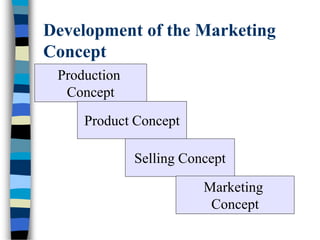
Development of the Marketing
Concept
Production
Concept
Selling Concept
Product Concept
Marketing
Concept
The Production Concept
 Assumes that consumers are interested
primarily in product availability at
low prices
 Marketing objectives:
– Cheap, efficient production
– Intensive distribution
– Market expansion
The Product Concept
 Assumes that consumers will buy the
product that offers them the highest
quality, the best performance, and the
most features
 Marketing objectives:
– Quality improvement
– Addition of features
 Tendency toward Marketing Myopia
The Selling Concept
 Assumes that consumers are unlikely
to buy a product unless they are
aggressively persuaded to do so
 Marketing objectives:
– Sell, sell, sell
 Lack of concern for customer needs
and satisfaction
The Marketing Concept
 Assumes that to be successful, a
company must determine the needs and
wants of specific target markets and
deliver the desired satisfactions better
than the competition
 Marketing objectives:
–Profits through customer satisfaction
Implementing the Marketing
Concept
Consumer Research
Segmentation
Targeting
Positioning
Segmentation, Targeting, and
Positioning
 Segmentation: process of dividing the
market into subsets of consumers with
common needs or characteristics
 Targeting: selecting one ore more of
the segments to pursue
 Positioning: developing a distinct
image for the product in the mind of
the consumer
Successful Positioning
Communicating the benefits of
the product, rather than its
features
Communicating a Unique Selling
Proposition for the product
The Marketing Mix
Product
Price
Place
Promotion
The Societal Marketing Concept
 All companies prosper when society
prospers.
 Companies, as well as individuals,
would be better off if social
responsibility was an integral
component of every marketing decision.
 Requires all marketers adhere to
principles of social responsibility.
Digital Revolution in the
Marketplace
 Allows customization of products,
services, and promotional messages
like never before
 Enhances relationships with customers
more effectively and efficiently
 Has increased the power of customers
and given them access to more
information
Digital Revolution in the
Marketplace - Continued
The exchange between consumers
and marketers has become more
interactive
May affect the way marketing is
done
Changes brought on by the
digital revolution
 Changes in segmentation strategies
 Re-evaluation of promotional budgets
– reduced impact of television?
– More internet-based promotion?
 Integrated marketing becomes critical
– Using off-line promotions to drive
consumers to company’s website (and
vice-a-versa)
» Continued
Environmental factors that affect the
marketing challenge
 Extent to which the supply of valid products and
services exceed consumer demand
 Ability to communicate with customers quickly
and accurately
 Existence of multiple avenues of distribution
quickly and economically
 Extent to which marketers can influence to induce
distributors to comply with overall marketing
strategy
 Economic growth, both nationally and globally
Changes brought on by the digital
revolution - continued
 Revamping distribution systems
– Direct distribution becomes more of an option
 Pricing methods may need to be re-
evaluated
– Comparison shopping made easier
 Consumer research methods may
change
– How do you measure web-based promotions?
“Remember Me?”
I'm the fellow who goes into a restaurant, sits down and patiently
waits while the waitresses do everything but take my order. I'm
the fellow who goes into a department store and stands quietly
while the sales clerks finish their little chitchat. I'm the man
who drives into a gasoline station and never blows his horn, but
waits patiently while the attendant finishes reading his comic
book.
"Yes, you might say, I'm a good guy. But do you know who else I
am? I am the fellow who never comes back, and it amuses me
to see you spending thousands of dollars every year to get me
back into your store, when I was there in the first place, and all
you had to do to keep me was to give me a little service; show
me a little courtesy."
Source: From a Better Business Bureau bulletin submitted by An
Arkansas Reader to Dear Abby
THE NEW CONSUMER
“Meet the new customer and smile when
you do because she is your boss. It may
not be the person you thought you knew.
Instead of choosing from what you have to
offer, she tells you what she wants. You
figure it out how to give it to her.”
-Fortune Editor
A new product must satisfy
consumer needs, not the needs
and expectations of management.
 Understanding and adapting to
consumer motivation and
behaviour is not an option – it
becomes a necessity for
competitive survival
All managers must become astute
analysts of Consumer motivation
and Behaviour
Three foundations for marketing
decisions
Experience
Intuition
Research
Dominant forces shaping Consumer
Research
Factors that move an economy
from Production-driven to Market-
driven
Level of sophistication with which
human behaviour is understood in
psychology and other behavioural
sciences
Motivational Research
It seeks to learn what motivates
people in making choices. The
techniques are such as to delve into
the conscious, subconscious and
the unconscious.
‘women don’t buy cosmetics, they
buy hope.’
‘women bake cakes out of the
unconscious desire to give birth’
The advice to footwear salesmen
should be ‘Don’t sell shoes – sell
lovely feet’
Marketers must contend with small
changing segments of highly selective
buyers intent on receiving genuine value at
the lowest price
Enhancing Consumer Value-added
Marketers have to constantly innovate after
understanding their consumers to strip out
costs permanently by focusing on what
adds value for the customer and
eliminating what doesn’t.
Individualised Marketing
A very personal form of marketing
that recognises, acknowledges,
appreciates and serves individuals
who become or are known to the
marketer.
Data – based marketing; DM
Customized marketing
Consumer Behaviour
The behaviour that consumers
display in searching for,
purchasing, using, evaluating,
and disposing of products and
services that they expect will
satisfy their needs.
This study draws on concepts
from various other disciplines
Psychology
Sociology
Anthropology
Economics
Marketing
Anthropology
 The study of people
within and across
cultures
 Emphasis on cross-
cultural differences
 Questioning of
assumptions within own
culture
Economics
 Basic economic issues
– Supply and demand
– Rational decision making
– Perfect information
 Emphasis on predicting
behavior
 Complications in real life
 Behavioral economics—
e.g., “mental accounting”
History and Geography
 Origins of behavior,
perspectives, and
traditions
 Impact of geography on
individuals
– Isolation
– Language development
– Climate
 Geographic determinism
Psychology
 Study of human
thinking and behavior
 Some issues
– Personality
– Personal development
– Cognition (thinking),
perception
– Attention and its
limitations
– “Learning”—e.g.,
acquired tastes
Sociology
 Cultural and
interpersonal influences
on consumption—e.g.,
– Fads, fashions
– Diffusion of innovation
– Popular culture
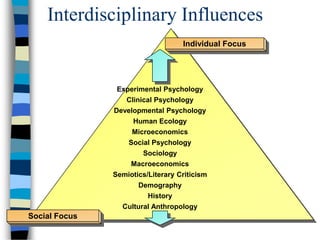
Interdisciplinary Influences
Experimental Psychology
Clinical Psychology
Developmental Psychology
Human Ecology
Microeconomics
Social Psychology
Sociology
Macroeconomics
Semiotics/Literary Criticism
Demography
History
Cultural Anthropology
Individual Focus
Social Focus
The Nature of Consumer
Behavior
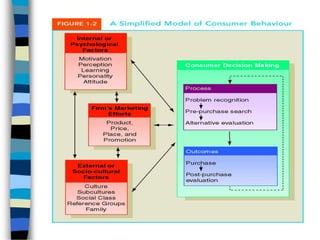
 External Influences
 Internal Influences
 Self-Concept
 Situations
 Experiences and
acquisitions
Variables involved in
understanding consumer
behaviour
 Stimulus – ads, products, hunger-
pangs
 Response – physical/mental
reaction to the stimulus
 Intervening variables – mood,
knowledge, attitude, values,
situations, etc.
Cultural/Social Factors
Culture
Social Class
Reference groups
Family
Personal
Roles & Status in the society.
Situational Factors
 Physical and social surroundings (i.e.
the actual environment within which a
person lives.
 Timing (i.e. the propensity/opportunity
to purchase).
 Type of purchase.
 Prior experience.
Psychological Factors
Self-concept.
Motivations.
Perceptions.
Knowledge.
Beliefs/Attitudes.
Need to study ?
‘You cannot take the consumer for granted any more’
Therefore a sound understanding of consumer behaviour
is essential for the long run success of any marketing
program
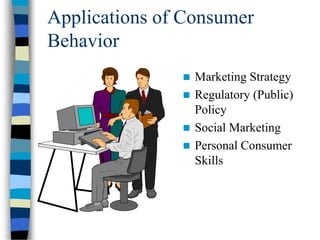
Applications of Consumer
Behavior
 Marketing Strategy
 Regulatory (Public)
Policy
 Social Marketing
 Personal Consumer
Skills
Applications of Consumer
Behavior…
 Understanding consumer behavior is good
business.
– Firms exist to satisfy consumers’ needs, so
– Firms must understand consumers needs to satisfy
them.
 The Process of Marketing Segmentation:
– Identifies Groups of Consumers Who are Similar
to One Another in One or More Ways, and
– Devises Marketing Strategies that Appeal to
One or More of These Groups.
Why study consumer behaviour?
 Understanding consumer behaviour
will help you become better marketers
as it is the foundation for
 Segmenting markets
 Positioning products
 Developing an appropriate marketing
 continued
Why study consumer behaviour?
 Knowledge of consumer behaviour is
essential for non-profit organizations
– Non profits have different customers to
please
– Donors, users, volunteers, general public,
government
» continued
Why study consumer behaviour?
 Public service initiatives have to be
based on an understanding of
consumer behaviour
– Canada’s largest advertiser is the federal
government
– Most government initiatives (e.g.,
antismoking campaigns) need a
knowledge of consumer behaviour to
succeed
» continued
Why study consumer behaviour?
Better understanding of our own
consumption behaviour
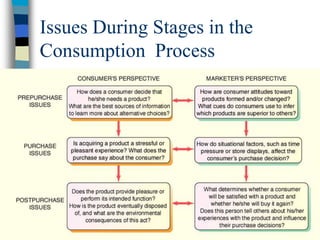
Issues During Stages in the
Consumption Process
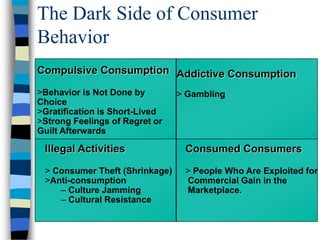
The Dark Side of Consumer
Behavior
Compulsive Consumption
>Behavior is Not Done by
Choice
>Gratification is Short-Lived
>Strong Feelings of Regret or
Guilt Afterwards
Illegal Activities
> Consumer Theft (Shrinkage)
>Anti-consumption
– Culture Jamming
– Cultural Resistance
Consumed Consumers
> People Who Are Exploited for
Commercial Gain in the
Marketplace.
Addictive Consumption
> Gambling
Business Leaders Who Understood
Consumer Behaviour
 Alfred Sloan, General Motors
 Colonel Sanders, KFC
 Ray Kroc, McDonald’s

chapter 1-Introduction to Consumer Behavior.pptx

  • 1.
    Chapter 1 Introduction toConsumer Behaviour
  • 2.
    The changing equation Out of 11000 products launched by 77 companies, only 56% are present five years later – Kuczmaski & Associates  Only 8% of new product concepts offered by 112 leading companies reached the market. Out of this 83% failed to reach marketing objectives – Group EFO Ltd., Marketing News, Feb 1, 1993, Pg 2
  • 3.
    Development of theMarketing Concept Production Concept Selling Concept Product Concept Marketing Concept
  • 4.
    The Production Concept Assumes that consumers are interested primarily in product availability at low prices  Marketing objectives: – Cheap, efficient production – Intensive distribution – Market expansion
  • 5.
    The Product Concept Assumes that consumers will buy the product that offers them the highest quality, the best performance, and the most features  Marketing objectives: – Quality improvement – Addition of features  Tendency toward Marketing Myopia
  • 6.
    The Selling Concept Assumes that consumers are unlikely to buy a product unless they are aggressively persuaded to do so  Marketing objectives: – Sell, sell, sell  Lack of concern for customer needs and satisfaction
  • 7.
    The Marketing Concept Assumes that to be successful, a company must determine the needs and wants of specific target markets and deliver the desired satisfactions better than the competition  Marketing objectives: –Profits through customer satisfaction
  • 8.
    Implementing the Marketing Concept ConsumerResearch Segmentation Targeting Positioning
  • 9.
    Segmentation, Targeting, and Positioning Segmentation: process of dividing the market into subsets of consumers with common needs or characteristics  Targeting: selecting one ore more of the segments to pursue  Positioning: developing a distinct image for the product in the mind of the consumer
  • 10.
    Successful Positioning Communicating thebenefits of the product, rather than its features Communicating a Unique Selling Proposition for the product
  • 11.
  • 12.
    The Societal MarketingConcept  All companies prosper when society prospers.  Companies, as well as individuals, would be better off if social responsibility was an integral component of every marketing decision.  Requires all marketers adhere to principles of social responsibility.
  • 13.
    Digital Revolution inthe Marketplace  Allows customization of products, services, and promotional messages like never before  Enhances relationships with customers more effectively and efficiently  Has increased the power of customers and given them access to more information
  • 14.
    Digital Revolution inthe Marketplace - Continued The exchange between consumers and marketers has become more interactive May affect the way marketing is done
  • 15.
    Changes brought onby the digital revolution  Changes in segmentation strategies  Re-evaluation of promotional budgets – reduced impact of television? – More internet-based promotion?  Integrated marketing becomes critical – Using off-line promotions to drive consumers to company’s website (and vice-a-versa) » Continued
  • 16.
    Environmental factors thataffect the marketing challenge  Extent to which the supply of valid products and services exceed consumer demand  Ability to communicate with customers quickly and accurately  Existence of multiple avenues of distribution quickly and economically  Extent to which marketers can influence to induce distributors to comply with overall marketing strategy  Economic growth, both nationally and globally
  • 17.
    Changes brought onby the digital revolution - continued  Revamping distribution systems – Direct distribution becomes more of an option  Pricing methods may need to be re- evaluated – Comparison shopping made easier  Consumer research methods may change – How do you measure web-based promotions?
  • 18.
    “Remember Me?” I'm thefellow who goes into a restaurant, sits down and patiently waits while the waitresses do everything but take my order. I'm the fellow who goes into a department store and stands quietly while the sales clerks finish their little chitchat. I'm the man who drives into a gasoline station and never blows his horn, but waits patiently while the attendant finishes reading his comic book. "Yes, you might say, I'm a good guy. But do you know who else I am? I am the fellow who never comes back, and it amuses me to see you spending thousands of dollars every year to get me back into your store, when I was there in the first place, and all you had to do to keep me was to give me a little service; show me a little courtesy." Source: From a Better Business Bureau bulletin submitted by An Arkansas Reader to Dear Abby
  • 19.
    THE NEW CONSUMER “Meetthe new customer and smile when you do because she is your boss. It may not be the person you thought you knew. Instead of choosing from what you have to offer, she tells you what she wants. You figure it out how to give it to her.” -Fortune Editor
  • 20.
    A new productmust satisfy consumer needs, not the needs and expectations of management.  Understanding and adapting to consumer motivation and behaviour is not an option – it becomes a necessity for competitive survival
  • 21.
    All managers mustbecome astute analysts of Consumer motivation and Behaviour Three foundations for marketing decisions Experience Intuition Research
  • 22.
    Dominant forces shapingConsumer Research Factors that move an economy from Production-driven to Market- driven Level of sophistication with which human behaviour is understood in psychology and other behavioural sciences
  • 23.
    Motivational Research It seeksto learn what motivates people in making choices. The techniques are such as to delve into the conscious, subconscious and the unconscious. ‘women don’t buy cosmetics, they buy hope.’ ‘women bake cakes out of the unconscious desire to give birth’
  • 24.
    The advice tofootwear salesmen should be ‘Don’t sell shoes – sell lovely feet’ Marketers must contend with small changing segments of highly selective buyers intent on receiving genuine value at the lowest price
  • 25.
    Enhancing Consumer Value-added Marketershave to constantly innovate after understanding their consumers to strip out costs permanently by focusing on what adds value for the customer and eliminating what doesn’t.
  • 26.
    Individualised Marketing A verypersonal form of marketing that recognises, acknowledges, appreciates and serves individuals who become or are known to the marketer. Data – based marketing; DM Customized marketing
  • 28.
    Consumer Behaviour The behaviourthat consumers display in searching for, purchasing, using, evaluating, and disposing of products and services that they expect will satisfy their needs.
  • 29.
    This study drawson concepts from various other disciplines Psychology Sociology Anthropology Economics Marketing
  • 30.
    Anthropology  The studyof people within and across cultures  Emphasis on cross- cultural differences  Questioning of assumptions within own culture
  • 31.
    Economics  Basic economicissues – Supply and demand – Rational decision making – Perfect information  Emphasis on predicting behavior  Complications in real life  Behavioral economics— e.g., “mental accounting”
  • 32.
    History and Geography Origins of behavior, perspectives, and traditions  Impact of geography on individuals – Isolation – Language development – Climate  Geographic determinism
  • 33.
    Psychology  Study ofhuman thinking and behavior  Some issues – Personality – Personal development – Cognition (thinking), perception – Attention and its limitations – “Learning”—e.g., acquired tastes
  • 34.
    Sociology  Cultural and interpersonalinfluences on consumption—e.g., – Fads, fashions – Diffusion of innovation – Popular culture
  • 35.
    Interdisciplinary Influences Experimental Psychology ClinicalPsychology Developmental Psychology Human Ecology Microeconomics Social Psychology Sociology Macroeconomics Semiotics/Literary Criticism Demography History Cultural Anthropology Individual Focus Social Focus
  • 36.
    The Nature ofConsumer Behavior  External Influences  Internal Influences  Self-Concept  Situations  Experiences and acquisitions
  • 37.
    Variables involved in understandingconsumer behaviour  Stimulus – ads, products, hunger- pangs  Response – physical/mental reaction to the stimulus  Intervening variables – mood, knowledge, attitude, values, situations, etc.
  • 38.
    Cultural/Social Factors Culture Social Class Referencegroups Family Personal Roles & Status in the society.
  • 39.
    Situational Factors  Physicaland social surroundings (i.e. the actual environment within which a person lives.  Timing (i.e. the propensity/opportunity to purchase).  Type of purchase.  Prior experience.
  • 40.
  • 41.
    Need to study? ‘You cannot take the consumer for granted any more’ Therefore a sound understanding of consumer behaviour is essential for the long run success of any marketing program
  • 42.
    Applications of Consumer Behavior Marketing Strategy  Regulatory (Public) Policy  Social Marketing  Personal Consumer Skills
  • 43.
    Applications of Consumer Behavior… Understanding consumer behavior is good business. – Firms exist to satisfy consumers’ needs, so – Firms must understand consumers needs to satisfy them.  The Process of Marketing Segmentation: – Identifies Groups of Consumers Who are Similar to One Another in One or More Ways, and – Devises Marketing Strategies that Appeal to One or More of These Groups.
  • 44.
    Why study consumerbehaviour?  Understanding consumer behaviour will help you become better marketers as it is the foundation for  Segmenting markets  Positioning products  Developing an appropriate marketing  continued
  • 45.
    Why study consumerbehaviour?  Knowledge of consumer behaviour is essential for non-profit organizations – Non profits have different customers to please – Donors, users, volunteers, general public, government » continued
  • 46.
    Why study consumerbehaviour?  Public service initiatives have to be based on an understanding of consumer behaviour – Canada’s largest advertiser is the federal government – Most government initiatives (e.g., antismoking campaigns) need a knowledge of consumer behaviour to succeed » continued
  • 47.
    Why study consumerbehaviour? Better understanding of our own consumption behaviour
  • 48.
    Issues During Stagesin the Consumption Process
  • 49.
    The Dark Sideof Consumer Behavior Compulsive Consumption >Behavior is Not Done by Choice >Gratification is Short-Lived >Strong Feelings of Regret or Guilt Afterwards Illegal Activities > Consumer Theft (Shrinkage) >Anti-consumption – Culture Jamming – Cultural Resistance Consumed Consumers > People Who Are Exploited for Commercial Gain in the Marketplace. Addictive Consumption > Gambling
  • 51.
    Business Leaders WhoUnderstood Consumer Behaviour  Alfred Sloan, General Motors  Colonel Sanders, KFC  Ray Kroc, McDonald’s