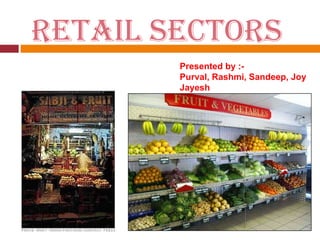
RETAIL SECTORS   Presented by :- Purval, Rashmi, Sandeep, Joy Jayesh
Retail Sector
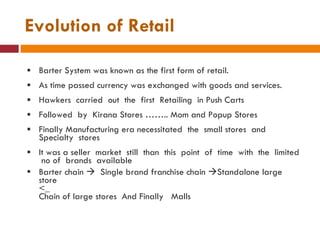
Evolution of Retail Barter System was known as the first form of retail. As time passed currency was exchanged with goods and services. Hawkers  carried  out  the  first  Retailing  in Push Carts Followed  by  Kirana Stores …….. Mom and Popup Stores Finally Manufacturing era necessitated  the  small stores  and Specialty  stores  It was a seller  market  still  than  this  point  of  time  with  the  limited  no of  brands  available  Barter chain     Single brand franchise chain   Standalone large store  <_ Chain of large stores  And Finally  Malls
Economist says  that Boom Has  Started of Retail due to more spending Capacity of Indians  Emerging of  retail started  in brief in patterns  like  changing face of the Indian retail sector  Provide customers with 3 V’s i.e.  Value, Variety and Volume.
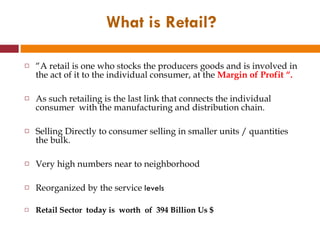
“ A retail is one who stocks the producers goods and is involved in the act of it to the individual consumer, at the  Margin of Profit “. As such retailing is the last link that connects the individual consumer  with the manufacturing and distribution chain. Selling Directly to consumer selling in smaller units / quantities the bulk. Very high numbers near to neighborhood Reorganized by the service  levels  Retail Sector  today is  worth  of  394 Billion Us $ What is Retail?
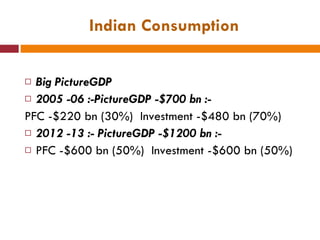
Indian Consumption Big PictureGDP  2005 -06 :-PictureGDP -$700 bn :- PFC -$220 bn (30%)  Investment -$480 bn (70%)  2012 -13 :- PictureGDP -$1200 bn :- PFC -$600 bn (50%)  Investment -$600 bn (50%)
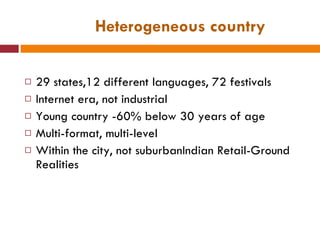
Heterogeneous country 29 states,12 different languages, 72 festivals Internet era, not industrial Young country -60% below 30 years of age Multi-format, multi-level Within the city, not suburbanIndian Retail-Ground Realities
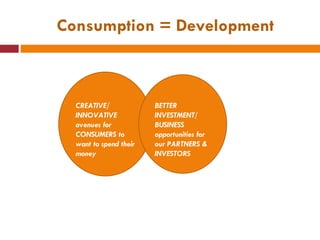
Consumption = Development CREATIVE/ INNOVATIVE avenues for CONSUMERS to want to spend their money BETTER INVESTMENT/ BUSINESS opportunities for our PARTNERS & INVESTORS
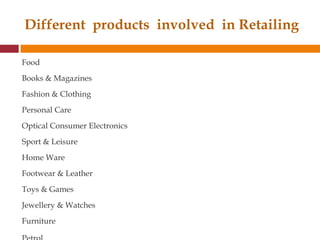
Food        Books & Magazines Fashion & Clothing   Personal Care Optical Consumer Electronics   Sport & Leisure Home Ware  Footwear & Leather  Toys & Games Jewellery & Watches  Furniture  Petrol           Different  products  involved  in Retailing
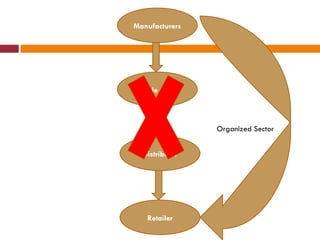
Manufacturers Whole seller Distributor Retailer Organized Sector
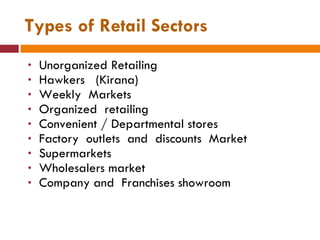
Types of Retail Sectors Unorganized Retailing  Hawkers  (Kirana)  Weekly  Markets  Organized  retailing  Convenient / Departmental stores  Factory  outlets  and  discounts  Market  Supermarkets  Wholesalers market  Company and  Franchises showroom
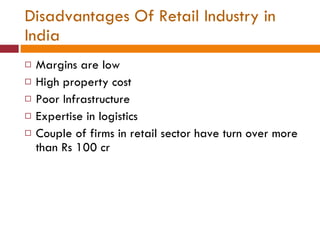
Disadvantages Of Retail Industry in India Margins are low High property cost Poor Infrastructure Expertise in logistics Couple of firms in retail sector have turn over more than Rs 100 cr
Factors that attracted major industry players to enter the retail sector Phenomenal success of certain players in retail sector Eg: Shopper’s Stop Hype created by management consultants and media Phenomenal growth of service sector and down turn in manufacturing sector A good way to leverage existing property Eg: Primals started developing Crossroads after closing of Roche factory they have acquired on prime property in Mumbai
Cont… . Globalization Success of organized retail sector in developed countries Changes in Consumer behavior and increase in their purchasing power. Ever green demand for basic things like food Negative working capital ; Companies buy on credit and sell for cash
Importance Largest and fastest growing sector in India. Modern retailing forms one point stop for all shopping.  Consumer gets a large product variety of brands to choose from one roof. First it was a sellers market and now its changing to  buyers market. By 2010 Indian retail sector would be generating 10 million employment opportunities.

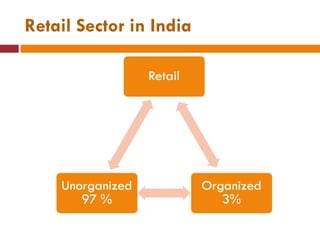
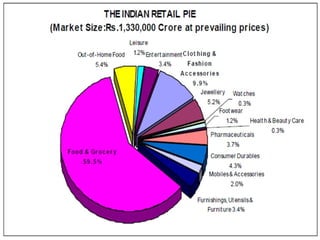
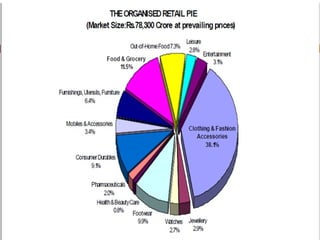
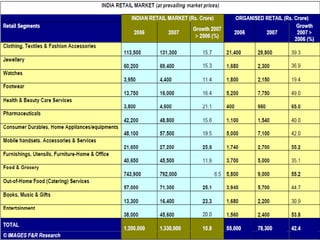
Retail Sector in India
 
 
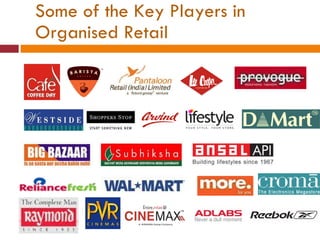
Some of the Key Players in Organised Retail
 
 
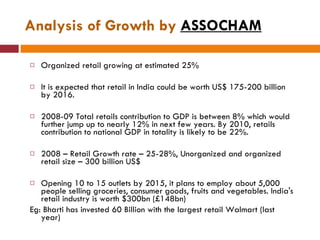
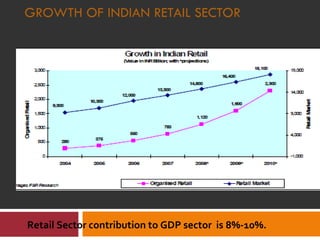
Analysis of Growth by  ASSOCHAM Organized retail growing at estimated 25%  It is expected that retail in India could be worth US$ 175-200 billion by 2016.  2008-09 Total retails contribution to GDP is between 8% which would further jump up to nearly 12% in next few years. By 2010, retails contribution to national GDP in totality is likely to be 22%. 2008 – Retail Growth rate – 25-28%, Unorganized and organized retail size – 300 billion US$  Opening 10 to 15 outlets by 2015, it plans to employ about 5,000 people selling groceries, consumer goods, fruits and vegetables. India's retail industry is worth $300bn (£148bn) Eg: Bharti has invested 60 Billion with the largest retail Walmart (last year)
GROWTH OF INDIAN RETAIL SECTOR Retail Sector contribution to GDP sector  is 8%-10%.
 
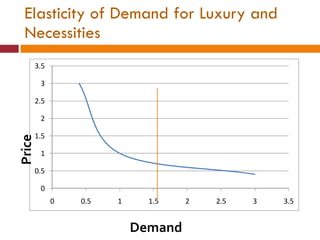
Elasticity of Demand for Luxury and Necessities Price Demand
Government Policies The retail industry in India is growing at a significant pace. However, there are several problems faced by the industry. The major challenges for the organized sector include: Taxation laws that favor small retailers. Multi-point octroi collection. According to analysts, for this industry to thrive, Indian retailers need to emulate worldwide retail practices such as accuracy in financial reporting, increased levels of corporate governance and greater accountability among employees.  Foreign Equity  does not go beyond 51 percent. Additions to the product categories to be sold under ‘single brand’ require fresh govt. approval.
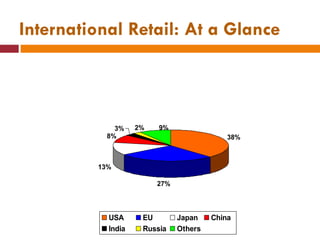
International Retail: At a Glance
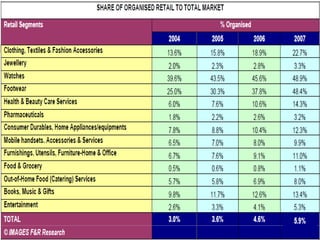
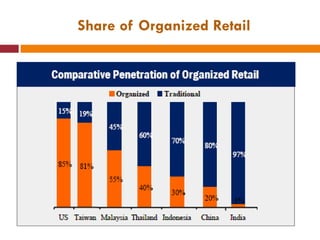
Share of Organized Retail
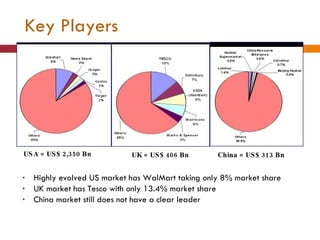
Key Players Highly evolved US market has WalMart taking only 8% market share  UK market has Tesco with only 13.4% market share China market still does not have a clear leader  USA = US$ 2,350 Bn UK = US$ 406 Bn China = US$ 313 Bn
SWOT Analysis
Strength Increasing demand driven by the country’s young working population Increase in per capita income which in turn increases the household consumption Create win-win situation for all links in value chain ( suppliers, producers, retailers and customers). Improvement in the standard of living. Technology intensive industry
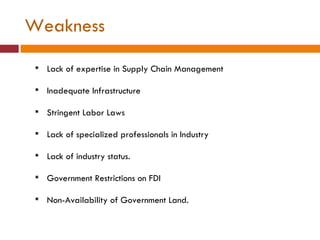
Weakness  Lack of expertise in Supply Chain Management Inadequate Infrastructure Stringent Labor Laws Lack of specialized professionals in Industry Lack of industry status. Government Restrictions on FDI Non-Availability of Government Land.
Opportunities Change in consumer behavior pattern and increase in disposable income. It is estimated that 15 million people would be engaged in Retail and Retail support activities by 2010 Indian rural markets offer a sea of an opportunity for the retail sector. Upcoming international Players Healthy prospect for the fashion industry.
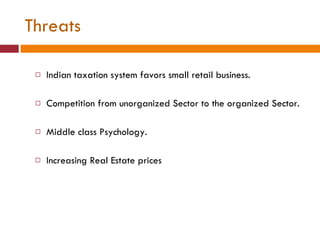
Threats Indian taxation system favors small retail business.  Competition from unorganized Sector to the organized Sector. Middle class Psychology. Increasing Real Estate prices
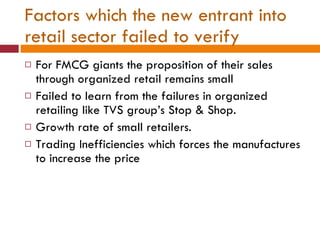
Factors which the new entrant into retail sector failed to verify For FMCG giants the proposition of their sales through organized retail remains small Failed to learn from the failures in organized retailing like TVS group’s Stop & Shop. Growth rate of small retailers. Trading Inefficiencies which forces the manufactures to increase the price
Cont…. Small retailers can compensate this by personalized services like credit and free home delivery.  Unsupportive nature of few manufactures like not printing the bar codes, despite this being so important for retail logistics.
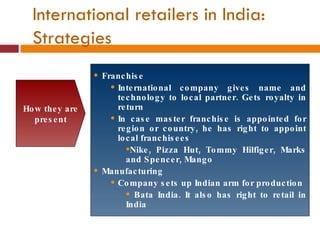
Franchise International company gives name and technology to local partner. Gets royalty in return In case master franchise is appointed for region or country, he has right to appoint local franchisees Nike, Pizza Hut, Tommy Hilfiger, Marks and Spencer, Mango Manufacturing Company sets up Indian arm for production Bata India. It also has right to retail in India How they are present International retailers in India: Strategies
Distribution International company sets up local distribution office Supply products to Indian retailers to sell Also set up franchised outlets for brand Swarovski, Hugo Boss Wholesale trading Cash and Carry operations 100% FDI permitted Metro Cash n Carry How they are present International retailers in India: Strategies
Improve competition Develop the market Greater level of exports due to increased sourcing by major players Sourcing by Wal-Mart from China improved multifold after FDI permitted in China Similar increase in sourcing observed for Metro in India Provides access to global markets for Indian producers Benefits of FDI Why FDI?
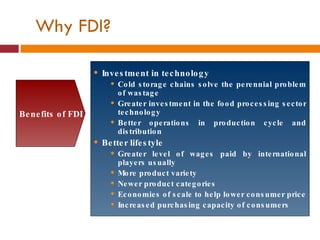
Investment in technology Cold storage chains solve the perennial problem of wastage Greater investment in the food processing sector technology Better operations in production cycle and distribution Better lifestyle Greater level of wages paid by international players usually More product variety Newer product categories Economies of scale to help lower consumer price Increased purchasing capacity of consumers Benefits of FDI Why FDI?
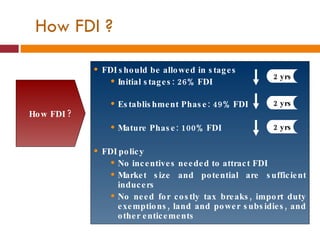
FDI should be allowed in stages Initial stages: 26% FDI Establishment Phase: 49% FDI Mature Phase: 100% FDI FDI policy No incentives needed to attract FDI Market size and potential are sufficient inducers No need for costly tax breaks, import duty exemptions, land and power subsidies, and other enticements How FDI ? How FDI ? 2 yrs 2 yrs 2 yrs
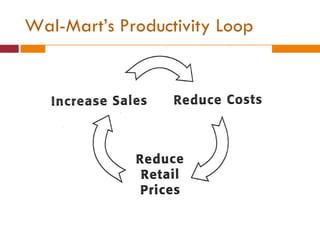
Wal-Mart’s Productivity Loop
Consequences of Wal-Mart’s Productivity Loop Step 1: Reduce Costs Squeeze suppliers Extracts producer revenues Relocated manufacturing overseas Increase foreign debts Erodes Wages and Benefits Low wages in a low-wage sector Working off the clock Skimps on benefits, e.g., health care
Consequences of Wal-Mart’s Productivity Loop Step 2: Reduce Retail Prices Improves consumer living standards Increases consumer purchasing power Displaces existing retailers Drives out small chains and independent producers Displaces existing suppliers Excludes local businesses from internal Wal-Mart supply systems Triggers retail price wars Pressures industry rivals to imitate its operative behavior Extends to national and global markets
Consequences of Wal-Mart’s Productivity Loop Step 3: Increase Sales Increases efficiency of supply systems Higher sales volume means greater economies of scale Facilitates additional consumer debt
Kishore Biyani and Big Bazaar Starts with his family business in textile. 1987 he launched frist ready-made trousers brand- Pantaloon. 1992 Pantaloon Fashion went public. Started manufacturing garments under two more brands – John Miller and Bare. The business seems unviable due to high distribution cost and margins. 1997 – opened his first store at Kolkata.
Cont… Store did a business worth Rs 100 million. 2001 he introduced the hypermarket concept adapted to Indian conditions in the form of Big Bazaar(Mumbai). For further expansion Biyani went for a loan of Rs 1.2 billion. Was able to pull out over1,00,000 people within 1 st  week of its operation.
Cont…. Gave the Indian customers the feel of local market place – narrow lanes, crowded market place and customers bumping into each other and into commodities. He understood that Indian like the hustle-bustle of the market place, which gives them a feeling that the goods are sold at a lower price. Exploited the Economics of scale. Tie up with manufactures to bring down the selling price of products.
Cont…. 2002 Biyani started Food Bazaar within Big Bazaar. Focused on “Farm To Plate“ concept in Food Bazaar (Farm next to the store). Sold In House products. Used traditional supply chain management. His principle was “KIS” Keep It Simple; ie not making the operations complex.
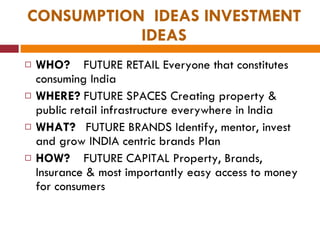
CONSUMPTION  IDEAS INVESTMENT IDEAS WHO?  FUTURE RETAIL Everyone that constitutes consuming India WHERE?  FUTURE SPACES Creating property & public retail infrastructure everywhere in India  WHAT?  FUTURE BRANDS Identify, mentor, invest and grow INDIA centric brands Plan  HOW?  FUTURE CAPITAL Property, Brands, Insurance & most importantly easy access to money for consumers
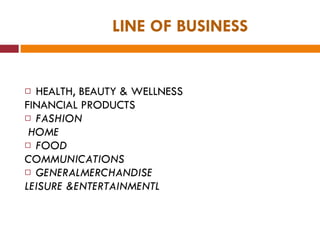
LINE OF BUSINESS HEALTH, BEAUTY & WELLNESS  FINANCIAL PRODUCTS FASHION HOME FOOD  COMMUNICATIONS GENERALMERCHANDISE  LEISURE &ENTERTAINMENTL
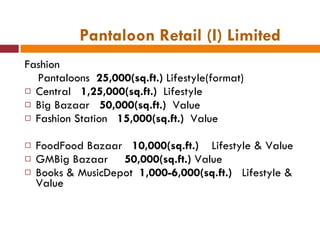
Pantaloon Retail (I) Limited Fashion Pantaloons  25,000(sq.ft.)  Lifestyle(format) Central  1,25,000(sq.ft.)  Lifestyle Big Bazaar  50,000(sq.ft.)  Value Fashion Station  15,000(sq.ft.)  Value FoodFood Bazaar  10,000(sq.ft.)  Lifestyle & Value GMBig Bazaar  50,000(sq.ft.)  Value Books & MusicDepot  1,000-6,000(sq.ft.)   Lifestyle & Value
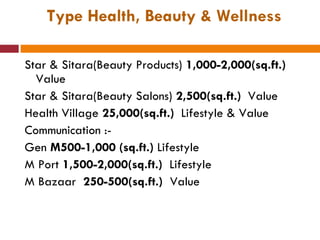
Type Health, Beauty & Wellness Star & Sitara(Beauty Products)  1,000-2,000(sq.ft.)   Value Star & Sitara(Beauty Salons)  2,500(sq.ft.)  Value Health Village  25,000(sq.ft.)  Lifestyle & Value Communication :- Gen  M500-1,000 (sq.ft.)  Lifestyle M Port  1,500-2,000(sq.ft.)  Lifestyle M Bazaar  250-500(sq.ft.)   Value
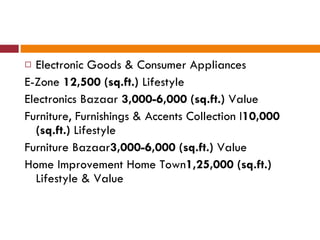
Electronic Goods & Consumer Appliances E-Zone  12,500 (sq.ft.)  Lifestyle Electronics Bazaar  3,000-6,000 (sq.ft.)  Value Furniture, Furnishings & Accents Collection I 10,000 (sq.ft.)  Lifestyle Furniture Bazaar 3,000-6,000 (sq.ft.)  Value Home Improvement Home Town 1,25,000 (sq.ft.)  Lifestyle & Value
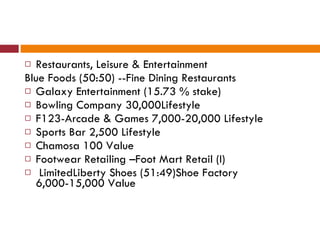
Restaurants, Leisure & Entertainment Blue Foods (50:50) --Fine Dining Restaurants Galaxy Entertainment (15.73 % stake) Bowling Company 30,000Lifestyle  F123-Arcade & Games 7,000-20,000 Lifestyle Sports Bar 2,500 Lifestyle Chamosa 100 Value Footwear Retailing –Foot Mart Retail (I) LimitedLiberty Shoes (51:49)Shoe Factory 6,000-15,000 Value
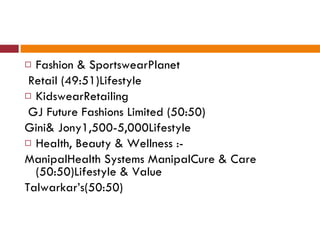
Fashion & SportswearPlanet Retail (49:51)Lifestyle KidswearRetailing GJ Future Fashions Limited (50:50) Gini& Jony1,500-5,000Lifestyle Health, Beauty & Wellness :- ManipalHealth Systems ManipalCure & Care (50:50)Lifestyle & Value Talwarkar’s(50:50)
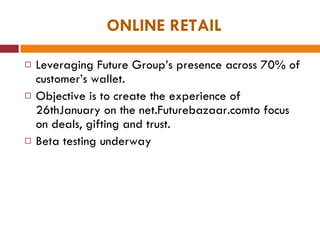
ONLINE RETAIL Leveraging Future Group’s presence across 70% of customer’s wallet. Objective is to create the experience of 26thJanuary on the net.Futurebazaar.comto focus on deals, gifting and trust. Beta testing underway
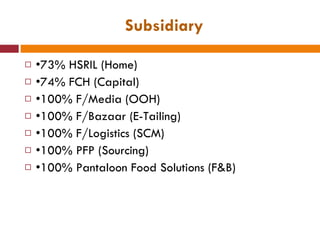
Subsidiary • 73% HSRIL (Home) • 74% FCH (Capital) • 100% F/Media (OOH) • 100% F/Bazaar (E-Tailing) • 100% F/Logistics (SCM) • 100% PFP (Sourcing) • 100% Pantaloon Food Solutions (F&B)
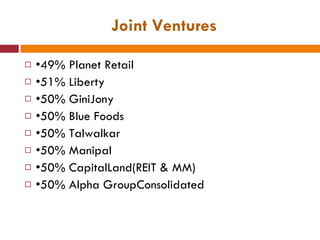
Joint Ventures • 49% Planet Retail • 51% Liberty • 50% GiniJony • 50% Blue Foods • 50% Talwalkar • 50% Manipal • 50% CapitalLand(REIT & MM) • 50% Alpha GroupConsolidated
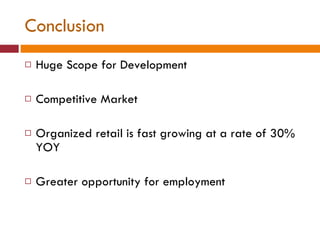
Conclusion Huge Scope for Development Competitive Market Organized retail is fast growing at a rate of 30% YOY Greater opportunity for employment
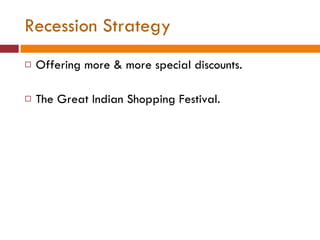
Recession Strategy Offering more & more special discounts. The Great Indian Shopping Festival.
 

Retail Sector In India

  • 1.
    RETAIL SECTORS Presented by :- Purval, Rashmi, Sandeep, Joy Jayesh
  • 2.
  • 3.
    Evolution of RetailBarter System was known as the first form of retail. As time passed currency was exchanged with goods and services. Hawkers carried out the first Retailing in Push Carts Followed by Kirana Stores …….. Mom and Popup Stores Finally Manufacturing era necessitated the small stores and Specialty stores It was a seller market still than this point of time with the limited no of brands available Barter chain  Single brand franchise chain  Standalone large store <_ Chain of large stores And Finally Malls
  • 4.
    Economist says that Boom Has Started of Retail due to more spending Capacity of Indians Emerging of retail started in brief in patterns like changing face of the Indian retail sector Provide customers with 3 V’s i.e. Value, Variety and Volume.
  • 5.
    “ A retailis one who stocks the producers goods and is involved in the act of it to the individual consumer, at the Margin of Profit “. As such retailing is the last link that connects the individual consumer with the manufacturing and distribution chain. Selling Directly to consumer selling in smaller units / quantities the bulk. Very high numbers near to neighborhood Reorganized by the service levels Retail Sector today is worth of 394 Billion Us $ What is Retail?
  • 6.
    Indian Consumption BigPictureGDP 2005 -06 :-PictureGDP -$700 bn :- PFC -$220 bn (30%) Investment -$480 bn (70%) 2012 -13 :- PictureGDP -$1200 bn :- PFC -$600 bn (50%) Investment -$600 bn (50%)
  • 7.
    Heterogeneous country 29states,12 different languages, 72 festivals Internet era, not industrial Young country -60% below 30 years of age Multi-format, multi-level Within the city, not suburbanIndian Retail-Ground Realities
  • 8.
    Consumption = DevelopmentCREATIVE/ INNOVATIVE avenues for CONSUMERS to want to spend their money BETTER INVESTMENT/ BUSINESS opportunities for our PARTNERS & INVESTORS
  • 9.
    Food        Books &Magazines Fashion & Clothing   Personal Care Optical Consumer Electronics   Sport & Leisure Home Ware Footwear & Leather  Toys & Games Jewellery & Watches Furniture  Petrol           Different products involved in Retailing
  • 10.
    Manufacturers Whole sellerDistributor Retailer Organized Sector
  • 11.
    Types of RetailSectors Unorganized Retailing Hawkers (Kirana) Weekly Markets Organized retailing Convenient / Departmental stores Factory outlets and discounts Market Supermarkets Wholesalers market Company and Franchises showroom
  • 12.
    Disadvantages Of RetailIndustry in India Margins are low High property cost Poor Infrastructure Expertise in logistics Couple of firms in retail sector have turn over more than Rs 100 cr
  • 13.
    Factors that attractedmajor industry players to enter the retail sector Phenomenal success of certain players in retail sector Eg: Shopper’s Stop Hype created by management consultants and media Phenomenal growth of service sector and down turn in manufacturing sector A good way to leverage existing property Eg: Primals started developing Crossroads after closing of Roche factory they have acquired on prime property in Mumbai
  • 14.
    Cont… . GlobalizationSuccess of organized retail sector in developed countries Changes in Consumer behavior and increase in their purchasing power. Ever green demand for basic things like food Negative working capital ; Companies buy on credit and sell for cash
  • 15.
    Importance Largest andfastest growing sector in India. Modern retailing forms one point stop for all shopping. Consumer gets a large product variety of brands to choose from one roof. First it was a sellers market and now its changing to buyers market. By 2010 Indian retail sector would be generating 10 million employment opportunities.
  • 16.
  • 17.
  • 18.
  • 19.
    Some of theKey Players in Organised Retail
  • 20.
  • 21.
  • 22.
    Analysis of Growthby ASSOCHAM Organized retail growing at estimated 25% It is expected that retail in India could be worth US$ 175-200 billion by 2016. 2008-09 Total retails contribution to GDP is between 8% which would further jump up to nearly 12% in next few years. By 2010, retails contribution to national GDP in totality is likely to be 22%. 2008 – Retail Growth rate – 25-28%, Unorganized and organized retail size – 300 billion US$ Opening 10 to 15 outlets by 2015, it plans to employ about 5,000 people selling groceries, consumer goods, fruits and vegetables. India's retail industry is worth $300bn (£148bn) Eg: Bharti has invested 60 Billion with the largest retail Walmart (last year)
  • 23.
    GROWTH OF INDIANRETAIL SECTOR Retail Sector contribution to GDP sector is 8%-10%.
  • 24.
  • 25.
    Elasticity of Demandfor Luxury and Necessities Price Demand
  • 26.
    Government Policies Theretail industry in India is growing at a significant pace. However, there are several problems faced by the industry. The major challenges for the organized sector include: Taxation laws that favor small retailers. Multi-point octroi collection. According to analysts, for this industry to thrive, Indian retailers need to emulate worldwide retail practices such as accuracy in financial reporting, increased levels of corporate governance and greater accountability among employees. Foreign Equity does not go beyond 51 percent. Additions to the product categories to be sold under ‘single brand’ require fresh govt. approval.
  • 27.
  • 28.
  • 29.
    Key Players Highlyevolved US market has WalMart taking only 8% market share UK market has Tesco with only 13.4% market share China market still does not have a clear leader USA = US$ 2,350 Bn UK = US$ 406 Bn China = US$ 313 Bn
  • 30.
  • 31.
    Strength Increasing demanddriven by the country’s young working population Increase in per capita income which in turn increases the household consumption Create win-win situation for all links in value chain ( suppliers, producers, retailers and customers). Improvement in the standard of living. Technology intensive industry
  • 32.
    Weakness Lackof expertise in Supply Chain Management Inadequate Infrastructure Stringent Labor Laws Lack of specialized professionals in Industry Lack of industry status. Government Restrictions on FDI Non-Availability of Government Land.
  • 33.
    Opportunities Change inconsumer behavior pattern and increase in disposable income. It is estimated that 15 million people would be engaged in Retail and Retail support activities by 2010 Indian rural markets offer a sea of an opportunity for the retail sector. Upcoming international Players Healthy prospect for the fashion industry.
  • 34.
    Threats Indian taxationsystem favors small retail business. Competition from unorganized Sector to the organized Sector. Middle class Psychology. Increasing Real Estate prices
  • 35.
    Factors which thenew entrant into retail sector failed to verify For FMCG giants the proposition of their sales through organized retail remains small Failed to learn from the failures in organized retailing like TVS group’s Stop & Shop. Growth rate of small retailers. Trading Inefficiencies which forces the manufactures to increase the price
  • 36.
    Cont…. Small retailerscan compensate this by personalized services like credit and free home delivery. Unsupportive nature of few manufactures like not printing the bar codes, despite this being so important for retail logistics.
  • 37.
    Franchise International companygives name and technology to local partner. Gets royalty in return In case master franchise is appointed for region or country, he has right to appoint local franchisees Nike, Pizza Hut, Tommy Hilfiger, Marks and Spencer, Mango Manufacturing Company sets up Indian arm for production Bata India. It also has right to retail in India How they are present International retailers in India: Strategies
  • 38.
    Distribution International companysets up local distribution office Supply products to Indian retailers to sell Also set up franchised outlets for brand Swarovski, Hugo Boss Wholesale trading Cash and Carry operations 100% FDI permitted Metro Cash n Carry How they are present International retailers in India: Strategies
  • 39.
    Improve competition Developthe market Greater level of exports due to increased sourcing by major players Sourcing by Wal-Mart from China improved multifold after FDI permitted in China Similar increase in sourcing observed for Metro in India Provides access to global markets for Indian producers Benefits of FDI Why FDI?
  • 40.
    Investment in technologyCold storage chains solve the perennial problem of wastage Greater investment in the food processing sector technology Better operations in production cycle and distribution Better lifestyle Greater level of wages paid by international players usually More product variety Newer product categories Economies of scale to help lower consumer price Increased purchasing capacity of consumers Benefits of FDI Why FDI?
  • 41.
    FDI should beallowed in stages Initial stages: 26% FDI Establishment Phase: 49% FDI Mature Phase: 100% FDI FDI policy No incentives needed to attract FDI Market size and potential are sufficient inducers No need for costly tax breaks, import duty exemptions, land and power subsidies, and other enticements How FDI ? How FDI ? 2 yrs 2 yrs 2 yrs
  • 42.
  • 43.
    Consequences of Wal-Mart’sProductivity Loop Step 1: Reduce Costs Squeeze suppliers Extracts producer revenues Relocated manufacturing overseas Increase foreign debts Erodes Wages and Benefits Low wages in a low-wage sector Working off the clock Skimps on benefits, e.g., health care
  • 44.
    Consequences of Wal-Mart’sProductivity Loop Step 2: Reduce Retail Prices Improves consumer living standards Increases consumer purchasing power Displaces existing retailers Drives out small chains and independent producers Displaces existing suppliers Excludes local businesses from internal Wal-Mart supply systems Triggers retail price wars Pressures industry rivals to imitate its operative behavior Extends to national and global markets
  • 45.
    Consequences of Wal-Mart’sProductivity Loop Step 3: Increase Sales Increases efficiency of supply systems Higher sales volume means greater economies of scale Facilitates additional consumer debt
  • 46.
    Kishore Biyani andBig Bazaar Starts with his family business in textile. 1987 he launched frist ready-made trousers brand- Pantaloon. 1992 Pantaloon Fashion went public. Started manufacturing garments under two more brands – John Miller and Bare. The business seems unviable due to high distribution cost and margins. 1997 – opened his first store at Kolkata.
  • 47.
    Cont… Store dida business worth Rs 100 million. 2001 he introduced the hypermarket concept adapted to Indian conditions in the form of Big Bazaar(Mumbai). For further expansion Biyani went for a loan of Rs 1.2 billion. Was able to pull out over1,00,000 people within 1 st week of its operation.
  • 48.
    Cont…. Gave theIndian customers the feel of local market place – narrow lanes, crowded market place and customers bumping into each other and into commodities. He understood that Indian like the hustle-bustle of the market place, which gives them a feeling that the goods are sold at a lower price. Exploited the Economics of scale. Tie up with manufactures to bring down the selling price of products.
  • 49.
    Cont…. 2002 Biyanistarted Food Bazaar within Big Bazaar. Focused on “Farm To Plate“ concept in Food Bazaar (Farm next to the store). Sold In House products. Used traditional supply chain management. His principle was “KIS” Keep It Simple; ie not making the operations complex.
  • 50.
    CONSUMPTION IDEASINVESTMENT IDEAS WHO? FUTURE RETAIL Everyone that constitutes consuming India WHERE? FUTURE SPACES Creating property & public retail infrastructure everywhere in India WHAT? FUTURE BRANDS Identify, mentor, invest and grow INDIA centric brands Plan HOW? FUTURE CAPITAL Property, Brands, Insurance & most importantly easy access to money for consumers
  • 51.
    LINE OF BUSINESSHEALTH, BEAUTY & WELLNESS FINANCIAL PRODUCTS FASHION HOME FOOD COMMUNICATIONS GENERALMERCHANDISE LEISURE &ENTERTAINMENTL
  • 52.
    Pantaloon Retail (I)Limited Fashion Pantaloons 25,000(sq.ft.) Lifestyle(format) Central 1,25,000(sq.ft.) Lifestyle Big Bazaar 50,000(sq.ft.) Value Fashion Station 15,000(sq.ft.) Value FoodFood Bazaar 10,000(sq.ft.) Lifestyle & Value GMBig Bazaar 50,000(sq.ft.) Value Books & MusicDepot 1,000-6,000(sq.ft.) Lifestyle & Value
  • 53.
    Type Health, Beauty& Wellness Star & Sitara(Beauty Products) 1,000-2,000(sq.ft.) Value Star & Sitara(Beauty Salons) 2,500(sq.ft.) Value Health Village 25,000(sq.ft.) Lifestyle & Value Communication :- Gen M500-1,000 (sq.ft.) Lifestyle M Port 1,500-2,000(sq.ft.) Lifestyle M Bazaar 250-500(sq.ft.) Value
  • 54.
    Electronic Goods &Consumer Appliances E-Zone 12,500 (sq.ft.) Lifestyle Electronics Bazaar 3,000-6,000 (sq.ft.) Value Furniture, Furnishings & Accents Collection I 10,000 (sq.ft.) Lifestyle Furniture Bazaar 3,000-6,000 (sq.ft.) Value Home Improvement Home Town 1,25,000 (sq.ft.) Lifestyle & Value
  • 55.
    Restaurants, Leisure &Entertainment Blue Foods (50:50) --Fine Dining Restaurants Galaxy Entertainment (15.73 % stake) Bowling Company 30,000Lifestyle F123-Arcade & Games 7,000-20,000 Lifestyle Sports Bar 2,500 Lifestyle Chamosa 100 Value Footwear Retailing –Foot Mart Retail (I) LimitedLiberty Shoes (51:49)Shoe Factory 6,000-15,000 Value
  • 56.
    Fashion & SportswearPlanetRetail (49:51)Lifestyle KidswearRetailing GJ Future Fashions Limited (50:50) Gini& Jony1,500-5,000Lifestyle Health, Beauty & Wellness :- ManipalHealth Systems ManipalCure & Care (50:50)Lifestyle & Value Talwarkar’s(50:50)
  • 57.
    ONLINE RETAIL LeveragingFuture Group’s presence across 70% of customer’s wallet. Objective is to create the experience of 26thJanuary on the net.Futurebazaar.comto focus on deals, gifting and trust. Beta testing underway
  • 58.
    Subsidiary • 73%HSRIL (Home) • 74% FCH (Capital) • 100% F/Media (OOH) • 100% F/Bazaar (E-Tailing) • 100% F/Logistics (SCM) • 100% PFP (Sourcing) • 100% Pantaloon Food Solutions (F&B)
  • 59.
    Joint Ventures •49% Planet Retail • 51% Liberty • 50% GiniJony • 50% Blue Foods • 50% Talwalkar • 50% Manipal • 50% CapitalLand(REIT & MM) • 50% Alpha GroupConsolidated
  • 60.
    Conclusion Huge Scopefor Development Competitive Market Organized retail is fast growing at a rate of 30% YOY Greater opportunity for employment
  • 61.
    Recession Strategy Offeringmore & more special discounts. The Great Indian Shopping Festival.
  • 62.