


FDI inRetail Sector
FDI in Retail – Policy Perspectives.
Retail Sector – An Overview.
FDI Policy in Retail - Opportunities & Challenges.
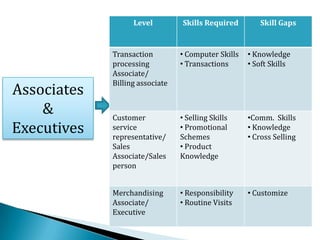
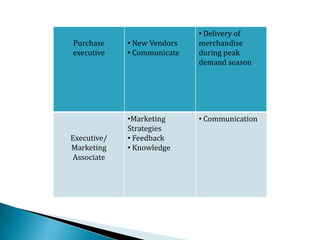
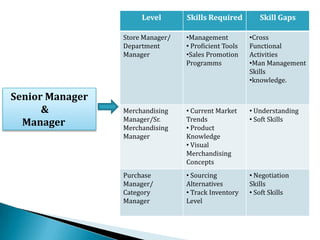
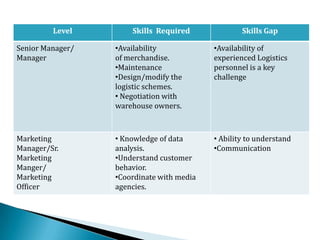
Emerging Human Resource Challenges.
What lies ahead ?Issues for Discussion
FDIInRetailPolicyPerspective
An investment is..   The commitment of money or capital to purchase financial instruments or assets in order to gain profitable returns.
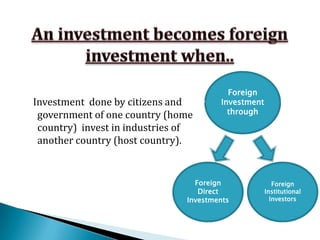
An investment becomes foreign investment when..Foreign Investment through  Investment  done by citizens and government of one country (home country)  invest in industries of another country (host country).Foreign Direct InvestmentsForeign Institutional Investors
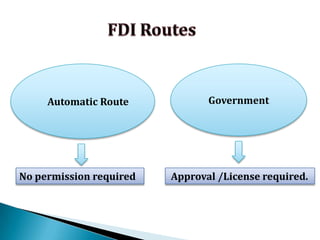
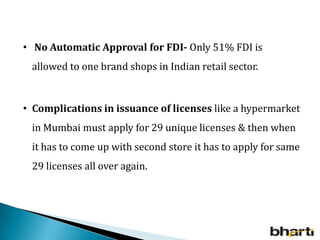
FDI Routes   Automatic RouteGovernmentNo permission required Approval /License required.
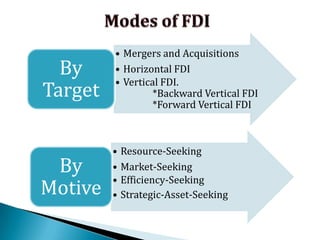
Modes of FDI
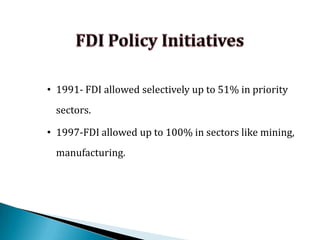
FDI Policy Initiatives1991- FDI allowed selectively up to 51% in priority sectors.
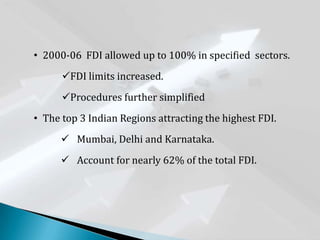
1997-FDI allowed up to 100% in sectors like mining, manufacturing.2000-06  FDI allowed up to 100% in specified  sectors.
FDI limits increased.
Procedures further simplified
The top 3 Indian Regions attracting the highest FDI.
Mumbai, Delhi and Karnataka.
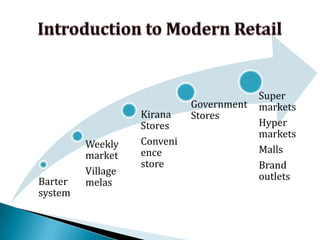
Account for nearly 62% of the total FDI.Introduction to Modern Retail
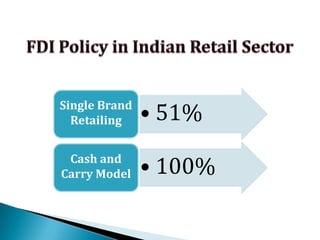
FDI Policy in Indian Retail Sector
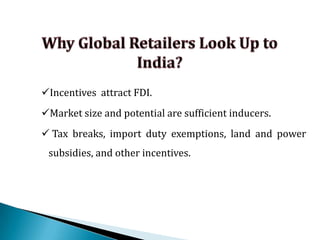
Why Global Retailers Look Up to India?Incentives  attract FDI.
Market size and potential are sufficient inducers.
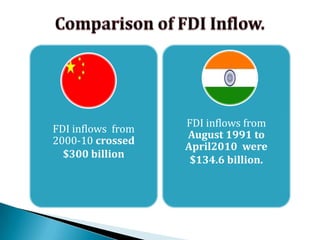
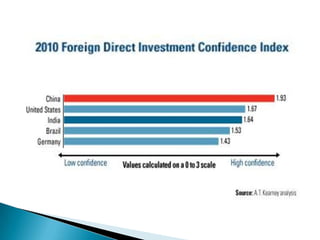
 Tax breaks, import duty exemptions, land and power subsidies, and other incentives.Comparison of FDI Inflow.
RetailIndustry : An Overview
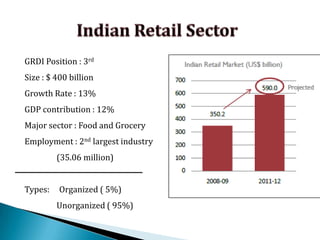
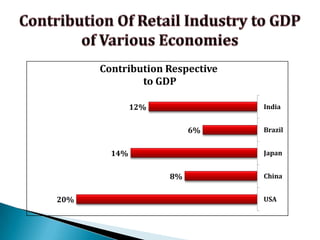
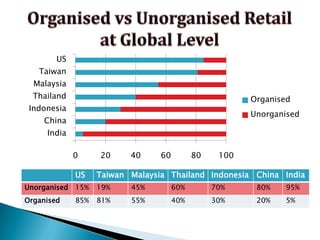
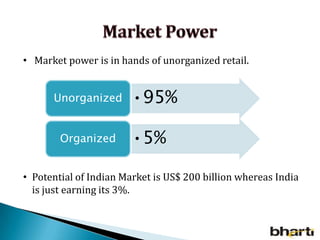
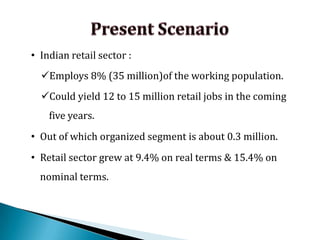
Indian Retail SectorGRDI Position : 3rdSize : $ 400 billionGrowth Rate : 13%GDP contribution : 12%Major sector : Food and GroceryEmployment : 2nd largest industry       	(35.06 million)Types:     Organized ( 5%)	Unorganized ( 95%)
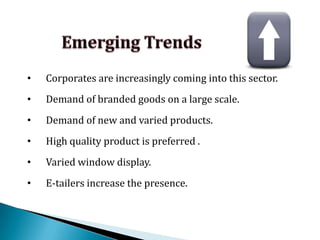
Emerging TrendsCorporates are increasingly coming into this sector.
Demand of branded goods on a large scale.
Demand of new and varied products.
High quality product is preferred .
Varied window display.
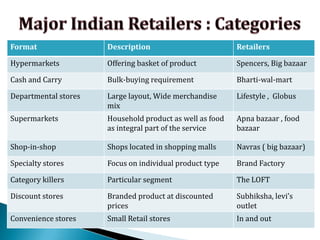
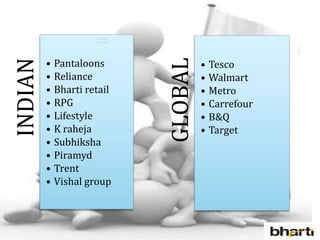
E-tailers increase the presence.Major Indian Retailers : Categories
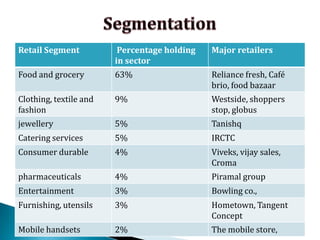
Segmentation
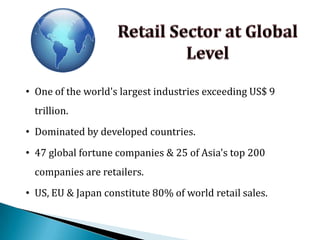
Retail Sector at Global LevelOne of the world's largest industries exceeding US$ 9 trillion.
Dominated by developed countries.
47 global fortune companies & 25 of Asia's top 200 companies are retailers.
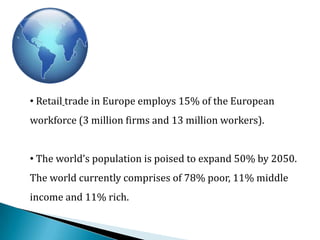
US, EU & Japan constitute 80% of world retail sales. Retailtrade in Europe employs 15% of the Europeanworkforce (3 million firms and 13 million workers).
 The world’s population is poised to expand 50% by 2050. The world currently comprises of 78% poor, 11% middle income and 11% rich.Contribution Of Retail Industry to GDP of Various Economies
OrganisedvsUnorganised Retail at Global Level
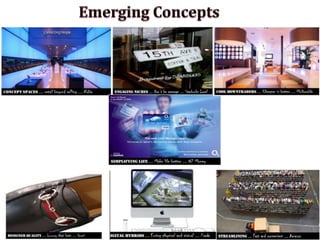
Emerging Concepts
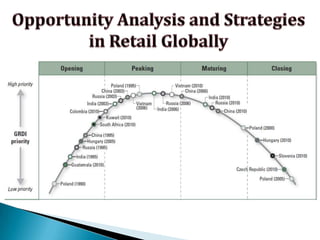
Opportunity Analysis and Strategies in Retail Globally
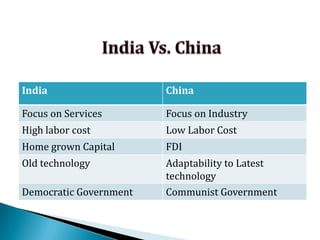
 India Vs. China
FDIPolicy in retailopportunities
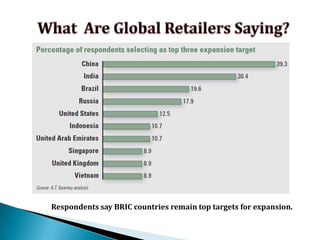
What  Are Global Retailers Saying?Respondents say BRIC countries remain top targets for expansion.
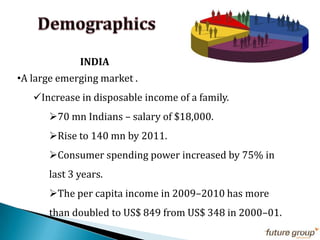
DemographicsINDIAA large emerging market .
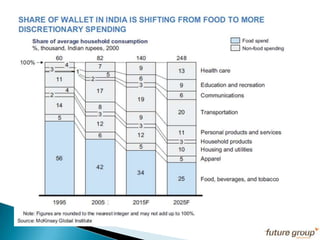
Increase in disposable income of a family.
70 mn Indians – salary of $18,000.
Rise to 140 mn by 2011.
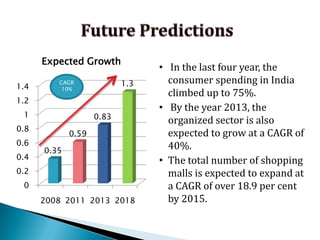
Consumer spending power increased by 75% in last 3 years.
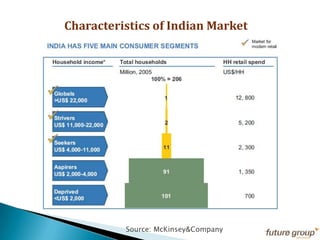
The per capita income in 2009–2010 has more than doubled to US$ 849 from US$ 348 in 2000–01.Characteristics of Indian MarketSource: McKinsey&Company
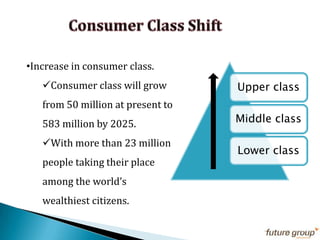
Consumer Class ShiftIncrease in consumer class.
Consumer class will grow from 50 million at present to 583 million by 2025.
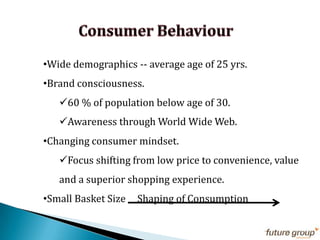
With more than 23 million people taking their place among the world’s wealthiest citizens. Consumer BehaviourWide demographics -- average age of 25 yrs.
Brand consciousness.
60 % of population below age of 30.
Awareness through World Wide Web.
Changing consumer mindset.
Focus shifting from low price to convenience, value and a superior shopping experience.
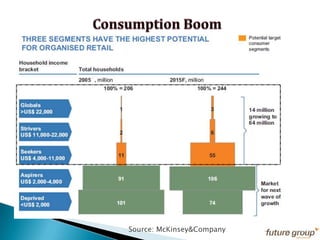
Small Basket Size     Shaping of ConsumptionConsumption BoomSource: McKinsey&Company
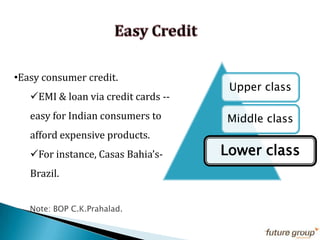
Easy CreditEasy consumer credit.
EMI & loan via credit cards -- easy for Indian consumers to afford expensive products.
For instance, Casas Bahia’s- Brazil. Note: BOP C.K.Prahalad.
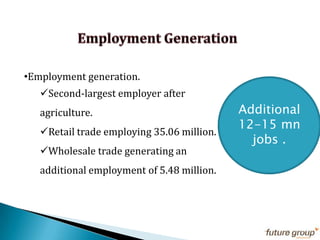
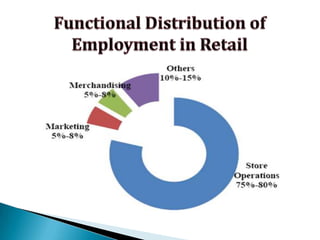
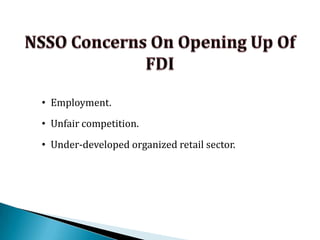
Employment GenerationEmployment generation.
Second-largest employer after agriculture.
Retail trade employing 35.06 million.
Wholesale trade generating an additional employment of 5.48 million.Additional 12-15 mn jobs .
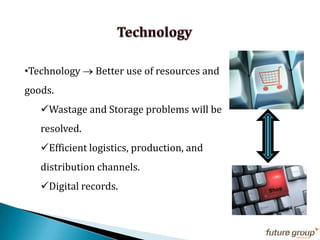
TechnologyTechnology  Better use of resources and goods.
Wastage and Storage problems will be resolved.
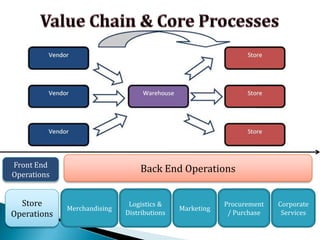
Efficient logistics, production, and distribution channels.
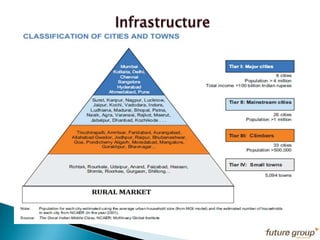
Digital records.Infrastructure
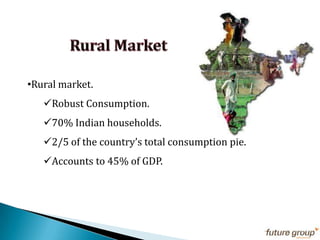
Rural MarketRural market.
Robust Consumption.
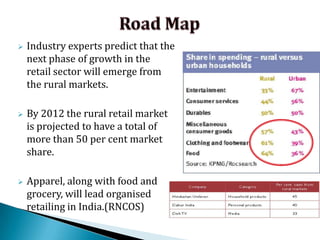
70% Indian households.
2/5 of the country’s total consumption pie.
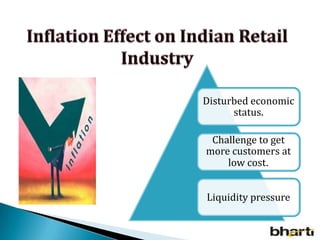
Accounts to 45% of GDP.Fiscal GrowthFDI in Retail sector will resolve problems regarding foreign exchange in India.Evergreen NeedThe life-long basic needs will keep on driving the Retail Industry.Let the liberalisation be in steps rather than being a leap.
FDI PolicyinRETAILCHALLENGES
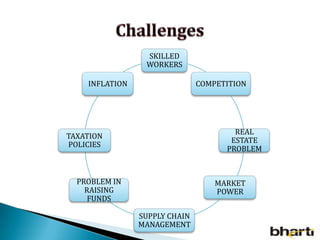
Challenges
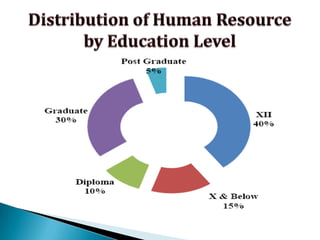
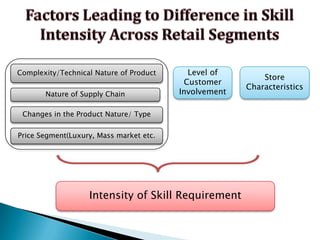
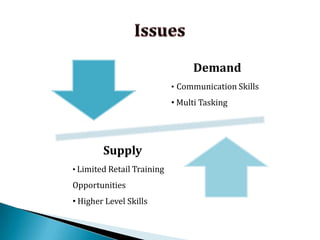
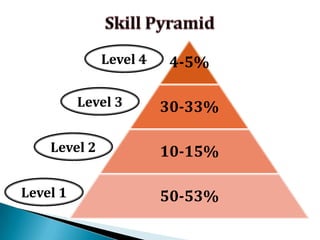
Major challenge faced by Organized retail sector:   	In Retail, over 70 per cent of the labor force in both sectors combined (organized and unorganized) is either illiterate or educated below the primary level.
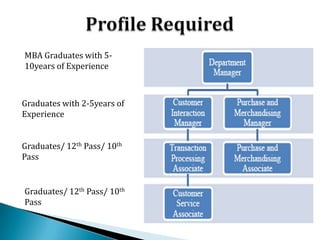
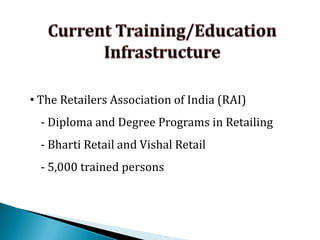
Labor LawsLack of Skilled Workforce
A strong competition from mom and pop shops:-
Easily accessible & approachable.
Provide services like Free home delivery and goods on credit.
They change consumer focus.COMPETITION
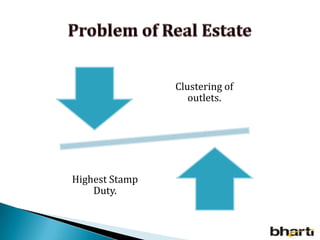
Problem of Real Estate
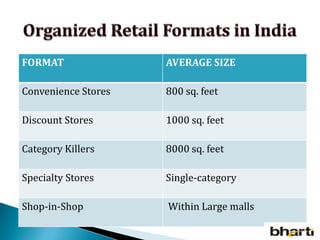
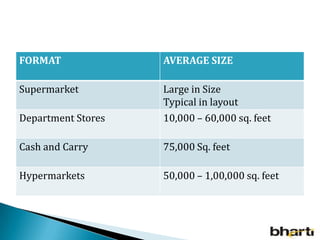
Organized Retail Formats in India

FDI in RETAIL

Editor's Notes

  • #18 Varied window displat : now a days retailers know that if your product is dosplayed properly acc. to the culture of the state you are operating in , will definaltey help you
  • #27 Count the country and then speak on the 4 things showed here
  • #52 This is not all there is still more
  • #78 In 2881, India had the highest shop density in the world, with 11 outlets for every 1,888people.. The high density restricts their scope of expansion, and thereby ofupgrading. This also means that, except in the case of severely segmented markets, thissector stands little chance of competing against large retailing corporations operatingwith economies of scale.
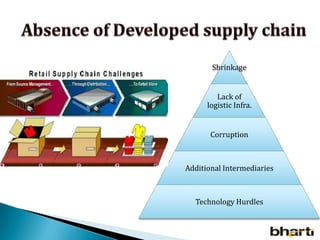
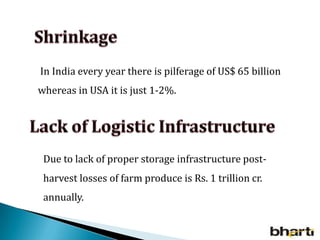
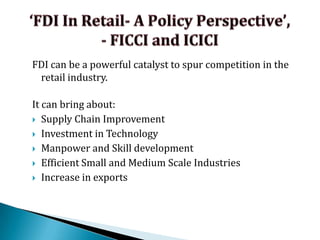
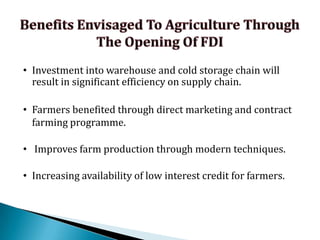
  • #79 It will bring out many positive changes i.e. improvement in supply chain management. It is noticed that 35-40% of the agriculture produce perishes every year due to poor infrastructure in India and there are only 6522 cold storages in India mainly used for potatoes.Investment in technologies and infrastructure by the retail corporations will act as a boon for our economy.These org will come in with technical know how and expertise and will train indian manpower and hone their skills as suitable for the industry.Moreover small players who have already been working with Internationalchains like Wal-Mart/Carrefour in India have benefitted a lot by manufacturing their private label products & also showcasing ourproducts in their stores by reaching end consumer directly at competitiveprices which would otherwise launching and building a new brand is a task in itself.It is understood that MNC that invest in retail in india would also source indian goods to their international outlets in a big way, thus provide a boost to indian exports. Indian retail chains would get integrated with global supply chain since Fdi will bring in technology, quality standards and marketing.
  • #82 technological know how, soil quality improvement, pesticide and fertilizer usage,grading, sorting, capabilities and increasing availability of low interest credit forfarmers.
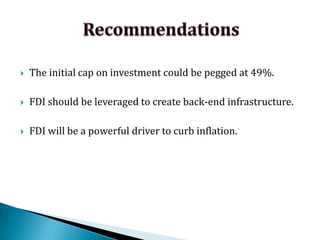
  • #84 After observing the opportunities and challenges, the views of different org. and the benefits that are likely to take place in indian economy..the panel recommends that fdi in multi brand retail should be allowed but a cap of 49% should be imposed to protect the interest of small and medium size retailers and give them a breathing space to adjust themselves to the new environment and also work to bring in their competitive advantage. China opened the fdi 49% in 1992 and has been immensely benefitted due transfer of technical know how and increased exports there are currently appx 40 foreign players contributing to org retail sector. Now, its time for india to open the borders and be benefitted by the retail growth.A major proportion of initial FDI should be invested in developing back endinfrastructure. For e.g. the foreign partners need to tell the total amount thatthey will be investing in next five years. Out of these atleast 80% of the FDIhas to be made in initial three years.We talked of large percentage of agriculture produce getting wasted annually. Well investment in technology and supply chain will surely prevent such wastages consequently curb the supply caused inflation which is currently hovering around 15.46%.
  • #85 It is well noted that urban migration has created a significant excess of labour in India's largeand medium-sized cities. Retail jobs can offer a viable career opportunity for the urbanunemployed who may lack in formal education and training, just as they can for those inrural areas. Rather than stipulating employment conditionalities that may obstructemployment generation in urban areas, alternative incentive structures may be used toencourage companies to train and employ youth in the areas in which retail outlets arelocated - both rural and urban.Additionally, if incentive structures or conditionalities are imposed, they should be mandatedupon both domestic and foreign funded retail chains equally.Furthermore, it is being discussed that retailers should be restricted to larger citiesof 10 lakh or more. This point is in direct conflict with a stipulation requiring the hiring ofrural youth, who will likely be unable to travel to their place of employment in a consistent,cost-effective manner.
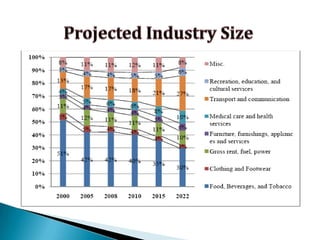
  • #86 And u can well see difference in the share of spending in these 3 categories by rural and urban households.
  • #87 Retail investments and operations are typically executed with local and regionalconsiderations in mind, so a national legal framework cannot truly be effective. State andlocal licensing requirements are sufficient to protect small retailers, and otherwise regulatethe industry.Implementing new regulations will likely hold back growth in this sector, as well as weaken itsAttendant benefits on SME suppliers, consumers and supply chain investment. Rather thanimpose such regualtion, the government may consider policies and incentives that directlybenefit small retailers. These incentives can include, for example, access to low-cost capital,training on quality and technical standards, and infrastructure investment in their ownbusinesses.