Chapter 2
Consumer Motivation
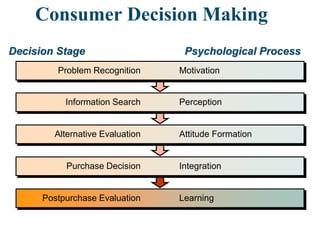
Information Search Perception
Postpurchase Evaluation Learning
Purchase Decision Integration
Alternative Evaluation Attitude Formation
Problem Recognition Motivation
Purchase Decision Integration
Consumer Decision Making
Decision Stage Psychological Process
Alternative Evaluation Attitude Formation
Information Search Perception
Problem Recognition Motivation
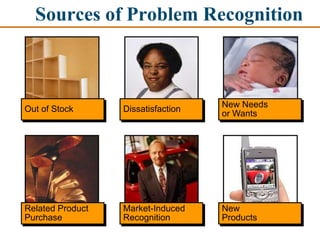
Out of Stock
Sources of Problem Recognition
Dissatisfaction
New Needs
or Wants
Related Product
Purchase
Market-Induced
Recognition
New
Products
Ads Help Consumers Recognize
Problems
.
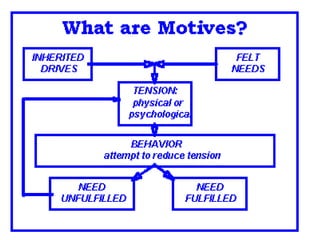
What is Motivation
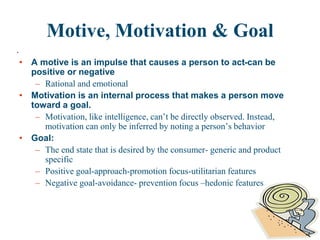
Motive, Motivation & Goal
• A motive is an impulse that causes a person to act-can be
positive or negative
– Rational and emotional
• Motivation is an internal process that makes a person move
toward a goal.
– Motivation, like intelligence, can’t be directly observed. Instead,
motivation can only be inferred by noting a person’s behavior
• Goal:
– The end state that is desired by the consumer- generic and product
specific
– Positive goal-approach-promotion focus-utilitarian features
– Negative goal-avoidance- prevention focus –hedonic features
Why we do what we do…
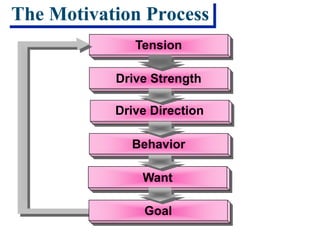
The Motivation Process
Tension
Drive Strength
Drive Direction
Behavior
Want
Goal
The Motivation Process
• The processes that lead people to
behave as they do. It occurs when a
need arises that a consumer wishes to
satisfy.
– Biogenic needs/innate/primary: Needs
necessary to maintain life-more aware
– Psychogenic needs/acquired/secondary:
Culture-related needs (e.g. need for status,
power, affiliation, etc.)-less aware
– From application point- extrinsic/intrinsic
The Motivation Process
• Drive:
– The degree of arousal present due to a discrepancy between
the consumer’s present state and some ideal state
– Positive drive- need, want and desire
– Negative drive- fear and aversion
• Want:
– A manifestation of a need created by personal and cultural
factors.
• Motivation can be described in terms of:
– Strength: The pull it exerts on the consumer
– Direction: The particular way the consumer attempts to
reduce motivational tension
Ads Reinforce Desired States
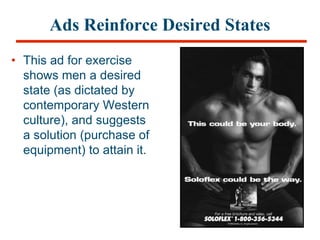
• This ad for exercise
shows men a desired
state (as dictated by
contemporary Western
culture), and suggests
a solution (purchase of
equipment) to attain it.
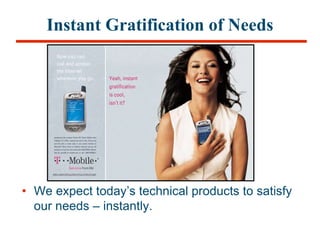
Instant Gratification of Needs
• We expect today’s technical products to satisfy
our needs – instantly.
The Dynamics of Motivation
• Needs are never fully satisfied
• New needs emerge as old needs are satisfied
• Success and failure influence goals
– Substitute goals
– Frustration
– Defense mechanisms
• Multiplicity of needs and variation of goals
• Arousal of motives
– Physiological, emotional, cognitive
– Behaviorist school and cognitive school
Types & Systems of Needs
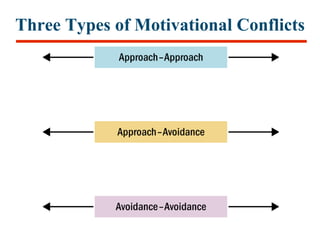
Three Types of Motivational Conflicts
Motivation Theory and Marketing Strategy
Consumers do not buy products; instead they buy motive
satisfaction or problem solutions.
Managers must discover the motives that their product and
brands can satisfy and develop marketing mixes around
these motives.
Who purchases these products and what are the motives
for purchasing:
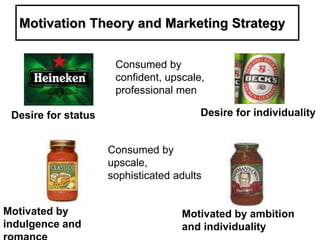
- Imported Beer: Beck’s, Heineken
- Spaghetti Sauce: Classico, Newman’s Own
Motivation Theory and Marketing Strategy
Consumed by
confident, upscale,
professional men
Desire for status Desire for individuality
Motivated by
indulgence and
Motivated by ambition
and individuality
Consumed by
upscale,
sophisticated adults
Motivation Theory and Marketing Strategy
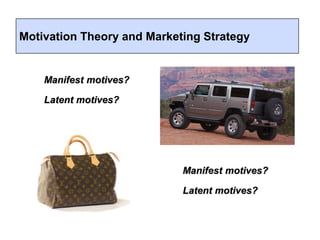
Discovering Purchase Motives
Manifest motives are motives that are
known and freely admitted.
Consumers don’t always readily admit their
motives
Latent motives are either unknown to the
consumer or are such that he/she is
reluctant to admit them.
Motivation Theory and Marketing Strategy
Manifest motives?
Latent motives?
Manifest motives?
Latent motives?
The Measurement of Motives
• Combination of
– Response to questionnaire
– Insights from focus groups
– In-depth interviews
– Projective techniques
Motivational Research
• Sigmund Freud’s psychoanalytic
theory of personality
– Unconscious needs and drives are at the heart of
human motivation and personality
• Attempts to discover underlying
feelings, attitudes and emotions
concerning products, service or brand
use.
• Dr. Ernest Ditchter- trained clinical
psychoanalyst 1930s
Product Profiles
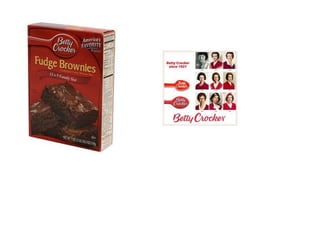
• Baking
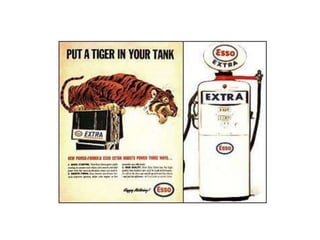
• Automobiles
• Dolls
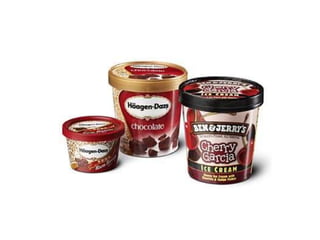
• Ice cream
Individual Assignment
• Take a look at each of the 10 items you
bought
• Categorize each according to
– The motivational force(s) that caused you to but it
• Biological, emotional, rational, social
– The theory that best explains why you bought it
• Thorndike, Alderfer, Maslow

Chapter 2-Consumer Motivation.ppt

  • 1.
  • 2.
    Information Search Perception PostpurchaseEvaluation Learning Purchase Decision Integration Alternative Evaluation Attitude Formation Problem Recognition Motivation Purchase Decision Integration Consumer Decision Making Decision Stage Psychological Process Alternative Evaluation Attitude Formation Information Search Perception Problem Recognition Motivation
  • 3.
    Out of Stock Sourcesof Problem Recognition Dissatisfaction New Needs or Wants Related Product Purchase Market-Induced Recognition New Products
  • 4.
    Ads Help ConsumersRecognize Problems
  • 6.
    . What is Motivation Motive,Motivation & Goal • A motive is an impulse that causes a person to act-can be positive or negative – Rational and emotional • Motivation is an internal process that makes a person move toward a goal. – Motivation, like intelligence, can’t be directly observed. Instead, motivation can only be inferred by noting a person’s behavior • Goal: – The end state that is desired by the consumer- generic and product specific – Positive goal-approach-promotion focus-utilitarian features – Negative goal-avoidance- prevention focus –hedonic features
  • 7.
    Why we dowhat we do…
  • 8.
    The Motivation Process Tension DriveStrength Drive Direction Behavior Want Goal
  • 9.
    The Motivation Process •The processes that lead people to behave as they do. It occurs when a need arises that a consumer wishes to satisfy. – Biogenic needs/innate/primary: Needs necessary to maintain life-more aware – Psychogenic needs/acquired/secondary: Culture-related needs (e.g. need for status, power, affiliation, etc.)-less aware – From application point- extrinsic/intrinsic
  • 10.
    The Motivation Process •Drive: – The degree of arousal present due to a discrepancy between the consumer’s present state and some ideal state – Positive drive- need, want and desire – Negative drive- fear and aversion • Want: – A manifestation of a need created by personal and cultural factors. • Motivation can be described in terms of: – Strength: The pull it exerts on the consumer – Direction: The particular way the consumer attempts to reduce motivational tension
  • 11.
    Ads Reinforce DesiredStates • This ad for exercise shows men a desired state (as dictated by contemporary Western culture), and suggests a solution (purchase of equipment) to attain it.
  • 12.
    Instant Gratification ofNeeds • We expect today’s technical products to satisfy our needs – instantly.
  • 14.
    The Dynamics ofMotivation • Needs are never fully satisfied • New needs emerge as old needs are satisfied • Success and failure influence goals – Substitute goals – Frustration – Defense mechanisms • Multiplicity of needs and variation of goals • Arousal of motives – Physiological, emotional, cognitive – Behaviorist school and cognitive school
  • 15.
  • 16.
  • 17.
    Three Types ofMotivational Conflicts
  • 21.
    Motivation Theory andMarketing Strategy Consumers do not buy products; instead they buy motive satisfaction or problem solutions. Managers must discover the motives that their product and brands can satisfy and develop marketing mixes around these motives. Who purchases these products and what are the motives for purchasing: - Imported Beer: Beck’s, Heineken - Spaghetti Sauce: Classico, Newman’s Own
  • 22.
    Motivation Theory andMarketing Strategy Consumed by confident, upscale, professional men Desire for status Desire for individuality Motivated by indulgence and Motivated by ambition and individuality Consumed by upscale, sophisticated adults
  • 23.
    Motivation Theory andMarketing Strategy Discovering Purchase Motives Manifest motives are motives that are known and freely admitted. Consumers don’t always readily admit their motives Latent motives are either unknown to the consumer or are such that he/she is reluctant to admit them.
  • 24.
    Motivation Theory andMarketing Strategy Manifest motives? Latent motives? Manifest motives? Latent motives?
  • 25.
    The Measurement ofMotives • Combination of – Response to questionnaire – Insights from focus groups – In-depth interviews – Projective techniques
  • 26.
    Motivational Research • SigmundFreud’s psychoanalytic theory of personality – Unconscious needs and drives are at the heart of human motivation and personality • Attempts to discover underlying feelings, attitudes and emotions concerning products, service or brand use. • Dr. Ernest Ditchter- trained clinical psychoanalyst 1930s
  • 27.
    Product Profiles • Baking •Automobiles • Dolls • Ice cream
  • 32.
    Individual Assignment • Takea look at each of the 10 items you bought • Categorize each according to – The motivational force(s) that caused you to but it • Biological, emotional, rational, social – The theory that best explains why you bought it • Thorndike, Alderfer, Maslow