INTRODUCTION TO RESEARCH IN
SCIENCE
PRESENTED BY
ATHUL RAVI
RESEARCH SCHOLAR
SMM LAB, DEPT. OF SCIENCE
AMRITA VISHWAVIDYAPEETHAM UNIVERSITY
COIMBATORE CAMPUS
OUTLINE
INTRODUCTION TO RESEARCH
RESEARCH PROCES
PROBLEM STATEMENT
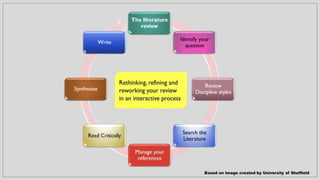
LITERARURE REVIEW
SCOPE OF SCOPUS
RESEARCH ETHICS
RESERCH
•Research is defined as the creation of new knowledge
and/or the use of existing knowledge in a new and
creative way so as to generate new concepts,
methodologies and understandings. This could include
synthesis and analysis of previous research to the extent
that it leads to new and creative outcomes.
• Research is a movement from known to unknown. It is actually a voyage of
discovery.
• Systematic research in any field of inquiry involves three basic operations
1. Data collection: It refers to observing, measuring, and recording information.
2. Data analysis: It refers to arranging and organizing the collected data so that
we may be able to find out what their significance is and generalize about them.
3. Report writing: It is an inseparable part and a final outcome of a research
study. Its purpose is to convey information contained in it to the readers or
audience.
Literature survey
“A systematic and thorough search of all
types of published literature as well as other
sources including dissertation, theses in
order to identify as many items as possible
that are relevant to a particular topic .”
- GASH, 1989
SIGNIFICANCE OF LITERATURE SURVEY
To discover what information exists in our topic of
interest.
To form a starting point for our own work.
To give scholarly authority to our work.
To make effective use of our time by focusing on appropriate
resources.
To avoid duplication.
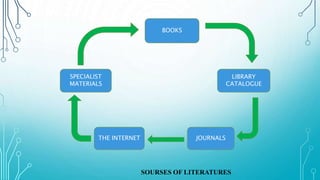
BOOKS
LIBRARY
CATALOGUE
JOURNALS
THE INTERNET
SPECIALIST
MATERIALS
SOURSES OF LITERATURES
JOURNALS
Journals are vital source of up to date research. They can
also provide information on various specialized topics.
The journal in which the article appears
identifies itself as a peer or refereed journal.
Articles are reviewed by an editorial or
advisory board
Authors are affiliated with universities,
colleges, or prestigious research centers
References are cited at the end of articles
Eg. Nature Nanotechnology, Journal of American Chemical Society, ACS
Nano, Chemistry letters, Nature Physics, Applied physics letters, etc..
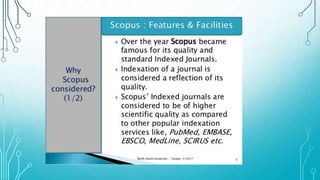
What is Scopus?
The largest abstract and
citation database of
research information
>63M records and
21,912 active titles from
more
than 5k international
publishers. More than
3,780 Gold
Open Access journals
indexed, 120k books
and 7.3M
conference proceedings
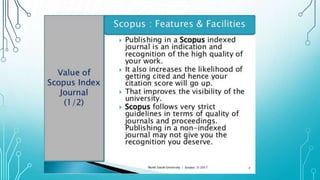
Scopus assists with
forwards and backwards
citation research by
identifying not only an
article’s cited references
but also its citing
Scopus fosters the easy
discovery
of research and
enables researchers to
claim their work,
ensuring proper
accreditation and
supporting career
development.
SCOPUS
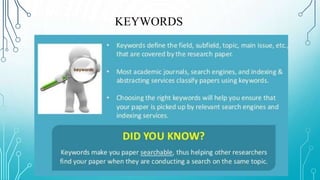
KEYWORDS
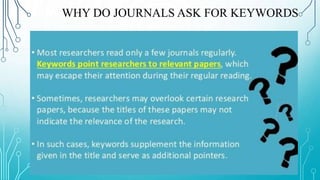
WHY DO JOURNALS ASK FOR KEYWORDS
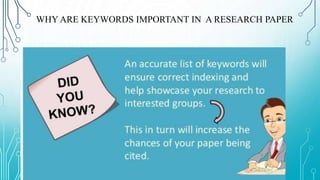
WHY ARE KEYWORDS IMPORTANT IN A RESEARCH PAPER
RESEARCH ETHICS
The application of moral rules and
professional codes of conduct to the
collection, analysis, reporting, and publication
of information about research subjects, in
particular active acceptance of subjects' right
to privacy, confidentiality, and informed
consent.
Five principles for research ethics
•Discuss intellectual property frankly.
•Be conscious of multiple roles.
•Follow informed-consent rules.
•Respect confidentiality and privacy.
•Tap into ethics resources.
REFERENCES
• Five principles of research ethics ,Deborah Smith, cover story of
American physiological Association, p.no. 35, vol. 34 no. 1,
January 2003
• Research methodology- Methods and techniques, C R Kothari,
second revised edition, New Age International publishers
Introduction to Research In Science

Introduction to Research In Science

  • 1.
    INTRODUCTION TO RESEARCHIN SCIENCE PRESENTED BY ATHUL RAVI RESEARCH SCHOLAR SMM LAB, DEPT. OF SCIENCE AMRITA VISHWAVIDYAPEETHAM UNIVERSITY COIMBATORE CAMPUS
  • 2.
    OUTLINE INTRODUCTION TO RESEARCH RESEARCHPROCES PROBLEM STATEMENT LITERARURE REVIEW SCOPE OF SCOPUS RESEARCH ETHICS
  • 3.
    RESERCH •Research is definedas the creation of new knowledge and/or the use of existing knowledge in a new and creative way so as to generate new concepts, methodologies and understandings. This could include synthesis and analysis of previous research to the extent that it leads to new and creative outcomes.
  • 4.
    • Research isa movement from known to unknown. It is actually a voyage of discovery. • Systematic research in any field of inquiry involves three basic operations 1. Data collection: It refers to observing, measuring, and recording information. 2. Data analysis: It refers to arranging and organizing the collected data so that we may be able to find out what their significance is and generalize about them. 3. Report writing: It is an inseparable part and a final outcome of a research study. Its purpose is to convey information contained in it to the readers or audience.
  • 6.
    Literature survey “A systematicand thorough search of all types of published literature as well as other sources including dissertation, theses in order to identify as many items as possible that are relevant to a particular topic .” - GASH, 1989
  • 7.
    SIGNIFICANCE OF LITERATURESURVEY To discover what information exists in our topic of interest. To form a starting point for our own work. To give scholarly authority to our work. To make effective use of our time by focusing on appropriate resources. To avoid duplication.
  • 8.
  • 9.
    JOURNALS Journals are vitalsource of up to date research. They can also provide information on various specialized topics. The journal in which the article appears identifies itself as a peer or refereed journal. Articles are reviewed by an editorial or advisory board Authors are affiliated with universities, colleges, or prestigious research centers References are cited at the end of articles Eg. Nature Nanotechnology, Journal of American Chemical Society, ACS Nano, Chemistry letters, Nature Physics, Applied physics letters, etc..
  • 10.
    What is Scopus? Thelargest abstract and citation database of research information >63M records and 21,912 active titles from more than 5k international publishers. More than 3,780 Gold Open Access journals indexed, 120k books and 7.3M conference proceedings Scopus assists with forwards and backwards citation research by identifying not only an article’s cited references but also its citing Scopus fosters the easy discovery of research and enables researchers to claim their work, ensuring proper accreditation and supporting career development. SCOPUS
  • 13.
  • 14.
    WHY DO JOURNALSASK FOR KEYWORDS
  • 15.
    WHY ARE KEYWORDSIMPORTANT IN A RESEARCH PAPER
  • 16.
    RESEARCH ETHICS The applicationof moral rules and professional codes of conduct to the collection, analysis, reporting, and publication of information about research subjects, in particular active acceptance of subjects' right to privacy, confidentiality, and informed consent.
  • 17.
    Five principles forresearch ethics •Discuss intellectual property frankly. •Be conscious of multiple roles. •Follow informed-consent rules. •Respect confidentiality and privacy. •Tap into ethics resources.
  • 18.
    REFERENCES • Five principlesof research ethics ,Deborah Smith, cover story of American physiological Association, p.no. 35, vol. 34 no. 1, January 2003 • Research methodology- Methods and techniques, C R Kothari, second revised edition, New Age International publishers