
Research proposals &
Report Writing
FDP on Promoting Research among Academicians
St. Philomena’s College (Autonomous)
Mysore
27-06-2022
HELLO!
I am Vasantha Raju N.
Librarian
Government First Grade College-Talakadu
You can mail me at
vasanthrz@gmail.com
Focus of the
Presentation
▸ Why Indian Publications are Retracted?
▸ Key factors Influencing the Acceptance
Scientific manuscripts
▸ Research Report Structure
▸ Grant Proposals
▸ Tools and Resources for Research Report
Writing
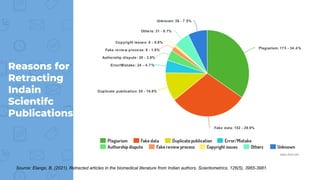
Source: Elango, B. (2021). Retracted articles in the biomedical literature from Indian authors. Scientometrics, 126(5), 3965-3981.
Reasons for
Retracting
Indain
Scientifc
Publications
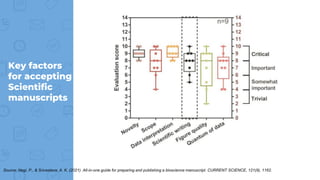
Key factors
for accepting
Scientific
manuscripts
Source: Negi, P., & Srivastava, A. K. (2021). All-in-one guide for preparing and publishing a bioscience manuscript. CURRENT SCIENCE, 121(9), 1162.
Scientific/
Research
Report
A scientific report is a document that
describes the process, progress, and or
results of scientific research.
Scientific writing also includes other types of
communication by scientists –research
proposals, oral presentation and poster
presentations, etc.
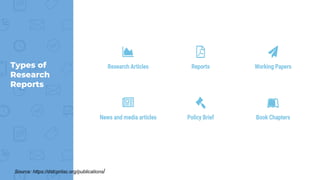
Types of
Research
Reports
Source: https://dstcpriisc.org/publications/
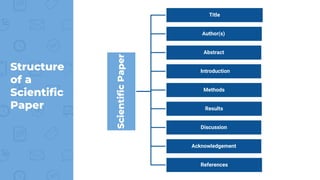
Structure
of a
Scientific
Paper
Scientific
Paper
Title
Author(s)
Abstract
Introduction
Methods
Results
Discussion
Acknowledgement
References
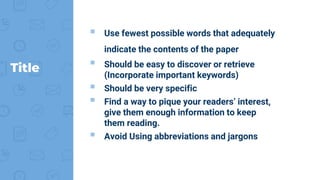
Title
 Use fewest possible words that adequately
indicate the contents of the paper
 Should be easy to discover or retrieve
(Incorporate important keywords)
 Should be very specific
 Find a way to pique your readers’ interest,
give them enough information to keep
them reading.
 Avoid Using abbreviations and jargons
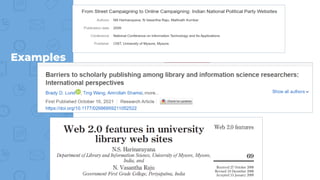
Examples
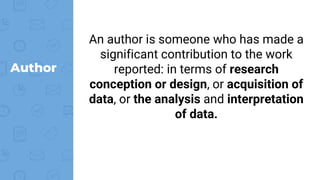
Author
An author is someone who has made a
significant contribution to the work
reported: in terms of research
conception or design, or acquisition of
data, or the analysis and interpretation
of data.
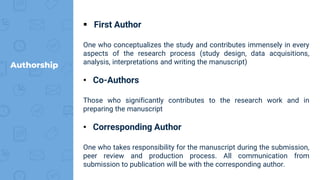
Authorship
 First Author
One who conceptualizes the study and contributes immensely in every
aspects of the research process (study design, data acquisitions,
analysis, interpretations and writing the manuscript)
• Co-Authors
Those who significantly contributes to the research work and in
preparing the manuscript
• Corresponding Author
One who takes responsibility for the manuscript during the submission,
peer review and production process. All communication from
submission to publication will be with the corresponding author.
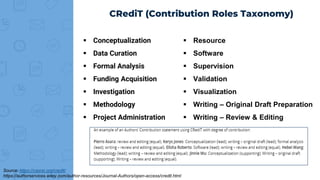
CRediT (Contribution Roles Taxonomy)
 Conceptualization
 Data Curation
 Formal Analysis
 Funding Acquisition
 Investigation
 Methodology
 Project Administration
 Resource
 Software
 Supervision
 Validation
 Visualization
 Writing – Original Draft Preparation
 Writing – Review & Editing
Source: https://casrai.org/credit/
https://authorservices.wiley.com/author-resources/Journal-Authors/open-access/credit.html
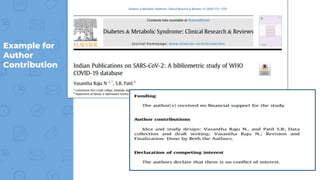
Example for
Author
Contribution
Abstract
▸ An important part of the paper
▹ Relatively widely read
▹ Used to decide whether to read the
rest of the paper or not
▹ Gives editors, reviewers, others a
first impression
Source: Gastel, B. (2012, May 1). Writing a journal: section by section. [ Presentation]. https://www.authoraid.info/en/resources/details/997/
.
Abstract
▸ An abstract should include
▹ Background or introduction
▹ Main objectives and scope of the
investigation
▹ Methods employed or used in the
research
▹ Summary of the results and
▹ Key aspects of conclusion
Source: Gastel, B. (2012, May 1). Writing a journal: section by section. [Presentation]. https://www.authoraid.info/en/resources/details/997/
.
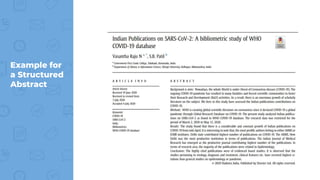
Example for
a Structured
Abstract
Introduction
▸ Introduction should be like more of a
moving from General to Specific
(Funnel Shaped)
▹ Should start from providing the information on why
the overall subject area of the research is important
▹ It should briefly include the previously published
literature and gap in the existing literature which the
current research intended to address
▹ Should make clear the objectives of the research
▹ Should briefly state the method of research
▹ Should mention the key findings of the research
Source: Gastel, B. (2012, May 1). Writing a journal: section by section. [Presentation]. https://www.authoraid.info/en/resources/details/997/
Length
▸ Length of the Introduction
▹ Varies depending on the subject field
and journal guidelines also
▹ Some subject field- introduction will
be of in few paragraphs
▹ In Some subject field introduction
will be of longer version which also
includes literature review
Source: Gastel, B. (2012, May 1). Writing a journal: section by section. [Presentation]. https://www.authoraid.info/en/resources/details/997/
.
Methods
▸ Purpose of Methods Section
▹ Allow others to replicate the research
to test its soundness and genuinity
▹ To carry out further research
▹ To determine whether the conclusions
seems valid or not
▹ To determine whether the findings
seem applicable to other situations
Source: Gastel, B. (2012, May 1). Writing a journal: section by section. [ Presentation]. https://www.authoraid.info/en/resources/details/997/
.
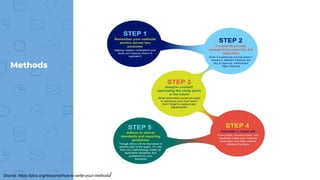
Methods
Source: https://plos.org/resource/how-to-write-your-methods/
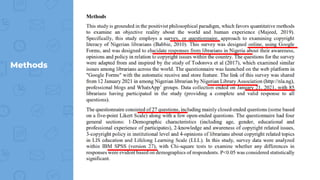
Methods
▸ Methods section includes
▹ Information on study design such as
■ Study population
■ Sample
■ Data collection methods/Instrument
■ Statistical methods for analysis, time line
etc.
▹ Consider flow charts, diagrams and tables and
other visual aids
▹ Write in past tense
Source: Gastel, B. (2012, May 1). Writing a journal: section by section. [Presentation]. https://www.authoraid.info/en/resources/details/997/
.
Methods
Results
▸ Result Section
▹ Considered as core of the paper
▹ Includes Tables and Figures or
both
▹ Summarize key findings instead
of repeating the data in detail
▹ Should present results not
commenting on them
Source: Gastel, B. (2012, May 1). Writing a journal: section by section. [Presentation]. https://www.authoraid.info/en/resources/details/997/
.
Results
▸ Results Sections with Tables and
Figures
▹ Tables and Figures should simple and
easily understandable
▹ Provide only main key points of the
Tables and figures
▹ Avoid extensive overlap of data with text,
table and figures
Source: Gastel, B., & Day, R. A. (2016). How to write and publish a scientific paper. Cambridge University Press.
Discussion
▸ One of the hardest section to write
▸ Often should begin with a brief summary of the
main findings
▸ Should answer the question(s) stated in the
introduction (or address the hypothesis or
hypotheses)
▸ Relate to the findings of the previous research
(similarities or contrast )
▸ Discuss the theoretical and practical
implications
▸ Discuss the limitations of the study and
potential areas for future research
Source: Gastel, B. (2012, May 1). Writing a journal: section by section. [Presentation]. https://www.authoraid.info/en/resources/details/997/
.
Acknowledgement
Place to express the gratitude for funding
agencies for providing financial
assistance
institutions for using its lab and other
infrastructure,
people helped in materializing the study but
could not qualify as authors,
reviewers for their critical comments.
Source: Gastel, B., & Day, R. A. (2016). How to write and publish a scientific paper. Cambridge University Press.
References
Functions of Citations/References
▸ To acknowledge and credit others
work
▸ To add credibility to our work by
showing that we have used valid
information sources
▸ To establish relationships to previous
research
▸ To provide further information
Source: Gastel, B., & Day, R. A. (2016). How to write and publish a scientific paper. Cambridge University Press.
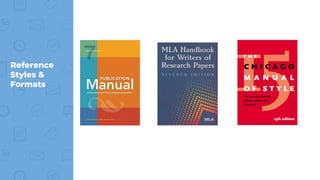
Reference
Styles &
Formats
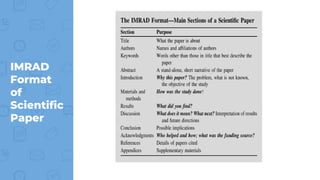
IMRAD
Format
of
Scientific
Paper
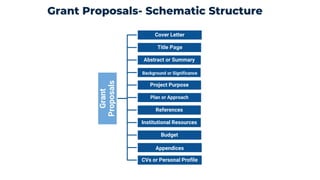
Grant Proposals- Schematic Structure
Grant
Proposals
Cover Letter
Title Page
Abstract or Summary
Background or Significance
Project Purpose
Plan or Approach
References
Institutional Resources
Budget
Appendices
CVs or Personal Profile
Research
Proposal
Format
Research Proposal Format
Sample
ICSSR
Important
tools and resources
for simplifying
the process of
research paper
writings
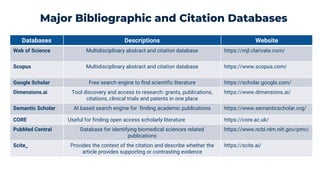
Databases Descriptions Website
Web of Science Multidisciplinary abstract and citation database https://mjl.clarivate.com/
Scopus Multidisciplinary abstract and citation database https://www.scopus.com/
Google Scholar Free search engine to find scientific literature https://scholar.google.com/
Dimensions.ai Tool discovery and access to research: grants, publications,
citations, clinical trials and patents in one place
https://www.dimensions.ai/
Semantic Scholar AI based search engine for finding academic publications https://www.semanticscholar.org/
CORE Useful for finding open access scholarly literature https://core.ac.uk/
PubMed Central Database for identifying biomedical sciences related
publications
https://www.ncbi.nlm.nih.gov/pmc/
Scite_ Provides the context of the citation and describe whether the
article provides supporting or contrasting evidence
https://scite.ai/
Major Bibliographic and Citation Databases
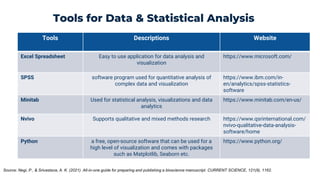
Tools Descriptions Website
Excel Spreadsheet Easy to use application for data analysis and
visualization
https://www.microsoft.com/
SPSS software program used for quantitative analysis of
complex data and visualization
https://www.ibm.com/in-
en/analytics/spss-statistics-
software
Minitab Used for statistical analysis, visualizations and data
analytics
https://www.minitab.com/en-us/
Nvivo Supports qualitative and mixed methods research https://www.qsrinternational.com/
nvivo-qualitative-data-analysis-
software/home
Python a free, open-source software that can be used for a
high level of visualization and comes with packages
such as Matplotlib, Seaborn etc.
https://www.python.org/
Tools for Data & Statistical Analysis
Source: Negi, P., & Srivastava, A. K. (2021). All-in-one guide for preparing and publishing a bioscience manuscript. CURRENT SCIENCE, 121(9), 1162.
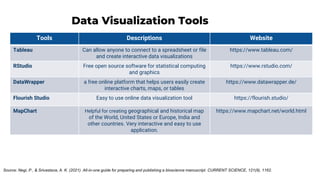
Tools Descriptions Website
Tableau Can allow anyone to connect to a spreadsheet or file
and create interactive data visualizations
https://www.tableau.com/
RStudio Free open source software for statistical computing
and graphics
https://www.rstudio.com/
DataWrapper a free online platform that helps users easily create
interactive charts, maps, or tables
https://www.datawrapper.de/
Flourish Studio Easy to use online data visualization tool https://flourish.studio/
MapChart Helpful for creating geographical and historical map
of the World, United States or Europe, India and
other countries. Very interactive and easy to use
application.
https://www.mapchart.net/world.html
Data Visualization Tools
Source: Negi, P., & Srivastava, A. K. (2021). All-in-one guide for preparing and publishing a bioscience manuscript. CURRENT SCIENCE, 121(9), 1162.
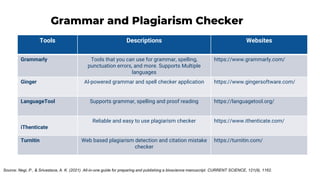
Tools Descriptions Websites
Grammarly Tools that you can use for grammar, spelling,
punctuation errors, and more. Supports Multiple
languages
https://www.grammarly.com/
Ginger AI-powered grammar and spell checker application https://www.gingersoftware.com/
LanguageTool Supports grammar, spelling and proof reading https://languagetool.org/
iThenticate
Reliable and easy to use plagiarism checker https://www.ithenticate.com/
Turnitin Web based plagiarism detection and citation mistake
checker
https://turnitin.com/
Grammar and Plagiarism Checker
Source: Negi, P., & Srivastava, A. K. (2021). All-in-one guide for preparing and publishing a bioscience manuscript. CURRENT SCIENCE, 121(9), 1162.
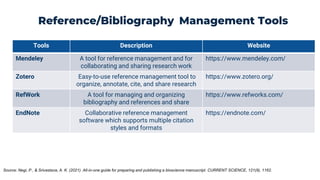
Tools Description Website
Mendeley A tool for reference management and for
collaborating and sharing research work
https://www.mendeley.com/
Zotero Easy-to-use reference management tool to
organize, annotate, cite, and share research
https://www.zotero.org/
RefWork A tool for managing and organizing
bibliography and references and share
https://www.refworks.com/
EndNote Collaborative reference management
software which supports multiple citation
styles and formats
https://endnote.com/
Reference/Bibliography Management Tools
Source: Negi, P., & Srivastava, A. K. (2021). All-in-one guide for preparing and publishing a bioscience manuscript. CURRENT SCIENCE, 121(9), 1162.
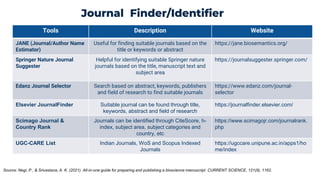
Tools Description Website
JANE (Journal/Author Name
Estimator)
Useful for finding suitable journals based on the
title or keywords or abstract
https://jane.biosemantics.org/
Springer Nature Journal
Suggester
Helpful for identifying suitable Springer nature
journals based on the title, manuscript text and
subject area
https://journalsuggester.springer.com/
Edanz Journal Selector Search based on abstract, keywords, publishers
and field of research to find suitable journals
https://www.edanz.com/journal-
selector
Elsevier JournalFinder Suitable journal can be found through title,
keywords, abstract and field of research
https://journalfinder.elsevier.com/
Scimago Journal &
Country Rank
Journals can be identified through CiteScore, h-
index, subject area, subject categories and
country, etc
https://www.scimagojr.com/journalrank.
php
UGC-CARE List Indian Journals, WoS and Scopus Indexed
Journals
https://ugccare.unipune.ac.in/apps1/ho
me/index
Journal Finder/Identifier
Source: Negi, P., & Srivastava, A. K. (2021). All-in-one guide for preparing and publishing a bioscience manuscript. CURRENT SCIENCE, 121(9), 1162.
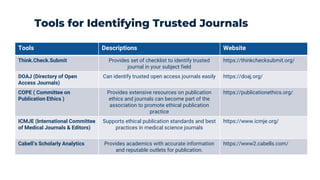
Tools Descriptions Website
Think.Check.Submit Provides set of checklist to identify trusted
journal in your subject field
https://thinkchecksubmit.org/
DOAJ (Directory of Open
Access Journals)
Can identify trusted open access journals easily https://doaj.org/
COPE ( Committee on
Publication Ethics )
Provides extensive resources on publication
ethics and journals can become part of the
association to promote ethical publication
practice
https://publicationethics.org/
ICMJE (International Committee
of Medical Journals & Editors)
Supports ethical publication standards and best
practices in medical science journals
https://www.icmje.org/
Cabell’s Scholarly Analytics Provides academics with accurate information
and reputable outlets for publication.
https://www2.cabells.com/
Tools for Identifying Trusted Journals
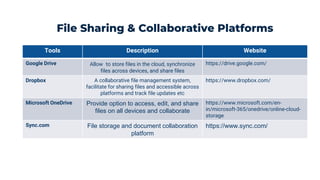
Tools Description Website
Google Drive Allow to store files in the cloud, synchronize
files across devices, and share files
https://drive.google.com/
Dropbox A collaborative file management system,
facilitate for sharing files and accessible across
platforms and track file updates etc
https://www.dropbox.com/
Microsoft OneDrive Provide option to access, edit, and share
files on all devices and collaborate
https://www.microsoft.com/en-
in/microsoft-365/onedrive/online-cloud-
storage
Sync.com File storage and document collaboration
platform
https://www.sync.com/
File Sharing & Collaborative Platforms
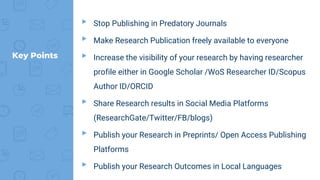
▸ Stop Publishing in Predatory Journals
▸ Make Research Publication freely available to everyone
▸ Increase the visibility of your research by having researcher
profile either in Google Scholar /WoS Researcher ID/Scopus
Author ID/ORCID
▸ Share Research results in Social Media Platforms
(ResearchGate/Twitter/FB/blogs)
▸ Publish your Research in Preprints/ Open Access Publishing
Platforms
▸ Publish your Research Outcomes in Local Languages
Key Points
Our Initiative
Research & Publication
Support for College
Faculty
http://researchhelpgfgctdk.in/.
THANKS!
Any questions?
You can mail me at:
vasanthrz@gmail.com
Presentation template by SlidesCarnival

Report Writing_Presentation-Vasanth.pdf

  • 1.
    Research proposals & ReportWriting FDP on Promoting Research among Academicians St. Philomena’s College (Autonomous) Mysore 27-06-2022
  • 2.
    HELLO! I am VasanthaRaju N. Librarian Government First Grade College-Talakadu You can mail me at vasanthrz@gmail.com
  • 3.
    Focus of the Presentation ▸Why Indian Publications are Retracted? ▸ Key factors Influencing the Acceptance Scientific manuscripts ▸ Research Report Structure ▸ Grant Proposals ▸ Tools and Resources for Research Report Writing
  • 4.
    Source: Elango, B.(2021). Retracted articles in the biomedical literature from Indian authors. Scientometrics, 126(5), 3965-3981. Reasons for Retracting Indain Scientifc Publications
  • 5.
    Key factors for accepting Scientific manuscripts Source:Negi, P., & Srivastava, A. K. (2021). All-in-one guide for preparing and publishing a bioscience manuscript. CURRENT SCIENCE, 121(9), 1162.
  • 6.
    Scientific/ Research Report A scientific reportis a document that describes the process, progress, and or results of scientific research. Scientific writing also includes other types of communication by scientists –research proposals, oral presentation and poster presentations, etc.
  • 7.
  • 8.
  • 9.
    Title  Use fewestpossible words that adequately indicate the contents of the paper  Should be easy to discover or retrieve (Incorporate important keywords)  Should be very specific  Find a way to pique your readers’ interest, give them enough information to keep them reading.  Avoid Using abbreviations and jargons
  • 10.
  • 11.
    Author An author issomeone who has made a significant contribution to the work reported: in terms of research conception or design, or acquisition of data, or the analysis and interpretation of data.
  • 12.
    Authorship  First Author Onewho conceptualizes the study and contributes immensely in every aspects of the research process (study design, data acquisitions, analysis, interpretations and writing the manuscript) • Co-Authors Those who significantly contributes to the research work and in preparing the manuscript • Corresponding Author One who takes responsibility for the manuscript during the submission, peer review and production process. All communication from submission to publication will be with the corresponding author.
  • 13.
    CRediT (Contribution RolesTaxonomy)  Conceptualization  Data Curation  Formal Analysis  Funding Acquisition  Investigation  Methodology  Project Administration  Resource  Software  Supervision  Validation  Visualization  Writing – Original Draft Preparation  Writing – Review & Editing Source: https://casrai.org/credit/ https://authorservices.wiley.com/author-resources/Journal-Authors/open-access/credit.html
  • 14.
  • 15.
    Abstract ▸ An importantpart of the paper ▹ Relatively widely read ▹ Used to decide whether to read the rest of the paper or not ▹ Gives editors, reviewers, others a first impression Source: Gastel, B. (2012, May 1). Writing a journal: section by section. [ Presentation]. https://www.authoraid.info/en/resources/details/997/ .
  • 16.
    Abstract ▸ An abstractshould include ▹ Background or introduction ▹ Main objectives and scope of the investigation ▹ Methods employed or used in the research ▹ Summary of the results and ▹ Key aspects of conclusion Source: Gastel, B. (2012, May 1). Writing a journal: section by section. [Presentation]. https://www.authoraid.info/en/resources/details/997/ .
  • 17.
  • 18.
    Introduction ▸ Introduction shouldbe like more of a moving from General to Specific (Funnel Shaped) ▹ Should start from providing the information on why the overall subject area of the research is important ▹ It should briefly include the previously published literature and gap in the existing literature which the current research intended to address ▹ Should make clear the objectives of the research ▹ Should briefly state the method of research ▹ Should mention the key findings of the research Source: Gastel, B. (2012, May 1). Writing a journal: section by section. [Presentation]. https://www.authoraid.info/en/resources/details/997/
  • 19.
    Length ▸ Length ofthe Introduction ▹ Varies depending on the subject field and journal guidelines also ▹ Some subject field- introduction will be of in few paragraphs ▹ In Some subject field introduction will be of longer version which also includes literature review Source: Gastel, B. (2012, May 1). Writing a journal: section by section. [Presentation]. https://www.authoraid.info/en/resources/details/997/ .
  • 20.
    Methods ▸ Purpose ofMethods Section ▹ Allow others to replicate the research to test its soundness and genuinity ▹ To carry out further research ▹ To determine whether the conclusions seems valid or not ▹ To determine whether the findings seem applicable to other situations Source: Gastel, B. (2012, May 1). Writing a journal: section by section. [ Presentation]. https://www.authoraid.info/en/resources/details/997/ .
  • 21.
  • 22.
    Methods ▸ Methods sectionincludes ▹ Information on study design such as ■ Study population ■ Sample ■ Data collection methods/Instrument ■ Statistical methods for analysis, time line etc. ▹ Consider flow charts, diagrams and tables and other visual aids ▹ Write in past tense Source: Gastel, B. (2012, May 1). Writing a journal: section by section. [Presentation]. https://www.authoraid.info/en/resources/details/997/ .
  • 23.
  • 24.
    Results ▸ Result Section ▹Considered as core of the paper ▹ Includes Tables and Figures or both ▹ Summarize key findings instead of repeating the data in detail ▹ Should present results not commenting on them Source: Gastel, B. (2012, May 1). Writing a journal: section by section. [Presentation]. https://www.authoraid.info/en/resources/details/997/ .
  • 25.
    Results ▸ Results Sectionswith Tables and Figures ▹ Tables and Figures should simple and easily understandable ▹ Provide only main key points of the Tables and figures ▹ Avoid extensive overlap of data with text, table and figures Source: Gastel, B., & Day, R. A. (2016). How to write and publish a scientific paper. Cambridge University Press.
  • 26.
    Discussion ▸ One ofthe hardest section to write ▸ Often should begin with a brief summary of the main findings ▸ Should answer the question(s) stated in the introduction (or address the hypothesis or hypotheses) ▸ Relate to the findings of the previous research (similarities or contrast ) ▸ Discuss the theoretical and practical implications ▸ Discuss the limitations of the study and potential areas for future research Source: Gastel, B. (2012, May 1). Writing a journal: section by section. [Presentation]. https://www.authoraid.info/en/resources/details/997/ .
  • 27.
    Acknowledgement Place to expressthe gratitude for funding agencies for providing financial assistance institutions for using its lab and other infrastructure, people helped in materializing the study but could not qualify as authors, reviewers for their critical comments. Source: Gastel, B., & Day, R. A. (2016). How to write and publish a scientific paper. Cambridge University Press.
  • 28.
    References Functions of Citations/References ▸To acknowledge and credit others work ▸ To add credibility to our work by showing that we have used valid information sources ▸ To establish relationships to previous research ▸ To provide further information Source: Gastel, B., & Day, R. A. (2016). How to write and publish a scientific paper. Cambridge University Press.
  • 29.
  • 30.
  • 31.
    Grant Proposals- SchematicStructure Grant Proposals Cover Letter Title Page Abstract or Summary Background or Significance Project Purpose Plan or Approach References Institutional Resources Budget Appendices CVs or Personal Profile
  • 32.
  • 33.
    Important tools and resources forsimplifying the process of research paper writings
  • 34.
    Databases Descriptions Website Webof Science Multidisciplinary abstract and citation database https://mjl.clarivate.com/ Scopus Multidisciplinary abstract and citation database https://www.scopus.com/ Google Scholar Free search engine to find scientific literature https://scholar.google.com/ Dimensions.ai Tool discovery and access to research: grants, publications, citations, clinical trials and patents in one place https://www.dimensions.ai/ Semantic Scholar AI based search engine for finding academic publications https://www.semanticscholar.org/ CORE Useful for finding open access scholarly literature https://core.ac.uk/ PubMed Central Database for identifying biomedical sciences related publications https://www.ncbi.nlm.nih.gov/pmc/ Scite_ Provides the context of the citation and describe whether the article provides supporting or contrasting evidence https://scite.ai/ Major Bibliographic and Citation Databases
  • 35.
    Tools Descriptions Website ExcelSpreadsheet Easy to use application for data analysis and visualization https://www.microsoft.com/ SPSS software program used for quantitative analysis of complex data and visualization https://www.ibm.com/in- en/analytics/spss-statistics- software Minitab Used for statistical analysis, visualizations and data analytics https://www.minitab.com/en-us/ Nvivo Supports qualitative and mixed methods research https://www.qsrinternational.com/ nvivo-qualitative-data-analysis- software/home Python a free, open-source software that can be used for a high level of visualization and comes with packages such as Matplotlib, Seaborn etc. https://www.python.org/ Tools for Data & Statistical Analysis Source: Negi, P., & Srivastava, A. K. (2021). All-in-one guide for preparing and publishing a bioscience manuscript. CURRENT SCIENCE, 121(9), 1162.
  • 36.
    Tools Descriptions Website TableauCan allow anyone to connect to a spreadsheet or file and create interactive data visualizations https://www.tableau.com/ RStudio Free open source software for statistical computing and graphics https://www.rstudio.com/ DataWrapper a free online platform that helps users easily create interactive charts, maps, or tables https://www.datawrapper.de/ Flourish Studio Easy to use online data visualization tool https://flourish.studio/ MapChart Helpful for creating geographical and historical map of the World, United States or Europe, India and other countries. Very interactive and easy to use application. https://www.mapchart.net/world.html Data Visualization Tools Source: Negi, P., & Srivastava, A. K. (2021). All-in-one guide for preparing and publishing a bioscience manuscript. CURRENT SCIENCE, 121(9), 1162.
  • 37.
    Tools Descriptions Websites GrammarlyTools that you can use for grammar, spelling, punctuation errors, and more. Supports Multiple languages https://www.grammarly.com/ Ginger AI-powered grammar and spell checker application https://www.gingersoftware.com/ LanguageTool Supports grammar, spelling and proof reading https://languagetool.org/ iThenticate Reliable and easy to use plagiarism checker https://www.ithenticate.com/ Turnitin Web based plagiarism detection and citation mistake checker https://turnitin.com/ Grammar and Plagiarism Checker Source: Negi, P., & Srivastava, A. K. (2021). All-in-one guide for preparing and publishing a bioscience manuscript. CURRENT SCIENCE, 121(9), 1162.
  • 38.
    Tools Description Website MendeleyA tool for reference management and for collaborating and sharing research work https://www.mendeley.com/ Zotero Easy-to-use reference management tool to organize, annotate, cite, and share research https://www.zotero.org/ RefWork A tool for managing and organizing bibliography and references and share https://www.refworks.com/ EndNote Collaborative reference management software which supports multiple citation styles and formats https://endnote.com/ Reference/Bibliography Management Tools Source: Negi, P., & Srivastava, A. K. (2021). All-in-one guide for preparing and publishing a bioscience manuscript. CURRENT SCIENCE, 121(9), 1162.
  • 39.
    Tools Description Website JANE(Journal/Author Name Estimator) Useful for finding suitable journals based on the title or keywords or abstract https://jane.biosemantics.org/ Springer Nature Journal Suggester Helpful for identifying suitable Springer nature journals based on the title, manuscript text and subject area https://journalsuggester.springer.com/ Edanz Journal Selector Search based on abstract, keywords, publishers and field of research to find suitable journals https://www.edanz.com/journal- selector Elsevier JournalFinder Suitable journal can be found through title, keywords, abstract and field of research https://journalfinder.elsevier.com/ Scimago Journal & Country Rank Journals can be identified through CiteScore, h- index, subject area, subject categories and country, etc https://www.scimagojr.com/journalrank. php UGC-CARE List Indian Journals, WoS and Scopus Indexed Journals https://ugccare.unipune.ac.in/apps1/ho me/index Journal Finder/Identifier Source: Negi, P., & Srivastava, A. K. (2021). All-in-one guide for preparing and publishing a bioscience manuscript. CURRENT SCIENCE, 121(9), 1162.
  • 40.
    Tools Descriptions Website Think.Check.SubmitProvides set of checklist to identify trusted journal in your subject field https://thinkchecksubmit.org/ DOAJ (Directory of Open Access Journals) Can identify trusted open access journals easily https://doaj.org/ COPE ( Committee on Publication Ethics ) Provides extensive resources on publication ethics and journals can become part of the association to promote ethical publication practice https://publicationethics.org/ ICMJE (International Committee of Medical Journals & Editors) Supports ethical publication standards and best practices in medical science journals https://www.icmje.org/ Cabell’s Scholarly Analytics Provides academics with accurate information and reputable outlets for publication. https://www2.cabells.com/ Tools for Identifying Trusted Journals
  • 41.
    Tools Description Website GoogleDrive Allow to store files in the cloud, synchronize files across devices, and share files https://drive.google.com/ Dropbox A collaborative file management system, facilitate for sharing files and accessible across platforms and track file updates etc https://www.dropbox.com/ Microsoft OneDrive Provide option to access, edit, and share files on all devices and collaborate https://www.microsoft.com/en- in/microsoft-365/onedrive/online-cloud- storage Sync.com File storage and document collaboration platform https://www.sync.com/ File Sharing & Collaborative Platforms
  • 42.
    ▸ Stop Publishingin Predatory Journals ▸ Make Research Publication freely available to everyone ▸ Increase the visibility of your research by having researcher profile either in Google Scholar /WoS Researcher ID/Scopus Author ID/ORCID ▸ Share Research results in Social Media Platforms (ResearchGate/Twitter/FB/blogs) ▸ Publish your Research in Preprints/ Open Access Publishing Platforms ▸ Publish your Research Outcomes in Local Languages Key Points
  • 43.
    Our Initiative Research &Publication Support for College Faculty http://researchhelpgfgctdk.in/.
  • 44.
    THANKS! Any questions? You canmail me at: vasanthrz@gmail.com Presentation template by SlidesCarnival