Survey Types – What works well for
you?
Live webinar
“Now, it’s my turn to create a survey for my employees… What are all these
surveys telling us, anyway? And what makes surveys useful? We have an
overdose of it – Take it to an employee, and he is going to say the same
thing!!!”
Workforce Surveys
An Overview
Human Resources the way you want it, on our platform
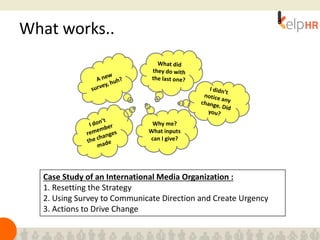
What works..
Case Study of an International Media Organization :
1. Resetting the Strategy
2. Using Survey to Communicate Direction and Create Urgency
3. Actions to Drive Change
Why me?
What inputs
can I give?
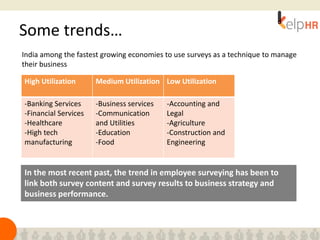
Some trends…
India among the fastest growing economies to use surveys as a technique to manage
their business
High Utilization Medium Utilization Low Utilization
-Banking Services
-Financial Services
-Healthcare
-High tech
manufacturing
-Business services
-Communication
and Utilities
-Education
-Food
-Accounting and
Legal
-Agriculture
-Construction and
Engineering
In the most recent past, the trend in employee surveying has been to
link both survey content and survey results to business strategy and
business performance.
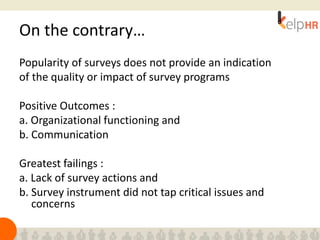
On the contrary…
Popularity of surveys does not provide an indication
of the quality or impact of survey programs
Positive Outcomes :
a. Organizational functioning and
b. Communication
Greatest failings :
a. Lack of survey actions and
b. Survey instrument did not tap critical issues and
concerns
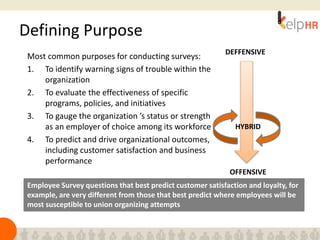
Defining Purpose
Most common purposes for conducting surveys:
1. To identify warning signs of trouble within the
organization
2. To evaluate the effectiveness of specific
programs, policies, and initiatives
3. To gauge the organization ’s status or strength
as an employer of choice among its workforce
4. To predict and drive organizational outcomes,
including customer satisfaction and business
performance
DEFFENSIVE
OFFENSIVE
Employee Survey questions that best predict customer satisfaction and loyalty, for
example, are very different from those that best predict where employees will be
most susceptible to union organizing attempts
HYBRID
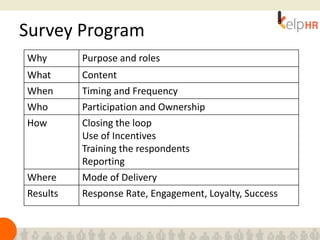
Why Purpose and roles
What Content
When Timing and Frequency
Who Participation and Ownership
How Closing the loop
Use of Incentives
Training the respondents
Reporting
Where Mode of Delivery
Results Response Rate, Engagement, Loyalty, Success
Survey Program
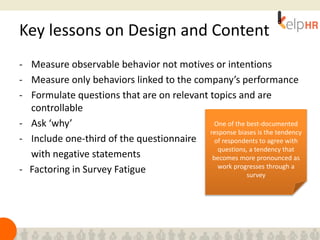
Key lessons on Design and Content
- Measure observable behavior not motives or intentions
- Measure only behaviors linked to the company’s performance
- Formulate questions that are on relevant topics and are
controllable
- Ask ‘why’
- Include one-third of the questionnaire
with negative statements
- Factoring in Survey Fatigue
One of the best-documented
response biases is the tendency
of respondents to agree with
questions, a tendency that
becomes more pronounced as
work progresses through a
survey
Some common employee surveys…
• 360 degree
• Employee Engagement
• Exit Surveys
Radical Redesign at Deloitte
Idiosyncratic rater effects – “…. most of what is being measured by the
ratings is the unique rating tendencies of the rater. Thus ratings
reveal more about the rater than they do about the ratee.”
What did they redesign in the way they capture performance data ?
“……, we will ask team leaders not about the skills of
each team member but about their own future actions with respect to that
person.”
Winning the battle of Engagement
Research has found that the new work environment is more:
• Reliant on Coordination
• Global and Virtual
• Matrixed
• Focused on Group Decision Making
• Subject to Frequent Change
Engagement Surveys
• I know what is expected of me at work
• I have the materials and equipment I need to do my work right
• At work, I have the opportunity to do what I do best
• In the last seven days, I have received recognition or praise for doing good
work
• My supervisor seem to care about me as a person
Each time Gallup conducts a census of employee opinion within a business, it
also requests every available datum of performance: customer surveys,
resignations, accidents, productivity, sick days, creativity, sales, and profitability.
Case Study – A Leading Indian Paint Manufacturer
Problem statement : Fatigue and lack of engagement that people had at work
Existing methodology and Issues : Employee Satisfaction Survey conducted over
previous 2 years. Issues related to redundancy existed due to high turnover
New methodology : Telephonic Survey followed by In-person Interviews
Factors assessed included :
a. Company as a brand
b. Relationship with the reporting Manager
c. Rewards and Recognition
d. Growth and Development Opportunities
e. Performance Management Systems
f. Relationship Quotient
Exit Interview vs. Survey
Adaptations of Core Employee Engagement elements could be helpful to ask
departing employees in order to assess improvement areas
Pros of an Exit Interview Pros of an Exit Survey
Personal Impersonal
Response rate is high Response rate is below 50%
Richer Data
Therapeutic experience for
the departing employee
To know more, please write to me at
anila@kelphr.com
www.kelphr.com
15

Workforce surveys

  • 1.
    Survey Types –What works well for you? Live webinar “Now, it’s my turn to create a survey for my employees… What are all these surveys telling us, anyway? And what makes surveys useful? We have an overdose of it – Take it to an employee, and he is going to say the same thing!!!”
  • 2.
    Workforce Surveys An Overview HumanResources the way you want it, on our platform
  • 3.
    What works.. Case Studyof an International Media Organization : 1. Resetting the Strategy 2. Using Survey to Communicate Direction and Create Urgency 3. Actions to Drive Change Why me? What inputs can I give?
  • 4.
    Some trends… India amongthe fastest growing economies to use surveys as a technique to manage their business High Utilization Medium Utilization Low Utilization -Banking Services -Financial Services -Healthcare -High tech manufacturing -Business services -Communication and Utilities -Education -Food -Accounting and Legal -Agriculture -Construction and Engineering In the most recent past, the trend in employee surveying has been to link both survey content and survey results to business strategy and business performance.
  • 5.
    On the contrary… Popularityof surveys does not provide an indication of the quality or impact of survey programs Positive Outcomes : a. Organizational functioning and b. Communication Greatest failings : a. Lack of survey actions and b. Survey instrument did not tap critical issues and concerns
  • 6.
    Defining Purpose Most commonpurposes for conducting surveys: 1. To identify warning signs of trouble within the organization 2. To evaluate the effectiveness of specific programs, policies, and initiatives 3. To gauge the organization ’s status or strength as an employer of choice among its workforce 4. To predict and drive organizational outcomes, including customer satisfaction and business performance DEFFENSIVE OFFENSIVE Employee Survey questions that best predict customer satisfaction and loyalty, for example, are very different from those that best predict where employees will be most susceptible to union organizing attempts HYBRID
  • 7.
    Why Purpose androles What Content When Timing and Frequency Who Participation and Ownership How Closing the loop Use of Incentives Training the respondents Reporting Where Mode of Delivery Results Response Rate, Engagement, Loyalty, Success Survey Program
  • 8.
    Key lessons onDesign and Content - Measure observable behavior not motives or intentions - Measure only behaviors linked to the company’s performance - Formulate questions that are on relevant topics and are controllable - Ask ‘why’ - Include one-third of the questionnaire with negative statements - Factoring in Survey Fatigue One of the best-documented response biases is the tendency of respondents to agree with questions, a tendency that becomes more pronounced as work progresses through a survey
  • 9.
    Some common employeesurveys… • 360 degree • Employee Engagement • Exit Surveys
  • 10.
    Radical Redesign atDeloitte Idiosyncratic rater effects – “…. most of what is being measured by the ratings is the unique rating tendencies of the rater. Thus ratings reveal more about the rater than they do about the ratee.” What did they redesign in the way they capture performance data ? “……, we will ask team leaders not about the skills of each team member but about their own future actions with respect to that person.”
  • 11.
    Winning the battleof Engagement Research has found that the new work environment is more: • Reliant on Coordination • Global and Virtual • Matrixed • Focused on Group Decision Making • Subject to Frequent Change
  • 12.
    Engagement Surveys • Iknow what is expected of me at work • I have the materials and equipment I need to do my work right • At work, I have the opportunity to do what I do best • In the last seven days, I have received recognition or praise for doing good work • My supervisor seem to care about me as a person Each time Gallup conducts a census of employee opinion within a business, it also requests every available datum of performance: customer surveys, resignations, accidents, productivity, sick days, creativity, sales, and profitability.
  • 13.
    Case Study –A Leading Indian Paint Manufacturer Problem statement : Fatigue and lack of engagement that people had at work Existing methodology and Issues : Employee Satisfaction Survey conducted over previous 2 years. Issues related to redundancy existed due to high turnover New methodology : Telephonic Survey followed by In-person Interviews Factors assessed included : a. Company as a brand b. Relationship with the reporting Manager c. Rewards and Recognition d. Growth and Development Opportunities e. Performance Management Systems f. Relationship Quotient
  • 14.
    Exit Interview vs.Survey Adaptations of Core Employee Engagement elements could be helpful to ask departing employees in order to assess improvement areas Pros of an Exit Interview Pros of an Exit Survey Personal Impersonal Response rate is high Response rate is below 50% Richer Data Therapeutic experience for the departing employee
  • 15.
    To know more,please write to me at anila@kelphr.com www.kelphr.com 15