Chemotherapy & Radiation
therapy
Presentation
By
Asokan R
Associate Professor
Kalinga Institute of Nursing Sciences,
KIIT Deemed to be University,
Bhubaneswar.
Radiation therapy
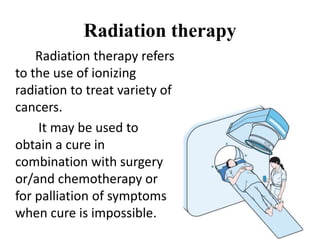
Radiation therapy refers
to the use of ionizing
radiation to treat variety of
cancers.
It may be used to
obtain a cure in
combination with surgery
or/and chemotherapy or
for palliation of symptoms
when cure is impossible.
Radiation therapy
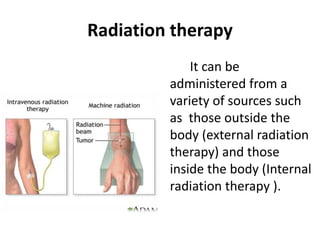
It can be
administered from a
variety of sources such
as those outside the
body (external radiation
therapy) and those
inside the body (Internal
radiation therapy ).
External radiation therapy
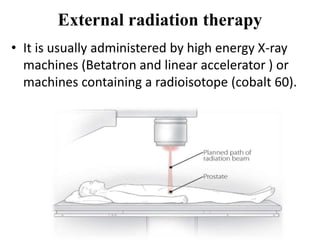
• It is usually administered by high energy X-ray
machines (Betatron and linear accelerator ) or
machines containing a radioisotope (cobalt 60).
.
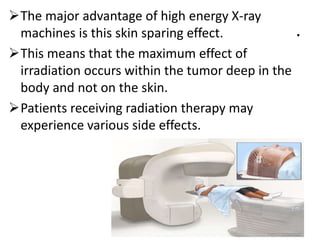
The major advantage of high energy X-ray
machines is this skin sparing effect.
This means that the maximum effect of
irradiation occurs within the tumor deep in the
body and not on the skin.
Patients receiving radiation therapy may
experience various side effects.
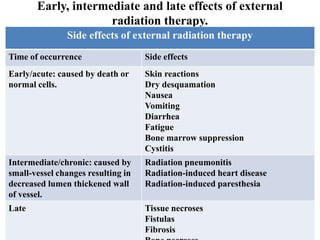
Early, intermediate and late effects of external
radiation therapy.
Side effects of external radiation therapy
Time of occurrence Side effects
Early/acute: caused by death or
normal cells.
Skin reactions
Dry desquamation
Nausea
Vomiting
Diarrhea
Fatigue
Bone marrow suppression
Cystitis
Intermediate/chronic: caused by
small-vessel changes resulting in
decreased lumen thickened wall
of vessel.
Radiation pneumonitis
Radiation-induced heart disease
Radiation-induced paresthesia
Late Tissue necroses
Fistulas
Fibrosis
Nursing intervention for external radiation
therapy
Nursing interventions for external
radiation therapy
Be sure you are familiar with the
patient, his chart and problems:
The type of radiotherapy
prescribed
The side of tumor undergoing
radiation
Purpose of therapy-palliate or
curative
Number of radiation planned
.
 Check the knowledge and understanding of patient
about the therapy.
 Instruct about the skin markings that the
radiotherapist makes and not to erase it until
treatment is finished.
 Answer all the question in a pleasant way; give
psychological reassurance like:
 Radiotherapy is painless, no sensation is felt as
such,
 To be still on a special table.
To remain alone while X-
ray/teletherapy units are in operation,
Can talk over an intercom to the
technician outside observing through a
window or television,
Different ports (area through which
rays pass into ) are used on different
days – so position may be changed
slightly at intervals.
Skin preparation
Remove any ointment or dressings.
cleaning of skin usually an alcohol rub is given.
Get the area outlined – the area to be treated is
usually outlined by the radiologist at the time of
first treatment. Instruct the patient not to wash
off the marks until the treatment is completed
because they are important guides to the
radiologist and also not to apply any medicated
solution or ointments on the marked area until
the series of treatment is completed.
Avoid constricting clothing as skin gets irritated
and breaks down easily
Avoid hot water bottle, ice caps, exposure to
sunlight and wetting for 2 weeks.
Give high protein diet, maintain fluid and
electrolyte balance
Nursing personnel to be protected by observing
radiation protection principles of time, distance and
shielding; wear a film badge to assess the amount
of radiation received.
Observe for local and systemic reaction
Provide symptomatic and supportive care.
Internal Radiation Therapy
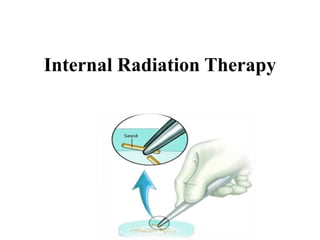
It involves placement of specially prepared
radioisotopes directly into or near the tumour itself
or into the systemic circulation. They are called
sealed source.
Radioactive material is enclosed in a sealed
container or unsealed sources in which radioactive
material is administered directly such as by
injection or orally.
Sealed source (Brachytherapy)
Sealed source (brachytherapy ) Includes
intracavitary therapy in which the radio-isotope
usually 137 cessium or 226 radium in sealed
applicator are placed into the body cavity for
calculated period of 24-72 hours.
Applications may be inserted into the patient’s
mouth, tongue, neck, vagina, cervix or other body
cavity.
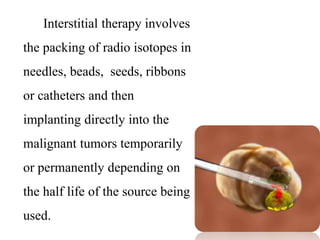
Interstitial therapy involves
the packing of radio isotopes in
needles, beads, seeds, ribbons
or catheters and then
implanting directly into the
malignant tumors temporarily
or permanently depending on
the half life of the source being
used.
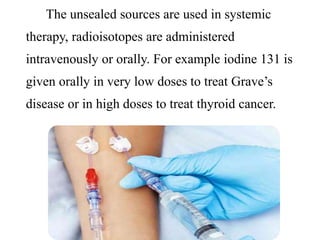
The unsealed sources are used in systemic
therapy, radioisotopes are administered
intravenously or orally. For example iodine 131 is
given orally in very low doses to treat Grave’s
disease or in high doses to treat thyroid cancer.
Nursing interventions
While giving nursing care to the patient undergoing
radiation should learn how to avoid excessive exposure to
radiation. This can be done by using three main principles of
radiation protection.
1. Distance-Greater the distance from the source of X-ray lesser
will be the exposure.
2. Time-less time you spend close to a radiation source, the less
you will be exposed.
3. Shielding: using lead or other materials to absorb radiant
energy helps reduce radiation exposure.
Nursing interventions for Internal Radiation
Therapy
Be familiar with the patient, his condition and his file
as to:
what radioisotope is to be used
type of source (sealed or unsealed)
mode of action (interstitial, intracavitary,
systemic)
site of implantation if sealed
number of days required isolation.
Give proper explanation about the purpose and
procedure and reassure patient and significant
others
Preparation depends upon whether radioisotope is
to be implanted or administered systemically.
If sealed in needles, beads or wires prepare the
patient for a surgery.
No special preparation for systemic administration.
Strict isolation after implantation, in a bath attached
room with another patient receiving the same.
Keep radiation precaution sign at the door for
restricting visitors.
Explain the routine to the patient and the reason for
the precaution (patient is a source of radioactivity as
the implanted or injected radioisotope continues to
emanate rays of radiant energy.
• Provide a clear unit with extra articles (pillows,
backrest, cardiac table) and facilities like intercom,
television, radio, etc.
Instruct the visitors to maintain some distance from
the source; restrict pregnant women and children
from visiting.
Notify the radiation officer if a radioactive source is
spilled, dropped to the floor, lost or accidentally
discarded.
Use a long lead forceps in case of dislodged
isotope.
Save all dressings and bed linen till the radioactive
source is removed.
Encourage the patient for self care.
Maintain measures of self-protection; limit time
spent in the room, keep safe distance from the
patient and use shielding (lead apron, gloves)
devises.
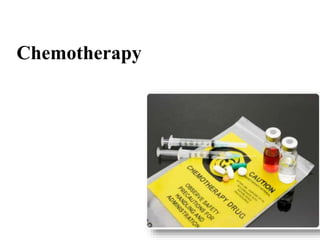
Chemotherapy
Chemotherapy
Chemotherapy evolved in the 1940s with the
therapeutic application of nitrogen mustard.
The objective of chemotherapy is to destroy
all malignant tumour cells without destruction of
normal cells.
Normally cells respond to body’s need for
growth, repair or regeneration in an orderly manner
and cease production by entering a resting phase or
slowing growth when the need is met.
Cancer cells reproduce in the same manner as
normal cells. But the growth continues in an
uncontrolled manner.
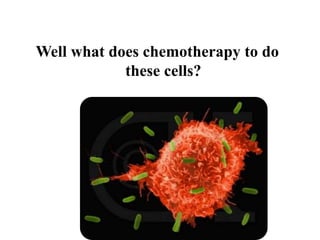
Well what does chemotherapy to do
these cells?
• Chemotherapy directly or indirectly disrupts
reproduction of cells by altering essential
biochemical processes, thereby-a control or
eradication of all malignant cells is possible.
• The chemotherapeutic agents are generally
classified according to their mechanism of action.
A summary of the common chemotherapeutic
drugs and their action is given below.
Classification of chemotherapy
classificatio
n
Frequently used
medications
Mechanism of
action
Nursing implications
and general toxicities
Alkylating
agents
(ccns)
Chlorambucil
(Leukeram)
Cyclophosphamide
(cytoxan)
Nitrogen mustard
9Mustargen)
Triethylenethiophos
pphoramide
(thin-TEPA)
Contain alkyi
groups, which
bind to DNA
and prevent
replication
and mitosis
May be unstable;
check solutions for
clarity; mix and
administer without
lengthily delay generi
toxicities:
1.Bone marrow
suppression
2.Nausea and
vomiting
3.Alopecia
4. Hemorrhagic
cystitis as a result of
chemical irritation.
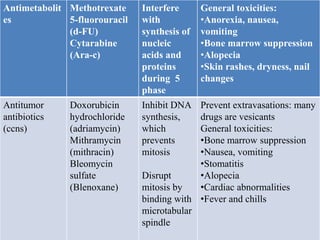
Antimetabolit
es
Methotrexate
5-fluorouracil
(d-FU)
Cytarabine
(Ara-c)
Interfere
with
synthesis of
nucleic
acids and
proteins
during 5
phase
General toxicities:
•Anorexia, nausea,
vomiting
•Bone marrow suppression
•Alopecia
•Skin rashes, dryness, nail
changes
Antitumor
antibiotics
(ccns)
Doxorubicin
hydrochloride
(adriamycin)
Mithramycin
(mithracin)
Bleomycin
sulfate
(Blenoxane)
Inhibit DNA
synthesis,
which
prevents
mitosis
Disrupt
mitosis by
binding with
microtabular
spindle
Prevent extravasations: many
drugs are vesicants
General toxicities:
•Bone marrow suppression
•Nausea, vomiting
•Stomatitis
•Alopecia
•Cardiac abnormalities
•Fever and chills
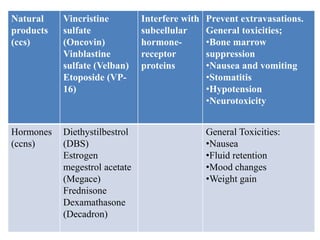
Natural
products
(ccs)
Vincristine
sulfate
(Oncovin)
Vinblastine
sulfate (Velban)
Etoposide (VP-
16)
Interfere with
subcellular
hormone-
receptor
proteins
Prevent extravasations.
General toxicities;
•Bone marrow
suppression
•Nausea and vomiting
•Stomatitis
•Hypotension
•Neurotoxicity
Hormones
(ccns)
Diethystilbestrol
(DBS)
Estrogen
megestrol acetate
(Megace)
Frednisone
Dexamathasone
(Decadron)
General Toxicities:
•Nausea
•Fluid retention
•Mood changes
•Weight gain
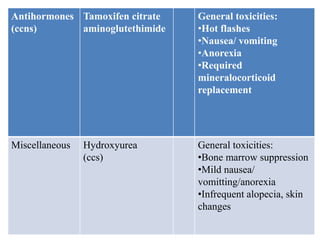
Antihormones
(ccns)
Tamoxifen citrate
aminoglutethimide
General toxicities:
•Hot flashes
•Nausea/ vomiting
•Anorexia
•Required
mineralocorticoid
replacement
Miscellaneous Hydroxyurea
(ccs)
General toxicities:
•Bone marrow suppression
•Mild nausea/
vomitting/anorexia
•Infrequent alopecia, skin
changes
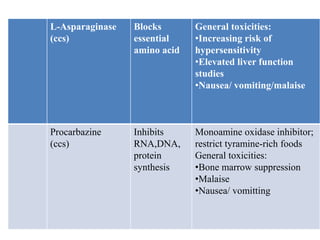
L-Asparaginase
(ccs)
Blocks
essential
amino acid
General toxicities:
•Increasing risk of
hypersensitivity
•Elevated liver function
studies
•Nausea/ vomiting/malaise
Procarbazine
(ccs)
Inhibits
RNA,DNA,
protein
synthesis
Monoamine oxidase inhibitor;
restrict tyramine-rich foods
General toxicities:
•Bone marrow suppression
•Malaise
•Nausea/ vomitting
Administration of drugs
Chemotherapeutic drugs can be administered
by variety of routes depending upon the property
of the medication and the purpose of the therapy.
It may be prescribed by oral intramuscular
subcutaneous and intravenous routes and can be
administered singly or in combination.
• Presently, the combination chemotherapy is given as
it decreases the potential for development of resistant
cells and lowers the remission rate as compared to
the drugs used singly.
• These drugs must be given with great caution and
your major responsibility is to watch any side effect
during therapy and report to the appropriate
authority.
• These side effects can be the major limiting factor in
their use.
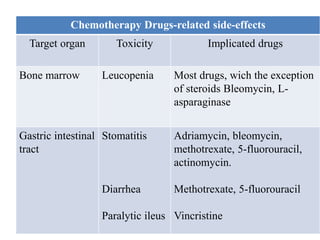
Chemotherapy Drugs-related side-effects
Target organ Toxicity Implicated drugs
Bone marrow Leucopenia Most drugs, wich the exception
of steroids Bleomycin, L-
asparaginase
Gastric intestinal
tract
Stomatitis
Diarrhea
Paralytic ileus
Adriamycin, bleomycin,
methotrexate, 5-fluorouracil,
actinomycin.
Methotrexate, 5-fluorouracil
Vincristine
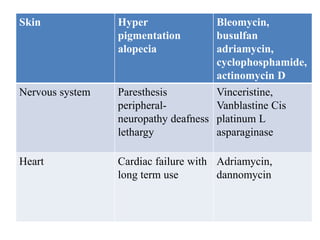
Skin Hyper
pigmentation
alopecia
Bleomycin,
busulfan
adriamycin,
cyclophosphamide,
actinomycin D
Nervous system Paresthesis
peripheral-
neuropathy deafness
lethargy
Vinceristine,
Vanblastine Cis
platinum L
asparaginase
Heart Cardiac failure with
long term use
Adriamycin,
dannomycin
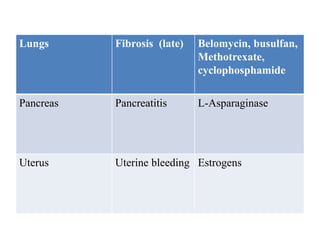
Lungs Fibrosis (late) Belomycin, busulfan,
Methotrexate,
cyclophosphamide
Pancreas Pancreatitis L-Asparaginase
Uterus Uterine bleeding Estrogens
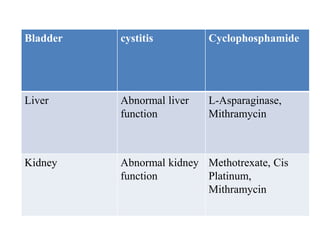
Bladder cystitis Cyclophosphamide
Liver Abnormal liver
function
L-Asparaginase,
Mithramycin
Kidney Abnormal kidney
function
Methotrexate, Cis
Platinum,
Mithramycin
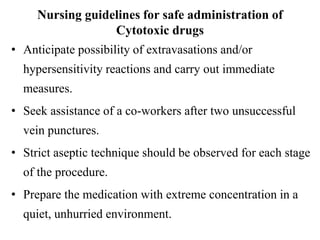
Nursing guidelines for safe administration of
Cytotoxic drugs
• Anticipate possibility of extravasations and/or
hypersensitivity reactions and carry out immediate
measures.
• Seek assistance of a co-workers after two unsuccessful
vein punctures.
• Strict aseptic technique should be observed for each stage
of the procedure.
• Prepare the medication with extreme concentration in a
quiet, unhurried environment.
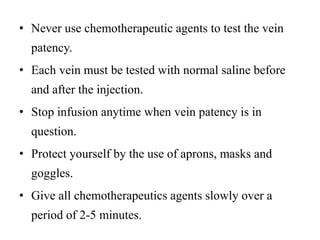
• Never use chemotherapeutic agents to test the vein
patency.
• Each vein must be tested with normal saline before
and after the injection.
• Stop infusion anytime when vein patency is in
question.
• Protect yourself by the use of aprons, masks and
goggles.
• Give all chemotherapeutics agents slowly over a
period of 2-5 minutes.
• Monitor the patient results closely and notify the doctor
if any leucopenia is present.
• Monitor the patient during the entire time of
administration and assist with the all the side effects.
• Anaphylactic shock may occur with any drug; stop
infusion immediately.
• Always be compassionate to such patients. Encourage
them to continue the full course of treatment.
Chemotherapy & Radiation Therapy