Introduction to Quantum Computing Superposition & Entanglement.pptx
1.
CENTER OF DEVLOPMENTFOR ADVANCE COMPUTING, MOHALI
Introduction
to
Quantum Computing: Superposition & Entanglement
Submitted to:
Dr. Manjit Kaur
Scientist-E,
Quantum Technology,
CDAC , Mohali
Submitted by:
Mohit Kumar
2.
Introduction
Quantum computing isa new form of computation that leverages quantum
mechanics principles like superposition and entanglement to solve complex
problems much faster than traditional computers, using quantum bits (qubits)
that can be both 0 and 1 simultaneously.
Superposition
Entanglement
Interference
Ex:
Dirac Notation
Dirac Notation(Bra-Ket Notation) is a standard notation in quantum mechanics introduced by Paul Dirac to
represent quantum states concisely.
5.
Superposition
Superposition is afundamental principle of quantum mechanics where a quantum bit (qubit) can exist in
multiple states simultaneously until measured.
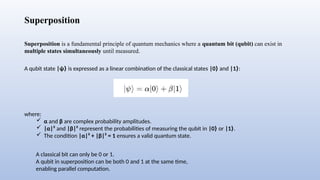
A qubit state |ψ⟩ is expressed as a linear combination of the classical states |0⟩ and |1⟩:
where:
α and β are complex probability amplitudes.
|α|² and |β|² represent the probabilities of measuring the qubit in |0⟩ or |1⟩.
The condition |α|² + |β|² = 1 ensures a valid quantum state.
A classical bit can only be 0 or 1.
A qubit in superposition can be both 0 and 1 at the same time,
enabling parallel computation.
6.
Entanglement
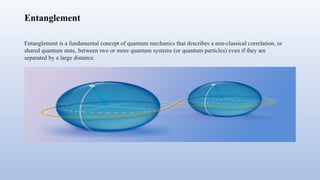
Entanglement is afundamental concept of quantum mechanics that describes a non-classical correlation, or
shared quantum state, between two or more quantum systems (or quantum particles) even if they are
separated by a large distance.
7.
Interference
Quantum interference arisesfrom the wave-like nature of quantum particles, enabling constructive and
destructive interference. It’s used in quantum computing for phase estimation, error correction, and amplifying
desired computational outcomes through controlled quantum gates.