Introduction
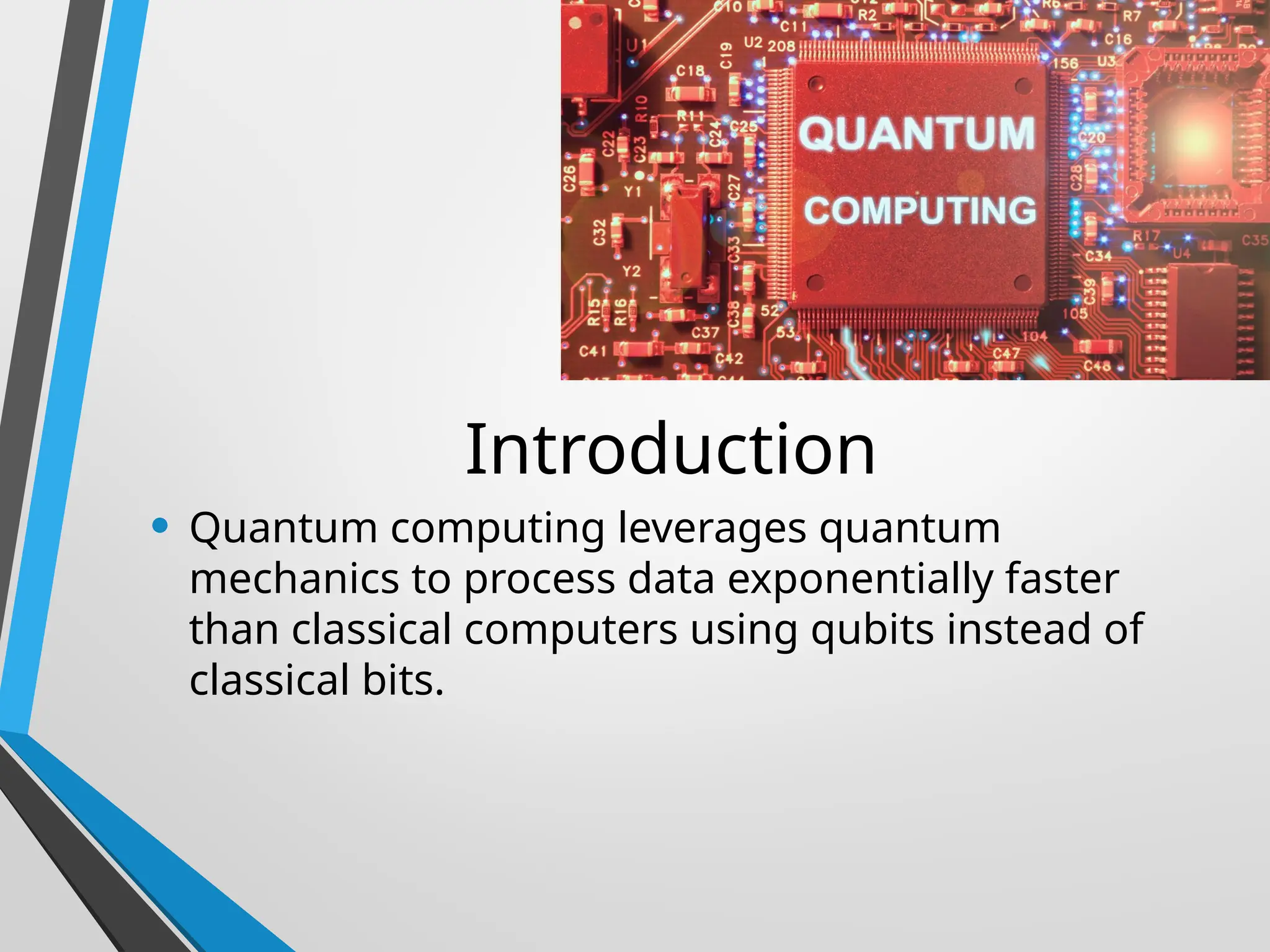
• Quantum computingleverages quantum
mechanics to process data exponentially faster
than classical computers using qubits instead of
classical bits.
3.
Classical vs. Quantum
Computing
•• Classical Computers: Use bits (0s and 1s) for
calculations.
• • Quantum Computers: Use qubits, allowing
superposition and entanglement.
• • Key Differences: Superposition, entanglement,
and parallelism.
4.
Key Principles ofQuantum
Computing
• • Superposition: Qubits can be in multiple states
simultaneously.
• • Entanglement: Qubits influence each other
instantly over distances.
• • Quantum Interference: Probability amplitudes
affect computational results.
5.
Applications of Quantum
Computing
•• Cryptography: Breaking encryption algorithms.
• • Drug Discovery: Simulating molecular
interactions.
• • Optimization Problems: Logistics, finance, and
AI.
• • Climate Modeling: More accurate weather
predictions.
6.
Advantages and Challenges
•Advantages:
• • Faster computation for complex problems.
• • Potential breakthroughs in AI and cryptography.
• Challenges:
• • Decoherence and noise in qubits.
• • High costs and limited scalability.
7.
Future of QuantumComputing
• • Advancements in quantum hardware and
algorithms.
• • Hybrid quantum-classical systems for real-world
use.
• • Potential commercialization of quantum
computing.
![Quantum
Computing
The Future of Computing
Presented by: [Pratham]](https://image.slidesharecdn.com/quantumcomputingpresentation-250403015914-c9160d57/75/Quantum-Computing-presentation-ppt-form-some-slides-1-2048.jpg)


![QUANTUM_COMPUTING_AND_ITS_POTENTIAL_APPLICATIONS[2].pptx](https://cdn.slidesharecdn.com/ss_thumbnails/quantumcomputinganditspotentialapplications2-250814011918-2632c4bc-thumbnail.jpg?width=640&height=640&fit=bounds)


