Introduction to Operative Dentistry Part I Dr. Feras Aalam
Definition:   Operative Dentistry is the art and science of the  prevention , diagnosis  and  treatment  of defects in the enamel and dentin of individual teeth.
 
History and Epidemiology •  Operative Dentistry was considered to be the  entirety  of the clinical practice of dentistry. •  Has been recognized as the  foundation  of dentistry and the base from which most other aspects of dentistry evolved.
History and Epidemiology •  In United States, dentistry originated in the 17th century when several barbers were sent from England. •  The practice of these early dentists consisted mainly of  tooth extraction  and practice of dentistry during the founding years was not based on scientific knowledge.
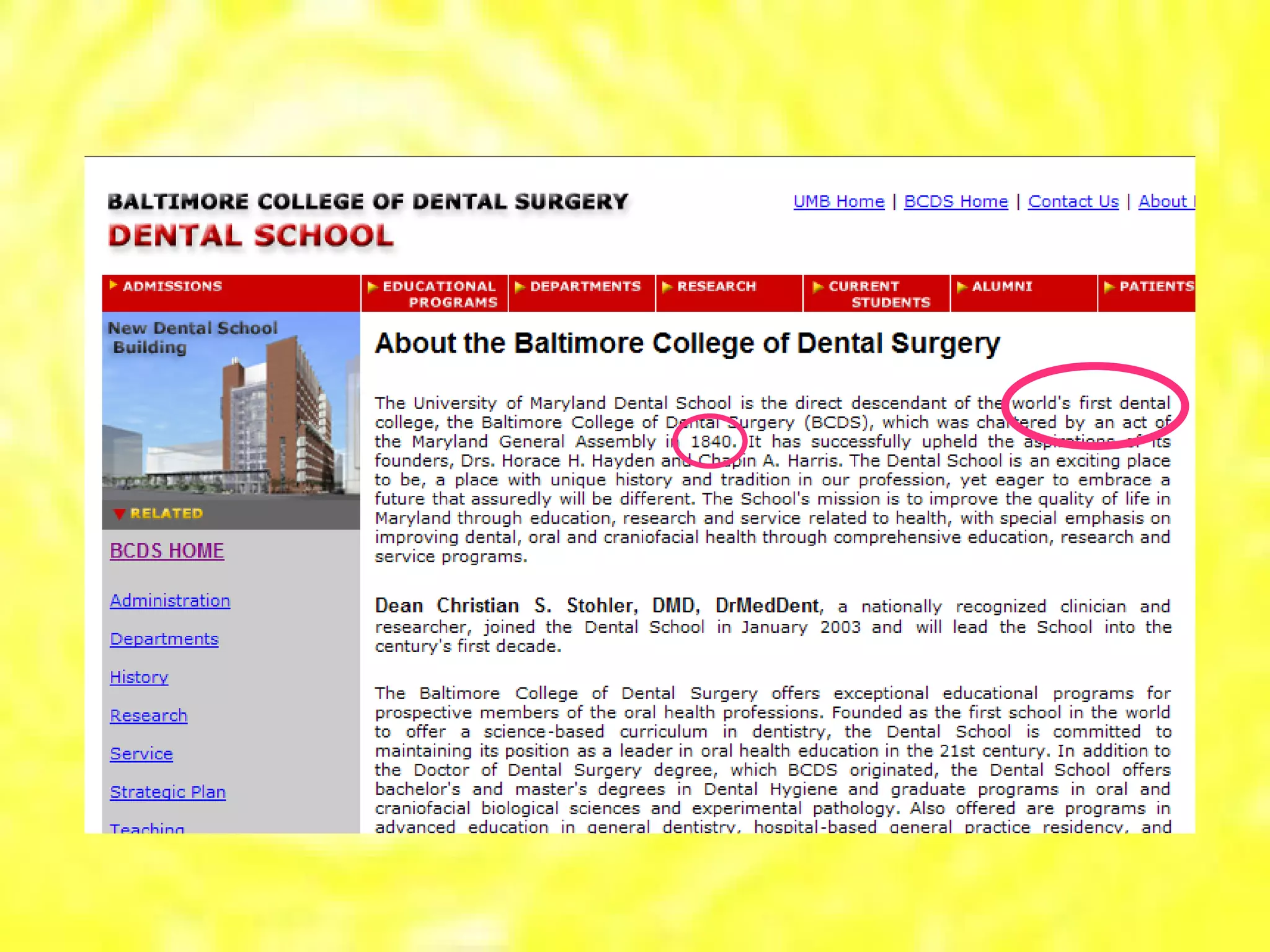
History and Epidemiology •  Baltimore College of Dental Surgery in  1840  dental education •  Harvard University in  1867  dental program
 
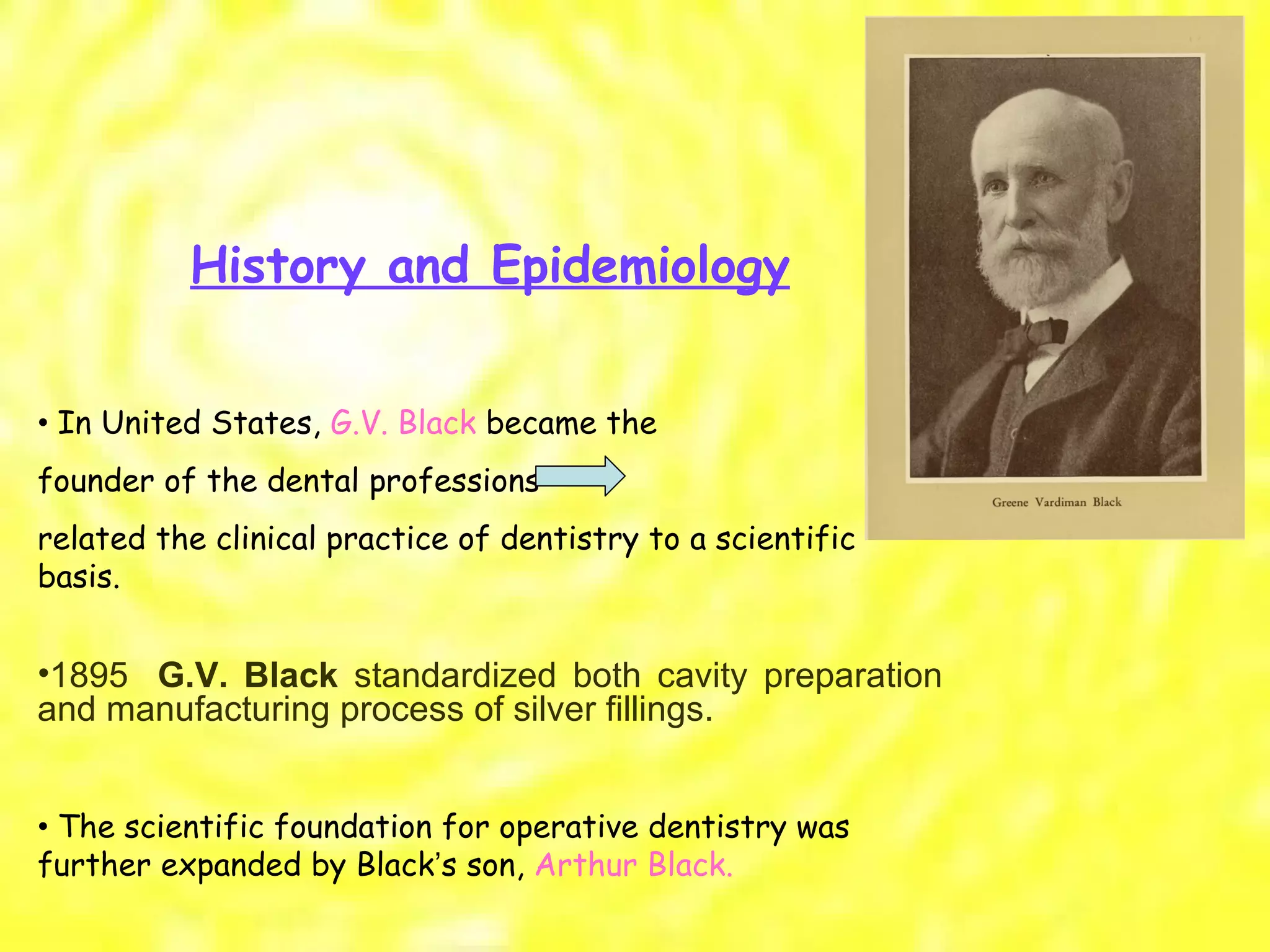
History and Epidemiology •  In United States,  G.V. Black  became the founder of the dental professions  related the clinical practice of dentistry to a scientific basis. 1895    G.V. Black  standardized both cavity preparation and manufacturing process of silver fillings.  •  The scientific foundation for operative dentistry was further expanded by Black ’ s son,  Arthur Black.
History and Epidemiology •  Operative Dentistry plays an important role in enhancing dental health and new branched into dental specialities. •  Today, O.D. continues to be a  most active component  of most dental practice. •  Epidemiologically, demand for O.D. will not    in the foreseeable future.
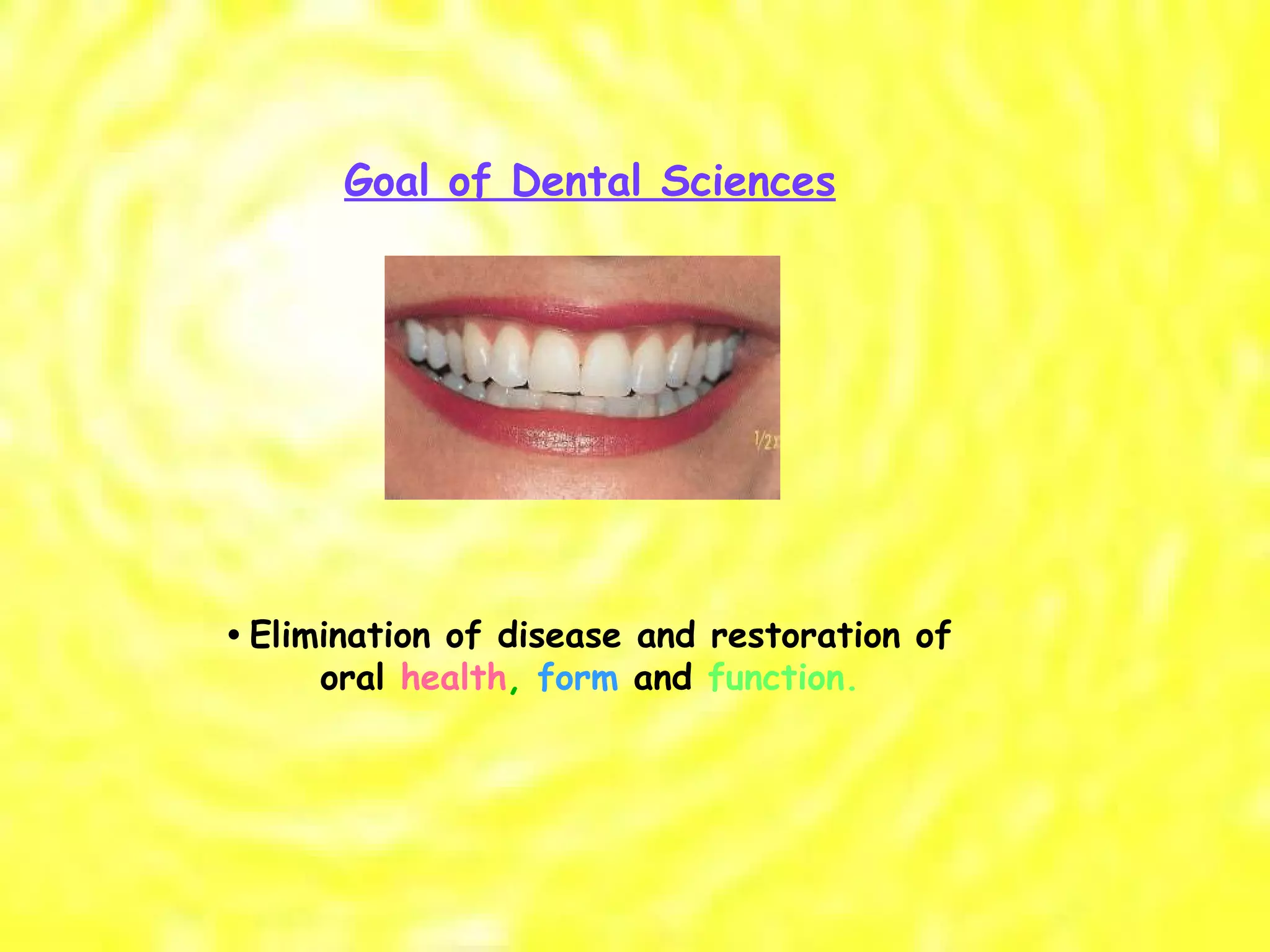
Goal of Dental Sciences •  Elimination of disease and restoration of oral  health ,  form  and  function.
Function and Purpose •  An understanding and appreciation for  infection control. •  Examination not only the  affected tooth  but also the  oral and systemic health  of the patient. •  Diagnosis of the dental problem and must be  correlated  with other bodily tissues. •  A treatment plan that has a potential to return the affected area to a  state of health and function.
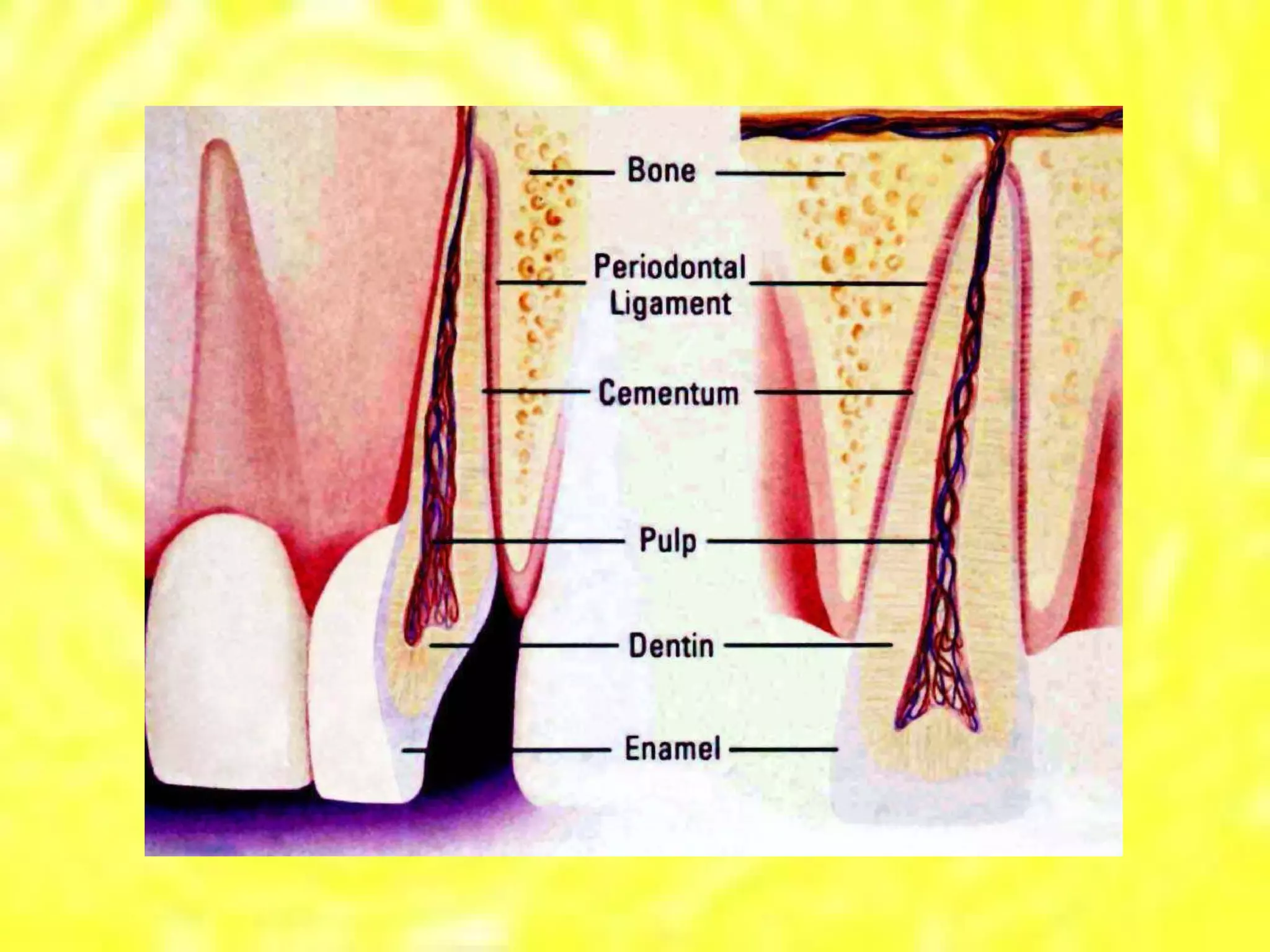
Function and Purpose •  An understanding of  material  to be used to restore the affected area with a realization of both the material limitations and demands. •  An understanding of the  oral environment  into which the restoration will be placed. •  To understand the biological basis and function of the various  tooth components  and  supporting tissues  although the knowledge of correct  dental anatomy .
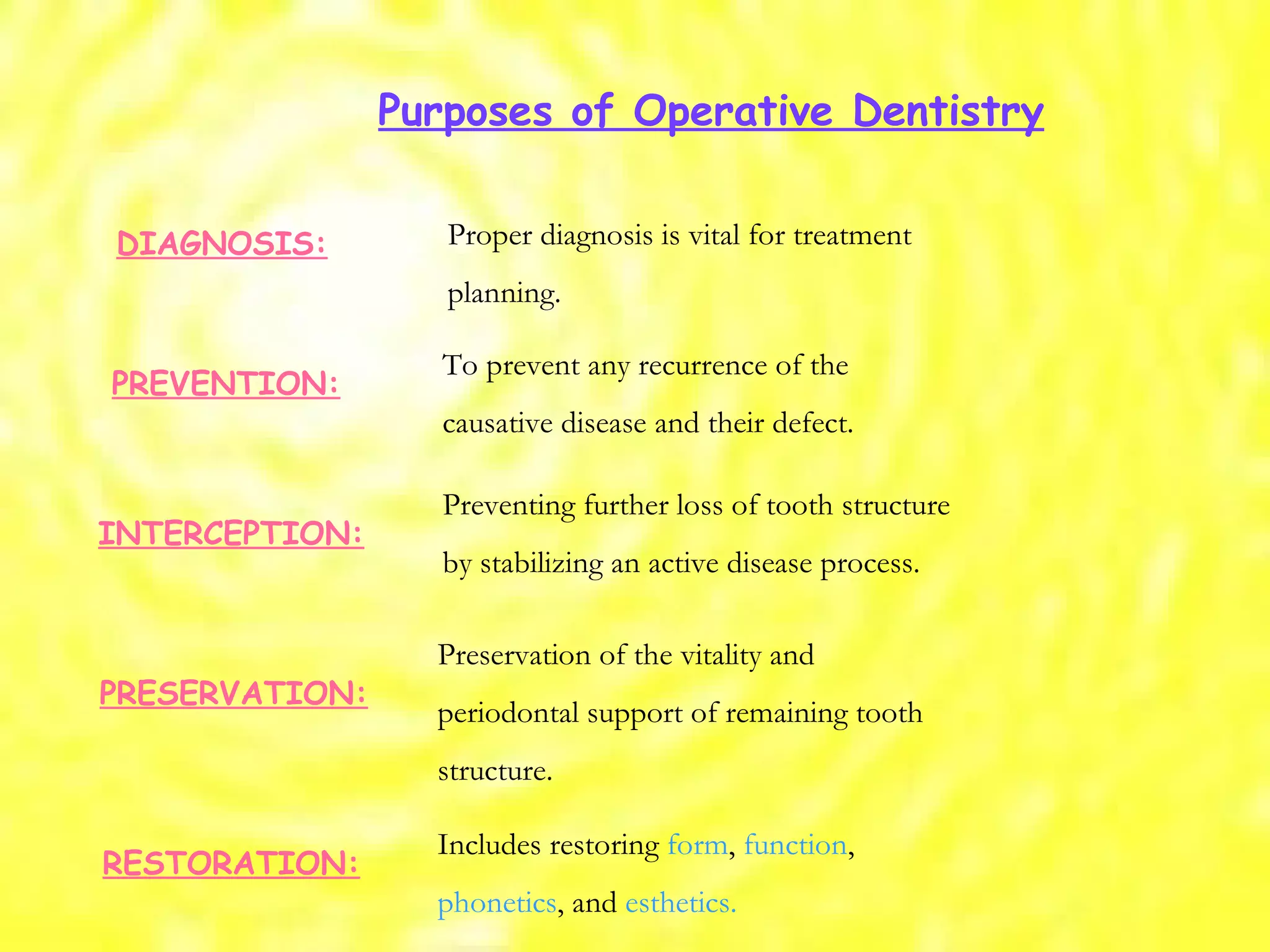
Proper diagnosis is vital for treatment planning. DIAGNOSIS: PREVENTION: To prevent any recurrence of the causative disease and their defect. INTERCEPTION: Preventing further loss of tooth structure by stabilizing an active disease process. PRESERVATION: Preservation of the vitality and periodontal support of remaining tooth structure. RESTORATION: Includes restoring  form ,  function , phonetics , and  esthetics. Purposes of Operative Dentistry
The placement of a restoration in a tooth requires the dentist to: •  Practice applied  human biology + microbiology •  Possess highly developed  technical skills •  Demonstrate  artistic abilities
Type of Lesion in Tooth Destruction •  Dental caries •  Tooth wear •  Trauma •  Developmental defect
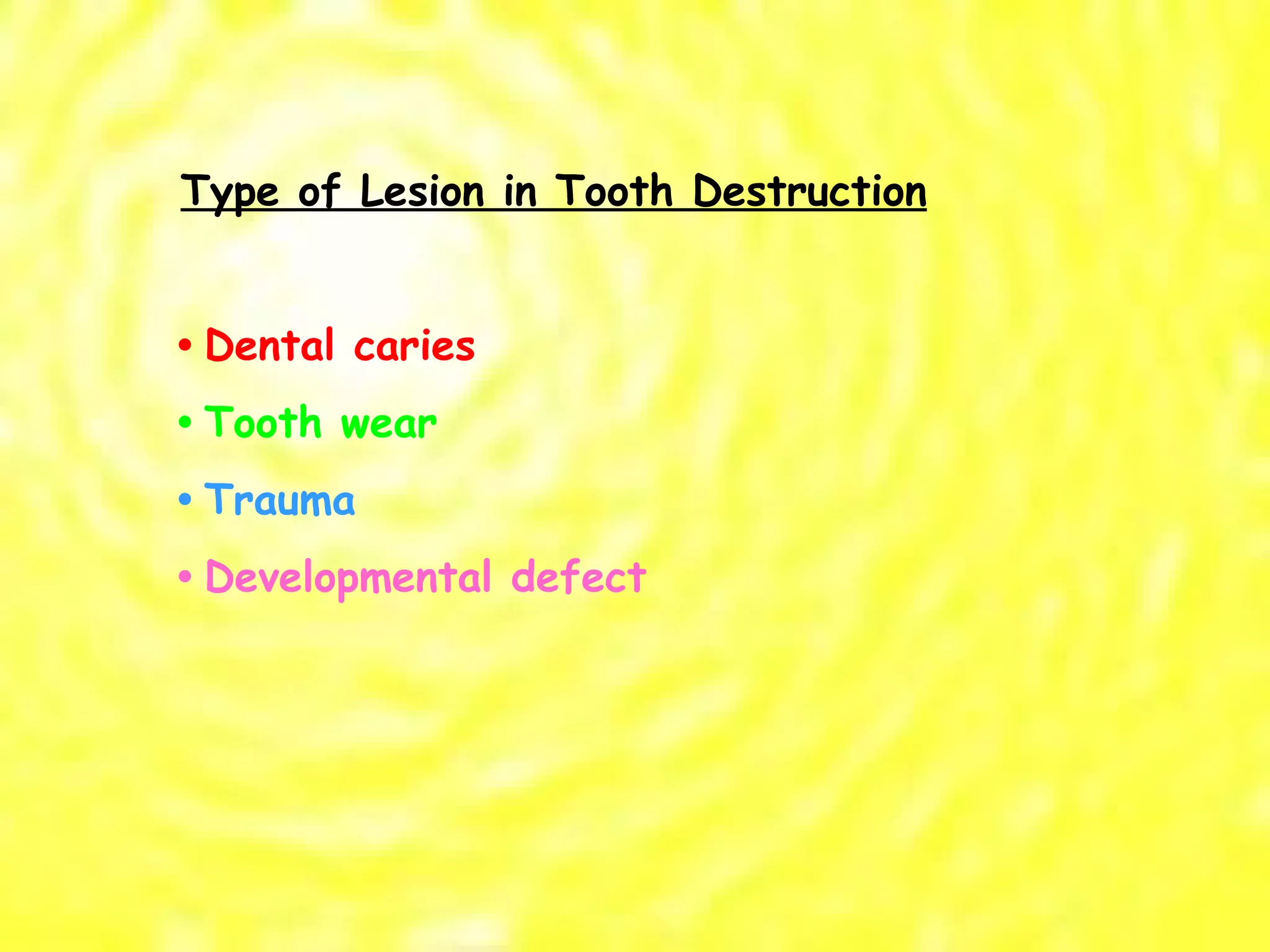
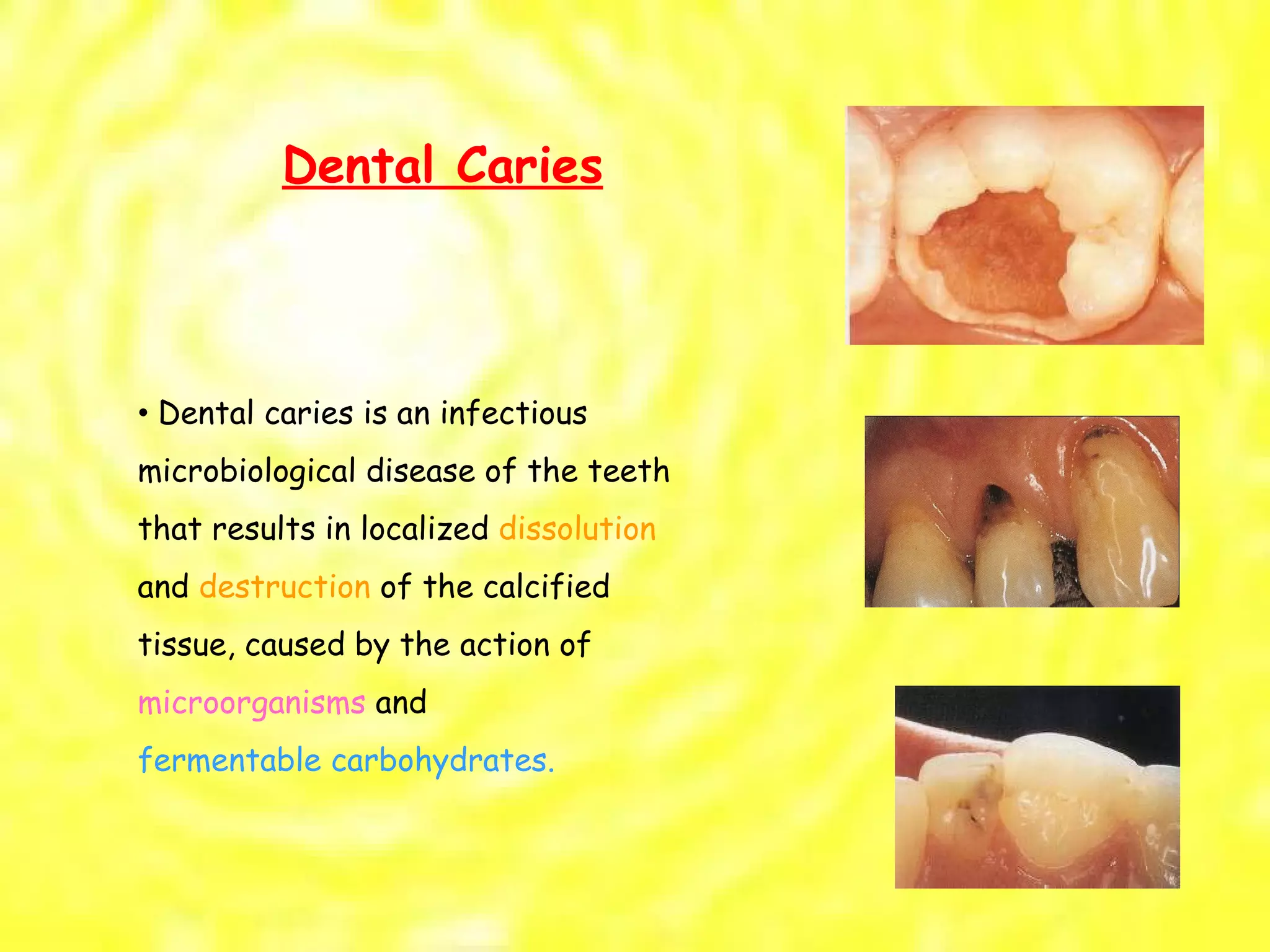
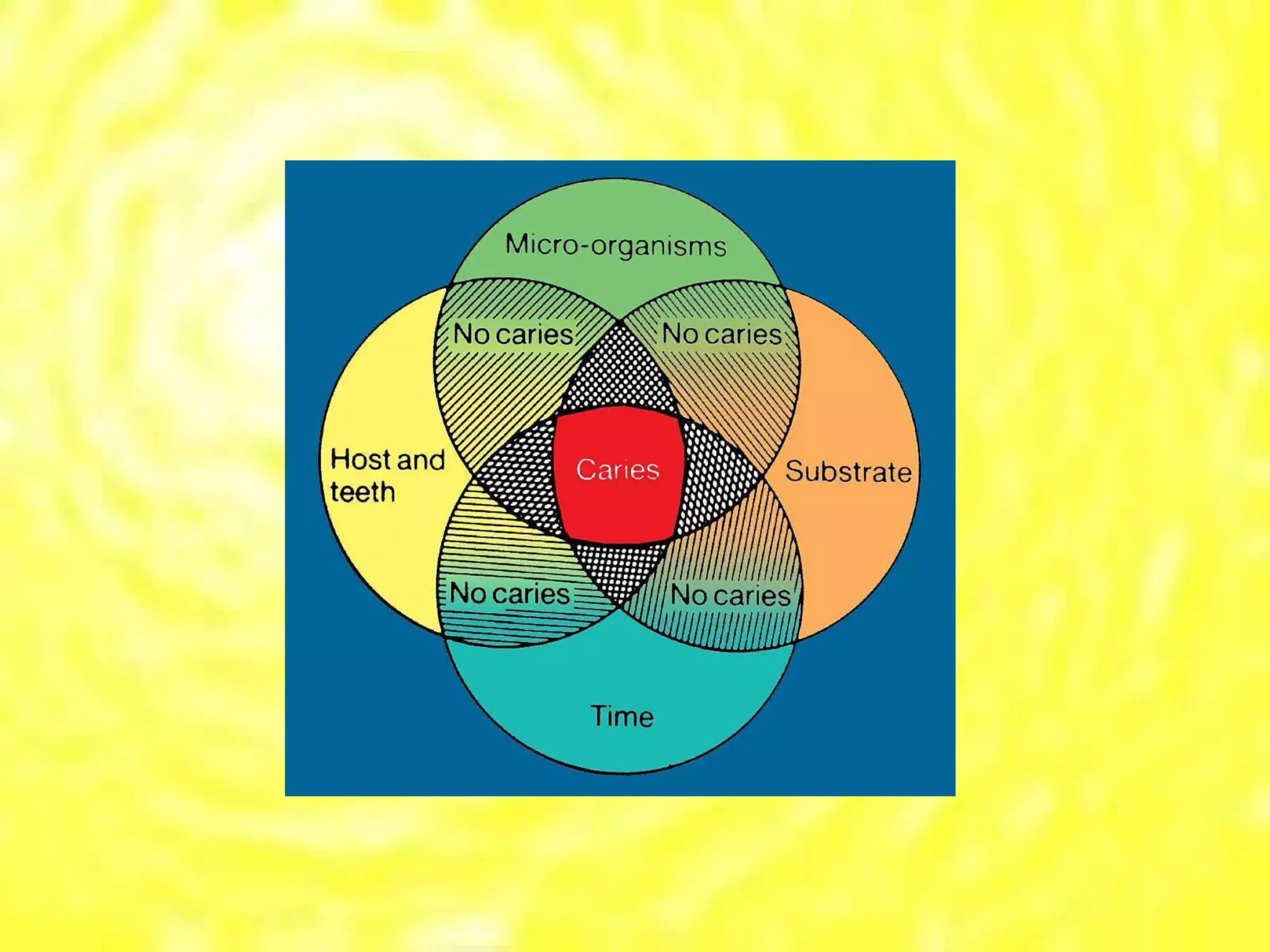
Dental Caries •  Dental caries is an infectious microbiological disease of the teeth that results in localized  dissolution and  destruction  of the calcified tissue, caused by the action of microorganisms  and fermentable carbohydrates.
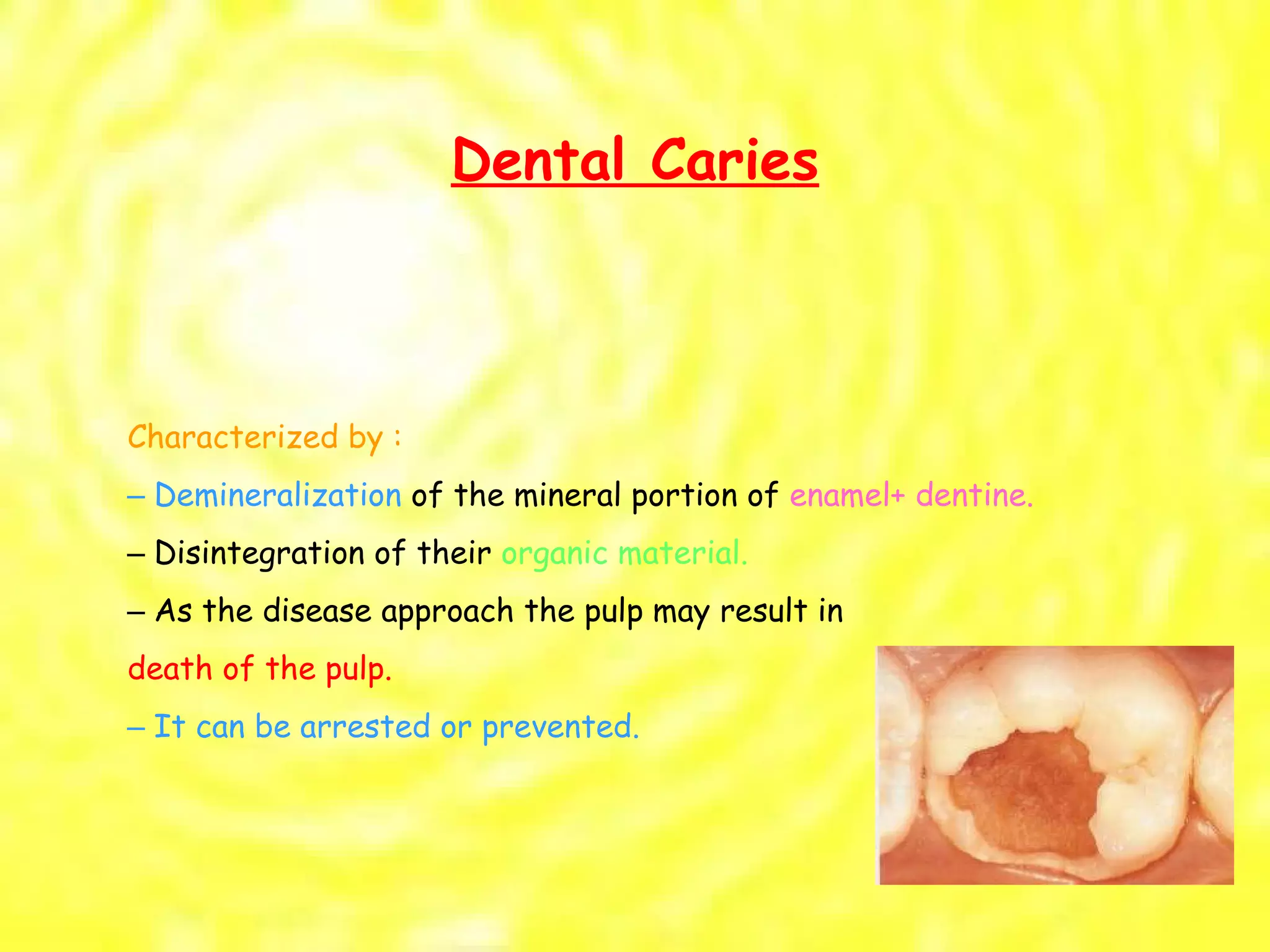
Dental Caries Characterized by : –  Demineralization  of the mineral portion of  enamel+ dentine. –  Disintegration of their  organic material. –  As the disease approach the pulp may result in death of the pulp. –  It can be arrested or prevented.
 
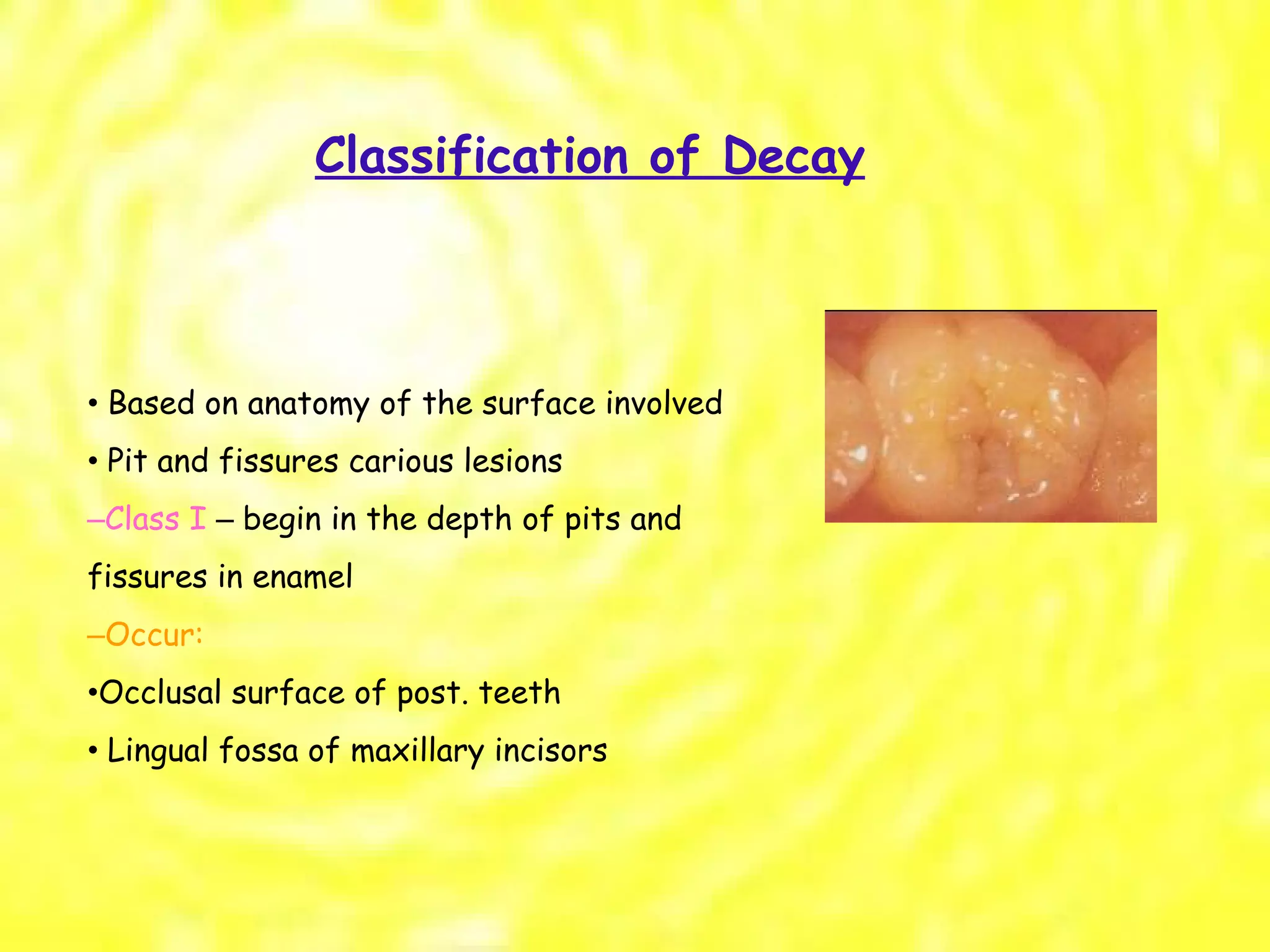
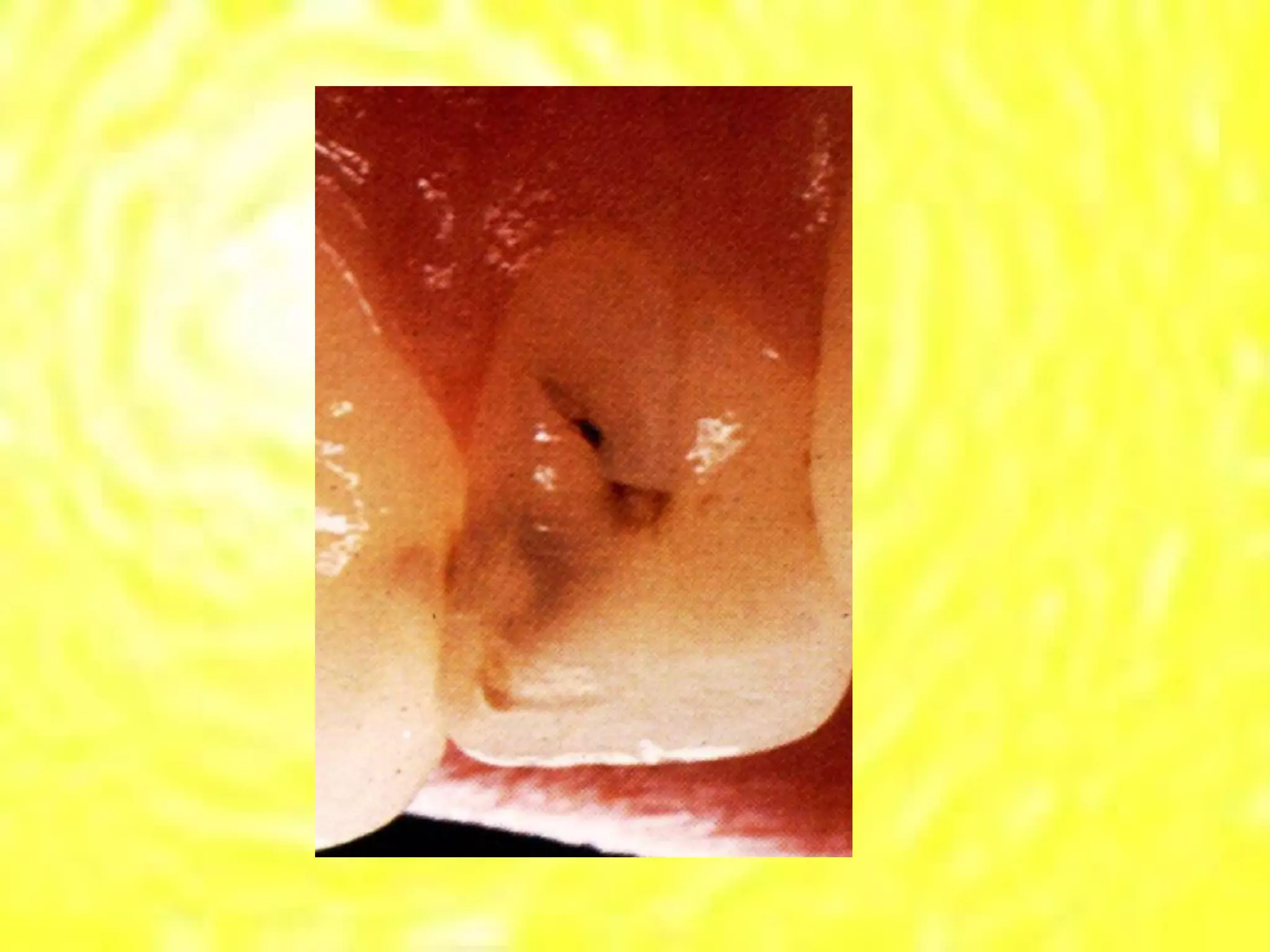
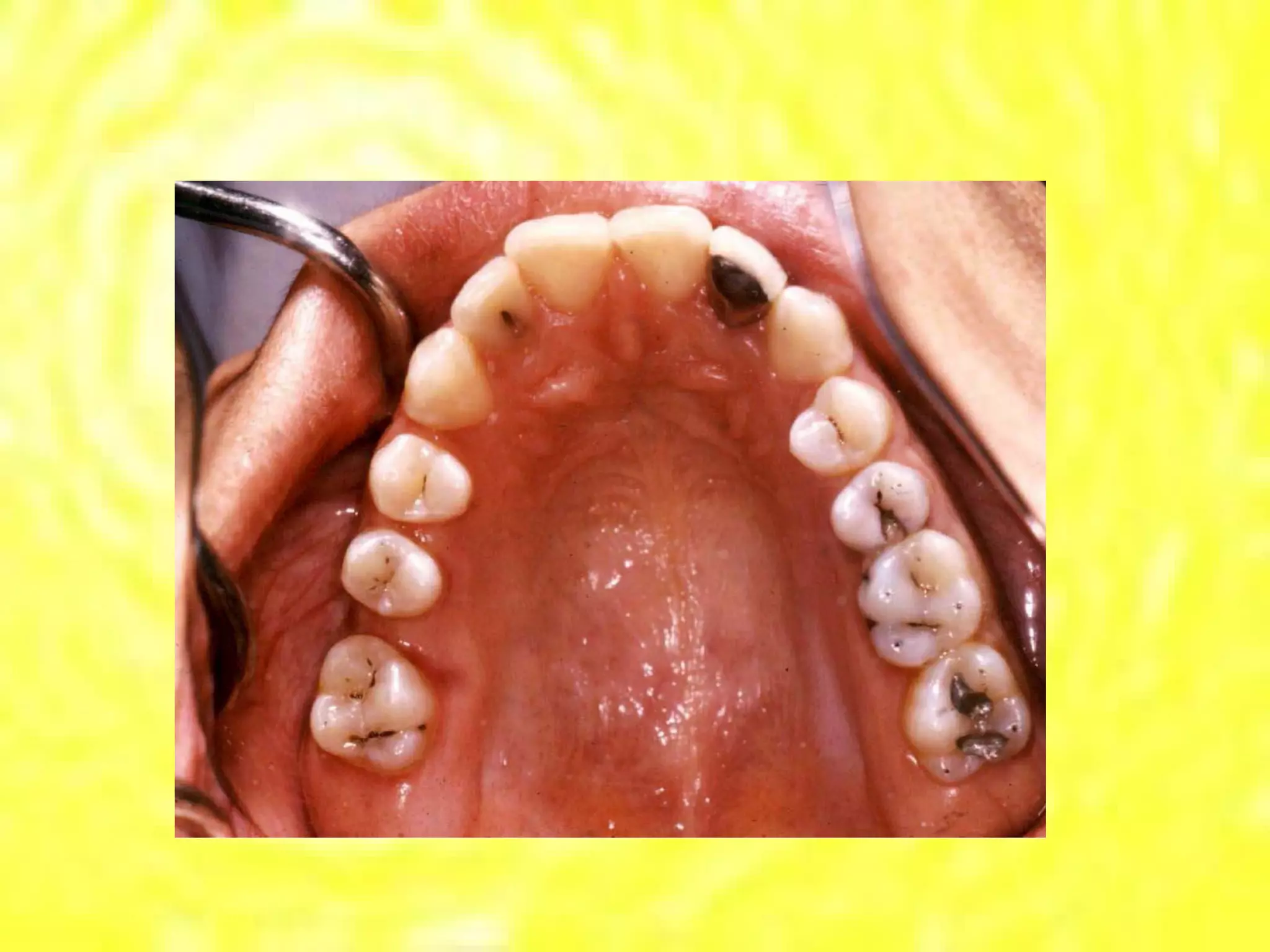
Classification of Decay •  Based on anatomy of the surface involved •  Pit and fissures carious lesions – Class I  –  begin in the depth of pits and fissures in enamel – Occur: • Occlusal surface of post. teeth •  Lingual fossa of maxillary incisors
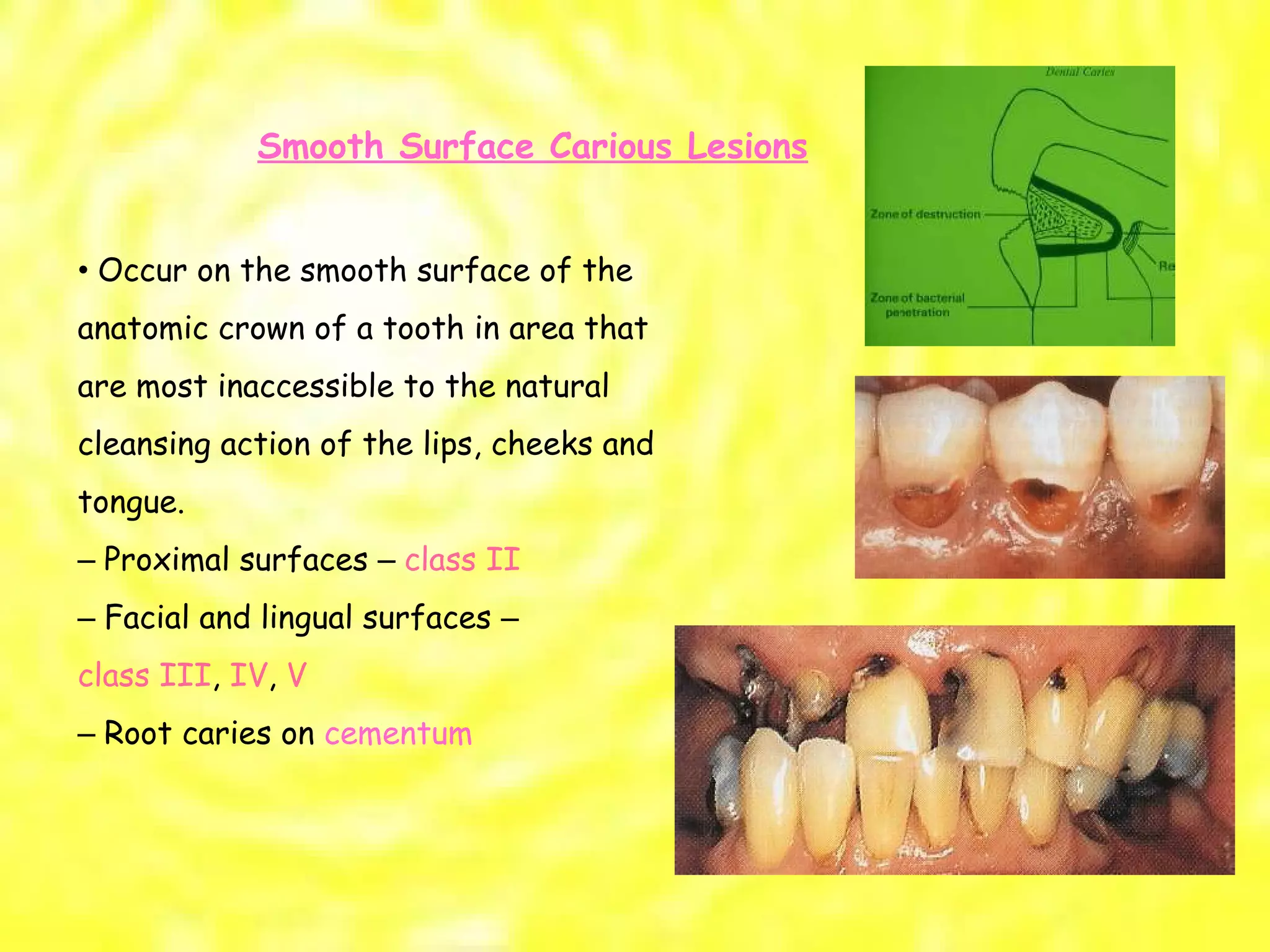
Smooth Surface Carious Lesions •  Occur on the smooth surface of the anatomic crown of a tooth in area that are most inaccessible to the natural cleansing action of the lips, cheeks and tongue. –  Proximal surfaces  –  class II –  Facial and lingual surfaces  – class III ,  IV ,  V –  Root caries on  cementum
 
 
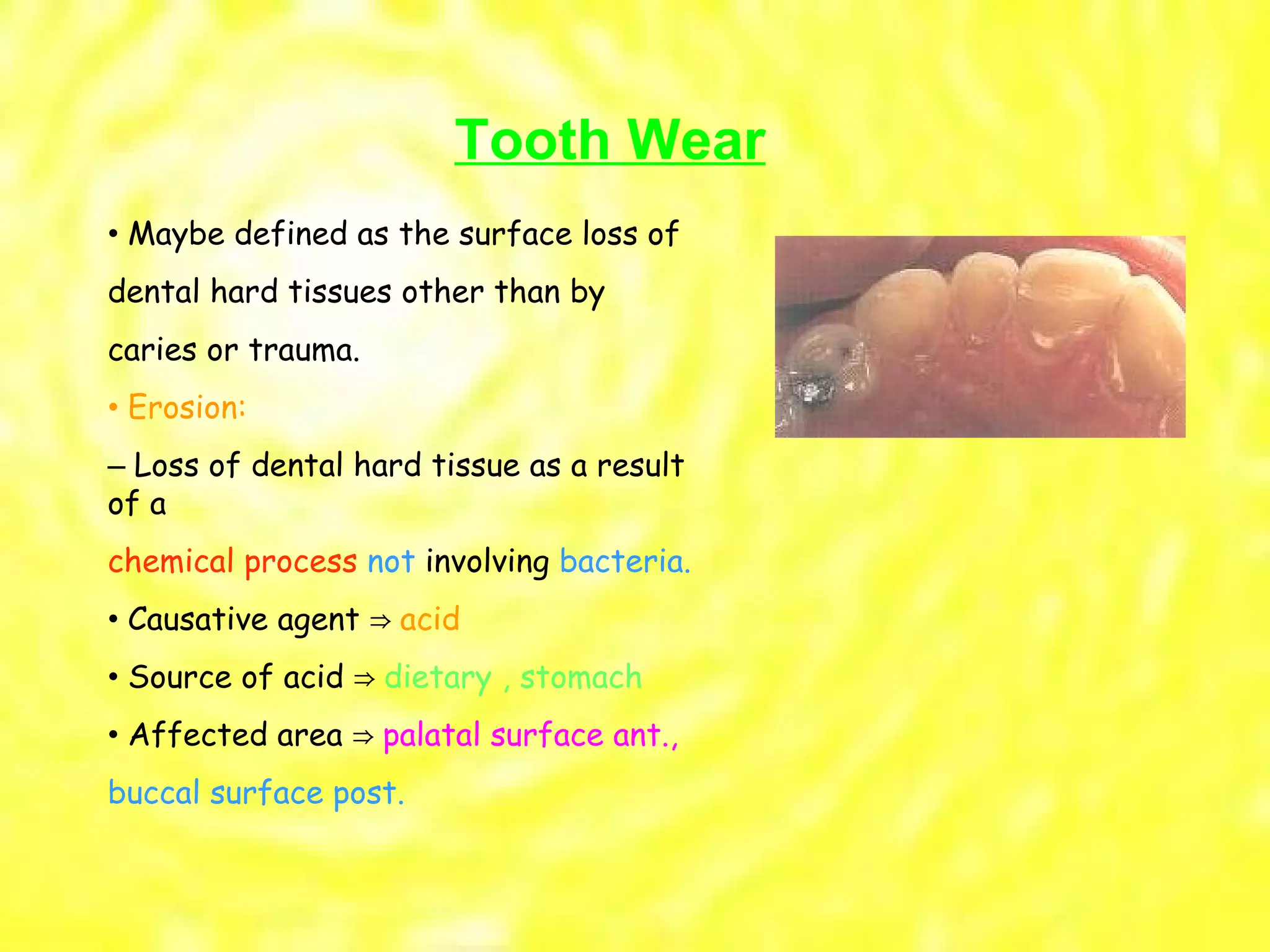
•  Maybe defined as the surface loss of dental hard tissues other than by caries or trauma. •  Erosion: –  Loss of dental hard tissue as a result of a chemical process  not  involving  bacteria. •  Causative agent  ⇒ acid •  Source of acid  ⇒ dietary , stomach •  Affected area  ⇒ palatal surface ant., buccal surface post. Tooth Wear
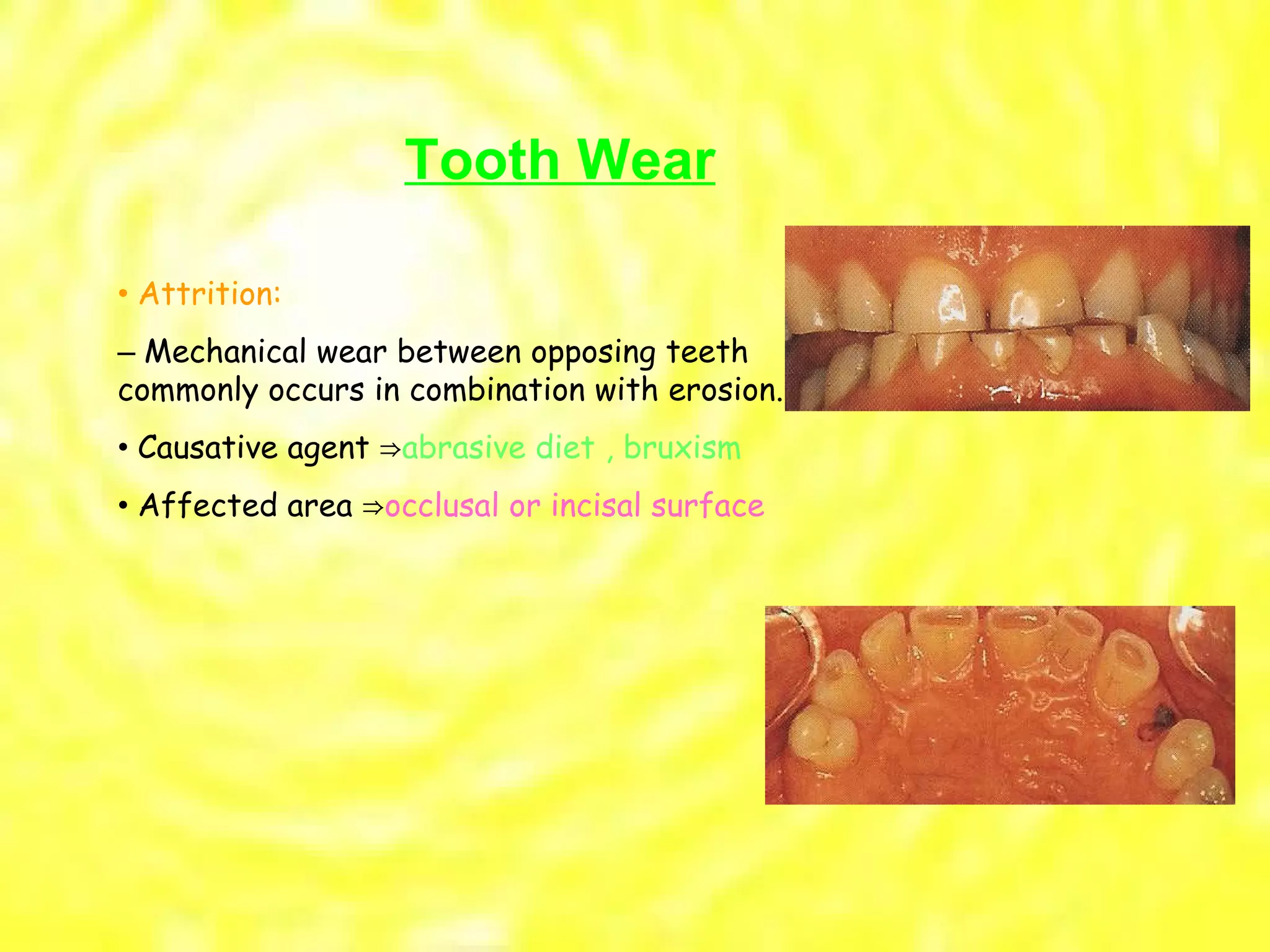
•  Attrition: –  Mechanical wear between opposing teeth commonly occurs in combination with erosion. •  Causative agent  ⇒ abrasive diet , bruxism •  Affected area  ⇒ occlusal or incisal surface Tooth Wear
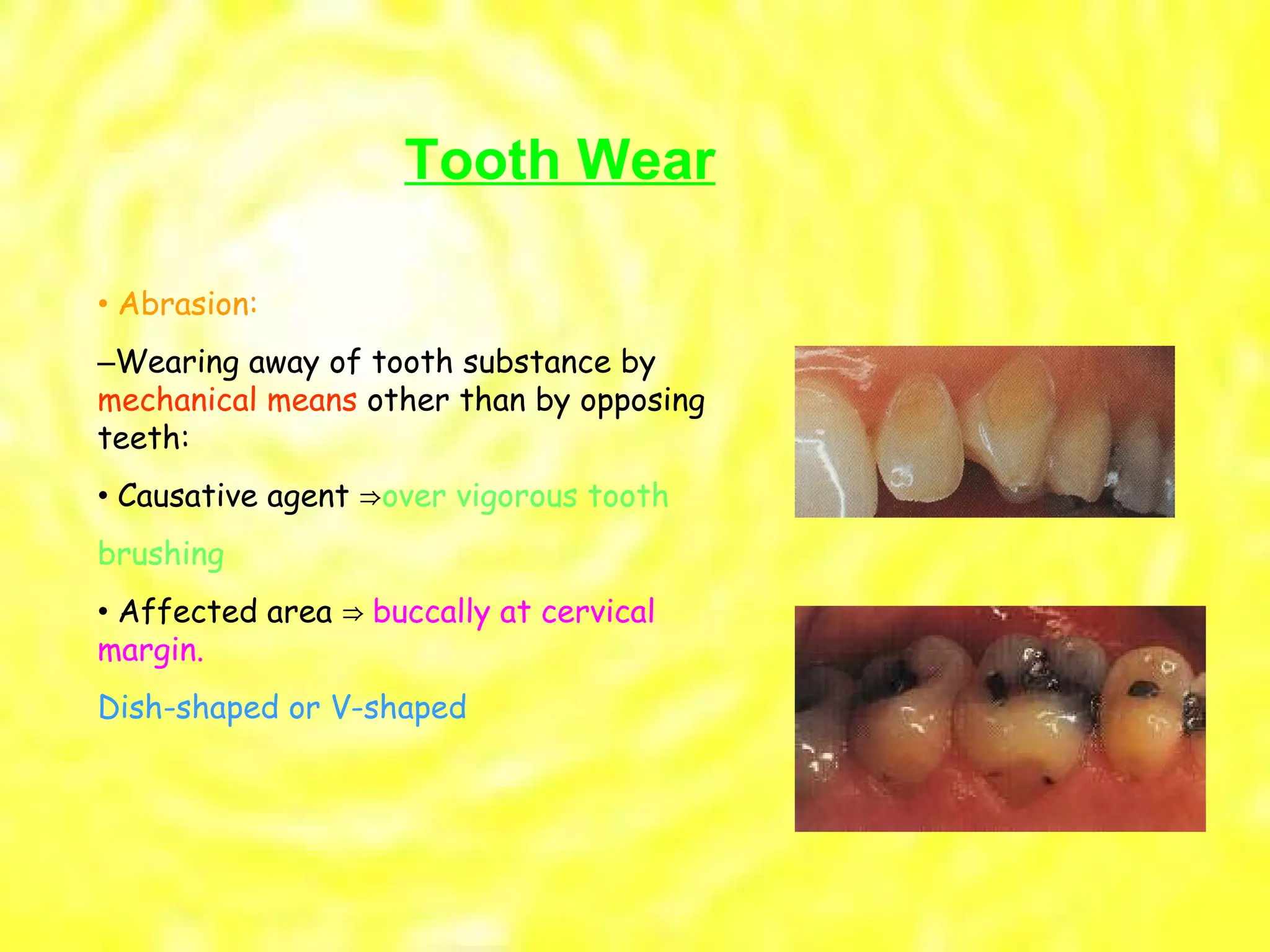
•  Abrasion: – Wearing away of tooth substance by  mechanical means  other than by opposing teeth: •  Causative agent  ⇒ over vigorous tooth brushing •  Affected area  ⇒ buccally at cervical margin. Dish-shaped or V-shaped Tooth Wear
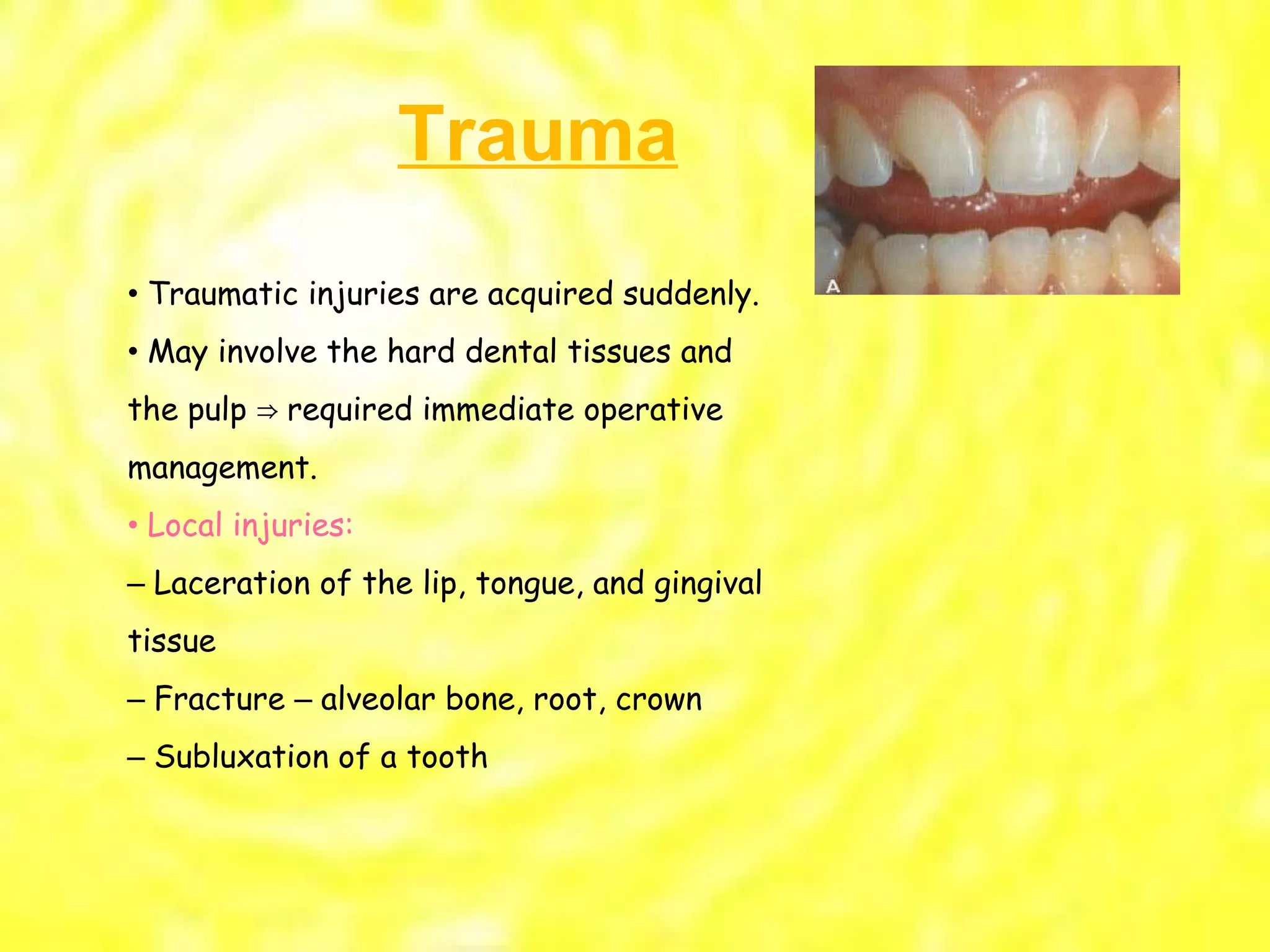
•  Traumatic injuries are acquired suddenly. •  May involve the hard dental tissues and the pulp  ⇒ required immediate operative management. •  Local injuries: –  Laceration of the lip, tongue, and gingival tissue –  Fracture  –  alveolar bone, root, crown –  Subluxation of a tooth Trauma


Introduction to operative dentistry part I

  • 1.
    Introduction to OperativeDentistry Part I Dr. Feras Aalam
  • 2.
    Definition: Operative Dentistry is the art and science of the prevention , diagnosis and treatment of defects in the enamel and dentin of individual teeth.
  • 3.
  • 4.
    History and Epidemiology• Operative Dentistry was considered to be the entirety of the clinical practice of dentistry. • Has been recognized as the foundation of dentistry and the base from which most other aspects of dentistry evolved.
  • 5.
    History and Epidemiology• In United States, dentistry originated in the 17th century when several barbers were sent from England. • The practice of these early dentists consisted mainly of tooth extraction and practice of dentistry during the founding years was not based on scientific knowledge.
  • 6.
    History and Epidemiology• Baltimore College of Dental Surgery in 1840 dental education • Harvard University in 1867 dental program
  • 7.
  • 8.
    History and Epidemiology• In United States, G.V. Black became the founder of the dental professions related the clinical practice of dentistry to a scientific basis. 1895    G.V. Black standardized both cavity preparation and manufacturing process of silver fillings. • The scientific foundation for operative dentistry was further expanded by Black ’ s son, Arthur Black.
  • 9.
    History and Epidemiology• Operative Dentistry plays an important role in enhancing dental health and new branched into dental specialities. • Today, O.D. continues to be a most active component of most dental practice. • Epidemiologically, demand for O.D. will not   in the foreseeable future.
  • 10.
    Goal of DentalSciences • Elimination of disease and restoration of oral health , form and function.
  • 11.
    Function and Purpose• An understanding and appreciation for infection control. • Examination not only the affected tooth but also the oral and systemic health of the patient. • Diagnosis of the dental problem and must be correlated with other bodily tissues. • A treatment plan that has a potential to return the affected area to a state of health and function.
  • 12.
    Function and Purpose• An understanding of material to be used to restore the affected area with a realization of both the material limitations and demands. • An understanding of the oral environment into which the restoration will be placed. • To understand the biological basis and function of the various tooth components and supporting tissues although the knowledge of correct dental anatomy .
  • 13.
    Proper diagnosis isvital for treatment planning. DIAGNOSIS: PREVENTION: To prevent any recurrence of the causative disease and their defect. INTERCEPTION: Preventing further loss of tooth structure by stabilizing an active disease process. PRESERVATION: Preservation of the vitality and periodontal support of remaining tooth structure. RESTORATION: Includes restoring form , function , phonetics , and esthetics. Purposes of Operative Dentistry
  • 14.
    The placement ofa restoration in a tooth requires the dentist to: • Practice applied human biology + microbiology • Possess highly developed technical skills • Demonstrate artistic abilities
  • 15.
    Type of Lesionin Tooth Destruction • Dental caries • Tooth wear • Trauma • Developmental defect
  • 16.
    Dental Caries • Dental caries is an infectious microbiological disease of the teeth that results in localized dissolution and destruction of the calcified tissue, caused by the action of microorganisms and fermentable carbohydrates.
  • 17.
    Dental Caries Characterizedby : – Demineralization of the mineral portion of enamel+ dentine. – Disintegration of their organic material. – As the disease approach the pulp may result in death of the pulp. – It can be arrested or prevented.
  • 18.
  • 19.
    Classification of Decay• Based on anatomy of the surface involved • Pit and fissures carious lesions – Class I – begin in the depth of pits and fissures in enamel – Occur: • Occlusal surface of post. teeth • Lingual fossa of maxillary incisors
  • 20.
    Smooth Surface CariousLesions • Occur on the smooth surface of the anatomic crown of a tooth in area that are most inaccessible to the natural cleansing action of the lips, cheeks and tongue. – Proximal surfaces – class II – Facial and lingual surfaces – class III , IV , V – Root caries on cementum
  • 21.
  • 22.
  • 23.
    • Maybedefined as the surface loss of dental hard tissues other than by caries or trauma. • Erosion: – Loss of dental hard tissue as a result of a chemical process not involving bacteria. • Causative agent ⇒ acid • Source of acid ⇒ dietary , stomach • Affected area ⇒ palatal surface ant., buccal surface post. Tooth Wear
  • 24.
    • Attrition:– Mechanical wear between opposing teeth commonly occurs in combination with erosion. • Causative agent ⇒ abrasive diet , bruxism • Affected area ⇒ occlusal or incisal surface Tooth Wear
  • 25.
    • Abrasion:– Wearing away of tooth substance by mechanical means other than by opposing teeth: • Causative agent ⇒ over vigorous tooth brushing • Affected area ⇒ buccally at cervical margin. Dish-shaped or V-shaped Tooth Wear
  • 26.
    • Traumaticinjuries are acquired suddenly. • May involve the hard dental tissues and the pulp ⇒ required immediate operative management. • Local injuries: – Laceration of the lip, tongue, and gingival tissue – Fracture – alveolar bone, root, crown – Subluxation of a tooth Trauma
  • 27.
  • 28.