CONTENT
โ€ข DEFINITION
โ€ข CLASS III AMALGAM RESTORATION
โ€ข CLASS III COMPOSITE RESTORATION
DEFINITION
Class III Cavity preparation is cavity preparation involving
the proximal surface of the anterior teeth.
โ€ข Amalgam restoration is used infrequently in Class III
cavity preparation due to aesthetic concerns
โ€ข It has been replaced by tooth colored restorative material
especially composites which have become increaasingly
wear resistant and color stable.
INDICATION
โ€ข Distal surface of maxillary and mandibular canines in
situations:
1) Extensive prep with minimal facial involvement
2) Gingival margin is primarily in cementum
3) Difficulty in moisture control
โ€ข Any class III not involving the facial surface or
undermining the incisal corner.
CONTRAINDICATION
Areas of aesthetic importance such as mesial surface and
preparation involving the facial surface rather than lingual.
BUR SELECTION
โ€ข Depending on the anticipated size of the restoration, the
bur selection done
No. 2 Bur:- Entry cut on Disto-lingual marginal ridge
No. 1 or 1/2 Bur:- Tooth or carious lesion is small
No. 1/4 Bur:- To place retention grooves.
โ€ข Even diamond points can be used.
OUTLINE FORM
โ€ข A lingual access preparation is recommended because of
the use of amalgam in that location is more appropriate.
โ€ข Mandibular canine a facial approach may be indicated if
the lesion is more facial than lingual.
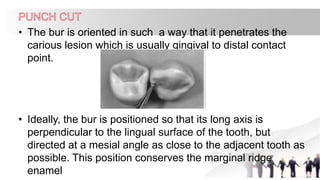
โ€ข The bur is oriented in such a way that it penetrates the
carious lesion which is usually gingival to distal contact
point.
โ€ข Ideally, the bur is positioned so that its long axis is
perpendicular to the lingual surface of the tooth, but
directed at a mesial angle as close to the adjacent tooth as
possible. This position conserves the marginal ridge
enamel
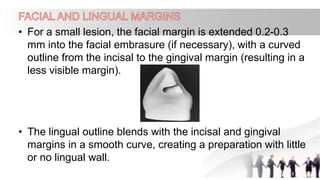
โ€ข For a small lesion, the facial margin is extended 0.2-0.3
mm into the facial embrasure (if necessary), with a curved
outline from the incisal to the gingival margin (resulting in a
less visible margin).
โ€ข The lingual outline blends with the incisal and gingival
margins in a smooth curve, creating a preparation with little
or no lingual wall.
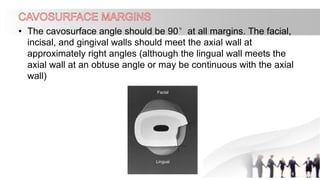
โ€ข The cavosurface angle should be 90ยฐat all margins. The facial,
incisal, and gingival walls should meet the axial wall at
approximately right angles (although the lingual wall meets the
axial wall at an obtuse angle or may be continuous with the axial
wall)
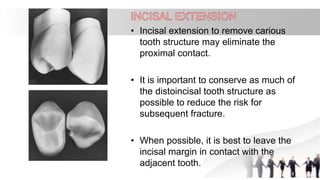
โ€ข Incisal extension to remove carious
tooth structure may eliminate the
proximal contact.
โ€ข It is important to conserve as much of
the distoincisal tooth structure as
possible to reduce the risk for
subsequent fracture.
โ€ข When possible, it is best to leave the
incisal margin in contact with the
adjacent tooth.
โ€ข When preparing a gingival wall that is near the level of the
rubber dam or apical to it, it is beneficial to place a wedge
in the gingival embrasure earlier to depress and protect
soft tissue and the rubber dam.
โ€ข As the bur is preparing the gingival wall, it may lightly
shave the wedge.
โ€ข A triangular (i.e., anatomic) wedge, rather than a round
wedge, is used for a deep gingival margin
โ€ข Penetration should be at a limited initial axial depth (i.e.,
0.5โ€“0.6 mm) inside the DEJ (see Fig. 15-7, C and D) or at a
0.75-0.8-mm axial depth when the gingival margin is on the
root surface (in cementum).
โ€ข It may be in sound dentin (i.e. shallow lesion), in infected
dentin (i.e. moderate to deep lesion) or in existing
restorative material (if replacing a restoration).
PRIMARY RESISTANCE FORM
โ€ข Primary Resistance form is that shape and placement of the
cavity walls to best enable both the tooth and restoration to
withstand, without fracture the stresses of Masticatory forces
delivered principally along the long axis of the tooth.
โ€ข Features of Primary Resistance Form
1) Cavosurface margin is 90ยฐ.
2) Enamel walls supported by sound dentin.
3) Sufficient bulk of enamel (= 1mm)
4) Slightly rounded internal line angles.
PRIMARY RETENTION FORM
โ€ข Primary Resistance form is that shape and placement of
the cavity walls to best enable both the tooth and
restoration to withstand, without fracture the stresses of
Masticatory forces delivered principally along the long
axis of the tooth.
โ€ข Primary retention form is provided by box like
preparation form.
FINAL TOOTH PREPARATION
โ€ข REMOVAL OF ANY INFECTED CARIOUS DENTIN on
the axial wall which is done by
1) a slowly revolving no. 2 or 4 round burs
2) spoon excavator
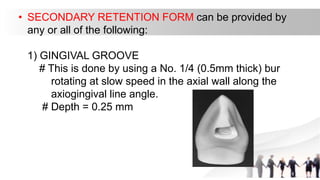
โ€ข SECONDARY RETENTION FORM can be provided by
any or all of the following:
1) GINGIVAL GROOVE
# This is done by using a No. 1/4 (0.5mm thick) bur
rotating at slow speed in the axial wall along the
axiogingival line angle.
# Depth = 0.25 mm
2) GINGIVAL RETENTION COVES
# indicated as an alternative to retentive groove when
less amount of retention is needed.
# instead of a continuos groove two coves can been
placed at axiogingivofacial and axiogingivolingual point
angles.
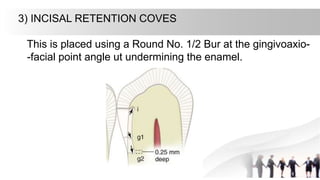
3) INCISAL RETENTION COVES
This is placed using a Round No. 1/2 Bur at the gingivoaxio-
-facial point angle ut undermining the enamel.
4) LINGUAL DOVETAIL
# It is placed on the lingual surface of the teeth in teeth
with large preparation, especially those with excessive
incisal extension in which additional retention form is
needed.
โ€ข FINISHING EXTERNAL WALLS
# Finishing of minimally extended margins is recommended
by using a hoe.
# If the gingival margin is in enamel, a slight bevel is
necessary to ensure full length enamel rods (Approx.
20ยฐ).
โ€ข CONVENTION CAVITY PREPARATION
โ€ข BEVELED CONVENTIONAL PREPARATION
โ€ข MINIMALLY INVASIVE PREPARATION
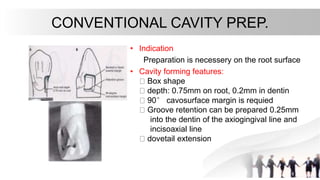
CONVENTIONAL CAVITY PREP.
โ€ข Indication
Preparation is necessery on the root surface
โ€ข Cavity forming features:
Box shape
depth: 0.75mm on root, 0.2mm in dentin
90ยฐ cavosurface margin is requied
Groove retention can be prepared 0.25mm
into the dentin of the axiogingival line and
incisoaxial line
dovetail extension
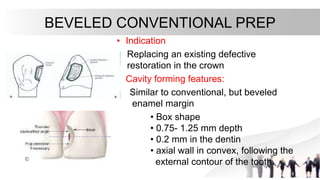
BEVELED CONVENTIONAL PREP
โ€ข Indication
Replacing an existing defective
restoration in the crown
โ€ข Cavity forming features:
Similar to conventional, but beveled
enamel margin
โ€ข Box shape
โ€ข 0.75- 1.25 mm depth
โ€ข 0.2 mm in the dentin
โ€ข axial wall in convex, following the
external contour of the tooth.
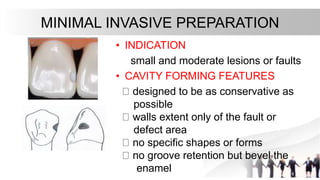
MINIMAL INVASIVE PREPARATION
โ€ข INDICATION
small and moderate lesions or faults
โ€ข CAVITY FORMING FEATURES
designed to be as conservative as
possible
walls extent only of the fault or
defect area
no specific shapes or forms
no groove retention but bevel the
enamel
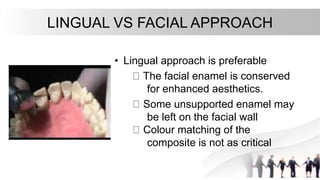
LINGUAL VS FACIAL APPROACH
โ€ข Lingual approach is preferable
The facial enamel is conserved
for enhanced aesthetics.
Some unsupported enamel may
be left on the facial wall
Colour matching of the
composite is not as critical
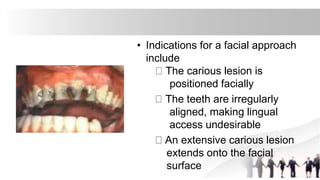
โ€ข Indications for a facial approach
include
The carious lesion is
positioned facially
The teeth are irregularly
aligned, making lingual
access undesirable
An extensive carious lesion
extends onto the facial
surface
Class iii cavity preparation

Class iii cavity preparation

  • 2.
    CONTENT โ€ข DEFINITION โ€ข CLASSIII AMALGAM RESTORATION โ€ข CLASS III COMPOSITE RESTORATION
  • 3.
    DEFINITION Class III Cavitypreparation is cavity preparation involving the proximal surface of the anterior teeth.
  • 5.
    โ€ข Amalgam restorationis used infrequently in Class III cavity preparation due to aesthetic concerns โ€ข It has been replaced by tooth colored restorative material especially composites which have become increaasingly wear resistant and color stable.
  • 6.
    INDICATION โ€ข Distal surfaceof maxillary and mandibular canines in situations: 1) Extensive prep with minimal facial involvement 2) Gingival margin is primarily in cementum 3) Difficulty in moisture control โ€ข Any class III not involving the facial surface or undermining the incisal corner.
  • 7.
    CONTRAINDICATION Areas of aestheticimportance such as mesial surface and preparation involving the facial surface rather than lingual.
  • 8.
    BUR SELECTION โ€ข Dependingon the anticipated size of the restoration, the bur selection done No. 2 Bur:- Entry cut on Disto-lingual marginal ridge No. 1 or 1/2 Bur:- Tooth or carious lesion is small No. 1/4 Bur:- To place retention grooves. โ€ข Even diamond points can be used.
  • 9.
    OUTLINE FORM โ€ข Alingual access preparation is recommended because of the use of amalgam in that location is more appropriate. โ€ข Mandibular canine a facial approach may be indicated if the lesion is more facial than lingual.
  • 10.
    โ€ข The buris oriented in such a way that it penetrates the carious lesion which is usually gingival to distal contact point. โ€ข Ideally, the bur is positioned so that its long axis is perpendicular to the lingual surface of the tooth, but directed at a mesial angle as close to the adjacent tooth as possible. This position conserves the marginal ridge enamel
  • 11.
    โ€ข For asmall lesion, the facial margin is extended 0.2-0.3 mm into the facial embrasure (if necessary), with a curved outline from the incisal to the gingival margin (resulting in a less visible margin). โ€ข The lingual outline blends with the incisal and gingival margins in a smooth curve, creating a preparation with little or no lingual wall.
  • 12.
    โ€ข The cavosurfaceangle should be 90ยฐat all margins. The facial, incisal, and gingival walls should meet the axial wall at approximately right angles (although the lingual wall meets the axial wall at an obtuse angle or may be continuous with the axial wall)
  • 13.
    โ€ข Incisal extensionto remove carious tooth structure may eliminate the proximal contact. โ€ข It is important to conserve as much of the distoincisal tooth structure as possible to reduce the risk for subsequent fracture. โ€ข When possible, it is best to leave the incisal margin in contact with the adjacent tooth.
  • 14.
    โ€ข When preparinga gingival wall that is near the level of the rubber dam or apical to it, it is beneficial to place a wedge in the gingival embrasure earlier to depress and protect soft tissue and the rubber dam. โ€ข As the bur is preparing the gingival wall, it may lightly shave the wedge. โ€ข A triangular (i.e., anatomic) wedge, rather than a round wedge, is used for a deep gingival margin
  • 15.
    โ€ข Penetration shouldbe at a limited initial axial depth (i.e., 0.5โ€“0.6 mm) inside the DEJ (see Fig. 15-7, C and D) or at a 0.75-0.8-mm axial depth when the gingival margin is on the root surface (in cementum). โ€ข It may be in sound dentin (i.e. shallow lesion), in infected dentin (i.e. moderate to deep lesion) or in existing restorative material (if replacing a restoration).
  • 16.
    PRIMARY RESISTANCE FORM โ€ขPrimary Resistance form is that shape and placement of the cavity walls to best enable both the tooth and restoration to withstand, without fracture the stresses of Masticatory forces delivered principally along the long axis of the tooth. โ€ข Features of Primary Resistance Form 1) Cavosurface margin is 90ยฐ. 2) Enamel walls supported by sound dentin. 3) Sufficient bulk of enamel (= 1mm) 4) Slightly rounded internal line angles.
  • 17.
    PRIMARY RETENTION FORM โ€ขPrimary Resistance form is that shape and placement of the cavity walls to best enable both the tooth and restoration to withstand, without fracture the stresses of Masticatory forces delivered principally along the long axis of the tooth. โ€ข Primary retention form is provided by box like preparation form.
  • 18.
    FINAL TOOTH PREPARATION โ€ขREMOVAL OF ANY INFECTED CARIOUS DENTIN on the axial wall which is done by 1) a slowly revolving no. 2 or 4 round burs 2) spoon excavator
  • 19.
    โ€ข SECONDARY RETENTIONFORM can be provided by any or all of the following: 1) GINGIVAL GROOVE # This is done by using a No. 1/4 (0.5mm thick) bur rotating at slow speed in the axial wall along the axiogingival line angle. # Depth = 0.25 mm
  • 20.
    2) GINGIVAL RETENTIONCOVES # indicated as an alternative to retentive groove when less amount of retention is needed. # instead of a continuos groove two coves can been placed at axiogingivofacial and axiogingivolingual point angles.
  • 21.
    3) INCISAL RETENTIONCOVES This is placed using a Round No. 1/2 Bur at the gingivoaxio- -facial point angle ut undermining the enamel.
  • 22.
    4) LINGUAL DOVETAIL #It is placed on the lingual surface of the teeth in teeth with large preparation, especially those with excessive incisal extension in which additional retention form is needed.
  • 23.
    โ€ข FINISHING EXTERNALWALLS # Finishing of minimally extended margins is recommended by using a hoe. # If the gingival margin is in enamel, a slight bevel is necessary to ensure full length enamel rods (Approx. 20ยฐ).
  • 25.
    โ€ข CONVENTION CAVITYPREPARATION โ€ข BEVELED CONVENTIONAL PREPARATION โ€ข MINIMALLY INVASIVE PREPARATION
  • 26.
    CONVENTIONAL CAVITY PREP. โ€ขIndication Preparation is necessery on the root surface โ€ข Cavity forming features: Box shape depth: 0.75mm on root, 0.2mm in dentin 90ยฐ cavosurface margin is requied Groove retention can be prepared 0.25mm into the dentin of the axiogingival line and incisoaxial line dovetail extension
  • 27.
    BEVELED CONVENTIONAL PREP โ€ขIndication Replacing an existing defective restoration in the crown โ€ข Cavity forming features: Similar to conventional, but beveled enamel margin โ€ข Box shape โ€ข 0.75- 1.25 mm depth โ€ข 0.2 mm in the dentin โ€ข axial wall in convex, following the external contour of the tooth.
  • 28.
    MINIMAL INVASIVE PREPARATION โ€ขINDICATION small and moderate lesions or faults โ€ข CAVITY FORMING FEATURES designed to be as conservative as possible walls extent only of the fault or defect area no specific shapes or forms no groove retention but bevel the enamel
  • 29.
    LINGUAL VS FACIALAPPROACH โ€ข Lingual approach is preferable The facial enamel is conserved for enhanced aesthetics. Some unsupported enamel may be left on the facial wall Colour matching of the composite is not as critical
  • 30.
    โ€ข Indications fora facial approach include The carious lesion is positioned facially The teeth are irregularly aligned, making lingual access undesirable An extensive carious lesion extends onto the facial surface