Welcome
Ethics of Management
Presented to:
Habiba Rahman,
Assistant Professor & Chairperson,
Department of Television, Film and Photography
University of Dhaka.
Presented by: Asrafun Naher
Roll: RK-048-001
Course: Broadcast and Film Production
Management (TFS 404)
 Contents:
 Ethics
 Ethical Decision Making in the Media Industries
 Challenges in Making Ethical Decision
 Norms Used in Moral Decision Making
 Ethical issues in Media Management
 Ethical Codes and Mission Statements
 Implementing an ethics program
 Source:
 Book: Management of Electronic and Digital Media, 6th Edition
 Writer: Alan B. Albarren
Ethics
Origin:
 Derived from the word ethos;
 Began nearly 2,500 years ago in ancient Greek society.
Characteristics:
 Involves the character and conduct of individuals and institutions.
 Reflects a society’s norms about what is morally right and wrong.
Ways of studying ethics:
 Empirical methods: Describe the particular moral values of a group or society;
 Normative ethics: Concerned with understanding the most relevant to a society.
Ethical Decision Making in the Media Industries
Five ethical duties of mass media employees (Christians, Fackler,
Richardson, Kreshel, and Woods, 2009):
Duty to self;
Duty to the audience;
Duty to employer or organization;
Duty to professional colleagues;
Duty to society.
Challenges in Making Ethical Decision
Six factors that complicate the making of ethical decisions by managers (listed by
Hosmer):
 Extended consequences;
 Many alternatives;
 Mixed outcomes;
 Uncertain consequences;
 Personal implications;
 Means of making informed decisions.
Norms Used in Moral Decision Making
Ethical Norms:
A set of theories derived from the study of ethics and ethical principles;
Form the basis of many of individual and societal beliefs;
Provide a philosophical foundation’
Widely used ethical norms:
The golden mean, the Judeo-Christian ethic, the categorical imperative,
utilitarianism, egalitarianism, relativism, and social responsibility theory.
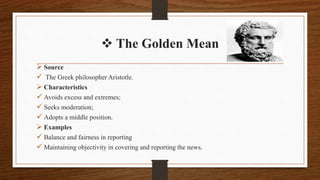
 The Golden Mean
 Source
 The Greek philosopher Aristotle.
 Characteristics
 Avoids excess and extremes;
 Seeks moderation;
 Adopts a middle position.
 Examples
 Balance and fairness in reporting
 Maintaining objectivity in covering and reporting the news.
 The Judeo-Christian Ethic
Source: Bible
Ideas
Respect and dignity for all people based on a universal love for God;
Considering impact of the decisions.
Violation of the norm:
Degrading or demoralizing content;
Overrepresenting certain segments of society.
Example
Providing greater diversity among the characters.
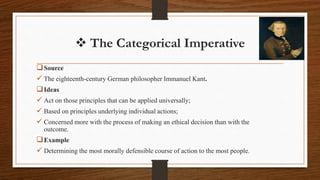
 The Categorical Imperative
Source
 The eighteenth-century German philosopher Immanuel Kant.
Ideas
 Act on those principles that can be applied universally;
 Based on principles underlying individual actions;
 Concerned more with the process of making an ethical decision than with the
outcome.
Example
 Determining the most morally defensible course of action to the most people.
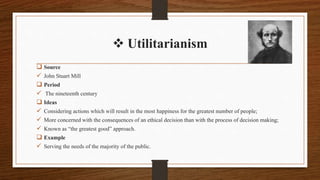
 Utilitarianism
 Source
 John Stuart Mill
 Period
 The nineteenth century
 Ideas
 Considering actions which will result in the most happiness for the greatest number of people;
 More concerned with the consequences of an ethical decision than with the process of decision making;
 Known as “the greatest good” approach.
 Example
 Serving the needs of the majority of the public.
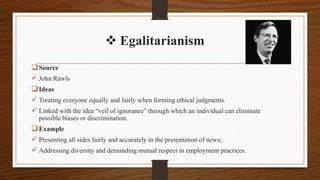
 Egalitarianism
Source
 John Rawls
Ideas
 Treating everyone equally and fairly when forming ethical judgments.
 Linked with the idea “veil of ignorance” through which an individual can eliminate
possible biases or discrimination.
Example
 Presenting all sides fairly and accurately in the presentation of news;
 Addressing diversity and demanding mutual respect in employment practices.
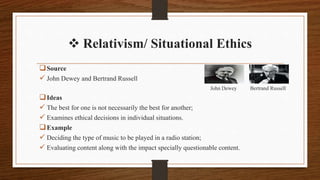
Source
 John Dewey and Bertrand Russell
John Dewey Bertrand Russell
Ideas
 The best for one is not necessarily the best for another;
 Examines ethical decisions in individual situations.
Example
 Deciding the type of music to be played in a radio station;
 Evaluating content along with the impact specially questionable content.
 Relativism/ Situational Ethics
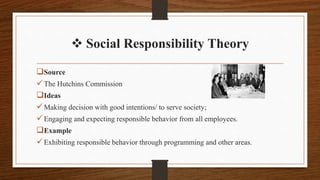
 Social Responsibility Theory
Source
The Hutchins Commission
Ideas
Making decision with good intentions/ to serve society;
Engaging and expecting responsible behavior from all employees.
Example
Exhibiting responsible behavior through programming and other areas.
Deontological and Teleological Ethics
Deontological Ethics
Concerned with the process of making decisions based on established
principles;
Reflected in the works of Kant.
Teleological Ethics
Concerned with the actions or consequences of decisions.
Ethical Codes and Mission Statements
(Defining business values publicly)
Codes of Ethics
Produced by professional organizations;
Suggestions for a universal ethical standard applied to journalism by Strentz
(2002): Use restraint, know thyself, respect others, and be accountable for your
actions.
Mission Statements
Created by companies;
Define the mission and reflect the organization’s sense of values.
Ethical issues in Media Management
Four areas of ethical issues:
i. Serving the Market or the Marketplace;
ii. Controversies over Content;
iii. Ethics in News and Public Affairs;
iv. Ethics in Sales and Marketing.
 Serving the Market or the Marketplace
Tasks:
Defining and serving the public interest;
Maintaining a profitable business.
Conflict:
 Business interests vs audience.
Criticism:
Unconcerned with meeting the needs of the audience after deregulation.
 Controversies over Content
Sexual Content:
NYPD Blue in the 1990s; Daytime Soap Operas;
Cable Networks ; Spanish Language Telenovelas.
Indecency (Super Bowl halftime show, 2004).
Violence:
Television programming; Cable Channels;
Online Streaming Services; Video Games.
 Controversies over Content
Children’s Programming:
Lack of good children’s programming since the 1960s.
Social Media Content:
Tweet or Inflammatory Posting;
Unfactual Photographs or Video.
 Ethics in News and Public Affairs
Questions of Truth and Accuracy
Dramatic recreation, biassed, inaccurate/intentional postings.
Right to Privacy
Being certain on the newsworthiness;
Giving special treatment to some areas like sexual assault, details of suicides.
Citizen Journalists
Verifying authenticity and maintaining integrity in utilizing UGC.
 Ethics in News and Public Affairs
Conflicts of Interest
Avoidance must as impair the ability to report a story accurately,.
Confidentiality of Sources
Maintaining confidentiality versus demand of the external forces.
Pressures from Advertisers
Objection on the presentation of products or services negatively;
Threaten to pull future advertising.
 Ethics in Sales and Marketing
Responsibility to the Audience
Maintaining the truth in all commercial announcements.
Responsibility to One’s Conscience
Exhibiting good ethical behavior.
Responsibility to Customers
Considering information privileged like a client’s outlook on advertising, budget,
goals, objectives, and primary competitors.
Being a professional representative at all times.
Ethics in Sales and Marketing
Responsibility to Community
Being a representative of communities like a global community, a business
community, an industry community, and a local community.
Responsibility to a Company
Being loyal and using the firm’s assets wisely;
Implementing an ethics program
A four-step plan offered by Hitt (2009) for implementing an ethics
program:
State the mission
Clarifying the purpose of the organization for both employees and
external publics;
Clarify the values of the organization
Clarifying values should be clear, understandable and publicly
posted.
Implementing an ethics program
Create a code of ethics
Clarifying the company’s position on ethical principles.
Develop an ethics program
Completing the necessary basic information, orienting all new
employees, conducting ethics seminars. Discussing ethical
issues and evaluating ethics program regularly.

Ethics of management

  • 1.
  • 2.
    Ethics of Management Presentedto: Habiba Rahman, Assistant Professor & Chairperson, Department of Television, Film and Photography University of Dhaka. Presented by: Asrafun Naher Roll: RK-048-001 Course: Broadcast and Film Production Management (TFS 404)  Contents:  Ethics  Ethical Decision Making in the Media Industries  Challenges in Making Ethical Decision  Norms Used in Moral Decision Making  Ethical issues in Media Management  Ethical Codes and Mission Statements  Implementing an ethics program  Source:  Book: Management of Electronic and Digital Media, 6th Edition  Writer: Alan B. Albarren
  • 3.
    Ethics Origin:  Derived fromthe word ethos;  Began nearly 2,500 years ago in ancient Greek society. Characteristics:  Involves the character and conduct of individuals and institutions.  Reflects a society’s norms about what is morally right and wrong. Ways of studying ethics:  Empirical methods: Describe the particular moral values of a group or society;  Normative ethics: Concerned with understanding the most relevant to a society.
  • 4.
    Ethical Decision Makingin the Media Industries Five ethical duties of mass media employees (Christians, Fackler, Richardson, Kreshel, and Woods, 2009): Duty to self; Duty to the audience; Duty to employer or organization; Duty to professional colleagues; Duty to society.
  • 5.
    Challenges in MakingEthical Decision Six factors that complicate the making of ethical decisions by managers (listed by Hosmer):  Extended consequences;  Many alternatives;  Mixed outcomes;  Uncertain consequences;  Personal implications;  Means of making informed decisions.
  • 6.
    Norms Used inMoral Decision Making Ethical Norms: A set of theories derived from the study of ethics and ethical principles; Form the basis of many of individual and societal beliefs; Provide a philosophical foundation’ Widely used ethical norms: The golden mean, the Judeo-Christian ethic, the categorical imperative, utilitarianism, egalitarianism, relativism, and social responsibility theory.
  • 7.
     The GoldenMean  Source  The Greek philosopher Aristotle.  Characteristics  Avoids excess and extremes;  Seeks moderation;  Adopts a middle position.  Examples  Balance and fairness in reporting  Maintaining objectivity in covering and reporting the news.
  • 8.
     The Judeo-ChristianEthic Source: Bible Ideas Respect and dignity for all people based on a universal love for God; Considering impact of the decisions. Violation of the norm: Degrading or demoralizing content; Overrepresenting certain segments of society. Example Providing greater diversity among the characters.
  • 9.
     The CategoricalImperative Source  The eighteenth-century German philosopher Immanuel Kant. Ideas  Act on those principles that can be applied universally;  Based on principles underlying individual actions;  Concerned more with the process of making an ethical decision than with the outcome. Example  Determining the most morally defensible course of action to the most people.
  • 10.
     Utilitarianism  Source John Stuart Mill  Period  The nineteenth century  Ideas  Considering actions which will result in the most happiness for the greatest number of people;  More concerned with the consequences of an ethical decision than with the process of decision making;  Known as “the greatest good” approach.  Example  Serving the needs of the majority of the public.
  • 11.
     Egalitarianism Source  JohnRawls Ideas  Treating everyone equally and fairly when forming ethical judgments.  Linked with the idea “veil of ignorance” through which an individual can eliminate possible biases or discrimination. Example  Presenting all sides fairly and accurately in the presentation of news;  Addressing diversity and demanding mutual respect in employment practices.
  • 12.
    Source  John Deweyand Bertrand Russell John Dewey Bertrand Russell Ideas  The best for one is not necessarily the best for another;  Examines ethical decisions in individual situations. Example  Deciding the type of music to be played in a radio station;  Evaluating content along with the impact specially questionable content.  Relativism/ Situational Ethics
  • 13.
     Social ResponsibilityTheory Source The Hutchins Commission Ideas Making decision with good intentions/ to serve society; Engaging and expecting responsible behavior from all employees. Example Exhibiting responsible behavior through programming and other areas.
  • 14.
    Deontological and TeleologicalEthics Deontological Ethics Concerned with the process of making decisions based on established principles; Reflected in the works of Kant. Teleological Ethics Concerned with the actions or consequences of decisions.
  • 15.
    Ethical Codes andMission Statements (Defining business values publicly) Codes of Ethics Produced by professional organizations; Suggestions for a universal ethical standard applied to journalism by Strentz (2002): Use restraint, know thyself, respect others, and be accountable for your actions. Mission Statements Created by companies; Define the mission and reflect the organization’s sense of values.
  • 16.
    Ethical issues inMedia Management Four areas of ethical issues: i. Serving the Market or the Marketplace; ii. Controversies over Content; iii. Ethics in News and Public Affairs; iv. Ethics in Sales and Marketing.
  • 17.
     Serving theMarket or the Marketplace Tasks: Defining and serving the public interest; Maintaining a profitable business. Conflict:  Business interests vs audience. Criticism: Unconcerned with meeting the needs of the audience after deregulation.
  • 18.
     Controversies overContent Sexual Content: NYPD Blue in the 1990s; Daytime Soap Operas; Cable Networks ; Spanish Language Telenovelas. Indecency (Super Bowl halftime show, 2004). Violence: Television programming; Cable Channels; Online Streaming Services; Video Games.
  • 19.
     Controversies overContent Children’s Programming: Lack of good children’s programming since the 1960s. Social Media Content: Tweet or Inflammatory Posting; Unfactual Photographs or Video.
  • 20.
     Ethics inNews and Public Affairs Questions of Truth and Accuracy Dramatic recreation, biassed, inaccurate/intentional postings. Right to Privacy Being certain on the newsworthiness; Giving special treatment to some areas like sexual assault, details of suicides. Citizen Journalists Verifying authenticity and maintaining integrity in utilizing UGC.
  • 21.
     Ethics inNews and Public Affairs Conflicts of Interest Avoidance must as impair the ability to report a story accurately,. Confidentiality of Sources Maintaining confidentiality versus demand of the external forces. Pressures from Advertisers Objection on the presentation of products or services negatively; Threaten to pull future advertising.
  • 22.
     Ethics inSales and Marketing Responsibility to the Audience Maintaining the truth in all commercial announcements. Responsibility to One’s Conscience Exhibiting good ethical behavior. Responsibility to Customers Considering information privileged like a client’s outlook on advertising, budget, goals, objectives, and primary competitors. Being a professional representative at all times.
  • 23.
    Ethics in Salesand Marketing Responsibility to Community Being a representative of communities like a global community, a business community, an industry community, and a local community. Responsibility to a Company Being loyal and using the firm’s assets wisely;
  • 24.
    Implementing an ethicsprogram A four-step plan offered by Hitt (2009) for implementing an ethics program: State the mission Clarifying the purpose of the organization for both employees and external publics; Clarify the values of the organization Clarifying values should be clear, understandable and publicly posted.
  • 25.
    Implementing an ethicsprogram Create a code of ethics Clarifying the company’s position on ethical principles. Develop an ethics program Completing the necessary basic information, orienting all new employees, conducting ethics seminars. Discussing ethical issues and evaluating ethics program regularly.