



Presented by: Mehdi Soleymani Goloujeh 
Supervisor: Dr. S. Davaran
Outlook: 
 History 
 Introduction 
 The components of the high performance liquid chromatograph 
 What affects system 
 The separation process 
 The chromatogram 
 The most common modes of HPLC 
 HPLC Applications 
 The differences between HPLC and GC 
 Advantages of High Performance Liquid Chromatography 
Mehdi Soleymani 2 
Medical Nanotechnology Department
3 
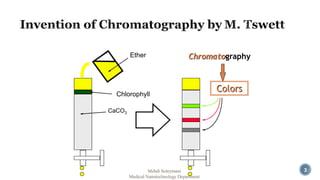
Ether 
Chlorophyll 
CaCO3 
Chromatography 
Colors 
Mehdi Soleymani 
Medical Nanotechnology Department
4 
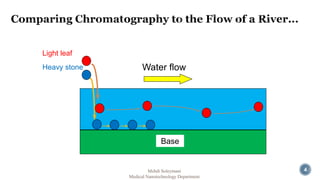
Water flow 
Base 
Light leaf 
Heavy stone 
Mehdi Soleymani 
Medical Nanotechnology Department
5 
Chromatography in which the mobile phase is a liquid. 
 The liquid used as the mobile phase is called the “eluent”. 
The stationary phase is usually a solid or a liquid. 
In general, it is possible to analyze any substance that 
can be stably dissolved in the mobile phase. 
Mehdi Soleymani 
Medical Nanotechnology Department
6 
Chromatography: Analytical technique 
Chromatograph: Instrument 
Chromatogram: Obtained “picture” 
Chromatographer: Person 
Mehdi Soleymani 
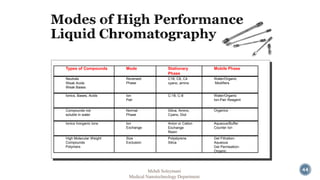
Medical Nanotechnology Department
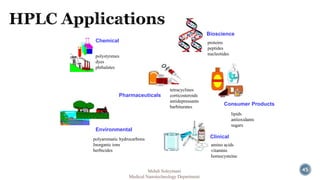
7 
 Higher degree of separation! 
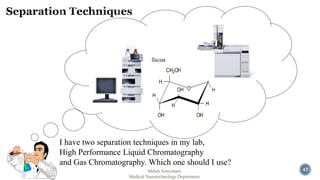
 Refinement of packing material (3 to 10 μm) 
Reduction of analysis time! 
 Delivery of eluent by pump 
 Demand for special equipment that can withstand high pressures 
The arrival of high performance liquid chromatography! 
Mehdi Soleymani 
Medical Nanotechnology Department
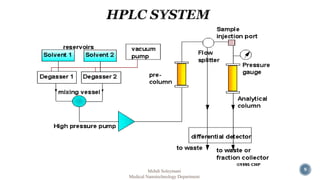
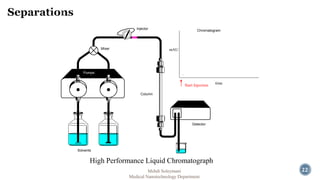
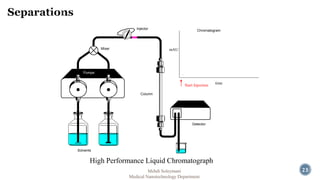
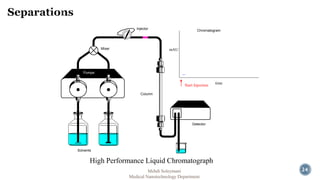
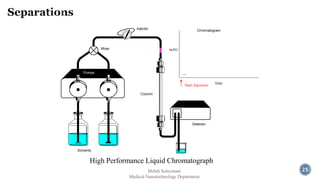
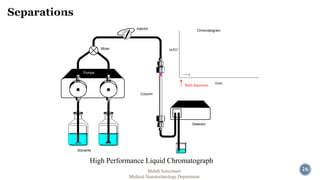
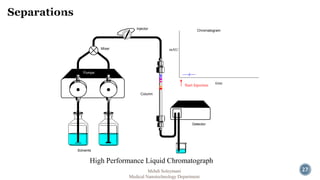
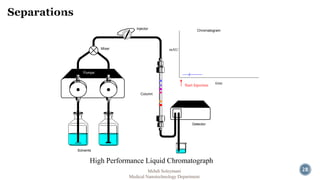
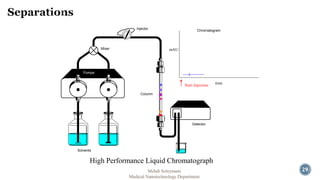
 HPLC is a form of liquid chromatography used to separate compounds 
that are dissolved in solution. HPLC instruments consist of a reservoir of 
mobile phase, a pump, an injector, a separation column, and a detector. 
 Compounds are separated by injecting a sample mixture onto the 
column. The different component in the mixture pass through the 
column at differentiates due to differences in their partition behavior 
between the mobile phase and the stationary phase. The mobile phase 
must be degassed to eliminate the formation of air bubbles. 
Mehdi Soleymani 8 
Medical Nanotechnology Department
Mehdi Soleymani 9 
Medical Nanotechnology Department
10 
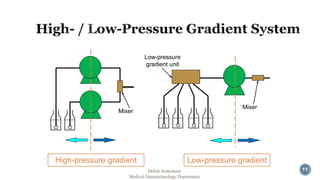
Isocratic system 
Constant eluent composition 
Gradient system 
Varying eluent composition 
 HPGE (High Pressure Gradient) 
 LPGE (Low Pressure Gradient) 
Mehdi Soleymani 
Medical Nanotechnology Department
11 
Mixer 
High-pressure gradient 
Low-pressure 
gradient unit 
Mixer 
Low-pressure gradient 
Mehdi Soleymani 
Medical Nanotechnology Department
12 
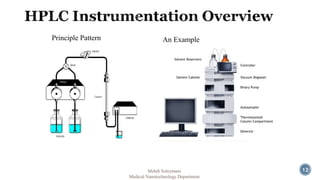
Principle Pattern An Example 
Solvent Cabinet Vacuum Degasser 
Binary Pump 
Autosampler 
Thermostatted 
Column Compartment 
Detector 
Solvent Reservoirs 
Controller 
Mehdi Soleymani 
Medical Nanotechnology Department
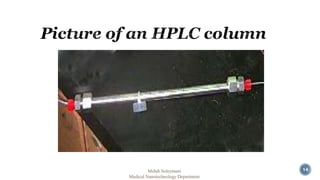
 The column is one of the most 
important components of the HPLC 
chromatograph because the separation 
of the sample components is achieved 
when those components pass through 
the column. The High performance 
liquid chromatography apparatus is 
made out of stainless steel tubes with a 
diameter of 3 to 5mm and a length 
ranging from 10 to 30cm. 
 Normally, columns are filled with silica 
gel because its particle shape, surface 
properties, and pore structure help to get 
a good separation. Silica is wetted by 
nearly every potential mobile phase, is 
inert to most compounds and has a high 
surface activity which can be modified 
easily with water and other agents. Silica 
can be used to separate a wide variety of 
chemical compounds, and its 
chromatographic behavior is generally 
predictable and reproducible. 
Mehdi Soleymani 
Medical Nanotechnology Department 
13
Mehdi Soleymani 14 
Medical Nanotechnology Department
15 
Problems caused by dissolved air in the eluent 
 Unstable delivery by pump 
 More noise and large baseline drift in detector cell 
In order to avoid these problems, the eluent 
must be degassed. 
Mehdi Soleymani 
Medical Nanotechnology Department
 The function of the injector is to place the sample into the high-pressure flow 
in as narrow volume as possible so that the sample enters the column as a 
homogeneous, low-volume plug. To minimize spreading of the injected volume 
during transport to the column, the shortest possible length of tubing should be 
used from the injector to the column. 
When an injection is started, an air actuator rotates the valve: solvent goes 
directly to the column; and the injector needle is connected to the syringe. The 
air pressure lifts the needle and the vial is moved into position beneath the 
needle. Then, the needle is lowered to the vial. 
Mehdi Soleymani 
Medical Nanotechnology Department 
16
17 
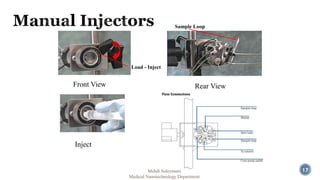
Front View 
Inject 
Rear View 
Load - Inject 
Sample Loop 
Mehdi Soleymani 
Medical Nanotechnology Department
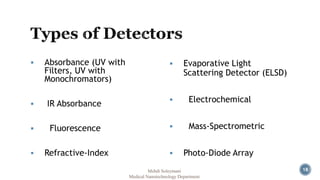
 Absorbance (UV with 
Filters, UV with 
Monochromators) 
 IR Absorbance 
 Fluorescence 
 Refractive-Index 
 Evaporative Light 
Scattering Detector (ELSD) 
 Electrochemical 
 Mass-Spectrometric 
 Photo-Diode Array 
Mehdi Soleymani 18 
Medical Nanotechnology Department
19 
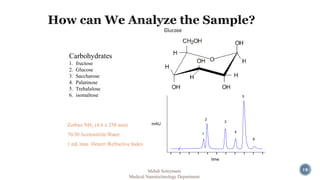
Carbohydrates 
1. fructose 
2. Glucose 
3. Saccharose 
4. Palatinose 
5. Trehalulose 
6. isomaltose 
Zorbax NH2 (4.6 x 250 mm) 
70/30 Acetonitrile/Water 
1 mL/min Detect=Refractive Index 
1 
2 
3 
4 
5 
mAU 
time 
6 
Mehdi Soleymani 
Medical Nanotechnology Department
Waste 
Mehdi Soleymani 20 
Medical Nanotechnology Department 
Injector 
Detector 
Column 
Solvents 
Mixer 
Pumps 
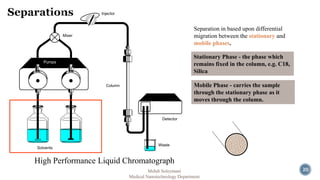
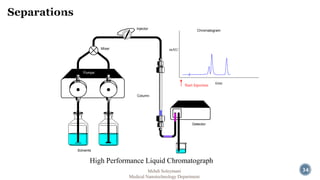
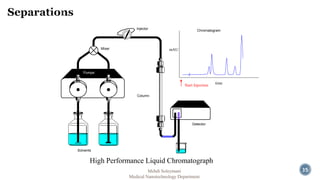
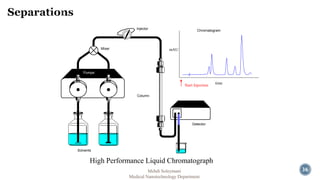
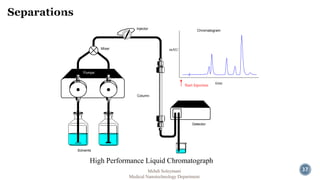
High Performance Liquid Chromatograph 
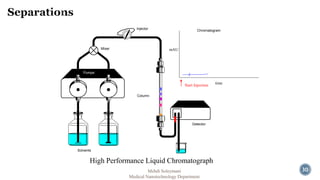
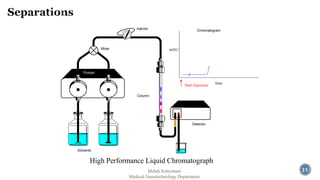
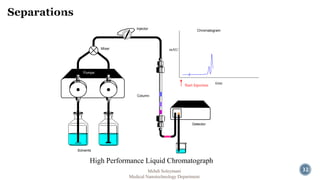
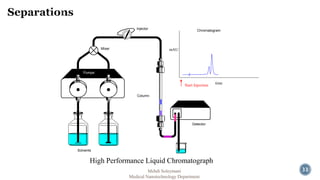
Separation in based upon differential 
migration between the stationary and 
mobile phases. 
Stationary Phase - the phase which 
remains fixed in the column, e.g. C18, 
Silica 
Mobile Phase - carries the sample 
through the stationary phase as it 
moves through the column.
21 
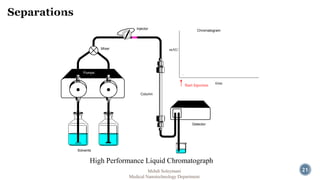
Injector 
Detector 
Column 
Solvents 
Mixer 
Pumps 
Chromatogram 
Start Injection 
mAU 
time 
High Performance Liquid Chromatograph 
Mehdi Soleymani 
Medical Nanotechnology Department
22 
Injector 
Detector 
Column 
Solvents 
Mixer 
Pumps 
Chromatogram 
Start Injection 
mAU 
time 
High Performance Liquid Chromatograph 
Mehdi Soleymani 
Medical Nanotechnology Department
23 
Injector 
Detector 
Column 
Solvents 
Mixer 
Pumps 
Chromatogram 
Start Injection 
mAU 
time 
High Performance Liquid Chromatograph 
Mehdi Soleymani 
Medical Nanotechnology Department
24 
Injector 
Detector 
Column 
Pumps 
Solvents 
Mixer 
Chromatogram 
Start Injection 
mAU 
time 
High Performance Liquid Chromatograph 
Mehdi Soleymani 
Medical Nanotechnology Department
25 
Injector 
Detector 
Column 
Pumps 
Solvents 
Mixer 
Chromatogram 
Start Injection 
mAU 
time 
High Performance Liquid Chromatograph 
Mehdi Soleymani 
Medical Nanotechnology Department
26 
Injector 
Detector 
Column 
Pumps 
Solvents 
Mixer 
Chromatogram 
Start Injection 
mAU 
time 
High Performance Liquid Chromatograph 
Mehdi Soleymani 
Medical Nanotechnology Department
27 
Injector 
Detector 
Column 
Pumps 
Solvents 
Mixer 
Chromatogram 
Start Injection 
mAU 
time 
High Performance Liquid Chromatograph 
Mehdi Soleymani 
Medical Nanotechnology Department
28 
Injector 
Detector 
Column 
Pumps 
Solvents 
Mixer 
Chromatogram 
Start Injection 
mAU 
time 
High Performance Liquid Chromatograph 
Mehdi Soleymani 
Medical Nanotechnology Department
29 
Injector 
Detector 
Column 
Pumps 
Solvents 
Mixer 
Chromatogram 
Start Injection 
mAU 
time 
High Performance Liquid Chromatograph 
Mehdi Soleymani 
Medical Nanotechnology Department
30 
Injector 
Detector 
Column 
Pumps 
Solvents 
Mixer 
Chromatogram 
Start Injection 
mAU 
time 
High Performance Liquid Chromatograph 
Mehdi Soleymani 
Medical Nanotechnology Department
31 
Injector 
Detector 
Column 
Pumps 
Solvents 
Mixer 
Chromatogram 
Start Injection 
mAU 
time 
High Performance Liquid Chromatograph 
Mehdi Soleymani 
Medical Nanotechnology Department
32 
Injector 
Detector 
Column 
Pumps 
Solvents 
Mixer 
Chromatogram 
Start Injection 
mAU 
time 
High Performance Liquid Chromatograph 
Mehdi Soleymani 
Medical Nanotechnology Department
33 
Injector 
Detector 
Column 
Pumps 
Solvents 
Mixer 
Chromatogram 
Start Injection 
mAU 
time 
High Performance Liquid Chromatograph 
Mehdi Soleymani 
Medical Nanotechnology Department
34 
Injector 
Detector 
Column 
Pumps 
Solvents 
Mixer 
Chromatogram 
Start Injection 
mAU 
time 
High Performance Liquid Chromatograph 
Mehdi Soleymani 
Medical Nanotechnology Department
35 
Injector 
Detector 
Column 
Pumps 
Solvents 
Mixer 
Chromatogram 
Start Injection 
mAU 
time 
High Performance Liquid Chromatograph 
Mehdi Soleymani 
Medical Nanotechnology Department
36 
Injector 
Detector 
Column 
Pumps 
Solvents 
Mixer 
Chromatogram 
Start Injection 
mAU 
time 
High Performance Liquid Chromatograph 
Mehdi Soleymani 
Medical Nanotechnology Department
37 
Injector 
Detector 
Column 
Pumps 
Solvents 
Mixer 
Chromatogram 
Start Injection 
mAU 
time 
High Performance Liquid Chromatograph 
Mehdi Soleymani 
Medical Nanotechnology Department
38 
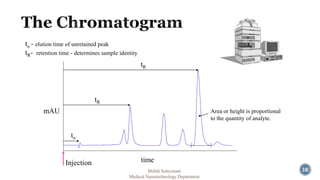
to 
Injection 
tR 
mAU 
tR 
time 
to - elution time of unretained peak 
tR- retention time - determines sample identity 
Area or height is proportional 
to the quantity of analyte. 
Mehdi Soleymani 
Medical Nanotechnology Department
39 
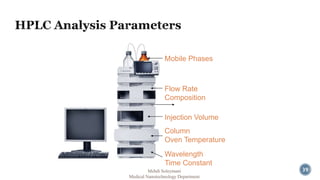
Mobile Phases 
Flow Rate 
Composition 
Injection Volume 
Column 
Oven Temperature 
Wavelength 
Time Constant 
Mehdi Soleymani 
Medical Nanotechnology Department
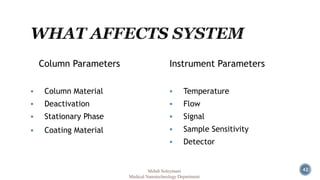
Column Parameters 
 Column Material 
 Deactivation 
 Stationary Phase 
 Coating Material 
Instrument Parameters 
 Temperature 
 Flow 
 Signal 
 Sample Sensitivity 
 Detector 
Mehdi Soleymani 42 
Medical Nanotechnology Department
Sample Parameters 
 Concentration 
 Matrix 
 Solvent Effect 
 Sample Effect 
Mehdi Soleymani 43 
Medical Nanotechnology Department
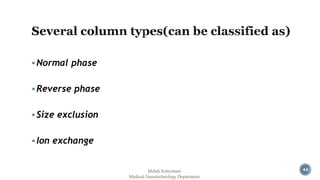
Normal phase 
Reverse phase 
 Size exclusion 
 Ion exchange 
Mehdi Soleymani 44 
Medical Nanotechnology Department
 Normal Phase. 
- Polar stationary phase and non-polar solvent. 
• Reverse Phase. 
- Non-polar stationary phase and a polar 
solvent. 
Mehdi Soleymani 
Medical Nanotechnology Department 
45
44 
Types of Compounds Mode Stationary 
Phase 
Mobile Phase 
Neutrals 
Weak Acids 
Weak Bases 
Reversed 
Phase 
C18, C8, C4 
cyano, amino 
Water/Organic 
Modifiers 
Ionics, Bases, Acids Ion 
Pair 
C-18, C-8 Water/Organic 
Ion-Pair Reagent 
Compounds not 
soluble in water 
Normal 
Phase 
Silica, Amino, 
Cyano, Diol 
Organics 
Ionics Inorganic Ions Ion 
Exchange 
Anion or Cation 
Exchange 
Resin 
Aqueous/Buffer 
Counter Ion 
High Molecular Weight 
Compounds 
Polymers 
Size 
Exclusion 
Polystyrene 
Silica 
Gel Filtration- 
Aqueous 
Gel Permeation- 
Organic 
Mehdi Soleymani 
Medical Nanotechnology Department
Chemical 
Pharmaceuticals 
Environmental 
Bioscience 
proteins 
peptides 
nucleotides 
Consumer Products 
Clinical 
polystyrenes 
dyes 
phthalates 
tetracyclines 
corticosteroids 
antidepressants 
barbiturates 
lipids 
antioxidants 
sugars 
amino acids 
vitamins 
homocysteine 
polyaromatic hydrocarbons 
Inorganic ions 
herbicides 
Mehdi Soleymani 45 
Medical Nanotechnology Department
I need a quantitative separation of 
carbohydrates in some of our 
products as soon as possible. 
I’ll need a separation technique. 
Mehdi Soleymani 46 
Medical Nanotechnology Department 
I’ll get on it!
I have two separation techniques in my lab, 
High Performance Liquid Chromatography 
and Gas Chromatography. Which one should I use? 
Mehdi Soleymani 47 
Medical Nanotechnology Department
48 
 High separation capacity, enabling the batch analysis 
of multiple components 
 Superior quantitative capability and reproducibility 
 Moderate analytical conditions 
 Unlike GC, the sample does not need to be vaporized. 
 Generally high sensitivity 
 Low sample consumption 
 Easy preparative separation and purification of 
samples 
Mehdi Soleymani 
Medical Nanotechnology Department
Mehdi Soleymani 49 
Medical Nanotechnology Department
50 
 http://192.215.107.101/ebn/942/tech/techfocus/1071main.html 
 http://www.chem.usu.edu/~sbialk/Classes/565/opamps/opamps.html 
 Skoog, Holler, and Neiman. Principles of Instrumental Analysis. 5th ed. Orlando: 
Harcourt Brace & Co., 1998. 
 http://weather.nmsu.edu 
 http://elchem.kaist.ac.kr/vt/chem-ed/sep/lc/hplc.htm 
 http://www.chemistry.nmsu.edu/Instrumentation/Lqd_Chroma.html 
 http://weather.nmsu.edu/Teaching_Material/SOIL698/Student_Material/HPLCHP1090/H 
PLCINJ.HTM 
 http://test-equipment. 
globalspec.com/LearnMore/Labware_Scientific_Instruments/Analytical_Instru 
ments/Chromatographs/HPLC_Columns 
 http://www.chemistry.adelaide.edu.au/external/soc-rel/content/lc-col.htm

Introduction to High Performance Liquid Chromatography-HPLC

  • 1.
    Presented by: MehdiSoleymani Goloujeh Supervisor: Dr. S. Davaran
  • 2.
    Outlook:  History  Introduction  The components of the high performance liquid chromatograph  What affects system  The separation process  The chromatogram  The most common modes of HPLC  HPLC Applications  The differences between HPLC and GC  Advantages of High Performance Liquid Chromatography Mehdi Soleymani 2 Medical Nanotechnology Department
  • 3.
    3 Ether Chlorophyll CaCO3 Chromatography Colors Mehdi Soleymani Medical Nanotechnology Department
  • 4.
    4 Water flow Base Light leaf Heavy stone Mehdi Soleymani Medical Nanotechnology Department
  • 5.
    5 Chromatography inwhich the mobile phase is a liquid.  The liquid used as the mobile phase is called the “eluent”. The stationary phase is usually a solid or a liquid. In general, it is possible to analyze any substance that can be stably dissolved in the mobile phase. Mehdi Soleymani Medical Nanotechnology Department
  • 6.
    6 Chromatography: Analyticaltechnique Chromatograph: Instrument Chromatogram: Obtained “picture” Chromatographer: Person Mehdi Soleymani Medical Nanotechnology Department
  • 7.
    7  Higherdegree of separation!  Refinement of packing material (3 to 10 μm) Reduction of analysis time!  Delivery of eluent by pump  Demand for special equipment that can withstand high pressures The arrival of high performance liquid chromatography! Mehdi Soleymani Medical Nanotechnology Department
  • 8.
     HPLC isa form of liquid chromatography used to separate compounds that are dissolved in solution. HPLC instruments consist of a reservoir of mobile phase, a pump, an injector, a separation column, and a detector.  Compounds are separated by injecting a sample mixture onto the column. The different component in the mixture pass through the column at differentiates due to differences in their partition behavior between the mobile phase and the stationary phase. The mobile phase must be degassed to eliminate the formation of air bubbles. Mehdi Soleymani 8 Medical Nanotechnology Department
  • 9.
    Mehdi Soleymani 9 Medical Nanotechnology Department
  • 10.
    10 Isocratic system Constant eluent composition Gradient system Varying eluent composition  HPGE (High Pressure Gradient)  LPGE (Low Pressure Gradient) Mehdi Soleymani Medical Nanotechnology Department
  • 11.
    11 Mixer High-pressuregradient Low-pressure gradient unit Mixer Low-pressure gradient Mehdi Soleymani Medical Nanotechnology Department
  • 12.
    12 Principle PatternAn Example Solvent Cabinet Vacuum Degasser Binary Pump Autosampler Thermostatted Column Compartment Detector Solvent Reservoirs Controller Mehdi Soleymani Medical Nanotechnology Department
  • 13.
     The columnis one of the most important components of the HPLC chromatograph because the separation of the sample components is achieved when those components pass through the column. The High performance liquid chromatography apparatus is made out of stainless steel tubes with a diameter of 3 to 5mm and a length ranging from 10 to 30cm.  Normally, columns are filled with silica gel because its particle shape, surface properties, and pore structure help to get a good separation. Silica is wetted by nearly every potential mobile phase, is inert to most compounds and has a high surface activity which can be modified easily with water and other agents. Silica can be used to separate a wide variety of chemical compounds, and its chromatographic behavior is generally predictable and reproducible. Mehdi Soleymani Medical Nanotechnology Department 13
  • 14.
    Mehdi Soleymani 14 Medical Nanotechnology Department
  • 15.
    15 Problems causedby dissolved air in the eluent  Unstable delivery by pump  More noise and large baseline drift in detector cell In order to avoid these problems, the eluent must be degassed. Mehdi Soleymani Medical Nanotechnology Department
  • 16.
     The functionof the injector is to place the sample into the high-pressure flow in as narrow volume as possible so that the sample enters the column as a homogeneous, low-volume plug. To minimize spreading of the injected volume during transport to the column, the shortest possible length of tubing should be used from the injector to the column. When an injection is started, an air actuator rotates the valve: solvent goes directly to the column; and the injector needle is connected to the syringe. The air pressure lifts the needle and the vial is moved into position beneath the needle. Then, the needle is lowered to the vial. Mehdi Soleymani Medical Nanotechnology Department 16
  • 17.
    17 Front View Inject Rear View Load - Inject Sample Loop Mehdi Soleymani Medical Nanotechnology Department
  • 18.
     Absorbance (UVwith Filters, UV with Monochromators)  IR Absorbance  Fluorescence  Refractive-Index  Evaporative Light Scattering Detector (ELSD)  Electrochemical  Mass-Spectrometric  Photo-Diode Array Mehdi Soleymani 18 Medical Nanotechnology Department
  • 19.
    19 Carbohydrates 1.fructose 2. Glucose 3. Saccharose 4. Palatinose 5. Trehalulose 6. isomaltose Zorbax NH2 (4.6 x 250 mm) 70/30 Acetonitrile/Water 1 mL/min Detect=Refractive Index 1 2 3 4 5 mAU time 6 Mehdi Soleymani Medical Nanotechnology Department
  • 20.
    Waste Mehdi Soleymani20 Medical Nanotechnology Department Injector Detector Column Solvents Mixer Pumps High Performance Liquid Chromatograph Separation in based upon differential migration between the stationary and mobile phases. Stationary Phase - the phase which remains fixed in the column, e.g. C18, Silica Mobile Phase - carries the sample through the stationary phase as it moves through the column.
  • 21.
    21 Injector Detector Column Solvents Mixer Pumps Chromatogram Start Injection mAU time High Performance Liquid Chromatograph Mehdi Soleymani Medical Nanotechnology Department
  • 22.
    22 Injector Detector Column Solvents Mixer Pumps Chromatogram Start Injection mAU time High Performance Liquid Chromatograph Mehdi Soleymani Medical Nanotechnology Department
  • 23.
    23 Injector Detector Column Solvents Mixer Pumps Chromatogram Start Injection mAU time High Performance Liquid Chromatograph Mehdi Soleymani Medical Nanotechnology Department
  • 24.
    24 Injector Detector Column Pumps Solvents Mixer Chromatogram Start Injection mAU time High Performance Liquid Chromatograph Mehdi Soleymani Medical Nanotechnology Department
  • 25.
    25 Injector Detector Column Pumps Solvents Mixer Chromatogram Start Injection mAU time High Performance Liquid Chromatograph Mehdi Soleymani Medical Nanotechnology Department
  • 26.
    26 Injector Detector Column Pumps Solvents Mixer Chromatogram Start Injection mAU time High Performance Liquid Chromatograph Mehdi Soleymani Medical Nanotechnology Department
  • 27.
    27 Injector Detector Column Pumps Solvents Mixer Chromatogram Start Injection mAU time High Performance Liquid Chromatograph Mehdi Soleymani Medical Nanotechnology Department
  • 28.
    28 Injector Detector Column Pumps Solvents Mixer Chromatogram Start Injection mAU time High Performance Liquid Chromatograph Mehdi Soleymani Medical Nanotechnology Department
  • 29.
    29 Injector Detector Column Pumps Solvents Mixer Chromatogram Start Injection mAU time High Performance Liquid Chromatograph Mehdi Soleymani Medical Nanotechnology Department
  • 30.
    30 Injector Detector Column Pumps Solvents Mixer Chromatogram Start Injection mAU time High Performance Liquid Chromatograph Mehdi Soleymani Medical Nanotechnology Department
  • 31.
    31 Injector Detector Column Pumps Solvents Mixer Chromatogram Start Injection mAU time High Performance Liquid Chromatograph Mehdi Soleymani Medical Nanotechnology Department
  • 32.
    32 Injector Detector Column Pumps Solvents Mixer Chromatogram Start Injection mAU time High Performance Liquid Chromatograph Mehdi Soleymani Medical Nanotechnology Department
  • 33.
    33 Injector Detector Column Pumps Solvents Mixer Chromatogram Start Injection mAU time High Performance Liquid Chromatograph Mehdi Soleymani Medical Nanotechnology Department
  • 34.
    34 Injector Detector Column Pumps Solvents Mixer Chromatogram Start Injection mAU time High Performance Liquid Chromatograph Mehdi Soleymani Medical Nanotechnology Department
  • 35.
    35 Injector Detector Column Pumps Solvents Mixer Chromatogram Start Injection mAU time High Performance Liquid Chromatograph Mehdi Soleymani Medical Nanotechnology Department
  • 36.
    36 Injector Detector Column Pumps Solvents Mixer Chromatogram Start Injection mAU time High Performance Liquid Chromatograph Mehdi Soleymani Medical Nanotechnology Department
  • 37.
    37 Injector Detector Column Pumps Solvents Mixer Chromatogram Start Injection mAU time High Performance Liquid Chromatograph Mehdi Soleymani Medical Nanotechnology Department
  • 38.
    38 to Injection tR mAU tR time to - elution time of unretained peak tR- retention time - determines sample identity Area or height is proportional to the quantity of analyte. Mehdi Soleymani Medical Nanotechnology Department
  • 39.
    39 Mobile Phases Flow Rate Composition Injection Volume Column Oven Temperature Wavelength Time Constant Mehdi Soleymani Medical Nanotechnology Department
  • 40.
    Column Parameters Column Material  Deactivation  Stationary Phase  Coating Material Instrument Parameters  Temperature  Flow  Signal  Sample Sensitivity  Detector Mehdi Soleymani 42 Medical Nanotechnology Department
  • 41.
    Sample Parameters Concentration  Matrix  Solvent Effect  Sample Effect Mehdi Soleymani 43 Medical Nanotechnology Department
  • 42.
    Normal phase Reversephase  Size exclusion  Ion exchange Mehdi Soleymani 44 Medical Nanotechnology Department
  • 43.
     Normal Phase. - Polar stationary phase and non-polar solvent. • Reverse Phase. - Non-polar stationary phase and a polar solvent. Mehdi Soleymani Medical Nanotechnology Department 45
  • 44.
    44 Types ofCompounds Mode Stationary Phase Mobile Phase Neutrals Weak Acids Weak Bases Reversed Phase C18, C8, C4 cyano, amino Water/Organic Modifiers Ionics, Bases, Acids Ion Pair C-18, C-8 Water/Organic Ion-Pair Reagent Compounds not soluble in water Normal Phase Silica, Amino, Cyano, Diol Organics Ionics Inorganic Ions Ion Exchange Anion or Cation Exchange Resin Aqueous/Buffer Counter Ion High Molecular Weight Compounds Polymers Size Exclusion Polystyrene Silica Gel Filtration- Aqueous Gel Permeation- Organic Mehdi Soleymani Medical Nanotechnology Department
  • 45.
    Chemical Pharmaceuticals Environmental Bioscience proteins peptides nucleotides Consumer Products Clinical polystyrenes dyes phthalates tetracyclines corticosteroids antidepressants barbiturates lipids antioxidants sugars amino acids vitamins homocysteine polyaromatic hydrocarbons Inorganic ions herbicides Mehdi Soleymani 45 Medical Nanotechnology Department
  • 46.
    I need aquantitative separation of carbohydrates in some of our products as soon as possible. I’ll need a separation technique. Mehdi Soleymani 46 Medical Nanotechnology Department I’ll get on it!
  • 47.
    I have twoseparation techniques in my lab, High Performance Liquid Chromatography and Gas Chromatography. Which one should I use? Mehdi Soleymani 47 Medical Nanotechnology Department
  • 48.
    48  Highseparation capacity, enabling the batch analysis of multiple components  Superior quantitative capability and reproducibility  Moderate analytical conditions  Unlike GC, the sample does not need to be vaporized.  Generally high sensitivity  Low sample consumption  Easy preparative separation and purification of samples Mehdi Soleymani Medical Nanotechnology Department
  • 49.
    Mehdi Soleymani 49 Medical Nanotechnology Department
  • 50.
    50  http://192.215.107.101/ebn/942/tech/techfocus/1071main.html  http://www.chem.usu.edu/~sbialk/Classes/565/opamps/opamps.html  Skoog, Holler, and Neiman. Principles of Instrumental Analysis. 5th ed. Orlando: Harcourt Brace & Co., 1998.  http://weather.nmsu.edu  http://elchem.kaist.ac.kr/vt/chem-ed/sep/lc/hplc.htm  http://www.chemistry.nmsu.edu/Instrumentation/Lqd_Chroma.html  http://weather.nmsu.edu/Teaching_Material/SOIL698/Student_Material/HPLCHP1090/H PLCINJ.HTM  http://test-equipment. globalspec.com/LearnMore/Labware_Scientific_Instruments/Analytical_Instru ments/Chromatographs/HPLC_Columns  http://www.chemistry.adelaide.edu.au/external/soc-rel/content/lc-col.htm