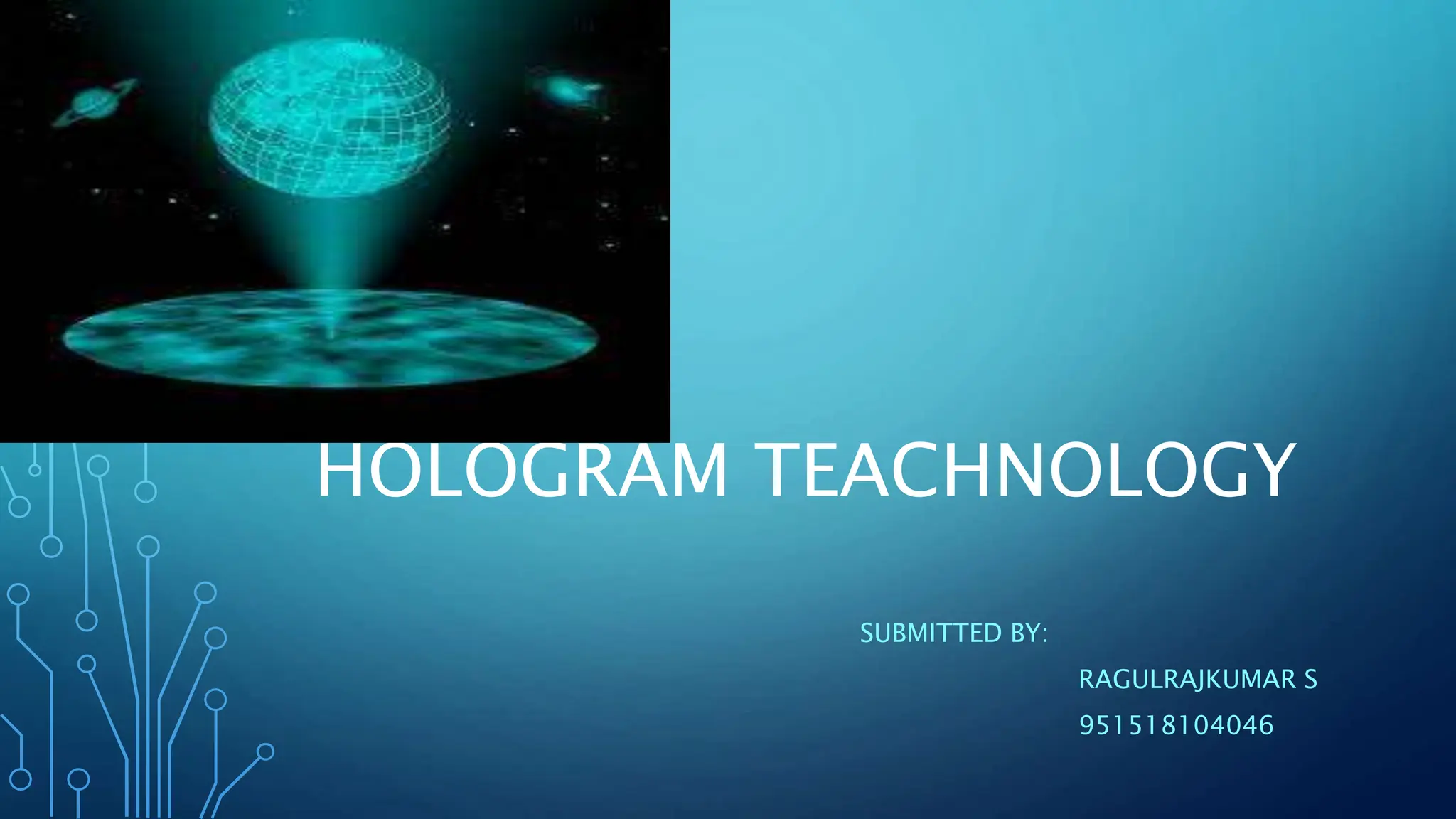
HOLOGRAM TEACHNOLOGY
SUBMITTED BY:
RAGULRAJKUMAR S
951518104046
CONTENTS
• Introduction
• History
• Working and Process
• Holography vs Photography
• Hologram Classification
• Applications
• Holography in Fiction
WHAT IS HOLOGRAM
A hologram is a physical structure that diffracts light
into an image. The term ‘hologram’ can refers to both
the encoded material and the resulting image.
HOLOGRAPHY
Science of producing holograms.
Enables 3-D images (hologram) to be made.
The image changes as the positon of the orientation
of the viewing system changes in exactly the same
way as if the object were still present , thus making
the image appear in Three-Dimensional.
HISTORY
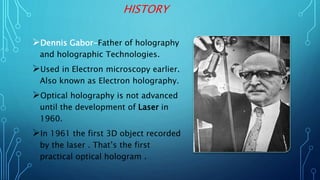
Dennis Gabor-Father of holography
and holographic Technologies.
Used in Electron microscopy earlier.
Also known as Electron holography.
Optical holography is not advanced
until the development of Laser in
1960.
In 1961 the first 3D object recorded
by the laser . That’s the first
practical optical hologram .
WORKIN
G
Enables a light field to be recorded and later
reconstructed when the original light field is no longer
present, due to the absence of the original object.
Can be thought of as somewhat similar to Sound
Recording, whereby a sound field is encoded in such a way
that it can be reproduced later , without the presence of
the original vibrating matter.
PROCESS
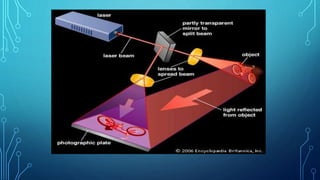
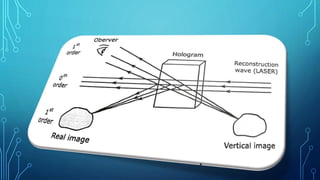
It is the interference pattern that is imprinted on the
recording medium.
The interference can be consider as the encoded version of
the scene/object.
This missing key is provided later by shining laser, identical
to the one used to record the hologram, onto the developed
film.
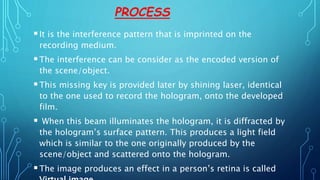
 When this beam illuminates the hologram, it is diffracted by
the hologram’s surface pattern. This produces a light field
which is similar to the one originally produced by the
scene/object and scattered onto the hologram.
The image produces an effect in a person’s retina is called
HOLOGRAPHY VS
PHOTOGRAPHY
Holography and Photography have three things in common:
• They use light energy,
• They employ a light-sensitive surface,
• And the result is visible image.
Differences from Ordinary Photography:
A hologram can be viewed from a range of different angles ,
as if it were still present. But a photograph can be viewed
from one direction.
A photograph can be recorded by a normal light sources ,
but for hologram laser is required to record the object.
When a hologram is cut in multiple pieces, the
whole scene/object can still be seen in each
pieces. But for a photograph it’s not possible.
The reproduced viewing range of a hologram
adds many more depth perception cues that
were present in the original scene/object. But a
photograph lacks in depth perception.
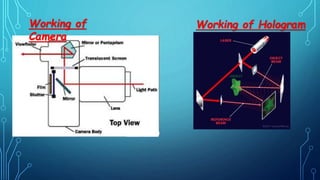
Working of
Camera
Working of Hologram
HOLOGRAM
CLASSIFICATION
Reflection Holograms
Volume hologram
Transmission Holograms
Rainbow Holograms
Multi-image Holograms
Holographic Stereograms
Holographic movies
APPLICATION
S
• Art
• Data Storage
• Dynamic Holography
• Holographic interferometry
• Interferometric microscopy
• Sensors and Bisensors
• Security
HOLOGRAPHY IN
FICTION
Often used as plot device in Science fiction.
• In science fiction books
• Live-action films
• Live-action television series
• Cartoon films
• Video games
CONCULSION
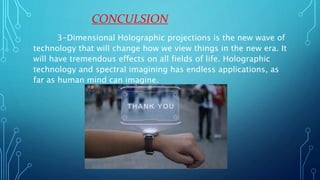
3-Dimensional Holographic projections is the new wave of
technology that will change how we view things in the new era. It
will have tremendous effects on all fields of life. Holographic
technology and spectral imagining has endless applications, as
far as human mind can imagine.

Presentation about hologram technology .

  • 1.
  • 2.
    CONTENTS • Introduction • History •Working and Process • Holography vs Photography • Hologram Classification • Applications • Holography in Fiction
  • 3.
    WHAT IS HOLOGRAM Ahologram is a physical structure that diffracts light into an image. The term ‘hologram’ can refers to both the encoded material and the resulting image.
  • 4.
    HOLOGRAPHY Science of producingholograms. Enables 3-D images (hologram) to be made. The image changes as the positon of the orientation of the viewing system changes in exactly the same way as if the object were still present , thus making the image appear in Three-Dimensional.
  • 5.
    HISTORY Dennis Gabor-Father ofholography and holographic Technologies. Used in Electron microscopy earlier. Also known as Electron holography. Optical holography is not advanced until the development of Laser in 1960. In 1961 the first 3D object recorded by the laser . That’s the first practical optical hologram .
  • 6.
    WORKIN G Enables a lightfield to be recorded and later reconstructed when the original light field is no longer present, due to the absence of the original object. Can be thought of as somewhat similar to Sound Recording, whereby a sound field is encoded in such a way that it can be reproduced later , without the presence of the original vibrating matter.
  • 8.
    PROCESS It is theinterference pattern that is imprinted on the recording medium. The interference can be consider as the encoded version of the scene/object. This missing key is provided later by shining laser, identical to the one used to record the hologram, onto the developed film.  When this beam illuminates the hologram, it is diffracted by the hologram’s surface pattern. This produces a light field which is similar to the one originally produced by the scene/object and scattered onto the hologram. The image produces an effect in a person’s retina is called
  • 10.
    HOLOGRAPHY VS PHOTOGRAPHY Holography andPhotography have three things in common: • They use light energy, • They employ a light-sensitive surface, • And the result is visible image. Differences from Ordinary Photography: A hologram can be viewed from a range of different angles , as if it were still present. But a photograph can be viewed from one direction. A photograph can be recorded by a normal light sources , but for hologram laser is required to record the object.
  • 11.
    When a hologramis cut in multiple pieces, the whole scene/object can still be seen in each pieces. But for a photograph it’s not possible. The reproduced viewing range of a hologram adds many more depth perception cues that were present in the original scene/object. But a photograph lacks in depth perception.
  • 12.
  • 13.
    HOLOGRAM CLASSIFICATION Reflection Holograms Volume hologram TransmissionHolograms Rainbow Holograms Multi-image Holograms Holographic Stereograms Holographic movies
  • 14.
    APPLICATION S • Art • DataStorage • Dynamic Holography • Holographic interferometry • Interferometric microscopy • Sensors and Bisensors • Security
  • 15.
    HOLOGRAPHY IN FICTION Often usedas plot device in Science fiction. • In science fiction books • Live-action films • Live-action television series • Cartoon films • Video games
  • 16.
    CONCULSION 3-Dimensional Holographic projectionsis the new wave of technology that will change how we view things in the new era. It will have tremendous effects on all fields of life. Holographic technology and spectral imagining has endless applications, as far as human mind can imagine.