Final Accounts
MCA
Financial Management Accounting
UNIT 2
Chapter Objectives
• Identify the objectives of preparing various
final accounts
• Understand the treatment of different items in
the preparation of the final accounts
• Explain the importance of final accounts
• Describe the role of worksheet in preparing
final accounts
2
Objectives of Final Accounts
• Final accounts refer to the various accounts
and statements that provide information
related to the progress of the business.
• These are prepared from the Trial Balance.
• They provide the following information:
– Profit earned or loss suffered by the business
during a particular accounting period
– Financial position of the business
3
Accounts and Statements Comprising
Final Accounts
• Final accounts with respect to a particular
business are:
– Trading account
– Profit and Loss account
– Balance Sheet
• Trading account and Profit and Loss account
are together known as income statements.
• Income statements are the final summary of
the accounts that affect the profit and loss
position of the business.
4
Trading Account
• It shows the overall results of purchasing and
selling of goods.
• It includes all the direct expenses incurred in
the business.
• It provides gross profit earned by the
business, if total sales is greater than total
purchases.
• It provides gross loss suffered by the business,
if total sales is less than total purchases.
5
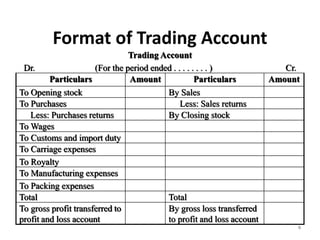
Format of Trading Account
Trading Account
Dr. (For the period ended . . . . . . . . ) Cr.
Particulars Amount Particulars Amount
To Opening stock By Sales
To Purchases Less: Sales returns
Less: Purchases returns By Closing stock
To Wages
To Customs and import duty
To Carriage expenses
To Royalty
To Manufacturing expenses
To Packing expenses
Total Total
To gross profit transferred to
profit and loss account
By gross loss transferred
to profit and loss account
6
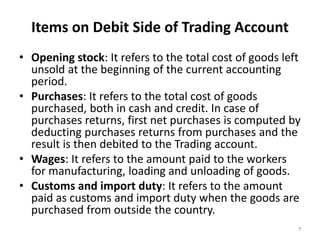
Items on Debit Side of Trading Account
• Opening stock: It refers to the total cost of goods left
unsold at the beginning of the current accounting
period.
• Purchases: It refers to the total cost of goods
purchased, both in cash and credit. In case of
purchases returns, first net purchases is computed by
deducting purchases returns from purchases and the
result is then debited to the Trading account.
• Wages: It refers to the amount paid to the workers
for manufacturing, loading and unloading of goods.
• Customs and import duty: It refers to the amount
paid as customs and import duty when the goods are
purchased from outside the country.
7
Items on Debit Side of Trading Account
(cont…)
• Carriage expenses: It refers to the direct expenses
that are incurred while transferring the purchased
goods from vendor to the factory. These expenses
are also known as freight in, carriage in or cartage.
• Royalty: It refers to the amount paid to the owner
for using his rights.
• Manufacturing expenses: It refers to the expenses
spent on gas, electricity, water and fuel, which are
required to run the factory.
• Packing expenses: It refers to the amount spent in
packing the purchased goods to bring them to
factory.
8
Items on Credit Side of Trading Account
• Closing stock: It refers to the total cost of the goods
that are left unsold at the end of the accounting
period.
• Sales: It refers to the total cost of goods sold, both in
cash and credit. In case of sales returns, first the net
sales is computed by deducting the sales returns
from total sales and the result is then credited to the
Trading account.
9
Importance of Trading Account
• It provides information related to gross profit and
loss and helps in defining the upper limits for the
operating expenses of the business.
• It helps in the computation of gross profit ratio. A
decrease in the gross profit ratio indicates increase in
the purchased cost or decrease in the selling price.
• It allows the comparison of opening and closing
stocks of two accounting periods. This helps in
preventing unnecessary investment of funds for the
purchase of inventories.
10
Profit and Loss Account
• Profit and Loss account shows all incomes and
indirect expenses related to business.
• Indirect expenses include those expenses such
as administrative, selling and distribution
expenses that are required for the operation
of business.
• Profit and Loss account provides net profit
earned or net loss suffered by the business.
11
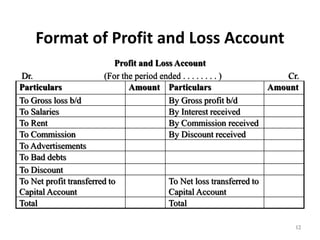
Format of Profit and Loss Account
Profit and Loss Account
Dr. (For the period ended . . . . . . . . ) Cr.
Particulars Amount Particulars Amount
To Gross loss b/d By Gross profit b/d
To Salaries By Interest received
To Rent By Commission received
To Commission By Discount received
To Advertisements
To Bad debts
To Discount
To Net profit transferred to
Capital Account
To Net loss transferred to
Capital Account
Total Total
12
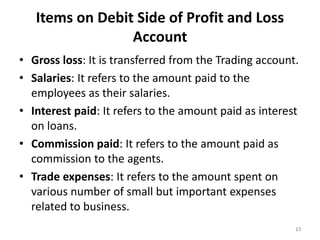
Items on Debit Side of Profit and Loss
Account
• Gross loss: It is transferred from the Trading account.
• Salaries: It refers to the amount paid to the
employees as their salaries.
• Interest paid: It refers to the amount paid as interest
on loans.
• Commission paid: It refers to the amount paid as
commission to the agents.
• Trade expenses: It refers to the amount spent on
various number of small but important expenses
related to business.
13
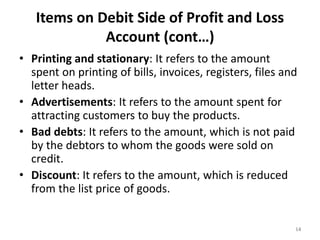
Items on Debit Side of Profit and Loss
Account (cont…)
• Printing and stationary: It refers to the amount
spent on printing of bills, invoices, registers, files and
letter heads.
• Advertisements: It refers to the amount spent for
attracting customers to buy the products.
• Bad debts: It refers to the amount, which is not paid
by the debtors to whom the goods were sold on
credit.
• Discount: It refers to the amount, which is reduced
from the list price of goods.
14
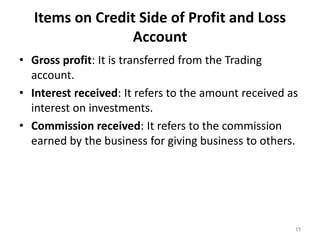
Items on Credit Side of Profit and Loss
Account
• Gross profit: It is transferred from the Trading
account.
• Interest received: It refers to the amount received as
interest on investments.
• Commission received: It refers to the commission
earned by the business for giving business to others.
15
Importance of Profit and Loss Account
• It provides information about net profit earned or
net loss suffered by the business.
• It helps in determining whether the business is being
run efficiently or not by comparing the Profit and
Loss account of two accounting periods.
• It helps in taking effective control steps by analyzing
the various expenses listed in the Profit and Loss
account of the current year with that of the previous
years.
• It allows in the estimation of profits for the coming
years by comparing the profits of previous years.
16
Manufacturing Account
• It is a special account, which is prepared only
when the business is engaged in
manufacturing of goods.
• It provides the cost of goods manufactured
during a given accounting period.
• In case of manufacturer, the manufacturing
account should be prepared prior to the
preparation of Trading account and Profit and
Loss account.
17
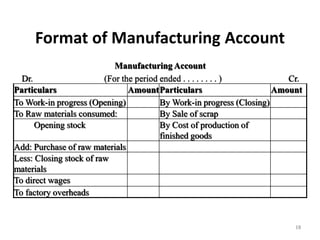
Format of Manufacturing Account
Manufacturing Account
Dr. (For the period ended . . . . . . . . ) Cr.
Particulars AmountParticulars Amount
To Work-in progress (Opening) By Work-in progress (Closing)
To Raw materials consumed: By Sale of scrap
Opening stock By Cost of production of
finished goods
Add: Purchase of raw materials
Less: Closing stock of raw
materials
To direct wages
To factory overheads
18
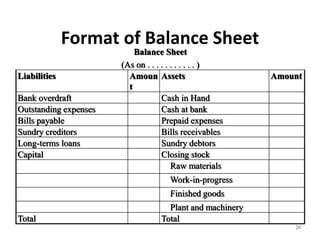
Balance Sheet
• It is a financial statement that states the
financial position of the business.
• It lists the assets and liabilities of a business
on a particular date.
• The assets and liabilities on a Balance Sheet
are listed in either of the following two orders:
– Liquidity order
– Permanency order
19
Format of Balance Sheet
Balance Sheet
(As on . . . . . . . . . . . )
Liabilities Amoun
t
Assets Amount
Bank overdraft Cash in Hand
Outstanding expenses Cash at bank
Bills payable Prepaid expenses
Sundry creditors Bills receivables
Long-terms loans Sundry debtors
Capital Closing stock
Raw materials
Work-in-progress
Finished goods
Plant and machinery
Total Total
20
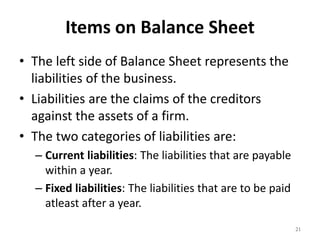
Items on Balance Sheet
• The left side of Balance Sheet represents the
liabilities of the business.
• Liabilities are the claims of the creditors
against the assets of a firm.
• The two categories of liabilities are:
– Current liabilities: The liabilities that are payable
within a year.
– Fixed liabilities: The liabilities that are to be paid
atleast after a year.
21
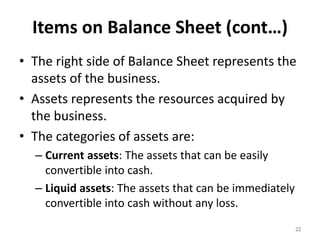
Items on Balance Sheet (cont…)
• The right side of Balance Sheet represents the
assets of the business.
• Assets represents the resources acquired by
the business.
• The categories of assets are:
– Current assets: The assets that can be easily
convertible into cash.
– Liquid assets: The assets that can be immediately
convertible into cash without any loss.
22
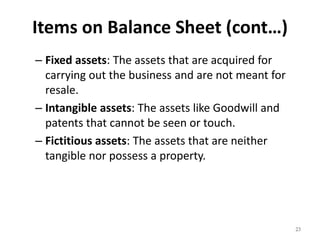
Items on Balance Sheet (cont…)
– Fixed assets: The assets that are acquired for
carrying out the business and are not meant for
resale.
– Intangible assets: The assets like Goodwill and
patents that cannot be seen or touch.
– Fictitious assets: The assets that are neither
tangible nor possess a property.
23
Adjustment Entries
• These are the entries that are made at the end of an
accounting period after closing the books of accounts
and preparing Trail Balance.
• Some of the adjustment entries that are required for
the preparation of final accounts are:
– Closing stock
– Outstanding expenses
– Outstanding income
– Income received in advance
– Depreciation
– Bad debts
– Interest on capital
– Interest on drawings
24
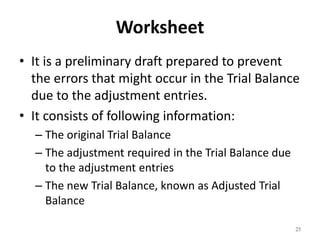
Worksheet
• It is a preliminary draft prepared to prevent
the errors that might occur in the Trial Balance
due to the adjustment entries.
• It consists of following information:
– The original Trial Balance
– The adjustment required in the Trial Balance due
to the adjustment entries
– The new Trial Balance, known as Adjusted Trial
Balance
25
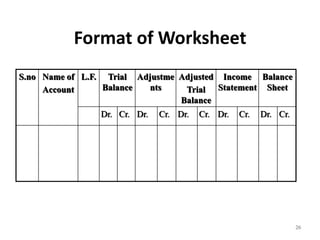
Format of Worksheet
S.no Name of
Account
L.F. Trial
Balance
Adjustme
nts
Adjusted
Trial
Balance
Income
Statement
Balance
Sheet
Dr. Cr. Dr. Cr. Dr. Cr. Dr. Cr. Dr. Cr.
26
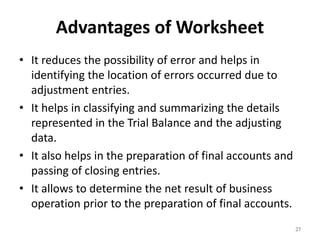
Advantages of Worksheet
• It reduces the possibility of error and helps in
identifying the location of errors occurred due to
adjustment entries.
• It helps in classifying and summarizing the details
represented in the Trial Balance and the adjusting
data.
• It also helps in the preparation of final accounts and
passing of closing entries.
• It allows to determine the net result of business
operation prior to the preparation of final accounts.
27
References
• ACCOUNTING FOR MANAGERS Dr. Sakshi
Vasudeva Galgotia publishing company
(Theory & Practice).Chapter no. 11 Financial
Statements –final accounts . Page no. 251.
28
Summary
• In this chapter, you have:
– Identified the objectives of preparing various final
accounts
– Understood the treatment of different items in
the preparation of the various final accounts
– Explained the importance of various final accounts
– Described the role of worksheet in preparing final
accounts
29
Thank you
30

Mca i fma u 2 final account

  • 1.
  • 2.
    Chapter Objectives • Identifythe objectives of preparing various final accounts • Understand the treatment of different items in the preparation of the final accounts • Explain the importance of final accounts • Describe the role of worksheet in preparing final accounts 2
  • 3.
    Objectives of FinalAccounts • Final accounts refer to the various accounts and statements that provide information related to the progress of the business. • These are prepared from the Trial Balance. • They provide the following information: – Profit earned or loss suffered by the business during a particular accounting period – Financial position of the business 3
  • 4.
    Accounts and StatementsComprising Final Accounts • Final accounts with respect to a particular business are: – Trading account – Profit and Loss account – Balance Sheet • Trading account and Profit and Loss account are together known as income statements. • Income statements are the final summary of the accounts that affect the profit and loss position of the business. 4
  • 5.
    Trading Account • Itshows the overall results of purchasing and selling of goods. • It includes all the direct expenses incurred in the business. • It provides gross profit earned by the business, if total sales is greater than total purchases. • It provides gross loss suffered by the business, if total sales is less than total purchases. 5
  • 6.
    Format of TradingAccount Trading Account Dr. (For the period ended . . . . . . . . ) Cr. Particulars Amount Particulars Amount To Opening stock By Sales To Purchases Less: Sales returns Less: Purchases returns By Closing stock To Wages To Customs and import duty To Carriage expenses To Royalty To Manufacturing expenses To Packing expenses Total Total To gross profit transferred to profit and loss account By gross loss transferred to profit and loss account 6
  • 7.
    Items on DebitSide of Trading Account • Opening stock: It refers to the total cost of goods left unsold at the beginning of the current accounting period. • Purchases: It refers to the total cost of goods purchased, both in cash and credit. In case of purchases returns, first net purchases is computed by deducting purchases returns from purchases and the result is then debited to the Trading account. • Wages: It refers to the amount paid to the workers for manufacturing, loading and unloading of goods. • Customs and import duty: It refers to the amount paid as customs and import duty when the goods are purchased from outside the country. 7
  • 8.
    Items on DebitSide of Trading Account (cont…) • Carriage expenses: It refers to the direct expenses that are incurred while transferring the purchased goods from vendor to the factory. These expenses are also known as freight in, carriage in or cartage. • Royalty: It refers to the amount paid to the owner for using his rights. • Manufacturing expenses: It refers to the expenses spent on gas, electricity, water and fuel, which are required to run the factory. • Packing expenses: It refers to the amount spent in packing the purchased goods to bring them to factory. 8
  • 9.
    Items on CreditSide of Trading Account • Closing stock: It refers to the total cost of the goods that are left unsold at the end of the accounting period. • Sales: It refers to the total cost of goods sold, both in cash and credit. In case of sales returns, first the net sales is computed by deducting the sales returns from total sales and the result is then credited to the Trading account. 9
  • 10.
    Importance of TradingAccount • It provides information related to gross profit and loss and helps in defining the upper limits for the operating expenses of the business. • It helps in the computation of gross profit ratio. A decrease in the gross profit ratio indicates increase in the purchased cost or decrease in the selling price. • It allows the comparison of opening and closing stocks of two accounting periods. This helps in preventing unnecessary investment of funds for the purchase of inventories. 10
  • 11.
    Profit and LossAccount • Profit and Loss account shows all incomes and indirect expenses related to business. • Indirect expenses include those expenses such as administrative, selling and distribution expenses that are required for the operation of business. • Profit and Loss account provides net profit earned or net loss suffered by the business. 11
  • 12.
    Format of Profitand Loss Account Profit and Loss Account Dr. (For the period ended . . . . . . . . ) Cr. Particulars Amount Particulars Amount To Gross loss b/d By Gross profit b/d To Salaries By Interest received To Rent By Commission received To Commission By Discount received To Advertisements To Bad debts To Discount To Net profit transferred to Capital Account To Net loss transferred to Capital Account Total Total 12
  • 13.
    Items on DebitSide of Profit and Loss Account • Gross loss: It is transferred from the Trading account. • Salaries: It refers to the amount paid to the employees as their salaries. • Interest paid: It refers to the amount paid as interest on loans. • Commission paid: It refers to the amount paid as commission to the agents. • Trade expenses: It refers to the amount spent on various number of small but important expenses related to business. 13
  • 14.
    Items on DebitSide of Profit and Loss Account (cont…) • Printing and stationary: It refers to the amount spent on printing of bills, invoices, registers, files and letter heads. • Advertisements: It refers to the amount spent for attracting customers to buy the products. • Bad debts: It refers to the amount, which is not paid by the debtors to whom the goods were sold on credit. • Discount: It refers to the amount, which is reduced from the list price of goods. 14
  • 15.
    Items on CreditSide of Profit and Loss Account • Gross profit: It is transferred from the Trading account. • Interest received: It refers to the amount received as interest on investments. • Commission received: It refers to the commission earned by the business for giving business to others. 15
  • 16.
    Importance of Profitand Loss Account • It provides information about net profit earned or net loss suffered by the business. • It helps in determining whether the business is being run efficiently or not by comparing the Profit and Loss account of two accounting periods. • It helps in taking effective control steps by analyzing the various expenses listed in the Profit and Loss account of the current year with that of the previous years. • It allows in the estimation of profits for the coming years by comparing the profits of previous years. 16
  • 17.
    Manufacturing Account • Itis a special account, which is prepared only when the business is engaged in manufacturing of goods. • It provides the cost of goods manufactured during a given accounting period. • In case of manufacturer, the manufacturing account should be prepared prior to the preparation of Trading account and Profit and Loss account. 17
  • 18.
    Format of ManufacturingAccount Manufacturing Account Dr. (For the period ended . . . . . . . . ) Cr. Particulars AmountParticulars Amount To Work-in progress (Opening) By Work-in progress (Closing) To Raw materials consumed: By Sale of scrap Opening stock By Cost of production of finished goods Add: Purchase of raw materials Less: Closing stock of raw materials To direct wages To factory overheads 18
  • 19.
    Balance Sheet • Itis a financial statement that states the financial position of the business. • It lists the assets and liabilities of a business on a particular date. • The assets and liabilities on a Balance Sheet are listed in either of the following two orders: – Liquidity order – Permanency order 19
  • 20.
    Format of BalanceSheet Balance Sheet (As on . . . . . . . . . . . ) Liabilities Amoun t Assets Amount Bank overdraft Cash in Hand Outstanding expenses Cash at bank Bills payable Prepaid expenses Sundry creditors Bills receivables Long-terms loans Sundry debtors Capital Closing stock Raw materials Work-in-progress Finished goods Plant and machinery Total Total 20
  • 21.
    Items on BalanceSheet • The left side of Balance Sheet represents the liabilities of the business. • Liabilities are the claims of the creditors against the assets of a firm. • The two categories of liabilities are: – Current liabilities: The liabilities that are payable within a year. – Fixed liabilities: The liabilities that are to be paid atleast after a year. 21
  • 22.
    Items on BalanceSheet (cont…) • The right side of Balance Sheet represents the assets of the business. • Assets represents the resources acquired by the business. • The categories of assets are: – Current assets: The assets that can be easily convertible into cash. – Liquid assets: The assets that can be immediately convertible into cash without any loss. 22
  • 23.
    Items on BalanceSheet (cont…) – Fixed assets: The assets that are acquired for carrying out the business and are not meant for resale. – Intangible assets: The assets like Goodwill and patents that cannot be seen or touch. – Fictitious assets: The assets that are neither tangible nor possess a property. 23
  • 24.
    Adjustment Entries • Theseare the entries that are made at the end of an accounting period after closing the books of accounts and preparing Trail Balance. • Some of the adjustment entries that are required for the preparation of final accounts are: – Closing stock – Outstanding expenses – Outstanding income – Income received in advance – Depreciation – Bad debts – Interest on capital – Interest on drawings 24
  • 25.
    Worksheet • It isa preliminary draft prepared to prevent the errors that might occur in the Trial Balance due to the adjustment entries. • It consists of following information: – The original Trial Balance – The adjustment required in the Trial Balance due to the adjustment entries – The new Trial Balance, known as Adjusted Trial Balance 25
  • 26.
    Format of Worksheet S.noName of Account L.F. Trial Balance Adjustme nts Adjusted Trial Balance Income Statement Balance Sheet Dr. Cr. Dr. Cr. Dr. Cr. Dr. Cr. Dr. Cr. 26
  • 27.
    Advantages of Worksheet •It reduces the possibility of error and helps in identifying the location of errors occurred due to adjustment entries. • It helps in classifying and summarizing the details represented in the Trial Balance and the adjusting data. • It also helps in the preparation of final accounts and passing of closing entries. • It allows to determine the net result of business operation prior to the preparation of final accounts. 27
  • 28.
    References • ACCOUNTING FORMANAGERS Dr. Sakshi Vasudeva Galgotia publishing company (Theory & Practice).Chapter no. 11 Financial Statements –final accounts . Page no. 251. 28
  • 29.
    Summary • In thischapter, you have: – Identified the objectives of preparing various final accounts – Understood the treatment of different items in the preparation of the various final accounts – Explained the importance of various final accounts – Described the role of worksheet in preparing final accounts 29
  • 30.