Guidelines
•Tips to bemore interactive in Live Session
• Maintain discipline for smooth conductance of
the interactive live session.
• Type in your Name, UID and Program name on
chat to mark your attendance.
• Raise your questions only after completion of
session and do not intervene in between.
• Avoid posting irrelevant questions. Also, don’t
start any personal conversation.
• Interaction with faculty should be constructive,
and no disruptive comment is appreciated.
• For any issues, please contact our academic
support service @+91 8530568939 or post
your queries on support@dypatiledu.com
3.
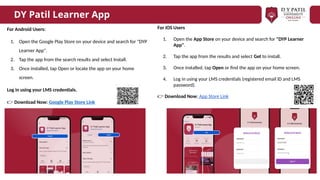
For Android Users:
1.Open the Google Play Store on your device and search for "DYP
Learner App".
2. Tap the app from the search results and select Install.
3. Once installed, tap Open or locate the app on your home
screen.
Log in using your LMS credentials.
👉 Download Now: Google Play Store Link
DY Patil Learner App
For iOS Users
1. Open the App Store on your device and search for "DYP Learner
App".
2. Tap the app from the results and select Get to install.
3. Once installed, tap Open or find the app on your home screen.
4. Log in using your LMS credentials (registered email ID and LMS
password).
👉 Download Now: App Store Link
4.
By the endof this session, you will be able to:
Learning Objectives
o Final Accounts
5.
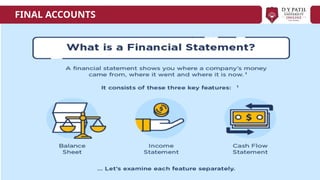
• Final Accountsis the last step in the accounting process. Trial
Balance is prepared at the end of all the accounting year to know
the balances of all the accounts & to test the arithmetic accuracy of
accounts. But the basic objective of accounting is to know about the
profit or loss during the previous year & present financial position.
This can be known only if Trading account and Profit & Loss account
and Balance Sheet are prepared at the end pf year. These are also
known as FINANCIAL STSTEMENTS which are prepared
FINAL ACCOUNTS
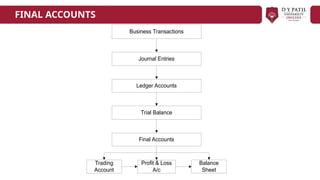
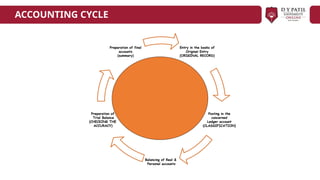
Entry in thebooks of
Original Entry
(ORIGINAL RECORD)
Posting in the
concerned
Ledger account
(CLASSIFICATION)
Balancing of Real &
Personal accounts
Preparation of
Trial Balance
(CHECKING THE
ACCURACY)
Preparation of final
accounts
(summary)
ACCOUNTING CYCLE
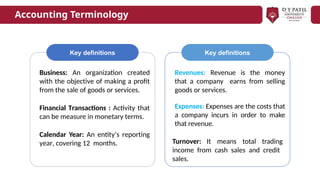
Key definitions
Business: Anorganization created
with the objective of making a profit
from the sale of goods or services.
Financial Transactions : Activity that
can be measure in monetary terms.
Calendar Year: An entity’s reporting
year, covering 12 months.
Revenues: Revenue is the money
that a company earns from selling
goods or services.
Expenses: Expenses are the costs that
a company incurs in order to make
that revenue.
Turnover: It means total trading
income from cash sales and credit
sales.
Key definitions
Accounting Terminology
12.
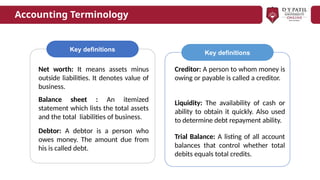
Key definitions
Net worth:It means assets minus
outside liabilities. It denotes value of
business.
Balance sheet : An itemized
statement which lists the total assets
and the total liabilities of business.
Debtor: A debtor is a person who
owes money. The amount due from
his is called debt.
Creditor: A person to whom money is
owing or payable is called a creditor.
Liquidity: The availability of cash or
ability to obtain it quickly. Also used
to determine debt repayment ability.
Trial Balance: A listing of all account
balances that control whether total
debits equals total credits.
Key definitions
Accounting Terminology
13.
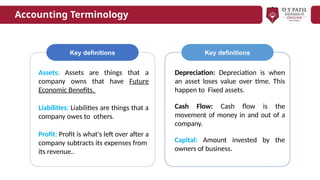
Key definitions
Assets: Assetsare things that a
company owns that have Future
Economic Benefits.
Liabilities: Liabilities are things that a
company owes to others.
Profit: Profit is what's left over after a
company subtracts its expenses from
its revenue..
Depreciation: Depreciation is when
an asset loses value over time. This
happen to Fixed assets.
Cash Flow: Cash flow is the
movement of money in and out of a
company.
Capital: Amount invested by the
owners of business.
Key definitions
Accounting Terminology
14.
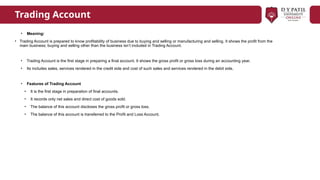
Trading Account
• Meaning:
•Trading Account is prepared to know profitability of business due to buying and selling or manufacturing and selling. It shows the profit from the
main business; buying and selling other than the business isn’t included in Trading Account.
• Trading Account is the first stage in preparing a final account. It shows the gross profit or gross loss during an accounting year.
• Its includes sales, services rendered in the credit side and cost of such sales and services rendered in the debit side.
• Features of Trading Account
• It is the first stage in preparation of final accounts.
• It records only net sales and direct cost of goods sold.
• The balance of this account discloses the gross profit or gross loss.
• The balance of this account is transferred to the Profit and Loss Account.
15.
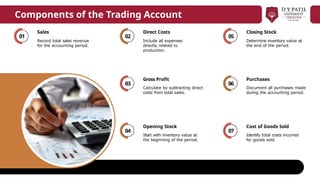
01
Sales
Record total salesrevenue
for the accounting period.
02
Direct Costs
Include all expenses
directly related to
production.
03
Gross Profit
Calculate by subtracting direct
costs from total sales.
04
Opening Stock
Start with inventory value at
the beginning of the period.
05
Closing Stock
Determine inventory value at
the end of the period.
06
Purchases
Document all purchases made
during the accounting period.
07
Cost of Goods Sold
Identify total costs incurred
for goods sold.
Components of the Trading Account
16.
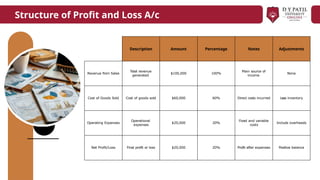
Description Amount PercentageNotes Adjustments
Revenue from Sales
Total revenue
generated
$100,000 100%
Main source of
income
None
Cost of Goods Sold Cost of goods sold $60,000 60% Direct costs incurred Less inventory
Operating Expenses
Operational
expenses
$20,000 20%
Fixed and variable
costs
Include overheads
Net Profit/Loss Final profit or loss $20,000 20% Profit after expenses Positive balance
Structure of Profit and Loss A/c
17.
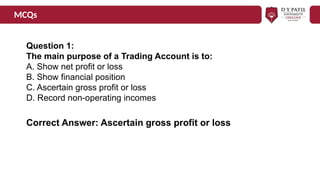
MCQs
Question 1:
The mainpurpose of a Trading Account is to:
A. Show net profit or loss
B. Show financial position
C. Ascertain gross profit or loss
D. Record non-operating incomes
Correct Answer: Ascertain gross profit or loss
18.
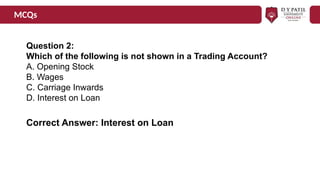
MCQs
Question 2:
Which ofthe following is not shown in a Trading Account?
A. Opening Stock
B. Wages
C. Carriage Inwards
D. Interest on Loan
Correct Answer: Interest on Loan
19.
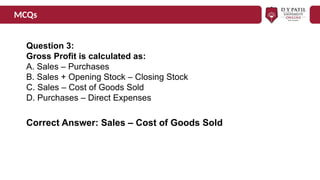
MCQs
Question 3:
Gross Profitis calculated as:
A. Sales – Purchases
B. Sales + Opening Stock – Closing Stock
C. Sales – Cost of Goods Sold
D. Purchases – Direct Expenses
Correct Answer: Sales – Cost of Goods Sold
#11 Revenue – Details about revenue. How definition of revenue changes with change in industry. Difference between revenue from operation and other revenues
Expenses: impact of expenses definition in different industries. Type of expenses (direct, indirect, operating, non operating, fixed variable etc)
#13 Assets:
Definition if Future economic benefits. Difference between assets and expenses.
Type of assets (current asset, fixed assets and investment).
Liabilities.
Type of liabilities (current and non current), accrual concept. Difference between liabilities and equity.
Profits. Type of profits (gross profit, net profit, operating profits EBITDA, EBIT, EBT etc)
Capital- what is share, concept of corporate veil, retained earnings, link of profits with capital