RM Accounts Ed

lesson notes on
ram@2013

THE INTRODUCTION TO

LIMITED LIABILITY COMPANIES

1
LIMITED LIABILITY COMPANIES
(an introduction)

Principles of Accounts [CXC – CSEC]
WHAT IS A LIMITED LIABILITY COMPANY?


A business structure where the
owners (shareholders) are liable only
to the amount they have invested
(shares bought).



It is to be treated as a “separate legal
entity” according to the Companies Act
(1985…).
Types of Limited Liability
Companies

Public Limited Companies

Private Limited Companies
Public Limited Companies








Have a minimum of 2 shareholders
Have an authorized capital than exceeds
BDS$160k (£50k)
Have to be registered with the Registrar of
Companies as a “public limited company”
Have the abbreviation “plc” attached to its
official name.
Have to trade its shares on the public
exchange (Stock Market or Securities
Exchange)
Have to publish its financial statements
annually
Private Limited Companies








Have a minimum of 1 shareholder
Have an authorized capital that can be less
than BDS$160k (£50k)
Have to be registered with the Registrar of
Companies as a “private limited company”
Have the abbreviation “ltd” attached to its
official name.
Does NOT have to trade its shares on the
public exchange (Stock Market or Securities
Exchange)
Does NOT have to publish its financial
statements
Management


A Board of Directors (and not the shareholders)
manage the affairs of a limited liability
company.



The directors are employees of the
company; and are thus paid a fee (usually a
negotiated package) for their services.



The directors‟ fee is expensed on the
company‟s income statement.
Capital


The capital of a limited company is
divided into shares.



Shares – are certificates of ownership.



Shareholders – are the persons who
own the shares (i.e. invested in its
equity)
Types of shares


Preference Shares
shares with an agreed percentage rate of dividend
(payable before ordinary share dividends)



Ordinary Shares
shares referred to as common with no guaranteed rate of
dividend.

(payable after all other deductions from profits are made)
Dividends


Dividends – are paid to the shareholders
out the net profits as a return on their
investment.



Dividends – are paid in either cash or
stocks (own shares/treasury)



Dividends - „must‟ be paid on preference
shares; however there is no obligation to
pay on ordinary shares (common stock).
Debentures


Debentures – are loan certificates or certificates of debt.



They acknowledge the existence of a debt (without collateral) of
a particular amount and the accompanying interest rate.



The debenture interest is expensed on the income
statement.



Due payments on the debenture MUST BE PAID whether
the business makes a profit or not.



Debentures - are treated as long-term debt on the
Balance Sheet
Accounting aspects


One is expected to present (at this
level)
◦ The Trading, Profit & Loss a/c
[generally called the income statement]
◦ The Appropriation of Net Profit
[usually attached to the income statement]
◦ The Balance Sheet
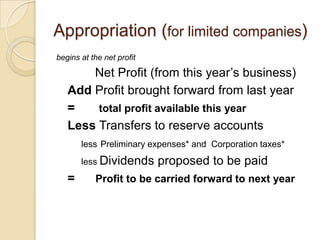
Appropriation (for limited companies)
begins at the net profit

Net Profit (from this year‟s business)
Add Profit brought forward from last year
=
total profit available this year
Less Transfers to reserve accounts
less Preliminary expenses* and Corporation taxes*
less Dividends

=

proposed to be paid

Profit to be carried forward to next year
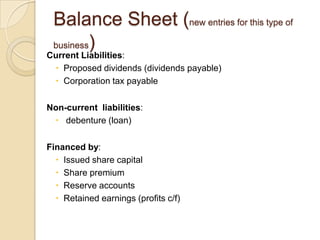
Balance Sheet (new entries for this type of
business)

Current Liabilities:
 Proposed dividends (dividends payable)
 Corporation tax payable
Non-current liabilities:
 debenture (loan)
Financed by:
 Issued share capital
 Share premium
 Reserve accounts
 Retained earnings (profits c/f)
Take note….


It is the issued share capital rather than
the authorized share capital that MUST
be disclosed on the Balance Sheet.



The issued share capital is the actual
capital invested by the shareholders (to
date).



The authorized share capital is simply
the amount the business is allowed to
offer to potential shareholders.

Limited liability Companies (introduction)

  • 1.
    RM Accounts Ed lessonnotes on ram@2013 THE INTRODUCTION TO LIMITED LIABILITY COMPANIES 1
  • 2.
    LIMITED LIABILITY COMPANIES (anintroduction) Principles of Accounts [CXC – CSEC]
  • 3.
    WHAT IS ALIMITED LIABILITY COMPANY?  A business structure where the owners (shareholders) are liable only to the amount they have invested (shares bought).  It is to be treated as a “separate legal entity” according to the Companies Act (1985…).
  • 4.
    Types of LimitedLiability Companies Public Limited Companies Private Limited Companies
  • 5.
    Public Limited Companies       Havea minimum of 2 shareholders Have an authorized capital than exceeds BDS$160k (£50k) Have to be registered with the Registrar of Companies as a “public limited company” Have the abbreviation “plc” attached to its official name. Have to trade its shares on the public exchange (Stock Market or Securities Exchange) Have to publish its financial statements annually
  • 6.
    Private Limited Companies       Havea minimum of 1 shareholder Have an authorized capital that can be less than BDS$160k (£50k) Have to be registered with the Registrar of Companies as a “private limited company” Have the abbreviation “ltd” attached to its official name. Does NOT have to trade its shares on the public exchange (Stock Market or Securities Exchange) Does NOT have to publish its financial statements
  • 7.
    Management  A Board ofDirectors (and not the shareholders) manage the affairs of a limited liability company.  The directors are employees of the company; and are thus paid a fee (usually a negotiated package) for their services.  The directors‟ fee is expensed on the company‟s income statement.
  • 8.
    Capital  The capital ofa limited company is divided into shares.  Shares – are certificates of ownership.  Shareholders – are the persons who own the shares (i.e. invested in its equity)
  • 9.
    Types of shares  PreferenceShares shares with an agreed percentage rate of dividend (payable before ordinary share dividends)  Ordinary Shares shares referred to as common with no guaranteed rate of dividend. (payable after all other deductions from profits are made)
  • 10.
    Dividends  Dividends – arepaid to the shareholders out the net profits as a return on their investment.  Dividends – are paid in either cash or stocks (own shares/treasury)  Dividends - „must‟ be paid on preference shares; however there is no obligation to pay on ordinary shares (common stock).
  • 11.
    Debentures  Debentures – areloan certificates or certificates of debt.  They acknowledge the existence of a debt (without collateral) of a particular amount and the accompanying interest rate.  The debenture interest is expensed on the income statement.  Due payments on the debenture MUST BE PAID whether the business makes a profit or not.  Debentures - are treated as long-term debt on the Balance Sheet
  • 12.
    Accounting aspects  One isexpected to present (at this level) ◦ The Trading, Profit & Loss a/c [generally called the income statement] ◦ The Appropriation of Net Profit [usually attached to the income statement] ◦ The Balance Sheet
  • 13.
    Appropriation (for limitedcompanies) begins at the net profit Net Profit (from this year‟s business) Add Profit brought forward from last year = total profit available this year Less Transfers to reserve accounts less Preliminary expenses* and Corporation taxes* less Dividends = proposed to be paid Profit to be carried forward to next year
  • 14.
    Balance Sheet (newentries for this type of business) Current Liabilities:  Proposed dividends (dividends payable)  Corporation tax payable Non-current liabilities:  debenture (loan) Financed by:  Issued share capital  Share premium  Reserve accounts  Retained earnings (profits c/f)
  • 15.
    Take note….  It isthe issued share capital rather than the authorized share capital that MUST be disclosed on the Balance Sheet.  The issued share capital is the actual capital invested by the shareholders (to date).  The authorized share capital is simply the amount the business is allowed to offer to potential shareholders.