TECHNICAL AND BUSINESS
CONSIDERATIONS FOR ADOPTION CLOUD
COMPUTING
Dr Hitesh Mohapatra
Associate Professor
BUSINESS CONSIDERATION FOR CLOUD
COMPUTING
• There are technical and business considerations organization needs to
take into accounts before adopting cloud computing technology.
• There is several technical and business considerations of on-premise
deployment models and cloud base IT resources model that meet
business needs.
• Before any recommendations of moving to a cloud-based IT
resources, several technical issues, cost and network expenditure,
Cloud model, network bandwidth and latency Issues, connectivity
issues and cloud carrier and cloud provider selection.
Connectivity Issues
• Traditional on-premise deployments models for enterprise and
businesses are mostly hosted on a private centralize servers storage
devices residing in the organizations and business own data center.
• TCP/IP facilitates both internet access and uninterrupted internet
connectivity for on-premise data exchange over LANs for data center
through the corporate networks for end-use devices (smartphones,
tablets, laptop and PC's).
• Geographical distance between cloud consumer and the cloud
provider can also be considered as longer distance can require
additional network hops but can also introduced potential bandwidth
and fluctuating latency constraints.
Cont.
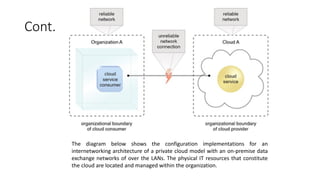
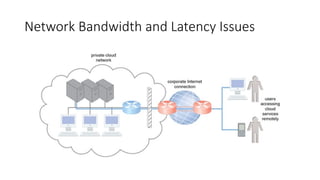
The diagram below shows the configuration implementations for an
internetworking architecture of a private cloud model with an on-premise data
exchange networks of over the LANs. The physical IT resources that constitute
the cloud are located and managed within the organization.
Network Bandwidth and Latency Issues
Cont.
• End-to-End Bandwidth: Determined by transmission capacity of
shared data links.
• Impact of ISP Connection: Bandwidth can be affected by
intermediary nodes connecting networks to ISPs.
• Broadband Network Technology: ISPs must implement broadband
technology in the core network to ensure end-to-end connectivity.
Cont.
• Latency Considerations: Time delay (latency) needs to be reduced for
network efficiency.
• Web Acceleration Technologies: Dynamic caching, compression, and
prefetching are driving the need to improve end-user connectivity
and Quality of Service (QoS).
• Packet Switching: Allows data packets to dynamically choose their
path, impacting end-to-end communication and QoS.
Cont.
• Cloud Bandwidth & Latency: Critical for cloud provisioning, as
bandwidth impacts data transfer, and latency affects application
response times and QoS.
• Business Requirements: Organizations need to assess bandwidth and
latency when moving IT solutions to the cloud to meet business
needs effectively.
Other challenges to consider
in cloud computing
Cloud Carrier and Cloud Provider
Selection
• Importance of selecting the right cloud carrier and provider
• Service Level Agreements (SLAs) ensure proper internet connections,
QoS, and network paths
• Multiple ISPs help meet business needs through improved
connectivity and reliability
• Multiple cloud carriers enhance cloud application performance and
QoS but increase costs
• Risks of unreliable cloud providers failing to meet SLA guarantees
• Impact of poor SLA compliance on cloud consumer solutions
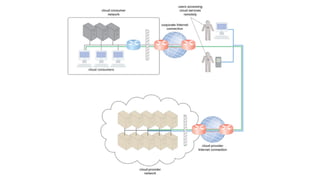
Cloud IT resources
Cloud Deployment Model
•Organizations can utilize their cloud deployment model over the internet.
•IT operations are maintained while safeguarding corporate networks.
•Firewall and monitoring software ensure network security.
Advantages of Cloud for End-Users
•Centralized IT resources accessible via the internet.
•Same protocol used for access, whether resources are inside or outside the corporate
network.
Continuous Access to Cloud Resources
•Centralized servers and applications are continuously accessible through the internet.
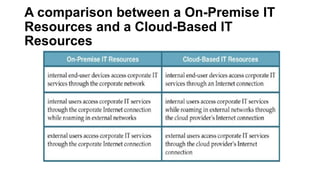
A comparison between a On-Premise IT
Resources and a Cloud-Based IT
Resources
Challenges and risk in Cloud
Computing Adoption
Cloud Carrier and Cloud Provider
Selection
Service Levels of Internet Connections
•Determined by different ISPs between cloud consumers and providers
•Involves multiple ISP networks in their paths
Challenges in QoS Management
•Difficult to manage across multiple ISPs
•Requires collaboration between cloud carriers
Impact on Cloud Connectivity
•Cloud consumers and providers may need multiple cloud carriers
•Ensures necessary connectivity and reliability for cloud applications
•Results in additional costs
Cloud Adoption Considerations
•Easier for applications with relaxed latency and bandwidth requirements
Reduced Operational Governance
Control
• Reduce Operational governance control provided for cloud
consumers are usually lower than than of on-premise IT
resources.
• This reduced level of governance operational control on cloud
can introduce risks that is associated the provisioning of cloud
and how it operates by the cloud providers.
Limited Portability Between Cloud
Providers
• Lack of Industry Standards: Public clouds lack established industry
standards, leading to issues related to ownership and control.
• Challenges in Cloud Migration: Cloud consumers using custom-built
solutions face difficulties when switching from one provider to another.
• Portability Definition: Portability measures the impact of moving IT
resources and data between cloud providers.
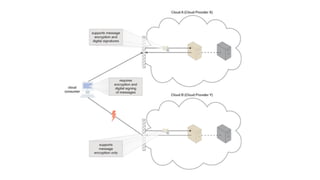
• Decreased Portability: The diagram shows how cloud consumer (A)
experiences reduced portability during a migration between cloud (A) and
cloud (B).
• Security Technology Mismatch: Portability is affected as cloud (B) does not
support the same security technologies as cloud (A).
Multi-Regional Regulatory and Legal
Issues
•Geographical location preferences: Data centers are often established
in affordable and convenient locations.
•Legal concerns: Cloud providers must consider data privacy and
storage policies to comply with industry and government regulations.
•Data residency requirements: For instance, UK laws mandate that
personal data of UK citizens be stored within the country.
•Data accessibility issues: Different countries have varying laws
regarding data disclosure to government agencies.
•Example - U.S. Patriot Act: U.S. government agencies can access cloud
consumer data (including European data) stored in the U.S., unlike data
located in other EU countries.

BUSINESS CONSIDERATIONS FOR CLOUD COMPUTING

  • 1.
    TECHNICAL AND BUSINESS CONSIDERATIONSFOR ADOPTION CLOUD COMPUTING Dr Hitesh Mohapatra Associate Professor
  • 2.
    BUSINESS CONSIDERATION FORCLOUD COMPUTING • There are technical and business considerations organization needs to take into accounts before adopting cloud computing technology. • There is several technical and business considerations of on-premise deployment models and cloud base IT resources model that meet business needs. • Before any recommendations of moving to a cloud-based IT resources, several technical issues, cost and network expenditure, Cloud model, network bandwidth and latency Issues, connectivity issues and cloud carrier and cloud provider selection.
  • 3.
    Connectivity Issues • Traditionalon-premise deployments models for enterprise and businesses are mostly hosted on a private centralize servers storage devices residing in the organizations and business own data center. • TCP/IP facilitates both internet access and uninterrupted internet connectivity for on-premise data exchange over LANs for data center through the corporate networks for end-use devices (smartphones, tablets, laptop and PC's). • Geographical distance between cloud consumer and the cloud provider can also be considered as longer distance can require additional network hops but can also introduced potential bandwidth and fluctuating latency constraints.
  • 4.
    Cont. The diagram belowshows the configuration implementations for an internetworking architecture of a private cloud model with an on-premise data exchange networks of over the LANs. The physical IT resources that constitute the cloud are located and managed within the organization.
  • 5.
    Network Bandwidth andLatency Issues
  • 6.
    Cont. • End-to-End Bandwidth:Determined by transmission capacity of shared data links. • Impact of ISP Connection: Bandwidth can be affected by intermediary nodes connecting networks to ISPs. • Broadband Network Technology: ISPs must implement broadband technology in the core network to ensure end-to-end connectivity.
  • 7.
    Cont. • Latency Considerations:Time delay (latency) needs to be reduced for network efficiency. • Web Acceleration Technologies: Dynamic caching, compression, and prefetching are driving the need to improve end-user connectivity and Quality of Service (QoS). • Packet Switching: Allows data packets to dynamically choose their path, impacting end-to-end communication and QoS.
  • 8.
    Cont. • Cloud Bandwidth& Latency: Critical for cloud provisioning, as bandwidth impacts data transfer, and latency affects application response times and QoS. • Business Requirements: Organizations need to assess bandwidth and latency when moving IT solutions to the cloud to meet business needs effectively.
  • 9.
    Other challenges toconsider in cloud computing
  • 10.
    Cloud Carrier andCloud Provider Selection • Importance of selecting the right cloud carrier and provider • Service Level Agreements (SLAs) ensure proper internet connections, QoS, and network paths • Multiple ISPs help meet business needs through improved connectivity and reliability • Multiple cloud carriers enhance cloud application performance and QoS but increase costs • Risks of unreliable cloud providers failing to meet SLA guarantees • Impact of poor SLA compliance on cloud consumer solutions
  • 11.
    Cloud IT resources CloudDeployment Model •Organizations can utilize their cloud deployment model over the internet. •IT operations are maintained while safeguarding corporate networks. •Firewall and monitoring software ensure network security. Advantages of Cloud for End-Users •Centralized IT resources accessible via the internet. •Same protocol used for access, whether resources are inside or outside the corporate network. Continuous Access to Cloud Resources •Centralized servers and applications are continuously accessible through the internet.
  • 13.
    A comparison betweena On-Premise IT Resources and a Cloud-Based IT Resources
  • 14.
    Challenges and riskin Cloud Computing Adoption
  • 15.
    Cloud Carrier andCloud Provider Selection Service Levels of Internet Connections •Determined by different ISPs between cloud consumers and providers •Involves multiple ISP networks in their paths Challenges in QoS Management •Difficult to manage across multiple ISPs •Requires collaboration between cloud carriers Impact on Cloud Connectivity •Cloud consumers and providers may need multiple cloud carriers •Ensures necessary connectivity and reliability for cloud applications •Results in additional costs Cloud Adoption Considerations •Easier for applications with relaxed latency and bandwidth requirements
  • 16.
    Reduced Operational Governance Control •Reduce Operational governance control provided for cloud consumers are usually lower than than of on-premise IT resources. • This reduced level of governance operational control on cloud can introduce risks that is associated the provisioning of cloud and how it operates by the cloud providers.
  • 17.
    Limited Portability BetweenCloud Providers • Lack of Industry Standards: Public clouds lack established industry standards, leading to issues related to ownership and control. • Challenges in Cloud Migration: Cloud consumers using custom-built solutions face difficulties when switching from one provider to another. • Portability Definition: Portability measures the impact of moving IT resources and data between cloud providers. • Decreased Portability: The diagram shows how cloud consumer (A) experiences reduced portability during a migration between cloud (A) and cloud (B). • Security Technology Mismatch: Portability is affected as cloud (B) does not support the same security technologies as cloud (A).
  • 19.
    Multi-Regional Regulatory andLegal Issues •Geographical location preferences: Data centers are often established in affordable and convenient locations. •Legal concerns: Cloud providers must consider data privacy and storage policies to comply with industry and government regulations. •Data residency requirements: For instance, UK laws mandate that personal data of UK citizens be stored within the country. •Data accessibility issues: Different countries have varying laws regarding data disclosure to government agencies. •Example - U.S. Patriot Act: U.S. government agencies can access cloud consumer data (including European data) stored in the U.S., unlike data located in other EU countries.