BBA-5th Sem
Boston International College
By: Bipin Kandel
 Meaning and nature of buyer behavior.
 Difference between Consumer buying and
organizational buying in terms of
characteristics and process.
 Strategic use of consumer behavior
knowledge in marketing and public policy
decisions.
 Modern Consumerism and the global
consumer movement.
 A person who purchases goods and services
for personal use.
 A consumer cannot resell the good, product
or service but can consume it to earn his/her
livelihood and self-employment.
 The consumer is the one who is the end-user
of any goods or services.
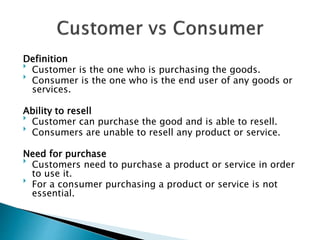
Definition

Customer is the one who is purchasing the goods.

Consumer is the one who is the end user of any goods or
services.
Ability to resell

Customer can purchase the good and is able to resell.

Consumers are unable to resell any product or service.
Need for purchase

Customers need to purchase a product or service in order
to use it.

For a consumer purchasing a product or service is not
essential.
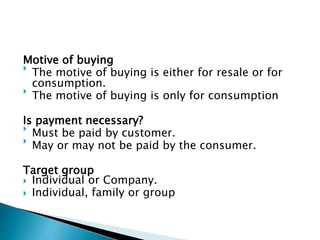
Motive of buying

The motive of buying is either for resale or for
consumption.

The motive of buying is only for consumption
Is payment necessary?

Must be paid by customer.

May or may not be paid by the consumer.
Target group
 Individual or Company.
 Individual, family or group
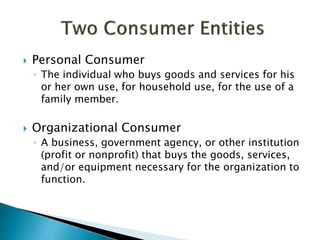
 Personal Consumer
◦ The individual who buys goods and services for his
or her own use, for household use, for the use of a
family member.
 Organizational Consumer
◦ A business, government agency, or other institution
(profit or nonprofit) that buys the goods, services,
and/or equipment necessary for the organization to
function.
 Is study of individuals, groups, or
organizations and all the activities associated
with the purchase, use and disposal of goods
and services.
 Consumer behavior consists of how the
consumer's emotions, attitudes, and
preferences affect buying behavior.
 The study of individuals, groups, or
organizations and the processes they use to
select, secure, use, and dispose of the
products, services, experiences, or ideas to
satisfy needs and the impacts that these
processes have on the consumer and society.
“The behavior that consumers display in
searching for, purchasing, using, evaluating
and disposing of products and services that
they expect will satisfy their needs.”
-Schiffman and Kanuk
“ The study of consumers as they exchange
something of value for a product or service
that satisfies their needs”
- Wells and Prensky
 Initiator: The initiator is the person who
identifies that there exists a need or want.
 Influencer: the influencer is the one who
influences the purchase decision .
 Decider: the decider is the one who decides
whether to buy, what to buy, when to buy,
from where to buy, and how to buy.
 Buyer: the buyer is the one who makes the
actual purchase.
 User: the user is the person who use the
product.
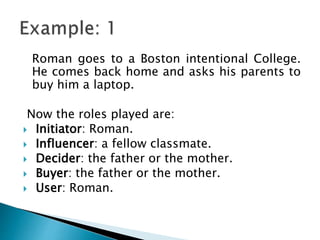
Roman goes to a Boston intentional College.
He comes back home and asks his parents to
buy him a laptop.
Now the roles played are:
 Initiator: Roman.
 Influencer: a fellow classmate.
 Decider: the father or the mother.
 Buyer: the father or the mother.
 User: Roman.
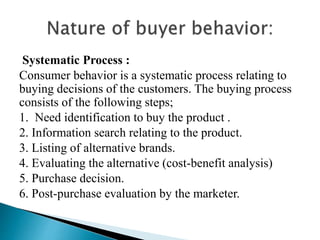
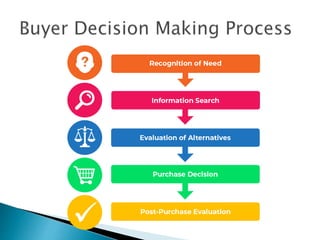
Systematic Process :
Consumer behavior is a systematic process relating to
buying decisions of the customers. The buying process
consists of the following steps;
1. Need identification to buy the product .
2. Information search relating to the product.
3. Listing of alternative brands.
4. Evaluating the alternative (cost-benefit analysis)
5. Purchase decision.
6. Post-purchase evaluation by the marketer.
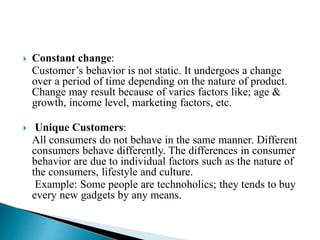
 Constant change:
Customer’s behavior is not static. It undergoes a change
over a period of time depending on the nature of product.
Change may result because of varies factors like; age &
growth, income level, marketing factors, etc.
 Unique Customers:
All consumers do not behave in the same manner. Different
consumers behave differently. The differences in consumer
behavior are due to individual factors such as the nature of
the consumers, lifestyle and culture.
Example: Some people are technoholics; they tends to buy
every new gadgets by any means.
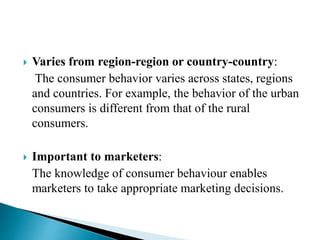
 Varies from region-region or country-country:
The consumer behavior varies across states, regions
and countries. For example, the behavior of the urban
consumers is different from that of the rural
consumers.
 Important to marketers:
The knowledge of consumer behaviour enables
marketers to take appropriate marketing decisions.
 Varies from product to product:
Consumer behavior is different for different products.
There are some consumers who may buy more quantity
of certain items and very low or no quantity of other
items.
For example, teenagers may spend heavily on products
such as cell phones and branded wears, but may not
spend on general and academic reading, whereas the
aged citizens turns out to be more concerned about
saving and future security.
 Reflects status:
The consumer behaviour is not only influenced by the status
of a consumer, but it also reflects it. The consumers who
own luxury cars, watches and other items are considered
belonging to a higher status. The luxury items also give a
sense of pride to the owners.
 Spread Effect:
The buying behaviour of one person may influence the
buying behaviour of another person. This may influence
some of his friends, neighbors, colleagues. This is one of
the reasons why marketers use celebrities like Shahrukh
Khan, Paras Khadka to endorse their brands.
Region Bounded :
The consumer behavior varies across states, regions and
countries. For instance, the behavior of urban consumers is
different from that of rural consumers.
Normally, rural consumers are conservative (traditional) in
their buying behavior.
Keeps On Changing :
The consumer’s behavior undergoes a change over a period
of time depending upon changes in age, education and
income level. Etc, for instance,, kids may prefer colorful
dresses, but as they grow up as teenagers and young adults,
they may prefer trendy clothes.
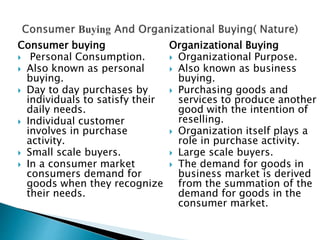
Consumer buying
 Personal Consumption.
 Also known as personal
buying.
 Day to day purchases by
individuals to satisfy their
daily needs.
 Individual customer
involves in purchase
activity.
 Small scale buyers.
 In a consumer market
consumers demand for
goods when they recognize
their needs.
Organizational Buying
 Organizational Purpose.
 Also known as business
buying.
 Purchasing goods and
services to produce another
good with the intention of
reselling.
 Organization itself plays a
role in purchase activity.
 Large scale buyers.
 The demand for goods in
business market is derived
from the summation of the
demand for goods in the
consumer market.
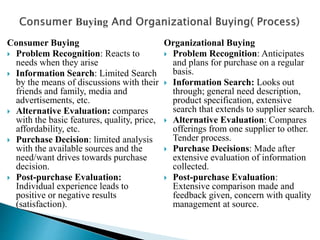
Consumer Buying
 Problem Recognition: Reacts to
needs when they arise
 Information Search: Limited Search
by the means of discussions with their
friends and family, media and
advertisements, etc.
 Alternative Evaluation: compares
with the basic features, quality, price,
affordability, etc.
 Purchase Decision: limited analysis
with the available sources and the
need/want drives towards purchase
decision.
 Post-purchase Evaluation:
Individual experience leads to
positive or negative results
(satisfaction).
Organizational Buying
 Problem Recognition: Anticipates
and plans for purchase on a regular
basis.
 Information Search: Looks out
through; general need description,
product specification, extensive
search that extends to supplier search.
 Alternative Evaluation: Compares
offerings from one supplier to other.
Tender process.
 Purchase Decisions: Made after
extensive evaluation of information
collected.
 Post-purchase Evaluation:
Extensive comparison made and
feedback given, concern with quality
management at source.
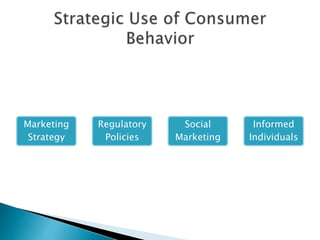
Marketing
Strategy
Regulatory
Policies
Social
Marketing
Informed
Individuals
 Decisions based on explicit beliefs tends to
be more beneficial than that of decisions
solely based on implicit beliefs.
 Knowledge of consumer behavior can be
important competitive advantage and can
greatly reduce the odds of bad decisions and
market failures.
 Various regulatory bodies exists to develop,
interpret and/or implement
policies designed to protect and aid
consumer.
 Effective regulation of many marketing
practices requires an extensive
knowledge of consumer behaviour.

Example: Sausage,Noodles, Pustakari,
ketchup,etc.
 Social Marketing is the application of
marketing strategies and tactics to alter or
create behaviors that have a positive effect on
the targeted individuals or society as a whole.
 Just as for commercial marketing Strategy,
Successful social marketing strategy requires
a sound understanding of consumer
behavior.
 Ex- Polio campaigns, Drugs free campaigns
 How to flow information to public/
consumers?
 Influencing Consumer decisions.
 Attempts- Tv ads, websites, on packages, tv
shows , sales pitches etc
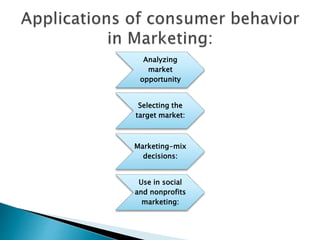
Analyzing
market
opportunity
Selecting the
target market:
Marketing-mix
decisions:
Use in social
and nonprofits
marketing:
 Consumer behavior study help in identifying the
unfulfilled needs and wants of consumers.
 This requires examining the friends and conditions
operating in the Marketplace, consumer’s lifestyle,
income levels, and energy influences.
 This may reveal unsatisfied needs and wants.
 Mosquito repellents have been marketed in response
to a genuine and unfulfilled consumer need.
 Review of market opportunities often helps in identifying district
consumer segments with very distinct and unique wants and
needs.
 Identifying these groups, behave and how they make purchase
decisions enable the marketer to design and market products or
services particularly suited to their wants and needs.
 For example, please sleep revealed that many existing and
potential shampoo users did not want to buy shampoo fax price
at rate 60 for more and would rather prefer a low price package
containing enough quantity for one or two washers. This finding
LED companies to introduce the shampoos sachet, which
become a good seller.
 Once unsatisfied needs and wants are identified,
the marketer has to determine the right mix of
product, price, distribution, and promotion.
 Where too, consumer behavior study is very
helpful in finding answers to too many perplexing
questions.
 The factors of marketing mix decisions are:
i) product ii) price iii) promotion iv) distribution
 Consumer behavior studies are useful to design
marketing strategies by social, governmental, and
not for profit organizations to make their programs
more effective such as family planning, awareness
about AIDS.
 The set of policies (laws, plans, actions, behaviours) of a government;
plans and methods of action that govern that society; a system of laws,
courses of action, and priorities directing a government action.
 Public policy, as government action, is generally known as the principled
guide to action taken by the administrative or executive branches of the
state with regard to a class of issues in a manner consistent with law and
institutional customs.
 Shaping public policy is a complex and multifaceted process that involves
the interplay of numerous individuals and interest groups competing and
collaborating to influence policymakers to act in a particular way.
 Nepal’s Consumer Protection Act from 1998 clearly states that any
activity that intends to deceive consumers is strictly punishable by
law.
-Provisions of the Act protect consumers from irregularities such as
the quality, quantity and prices of consumer goods or services;
ensuring that no one lowers or removes the attributes or usefulness
of consumer goods or services; preventing circumstances in which
monopolies and unfair trading practices may lead to an increase in
prices, as well as false and misleading propaganda about the use
and usefulness of consumer goods or services.
 The Act includes provisions on selling, supplying, importing,
exporting and storing safe and quality consumer goods or services,
and protecting the rights and interests of consumers through the
establishment of an agency for redress.
 The protection or promotion of the interests of consumers.
 “The growth of consumerism has led to many organizations
improving their service to the customer“
 Consumerism is defined as a social force designed to
protect consumer interests in the market place by
organising consumer pressures on business.
 Consumer organisations could provide united and
organised efforts to fight against unfair marketing practices
and to achieve consumer protection.
 Consumerism is a fight against exploitation.
It is a protest movement initiates by various
public and voluntary organization.
 "Consumerism refers to the increasing range
of activities of business, government and
other organization that have to satisfy the
need or to protect the rights of consumer.
 Definition
 According to Philip kotler - "consumerism is a
social movement seeking to arrange the
rights and power of the buyers in relation to
seller"
 Need of consumerism
 To satisfy consumer and for consumer rating.
a) It will develop cordial relations between producer and consumer.
b) The consumer will get right information about the supply and
price.
c) The producer will be compelled to avoid unfair trade practices.
d) The consumer organization will maintain liaison with producer on
the one hand and the government authority.
e) It provides legal redressed machinery to protect consumer right.
 The consumer movement is an effort to
promote consumer protection through an organized social
movement, which is in many places led by consumer
organizations.
 It advocates for the rights of consumers, especially when
those rights are actively breached by the actions of
corporations, governments, and other organizations which
provide products and services to consumers.
 Consumer movements also commonly advocate for
increased health and safety standards, honest information
about products in advertising, and consumer representation
in political bodies.
Consumer Behavior unit one.pptx

Consumer Behavior unit one.pptx

  • 1.
    BBA-5th Sem Boston InternationalCollege By: Bipin Kandel
  • 2.
     Meaning andnature of buyer behavior.  Difference between Consumer buying and organizational buying in terms of characteristics and process.  Strategic use of consumer behavior knowledge in marketing and public policy decisions.  Modern Consumerism and the global consumer movement.
  • 4.
     A personwho purchases goods and services for personal use.  A consumer cannot resell the good, product or service but can consume it to earn his/her livelihood and self-employment.  The consumer is the one who is the end-user of any goods or services.
  • 5.
    Definition  Customer is theone who is purchasing the goods.  Consumer is the one who is the end user of any goods or services. Ability to resell  Customer can purchase the good and is able to resell.  Consumers are unable to resell any product or service. Need for purchase  Customers need to purchase a product or service in order to use it.  For a consumer purchasing a product or service is not essential.
  • 6.
    Motive of buying  Themotive of buying is either for resale or for consumption.  The motive of buying is only for consumption Is payment necessary?  Must be paid by customer.  May or may not be paid by the consumer. Target group  Individual or Company.  Individual, family or group
  • 7.
     Personal Consumer ◦The individual who buys goods and services for his or her own use, for household use, for the use of a family member.  Organizational Consumer ◦ A business, government agency, or other institution (profit or nonprofit) that buys the goods, services, and/or equipment necessary for the organization to function.
  • 8.
     Is studyof individuals, groups, or organizations and all the activities associated with the purchase, use and disposal of goods and services.  Consumer behavior consists of how the consumer's emotions, attitudes, and preferences affect buying behavior.
  • 9.
     The studyof individuals, groups, or organizations and the processes they use to select, secure, use, and dispose of the products, services, experiences, or ideas to satisfy needs and the impacts that these processes have on the consumer and society.
  • 10.
    “The behavior thatconsumers display in searching for, purchasing, using, evaluating and disposing of products and services that they expect will satisfy their needs.” -Schiffman and Kanuk “ The study of consumers as they exchange something of value for a product or service that satisfies their needs” - Wells and Prensky
  • 11.
     Initiator: Theinitiator is the person who identifies that there exists a need or want.  Influencer: the influencer is the one who influences the purchase decision .  Decider: the decider is the one who decides whether to buy, what to buy, when to buy, from where to buy, and how to buy.
  • 12.
     Buyer: thebuyer is the one who makes the actual purchase.  User: the user is the person who use the product.
  • 13.
    Roman goes toa Boston intentional College. He comes back home and asks his parents to buy him a laptop. Now the roles played are:  Initiator: Roman.  Influencer: a fellow classmate.  Decider: the father or the mother.  Buyer: the father or the mother.  User: Roman.
  • 14.
    Systematic Process : Consumerbehavior is a systematic process relating to buying decisions of the customers. The buying process consists of the following steps; 1. Need identification to buy the product . 2. Information search relating to the product. 3. Listing of alternative brands. 4. Evaluating the alternative (cost-benefit analysis) 5. Purchase decision. 6. Post-purchase evaluation by the marketer.
  • 15.
     Constant change: Customer’sbehavior is not static. It undergoes a change over a period of time depending on the nature of product. Change may result because of varies factors like; age & growth, income level, marketing factors, etc.  Unique Customers: All consumers do not behave in the same manner. Different consumers behave differently. The differences in consumer behavior are due to individual factors such as the nature of the consumers, lifestyle and culture. Example: Some people are technoholics; they tends to buy every new gadgets by any means.
  • 16.
     Varies fromregion-region or country-country: The consumer behavior varies across states, regions and countries. For example, the behavior of the urban consumers is different from that of the rural consumers.  Important to marketers: The knowledge of consumer behaviour enables marketers to take appropriate marketing decisions.
  • 17.
     Varies fromproduct to product: Consumer behavior is different for different products. There are some consumers who may buy more quantity of certain items and very low or no quantity of other items. For example, teenagers may spend heavily on products such as cell phones and branded wears, but may not spend on general and academic reading, whereas the aged citizens turns out to be more concerned about saving and future security.
  • 18.
     Reflects status: Theconsumer behaviour is not only influenced by the status of a consumer, but it also reflects it. The consumers who own luxury cars, watches and other items are considered belonging to a higher status. The luxury items also give a sense of pride to the owners.  Spread Effect: The buying behaviour of one person may influence the buying behaviour of another person. This may influence some of his friends, neighbors, colleagues. This is one of the reasons why marketers use celebrities like Shahrukh Khan, Paras Khadka to endorse their brands.
  • 19.
    Region Bounded : Theconsumer behavior varies across states, regions and countries. For instance, the behavior of urban consumers is different from that of rural consumers. Normally, rural consumers are conservative (traditional) in their buying behavior. Keeps On Changing : The consumer’s behavior undergoes a change over a period of time depending upon changes in age, education and income level. Etc, for instance,, kids may prefer colorful dresses, but as they grow up as teenagers and young adults, they may prefer trendy clothes.
  • 21.
    Consumer buying  PersonalConsumption.  Also known as personal buying.  Day to day purchases by individuals to satisfy their daily needs.  Individual customer involves in purchase activity.  Small scale buyers.  In a consumer market consumers demand for goods when they recognize their needs. Organizational Buying  Organizational Purpose.  Also known as business buying.  Purchasing goods and services to produce another good with the intention of reselling.  Organization itself plays a role in purchase activity.  Large scale buyers.  The demand for goods in business market is derived from the summation of the demand for goods in the consumer market.
  • 22.
    Consumer Buying  ProblemRecognition: Reacts to needs when they arise  Information Search: Limited Search by the means of discussions with their friends and family, media and advertisements, etc.  Alternative Evaluation: compares with the basic features, quality, price, affordability, etc.  Purchase Decision: limited analysis with the available sources and the need/want drives towards purchase decision.  Post-purchase Evaluation: Individual experience leads to positive or negative results (satisfaction). Organizational Buying  Problem Recognition: Anticipates and plans for purchase on a regular basis.  Information Search: Looks out through; general need description, product specification, extensive search that extends to supplier search.  Alternative Evaluation: Compares offerings from one supplier to other. Tender process.  Purchase Decisions: Made after extensive evaluation of information collected.  Post-purchase Evaluation: Extensive comparison made and feedback given, concern with quality management at source.
  • 23.
  • 24.
     Decisions basedon explicit beliefs tends to be more beneficial than that of decisions solely based on implicit beliefs.  Knowledge of consumer behavior can be important competitive advantage and can greatly reduce the odds of bad decisions and market failures.
  • 25.
     Various regulatorybodies exists to develop, interpret and/or implement policies designed to protect and aid consumer.  Effective regulation of many marketing practices requires an extensive knowledge of consumer behaviour.  Example: Sausage,Noodles, Pustakari, ketchup,etc.
  • 26.
     Social Marketingis the application of marketing strategies and tactics to alter or create behaviors that have a positive effect on the targeted individuals or society as a whole.  Just as for commercial marketing Strategy, Successful social marketing strategy requires a sound understanding of consumer behavior.  Ex- Polio campaigns, Drugs free campaigns
  • 27.
     How toflow information to public/ consumers?  Influencing Consumer decisions.  Attempts- Tv ads, websites, on packages, tv shows , sales pitches etc
  • 28.
  • 29.
     Consumer behaviorstudy help in identifying the unfulfilled needs and wants of consumers.  This requires examining the friends and conditions operating in the Marketplace, consumer’s lifestyle, income levels, and energy influences.  This may reveal unsatisfied needs and wants.  Mosquito repellents have been marketed in response to a genuine and unfulfilled consumer need.
  • 30.
     Review ofmarket opportunities often helps in identifying district consumer segments with very distinct and unique wants and needs.  Identifying these groups, behave and how they make purchase decisions enable the marketer to design and market products or services particularly suited to their wants and needs.  For example, please sleep revealed that many existing and potential shampoo users did not want to buy shampoo fax price at rate 60 for more and would rather prefer a low price package containing enough quantity for one or two washers. This finding LED companies to introduce the shampoos sachet, which become a good seller.
  • 31.
     Once unsatisfiedneeds and wants are identified, the marketer has to determine the right mix of product, price, distribution, and promotion.  Where too, consumer behavior study is very helpful in finding answers to too many perplexing questions.  The factors of marketing mix decisions are: i) product ii) price iii) promotion iv) distribution
  • 32.
     Consumer behaviorstudies are useful to design marketing strategies by social, governmental, and not for profit organizations to make their programs more effective such as family planning, awareness about AIDS.
  • 33.
     The setof policies (laws, plans, actions, behaviours) of a government; plans and methods of action that govern that society; a system of laws, courses of action, and priorities directing a government action.  Public policy, as government action, is generally known as the principled guide to action taken by the administrative or executive branches of the state with regard to a class of issues in a manner consistent with law and institutional customs.  Shaping public policy is a complex and multifaceted process that involves the interplay of numerous individuals and interest groups competing and collaborating to influence policymakers to act in a particular way.
  • 34.
     Nepal’s ConsumerProtection Act from 1998 clearly states that any activity that intends to deceive consumers is strictly punishable by law. -Provisions of the Act protect consumers from irregularities such as the quality, quantity and prices of consumer goods or services; ensuring that no one lowers or removes the attributes or usefulness of consumer goods or services; preventing circumstances in which monopolies and unfair trading practices may lead to an increase in prices, as well as false and misleading propaganda about the use and usefulness of consumer goods or services.  The Act includes provisions on selling, supplying, importing, exporting and storing safe and quality consumer goods or services, and protecting the rights and interests of consumers through the establishment of an agency for redress.
  • 35.
     The protectionor promotion of the interests of consumers.  “The growth of consumerism has led to many organizations improving their service to the customer“  Consumerism is defined as a social force designed to protect consumer interests in the market place by organising consumer pressures on business.  Consumer organisations could provide united and organised efforts to fight against unfair marketing practices and to achieve consumer protection.
  • 36.
     Consumerism isa fight against exploitation. It is a protest movement initiates by various public and voluntary organization.  "Consumerism refers to the increasing range of activities of business, government and other organization that have to satisfy the need or to protect the rights of consumer.
  • 37.
     Definition  Accordingto Philip kotler - "consumerism is a social movement seeking to arrange the rights and power of the buyers in relation to seller"  Need of consumerism  To satisfy consumer and for consumer rating.
  • 38.
    a) It willdevelop cordial relations between producer and consumer. b) The consumer will get right information about the supply and price. c) The producer will be compelled to avoid unfair trade practices. d) The consumer organization will maintain liaison with producer on the one hand and the government authority. e) It provides legal redressed machinery to protect consumer right.
  • 41.
     The consumermovement is an effort to promote consumer protection through an organized social movement, which is in many places led by consumer organizations.  It advocates for the rights of consumers, especially when those rights are actively breached by the actions of corporations, governments, and other organizations which provide products and services to consumers.  Consumer movements also commonly advocate for increased health and safety standards, honest information about products in advertising, and consumer representation in political bodies.