Submitted to:- Dr. Chandresh
Geleria
Submitted by:- Tapan
Adhikari,Phd 1st sem,
F-2019-15-D
Dept. of Medicinal &
Aromatic Plants
INTRODUCTION
 Any person engaged in the consumption process is consumer.
These consumers can be identified by the type of markets to
which they belong.
 The consumer behaviour refers to those actions and related
activities of persons involved specifically in buying and using
economic goods and services .
 It also includes whether, why, when , where, how, how much ,and
how often and how long consumption depends. It includes both
mental and physical actions.
 Adam smith at the end of 18th century wrote consumption is the
sole end purpose of all production and the interest of the
producer ought to be attended to only ,so far as it may be
necessary for the promoting that of consumer.
CONSUMER BEHAVIOUR
 The consumer behaviour is the study of how individuals , groups and
organisation select buy , use and dispose of goods and services , ideas or
experiences to satisfy their needs and wants .
 It may be defined as the decision process and physical activity individuals
engaged in when evaluating, acquiring using or disposing of goods and
services.
 NATURE OF COUNSUMER BEHAVIOUR:
 Systematic process : Consumer behaviour is a systematic process relating to
buying decisions of the customers. The buying process consists of the following
steps :
1. Need identification to buy the product .
2. Information search relating to the product .
3. Listining and evaluting the alternative .
4. Purchase decicion .
5. Post purhase evaluation by the marketer.
1. The production policies
2. Price policies
3. Decision regarding channels of distribution
4. Decision regarding sales promotion
5. Exploiting marketing opportunities
6. Consumer do not always act or react predictably
7. Highly diversified consumer preferences
8. Rapid introduction of new products
9. Implementing the marketing concept.
The major theories of consumer behaviour can be grouped with
1 ECONOMIC THEORIES.
2 PSYCHOLOGICAL THEORIES .
3 PSYCHO- ANALYTIAL THEORIES.
4 SOCIO- CULTURAL THEORIES.
 All the counsumer behavioural theories are based on the basic law of
consumption .
 Economic theories : The economic theories on consumer behaviour
focused on how consumer allocate their income and how this determines
the demands of various goods and services . The theories include
marginal utility theory , psychological law of consumption , absolute ,
relative and permanent income hypothesis etc.,
 Psychological theories : The essence of psychological theories ( learning
theories) lies in the fact that the people learn from the experience and the
results of experience will modify their actions on future occasions.
 Psycho – analytic theories : It follows that the consumer behaviour
is a function of the interaction of these three systems . Here the id
,the ego, the super ego.
 Here the id urges an enjoyable act , the super ego presents the
moral issues involved and the ego acts as the arbitration in
determining whether to proceed or not .
 This motivational research and has proved useful in analyzing
buyers behaviour.
 Socio-cultural theories : This theories asserted that a man is
primarily a social animal and his wants and behaviour are largely
influenced by the group of which he is a member.That the people
have a tendency to fit in a society in spite of their personal likes and
dislikes. Culture ,sub culture, social classes references groups ,
family are the different factor groups that influence buyer
behaviour.
 Consumer behaviour results from individual and environmental
influences. The four basic determined of consumer behaviour .
 Individual needs of consumers .
 Motive of consumer .
 Perception of consumer .
 Attitudes of consumer .
 Individual needs of consumers : An individual consumer always has
innumerable unsatisfied needs. These needs become motives later
on because every consumer is motivated by his needs
 Motive of consumer: Drive or motive is a state of tension where an
individual consumer tries to finds ways to satisfy the drive . Thus ,
the motive can be as an urge for which an individual consumer
seeks satisfaction through the purchase of something .
 Perception of consumer : It is the image or the formalised
impressions residing in the minds of the individual consumers about
different products on , producers and retailers and of themselves .
As perception affects the buying behaviour of the consumer .
There are 2 types
1. self image :It is a picture of himself in the mind of the individual
consumer .
2. Brand image: It is the image of the impression of a particular band
in the minds of the consumers.
 Attitudes of consumers : Attitude of the consumer cannot be
neutral . They immediately defines the position of consumers for or
against a thing .
Consumer buying process
 The buying process is the process of decision making leading to a purchase
function .
 This is an important process which has a vital role in consumer behaviour
study .
 The objective of study of consumer buying process is to know how a
consumer makes his decision regarding buying or not buying any
commodity .
 In most cases, a decision involves the selection of an option from two or
more attractive choices .
Participants in the buying process:
 These are the following five different roles that persons can play
in a buying decision :
1. Initiator :- the initiator is a person who first suggests or thinks of
the idea of buying the particular product .
2. Influencer :- influencer is a person who explicitly or impliciltly
has some influence on the final buying decision of others .
3. Decider :- The decider is a person who ultimately any part or
whole of the buying decision .
4. Buyer:- The buyer is a person who actually purchases .
5. User :- user is the person who actually uses or consumer the
services or products .
The buyer should initiate all of them to make purchases of his
product at different stages and through different strategies .
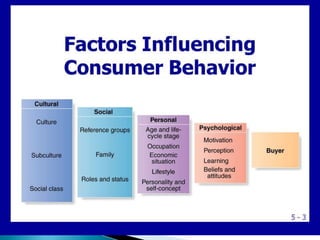
FACTORS INFLUENCING CONSUMER BEHAVIOUR
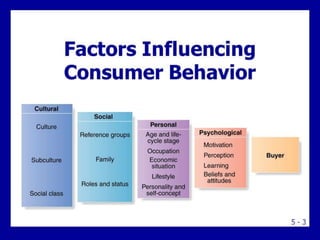
 There are various factors influencing the buying behaviour
internally and externally .
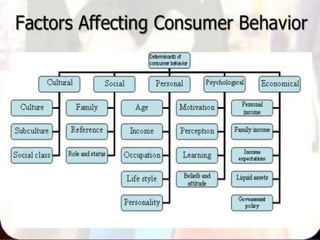
 CULTURAL FATORS
 SOCIAL FACTORS
 PERSONAL FACTORS
 PSYCHOLOGICAL FACTORS
 Cultural factor:- It is the most fundamental determinant of a
persons wants and behaviour .cultural factor is a very old civilisation
like india ,is in everything that touches life. They are sub divided
into Cultural , sub cultural ,and social class.
 Social factors :- A customers behaviour is influenced by the social
factor such as reference groups ,family ,roles ,and status .
 Personal factors :- A buyers decision are also influenced by
personal characteristics . These include the buyres age and stage in
the life cycle , occupation ,economic ,circumstances ,lifestyle
,personality ,and self concept .
 Psychologcial factor :- A Person decision is influenced by the
motivation , perception ,learning ,beliefs ,and attitudes .
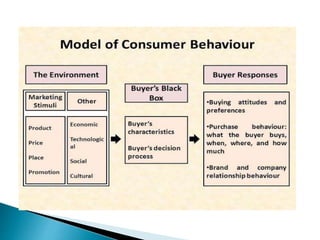
 The environmental stimuli , such as economics technology ,and
culture ,combine with marketing stimuli ,like the product , price ,
and promotion ,inside the black box ,where decisions are made.
 The black box model ,also called the stimulus response model , is
one of the most simple types of consumer behaviour models .
 They are essential tools that marketers can use to help understand
why consumers do or do not buy a product .
 They are different types of models are the black box model , the
personal variable model ,and comprehensive model ,and each model
has a specific focus .
 The black model concentrates on external stimuli , the personal
variable model focuses on internal stimuli within the consumer , and
the comprehensive model studies a combination of external and
internal stimuli.
 CULTURAL FACTOR : cultural factor is the most fundamental
determinant of a persons wants and behaviour . Cultural is the
especially in a old civilisation like india , is in everything that
touches life .
 SUB CULTURE : It provides more specific identification and
sociallisation for its members . It make up important market
segments ,and marketers often design products and marketing
programs tailored to their needs .
 SOCIAL CLASS : It is a relatively homogeneous and enduring
divisiosssssn in a society . It does not reflect income but also other
indicators such as occupation , education and area of residence .
 FAMILY : As the fundamental social unit , the family influence on
consumer behaviour is the most important and fundamental . It act
as a purchasing unit and may be supplying needs of perhaps two or
more generation .
 REFERENCE GROUP: A group that serves as a reference point and
influences a individuals affective responses ,cognitions and behaviour ,
influences a person thoughts and action . Knowing the references and
using those reference groups, play an important role in designing
marketing strategies .
 ROLE AND STATUS : Role are the patterns of needs, goals, beliefs ,
attitudes , values and behaviour that expected of an individual
occupying a particular position in the society .
 AGE AND STAGE IN THE LIFE CYCLE :consumption is shaped by the
family life cycle people buy different goods and services over a life time .
 OCCUPATION : It influences on consumption patterns ,markets try to identify the
occupational groups that have above average interest in their products and
services and likewise tailor the products and services for certain occupational
groups .
 LIFE STYLE : Lifestyle portrays the “ whole person” interacting
with the environment . Marketers thus search for relationship
between their products and lifestyle groups .
 PERSONALITY : It is often described in terms of self
confidence , autonomy, dominance and adaptability . By
personality market attempt to develop brand personalities
that will attract consumer with the same self concept .
 MOTIVATION : It is a need that is sufficiently pressing to drive
the person to act . A need becomes a motive when it is
aroused to a sufficient level of intensity.
 PRECEPTION : it is the process by which an individual selects
organizes , interprets information inputs to create a
meaningful picture of the world .In marketing , people’s
perceptions are more important than the reality.
 LEARNING : Learning theory teaches marketers that they can
build up demand for a product by associating it with strong
drives , using motivating cues and providing reinforcement .
 BELIEFS AND ATTITUDES : Peoples belief about a product or
brand influences their buying decisions . Attitudes economize
on energy and thought and are very difficult to change . Thus
a company would be well –advised to fit its product into
existing attitudes rather than to try to change the peoples
attitudes.
For 604

For 604

  • 1.
    Submitted to:- Dr.Chandresh Geleria Submitted by:- Tapan Adhikari,Phd 1st sem, F-2019-15-D Dept. of Medicinal & Aromatic Plants
  • 2.
    INTRODUCTION  Any personengaged in the consumption process is consumer. These consumers can be identified by the type of markets to which they belong.  The consumer behaviour refers to those actions and related activities of persons involved specifically in buying and using economic goods and services .  It also includes whether, why, when , where, how, how much ,and how often and how long consumption depends. It includes both mental and physical actions.  Adam smith at the end of 18th century wrote consumption is the sole end purpose of all production and the interest of the producer ought to be attended to only ,so far as it may be necessary for the promoting that of consumer.
  • 3.
    CONSUMER BEHAVIOUR  Theconsumer behaviour is the study of how individuals , groups and organisation select buy , use and dispose of goods and services , ideas or experiences to satisfy their needs and wants .  It may be defined as the decision process and physical activity individuals engaged in when evaluating, acquiring using or disposing of goods and services.  NATURE OF COUNSUMER BEHAVIOUR:  Systematic process : Consumer behaviour is a systematic process relating to buying decisions of the customers. The buying process consists of the following steps : 1. Need identification to buy the product . 2. Information search relating to the product . 3. Listining and evaluting the alternative . 4. Purchase decicion . 5. Post purhase evaluation by the marketer.
  • 4.
    1. The productionpolicies 2. Price policies 3. Decision regarding channels of distribution 4. Decision regarding sales promotion 5. Exploiting marketing opportunities 6. Consumer do not always act or react predictably 7. Highly diversified consumer preferences 8. Rapid introduction of new products 9. Implementing the marketing concept.
  • 5.
    The major theoriesof consumer behaviour can be grouped with 1 ECONOMIC THEORIES. 2 PSYCHOLOGICAL THEORIES . 3 PSYCHO- ANALYTIAL THEORIES. 4 SOCIO- CULTURAL THEORIES.  All the counsumer behavioural theories are based on the basic law of consumption .  Economic theories : The economic theories on consumer behaviour focused on how consumer allocate their income and how this determines the demands of various goods and services . The theories include marginal utility theory , psychological law of consumption , absolute , relative and permanent income hypothesis etc.,  Psychological theories : The essence of psychological theories ( learning theories) lies in the fact that the people learn from the experience and the results of experience will modify their actions on future occasions.
  • 6.
     Psycho –analytic theories : It follows that the consumer behaviour is a function of the interaction of these three systems . Here the id ,the ego, the super ego.  Here the id urges an enjoyable act , the super ego presents the moral issues involved and the ego acts as the arbitration in determining whether to proceed or not .  This motivational research and has proved useful in analyzing buyers behaviour.  Socio-cultural theories : This theories asserted that a man is primarily a social animal and his wants and behaviour are largely influenced by the group of which he is a member.That the people have a tendency to fit in a society in spite of their personal likes and dislikes. Culture ,sub culture, social classes references groups , family are the different factor groups that influence buyer behaviour.
  • 7.
     Consumer behaviourresults from individual and environmental influences. The four basic determined of consumer behaviour .  Individual needs of consumers .  Motive of consumer .  Perception of consumer .  Attitudes of consumer .  Individual needs of consumers : An individual consumer always has innumerable unsatisfied needs. These needs become motives later on because every consumer is motivated by his needs  Motive of consumer: Drive or motive is a state of tension where an individual consumer tries to finds ways to satisfy the drive . Thus , the motive can be as an urge for which an individual consumer seeks satisfaction through the purchase of something .
  • 8.
     Perception ofconsumer : It is the image or the formalised impressions residing in the minds of the individual consumers about different products on , producers and retailers and of themselves . As perception affects the buying behaviour of the consumer . There are 2 types 1. self image :It is a picture of himself in the mind of the individual consumer . 2. Brand image: It is the image of the impression of a particular band in the minds of the consumers.  Attitudes of consumers : Attitude of the consumer cannot be neutral . They immediately defines the position of consumers for or against a thing .
  • 9.
    Consumer buying process The buying process is the process of decision making leading to a purchase function .  This is an important process which has a vital role in consumer behaviour study .  The objective of study of consumer buying process is to know how a consumer makes his decision regarding buying or not buying any commodity .  In most cases, a decision involves the selection of an option from two or more attractive choices .
  • 10.
    Participants in thebuying process:  These are the following five different roles that persons can play in a buying decision : 1. Initiator :- the initiator is a person who first suggests or thinks of the idea of buying the particular product . 2. Influencer :- influencer is a person who explicitly or impliciltly has some influence on the final buying decision of others . 3. Decider :- The decider is a person who ultimately any part or whole of the buying decision . 4. Buyer:- The buyer is a person who actually purchases . 5. User :- user is the person who actually uses or consumer the services or products . The buyer should initiate all of them to make purchases of his product at different stages and through different strategies .
  • 12.
    FACTORS INFLUENCING CONSUMERBEHAVIOUR  There are various factors influencing the buying behaviour internally and externally .  CULTURAL FATORS  SOCIAL FACTORS  PERSONAL FACTORS  PSYCHOLOGICAL FACTORS  Cultural factor:- It is the most fundamental determinant of a persons wants and behaviour .cultural factor is a very old civilisation like india ,is in everything that touches life. They are sub divided into Cultural , sub cultural ,and social class.  Social factors :- A customers behaviour is influenced by the social factor such as reference groups ,family ,roles ,and status .
  • 14.
     Personal factors:- A buyers decision are also influenced by personal characteristics . These include the buyres age and stage in the life cycle , occupation ,economic ,circumstances ,lifestyle ,personality ,and self concept .  Psychologcial factor :- A Person decision is influenced by the motivation , perception ,learning ,beliefs ,and attitudes .
  • 16.
     The environmentalstimuli , such as economics technology ,and culture ,combine with marketing stimuli ,like the product , price , and promotion ,inside the black box ,where decisions are made.  The black box model ,also called the stimulus response model , is one of the most simple types of consumer behaviour models .  They are essential tools that marketers can use to help understand why consumers do or do not buy a product .  They are different types of models are the black box model , the personal variable model ,and comprehensive model ,and each model has a specific focus .  The black model concentrates on external stimuli , the personal variable model focuses on internal stimuli within the consumer , and the comprehensive model studies a combination of external and internal stimuli.
  • 18.
     CULTURAL FACTOR: cultural factor is the most fundamental determinant of a persons wants and behaviour . Cultural is the especially in a old civilisation like india , is in everything that touches life .  SUB CULTURE : It provides more specific identification and sociallisation for its members . It make up important market segments ,and marketers often design products and marketing programs tailored to their needs .  SOCIAL CLASS : It is a relatively homogeneous and enduring divisiosssssn in a society . It does not reflect income but also other indicators such as occupation , education and area of residence .  FAMILY : As the fundamental social unit , the family influence on consumer behaviour is the most important and fundamental . It act as a purchasing unit and may be supplying needs of perhaps two or more generation .
  • 19.
     REFERENCE GROUP:A group that serves as a reference point and influences a individuals affective responses ,cognitions and behaviour , influences a person thoughts and action . Knowing the references and using those reference groups, play an important role in designing marketing strategies .  ROLE AND STATUS : Role are the patterns of needs, goals, beliefs , attitudes , values and behaviour that expected of an individual occupying a particular position in the society .  AGE AND STAGE IN THE LIFE CYCLE :consumption is shaped by the family life cycle people buy different goods and services over a life time .  OCCUPATION : It influences on consumption patterns ,markets try to identify the occupational groups that have above average interest in their products and services and likewise tailor the products and services for certain occupational groups .
  • 20.
     LIFE STYLE: Lifestyle portrays the “ whole person” interacting with the environment . Marketers thus search for relationship between their products and lifestyle groups .  PERSONALITY : It is often described in terms of self confidence , autonomy, dominance and adaptability . By personality market attempt to develop brand personalities that will attract consumer with the same self concept .  MOTIVATION : It is a need that is sufficiently pressing to drive the person to act . A need becomes a motive when it is aroused to a sufficient level of intensity.  PRECEPTION : it is the process by which an individual selects organizes , interprets information inputs to create a meaningful picture of the world .In marketing , people’s perceptions are more important than the reality.
  • 21.
     LEARNING :Learning theory teaches marketers that they can build up demand for a product by associating it with strong drives , using motivating cues and providing reinforcement .  BELIEFS AND ATTITUDES : Peoples belief about a product or brand influences their buying decisions . Attitudes economize on energy and thought and are very difficult to change . Thus a company would be well –advised to fit its product into existing attitudes rather than to try to change the peoples attitudes.