CONSUMER BEHAVIOUR

            Module-4
• Influence of reference group
• Impact of social class, culture, sub
  culture, and cross cultural factors on
  CB
                       Lekshmi S Nair
                       MBA/50026/11
INFLUENCE OF
REFERENCE GROUP
Reference Groups

  Any one can be influence by other peoples specially whom are
   coming in contact with or observe


A person or group that serves as a point of comparison (or
 reference) for an individual in the formation of either general
 or specific values, attitudes, or behavior that called (Reference
 group )
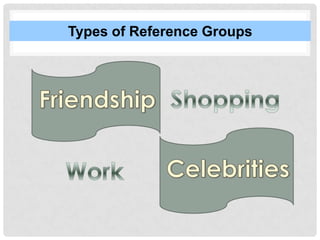
Types of Reference Groups
• Its are typically called informal group becous they
  are unstructured and lack specific authority levels

• Friends fulfill a wide range of needs they provide
  companiship, security and opportunity to discuss
  problems that an individual may be reluctant to
  discuss with family members
• Tow or more peoples who shop together , whether
  for food, clothing or simply to pass the time , can
  be called (Shopping groups )

• A special type of shopping group is the in home
  shopping party, which typically consist of a group
  that gathers to gathers in the home of a friend to
  attend a party devoted to demonstrating and
  evaluating a specific line of products.
• Celebrities can be a powerful force in creating
  interest or actions with regards to purchasing or
  using selected goods and services, its may be
  based on admiration, aspiration, empathy or
  recognition,

• There are five major types of appeals which market
  common usage like (celebrity, expert, common-
  man, executive and employee )
• The sheet amount of time that people spend at
  their jobs frequently more than 35 hours a week
  those can be easily influence on each others
  behavior.

• The both formal and informal groups can be
  influence the consumer behavior , the formal group
  consist of individual who work together as pare of
  team and those they have sustained opportunity to
  influence each others,
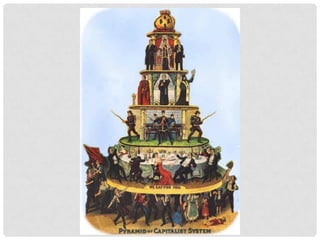
SOCIAL CLASS

Th    e d i v i s i o n o f
me    mb e r s o f a s o c i e t y
i n   t o a h i e r a r c h y o f
d i   s t i n c t s t a t u s
c l   a s s e s , s o t h a t
me    mb e r s o f e a c h c l a s s
h a   v e e i t h e r h i g h e r o r
l o   we r s t a t u s t h a n
me    mb e r s o f o t h e r
CHARACTERISTICS OF SOCIAL CLASS


• Is hierarchical
• Is a natural form of segmentation
• Provides a frame of reference for
  consumer behaviour
• Reflects a person’s relative social
  status
SOCIAL CLASS AND SOCIAL STATUS

Status is frequently thought of as the
relative rankings of members of each
social class
  • wealth
  • power
  • prestige
SOCIAL COMPARISON THEORY

States that individuals compare their
own possessions against those of others
to determine their relative social
standing.
SOCIAL CLASS MEASUREMENT

• Subjective Measures: individuals are asked to
  estimate their own social-class positions

• Reputational Measures: informants make judgments
  concerning the social-class membership of others
  within the community

• Objective Measures: individuals answer specific
  socioeconomic questions and then are categorized
  according to answers
OBJECTIVE MEASURES

• Single-variable      Composite-variable
  indexes               indexes
 • Occupation           – Index of Status
 • Education              Characteristics
 • Income               – Socioeconomic
                          Status Score
INDEX OF STATUS CHARACTERISTICS
              (ISC)

A classic composite measure of social class
that combines occupation, source of
income, house type / quality of
neighborhood into a single weighted index of
social class standing.
SOCIOECONOMIC STATUS SCORE
            (SES)

A multivariable social class measure used by
the United States Bureau of the Census that
combines occupational status, family
income, and educational attainment into a
single measure of social class standing.
SOCIAL CLASS AND MARKETING
           STRATEGY

• Clothing, Fashion, and Shopping
 • Where one shops
 • External point of identification


• The Pursuit of Leisure
 • Type of leisure activities differ
• Saving, Spending, and Credit
 • Level of immediate gratification sought varies


• Responses to marketing
  communication
 • Upper classes have a broader and more general view of
   the world
 • Regional variations in language rise as we move down the
   social ladder
 • Exposure to media varies by social class
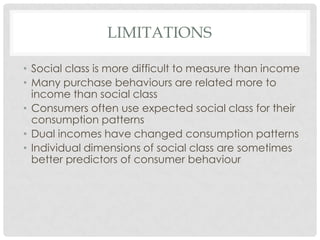
LIMITATIONS

• Social class is more difficult to measure than income
• Many purchase behaviours are related more to
  income than social class
• Consumers often use expected social class for their
  consumption patterns
• Dual incomes have changed consumption patterns
• Individual dimensions of social class are sometimes
  better predictors of consumer behaviour
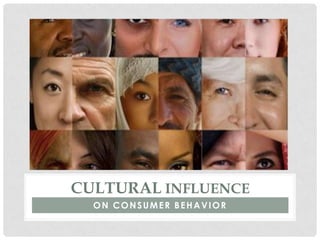
CULTURAL INFLUENCE
  ON CONSUMER BEHAVIOR
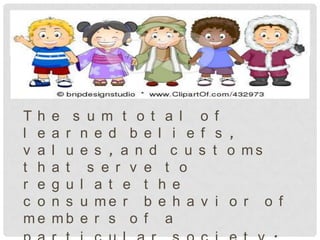
Th    e s u m t o t a l o     f
l e   a r n e d b e l i e f    s ,
v a   l u e s , a n d c u s   t o ms
t h   a t s e r v e t o
r e   g u l a t e t h e
c o   n s u me r b e h a v    i o r    o f
me    mb e r s o f a
CULTURE IS LEARNED

• Enculturation and acculturation
• Language and symbols
• Ritual
• Sharing of culture
• Enculturation
   • The learning of one’s own culture

• Acculturation
   • The learning of a new or foreign
     culture
LANGUAGE AND SYMBOLS

• Without a common language shared
  meaning could not exist

• Marketers must choose appropriate
  symbols in advertising

• Marketers can use “known” symbols for
  associations
RITUAL

• A ritual is a type of symbolic activity
  consisting of a series of steps

• Rituals extend over the human life cycle

• Marketers realize that rituals often involve
  products
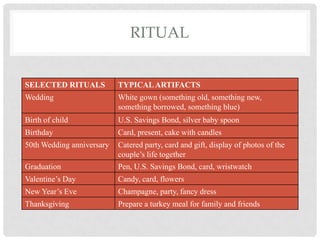
RITUAL


SELECTED RITUALS           TYPICAL ARTIFACTS
Wedding                    White gown (something old, something new,
                           something borrowed, something blue)
Birth of child             U.S. Savings Bond, silver baby spoon
Birthday                   Card, present, cake with candles
50th Wedding anniversary   Catered party, card and gift, display of photos of the
                           couple’s life together
Graduation                 Pen, U.S. Savings Bond, card, wristwatch
Valentine’s Day            Candy, card, flowers
New Year’s Eve             Champagne, party, fancy dress
Thanksgiving               Prepare a turkey meal for family and friends
SHARING OF CULTURE

• To be a cultural characteristic, a belief,
  value, or practice must be shared by a
  significant portion of the society

• Culture is transferred through family, schools,
  houses of worship, and media
THE SOUTH KOREAN DIAPER COMPANY GOOD-NITES
  SPOOFED DAVID BECKHAM’S SEXY ARMANI ADS
THE MEASUREMENT OF CULTURE

• Content Analysis

• Consumer Fieldwork

• Value Measurement Instruments
A method for
           systematically analyzing
           the content of verbal
           and/or pictorial
           communication. The
CONTENT    method is frequently used
ANALYSIS   to determine prevailing
           social values of a society.
A cultural measurement
              technique that takes place
              within a natural
FIELD         environment that focuses
OBSERVATION   on observing behavior
CHARACTERISTICS OF FIELD
           OBSERVATION
• Takes place within a natural environment

• Performed sometimes without the subject’s
  awareness

• Focuses on observation of behavior
Researchers who
              participate in the
              environment that they are
              studying without
PARTICIPANT   notifying those who are
OBSERVERS
              being observed
VALUE MEASUREMENT SURVEY
           INSTRUMENTS
• Rokeach Value Survey (RVS)
  • A self-administered inventory consisting of eighteen
    “terminal” values (i.e., personal goals) and eighteen
    “instrumental” values (i.e., ways of reaching personal
    goals)

• List of Values (LOV)
  • A value measurement instrument that asks consumers
    to identify their two most important values from a nine-
    value list that is based on the terminal values of the
    Rokeach Value Survey

• Values and Lifestyles (VALS)
  • A value measurement based on two categories: self-
    definition and resources
IMPACT OF SUBCULTURE
FACTORS ON CONSUMER
     BEHAVIOUR
WHAT IS SUBCULTURE????

• Subculture is defined, as a distinct cultural group
  that exists as an identifiable segment within a
  larger, more complex society.

• Each subculture has its own unique traits.

• Sub cultural analysis enables the marketing manager
  to focus on sizable and natural market segments.
TYPES OF SUB CULTURE

• NATIONALITY SUBCULTURES
It’s a composition of citizens who come from
 different nationalities or belong to different races.
Subcultures tend to vary in their values, aspiration
 and beliefs which get reflected in their consumption
 priorities, spend save patterns, purchase behavior,
 social mores and customs etc.
• RELIGIOUS SUBCULTURES
Most societies of the world today consist of people
 belonging to different religions, which may differ in
 their beliefs, values and customs.
Consumer behavior is directly affected by religion in
 terms of products that are symbolically and
 ritualistically associated with the celebration of
 various religious holidays.
• GEOGRAPHIC AND REGIONAL SUBCULTURES
They take into account of geographical and climatic
 condition which displays the regional differences that
 are distinct enough to enable marketer to identify a
 country as consisting of different regional
 subcultures.
Of special significance to the marketer are the
 various food preferences of these geographical
 regional subculture and the languages spoken in
 different regions.
Geographical subcultures also result in different
 consumption patterns in clothing, housing patterns
 and food habits on account of climatic conditions.

Example: Cottons may be the most preferred in North
 West India, silk materials in South, Woolen cloths
 have a very low priority in coastal regions.
• AGE SUBCULTURES
Its explains about the stages in family life cycle(culture)
 and understands how consumption priorities change as
 the age pattern of the family changes.
Age is a basis of identifying different sub cultural
 identities - youth market and the elderly market.
The youth market (14-24) is important to marketers
 not only because it is a growing and profitable
 segment but also because consumption preference
 found at this age are likely to continue for a long
 time.
The youth market is distinctive enough in terms of its
 spending patterns, demographics, psycholography,
 profiles etc.
The youth market differs significantly from the
 elderly market in term of its norms, purchase
 preferences, information sources used, media habits
 and preferences and to an extent values and beliefs, to
 constitute a sub cultural segment for the marketers.

The `Elderly Market' constitute the 50 plus Market
 segment.
In subculture segment term, this segment has been
 found to display value orientation which are more
 stable, have identified shopping patterns and store
 preferences, and are a very attractive market for home
 improvement, investment, insurance, health services
 and home equipment enabling convenience in living.
Though they tend to view advertising as a less reliable
 source of information, their media habits are more
 stable to enable the marketers to carve out
 communication positioning better.
GENDER AS A SUBCULTURE

Men and women vary in terms of dominant traits
 they posses. For instance, aggressiveness and
 competitiveness often were considered traditional
 masculine traits ,whereas neatness, tactfulness,
 gentleness, and talkativeness were considered
 traditional feminine traits.
In terms of role differences, women have historically
 been cast as homemakers with responsibility for
 child-care and men as the providers or bread earners.
SUB CULTURAL INTERACTION

• All consumers are simultaneously members of more
  than one sub cultural segment this can be viewed as
  sub cultural interaction.
• Marketers should strive to understand how multiple
  sub cultural memberships interact to influence target
  consumers relevant consumption behavior.
• Promotional strategy should not be limited to a single
  sub cultural membership
CROSS CULTURE INFLUENCE

• A Broad groups of consumers having different values
  that distinguish them from society as a whole.
Cross Culture Marketing- defined as "the effort to
  determine to what extent the consumers of two or
  more nations are similar or different. This will
  facilitate marketers to understand the psychological,
  social and cultural aspects of foreign consumers they
  wish to target, so as to design effective marketing
  strategies for each of the specific national markets
  involved."
PROBLEMS IN CROSS CULTURAL
           MARKETING

Problems related to product selection: The marketer
 going for cross cultural marketing has to select the market
 not on the basis of age or income, but by using the real
 motivating factors that prompt them to accept or reject
 products.
Problems related to promotion/marketing
 communication
Problems related to pricing: The marketer has to adjust
 his pricing policies according to the local economic
 conditions and customs.
Problems related to selection of distribution channels
CROSS-CULTURAL CONSUMER
             ANALYSIS

Cross-cultural consumer analysis can be defined-
 as the effort to determine to what extent the
 consumers of two or more nations are similar or
 different.
Such analysis can provide marketers with an
 understanding of the psychological, social, and
 cultural characteristics of the foreign consumers
 they wish to target, so that they can design
 effective marketing strategies for the specific
 national..
COSUMER BEHAVIOUR

COSUMER BEHAVIOUR

  • 1.
    CONSUMER BEHAVIOUR Module-4 • Influence of reference group • Impact of social class, culture, sub culture, and cross cultural factors on CB Lekshmi S Nair MBA/50026/11
  • 2.
  • 3.
    Reference Groups Any one can be influence by other peoples specially whom are coming in contact with or observe A person or group that serves as a point of comparison (or reference) for an individual in the formation of either general or specific values, attitudes, or behavior that called (Reference group )
  • 4.
  • 5.
    • Its aretypically called informal group becous they are unstructured and lack specific authority levels • Friends fulfill a wide range of needs they provide companiship, security and opportunity to discuss problems that an individual may be reluctant to discuss with family members
  • 6.
    • Tow ormore peoples who shop together , whether for food, clothing or simply to pass the time , can be called (Shopping groups ) • A special type of shopping group is the in home shopping party, which typically consist of a group that gathers to gathers in the home of a friend to attend a party devoted to demonstrating and evaluating a specific line of products.
  • 7.
    • Celebrities canbe a powerful force in creating interest or actions with regards to purchasing or using selected goods and services, its may be based on admiration, aspiration, empathy or recognition, • There are five major types of appeals which market common usage like (celebrity, expert, common- man, executive and employee )
  • 8.
    • The sheetamount of time that people spend at their jobs frequently more than 35 hours a week those can be easily influence on each others behavior. • The both formal and informal groups can be influence the consumer behavior , the formal group consist of individual who work together as pare of team and those they have sustained opportunity to influence each others,
  • 10.
    SOCIAL CLASS Th e d i v i s i o n o f me mb e r s o f a s o c i e t y i n t o a h i e r a r c h y o f d i s t i n c t s t a t u s c l a s s e s , s o t h a t me mb e r s o f e a c h c l a s s h a v e e i t h e r h i g h e r o r l o we r s t a t u s t h a n me mb e r s o f o t h e r
  • 11.
    CHARACTERISTICS OF SOCIALCLASS • Is hierarchical • Is a natural form of segmentation • Provides a frame of reference for consumer behaviour • Reflects a person’s relative social status
  • 12.
    SOCIAL CLASS ANDSOCIAL STATUS Status is frequently thought of as the relative rankings of members of each social class • wealth • power • prestige
  • 13.
    SOCIAL COMPARISON THEORY Statesthat individuals compare their own possessions against those of others to determine their relative social standing.
  • 14.
    SOCIAL CLASS MEASUREMENT •Subjective Measures: individuals are asked to estimate their own social-class positions • Reputational Measures: informants make judgments concerning the social-class membership of others within the community • Objective Measures: individuals answer specific socioeconomic questions and then are categorized according to answers
  • 16.
    OBJECTIVE MEASURES • Single-variable  Composite-variable indexes indexes • Occupation – Index of Status • Education Characteristics • Income – Socioeconomic Status Score
  • 17.
    INDEX OF STATUSCHARACTERISTICS (ISC) A classic composite measure of social class that combines occupation, source of income, house type / quality of neighborhood into a single weighted index of social class standing.
  • 18.
    SOCIOECONOMIC STATUS SCORE (SES) A multivariable social class measure used by the United States Bureau of the Census that combines occupational status, family income, and educational attainment into a single measure of social class standing.
  • 23.
    SOCIAL CLASS ANDMARKETING STRATEGY • Clothing, Fashion, and Shopping • Where one shops • External point of identification • The Pursuit of Leisure • Type of leisure activities differ
  • 24.
    • Saving, Spending,and Credit • Level of immediate gratification sought varies • Responses to marketing communication • Upper classes have a broader and more general view of the world • Regional variations in language rise as we move down the social ladder • Exposure to media varies by social class
  • 25.
    LIMITATIONS • Social classis more difficult to measure than income • Many purchase behaviours are related more to income than social class • Consumers often use expected social class for their consumption patterns • Dual incomes have changed consumption patterns • Individual dimensions of social class are sometimes better predictors of consumer behaviour
  • 26.
    CULTURAL INFLUENCE ON CONSUMER BEHAVIOR
  • 27.
    Th e s u m t o t a l o f l e a r n e d b e l i e f s , v a l u e s , a n d c u s t o ms t h a t s e r v e t o r e g u l a t e t h e c o n s u me r b e h a v i o r o f me mb e r s o f a
  • 28.
    CULTURE IS LEARNED •Enculturation and acculturation • Language and symbols • Ritual • Sharing of culture
  • 29.
    • Enculturation • The learning of one’s own culture • Acculturation • The learning of a new or foreign culture
  • 30.
    LANGUAGE AND SYMBOLS •Without a common language shared meaning could not exist • Marketers must choose appropriate symbols in advertising • Marketers can use “known” symbols for associations
  • 32.
    RITUAL • A ritualis a type of symbolic activity consisting of a series of steps • Rituals extend over the human life cycle • Marketers realize that rituals often involve products
  • 33.
    RITUAL SELECTED RITUALS TYPICAL ARTIFACTS Wedding White gown (something old, something new, something borrowed, something blue) Birth of child U.S. Savings Bond, silver baby spoon Birthday Card, present, cake with candles 50th Wedding anniversary Catered party, card and gift, display of photos of the couple’s life together Graduation Pen, U.S. Savings Bond, card, wristwatch Valentine’s Day Candy, card, flowers New Year’s Eve Champagne, party, fancy dress Thanksgiving Prepare a turkey meal for family and friends
  • 34.
    SHARING OF CULTURE •To be a cultural characteristic, a belief, value, or practice must be shared by a significant portion of the society • Culture is transferred through family, schools, houses of worship, and media
  • 35.
    THE SOUTH KOREANDIAPER COMPANY GOOD-NITES SPOOFED DAVID BECKHAM’S SEXY ARMANI ADS
  • 36.
    THE MEASUREMENT OFCULTURE • Content Analysis • Consumer Fieldwork • Value Measurement Instruments
  • 37.
    A method for systematically analyzing the content of verbal and/or pictorial communication. The CONTENT method is frequently used ANALYSIS to determine prevailing social values of a society.
  • 38.
    A cultural measurement technique that takes place within a natural FIELD environment that focuses OBSERVATION on observing behavior
  • 39.
    CHARACTERISTICS OF FIELD OBSERVATION • Takes place within a natural environment • Performed sometimes without the subject’s awareness • Focuses on observation of behavior
  • 40.
    Researchers who participate in the environment that they are studying without PARTICIPANT notifying those who are OBSERVERS being observed
  • 41.
    VALUE MEASUREMENT SURVEY INSTRUMENTS • Rokeach Value Survey (RVS) • A self-administered inventory consisting of eighteen “terminal” values (i.e., personal goals) and eighteen “instrumental” values (i.e., ways of reaching personal goals) • List of Values (LOV) • A value measurement instrument that asks consumers to identify their two most important values from a nine- value list that is based on the terminal values of the Rokeach Value Survey • Values and Lifestyles (VALS) • A value measurement based on two categories: self- definition and resources
  • 42.
    IMPACT OF SUBCULTURE FACTORSON CONSUMER BEHAVIOUR
  • 43.
    WHAT IS SUBCULTURE???? •Subculture is defined, as a distinct cultural group that exists as an identifiable segment within a larger, more complex society. • Each subculture has its own unique traits. • Sub cultural analysis enables the marketing manager to focus on sizable and natural market segments.
  • 44.
    TYPES OF SUBCULTURE • NATIONALITY SUBCULTURES It’s a composition of citizens who come from different nationalities or belong to different races. Subcultures tend to vary in their values, aspiration and beliefs which get reflected in their consumption priorities, spend save patterns, purchase behavior, social mores and customs etc.
  • 45.
    • RELIGIOUS SUBCULTURES Mostsocieties of the world today consist of people belonging to different religions, which may differ in their beliefs, values and customs. Consumer behavior is directly affected by religion in terms of products that are symbolically and ritualistically associated with the celebration of various religious holidays.
  • 46.
    • GEOGRAPHIC ANDREGIONAL SUBCULTURES They take into account of geographical and climatic condition which displays the regional differences that are distinct enough to enable marketer to identify a country as consisting of different regional subcultures. Of special significance to the marketer are the various food preferences of these geographical regional subculture and the languages spoken in different regions.
  • 47.
    Geographical subcultures alsoresult in different consumption patterns in clothing, housing patterns and food habits on account of climatic conditions. Example: Cottons may be the most preferred in North West India, silk materials in South, Woolen cloths have a very low priority in coastal regions.
  • 48.
    • AGE SUBCULTURES Itsexplains about the stages in family life cycle(culture) and understands how consumption priorities change as the age pattern of the family changes. Age is a basis of identifying different sub cultural identities - youth market and the elderly market. The youth market (14-24) is important to marketers not only because it is a growing and profitable segment but also because consumption preference found at this age are likely to continue for a long time.
  • 49.
    The youth marketis distinctive enough in terms of its spending patterns, demographics, psycholography, profiles etc. The youth market differs significantly from the elderly market in term of its norms, purchase preferences, information sources used, media habits and preferences and to an extent values and beliefs, to constitute a sub cultural segment for the marketers.
  • 50.
    The `Elderly Market'constitute the 50 plus Market segment. In subculture segment term, this segment has been found to display value orientation which are more stable, have identified shopping patterns and store preferences, and are a very attractive market for home improvement, investment, insurance, health services and home equipment enabling convenience in living. Though they tend to view advertising as a less reliable source of information, their media habits are more stable to enable the marketers to carve out communication positioning better.
  • 51.
    GENDER AS ASUBCULTURE Men and women vary in terms of dominant traits they posses. For instance, aggressiveness and competitiveness often were considered traditional masculine traits ,whereas neatness, tactfulness, gentleness, and talkativeness were considered traditional feminine traits. In terms of role differences, women have historically been cast as homemakers with responsibility for child-care and men as the providers or bread earners.
  • 52.
    SUB CULTURAL INTERACTION •All consumers are simultaneously members of more than one sub cultural segment this can be viewed as sub cultural interaction. • Marketers should strive to understand how multiple sub cultural memberships interact to influence target consumers relevant consumption behavior. • Promotional strategy should not be limited to a single sub cultural membership
  • 53.
    CROSS CULTURE INFLUENCE •A Broad groups of consumers having different values that distinguish them from society as a whole. Cross Culture Marketing- defined as "the effort to determine to what extent the consumers of two or more nations are similar or different. This will facilitate marketers to understand the psychological, social and cultural aspects of foreign consumers they wish to target, so as to design effective marketing strategies for each of the specific national markets involved."
  • 54.
    PROBLEMS IN CROSSCULTURAL MARKETING Problems related to product selection: The marketer going for cross cultural marketing has to select the market not on the basis of age or income, but by using the real motivating factors that prompt them to accept or reject products. Problems related to promotion/marketing communication Problems related to pricing: The marketer has to adjust his pricing policies according to the local economic conditions and customs. Problems related to selection of distribution channels
  • 55.
    CROSS-CULTURAL CONSUMER ANALYSIS Cross-cultural consumer analysis can be defined- as the effort to determine to what extent the consumers of two or more nations are similar or different. Such analysis can provide marketers with an understanding of the psychological, social, and cultural characteristics of the foreign consumers they wish to target, so that they can design effective marketing strategies for the specific national..