Precalculus:
CONIC SECTIONS:
CIRCLES
Session Objectives
For this two-hour period, SHS students in
Precalculus are expected to develop the following
learning competencies:
1. illustrate the different
types of conic sections:
parabola, ellipse, circle,
hyperbola, and
degenerate cases;
2. define a circle;
3. determine the standard
form and general form of
the equation of a circle;
and
4. graph a circle in a
rectangular coordinate
system.
Conic Sections
Intersections of cones and planes
1
Starting with Basics
Explain the following mathematical terms:
◉ Undefined Terms in Geometry
◉ Intersecting lines
◉ Parallel lines
◉ Perpendicular lines
◉ Angle
◉ Cone
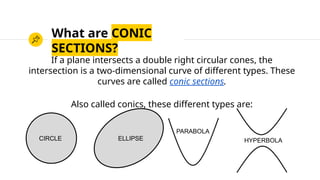
What are CONIC
SECTIONS?
If a plane intersects a double right circular cones, the
intersection is a two-dimensional curve of different types. These
curves are called conic sections.
Also called conics, these different types are:
CIRCLE ELLIPSE
PARABOLA
HYPERBOLA
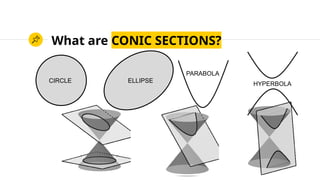
What are CONIC SECTIONS?
CIRCLE ELLIPSE
PARABOLA
HYPERBOLA
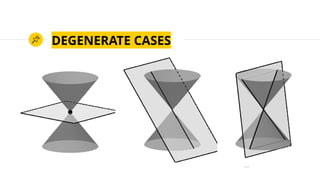
DEGENERATE CASES
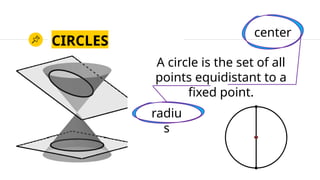
CIRCLES
A circle is the set of all
points equidistant to a
fixed point.
radiu
s
center
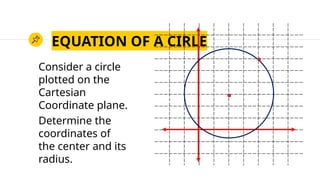
EQUATION OF A CIRLE
Consider a circle
plotted on the
Cartesian
Coordinate plane.
Determine the
coordinates of
the center and its
radius.
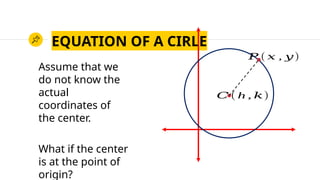
EQUATION OF A CIRLE
Assume that we
do not know the
actual
coordinates of
the center.
What if the center
is at the point of
origin?
𝐶 ( h , 𝑘)
𝑃 ( 𝑥 , 𝑦)
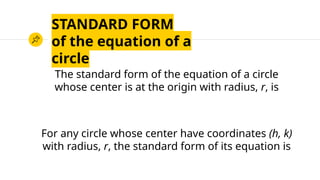
STANDARD FORM
of the equation of a
circle
The standard form of the equation of a circle
whose center is at the origin with radius, r, is
For any circle whose center have coordinates (h, k)
with radius, r, the standard form of its equation is
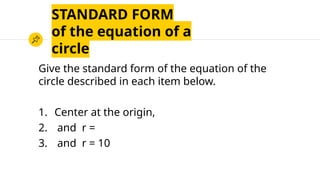
STANDARD FORM
of the equation of a
circle
Give the standard form of the equation of the
circle described in each item below.
1. Center at the origin,
2. and r =
3. and r = 10
EQUATION OF A CIRLE
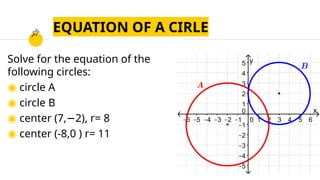
Solve for the equation of the
following circles:
◉ circle A
◉ circle B
◉ center (7, 2), r= 8
−
◉ center (-8,0 ) r= 11
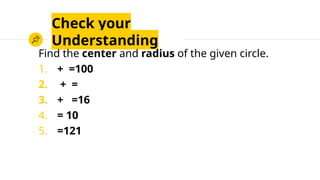
Check your
Understanding
Find the center and radius of the given circle.
1. + =100
2. + =
3. + =16
4. = 10
5. =121
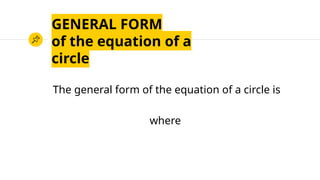
GENERAL FORM
of the equation of a
circle
The general form of the equation of a circle is
where
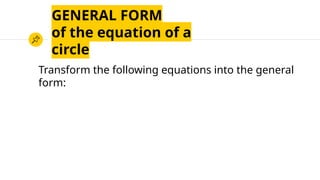
GENERAL FORM
of the equation of a
circle
Transform the following equations into the general
form:
Transforming
equations
Transform the following equations into the
standard form:
Transforming
equations
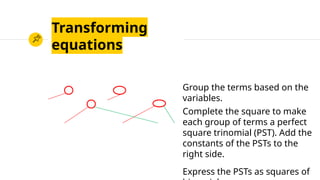
Group the terms based on the
variables.
Complete the square to make
each group of terms a perfect
square trinomial (PST). Add the
constants of the PSTs to the
right side.
Express the PSTs as squares of

conic_sections_and_circles.pptxpptppptppppppt

  • 1.
  • 2.
    Session Objectives For thistwo-hour period, SHS students in Precalculus are expected to develop the following learning competencies: 1. illustrate the different types of conic sections: parabola, ellipse, circle, hyperbola, and degenerate cases; 2. define a circle; 3. determine the standard form and general form of the equation of a circle; and 4. graph a circle in a rectangular coordinate system.
  • 3.
  • 4.
    Starting with Basics Explainthe following mathematical terms: ◉ Undefined Terms in Geometry ◉ Intersecting lines ◉ Parallel lines ◉ Perpendicular lines ◉ Angle ◉ Cone
  • 5.
    What are CONIC SECTIONS? Ifa plane intersects a double right circular cones, the intersection is a two-dimensional curve of different types. These curves are called conic sections. Also called conics, these different types are: CIRCLE ELLIPSE PARABOLA HYPERBOLA
  • 6.
    What are CONICSECTIONS? CIRCLE ELLIPSE PARABOLA HYPERBOLA
  • 7.
  • 8.
    CIRCLES A circle isthe set of all points equidistant to a fixed point. radiu s center
  • 9.
    EQUATION OF ACIRLE Consider a circle plotted on the Cartesian Coordinate plane. Determine the coordinates of the center and its radius.
  • 10.
    EQUATION OF ACIRLE Assume that we do not know the actual coordinates of the center. What if the center is at the point of origin? 𝐶 ( h , 𝑘) 𝑃 ( 𝑥 , 𝑦)
  • 11.
    STANDARD FORM of theequation of a circle The standard form of the equation of a circle whose center is at the origin with radius, r, is For any circle whose center have coordinates (h, k) with radius, r, the standard form of its equation is
  • 12.
    STANDARD FORM of theequation of a circle Give the standard form of the equation of the circle described in each item below. 1. Center at the origin, 2. and r = 3. and r = 10
  • 13.
    EQUATION OF ACIRLE Solve for the equation of the following circles: ◉ circle A ◉ circle B ◉ center (7, 2), r= 8 − ◉ center (-8,0 ) r= 11
  • 14.
    Check your Understanding Find thecenter and radius of the given circle. 1. + =100 2. + = 3. + =16 4. = 10 5. =121
  • 15.
    GENERAL FORM of theequation of a circle The general form of the equation of a circle is where
  • 16.
    GENERAL FORM of theequation of a circle Transform the following equations into the general form:
  • 17.
    Transforming equations Transform the followingequations into the standard form:
  • 18.
    Transforming equations Group the termsbased on the variables. Complete the square to make each group of terms a perfect square trinomial (PST). Add the constants of the PSTs to the right side. Express the PSTs as squares of

Editor's Notes

  • #4 The three undefined terms in Geometry are the point, line, and plane. A point is represented by a dot, a line is a set of points that form a straight line, and a plane is a perfectly flat surface extending infinitely in every direction. Intersecting lines are two or more lines that meet at exactly one point. Parallel lines are lines that do not intersect, even if extended infinitely in both directions. Perpendicular lines are special type of intersecting lines that intersect to form a right angle. An angle is composed of two rays with a common endpoint. A cone is a geometric solid composed of a point called the vertex and a circular base.
  • #6 Circle - when the plane is horizontal Ellipse - when the (tilted) plane intersects only one cone to form a bounded curve Parabola - when the plane intersects only one cone to form an unbounded curve Hyperbola - when the plane (not necessarily vertical) intersects both cones to form two unbounded curves (each called a branch of the hyperbola)
  • #7 If the plane intersects the double right circular cones, passing through the vertex, degenerate cones are formed. When perpendicular to the base, such as that of a circle, a point is formed. When the plane is tilted, such as the case of a parabola, a line is the intersection. A hyperbola becomes two intersecting lines.