Conic Sections (Conics)
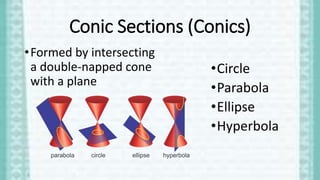
•Formed by intersecting
a double-napped cone
with a plane
•Circle
•Parabola
•Ellipse
•Hyperbola
Circle
Circle
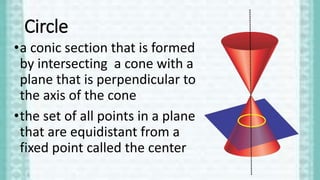
•a conic section that is formed
by intersecting a cone with a
plane that is perpendicular to
the axis of the cone
•the set of all points in a plane
that are equidistant from a
fixed point called the center
Standard Form of the Equation of a Circle
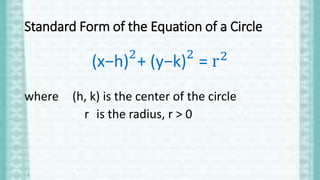
(x−h)2
+ (y−k)2
= r2
where (h, k) is the center of the circle
r is the radius, r > 0
Example 1. Determine the standard equation of
the circle given the coordinates of its center and
the length of its radius
a. center at (2, -3) and r= 3
(x−h)2
+ (y−k)2
= r2
(x−2)2
+ [y−(−3)]2
= 32
(x−2)2
+ (y+3)2
= 9
Example 2. Given the standard form of the
equation below, find the coordinates of the center
and the radius.
a. (x+9)2
+ (y−1)2
= 25
Center is at (-9, 1) and r=5
(x+9)2
+ (y−1)2
= 25
[x− (−9)]2
+ (y−1)2
= 52
General Form of the Equation of a Circle
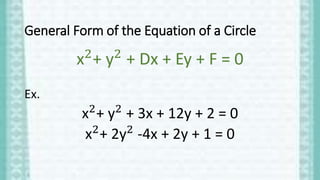
x2
+ y2
+ Dx + Ey + F = 0
Ex.
x2+ y2 + 3x + 12y + 2 = 0
x2
+ 2y2
-4x + 2y + 1 = 0
Transforming the Equation of a
Circle from the General Form
to the Standard Form and Vice
Versa
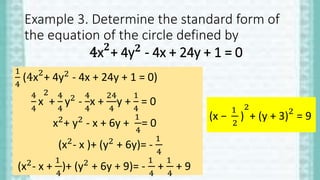
Example 3. Determine the standard form of
the equation of the circle defined by
4x𝟐
+ 4y𝟐
- 4x + 24y + 1 = 0
1
4
(4x2
+ 4y2
- 4x + 24y + 1 = 0)
4
4
x
2
+
4
4
y2
-
4
4
x +
24
4
y +
1
4
= 0
x2
+ y2
- x + 6y +
1
4
= 0
(x2
- x )+ (y2
+ 6y)= -
1
4
(x2
- x +
1
4
)+ (y2
+ 6y + 9)= -
1
4
+
1
4
+ 9
(x −
1
2
)
2
+ (y + 3)2
= 9
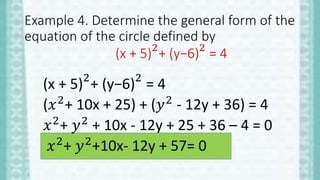
Example 4. Determine the general form of the
equation of the circle defined by
(x + 5)2
+ (y−6)2
= 4
(x + 5)2
+ (y−6)2
= 4
(𝑥2
+ 10x + 25) + (𝑦2
- 12y + 36) = 4
𝑥2
+ 𝑦2
+ 10x - 12y + 25 + 36 – 4 = 0
𝑥2+ 𝑦2+10x- 12y + 57= 0
Graph of a Circle
•The rectangular coordinate system
(Cartesian Coordinate Plane) is used to
sketch the graph of a circle. The graph
provides a clear view of its center and radius
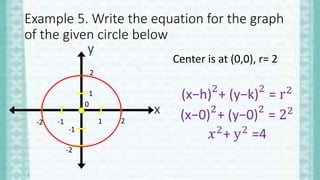
Example 5. Write the equation for the graph
of the given circle below
Center is at (0,0), r= 2
(x−h)2
+ (y−k)2
= r2
(x−0)2
+ (y−0)2
= 22
𝑥2
+ y2
=4
x
y
0
1 2
-2 -1
-2
-1
1
2
L1 Circle.pptx

L1 Circle.pptx

  • 3.
    Conic Sections (Conics) •Formedby intersecting a double-napped cone with a plane •Circle •Parabola •Ellipse •Hyperbola
  • 4.
  • 5.
    Circle •a conic sectionthat is formed by intersecting a cone with a plane that is perpendicular to the axis of the cone •the set of all points in a plane that are equidistant from a fixed point called the center
  • 6.
    Standard Form ofthe Equation of a Circle (x−h)2 + (y−k)2 = r2 where (h, k) is the center of the circle r is the radius, r > 0
  • 7.
    Example 1. Determinethe standard equation of the circle given the coordinates of its center and the length of its radius a. center at (2, -3) and r= 3 (x−h)2 + (y−k)2 = r2 (x−2)2 + [y−(−3)]2 = 32 (x−2)2 + (y+3)2 = 9
  • 8.
    Example 2. Giventhe standard form of the equation below, find the coordinates of the center and the radius. a. (x+9)2 + (y−1)2 = 25 Center is at (-9, 1) and r=5 (x+9)2 + (y−1)2 = 25 [x− (−9)]2 + (y−1)2 = 52
  • 9.
    General Form ofthe Equation of a Circle x2 + y2 + Dx + Ey + F = 0 Ex. x2+ y2 + 3x + 12y + 2 = 0 x2 + 2y2 -4x + 2y + 1 = 0
  • 10.
    Transforming the Equationof a Circle from the General Form to the Standard Form and Vice Versa
  • 11.
    Example 3. Determinethe standard form of the equation of the circle defined by 4x𝟐 + 4y𝟐 - 4x + 24y + 1 = 0 1 4 (4x2 + 4y2 - 4x + 24y + 1 = 0) 4 4 x 2 + 4 4 y2 - 4 4 x + 24 4 y + 1 4 = 0 x2 + y2 - x + 6y + 1 4 = 0 (x2 - x )+ (y2 + 6y)= - 1 4 (x2 - x + 1 4 )+ (y2 + 6y + 9)= - 1 4 + 1 4 + 9 (x − 1 2 ) 2 + (y + 3)2 = 9
  • 12.
    Example 4. Determinethe general form of the equation of the circle defined by (x + 5)2 + (y−6)2 = 4 (x + 5)2 + (y−6)2 = 4 (𝑥2 + 10x + 25) + (𝑦2 - 12y + 36) = 4 𝑥2 + 𝑦2 + 10x - 12y + 25 + 36 – 4 = 0 𝑥2+ 𝑦2+10x- 12y + 57= 0
  • 13.
    Graph of aCircle •The rectangular coordinate system (Cartesian Coordinate Plane) is used to sketch the graph of a circle. The graph provides a clear view of its center and radius
  • 14.
    Example 5. Writethe equation for the graph of the given circle below Center is at (0,0), r= 2 (x−h)2 + (y−k)2 = r2 (x−0)2 + (y−0)2 = 22 𝑥2 + y2 =4 x y 0 1 2 -2 -1 -2 -1 1 2