Click to edit Master title style
1
Introduction To
Computer
P r e p a r e d b y : R o s h a n M a h a r j a n
Click to edit Master title style
2
Introduction
• Computer derived from Latin word COMPUTE.
• Webster’s Dictionary defines “computer” as any
programmable electronic device that can store,
retrieve, and process data.
• An electronic device, operating under the control of
instructions stored in its own memory unit, that can
accept data, manipulate the data according to
specified rules, produce information from the
processing, and store the results for future use.
2
Click to edit Master title style
3
Importance of computer
Computers are part of every industry and without it the
whole world will freeze:
• Computers help industries by making their employees
productive and efficient.
• Computers in schools will help the students to understand
better with audio and videos.
• Computers in universities will help the researchers and
professors to do their calculation
• computers are helping doctors in diagnosing the disease
efficiently and quickly.
• Farmers use innovations in computer technology to
determine best time to plant, fertilize, harvest…
• People corresponds with friends in social media.
• Computers are used in film industry.
3
Click to edit Master title style
4
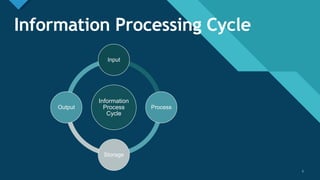
Information Processing Cycle
• Information processing cycle is a sequence of events consisting
of Input, Processing, Storage & Output.
• Four Phases of the information processing cycle
1. Input: Computer receives data and instructions.
2. Process: Computer applies instructions to data to produce
information (organized Data).
3. Storage: Saving the information for a subsequent use or use
in future.
4. Output: Computer sends information to people in a usable
format.
4
Click to edit Master title style
5 5
Information Processing Cycle
Information
Process
Cycle
Input
Process
Storage
Output
Click to edit Master title style
6
Stages of Data Processing Cycle
• Input:
Input is any data that a computer collects from the
outside world. Input cycle involves data capturing, data
collection and data checking and converting data in
machine readable form.
• Processing:
Processing is a systematic series of actions that a
computer uses to convert input to output. This cycle
involves calculation, comparisons, classification,
summarizations, sorting and storing of information.
6
Click to edit Master title style
7
Continue…….
• Output:
Output is any computer information displayed on
the screen or printed on paper. This cycle involves
retrieval of output, conversion of it in human readable
form and directing to the output device.
• Storage:
Storage is the last stage where data and
information are held for future use. This cycle allows
quick access and retrieval of the information and
allowing it to be passed on to next stage when needed.
7
Click to edit Master title style
8
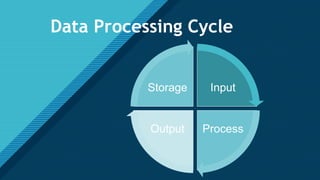
Data Processing Cycle
Input
Process
Output
Storage
Click to edit Master title style
9
Strengths of computer
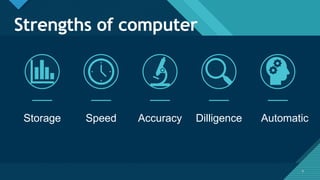
Storage Speed Accuracy Dilligence Automatic
9
Click to edit Master title style
10
Strengths of computer
• Speed:
Computer works at an amazing speed without any
mistake. A modern computer can execute billions of instructions in
one second. The computer’s speed can be measured in terms of
milliseconds, microseconds, nanoseconds and picoseconds.
• Accuracy:
A computer is highly accurate and the degree of accuracy
of a particular computer depend upon its design. A very small
percentage of its errors due to component malfunctioning and the
errors caused due to incorrect input data or unreliable program
are often called as GIGO.
10
Click to edit Master title style
11
Continue ……
• Automatic:
A computer is automatic. It executes the process without any
intervention of the user once it is assigned to work. It works from a
program which specify exactly how a particular job is to be done.
• Storage:
Computer store vast amount of information. You can quickly
and efficiently organize and search information, making for easier
retrieval than paper storage. The storage capacity can be expressed
in kilobyte, megabyte, gigabyte, terabyte, petabyte etc.
• Diligent:
Computers does not suffer from tiredness and lack of
concentration. The computer is capable of performing complex
operation for a long period of time repeatedly at the same level of
speed and accuracy.
11
Click to edit Master title style
12
Continue ……
• Mobility:
Researchers can take computer anywhere, making it
easier to conduct field research and collect data. New areas of
research in remote areas are opened up by the mobility of
computers.
• Versatile:
Computer can perform more then one task at a time, it
can do a set of repetitive jobs more efficiently, it has the ability
to perform several types of jobs or tasks like audio, graphic,
visual characters, etc at same time.
12
Click to edit Master title style
1313
Impacts of Computer
• Computers have impacted the way we live on a large scale.
• You will find computers in hospitals, libraries, schools and banks, each
running tasks that would be difficult for people to do on their own.
• Computers serve as a quick and convenient way to get things done.
• As computer technology advances, the effects will continue to change
the world for better or worse.
• Unfortunately, using computers can also bring many negative effects for
your overall health.
Click to edit Master title style
14
Positive Impacts:
• Positive Effects on Learning
People have access to a wealth of information on computers,
without having to drive to the library for research. Wireless
technology allows people to obtain information within minutes. The
Internet contains online dictionaries, encyclopedias and a wide
variety of games and software for learning math, reading, science
and history. Many online videos teach skills, such as learning a
language.
• Positive Effects on Social Behavior
Computers offer many opportunities to meet new people.
There are many social networking sites that let people connect with
others. People can communicate in a variety of ways, date people
and reconnect with old friends and classmates. The Internet can help
people find others with common interests, form bonds with strangers
and expand their social network.
14
Click to edit Master title style
15
Continue….
• Positive Effects of Computers on our Personal Life
o Genealogy
o Reconnecting with friends
o Easier/Faster communication
o Catalog pictures
o Games
o Access to information
• Positive Effects of Computers on our Professional Life
o Training online
o Job Work faster
o More affiant
o Easier access to information
o Meetings at a company are reduced
o Manage payroll, accounts receivable, taxes • Control inventory 15
Click to edit Master title style
16
Continue….
• Positive Effects of Computers on our Academic Life
o Distance learner
o Can study day or night
o More resources to information
o Video conferences
o Access to your courses
• Overall Positive Impacts
o Reducing cost / number of staff needed
o Reducing amount of hardware (printers) due to LAN networking.
o Fun - games, Internet, music, graphics. Communication.
o More ways to interact globally.
o Education - access to info for research. 16
Click to edit Master title style
17
Negative Impacts:
• Negative Effects on Physical Health
o Less participation in physical activities
o Experiences eye and back strain
o Computers can create turmoil for users by reacting slowly or
suffering from viruses and other problems, requiring repair.
o Increase in stress level and overall health.
• Children and Exposure to Adult Material
o Vulnerable of finding highly explicit adult material.
o Pornography is easily accessible to children.
o Risk of learning about different type of drugs
o Easily learn different ways of committing crimes.
17
Click to edit Master title style
18
Continue…
• Exposure to Radiation
o Many computers have CRT, or Cathode Ray Tube, monitors
that give off X-ray radiation that can affect your health.
o Being exposed to computer radiation can cause cancer,
tumors, miscarriage and birth defects, headaches and
insomnia
• Addiction
o Computers also give you access to a wide variety of
information and entertainment.
o Becomes addicted to online activities like reading articles and
researching for fun, playing online games, visiting chat rooms,
gambling or even pornography or cybersex.
18
Click to edit Master title style
19
Continue…
• Negative Effects of Computers on our Personal Life
o Spend more time on the computer than with your family
o Addiction-less interaction with people
o Faster communication may not be better communication
o Identity theft
• Overall Negative Impacts
o Spammers are annoying.
o Hackers can ruin your computer system.
o Hackers, ID fraud and spoof websites,
o Viruses, spam and Trojans.
o Cyber-bullying and cyber-stalking.
o Online gambling.
19
Click to edit Master title style
20
Negative Impacts:
• Zero IQ :
Since the computer is a dump machine with zero IQ because
it needs to be told each and every step to perform any of the type of
certain task or action.
• Lack of decision making power or Dependency
Computer can not make any decision on there on because it
have not any mind like humans, but soon things might change as
artificial intelligence a new invention of science is working on
modifying the ability of the computer.
• No feelings
The computer do not have any feelings.
20
Click to edit Master title style
21
“
Study While
Others are sleeping
Work While
others are loafing
Prepare While
others are playing
and
Dream While
others are wishing”
- William Arthur Ward 21
Click to edit Master title style
22
Thank you
22

Introduction to computer

  • 1.
    Click to editMaster title style 1 Introduction To Computer P r e p a r e d b y : R o s h a n M a h a r j a n
  • 2.
    Click to editMaster title style 2 Introduction • Computer derived from Latin word COMPUTE. • Webster’s Dictionary defines “computer” as any programmable electronic device that can store, retrieve, and process data. • An electronic device, operating under the control of instructions stored in its own memory unit, that can accept data, manipulate the data according to specified rules, produce information from the processing, and store the results for future use. 2
  • 3.
    Click to editMaster title style 3 Importance of computer Computers are part of every industry and without it the whole world will freeze: • Computers help industries by making their employees productive and efficient. • Computers in schools will help the students to understand better with audio and videos. • Computers in universities will help the researchers and professors to do their calculation • computers are helping doctors in diagnosing the disease efficiently and quickly. • Farmers use innovations in computer technology to determine best time to plant, fertilize, harvest… • People corresponds with friends in social media. • Computers are used in film industry. 3
  • 4.
    Click to editMaster title style 4 Information Processing Cycle • Information processing cycle is a sequence of events consisting of Input, Processing, Storage & Output. • Four Phases of the information processing cycle 1. Input: Computer receives data and instructions. 2. Process: Computer applies instructions to data to produce information (organized Data). 3. Storage: Saving the information for a subsequent use or use in future. 4. Output: Computer sends information to people in a usable format. 4
  • 5.
    Click to editMaster title style 5 5 Information Processing Cycle Information Process Cycle Input Process Storage Output
  • 6.
    Click to editMaster title style 6 Stages of Data Processing Cycle • Input: Input is any data that a computer collects from the outside world. Input cycle involves data capturing, data collection and data checking and converting data in machine readable form. • Processing: Processing is a systematic series of actions that a computer uses to convert input to output. This cycle involves calculation, comparisons, classification, summarizations, sorting and storing of information. 6
  • 7.
    Click to editMaster title style 7 Continue……. • Output: Output is any computer information displayed on the screen or printed on paper. This cycle involves retrieval of output, conversion of it in human readable form and directing to the output device. • Storage: Storage is the last stage where data and information are held for future use. This cycle allows quick access and retrieval of the information and allowing it to be passed on to next stage when needed. 7
  • 8.
    Click to editMaster title style 8 Data Processing Cycle Input Process Output Storage
  • 9.
    Click to editMaster title style 9 Strengths of computer Storage Speed Accuracy Dilligence Automatic 9
  • 10.
    Click to editMaster title style 10 Strengths of computer • Speed: Computer works at an amazing speed without any mistake. A modern computer can execute billions of instructions in one second. The computer’s speed can be measured in terms of milliseconds, microseconds, nanoseconds and picoseconds. • Accuracy: A computer is highly accurate and the degree of accuracy of a particular computer depend upon its design. A very small percentage of its errors due to component malfunctioning and the errors caused due to incorrect input data or unreliable program are often called as GIGO. 10
  • 11.
    Click to editMaster title style 11 Continue …… • Automatic: A computer is automatic. It executes the process without any intervention of the user once it is assigned to work. It works from a program which specify exactly how a particular job is to be done. • Storage: Computer store vast amount of information. You can quickly and efficiently organize and search information, making for easier retrieval than paper storage. The storage capacity can be expressed in kilobyte, megabyte, gigabyte, terabyte, petabyte etc. • Diligent: Computers does not suffer from tiredness and lack of concentration. The computer is capable of performing complex operation for a long period of time repeatedly at the same level of speed and accuracy. 11
  • 12.
    Click to editMaster title style 12 Continue …… • Mobility: Researchers can take computer anywhere, making it easier to conduct field research and collect data. New areas of research in remote areas are opened up by the mobility of computers. • Versatile: Computer can perform more then one task at a time, it can do a set of repetitive jobs more efficiently, it has the ability to perform several types of jobs or tasks like audio, graphic, visual characters, etc at same time. 12
  • 13.
    Click to editMaster title style 1313 Impacts of Computer • Computers have impacted the way we live on a large scale. • You will find computers in hospitals, libraries, schools and banks, each running tasks that would be difficult for people to do on their own. • Computers serve as a quick and convenient way to get things done. • As computer technology advances, the effects will continue to change the world for better or worse. • Unfortunately, using computers can also bring many negative effects for your overall health.
  • 14.
    Click to editMaster title style 14 Positive Impacts: • Positive Effects on Learning People have access to a wealth of information on computers, without having to drive to the library for research. Wireless technology allows people to obtain information within minutes. The Internet contains online dictionaries, encyclopedias and a wide variety of games and software for learning math, reading, science and history. Many online videos teach skills, such as learning a language. • Positive Effects on Social Behavior Computers offer many opportunities to meet new people. There are many social networking sites that let people connect with others. People can communicate in a variety of ways, date people and reconnect with old friends and classmates. The Internet can help people find others with common interests, form bonds with strangers and expand their social network. 14
  • 15.
    Click to editMaster title style 15 Continue…. • Positive Effects of Computers on our Personal Life o Genealogy o Reconnecting with friends o Easier/Faster communication o Catalog pictures o Games o Access to information • Positive Effects of Computers on our Professional Life o Training online o Job Work faster o More affiant o Easier access to information o Meetings at a company are reduced o Manage payroll, accounts receivable, taxes • Control inventory 15
  • 16.
    Click to editMaster title style 16 Continue…. • Positive Effects of Computers on our Academic Life o Distance learner o Can study day or night o More resources to information o Video conferences o Access to your courses • Overall Positive Impacts o Reducing cost / number of staff needed o Reducing amount of hardware (printers) due to LAN networking. o Fun - games, Internet, music, graphics. Communication. o More ways to interact globally. o Education - access to info for research. 16
  • 17.
    Click to editMaster title style 17 Negative Impacts: • Negative Effects on Physical Health o Less participation in physical activities o Experiences eye and back strain o Computers can create turmoil for users by reacting slowly or suffering from viruses and other problems, requiring repair. o Increase in stress level and overall health. • Children and Exposure to Adult Material o Vulnerable of finding highly explicit adult material. o Pornography is easily accessible to children. o Risk of learning about different type of drugs o Easily learn different ways of committing crimes. 17
  • 18.
    Click to editMaster title style 18 Continue… • Exposure to Radiation o Many computers have CRT, or Cathode Ray Tube, monitors that give off X-ray radiation that can affect your health. o Being exposed to computer radiation can cause cancer, tumors, miscarriage and birth defects, headaches and insomnia • Addiction o Computers also give you access to a wide variety of information and entertainment. o Becomes addicted to online activities like reading articles and researching for fun, playing online games, visiting chat rooms, gambling or even pornography or cybersex. 18
  • 19.
    Click to editMaster title style 19 Continue… • Negative Effects of Computers on our Personal Life o Spend more time on the computer than with your family o Addiction-less interaction with people o Faster communication may not be better communication o Identity theft • Overall Negative Impacts o Spammers are annoying. o Hackers can ruin your computer system. o Hackers, ID fraud and spoof websites, o Viruses, spam and Trojans. o Cyber-bullying and cyber-stalking. o Online gambling. 19
  • 20.
    Click to editMaster title style 20 Negative Impacts: • Zero IQ : Since the computer is a dump machine with zero IQ because it needs to be told each and every step to perform any of the type of certain task or action. • Lack of decision making power or Dependency Computer can not make any decision on there on because it have not any mind like humans, but soon things might change as artificial intelligence a new invention of science is working on modifying the ability of the computer. • No feelings The computer do not have any feelings. 20
  • 21.
    Click to editMaster title style 21 “ Study While Others are sleeping Work While others are loafing Prepare While others are playing and Dream While others are wishing” - William Arthur Ward 21
  • 22.
    Click to editMaster title style 22 Thank you 22