2+2 =
4
vlsi design
March 4, 2025
Introduction to VLSI Design
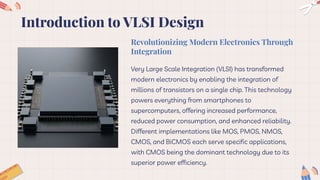
Very Large Scale Integration (VLSI) has transformed
modern electronics by enabling the integration of
millions of transistors on a single chip. This technology
powers everything from smartphones to
supercomputers, offering increased performance,
reduced power consumption, and enhanced reliability.
Different implementations like MOS, PMOS, NMOS,
CMOS, and BiCMOS each serve specific applications,
with CMOS being the dominant technology due to its
superior power efficiency.
Revolutionizing Modern Electronics Through
Integration
Basic MOS Transistor Operation
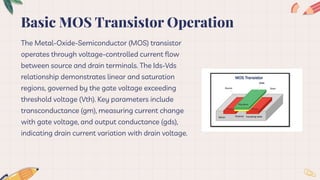
The Metal-Oxide-Semiconductor (MOS) transistor
operates through voltage-controlled current flow
between source and drain terminals. The Ids-Vds
relationship demonstrates linear and saturation
regions, governed by the gate voltage exceeding
threshold voltage (Vth). Key parameters include
transconductance (gm), measuring current change
with gate voltage, and output conductance (gds),
indicating drain current variation with drain voltage.
2+2 = 4
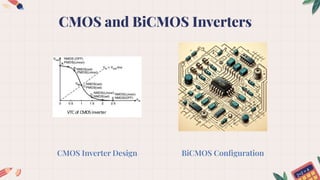
CMOS and BiCMOS Inverters
CMOS Inverter Design BiCMOS Configuration
System requirements defined through HDL coding and
behavioral modeling
Converting HDL to gate-level netlist with timing and area
constraints
Design Entry &
Specification
Logic Synthesis &
Optimization
Physical Design &
Verification
Layout generation, DRC checks, and final tape-out
preparation
VLSI Design Flow
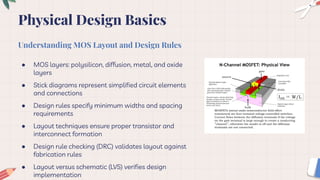
Physical Design Basics
Understanding MOS Layout and Design Rules
● MOS layers: polysilicon, diffusion, metal, and oxide
layers
● Stick diagrams represent simplified circuit elements
and connections
● Design rules specify minimum widths and spacing
requirements
● Layout techniques ensure proper transistor and
interconnect formation
● Design rule checking (DRC) validates layout against
fabrication rules
● Layout versus schematic (LVS) verifies design
implementation
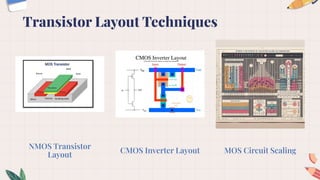
NMOS Transistor
Layout
Transistor Layout Techniques
CMOS Inverter Layout MOS Circuit Scaling
Logic Gate Design
Essential components for digital circuit implementation in VLSI
● Basic gates: NAND, NOR, AND, OR implementations using CMOS
● Complex gates: AOI, OAI, XOR using optimized transistor arrangements
● Switch logic design using transmission gates
● Alternative gate structures for power-delay optimization
● Static vs Dynamic logic implementation techniques
● Layout considerations for efficient gate design
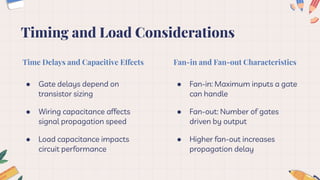
Timing and Load Considerations
Time Delays and Capacitive Effects
● Gate delays depend on
transistor sizing
● Wiring capacitance affects
signal propagation speed
● Load capacitance impacts
circuit performance
Fan-in and Fan-out Characteristics
● Fan-in: Maximum inputs a gate
can handle
● Fan-out: Number of gates
driven by output
● Higher fan-out increases
propagation delay
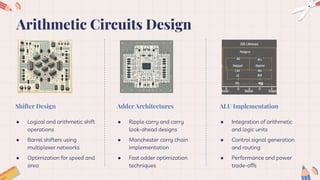
Arithmetic Circuits Design
Shifter Design
● Logical and arithmetic shift
operations
● Barrel shifters using
multiplexer networks
● Optimization for speed and
area
Adder Architectures
● Ripple carry and carry
look-ahead designs
● Manchester carry chain
implementation
● Fast adder optimization
techniques
ALU Implementation
● Integration of arithmetic
and logic units
● Control signal generation
and routing
● Performance and power
trade-offs
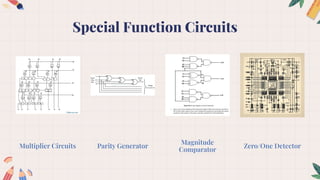
Multiplier Circuits
Special Function Circuits
Parity Generator
Magnitude
Comparator
Zero/One Detector
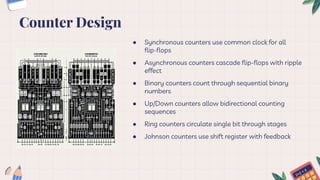
Counter Design
● Synchronous counters use common clock for all
flip-flops
● Asynchronous counters cascade flip-flops with ripple
effect
● Binary counters count through sequential binary
numbers
● Up/Down counters allow bidirectional counting
sequences
● Ring counters circulate single bit through stages
● Johnson counters use shift register with feedback
2+2 = 4
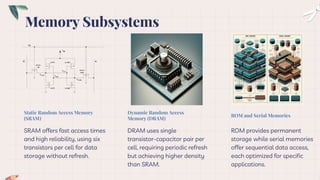
Memory Subsystems
Static Random Access Memory
(SRAM)
SRAM offers fast access times
and high reliability, using six
transistors per cell for data
storage without refresh.
Dynamic Random Access
Memory (DRAM)
DRAM uses single
transistor-capacitor pair per
cell, requiring periodic refresh
but achieving higher density
than SRAM.
ROM and Serial Memories
ROM provides permanent
storage while serial memories
offer sequential data access,
each optimized for specific
applications.
Programmable Array
Logic (PAL)
Field Programmable
Gate Arrays
Complex PLDs (CPLDs)
Programmable Logic Devices
Programmable Logic
Arrays (PLAs)
● Programmable AND
and OR arrays
● Flexible
implementation of
logic functions
● Higher complexity
but more versatile
design
● Fixed OR array with
programmable AND
● Faster operation
than PLAs
● Cost-effective for
simple logic
functions
● Configurable logic
blocks and
interconnects
● High flexibility in
design
implementation
● Reprogrammable
for different
● Multiple PAL-like
blocks with
interconnects
● Non-volatile
memory
configuration
● Suitable for
medium-complexity
● Built-in Self-Test (BIST)
implementation
● Scan chain design for testability
● Fault simulation and coverage
analysis
● Automated Test Pattern
Generation (ATPG)
Key Testing Strategies
● Limited pin accessibility in
complex circuits
● High cost of comprehensive
testing
● Increased overhead for test
circuitry
● Time-consuming test pattern
generation
Common Testing Challenges
CMOS Testing Fundamentals
Advanced Testing Techniques
Modern Approaches in VLSI Testing
● Fault Models: Stuck-at, bridging, and delay fault
testing
● Automatic Test Pattern Generation (ATPG) algorithms
● Boundary scan and JTAG testing methods
● Built-In Self-Test (BIST) implementation strategies
● Scan chain design and testing methodology
● Memory testing techniques and algorithms

VLSI DESIGN ITS ANALYSIS AND APPLICATIONS

  • 1.
  • 2.
    Introduction to VLSIDesign Very Large Scale Integration (VLSI) has transformed modern electronics by enabling the integration of millions of transistors on a single chip. This technology powers everything from smartphones to supercomputers, offering increased performance, reduced power consumption, and enhanced reliability. Different implementations like MOS, PMOS, NMOS, CMOS, and BiCMOS each serve specific applications, with CMOS being the dominant technology due to its superior power efficiency. Revolutionizing Modern Electronics Through Integration
  • 3.
    Basic MOS TransistorOperation The Metal-Oxide-Semiconductor (MOS) transistor operates through voltage-controlled current flow between source and drain terminals. The Ids-Vds relationship demonstrates linear and saturation regions, governed by the gate voltage exceeding threshold voltage (Vth). Key parameters include transconductance (gm), measuring current change with gate voltage, and output conductance (gds), indicating drain current variation with drain voltage.
  • 4.
    2+2 = 4 CMOSand BiCMOS Inverters CMOS Inverter Design BiCMOS Configuration
  • 5.
    System requirements definedthrough HDL coding and behavioral modeling Converting HDL to gate-level netlist with timing and area constraints Design Entry & Specification Logic Synthesis & Optimization Physical Design & Verification Layout generation, DRC checks, and final tape-out preparation VLSI Design Flow
  • 6.
    Physical Design Basics UnderstandingMOS Layout and Design Rules ● MOS layers: polysilicon, diffusion, metal, and oxide layers ● Stick diagrams represent simplified circuit elements and connections ● Design rules specify minimum widths and spacing requirements ● Layout techniques ensure proper transistor and interconnect formation ● Design rule checking (DRC) validates layout against fabrication rules ● Layout versus schematic (LVS) verifies design implementation
  • 7.
    NMOS Transistor Layout Transistor LayoutTechniques CMOS Inverter Layout MOS Circuit Scaling
  • 8.
    Logic Gate Design Essentialcomponents for digital circuit implementation in VLSI ● Basic gates: NAND, NOR, AND, OR implementations using CMOS ● Complex gates: AOI, OAI, XOR using optimized transistor arrangements ● Switch logic design using transmission gates ● Alternative gate structures for power-delay optimization ● Static vs Dynamic logic implementation techniques ● Layout considerations for efficient gate design
  • 9.
    Timing and LoadConsiderations Time Delays and Capacitive Effects ● Gate delays depend on transistor sizing ● Wiring capacitance affects signal propagation speed ● Load capacitance impacts circuit performance Fan-in and Fan-out Characteristics ● Fan-in: Maximum inputs a gate can handle ● Fan-out: Number of gates driven by output ● Higher fan-out increases propagation delay
  • 10.
    Arithmetic Circuits Design ShifterDesign ● Logical and arithmetic shift operations ● Barrel shifters using multiplexer networks ● Optimization for speed and area Adder Architectures ● Ripple carry and carry look-ahead designs ● Manchester carry chain implementation ● Fast adder optimization techniques ALU Implementation ● Integration of arithmetic and logic units ● Control signal generation and routing ● Performance and power trade-offs
  • 11.
    Multiplier Circuits Special FunctionCircuits Parity Generator Magnitude Comparator Zero/One Detector
  • 12.
    Counter Design ● Synchronouscounters use common clock for all flip-flops ● Asynchronous counters cascade flip-flops with ripple effect ● Binary counters count through sequential binary numbers ● Up/Down counters allow bidirectional counting sequences ● Ring counters circulate single bit through stages ● Johnson counters use shift register with feedback 2+2 = 4
  • 13.
    Memory Subsystems Static RandomAccess Memory (SRAM) SRAM offers fast access times and high reliability, using six transistors per cell for data storage without refresh. Dynamic Random Access Memory (DRAM) DRAM uses single transistor-capacitor pair per cell, requiring periodic refresh but achieving higher density than SRAM. ROM and Serial Memories ROM provides permanent storage while serial memories offer sequential data access, each optimized for specific applications.
  • 14.
    Programmable Array Logic (PAL) FieldProgrammable Gate Arrays Complex PLDs (CPLDs) Programmable Logic Devices Programmable Logic Arrays (PLAs) ● Programmable AND and OR arrays ● Flexible implementation of logic functions ● Higher complexity but more versatile design ● Fixed OR array with programmable AND ● Faster operation than PLAs ● Cost-effective for simple logic functions ● Configurable logic blocks and interconnects ● High flexibility in design implementation ● Reprogrammable for different ● Multiple PAL-like blocks with interconnects ● Non-volatile memory configuration ● Suitable for medium-complexity
  • 15.
    ● Built-in Self-Test(BIST) implementation ● Scan chain design for testability ● Fault simulation and coverage analysis ● Automated Test Pattern Generation (ATPG) Key Testing Strategies ● Limited pin accessibility in complex circuits ● High cost of comprehensive testing ● Increased overhead for test circuitry ● Time-consuming test pattern generation Common Testing Challenges CMOS Testing Fundamentals
  • 16.
    Advanced Testing Techniques ModernApproaches in VLSI Testing ● Fault Models: Stuck-at, bridging, and delay fault testing ● Automatic Test Pattern Generation (ATPG) algorithms ● Boundary scan and JTAG testing methods ● Built-In Self-Test (BIST) implementation strategies ● Scan chain design and testing methodology ● Memory testing techniques and algorithms