Building Codes Life and Safety Issues
Mesopotamia  circa 1800 B.C. The Code of Hammurabi (the sixth Babylonian king)
228    If a builder build a house for some one and complete it, he shall give him a fee of two shekels in money for each sar of surface.  229    If a builder build a house for some one, and does not construct it properly, and the house which he built fall in and kill its owner, then that builder shall be put to death.  230    If it kill the son of the owner the son of that builder shall be put to death.  231    If it kill a slave of the owner, then he shall pay slave for slave to the owner of the house.  232    If it ruin goods, he shall make compensation for all that has been ruined, and inasmuch as he did not construct properly this house which he built and it fell, he shall re-erect the house from his own means.  233    If a builder build a house for some one, even though he has not yet completed it; if then the walls seem toppling, the builder must make the walls solid from his own means.
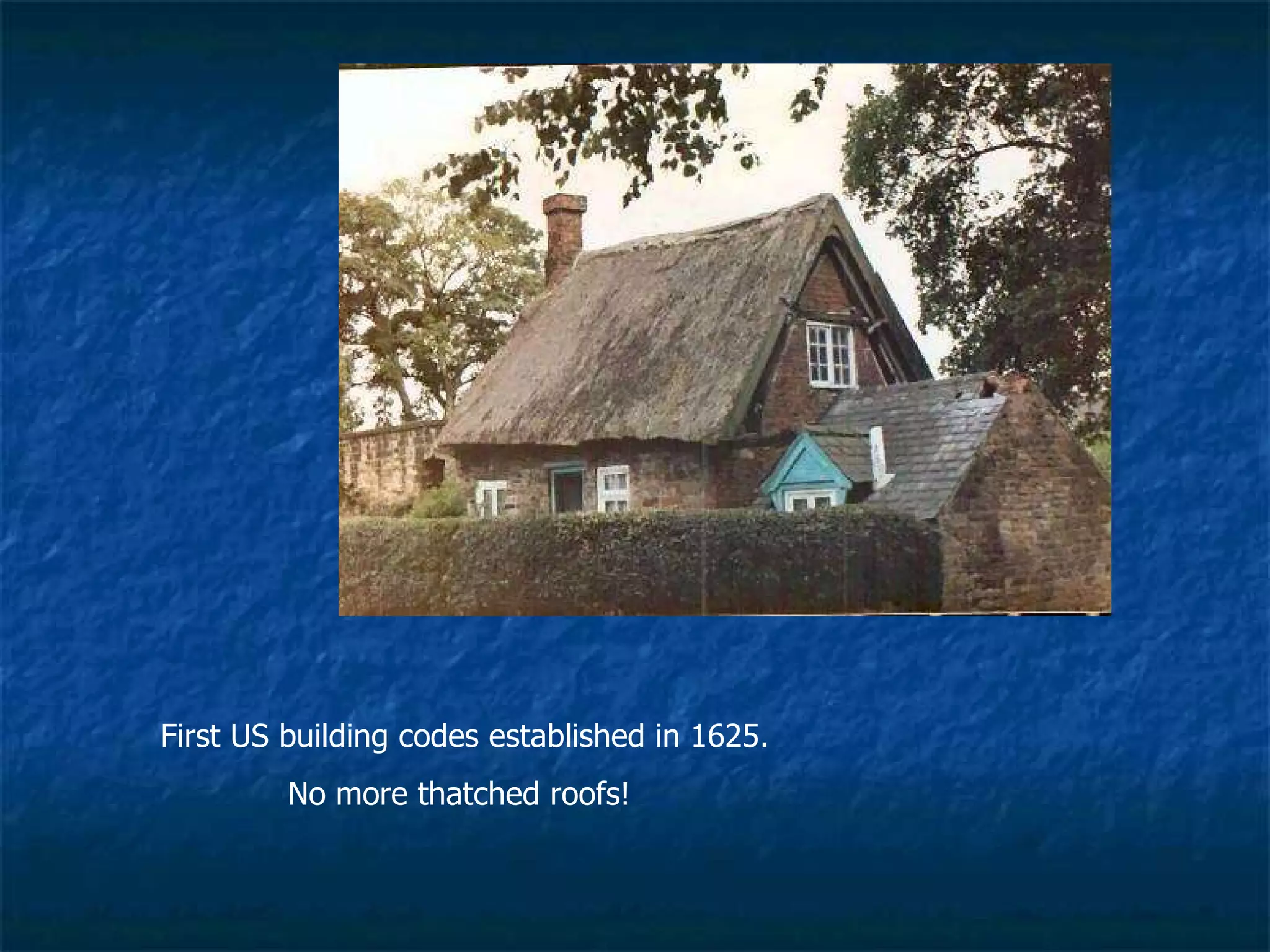
First US building codes established in 1625. No more thatched roofs!
New York 1835  Chicago 1871 Boston 1872 Brooklyn 1876 Baltimore 1904 San Francisco 1906
Tenement Housing
Disease  Tuberculosis Cholera Small pox
Injuries lead to concern
ELECTRICAL  and  MECHANICAL  SYSTEMS CHIMNEYS And FIREPLACES CEILING AND ROOF WALLS FLOORS FOUNDATIONS BUILDING PLANNING BUILDING PLANNING and CONSTRUCTION
Building Planning with the code… Light, Ventilation, Heating Room sizes and Ceiling heights Sanitation and bathroom requirements Glazing and Hazardous locations Other use areas—like Garages How to get out safely. Stairways and special requirements Fire protection Moisture and decay protection Pesky pests… (termites among others) And more….addresses, flood stuff…
 
Stair width and tread depth? Moisture protection issues ? Garage emissions separated and safe? Exit door and stoop safe? Required rooms accounted for? Is the smallest room big enough for human impact? Window locations and which ones open? Bedroom window large enough to get out if needed?
The details
Fire Protection Smoke Detectors- Required in each bedroom  Required in adjoining areas to the bedrooms One required per floor
Egress Predominately a fire concern and lobbied heavily by emergency and fire response services. Primary egress door required Minimum sizes for window escape Requirements for stairways and landings Provision for movement away from building once out.
Stairs Stair height and tread distance combine to form a ergo dynamic pattern.  If too steep or without adequate tread depth the stair becomes more likely to cause falls.
Windows Required for light and ventilation (clean air) Required for escape Must be safety glazed when specific conditions are met. Size of glass pane Location near traffic or wet area
Ventilation A certain amount of light and ventilation is required per room Fans  Required in bathrooms Whole house fan required Vent required over cook top Windows Operable windows in the bathrooms and living areas
Building Planning Structure…
To be continued by “Others”….

Introduction To Building Codes

  • 1.
    Building Codes Lifeand Safety Issues
  • 2.
    Mesopotamia circa1800 B.C. The Code of Hammurabi (the sixth Babylonian king)
  • 3.
    228    If abuilder build a house for some one and complete it, he shall give him a fee of two shekels in money for each sar of surface. 229    If a builder build a house for some one, and does not construct it properly, and the house which he built fall in and kill its owner, then that builder shall be put to death. 230    If it kill the son of the owner the son of that builder shall be put to death. 231    If it kill a slave of the owner, then he shall pay slave for slave to the owner of the house. 232    If it ruin goods, he shall make compensation for all that has been ruined, and inasmuch as he did not construct properly this house which he built and it fell, he shall re-erect the house from his own means. 233    If a builder build a house for some one, even though he has not yet completed it; if then the walls seem toppling, the builder must make the walls solid from his own means.
  • 4.
    First US buildingcodes established in 1625. No more thatched roofs!
  • 5.
    New York 1835 Chicago 1871 Boston 1872 Brooklyn 1876 Baltimore 1904 San Francisco 1906
  • 6.
  • 7.
    Disease TuberculosisCholera Small pox
  • 8.
  • 9.
    ELECTRICAL and MECHANICAL SYSTEMS CHIMNEYS And FIREPLACES CEILING AND ROOF WALLS FLOORS FOUNDATIONS BUILDING PLANNING BUILDING PLANNING and CONSTRUCTION
  • 10.
    Building Planning withthe code… Light, Ventilation, Heating Room sizes and Ceiling heights Sanitation and bathroom requirements Glazing and Hazardous locations Other use areas—like Garages How to get out safely. Stairways and special requirements Fire protection Moisture and decay protection Pesky pests… (termites among others) And more….addresses, flood stuff…
  • 11.
  • 12.
    Stair width andtread depth? Moisture protection issues ? Garage emissions separated and safe? Exit door and stoop safe? Required rooms accounted for? Is the smallest room big enough for human impact? Window locations and which ones open? Bedroom window large enough to get out if needed?
  • 13.
  • 14.
    Fire Protection SmokeDetectors- Required in each bedroom Required in adjoining areas to the bedrooms One required per floor
  • 15.
    Egress Predominately afire concern and lobbied heavily by emergency and fire response services. Primary egress door required Minimum sizes for window escape Requirements for stairways and landings Provision for movement away from building once out.
  • 16.
    Stairs Stair heightand tread distance combine to form a ergo dynamic pattern. If too steep or without adequate tread depth the stair becomes more likely to cause falls.
  • 17.
    Windows Required forlight and ventilation (clean air) Required for escape Must be safety glazed when specific conditions are met. Size of glass pane Location near traffic or wet area
  • 18.
    Ventilation A certainamount of light and ventilation is required per room Fans Required in bathrooms Whole house fan required Vent required over cook top Windows Operable windows in the bathrooms and living areas
  • 19.
  • 20.
    To be continuedby “Others”….

Editor's Notes

  • #3 Today's building codes can be traced back to the code of Hammurabi, circa 2200-1800 B.C. The Code of Hammurabi (also known as Codex Hammurabi ) is one of the earliest and best preserved law codes from ancient Babylon, created ca. 1760 BC (middle chronology). It was enacted by the sixth Babylonian king, Hammurabi.
  • #4 The code of Hammurabi provided for the death of a builder if the construction of a dwelling collapsed and caused the death of the owner. A shekel was originally 180 grains (8.33 grams). A sar is approximately 12 sq. ft.
  • #5 First building codes in the US established in 1625 addressed fire safety and specified materials for roof coverings. In 1630, Boston outlawed chimneys made with wood and thatch roof coverings. Late 1770s George Washington recommended that height and area limitations be imposed on wood frame buildings in his plans for the District of Columbia.
  • #6 NYC 500 bldgs destroyed, chicago 4-1/2 miles 1800 bldgs 300+ lives, brklyn 295 lives, SF Earthquack 3000+
  • #7 Council of Hygiene, organized in 1863. Presented this plan to the Citizens’ Association of New York as a specimen “multiple domicile” “Here are 12 living rooms and 21 bedrooms, and only six of the latter have any provision or possibility for the admission of light and air, excepting through the family sitting and living room; being utterly dark, close, and unventilated. The living rooms are but 10 x 12 feet, bedrooms are 6.5 x 7 feet” Mortality rate 1:48 in 1815 to 1:27 in 1855.
  • #8 Tuberculosis, cholera, small pox; A death of a child was recorded as “plainly due to suffocation in the foul air of an unventilated apartment”.
  • #9 Injuries occurring in homes are reported by medical service agencies. These injury and death records are used by code change lobbyists to substantiate cyclical changes to building code.
  • #10 Modern building codes include all aspects of the construction trade.
  • #11 Today’s building code addresses many issues of life and safety. Prior to the International Code Council, building safety codes were regional. Most codes were produced by three model cod organizations. BOCA National Codes were used mostly in Eastern and Great Lakes states; ICBO Uniform Codes in Western and Midwest states; SBCCI Standard codes in Southern states. As a result the construction industry often faced the challenge, and cost, of building to different codes in different areas of the country.
  • #12 Today, the ICC International Codes (I-Codes) combine the strengths of the regional codes. I-codes respond to the needs of the construction industry and publc safety. A single set of codes has strong support from government
  • #13 From initial design conception code requirements are planned for and incorporated.
  • #14 As the plan is developed with dimensions, details, and notations, items of special interest and concern are clarified on the plan to ensure clear communication and compliance in the field.
  • #15 Many life concerns in residential and hotel construction are centered around one of the two strongest threats. Fire and Structure. Let’s take a quick look at some of the code provisions for fire alarms and safety requirements built into the home.
  • #16 All good safety plans provide for escape routes. In buildings we call this egress and the primary route will be through a door way.
  • #17 Normal residential traffic patterns for two stor7y homes will include at least one staircase. Here are some examples of stairways that are not safe. Previous codes allowed for very steep stairways. The rise of the step was significantly greater than the tread length, it was considered of sound design when the rise dimension plus the tread depth dimension equalled 17. This could result in a 12” step with a 5” tread with a usability more in line with a ladder!
  • #18 Whhhoooops! Wrong windows! The glass in my door broke and the glass shop will not sell me a piece of plate glass to replace it. They say I need to buy "safety glass." Are they trying to cheat me? No, but they may be saving your life - or keeping you out of legal trouble. You may not know that glass is one of the few building materials actually regulated by the Federal government and that usage of glass in and near doors falls under strict Consumer Product Safety Commission rules. Quality glass shops know that all glass in doors must meet the requirements of CPSC 16 CFR 1201 safety glazing - which generally means that either tempered or laminated glass or plastic must be used
  • #19 As a way of addressing the special needs of our Washington state climates, our local government has implemented a state wide ventilation and energy code. Within the scope of this code are ventilation requirements intended to address health issues that could result from moisture damage, or mold. The Washington State Ventilation and Indoor Air Quality Code (VIAQC) provides for moisture expelling fans as well as those required for cooking and odor.
  • #20 Building planning is also about keeping the unit standing, and more safety aspects, and because I know you are intensely interested and curious about how and where and why the Design department wants to share this exciting safety information– after all…. It’s our baby!