Agile Metrics and Quality
Metrics -> Improvements

Use metrics to
 •   Improve quality
 •   Shorten product cycle time
 •   Decrease costs
 •   Decrease risks
 •   Increase predictability and reliability
Control Limits and Variances
We can have limits for
• WIP
• Defects
• Team size
• Velocity
• Time-boxes
• Others?
We can analyze variances to understand
  the special causes of variation
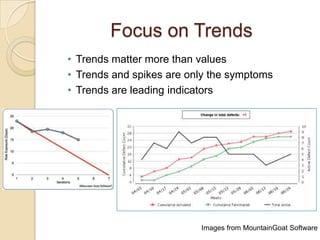
Focus on Trends
• Trends matter more than values
• Trends and spikes are only the symptoms
• Trends are leading indicators


                          Images from MountainGoat Software
Improve quality
 ◦ Quality is measured by passed tests and
   customer acceptance
 ◦ Quality is defined by Definition of Done
   and Acceptance Criteria
 ◦ Defect trends to use in Agile projects
     Number of open defects
     Escaped defects
     Defect Cycle Time
     Defect spill-over
 ◦ Test Automation is critical!
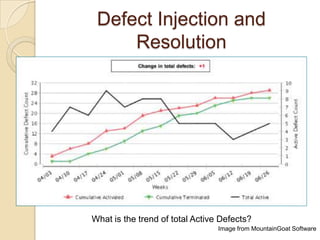
Defect Injection and
     Resolution


What is the trend of total Active Defects?
                                 Image from MountainGoat Software
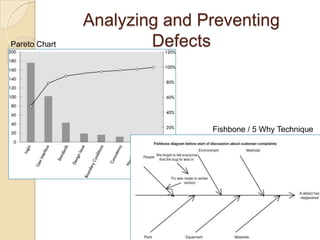
Analyzing and Preventing
Pareto Chart           Defects


                              Fishbone / 5 Why Technique
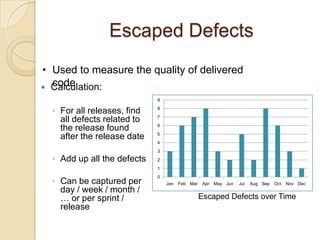
Escaped Defects
• Used to measure the quality of delivered
  code
 Calculation:
                             9

  ◦ For all releases, find   8
                             7
    all defects related to
                             6
    the release found
                             5
    after the release date
                             4
                             3
  ◦ Add up all the defects   2
                             1


  ◦ Can be captured per
                             0
                                 Jan   Feb Mar    Apr May Jun   Jul   Aug Sep   Oct   Nov Dec
    day / week / month /
    … or per sprint /                            Escaped Defects over Time
    release
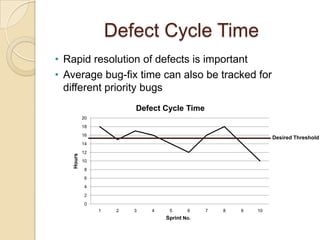
Defect Cycle Time
• Rapid resolution of defects is important
• Average bug-fix time can also be tracked for
  different priority bugs
                         Defect Cycle Time
           20
           18
           16
                                                               Desired Threshold
           14
           12
   Hours


           10
            8
            6
            4
            2
            0
                1    2   3   4    5      6    7   8   9   10
                                 Sprint No.
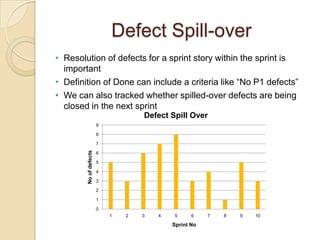
Defect Spill-over
• Resolution of defects for a sprint story within the sprint is
  important
• Definition of Done can include a criteria like “No P1 defects”
• We can also tracked whether spilled-over defects are being
  closed in the next sprint
                                    Defect Spill Over
                        9

                        8

                        7
        No of defects


                        6

                        5

                        4

                        3

                        2

                        1

                        0
                            1   2   3   4   5      6    7   8   9   10

                                            Sprint No
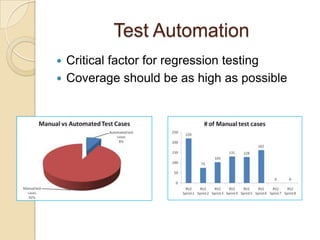
Test Automation
 Critical factor for regression testing
 Coverage should be as high as possible
Shorten product cycle time
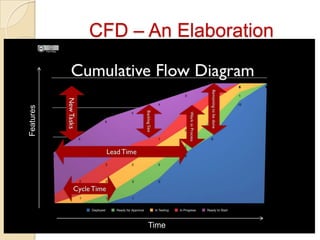
   Cumulative Flow Diagrams
    ◦ Lead Time
    ◦ Cycle Time
Features   CFD – An Elaboration


                 Time
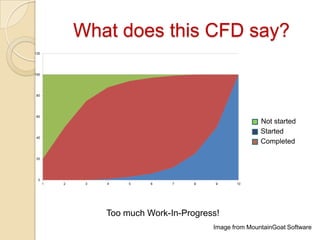
What does this CFD say?


                                          Not started
                                          Started
                                          Completed


   Too much Work-In-Progress!
                           Image from MountainGoat Software
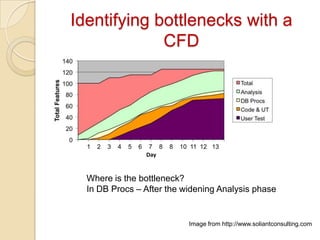
Identifying bottlenecks with a
             CFD


  1   2   3   4   5   6    7 8   8   10 11 12 13
                          Day


  Where is the bottleneck?
  In DB Procs – After the widening Analysis phase


                                       Image from http://www.soliantconsulting.com
Decrease costs
• Earned Value Management
• Wastage
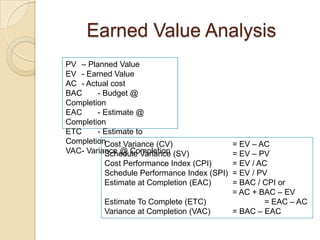
Earned Value Analysis
PV – Planned Value
EV - Earned Value
AC - Actual cost
BAC     - Budget @
Completion
EAC     - Estimate @
Completion
ETC     - Estimate to
CompletionCost Variance (CV)              = EV – AC
VAC- Variance @ Completion (SV)
          Schedule Variance               = EV – PV
         Cost Performance Index (CPI)     = EV / AC
         Schedule Performance Index (SPI) = EV / PV
         Estimate at Completion (EAC)     = BAC / CPI or
                                          = AC + BAC – EV
         Estimate To Complete (ETC)                = EAC – AC
         Variance at Completion (VAC)     = BAC – EAC
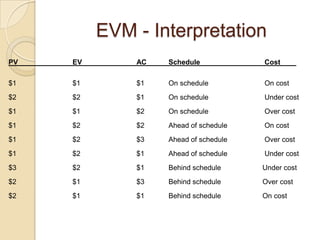
EVM - Interpretation
PV   EV       AC   Schedule            Cost

$1   $1       $1   On schedule         On cost
$2   $2       $1   On schedule         Under cost
$1   $1       $2   On schedule         Over cost
$1   $2       $2   Ahead of schedule   On cost
$1   $2       $3   Ahead of schedule   Over cost
$1   $2       $1   Ahead of schedule   Under cost
$3   $2       $1   Behind schedule     Under cost
$2   $1       $3   Behind schedule     Over cost
$2   $1       $1   Behind schedule     On cost
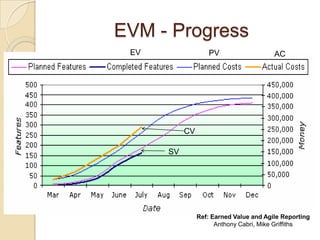
EVM - Progress
 EV                PV                    AC


           CV

      SV


                Ref: Earned Value and Agile Reporting
                      Anthony Cabri, Mike Griffiths
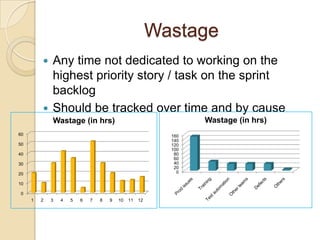
Wastage
          Any time not dedicated to working on the
           highest priority story / task on the sprint
           backlog
          Should be tracked over time and by cause
             Wastage (in hrs)                                   Wastage (in hrs)
60                                                        160
                                                          140
50                                                        120
                                                          100
40                                                         80
                                                           60
30                                                         40
                                                           20
20                                                          0

10

 0
     1   2   3   4   5   6   7   8   9   10   11   12
Decrease risks
• WIP Limits
• Small Iterations
• More predictability
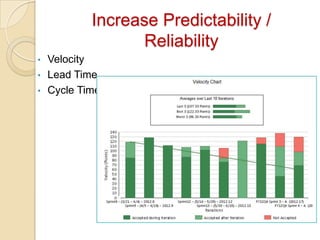
Increase Predictability /
                   Reliability
•   Velocity
•   Lead Time
•   Cycle Time
Metrics to Avoid
•   Velocity comparisons
•   Productivity e.g. Story Points per day
•   Effort Estimation accuracy
•   Number of stories completed
•   LOC/Function Points
•   Code quality
Questions?


Contact
Anu.khendry@gmail.com

Agile metrics and quality

  • 1.
  • 2.
    Metrics -> Improvements Usemetrics to • Improve quality • Shorten product cycle time • Decrease costs • Decrease risks • Increase predictability and reliability
  • 3.
    Control Limits andVariances We can have limits for • WIP • Defects • Team size • Velocity • Time-boxes • Others? We can analyze variances to understand the special causes of variation
  • 4.
    Focus on Trends •Trends matter more than values • Trends and spikes are only the symptoms • Trends are leading indicators Images from MountainGoat Software
  • 5.
    Improve quality ◦Quality is measured by passed tests and customer acceptance ◦ Quality is defined by Definition of Done and Acceptance Criteria ◦ Defect trends to use in Agile projects  Number of open defects  Escaped defects  Defect Cycle Time  Defect spill-over ◦ Test Automation is critical!
  • 6.
    Defect Injection and Resolution What is the trend of total Active Defects? Image from MountainGoat Software
  • 7.
    Analyzing and Preventing ParetoChart Defects Fishbone / 5 Why Technique
  • 8.
    Escaped Defects • Usedto measure the quality of delivered code  Calculation: 9 ◦ For all releases, find 8 7 all defects related to 6 the release found 5 after the release date 4 3 ◦ Add up all the defects 2 1 ◦ Can be captured per 0 Jan Feb Mar Apr May Jun Jul Aug Sep Oct Nov Dec day / week / month / … or per sprint / Escaped Defects over Time release
  • 9.
    Defect Cycle Time •Rapid resolution of defects is important • Average bug-fix time can also be tracked for different priority bugs Defect Cycle Time 20 18 16 Desired Threshold 14 12 Hours 10 8 6 4 2 0 1 2 3 4 5 6 7 8 9 10 Sprint No.
  • 10.
    Defect Spill-over • Resolutionof defects for a sprint story within the sprint is important • Definition of Done can include a criteria like “No P1 defects” • We can also tracked whether spilled-over defects are being closed in the next sprint Defect Spill Over 9 8 7 No of defects 6 5 4 3 2 1 0 1 2 3 4 5 6 7 8 9 10 Sprint No
  • 11.
    Test Automation  Criticalfactor for regression testing  Coverage should be as high as possible
  • 12.
    Shorten product cycletime  Cumulative Flow Diagrams ◦ Lead Time ◦ Cycle Time
  • 13.
    Features CFD – An Elaboration Time
  • 14.
    What does thisCFD say? Not started Started Completed Too much Work-In-Progress! Image from MountainGoat Software
  • 15.
    Identifying bottlenecks witha CFD 1 2 3 4 5 6 7 8 8 10 11 12 13 Day Where is the bottleneck? In DB Procs – After the widening Analysis phase Image from http://www.soliantconsulting.com
  • 16.
    Decrease costs • EarnedValue Management • Wastage
  • 17.
    Earned Value Analysis PV– Planned Value EV - Earned Value AC - Actual cost BAC - Budget @ Completion EAC - Estimate @ Completion ETC - Estimate to CompletionCost Variance (CV) = EV – AC VAC- Variance @ Completion (SV) Schedule Variance = EV – PV Cost Performance Index (CPI) = EV / AC Schedule Performance Index (SPI) = EV / PV Estimate at Completion (EAC) = BAC / CPI or = AC + BAC – EV Estimate To Complete (ETC) = EAC – AC Variance at Completion (VAC) = BAC – EAC
  • 18.
    EVM - Interpretation PV EV AC Schedule Cost $1 $1 $1 On schedule On cost $2 $2 $1 On schedule Under cost $1 $1 $2 On schedule Over cost $1 $2 $2 Ahead of schedule On cost $1 $2 $3 Ahead of schedule Over cost $1 $2 $1 Ahead of schedule Under cost $3 $2 $1 Behind schedule Under cost $2 $1 $3 Behind schedule Over cost $2 $1 $1 Behind schedule On cost
  • 19.
    EVM - Progress EV PV AC CV SV Ref: Earned Value and Agile Reporting Anthony Cabri, Mike Griffiths
  • 20.
    Wastage  Any time not dedicated to working on the highest priority story / task on the sprint backlog  Should be tracked over time and by cause Wastage (in hrs) Wastage (in hrs) 60 160 140 50 120 100 40 80 60 30 40 20 20 0 10 0 1 2 3 4 5 6 7 8 9 10 11 12
  • 21.
    Decrease risks • WIPLimits • Small Iterations • More predictability
  • 22.
    Increase Predictability / Reliability • Velocity • Lead Time • Cycle Time
  • 23.
    Metrics to Avoid • Velocity comparisons • Productivity e.g. Story Points per day • Effort Estimation accuracy • Number of stories completed • LOC/Function Points • Code quality
  • 24.