Housing
Definition
• Housing is defined as a physical structure
which provides safety, security and shelter to
the members living in and the environment
including services and facilities necessary for
maintaining optimum health by those
members.
REQUIREMENTS OF A HOUSE
a. Location: The house should be located on dry,
non caving ground, having an independent unit
and should be nearer to shopping place,
recreational facilities, educational centers,
emergency services and transport system.
secured.
b. Construction: The house should be so strongly
constructed as to withstand the vagaries of
nature such as landslide, floods or earth-quake,
etc. and also it should be safe and secured.
c. Sanitation: From the point of view of health,
there should not be overcrowding and there
must be sufficient light and ventilation,
sufficient water supply and proper
arrangements for drainage of liquid waste in
the house. Provision should be made for insect
proofing and rodent proofing also. Cleanliness
to be maintained in and around the house.
d. Comfortable house-life: For this, there
must be ideally
-separate kitchen,
-store room
-bed rooms
-a common living room for the entire family
-a corridor
HOUSING STANDARDS
• These vary from country to country,
depending upon the socioeconomic status,
family size and composition, cultural practices
and climate conditions. The standards
recommended in India are as follows:
• Site selection: The site or the ground selected
should be high and only to drain the water.
The soil should be of gravel nature. ‘Made-
soil’ (i.e. ground leveled by dumping refuse)
and damp-sites should be avoided. It should
have proper approach roads and away from
traffic and industries.
• Foundation: This must always be solid and
substantial. The foundation is laid with a bed
of cement concrete over the stones to cover
the trench. The object is to prevent
subsidence of the building. The width of the
foundation should never be less than 25
inches.
• In addition to this bed of concrete, a layer of
impervious material known as ‘damp proof
course’ should be laid horizontally, along the
entire thickness of each wall at plinth level.
This prevents the upward progress of the
moisture.
• Walls: The walls are constructed with cement
and bricks or stones, with a minimum
thickness of 9 inches, obtained by laying the
bricks lengthwise and crosswise in alternate
layers. The walls are then plastered so that it
should neither absorb heat nor it should
conduct the heat. Painting of the walls renders
the surface impervious and enables easy
wash.
• Floor: Floor should be air and water tight,
surface should be smooth, facilitate easy wash
and should be damp proof. The concreted
floor should be covered with patent stone
slabs or in better class houses, with marble
slabs or tiles.
• Roof: Flat roofs should have sufficient slope to
drain rain water. Height of the roof should not
be less than 10 feet, as the heat radiated from
the roof is in inverse ratio to the square of its
distance. Sloping roofs may be either of tiles,
slates, thatch, corrugated iron, asbestos, etc. A
double roof with a space between will make a
very cool covering to a dwelling.
• Rooms: The number of living rooms depends
upon the size of the family to prevent
overcrowding.
• Doors and windows: Every living room should
be provided with at least two windows and one
of them should open directly to the open space.
Doors and windows should be so placed as to
allow cross-ventilation (i.e. air should pass
through one end and come out at the other.
• The windows should be placed at 2 ½ feet
above the floor level (and not above 3 feet)
and the window area should be 1/5th of the
floor area of the room.
• Doors and windows combined should have
2/5th of the floor area.
• Ventilating grills should occupy 2 percent of
the floor area, placed near the ceiling and
facing open space outside.
• Doors and windows can be made mosquito
proof with wire gauze.
• Floor area: The optimum floor area per
person in the living room should be 50 to 100
sq feet. But it should never be less than 50 sq
feet (Av = 75 sq feet).
• Lighting: The day light factor should exceed 1
percent over half the floor area. The room is
said to be adequately lighted, when one can
read or write in the center of the hall without
the help of artificial light during day time
• Kitchen: Every house should have separate
kitchen room, should not be near a privy
(toilet), nor so placed as to allow the smoke
and smell of cooking getting into the rest of
the house.
• It should not be exposed to dust and
impurities getting into it.
• It should have adequate light and ventilation.
Provision must be made for storing food grain,
fuel (LPG cylinders) and utensils.
• There should be sufficient water supply and
drainage facility. The floor of the kitchen must
be impervious.
• Water closets or privies: Minimum one
sanitary privy is a must for every house,
preferably on the lee-ward side.
• It should have good ventilation. It should
always be clean and dry.
• Bathroom: This should also be on the lee ward
side of the house with drainage facility for the
sullage water.
• Utility: Provision should be made for washing
utensils and clothes.
• Water supply: There must be sufficient supply
of safe and wholesome water. There may be
individual water source for the house with a
tube well, during the time of scarcity of water
supply.
• Setback: There must be sufficient open space
all around the building for adequate lighting
and ventilation.
• This also prevents ‘back-to-back’ houses.
Balcony should be provided in the
multistoried buildings.
• The question of open space becomes more a
luxury than necessity in cities, where the value
of land is very high.
• Refuse and garbage: Refuse like ash, dust,
waste paper, rags and garbage like vegetable
and animal matter, collected in metal
receptacles at least twice daily and emptied
into the public dust bin, at regular hours.
• The liquid refuse like wash water from the
kitchen, bathroom and other washing places
like utility and also the human excreta must be
drained by underground drainage system.
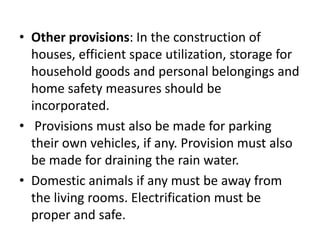
• Other provisions: In the construction of
houses, efficient space utilization, storage for
household goods and personal belongings and
home safety measures should be
incorporated.
• Provisions must also be made for parking
their own vehicles, if any. Provision must also
be made for draining the rain water.
• Domestic animals if any must be away from
the living rooms. Electrification must be
proper and safe.
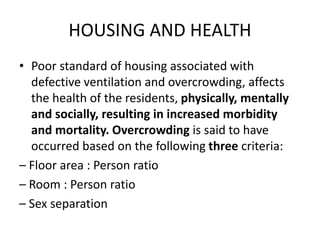
HOUSING AND HEALTH
• Poor standard of housing associated with
defective ventilation and overcrowding, affects
the health of the residents, physically, mentally
and socially, resulting in increased morbidity
and mortality. Overcrowding is said to have
occurred based on the following three criteria:
– Floor area : Person ratio
– Room : Person ratio
– Sex separation
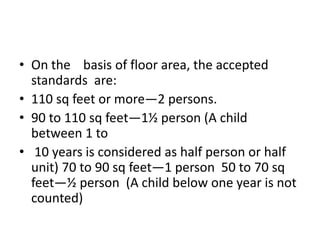
• On the basis of floor area, the accepted
standards are:
• 110 sq feet or more—2 persons.
• 90 to 110 sq feet—1½ person (A child
between 1 to
• 10 years is considered as half person or half
unit) 70 to 90 sq feet—1 person 50 to 70 sq
feet—½ person (A child below one year is not
counted)
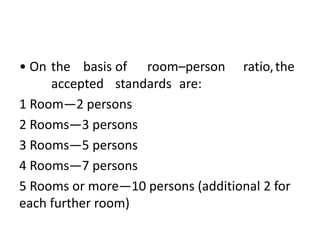
• On the basis of room–person ratio,the
accepted standards are:
1 Room—2 persons
2 Rooms—3 persons
3 Rooms—5 persons
4 Rooms—7 persons
5 Rooms or more—10 persons (additional 2 for
each further room)
• On the basis of sex separation, overcrowding
is considered, if 2 persons, over 10 years of age,
of opposite sex, unless husband and wife, are
obliged to sleep in the same room.
• Overcrowding associated with poor ventilation
(and poor housing) causes rise of temperature,
excessive humidity and air stagnation of the
room which lowers the vitality of the inmates
and makes them more susceptible to diseases.
• Respiratory diseases spread by droplet infection
very fast such as tuberculosis, measles,
influenza, streptococcal throat infections, acute
rheumatic fever, common cold, diphtheria,
whooping cough, bronchitis, etc. contagious
diseases like scabies, impetigo, ringworm,
leprosy, trachoma, conjunctivitis also spread.
• Overcrowding has a bad social effect especially
when persons of opposite sexes occupy the same
sleeping room.
• On the other hand, isolation or loneliness felt
by the person, living alone in the house, may
result in neurosis, psychosis, behavioral
disorders and also habits like alcoholism and
drug addiction.
Standards of Rural housing
•Builtup area should be about 60 percent of the total
site.
•There must be sufficient space around the house for
adequate lighting and ventilation.
•The area of doors and window should be about 25
percent of the floor area.
.
• Preferably two living rooms at least.
• Separate kitchen with a provision for
washing utensils.
• Provision for washing the clothes
• Soakage pit for disposal of sullage
watercoming form bathroom and kitchen.
• House should beprovided with a RCA
latrine.
INDICATORS FOR HOUSING
Grouped into three groups:
• Physical Indicators
This consists of type of construction, floor
area, persons per room, and sanitation (like
lighting, ventilation, water supply, drainage
facilities, etc.)
• Economic indicator
• This consists of cost of the building, rental
level, taxes, luxurious fittings
• Social Indicators
• These are further grouped into three subgroups: a.
Indicators related to preventable diseases
• Frequency of diseasesdue to overcrowding
• Frequency of diseasesdue to contaminated
water source
• Frequency of domestic accidents
• Insect borne diseases
• Zoonotic diseases.
• b. Indicators related to comfort
• Thermal comfort
• Acoustic comfort
• Visual comfort
• Spatial comfort.
c. Indicators related to mental health and social
well-being
• Frequency of suicides
• Frequency of drug abuse including alcohol
abuse
• Frequency of psychoses and neuroses.
HOUSING PROBLEM
• In India, housing problem has assumed
serious proportions in recent times, due to
population explosion, migration of population
due to industrialization and urbanization,
eruptions of slums, faulty methods of
construction of houses, lack of provision of
protected water supply, disposal of refuse and
excreta, etc. have given rise to the following
problems:
• Non-availability of houses: So, the homeless
are forced to live on pavements, in railway and
bus stations, or among the discarded truck
bodies, rail carriages, etc.
•Substandard houses and slums: These are
poorly constructed houses with lack of lighting,
ventilation and drainage facilities. New slums
are constantly growing up and old ones are
getting expanded.
•Dilapidated and crumbling houses: Frequently,
these are due to use of poor construction materials
by the contractor.
• A reasonably good house in bad surroundings:
In the vicinity of cesspools, open drains, offensive
trades, noisy industries, liqor shops, red light areas.
• A house with a bad social environment such as un
co-operative attitude and quarreling after
consuming alcohol and also prostitution, gambling,
etc.
Measures to Solve the Housing
Problem
• Provision of good quality houses or
tenementsto the poorest of poor.
• Provisionof sites with loan on easy
terms to the landless poor.
• Improvement of existing slums by
providing basic amenities like street lights,
protected water supply, drainage facilities,
community latrines, etc.
• Encouragement of owners of large
establishments to built quarters for their
employees.
• Construction of shelters for the street children.
The programs related to above activities are
Indira Awas Yojana, Ashraya Programme and
Nirman Kendra.
• Building and other construction workers act 1996
(BOCW act)
• Social security- insurance, disability benefits,
pension, maternity benefits, educational
assurance
• Registration and identification- ten or more
workers
• Health and safety measures – aims to protect
workers from accidents, provide safety
equipments
• Improved working condition- working hours,
leave entitlements, weekly rest,
• Legal protection – workers rights are
safeguarded
• Punishment and penaltys:

Housing standards presentation for community

  • 1.
  • 2.
    Definition • Housing isdefined as a physical structure which provides safety, security and shelter to the members living in and the environment including services and facilities necessary for maintaining optimum health by those members.
  • 3.
    REQUIREMENTS OF AHOUSE a. Location: The house should be located on dry, non caving ground, having an independent unit and should be nearer to shopping place, recreational facilities, educational centers, emergency services and transport system. secured.
  • 4.
    b. Construction: Thehouse should be so strongly constructed as to withstand the vagaries of nature such as landslide, floods or earth-quake, etc. and also it should be safe and secured.
  • 5.
    c. Sanitation: Fromthe point of view of health, there should not be overcrowding and there must be sufficient light and ventilation, sufficient water supply and proper arrangements for drainage of liquid waste in the house. Provision should be made for insect proofing and rodent proofing also. Cleanliness to be maintained in and around the house.
  • 6.
    d. Comfortable house-life:For this, there must be ideally -separate kitchen, -store room -bed rooms -a common living room for the entire family -a corridor
  • 7.
    HOUSING STANDARDS • Thesevary from country to country, depending upon the socioeconomic status, family size and composition, cultural practices and climate conditions. The standards recommended in India are as follows:
  • 8.
    • Site selection:The site or the ground selected should be high and only to drain the water. The soil should be of gravel nature. ‘Made- soil’ (i.e. ground leveled by dumping refuse) and damp-sites should be avoided. It should have proper approach roads and away from traffic and industries.
  • 9.
    • Foundation: Thismust always be solid and substantial. The foundation is laid with a bed of cement concrete over the stones to cover the trench. The object is to prevent subsidence of the building. The width of the foundation should never be less than 25 inches.
  • 10.
    • In additionto this bed of concrete, a layer of impervious material known as ‘damp proof course’ should be laid horizontally, along the entire thickness of each wall at plinth level. This prevents the upward progress of the moisture.
  • 11.
    • Walls: Thewalls are constructed with cement and bricks or stones, with a minimum thickness of 9 inches, obtained by laying the bricks lengthwise and crosswise in alternate layers. The walls are then plastered so that it should neither absorb heat nor it should conduct the heat. Painting of the walls renders the surface impervious and enables easy wash.
  • 12.
    • Floor: Floorshould be air and water tight, surface should be smooth, facilitate easy wash and should be damp proof. The concreted floor should be covered with patent stone slabs or in better class houses, with marble slabs or tiles.
  • 13.
    • Roof: Flatroofs should have sufficient slope to drain rain water. Height of the roof should not be less than 10 feet, as the heat radiated from the roof is in inverse ratio to the square of its distance. Sloping roofs may be either of tiles, slates, thatch, corrugated iron, asbestos, etc. A double roof with a space between will make a very cool covering to a dwelling.
  • 14.
    • Rooms: Thenumber of living rooms depends upon the size of the family to prevent overcrowding. • Doors and windows: Every living room should be provided with at least two windows and one of them should open directly to the open space. Doors and windows should be so placed as to allow cross-ventilation (i.e. air should pass through one end and come out at the other.
  • 15.
    • The windowsshould be placed at 2 ½ feet above the floor level (and not above 3 feet) and the window area should be 1/5th of the floor area of the room. • Doors and windows combined should have 2/5th of the floor area.
  • 16.
    • Ventilating grillsshould occupy 2 percent of the floor area, placed near the ceiling and facing open space outside. • Doors and windows can be made mosquito proof with wire gauze.
  • 17.
    • Floor area:The optimum floor area per person in the living room should be 50 to 100 sq feet. But it should never be less than 50 sq feet (Av = 75 sq feet). • Lighting: The day light factor should exceed 1 percent over half the floor area. The room is said to be adequately lighted, when one can read or write in the center of the hall without the help of artificial light during day time
  • 18.
    • Kitchen: Everyhouse should have separate kitchen room, should not be near a privy (toilet), nor so placed as to allow the smoke and smell of cooking getting into the rest of the house. • It should not be exposed to dust and impurities getting into it.
  • 19.
    • It shouldhave adequate light and ventilation. Provision must be made for storing food grain, fuel (LPG cylinders) and utensils. • There should be sufficient water supply and drainage facility. The floor of the kitchen must be impervious.
  • 20.
    • Water closetsor privies: Minimum one sanitary privy is a must for every house, preferably on the lee-ward side. • It should have good ventilation. It should always be clean and dry. • Bathroom: This should also be on the lee ward side of the house with drainage facility for the sullage water.
  • 21.
    • Utility: Provisionshould be made for washing utensils and clothes. • Water supply: There must be sufficient supply of safe and wholesome water. There may be individual water source for the house with a tube well, during the time of scarcity of water supply.
  • 22.
    • Setback: Theremust be sufficient open space all around the building for adequate lighting and ventilation. • This also prevents ‘back-to-back’ houses. Balcony should be provided in the multistoried buildings. • The question of open space becomes more a luxury than necessity in cities, where the value of land is very high.
  • 23.
    • Refuse andgarbage: Refuse like ash, dust, waste paper, rags and garbage like vegetable and animal matter, collected in metal receptacles at least twice daily and emptied into the public dust bin, at regular hours.
  • 24.
    • The liquidrefuse like wash water from the kitchen, bathroom and other washing places like utility and also the human excreta must be drained by underground drainage system.
  • 25.
    • Other provisions:In the construction of houses, efficient space utilization, storage for household goods and personal belongings and home safety measures should be incorporated. • Provisions must also be made for parking their own vehicles, if any. Provision must also be made for draining the rain water. • Domestic animals if any must be away from the living rooms. Electrification must be proper and safe.
  • 26.
    HOUSING AND HEALTH •Poor standard of housing associated with defective ventilation and overcrowding, affects the health of the residents, physically, mentally and socially, resulting in increased morbidity and mortality. Overcrowding is said to have occurred based on the following three criteria: – Floor area : Person ratio – Room : Person ratio – Sex separation
  • 27.
    • On thebasis of floor area, the accepted standards are: • 110 sq feet or more—2 persons. • 90 to 110 sq feet—1½ person (A child between 1 to • 10 years is considered as half person or half unit) 70 to 90 sq feet—1 person 50 to 70 sq feet—½ person (A child below one year is not counted)
  • 28.
    • On thebasis of room–person ratio,the accepted standards are: 1 Room—2 persons 2 Rooms—3 persons 3 Rooms—5 persons 4 Rooms—7 persons 5 Rooms or more—10 persons (additional 2 for each further room)
  • 29.
    • On thebasis of sex separation, overcrowding is considered, if 2 persons, over 10 years of age, of opposite sex, unless husband and wife, are obliged to sleep in the same room.
  • 30.
    • Overcrowding associatedwith poor ventilation (and poor housing) causes rise of temperature, excessive humidity and air stagnation of the room which lowers the vitality of the inmates and makes them more susceptible to diseases.
  • 31.
    • Respiratory diseasesspread by droplet infection very fast such as tuberculosis, measles, influenza, streptococcal throat infections, acute rheumatic fever, common cold, diphtheria, whooping cough, bronchitis, etc. contagious diseases like scabies, impetigo, ringworm, leprosy, trachoma, conjunctivitis also spread. • Overcrowding has a bad social effect especially when persons of opposite sexes occupy the same sleeping room.
  • 32.
    • On theother hand, isolation or loneliness felt by the person, living alone in the house, may result in neurosis, psychosis, behavioral disorders and also habits like alcoholism and drug addiction.
  • 33.
    Standards of Ruralhousing •Builtup area should be about 60 percent of the total site. •There must be sufficient space around the house for adequate lighting and ventilation. •The area of doors and window should be about 25 percent of the floor area. .
  • 34.
    • Preferably twoliving rooms at least. • Separate kitchen with a provision for washing utensils. • Provision for washing the clothes • Soakage pit for disposal of sullage watercoming form bathroom and kitchen. • House should beprovided with a RCA latrine.
  • 35.
    INDICATORS FOR HOUSING Groupedinto three groups: • Physical Indicators This consists of type of construction, floor area, persons per room, and sanitation (like lighting, ventilation, water supply, drainage facilities, etc.) • Economic indicator • This consists of cost of the building, rental level, taxes, luxurious fittings
  • 36.
    • Social Indicators •These are further grouped into three subgroups: a. Indicators related to preventable diseases • Frequency of diseasesdue to overcrowding • Frequency of diseasesdue to contaminated water source • Frequency of domestic accidents • Insect borne diseases • Zoonotic diseases.
  • 37.
    • b. Indicatorsrelated to comfort • Thermal comfort • Acoustic comfort • Visual comfort • Spatial comfort.
  • 38.
    c. Indicators relatedto mental health and social well-being • Frequency of suicides • Frequency of drug abuse including alcohol abuse • Frequency of psychoses and neuroses.
  • 39.
    HOUSING PROBLEM • InIndia, housing problem has assumed serious proportions in recent times, due to population explosion, migration of population due to industrialization and urbanization, eruptions of slums, faulty methods of construction of houses, lack of provision of protected water supply, disposal of refuse and excreta, etc. have given rise to the following problems:
  • 40.
    • Non-availability ofhouses: So, the homeless are forced to live on pavements, in railway and bus stations, or among the discarded truck bodies, rail carriages, etc. •Substandard houses and slums: These are poorly constructed houses with lack of lighting, ventilation and drainage facilities. New slums are constantly growing up and old ones are getting expanded.
  • 41.
    •Dilapidated and crumblinghouses: Frequently, these are due to use of poor construction materials by the contractor. • A reasonably good house in bad surroundings: In the vicinity of cesspools, open drains, offensive trades, noisy industries, liqor shops, red light areas. • A house with a bad social environment such as un co-operative attitude and quarreling after consuming alcohol and also prostitution, gambling, etc.
  • 42.
    Measures to Solvethe Housing Problem • Provision of good quality houses or tenementsto the poorest of poor. • Provisionof sites with loan on easy terms to the landless poor. • Improvement of existing slums by providing basic amenities like street lights, protected water supply, drainage facilities, community latrines, etc.
  • 43.
    • Encouragement ofowners of large establishments to built quarters for their employees. • Construction of shelters for the street children. The programs related to above activities are Indira Awas Yojana, Ashraya Programme and Nirman Kendra.
  • 44.
    • Building andother construction workers act 1996 (BOCW act) • Social security- insurance, disability benefits, pension, maternity benefits, educational assurance • Registration and identification- ten or more workers • Health and safety measures – aims to protect workers from accidents, provide safety equipments
  • 45.
    • Improved workingcondition- working hours, leave entitlements, weekly rest, • Legal protection – workers rights are safeguarded • Punishment and penaltys: