Chemical Bonding - Detailed PPT
Batch 1: Introduction & Ionic Bond
(Slides 1–20)
Introduction
• Atoms rarely exist independently.
• Molecules form when total energy decreases → stability increases.
• Chemical Bond = Attractive force holding atoms together.
• Examples: H2, O2, Cl2, NaCl.
Need for Bonding
• Atoms combine to achieve:
• • Minimum Energy State (more stable).
• • Noble Gas Configuration (octet rule).
• Bond formation = Exothermic process (energy release).
Definition of Chemical Bond
• The attractive force that holds atoms together in a stable molecule.
• Involves redistribution of valence electrons.
• Bond formation → energy decreases → stability increases.
Lewis Symbols
• Valence electrons are represented as dots around element symbols.
• Examples:
• • H (1 electron): H•
• • O (6 electrons): O••••
• • N (5 electrons): N•••
• • Cl (7 electrons): Cl•••••••
Octet Rule
• Atoms tend to achieve 8 electrons in outermost shell (stable configuration).
• Achieved by:
• • Losing electrons (Na → Na+).
• • Gaining electrons (Cl → Cl−).
• • Sharing electrons (H2, O2, N2).
Exceptions to Octet Rule
• 1. Electron deficient molecules (BF3, BeCl2).
• 2. Odd-electron molecules (NO2, NO).
• 3. Expanded octet (SF6, PCl5, XeF4).
• 4. Does not explain shapes or stability of molecules.
Causes of Chemical Combination
• 1. Tendency to achieve minimum energy.
• • Nucleus of one atom attracts electrons of another.
• • Net attraction → potential energy decreases → bond forms.
• 2. Noble Gas Configuration.
• • Atoms combine to achieve stable electronic configuration.
Ionic Bond - Definition
• Formed by complete transfer of electrons.
• Results in positively charged cation & negatively charged anion.
• Held by strong electrostatic attraction.
• Examples: NaCl, MgCl2, CaO.
Conditions for Ionic Bond
Formation
• 1. Low Ionization Energy (easy cation formation).
• 2. High Electron Affinity (easy anion formation).
• 3. High Lattice Energy (strong ionic bond stability).
• Favourable: Metals (s-block) + Non-metals (p-block).
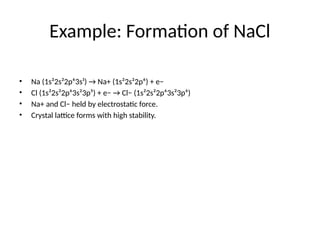
Example: Formation of NaCl
• Na (1s²2s²2p⁶3s¹) → Na+ (1s²2s²2p⁶) + e−
• Cl (1s²2s²2p⁶3s²3p⁵) + e− → Cl− (1s²2s²2p⁶3s²3p⁶)
• Na+ and Cl− held by electrostatic force.
• Crystal lattice forms with high stability.
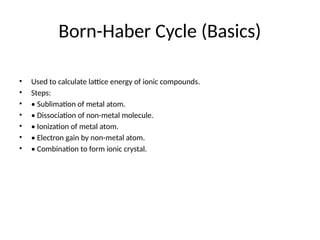
Born-Haber Cycle (Basics)
• Used to calculate lattice energy of ionic compounds.
• Steps:
• • Sublimation of metal atom.
• • Dissociation of non-metal molecule.
• • Ionization of metal atom.
• • Electron gain by non-metal atom.
• • Combination to form ionic crystal.
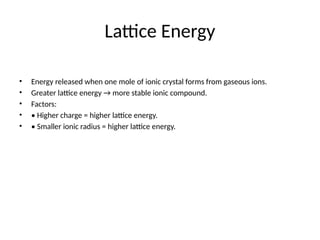
Lattice Energy
• Energy released when one mole of ionic crystal forms from gaseous ions.
• Greater lattice energy → more stable ionic compound.
• Factors:
• • Higher charge = higher lattice energy.
• • Smaller ionic radius = higher lattice energy.
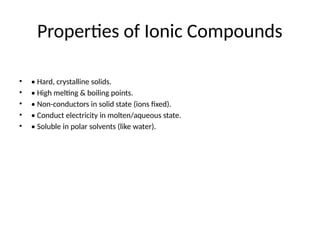
Properties of Ionic Compounds
• • Hard, crystalline solids.
• • High melting & boiling points.
• • Non-conductors in solid state (ions fixed).
• • Conduct electricity in molten/aqueous state.
• • Soluble in polar solvents (like water).
Examples of Ionic Compounds
• NaCl – common salt.
• MgO – refractory material.
• CaF2 – fluorite, used in metallurgy.
• Al2O3 – alumina, amphoteric oxide.
Comparison: Ionic vs Covalent
Bond (Intro)
• Ionic Bond:
• • Transfer of electrons.
• • Non-directional.
• • Strong electrostatic forces.
• Covalent Bond:
• • Sharing of electrons.
• • Directional.
• • Strong but weaker than ionic.

Chemical_Bonding_Batch1.pptx field toddler

  • 1.
    Chemical Bonding -Detailed PPT Batch 1: Introduction & Ionic Bond (Slides 1–20)
  • 2.
    Introduction • Atoms rarelyexist independently. • Molecules form when total energy decreases → stability increases. • Chemical Bond = Attractive force holding atoms together. • Examples: H2, O2, Cl2, NaCl.
  • 3.
    Need for Bonding •Atoms combine to achieve: • • Minimum Energy State (more stable). • • Noble Gas Configuration (octet rule). • Bond formation = Exothermic process (energy release).
  • 4.
    Definition of ChemicalBond • The attractive force that holds atoms together in a stable molecule. • Involves redistribution of valence electrons. • Bond formation → energy decreases → stability increases.
  • 5.
    Lewis Symbols • Valenceelectrons are represented as dots around element symbols. • Examples: • • H (1 electron): H• • • O (6 electrons): O•••• • • N (5 electrons): N••• • • Cl (7 electrons): Cl•••••••
  • 6.
    Octet Rule • Atomstend to achieve 8 electrons in outermost shell (stable configuration). • Achieved by: • • Losing electrons (Na → Na+). • • Gaining electrons (Cl → Cl−). • • Sharing electrons (H2, O2, N2).
  • 7.
    Exceptions to OctetRule • 1. Electron deficient molecules (BF3, BeCl2). • 2. Odd-electron molecules (NO2, NO). • 3. Expanded octet (SF6, PCl5, XeF4). • 4. Does not explain shapes or stability of molecules.
  • 8.
    Causes of ChemicalCombination • 1. Tendency to achieve minimum energy. • • Nucleus of one atom attracts electrons of another. • • Net attraction → potential energy decreases → bond forms. • 2. Noble Gas Configuration. • • Atoms combine to achieve stable electronic configuration.
  • 9.
    Ionic Bond -Definition • Formed by complete transfer of electrons. • Results in positively charged cation & negatively charged anion. • Held by strong electrostatic attraction. • Examples: NaCl, MgCl2, CaO.
  • 10.
    Conditions for IonicBond Formation • 1. Low Ionization Energy (easy cation formation). • 2. High Electron Affinity (easy anion formation). • 3. High Lattice Energy (strong ionic bond stability). • Favourable: Metals (s-block) + Non-metals (p-block).
  • 11.
    Example: Formation ofNaCl • Na (1s²2s²2p⁶3s¹) → Na+ (1s²2s²2p⁶) + e− • Cl (1s²2s²2p⁶3s²3p⁵) + e− → Cl− (1s²2s²2p⁶3s²3p⁶) • Na+ and Cl− held by electrostatic force. • Crystal lattice forms with high stability.
  • 12.
    Born-Haber Cycle (Basics) •Used to calculate lattice energy of ionic compounds. • Steps: • • Sublimation of metal atom. • • Dissociation of non-metal molecule. • • Ionization of metal atom. • • Electron gain by non-metal atom. • • Combination to form ionic crystal.
  • 13.
    Lattice Energy • Energyreleased when one mole of ionic crystal forms from gaseous ions. • Greater lattice energy → more stable ionic compound. • Factors: • • Higher charge = higher lattice energy. • • Smaller ionic radius = higher lattice energy.
  • 14.
    Properties of IonicCompounds • • Hard, crystalline solids. • • High melting & boiling points. • • Non-conductors in solid state (ions fixed). • • Conduct electricity in molten/aqueous state. • • Soluble in polar solvents (like water).
  • 15.
    Examples of IonicCompounds • NaCl – common salt. • MgO – refractory material. • CaF2 – fluorite, used in metallurgy. • Al2O3 – alumina, amphoteric oxide.
  • 16.
    Comparison: Ionic vsCovalent Bond (Intro) • Ionic Bond: • • Transfer of electrons. • • Non-directional. • • Strong electrostatic forces. • Covalent Bond: • • Sharing of electrons. • • Directional. • • Strong but weaker than ionic.