Trends in the Periodic Table
Why share questions?
• There are many excellent open
educational resources on the
internet.
• These include many videos of
more-or-less traditional university
lecturing.
• These questions have been
provided on a CC-BY basis to
facilitate peer instruction.
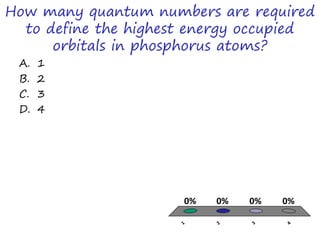
How many quantum numbers are required
to define the highest energy occupied
orbitals in phosphorus atoms?
A. 1
B. 2
C. 3
D. 4
1
2
3
4
0% 0%0%0%
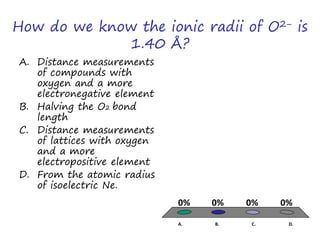
How do we know the ionic radii of O2− is
1.40 Å?
A. Distance measurements
of compounds with
oxygen and a more
electronegative element
B. Halving the O2 bond
length
C. Distance measurements
of lattices with oxygen
and a more
electropositive element
D. From the atomic radius
of isoelectric Ne.
A. B. C. D.
0% 0%0%0%
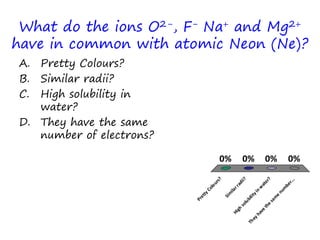
What do the ions O2-, F- Na+ and Mg2+
have in common with atomic Neon (Ne)?
A. Pretty Colours?
B. Similar radii?
C. High solubility in
water?
D. They have the same
number of electrons?
Pretty
Colours?
Sim
ilarradii?
High
solubilityin
w
ater?
They
have
the
sam
e
num
ber...
0% 0%0%0%
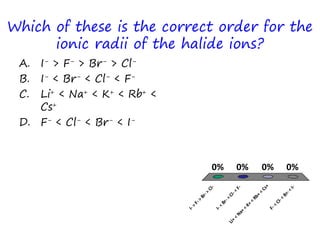
Which of these is the correct order for the
ionic radii of the halide ions?
A. I- > F- > Br- > Cl-
B. I- < Br- < Cl- < F-
C. Li+ < Na+ < K+ < Rb+ <
Cs+
D. F- < Cl- < Br- < I-
I->
F->
Br->
Cl-
I-<
Br-<Cl-<
F-
Li+
<
Na+
<
K+
<
Rb+
<
Cs+
F-<
Cl-<
Br-<
I-
0% 0%0%0%
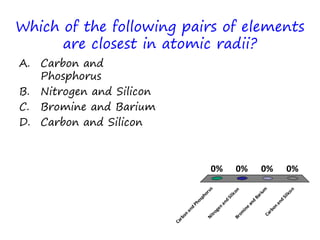
Which of the following pairs of elements
are closest in atomic radii?
A. Carbon and
Phosphorus
B. Nitrogen and Silicon
C. Bromine and Barium
D. Carbon and Silicon
Carbon
and
PhosphorusNitrogen
and
SiliconBrom
ine
and
Barium
Carbon
and
Silicon
0% 0%0%0%

Periodic table questions

  • 1.
    Trends in thePeriodic Table
  • 2.
    Why share questions? •There are many excellent open educational resources on the internet. • These include many videos of more-or-less traditional university lecturing. • These questions have been provided on a CC-BY basis to facilitate peer instruction.
  • 3.
    How many quantumnumbers are required to define the highest energy occupied orbitals in phosphorus atoms? A. 1 B. 2 C. 3 D. 4 1 2 3 4 0% 0%0%0%
  • 4.
    How do weknow the ionic radii of O2− is 1.40 Å? A. Distance measurements of compounds with oxygen and a more electronegative element B. Halving the O2 bond length C. Distance measurements of lattices with oxygen and a more electropositive element D. From the atomic radius of isoelectric Ne. A. B. C. D. 0% 0%0%0%
  • 5.
    What do theions O2-, F- Na+ and Mg2+ have in common with atomic Neon (Ne)? A. Pretty Colours? B. Similar radii? C. High solubility in water? D. They have the same number of electrons? Pretty Colours? Sim ilarradii? High solubilityin w ater? They have the sam e num ber... 0% 0%0%0%
  • 6.
    Which of theseis the correct order for the ionic radii of the halide ions? A. I- > F- > Br- > Cl- B. I- < Br- < Cl- < F- C. Li+ < Na+ < K+ < Rb+ < Cs+ D. F- < Cl- < Br- < I- I-> F-> Br-> Cl- I-< Br-<Cl-< F- Li+ < Na+ < K+ < Rb+ < Cs+ F-< Cl-< Br-< I- 0% 0%0%0%
  • 7.
    Which of thefollowing pairs of elements are closest in atomic radii? A. Carbon and Phosphorus B. Nitrogen and Silicon C. Bromine and Barium D. Carbon and Silicon Carbon and PhosphorusNitrogen and SiliconBrom ine and Barium Carbon and Silicon 0% 0%0%0%