QUANTUM
MECHANICAL
MODEL
Lesson Objectives
a.understand the development of
atomic models;
b.identify the energy levels, sublevels
and atomic orbitals in an atom; and
c. write the electron configuration of
the elements.
MOST ESSENTIAL LEARNING
COMPETENCIES
● Explain how the Quantum
Mechanical Model of the atom
describes the energies and
positions of the electrons.
ENABLING COMPETENCIES
● Describe how Bohr model of the
atom improved Rutherford`s
atomic model.
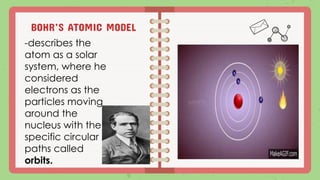
BOHR’S ATOMIC MODEL
-describes the
atom as a solar
system, where he
considered
electrons as the
particles moving
around the
nucleus with the
specific circular
paths called
orbits.
WAVE
MECHANICAL
MODEL OF AN
ATOM
De Broglie proposed
that the electrons
(which thought as a
particle) could also
be taught as a
wave.
LOUIS VICTOR DE BROGLIE
Erwin Schrodinger
-used the idea of De
Broglie to develop a
mathematical equation
to describe the
probable location of an
electron around the
nucleus.
Heisenberg
discovered that for
every small particle
like the electron, its
location cannot be
exactly known. This is
called the
Uncertainty Principle.
Werner Heisenberg
QUANTUM NUMBERS,
ORBITALS AND ENERGY
LEVELS
Quantum Number ORBITALS
are three-
dimensional
description of the
most likely location
of an atom.
-is a value that is
used when
describing the
energy levels
available to
atoms and
molecules.
ENERGY LEVEL
-a fixed amount of
energy that a system
described by quantum
mechanics, such as a
molecule, atom,
electron, or nucleus,
can have.
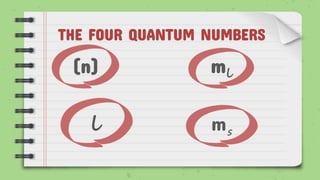
THE FOUR QUANTUM NUMBERS
(n)
l
ml
ms
PRINCIPAL QUANTUM
NUMBER
-describes the energy
level of an electron
inside an atom.
(n) = 1, 2, 3, 4 and so
on.
PRINCIPAL QUANTUM
NUMBER
-each principal
energy level is
also known as
an electron
shell.
-a collection
of atomic
orbitals with
the same
principal
quantum
number value.
ANGULAR MOMENTUM
QUANTUM NUMBER
- this number
describes the shape
of the sublevel within
an energy level.
- represented by l
ORBITALS
s (sharp)
l =0
p (principal)
l =1
d (diffuse)
l =2
f (fundamental)
l =3
Relationship between
(n) and (l)
l < n-1 n=2 l=0,1
n=1 l=0
n=3 l=0,1,2
MAGNETIC
QUANTUM
NUMBER
-number that
describes the
orbital within the
sublevel.
-represented by the
symbol (ml).
l ml
0 0
1 -1,0,1
2 -2,-1,0,1,2
3 -3,-2,-1,0,1,2,3
-indicates the
direction the
electron is spinning.
-represented by the
symbol ms.
ELECTRON
SPIN
ms= ±½
ELECTRON
CONFIGURATION
- is a way of
distributing the
electrons of the
atom among the
orbitals of the atom.
RULES IN ELECTRON
CONFIGURATION
PAULI’S
EXCLUSION
PRINCIPLE
-states that
electrons
occupying the
same orbitals must
have opposite
spin.
AUFBAU
PRINCIPLE
-the available
atomic orbitals with
the lowest energy
levels are occupied
before those with
higher energy
levels.
HUND’S
PRINCIPLE OF
MULTIPLICITY
-when electrons enter
a sublevel with more
than one orbital, they
will spread out to the
available orbitals with
the same spin before
pairing.
EXAMPLES
1s22s1
s=2 electrons
p=6 electrons
d= 10 electrons
f=14 electrons
1s22s22p3
4
Be
1s22s2
10
Ne
1s22s22p6
1s22s22p5
19
K
1s22s22p63s23p64s1
11
Na
1s22s22p63s1
29
Cu
1s22s22p63s23p64s23d9
14
Si
1s22s22p63s23p2
36
Kr
1s22s22p63s23p64s23d104p6
26
Fe
1s22s22p63s23p64s23d6
22
Ti
1s22s22p63s23p64s23d2
QUANTUM MECHANICAL MODEL.pptx

QUANTUM MECHANICAL MODEL.pptx