Introduction
To
Biochemistry
Prepared by: Bushra Deshpande
(M.Pharmacy)
K.Y.D.S.C.T'S COP Sakegaon.
BHUSAWAL
Introduction
The term Biochemistry’ was first introduced
by a German chemist, Cari New berg, in
1903.
It may be defined as, “the science, of
chemistry, of living matter in its different
phases of activity”.
Biochemistry in its broad aspects the most
comprehensive of all the branches of
chemistry includes organic, inorganic and
physical chemistry to the extent.
• Which is related to the chemistry of living
things, both the plants and animals.
WHAT IS BIOCHEMISTRY?
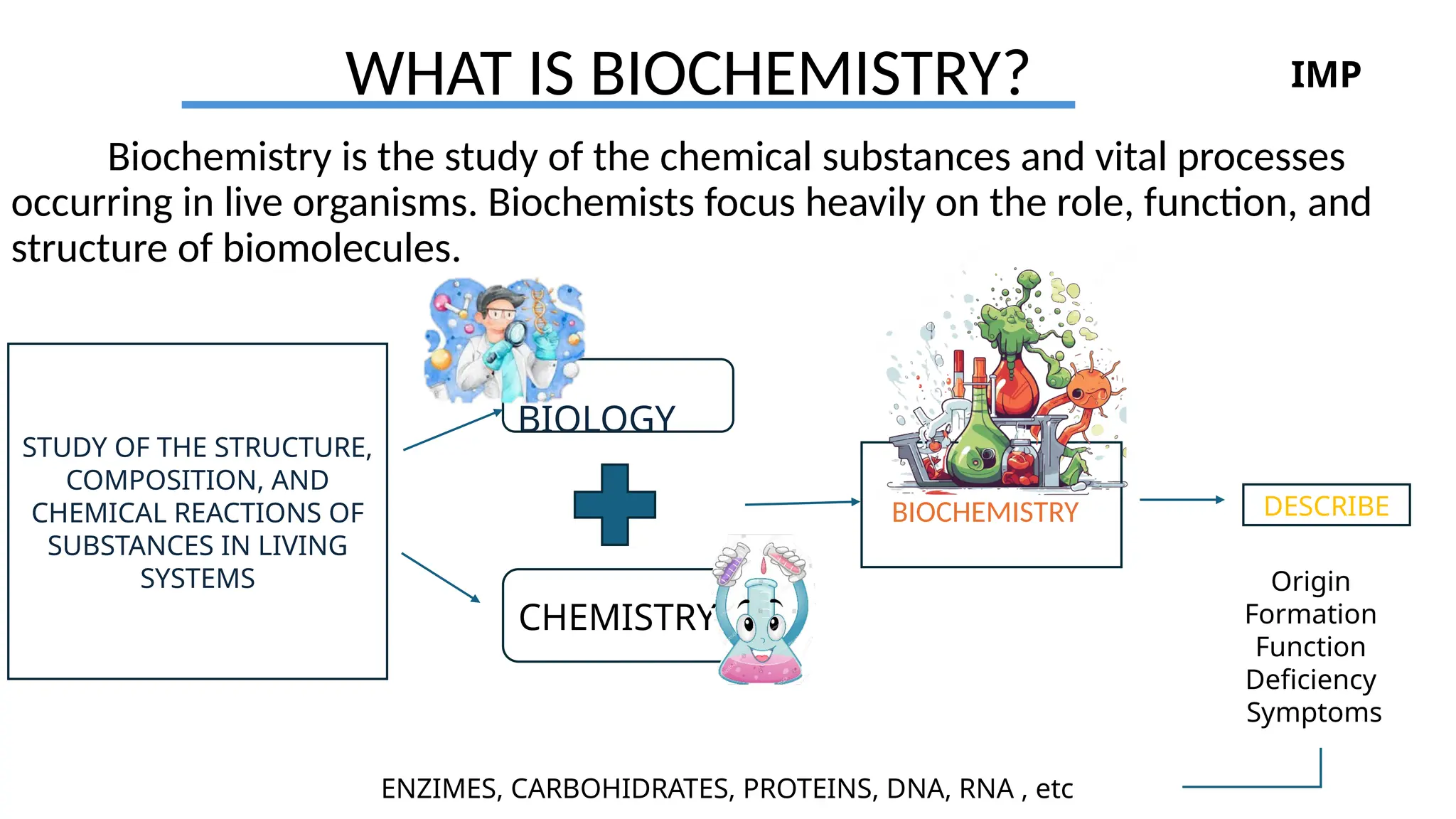
Biochemistry is the study of the chemical substances and vital processes
occurring in live organisms. Biochemists focus heavily on the role, function, and
structure of biomolecules.
STUDY OF THE STRUCTURE,
COMPOSITION, AND
CHEMICAL REACTIONS OF
SUBSTANCES IN LIVING
SYSTEMS
BIOLOGY
CHEMISTRY
BIOCHEMISTRY
Origin
Formation
Function
Deficiency
Symptoms
ENZIMES, CARBOHIDRATES, PROTEINS, DNA, RNA , etc
DESCRIBE
IMP
Biochemistry is Super chemistry.
which Biochemistry includes the relationship of living organisms to their
environment, the process by exchange of chemical sub take place through the
digestion, absorption and excretion.
By which the absorbed materials are utilized for synthetic reactions leading to
growth, Replenishment of tissues & multiplication of the cell and species for the
metabolic breakdown of materials to supply energy.
• The mechanism which regulate with precision all these processes by means of
hormonal and neuro-regulatory stimuli- all these come under the biochemistry.
Hence, it is called super chemistry.
• Biochemistry has wide areas of cell biology and all of molecular biology.
• Biochemical genetics is the field that has stimulated a lively interest, is a field of
biochemistry.
• “Genetics is the study of heredity, the process in which a parent passes certain
genes onto their children.”
(such as characteristics, natural talents and genetic disorders.)
Objective of Biochemistry
To study and understand the structures and properties of
substances constituting the fretwork of cell and tissues.
To study the structures and properties of substances
which enter the cell as sources of energy or leave the cell
as waste products.
1. To study the catalytic activity of enzymes.
2. To study processes that convert diet into compound
which are characterizes of the cells of a given species
3. To study the manifold energy requiring process of the
living cell.
4. To study the chemistry of in heritance.
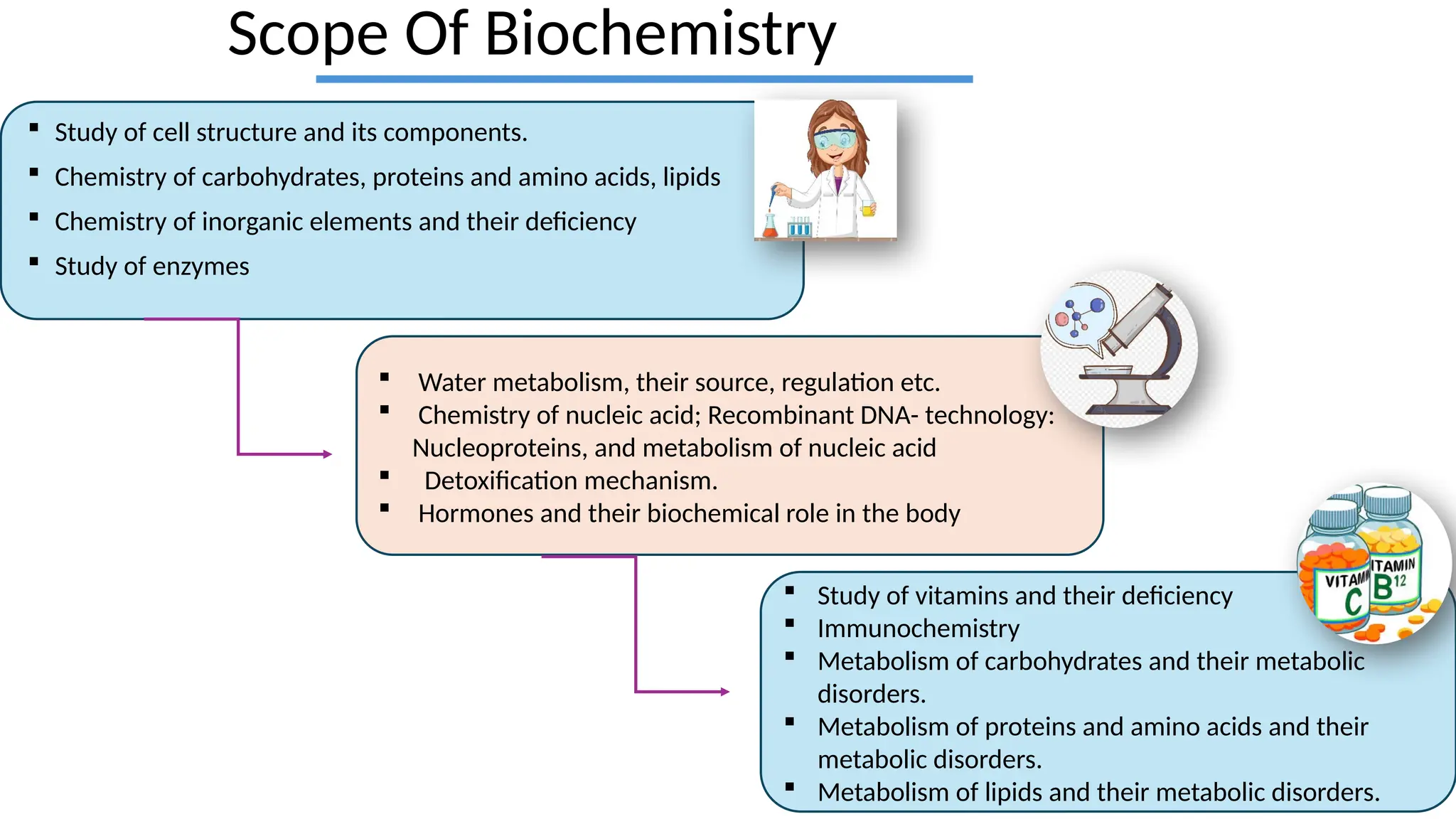
Scope Of Biochemistry
 Study of cell structure and its components.
 Chemistry of carbohydrates, proteins and amino acids, lipids
 Chemistry of inorganic elements and their deficiency
 Study of enzymes
 Study of vitamins and their deficiency
 Immunochemistry
 Metabolism of carbohydrates and their metabolic
disorders.
 Metabolism of proteins and amino acids and their
metabolic disorders.
 Metabolism of lipids and their metabolic disorders.
 Water metabolism, their source, regulation etc.
 Chemistry of nucleic acid; Recombinant DNA- technology:
Nucleoproteins, and metabolism of nucleic acid
 Detoxification mechanism.
 Hormones and their biochemical role in the body
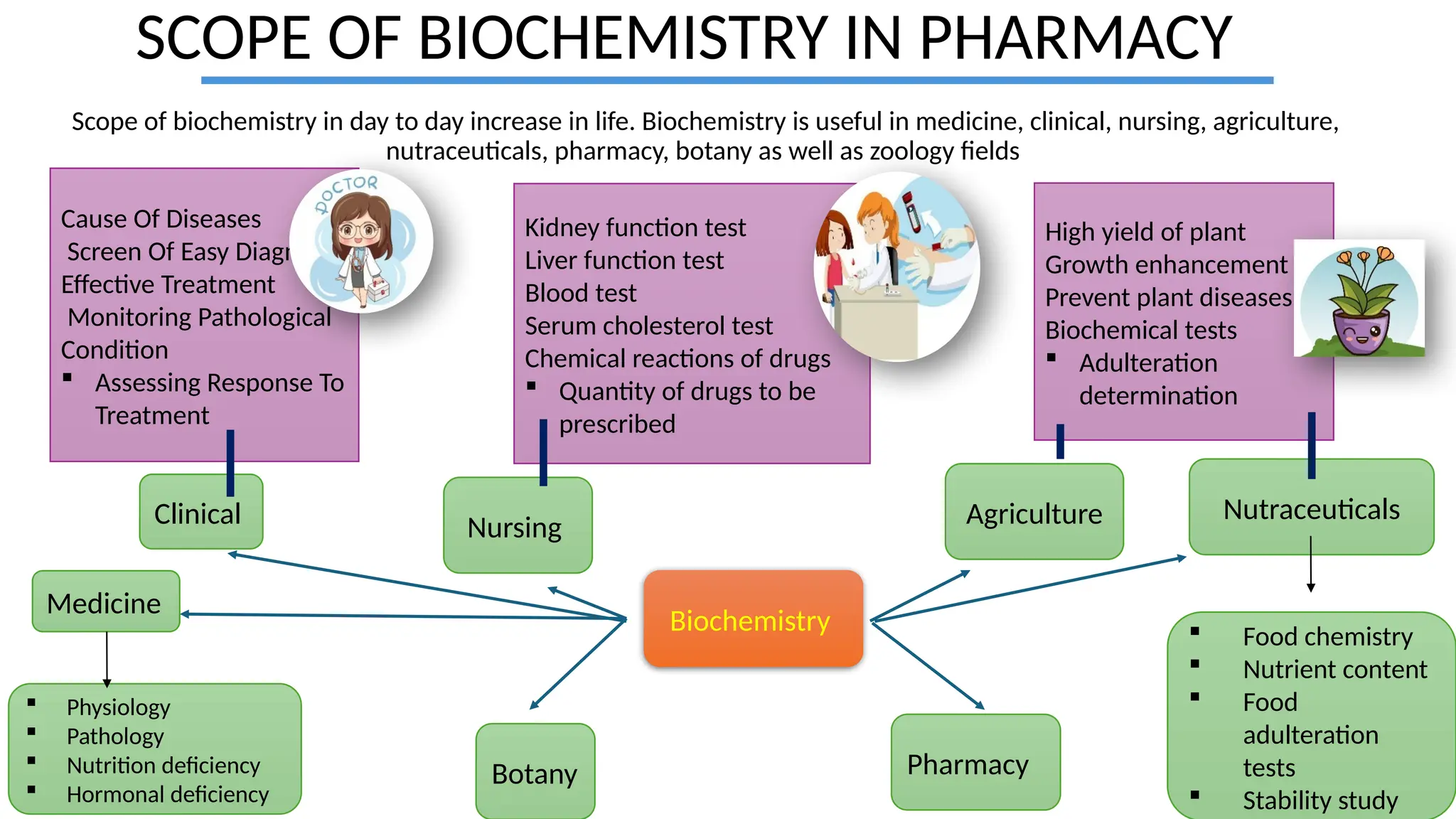
SCOPE OF BIOCHEMISTRY IN PHARMACY
Scope of biochemistry in day to day increase in life. Biochemistry is useful in medicine, clinical, nursing, agriculture,
nutraceuticals, pharmacy, botany as well as zoology fields
Cause Of Diseases
Screen Of Easy Diagnosis
Effective Treatment
Monitoring Pathological
Condition
 Assessing Response To
Treatment
Kidney function test
Liver function test
Blood test
Serum cholesterol test
Chemical reactions of drugs
 Quantity of drugs to be
prescribed
High yield of plant
Growth enhancement
Prevent plant diseases
Biochemical tests
 Adulteration
determination
Clinical Agriculture
Nursing
Nutraceuticals
 Food chemistry
 Nutrient content
 Food
adulteration
tests
 Stability study
 Physiology
 Pathology
 Nutrition deficiency
 Hormonal deficiency
Botany
Medicine
Pharmacy
Biochemistry
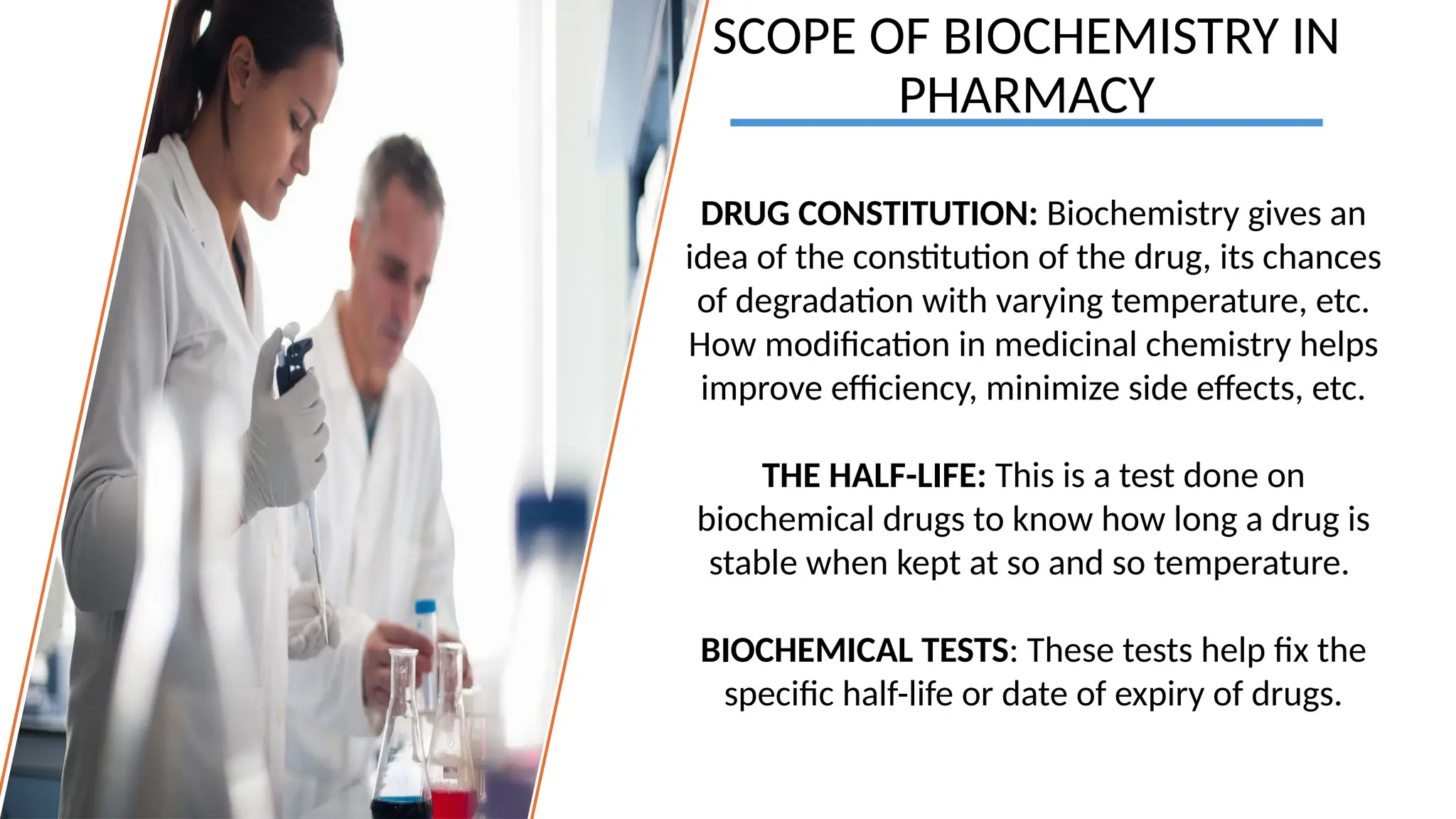
SCOPE OF BIOCHEMISTRY IN
PHARMACY
DRUG CONSTITUTION: Biochemistry gives an
idea of the constitution of the drug, its chances
of degradation with varying temperature, etc.
How modification in medicinal chemistry helps
improve efficiency, minimize side effects, etc.
THE HALF-LIFE: This is a test done on
biochemical drugs to know how long a drug is
stable when kept at so and so temperature.
BIOCHEMICAL TESTS: These tests help fix the
specific half-life or date of expiry of drugs.
• DRUG STORAGE: The storage condition
required can judge the value by the
biochemical test.
For example, many enzymes, hormones are
stored for dispensing.
• DRUG METABOLISM: It also gives an idea of
how drug molecules are metabolized by many
biochemical reactions in the presence of
enzymes. This helps to avoid drugs which have
a poor metabolism or those with excessive side
effects from being prescribed or dispensed to
the patient.
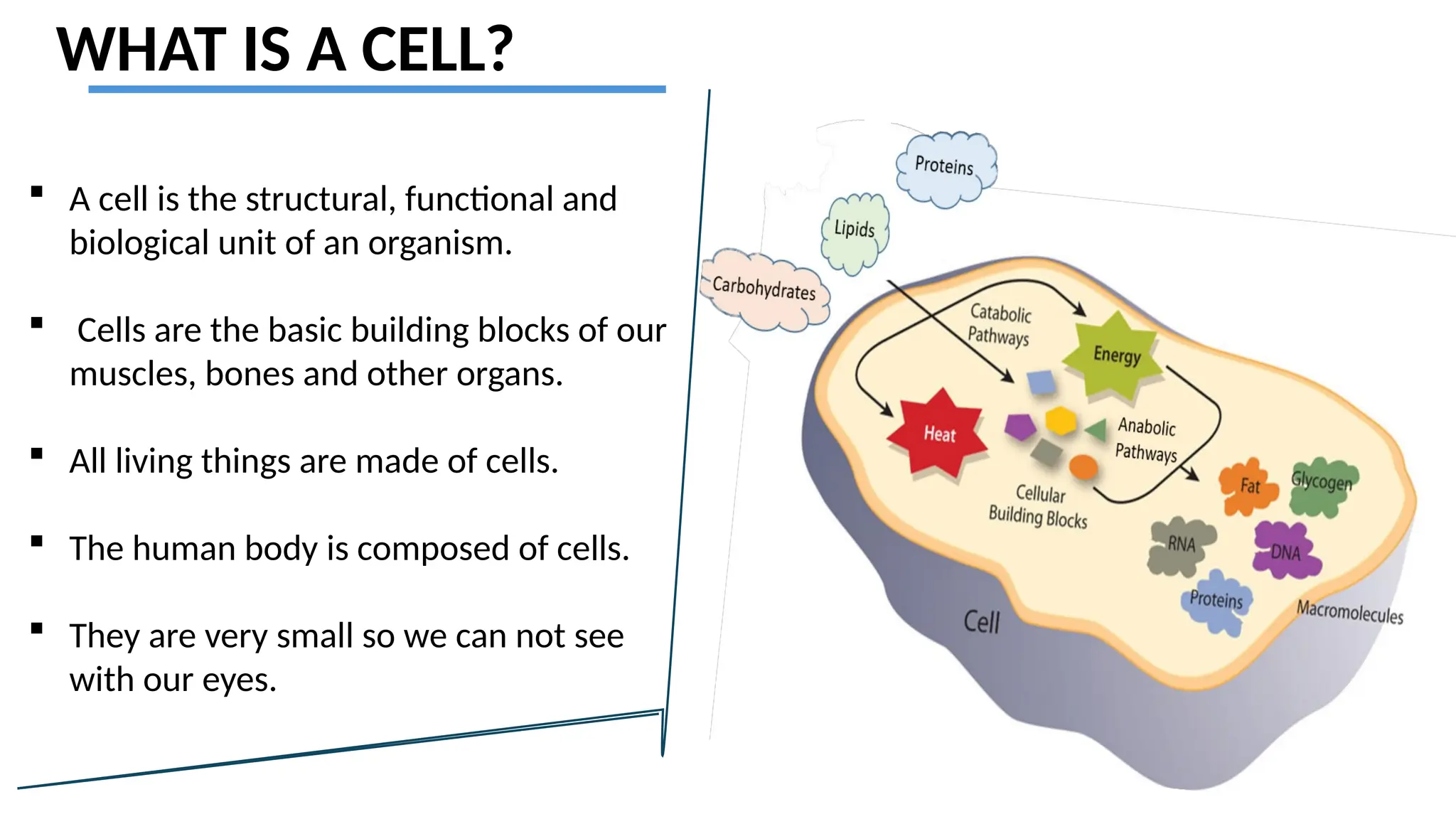
WHAT IS A CELL?
 A cell is the structural, functional and
biological unit of an organism.
 Cells are the basic building blocks of our
muscles, bones and other organs.
 All living things are made of cells.
 The human body is composed of cells.
 They are very small so we can not see
with our eyes.
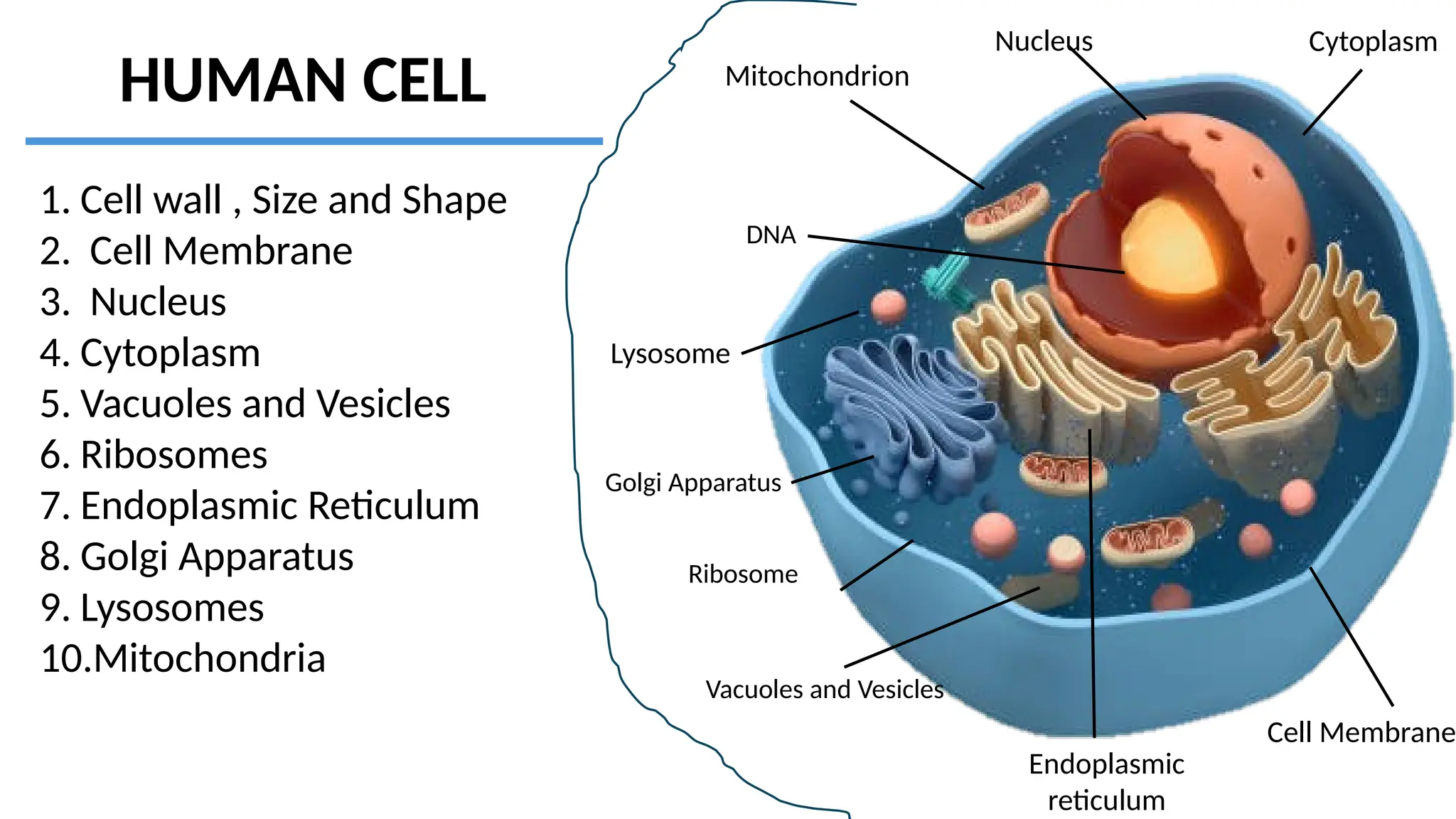
HUMAN CELL
Cell Membrane
Cytoplasm
Mitochondrion
Nucleus
DNA
Endoplasmic
reticulum
Lysosome
Ribosome
1. Cell wall , Size and Shape
2. Cell Membrane
3. Nucleus
4. Cytoplasm
5. Vacuoles and Vesicles
6. Ribosomes
7. Endoplasmic Reticulum
8. Golgi Apparatus
9. Lysosomes
10.Mitochondria
Vacuoles and Vesicles
Golgi Apparatus
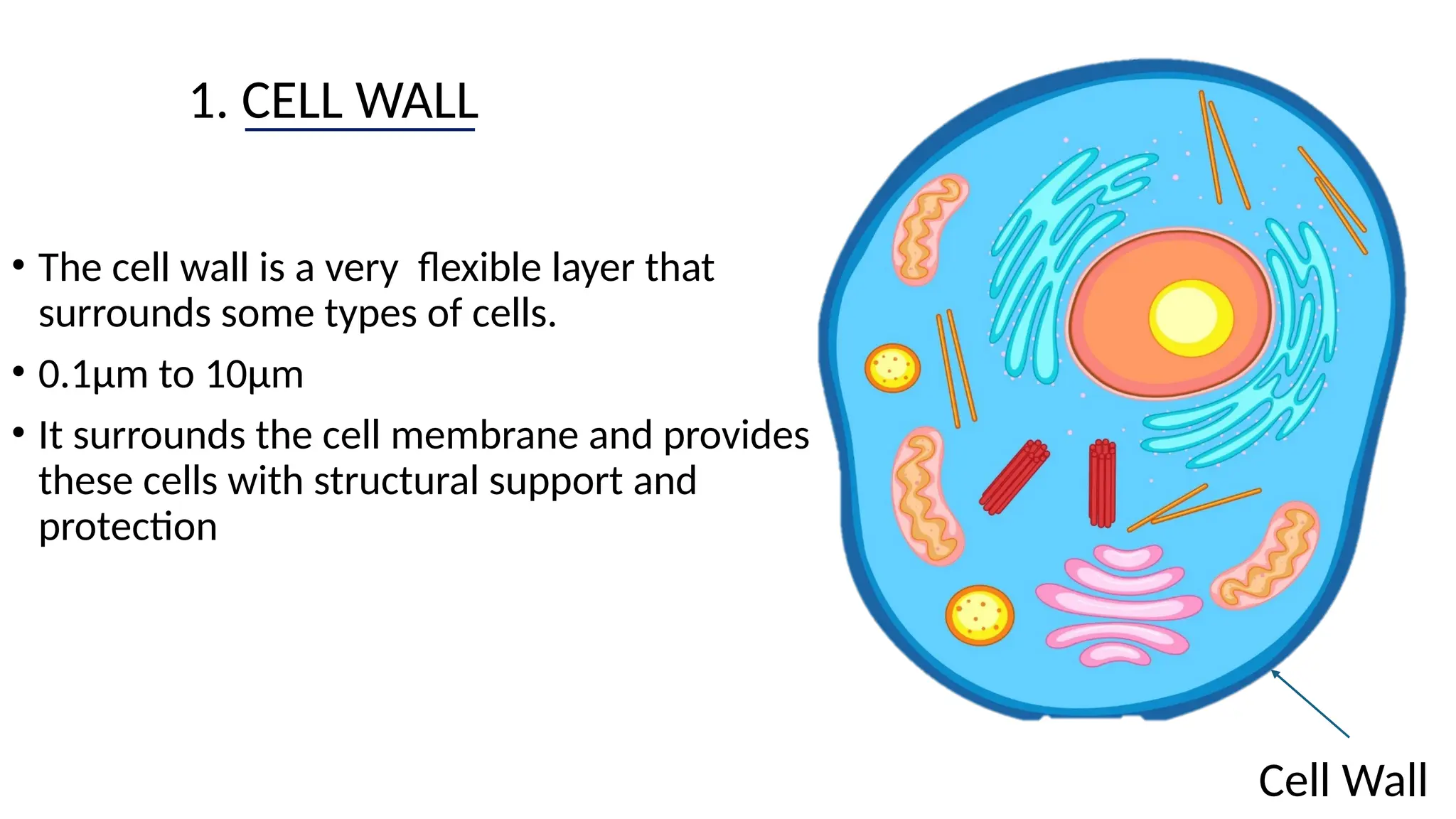
1. CELL WALL
• The cell wall is a very flexible layer that
surrounds some types of cells.
• 0.1µm to 10µm
• It surrounds the cell membrane and provides
these cells with structural support and
protection
Cell Wall
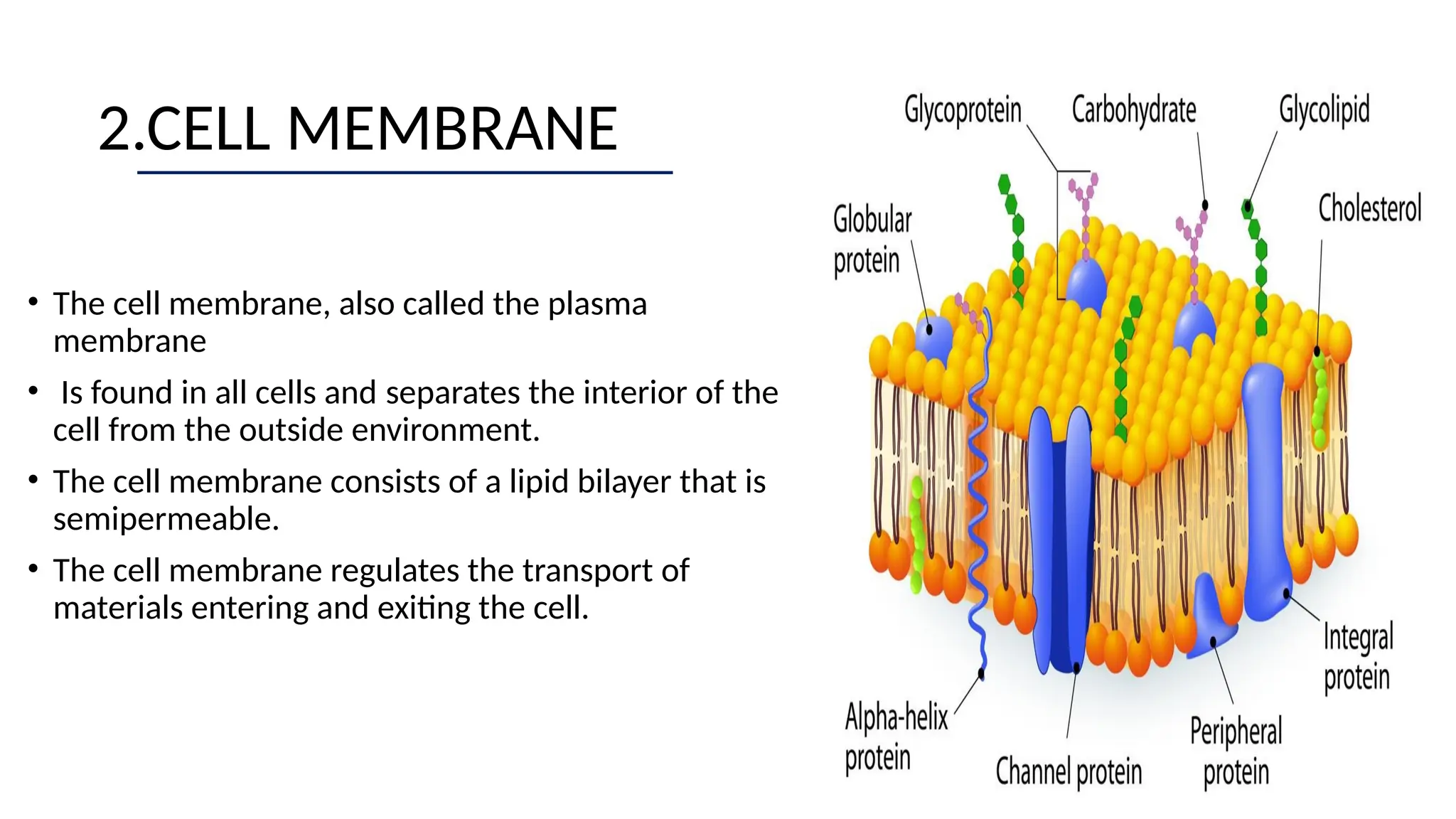
2.CELL MEMBRANE
• The cell membrane, also called the plasma
membrane
• Is found in all cells and separates the interior of the
cell from the outside environment.
• The cell membrane consists of a lipid bilayer that is
semipermeable.
• The cell membrane regulates the transport of
materials entering and exiting the cell.
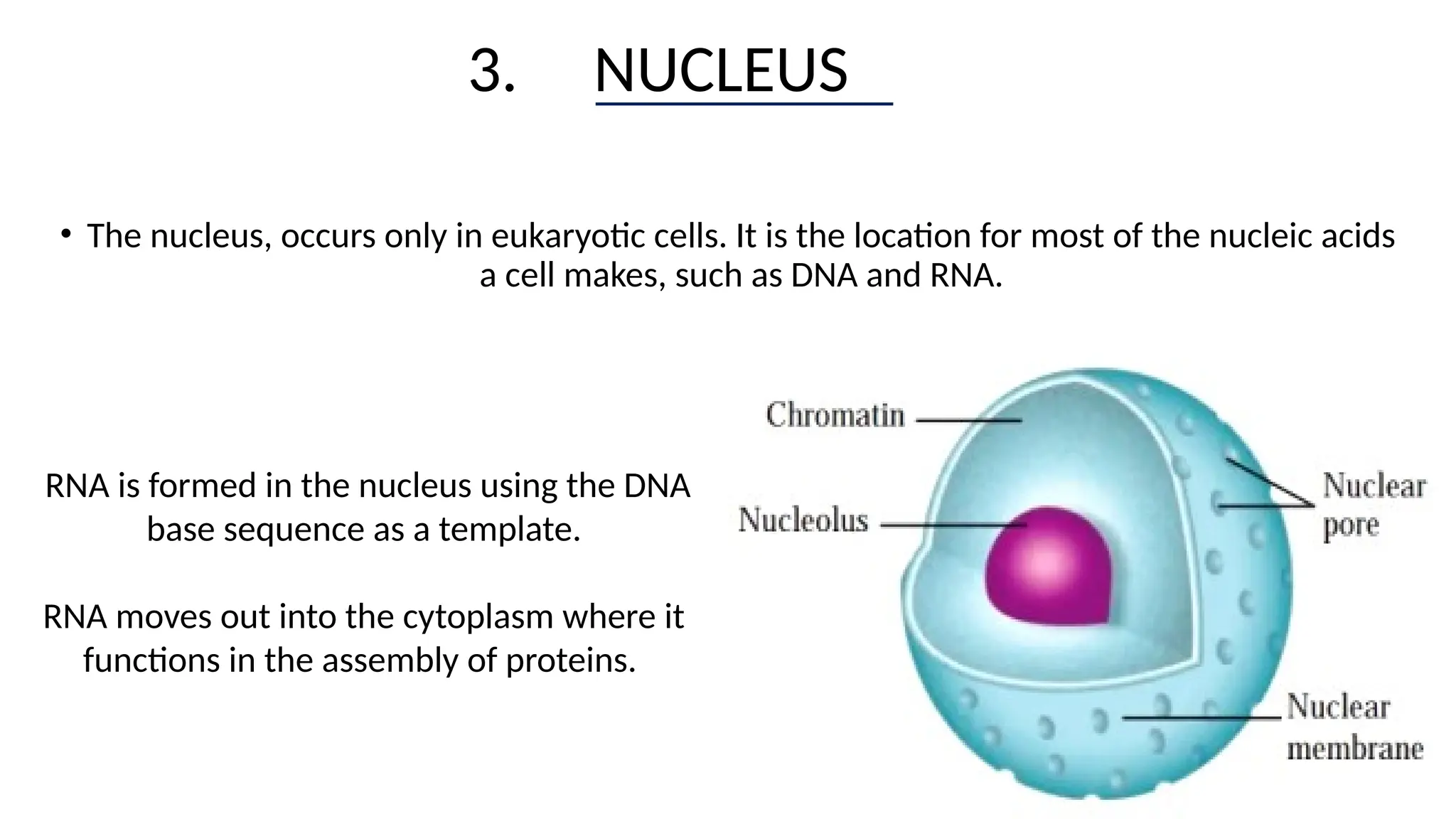
3. NUCLEUS
• The nucleus, occurs only in eukaryotic cells. It is the location for most of the nucleic acids
a cell makes, such as DNA and RNA.
RNA is formed in the nucleus using the DNA
base sequence as a template.
RNA moves out into the cytoplasm where it
functions in the assembly of proteins.
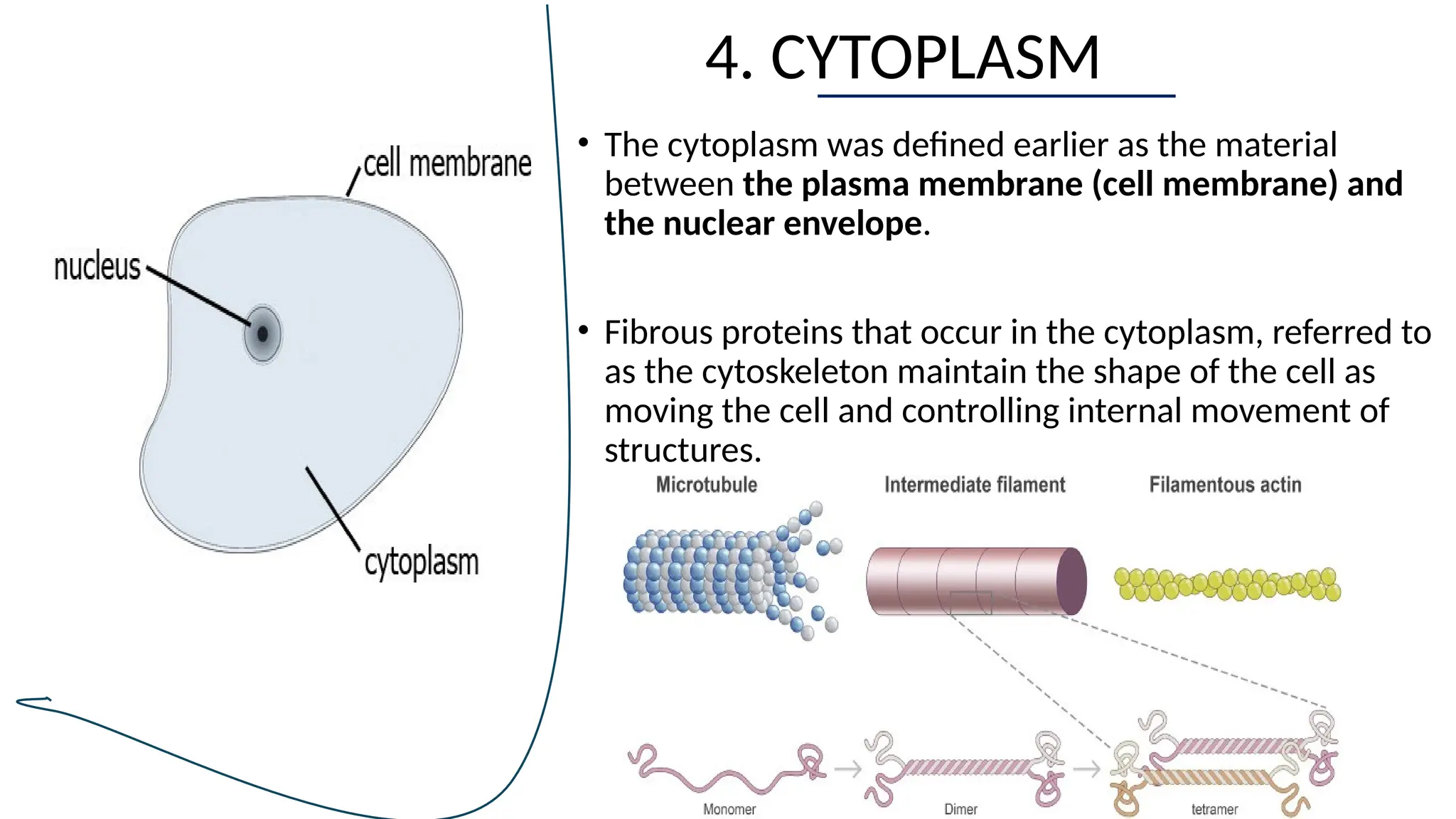
4. CYTOPLASM
• The cytoplasm was defined earlier as the material
between the plasma membrane (cell membrane) and
the nuclear envelope.
• Fibrous proteins that occur in the cytoplasm, referred to
as the cytoskeleton maintain the shape of the cell as
moving the cell and controlling internal movement of
structures.
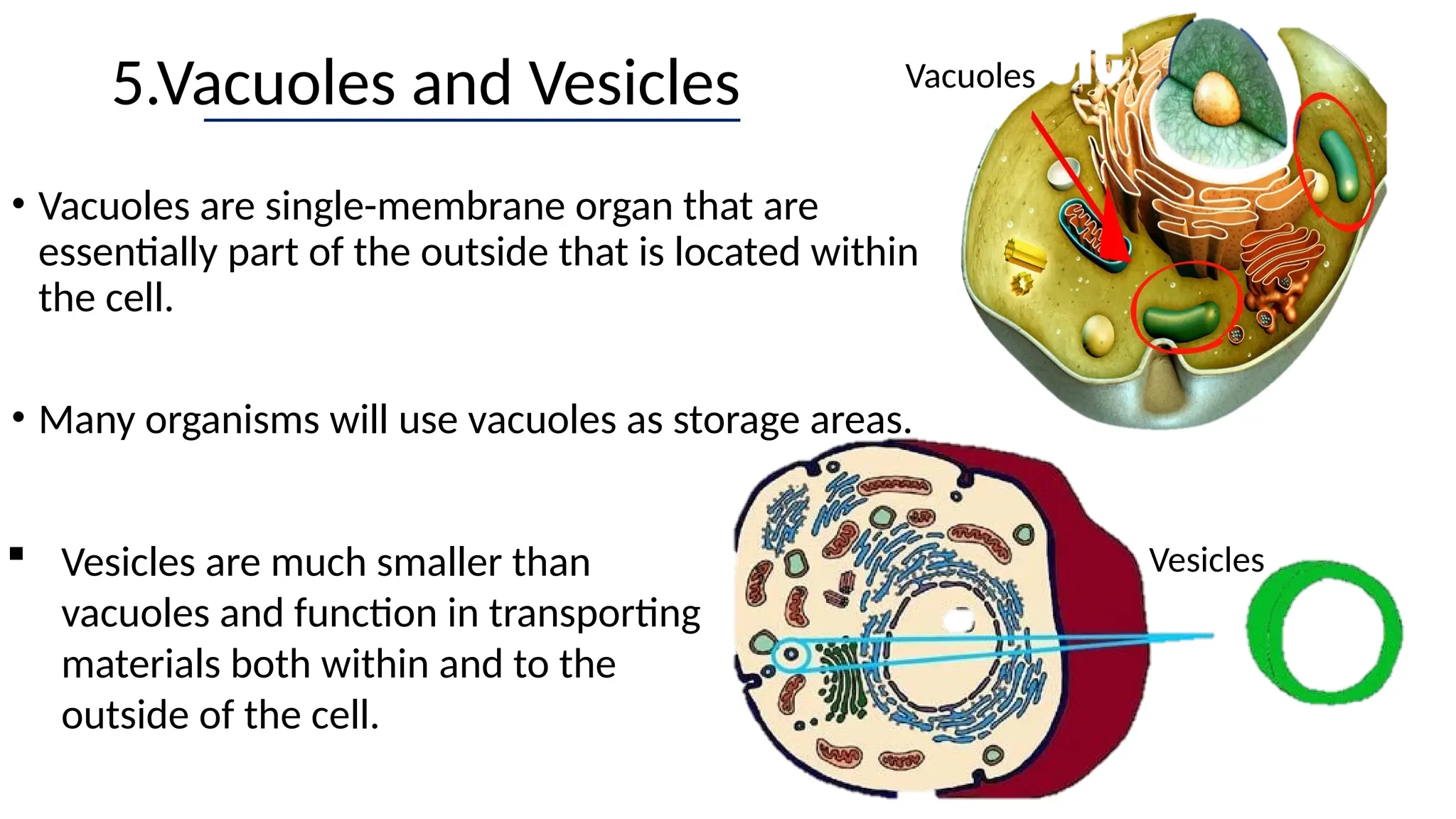
5.Vacuoles and Vesicles
• Vacuoles are single-membrane organ that are
essentially part of the outside that is located within
the cell.
• Many organisms will use vacuoles as storage areas.
Vacuoles
Vesicles
 Vesicles are much smaller than
vacuoles and function in transporting
materials both within and to the
outside of the cell.
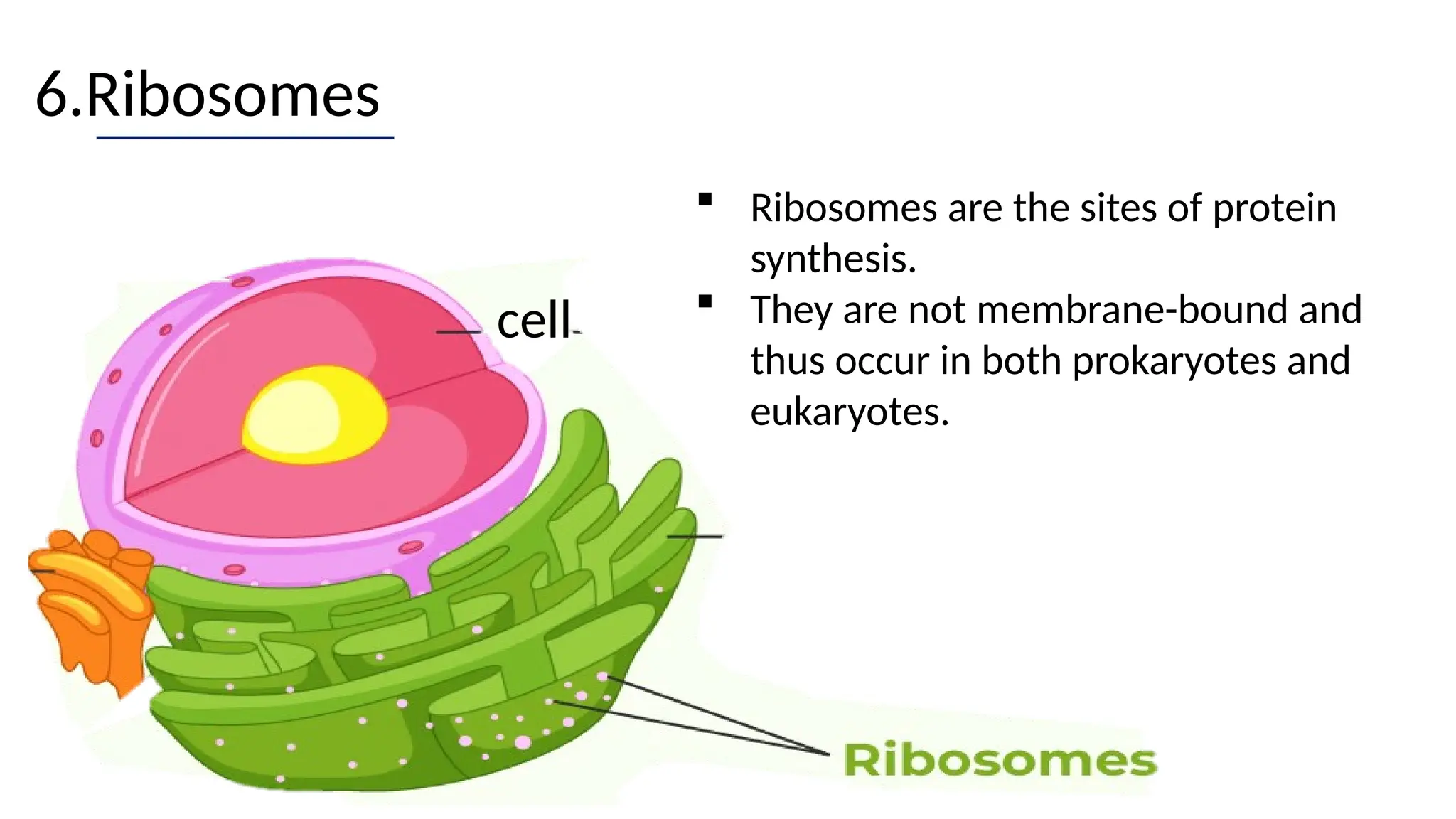
6.Ribosomes
 Ribosomes are the sites of protein
synthesis.
 They are not membrane-bound and
thus occur in both prokaryotes and
eukaryotes.
cell
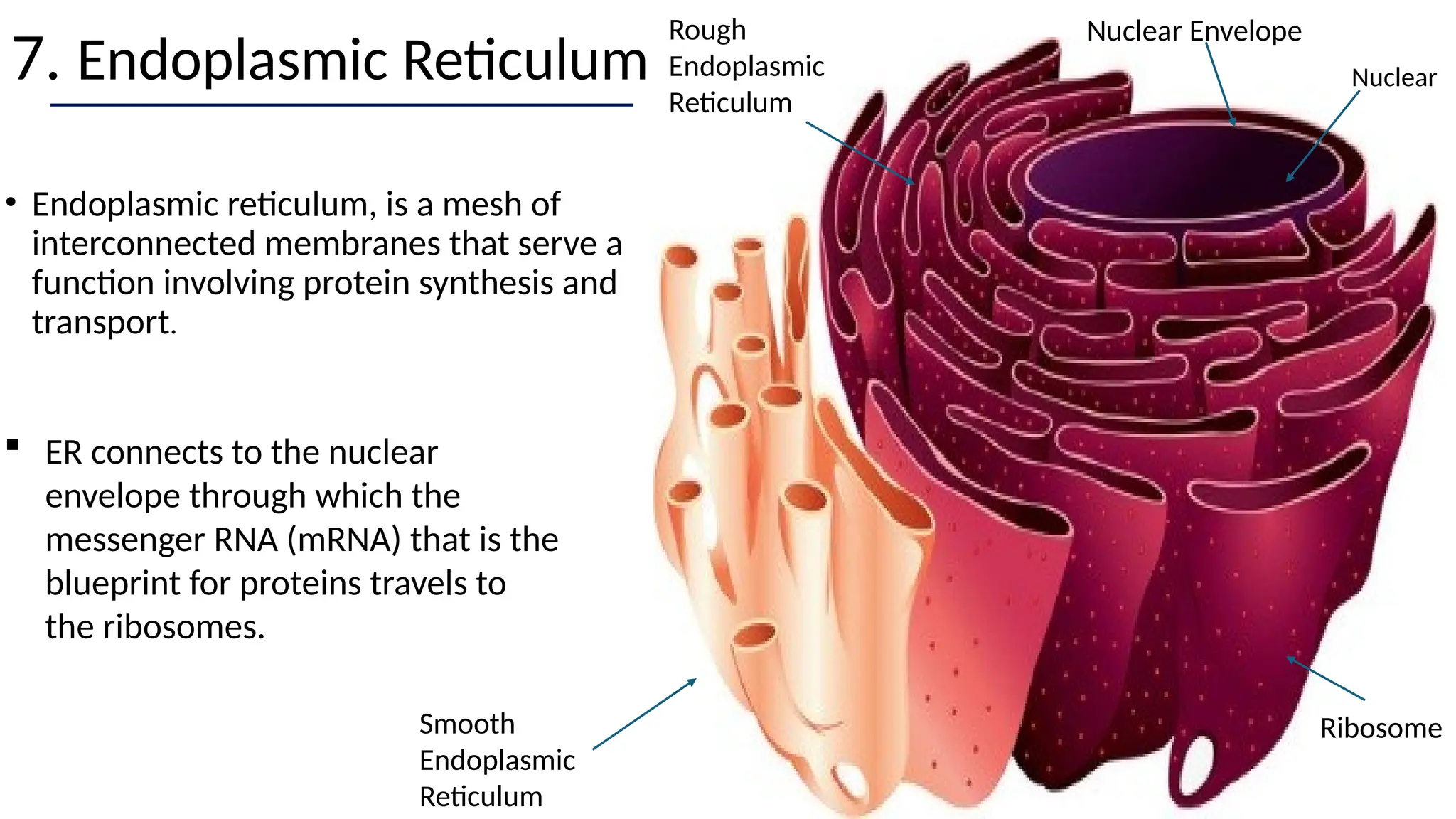
7. Endoplasmic Reticulum
• Endoplasmic reticulum, is a mesh of
interconnected membranes that serve a
function involving protein synthesis and
transport.
Rough
Endoplasmic
Reticulum
Nuclear Envelope
Nuclear
Smooth
Endoplasmic
Reticulum
Ribosome
 ER connects to the nuclear
envelope through which the
messenger RNA (mRNA) that is the
blueprint for proteins travels to
the ribosomes.
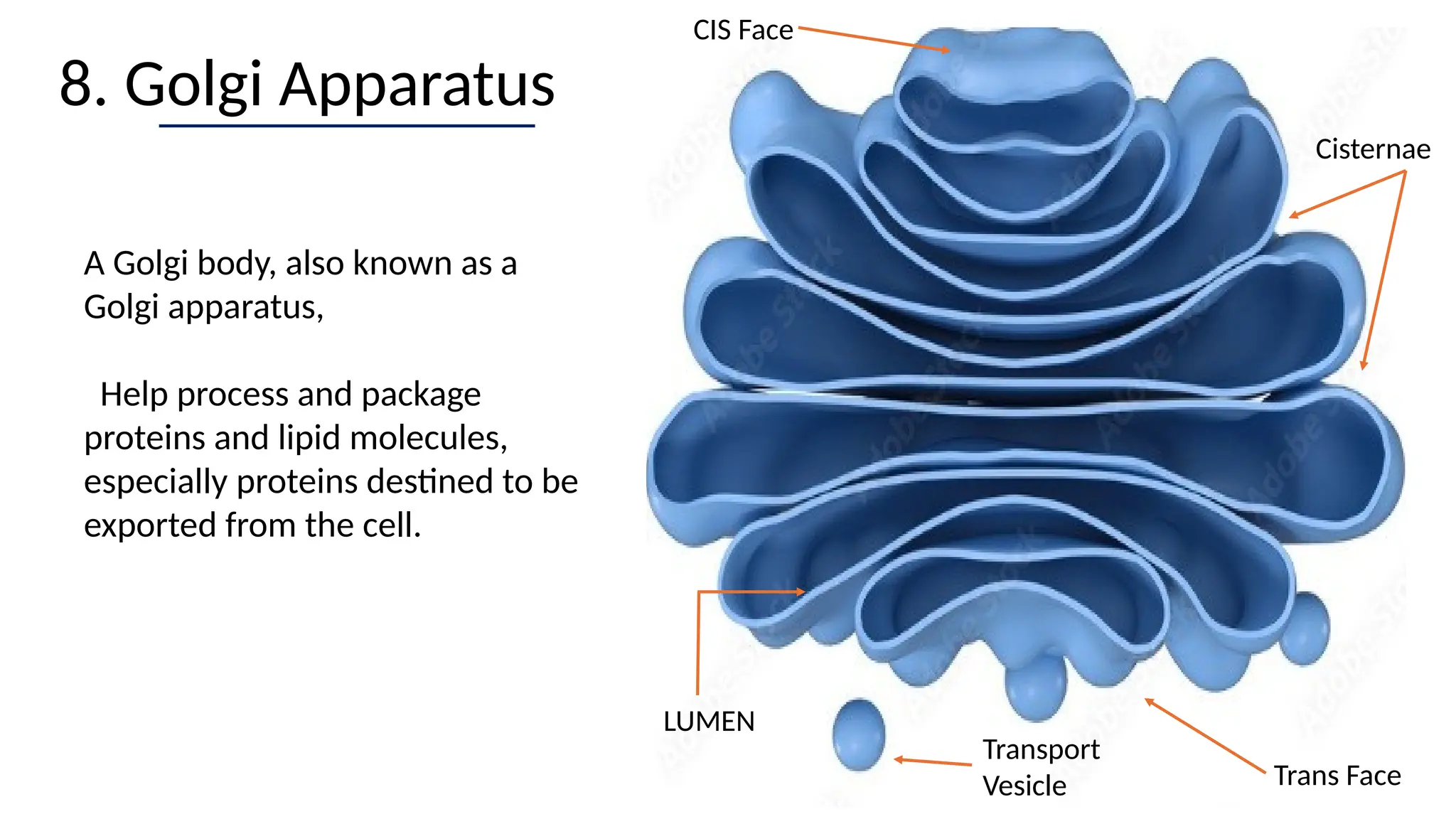
8. Golgi Apparatus
CIS Face
Transport
Vesicle
Cisternae
LUMEN
Trans Face
A Golgi body, also known as a
Golgi apparatus,
Help process and package
proteins and lipid molecules,
especially proteins destined to be
exported from the cell.
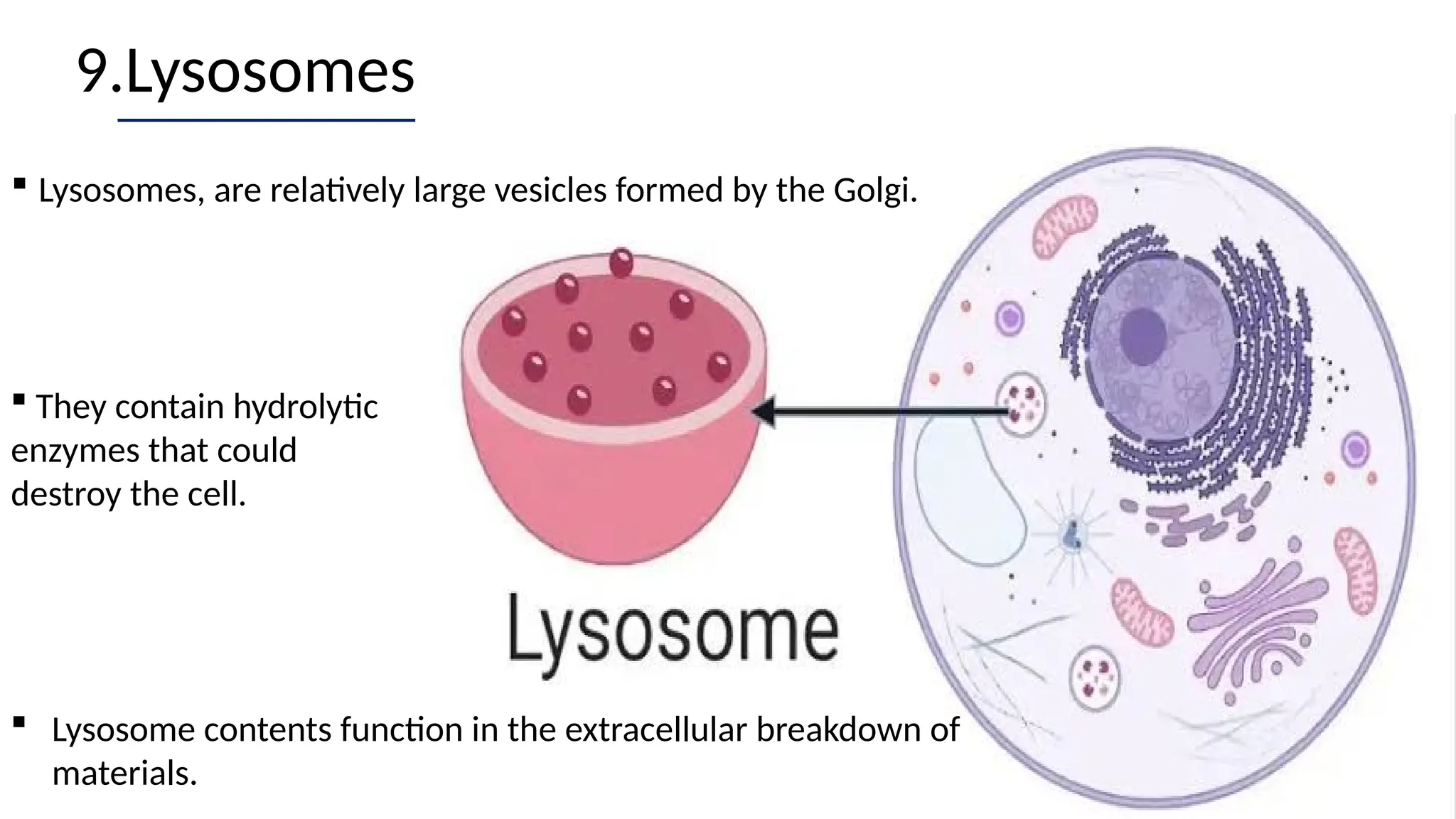
9.Lysosomes
 Lysosomes, are relatively large vesicles formed by the Golgi.
 Lysosome contents function in the extracellular breakdown of
materials.
 They contain hydrolytic
enzymes that could
destroy the cell.
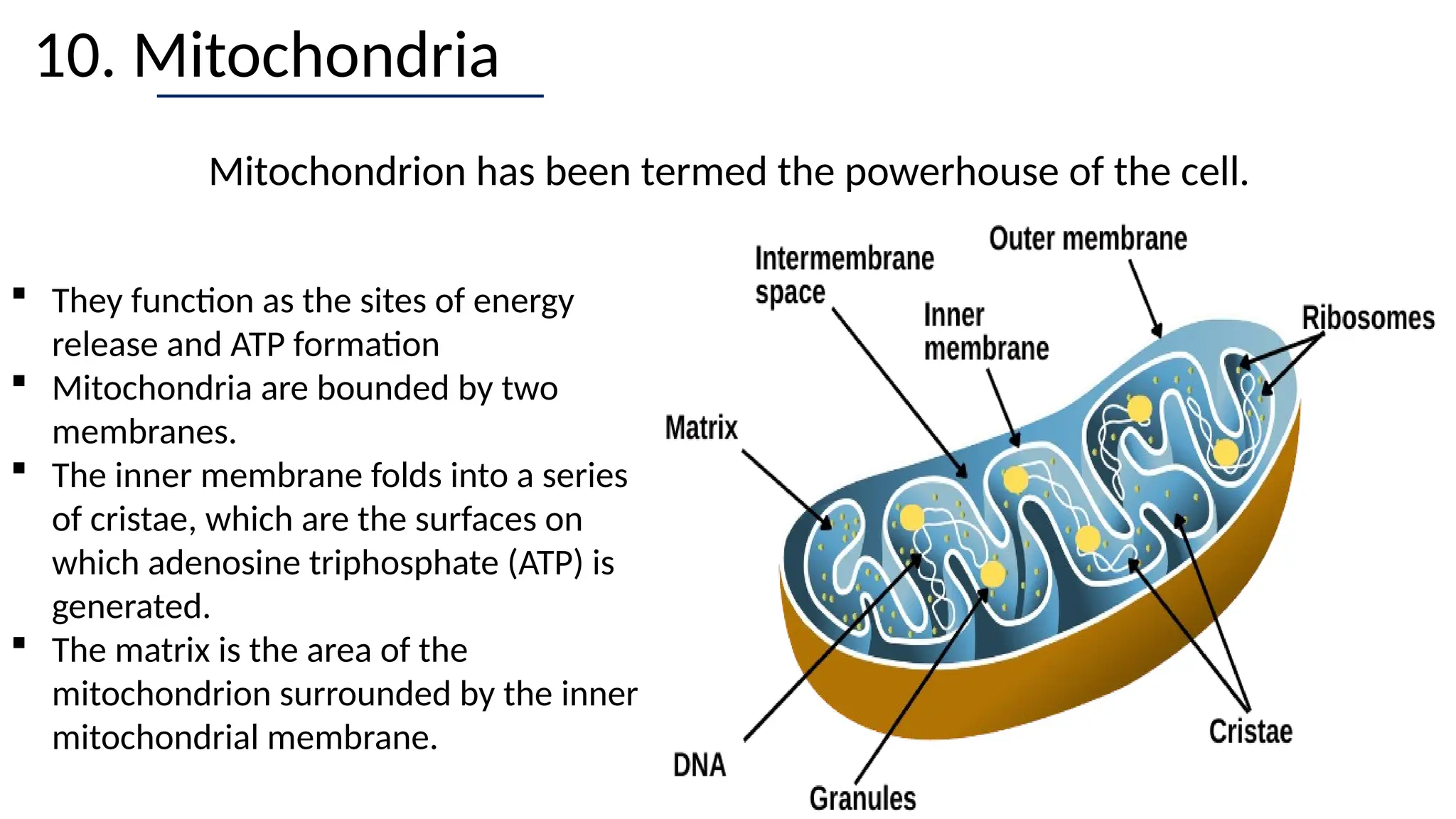
10. Mitochondria
 They function as the sites of energy
release and ATP formation
 Mitochondria are bounded by two
membranes.
 The inner membrane folds into a series
of cristae, which are the surfaces on
which adenosine triphosphate (ATP) is
generated.
 The matrix is the area of the
mitochondrion surrounded by the inner
mitochondrial membrane.
Mitochondrion has been termed the powerhouse of the cell.
1.What is biochemistry ?
2.What is objective of biochemistry?
3.What is scope of biochemistry in pharmacy ?
4.What is a cell? Explain describe a typical cell
Introduction To Biochemistry   Department of Biochemistry

Introduction To Biochemistry Department of Biochemistry

  • 1.
    Introduction To Biochemistry Prepared by: BushraDeshpande (M.Pharmacy) K.Y.D.S.C.T'S COP Sakegaon. BHUSAWAL
  • 2.
    Introduction The term Biochemistry’was first introduced by a German chemist, Cari New berg, in 1903. It may be defined as, “the science, of chemistry, of living matter in its different phases of activity”. Biochemistry in its broad aspects the most comprehensive of all the branches of chemistry includes organic, inorganic and physical chemistry to the extent. • Which is related to the chemistry of living things, both the plants and animals.
  • 3.
    WHAT IS BIOCHEMISTRY? Biochemistryis the study of the chemical substances and vital processes occurring in live organisms. Biochemists focus heavily on the role, function, and structure of biomolecules. STUDY OF THE STRUCTURE, COMPOSITION, AND CHEMICAL REACTIONS OF SUBSTANCES IN LIVING SYSTEMS BIOLOGY CHEMISTRY BIOCHEMISTRY Origin Formation Function Deficiency Symptoms ENZIMES, CARBOHIDRATES, PROTEINS, DNA, RNA , etc DESCRIBE IMP
  • 4.
    Biochemistry is Superchemistry. which Biochemistry includes the relationship of living organisms to their environment, the process by exchange of chemical sub take place through the digestion, absorption and excretion. By which the absorbed materials are utilized for synthetic reactions leading to growth, Replenishment of tissues & multiplication of the cell and species for the metabolic breakdown of materials to supply energy. • The mechanism which regulate with precision all these processes by means of hormonal and neuro-regulatory stimuli- all these come under the biochemistry. Hence, it is called super chemistry. • Biochemistry has wide areas of cell biology and all of molecular biology. • Biochemical genetics is the field that has stimulated a lively interest, is a field of biochemistry. • “Genetics is the study of heredity, the process in which a parent passes certain genes onto their children.” (such as characteristics, natural talents and genetic disorders.)
  • 5.
    Objective of Biochemistry Tostudy and understand the structures and properties of substances constituting the fretwork of cell and tissues. To study the structures and properties of substances which enter the cell as sources of energy or leave the cell as waste products. 1. To study the catalytic activity of enzymes. 2. To study processes that convert diet into compound which are characterizes of the cells of a given species 3. To study the manifold energy requiring process of the living cell. 4. To study the chemistry of in heritance.
  • 6.
    Scope Of Biochemistry Study of cell structure and its components.  Chemistry of carbohydrates, proteins and amino acids, lipids  Chemistry of inorganic elements and their deficiency  Study of enzymes  Study of vitamins and their deficiency  Immunochemistry  Metabolism of carbohydrates and their metabolic disorders.  Metabolism of proteins and amino acids and their metabolic disorders.  Metabolism of lipids and their metabolic disorders.  Water metabolism, their source, regulation etc.  Chemistry of nucleic acid; Recombinant DNA- technology: Nucleoproteins, and metabolism of nucleic acid  Detoxification mechanism.  Hormones and their biochemical role in the body
  • 7.
    SCOPE OF BIOCHEMISTRYIN PHARMACY Scope of biochemistry in day to day increase in life. Biochemistry is useful in medicine, clinical, nursing, agriculture, nutraceuticals, pharmacy, botany as well as zoology fields Cause Of Diseases Screen Of Easy Diagnosis Effective Treatment Monitoring Pathological Condition  Assessing Response To Treatment Kidney function test Liver function test Blood test Serum cholesterol test Chemical reactions of drugs  Quantity of drugs to be prescribed High yield of plant Growth enhancement Prevent plant diseases Biochemical tests  Adulteration determination Clinical Agriculture Nursing Nutraceuticals  Food chemistry  Nutrient content  Food adulteration tests  Stability study  Physiology  Pathology  Nutrition deficiency  Hormonal deficiency Botany Medicine Pharmacy Biochemistry
  • 8.
    SCOPE OF BIOCHEMISTRYIN PHARMACY DRUG CONSTITUTION: Biochemistry gives an idea of the constitution of the drug, its chances of degradation with varying temperature, etc. How modification in medicinal chemistry helps improve efficiency, minimize side effects, etc. THE HALF-LIFE: This is a test done on biochemical drugs to know how long a drug is stable when kept at so and so temperature. BIOCHEMICAL TESTS: These tests help fix the specific half-life or date of expiry of drugs.
  • 9.
    • DRUG STORAGE:The storage condition required can judge the value by the biochemical test. For example, many enzymes, hormones are stored for dispensing. • DRUG METABOLISM: It also gives an idea of how drug molecules are metabolized by many biochemical reactions in the presence of enzymes. This helps to avoid drugs which have a poor metabolism or those with excessive side effects from being prescribed or dispensed to the patient.
  • 11.
    WHAT IS ACELL?  A cell is the structural, functional and biological unit of an organism.  Cells are the basic building blocks of our muscles, bones and other organs.  All living things are made of cells.  The human body is composed of cells.  They are very small so we can not see with our eyes.
  • 12.
    HUMAN CELL Cell Membrane Cytoplasm Mitochondrion Nucleus DNA Endoplasmic reticulum Lysosome Ribosome 1.Cell wall , Size and Shape 2. Cell Membrane 3. Nucleus 4. Cytoplasm 5. Vacuoles and Vesicles 6. Ribosomes 7. Endoplasmic Reticulum 8. Golgi Apparatus 9. Lysosomes 10.Mitochondria Vacuoles and Vesicles Golgi Apparatus
  • 13.
    1. CELL WALL •The cell wall is a very flexible layer that surrounds some types of cells. • 0.1µm to 10µm • It surrounds the cell membrane and provides these cells with structural support and protection Cell Wall
  • 14.
    2.CELL MEMBRANE • Thecell membrane, also called the plasma membrane • Is found in all cells and separates the interior of the cell from the outside environment. • The cell membrane consists of a lipid bilayer that is semipermeable. • The cell membrane regulates the transport of materials entering and exiting the cell.
  • 15.
    3. NUCLEUS • Thenucleus, occurs only in eukaryotic cells. It is the location for most of the nucleic acids a cell makes, such as DNA and RNA. RNA is formed in the nucleus using the DNA base sequence as a template. RNA moves out into the cytoplasm where it functions in the assembly of proteins.
  • 16.
    4. CYTOPLASM • Thecytoplasm was defined earlier as the material between the plasma membrane (cell membrane) and the nuclear envelope. • Fibrous proteins that occur in the cytoplasm, referred to as the cytoskeleton maintain the shape of the cell as moving the cell and controlling internal movement of structures.
  • 17.
    5.Vacuoles and Vesicles •Vacuoles are single-membrane organ that are essentially part of the outside that is located within the cell. • Many organisms will use vacuoles as storage areas. Vacuoles Vesicles  Vesicles are much smaller than vacuoles and function in transporting materials both within and to the outside of the cell.
  • 18.
    6.Ribosomes  Ribosomes arethe sites of protein synthesis.  They are not membrane-bound and thus occur in both prokaryotes and eukaryotes. cell
  • 19.
    7. Endoplasmic Reticulum •Endoplasmic reticulum, is a mesh of interconnected membranes that serve a function involving protein synthesis and transport. Rough Endoplasmic Reticulum Nuclear Envelope Nuclear Smooth Endoplasmic Reticulum Ribosome  ER connects to the nuclear envelope through which the messenger RNA (mRNA) that is the blueprint for proteins travels to the ribosomes.
  • 20.
    8. Golgi Apparatus CISFace Transport Vesicle Cisternae LUMEN Trans Face A Golgi body, also known as a Golgi apparatus, Help process and package proteins and lipid molecules, especially proteins destined to be exported from the cell.
  • 21.
    9.Lysosomes  Lysosomes, arerelatively large vesicles formed by the Golgi.  Lysosome contents function in the extracellular breakdown of materials.  They contain hydrolytic enzymes that could destroy the cell.
  • 22.
    10. Mitochondria  Theyfunction as the sites of energy release and ATP formation  Mitochondria are bounded by two membranes.  The inner membrane folds into a series of cristae, which are the surfaces on which adenosine triphosphate (ATP) is generated.  The matrix is the area of the mitochondrion surrounded by the inner mitochondrial membrane. Mitochondrion has been termed the powerhouse of the cell.
  • 23.
    1.What is biochemistry? 2.What is objective of biochemistry? 3.What is scope of biochemistry in pharmacy ? 4.What is a cell? Explain describe a typical cell