A Constituent College of Yenepoya (Deemed to be University)
Naringana, Mangaluru
INTRODUCTION OF
BIOCHEMISTRY
Ms. Sajini
Assistant professor
Department of Pharmaceutical
chemistry
Table of content
• Introduction to biochemistry
• Cell organelles and functions
• Application of biochemistry
Specific learning outcomes
At the end of the lecture students should know
• what is biochemistry
• Role of biochemistry in the pharmacy field
• Cellular organisation and molecular level
Introduction
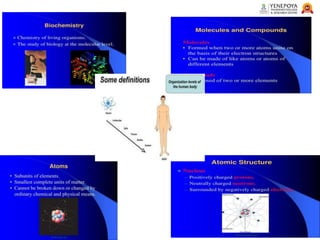
• Biochemistry is the study of the chemistry of living organismas
and deals with the structure of tissues, cells, organelles, and
individual biomolecules
• Biomolecules the living cell is composed of a few elements like
C, H, O, and N that combine to form a great variety of molecules
• eg: Carbohydrates, proteins, fats, nucleic acid, and lipids
• The term Biochemistry was introduced by the German
Chemist Carl Neuberg in 1903
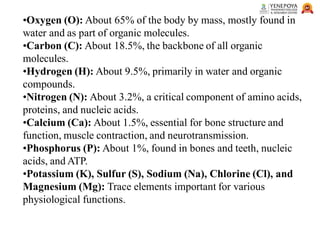
•Oxygen (O): About 65% of the body by mass, mostly found in
water and as part of organic molecules.
•Carbon (C): About 18.5%, the backbone of all organic
molecules.
•Hydrogen (H): About 9.5%, primarily in water and organic
compounds.
•Nitrogen (N): About 3.2%, a critical component of amino acids,
proteins, and nucleic acids.
•Calcium (Ca): About 1.5%, essential for bone structure and
function, muscle contraction, and neurotransmission.
•Phosphorus (P): About 1%, found in bones and teeth, nucleic
acids, and ATP.
•Potassium (K), Sulfur (S), Sodium (Na), Chlorine (Cl), and
Magnesium (Mg): Trace elements important for various
physiological functions.
CELL AND ITS BIOCHEMICAL
ORGANISATION
• The cell is the structural and functional unit of life. It
may also be regarded as the basic unit of biological
activity.
• The concept of cell originated from the contributions
of Schleiden and Schwann (1838).
Prokaryotic and eukaryotic cells
• Prokaryotes (Greek : pro– before; karyon nucleus)
lack a well defined nucleus and possess relatively
simple structure. These include the various bacteria.
• Eukaryotes (Greek : eu–true; karyon nucleus) possess
a well defined nucleus and are more complex in their
structure and function. The higher organisms (animals
and plants) are composed of eukaryotic cells.
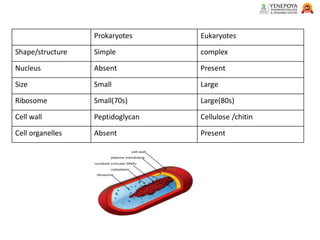
Prokaryotes Eukaryotes
Shape/structure Simple complex
Nucleus Absent Present
Size Small Large
Ribosome Small(70s) Large(80s)
Cell wall Peptidoglycan Cellulose /chitin
Cell organelles Absent Present
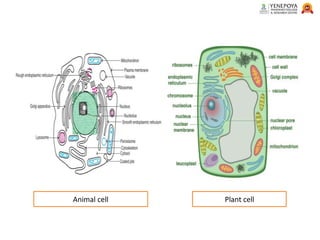
Animal cell Plant cell
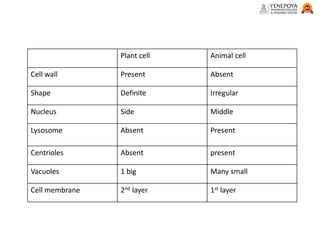
Plant cell Animal cell
Cell wall Present Absent
Shape Definite Irregular
Nucleus Side Middle
Lysosome Absent Present
Centrioles Absent present
Vacuoles 1 big Many small
Cell membrane 2nd layer 1st layer
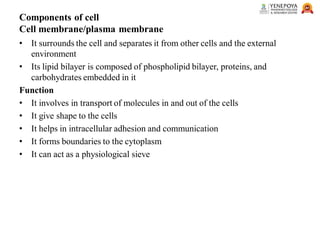
Components of cell
Cell membrane/plasma membrane
• It surrounds the cell and separates it from other cells and the external
environment
• Its lipid bilayer is composed of phospholipid bilayer, proteins, and
carbohydrates embedded in it
Function
• It involves in transport of molecules in and out of the cells
• It give shape to the cells
• It helps in intracellular adhesion and communication
• It forms boundaries to the cytoplasm
• It can act as a physiological sieve
Nucleus
It’s spherical and the largest part of a cell
It contains a nuclear membrane, nucleoplasm, nucleoli, and
genetic material DNA
Nuclear membrane continuous with endoplasmic reticulum
functions
• it controls all cellular activities (gene expression, cellular
division, signal transduction)
• it contains DNA, RNA, and proteins
• RNA helps in protein synthesis
• DNA helps in the production of chromosomes
• The marker enzyme is DNA polymerase which is a site of
DNA and RNA synthesis
Cytoplasm
• The cytoplasm is the gel-like substance inside the cell,
excluding the nucleus.
• It is composed mainly of water, salts, and proteins, and it
houses the organelles.
Function
• The cytoplasm plays a critical role in maintaining the cell's
shape, supporting and suspending organelles, and facilitating
the movement of materials within the cell.
• It also aids in metabolic activities such as glycolysis, which is
the first step in cellular respiration.
Endoplasmic reticulum
• It’s a network of membranes continuous with a nuclear
membrane
Function
• It provides surface area for a number of chemical reaction
• It helps in the synthesis of steroids, protein
• It provides pathways for transporting various chemical
substances
• It helps to concentrate the products of synthetic activities of a
cell
Golgi apparatus
• Golgi apparatus is made up of a series of flattened, stacked
pouches called cisternae.
• These cisternae are typically organized into a series of
compartments, each with specific functions. The "cis" face of
the Golgi apparatus is the receiving side, where vesicles from
the ER fuse and deliver their contents. The "trans" face is the
shipping side, where vesicles bud off to transport their
contents to their final destinations.
Function
• It helps in the intracellular sorting of proteins
• It helps in the packaging of secretory products
• Modification of cellular content
Ribosomes
• These are tiny granules present in the cytoplasm as well as on
the surface of endoplasmic reticulum
• It contains a special type of RNA called rRNA
Function
Ribosomes are the main sites for protein synthesis
Lysosome
• These are membranous vesicles that contain powerful
digestive enzymes which are capable of breaking
down many kinds of molecules
Function
• It helps for intracellular digestion
• Autolysis
• Phagocytosis
Mitochondria
• There are small intracellular organelles known as the powerhouse of cells
• Structurally, mitochondria have two membranes: an outer membrane that
encloses the entire organelle and an inner membrane that folds inward to
form structures known as cristae.. The space within the inner membrane is
called the mitochondrial matrix, which contains enzymes, mitochondrial
DNA, and ribosomes. The unique structure of mitochondria, including the
cristae, increases the surface area for ATP production.
Function
• It is the main site for the synthesis and storage of ATP
• It is the site of the citric acid cycle, beta-oxidation, urea cycle, ETS
• It contains special DNA and self-replicative
• Mitochondria perform the main function of conversion and transfer of
cellular energy
Vacuoles
Vacuoles are fluid filled organelles enclosed by a
membrane. They can store materials such as food,
water, sugar, minerals and waste products.
Peroxisomes or microbodies
• Degrade hydrogen peroxide, a toxic compound that
can be produced during metabolism
Organelles and other features found only in plant cells:
Cell wall The cell wall is a rigid organelle composed of cellulose and lying
just outside the cell membrane. The cell wall gives the plant cell its box-like
shape. It also protects the cell. The cell wall contains pores which allow
materials to pass to and from the cell membrane.
Plastids Plastids are double membrane bound organelles. It is in plastids that
plants make and store food. Plastids are found in the cytoplasm and there are
two main types:
• Leucoplasts - colorless organelles which store starch or other plant
nutrients. (Example - starch stored in a potato)
• Chromoplasts - contain different colored pigments. The most important
type of chromoplast is the chloroplast, which contains the green pigment
chlorophyll. This is important in the process of photosynthesis.
Central vacuole The central vacuole is a large fluid-filled vacuole found in
plants.
Macromolecules
Proteins: Serve as enzymes, structural components,
signaling molecules, and transporters.
Nucleic Acids: DNA stores genetic information, while
RNA translates that information into proteins.
Lipids: Form cell membranes and act as signalling
molecules.
Carbohydrates: Provide energy and serve as cellular
recognition sites.
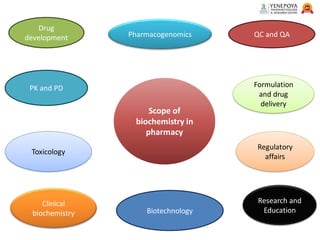
Drug
development
Toxicology
Regulatory
affairs
Pharmacogenomics
PK and PD
Clinical
biochemistry Biotechnology
Research and
Education
Formulation
and drug
delivery
QC and QA
Scope of
biochemistry in
pharmacy
• Biochemistry plays a crucial role in the field of
pharmacy, encompassing various aspects such as
drug design, development, and therapeutic
application
• Drug Discovery and Development
• Pharmacokinetics and Pharmacodynamics
• Toxicology
• Pharmacogenomics
• Drug Formulation and Delivery
• Clinical Biochemistry
• Drug Discovery and Development
Target Identification and Validation: understanding
the biochemical pathways helps to identifying potential
target for new drugs
Lead Compound Identification: Biochemical assays
are used to screen compounds that interact with target
molecules
Mechanism of Action: Biochemistry helps elucidate
how drugs interact with biological systems at the
molecular level
• Pharmacokinetics and Pharmacodynamics
• Absorption, Distribution, Metabolism, and Excretion
(ADME):
• Drug Interactions:
• Toxicology:
• Toxic Mechanisms: Understanding the biochemical
basis of toxicity helps in predicting and mitigating
adverse effects of drugs.
• Pharmacogenomics:
• Genetic Variability: Biochemical techniques are
used to study how genetic variations affect
individual responses to drugs.
References
• V.N raje, Biochemistry and clinical pathology-3rd
edition
Introduction to Biochemistry – Cell Organelles, Functions & Applications in Pharmacy