Asst.professor
Gayatri patra
EPCP, Bangalore
Biochemistry
Introduction:
• Biochemistry is a discipline of chemistry that deals with the chemical composition of living organisms.
• Biochemistry can be simply defined as, “chemistry of the living cell”
• The term Biochemistry was introduced by Carl Neuberg in 1903.
• The living matter is composed of mainly six elements – carbon, Hydrogen, oxygen, nitrogen, phosphorus and
sulphur
• These elements together constitute about 90% of the dry weight of the human body.
• Several other functionally important elements are also found in the cells.
Definition :
• Biochemistry is the study of structures and the interactions of biological macromolecules.
• These macromolecules include protein, nucleic acids, lipids and carbohydrates present in body.
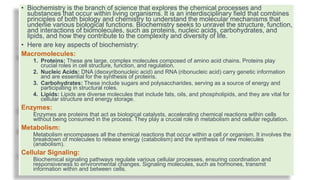
• Biochemistry is the branch of science that explores the chemical processes and
substances that occur within living organisms. It is an interdisciplinary field that combines
principles of both biology and chemistry to understand the molecular mechanisms that
underlie various biological functions. Biochemistry seeks to unravel the structure, function,
and interactions of biomolecules, such as proteins, nucleic acids, carbohydrates, and
lipids, and how they contribute to the complexity and diversity of life.
• Here are key aspects of biochemistry:
Macromolecules:
1. Proteins: These are large, complex molecules composed of amino acid chains. Proteins play
crucial roles in cell structure, function, and regulation.
2. Nucleic Acids: DNA (deoxyribonucleic acid) and RNA (ribonucleic acid) carry genetic information
and are essential for the synthesis of proteins.
3. Carbohydrates: These include sugars and polysaccharides, serving as a source of energy and
participating in structural roles.
4. Lipids: Lipids are diverse molecules that include fats, oils, and phospholipids, and they are vital for
cellular structure and energy storage.
Enzymes:
Enzymes are proteins that act as biological catalysts, accelerating chemical reactions within cells
without being consumed in the process. They play a crucial role in metabolism and cellular regulation.
Metabolism:
Metabolism encompasses all the chemical reactions that occur within a cell or organism. It involves the
breakdown of molecules to release energy (catabolism) and the synthesis of new molecules
(anabolism).
Cellular Signaling:
Biochemical signaling pathways regulate various cellular processes, ensuring coordination and
responsiveness to environmental changes. Signaling molecules, such as hormones, transmit
information within and between cells.
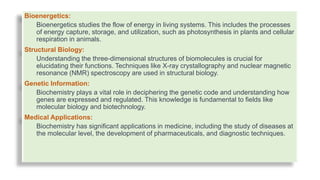
Bioenergetics:
Bioenergetics studies the flow of energy in living systems. This includes the processes
of energy capture, storage, and utilization, such as photosynthesis in plants and cellular
respiration in animals.
Structural Biology:
Understanding the three-dimensional structures of biomolecules is crucial for
elucidating their functions. Techniques like X-ray crystallography and nuclear magnetic
resonance (NMR) spectroscopy are used in structural biology.
Genetic Information:
Biochemistry plays a vital role in deciphering the genetic code and understanding how
genes are expressed and regulated. This knowledge is fundamental to fields like
molecular biology and biotechnology.
Medical Applications:
Biochemistry has significant applications in medicine, including the study of diseases at
the molecular level, the development of pharmaceuticals, and diagnostic techniques.
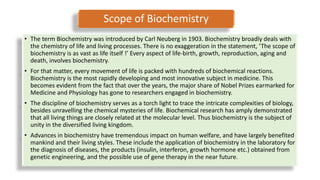
Scope of Biochemistry
• The term Biochemistry was introduced by Carl Neuberg in 1903. Biochemistry broadly deals with
the chemistry of life and living processes. There is no exaggeration in the statement, ‘The scope of
biochemistry is as vast as life itself !’ Every aspect of life-birth, growth, reproduction, aging and
death, involves biochemistry.
• For that matter, every movement of life is packed with hundreds of biochemical reactions.
Biochemistry is the most rapidly developing and most innovative subject in medicine. This
becomes evident from the fact that over the years, the major share of Nobel Prizes earmarked for
Medicine and Physiology has gone to researchers engaged in biochemistry.
• The discipline of biochemistry serves as a torch light to trace the intricate complexities of biology,
besides unravelling the chemical mysteries of life. Biochemical research has amply demonstrated
that all living things are closely related at the molecular level. Thus biochemistry is the subject of
unity in the diversified living kingdom.
• Advances in biochemistry have tremendous impact on human welfare, and have largely benefited
mankind and their living styles. These include the application of biochemistry in the laboratory for
the diagnosis of diseases, the products (insulin, interferon, growth hormone etc.) obtained from
genetic engineering, and the possible use of gene therapy in the near future.
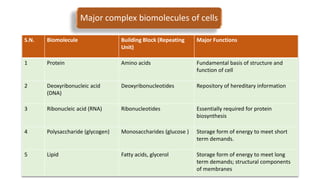
Major complex biomolecules of cells
S.N. Biomolecule Building Block (Repeating
Unit)
Major Functions
1 Protein Amino acids Fundamental basis of structure and
function of cell
2 Deoxyribonucleic acid
(DNA)
Deoxyribonucleotides Repository of hereditary information
3 Ribonucleic acid (RNA) Ribonucleotides Essentially required for protein
biosynthesis
4 Polysaccharide (glycogen) Monosaccharides (glucose ) Storage form of energy to meet short
term demands.
5 Lipid Fatty acids, glycerol Storage form of energy to meet long
term demands; structural components
of membranes
Cell
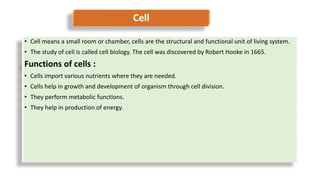
• Cell means a small room or chamber, cells are the structural and functional unit of living system.
• The study of cell is called cell biology. The cell was discovered by Robert Hooke in 1665.
Functions of cells :
• Cells import various nutrients where they are needed.
• Cells help in growth and development of organism through cell division.
• They perform metabolic functions.
• They help in production of energy.
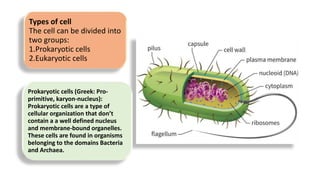
Types of cell
The cell can be divided into
two groups:
1.Prokaryotic cells
2.Eukaryotic cells
Prokaryotic cells (Greek: Pro-
primitive, karyon-nucleus):
Prokaryotic cells are a type of
cellular organization that don’t
contain a a well defined nucleus
and membrane-bound organelles.
These cells are found in organisms
belonging to the domains Bacteria
and Archaea.
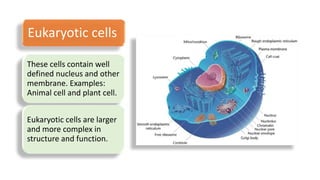
Eukaryotic cells
These cells contain well
defined nucleus and other
membrane. Examples:
Animal cell and plant cell.
Eukaryotic cells are larger
and more complex in
structure and function.
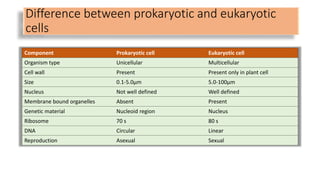
Difference between prokaryotic and eukaryotic
cells
Component Prokaryotic cell Eukaryotic cell
Organism type Unicellular Multicellular
Cell wall Present Present only in plant cell
Size 0.1-5.0μm 5.0-100μm
Nucleus Not well defined Well defined
Membrane bound organelles Absent Present
Genetic material Nucleoid region Nucleus
Ribosome 70 s 80 s
DNA Circular Linear
Reproduction Asexual Sexual
Components of the cell
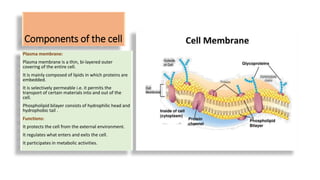
Plasma membrane:
Plasma membrane is a thin, bi-layered outer
covering of the entire cell.
It is mainly composed of lipids in which proteins are
embedded.
It is selectively permeable i.e. it permits the
transport of certain materials into and out of the
cell.
Phospholipid bilayer consists of hydrophilic head and
hydrophobic tail .
Functions:
It protects the cell from the external environment.
It regulates what enters and exits the cell.
It participates in metabolic activities.
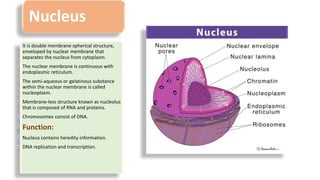
Nucleus
It is double membrane spherical structure,
enveloped by nuclear membrane that
separates the nucleus from cytoplasm.
The nuclear membrane is continuous with
endoplasmic reticulum.
The semi-aqueous or gelatinous substance
within the nuclear membrane is called
nucleoplasm.
Membrane-less structure known as nucleolus
that is composed of RNA and proteins.
Chromosomes consist of DNA.
Function:
Nucleus contains heredity information.
DNA replication and transcription.
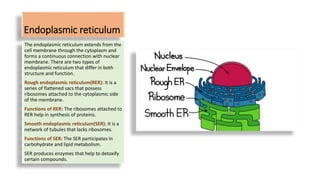
Endoplasmic reticulum
The endoplasmic reticulum extends from the
cell membrane through the cytoplasm and
forms a continuous connection with nuclear
membrane. There are two types of
endoplasmic reticulum that differ in both
structure and function.
Rough endoplasmic reticulum(RER): It is a
series of flattened sacs that possess
ribosomes attached to the cytoplasmic side
of the membrane.
Functions of RER: The ribosomes attached to
RER help in synthesis of proteins.
Smooth endoplasmic reticulum(SER): It is a
network of tubules that lacks ribosomes.
Functions of SER: The SER participates in
carbohydrate and lipid metabolism.
SER produces enzymes that help to detoxify
certain compounds.
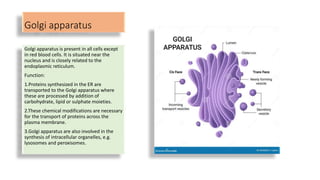
Golgi apparatus
Golgi apparatus is present in all cells except
in red blood cells. It is situated near the
nucleus and is closely related to the
endoplasmic reticulum.
Function:
1.Proteins synthesized in the ER are
transported to the Golgi apparatus where
these are processed by addition of
carbohydrate, lipid or sulphate moieties.
2.These chemical modifications are necessary
for the transport of proteins across the
plasma membrane.
3.Golgi apparatus are also involved in the
synthesis of intracellular organelles, e.g.
lysosomes and peroxisomes.
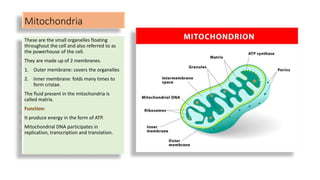
Mitochondria
These are the small organelles floating
throughout the cell and also referred to as
the powerhouse of the cell.
They are made up of 2 membranes.
1. Outer membrane: covers the organelles
2. Inner membrane: folds many times to
form cristae.
The fluid present in the mitochondria is
called matrix.
Function:
It produce energy in the form of ATP.
Mitochondrial DNA participates in
replication, transcription and translation.
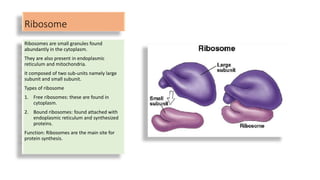
Ribosome
Ribosomes are small granules found
abundantly in the cytoplasm.
They are also present in endoplasmic
reticulum and mitochondria.
It composed of two sub-units namely large
subunit and small subunit.
Types of ribosome
1. Free ribosomes: these are found in
cytoplasm.
2. Bound ribosomes: found attached with
endoplasmic reticulum and synthesized
proteins.
Function: Ribosomes are the main site for
protein synthesis.
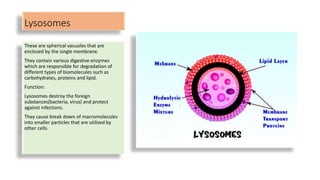
Lysosomes
These are spherical vacuoles that are
enclosed by the single membrane.
They contain various digestive enzymes
which are responsible for degradation of
different types of biomolecules such as
carbohydrates, proteins and lipid.
Function:
Lysosomes destroy the foreign
substances(bacteria, virus) and protect
against infections.
They cause break down of macromolecules
into smaller particles that are utilized by
other cells.
• Cytoplasm:
• The dense and jelly like substance found inside the cell and outside the nucleus is called
cytoplasm.
• The cytoplasm is made of 70 – 90% water and is colourless.
Various metabolic and cellular processes take place in cytoplasm.
• Peroxisomes:
• Peroxisomes, also called microbodies, are single membrane cellular organelles found in the
cytoplasm.
• They contain variety of enzymes which function together to remove the toxic substances.
• Function:
Peroxisomes are also capable of carrying out beta-oxidation of fatty acid.s