Prepared by:
BUSHRA DESHPANDE
K.Y.D.S.C.T'S COP SAKEGAON. BHUSAWAL
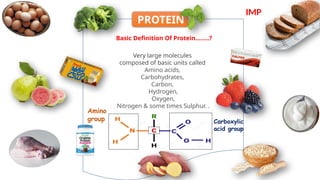
Very large molecules
composed of basic units called
Amino acids,
Carbohydrates,
Carbon,
Hydrogen,
Oxygen,
Nitrogen & some times Sulphur. .
PROTEIN
Basic Definition Of Protein……..?
Amino
group Carboxylic
acid group
IMP
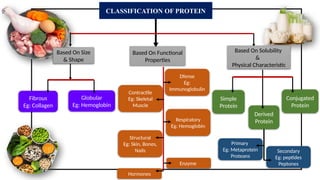
CLASSIFICATION OF PROTEIN
Based On Size
& Shape
Based On Functional
Properties
Based On Solubility
&
Physical Characteristic
Fibrous
Eg: Collagen
Globular
Eg: Hemoglobin
Dfense
Eg:
Immunoglobulin
Contractile
Eg: Skeletal
Muscle
Respiratory
Eg: Hemoglobin
Structural
Eg: Skin, Bones,
Nails
Enzyme
Hormones
Simple
Protein
Conjugated
Protein
Derived
Protein
Primary
Eg: Metaprotein
Proteans
Secondary
Eg: peptides
Peptones
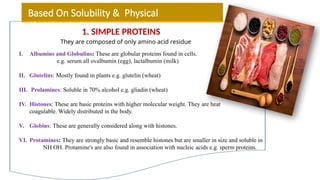
They are composed of only amino acid residue
I. Albumins and Globulins: These are globular proteins found in cells.
e.g. serum all ovalbumin (egg), lactalbumin (milk)
II. Glutelins: Mostly found in plants e.g. glutelin (wheat)
III. Prolamines: Soluble in 70% alcohol e.g. gliadin (wheat)
IV. Histones: These are basic proteins with higher molecular weight. They are heat
coagulable. Widely distributed in the body.
V. Globins: These are generally considered along with histones.
VI. Protamines: They are strongly basic and resemble histones but are smaller in size and soluble in
NH OH. Protamine's are also found in association with nucleic acids e.g. sperm proteins.
Based On Solubility & Physical
Characteristic
1. SIMPLE PROTEINS
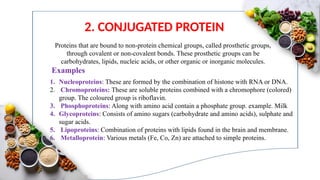
1. Nucleoproteins: These are formed by the combination of histone with RNA or DNA.
2. Chromoproteins: These are soluble proteins combined with a chromophore (colored)
group. The coloured group is riboflavin.
3. Phosphoproteins: Along with amino acid contain a phosphate group. example. Milk
4. Glycoproteins: Consists of amino sugars (carbohydrate and amino acids), sulphate and
sugar acids.
5. Lipoproteins: Combination of proteins with lipids found in the brain and membrane.
6. Metalloprotein: Various metals (Fe, Co, Zn) are attached to simple proteins.
Proteins that are bound to non-protein chemical groups, called prosthetic groups,
through covalent or non-covalent bonds. These prosthetic groups can be
carbohydrates, lipids, nucleic acids, or other organic or inorganic molecules.
Examples
2. CONJUGATED PROTEIN
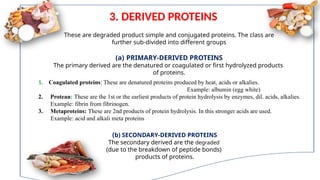
1. Coagulated proteins: These are denatured proteins produced by heat, acids or alkalies.
Example: albumin (egg white)
2. Protean: These are the 1st or the earliest products of protein hydrolysis by enzymes, dil. acids, alkalies.
Example: fibrin from fibrinogen.
3. Metaproteins: These are 2nd products of protein hydrolysis. In this stronger acids are used.
Example: acid and alkali meta proteins
These are degraded product simple and conjugated proteins. The class are
further sub-divided into different groups
(a) PRIMARY-DERIVED PROTEINS
The primary derived are the denatured or coagulated or first hydrolyzed products
of proteins.
(b) SECONDARY-DERIVED PROTEINS
The secondary derived are the degraded
(due to the breakdown of peptide bonds)
products of proteins.
3. DERIVED PROTEINS
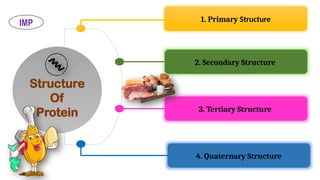
Structure
Of
Protein
1. Primary Structure
3. Tertiary Structure
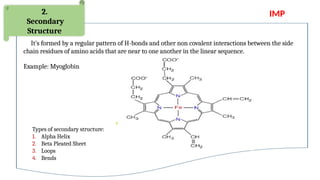
2. Secondary Structure
4. Quaternary Structure
IMP
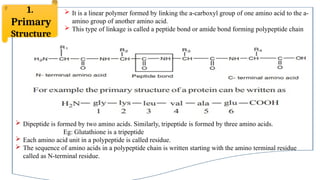
1.
Primary
Structure
 It is a linear polymer formed by linking the a-carboxyl group of one amino acid to the a-
amino group of another amino acid.
 This type of linkage is called a peptide bond or amide bond forming polypeptide chain
 Dipeptide is formed by two amino acids. Similarly, tripeptide is formed by three amino acids.
Eg: Glutathione is a tripeptide
 Each amino acid unit in a polypeptide is called residue.
 The sequence of amino acids in a polypeptide chain is written starting with the amino terminal residue
called as N-terminal residue.
2.
Secondary
Structure
Types of secondary structure:
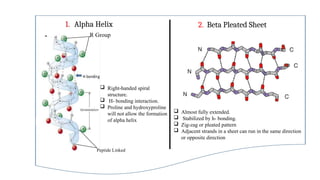
1. Alpha Helix
2. Beta Pleated Sheet
3. Loops
4. Bends
It’s formed by a regular pattern of H-bonds and other non covalent interactions between the side
chain residues of amino acids that are near to one another in the linear sequence.
Example: Myoglobin
IMP
1. Alpha Helix
R Group
Peptide Linked
2. Beta Pleated Sheet
 Right-handed spiral
structure.
 H- bonding interaction.
 Proline and hydroxyproline
will not allow the formation
of alpha helix
 Almost fully extended.
 Stabilized by h- bonding.
 Zig-zag or pleated pattern
 Adjacent strands in a sheet can run in the same direction
or opposite direction
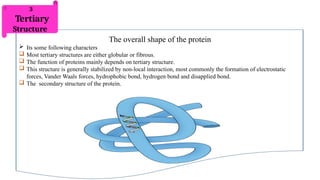
3
Tertiary
Structure
The overall shape of the protein
 Its some following characters
 Most tertiary structures are either globular or fibrous.
 The function of proteins mainly depends on tertiary structure.
 This structure is generally stabilized by non-local interaction, most commonly the formation of electrostatic
forces, Vander Waals forces, hydrophobic bond, hydrogen bond and disapplied bond.
 The secondary structure of the protein.
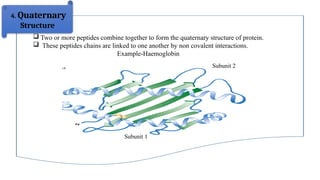
4. Quaternary
Structure
 Two or more peptides combine together to form the quaternary structure of protein.
 These peptides chains are linked to one another by non covalent interactions.
Example-Haemoglobin
Subunit 1
Subunit 2
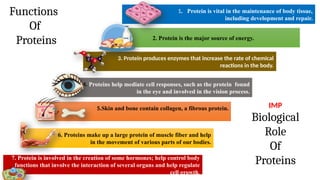
1. Protein is vital in the maintenance of body tissue,
including development and repair.
2. Protein is the major source of energy.
3. Protein produces enzymes that increase the rate of chemical
reactions in the body.
4. Proteins help mediate cell responses, such as the protein found
in the eye and involved in the vision process.
5.Skin and bone contain collagen, a fibrous protein.
6. Proteins make up a large protein of muscle fiber and help
in the movement of various parts of our bodies.
7. Protein is involved in the creation of some hormones; help control body
functions that involve the interaction of several organs and help regulate
cell growth.
Functions
Of
Proteins
Biological
Role
Of
Proteins
IMP
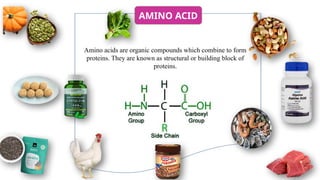
AMINO ACID
Amino acids are organic compounds which combine to form
proteins. They are known as structural or building block of
proteins.
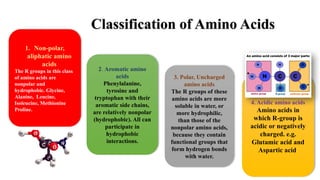
1. Non-polar,
aliphatic amino
acids
The R groups in this class
of amino acids are
nonpolar and
hydrophobic. Glycine,
Alanine, Leucine,
Isoleucine, Methionine
Proline.
2. Aromatic amino
acids
Phenylalanine,
tyrosine and
tryptophan with their
aromatic side chains,
are relatively nonpolar
(hydrophobic). All can
participate in
hydrophobic
interactions.
3. Polar, Uncharged
amino acids
The R groups of these
amino acids are more
soluble in water, or
more hydrophilic,
than those of the
nonpolar amino acids,
because they contain
functional groups that
form hydrogen bonds
with water.
4. Acidic amino acids
Amino acids in
which R-group is
acidic or negatively
charged. e.g.
Glutamic acid and
Aspartic acid.
Classification of Amino Acids
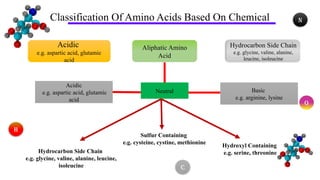
Aliphatic Amino
Acid
Acidic
e.g. aspartic acid, glutamic
acid
Hydrocarbon Side Chain
e.g. glycine, valine, alanine,
leucine, isoleucine
Neutral
Acidic
e.g. aspartic acid, glutamic
acid
Basic
e.g. arginine, lysine
Hydrocarbon Side Chain
e.g. glycine, valine, alanine, leucine,
isoleucine
Sulfur Containing
e.g. cysteine, cystine, methionine
Hydroxyl Containing
e.g. serine, threonine
H
N
C
O
Classification Of Amino Acids Based On Chemical
Nature
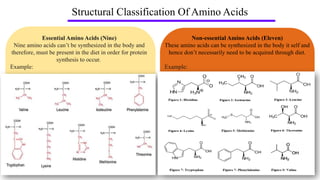
Essential Amino Acids (Nine)
Nine amino acids can’t be synthesized in the body and
therefore, must be present in the diet in order for protein
synthesis to occur.
Example:
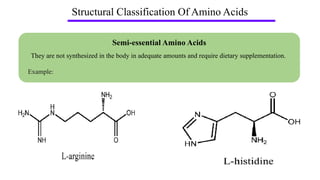
Non-essential Amino Acids (Eleven)
These amino acids can be synthesized in the body it self and
hence don’t necessarily need to be acquired through diet.
Example:
Structural Classification Of Amino Acids
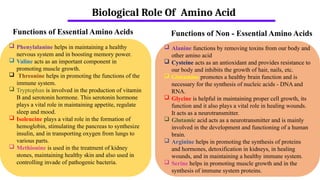
Semi-essential Amino Acids
They are not synthesized in the body in adequate amounts and require dietary supplementation.
Example:
Structural Classification Of Amino Acids
 Phenylalanine helps in maintaining a healthy
nervous system and in boosting memory power.
 Valine acts as an important component in
promoting muscle growth.
 Threonine helps in promoting the functions of the
immune system.
 Tryptophan is involved in the production of vitamin
B and serotonin hormone. This serotonin hormone
plays a vital role in maintaining appetite, regulate
sleep and mood.
 Isoleucine plays a vital role in the formation of
hemoglobin, stimulating the pancreas to synthesize
insulin, and in transporting oxygen from lungs to
various parts.
 Methionine is used in the treatment of kidney
stones, maintaining healthy skin and also used in
controlling invade of pathogenic bacteria.
 Alanine functions by removing toxins from our body and
other amino acid
 Cysteine acts as an antioxidant and provides resistance to
our body and inhibits the growth of hair, nails, etc.
 Glutamine promotes a healthy brain function and is
necessary for the synthesis of nucleic acids - DNA and
RNA.
 Glycine is helpful in maintaining proper cell growth, its
function and it also plays a vital role in healing wounds.
It acts as a neurotransmitter.
 Glutamic acid acts as a neurotransmitter and is mainly
involved in the development and functioning of a human
brain.
 Arginine helps in promoting the synthesis of proteins
and hormones, detoxification in kidneys, in healing
wounds, and in maintaining a healthy immune system.
 Serine helps in promoting muscle growth and in the
synthesis of immune system proteins.
Functions of Essential Amino Acids Functions of Non - Essential Amino Acids
Biological Role Of Amino Acid
Diseases
Related
To
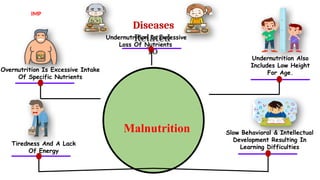
Undernutrition Is Excessive
Loss Of Nutrients.
Overnutrition Is Excessive Intake
Of Specific Nutrients
Tiredness And A Lack
Of Energy
Slow Behavioral & Intellectual
Development Resulting In
Learning Difficulties
Undernutrition Also
Includes Low Height
For Age.
IMP
Malnutrition
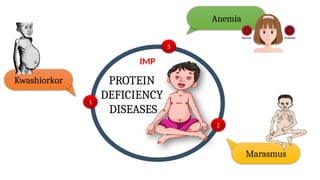
PROTEIN
DEFICIENCY
DISEASES
2
1
3
Kwashiorkor
Marasmus
Anemia
IMP
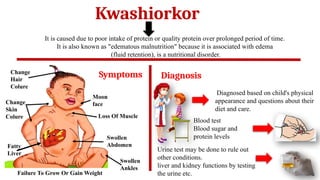
Kwashiorkor
It is caused due to poor intake of protein or quality protein over prolonged period of time.
It is also known as "edematous malnutrition" because it is associated with edema
(fluid retention), is a nutritional disorder.
Change
Skin
Colure
Change
Hair
Colure
Fatty
Liver
Loss Of Muscle
Swollen
Abdomen
Swollen
Ankles
Failure To Grow Or Gain Weight
Moon
face
Urine test may be done to rule out
other conditions.
liver and kidney functions by testing
the urine etc.
Diagnosis
Symptoms
Diagnosed based on child's physical
appearance and questions about their
diet and care.
Blood test
Blood sugar and
protein levels
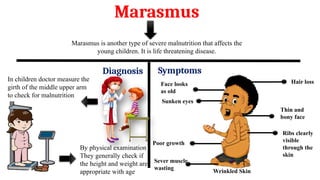
Marasmus
Marasmus is another type of severe malnutrition that affects the
young children. It is life threatening disease.
Ribs clearly
visible
through the
skin
Hair loss
Sunken eyes
Face looks
as old
Thin and
bony face
Wrinkled Skin
Sever muscle
wasting
Poor growth
Symptoms
Diagnosis
By physical examination
They generally check if
the height and weight are
appropriate with age
In children doctor measure the
girth of the middle upper arm
to check for malnutrition
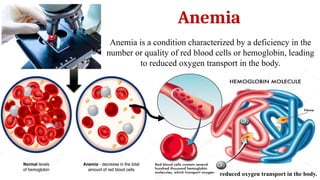
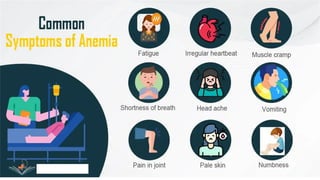
Anemia is a condition characterized by a deficiency in the
number or quality of red blood cells or hemoglobin, leading
to reduced oxygen transport in the body.
Anemia
reduced oxygen transport in the body.
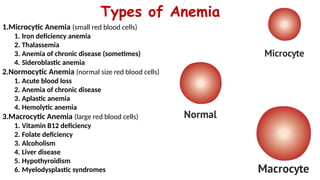
1.Microcytic Anemia (small red blood cells)
1. Iron deficiency anemia
2. Thalassemia
3. Anemia of chronic disease (sometimes)
4. Sideroblastic anemia
2.Normocytic Anemia (normal size red blood cells)
1. Acute blood loss
2. Anemia of chronic disease
3. Aplastic anemia
4. Hemolytic anemia
3.Macrocytic Anemia (large red blood cells)
1. Vitamin B12 deficiency
2. Folate deficiency
3. Alcoholism
4. Liver disease
5. Hypothyroidism
6. Myelodysplastic syndromes
Types of Anemia
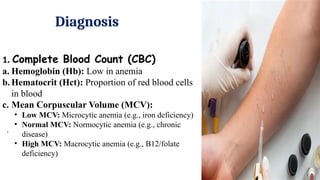
1. Complete Blood Count (CBC)
a. Hemoglobin (Hb): Low in anemia
b. Hematocrit (Hct): Proportion of red blood cells
in blood
c. Mean Corpuscular Volume (MCV):
• Low MCV: Microcytic anemia (e.g., iron deficiency)
• Normal MCV: Normocytic anemia (e.g., chronic
disease)
• High MCV: Macrocytic anemia (e.g., B12/folate
deficiency)
.
Diagnosis
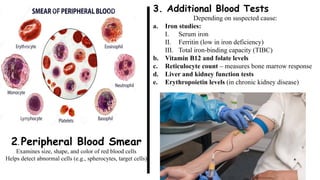
2. Peripheral Blood Smear
Examines size, shape, and color of red blood cells
Helps detect abnormal cells (e.g., spherocytes, target cells)
3. Additional Blood Tests
Depending on suspected cause:
a. Iron studies:
I. Serum iron
II. Ferritin (low in iron deficiency)
III. Total iron-binding capacity (TIBC)
b. Vitamin B12 and folate levels
c. Reticulocyte count – measures bone marrow response
d. Liver and kidney function tests
e. Erythropoietin levels (in chronic kidney disease)
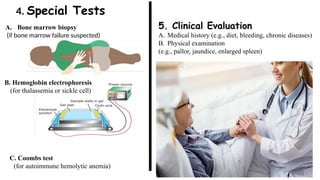
4. Special Tests
5. Clinical Evaluation
A. Medical history (e.g., diet, bleeding, chronic diseases)
B. Physical examination
(e.g., pallor, jaundice, enlarged spleen)
A. Bone marrow biopsy
(if bone marrow failure suspected)
B. Hemoglobin electrophoresis
(for thalassemia or sickle cell)
C. Coombs test
(for autoimmune hemolytic anemia)
THANK
YOU