Outline
• Big Data
• Big Data
Processing
– To Know
– To explain
– To forecast
• Conclusion
Photo by John Trainoron Flickr
http://www.flickr.com/photos/trainor/2902023575/, Licensed under CC
A day in your life
 Think about a day in your life?
– What is the best road to take?
– Would there be any bad weather?
– How to invest my money?
– How is my health?
 There are many decisions that
you can do better if only you can
access the data and process
them.
http://www.flickr.com/photos/kcolwell/5
512461652/ CC licence
Data Avalanche/ Moore’s law of data
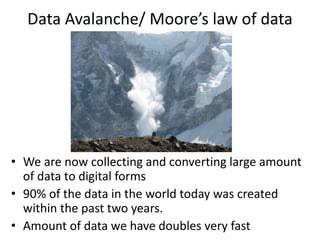
• We are now collecting and converting large amount
of data to digital forms
• 90% of the data in the world today was created
within the past two years.
• Amount of data we have doubles very fast
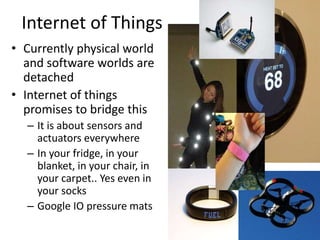
Internet of Things
• Currently physical world
and software worlds are
detached
• Internet of things
promises to bridge this
– It is about sensors and
actuators everywhere
– In your fridge, in your
blanket, in your chair, in
your carpet.. Yes even in
your socks
– Google IO pressure mats
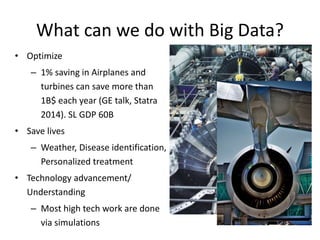
What can we do with Big Data?
• Optimize
– 1% saving in Airplanes and
turbines can save more than
1B$ each year (GE talk, Statra
2014). SL GDP 60B
• Save lives
– Weather, Disease identification,
Personalized treatment
• Technology advancement/
Understanding
– Most high tech work are done
via simulations
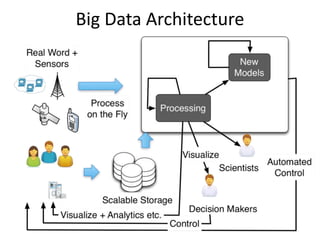
Big Data Architecture
Why Big Data is hard?
• How store? Assuming 1TB bytes it
takes 1000 computers to store a 1PB
• How to move? Assuming 10Gb
network, it takes 2 hours to copy 1TB,
or 83 days to copy a 1PB
• How to search? Assuming each record
is 1KB and one machine can process
1000 records per sec, it needs 277CPU
days to process a 1TB and 785 CPU
years to process a 1 PB
• How to process?
– How to convert algorithms to work in large
size
– How to create new algorithms
http://www.susanica.com/photo/9
Why it is hard (Contd.)?
• System build of many
computers
• That handles lots of data
• Running complex logic
• This pushes us to frontier of
Distributed Systems and
Databases
• More data does not mean
there is a simple model
• Some models can be complex
as the system
http://www.flickr.com/photos/mariachily/5250487136,
Licensed CC
Tools for Processing
Data
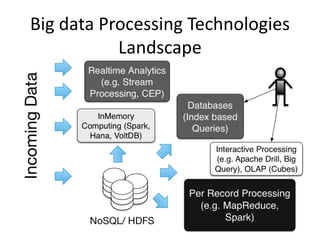
Big data Processing Technologies
Landscape
MapReduce/ Hadoop
• First introduced by Google,
and used as the processing
model for their architecture
• Implemented by opensource
projects like Apache Hadoop
and Spark
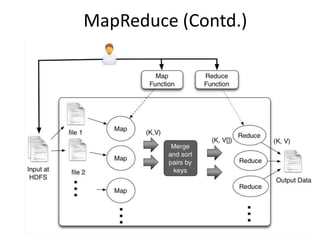
• Users writes two functions:
map and reduce
• The framework handles the
details like distributed
processing, fault tolerance,
load balancing etc.
• Widely used, and the one of
the catalyst of Big data
void map(ctx, k, v){
tokens = v.split();
for t in tokens
ctx.emit(t,1)
}
void reduce(ctx, k, values[]){
count = 0;
for v in values
count = count + v;
ctx.emit(k,count);
}
MapReduce (Contd.)
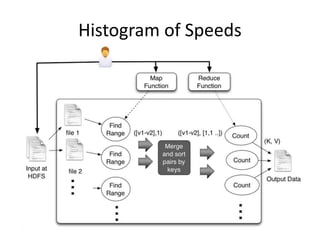
Histogram of Speeds
Histogram of Speeds(Contd.)
void map(ctx, k, v){
event = parse(v);
range = calcuateRange(event.v);
ctx.emit(range,1)
}
void reduce(ctx, k, values[]){
count = 0;
for v in values
count = count + v;
ctx.emit(k,count);
}
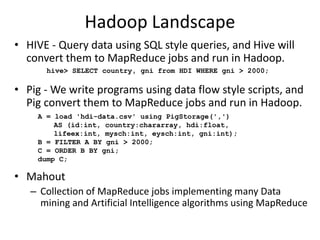
Hadoop Landscape
• HIVE - Query data using SQL style queries, and Hive will
convert them to MapReduce jobs and run in Hadoop.
• Pig - We write programs using data flow style scripts, and
Pig convert them to MapReduce jobs and run in Hadoop.
• Mahout
– Collection of MapReduce jobs implementing many Data
mining and Artificial Intelligence algorithms using MapReduce
A = load 'hdi-data.csv' using PigStorage(',')
AS (id:int, country:chararray, hdi:float,
lifeex:int, mysch:int, eysch:int, gni:int);
B = FILTER A BY gni > 2000;
C = ORDER B BY gni;
dump C;
hive> SELECT country, gni from HDI WHERE gni > 2000;
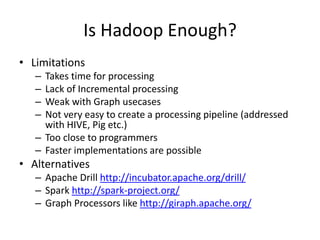
Is Hadoop Enough?
• Limitations
– Takes time for processing
– Lack of Incremental processing
– Weak with Graph usecases
– Not very easy to create a processing pipeline (addressed
with HIVE, Pig etc.)
– Too close to programmers
– Faster implementations are possible
• Alternatives
– Apache Drill http://incubator.apache.org/drill/
– Spark http://spark-project.org/
– Graph Processors like http://giraph.apache.org/
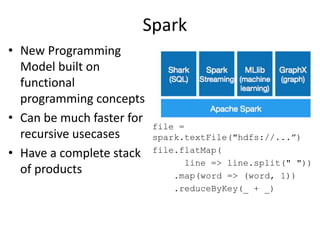
Spark
• New Programming
Model built on
functional
programming concepts
• Can be much faster for
recursive usecases
• Have a complete stack
of products
file =
spark.textFile("hdfs://...”)
file.flatMap(
line => line.split(" "))
.map(word => (word, 1))
.reduceByKey(_ + _)
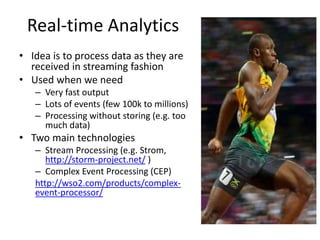
Real-time Analytics
• Idea is to process data as they are
received in streaming fashion
• Used when we need
– Very fast output
– Lots of events (few 100k to millions)
– Processing without storing (e.g. too
much data)
• Two main technologies
– Stream Processing (e.g. Strom,
http://storm-project.net/ )
– Complex Event Processing (CEP)
http://wso2.com/products/complex-
event-processor/
Complex Event Processing (CEP)
• Sees inputs as Event streams and queried with
SQL like language
• Supports Filters, Windows, Join, Patterns and
Sequences
from p=PINChangeEvents#win.time(3600) join
t=TransactionEvents[p.custid=custid][amount>1000
0] #win.time(3600)
return t.custid, t.amount;
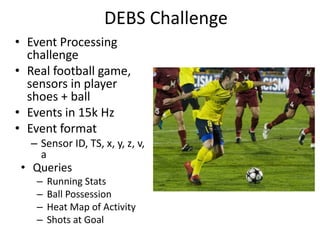
DEBS Challenge
• Event Processing
challenge
• Real football game,
sensors in player
shoes + ball
• Events in 15k Hz
• Event format
– Sensor ID, TS, x, y, z, v,
a
• Queries
– Running Stats
– Ball Possession
– Heat Map of Activity
– Shots at Goal
Example: Detect ball Possession
• Possession is time a
player hit the ball
until someone else
hits it or it goes out
of the ground
from Ball#window.length(1) as b join
Players#window.length(1) as p
unidirectional
on debs: getDistance(b.x,b.y,b.z,
p.x, p.y, p.z) < 1000
and b.a > 55
select ...
insert into hitStream
from old = hitStream ,
b = hitStream [old. pid != pid ],
n= hitStream[b.pid == pid]*,
( e1 = hitStream[b.pid != pid ]
or e2= ballLeavingHitStream)
select ...
insert into BallPossessionStream
http://www.flickr.com/photos/glennharper/146164820/
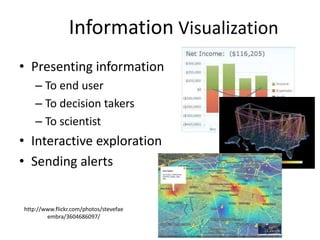
Information Visualization
• Presenting information
– To end user
– To decision takers
– To scientist
• Interactive exploration
• Sending alerts
http://www.flickr.com/photos/stevefae
embra/3604686097/
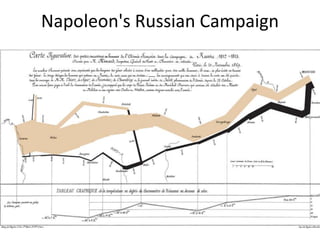
Napoleon's Russian Campaign
Show Han Rosling’s Data
• This use a tool called “Gapminder”
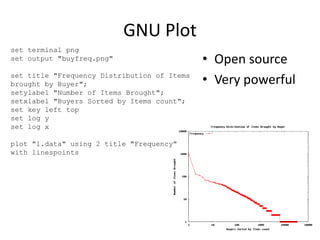
GNU Plot
set terminal png
set output "buyfreq.png"
set title "Frequency Distribution of Items
brought by Buyer";
setylabel "Number of Items Brought";
setxlabel "Buyers Sorted by Items count";
set key left top
set log y
set log x
plot "1.data" using 2 title "Frequency"
with linespoints
• Open source
• Very powerful
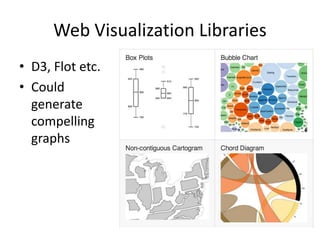
Web Visualization Libraries
• D3, Flot etc.
• Could
generate
compelling
graphs
Solving the Problem
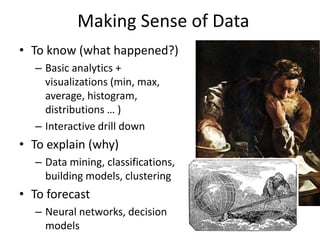
Making Sense of Data
• To know (what happened?)
– Basic analytics +
visualizations (min, max,
average, histogram,
distributions … )
– Interactive drill down
• To explain (why)
– Data mining, classifications,
building models, clustering
• To forecast
– Neural networks, decision
models
To know (what happened/
happening?)
• Analytics Implemented
with MapReduce or
Queries
– Min, Max, average,
correlation, histograms
– Might join group data in
many ways
• Data is often presented
with some visualizations
• Support for drill down
• Real-time analytics to
track things fast enough
and Alerts.
http://www.flickr.com/photos/isriya/2967310
333/
Analytics/ Summary
• Min, Max, Mean, Standard deviation,
correlation, grouping etc.
• E.g. Internet Access logs
– Number of hits, total, by day or hour, trend over
time
– File size distribution
– Request Success to failure ratio
– Hits by client IP region
http://pixabay.com, by Steven Iodice
Drill Down
• Idea is to let users drill down and explore a
view of the data (called BI or OLAP)
• Users go and define 3 dimensions (or more),
and tool let users explore the cube and only
look at subset of data.
• E.g. tool: Mondrian
http://pixabay.com, by Steven Iodice
Search
• Process and Index the data. The killer app of
our time.
http://pixabay.com, by Steven Iodice
• Web Search
• Graph Search
• Semantic Search
• Drug Discovery
• …
Search: New Ideas
• Apache Drill, Big Query
• Blink: search via sampling
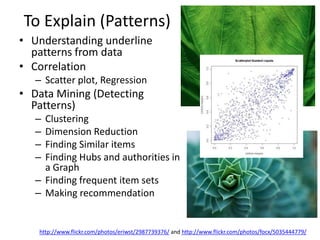
To Explain (Patterns)
• Understanding underline
patterns from data
• Correlation
– Scatter plot, Regression
• Data Mining (Detecting
Patterns)
– Clustering
– Dimension Reduction
– Finding Similar items
– Finding Hubs and authorities in
a Graph
– Finding frequent item sets
– Making recommendation
http://www.flickr.com/photos/eriwst/2987739376/ and http://www.flickr.com/photos/focx/5035444779/
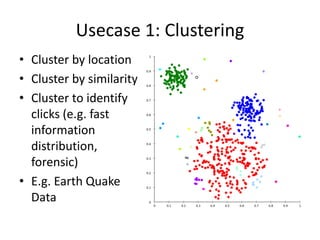
Usecase 1: Clustering
• Cluster by location
• Cluster by similarity
• Cluster to identify
clicks (e.g. fast
information
distribution,
forensic)
• E.g. Earth Quake
Data
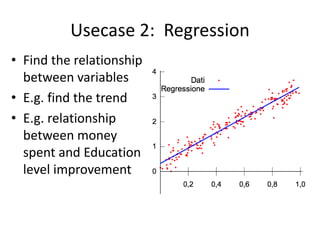
Usecase 2: Regression
• Find the relationship
between variables
• E.g. find the trend
• E.g. relationship
between money
spent and Education
level improvement
Tools
• Weka – java machine learning library
• Mahout – MapReduce implementation of
Machine learning algorithms
• R – programming language for statistical
computing
• PMML (Predictive model markup language)
• Scaling these libraries is a challenge
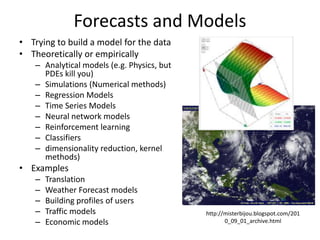
Forecasts and Models
• Trying to build a model for the data
• Theoretically or empirically
– Analytical models (e.g. Physics, but
PDEs kill you)
– Simulations (Numerical methods)
– Regression Models
– Time Series Models
– Neural network models
– Reinforcement learning
– Classifiers
– dimensionality reduction, kernel
methods)
• Examples
– Translation
– Weather Forecast models
– Building profiles of users
– Traffic models
– Economic models
http://misterbijou.blogspot.com/201
0_09_01_archive.html
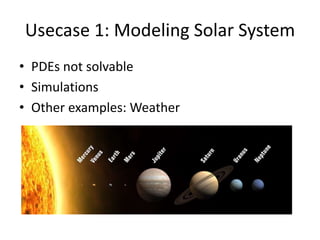
Usecase 1: Modeling Solar System
• PDEs not solvable
• Simulations
• Other examples: Weather
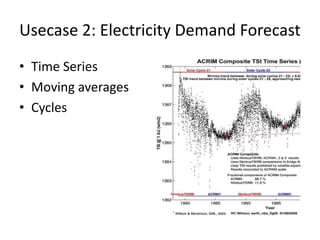
Usecase 2: Electricity Demand Forecast
• Time Series
• Moving averages
• Cycles
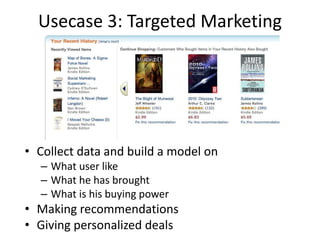
Usecase 3: Targeted Marketing
• Collect data and build a model on
– What user like
– What he has brought
– What is his buying power
• Making recommendations
• Giving personalized deals
Big data lifecycle
• Realizing the big data lifecycle is hard
• Need wide understanding about many fields
• Big data teams will include members from
many fields working together
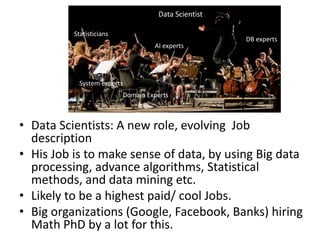
• Data Scientists: A new role, evolving Job
description
• His Job is to make sense of data, by using Big data
processing, advance algorithms, Statistical
methods, and data mining etc.
• Likely to be a highest paid/ cool Jobs.
• Big organizations (Google, Facebook, Banks) hiring
Math PhD by a lot for this.
Data Scientist
Statisticians
System experts
Domain Experts
DB experts
AI experts
Challenges
• Fast scalable real-time analytics
• Merging real-time and batch processing
• Good libraries for machine learning
• Scaling decision models e.g. machine learning
Conclusions
• Big data? How, Why and Bigdata architecture
• Data Processing Tools
– MapReduce, CEP, visualizations
• Solving problems
– To know what happened
– To explain what happened
– To predict what will happen
• Conclusions
Questions?

Big Data Analysis : Deciphering the haystack

  • 2.
    Outline • Big Data •Big Data Processing – To Know – To explain – To forecast • Conclusion Photo by John Trainoron Flickr http://www.flickr.com/photos/trainor/2902023575/, Licensed under CC
  • 3.
    A day inyour life  Think about a day in your life? – What is the best road to take? – Would there be any bad weather? – How to invest my money? – How is my health?  There are many decisions that you can do better if only you can access the data and process them. http://www.flickr.com/photos/kcolwell/5 512461652/ CC licence
  • 4.
    Data Avalanche/ Moore’slaw of data • We are now collecting and converting large amount of data to digital forms • 90% of the data in the world today was created within the past two years. • Amount of data we have doubles very fast
  • 5.
    Internet of Things •Currently physical world and software worlds are detached • Internet of things promises to bridge this – It is about sensors and actuators everywhere – In your fridge, in your blanket, in your chair, in your carpet.. Yes even in your socks – Google IO pressure mats
  • 6.
    What can wedo with Big Data? • Optimize – 1% saving in Airplanes and turbines can save more than 1B$ each year (GE talk, Statra 2014). SL GDP 60B • Save lives – Weather, Disease identification, Personalized treatment • Technology advancement/ Understanding – Most high tech work are done via simulations
  • 7.
  • 8.
    Why Big Datais hard? • How store? Assuming 1TB bytes it takes 1000 computers to store a 1PB • How to move? Assuming 10Gb network, it takes 2 hours to copy 1TB, or 83 days to copy a 1PB • How to search? Assuming each record is 1KB and one machine can process 1000 records per sec, it needs 277CPU days to process a 1TB and 785 CPU years to process a 1 PB • How to process? – How to convert algorithms to work in large size – How to create new algorithms http://www.susanica.com/photo/9
  • 9.
    Why it ishard (Contd.)? • System build of many computers • That handles lots of data • Running complex logic • This pushes us to frontier of Distributed Systems and Databases • More data does not mean there is a simple model • Some models can be complex as the system http://www.flickr.com/photos/mariachily/5250487136, Licensed CC
  • 10.
  • 11.
    Big data ProcessingTechnologies Landscape
  • 12.
    MapReduce/ Hadoop • Firstintroduced by Google, and used as the processing model for their architecture • Implemented by opensource projects like Apache Hadoop and Spark • Users writes two functions: map and reduce • The framework handles the details like distributed processing, fault tolerance, load balancing etc. • Widely used, and the one of the catalyst of Big data void map(ctx, k, v){ tokens = v.split(); for t in tokens ctx.emit(t,1) } void reduce(ctx, k, values[]){ count = 0; for v in values count = count + v; ctx.emit(k,count); }
  • 13.
  • 14.
  • 15.
    Histogram of Speeds(Contd.) voidmap(ctx, k, v){ event = parse(v); range = calcuateRange(event.v); ctx.emit(range,1) } void reduce(ctx, k, values[]){ count = 0; for v in values count = count + v; ctx.emit(k,count); }
  • 16.
    Hadoop Landscape • HIVE- Query data using SQL style queries, and Hive will convert them to MapReduce jobs and run in Hadoop. • Pig - We write programs using data flow style scripts, and Pig convert them to MapReduce jobs and run in Hadoop. • Mahout – Collection of MapReduce jobs implementing many Data mining and Artificial Intelligence algorithms using MapReduce A = load 'hdi-data.csv' using PigStorage(',') AS (id:int, country:chararray, hdi:float, lifeex:int, mysch:int, eysch:int, gni:int); B = FILTER A BY gni > 2000; C = ORDER B BY gni; dump C; hive> SELECT country, gni from HDI WHERE gni > 2000;
  • 17.
    Is Hadoop Enough? •Limitations – Takes time for processing – Lack of Incremental processing – Weak with Graph usecases – Not very easy to create a processing pipeline (addressed with HIVE, Pig etc.) – Too close to programmers – Faster implementations are possible • Alternatives – Apache Drill http://incubator.apache.org/drill/ – Spark http://spark-project.org/ – Graph Processors like http://giraph.apache.org/
  • 18.
    Spark • New Programming Modelbuilt on functional programming concepts • Can be much faster for recursive usecases • Have a complete stack of products file = spark.textFile("hdfs://...”) file.flatMap( line => line.split(" ")) .map(word => (word, 1)) .reduceByKey(_ + _)
  • 19.
    Real-time Analytics • Ideais to process data as they are received in streaming fashion • Used when we need – Very fast output – Lots of events (few 100k to millions) – Processing without storing (e.g. too much data) • Two main technologies – Stream Processing (e.g. Strom, http://storm-project.net/ ) – Complex Event Processing (CEP) http://wso2.com/products/complex- event-processor/
  • 20.
    Complex Event Processing(CEP) • Sees inputs as Event streams and queried with SQL like language • Supports Filters, Windows, Join, Patterns and Sequences from p=PINChangeEvents#win.time(3600) join t=TransactionEvents[p.custid=custid][amount>1000 0] #win.time(3600) return t.custid, t.amount;
  • 21.
    DEBS Challenge • EventProcessing challenge • Real football game, sensors in player shoes + ball • Events in 15k Hz • Event format – Sensor ID, TS, x, y, z, v, a • Queries – Running Stats – Ball Possession – Heat Map of Activity – Shots at Goal
  • 22.
    Example: Detect ballPossession • Possession is time a player hit the ball until someone else hits it or it goes out of the ground from Ball#window.length(1) as b join Players#window.length(1) as p unidirectional on debs: getDistance(b.x,b.y,b.z, p.x, p.y, p.z) < 1000 and b.a > 55 select ... insert into hitStream from old = hitStream , b = hitStream [old. pid != pid ], n= hitStream[b.pid == pid]*, ( e1 = hitStream[b.pid != pid ] or e2= ballLeavingHitStream) select ... insert into BallPossessionStream http://www.flickr.com/photos/glennharper/146164820/
  • 23.
    Information Visualization • Presentinginformation – To end user – To decision takers – To scientist • Interactive exploration • Sending alerts http://www.flickr.com/photos/stevefae embra/3604686097/
  • 24.
  • 25.
    Show Han Rosling’sData • This use a tool called “Gapminder”
  • 26.
    GNU Plot set terminalpng set output "buyfreq.png" set title "Frequency Distribution of Items brought by Buyer"; setylabel "Number of Items Brought"; setxlabel "Buyers Sorted by Items count"; set key left top set log y set log x plot "1.data" using 2 title "Frequency" with linespoints • Open source • Very powerful
  • 27.
    Web Visualization Libraries •D3, Flot etc. • Could generate compelling graphs
  • 28.
  • 29.
    Making Sense ofData • To know (what happened?) – Basic analytics + visualizations (min, max, average, histogram, distributions … ) – Interactive drill down • To explain (why) – Data mining, classifications, building models, clustering • To forecast – Neural networks, decision models
  • 30.
    To know (whathappened/ happening?) • Analytics Implemented with MapReduce or Queries – Min, Max, average, correlation, histograms – Might join group data in many ways • Data is often presented with some visualizations • Support for drill down • Real-time analytics to track things fast enough and Alerts. http://www.flickr.com/photos/isriya/2967310 333/
  • 31.
    Analytics/ Summary • Min,Max, Mean, Standard deviation, correlation, grouping etc. • E.g. Internet Access logs – Number of hits, total, by day or hour, trend over time – File size distribution – Request Success to failure ratio – Hits by client IP region http://pixabay.com, by Steven Iodice
  • 32.
    Drill Down • Ideais to let users drill down and explore a view of the data (called BI or OLAP) • Users go and define 3 dimensions (or more), and tool let users explore the cube and only look at subset of data. • E.g. tool: Mondrian http://pixabay.com, by Steven Iodice
  • 33.
    Search • Process andIndex the data. The killer app of our time. http://pixabay.com, by Steven Iodice • Web Search • Graph Search • Semantic Search • Drug Discovery • …
  • 34.
    Search: New Ideas •Apache Drill, Big Query • Blink: search via sampling
  • 35.
    To Explain (Patterns) •Understanding underline patterns from data • Correlation – Scatter plot, Regression • Data Mining (Detecting Patterns) – Clustering – Dimension Reduction – Finding Similar items – Finding Hubs and authorities in a Graph – Finding frequent item sets – Making recommendation http://www.flickr.com/photos/eriwst/2987739376/ and http://www.flickr.com/photos/focx/5035444779/
  • 36.
    Usecase 1: Clustering •Cluster by location • Cluster by similarity • Cluster to identify clicks (e.g. fast information distribution, forensic) • E.g. Earth Quake Data
  • 37.
    Usecase 2: Regression •Find the relationship between variables • E.g. find the trend • E.g. relationship between money spent and Education level improvement
  • 38.
    Tools • Weka –java machine learning library • Mahout – MapReduce implementation of Machine learning algorithms • R – programming language for statistical computing • PMML (Predictive model markup language) • Scaling these libraries is a challenge
  • 39.
    Forecasts and Models •Trying to build a model for the data • Theoretically or empirically – Analytical models (e.g. Physics, but PDEs kill you) – Simulations (Numerical methods) – Regression Models – Time Series Models – Neural network models – Reinforcement learning – Classifiers – dimensionality reduction, kernel methods) • Examples – Translation – Weather Forecast models – Building profiles of users – Traffic models – Economic models http://misterbijou.blogspot.com/201 0_09_01_archive.html
  • 40.
    Usecase 1: ModelingSolar System • PDEs not solvable • Simulations • Other examples: Weather
  • 41.
    Usecase 2: ElectricityDemand Forecast • Time Series • Moving averages • Cycles
  • 42.
    Usecase 3: TargetedMarketing • Collect data and build a model on – What user like – What he has brought – What is his buying power • Making recommendations • Giving personalized deals
  • 43.
    Big data lifecycle •Realizing the big data lifecycle is hard • Need wide understanding about many fields • Big data teams will include members from many fields working together
  • 44.
    • Data Scientists:A new role, evolving Job description • His Job is to make sense of data, by using Big data processing, advance algorithms, Statistical methods, and data mining etc. • Likely to be a highest paid/ cool Jobs. • Big organizations (Google, Facebook, Banks) hiring Math PhD by a lot for this. Data Scientist Statisticians System experts Domain Experts DB experts AI experts
  • 45.
    Challenges • Fast scalablereal-time analytics • Merging real-time and batch processing • Good libraries for machine learning • Scaling decision models e.g. machine learning
  • 46.
    Conclusions • Big data?How, Why and Bigdata architecture • Data Processing Tools – MapReduce, CEP, visualizations • Solving problems – To know what happened – To explain what happened – To predict what will happen • Conclusions
  • 47.