Marko Grobelnik
marko.grobelnik@ijs.si
Jozef Stefan Institute

Kalamaki, May 25th 2012


Introduction
◦ What is Big data?
◦ Why Big-Data?
◦ When Big-Data is really a problem?






Techniques
Tools
Applications
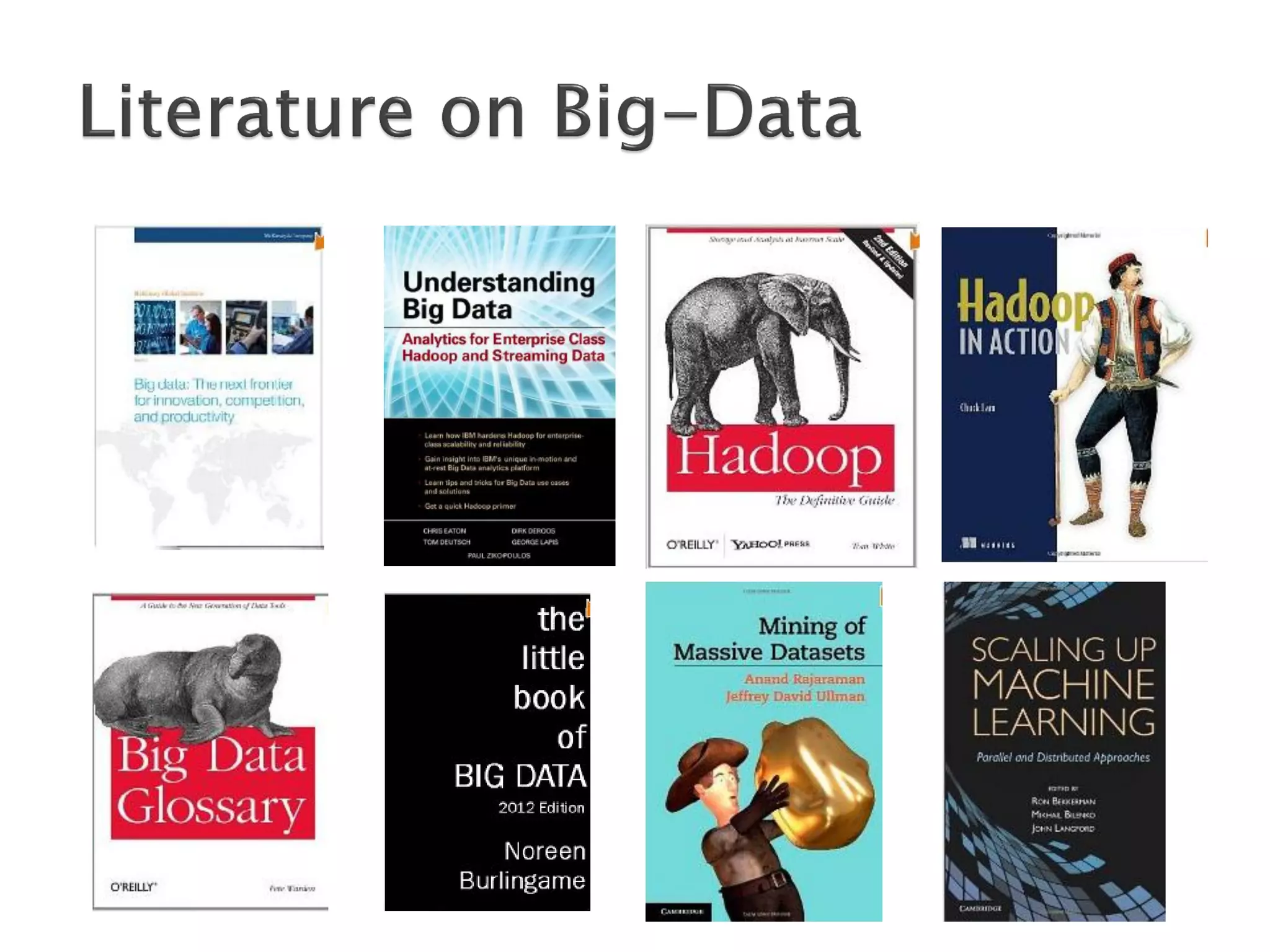
Literature




‘Big-data’ is similar to ‘Small-data’, but bigger
…but having data bigger consequently requires
different approaches:
◦ techniques, tools, architectures



…with an aim to solve new problems
◦ …and old problems in a better way.
From “Understanding Big Data” by IBM
Big-Data


Key enablers for the growth of “Big Data” are:
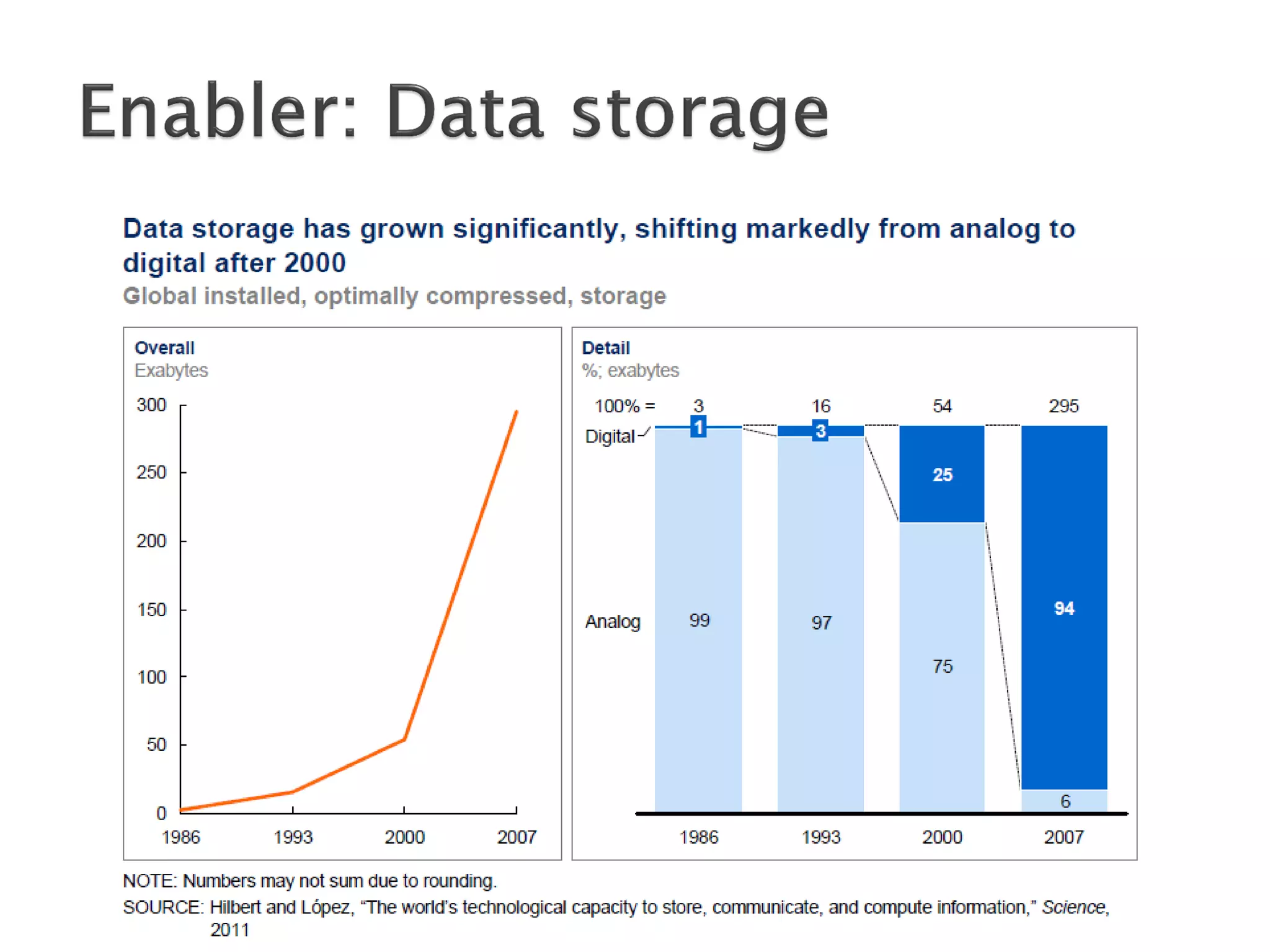
◦ Increase of storage capacities
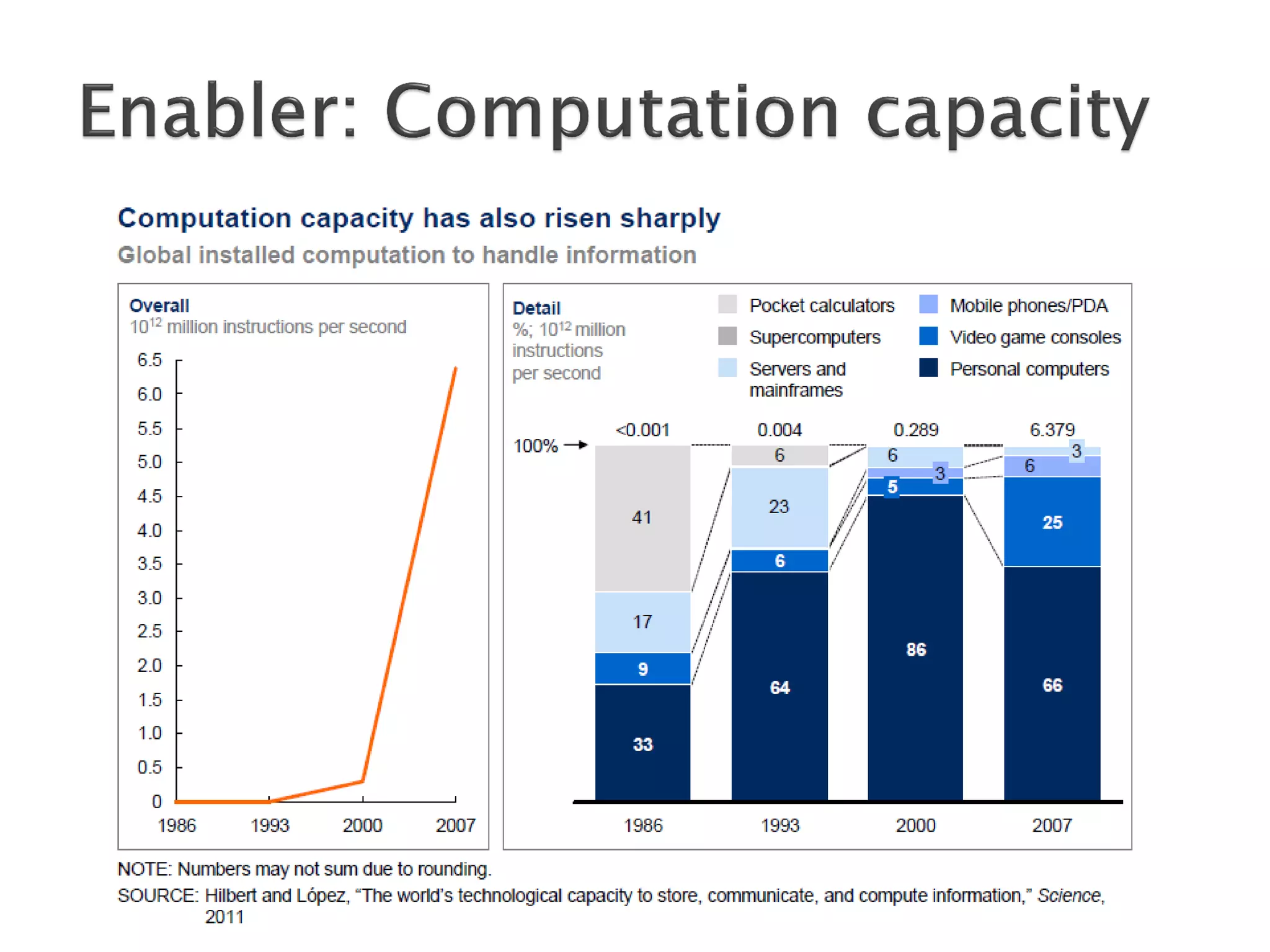
◦ Increase of processing power
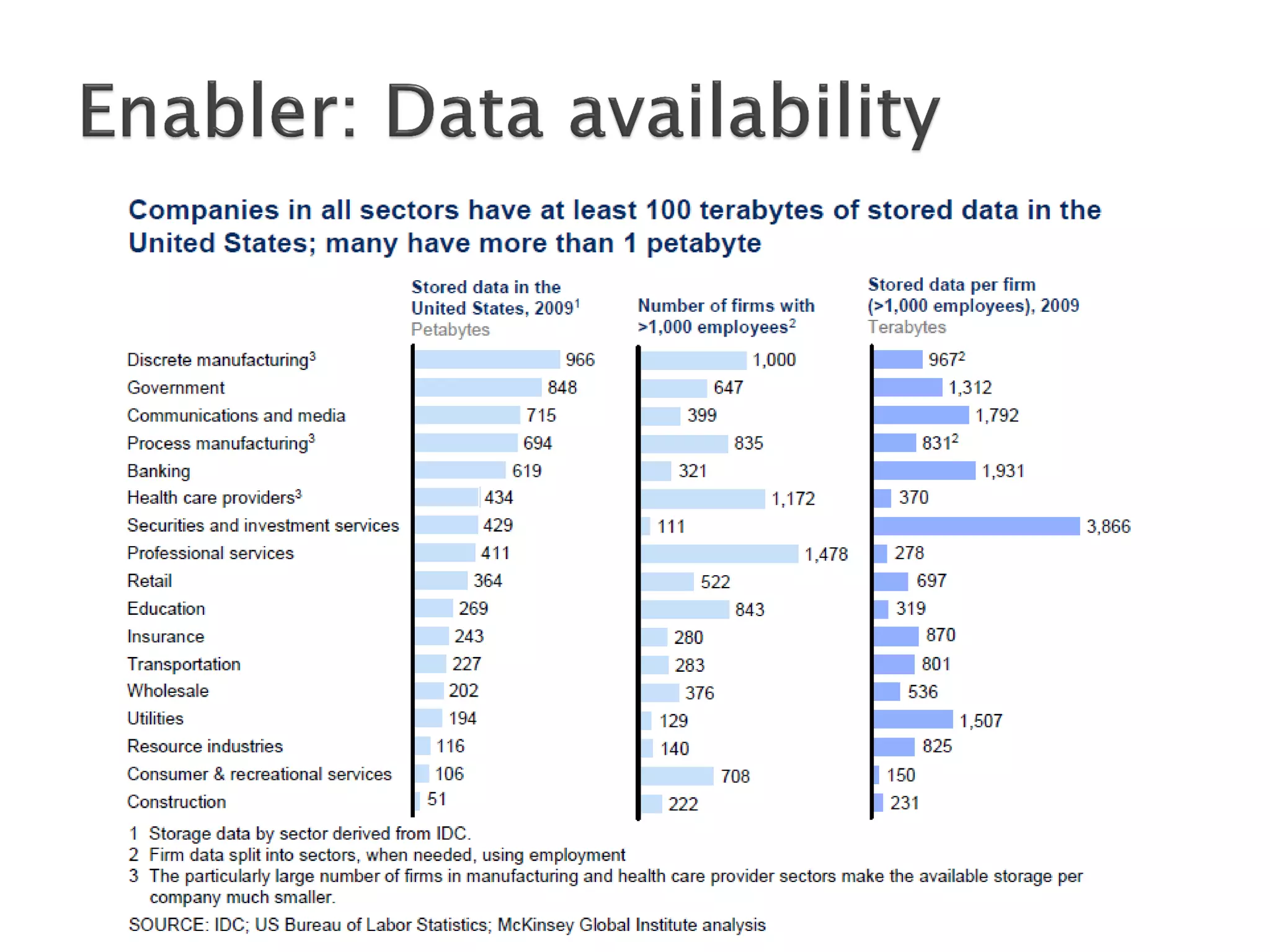
◦ Availability of data


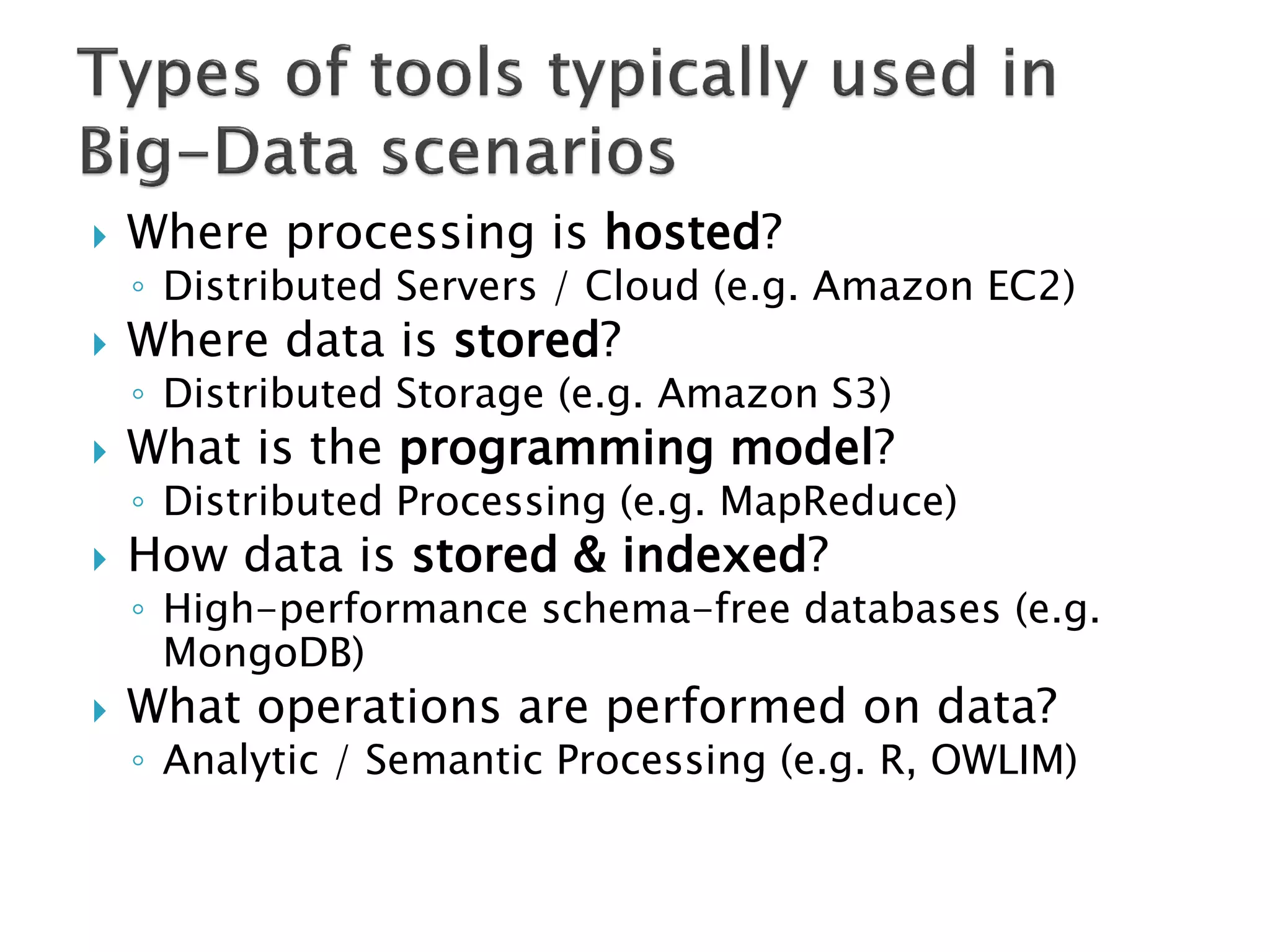
Where processing is hosted?

◦ Distributed Servers / Cloud (e.g. Amazon EC2)



Where data is stored?

◦ Distributed Storage (e.g. Amazon S3)



What is the programming model?

◦ Distributed Processing (e.g. MapReduce)



How data is stored & indexed?

◦ High-performance schema-free databases (e.g.
MongoDB)



What operations are performed on data?

◦ Analytic / Semantic Processing (e.g. R, OWLIM)


Computing and storage are typically hosted
transparently on cloud infrastructures
◦ …providing scale, flexibility and high fail-safety



Distributed Servers
◦ Amazon-EC2, Google App Engine, Elastic,
Beanstalk, Heroku



Distributed Storage
◦ Amazon-S3, Hadoop Distributed File System


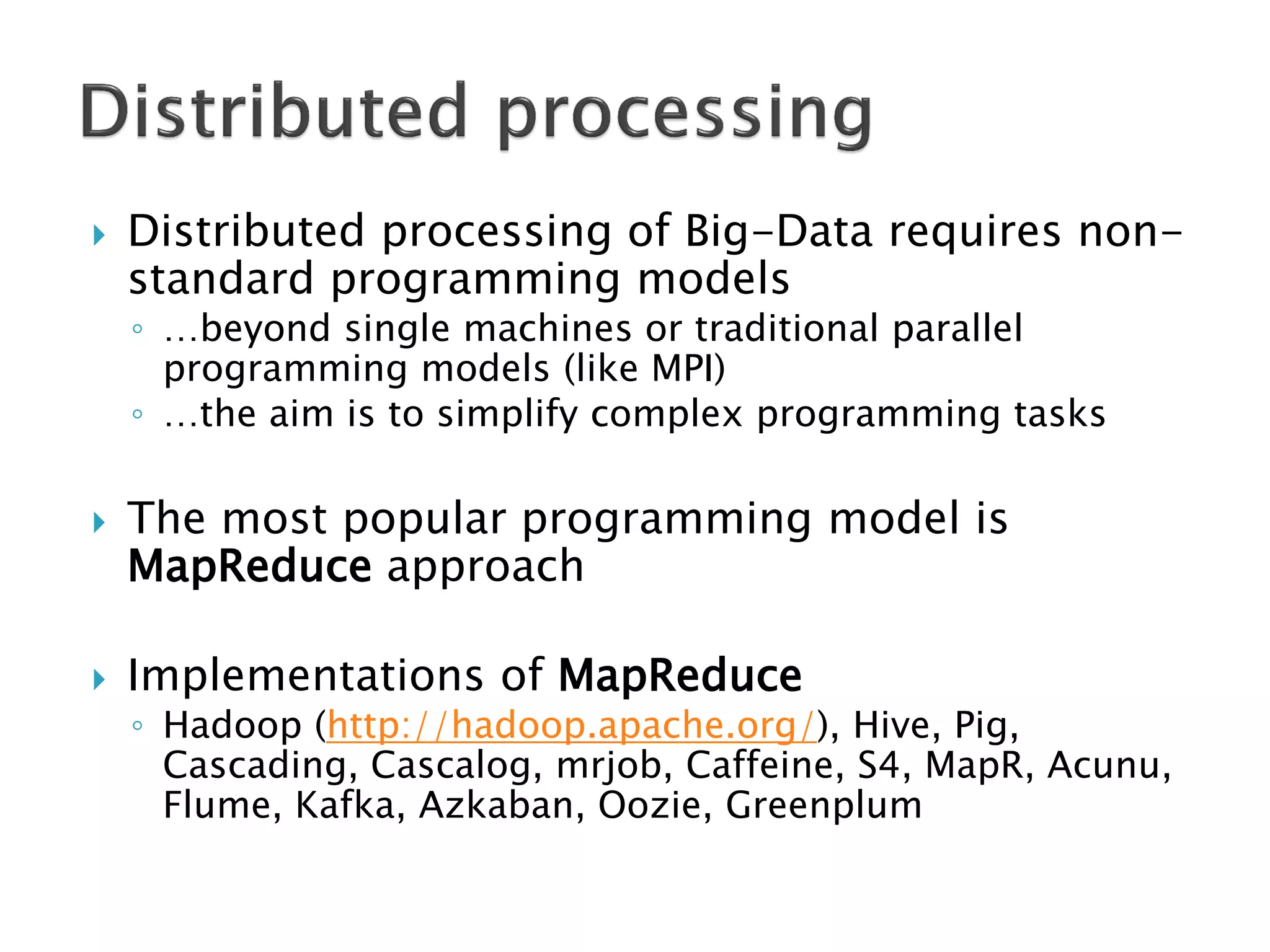
Distributed processing of Big-Data requires nonstandard programming models
◦ …beyond single machines or traditional parallel
programming models (like MPI)
◦ …the aim is to simplify complex programming tasks





The most popular programming model is
MapReduce approach
Implementations of MapReduce

◦ Hadoop (http://hadoop.apache.org/), Hive, Pig,
Cascading, Cascalog, mrjob, Caffeine, S4, MapR, Acunu,
Flume, Kafka, Azkaban, Oozie, Greenplum


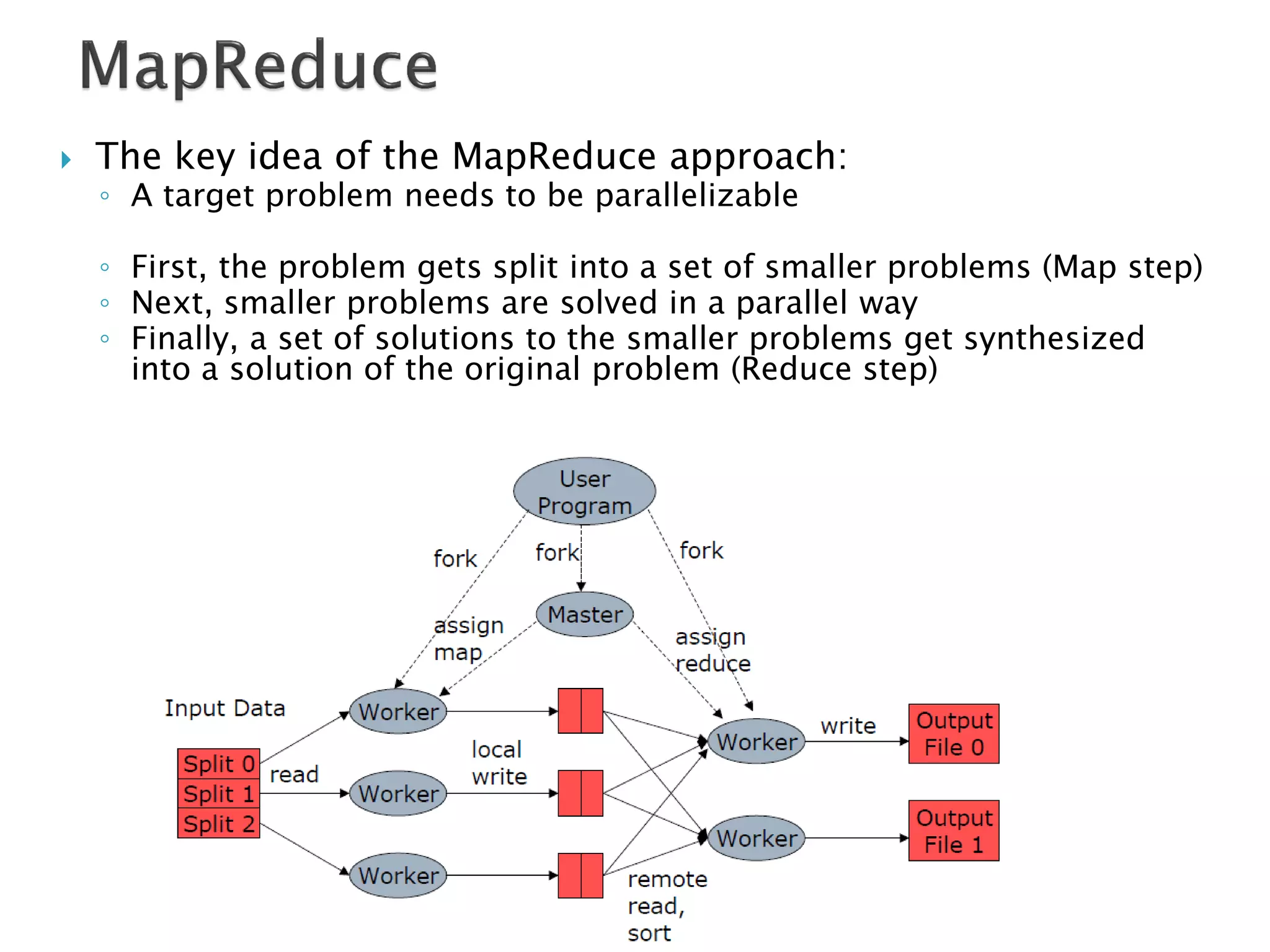
The key idea of the MapReduce approach:
◦ A target problem needs to be parallelizable

◦ First, the problem gets split into a set of smaller problems (Map step)
◦ Next, smaller problems are solved in a parallel way
◦ Finally, a set of solutions to the smaller problems get synthesized
into a solution of the original problem (Reduce step)


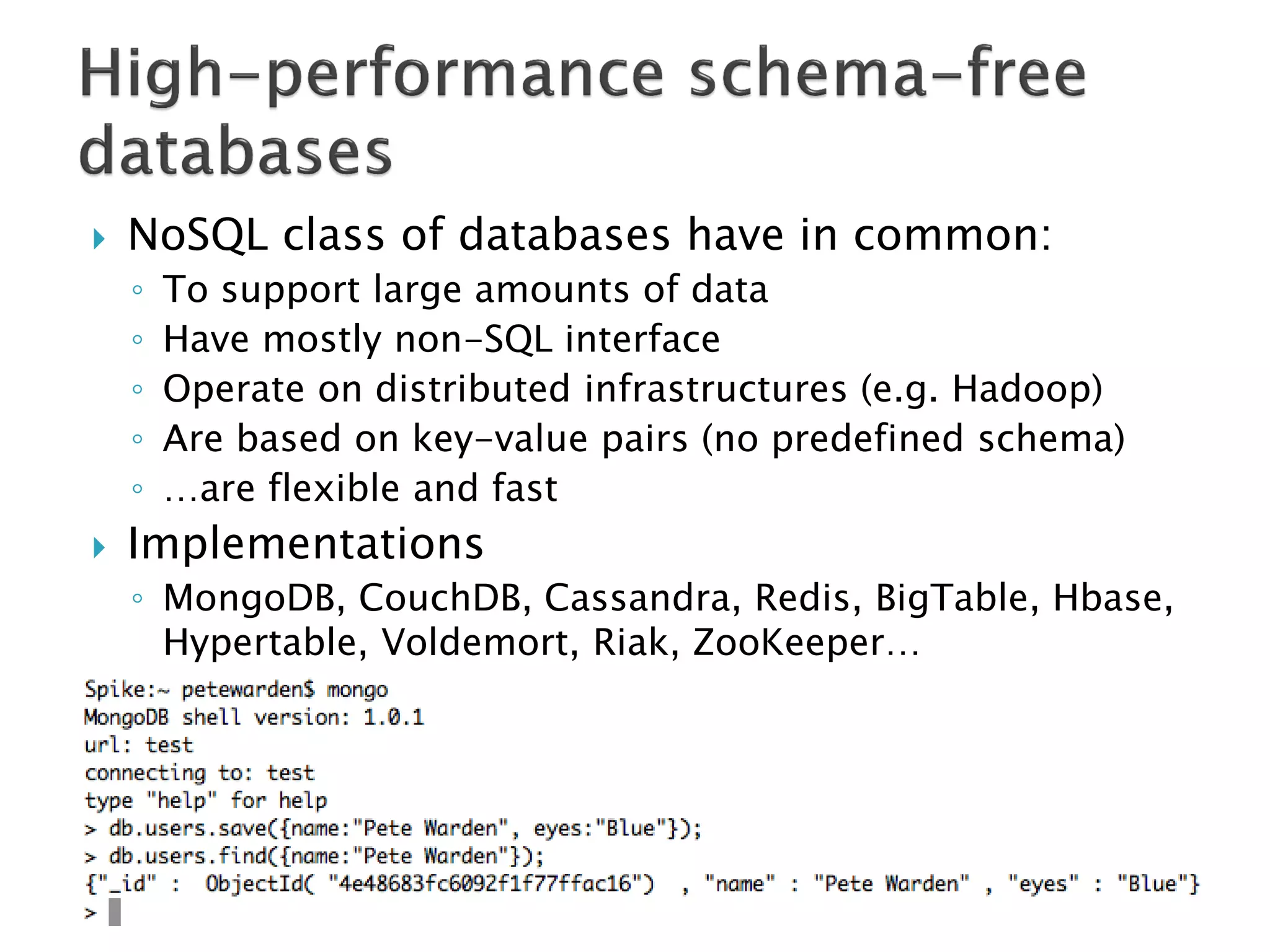
NoSQL class of databases have in common:
◦
◦
◦
◦
◦



To support large amounts of data
Have mostly non-SQL interface
Operate on distributed infrastructures (e.g. Hadoop)
Are based on key-value pairs (no predefined schema)
…are flexible and fast

Implementations
◦ MongoDB, CouchDB, Cassandra, Redis, BigTable, Hbase,
Hypertable, Voldemort, Riak, ZooKeeper…


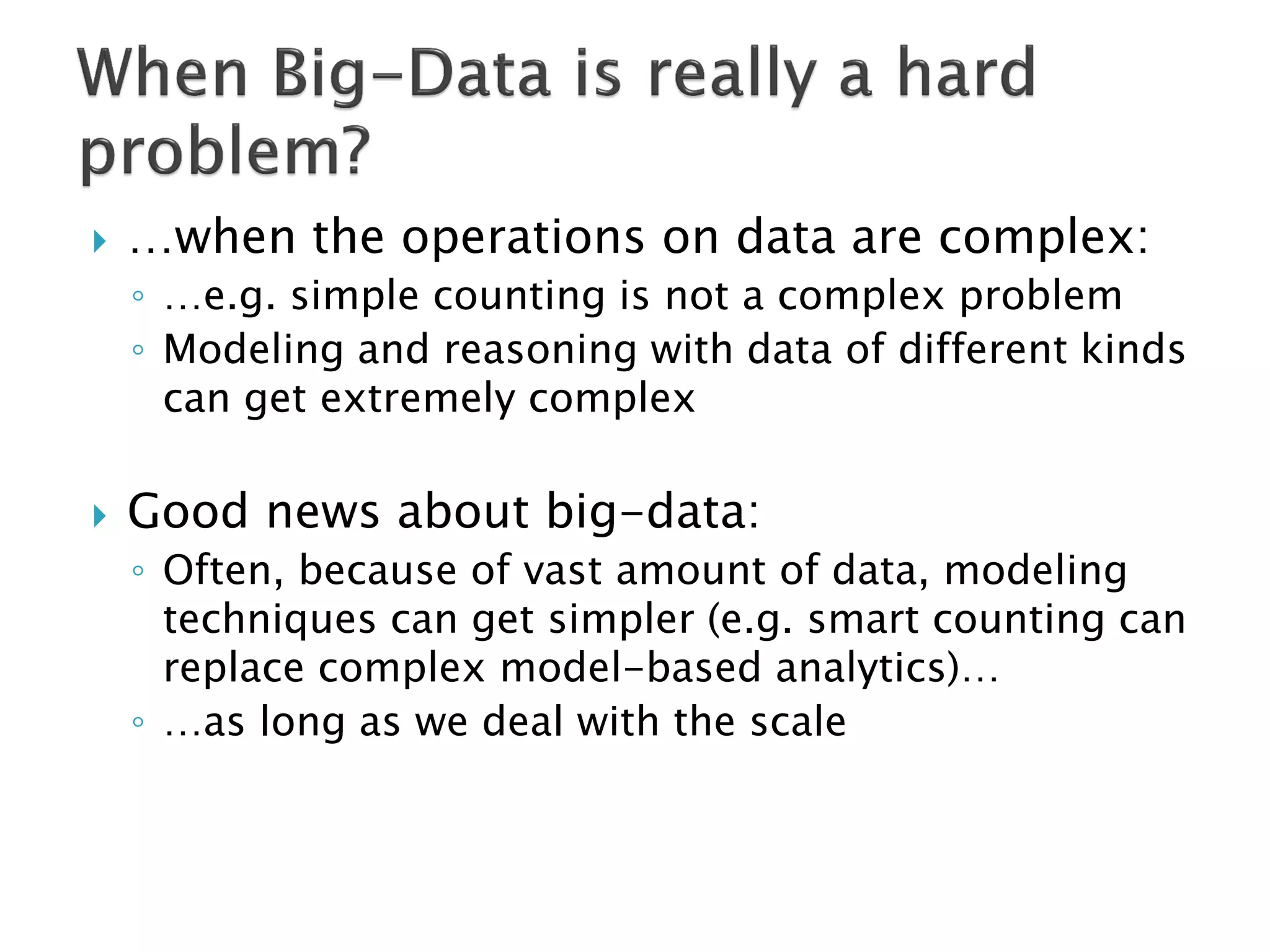
…when the operations on data are complex:
◦ …e.g. simple counting is not a complex problem
◦ Modeling and reasoning with data of different kinds
can get extremely complex



Good news about big-data:
◦ Often, because of vast amount of data, modeling
techniques can get simpler (e.g. smart counting can
replace complex model-based analytics)…
◦ …as long as we deal with the scale


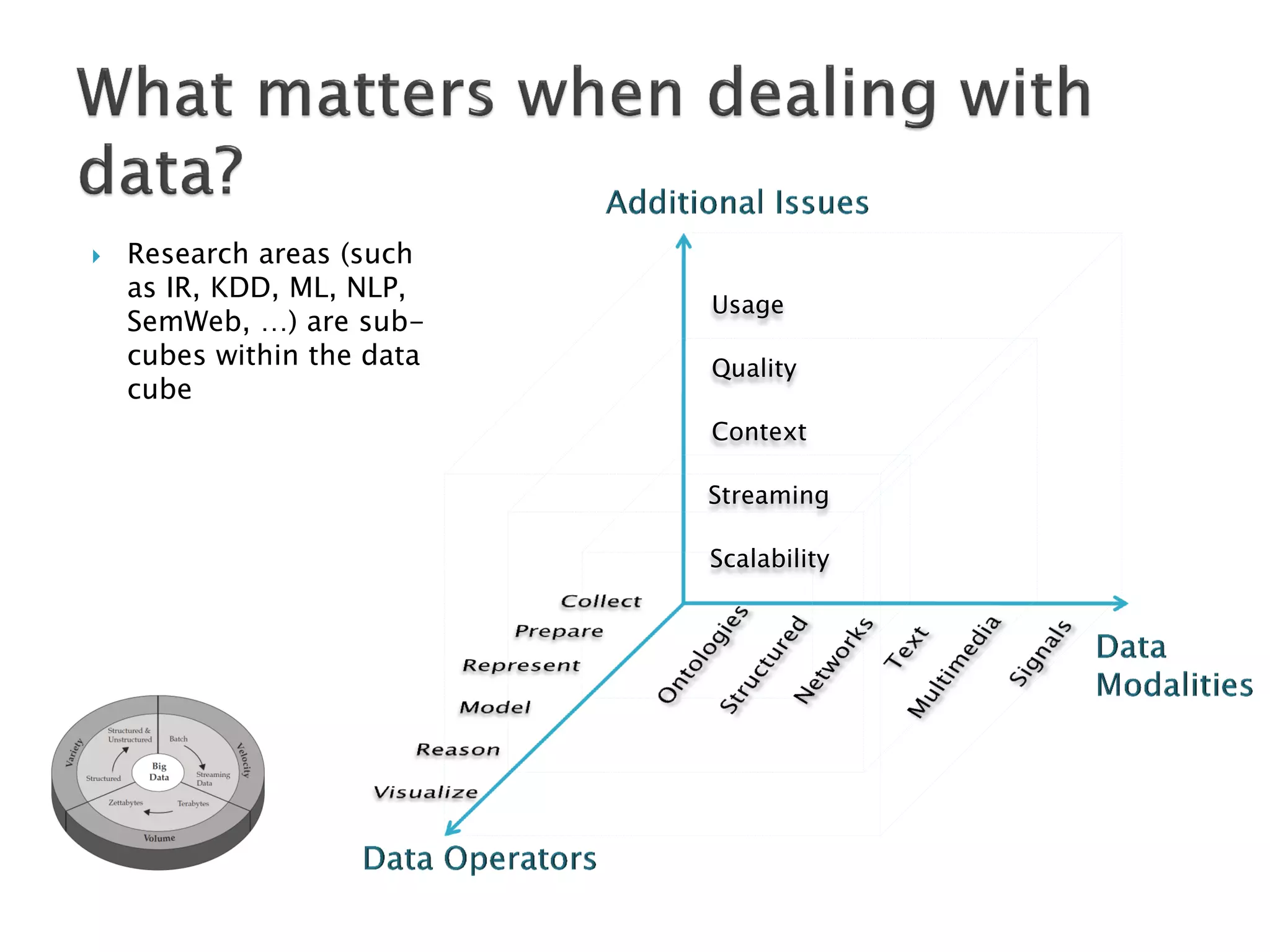
Research areas (such
as IR, KDD, ML, NLP,
SemWeb, …) are subcubes within the data
cube

Usage
Quality

Context
Streaming
Scalability




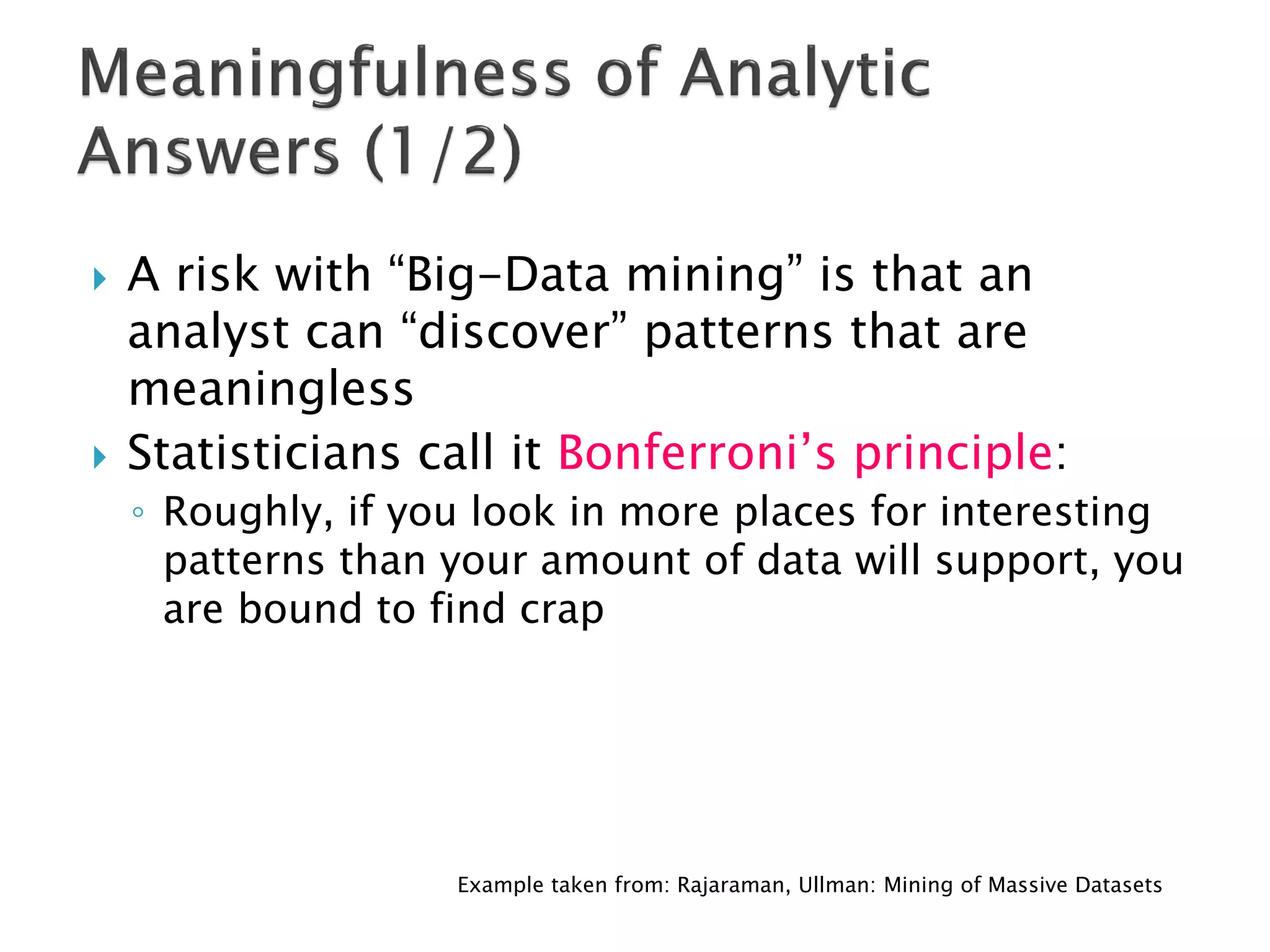
A risk with “Big-Data mining” is that an
analyst can “discover” patterns that are
meaningless
Statisticians call it Bonferroni’s principle:
◦ Roughly, if you look in more places for interesting
patterns than your amount of data will support, you
are bound to find crap

Example taken from: Rajaraman, Ullman: Mining of Massive Datasets
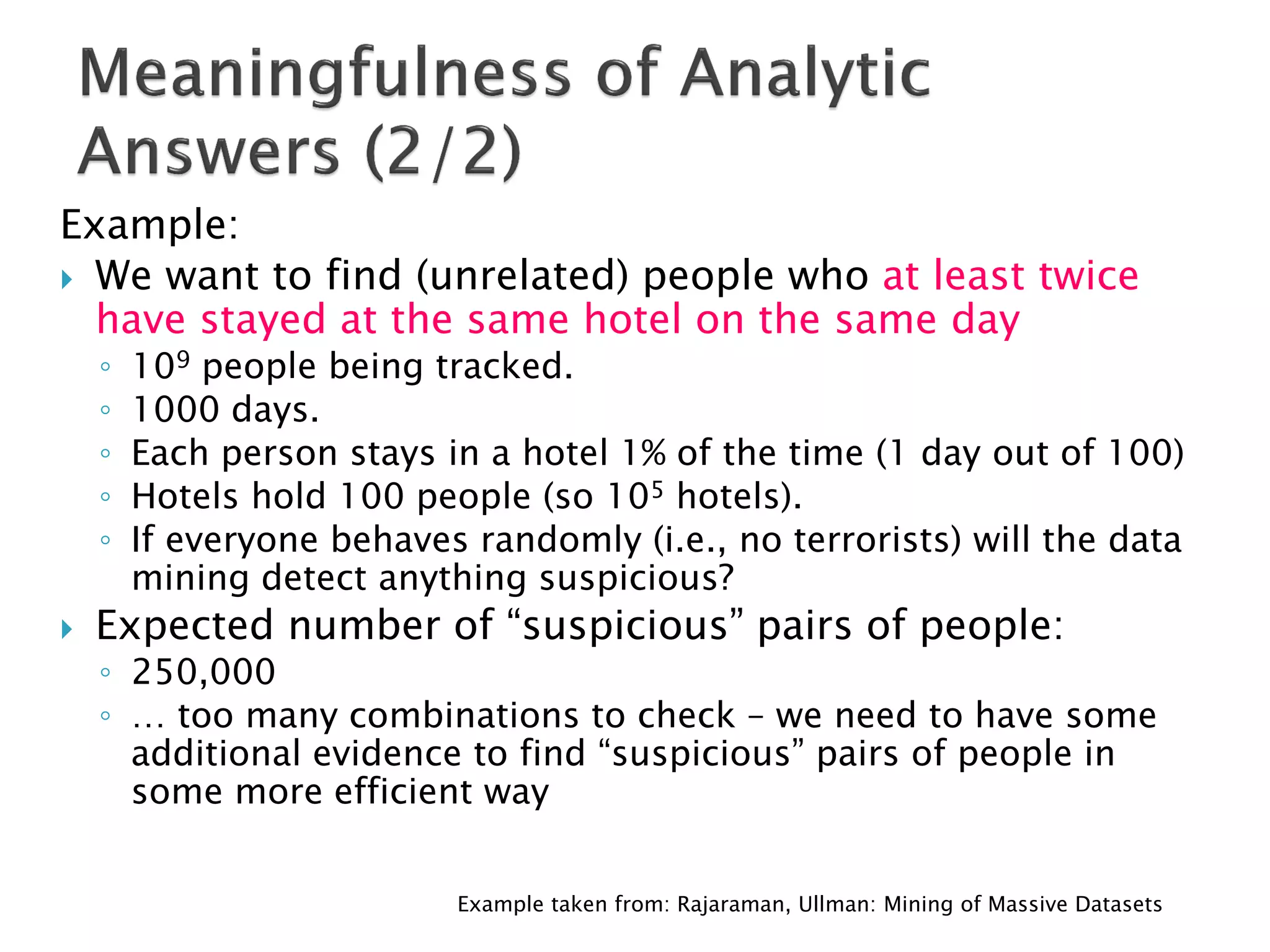
Example:
 We want to find (unrelated) people who at least twice
have stayed at the same hotel on the same day
◦
◦
◦
◦
◦


109 people being tracked.
1000 days.
Each person stays in a hotel 1% of the time (1 day out of 100)
Hotels hold 100 people (so 105 hotels).
If everyone behaves randomly (i.e., no terrorists) will the data
mining detect anything suspicious?

Expected number of “suspicious” pairs of people:

◦ 250,000
◦ … too many combinations to check – we need to have some
additional evidence to find “suspicious” pairs of people in
some more efficient way
Example taken from: Rajaraman, Ullman: Mining of Massive Datasets


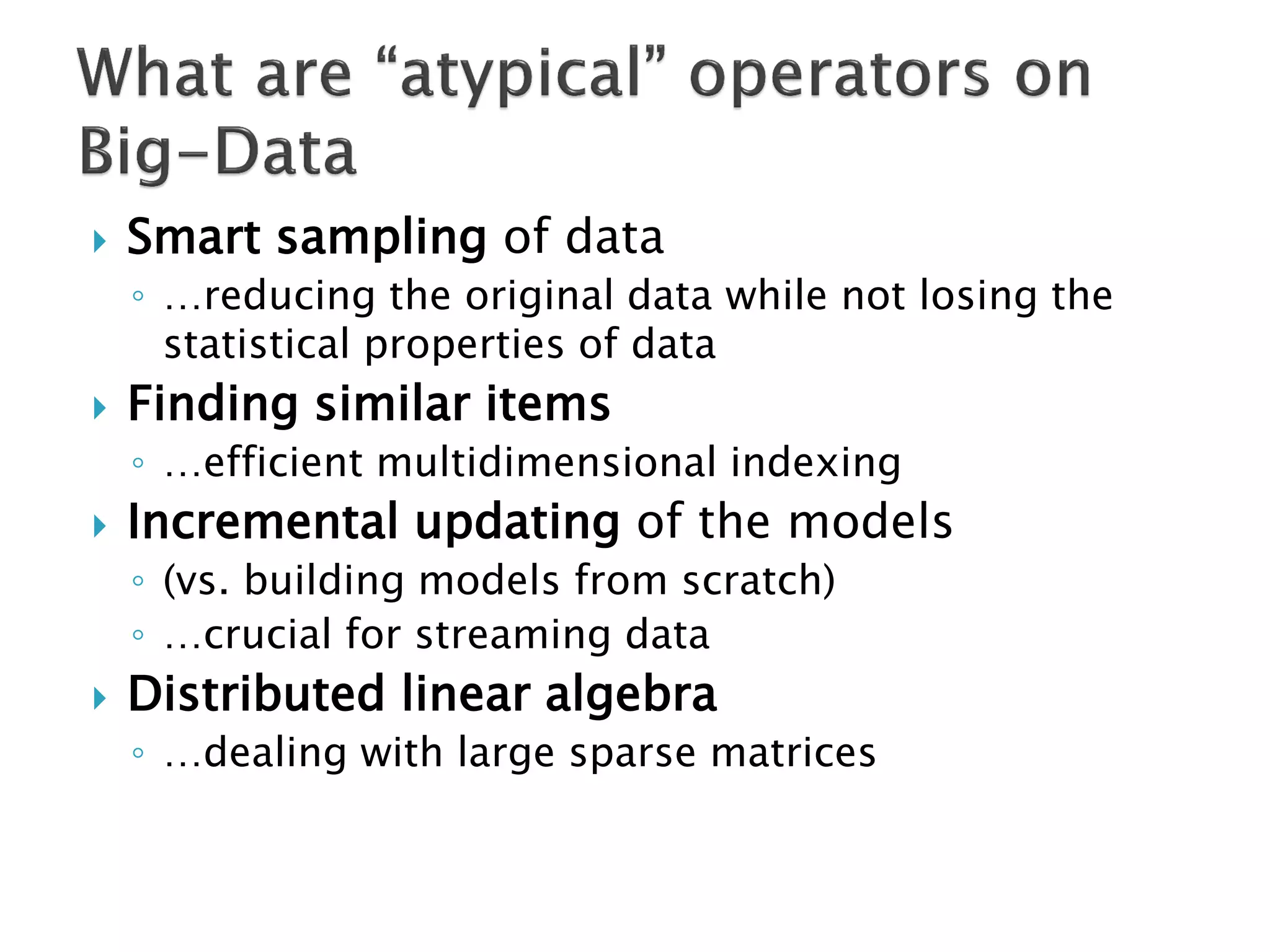
Smart sampling of data
◦ …reducing the original data while not losing the
statistical properties of data



Finding similar items
◦ …efficient multidimensional indexing



Incremental updating of the models
◦ (vs. building models from scratch)
◦ …crucial for streaming data



Distributed linear algebra
◦ …dealing with large sparse matrices


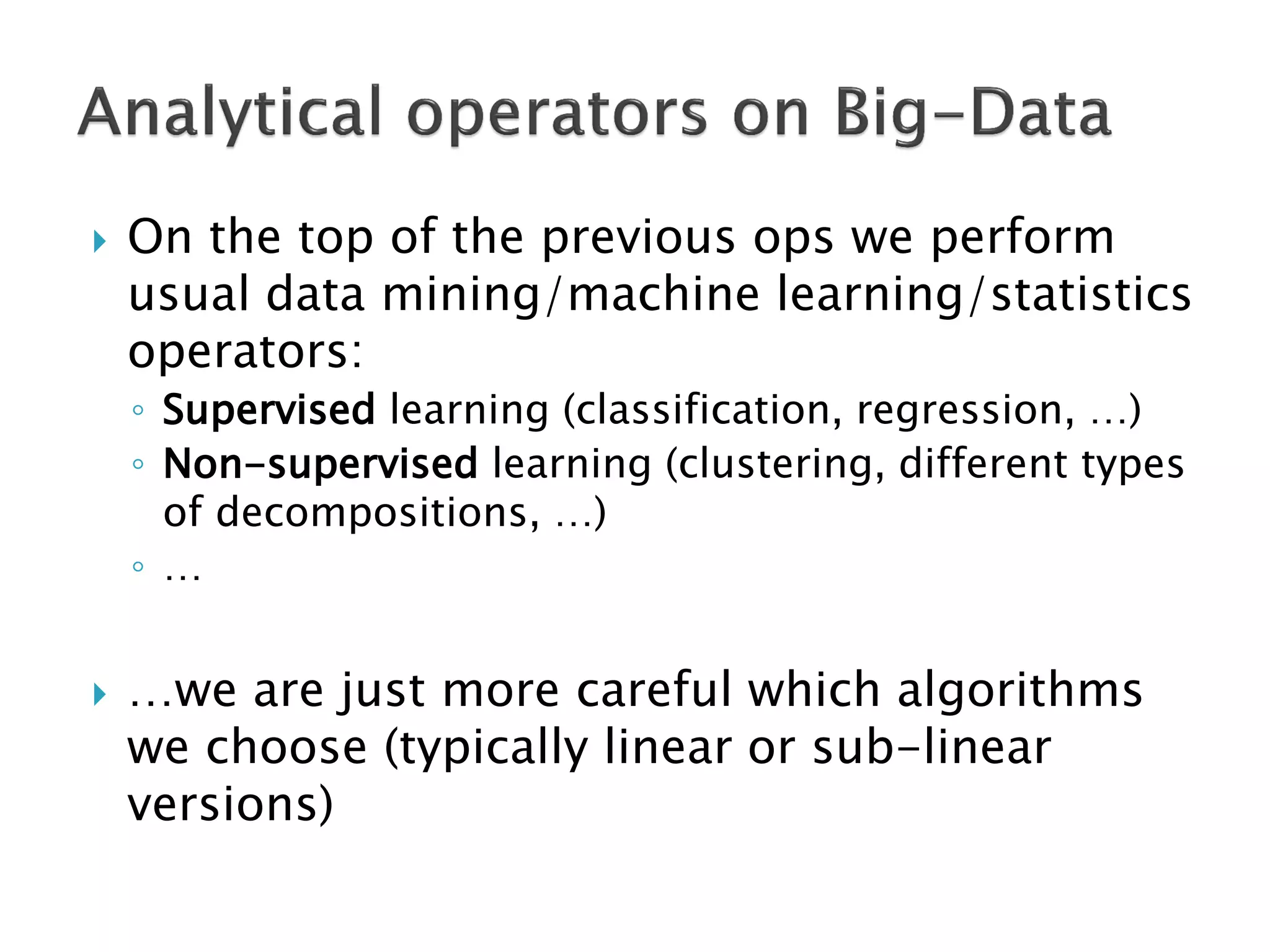
On the top of the previous ops we perform
usual data mining/machine learning/statistics
operators:
◦ Supervised learning (classification, regression, …)
◦ Non-supervised learning (clustering, different types
of decompositions, …)
◦ …



…we are just more careful which algorithms
we choose (typically linear or sub-linear
versions)


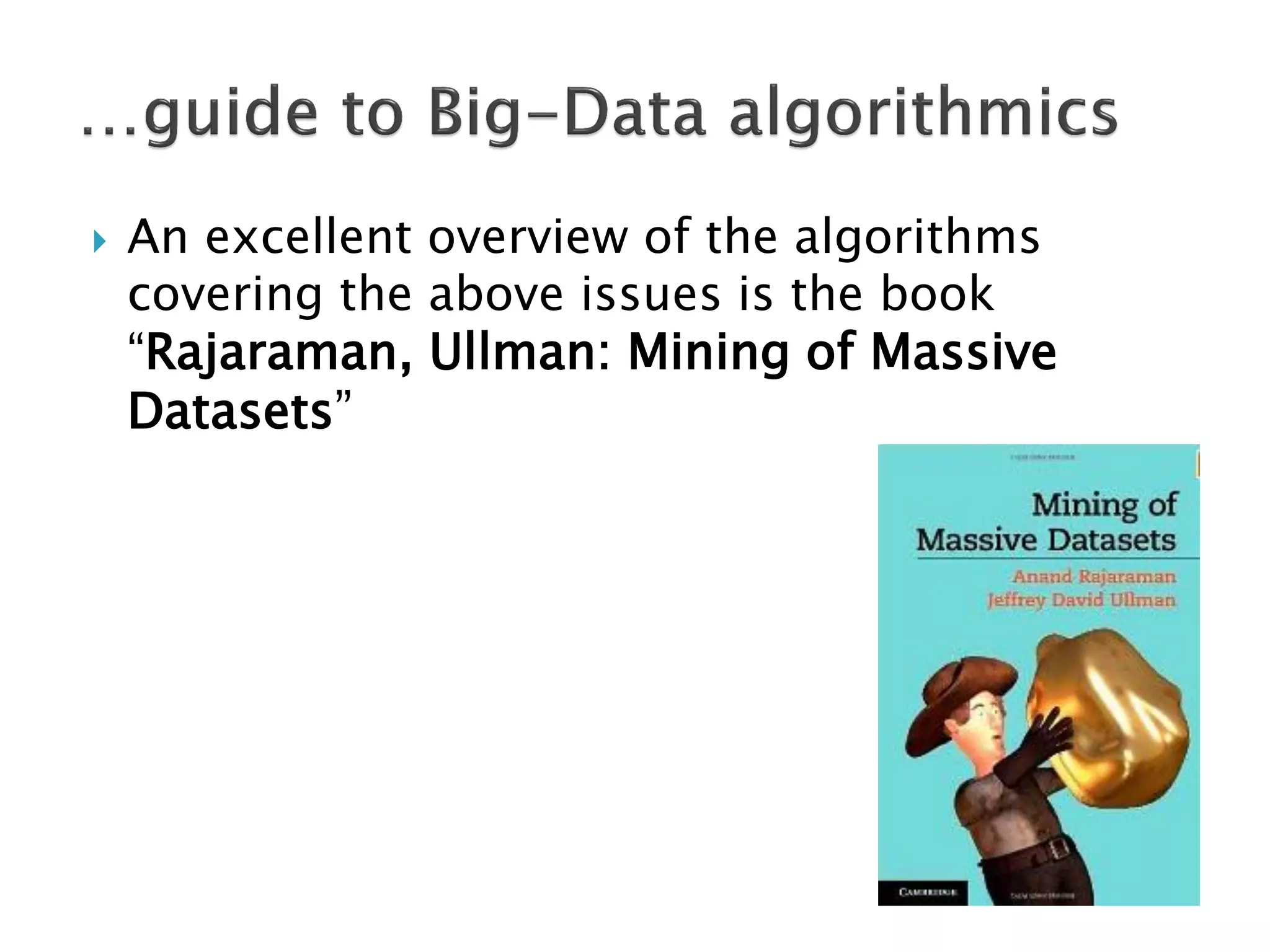
An excellent overview of the algorithms
covering the above issues is the book
“Rajaraman, Ullman: Mining of Massive
Datasets”


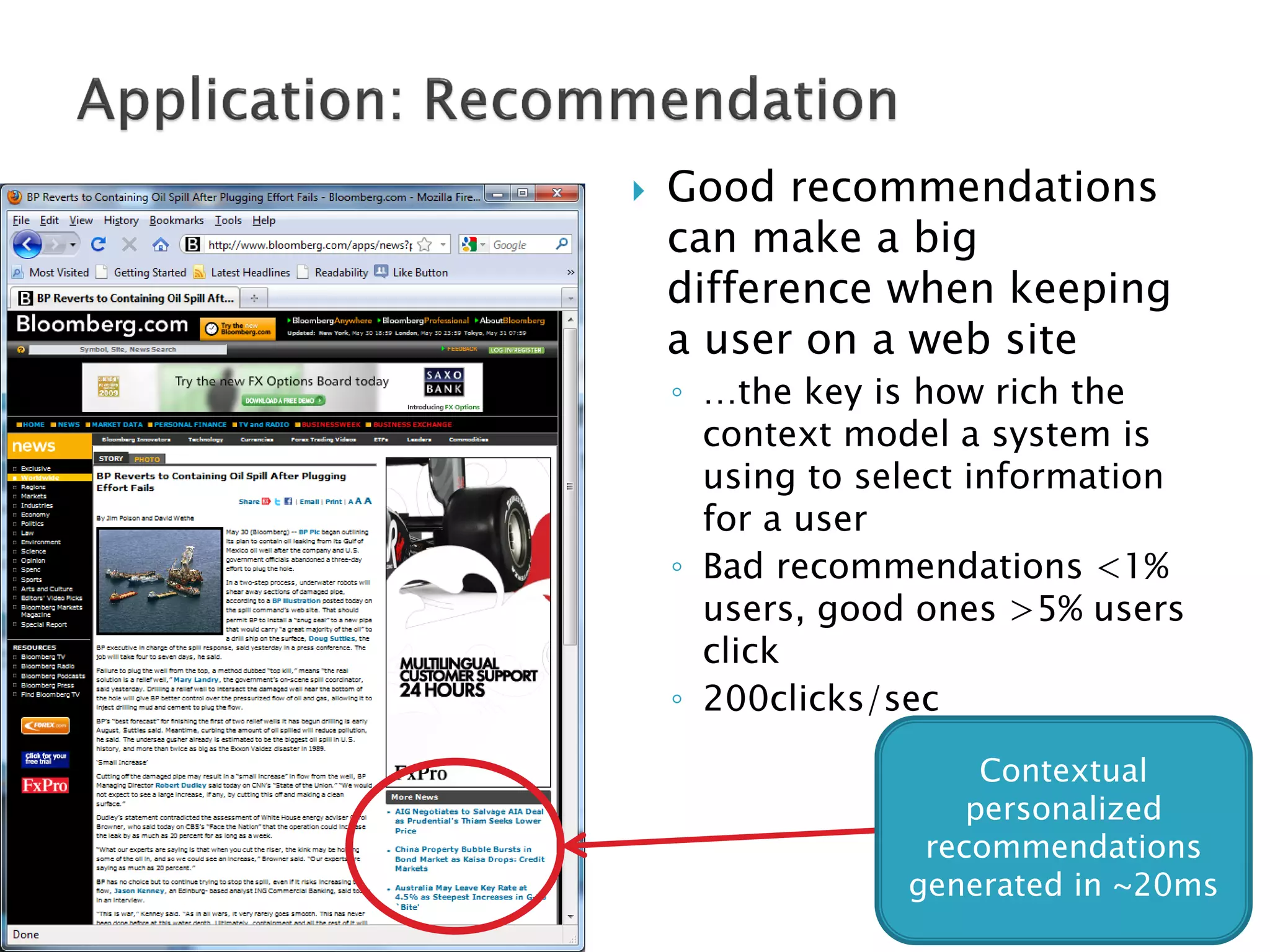
Good recommendations
can make a big
difference when keeping
a user on a web site
◦ …the key is how rich the
context model a system is
using to select information
for a user
◦ Bad recommendations <1%
users, good ones >5% users
click
◦ 200clicks/sec
Contextual
personalized
recommendations
generated in ~20ms






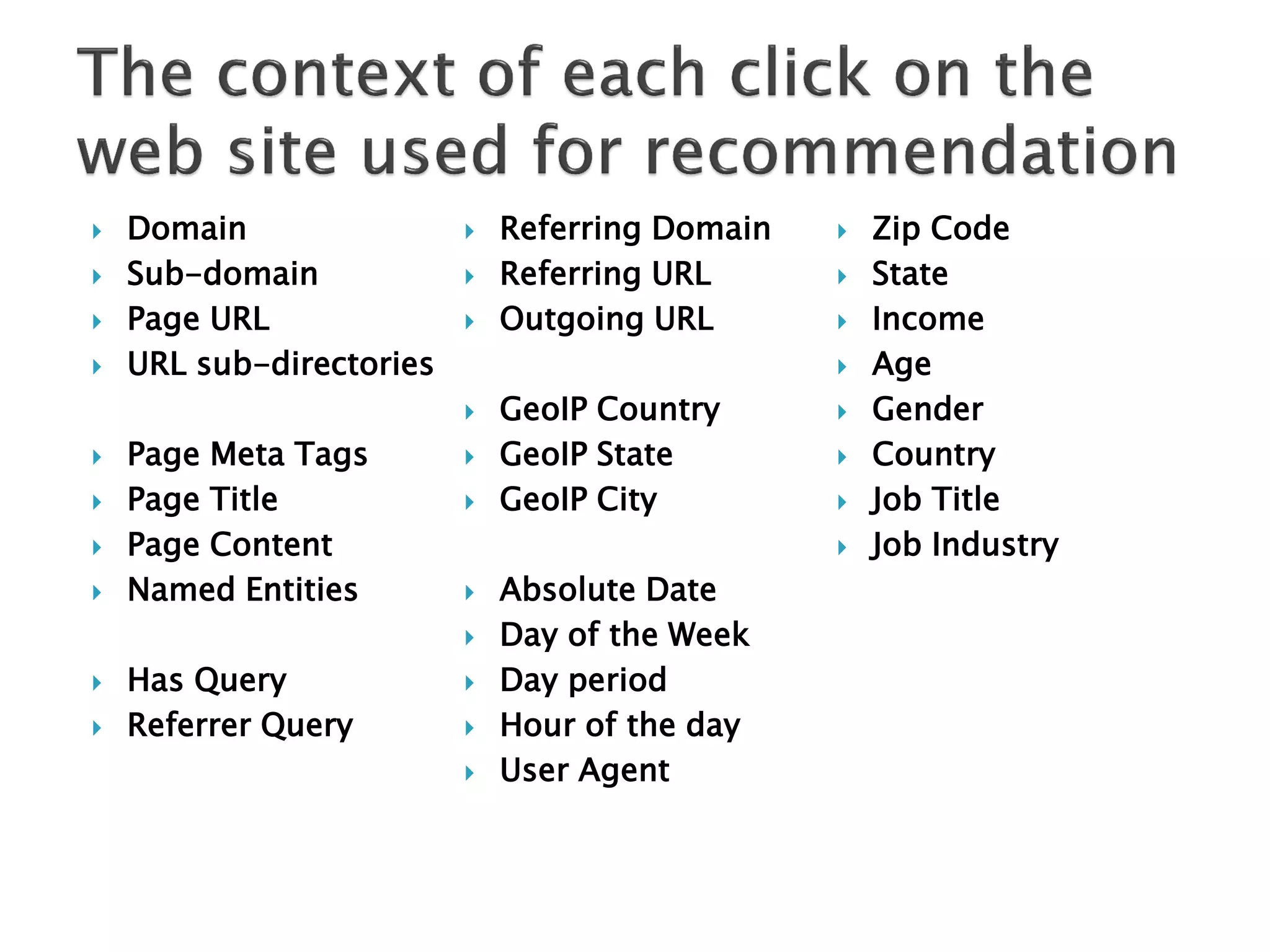
Domain
Sub-domain
Page URL
URL sub-directories










Page Meta Tags
Page Title
Page Content
Named Entities






Has Query
Referrer Query




GeoIP Country
GeoIP State
GeoIP City



















Referring Domain
Referring URL
Outgoing URL





Absolute Date
Day of the Week
Day period
Hour of the day
User Agent

Zip Code
State
Income
Age
Gender
Country
Job Title
Job Industry
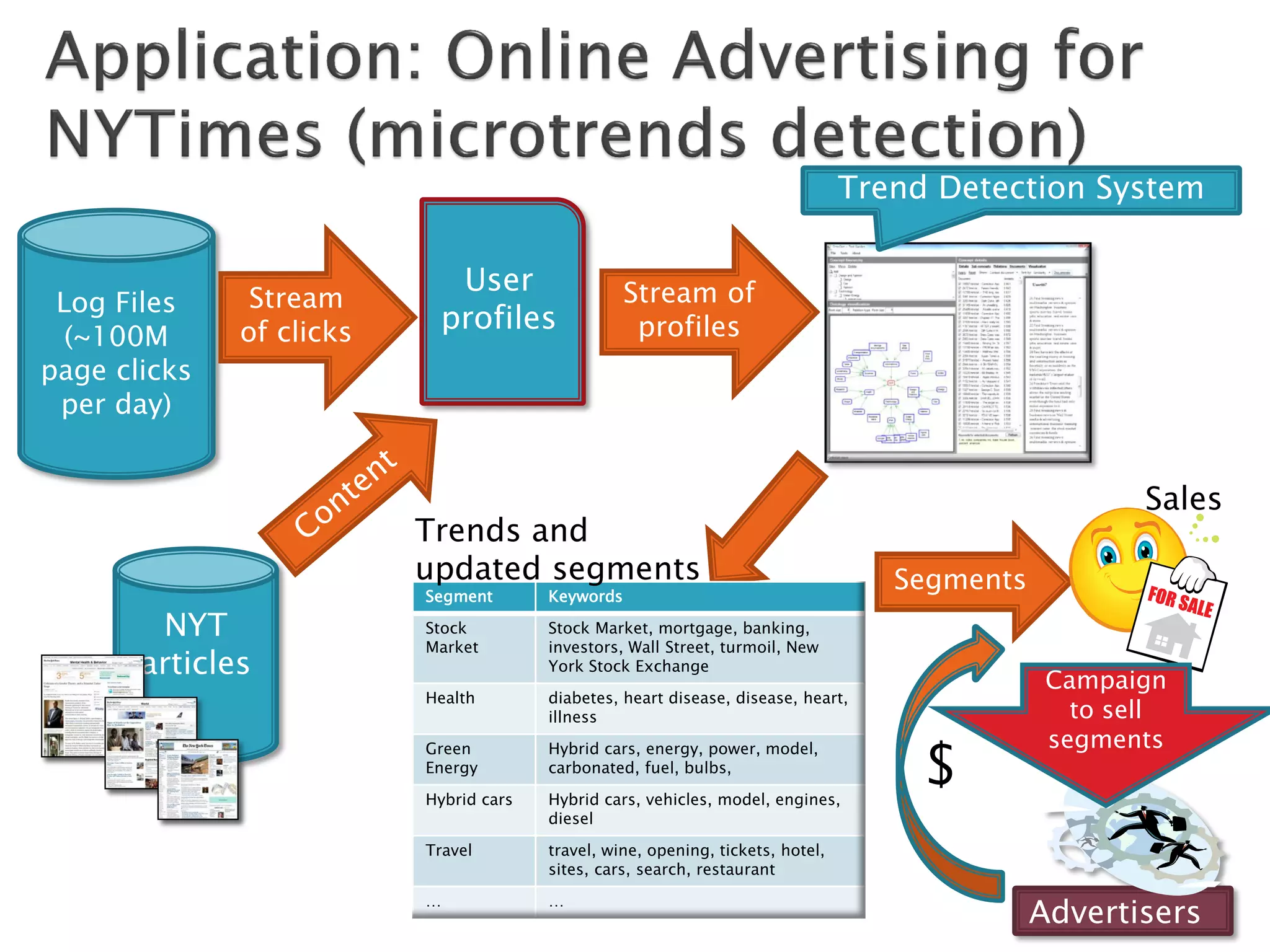
Trend Detection System
Log Files
(~100M
page clicks
per day)

Stream
of clicks

User
profiles

Stream of
profiles

Trends and
updated segments
NYT
articles

Segment

Keywords

Stock
Market

diabetes, heart disease, disease, heart,
illness

Green
Energy

Hybrid cars, energy, power, model,
carbonated, fuel, bulbs,

Hybrid cars

Hybrid cars, vehicles, model, engines,
diesel

Travel

travel, wine, opening, tickets, hotel,
sites, cars, search, restaurant

…

…

Segments

Stock Market, mortgage, banking,
investors, Wall Street, turmoil, New
York Stock Exchange

Health

Sales

$

Campaign
to sell
segments

Advertisers





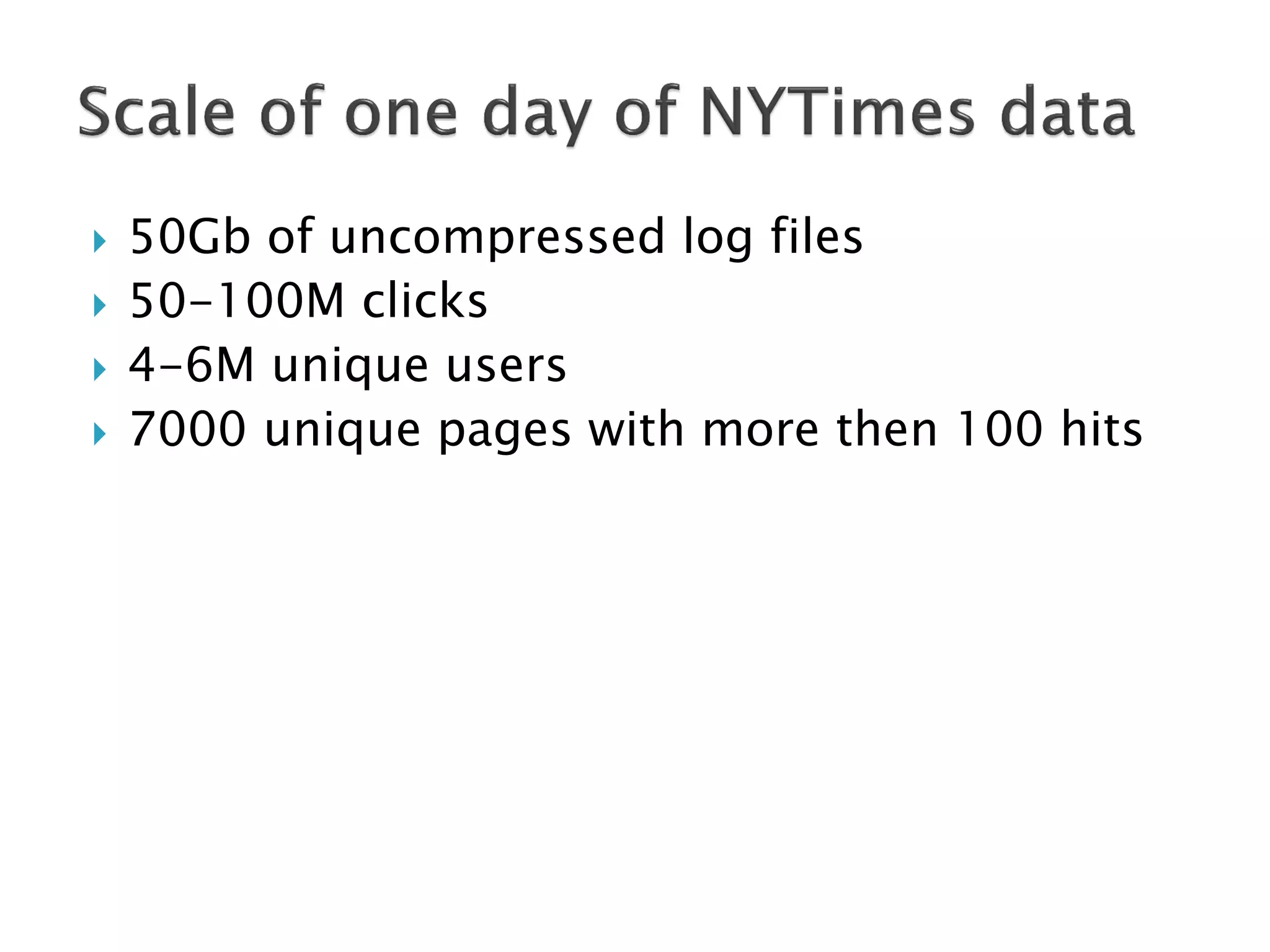
50Gb of uncompressed log files
50-100M clicks
4-6M unique users
7000 unique pages with more then 100 hits
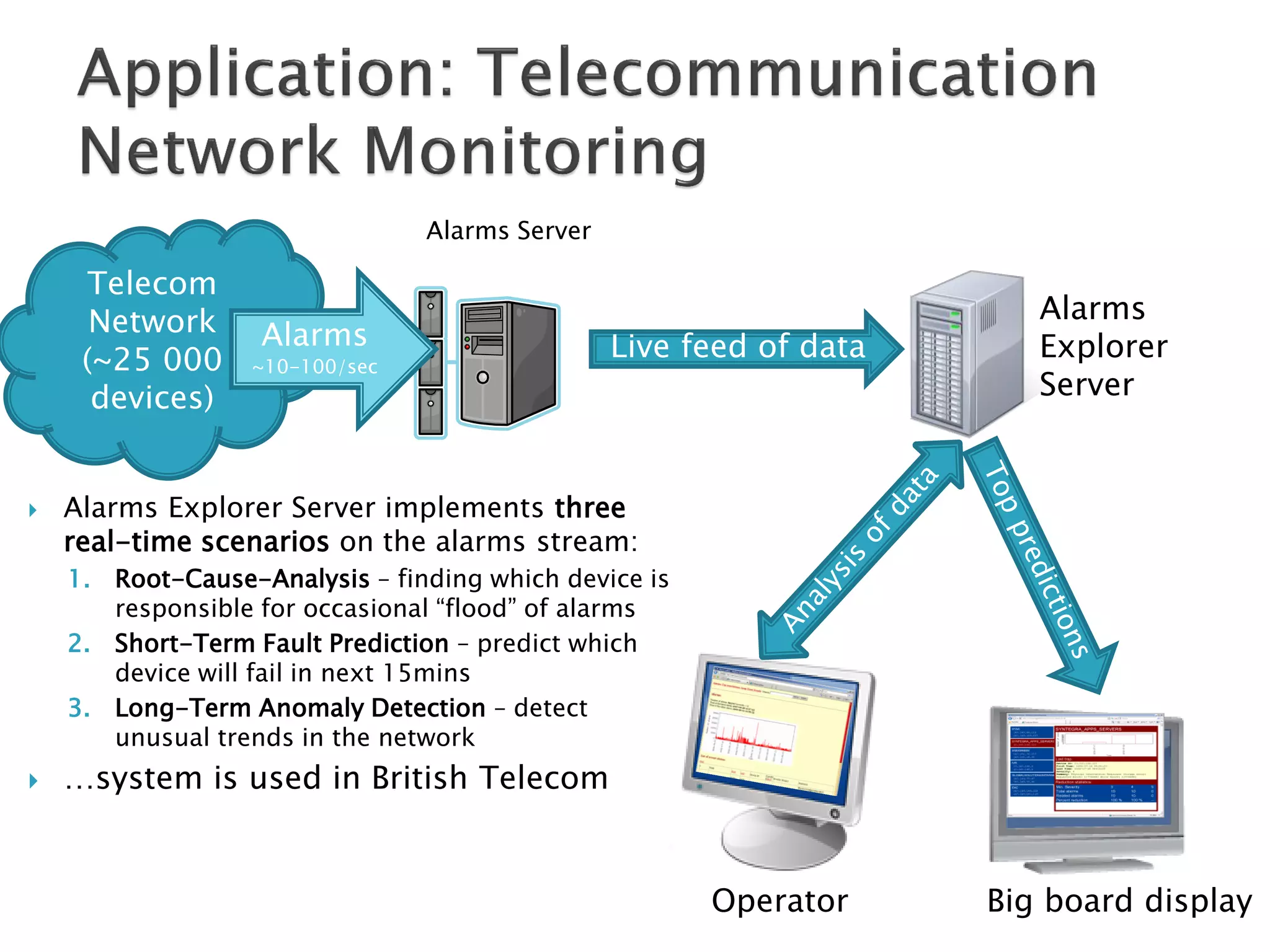
Alarms Server

Telecom
Network
(~25 000
devices)



Alarms

~10-100/sec

Live feed of data

Alarms
Explorer
Server

Alarms Explorer Server implements three
real-time scenarios on the alarms stream:
1. Root-Cause-Analysis – finding which device is
responsible for occasional “flood” of alarms
2. Short-Term Fault Prediction – predict which
device will fail in next 15mins
3. Long-Term Anomaly Detection – detect
unusual trends in the network



…system is used in British Telecom

Operator

Big board display


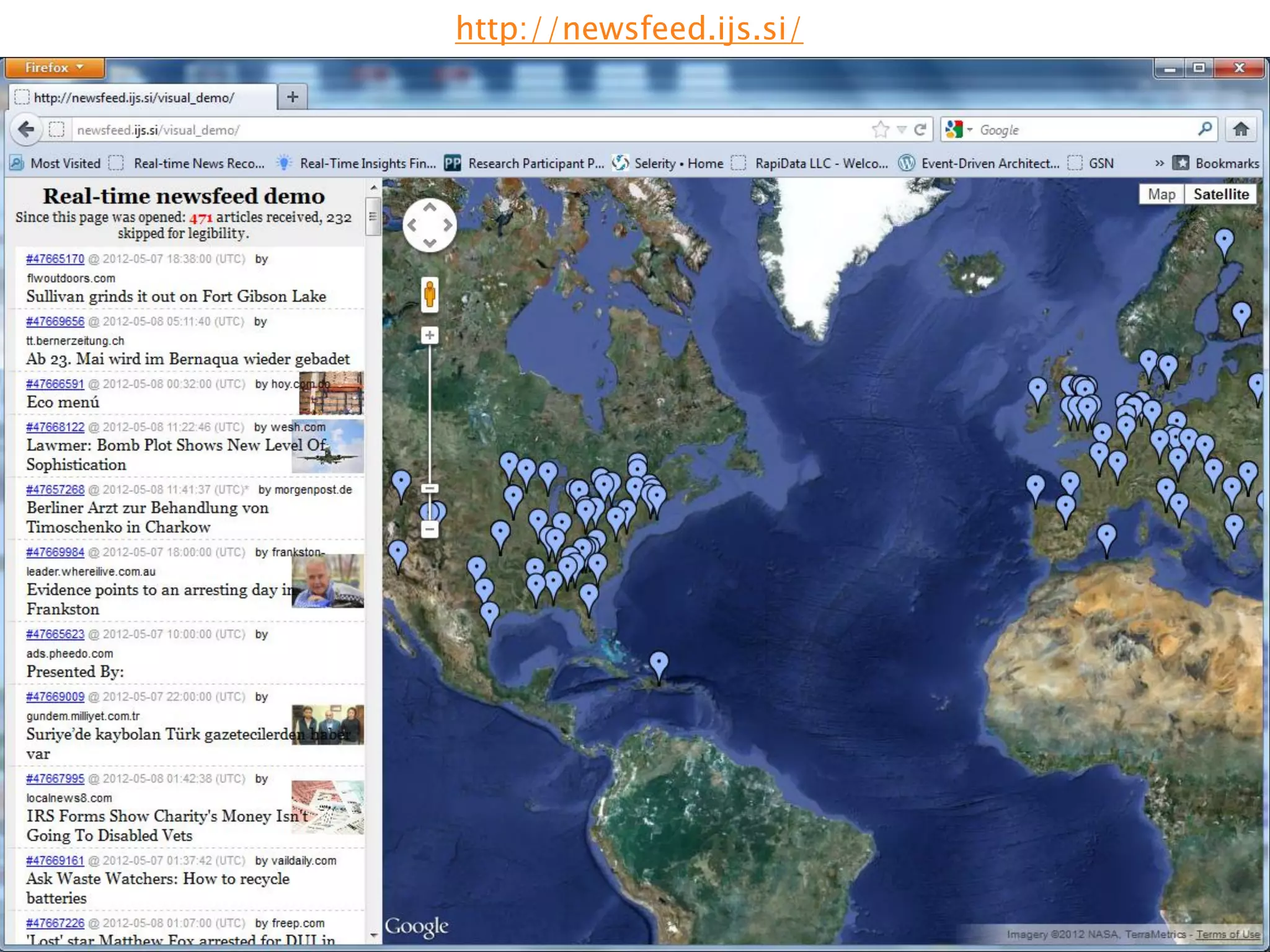
The aim of the project is to collect and analyze
most of the main-stream media across the world
◦ …from 35,000 publishers (180K RSS feeds) crawled in
real time (few ~10articles per second)
◦ …each article document gets extracted, cleaned,
semantically annotated, structure extracted



Challenges are in terms of complexity of
processing and querying of the extracted data
◦ …and matching textual information across the
languages (cross-lingual technologies)

http://render-project.eu/

http://www.xlike.org/
http://newsfeed.ijs.si/
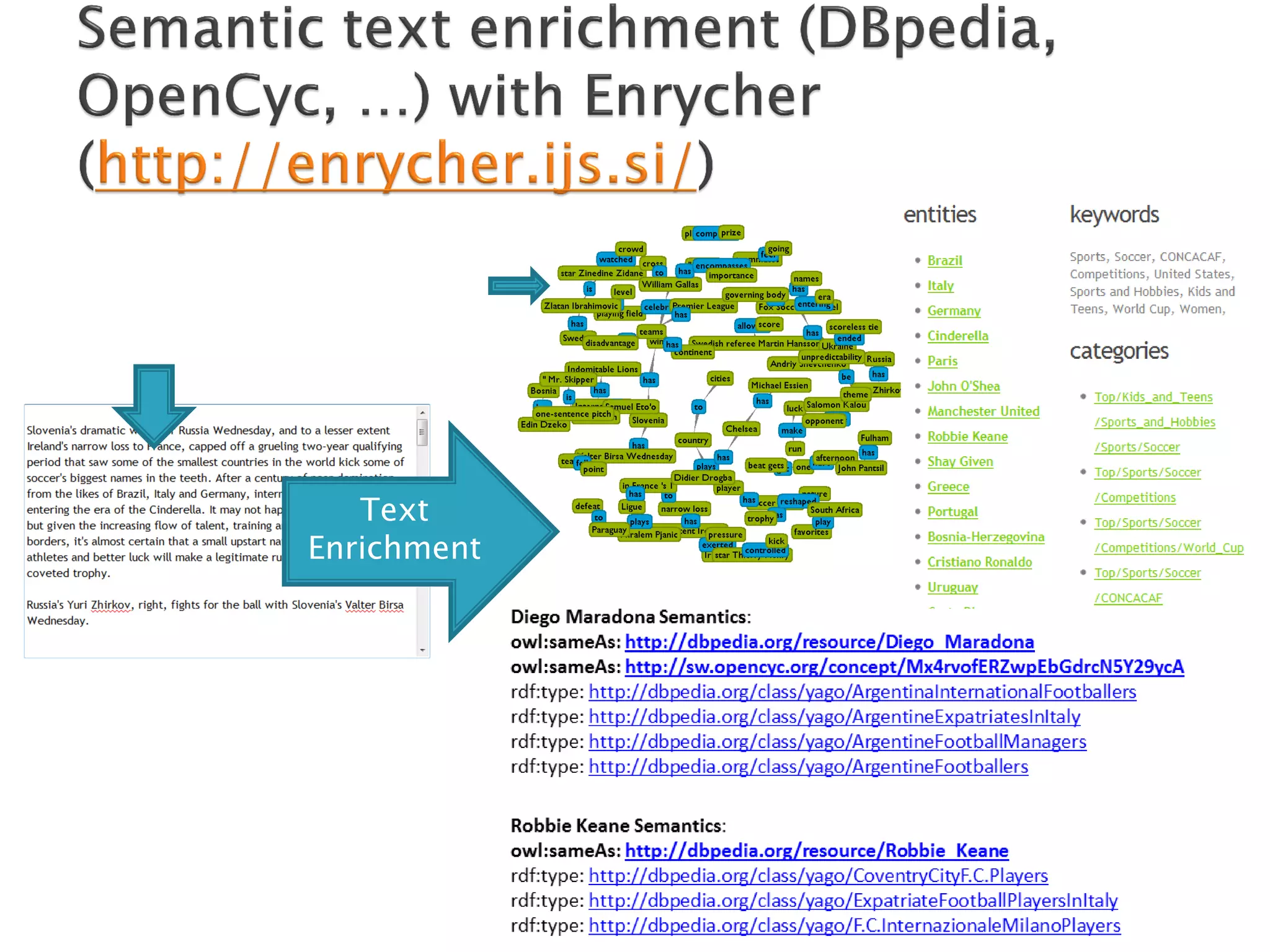
Plain text

Extracted
graph
of triples
from text

Text
Enrichment

“Enrycher” is available as
as a web-service generating
Semantic Graph, LOD links,
Entities, Keywords, Categories,
Text Summarization


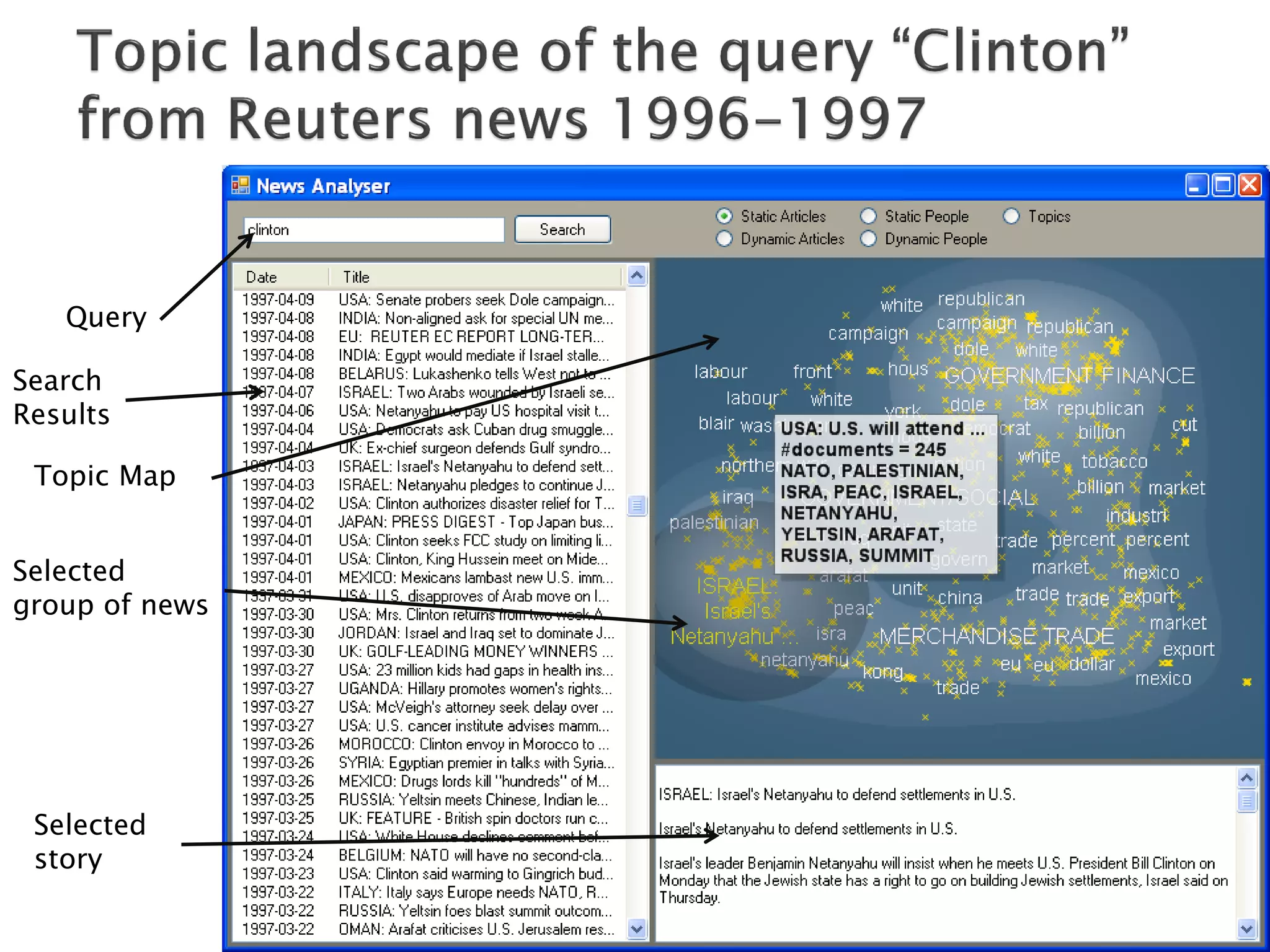
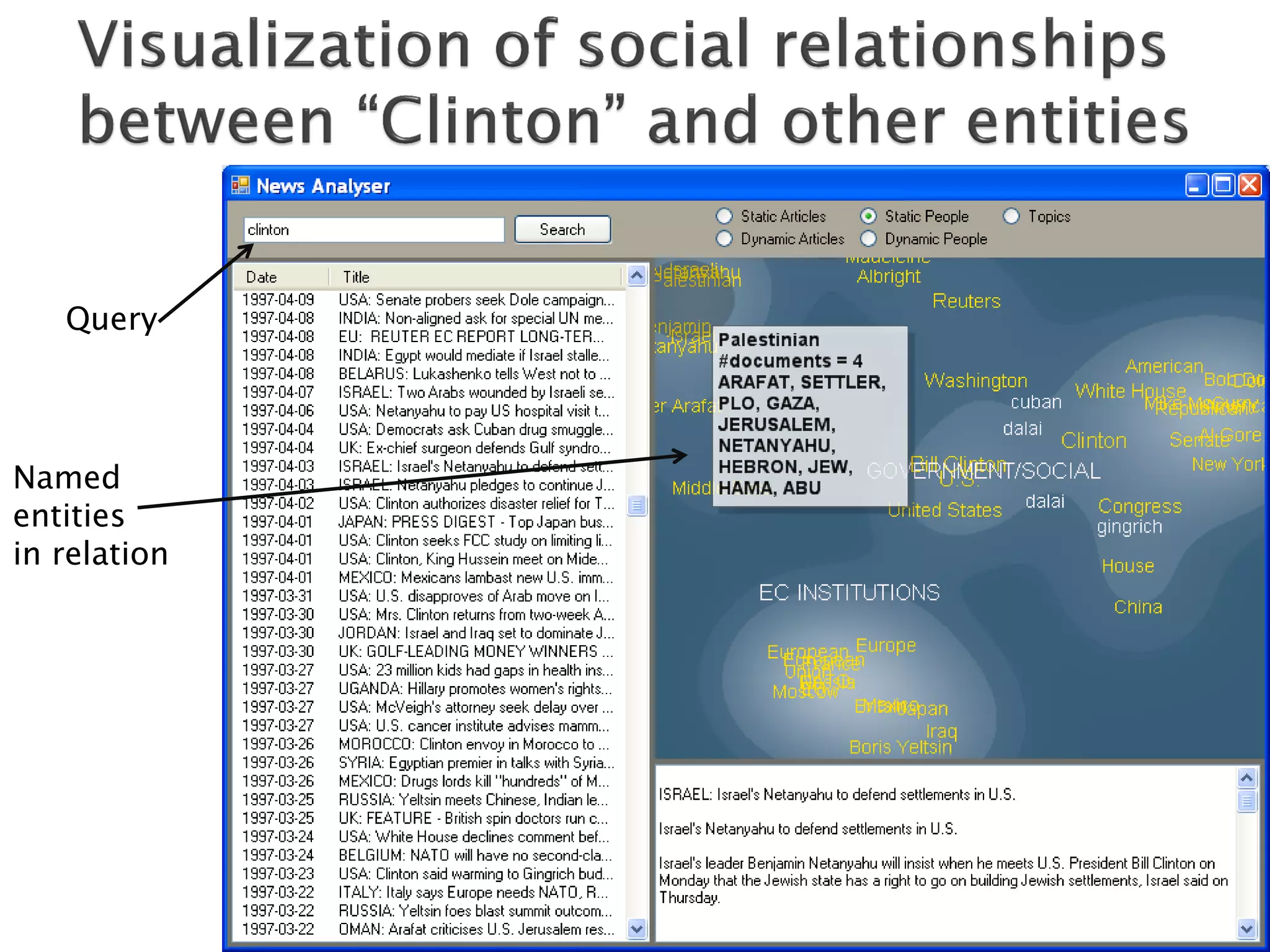
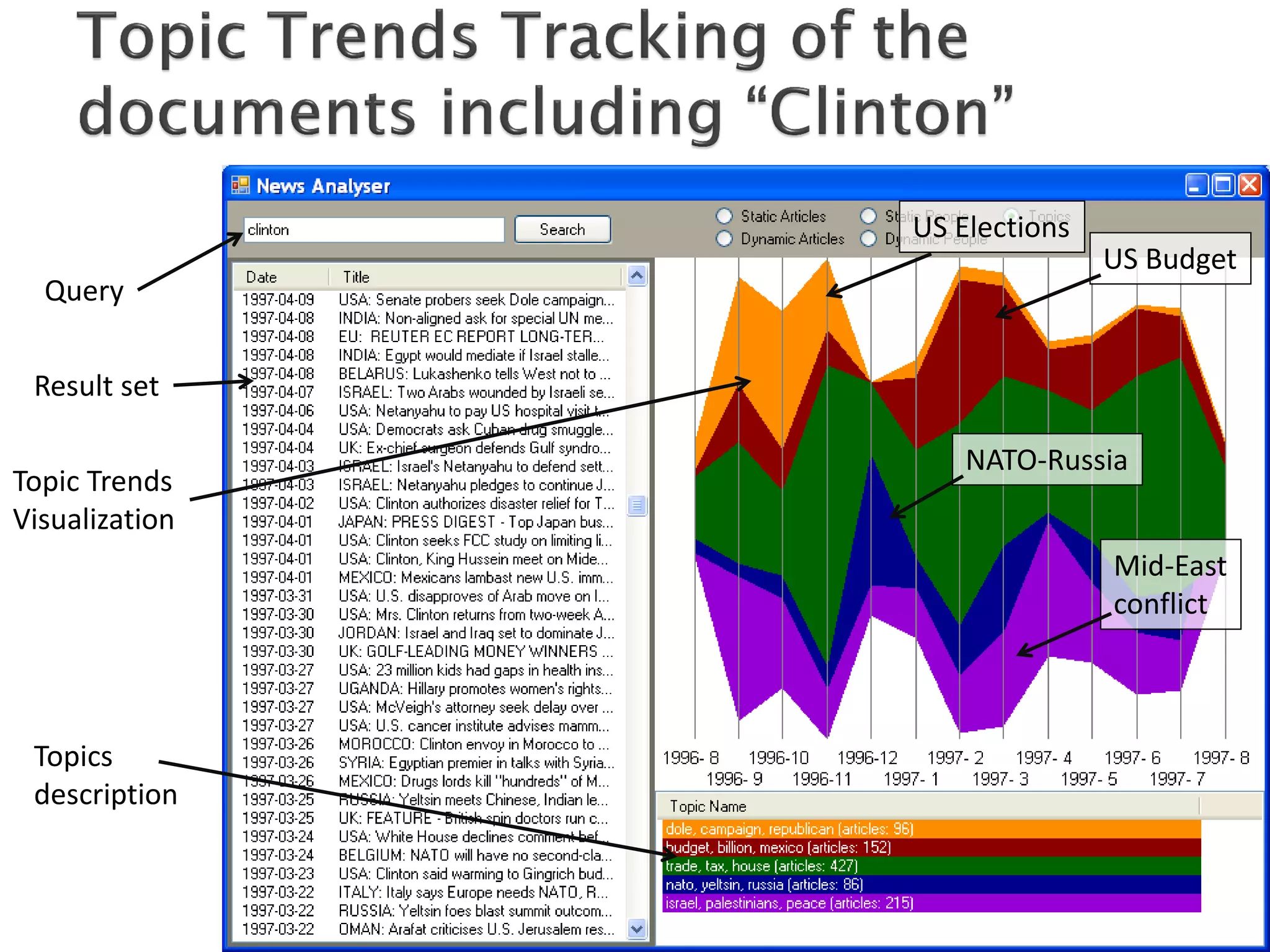
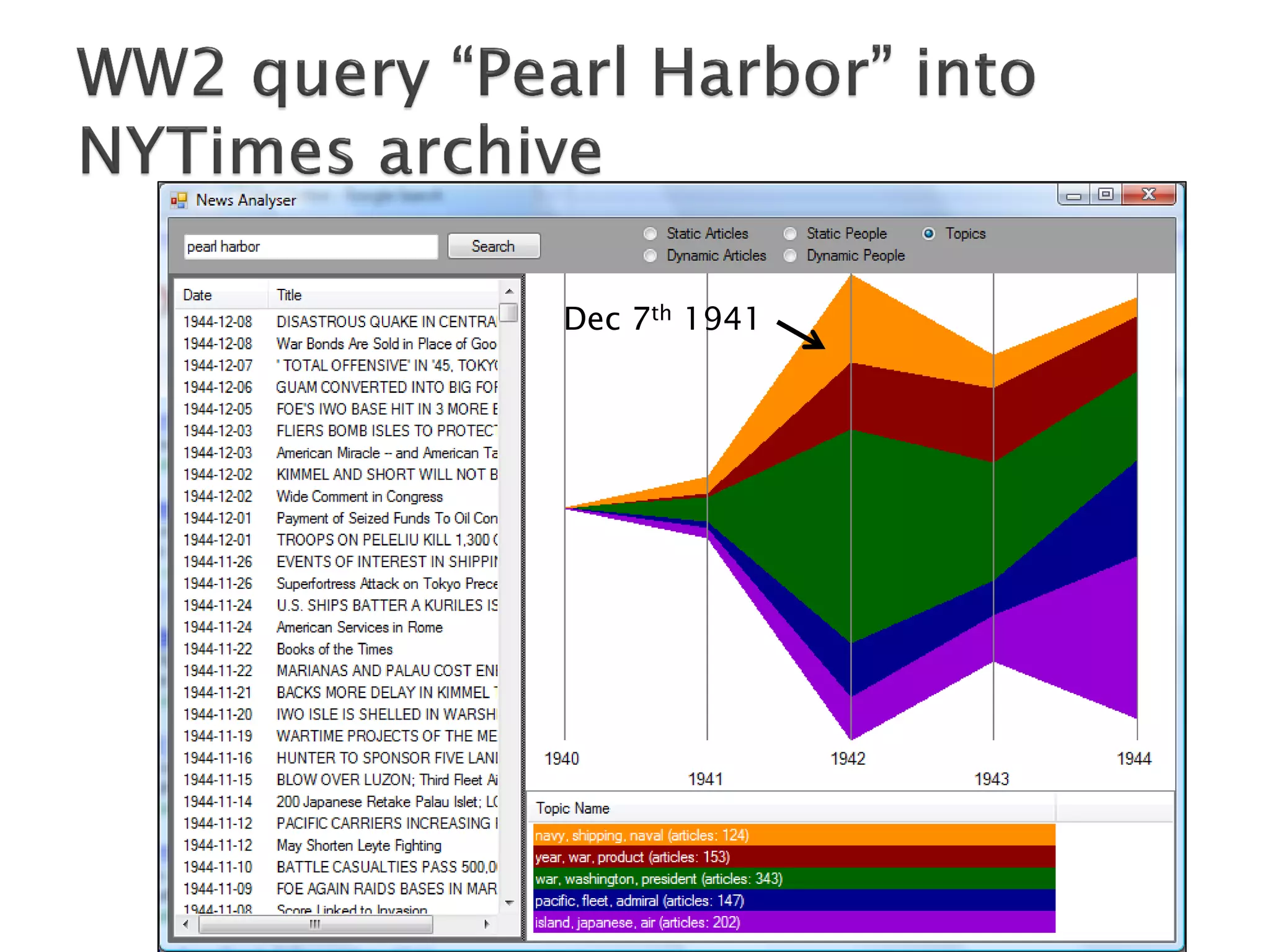
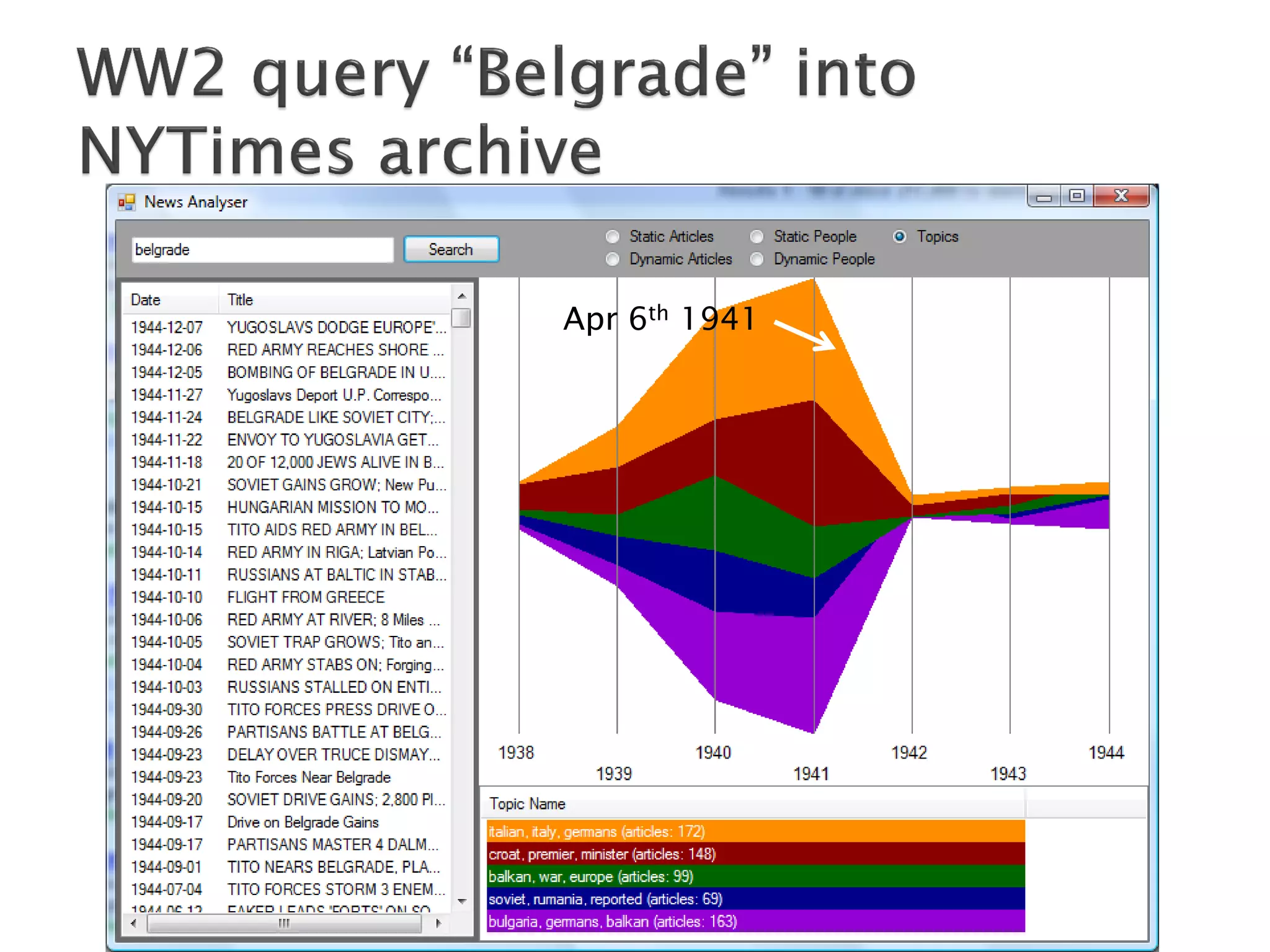
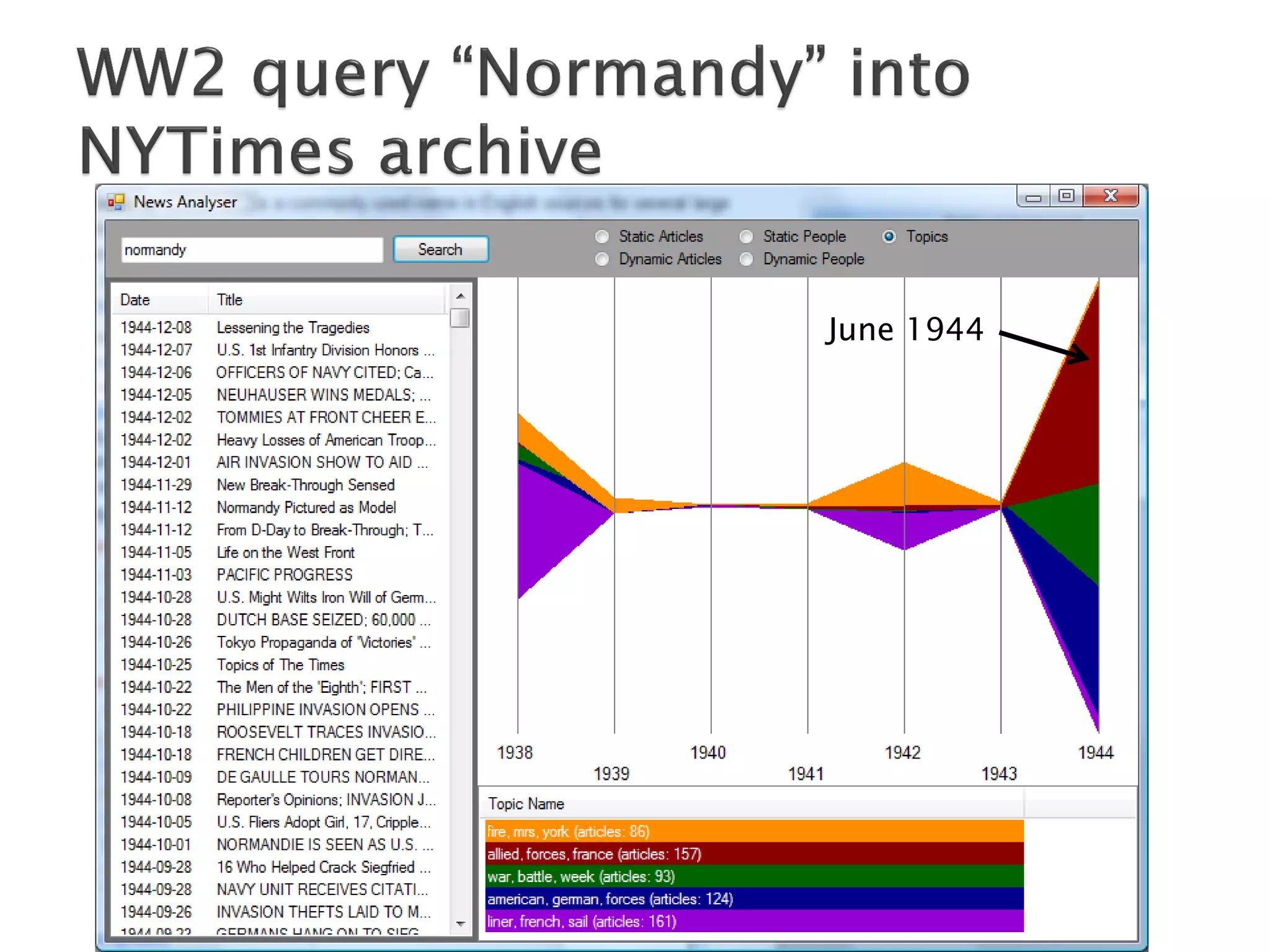
The aim is to use analytic techniques to
visualize documents in different ways:
◦ Topic view
◦ Social view
◦ Temporal view
Query
Search
Results
Topic Map
Selected
group of news

Selected
story
Query

Named
entities
in relation
US Elections
Query

US Budget

Result set
Topic Trends
Visualization

NATO-Russia
Mid-East
conflict

Topics
description
Dec 7th 1941
Apr 6th 1941
June 1944
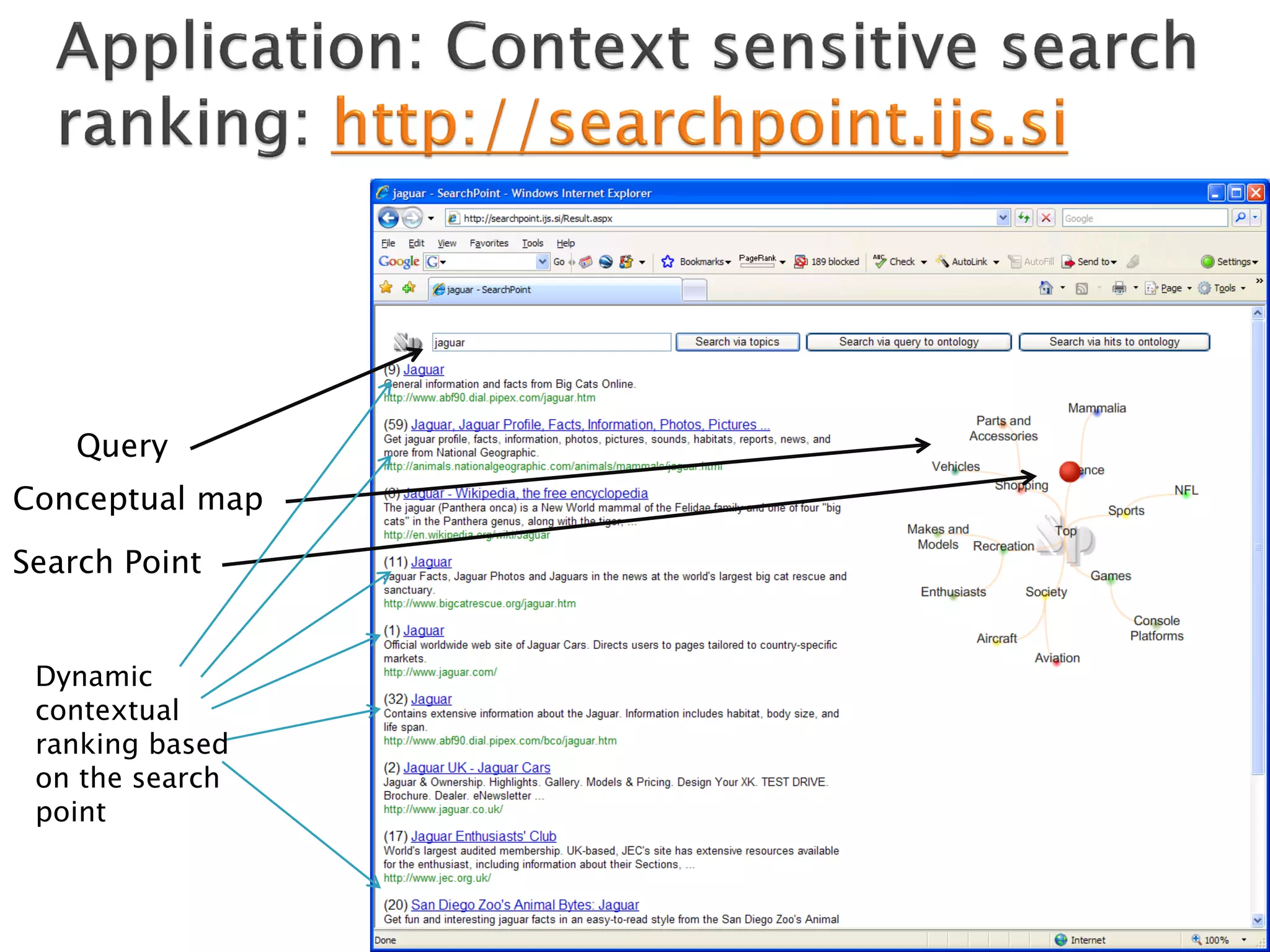
Query
Conceptual map
Search Point
Dynamic
contextual
ranking based
on the search
point




Observe social and communication
phenomena at a planetary scale
Largest social network analyzed till 2010

Research questions:
 How does communication change with user
demographics (age, sex, language, country)?
 How does geography affect communication?
 What is the structure of the communication
network?
“Planetary-Scale Views on a Large Instant-Messaging Network” Leskovec & Horvitz WWW2008

50








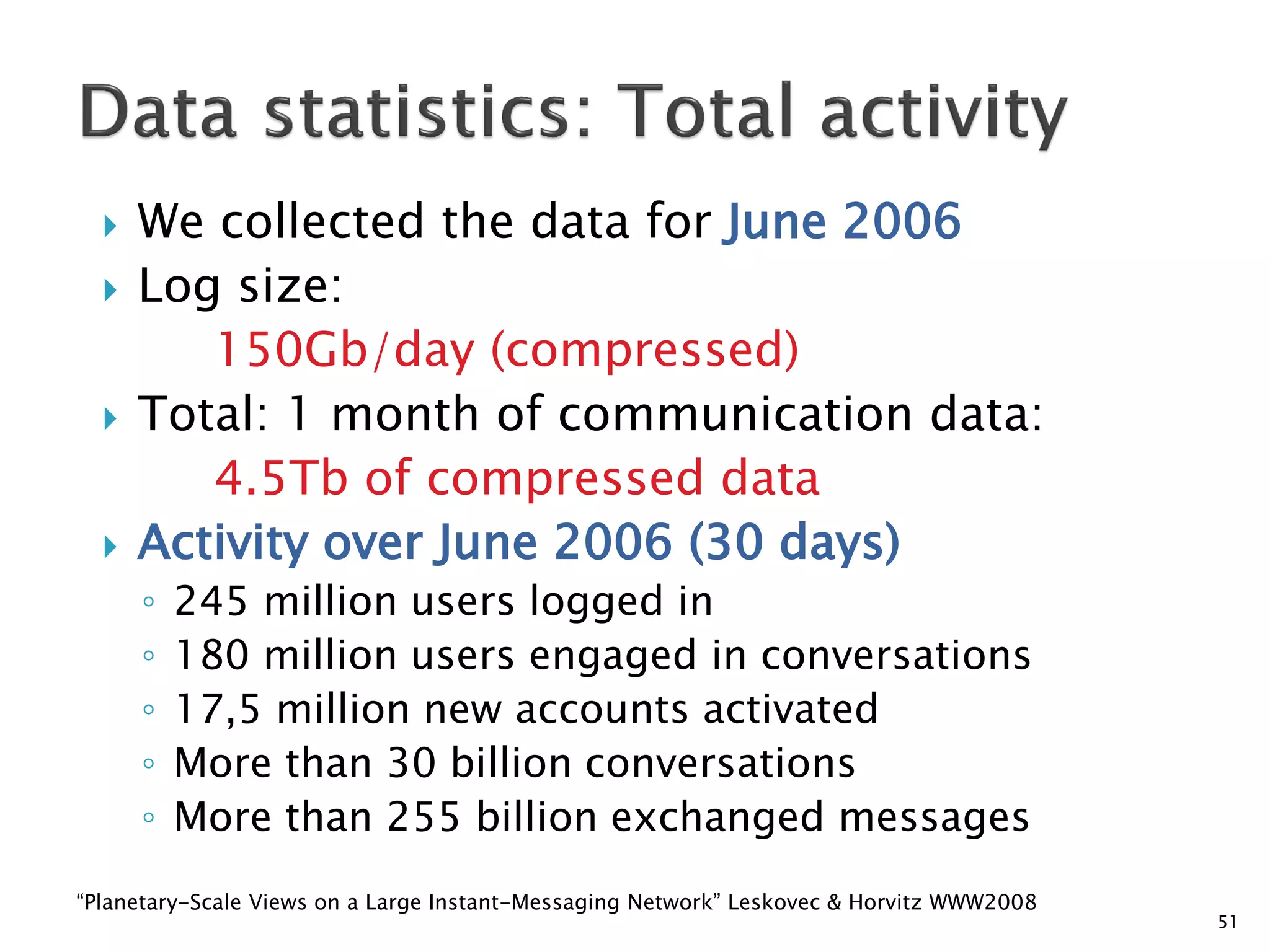
We collected the data for June 2006
Log size:
150Gb/day (compressed)
Total: 1 month of communication data:
4.5Tb of compressed data
Activity over June 2006 (30 days)
◦
◦
◦
◦
◦

245 million users logged in
180 million users engaged in conversations
17,5 million new accounts activated
More than 30 billion conversations
More than 255 billion exchanged messages

“Planetary-Scale Views on a Large Instant-Messaging Network” Leskovec & Horvitz WWW2008

51
“Planetary-Scale Views on a Large Instant-Messaging Network” Leskovec & Horvitz WWW2008

52
“Planetary-Scale Views on a Large Instant-Messaging Network” Leskovec & Horvitz WWW2008

53


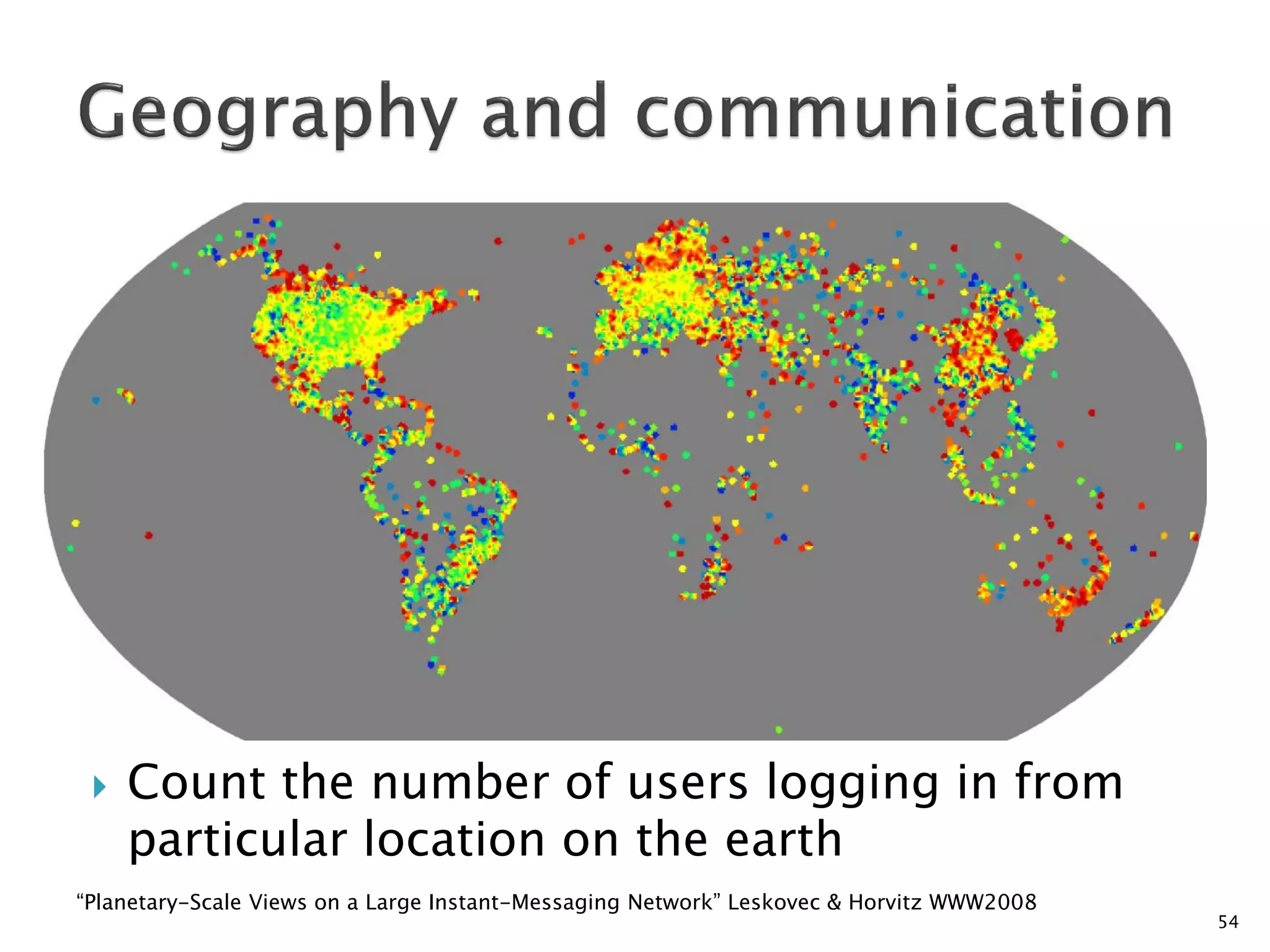
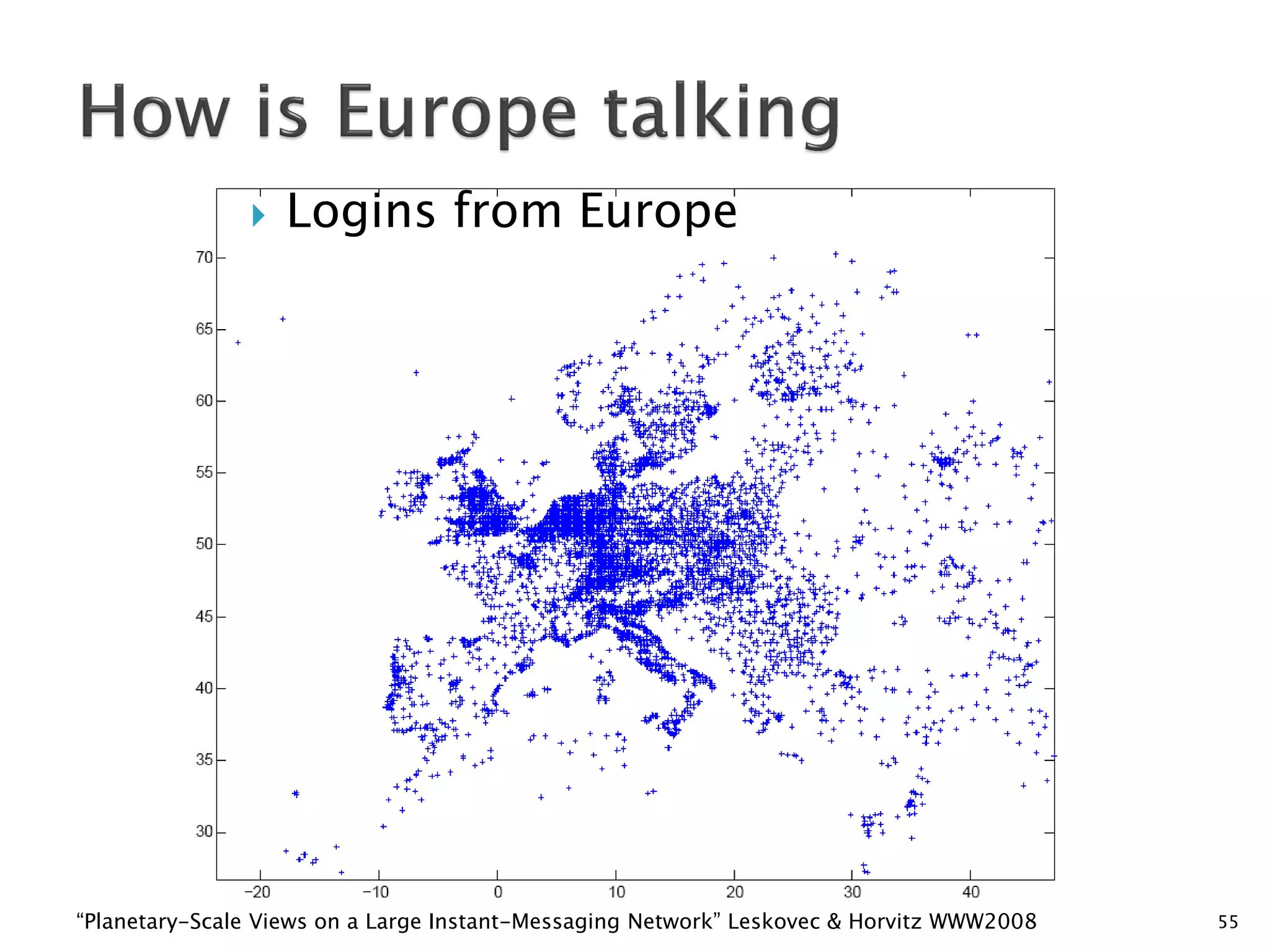
Count the number of users logging in from
particular location on the earth

“Planetary-Scale Views on a Large Instant-Messaging Network” Leskovec & Horvitz WWW2008

54


Logins from Europe

“Planetary-Scale Views on a Large Instant-Messaging Network” Leskovec & Horvitz WWW2008

55
Hops
1

396

4

8648

5

3299252

6

28395849

7

79059497

8

52995778

9

10321008

10

1955007

11

518410

12

149945

13

44616

14

13740

15

4476

16

1542

17

536

18

167

19



78

3



10

2



Nodes

71

20
6 degrees of separation [Milgram ’60s]
21
Average distance between two random users is 6.622
23
90% of nodes can be reached in < 8 hops

29

16
10
3

24

“Planetary-Scale Views on a Large Instant-Messaging Network” Leskovec & Horvitz WWW2008

2

25

3


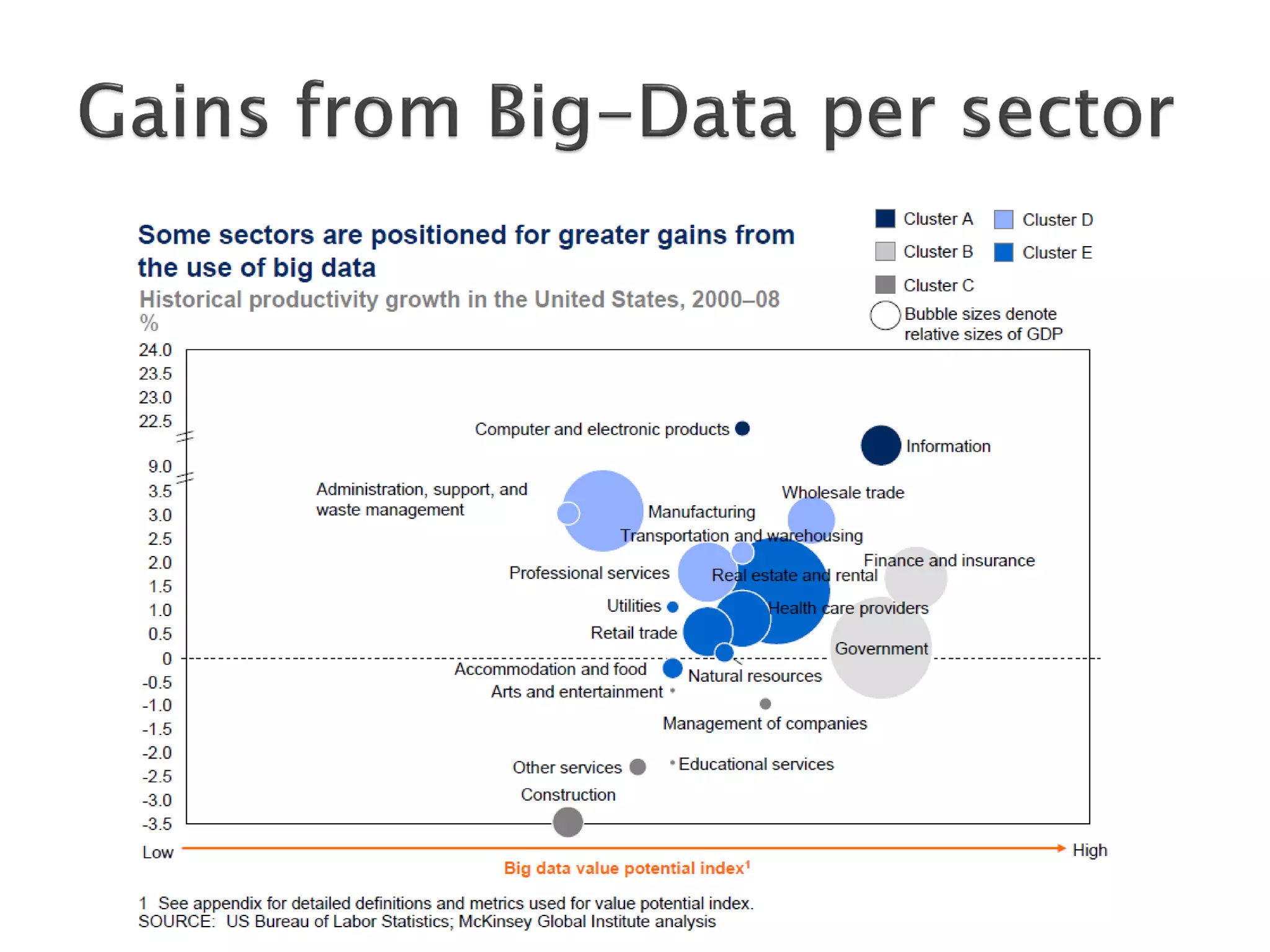
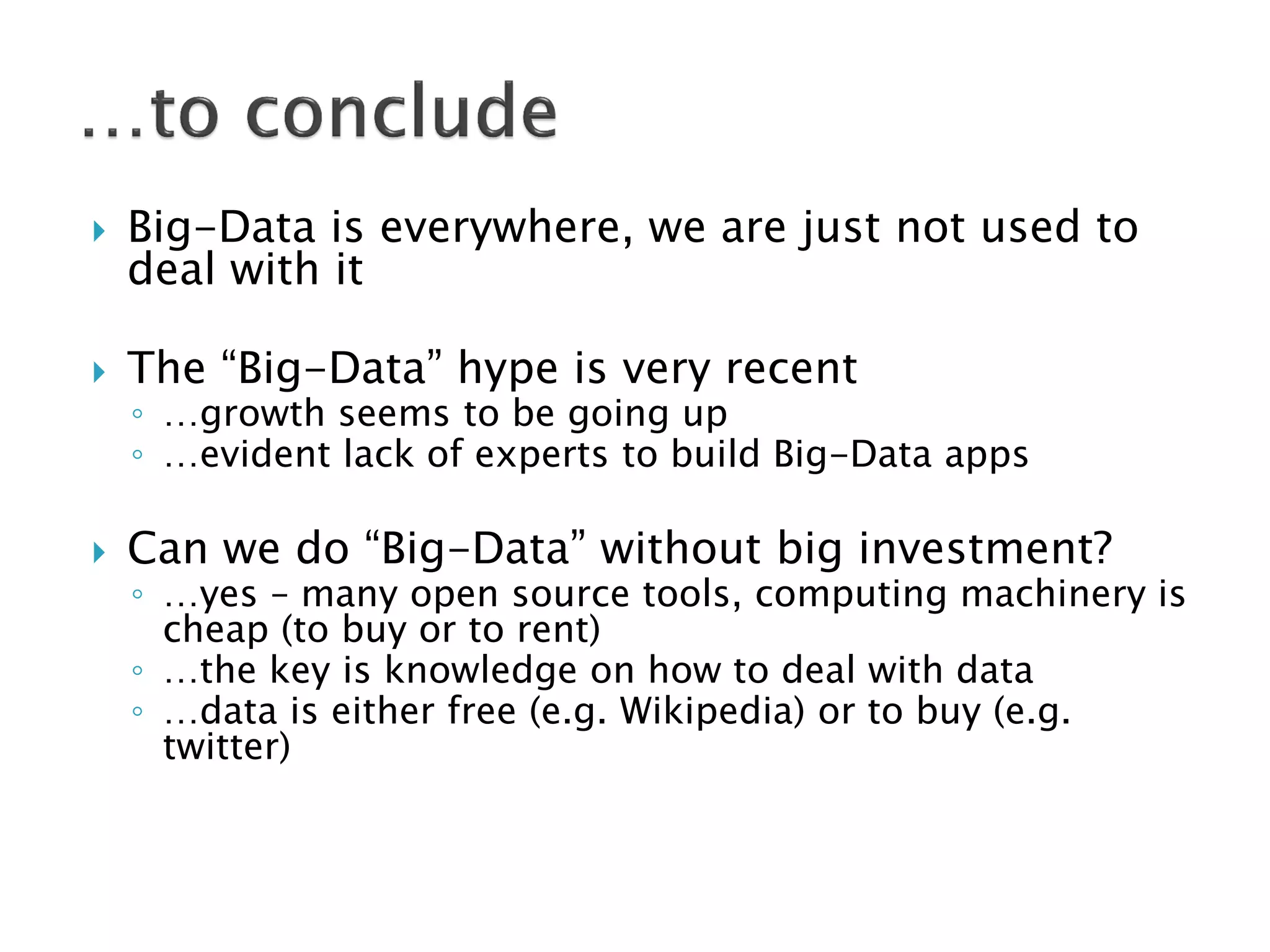
Big-Data is everywhere, we are just not used to
deal with it



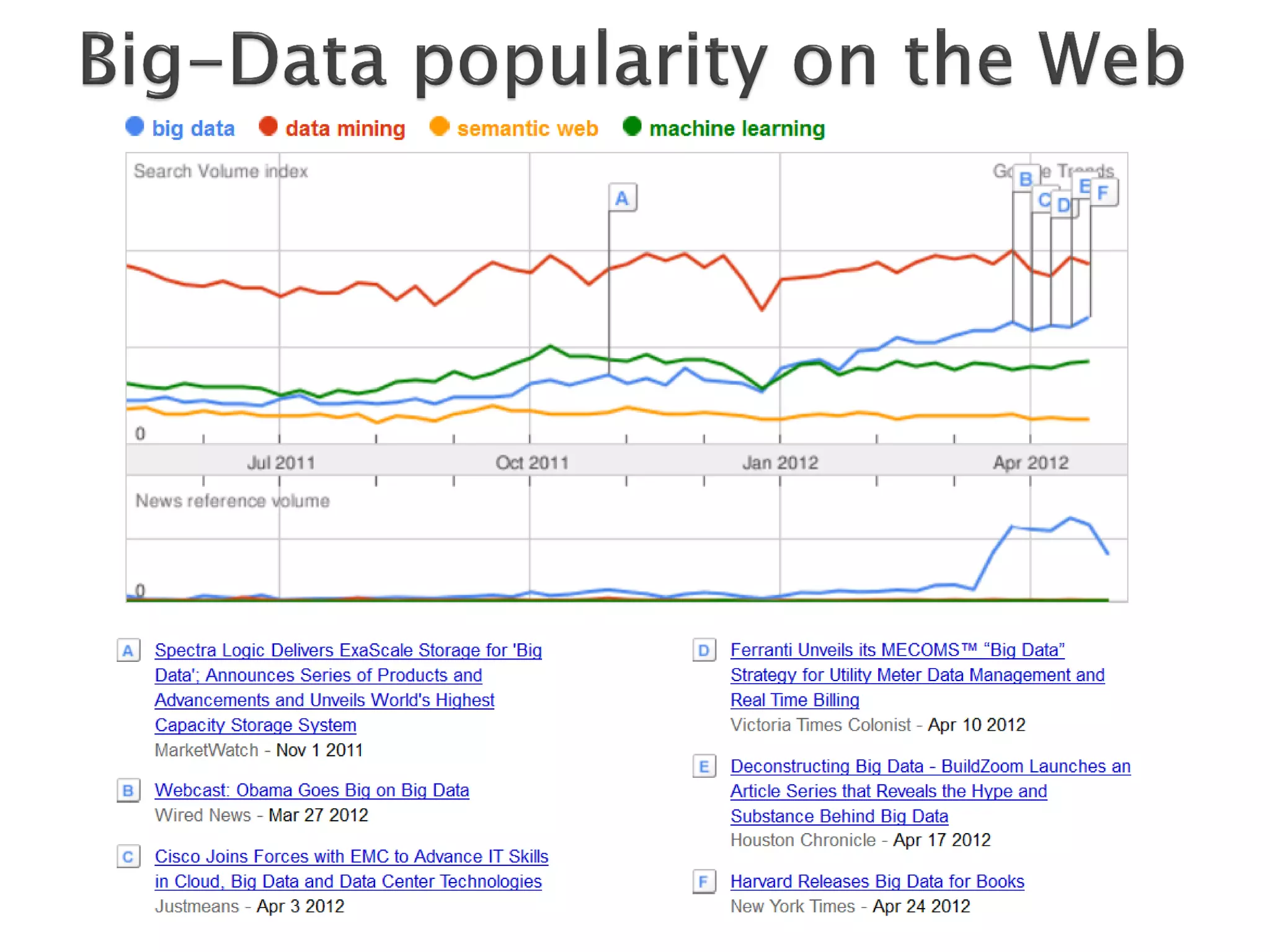
The “Big-Data” hype is very recent



Can we do “Big-Data” without big investment?

◦ …growth seems to be going up
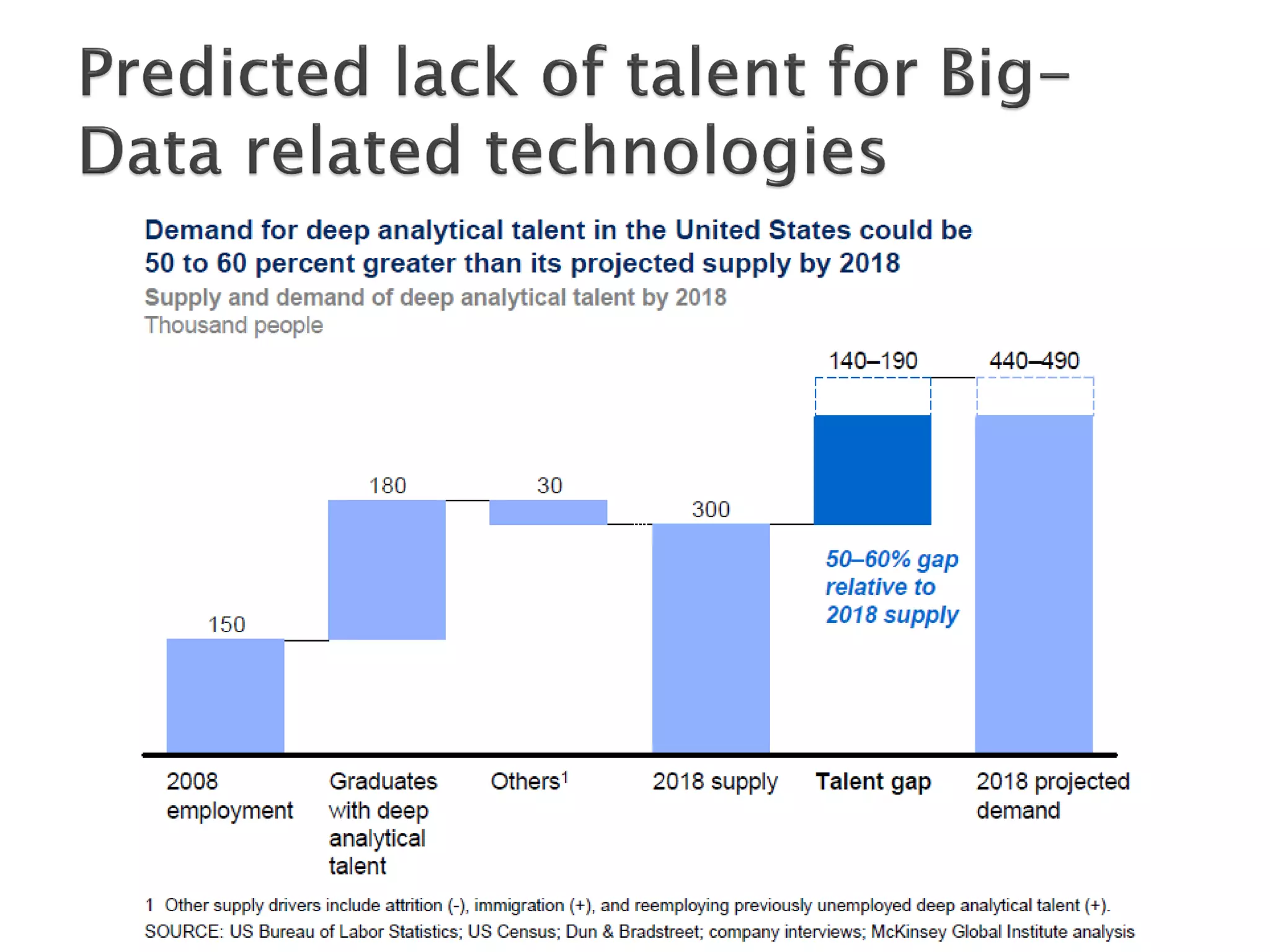
◦ …evident lack of experts to build Big-Data apps

◦ …yes – many open source tools, computing machinery is
cheap (to buy or to rent)
◦ …the key is knowledge on how to deal with data
◦ …data is either free (e.g. Wikipedia) or to buy (e.g.
twitter)

ESWC SS 2012 - Friday Keynote Marko Grobelnik: Big Data Tutorial

  • 1.
    Marko Grobelnik marko.grobelnik@ijs.si Jozef StefanInstitute Kalamaki, May 25th 2012
  • 2.
     Introduction ◦ What isBig data? ◦ Why Big-Data? ◦ When Big-Data is really a problem?     Techniques Tools Applications Literature
  • 5.
      ‘Big-data’ is similarto ‘Small-data’, but bigger …but having data bigger consequently requires different approaches: ◦ techniques, tools, architectures  …with an aim to solve new problems ◦ …and old problems in a better way.
  • 6.
  • 8.
  • 9.
     Key enablers forthe growth of “Big Data” are: ◦ Increase of storage capacities ◦ Increase of processing power ◦ Availability of data
  • 20.
     Where processing ishosted? ◦ Distributed Servers / Cloud (e.g. Amazon EC2)  Where data is stored? ◦ Distributed Storage (e.g. Amazon S3)  What is the programming model? ◦ Distributed Processing (e.g. MapReduce)  How data is stored & indexed? ◦ High-performance schema-free databases (e.g. MongoDB)  What operations are performed on data? ◦ Analytic / Semantic Processing (e.g. R, OWLIM)
  • 21.
     Computing and storageare typically hosted transparently on cloud infrastructures ◦ …providing scale, flexibility and high fail-safety  Distributed Servers ◦ Amazon-EC2, Google App Engine, Elastic, Beanstalk, Heroku  Distributed Storage ◦ Amazon-S3, Hadoop Distributed File System
  • 22.
     Distributed processing ofBig-Data requires nonstandard programming models ◦ …beyond single machines or traditional parallel programming models (like MPI) ◦ …the aim is to simplify complex programming tasks   The most popular programming model is MapReduce approach Implementations of MapReduce ◦ Hadoop (http://hadoop.apache.org/), Hive, Pig, Cascading, Cascalog, mrjob, Caffeine, S4, MapR, Acunu, Flume, Kafka, Azkaban, Oozie, Greenplum
  • 23.
     The key ideaof the MapReduce approach: ◦ A target problem needs to be parallelizable ◦ First, the problem gets split into a set of smaller problems (Map step) ◦ Next, smaller problems are solved in a parallel way ◦ Finally, a set of solutions to the smaller problems get synthesized into a solution of the original problem (Reduce step)
  • 24.
     NoSQL class ofdatabases have in common: ◦ ◦ ◦ ◦ ◦  To support large amounts of data Have mostly non-SQL interface Operate on distributed infrastructures (e.g. Hadoop) Are based on key-value pairs (no predefined schema) …are flexible and fast Implementations ◦ MongoDB, CouchDB, Cassandra, Redis, BigTable, Hbase, Hypertable, Voldemort, Riak, ZooKeeper…
  • 26.
     …when the operationson data are complex: ◦ …e.g. simple counting is not a complex problem ◦ Modeling and reasoning with data of different kinds can get extremely complex  Good news about big-data: ◦ Often, because of vast amount of data, modeling techniques can get simpler (e.g. smart counting can replace complex model-based analytics)… ◦ …as long as we deal with the scale
  • 27.
     Research areas (such asIR, KDD, ML, NLP, SemWeb, …) are subcubes within the data cube Usage Quality Context Streaming Scalability
  • 28.
      A risk with“Big-Data mining” is that an analyst can “discover” patterns that are meaningless Statisticians call it Bonferroni’s principle: ◦ Roughly, if you look in more places for interesting patterns than your amount of data will support, you are bound to find crap Example taken from: Rajaraman, Ullman: Mining of Massive Datasets
  • 29.
    Example:  We wantto find (unrelated) people who at least twice have stayed at the same hotel on the same day ◦ ◦ ◦ ◦ ◦  109 people being tracked. 1000 days. Each person stays in a hotel 1% of the time (1 day out of 100) Hotels hold 100 people (so 105 hotels). If everyone behaves randomly (i.e., no terrorists) will the data mining detect anything suspicious? Expected number of “suspicious” pairs of people: ◦ 250,000 ◦ … too many combinations to check – we need to have some additional evidence to find “suspicious” pairs of people in some more efficient way Example taken from: Rajaraman, Ullman: Mining of Massive Datasets
  • 30.
     Smart sampling ofdata ◦ …reducing the original data while not losing the statistical properties of data  Finding similar items ◦ …efficient multidimensional indexing  Incremental updating of the models ◦ (vs. building models from scratch) ◦ …crucial for streaming data  Distributed linear algebra ◦ …dealing with large sparse matrices
  • 31.
     On the topof the previous ops we perform usual data mining/machine learning/statistics operators: ◦ Supervised learning (classification, regression, …) ◦ Non-supervised learning (clustering, different types of decompositions, …) ◦ …  …we are just more careful which algorithms we choose (typically linear or sub-linear versions)
  • 32.
     An excellent overviewof the algorithms covering the above issues is the book “Rajaraman, Ullman: Mining of Massive Datasets”
  • 34.
     Good recommendations can makea big difference when keeping a user on a web site ◦ …the key is how rich the context model a system is using to select information for a user ◦ Bad recommendations <1% users, good ones >5% users click ◦ 200clicks/sec Contextual personalized recommendations generated in ~20ms
  • 35.
        Domain Sub-domain Page URL URL sub-directories       PageMeta Tags Page Title Page Content Named Entities    Has Query Referrer Query   GeoIP Country GeoIP State GeoIP City            Referring Domain Referring URL Outgoing URL    Absolute Date Day of the Week Day period Hour of the day User Agent Zip Code State Income Age Gender Country Job Title Job Industry
  • 36.
    Trend Detection System LogFiles (~100M page clicks per day) Stream of clicks User profiles Stream of profiles Trends and updated segments NYT articles Segment Keywords Stock Market diabetes, heart disease, disease, heart, illness Green Energy Hybrid cars, energy, power, model, carbonated, fuel, bulbs, Hybrid cars Hybrid cars, vehicles, model, engines, diesel Travel travel, wine, opening, tickets, hotel, sites, cars, search, restaurant … … Segments Stock Market, mortgage, banking, investors, Wall Street, turmoil, New York Stock Exchange Health Sales $ Campaign to sell segments Advertisers
  • 37.
        50Gb of uncompressedlog files 50-100M clicks 4-6M unique users 7000 unique pages with more then 100 hits
  • 38.
    Alarms Server Telecom Network (~25 000 devices)  Alarms ~10-100/sec Livefeed of data Alarms Explorer Server Alarms Explorer Server implements three real-time scenarios on the alarms stream: 1. Root-Cause-Analysis – finding which device is responsible for occasional “flood” of alarms 2. Short-Term Fault Prediction – predict which device will fail in next 15mins 3. Long-Term Anomaly Detection – detect unusual trends in the network  …system is used in British Telecom Operator Big board display
  • 39.
     The aim ofthe project is to collect and analyze most of the main-stream media across the world ◦ …from 35,000 publishers (180K RSS feeds) crawled in real time (few ~10articles per second) ◦ …each article document gets extracted, cleaned, semantically annotated, structure extracted  Challenges are in terms of complexity of processing and querying of the extracted data ◦ …and matching textual information across the languages (cross-lingual technologies) http://render-project.eu/ http://www.xlike.org/
  • 40.
  • 41.
    Plain text Extracted graph of triples fromtext Text Enrichment “Enrycher” is available as as a web-service generating Semantic Graph, LOD links, Entities, Keywords, Categories, Text Summarization
  • 42.
     The aim isto use analytic techniques to visualize documents in different ways: ◦ Topic view ◦ Social view ◦ Temporal view
  • 43.
  • 44.
  • 45.
    US Elections Query US Budget Resultset Topic Trends Visualization NATO-Russia Mid-East conflict Topics description
  • 46.
  • 47.
  • 48.
  • 49.
  • 50.
      Observe social andcommunication phenomena at a planetary scale Largest social network analyzed till 2010 Research questions:  How does communication change with user demographics (age, sex, language, country)?  How does geography affect communication?  What is the structure of the communication network? “Planetary-Scale Views on a Large Instant-Messaging Network” Leskovec & Horvitz WWW2008 50
  • 51.
        We collected thedata for June 2006 Log size: 150Gb/day (compressed) Total: 1 month of communication data: 4.5Tb of compressed data Activity over June 2006 (30 days) ◦ ◦ ◦ ◦ ◦ 245 million users logged in 180 million users engaged in conversations 17,5 million new accounts activated More than 30 billion conversations More than 255 billion exchanged messages “Planetary-Scale Views on a Large Instant-Messaging Network” Leskovec & Horvitz WWW2008 51
  • 52.
    “Planetary-Scale Views ona Large Instant-Messaging Network” Leskovec & Horvitz WWW2008 52
  • 53.
    “Planetary-Scale Views ona Large Instant-Messaging Network” Leskovec & Horvitz WWW2008 53
  • 54.
     Count the numberof users logging in from particular location on the earth “Planetary-Scale Views on a Large Instant-Messaging Network” Leskovec & Horvitz WWW2008 54
  • 55.
     Logins from Europe “Planetary-ScaleViews on a Large Instant-Messaging Network” Leskovec & Horvitz WWW2008 55
  • 56.
    Hops 1 396 4 8648 5 3299252 6 28395849 7 79059497 8 52995778 9 10321008 10 1955007 11 518410 12 149945 13 44616 14 13740 15 4476 16 1542 17 536 18 167 19  78 3  10 2  Nodes 71 20 6 degrees ofseparation [Milgram ’60s] 21 Average distance between two random users is 6.622 23 90% of nodes can be reached in < 8 hops 29 16 10 3 24 “Planetary-Scale Views on a Large Instant-Messaging Network” Leskovec & Horvitz WWW2008 2 25 3
  • 58.
     Big-Data is everywhere,we are just not used to deal with it  The “Big-Data” hype is very recent  Can we do “Big-Data” without big investment? ◦ …growth seems to be going up ◦ …evident lack of experts to build Big-Data apps ◦ …yes – many open source tools, computing machinery is cheap (to buy or to rent) ◦ …the key is knowledge on how to deal with data ◦ …data is either free (e.g. Wikipedia) or to buy (e.g. twitter)