How would AI shape
Future Integrations?
Srinath Perera, Ph.D.
VP Research WSO2, Apache Member,
( srinath@wso2.com)
@srinath_perera
History of Integration
!2
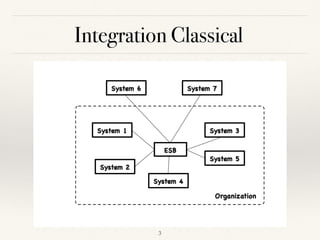
Integration Classical
!3
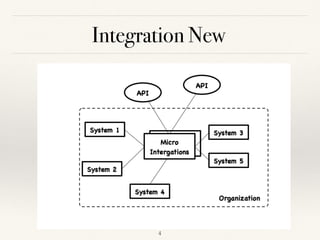
Integration New
!4
!5
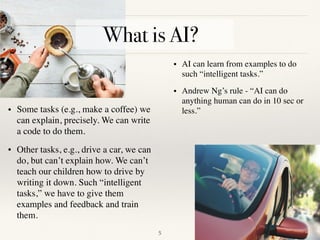
• Some tasks (e.g., make a coffee) we
can explain, precisely. We can write
a code to do them.
• Other tasks, e.g., drive a car, we can
do, but can’t explain how. We can’t
teach our children how to drive by
writing it down. Such “intelligent
tasks,” we have to give them
examples and feedback and train
them. 
• AI can learn from examples to do
such “intelligent tasks.”
• Andrew Ng’s rule - “AI can do
anything human can do in 10 sec or
less.”
What is AI?
What is the big deal?
• Compared to humans, Computer
doing these tasks (With AI) are
• Faster (1K-1000K times)
• Cheaper to replicate
• Reliable
• AI ability to learning can be used to
extrapolate the future
!6
Why AI in Integration?
Why? (1) Cost Savings
!8
• For repeated tasks, AI is often much
cheaper than Humans (e.g., video
surveillance, quality control)
• Having humans in the loop often leads
to complex integrations because those
interactions take time and because
humans make mistakes
• AI can pinpoint problems. Some times
AI can predict and proactively fix
problems.
• Increase the usability of systems 
• Optimize systems
Why? (2) Competitive Advantage
!9
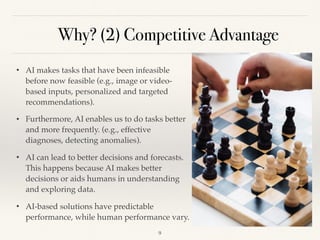
• AI makes tasks that have been infeasible
before now feasible (e.g., image or video-
based inputs, personalized and targeted
recommendations).
• Furthermore, AI enables us to do tasks better
and more frequently. (e.g., effective
diagnoses, detecting anomalies). 
• AI can lead to better decisions and forecasts.
This happens because AI makes better
decisions or aids humans in understanding
and exploring data.
• AI-based solutions have predictable
performance, while human performance vary.
!10
• An organization may share insights
derived through AI with other parties.
(e.g., Walmart shares data with
suppliers). 
• Organization may creating new revenue
streams by selling insights delivered
through the data
• e.g., a telco may share discoveries about
local trends with customers (e.g., sports
events). 
• e.g., Targeted Marketing ( market to
demographic)
• e.g., Credit card companies sells data
about customer behavior
Why? (3) New value and Revenue:
Feasibility
!11
• AI is beating human performance in
many cases
• (e.g., Voice recognition, character
recognition, Go) 
• Most tools are available as open-
source projects
• (e.g., TensorFlow, Torch, Sklearn) 
• Wide range of public datasets has
enabled multiple parties to build on
each other’s results 
• AI has Significant investments by
internet companies, academia, and
VCs. 
Challenges
!12
• Shortage of Skilled Professionals
• The data scientists, programmers, and architects are in short
supply and expensive (300-500K year).
• It is hard for medium and smaller organizations to attract
and hire enough skilled people.
• Solutions ( Wizards, Mapping AI to DB (e.g., Bays DB)
or spreadsheets, Automatic Statisticians)
• Most AI solutions will be delivered as cloud APIs 
• Only possible when If data formats are well known (e.g.,
banking or healthcare data) and key performance indicators
(KPIs) are well defined. Then reusable models can be built
for those use cases. 
• Examples are disease detection in healthcare, marketing
insights, spatiotemporal models, and analytics for specific
sports.
Challenges (contd.)
• Lack of Large Enough Data Sets.
• With 10,000 data points per day, it takes 3
years to collect 1 million data points
• Labeled data sets are hard to find
• Solutions
• Transfer learning
• Semi & Unsupervised learning
• Interpretability
• Some models are black boxes
• Tracking provenance of data used
AI mistakes are Dangerous
!14
• AI weaknesses can cause much more
potential harm than the same weakness
in humans
• Broad integration - AI will be everywhere
(e.g., selecting people for an interview,
picking suspicious people for further
investigation).
• Wide application - because the cost to
replicate AI operations is small, AI is applied
on a broader scale than humans
• Transparent application without oversight -
diversity of views among humans detect and
control flowed applications, while AI will be
applied transparently avoid such oversight. 
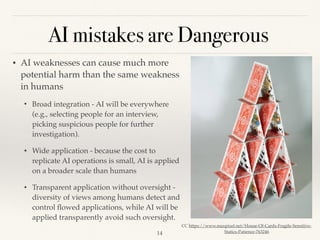
CC https://www.maxpixel.net/House-Of-Cards-Fragile-Sensitive-
Statics-Patience-763246
Risks
• Bias 
• AI can learn and repeat the inherent bias in
the data caused by human behavior (e.g.,
Book “Weapons of Math Destruction” by Cathy
O’Neil.)
• Removing bias is hard - For example, an
address in a certain neighborhood might act
as a proxy for the race; the name might act as
a proxy for gender, or name of the degree
might act as a proxy for age.
• AI tug war  
• If the use case ends up being a fight between
two AI algorithms, it can lead to lose-lose
situations 
!15
Risks (contd.)
• Privacy: AI can infer sensitive data from
seemingly harmless information 
• E.g., detect where you live using
accelerometer data 
• Detect what you watch on the TV using
electricity data 
• Your travel history by automatic
number plates reading 
• GOV policies 
• Data collections rules limiting data
collection 
• Laws limiting where AI can be
used (e.g., SF limiting face recognition) 
!16
Macro Trends
• Data Moats 
• AI depends on data. Hence data can be a significant
advantage. Also, products that get market adoption
first will get more data, creating data network
effects 
• In some cases, data network effects do not work
due to Diminishing returns of adding data
• This gives rise to AI offered as Cloud APIs
• Let vendors collect data 
• Concentrate both expertise and data 
• remove the complexity of managing AI models 
• AI provides a significant opportunity for large
companies such as telecom, credit card, and retail
sectors, which already have access to large and rich
data sets.
!17
AI Use cases
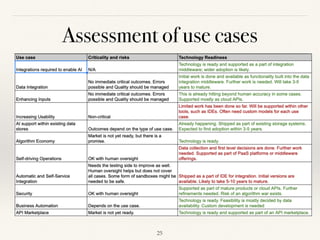
Use Cases1: Integrations required to enable AI
•  Most AI use cases in
organizations will have
significant Integration
component
• AI requires organizations to
collect data from many
sources, reconcile their
differences, and manage them.
• Carrying out actions suggested
by AI 
• Exposing data and insights via
APIs 
!19
Use Cases 2: Enhancing Inputs
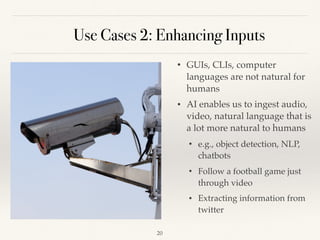
• GUIs, CLIs, computer
languages are not natural for
humans 
• AI enables us to ingest audio,
video, natural language that is
a lot more natural to humans 
• e.g., object detection, NLP,
chatbots
• Follow a football game just
through video 
• Extracting information from
twitter 
!20
Use Cases 3: AI support within existing data stores
• Vendors that build data
storages (e.g., CRM, ERP,
databases) can build AI as
turnkey solutions into
their products 
• e.g. Salesforce Einstein
• Users get AI without
additional investments or
coding for predictable
cost 
• User will benefit from the
data from all customers 
!21
Use Cases 4: Self Driving System Operations
• Use of AI to reduce or eliminate the
need for human intervention while
managing (integration) systems 
• Examples:
• Auto tuning 
• Predictive maintenance
• Detect anomalies, trigger deep
observations, rise alerts, help
analysis and root cause 
• Chat-based control 
• Automatic compliance and QoS
checks 
!22
• Use of AI to simplify the process
of creating integrations support
both programmers and non-
programmers  
• Examples:
• Let user draw the integration
visually and use AI automate
mapping with users having to fill
configurations forms 
• Let user describes the integration
in English, and a chatbot ask
more questions to clarify and
refine the integration 
Use Cases 5: Automatic and Self-Service Integration
!23
Use cases 6: AI-based Security
• Examples
• Fraud Detection 
• Adaptive Authentication
• Detection Session Hijacking 
• Detect sensitive data in messages
and hold the message 
• Continuous authentication 
• AI can also be used to attack well as
defence, and since it is hard to
defend than attack, outcomes are
unclear 
!24
Assessment of use cases
!25
!26
Conclusion
• Enabling AI creates many integration use cases
• AI mistakes are more harmful than human mistakes due to: broad integration,
cheap replication, and transparent application without any supervision.
• Most AI use cases will be delivered as cloud APIs due to
• Data provides competitive advantage and cloud enables vendors to collect data
• Most custom AI models will be limited to large organizations due to a lack of expertise and
data
• Cloud enables organizations to concentrate expertise and simplify deployment
• Use cases
• Security, Data Integration, Enhancing Inputs, and AI support within existing data stores,
already have systems available and are likely find more adoption.
• Increasing Usability, Self Driving Operations (DevOps and Regulatory Compliance),
Automatic and Self-Service Integration do not face critical challenges but will need 5-10 years
of development for wide adoption
• Business Automation will often be infeasible for SMEs if not already supported as a cloud
API.
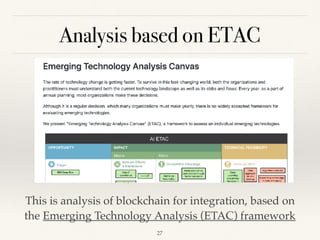
Analysis based on ETAC
!27
This is analysis of blockchain for integration, based on
the Emerging Technology Analysis (ETAC) framework
To receive updates to ETAC and ETAC-based
emerging technology analysis, subscribe to
our Newsletter.
Thanks for reading!!

How would AI shape Future Integrations?

  • 1.
    How would AIshape Future Integrations? Srinath Perera, Ph.D. VP Research WSO2, Apache Member, ( srinath@wso2.com) @srinath_perera
  • 2.
  • 3.
  • 4.
  • 5.
    !5 • Some tasks(e.g., make a coffee) we can explain, precisely. We can write a code to do them. • Other tasks, e.g., drive a car, we can do, but can’t explain how. We can’t teach our children how to drive by writing it down. Such “intelligent tasks,” we have to give them examples and feedback and train them.  • AI can learn from examples to do such “intelligent tasks.” • Andrew Ng’s rule - “AI can do anything human can do in 10 sec or less.” What is AI?
  • 6.
    What is thebig deal? • Compared to humans, Computer doing these tasks (With AI) are • Faster (1K-1000K times) • Cheaper to replicate • Reliable • AI ability to learning can be used to extrapolate the future !6
  • 7.
    Why AI inIntegration?
  • 8.
    Why? (1) CostSavings !8 • For repeated tasks, AI is often much cheaper than Humans (e.g., video surveillance, quality control) • Having humans in the loop often leads to complex integrations because those interactions take time and because humans make mistakes • AI can pinpoint problems. Some times AI can predict and proactively fix problems. • Increase the usability of systems  • Optimize systems
  • 9.
    Why? (2) CompetitiveAdvantage !9 • AI makes tasks that have been infeasible before now feasible (e.g., image or video- based inputs, personalized and targeted recommendations). • Furthermore, AI enables us to do tasks better and more frequently. (e.g., effective diagnoses, detecting anomalies).  • AI can lead to better decisions and forecasts. This happens because AI makes better decisions or aids humans in understanding and exploring data. • AI-based solutions have predictable performance, while human performance vary.
  • 10.
    !10 • An organizationmay share insights derived through AI with other parties. (e.g., Walmart shares data with suppliers).  • Organization may creating new revenue streams by selling insights delivered through the data • e.g., a telco may share discoveries about local trends with customers (e.g., sports events).  • e.g., Targeted Marketing ( market to demographic) • e.g., Credit card companies sells data about customer behavior Why? (3) New value and Revenue:
  • 11.
    Feasibility !11 • AI isbeating human performance in many cases • (e.g., Voice recognition, character recognition, Go)  • Most tools are available as open- source projects • (e.g., TensorFlow, Torch, Sklearn)  • Wide range of public datasets has enabled multiple parties to build on each other’s results  • AI has Significant investments by internet companies, academia, and VCs. 
  • 12.
    Challenges !12 • Shortage ofSkilled Professionals • The data scientists, programmers, and architects are in short supply and expensive (300-500K year). • It is hard for medium and smaller organizations to attract and hire enough skilled people. • Solutions ( Wizards, Mapping AI to DB (e.g., Bays DB) or spreadsheets, Automatic Statisticians) • Most AI solutions will be delivered as cloud APIs  • Only possible when If data formats are well known (e.g., banking or healthcare data) and key performance indicators (KPIs) are well defined. Then reusable models can be built for those use cases.  • Examples are disease detection in healthcare, marketing insights, spatiotemporal models, and analytics for specific sports.
  • 13.
    Challenges (contd.) • Lackof Large Enough Data Sets. • With 10,000 data points per day, it takes 3 years to collect 1 million data points • Labeled data sets are hard to find • Solutions • Transfer learning • Semi & Unsupervised learning • Interpretability • Some models are black boxes • Tracking provenance of data used
  • 14.
    AI mistakes areDangerous !14 • AI weaknesses can cause much more potential harm than the same weakness in humans • Broad integration - AI will be everywhere (e.g., selecting people for an interview, picking suspicious people for further investigation). • Wide application - because the cost to replicate AI operations is small, AI is applied on a broader scale than humans • Transparent application without oversight - diversity of views among humans detect and control flowed applications, while AI will be applied transparently avoid such oversight.  CC https://www.maxpixel.net/House-Of-Cards-Fragile-Sensitive- Statics-Patience-763246
  • 15.
    Risks • Bias  • AIcan learn and repeat the inherent bias in the data caused by human behavior (e.g., Book “Weapons of Math Destruction” by Cathy O’Neil.) • Removing bias is hard - For example, an address in a certain neighborhood might act as a proxy for the race; the name might act as a proxy for gender, or name of the degree might act as a proxy for age. • AI tug war   • If the use case ends up being a fight between two AI algorithms, it can lead to lose-lose situations  !15
  • 16.
    Risks (contd.) • Privacy:AI can infer sensitive data from seemingly harmless information  • E.g., detect where you live using accelerometer data  • Detect what you watch on the TV using electricity data  • Your travel history by automatic number plates reading  • GOV policies  • Data collections rules limiting data collection  • Laws limiting where AI can be used (e.g., SF limiting face recognition)  !16
  • 17.
    Macro Trends • DataMoats  • AI depends on data. Hence data can be a significant advantage. Also, products that get market adoption first will get more data, creating data network effects  • In some cases, data network effects do not work due to Diminishing returns of adding data • This gives rise to AI offered as Cloud APIs • Let vendors collect data  • Concentrate both expertise and data  • remove the complexity of managing AI models  • AI provides a significant opportunity for large companies such as telecom, credit card, and retail sectors, which already have access to large and rich data sets. !17
  • 18.
  • 19.
    Use Cases1: Integrationsrequired to enable AI •  Most AI use cases in organizations will have significant Integration component • AI requires organizations to collect data from many sources, reconcile their differences, and manage them. • Carrying out actions suggested by AI  • Exposing data and insights via APIs  !19
  • 20.
    Use Cases 2:Enhancing Inputs • GUIs, CLIs, computer languages are not natural for humans  • AI enables us to ingest audio, video, natural language that is a lot more natural to humans  • e.g., object detection, NLP, chatbots • Follow a football game just through video  • Extracting information from twitter  !20
  • 21.
    Use Cases 3:AI support within existing data stores • Vendors that build data storages (e.g., CRM, ERP, databases) can build AI as turnkey solutions into their products  • e.g. Salesforce Einstein • Users get AI without additional investments or coding for predictable cost  • User will benefit from the data from all customers  !21
  • 22.
    Use Cases 4:Self Driving System Operations • Use of AI to reduce or eliminate the need for human intervention while managing (integration) systems  • Examples: • Auto tuning  • Predictive maintenance • Detect anomalies, trigger deep observations, rise alerts, help analysis and root cause  • Chat-based control  • Automatic compliance and QoS checks  !22
  • 23.
    • Use ofAI to simplify the process of creating integrations support both programmers and non- programmers   • Examples: • Let user draw the integration visually and use AI automate mapping with users having to fill configurations forms  • Let user describes the integration in English, and a chatbot ask more questions to clarify and refine the integration  Use Cases 5: Automatic and Self-Service Integration !23
  • 24.
    Use cases 6:AI-based Security • Examples • Fraud Detection  • Adaptive Authentication • Detection Session Hijacking  • Detect sensitive data in messages and hold the message  • Continuous authentication  • AI can also be used to attack well as defence, and since it is hard to defend than attack, outcomes are unclear  !24
  • 25.
  • 26.
    !26 Conclusion • Enabling AIcreates many integration use cases • AI mistakes are more harmful than human mistakes due to: broad integration, cheap replication, and transparent application without any supervision. • Most AI use cases will be delivered as cloud APIs due to • Data provides competitive advantage and cloud enables vendors to collect data • Most custom AI models will be limited to large organizations due to a lack of expertise and data • Cloud enables organizations to concentrate expertise and simplify deployment • Use cases • Security, Data Integration, Enhancing Inputs, and AI support within existing data stores, already have systems available and are likely find more adoption. • Increasing Usability, Self Driving Operations (DevOps and Regulatory Compliance), Automatic and Self-Service Integration do not face critical challenges but will need 5-10 years of development for wide adoption • Business Automation will often be infeasible for SMEs if not already supported as a cloud API.
  • 27.
    Analysis based onETAC !27 This is analysis of blockchain for integration, based on the Emerging Technology Analysis (ETAC) framework
  • 28.
    To receive updatesto ETAC and ETAC-based emerging technology analysis, subscribe to our Newsletter. Thanks for reading!!