Srinath Perera
VP Research, WSO2
( srinath@wso2.com)
Blockchain, Impact, Challenges,
and Risks
Trust
The highest reach of
civilization is a seamless
system of trust among all
parties concerned.
— Charlie Munger
!2
Such a world needs does
not need government,
police, banks, ..
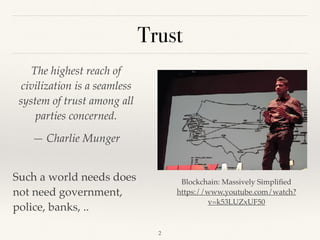
Blockchain: Massively Simplified
https://www.youtube.com/watch?
v=k53LUZxUF50
What is Blockchain?
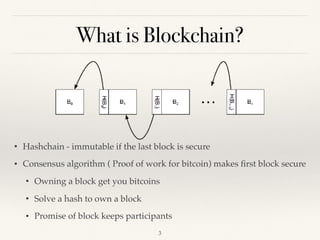
• Hashchain - immutable if the last block is secure
• Consensus algorithm ( Proof of work for bitcoin) makes first block secure
• Owning a block get you bitcoins
• Solve a hash to own a block
• Promise of block keeps participants
!3
Case Study: IAM
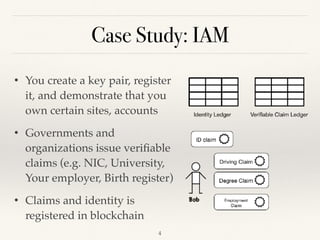
• You create a key pair, register
it, and demonstrate that you
own certain sites, accounts
• Governments and
organizations issue verifiable
claims (e.g. NIC, University,
Your employer, Birth register)
• Claims and identity is
registered in blockchain
!4
What does this mean for Cyber Security?
• Improve data Integrity and sharing
(e.g. One person can’t override)
• Embed Security and Privacy logic into
Access Protocols
• Less paperwork, tamperproof
• Reduce operational and processing
costs ( removing people in the path)
• Reduce Fraud
• Enable tracking (e.g. we can decide to
track public spending)
!5
Impact: Ledgers of Roles and Asserts
• Governments and organizations maintain ledgers
of identity, ownership, status, and Authority.(e.g.,
education, citizenship, right to travel, taxation
obligations, social security entitlements, and
property ownership).
• Blockchain can replace them
• Reduce Paperwork. (e.g. among examples of
records are education records, birth, and death
certificates, and Criminal records)
• Track public spending and trade money
• Reducing fraud, improve security and improve
agility.
!6
Impact:Lightweight Financial System
• Remove intermediaries or make current
models efficient and secure.
• mortgages, loans, escrow, crowdfunding,
widely accepted gift cards, loyalty points
and local currencies.
• Offer efficient and cheap micropayments.
Enable many who are currently disconnected
from banking systems due to costs. ( **
challenged due to high bitcoin costs)
• Disaggregate and enable many new business
models
!7
Impact:Smart Contracts
• Automatic Execution - e.g. upon a missed payment, the car
automatically locks and returns the control to the lender.
• Trustless transactions (e.g. escrow, hedges)
• Furthermore, due to the reduction of costs, smart contracts
would enable complex financial instruments to a wider audience.
!8
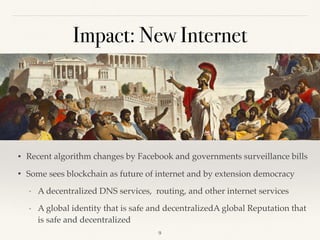
Impact: New Internet
• Recent algorithm changes by Facebook and governments surveillance bills
• Some sees blockchain as future of internet and by extension democracy
- A decentralized DNS services, routing, and other internet services
- A global identity that is safe and decentralizedA global Reputation that
is safe and decentralized
!9
Few More
• Disintermediation - shared database
• Provenance - tracking
• Initial Coin Offerings (ICO) - raising money
• Autonomous echo systems/ marketplace - e.g.
decentralized amazon, eBay
• Voting
• Healthcare - track medication, prescription management
!10
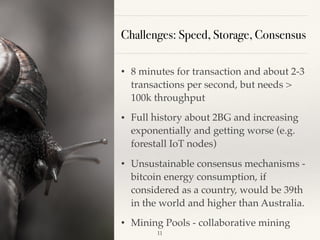
Challenges: Speed, Storage, Consensus
• 8 minutes for transaction and about 2-3
transactions per second, but needs >
100k throughput
• Full history about 2BG and increasing
exponentially and getting worse (e.g.
forestall IoT nodes)
• Unsustainable consensus mechanisms -
bitcoin energy consumption, if
considered as a country, would be 39th
in the world and higher than Australia.
• Mining Pools - collaborative mining
!11
Challenges: Limited Privacy
• Only provides pseudo anonymization
• By analyzing the transaction graph and
related other information, it is often
possible to link users to transactions.
• Once one transaction is linked to a
user, all transactions become known.
• Since transaction data are public or
shared, this means blockchain is riskier
than using a credit card in terms of
privacy.  
!12
Challenges: Verification & Governance
• Lack of methods to verify and limit risks
• Harder to break in, but can do more damage inside
• Solutions: formal verification, testing and
simulation, support for undo or bounded effects,
and put human in the loop.
• Lack of governance and standards
• How to evolve the blockchain, when to fork, what
is the process to accept a fork, how to handle
human errors, how to verify?
• Solutions themselves must be decentralized not
to undermine the goals .
!13
Challenges: Grand Impact
• We need to understand the economics,
social, and political side effects of the
blockchain.
• For example, blockchain may enable
chap voting, enabling us even replace
representative democracy with direct
democracy. However, we do not
know whether that will be a good
thing or a bad thing.
• Is inflation free currency a good thing
• Is global currency a good thing?
!14
Risk: Irrevocability
• For example, if a credit card is lost or bank
account is hacked, money can often be traced,
found, and returned. With blockchain, if you loose
your keys you can loose everything.
• Most systems such as marketplaces, platforms,
internet are complex systems. Complex systems
( hard to analyze) and Irrevocability are poisoned
combination.
• Fixing them via forks is risker
• Moreover, automation and irrevocability is a
poisoned combination.
!15
Risks: Missing Regulator
• Markets work only if it is fair ( As per Adam Smith)
• E.g. Stock market oversight, Pyramid schemes.
• Controlling hate speech, bias, targeted attacks, etc.
• there is no one to hold accountable.
• Malicous injection of bias other behaviours ( hard to verify updates)
!16
Future
• Impact is significant
• Tradeoffs: making it harder to breaking
vs. increasing the potential damage
• Technology is not ready expect for
limited use cases
• Lot of investments, I believe it will take
5-10 years more
• Can it sustain effort?
• Do we really need deceterlization?
!17
Conclusion
• Risky, high payback
• Be cautiously optimistic, but make sure technology is ready
for your use case
• Be careful at deployment
!18

Blockchain, Impact, Challenges, and Risks

  • 1.
    Srinath Perera VP Research,WSO2 ( srinath@wso2.com) Blockchain, Impact, Challenges, and Risks
  • 2.
    Trust The highest reachof civilization is a seamless system of trust among all parties concerned. — Charlie Munger !2 Such a world needs does not need government, police, banks, .. Blockchain: Massively Simplified https://www.youtube.com/watch? v=k53LUZxUF50
  • 3.
    What is Blockchain? •Hashchain - immutable if the last block is secure • Consensus algorithm ( Proof of work for bitcoin) makes first block secure • Owning a block get you bitcoins • Solve a hash to own a block • Promise of block keeps participants !3
  • 4.
    Case Study: IAM •You create a key pair, register it, and demonstrate that you own certain sites, accounts • Governments and organizations issue verifiable claims (e.g. NIC, University, Your employer, Birth register) • Claims and identity is registered in blockchain !4
  • 5.
    What does thismean for Cyber Security? • Improve data Integrity and sharing (e.g. One person can’t override) • Embed Security and Privacy logic into Access Protocols • Less paperwork, tamperproof • Reduce operational and processing costs ( removing people in the path) • Reduce Fraud • Enable tracking (e.g. we can decide to track public spending) !5
  • 6.
    Impact: Ledgers ofRoles and Asserts • Governments and organizations maintain ledgers of identity, ownership, status, and Authority.(e.g., education, citizenship, right to travel, taxation obligations, social security entitlements, and property ownership). • Blockchain can replace them • Reduce Paperwork. (e.g. among examples of records are education records, birth, and death certificates, and Criminal records) • Track public spending and trade money • Reducing fraud, improve security and improve agility. !6
  • 7.
    Impact:Lightweight Financial System •Remove intermediaries or make current models efficient and secure. • mortgages, loans, escrow, crowdfunding, widely accepted gift cards, loyalty points and local currencies. • Offer efficient and cheap micropayments. Enable many who are currently disconnected from banking systems due to costs. ( ** challenged due to high bitcoin costs) • Disaggregate and enable many new business models !7
  • 8.
    Impact:Smart Contracts • AutomaticExecution - e.g. upon a missed payment, the car automatically locks and returns the control to the lender. • Trustless transactions (e.g. escrow, hedges) • Furthermore, due to the reduction of costs, smart contracts would enable complex financial instruments to a wider audience. !8
  • 9.
    Impact: New Internet •Recent algorithm changes by Facebook and governments surveillance bills • Some sees blockchain as future of internet and by extension democracy - A decentralized DNS services, routing, and other internet services - A global identity that is safe and decentralizedA global Reputation that is safe and decentralized !9
  • 10.
    Few More • Disintermediation- shared database • Provenance - tracking • Initial Coin Offerings (ICO) - raising money • Autonomous echo systems/ marketplace - e.g. decentralized amazon, eBay • Voting • Healthcare - track medication, prescription management !10
  • 11.
    Challenges: Speed, Storage,Consensus • 8 minutes for transaction and about 2-3 transactions per second, but needs > 100k throughput • Full history about 2BG and increasing exponentially and getting worse (e.g. forestall IoT nodes) • Unsustainable consensus mechanisms - bitcoin energy consumption, if considered as a country, would be 39th in the world and higher than Australia. • Mining Pools - collaborative mining !11
  • 12.
    Challenges: Limited Privacy •Only provides pseudo anonymization • By analyzing the transaction graph and related other information, it is often possible to link users to transactions. • Once one transaction is linked to a user, all transactions become known. • Since transaction data are public or shared, this means blockchain is riskier than using a credit card in terms of privacy.   !12
  • 13.
    Challenges: Verification &Governance • Lack of methods to verify and limit risks • Harder to break in, but can do more damage inside • Solutions: formal verification, testing and simulation, support for undo or bounded effects, and put human in the loop. • Lack of governance and standards • How to evolve the blockchain, when to fork, what is the process to accept a fork, how to handle human errors, how to verify? • Solutions themselves must be decentralized not to undermine the goals . !13
  • 14.
    Challenges: Grand Impact •We need to understand the economics, social, and political side effects of the blockchain. • For example, blockchain may enable chap voting, enabling us even replace representative democracy with direct democracy. However, we do not know whether that will be a good thing or a bad thing. • Is inflation free currency a good thing • Is global currency a good thing? !14
  • 15.
    Risk: Irrevocability • Forexample, if a credit card is lost or bank account is hacked, money can often be traced, found, and returned. With blockchain, if you loose your keys you can loose everything. • Most systems such as marketplaces, platforms, internet are complex systems. Complex systems ( hard to analyze) and Irrevocability are poisoned combination. • Fixing them via forks is risker • Moreover, automation and irrevocability is a poisoned combination. !15
  • 16.
    Risks: Missing Regulator •Markets work only if it is fair ( As per Adam Smith) • E.g. Stock market oversight, Pyramid schemes. • Controlling hate speech, bias, targeted attacks, etc. • there is no one to hold accountable. • Malicous injection of bias other behaviours ( hard to verify updates) !16
  • 17.
    Future • Impact issignificant • Tradeoffs: making it harder to breaking vs. increasing the potential damage • Technology is not ready expect for limited use cases • Lot of investments, I believe it will take 5-10 years more • Can it sustain effort? • Do we really need deceterlization? !17
  • 18.
    Conclusion • Risky, highpayback • Be cautiously optimistic, but make sure technology is ready for your use case • Be careful at deployment !18