Welcome
INTRODUCTION TO
ANATOMY
By
Prof. Dr. Abdelmohaimen Mostafa Saleh
Professor of Anatomy & Embryology
Assiut University, Egypt.
‫أ‬.‫د‬/.‫صالح‬ ‫مصطفى‬ ‫عبدالمهيمن‬
‫كلية‬‫الطب‬‫البيطرى‬-‫اسيوط‬ ‫جامعة‬
What is meant by Anatomy:
What Is the Anatomy
Scientifically
The branch of biological science which deals with
form and structure of organisms (animal).
It means cutting apart or cut and see
Literally
BRANCHES OF ANATOMY
Microscopic Anatomy:
Study of various tissues and organs with the use
of microscope ( light & electron).
.
Gross Or MacroscopicAnatomy:
Study of form and structure of different parts of
the body with the unaided eye and using
simple instruments as scalpels and forcepses.
Comparative Anatomy:
The description and comparison of the structures of
animals. This forms bases for animals
classification.
Developmental Anatomy:
• Study of changes that occur to the organism
from the time of conception through birth,
youth, maturity and even to older age.
• The term embryology is usually limited to the
changes which occur from the time of
conception till birth.
Special anatomy:
The description of the structure of a single type or
species of animal. e.g : Anthropotomy = human anatomy
Hippotomym = horse anatomy.
Phylogony:
Ancestral history of different animal species i.e.
Historical development.
METHODS OF STUDYING ANATOMY
- Studying the body as systems such as the digestive,
respiratory or urogenital system is called systematic
anatomy,
- while studying the body as regions such as thorax,
abdomen or head & neck is called regional
anatomy.
- Applied anatomy explains the clinical importance of
any structure in the body.
The divisions of systematic anatomy are:
. Osteology : is the studying of bones & cartilages of the
skeleton.
. Syndesmology :is the studying of joints.
. Myology :is the studying of muscles and their
accessory structures.
. Splanchnology is the studying of the viscera which
includes the
digestive, respiratory and urogenital system.
.
Angiology : is the studying of organs of circulation
which include the heart, arteries, viens, lymphatics
and spleen.
. Neurology :is the studying of the nervous system &
sense organs.
. Common integument :is the studying of the skin
andits derivatives such as nails, hoof, horn, …. etc.
3. Applied Anatomy:
The use of anatomical facts in relation to applied
sciences like surgery, internal medicine,
theriogenology etc…..
2. Topographic Anatomy:
Description of different regions of the body like limbs,
head & neck, abdomen and thorax and pelvis.
TOPOGRAPHIC TERMS
TOPOGRAPHIC TERMS
Used to In order to indicate the position and direction
of parts of the body, certain descriptive terms are
employed, such as :
Dorsal -- directed toward the back [head, trunk, tail];
also applied to manus & pes.
Ventral -- directed toward the belly [head, trunk, tail].
Cranial -- directed toward the cranium (brain case).
Caudal -- directed toward the tail (& beyond).
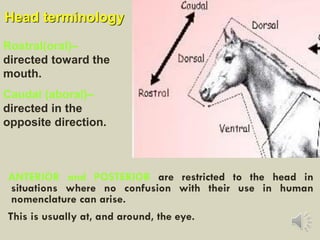
ANTERIOR and POSTERIOR are restricted to the head in
situations where no confusion with their use in human
nomenclature can arise.
This is usually at, and around, the eye.
Head terminology
Rostral(oral)–
directed toward the
mouth.
Caudal (aboral)–
directed in the
opposite direction.
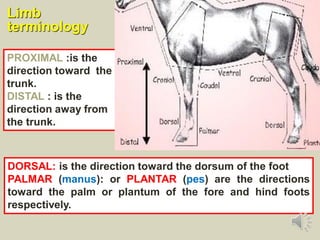
Limb
terminology
PROXIMAL :is the
direction toward the
trunk.
DISTAL : is the
direction away from
the trunk.
DORSAL: is the direction toward the dorsum of the foot
PALMAR (manus): or PLANTAR (pes) are the directions
toward the palm or plantum of the fore and hind foots
respectively.
Some terms are common to all regions:
SUPERFICIAL and DEEP (profundus) indicate
relative distances from the surface of the body.
EXTERNAL and INTERNAL refer to relations of
depth in organs and cavities.
MEDIAL and LATERAL give the position near to, or
farther from, the midline of the body.
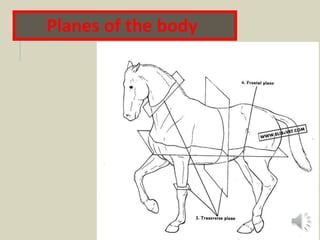
Planes of the body
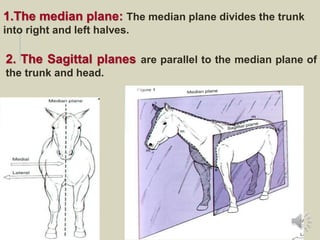
2. The Sagittal planes are parallel to the median plane of
the trunk and head.
1.The median plane: The median plane divides the trunk
into right and left halves.
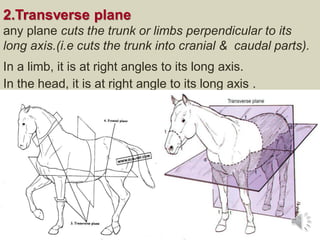
2.Transverse plane
any plane cuts the trunk or limbs perpendicular to its
long axis.(i.e cuts the trunk into cranial & caudal parts).
In a limb, it is at right angles to its long axis.
In the head, it is at right angle to its long axis .
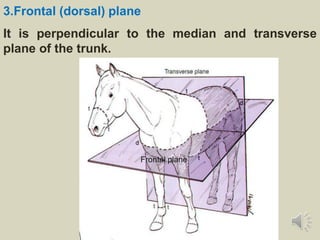
3.Frontal (dorsal) plane
It is perpendicular to the median and transverse
plane of the trunk.
Frontal plane
General Osteology
Functions of bones:
1.Protection of vital organs.
2.Give rigidity and form of the body.
3.Act as leavers that help in locomotion with the
aid of muscles.
4.Storage of minerals (calcium and
phosphorous).
5.Formation of blood cells.
General Osteology
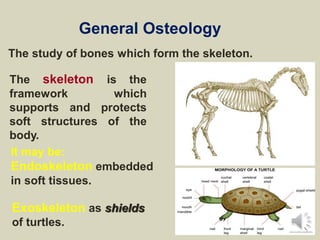
The study of bones which form the skeleton.
The skeleton is the
framework which
supports and protects
soft structures of the
body.
Exoskeleton as shields
of turtles.
It may be:
Endoskeleton embedded
in soft tissues.
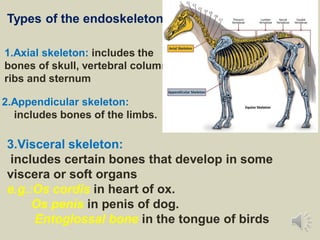
Types of the endoskeleton:
2.Appendicular skeleton:
includes bones of the limbs.
1.Axial skeleton: includes the
bones of skull, vertebral column,
ribs and sternum
3.Visceral skeleton:
includes certain bones that develop in some
viscera or soft organs
e.g.:Os cordis in heart of ox.
Os penis in penis of dog.
Entoglossal bone in the tongue of birds
Types of Bones
Bones are classified according to their shape into :
1- Long Bones
2-Short Bones
3- Flat bone
4-Irregular bones
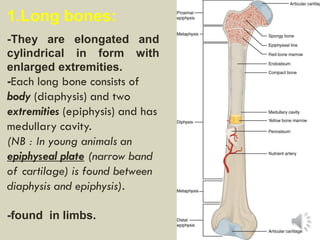
1.Long bones:
-They are elongated and
cylindrical in form with
enlarged extremities.
-Each long bone consists of
body (diaphysis) and two
extremities (epiphysis) and has
medullary cavity.
(NB : In young animals an
epiphyseal plate (narrow band
of cartilage) is found between
diaphysis and epiphysis).
-found in limbs.
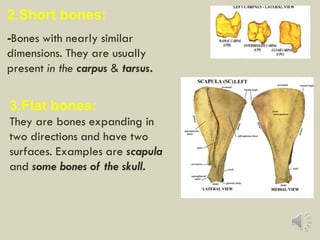
2.Short bones:
-Bones with nearly similar
dimensions. They are usually
present in the carpus & tarsus.
3.Flat bones:
They are bones expanding in
two directions and have two
surfaces. Examples are scapula
and some bones of the skull.
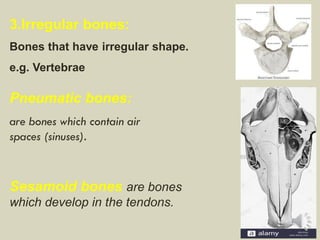
3.Irregular bones:
Bones that have irregular shape.
e.g. Vertebrae
Pneumatic bones:
are bones which contain air
spaces (sinuses).
Sesamoid bones are bones
which develop in the tendons.
Compact bone
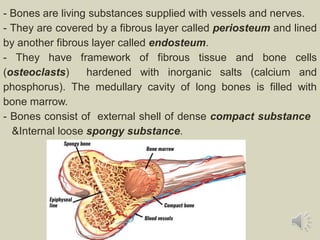
- Bones are living substances supplied with vessels and nerves.
- They are covered by a fibrous layer called periosteum and lined
by another fibrous layer called endosteum.
- They have framework of fibrous tissue and bone cells
(osteoclasts) hardened with inorganic salts (calcium and
phosphorus). The medullary cavity of long bones is filled with
bone marrow.
- Bones consist of external shell of dense compact substance
&Internal loose spongy substance.
Introduction to anatomy

Introduction to anatomy

  • 1.
    Welcome INTRODUCTION TO ANATOMY By Prof. Dr.Abdelmohaimen Mostafa Saleh Professor of Anatomy & Embryology Assiut University, Egypt. ‫أ‬.‫د‬/.‫صالح‬ ‫مصطفى‬ ‫عبدالمهيمن‬ ‫كلية‬‫الطب‬‫البيطرى‬-‫اسيوط‬ ‫جامعة‬
  • 2.
    What is meantby Anatomy: What Is the Anatomy Scientifically The branch of biological science which deals with form and structure of organisms (animal). It means cutting apart or cut and see Literally
  • 3.
    BRANCHES OF ANATOMY MicroscopicAnatomy: Study of various tissues and organs with the use of microscope ( light & electron). . Gross Or MacroscopicAnatomy: Study of form and structure of different parts of the body with the unaided eye and using simple instruments as scalpels and forcepses.
  • 4.
    Comparative Anatomy: The descriptionand comparison of the structures of animals. This forms bases for animals classification. Developmental Anatomy: • Study of changes that occur to the organism from the time of conception through birth, youth, maturity and even to older age. • The term embryology is usually limited to the changes which occur from the time of conception till birth.
  • 5.
    Special anatomy: The descriptionof the structure of a single type or species of animal. e.g : Anthropotomy = human anatomy Hippotomym = horse anatomy. Phylogony: Ancestral history of different animal species i.e. Historical development.
  • 6.
    METHODS OF STUDYINGANATOMY - Studying the body as systems such as the digestive, respiratory or urogenital system is called systematic anatomy, - while studying the body as regions such as thorax, abdomen or head & neck is called regional anatomy. - Applied anatomy explains the clinical importance of any structure in the body.
  • 7.
    The divisions ofsystematic anatomy are: . Osteology : is the studying of bones & cartilages of the skeleton. . Syndesmology :is the studying of joints. . Myology :is the studying of muscles and their accessory structures. . Splanchnology is the studying of the viscera which includes the digestive, respiratory and urogenital system. .
  • 8.
    Angiology : isthe studying of organs of circulation which include the heart, arteries, viens, lymphatics and spleen. . Neurology :is the studying of the nervous system & sense organs. . Common integument :is the studying of the skin andits derivatives such as nails, hoof, horn, …. etc.
  • 9.
    3. Applied Anatomy: Theuse of anatomical facts in relation to applied sciences like surgery, internal medicine, theriogenology etc….. 2. Topographic Anatomy: Description of different regions of the body like limbs, head & neck, abdomen and thorax and pelvis.
  • 10.
  • 11.
    TOPOGRAPHIC TERMS Used toIn order to indicate the position and direction of parts of the body, certain descriptive terms are employed, such as :
  • 12.
    Dorsal -- directedtoward the back [head, trunk, tail]; also applied to manus & pes. Ventral -- directed toward the belly [head, trunk, tail]. Cranial -- directed toward the cranium (brain case). Caudal -- directed toward the tail (& beyond).
  • 13.
    ANTERIOR and POSTERIORare restricted to the head in situations where no confusion with their use in human nomenclature can arise. This is usually at, and around, the eye. Head terminology Rostral(oral)– directed toward the mouth. Caudal (aboral)– directed in the opposite direction.
  • 14.
    Limb terminology PROXIMAL :is the directiontoward the trunk. DISTAL : is the direction away from the trunk. DORSAL: is the direction toward the dorsum of the foot PALMAR (manus): or PLANTAR (pes) are the directions toward the palm or plantum of the fore and hind foots respectively.
  • 15.
    Some terms arecommon to all regions: SUPERFICIAL and DEEP (profundus) indicate relative distances from the surface of the body. EXTERNAL and INTERNAL refer to relations of depth in organs and cavities. MEDIAL and LATERAL give the position near to, or farther from, the midline of the body.
  • 16.
  • 17.
    2. The Sagittalplanes are parallel to the median plane of the trunk and head. 1.The median plane: The median plane divides the trunk into right and left halves.
  • 18.
    2.Transverse plane any planecuts the trunk or limbs perpendicular to its long axis.(i.e cuts the trunk into cranial & caudal parts). In a limb, it is at right angles to its long axis. In the head, it is at right angle to its long axis .
  • 19.
    3.Frontal (dorsal) plane Itis perpendicular to the median and transverse plane of the trunk. Frontal plane
  • 20.
    General Osteology Functions ofbones: 1.Protection of vital organs. 2.Give rigidity and form of the body. 3.Act as leavers that help in locomotion with the aid of muscles. 4.Storage of minerals (calcium and phosphorous). 5.Formation of blood cells.
  • 21.
    General Osteology The studyof bones which form the skeleton. The skeleton is the framework which supports and protects soft structures of the body. Exoskeleton as shields of turtles. It may be: Endoskeleton embedded in soft tissues.
  • 22.
    Types of theendoskeleton: 2.Appendicular skeleton: includes bones of the limbs. 1.Axial skeleton: includes the bones of skull, vertebral column, ribs and sternum 3.Visceral skeleton: includes certain bones that develop in some viscera or soft organs e.g.:Os cordis in heart of ox. Os penis in penis of dog. Entoglossal bone in the tongue of birds
  • 23.
    Types of Bones Bonesare classified according to their shape into : 1- Long Bones 2-Short Bones 3- Flat bone 4-Irregular bones
  • 24.
    1.Long bones: -They areelongated and cylindrical in form with enlarged extremities. -Each long bone consists of body (diaphysis) and two extremities (epiphysis) and has medullary cavity. (NB : In young animals an epiphyseal plate (narrow band of cartilage) is found between diaphysis and epiphysis). -found in limbs.
  • 25.
    2.Short bones: -Bones withnearly similar dimensions. They are usually present in the carpus & tarsus. 3.Flat bones: They are bones expanding in two directions and have two surfaces. Examples are scapula and some bones of the skull.
  • 26.
    3.Irregular bones: Bones thathave irregular shape. e.g. Vertebrae Pneumatic bones: are bones which contain air spaces (sinuses). Sesamoid bones are bones which develop in the tendons.
  • 27.
    Compact bone - Bonesare living substances supplied with vessels and nerves. - They are covered by a fibrous layer called periosteum and lined by another fibrous layer called endosteum. - They have framework of fibrous tissue and bone cells (osteoclasts) hardened with inorganic salts (calcium and phosphorus). The medullary cavity of long bones is filled with bone marrow. - Bones consist of external shell of dense compact substance &Internal loose spongy substance.