General Myyology
By
Prof. Dr. Abdelmohaimen Mostafa Saleh
Professor of Anatomy & Embryology
Assiut University
‫أ‬.‫د‬/‫صالح‬ ‫مصطفى‬ ‫عبدالمهيمن‬
Myology is the science which deals with the
study of muscles.
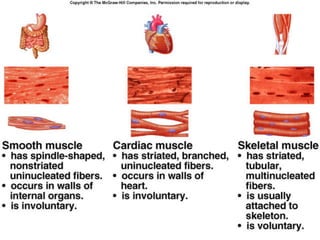
Muscles are classified morphologically &
functionally into 3 categories, smooth, cardiac
& skeleton muscles :
MUSCLE FUNCTIONS
• The muscles have 4 important functions:
1. Production of movement
– External and internal
2. Maintaining posture
3. Stabilizing joints
4. Generating heat
MUSCLE TYPES
1- Smooth muscles :
- found in the internal organs and blood vessels.
- They perform weak but sustained contractions.
- They are involuntary ( i.e. not under the control of will).
2- Cardiac muscles :
They are involuntary and form the bulk of the heart.
3- Skeletal muscles :
They are voluntry muscles, attached to the skeleton.
Some fibers appear dark ( red ), others are pale ( white(
Contraction of red fibers is tonic and prolonged.
Each muscle consists of bundles and each bundle
consists of fibers (muscle cells).
SKELETAL MUSCLE
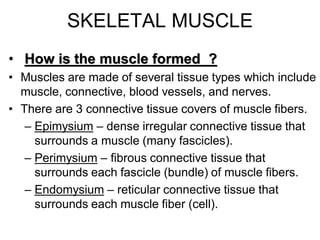
• How is the muscle formed ?
• Muscles are made of several tissue types which include
muscle, connective, blood vessels, and nerves.
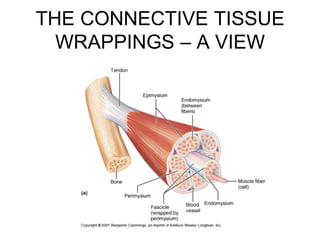
• There are 3 connective tissue covers of muscle fibers.
– Epimysium – dense irregular connective tissue that
surrounds a muscle (many fascicles).
– Perimysium – fibrous connective tissue that
surrounds each fascicle (bundle) of muscle fibers.
– Endomysium – reticular connective tissue that
surrounds each muscle fiber (cell).
THE CONNECTIVE TISSUE
WRAPPINGS – A VIEW
NB :
▪ New skeletal muscle fibers are not formed
after birth,
▪ Growth in muscle size is due to enlargement
of the existing fibers.
▪ Damaged muscle fibers are replaced by
connective tissue.
▪
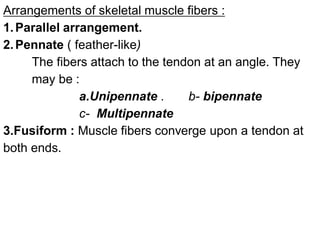
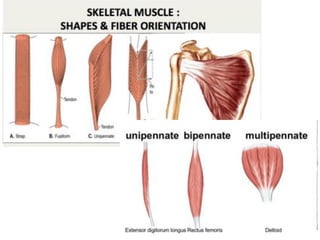
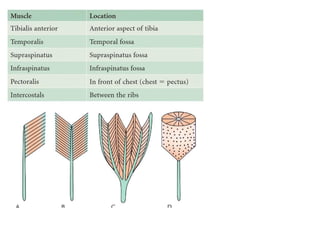
Arrangements of skeletal muscle fibers :
1.Parallel arrangement.
2.Pennate ( feather-like(
The fibers attach to the tendon at an angle. They
may be :
a.Unipennate . b- bipennate
c- Multipennate
3.Fusiform : Muscle fibers converge upon a tendon at
both ends.
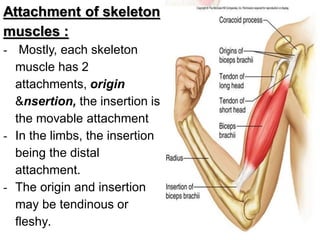
Attachment of skeleton
muscles :
- Mostly, each skeleton
muscle has 2
attachments, origin
&nsertion, the insertion is
the movable attachment
- In the limbs, the insertion
being the distal
attachment.
- The origin and insertion
may be tendinous or
fleshy.
Classification of skeletal muscles :
- According to function : extensors, flexors,
adductors ,abductors, levators, depressors, sphincters
& orbicularis (Muscles associated with the skin are
cutaneous muscles).
− According to number of divisions : Biceps (2
heads), Triceps (3 heads) & Quadriceps(4 heads).
− According to shape : Quadratus (rectangular),
Rhomboideus (resemble a rhomboid) & Serratus (with
serrated border)
− According to position: superficial, deep, external &
internal.
Structures associated with the muscles :
1- Tendons :
− It is composed of dense connective tissue to which the
muscle fibers are attached.
− It is either cord-like such as in fusiform muscles or flat
sheath as in flat muscles. ( NB : Some tendons contain
piece of bone called sesamoid bone )
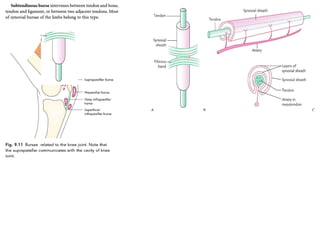
2-Tendon sheath :
− Long tendons are surrounded by tendon sheath
containing synovial fluid to make its movement smooth.
3- Bursa :
− It is a sac filled with synovia.
− It facilitates the movement of a tendon over a bony
prominent.
General myology   copy

General myology copy

  • 1.
    General Myyology By Prof. Dr.Abdelmohaimen Mostafa Saleh Professor of Anatomy & Embryology Assiut University ‫أ‬.‫د‬/‫صالح‬ ‫مصطفى‬ ‫عبدالمهيمن‬
  • 2.
    Myology is thescience which deals with the study of muscles. Muscles are classified morphologically & functionally into 3 categories, smooth, cardiac & skeleton muscles :
  • 3.
    MUSCLE FUNCTIONS • Themuscles have 4 important functions: 1. Production of movement – External and internal 2. Maintaining posture 3. Stabilizing joints 4. Generating heat
  • 4.
    MUSCLE TYPES 1- Smoothmuscles : - found in the internal organs and blood vessels. - They perform weak but sustained contractions. - They are involuntary ( i.e. not under the control of will). 2- Cardiac muscles : They are involuntary and form the bulk of the heart. 3- Skeletal muscles : They are voluntry muscles, attached to the skeleton. Some fibers appear dark ( red ), others are pale ( white( Contraction of red fibers is tonic and prolonged. Each muscle consists of bundles and each bundle consists of fibers (muscle cells).
  • 6.
    SKELETAL MUSCLE • Howis the muscle formed ? • Muscles are made of several tissue types which include muscle, connective, blood vessels, and nerves. • There are 3 connective tissue covers of muscle fibers. – Epimysium – dense irregular connective tissue that surrounds a muscle (many fascicles). – Perimysium – fibrous connective tissue that surrounds each fascicle (bundle) of muscle fibers. – Endomysium – reticular connective tissue that surrounds each muscle fiber (cell).
  • 7.
  • 8.
    NB : ▪ Newskeletal muscle fibers are not formed after birth, ▪ Growth in muscle size is due to enlargement of the existing fibers. ▪ Damaged muscle fibers are replaced by connective tissue. ▪
  • 9.
    Arrangements of skeletalmuscle fibers : 1.Parallel arrangement. 2.Pennate ( feather-like( The fibers attach to the tendon at an angle. They may be : a.Unipennate . b- bipennate c- Multipennate 3.Fusiform : Muscle fibers converge upon a tendon at both ends.
  • 11.
    Attachment of skeleton muscles: - Mostly, each skeleton muscle has 2 attachments, origin &nsertion, the insertion is the movable attachment - In the limbs, the insertion being the distal attachment. - The origin and insertion may be tendinous or fleshy.
  • 12.
    Classification of skeletalmuscles : - According to function : extensors, flexors, adductors ,abductors, levators, depressors, sphincters & orbicularis (Muscles associated with the skin are cutaneous muscles). − According to number of divisions : Biceps (2 heads), Triceps (3 heads) & Quadriceps(4 heads). − According to shape : Quadratus (rectangular), Rhomboideus (resemble a rhomboid) & Serratus (with serrated border) − According to position: superficial, deep, external & internal.
  • 13.
    Structures associated withthe muscles : 1- Tendons : − It is composed of dense connective tissue to which the muscle fibers are attached. − It is either cord-like such as in fusiform muscles or flat sheath as in flat muscles. ( NB : Some tendons contain piece of bone called sesamoid bone ) 2-Tendon sheath : − Long tendons are surrounded by tendon sheath containing synovial fluid to make its movement smooth. 3- Bursa : − It is a sac filled with synovia. − It facilitates the movement of a tendon over a bony prominent.