ANESTHETICS
Presented by GROUP 3
History - The Primitive techniques
• Club
• Strangulation
• Alcohol
• Mesmerism
• Plants
History – contd.
 General anesthesia was
absent until the mid-
1800’s
 Original discoverer of
general anesthetics
 Crawford Long, Physician
from Georgia: 1842,
ether anesthesia
 Chloroform introduced
 James Simpson: 1847
 Nitrous oxide
 Horace Wells in 1845
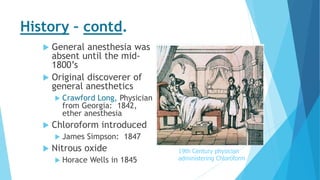
19th Century physician
administering Chloroform
History – contd.
 William T. G. Morton, a Boston
Dentist and medical student -
October 16, 1846 - Gaseous ether
 Public demonstration gained world-wide
attention
 Public demonstration consisted of an
operating room, “the ether dome,”
where Gilbert Abbot underwent surgery
for removal of a neck tumour in an
unconscious state at the Massachusetts
General Hospital
 But, no longer used in modern
practice, yet considered to be the
They did it for a better tomorrow!
Analgesics
Analgesics is sometimes confused
with anesthesia. Below is the difference
between them
Anesthetic
A medication that causes loss of
sensation. This is sometimes used to
alleviate pain or for loss of
consciousness for surgical procedures.
It relieves pain by numbing nerve
impulses. Its action is reversible when
right dose is administered
Anesthesia
Loss of consciousness
Analgesia (loss of pain sensation)
Adequate muscle relaxation
Analgesia
•Loss of sensation to pain
Types of anesthesia
General
Regional
Local
GENERAL ANESTHESIA
They induce unconsciousness and
eliminate pain by blocking the general
body innervation
usually administered by
 IV
 inhalation for the purpose of
In ophthalmology general anesthesia is rarely used but does have a place
in physically or emotionally traumatic surgeries and in non co-operative
children.
General anesthesia
need for
unconsciousness
‘Amnesia-hypnosis’
need for analgesia
‘Loss of sensory and
autonomic reflexes’
need for muscle
relaxation
REGIONAL ANESTHESIA
 Regional anesthesia is an injection of a local
anesthetics around nerves or into the trunk of a
nerve so that all the areas supplied by these
nerves will not send pain signals to the brain.
 They anesthetized area is usually larger than the
area affected by local anesthesia.
 Eg: retrobulbar injection to numb all eye movents by
targeting the oculomotor nerve
LOCAL ANAESTHESIA
 It is an anesthetic agent given to temporarily
stop the sense of pain in a particular area of
the body. The entire area supplied by a nerve
is not be anesthetized. Only a certain
branches does.
 Patient remains conscious during a local
anesthetic.
 Giving ametocaine to numb the cornea (only
axons of the ophthalmic division are severed)
Mechanism of action
GENERAL ANESTHESIA
 General anesthetics have two main routes:
Inhalation
 Most general anesthetics target GABAA
receptor channel
 Intravenous
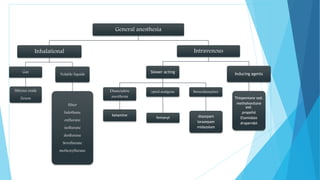
General anesthesia
Inhalational
Gas
Nitrous oxide
Zenon
Volatile liquids
Ether
halothane
enflurane
isoflurane
desflurane
Sevoflurane
methoxyflurane
Intravenous
Slower acting
Dissociative
anesthesia
ketamine
opiod analgesia
fentanyl
Benzodiazepines
diazepam
lorazepam
midazolam
Inducing agents
Thiopentone sod.
methohexitone
sod.
propofol
Etomidate
droperidol
Inhaled anesthetics
 Two main drugs used are
 Gases eg Nitrous oxide, cyclopropane
 Halogenated anesthetics e.g. halothanes,
isoflurane, desflurane and influrane
 Inhaled anesthetics have varying potency in proportion to
their lipid solubility.
 Every inhaled anesthetic has a specific MAC value.
A MAC (minimal alveolar anesthetic
concentration)
 is defined as the concentration of inhaled
anesthetic as a % of inspired air, at which
50% of patients will be anesthetized.
 MAC is a measure of potency: ED50.
Comparison between Nitrous Oxide
and the Halothanes
Facts about inhaled anesthetics
 Rates of onset and recovery depend on the blood-gas ratio:
a. The more soluble the anesthetic in the blood, the slower the
anesthesia.
b. Anesthetics with high blood-gas ratios are associated with slow
onset.
c. Anesthetics with high blood-gas ratios are associated with slow
recovery.
d. Anesthetics with low blood-gas ratios have fast onset and
recovery.
Intravenous anesthetics
 Their onset of action faster than the fastest of the
gaseous agents so they are used for induction of
anesthesia.
1. Thiopental
 Barbiturate used for induction
 Highly lipid soluble; rapid onset; short-acting due
to redistribution
Disadvantage:
Severe vasospasm
Cardiovascular depression
Hypersensitivity reactions
Midazolam
 Benzodiazepine used for:
 Preoperative sedation
 Anterograde amnesia
 Induction
 Outpatient surgery
Depresses respiratory function
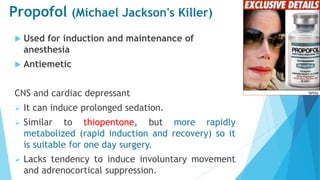
Propofol (Michael Jackson's Killer)
 Used for induction and maintenance of
anesthesia
 Antiemetic
CNS and cardiac depressant
 It can induce prolonged sedation.
 Similar to thiopentone, but more rapidly
metabolized (rapid induction and recovery) so it
is suitable for one day surgery.
 Lacks tendency to induce involuntary movement
and adrenocortical suppression.
Propofol (Michael Jackson's Killer)
Propofol. The onset of its
action begins after 30 s. After
a single dose patient recovers
after 5 min with a clear head
and no hangover.
Fentanyl
 Opiate used for induction and maintenance
of anesthesia
 Depresses respiratory function – be careful
of your asthma patient
Ketamine
 Dissociative anesthetic
 NMDA-receptor antagonist
 Induction of anesthesia
 Emergent delirium, hallucinations
 Cardiovascular stimulation
 increases intracranial pressure
 Disadvantages:
 Cerebral hemorrhage
 Dysphoria and hallucinations
Mechanism of action of general
anesthetics
Most injectable and inhaled anesthetic agents produce anesthesia by
enhancing GABA-mediated neuronal transmission, primarily at
GABAA receptors. GABA is an inhibitory neurotransmitter found
throughout the CNS. Some inhaled anesthesia may also act by
inhibiting such excitatory ion channels as neuronal nicotinic and
glutamate receptors.
Note: Ketamine does not affect GABAA it
antagonizes glutamic acid on NMDA receptor
4 (Four) Stages and signs !!!
• Traditional Description of signs and
stages of GA - Also called Guedel`s sign
• Typically seen in case of Ether
Stages of GA
Stage I: Stage of Analgesia
 Starts from beginning of anaesthetic inhalation and lasts upto
the loss of consciousness
 Pain is progressively abolished during this stage
 Patient remains conscious, can hear and see, and feels a dream
like state
 Reflexes and respiration remain normal
 It is difficult to maintain - use is limited to short procedures
only
Stage II: Stage of Delirium and Excitement:
 From loss of consciousness to beginning of regular respiration
 Excitement - patient may shout, struggle and hold his breath
 Muscle tone increases, jaws are tightly closed.
 Breathing is jerky; vomiting, involuntary micturition or defecation
may occur.
 Heart rate and BP may rise and pupils dilate due to sympathetic
stimulation.
 No stimulus or operative procedure carried out during this stage.
 Breatholding are commonly seen. Potentially dangerous responses
can occur during this stage including vomiting, laryngospasm and
uncontrolled movement.
 This stage is not found with modern anaesthesia – preanaesthetic
medication, rapid induction etc.
Stage III: Stage of Surgical
anaesthesia
Extends from onset of regular respiration
to cessation of spontaneous breathing.
 This has been divided into 4 planes:
Plane 1: Roving eye balls. This plane ends when
eyes become fixed.
Plane 2: Loss of corneal and laryngeal reflexes.
Plane 3: Pupil starts dilating and light reflex is
lost.
Plane 4: Intercostal paralysis, shallow
abdominal respiration, dilated pupil.
Stage IV: Medullary /
respiratory paralysis
 Cessation of breathing failure of circulation
death
 Pupils: widely dilated
 Muscles are totally flabby
 Pulse is imperceptible
 BP is very low.
Local anesthetics
Drugs used to provide local anesthesia are also used
to achieve regional anesthesia. Regional anesthesia
is an injection of a local anesthetics around nerves
so that the area supplied by these nerves will not
send pain signals to the brain. They anesthetized
area is usually larger than the area affected by local
anesthesia.
Mechanism of action
 Mechanisms:
Nonionized form crosses axonal membrane
- From within, ionized form blocks the inactivated Na+ channel
- Slows recovery and prevents propagation of action potentials
When local anesthetics are applied to the area that they numb,
they need to get to the axon by crossing to the membrane. Only
non ionized forms R-NH2 can enter the axon through the
membrane. Upon entering the axon, only the ionized forms can
block the sodium channels which causes depolarization of the
sodium channel consequently numbing the area.
Ionized form RNH3+
Classification of Local Anesthetics
based on chemical group
 - Esters:
procaine, cocaine, benzocaine are metabolized
by plasma and tissue esterases
 - Amides:
lidocaine, bupivacaine, mepivacaine are
metabolized by liver amides
Esters
Two types
1. Esters of benzoic acid (BA)
2. Esters of para amino benzoic acid.( PABA)
Esters of benzoic acid
 Butacaine
 Cocaine
 Ethyl aminobenzoate (benzocaine)
 Hexylcaine
 Piperocaine
 Tertracaine
Esters of para-aminobenzoic
acid
Cloroprocaine
Procaine
propoxycaine
Amides
 Articaine
 Bupivacaine
 Dibucaine
 Etidocaine
 Lidocaine
 Mepivacaine
 Prilocaine
 Roppivacaine
May also be classified into
a. Short acting – cocaine, procaine
b. Intermediate acting – lidocaine,
mepivacaine, dibucaine, prilocaine
c. Long acting – tetracaine,
bupivacaine, etidocaine
Metabolism
Esters are metabolized by the
plasma by enzymes esterase
amides are metabolized by liver
by the enzyme hepatic amidases
Clinical note
 Don’t give amides to patients with poor
liver function. Eg. patient with any form of
hepatitis! WHY?
 the amides will pile up due inability of the
liver to metabolize. Hence elicit a
complete history in your patient. In cases
where patients have liver problem; your
local anesthesia should be an ester.
How do we know which cocaine
derivative is an amides or ester?
The trick: the letter i
 in almost all cases if an i precedes the
“caine” sound, the drug is an amide but if not,
it is an ester.
Amides Esthers
 Articaine
 Bupivacaine
 Dibucaine
 Etidocaine
 Lidocaine
 Mepivacaine
 Prilocaine
 Roppivacaine
 Butacaine
 Cocaine
 Ethyl aminobenzoate (benzocaine)
 Hexylcaine
 Tertracaine
 Cloroprocaine
 Procaine
 propoxycaine
Limiting local anesthetics
 All local anesthetics should be co-administered
with alpha-1 agonist. E.g. phenylephrine,
metoximine. WHY?
Reason;
The alpha-1 agonist will cause a powerful
vasoconstriction and limit the access of
surrounding tissues to the local anesthetics.
The Cocaine saga
I am the only local anesthetics that
does not need an alpha-1 agonist.
WHY?
ANS: I am a NEP re-uptake blocker.
NOTE: it causes NEP build up in the synapsis. From the
synapsis NEP binds to the alpha-1 receptors and causes
vasoconstriction in the surrounding tissues. Therefore you don’t
need an alpha-1 agonist after administration of cocaine.
Side effect
 Local anesthetics can cause allergies
especially the ester groups because they
form PABA. All PABA containing compounds
can always cause allergic reactions.
 Therefore check your creams that you
buy on the market.
OCULAR FOCUS
QUICK NOTES
Injection:
amide + longer acting ester
= longer-acting motor and
sensory anesthesia.
Targets of injectable agents
 muscle cone of the orbit-blocks all motor
and sensory nerves of eye
 directly into orbicularis muscles into CNVII
 stylomastoid foramen –these two cause a
complete loss of facial nerve on that side
of face
Topical anesthesia
 Any test requiring contact with the cornea is made
more comfortable if topical anesthetic is used first
Indeed, some of these tests would be nearly
impossible for the patient to endure if the cornea was
not numbed first.
 In addition to numbing the cornea and conjunctiva
for testing, topial anesthetic is required in
procedures such as removal of a foreign body or
scraping a corneal lesion
Tetracaine
is the most popular topical
anesthetic. Tetracaine is
unpreserved.
Proparacaine and benoxinate
 contain preservatives and are effective in
anesthetizing the corneal nerve endings
through topical application.
 These formulations are highly osmotic and
therefore sting and burn when applied.
Home use?
never prescribed for a patient
to use at home. Frequent use
interferes with the healing
process and can cause corneal
melting
Please don’t rub your eyes!
the cornea now lacks sensation,
the patient could conceivably
rub hard enough to cause a
corneal abrasion.
Toxicity Potential
 . All anesthetics have a potential to become toxic
in higher doses. Individuals may experience
lightheadedness, ringing in their ears, or blurred
vision.
 At even higher doses, respiratory arrest can
occur, as well as convulsions, coma and death.
punctual occlusion
When topical anesthetic is used,
punctual occlusion can reduce the
amount of drug that is absorbed into
the system
MUSCLE RELAXANTS
Used mainly in anesthesia protocols
(EMERGENCIES) or in the (Intensive Care Unit)
ICU to afford muscle relaxation and/or
immobility. Used to relieve symptoms such as
spasms ,pain and hyperreflexia
Muscle relaxants interact with nicotinic ACh
receptors at the neuromuscular junction.
MECHANISM
 NORMAL CHOLINERGIC TRANSMISSION
Normally, a nerve impulse arrives at the motor nerve terminal, initiating an
influx of calcium ions, which causes the exocytosis of synaptic vesicles
containing acetylcholine.
Acetylcholine then diffuses across the synaptic cleft. It may be hydrolysed by
acetylcholine esterase (AchE) or bind to the nicotinic receptors located on
the motor end plate.
The binding of two acetylcholine molecules results in a conformational
change in the receptor that opens the sodium-potassium channel of the
nicotinic receptor. This allows Na + and Ca 2+ ions to enter the cell and K+
ions to leave the cell, causing a depolarization of the end plate, resulting
in muscle contraction.
Normal end plate function can be blocked by
two mechanisms.
1.Nondepolarizing agents (competetive),
such as tubocurarine,
block the agonist , acetylcholine, from
binding to nicotinic receptors and activating
them, thereby preventing depolarization.
Major Non-depolarizing MRs
Atracurium
 Rapid recovery
 Safe in hepatic or renal impairment
 Spontaneous inactivation to laudanosine
 ,Laudanosine can cause seizures
Mivacurium
 Very short duration
 Metabolized by plasma cholinesterases
2.depolarizing agents, (noncompetitive)
 Alternatively, depolarizing agents such as
succinylcholine, are nicotinic receptor
agonists which mimic Ach, block muscle
contraction by depolarizing to such an
extent that it desensitizes the receptor
and it can no longer initiate an action
potential and cause muscle contraction
MRs
mainly in anesthesia
protocols (EMERGENCIES) or
in the (Intensive Care Unit)
Beware of
Anesthetics!
Thank you
Any question?

Anesthesia

  • 1.
  • 2.
    History - ThePrimitive techniques • Club • Strangulation • Alcohol • Mesmerism • Plants
  • 3.
    History – contd. General anesthesia was absent until the mid- 1800’s  Original discoverer of general anesthetics  Crawford Long, Physician from Georgia: 1842, ether anesthesia  Chloroform introduced  James Simpson: 1847  Nitrous oxide  Horace Wells in 1845 19th Century physician administering Chloroform
  • 4.
    History – contd. William T. G. Morton, a Boston Dentist and medical student - October 16, 1846 - Gaseous ether  Public demonstration gained world-wide attention  Public demonstration consisted of an operating room, “the ether dome,” where Gilbert Abbot underwent surgery for removal of a neck tumour in an unconscious state at the Massachusetts General Hospital  But, no longer used in modern practice, yet considered to be the
  • 5.
    They did itfor a better tomorrow!
  • 6.
    Analgesics Analgesics is sometimesconfused with anesthesia. Below is the difference between them
  • 7.
    Anesthetic A medication thatcauses loss of sensation. This is sometimes used to alleviate pain or for loss of consciousness for surgical procedures. It relieves pain by numbing nerve impulses. Its action is reversible when right dose is administered
  • 8.
    Anesthesia Loss of consciousness Analgesia(loss of pain sensation) Adequate muscle relaxation Analgesia •Loss of sensation to pain
  • 9.
  • 10.
    GENERAL ANESTHESIA They induceunconsciousness and eliminate pain by blocking the general body innervation usually administered by  IV  inhalation for the purpose of In ophthalmology general anesthesia is rarely used but does have a place in physically or emotionally traumatic surgeries and in non co-operative children. General anesthesia need for unconsciousness ‘Amnesia-hypnosis’ need for analgesia ‘Loss of sensory and autonomic reflexes’ need for muscle relaxation
  • 11.
    REGIONAL ANESTHESIA  Regionalanesthesia is an injection of a local anesthetics around nerves or into the trunk of a nerve so that all the areas supplied by these nerves will not send pain signals to the brain.  They anesthetized area is usually larger than the area affected by local anesthesia.  Eg: retrobulbar injection to numb all eye movents by targeting the oculomotor nerve
  • 12.
    LOCAL ANAESTHESIA  Itis an anesthetic agent given to temporarily stop the sense of pain in a particular area of the body. The entire area supplied by a nerve is not be anesthetized. Only a certain branches does.  Patient remains conscious during a local anesthetic.  Giving ametocaine to numb the cornea (only axons of the ophthalmic division are severed)
  • 13.
    Mechanism of action GENERALANESTHESIA  General anesthetics have two main routes: Inhalation  Most general anesthetics target GABAA receptor channel  Intravenous
  • 14.
    General anesthesia Inhalational Gas Nitrous oxide Zenon Volatileliquids Ether halothane enflurane isoflurane desflurane Sevoflurane methoxyflurane Intravenous Slower acting Dissociative anesthesia ketamine opiod analgesia fentanyl Benzodiazepines diazepam lorazepam midazolam Inducing agents Thiopentone sod. methohexitone sod. propofol Etomidate droperidol
  • 15.
    Inhaled anesthetics  Twomain drugs used are  Gases eg Nitrous oxide, cyclopropane  Halogenated anesthetics e.g. halothanes, isoflurane, desflurane and influrane  Inhaled anesthetics have varying potency in proportion to their lipid solubility.  Every inhaled anesthetic has a specific MAC value.
  • 16.
    A MAC (minimalalveolar anesthetic concentration)  is defined as the concentration of inhaled anesthetic as a % of inspired air, at which 50% of patients will be anesthetized.  MAC is a measure of potency: ED50.
  • 17.
    Comparison between NitrousOxide and the Halothanes
  • 18.
    Facts about inhaledanesthetics  Rates of onset and recovery depend on the blood-gas ratio: a. The more soluble the anesthetic in the blood, the slower the anesthesia. b. Anesthetics with high blood-gas ratios are associated with slow onset. c. Anesthetics with high blood-gas ratios are associated with slow recovery. d. Anesthetics with low blood-gas ratios have fast onset and recovery.
  • 19.
    Intravenous anesthetics  Theironset of action faster than the fastest of the gaseous agents so they are used for induction of anesthesia.
  • 20.
    1. Thiopental  Barbiturateused for induction  Highly lipid soluble; rapid onset; short-acting due to redistribution Disadvantage: Severe vasospasm Cardiovascular depression Hypersensitivity reactions
  • 21.
    Midazolam  Benzodiazepine usedfor:  Preoperative sedation  Anterograde amnesia  Induction  Outpatient surgery Depresses respiratory function
  • 22.
    Propofol (Michael Jackson'sKiller)  Used for induction and maintenance of anesthesia  Antiemetic CNS and cardiac depressant  It can induce prolonged sedation.  Similar to thiopentone, but more rapidly metabolized (rapid induction and recovery) so it is suitable for one day surgery.  Lacks tendency to induce involuntary movement and adrenocortical suppression.
  • 23.
    Propofol (Michael Jackson'sKiller) Propofol. The onset of its action begins after 30 s. After a single dose patient recovers after 5 min with a clear head and no hangover.
  • 24.
    Fentanyl  Opiate usedfor induction and maintenance of anesthesia  Depresses respiratory function – be careful of your asthma patient
  • 25.
    Ketamine  Dissociative anesthetic NMDA-receptor antagonist  Induction of anesthesia  Emergent delirium, hallucinations  Cardiovascular stimulation  increases intracranial pressure  Disadvantages:  Cerebral hemorrhage  Dysphoria and hallucinations
  • 30.
    Mechanism of actionof general anesthetics Most injectable and inhaled anesthetic agents produce anesthesia by enhancing GABA-mediated neuronal transmission, primarily at GABAA receptors. GABA is an inhibitory neurotransmitter found throughout the CNS. Some inhaled anesthesia may also act by inhibiting such excitatory ion channels as neuronal nicotinic and glutamate receptors. Note: Ketamine does not affect GABAA it antagonizes glutamic acid on NMDA receptor
  • 31.
    4 (Four) Stagesand signs !!! • Traditional Description of signs and stages of GA - Also called Guedel`s sign • Typically seen in case of Ether
  • 32.
    Stages of GA StageI: Stage of Analgesia  Starts from beginning of anaesthetic inhalation and lasts upto the loss of consciousness  Pain is progressively abolished during this stage  Patient remains conscious, can hear and see, and feels a dream like state  Reflexes and respiration remain normal  It is difficult to maintain - use is limited to short procedures only
  • 33.
    Stage II: Stageof Delirium and Excitement:  From loss of consciousness to beginning of regular respiration  Excitement - patient may shout, struggle and hold his breath  Muscle tone increases, jaws are tightly closed.  Breathing is jerky; vomiting, involuntary micturition or defecation may occur.  Heart rate and BP may rise and pupils dilate due to sympathetic stimulation.  No stimulus or operative procedure carried out during this stage.  Breatholding are commonly seen. Potentially dangerous responses can occur during this stage including vomiting, laryngospasm and uncontrolled movement.  This stage is not found with modern anaesthesia – preanaesthetic medication, rapid induction etc.
  • 34.
    Stage III: Stageof Surgical anaesthesia Extends from onset of regular respiration to cessation of spontaneous breathing.  This has been divided into 4 planes: Plane 1: Roving eye balls. This plane ends when eyes become fixed. Plane 2: Loss of corneal and laryngeal reflexes. Plane 3: Pupil starts dilating and light reflex is lost. Plane 4: Intercostal paralysis, shallow abdominal respiration, dilated pupil.
  • 35.
    Stage IV: Medullary/ respiratory paralysis  Cessation of breathing failure of circulation death  Pupils: widely dilated  Muscles are totally flabby  Pulse is imperceptible  BP is very low.
  • 36.
    Local anesthetics Drugs usedto provide local anesthesia are also used to achieve regional anesthesia. Regional anesthesia is an injection of a local anesthetics around nerves so that the area supplied by these nerves will not send pain signals to the brain. They anesthetized area is usually larger than the area affected by local anesthesia.
  • 37.
    Mechanism of action Mechanisms: Nonionized form crosses axonal membrane - From within, ionized form blocks the inactivated Na+ channel - Slows recovery and prevents propagation of action potentials When local anesthetics are applied to the area that they numb, they need to get to the axon by crossing to the membrane. Only non ionized forms R-NH2 can enter the axon through the membrane. Upon entering the axon, only the ionized forms can block the sodium channels which causes depolarization of the sodium channel consequently numbing the area. Ionized form RNH3+
  • 39.
    Classification of LocalAnesthetics based on chemical group  - Esters: procaine, cocaine, benzocaine are metabolized by plasma and tissue esterases  - Amides: lidocaine, bupivacaine, mepivacaine are metabolized by liver amides
  • 40.
    Esters Two types 1. Estersof benzoic acid (BA) 2. Esters of para amino benzoic acid.( PABA)
  • 41.
    Esters of benzoicacid  Butacaine  Cocaine  Ethyl aminobenzoate (benzocaine)  Hexylcaine  Piperocaine  Tertracaine
  • 42.
  • 43.
    Amides  Articaine  Bupivacaine Dibucaine  Etidocaine  Lidocaine  Mepivacaine  Prilocaine  Roppivacaine
  • 44.
    May also beclassified into a. Short acting – cocaine, procaine b. Intermediate acting – lidocaine, mepivacaine, dibucaine, prilocaine c. Long acting – tetracaine, bupivacaine, etidocaine
  • 45.
    Metabolism Esters are metabolizedby the plasma by enzymes esterase amides are metabolized by liver by the enzyme hepatic amidases
  • 46.
    Clinical note  Don’tgive amides to patients with poor liver function. Eg. patient with any form of hepatitis! WHY?  the amides will pile up due inability of the liver to metabolize. Hence elicit a complete history in your patient. In cases where patients have liver problem; your local anesthesia should be an ester.
  • 47.
    How do weknow which cocaine derivative is an amides or ester? The trick: the letter i  in almost all cases if an i precedes the “caine” sound, the drug is an amide but if not, it is an ester.
  • 48.
    Amides Esthers  Articaine Bupivacaine  Dibucaine  Etidocaine  Lidocaine  Mepivacaine  Prilocaine  Roppivacaine  Butacaine  Cocaine  Ethyl aminobenzoate (benzocaine)  Hexylcaine  Tertracaine  Cloroprocaine  Procaine  propoxycaine
  • 49.
    Limiting local anesthetics All local anesthetics should be co-administered with alpha-1 agonist. E.g. phenylephrine, metoximine. WHY? Reason; The alpha-1 agonist will cause a powerful vasoconstriction and limit the access of surrounding tissues to the local anesthetics.
  • 50.
    The Cocaine saga Iam the only local anesthetics that does not need an alpha-1 agonist. WHY? ANS: I am a NEP re-uptake blocker. NOTE: it causes NEP build up in the synapsis. From the synapsis NEP binds to the alpha-1 receptors and causes vasoconstriction in the surrounding tissues. Therefore you don’t need an alpha-1 agonist after administration of cocaine.
  • 51.
    Side effect  Localanesthetics can cause allergies especially the ester groups because they form PABA. All PABA containing compounds can always cause allergic reactions.  Therefore check your creams that you buy on the market.
  • 52.
  • 53.
    Injection: amide + longeracting ester = longer-acting motor and sensory anesthesia.
  • 54.
    Targets of injectableagents  muscle cone of the orbit-blocks all motor and sensory nerves of eye  directly into orbicularis muscles into CNVII  stylomastoid foramen –these two cause a complete loss of facial nerve on that side of face
  • 55.
    Topical anesthesia  Anytest requiring contact with the cornea is made more comfortable if topical anesthetic is used first Indeed, some of these tests would be nearly impossible for the patient to endure if the cornea was not numbed first.  In addition to numbing the cornea and conjunctiva for testing, topial anesthetic is required in procedures such as removal of a foreign body or scraping a corneal lesion
  • 56.
    Tetracaine is the mostpopular topical anesthetic. Tetracaine is unpreserved.
  • 57.
    Proparacaine and benoxinate contain preservatives and are effective in anesthetizing the corneal nerve endings through topical application.  These formulations are highly osmotic and therefore sting and burn when applied.
  • 58.
    Home use? never prescribedfor a patient to use at home. Frequent use interferes with the healing process and can cause corneal melting
  • 59.
    Please don’t rubyour eyes! the cornea now lacks sensation, the patient could conceivably rub hard enough to cause a corneal abrasion.
  • 60.
    Toxicity Potential  .All anesthetics have a potential to become toxic in higher doses. Individuals may experience lightheadedness, ringing in their ears, or blurred vision.  At even higher doses, respiratory arrest can occur, as well as convulsions, coma and death.
  • 61.
    punctual occlusion When topicalanesthetic is used, punctual occlusion can reduce the amount of drug that is absorbed into the system
  • 62.
    MUSCLE RELAXANTS Used mainlyin anesthesia protocols (EMERGENCIES) or in the (Intensive Care Unit) ICU to afford muscle relaxation and/or immobility. Used to relieve symptoms such as spasms ,pain and hyperreflexia Muscle relaxants interact with nicotinic ACh receptors at the neuromuscular junction.
  • 63.
    MECHANISM  NORMAL CHOLINERGICTRANSMISSION Normally, a nerve impulse arrives at the motor nerve terminal, initiating an influx of calcium ions, which causes the exocytosis of synaptic vesicles containing acetylcholine. Acetylcholine then diffuses across the synaptic cleft. It may be hydrolysed by acetylcholine esterase (AchE) or bind to the nicotinic receptors located on the motor end plate. The binding of two acetylcholine molecules results in a conformational change in the receptor that opens the sodium-potassium channel of the nicotinic receptor. This allows Na + and Ca 2+ ions to enter the cell and K+ ions to leave the cell, causing a depolarization of the end plate, resulting in muscle contraction.
  • 64.
    Normal end platefunction can be blocked by two mechanisms. 1.Nondepolarizing agents (competetive), such as tubocurarine, block the agonist , acetylcholine, from binding to nicotinic receptors and activating them, thereby preventing depolarization.
  • 65.
    Major Non-depolarizing MRs Atracurium Rapid recovery  Safe in hepatic or renal impairment  Spontaneous inactivation to laudanosine  ,Laudanosine can cause seizures Mivacurium  Very short duration  Metabolized by plasma cholinesterases
  • 66.
    2.depolarizing agents, (noncompetitive) Alternatively, depolarizing agents such as succinylcholine, are nicotinic receptor agonists which mimic Ach, block muscle contraction by depolarizing to such an extent that it desensitizes the receptor and it can no longer initiate an action potential and cause muscle contraction
  • 67.
    MRs mainly in anesthesia protocols(EMERGENCIES) or in the (Intensive Care Unit)
  • 68.
  • 69.

Editor's Notes

  • #3 MESMERISE to have someone's attention completely so that they cannot think of anything else
  • #5 Cardiac and hepatic toxicity limited the usefulness of chloroform (out of date!).
  • #16 The lipophilicity character of the drug determines how much it can cross the highly lipophilic membranes of the nerves.
  • #18 Blood-gas ratio: ratio of concentration of the soluble form of drug in the blood to the concentration of the form of the drug that still remains a gas and can be distributed to other tissues.
  • #19 Blood-gas ratio: ratio of concentration of the soluble for of drug in the blood to the concentration of the form of the drug that still remains a gas and can be distributed to other tissues.
  • #20 This is many degrees faster than inhalation n route. Hence IV is much applied in surgeries. This is faster than the fastest
  • #21 Barbiturate: drugs that act as CNS depressant and can therefore produce a wide spectrum of effect from mild sedation to total anesthesia. It has analgesic effect.
  • #22 Anterograde Amnesia: inability to form or create new memories after the incident causing the amnesia. Hence long term memories before incident is intact but recent things after cannot be recalled
  • #23 Antiemetic: a drug that is effective against vomiting and nausea Propofol. The onset of its action begins after 30 s. After a single dose patient recovers after 5 min with a clear head and no hangover.
  • #24 Antiemetic: a drug that is effective against vomiting and nausea
  • #26 In dissociative anesthetic the patient is not totally unconscious but the brain no longer feels the pain as if the brain is dissociated from the other parts of the body. Ketamine:It works as an NMDA receptor antagonist. Ketamine is the only IV anesthetic with analgesic property. Emergent delirium- where a patient recovering or emerging soon from anaesthesia undergoes a psychomotor agitation or excitement Dysphoria a profund state of unease, restlessness ,anxiety and generalized dissatisfaction with life!-it can even be gender dysphoria
  • #31 Gamma Amino Butyric ACID N-METHYL D-ASPARTATE
  • #40 Both esters and amides are derivatives of cocaine the difference is the chemical structure
  • #52 PARA AMINO BENZOIC ACID
  • #54 directly into the muscle cone of the orbit, blocking the motor and sensory nerves of the eye. Injection of anesthetic can also be given directly into the orbicularis muscles of the eyelid, into the seventh cranial nerve as it crosses the maxillary bone, for a nerve block directly into the stylomastoid foramen, for complete motor block of the facial muscles on the facial muscles on that side