
Introduction to Accounting
Sanjaya Jayasundara
B.Sc.(Finance) Sp.
University of Sri Jayewardenepura,
Investment Advisor, International School Teacher
071 25 45 001
Introduction to Accounting
01) Introduction
02) Resources of a business (Assets)
03) Capital, Liabilities
04) Accounting entity concept
05) Accounting equation and its components
06) Recording transaction in the accounting equation
07) Building Double Entry System
Sanjaya Jayasundara Accounting
Accounting can be defined as a subject that tries to fulfill the information
requirement of stakeholders of any business. Accounting has been called as
the language of business. Current Accounting subject is a result of an
evolution of thousands years. Basically accounting information is submitted
through the financial reports of the business. Trading profit and loss account
(Income Statement) and Balance Sheet are the basic financial statements of a
business.
Accounting is a practical phenomenon and provides the discipline for
effective use of scarce resources around the business environment.
Sanjaya Jayasundara Accounting
Introduction
Accounting is the process of identifying, measuring and communicating
economic information to permit informed judgment and decisions by the
users of the information.
Accounting began because people needed to:
* record business transactions,
* know if they were being financially successful, and
•know how much they owned and how much they owed.
It is known to have existed in one form or another since at least 3,500 BC
(records exist which indicate its use at that time in Mesopotamia). There is
also considerable evidence of accounting being practiced in ancient times in
Egypt, China, Greece, and Rome.
Sanjaya Jayasundara Accounting
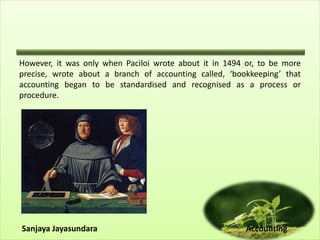
However, it was only when Paciloi wrote about it in 1494 or, to be more
precise, wrote about a branch of accounting called, ‘bookkeeping’ that
accounting began to be standardised and recognised as a process or
procedure.
Sanjaya Jayasundara Accounting
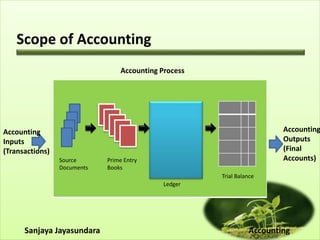
Scope of Accounting
Accounting Process
Accounting
Inputs
(Transactions)
Accounting
Outputs
(Final
Accounts)Source
Documents
Prime Entry
Books
Ledger
Trial Balance
Sanjaya Jayasundara Accounting
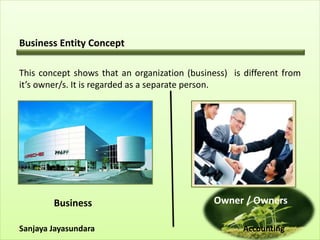
Business Entity Concept
This concept shows that an organization (business) is different from
it’s owner/s. It is regarded as a separate person.
Sanjaya Jayasundara Accounting
Business Owner / Owners
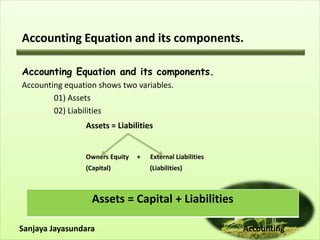
Accounting Equation and its components.
Accounting equation shows two variables.
01) Assets
02) Liabilities
Assets = Liabilities
Owners Equity + External Liabilities
(Capital) (Liabilities)
Sanjaya Jayasundara Accounting
Assets = Capital + Liabilities
Assets (Resources of a business )
All the things used for economic activities in a business are called economic
resources. (resources owned by a business.)
Ex:- Land, Building, Stocks, Cash
Capital
Total value of resources supplied by the owner/s of the business.
Liabilities
Total amount of assets supplied by other parties.
Ex:- Bank Loan, Creditors, Bank overdraft
Sanjaya Jayasundara Accounting
Components of Accounting Equation.
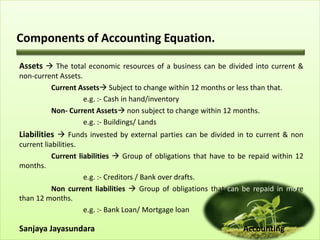
Assets  The total economic resources of a business can be divided into current &
non-current Assets.
Current Assets Subject to change within 12 months or less than that.
e.g. :- Cash in hand/inventory
Non- Current Assets non subject to change within 12 months.
e.g. :- Buildings/ Lands
Liabilities  Funds invested by external parties can be divided in to current & non
current liabilities.
Current liabilities  Group of obligations that have to be repaid within 12
months.
e.g. :- Creditors / Bank over drafts.
Non current liabilities  Group of obligations that can be repaid in more
than 12 months.
e.g. :- Bank Loan/ Mortgage loan
Sanjaya Jayasundara Accounting
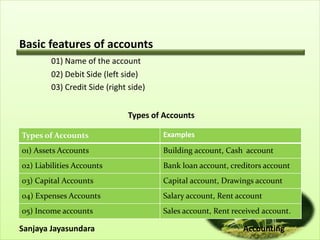
Basic features of accounts
01) Name of the account
02) Debit Side (left side)
03) Credit Side (right side)
Types of Accounts
Sanjaya Jayasundara Accounting
Types of Accounts Examples
01) Assets Accounts Building account, Cash account
02) Liabilities Accounts Bank loan account, creditors account
03) Capital Accounts Capital account, Drawings account
04) Expenses Accounts Salary account, Rent account
05) Income accounts Sales account, Rent received account.
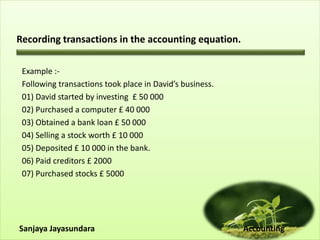
Recording transactions in the accounting equation.
Example :-
Following transactions took place in David’s business.
01) David started by investing £ 50 000
02) Purchased a computer £ 40 000
03) Obtained a bank loan £ 50 000
04) Selling a stock worth £ 10 000
05) Deposited £ 10 000 in the bank.
06) Paid creditors £ 2000
07) Purchased stocks £ 5000
Sanjaya Jayasundara Accounting
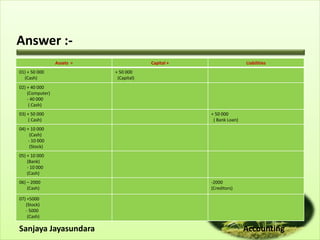
Answer :-
Sanjaya Jayasundara Accounting
Assets = Capital + Liabilities
01) + 50 000
(Cash)
+ 50 000
(Capital)
02) + 40 000
(Computer)
- 40 000
( Cash)
03) + 50 000
( Cash)
+ 50 000
( Bank Loan)
04) + 10 000
(Cash)
- 10 000
(Stock)
05) + 10 000
(Bank)
- 10 000
(Cash)
06) – 2000
(Cash)
-2000
(Creditors)
07) +5000
(Stock)
- 5000
(Cash)
Assets = Capital + Liabilities
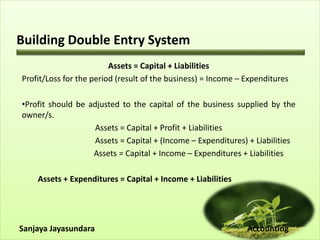
Profit/Loss for the period (result of the business) = Income – Expenditures
•Profit should be adjusted to the capital of the business supplied by the
owner/s.
Assets = Capital + Profit + Liabilities
Assets = Capital + (Income – Expenditures) + Liabilities
Assets = Capital + Income – Expenditures + Liabilities
Assets + Expenditures = Capital + Income + Liabilities
Sanjaya Jayasundara Accounting
Building Double Entry System
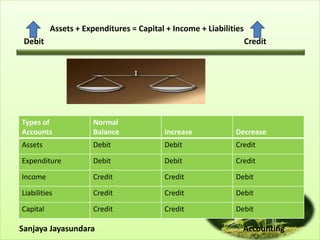
Assets + Expenditures = Capital + Income + Liabilities
Debit Credit
Sanjaya Jayasundara Accounting
Types of
Accounts
Normal
Balance Increase Decrease
Assets Debit Debit Credit
Expenditure Debit Debit Credit
Income Credit Credit Debit
Liabilities Credit Credit Debit
Capital Credit Credit Debit
I wish you an enjoyable learning…..!
Sanjaya Jayasundara
Talk, you teach. Listen, you learn.

Introduction to accounting

  • 1.
    Introduction to Accounting SanjayaJayasundara B.Sc.(Finance) Sp. University of Sri Jayewardenepura, Investment Advisor, International School Teacher 071 25 45 001
  • 2.
    Introduction to Accounting 01)Introduction 02) Resources of a business (Assets) 03) Capital, Liabilities 04) Accounting entity concept 05) Accounting equation and its components 06) Recording transaction in the accounting equation 07) Building Double Entry System Sanjaya Jayasundara Accounting
  • 3.
    Accounting can bedefined as a subject that tries to fulfill the information requirement of stakeholders of any business. Accounting has been called as the language of business. Current Accounting subject is a result of an evolution of thousands years. Basically accounting information is submitted through the financial reports of the business. Trading profit and loss account (Income Statement) and Balance Sheet are the basic financial statements of a business. Accounting is a practical phenomenon and provides the discipline for effective use of scarce resources around the business environment. Sanjaya Jayasundara Accounting Introduction
  • 4.
    Accounting is theprocess of identifying, measuring and communicating economic information to permit informed judgment and decisions by the users of the information. Accounting began because people needed to: * record business transactions, * know if they were being financially successful, and •know how much they owned and how much they owed. It is known to have existed in one form or another since at least 3,500 BC (records exist which indicate its use at that time in Mesopotamia). There is also considerable evidence of accounting being practiced in ancient times in Egypt, China, Greece, and Rome. Sanjaya Jayasundara Accounting
  • 5.
    However, it wasonly when Paciloi wrote about it in 1494 or, to be more precise, wrote about a branch of accounting called, ‘bookkeeping’ that accounting began to be standardised and recognised as a process or procedure. Sanjaya Jayasundara Accounting
  • 6.
    Scope of Accounting AccountingProcess Accounting Inputs (Transactions) Accounting Outputs (Final Accounts)Source Documents Prime Entry Books Ledger Trial Balance Sanjaya Jayasundara Accounting
  • 7.
    Business Entity Concept Thisconcept shows that an organization (business) is different from it’s owner/s. It is regarded as a separate person. Sanjaya Jayasundara Accounting Business Owner / Owners
  • 8.
    Accounting Equation andits components. Accounting Equation and its components. Accounting equation shows two variables. 01) Assets 02) Liabilities Assets = Liabilities Owners Equity + External Liabilities (Capital) (Liabilities) Sanjaya Jayasundara Accounting Assets = Capital + Liabilities
  • 9.
    Assets (Resources ofa business ) All the things used for economic activities in a business are called economic resources. (resources owned by a business.) Ex:- Land, Building, Stocks, Cash Capital Total value of resources supplied by the owner/s of the business. Liabilities Total amount of assets supplied by other parties. Ex:- Bank Loan, Creditors, Bank overdraft Sanjaya Jayasundara Accounting
  • 10.
    Components of AccountingEquation. Assets  The total economic resources of a business can be divided into current & non-current Assets. Current Assets Subject to change within 12 months or less than that. e.g. :- Cash in hand/inventory Non- Current Assets non subject to change within 12 months. e.g. :- Buildings/ Lands Liabilities  Funds invested by external parties can be divided in to current & non current liabilities. Current liabilities  Group of obligations that have to be repaid within 12 months. e.g. :- Creditors / Bank over drafts. Non current liabilities  Group of obligations that can be repaid in more than 12 months. e.g. :- Bank Loan/ Mortgage loan Sanjaya Jayasundara Accounting
  • 11.
    Basic features ofaccounts 01) Name of the account 02) Debit Side (left side) 03) Credit Side (right side) Types of Accounts Sanjaya Jayasundara Accounting Types of Accounts Examples 01) Assets Accounts Building account, Cash account 02) Liabilities Accounts Bank loan account, creditors account 03) Capital Accounts Capital account, Drawings account 04) Expenses Accounts Salary account, Rent account 05) Income accounts Sales account, Rent received account.
  • 12.
    Recording transactions inthe accounting equation. Example :- Following transactions took place in David’s business. 01) David started by investing £ 50 000 02) Purchased a computer £ 40 000 03) Obtained a bank loan £ 50 000 04) Selling a stock worth £ 10 000 05) Deposited £ 10 000 in the bank. 06) Paid creditors £ 2000 07) Purchased stocks £ 5000 Sanjaya Jayasundara Accounting
  • 13.
    Answer :- Sanjaya JayasundaraAccounting Assets = Capital + Liabilities 01) + 50 000 (Cash) + 50 000 (Capital) 02) + 40 000 (Computer) - 40 000 ( Cash) 03) + 50 000 ( Cash) + 50 000 ( Bank Loan) 04) + 10 000 (Cash) - 10 000 (Stock) 05) + 10 000 (Bank) - 10 000 (Cash) 06) – 2000 (Cash) -2000 (Creditors) 07) +5000 (Stock) - 5000 (Cash)
  • 14.
    Assets = Capital+ Liabilities Profit/Loss for the period (result of the business) = Income – Expenditures •Profit should be adjusted to the capital of the business supplied by the owner/s. Assets = Capital + Profit + Liabilities Assets = Capital + (Income – Expenditures) + Liabilities Assets = Capital + Income – Expenditures + Liabilities Assets + Expenditures = Capital + Income + Liabilities Sanjaya Jayasundara Accounting Building Double Entry System
  • 15.
    Assets + Expenditures= Capital + Income + Liabilities Debit Credit Sanjaya Jayasundara Accounting Types of Accounts Normal Balance Increase Decrease Assets Debit Debit Credit Expenditure Debit Debit Credit Income Credit Credit Debit Liabilities Credit Credit Debit Capital Credit Credit Debit
  • 16.
    I wish youan enjoyable learning…..! Sanjaya Jayasundara Talk, you teach. Listen, you learn.