1
Accounting with Sanjaya Sir
Business Purchase & Merger
Sanjaya Jayasundara
B.Sc.(Finance) Sp.
University of Sri Jayewardenepura,
Chartered Finalist,
Investment Advisor,
International School Teacher
2
Accounting with Sanjaya Sir
Business Purchase & Merger
Content
* Introduction.
* The difference between the purchase of a business by another and
the merger of two businesses.
* The merger of two sole traders to form a partnership.
* Goodwill arising on the purchase of a business.
* The purchase of a sole trader by a limited company.
* The preparation of a statement of financial position following the
purchase of a business.
* The purchase of a partnership by a limited company.
* How to calculate the return on an investment in a new business.
* Examples
* Past Paper Questions
* Model questions.
* Extra Readings
* Important Slides
* Summary
Syllabus according to Cambridge
1 Financial Accounting (A level) – Paper 03
1.2 Business purchase and merger
Candidates should understand the nature and purpose of the merger of different
types of businesses to form a new enterprise.
Candidates should be able to:
• make entries in the relevant ledger accounts to record the:
– merger of two or more sole traders’ businesses to form a partnership
– merger of a sole trader’s business with an existing partnership to form an
enlarged partnership
– acquisition of a sole trader’s business or partnership by a limited company
• prepare income statements and statements of financial position for the newly
formed business following the merger, for example the limited company acquiring the
partnership
• evaluate and discuss the advantages and disadvantages of the proposed merger.
3
Accounting with Sanjaya Sir
Business Purchase & Merger
Introduction.
When the owners (or directors in the case of a limited company) decide that they wish to
purchase another business they will appraise the financial benefits to be gained through the
acquisition.
Financial benefits may take the form of increased profitability of the ‘new’ enlarged business
due to:
……………………………………………………………………………………………………………………………………………………………
……………………………………………………………………………………………………………………………………………………………
……………………………………………………………………………………………………………………………………………………………
……………………………………………………………………………………………………………………………………………………………
……………………………………………………………………………………………………………………………………………………………
……………………………………………………………………………………………………………………………………………………………
……………………………………………………………………………………………………………………………………………………………
Other benefits may also be gained:
 An increase in market share may lead to disadvantages of a rival(s).
 The new company will be able to take advantage of internal economies of scale; these
could include:
* Technical economies – larger businesses can often be more efficient since
costs are generally not proportionate to the increase in size.
* managerial economies - larger businesses can generally afford specialist
managers who concentrate on one or two major areas of expertise.
* financial economies – larger businesses are generally able to raise finance
more easily and they tend to have a greater variety of potential sources from which to
choose.
* purchasing economies – larger businesses are more likely o purchase
materials in larger quantities and therefore take advantage of bulk discounting.
 Research and development can be undertaken more effectively by a larger business.
 Diversification is easier in a larger business; a more diverse portfolio of products will
open up further markets and reduce the risks associated with a limited range of
products.
You will need to be able to show the effects of the business purchase on the statement of financial
position for the ‘new’ business.
Test your understanding:
Q1 Explain the term ‘synergy’.
Q2 Explain the difference between vertical and horizontal integration.
Q3 Explain why a business might wish to acquire another business.
Q4 Identify and explain two types of economies of scale.
Q5 A manufacturer of television sets starts production of microwave cookers. This is an example of
diversification. True/False?
This topic will look at two aspects of business growth. The first is the merger of two existing businesses
to form a single, larger business. The second the purchase of an existing business by another
business(acquisition). This will result in the closure of the business being purchased and the
expansion of the business which buys it.
Merger:………………………………………………………………………………………………………………………………………………
……………………………………………………………………………………………………………………………………………………………
4
Accounting with Sanjaya Sir
Business Purchase & Merger
There are three possible situations you could be faced with:
 The merger of two sole traders to form a partnership.
 The purchase of a sole trader by a limited company.
 The purchase of a partnership by a limited company.
The merger of two sole traders to form a partnership.
After the two (or more) owners of sole traders have agreed on values for the assets and
liabilities that are to form the new partnership, the two statements of financial position are
combined. It may be necessary for the partners to make payments or withdrawals of capital to
achieve the required capital accounts balances that have been agreed.
Example 01: Amal and Bimal agree to merge their two businesses into a partnership from 1
January 2019. The following are statements of financial position at 31 December 2018.
Amal Bimal
Assets $ $ $ $
Non-Current Assets 40 000 70 000
Current Assets
Inventory 5 000 15 000
Trade Receivables 3 500 9 000
Cash and cash equivalent 1 000 9 500 4 000 28 000
Total Assets 49 500 98 000
Capital and liabilities
Capital accounts 47 000 91 000
Current liabilities
Trade Payables 2 500 7 000
Total capital and liabilities 49 500 98 000
The following values have been agreed for assets to be taken over by the partnership:
Amal Bimal
$ $
Non-current assets 50 000 60 000
Inventories 4 000 14 000
Trade Receivables 3 000 9 000
The partnership would assume responsibility for the current liabilities of both businesses. Each
partner would start with capital of $60 000. Bankers have agreed to provide any necessary
overdraft facilities.
Required:
a) Prepare the opening statement of financial position for the partnership at January
2019.
b) Prepare the capital accounts of Amal and Bimal to close their existing businesses.
c) Prepare the bank account of the partnership.
5
Accounting with Sanjaya Sir
Business Purchase & Merger
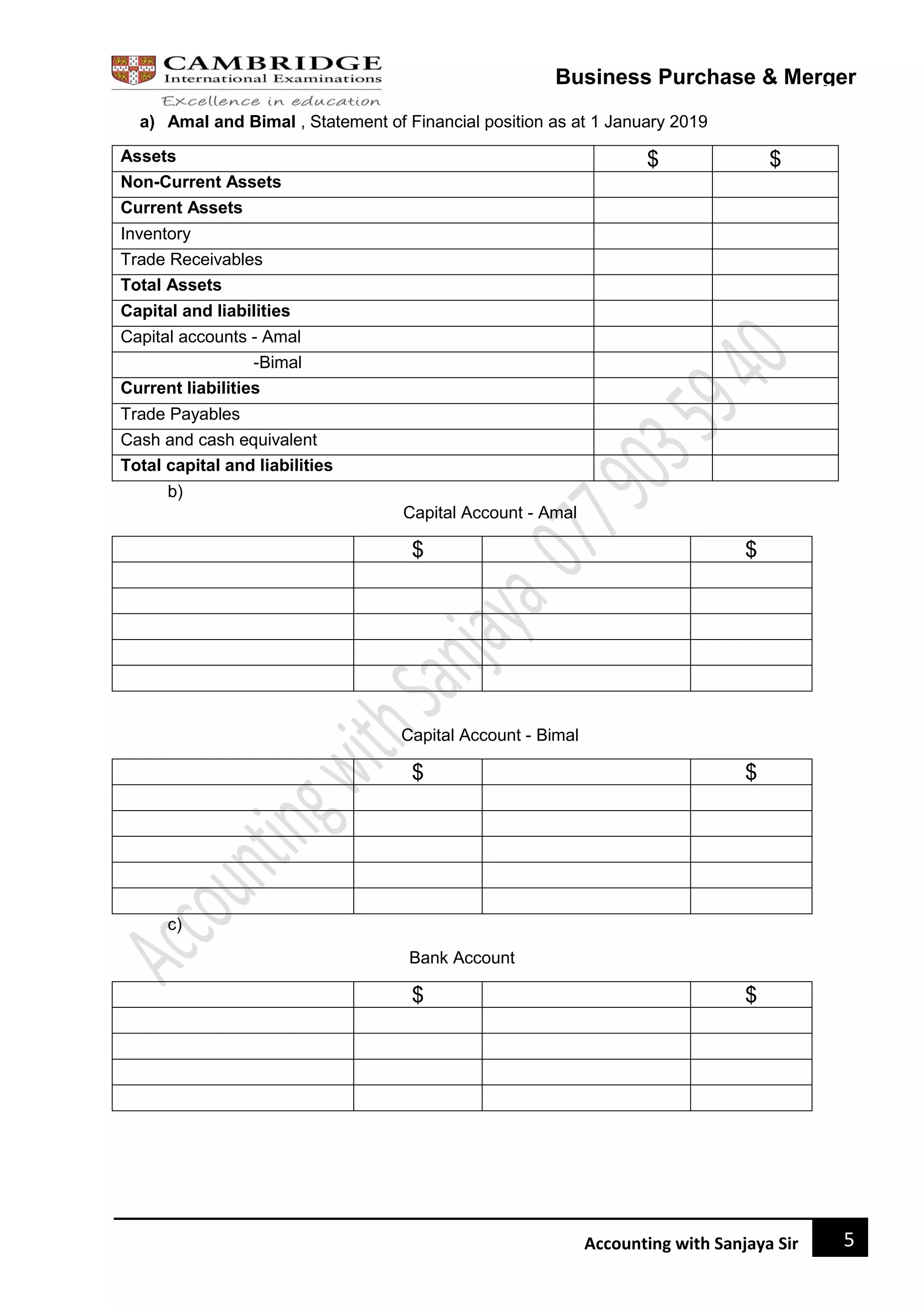
a) Amal and Bimal , Statement of Financial position as at 1 January 2019
Assets $ $
Non-Current Assets
Current Assets
Inventory
Trade Receivables
Total Assets
Capital and liabilities
Capital accounts - Amal
-Bimal
Current liabilities
Trade Payables
Cash and cash equivalent
Total capital and liabilities
b)
Capital Account - Amal
$ $
Capital Account - Bimal
$ $
c)
Bank Account
$ $
6
Accounting with Sanjaya Sir
Business Purchase & Merger
Past Paper Questions
The merger of two sole traders to form a partnership.
May/June 2018 – Variant 32
7
Accounting with Sanjaya Sir
Business Purchase & Merger
October/November 2017 – Variant 31
8
Accounting with Sanjaya Sir
Business Purchase & Merger
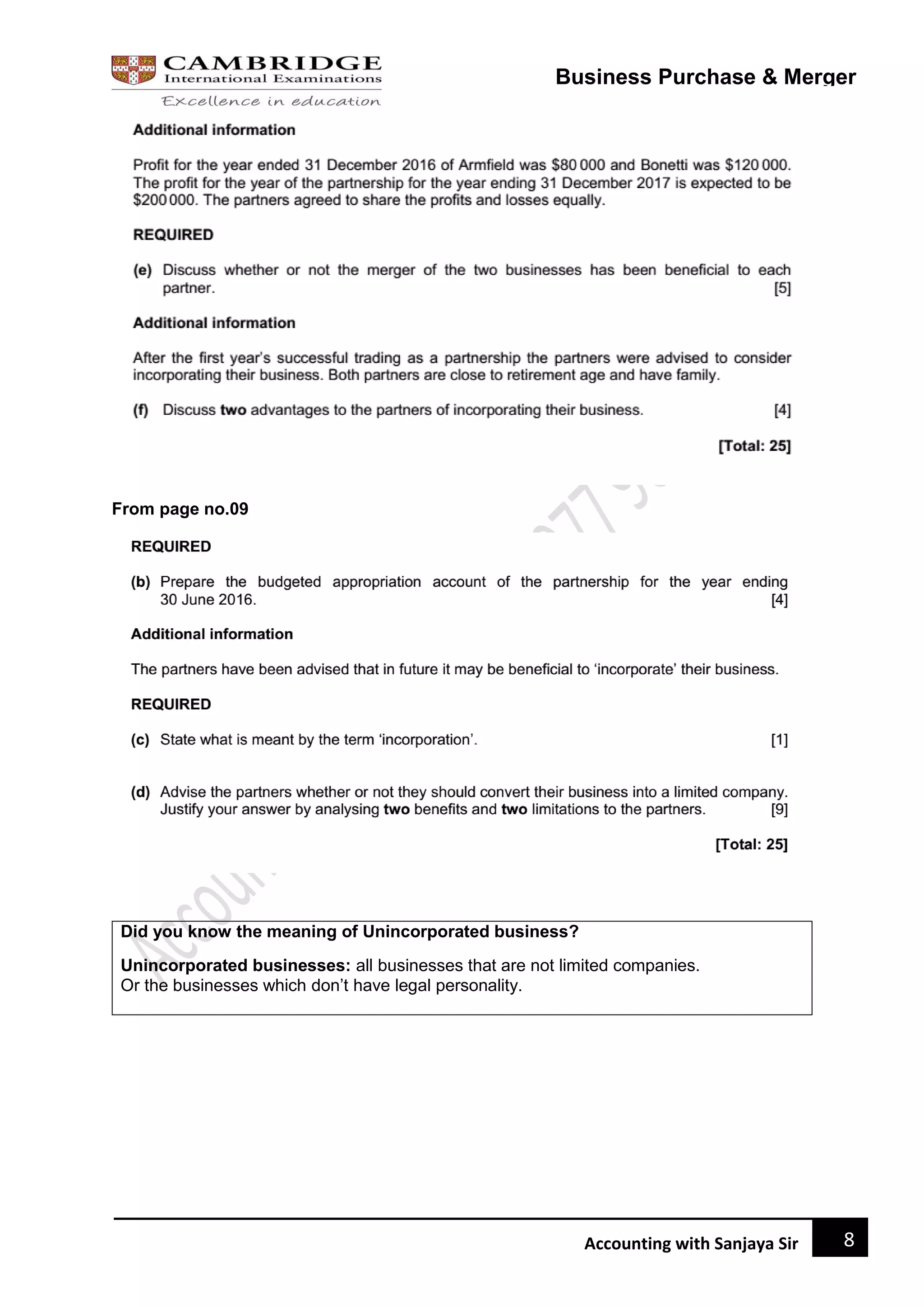
From page no.09
Did you know the meaning of Unincorporated business?
Unincorporated businesses: all businesses that are not limited companies.
Or the businesses which don’t have legal personality.
9
Accounting with Sanjaya Sir
Business Purchase & Merger
February/March 2016 – Variant 32
Please go to page no 08 for other required parts….
10
Accounting with Sanjaya Sir
Business Purchase & Merger
The purchase of a sole trader by a limited company.
When a successful business is sold, the vendor generally sets the selling price at a level
greater than the value of the net assets being sold. The cash paid by the purchaser to acquire
the goodwill is paid in order to gain access to future profits generated by the business taken
over. These principles apply to any business purchasing net assets at a price greater than the
value of these assets.
If the amount paid for a business is less than the value of its net assets, the results is negative
goodwill. This is shown as a negative figure under the heading ‘Intangible non-current assets’.
Goodwill
……………………………………………………………………………………………………………………………………………………………
……………………………………………………………………………………………………………………………………………………………
……………………………………………………………………………………………………………………………………………………………
Purchase consideration
……………………………………………………………………………………………………………………………………………………………
……………………………………………………………………………………………………………………………………………………………
……………………………………………………………………………………………………………………………………………………………
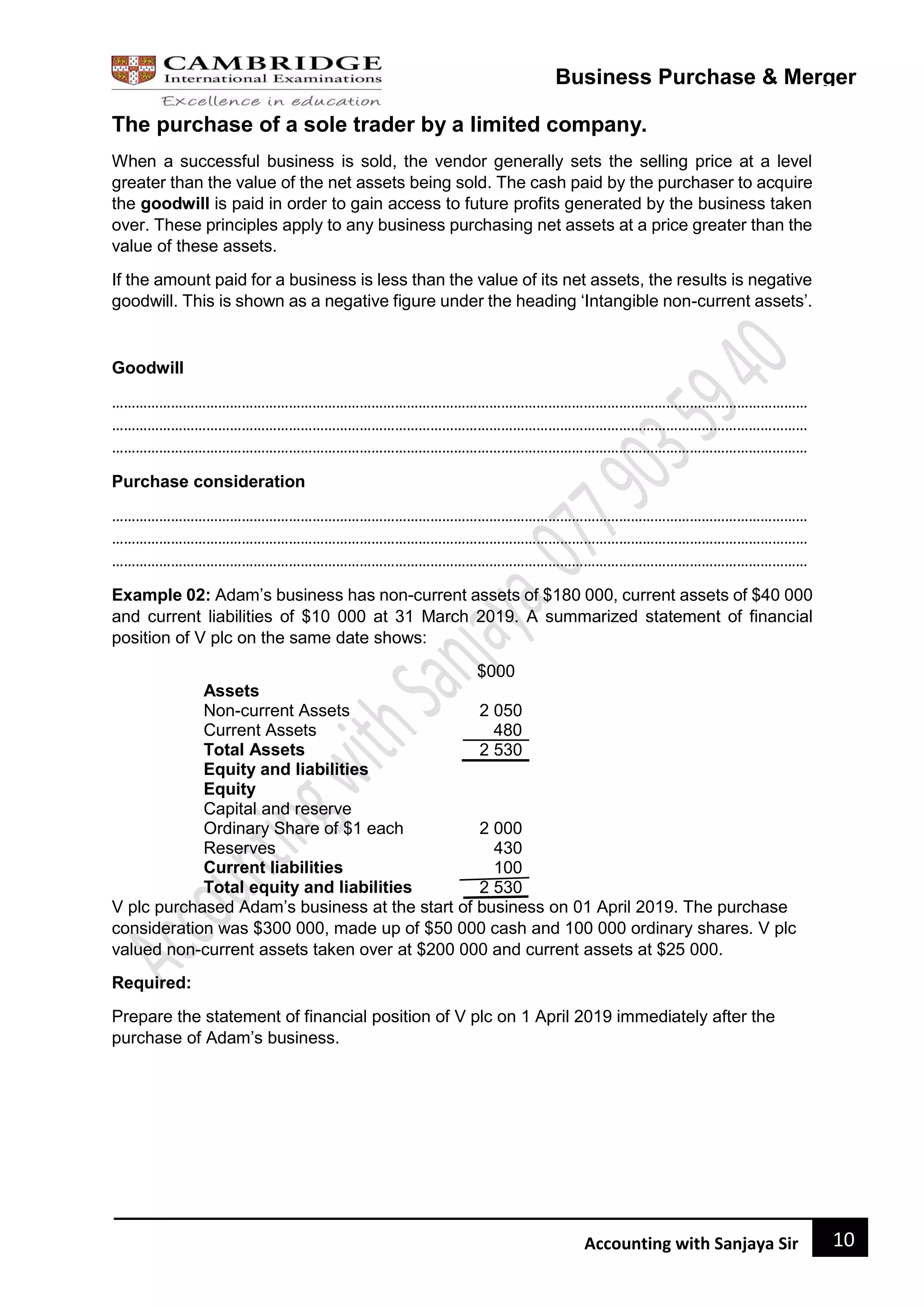
Example 02: Adam’s business has non-current assets of $180 000, current assets of $40 000
and current liabilities of $10 000 at 31 March 2019. A summarized statement of financial
position of V plc on the same date shows:
$000
Assets
Non-current Assets 2 050
Current Assets 480
Total Assets 2 530
Equity and liabilities
Equity
Capital and reserve
Ordinary Share of $1 each 2 000
Reserves 430
Current liabilities 100
Total equity and liabilities 2 530
V plc purchased Adam’s business at the start of business on 01 April 2019. The purchase
consideration was $300 000, made up of $50 000 cash and 100 000 ordinary shares. V plc
valued non-current assets taken over at $200 000 and current assets at $25 000.
Required:
Prepare the statement of financial position of V plc on 1 April 2019 immediately after the
purchase of Adam’s business.
11
Accounting with Sanjaya Sir
Business Purchase & Merger
$000 workings
Assets
Non-current Assets
Goodwill
Current Assets
Total Assets
Equity and liabilities
Equity
Capital and reserve
Ordinary Share of $1 each
Share Premium
Other Reserves
Current liabilities
Total equity and liabilities
Test your understanding
Q1. Explain why two sole trades might combine their businesses and form a partnership.
12
Accounting with Sanjaya Sir
Business Purchase & Merger
Past Paper Questions
The purchase of a sole trader by a limited company.
February/March 2018 – Variant 32
13
Accounting with Sanjaya Sir
Business Purchase & Merger
14
Accounting with Sanjaya Sir
Business Purchase & Merger
October/November 2016 – Variant 32
15
Accounting with Sanjaya Sir
Business Purchase & Merger
The purchase of a partnership by a limited company.
When a limited company purchases a partnership, the process is similar to when a sole
trader’s business is purchased. Technical difficulties could be encountered when apportioning
shares and debentures between partners. The proportions of each security to be allocated to
each partner will be given in the question.
Example 03: Maali and Murali are in partnership, sharing profits and losses in the ratio of 3:1
respectively. Their statement of financial position at 31 January 2019 showed the following:
$
Assets
Non-current assets
Premises 210 000
Office equipment 30 000
Vehicles 50 000
Current assets
Inventory 16 000
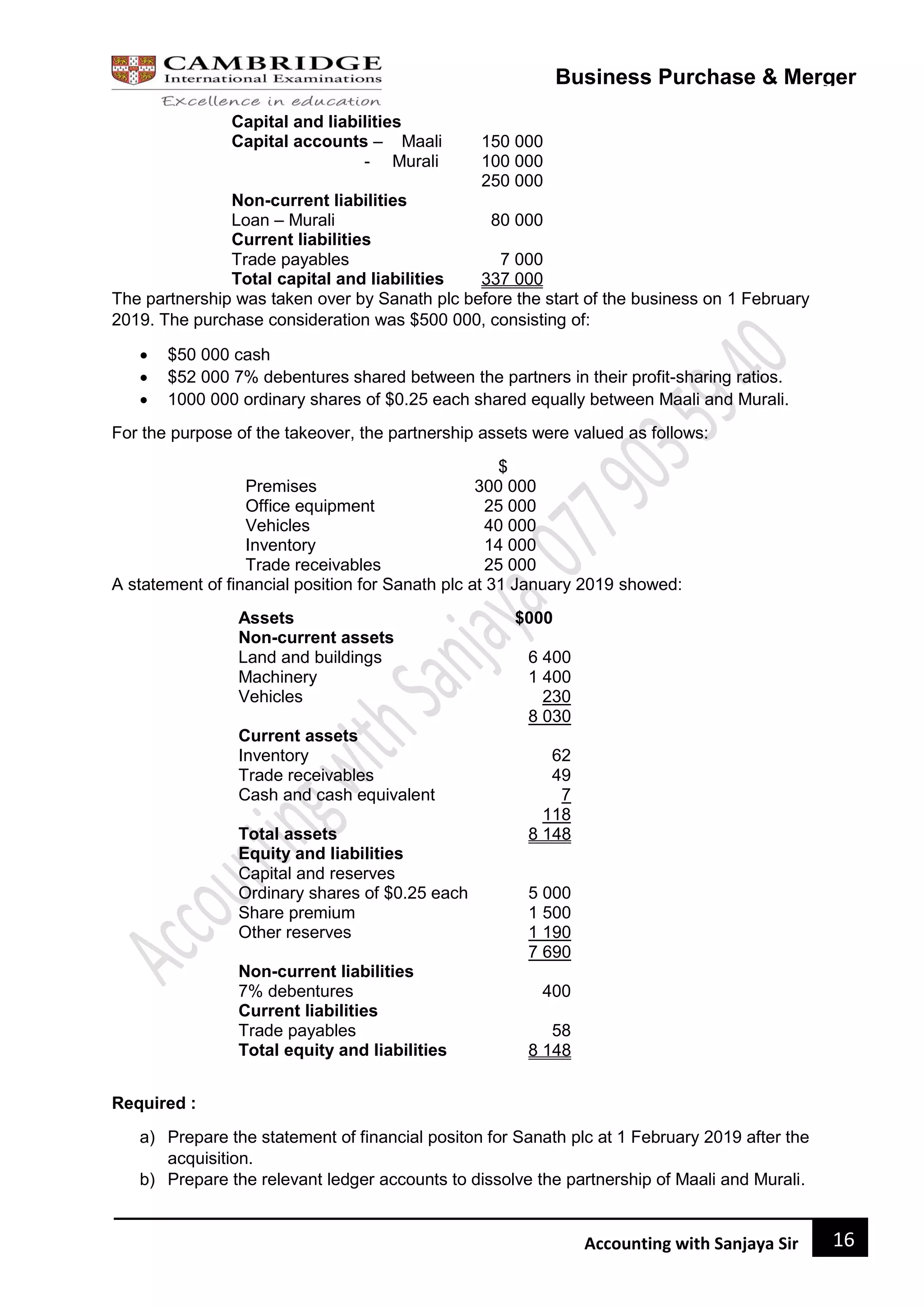
Trade receivables 26 000
Bank balance 5 000
Total assets 337 000
16
Accounting with Sanjaya Sir
Business Purchase & Merger
Capital and liabilities
Capital accounts – Maali 150 000
- Murali 100 000
250 000
Non-current liabilities
Loan – Murali 80 000
Current liabilities
Trade payables 7 000
Total capital and liabilities 337 000
The partnership was taken over by Sanath plc before the start of the business on 1 February
2019. The purchase consideration was $500 000, consisting of:
 $50 000 cash
 $52 000 7% debentures shared between the partners in their profit-sharing ratios.
 1000 000 ordinary shares of $0.25 each shared equally between Maali and Murali.
For the purpose of the takeover, the partnership assets were valued as follows:
$
Premises 300 000
Office equipment 25 000
Vehicles 40 000
Inventory 14 000
Trade receivables 25 000
A statement of financial position for Sanath plc at 31 January 2019 showed:
Assets $000
Non-current assets
Land and buildings 6 400
Machinery 1 400
Vehicles 230
8 030
Current assets
Inventory 62
Trade receivables 49
Cash and cash equivalent 7
118
Total assets 8 148
Equity and liabilities
Capital and reserves
Ordinary shares of $0.25 each 5 000
Share premium 1 500
Other reserves 1 190
7 690
Non-current liabilities
7% debentures 400
Current liabilities
Trade payables 58
Total equity and liabilities 8 148
Required :
a) Prepare the statement of financial positon for Sanath plc at 1 February 2019 after the
acquisition.
b) Prepare the relevant ledger accounts to dissolve the partnership of Maali and Murali.
17
Accounting with Sanjaya Sir
Business Purchase & Merger
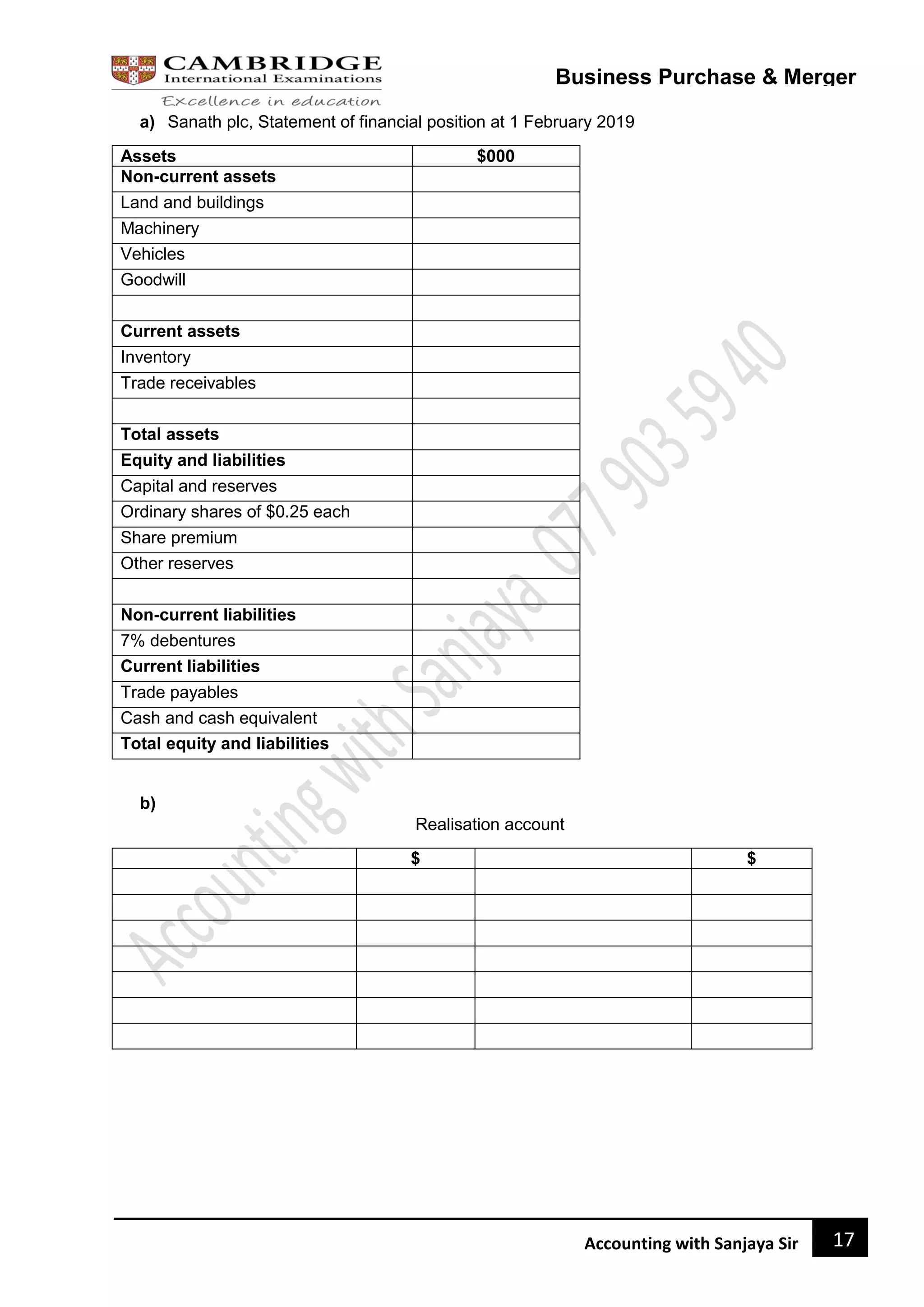
a) Sanath plc, Statement of financial position at 1 February 2019
Assets $000
Non-current assets
Land and buildings
Machinery
Vehicles
Goodwill
Current assets
Inventory
Trade receivables
Total assets
Equity and liabilities
Capital and reserves
Ordinary shares of $0.25 each
Share premium
Other reserves
Non-current liabilities
7% debentures
Current liabilities
Trade payables
Cash and cash equivalent
Total equity and liabilities
b)
Realisation account
$ $
18
Accounting with Sanjaya Sir
Business Purchase & Merger
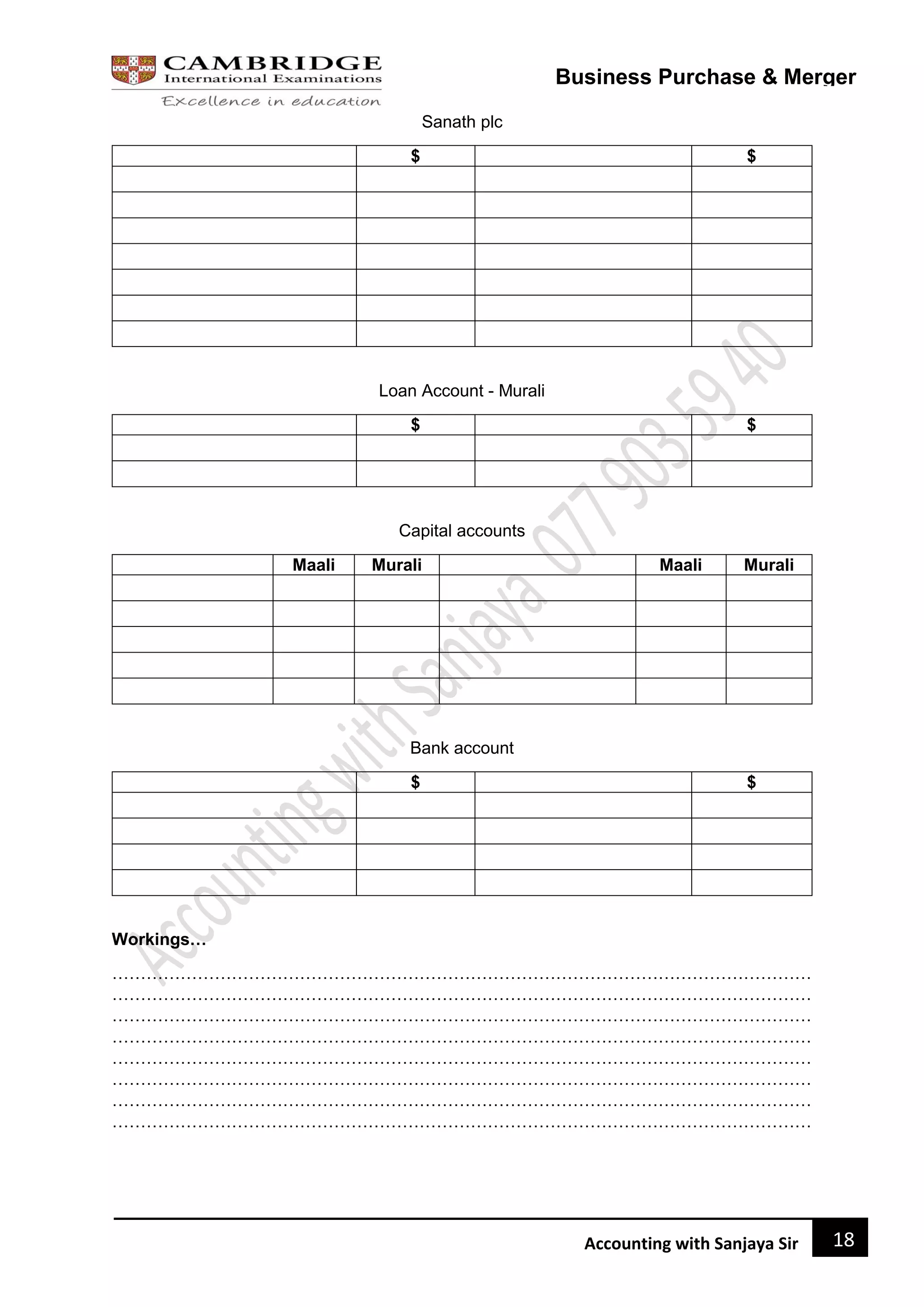
Sanath plc
$ $
Loan Account - Murali
$ $
Capital accounts
Maali Murali Maali Murali
Bank account
$ $
Workings…
……………………………………………………………………………………………………………
……………………………………………………………………………………………………………
……………………………………………………………………………………………………………
……………………………………………………………………………………………………………
……………………………………………………………………………………………………………
……………………………………………………………………………………………………………
……………………………………………………………………………………………………………
……………………………………………………………………………………………………………
19
Accounting with Sanjaya Sir
Business Purchase & Merger
Past Paper Questions
The purchase of a partnership by a limited company.
Specimen paper 2016/18
20
Accounting with Sanjaya Sir
Business Purchase & Merger
October/November 2018 – Variant 31
21
Accounting with Sanjaya Sir
Business Purchase & Merger
22
Accounting with Sanjaya Sir
Business Purchase & Merger
October/November 2017 – Variant 33
23
Accounting with Sanjaya Sir
Business Purchase & Merger
24
Accounting with Sanjaya Sir
Business Purchase & Merger
May/June 2017 – Variant 32
25
Accounting with Sanjaya Sir
Business Purchase & Merger
26
Accounting with Sanjaya Sir
Business Purchase & Merger
May/June 2016 – Variant 32
27
Accounting with Sanjaya Sir
Business Purchase & Merger
5 of the Best Mergers & Acquisitions of 2017
1. Amazon Buys Whole Foods
2. Intel Acquires Mobileye
3. United Technologies Buys Rockwell Collins
4. Disney To Buy Some of 21 st
Century Fox's Assets
5. JAB Holdings Acquires Panera
1. Amazon Buys Whole Foods
Earlier this summer, e-commerce giant Amazon AMZN announced that it would be buying high-
end organic grocery chain Whole Foods for $13.7 billion; the deal officially closed at the end of
August. While the acquisition has been off to a rocky start, it gives Amazon hundreds of physical
stores and provides the company a strong entryway into the competitive grocery and food
industry.
28
Accounting with Sanjaya Sir
Business Purchase & Merger
Summary
 Owners generally wish to combine businesses to gain greater financial
benefits.
 Sole traders may combine their businesses to achieve this.
 When a limited company acquires another business the purchase
consideration may be made up of cash, debentures or shares, or any
combination of the three.
 Sole traders or partnerships may combine to achieve a greater return on
investment.
 Unincorporated businesses may be purchased by a limited company for the
same reason.

All the best children…!
I wish you an enjoyable learning session...!
Sanjaya Jayasundara
Contact for online classes
+94 77 903 59 40 Sanjaya_Jayasundara

Cambridge A Level Business Purchase and Merger

  • 1.
    1 Accounting with SanjayaSir Business Purchase & Merger Business Purchase & Merger Sanjaya Jayasundara B.Sc.(Finance) Sp. University of Sri Jayewardenepura, Chartered Finalist, Investment Advisor, International School Teacher
  • 2.
    2 Accounting with SanjayaSir Business Purchase & Merger Content * Introduction. * The difference between the purchase of a business by another and the merger of two businesses. * The merger of two sole traders to form a partnership. * Goodwill arising on the purchase of a business. * The purchase of a sole trader by a limited company. * The preparation of a statement of financial position following the purchase of a business. * The purchase of a partnership by a limited company. * How to calculate the return on an investment in a new business. * Examples * Past Paper Questions * Model questions. * Extra Readings * Important Slides * Summary Syllabus according to Cambridge 1 Financial Accounting (A level) – Paper 03 1.2 Business purchase and merger Candidates should understand the nature and purpose of the merger of different types of businesses to form a new enterprise. Candidates should be able to: • make entries in the relevant ledger accounts to record the: – merger of two or more sole traders’ businesses to form a partnership – merger of a sole trader’s business with an existing partnership to form an enlarged partnership – acquisition of a sole trader’s business or partnership by a limited company • prepare income statements and statements of financial position for the newly formed business following the merger, for example the limited company acquiring the partnership • evaluate and discuss the advantages and disadvantages of the proposed merger.
  • 3.
    3 Accounting with SanjayaSir Business Purchase & Merger Introduction. When the owners (or directors in the case of a limited company) decide that they wish to purchase another business they will appraise the financial benefits to be gained through the acquisition. Financial benefits may take the form of increased profitability of the ‘new’ enlarged business due to: …………………………………………………………………………………………………………………………………………………………… …………………………………………………………………………………………………………………………………………………………… …………………………………………………………………………………………………………………………………………………………… …………………………………………………………………………………………………………………………………………………………… …………………………………………………………………………………………………………………………………………………………… …………………………………………………………………………………………………………………………………………………………… …………………………………………………………………………………………………………………………………………………………… Other benefits may also be gained:  An increase in market share may lead to disadvantages of a rival(s).  The new company will be able to take advantage of internal economies of scale; these could include: * Technical economies – larger businesses can often be more efficient since costs are generally not proportionate to the increase in size. * managerial economies - larger businesses can generally afford specialist managers who concentrate on one or two major areas of expertise. * financial economies – larger businesses are generally able to raise finance more easily and they tend to have a greater variety of potential sources from which to choose. * purchasing economies – larger businesses are more likely o purchase materials in larger quantities and therefore take advantage of bulk discounting.  Research and development can be undertaken more effectively by a larger business.  Diversification is easier in a larger business; a more diverse portfolio of products will open up further markets and reduce the risks associated with a limited range of products. You will need to be able to show the effects of the business purchase on the statement of financial position for the ‘new’ business. Test your understanding: Q1 Explain the term ‘synergy’. Q2 Explain the difference between vertical and horizontal integration. Q3 Explain why a business might wish to acquire another business. Q4 Identify and explain two types of economies of scale. Q5 A manufacturer of television sets starts production of microwave cookers. This is an example of diversification. True/False? This topic will look at two aspects of business growth. The first is the merger of two existing businesses to form a single, larger business. The second the purchase of an existing business by another business(acquisition). This will result in the closure of the business being purchased and the expansion of the business which buys it. Merger:……………………………………………………………………………………………………………………………………………… ……………………………………………………………………………………………………………………………………………………………
  • 4.
    4 Accounting with SanjayaSir Business Purchase & Merger There are three possible situations you could be faced with:  The merger of two sole traders to form a partnership.  The purchase of a sole trader by a limited company.  The purchase of a partnership by a limited company. The merger of two sole traders to form a partnership. After the two (or more) owners of sole traders have agreed on values for the assets and liabilities that are to form the new partnership, the two statements of financial position are combined. It may be necessary for the partners to make payments or withdrawals of capital to achieve the required capital accounts balances that have been agreed. Example 01: Amal and Bimal agree to merge their two businesses into a partnership from 1 January 2019. The following are statements of financial position at 31 December 2018. Amal Bimal Assets $ $ $ $ Non-Current Assets 40 000 70 000 Current Assets Inventory 5 000 15 000 Trade Receivables 3 500 9 000 Cash and cash equivalent 1 000 9 500 4 000 28 000 Total Assets 49 500 98 000 Capital and liabilities Capital accounts 47 000 91 000 Current liabilities Trade Payables 2 500 7 000 Total capital and liabilities 49 500 98 000 The following values have been agreed for assets to be taken over by the partnership: Amal Bimal $ $ Non-current assets 50 000 60 000 Inventories 4 000 14 000 Trade Receivables 3 000 9 000 The partnership would assume responsibility for the current liabilities of both businesses. Each partner would start with capital of $60 000. Bankers have agreed to provide any necessary overdraft facilities. Required: a) Prepare the opening statement of financial position for the partnership at January 2019. b) Prepare the capital accounts of Amal and Bimal to close their existing businesses. c) Prepare the bank account of the partnership.
  • 5.
    5 Accounting with SanjayaSir Business Purchase & Merger a) Amal and Bimal , Statement of Financial position as at 1 January 2019 Assets $ $ Non-Current Assets Current Assets Inventory Trade Receivables Total Assets Capital and liabilities Capital accounts - Amal -Bimal Current liabilities Trade Payables Cash and cash equivalent Total capital and liabilities b) Capital Account - Amal $ $ Capital Account - Bimal $ $ c) Bank Account $ $
  • 6.
    6 Accounting with SanjayaSir Business Purchase & Merger Past Paper Questions The merger of two sole traders to form a partnership. May/June 2018 – Variant 32
  • 7.
    7 Accounting with SanjayaSir Business Purchase & Merger October/November 2017 – Variant 31
  • 8.
    8 Accounting with SanjayaSir Business Purchase & Merger From page no.09 Did you know the meaning of Unincorporated business? Unincorporated businesses: all businesses that are not limited companies. Or the businesses which don’t have legal personality.
  • 9.
    9 Accounting with SanjayaSir Business Purchase & Merger February/March 2016 – Variant 32 Please go to page no 08 for other required parts….
  • 10.
    10 Accounting with SanjayaSir Business Purchase & Merger The purchase of a sole trader by a limited company. When a successful business is sold, the vendor generally sets the selling price at a level greater than the value of the net assets being sold. The cash paid by the purchaser to acquire the goodwill is paid in order to gain access to future profits generated by the business taken over. These principles apply to any business purchasing net assets at a price greater than the value of these assets. If the amount paid for a business is less than the value of its net assets, the results is negative goodwill. This is shown as a negative figure under the heading ‘Intangible non-current assets’. Goodwill …………………………………………………………………………………………………………………………………………………………… …………………………………………………………………………………………………………………………………………………………… …………………………………………………………………………………………………………………………………………………………… Purchase consideration …………………………………………………………………………………………………………………………………………………………… …………………………………………………………………………………………………………………………………………………………… …………………………………………………………………………………………………………………………………………………………… Example 02: Adam’s business has non-current assets of $180 000, current assets of $40 000 and current liabilities of $10 000 at 31 March 2019. A summarized statement of financial position of V plc on the same date shows: $000 Assets Non-current Assets 2 050 Current Assets 480 Total Assets 2 530 Equity and liabilities Equity Capital and reserve Ordinary Share of $1 each 2 000 Reserves 430 Current liabilities 100 Total equity and liabilities 2 530 V plc purchased Adam’s business at the start of business on 01 April 2019. The purchase consideration was $300 000, made up of $50 000 cash and 100 000 ordinary shares. V plc valued non-current assets taken over at $200 000 and current assets at $25 000. Required: Prepare the statement of financial position of V plc on 1 April 2019 immediately after the purchase of Adam’s business.
  • 11.
    11 Accounting with SanjayaSir Business Purchase & Merger $000 workings Assets Non-current Assets Goodwill Current Assets Total Assets Equity and liabilities Equity Capital and reserve Ordinary Share of $1 each Share Premium Other Reserves Current liabilities Total equity and liabilities Test your understanding Q1. Explain why two sole trades might combine their businesses and form a partnership.
  • 12.
    12 Accounting with SanjayaSir Business Purchase & Merger Past Paper Questions The purchase of a sole trader by a limited company. February/March 2018 – Variant 32
  • 13.
    13 Accounting with SanjayaSir Business Purchase & Merger
  • 14.
    14 Accounting with SanjayaSir Business Purchase & Merger October/November 2016 – Variant 32
  • 15.
    15 Accounting with SanjayaSir Business Purchase & Merger The purchase of a partnership by a limited company. When a limited company purchases a partnership, the process is similar to when a sole trader’s business is purchased. Technical difficulties could be encountered when apportioning shares and debentures between partners. The proportions of each security to be allocated to each partner will be given in the question. Example 03: Maali and Murali are in partnership, sharing profits and losses in the ratio of 3:1 respectively. Their statement of financial position at 31 January 2019 showed the following: $ Assets Non-current assets Premises 210 000 Office equipment 30 000 Vehicles 50 000 Current assets Inventory 16 000 Trade receivables 26 000 Bank balance 5 000 Total assets 337 000
  • 16.
    16 Accounting with SanjayaSir Business Purchase & Merger Capital and liabilities Capital accounts – Maali 150 000 - Murali 100 000 250 000 Non-current liabilities Loan – Murali 80 000 Current liabilities Trade payables 7 000 Total capital and liabilities 337 000 The partnership was taken over by Sanath plc before the start of the business on 1 February 2019. The purchase consideration was $500 000, consisting of:  $50 000 cash  $52 000 7% debentures shared between the partners in their profit-sharing ratios.  1000 000 ordinary shares of $0.25 each shared equally between Maali and Murali. For the purpose of the takeover, the partnership assets were valued as follows: $ Premises 300 000 Office equipment 25 000 Vehicles 40 000 Inventory 14 000 Trade receivables 25 000 A statement of financial position for Sanath plc at 31 January 2019 showed: Assets $000 Non-current assets Land and buildings 6 400 Machinery 1 400 Vehicles 230 8 030 Current assets Inventory 62 Trade receivables 49 Cash and cash equivalent 7 118 Total assets 8 148 Equity and liabilities Capital and reserves Ordinary shares of $0.25 each 5 000 Share premium 1 500 Other reserves 1 190 7 690 Non-current liabilities 7% debentures 400 Current liabilities Trade payables 58 Total equity and liabilities 8 148 Required : a) Prepare the statement of financial positon for Sanath plc at 1 February 2019 after the acquisition. b) Prepare the relevant ledger accounts to dissolve the partnership of Maali and Murali.
  • 17.
    17 Accounting with SanjayaSir Business Purchase & Merger a) Sanath plc, Statement of financial position at 1 February 2019 Assets $000 Non-current assets Land and buildings Machinery Vehicles Goodwill Current assets Inventory Trade receivables Total assets Equity and liabilities Capital and reserves Ordinary shares of $0.25 each Share premium Other reserves Non-current liabilities 7% debentures Current liabilities Trade payables Cash and cash equivalent Total equity and liabilities b) Realisation account $ $
  • 18.
    18 Accounting with SanjayaSir Business Purchase & Merger Sanath plc $ $ Loan Account - Murali $ $ Capital accounts Maali Murali Maali Murali Bank account $ $ Workings… …………………………………………………………………………………………………………… …………………………………………………………………………………………………………… …………………………………………………………………………………………………………… …………………………………………………………………………………………………………… …………………………………………………………………………………………………………… …………………………………………………………………………………………………………… …………………………………………………………………………………………………………… ……………………………………………………………………………………………………………
  • 19.
    19 Accounting with SanjayaSir Business Purchase & Merger Past Paper Questions The purchase of a partnership by a limited company. Specimen paper 2016/18
  • 20.
    20 Accounting with SanjayaSir Business Purchase & Merger October/November 2018 – Variant 31
  • 21.
    21 Accounting with SanjayaSir Business Purchase & Merger
  • 22.
    22 Accounting with SanjayaSir Business Purchase & Merger October/November 2017 – Variant 33
  • 23.
    23 Accounting with SanjayaSir Business Purchase & Merger
  • 24.
    24 Accounting with SanjayaSir Business Purchase & Merger May/June 2017 – Variant 32
  • 25.
    25 Accounting with SanjayaSir Business Purchase & Merger
  • 26.
    26 Accounting with SanjayaSir Business Purchase & Merger May/June 2016 – Variant 32
  • 27.
    27 Accounting with SanjayaSir Business Purchase & Merger 5 of the Best Mergers & Acquisitions of 2017 1. Amazon Buys Whole Foods 2. Intel Acquires Mobileye 3. United Technologies Buys Rockwell Collins 4. Disney To Buy Some of 21 st Century Fox's Assets 5. JAB Holdings Acquires Panera 1. Amazon Buys Whole Foods Earlier this summer, e-commerce giant Amazon AMZN announced that it would be buying high- end organic grocery chain Whole Foods for $13.7 billion; the deal officially closed at the end of August. While the acquisition has been off to a rocky start, it gives Amazon hundreds of physical stores and provides the company a strong entryway into the competitive grocery and food industry.
  • 28.
    28 Accounting with SanjayaSir Business Purchase & Merger Summary  Owners generally wish to combine businesses to gain greater financial benefits.  Sole traders may combine their businesses to achieve this.  When a limited company acquires another business the purchase consideration may be made up of cash, debentures or shares, or any combination of the three.  Sole traders or partnerships may combine to achieve a greater return on investment.  Unincorporated businesses may be purchased by a limited company for the same reason.  All the best children…! I wish you an enjoyable learning session...! Sanjaya Jayasundara Contact for online classes +94 77 903 59 40 Sanjaya_Jayasundara