Control Accounts
© Hodder Education 2008
A control account is so called because it
controls a section of the ledger.
By control it’s meant that the balance on the
control account should equal the total of the
balances in the section of the ledger it’s
controlling.
© Hodder Education 2008
Examples of control accounts
include:
The sales ledger control account, which
summarises the individual customer accounts,
i.e. debtors’ accounts.
The purchases ledger control account,
which summarises the individual suppliers’
accounts, i.e. creditors’ accounts.
© Hodder Education 2008
Where a business operates control accounts,
the control account forms part of the double-
entry system. The individual accounts, in the
sales or purchases ledger, then act as
subsidiary or memorandum accounts.
Control accounts are kept in the general
ledger, not in the ledger they are controlling.
© Hodder Education 2008
Localising errors Help locate errors, as the control
account balance should equal the total of balances from
schedule of debtors or creditors, therefore easier to locate.
Control accounts allow errors to be confined to relatively
small areas in the books and accounts.
Helps prevent fraud They provide an independent
check: control accounts are completed by a different
member of staff than the individual ledger accounts.
Purposes of control
accounts
© Hodder Education 2008
Calculating debtors’ and creditors’
totals The total amount owed by debtors and
owed to creditors, can be determined relatively
quickly if control accounts are used.
Provide totals for compiling final
accounts Control accounts can be used to
compile the profit and loss account and
balance sheet.
© Hodder Education 2008
Goods sold to: Smith £500, Jones £550, Walker £400
and Thomas £50.
Smith returned goods to the value of £50 and Jones £40.
Thomas’s debt was written off as a bad debt.
Smith and Walker made payments of £294 and £196
after being allowed a cash discount.
Follow the entries in the double-entry accounts on the
next slide.
Example of a sales
ledger control
account
© Hodder Education 2008
Sales Ledger General Ledger
Smith
SJ 500 SRJ 30
CB 294
DA 6
Jones
SJ 550 SRJ 40
Walker
SJ 400 CB 196
DA 4
Thomas
SJ 50 Bad Debt 50
Sales Journal
Smith 500
Jones 550
Walker 400
Thomas 50
1,500
Sales Ledger Control
SJ 1,500 SRJ 70
CB 490
DA 10
Bad D 50
___ _ Bal c/d 880
1,500 1,500
Sales Returns
SRJ 70
Sales
SJ 1,500
Sales Returns Journal
Smith 30
Jones 40
70
The Journal
Bad Debts 50
Thomas 50
Smith 6 294
Walker 4 196
10 490
Cash Book
© Hodder Education 2008
The balance from the individual accounts in
the sales ledger should equal the balance in
the sales ledger control account.
Schedule of debtors
£
Smith 170
Jones 510
Walker 200
Thomas 0
Total debtors 880
Balance on control
account
£
Balance b/d 880
© Hodder Education 2008
The purchases ledger
control account
The purchases ledger control account is
sometimes known as the creditors’ control
account. It is used to control the purchases
ledger, which controls the accounts of the
individual suppliers who supply goods on
credit.
© Hodder Education 2008
The information needed to prepare the
purchases ledger control account comes from
the books of prime entry. For example, the total
value of purchases comes from the purchases
journal.
© Hodder Education 2008
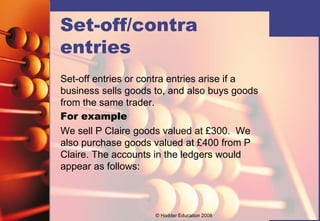
Set-off/contra
entries
Set-off entries or contra entries arise if a
business sells goods to, and also buys goods
from the same trader.
For example
We sell P Claire goods valued at £300. We
also purchase goods valued at £400 from P
Claire. The accounts in the ledgers would
appear as follows:
© Hodder Education 2008
Set-off/contra
entries
Sales ledger
P Claire
Sales 300 Set-off purchases 300
Purchases ledger
P Claire
Set-off sales 300 Purchases 400
Bank 100
400 400
© Hodder Education 2008
Sources of information:
sales ledger control
account
Opening debtors – List of debtors’ balances drawn
up at the end of the previous period
Credit sales – Total from the sales journal
Sales returns – Total from the sales returns journal
Cheques/cash received from debtors – Cash
book
Discounts allowed – Cash book
Bad debts – Journal
Closing debtors – List of debtors’ balances drawn up
at the end of the period
© Hodder Education 2008
Sources of information:
purchases ledger control
account
Opening creditors – List of creditors’ balances drawn up at
the end of the previous period.
Credit purchases – Total from purchases journal
Purchases returns – Total from purchases returns journal
Cheques/cash paid to creditors – Cash book
Discounts received – Cash book
Closing creditors – List of creditors’ balances drawn up at
the end of the period
© Hodder Education 2008
The opening balance on the sales ledger
control account is normally on the debit side.
It is possible for an individual credit customer
to end up with a credit balance.
Credit balance in
the sales ledger
© Hodder Education 2008
Credit balance in the
sales ledger
For example
Ruth sells £700 of goods to John on 2 April.
On 18 April John sends a cheque for £700 to
Ruth.
On 24 April John returns £250 of the goods to
Ruth as they are unsuitable.
© Hodder Education 2008
John’s account
£ £
Sales 700 Bank 700
Balance c/d 250 Sales returns 250
950 950
Balance b/d 250
We can see therefore that John now has a
credit balance on his account. When we draw
up the control account this is shown as a
separate balance b/d.
© Hodder Education 2008
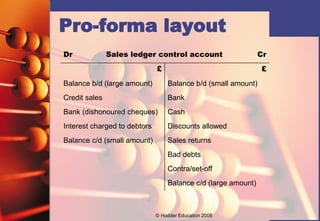
Pro-forma layout
Dr Sales ledger control account Cr
£ £
Balance b/d (large amount) Balance b/d (small amount)
Credit sales Bank
Bank (dishonoured cheques) Cash
Interest charged to debtors Discounts allowed
Balance c/d (small amount) Sales returns
Bad debts
Contra/set-off
Balance c/d (large amount)
© Hodder Education 2008
Pro-forma layout
Dr Purchases ledger control account Cr
£ £
Balance b/d (small amount) Balance b/d (large amount)
Bank Credit purchases
Cash Bank (returned cheques)
Discounts received Interest charged to creditors
Purchases returns Balance c/d (small amount)
Contra/set-off
Balance c/d (large amount)
© Hodder Education 2008
Tips
Don’t forget contra entries appear in both the
sales ledger control account and the
purchases ledger control account.
© Hodder Education 2008
Tasks
Complete task sheet and Questions 13-18,
Chapter 13 of text book.

Control accounts pptx

  • 1.
  • 2.
    © Hodder Education2008 A control account is so called because it controls a section of the ledger. By control it’s meant that the balance on the control account should equal the total of the balances in the section of the ledger it’s controlling.
  • 3.
    © Hodder Education2008 Examples of control accounts include: The sales ledger control account, which summarises the individual customer accounts, i.e. debtors’ accounts. The purchases ledger control account, which summarises the individual suppliers’ accounts, i.e. creditors’ accounts.
  • 4.
    © Hodder Education2008 Where a business operates control accounts, the control account forms part of the double- entry system. The individual accounts, in the sales or purchases ledger, then act as subsidiary or memorandum accounts. Control accounts are kept in the general ledger, not in the ledger they are controlling.
  • 5.
    © Hodder Education2008 Localising errors Help locate errors, as the control account balance should equal the total of balances from schedule of debtors or creditors, therefore easier to locate. Control accounts allow errors to be confined to relatively small areas in the books and accounts. Helps prevent fraud They provide an independent check: control accounts are completed by a different member of staff than the individual ledger accounts. Purposes of control accounts
  • 6.
    © Hodder Education2008 Calculating debtors’ and creditors’ totals The total amount owed by debtors and owed to creditors, can be determined relatively quickly if control accounts are used. Provide totals for compiling final accounts Control accounts can be used to compile the profit and loss account and balance sheet.
  • 7.
    © Hodder Education2008 Goods sold to: Smith £500, Jones £550, Walker £400 and Thomas £50. Smith returned goods to the value of £50 and Jones £40. Thomas’s debt was written off as a bad debt. Smith and Walker made payments of £294 and £196 after being allowed a cash discount. Follow the entries in the double-entry accounts on the next slide. Example of a sales ledger control account
  • 8.
    © Hodder Education2008 Sales Ledger General Ledger Smith SJ 500 SRJ 30 CB 294 DA 6 Jones SJ 550 SRJ 40 Walker SJ 400 CB 196 DA 4 Thomas SJ 50 Bad Debt 50 Sales Journal Smith 500 Jones 550 Walker 400 Thomas 50 1,500 Sales Ledger Control SJ 1,500 SRJ 70 CB 490 DA 10 Bad D 50 ___ _ Bal c/d 880 1,500 1,500 Sales Returns SRJ 70 Sales SJ 1,500 Sales Returns Journal Smith 30 Jones 40 70 The Journal Bad Debts 50 Thomas 50 Smith 6 294 Walker 4 196 10 490 Cash Book
  • 9.
    © Hodder Education2008 The balance from the individual accounts in the sales ledger should equal the balance in the sales ledger control account. Schedule of debtors £ Smith 170 Jones 510 Walker 200 Thomas 0 Total debtors 880 Balance on control account £ Balance b/d 880
  • 10.
    © Hodder Education2008 The purchases ledger control account The purchases ledger control account is sometimes known as the creditors’ control account. It is used to control the purchases ledger, which controls the accounts of the individual suppliers who supply goods on credit.
  • 11.
    © Hodder Education2008 The information needed to prepare the purchases ledger control account comes from the books of prime entry. For example, the total value of purchases comes from the purchases journal.
  • 12.
    © Hodder Education2008 Set-off/contra entries Set-off entries or contra entries arise if a business sells goods to, and also buys goods from the same trader. For example We sell P Claire goods valued at £300. We also purchase goods valued at £400 from P Claire. The accounts in the ledgers would appear as follows:
  • 13.
    © Hodder Education2008 Set-off/contra entries Sales ledger P Claire Sales 300 Set-off purchases 300 Purchases ledger P Claire Set-off sales 300 Purchases 400 Bank 100 400 400
  • 14.
    © Hodder Education2008 Sources of information: sales ledger control account Opening debtors – List of debtors’ balances drawn up at the end of the previous period Credit sales – Total from the sales journal Sales returns – Total from the sales returns journal Cheques/cash received from debtors – Cash book Discounts allowed – Cash book Bad debts – Journal Closing debtors – List of debtors’ balances drawn up at the end of the period
  • 15.
    © Hodder Education2008 Sources of information: purchases ledger control account Opening creditors – List of creditors’ balances drawn up at the end of the previous period. Credit purchases – Total from purchases journal Purchases returns – Total from purchases returns journal Cheques/cash paid to creditors – Cash book Discounts received – Cash book Closing creditors – List of creditors’ balances drawn up at the end of the period
  • 16.
    © Hodder Education2008 The opening balance on the sales ledger control account is normally on the debit side. It is possible for an individual credit customer to end up with a credit balance. Credit balance in the sales ledger
  • 17.
    © Hodder Education2008 Credit balance in the sales ledger For example Ruth sells £700 of goods to John on 2 April. On 18 April John sends a cheque for £700 to Ruth. On 24 April John returns £250 of the goods to Ruth as they are unsuitable.
  • 18.
    © Hodder Education2008 John’s account £ £ Sales 700 Bank 700 Balance c/d 250 Sales returns 250 950 950 Balance b/d 250 We can see therefore that John now has a credit balance on his account. When we draw up the control account this is shown as a separate balance b/d.
  • 19.
    © Hodder Education2008 Pro-forma layout Dr Sales ledger control account Cr £ £ Balance b/d (large amount) Balance b/d (small amount) Credit sales Bank Bank (dishonoured cheques) Cash Interest charged to debtors Discounts allowed Balance c/d (small amount) Sales returns Bad debts Contra/set-off Balance c/d (large amount)
  • 20.
    © Hodder Education2008 Pro-forma layout Dr Purchases ledger control account Cr £ £ Balance b/d (small amount) Balance b/d (large amount) Bank Credit purchases Cash Bank (returned cheques) Discounts received Interest charged to creditors Purchases returns Balance c/d (small amount) Contra/set-off Balance c/d (large amount)
  • 21.
    © Hodder Education2008 Tips Don’t forget contra entries appear in both the sales ledger control account and the purchases ledger control account.
  • 22.
    © Hodder Education2008 Tasks Complete task sheet and Questions 13-18, Chapter 13 of text book.