INTRODUCTION
TO ACCOUNTING
Submitted to:- Presented by:-
DR. SUNIL Ashish
punia
MBA – 1ST
YEAR
RECORDING OF ACCOUNTING TRANSACTIONS
INTRODUCTION
 The general Ledger contains all entries from both the general Journal and the special
 Using a double entry system to record the transactions keeps the accounts balance.
 The accounting requirement that each transaction be recorded by an entry that has equal
debits and credits is called double entry procedure.
ACCOUNTING TRANSACTIONS
 An accounting transaction is a business event having a monetary impact on the
financial statements of a business.
 It is recorded in the accounting records of the business.
 Examples of accounting transaction are as follows:-
1) Purchase fixed assets from supplier
2) sale on credit to the customer
3) in cash to a customer
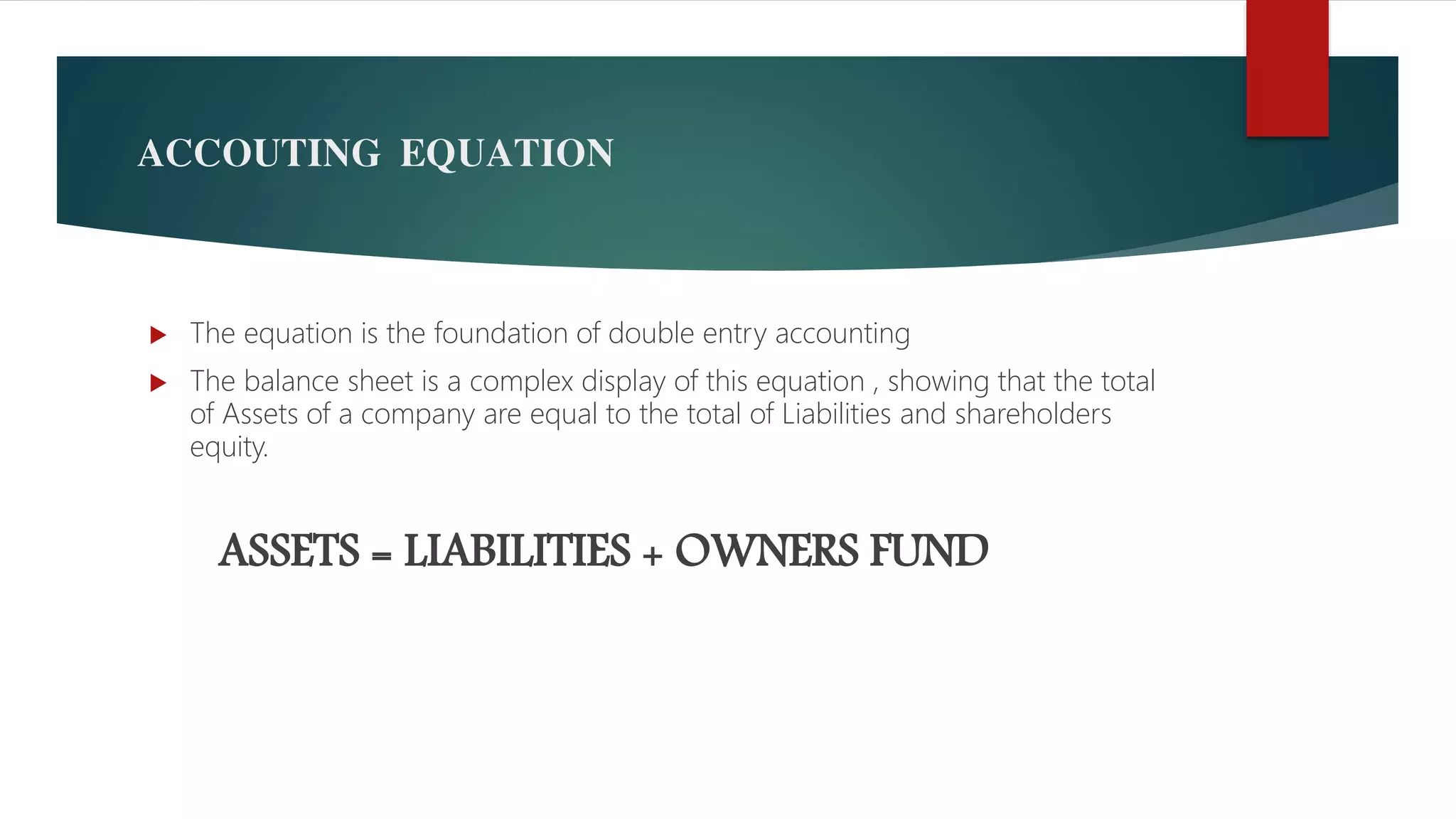
ACCOUTING EQUATION
 The equation is the foundation of double entry accounting
 The balance sheet is a complex display of this equation , showing that the total
of Assets of a company are equal to the total of Liabilities and shareholders
equity.
ASSETS = LIABILITIES + OWNERS FUND
TRANSACTION ANALYSIS
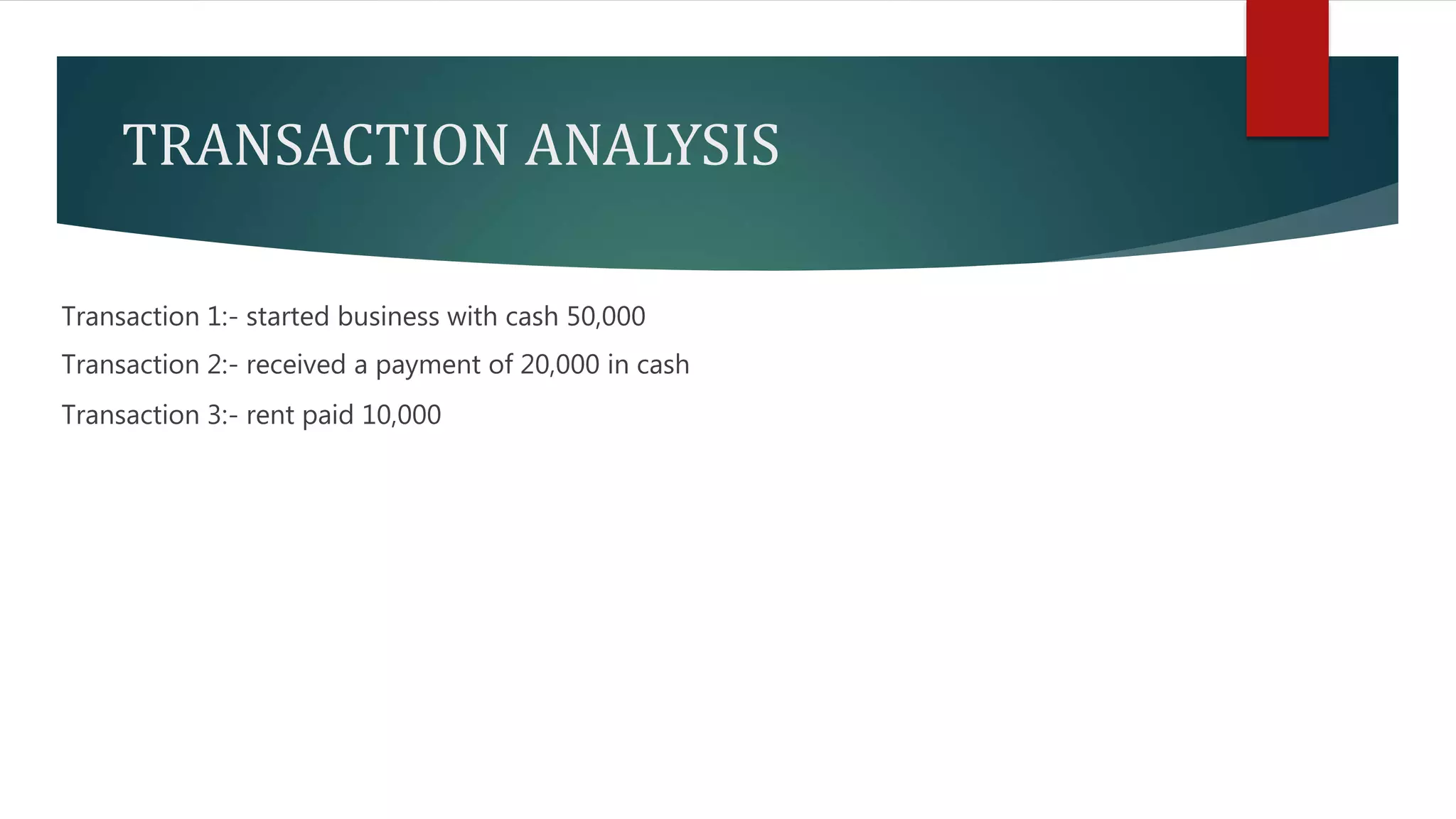
Transaction 1:- started business with cash 50,000
Transaction 2:- received a payment of 20,000 in cash
Transaction 3:- rent paid 10,000
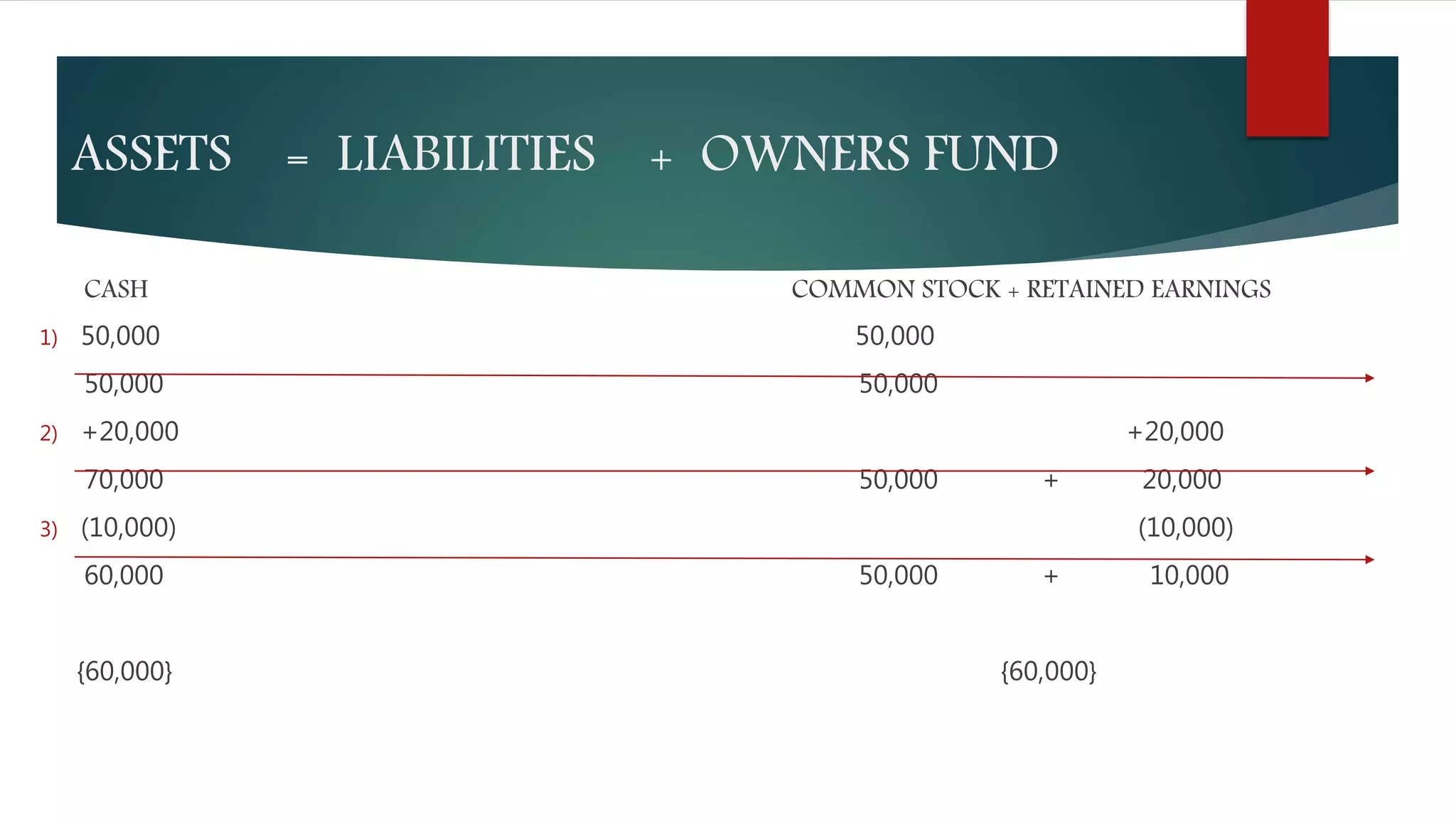
ASSETS = LIABILITIES + OWNERS FUND
CASH COMMON STOCK + RETAINED EARNINGS
1) 50,000 50,000
50,000 50,000
2) +20,000 +20,000
70,000 50,000 + 20,000
3) (10,000) (10,000)
60,000 50,000 + 10,000
{60,000} {60,000}
DOUBLE ENTRY SYSTEM
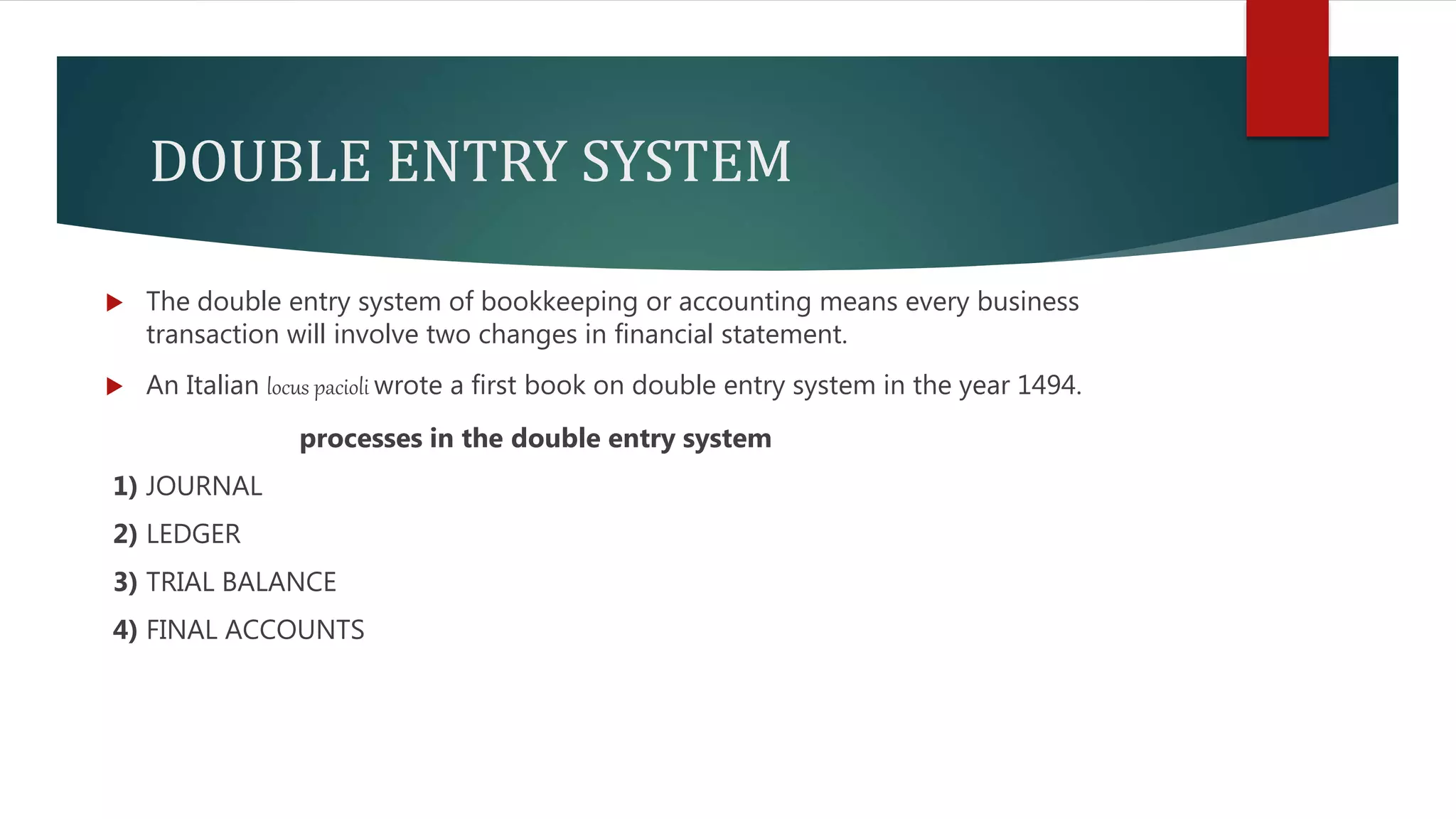
 The double entry system of bookkeeping or accounting means every business
transaction will involve two changes in financial statement.
 An Italian locus pacioli wrote a first book on double entry system in the year 1494.
processes in the double entry system
1) JOURNAL
2) LEDGER
3) TRIAL BALANCE
4) FINAL ACCOUNTS
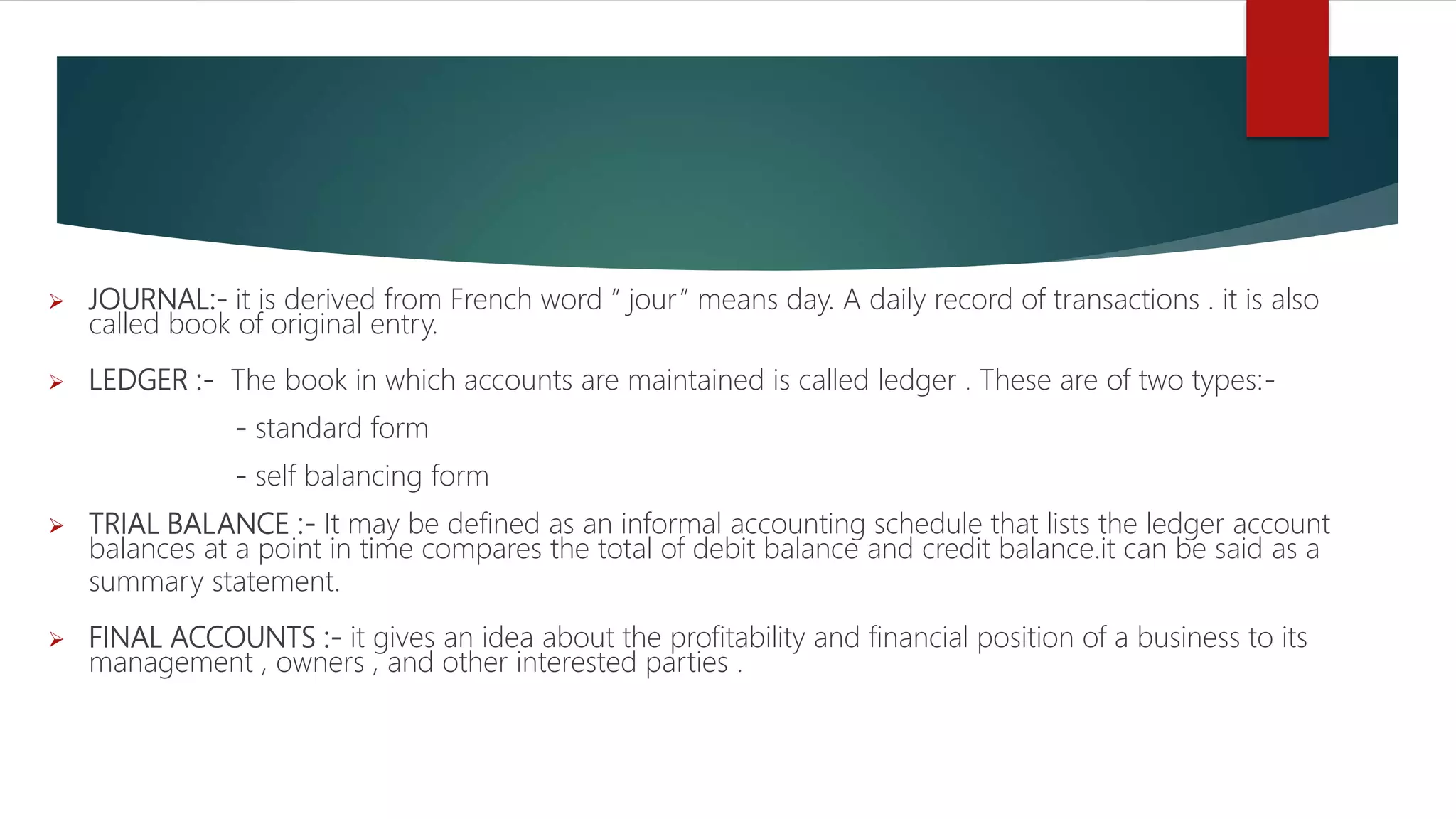
 JOURNAL:- it is derived from French word “ jour” means day. A daily record of transactions . it is also
called book of original entry.
 LEDGER :- The book in which accounts are maintained is called ledger . These are of two types:-
- standard form
- self balancing form
 TRIAL BALANCE :- It may be defined as an informal accounting schedule that lists the ledger account
balances at a point in time compares the total of debit balance and credit balance.it can be said as a
summary statement.
 FINAL ACCOUNTS :- it gives an idea about the profitability and financial position of a business to its
management , owners , and other interested parties .
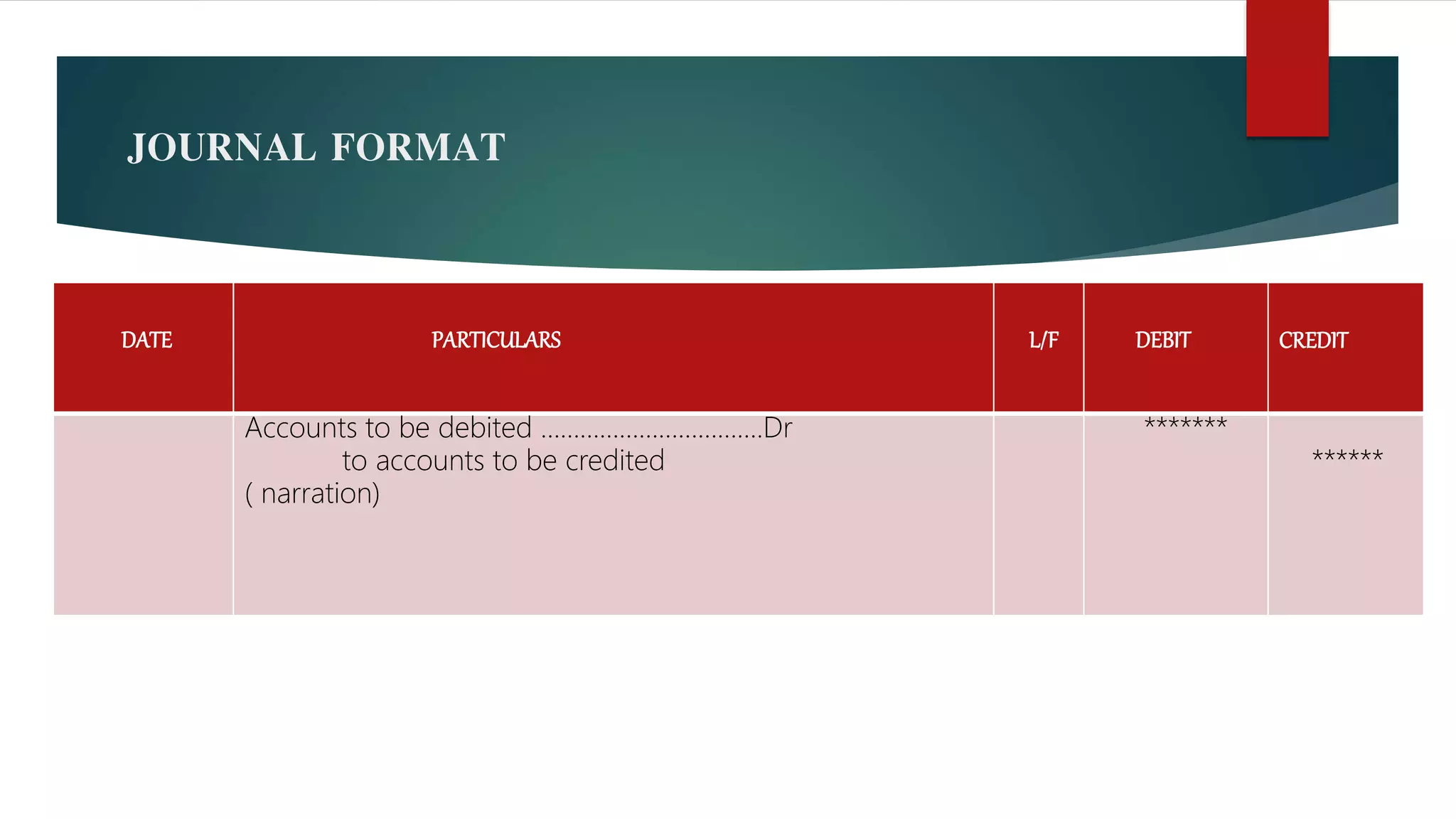
JOURNAL FORMAT
DATE PARTICULARS L/F DEBIT CREDIT
Accounts to be debited …………………………….Dr
to accounts to be credited
( narration)
*******
******
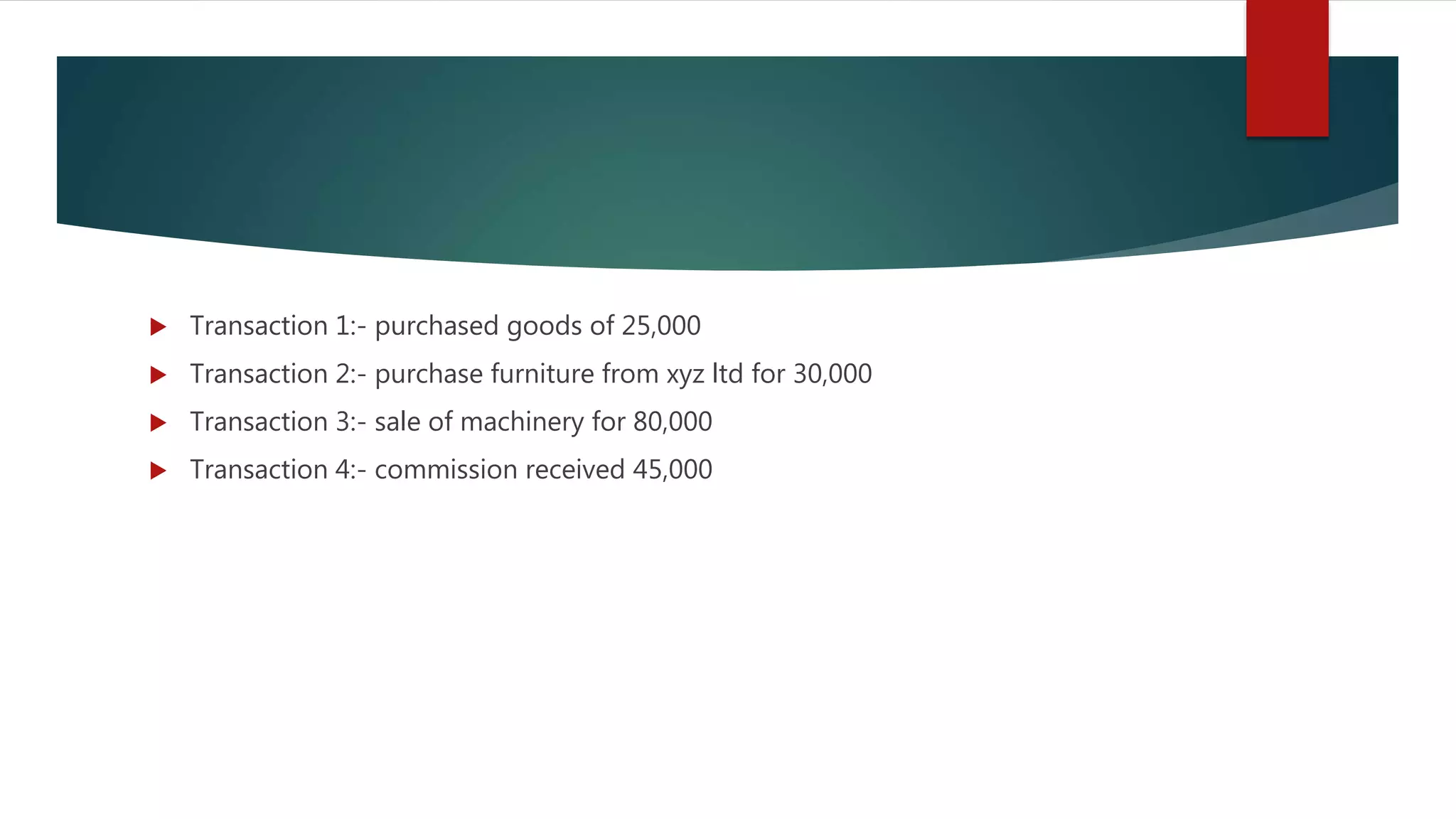
 Transaction 1:- purchased goods of 25,000
 Transaction 2:- purchase furniture from xyz ltd for 30,000
 Transaction 3:- sale of machinery for 80,000
 Transaction 4:- commission received 45,000
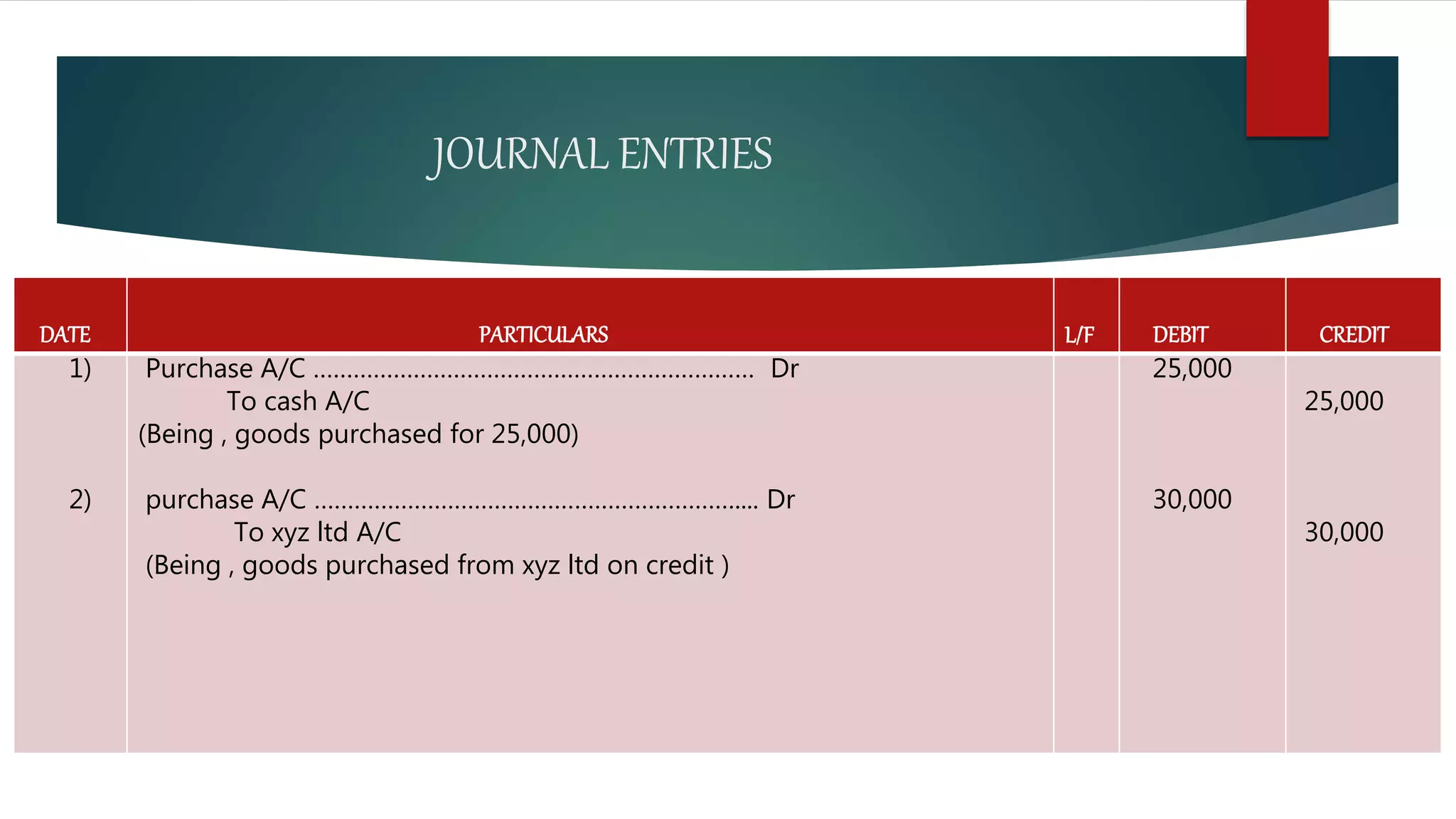
JOURNAL ENTRIES
DATE PARTICULARS L/F DEBIT CREDIT
1)
2)
Purchase A/C ………………………………………………………… Dr
To cash A/C
(Being , goods purchased for 25,000)
purchase A/C ……………………………………………………….... Dr
To xyz ltd A/C
(Being , goods purchased from xyz ltd on credit )
25,000
30,000
25,000
30,000
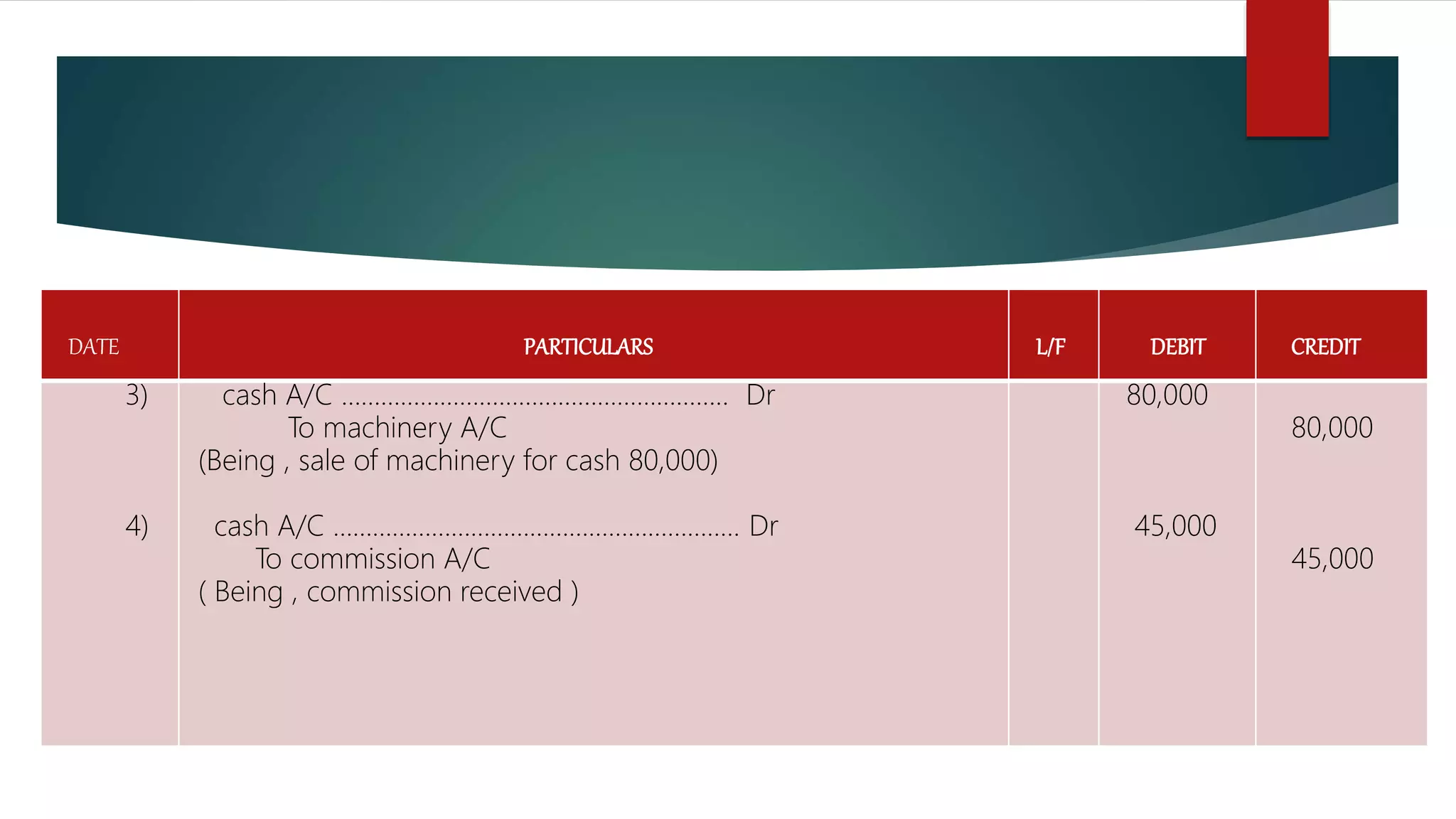
DATE PARTICULARS L/F DEBIT CREDIT
3)
4)
cash A/C ………………………………………………….. Dr
To machinery A/C
(Being , sale of machinery for cash 80,000)
cash A/C ………………………………………………........ Dr
To commission A/C
( Being , commission received )
80,000
45,000
80,000
45,000
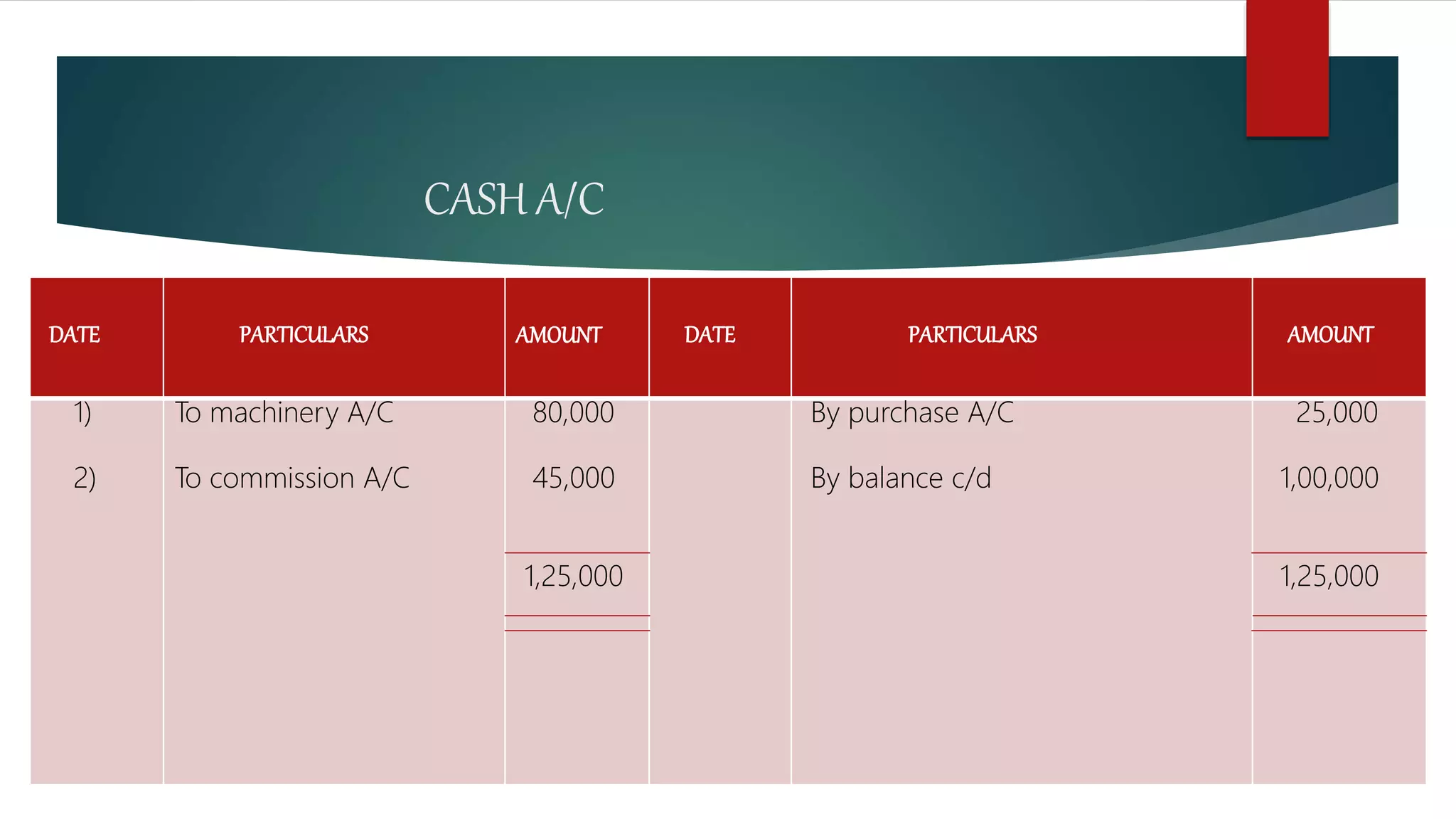
CASH A/C
DATE PARTICULARS AMOUNT DATE PARTICULARS AMOUNT
1)
2)
To machinery A/C
To commission A/C
80,000
45,000
1,25,000
By purchase A/C
By balance c/d
25,000
1,00,000
1,25,000
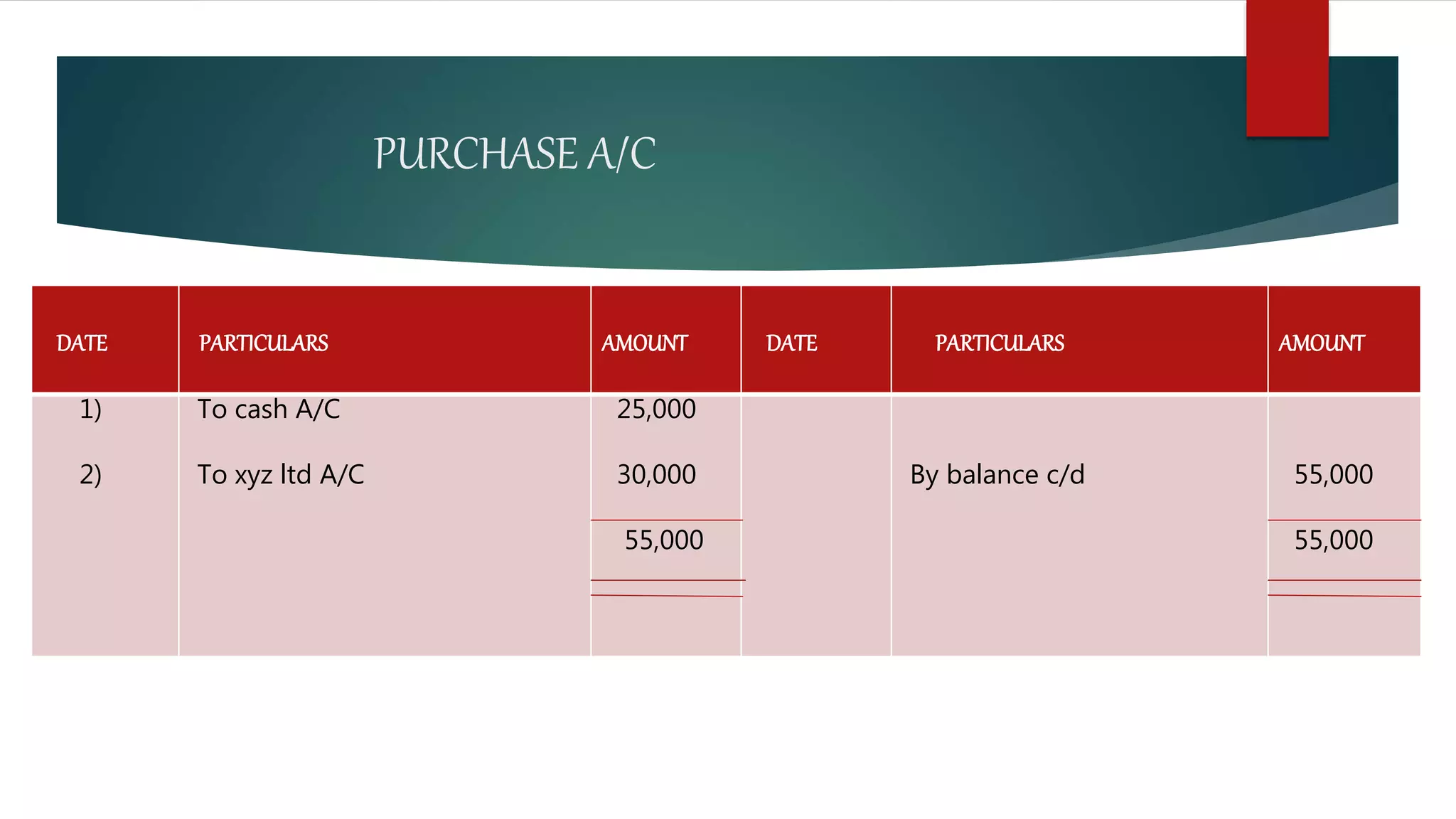
PURCHASE A/C
DATE PARTICULARS AMOUNT DATE PARTICULARS AMOUNT
1)
2)
To cash A/C
To xyz ltd A/C
25,000
30,000
55,000
By balance c/d 55,000
55,000
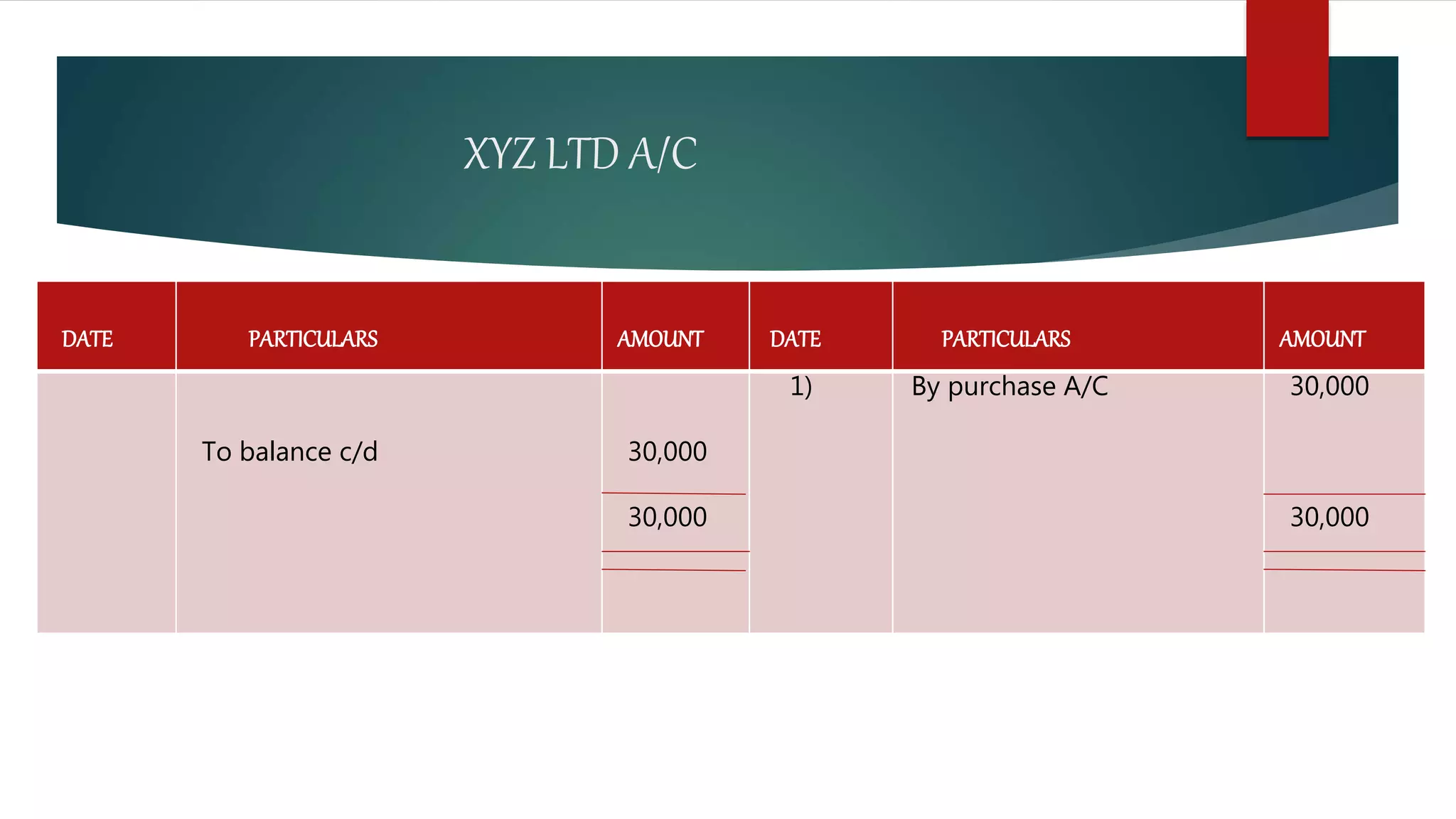
XYZ LTD A/C
DATE PARTICULARS AMOUNT DATE PARTICULARS AMOUNT
To balance c/d 30,000
30,000
1) By purchase A/C 30,000
30,000
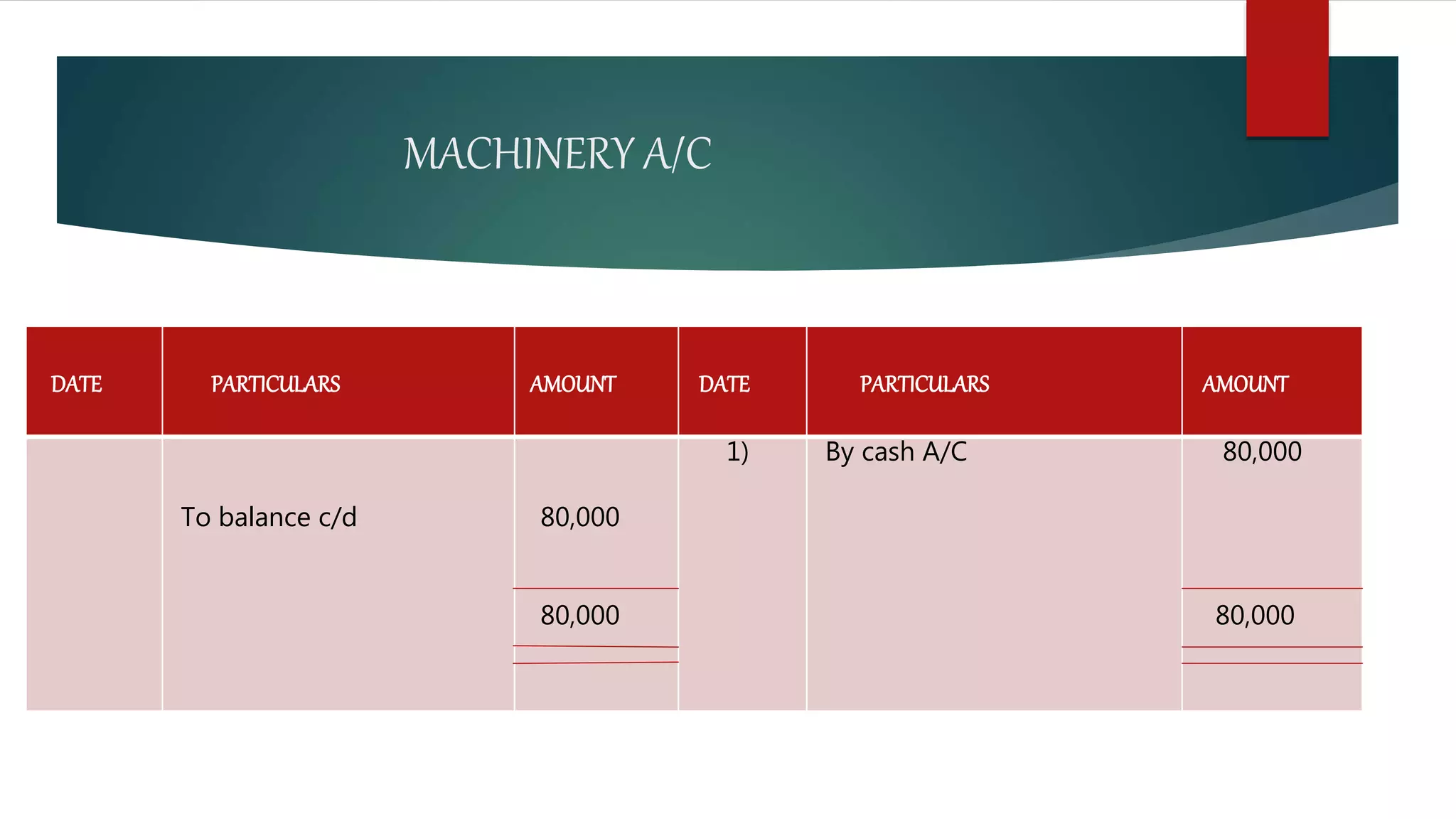
MACHINERY A/C
DATE PARTICULARS AMOUNT DATE PARTICULARS AMOUNT
To balance c/d 80,000
80,000
1) By cash A/C 80,000
80,000
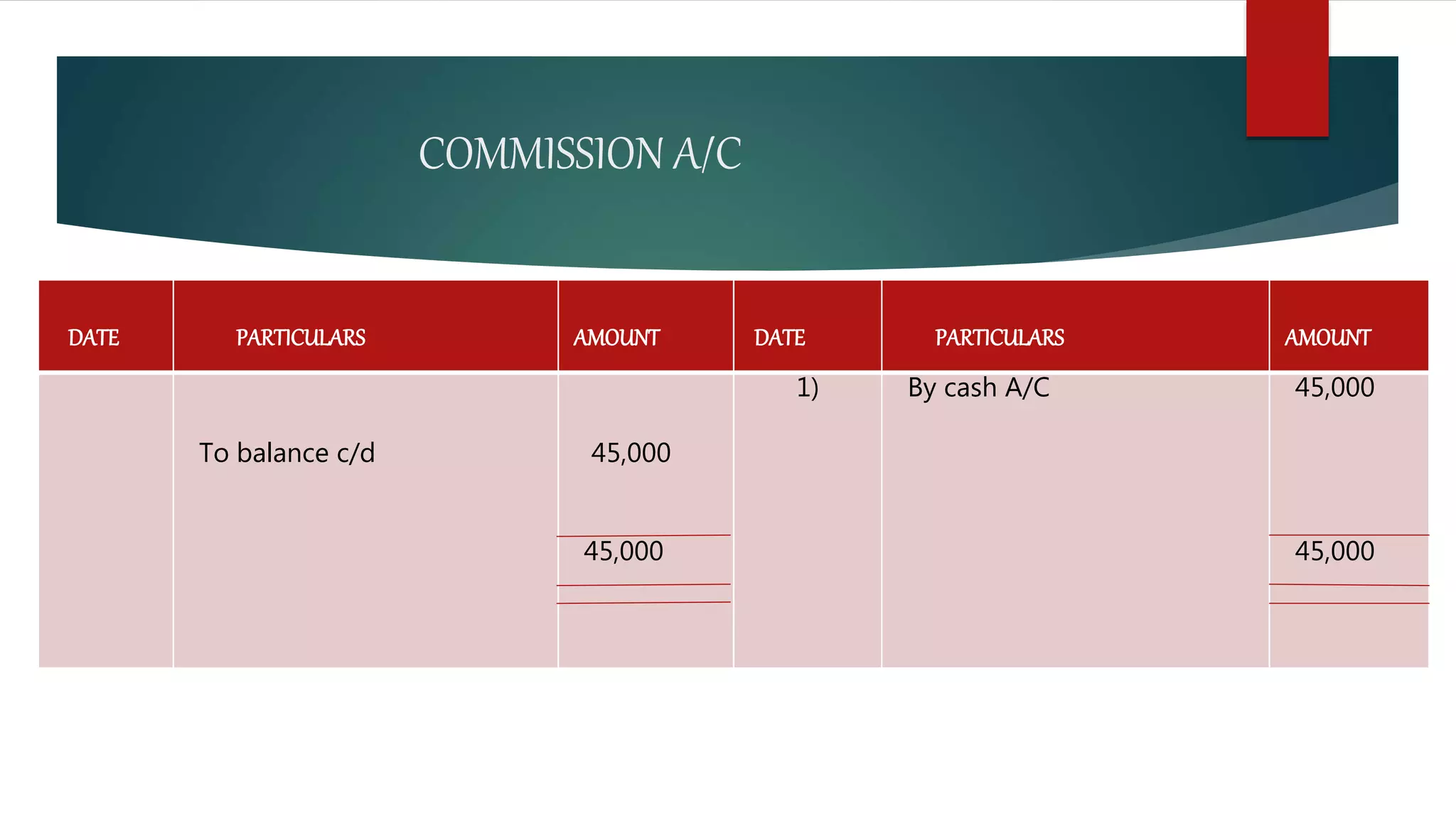
COMMISSION A/C
DATE PARTICULARS AMOUNT DATE PARTICULARS AMOUNT
To balance c/d 45,000
45,000
1) By cash A/C 45,000
45,000
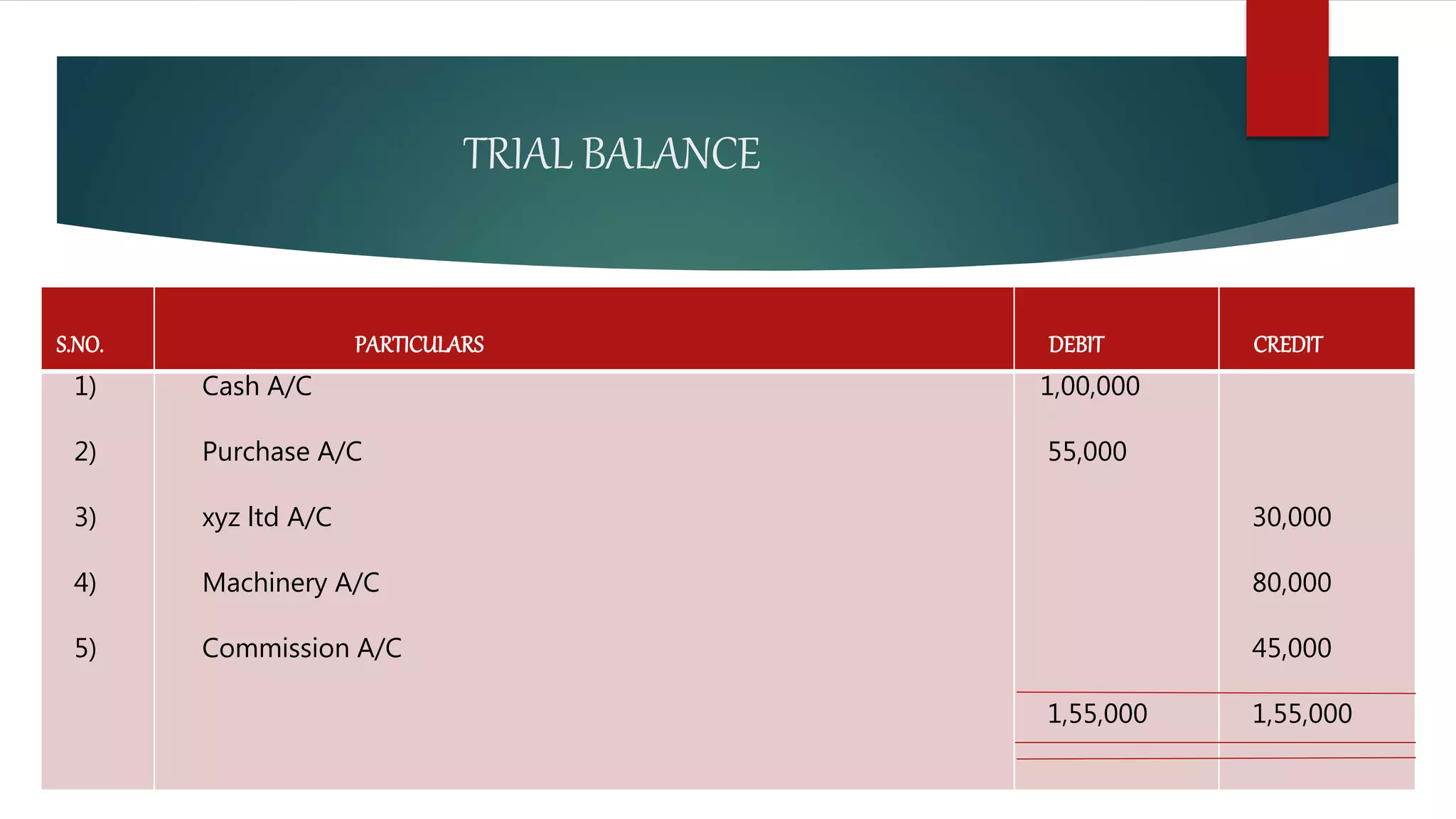
TRIAL BALANCE
S.NO. PARTICULARS DEBIT CREDIT
1)
2)
3)
4)
5)
Cash A/C
Purchase A/C
xyz ltd A/C
Machinery A/C
Commission A/C
1,00,000
55,000
1,55,000
30,000
80,000
45,000
1,55,000

Introduction to accounting

  • 1.
    INTRODUCTION TO ACCOUNTING Submitted to:-Presented by:- DR. SUNIL Ashish punia MBA – 1ST YEAR
  • 2.
    RECORDING OF ACCOUNTINGTRANSACTIONS INTRODUCTION  The general Ledger contains all entries from both the general Journal and the special  Using a double entry system to record the transactions keeps the accounts balance.  The accounting requirement that each transaction be recorded by an entry that has equal debits and credits is called double entry procedure.
  • 3.
    ACCOUNTING TRANSACTIONS  Anaccounting transaction is a business event having a monetary impact on the financial statements of a business.  It is recorded in the accounting records of the business.  Examples of accounting transaction are as follows:- 1) Purchase fixed assets from supplier 2) sale on credit to the customer 3) in cash to a customer
  • 4.
    ACCOUTING EQUATION  Theequation is the foundation of double entry accounting  The balance sheet is a complex display of this equation , showing that the total of Assets of a company are equal to the total of Liabilities and shareholders equity. ASSETS = LIABILITIES + OWNERS FUND
  • 5.
    TRANSACTION ANALYSIS Transaction 1:-started business with cash 50,000 Transaction 2:- received a payment of 20,000 in cash Transaction 3:- rent paid 10,000
  • 6.
    ASSETS = LIABILITIES+ OWNERS FUND CASH COMMON STOCK + RETAINED EARNINGS 1) 50,000 50,000 50,000 50,000 2) +20,000 +20,000 70,000 50,000 + 20,000 3) (10,000) (10,000) 60,000 50,000 + 10,000 {60,000} {60,000}
  • 7.
    DOUBLE ENTRY SYSTEM The double entry system of bookkeeping or accounting means every business transaction will involve two changes in financial statement.  An Italian locus pacioli wrote a first book on double entry system in the year 1494. processes in the double entry system 1) JOURNAL 2) LEDGER 3) TRIAL BALANCE 4) FINAL ACCOUNTS
  • 8.
     JOURNAL:- itis derived from French word “ jour” means day. A daily record of transactions . it is also called book of original entry.  LEDGER :- The book in which accounts are maintained is called ledger . These are of two types:- - standard form - self balancing form  TRIAL BALANCE :- It may be defined as an informal accounting schedule that lists the ledger account balances at a point in time compares the total of debit balance and credit balance.it can be said as a summary statement.  FINAL ACCOUNTS :- it gives an idea about the profitability and financial position of a business to its management , owners , and other interested parties .
  • 9.
    JOURNAL FORMAT DATE PARTICULARSL/F DEBIT CREDIT Accounts to be debited …………………………….Dr to accounts to be credited ( narration) ******* ******
  • 10.
     Transaction 1:-purchased goods of 25,000  Transaction 2:- purchase furniture from xyz ltd for 30,000  Transaction 3:- sale of machinery for 80,000  Transaction 4:- commission received 45,000
  • 11.
    JOURNAL ENTRIES DATE PARTICULARSL/F DEBIT CREDIT 1) 2) Purchase A/C ………………………………………………………… Dr To cash A/C (Being , goods purchased for 25,000) purchase A/C ……………………………………………………….... Dr To xyz ltd A/C (Being , goods purchased from xyz ltd on credit ) 25,000 30,000 25,000 30,000
  • 12.
    DATE PARTICULARS L/FDEBIT CREDIT 3) 4) cash A/C ………………………………………………….. Dr To machinery A/C (Being , sale of machinery for cash 80,000) cash A/C ………………………………………………........ Dr To commission A/C ( Being , commission received ) 80,000 45,000 80,000 45,000
  • 13.
    CASH A/C DATE PARTICULARSAMOUNT DATE PARTICULARS AMOUNT 1) 2) To machinery A/C To commission A/C 80,000 45,000 1,25,000 By purchase A/C By balance c/d 25,000 1,00,000 1,25,000
  • 14.
    PURCHASE A/C DATE PARTICULARSAMOUNT DATE PARTICULARS AMOUNT 1) 2) To cash A/C To xyz ltd A/C 25,000 30,000 55,000 By balance c/d 55,000 55,000
  • 15.
    XYZ LTD A/C DATEPARTICULARS AMOUNT DATE PARTICULARS AMOUNT To balance c/d 30,000 30,000 1) By purchase A/C 30,000 30,000
  • 16.
    MACHINERY A/C DATE PARTICULARSAMOUNT DATE PARTICULARS AMOUNT To balance c/d 80,000 80,000 1) By cash A/C 80,000 80,000
  • 17.
    COMMISSION A/C DATE PARTICULARSAMOUNT DATE PARTICULARS AMOUNT To balance c/d 45,000 45,000 1) By cash A/C 45,000 45,000
  • 18.
    TRIAL BALANCE S.NO. PARTICULARSDEBIT CREDIT 1) 2) 3) 4) 5) Cash A/C Purchase A/C xyz ltd A/C Machinery A/C Commission A/C 1,00,000 55,000 1,55,000 30,000 80,000 45,000 1,55,000