Teacher Bau mussabaujiti11@gmail.com 0742868019
Teacher Bau mussabaujiti11@gmail.com 0742868019 Page 1
ACCOUNTS
Accounts is a place in a ledger where all the transactions are relating to a particular asset,
liabilities and capital, expenses,or revenue items were recorded.
Accounts is a wider concept with identifying measuring and communicating economic
information to permit informed judgments and decisions by users of the information. The part of
accounting that is concerned with recording data is known as book keeping.
Book keeping - is the art of recording financial business transactions on a set of books in terms
of money or money’s worth.
Why do we need to keepbusiness records?
•To determine whether the business is making profit or loss.
To determine financial strength of the business.
•To enable the government to access reliable resources.
•To enable different stake holders to make reliable decisions about the business
i.e. investors, bankers, customers etc.
THE DOUBLE ENTRY SYSTEM
Before looking at the system of double entry let us look at the meaning of business transactions.
Transactions means movements of money,goods or services from one part/person to another.
For example: Selling goods in cash Tshs 10,000/= or selling goods worth Tshs 10,000 on credit
to Aisha.
The double entry system - Is the process of recording these business transactions twice.
LEDGERS
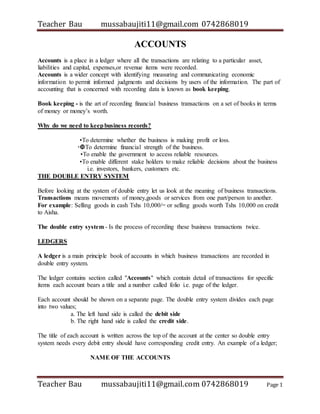
A ledger is a main principle book of accounts in which business transactions are recorded in
double entry system.
The ledger contains section called "Accounts" which contain detail of transactions for specific
items each account bears a title and a number called folio i.e. page of the ledger.
Each account should be shown on a separate page. The double entry system divides each page
into two values;
a. The left hand side is called the debit side
b. The right hand side is called the credit side.
The title of each account is written across the top of the account at the center so double entry
system needs every debit entry should have corresponding credit entry. An example of a ledger;
NAME OF THE ACCOUNTS
Teacher Bau mussabaujiti11@gmail.com 0742868019
Teacher Bau mussabaujiti11@gmail.com 0742868019 Page 2
Date Particulars folio Amount Date particular folio Amount
Each side of account should have four column i.e. date, particulars, folio and amount.
Use of columns;
i) Date column
For writing year, month and date.
ii) Particulars
For short descriptions of the transactions
iii) Folio column
For pages of reference
iv) Amount column
For writing amount of money
Worked examples on how to record transactions in double entry system;
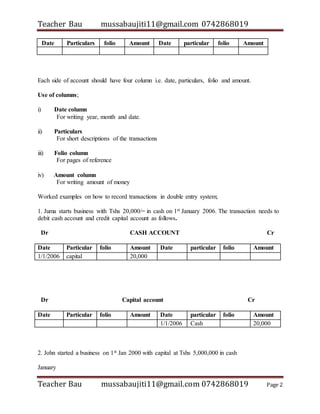
1. Juma starts business with Tshs 20,000/= in cash on 1st January 2006. The transaction needs to
debit cash account and credit capital account as follows.
Dr CASH ACCOUNT Cr
Date Particular folio Amount Date particular folio Amount
1/1/2006 capital 20,000
Dr Capital account Cr
Date Particular folio Amount Date particular folio Amount
1/1/2006 Cash 20,000
2. John started a business on 1st Jan 2000 with capital at Tshs 5,000,000 in cash
January
Teacher Bau mussabaujiti11@gmail.com 0742868019
Teacher Bau mussabaujiti11@gmail.com 0742868019 Page 3
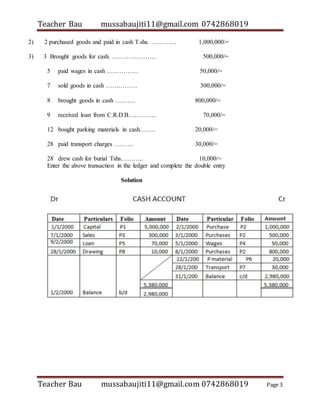
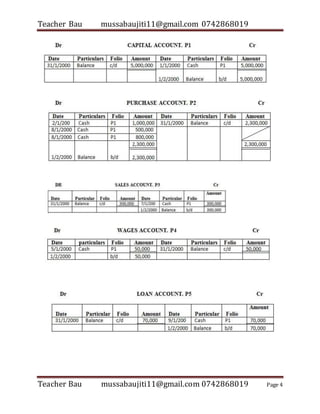
2) 2 purchased goods and paid in cash T.shs. ………… 1,000,000/=
3) 3 Brought goods for cash. ………………… 500,000/=
5 paid wages in cash …………… 50,000/=
7 sold goods in cash …………… 300,000/=
8 brought goods in cash ………. 800,000/=
9 received loan from C.R.D.B………….. 70,000/=
12 bought parking materials in cash…….. 20,000/=
28 paid transport charges ……… 30,000/=
28 drew cash for burial Tshs……….. 10,000/=
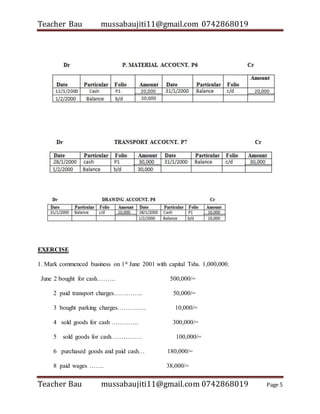
Enter the above transaction in the ledger and complete the double entry
Solution
Teacher Bau mussabaujiti11@gmail.com 0742868019
Teacher Bau mussabaujiti11@gmail.com 0742868019 Page 4
Teacher Bau mussabaujiti11@gmail.com 0742868019
Teacher Bau mussabaujiti11@gmail.com 0742868019 Page 5
EXERCISE
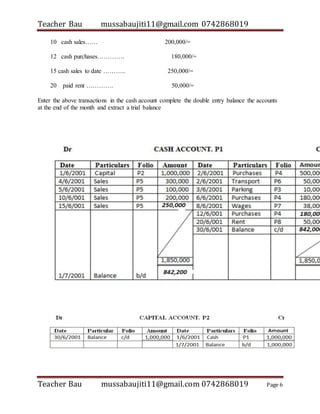
1. Mark commenced business on 1st June 2001 with capital Tshs. 1,000,000.
June 2 bought for cash……… 500,000/=
2 paid transport charges………….. 50,000/=
3 bought parking charges………….. 10,000/=
4 sold goods for cash …………. 300,000/=
5 sold goods for cash…………… 100,000/=
6 purchased goods and paid cash… 180,000/=
8 paid wages ……. 38,000/=
Teacher Bau mussabaujiti11@gmail.com 0742868019
Teacher Bau mussabaujiti11@gmail.com 0742868019 Page 6
10 cash sales…… 200,000/=
12 cash purchases…………. 180,000/=
15 cash sales to date ……….. 250,000/=
20 paid rent …………. 50,000/=
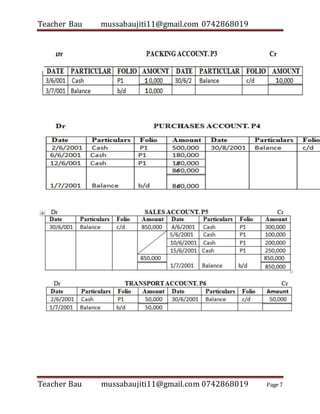
Enter the above transactions in the cash account complete the double entry balance the accounts
at the end of the month and extract a trial balance
Teacher Bau mussabaujiti11@gmail.com 0742868019
Teacher Bau mussabaujiti11@gmail.com 0742868019 Page 7
Teacher Bau mussabaujiti11@gmail.com 0742868019
Teacher Bau mussabaujiti11@gmail.com 0742868019 Page 8
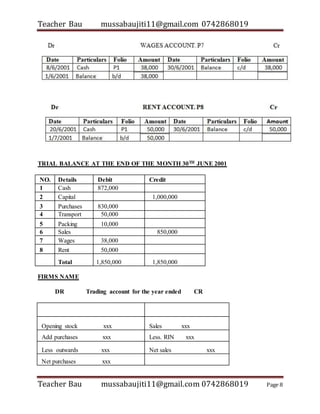
TRIAL BALANCE AT THE END OF THE MONTH 30TH JUNE 2001
NO. Details Debit Credit
1 Cash 872,000
2 Capital 1,000,000
3 Purchases 830,000
4 Transport 50,000
5 Packing 10,000
6 Sales 850,000
7 Wages 38,000
8 Rent 50,000
Total 1,850,000 1,850,000
FIRMS NAME
DR Trading account for the year ended CR
Opening stock xxx Sales xxx
Add purchases xxx Less. RIN xxx
Less outwards xxx Net sales xxx
Net purchases xxx
Teacher Bau mussabaujiti11@gmail.com 0742868019
Teacher Bau mussabaujiti11@gmail.com 0742868019 Page 9
Cost of goods available
For sale xxx
Less : closing stock xxx
Cost of goods sold xxx
Gross profit c/d xxx
Xxx Xxx
PROFIT AND LOSS ACCOUNT
This is an account prepared in order to ascertain the net profit and loss by the business. All
expenses are debited to this account while gains or profits are credited to this account and
debited with all incurred expenses.
Note
If the business has made profit it increases the capital and if it has suffered loss it reduces the
capital.
It’s lay out;
FIRM’S NAME
DR PROFIT AND LOSS ACCOUNT FOR THE YEAR ENDED CR
Expense xxx
Net profit xxx
Gross profit b/d from trading account xxx
Other gains [income] xxx
xxx
Teacher Bau mussabaujiti11@gmail.com 0742868019
Teacher Bau mussabaujiti11@gmail.com 0742868019 Page 10
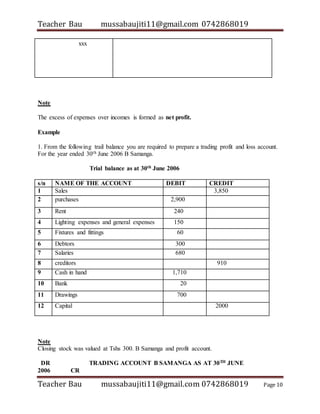
xxx
Note
The excess of expenses over incomes is formed as net profit.
Example
1. From the following trail balance you are required to prepare a trading profit and loss account.
For the year ended 30th June 2006 B Samanga.
Trial balance as at 30th June 2006
s/n NAME OF THE ACCOUNT DEBIT CREDIT
1 Sales 3,850
2 purchases 2,900
3 Rent 240
4 Lighting expenses and general expenses 150
5 Fixtures and fittings 60
6 Debtors 300
7 Salaries 680
8 creditors 910
9 Cash in hand 1,710
10 Bank 20
11 Drawings 700
12 Capital 2000
Note
Closing stock was valued at Tshs 300. B Samanga and profit account.
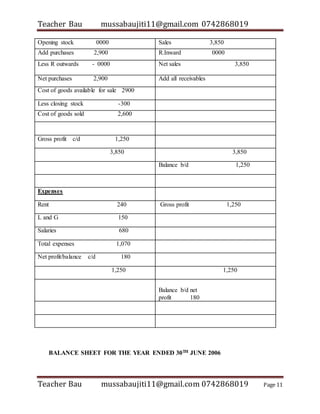
DR TRADING ACCOUNT B SAMANGA AS AT 30TH JUNE
2006 CR
Teacher Bau mussabaujiti11@gmail.com 0742868019
Teacher Bau mussabaujiti11@gmail.com 0742868019 Page 11
Opening stock 0000 Sales 3,850
Add purchases 2,900 R.Inward 0000
Less R outwards - 0000 Net sales 3,850
Net purchases 2,900 Add all receivables
Cost of goods available for sale 2900
Less closing stock -300
Cost of goods sold 2,600
Gross profit c/d 1,250
3,850 3,850
Balance b/d 1,250
Expenses
Rent 240 Gross profit 1,250
L and G 150
Salaries 680
Total expenses 1,070
Net profit/balance c/d 180
1,250 1,250
Balance b/d net
profit 180
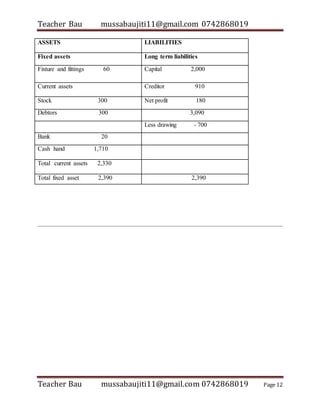
BALANCE SHEET FOR THE YEAR ENDED 30TH JUNE 2006
Teacher Bau mussabaujiti11@gmail.com 0742868019
Teacher Bau mussabaujiti11@gmail.com 0742868019 Page 12
ASSETS LIABILITIES
Fixed assets Long term liabilities
Fixture and fittings 60 Capital 2,000
Current assets Creditor 910
Stock 300 Net profit 180
Debtors 300 3,090
Less drawing - 700
Bank 20
Cash hand 1,710
Total current assets 2,330
Total fixed asset 2,390 2,390

Accounts

  • 1.
    Teacher Bau mussabaujiti11@gmail.com0742868019 Teacher Bau mussabaujiti11@gmail.com 0742868019 Page 1 ACCOUNTS Accounts is a place in a ledger where all the transactions are relating to a particular asset, liabilities and capital, expenses,or revenue items were recorded. Accounts is a wider concept with identifying measuring and communicating economic information to permit informed judgments and decisions by users of the information. The part of accounting that is concerned with recording data is known as book keeping. Book keeping - is the art of recording financial business transactions on a set of books in terms of money or money’s worth. Why do we need to keepbusiness records? •To determine whether the business is making profit or loss. To determine financial strength of the business. •To enable the government to access reliable resources. •To enable different stake holders to make reliable decisions about the business i.e. investors, bankers, customers etc. THE DOUBLE ENTRY SYSTEM Before looking at the system of double entry let us look at the meaning of business transactions. Transactions means movements of money,goods or services from one part/person to another. For example: Selling goods in cash Tshs 10,000/= or selling goods worth Tshs 10,000 on credit to Aisha. The double entry system - Is the process of recording these business transactions twice. LEDGERS A ledger is a main principle book of accounts in which business transactions are recorded in double entry system. The ledger contains section called "Accounts" which contain detail of transactions for specific items each account bears a title and a number called folio i.e. page of the ledger. Each account should be shown on a separate page. The double entry system divides each page into two values; a. The left hand side is called the debit side b. The right hand side is called the credit side. The title of each account is written across the top of the account at the center so double entry system needs every debit entry should have corresponding credit entry. An example of a ledger; NAME OF THE ACCOUNTS
  • 2.
    Teacher Bau mussabaujiti11@gmail.com0742868019 Teacher Bau mussabaujiti11@gmail.com 0742868019 Page 2 Date Particulars folio Amount Date particular folio Amount Each side of account should have four column i.e. date, particulars, folio and amount. Use of columns; i) Date column For writing year, month and date. ii) Particulars For short descriptions of the transactions iii) Folio column For pages of reference iv) Amount column For writing amount of money Worked examples on how to record transactions in double entry system; 1. Juma starts business with Tshs 20,000/= in cash on 1st January 2006. The transaction needs to debit cash account and credit capital account as follows. Dr CASH ACCOUNT Cr Date Particular folio Amount Date particular folio Amount 1/1/2006 capital 20,000 Dr Capital account Cr Date Particular folio Amount Date particular folio Amount 1/1/2006 Cash 20,000 2. John started a business on 1st Jan 2000 with capital at Tshs 5,000,000 in cash January
  • 3.
    Teacher Bau mussabaujiti11@gmail.com0742868019 Teacher Bau mussabaujiti11@gmail.com 0742868019 Page 3 2) 2 purchased goods and paid in cash T.shs. ………… 1,000,000/= 3) 3 Brought goods for cash. ………………… 500,000/= 5 paid wages in cash …………… 50,000/= 7 sold goods in cash …………… 300,000/= 8 brought goods in cash ………. 800,000/= 9 received loan from C.R.D.B………….. 70,000/= 12 bought parking materials in cash…….. 20,000/= 28 paid transport charges ……… 30,000/= 28 drew cash for burial Tshs……….. 10,000/= Enter the above transaction in the ledger and complete the double entry Solution
  • 4.
    Teacher Bau mussabaujiti11@gmail.com0742868019 Teacher Bau mussabaujiti11@gmail.com 0742868019 Page 4
  • 5.
    Teacher Bau mussabaujiti11@gmail.com0742868019 Teacher Bau mussabaujiti11@gmail.com 0742868019 Page 5 EXERCISE 1. Mark commenced business on 1st June 2001 with capital Tshs. 1,000,000. June 2 bought for cash……… 500,000/= 2 paid transport charges………….. 50,000/= 3 bought parking charges………….. 10,000/= 4 sold goods for cash …………. 300,000/= 5 sold goods for cash…………… 100,000/= 6 purchased goods and paid cash… 180,000/= 8 paid wages ……. 38,000/=
  • 6.
    Teacher Bau mussabaujiti11@gmail.com0742868019 Teacher Bau mussabaujiti11@gmail.com 0742868019 Page 6 10 cash sales…… 200,000/= 12 cash purchases…………. 180,000/= 15 cash sales to date ……….. 250,000/= 20 paid rent …………. 50,000/= Enter the above transactions in the cash account complete the double entry balance the accounts at the end of the month and extract a trial balance
  • 7.
    Teacher Bau mussabaujiti11@gmail.com0742868019 Teacher Bau mussabaujiti11@gmail.com 0742868019 Page 7
  • 8.
    Teacher Bau mussabaujiti11@gmail.com0742868019 Teacher Bau mussabaujiti11@gmail.com 0742868019 Page 8 TRIAL BALANCE AT THE END OF THE MONTH 30TH JUNE 2001 NO. Details Debit Credit 1 Cash 872,000 2 Capital 1,000,000 3 Purchases 830,000 4 Transport 50,000 5 Packing 10,000 6 Sales 850,000 7 Wages 38,000 8 Rent 50,000 Total 1,850,000 1,850,000 FIRMS NAME DR Trading account for the year ended CR Opening stock xxx Sales xxx Add purchases xxx Less. RIN xxx Less outwards xxx Net sales xxx Net purchases xxx
  • 9.
    Teacher Bau mussabaujiti11@gmail.com0742868019 Teacher Bau mussabaujiti11@gmail.com 0742868019 Page 9 Cost of goods available For sale xxx Less : closing stock xxx Cost of goods sold xxx Gross profit c/d xxx Xxx Xxx PROFIT AND LOSS ACCOUNT This is an account prepared in order to ascertain the net profit and loss by the business. All expenses are debited to this account while gains or profits are credited to this account and debited with all incurred expenses. Note If the business has made profit it increases the capital and if it has suffered loss it reduces the capital. It’s lay out; FIRM’S NAME DR PROFIT AND LOSS ACCOUNT FOR THE YEAR ENDED CR Expense xxx Net profit xxx Gross profit b/d from trading account xxx Other gains [income] xxx xxx
  • 10.
    Teacher Bau mussabaujiti11@gmail.com0742868019 Teacher Bau mussabaujiti11@gmail.com 0742868019 Page 10 xxx Note The excess of expenses over incomes is formed as net profit. Example 1. From the following trail balance you are required to prepare a trading profit and loss account. For the year ended 30th June 2006 B Samanga. Trial balance as at 30th June 2006 s/n NAME OF THE ACCOUNT DEBIT CREDIT 1 Sales 3,850 2 purchases 2,900 3 Rent 240 4 Lighting expenses and general expenses 150 5 Fixtures and fittings 60 6 Debtors 300 7 Salaries 680 8 creditors 910 9 Cash in hand 1,710 10 Bank 20 11 Drawings 700 12 Capital 2000 Note Closing stock was valued at Tshs 300. B Samanga and profit account. DR TRADING ACCOUNT B SAMANGA AS AT 30TH JUNE 2006 CR
  • 11.
    Teacher Bau mussabaujiti11@gmail.com0742868019 Teacher Bau mussabaujiti11@gmail.com 0742868019 Page 11 Opening stock 0000 Sales 3,850 Add purchases 2,900 R.Inward 0000 Less R outwards - 0000 Net sales 3,850 Net purchases 2,900 Add all receivables Cost of goods available for sale 2900 Less closing stock -300 Cost of goods sold 2,600 Gross profit c/d 1,250 3,850 3,850 Balance b/d 1,250 Expenses Rent 240 Gross profit 1,250 L and G 150 Salaries 680 Total expenses 1,070 Net profit/balance c/d 180 1,250 1,250 Balance b/d net profit 180 BALANCE SHEET FOR THE YEAR ENDED 30TH JUNE 2006
  • 12.
    Teacher Bau mussabaujiti11@gmail.com0742868019 Teacher Bau mussabaujiti11@gmail.com 0742868019 Page 12 ASSETS LIABILITIES Fixed assets Long term liabilities Fixture and fittings 60 Capital 2,000 Current assets Creditor 910 Stock 300 Net profit 180 Debtors 300 3,090 Less drawing - 700 Bank 20 Cash hand 1,710 Total current assets 2,330 Total fixed asset 2,390 2,390