Welingkar’s Distance Learning Division
Financial Accounting
CHAPTER-1. Accounting Mechanics:
Processing Accounting Information
We Learn – A Continuous Learning Forum
Financial Accounting
Accounting Mechanics :
Processing Accounting Information
Chapter Two
Importance
‘ Accounting Mechanics ’ shows us how
Accountants collect and record accounting data for
preparation of principal financial statements
required by GAAP.
Financial Accounting
Accounting Mechanics :
Processing Accounting Information
Chapter Two
Concept & Operation of ‘ Account ’
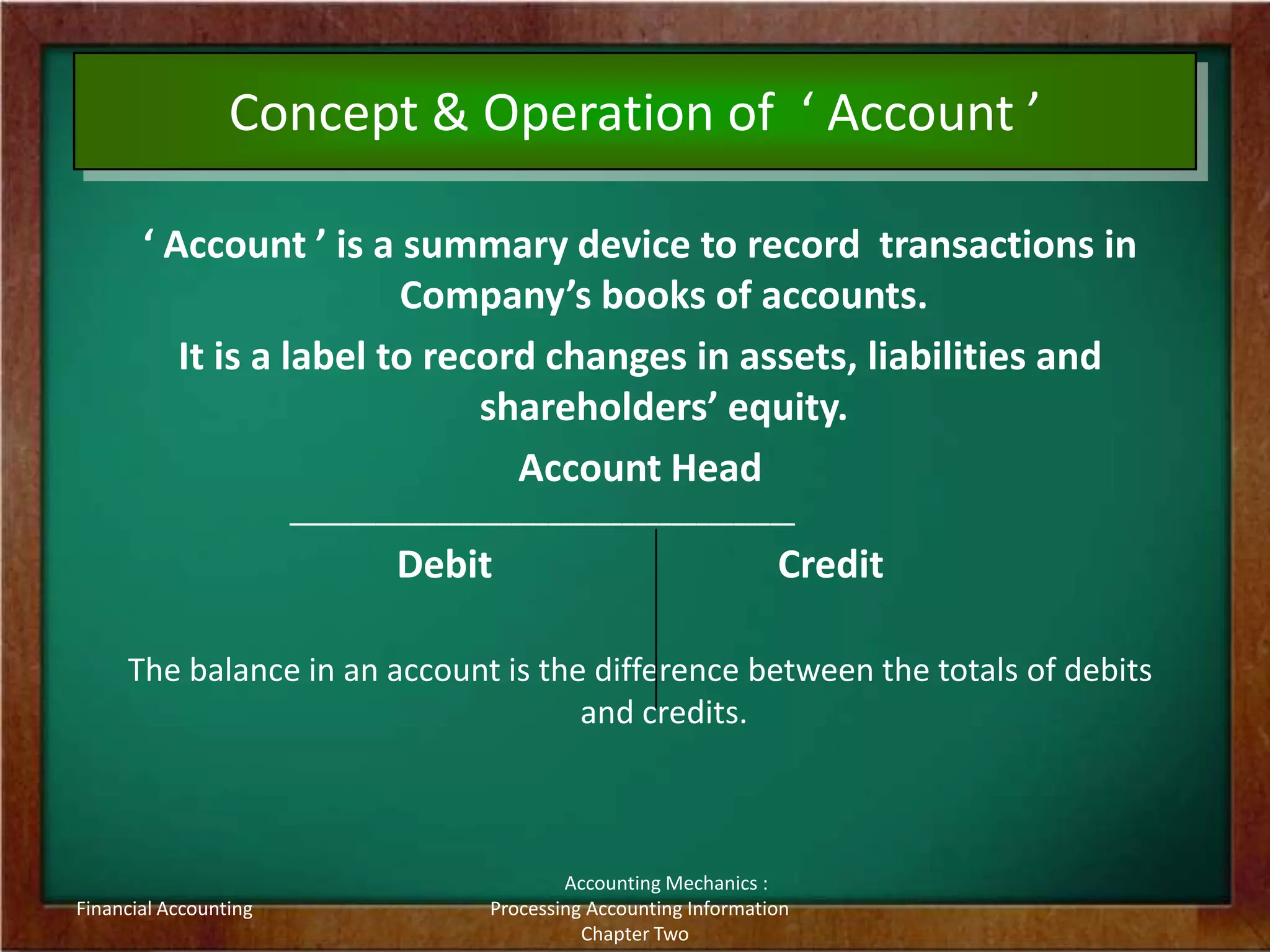
‘ Account ’ is a summary device to record transactions in
Company’s books of accounts.
It is a label to record changes in assets, liabilities and
shareholders’ equity.
Account Head
_________________________________________
Debit Credit
The balance in an account is the difference between the totals of debits
and credits.
Financial Accounting
Accounting Mechanics :
Processing Accounting Information
Chapter Two
Cash vs. Accrual Accounting
‘
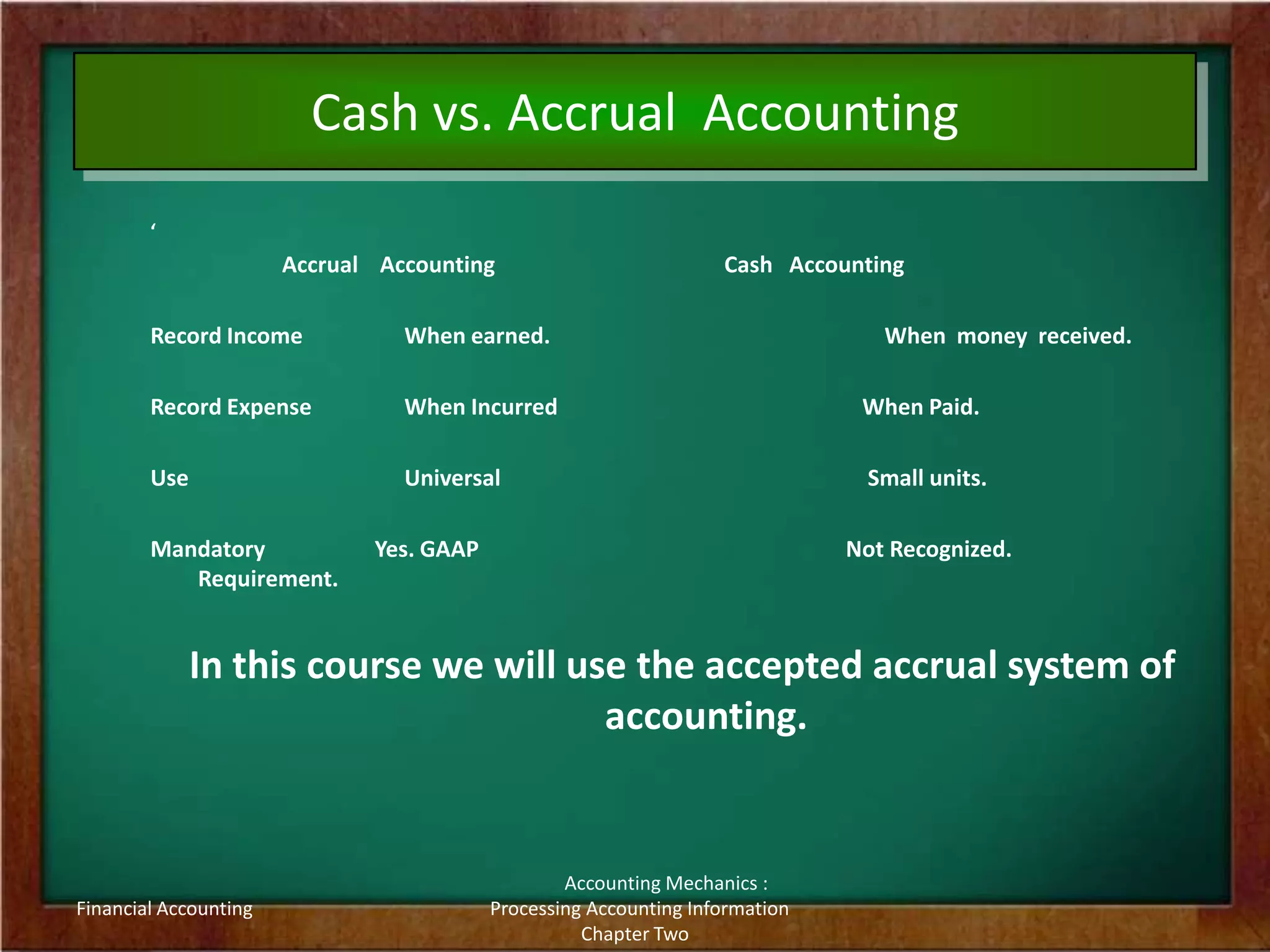
Accrual Accounting Cash Accounting
Record Income When earned. When money received.
Record Expense When Incurred When Paid.
Use Universal Small units.
Mandatory Yes. GAAP Not Recognized.
Requirement.
In this course we will use the accepted accrual system of
accounting.
Financial Accounting
Accounting Mechanics :
Processing Accounting Information
Chapter Two
Concept & Operation of ‘ Account ’
‘
Accounts are classified as :
Personal Accounts
Real Accounts
Non Personal Accounts }
Nominal Accounts
Financial Accounting
Accounting Mechanics :
Processing Accounting Information
Chapter Two
Concept & Operation of ‘ Account ’
‘
Accounts are classified as :
Personal Accounts – related to persons
like debtor, creditor, supplier or
customer.
Financial Accounting
Accounting Mechanics :
Processing Accounting Information
Chapter Two
Concept & Operation of ‘ Account ’
‘
Accounts are classified as :
• Personal Accounts
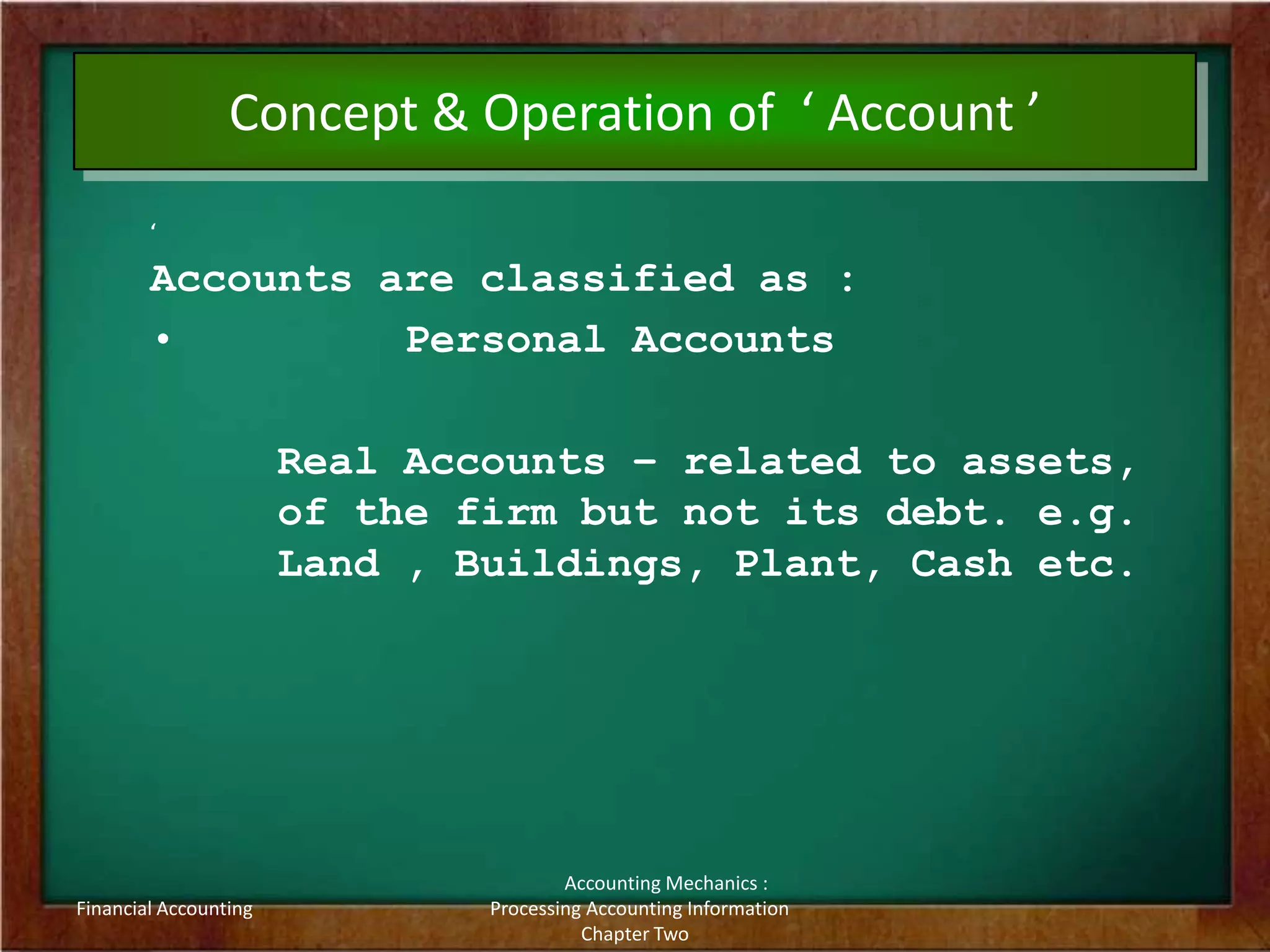
Real Accounts – related to assets,
of the firm but not its debt. e.g.
Land , Buildings, Plant, Cash etc.
Financial Accounting
Accounting Mechanics :
Processing Accounting Information
Chapter Two
Concept & Operation of ‘ Account ’
‘
Accounts are classified as :
• Personal Accounts
• Real Accounts
Nominal Accounts – related to
expenses, incomes, losses and gains.
e.g. salaries, interest, travel etc.
Financial Accounting
Accounting Mechanics :
Processing Accounting Information
Chapter Two
Concept & Operation of ‘ Account ’
‘
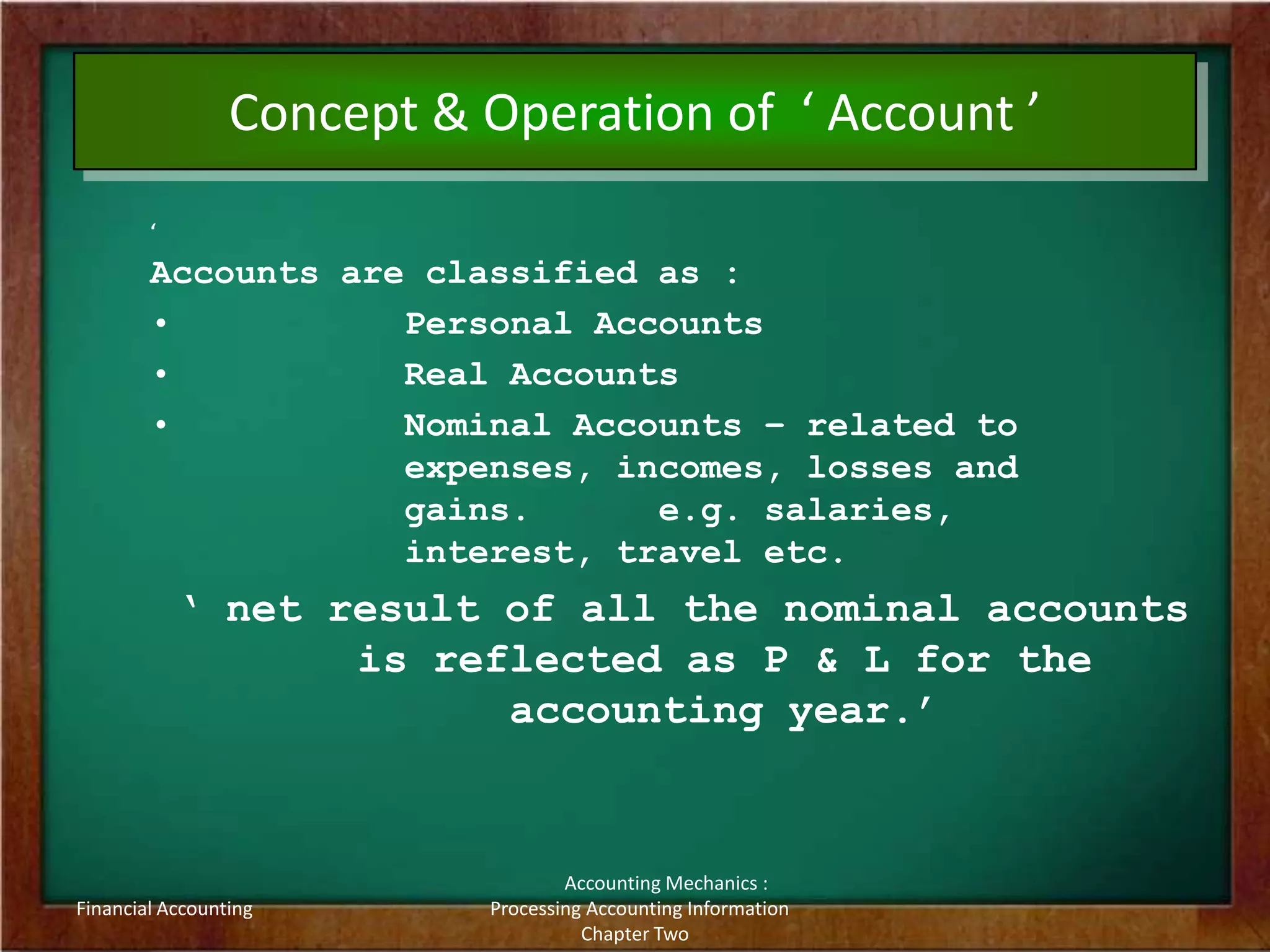
Accounts are classified as :
• Personal Accounts
• Real Accounts
• Nominal Accounts – related to
expenses, incomes, losses and
gains. e.g. salaries,
interest, travel etc.
‘ net result of all the nominal accounts
is reflected as P & L for the
accounting year.’
Financial Accounting
Accounting Mechanics :
Processing Accounting Information
Chapter Two
Concept & Operation of ‘ Account ’
‘
Golden rules of double entry
#1 For real accounts; debit (dr) what
comes in, and credit (cr) what goes out.
Purchased materials – dr Inventory.
Issued cheque for it - cr Bank
Financial Accounting
Accounting Mechanics :
Processing Accounting Information
Chapter Two
Concept & Operation of ‘ Account ’
‘
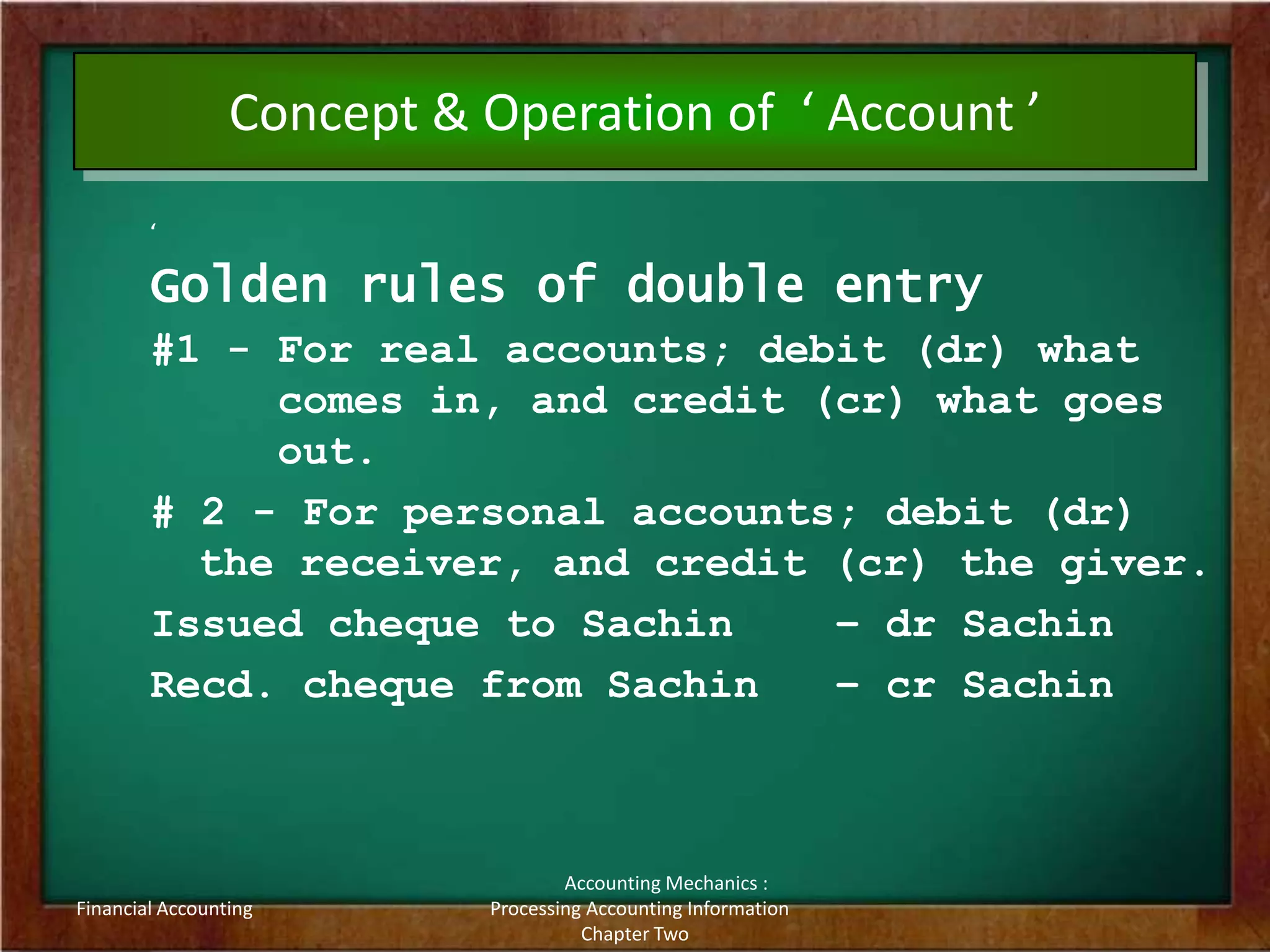
Golden rules of double entry
#1 - For real accounts; debit (dr) what
comes in, and credit (cr) what goes
out.
# 2 - For personal accounts; debit (dr)
the receiver, and credit (cr) the giver.
Issued cheque to Sachin – dr Sachin
Recd. cheque from Sachin – cr Sachin
Financial Accounting
Accounting Mechanics :
Processing Accounting Information
Chapter Two
Concept & Operation of ‘ Account ’
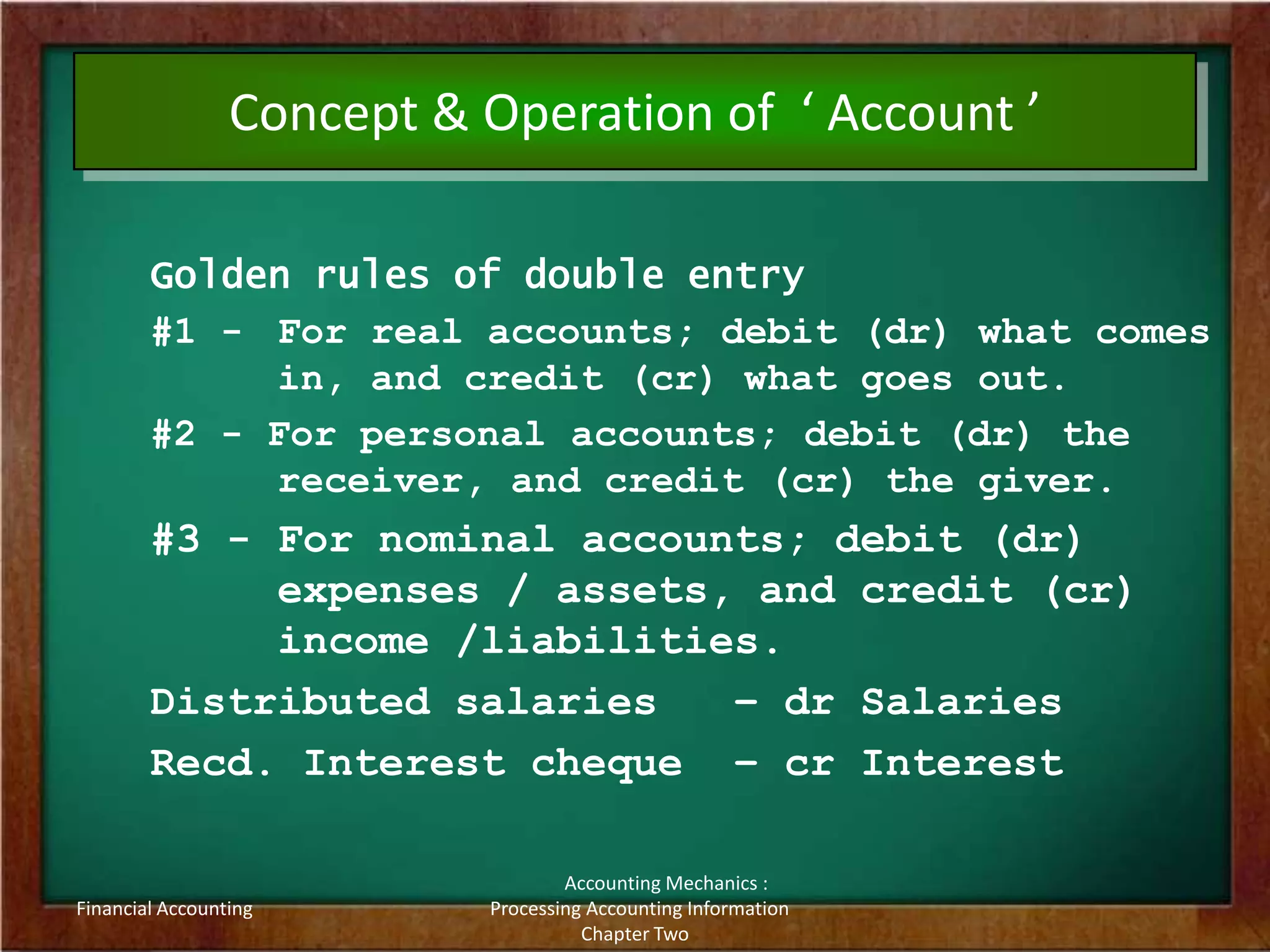
Golden rules of double entry
#1 - For real accounts; debit (dr) what comes
in, and credit (cr) what goes out.
#2 - For personal accounts; debit (dr) the
receiver, and credit (cr) the giver.
#3 - For nominal accounts; debit (dr)
expenses / assets, and credit (cr)
income /liabilities.
Distributed salaries – dr Salaries
Recd. Interest cheque – cr Interest
Financial Accounting
Accounting Mechanics :
Processing Accounting Information
Chapter Two
Concept & Operation of ‘ Account ’
Golden rules of double entry :
You buy a machine for Rs 15,000/- & issue
cheque.
Dr Machinery ( Rule # 3 – dr expenses )
Cr Bank ( Rule # 1 – cr what goes out )
Financial Accounting
Accounting Mechanics :
Processing Accounting Information
Chapter Two
Concept & Operation of ‘ Account ’
Golden rules of double entry :
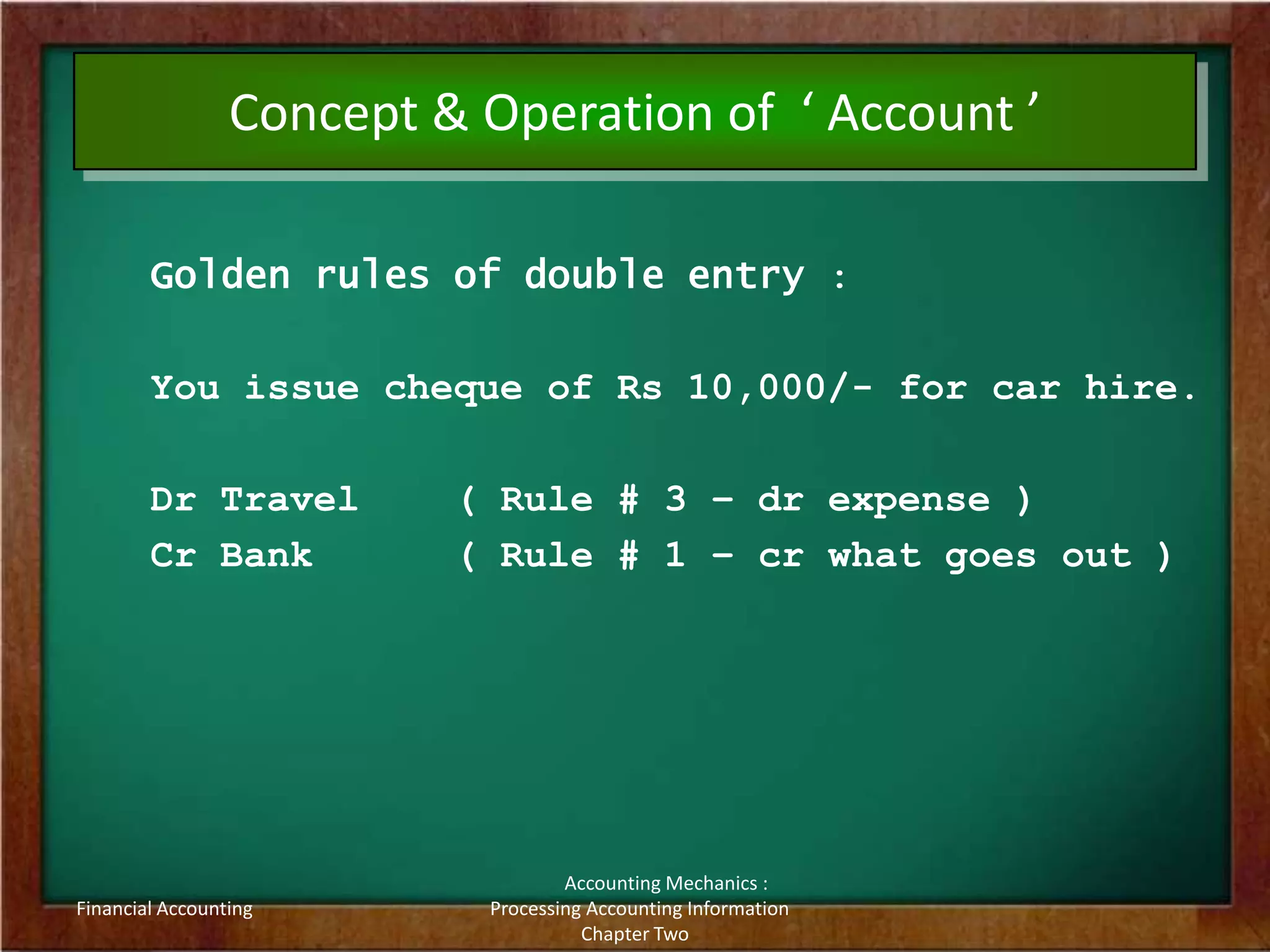
You issue cheque of Rs 10,000/- for car hire.
Dr Travel ( Rule # 3 – dr expense )
Cr Bank ( Rule # 1 – cr what goes out )
Financial Accounting
Accounting Mechanics :
Processing Accounting Information
Chapter Two
Concept & Operation of ‘ Account ’
Golden rules of double entry :
You receive cheque of Rs 10,000/- for
interest on Fixed Deposit.
Dr Bank ( Rule # 1 – dr what comes in )
Cr Interest ( Rule # 3 – cr incomes )
Financial Accounting
Accounting Mechanics :
Processing Accounting Information
Chapter Two
Concept & Operation of ‘ Account ’
Golden rules of double entry :
You sell goods worth Rs. 10,000/- and offer 5%
quantity ( trade ) discount. You receive cheque.
Dr Bank Rs 9,500/-
Cr Sales Rs 9,500/-
‘trade discount is a reduction in market
price. Market price is not relevant in
accounting, & is ignored.
Financial Accounting
Accounting Mechanics :
Processing Accounting Information
Chapter Two
Concept & Operation of ‘ Account ’
Golden rules of double entry :
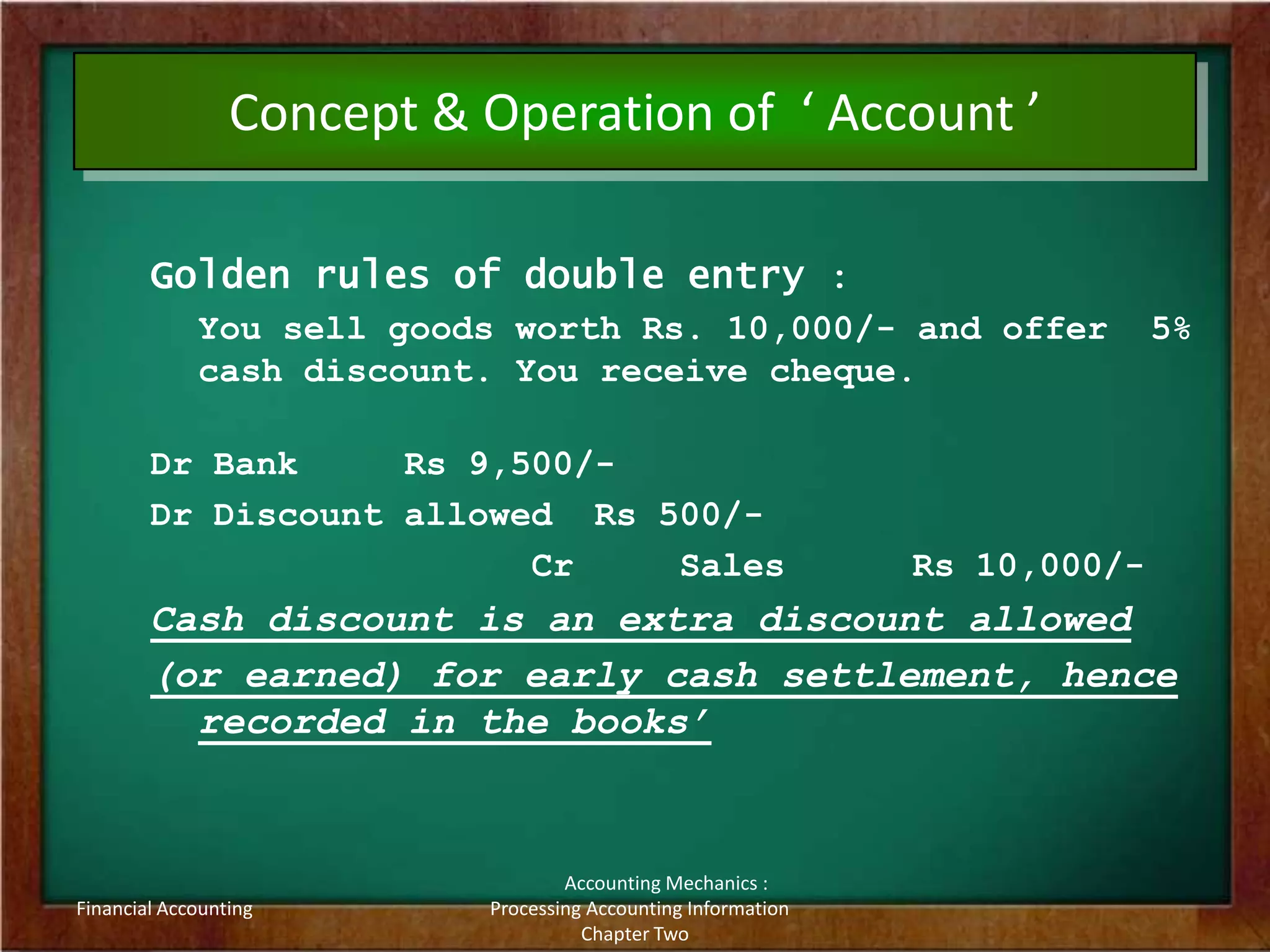
You sell goods worth Rs. 10,000/- and offer 5%
cash discount. You receive cheque.
Dr Bank Rs 9,500/-
Dr Discount allowed Rs 500/-
Cr Sales Rs 10,000/-
Cash discount is an extra discount allowed
(or earned) for early cash settlement, hence
recorded in the books’
Financial Accounting
Accounting Mechanics :
Processing Accounting Information
Chapter Two
‘ Journal & Ledger’
The Journal
‘is the Book of Prime Entry where all
entries are first recorded in a
chronological order.’
Financial Accounting
Accounting Mechanics :
Processing Accounting Information
Chapter Two
‘ Journal & Ledger’
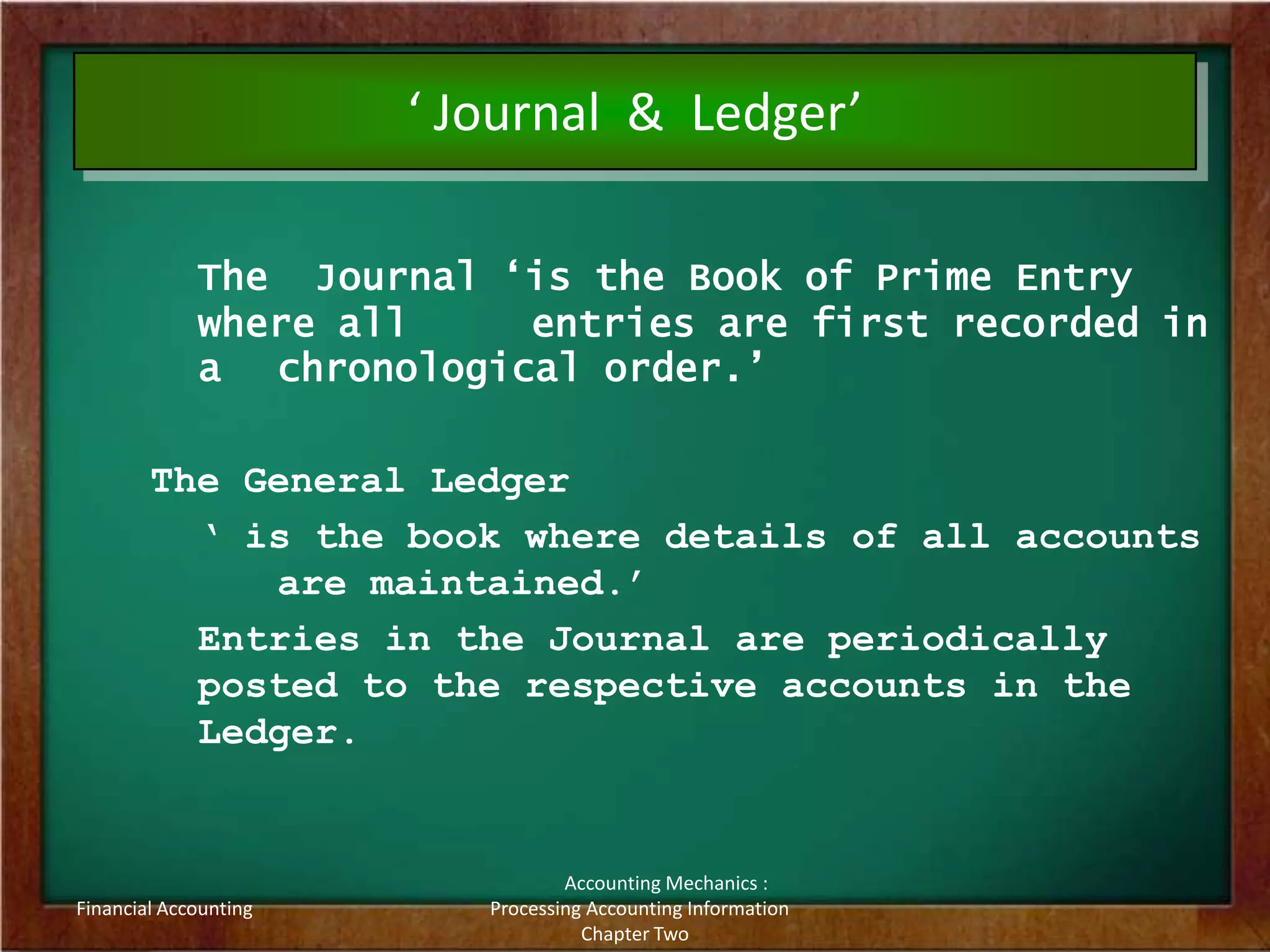
The Journal ‘is the Book of Prime Entry
where all entries are first recorded in
a chronological order.’
The General Ledger
‘ is the book where details of all accounts
are maintained.’
Entries in the Journal are periodically
posted to the respective accounts in the
Ledger.
Financial Accounting
Accounting Mechanics :
Processing Accounting Information
Chapter Two
‘ Journal & Ledger’
The Journal ‘is the Book of Prime Entry
where all entries are first recorded in
a chronological order.’
The General Ledger ‘ is the book where
details of all accounts are maintained.’
“ in computerized environment these two
stages get rolled into one “
Financial Accounting
Accounting Mechanics :
Processing Accounting Information
Chapter Two
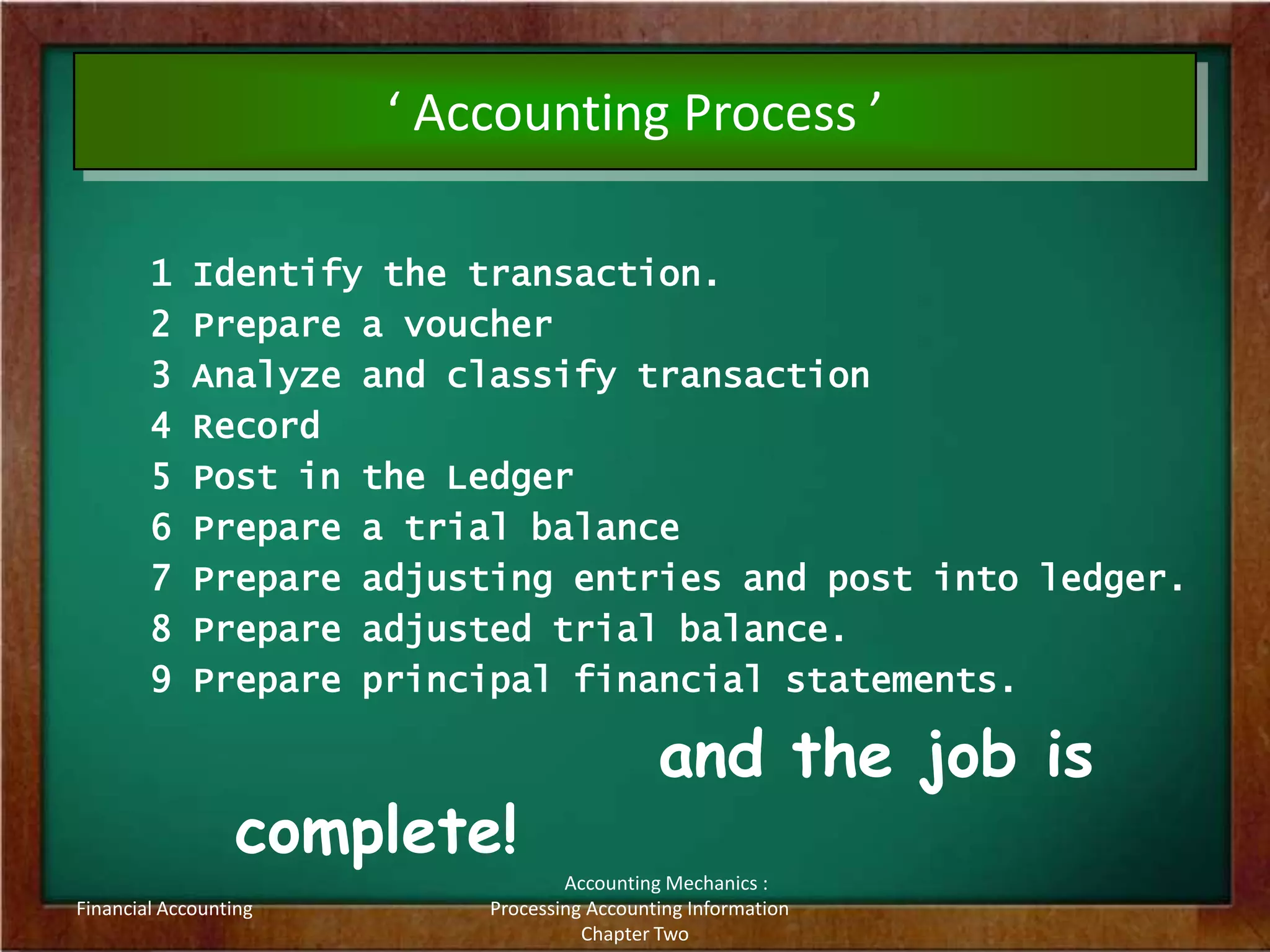
‘ Accounting Process ’
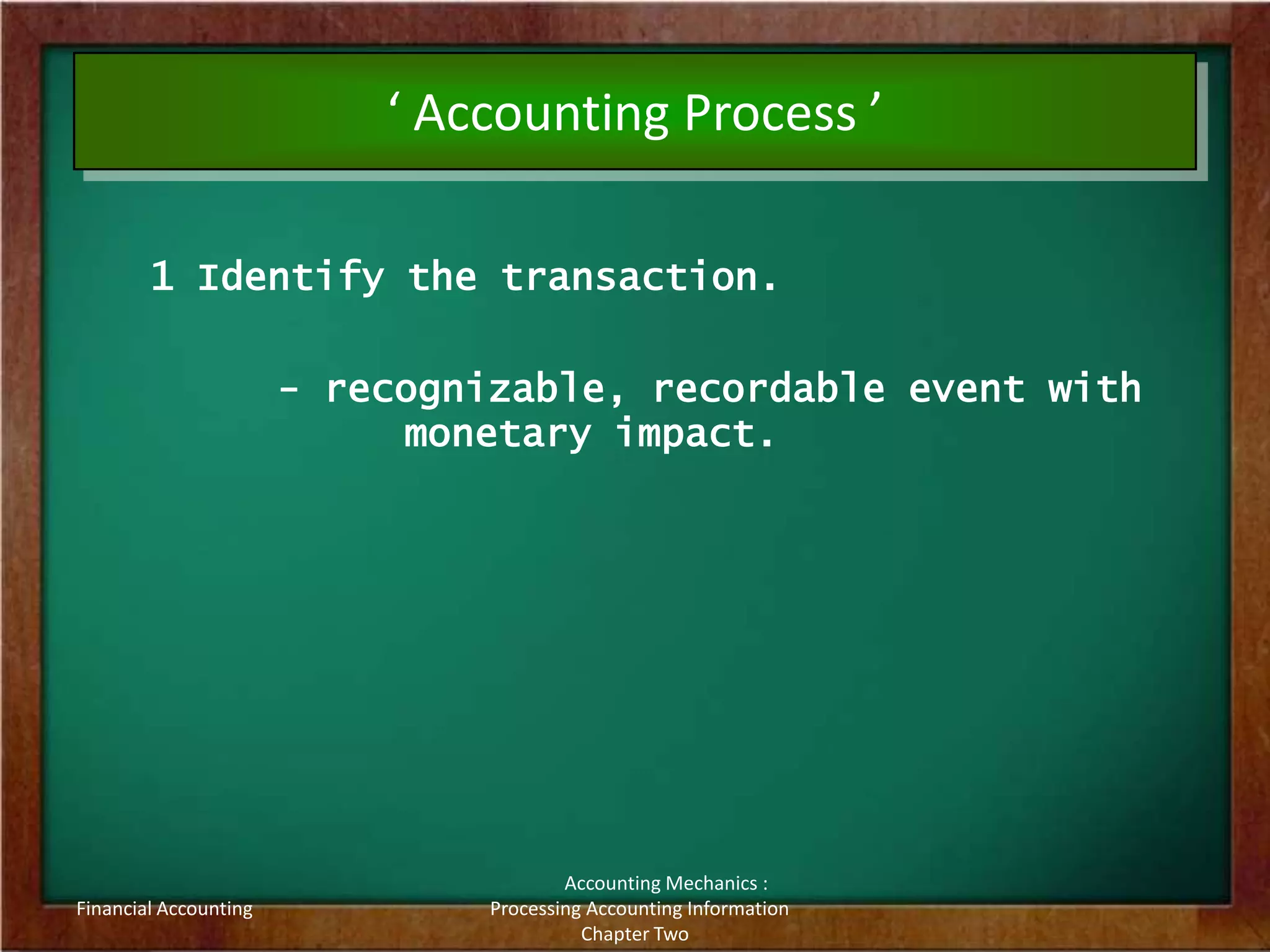
1 Identify the transaction.
- recognizable, recordable event with
monetary impact.
Financial Accounting
Accounting Mechanics :
Processing Accounting Information
Chapter Two
‘ Accounting Process ’
1 Identify the transaction.
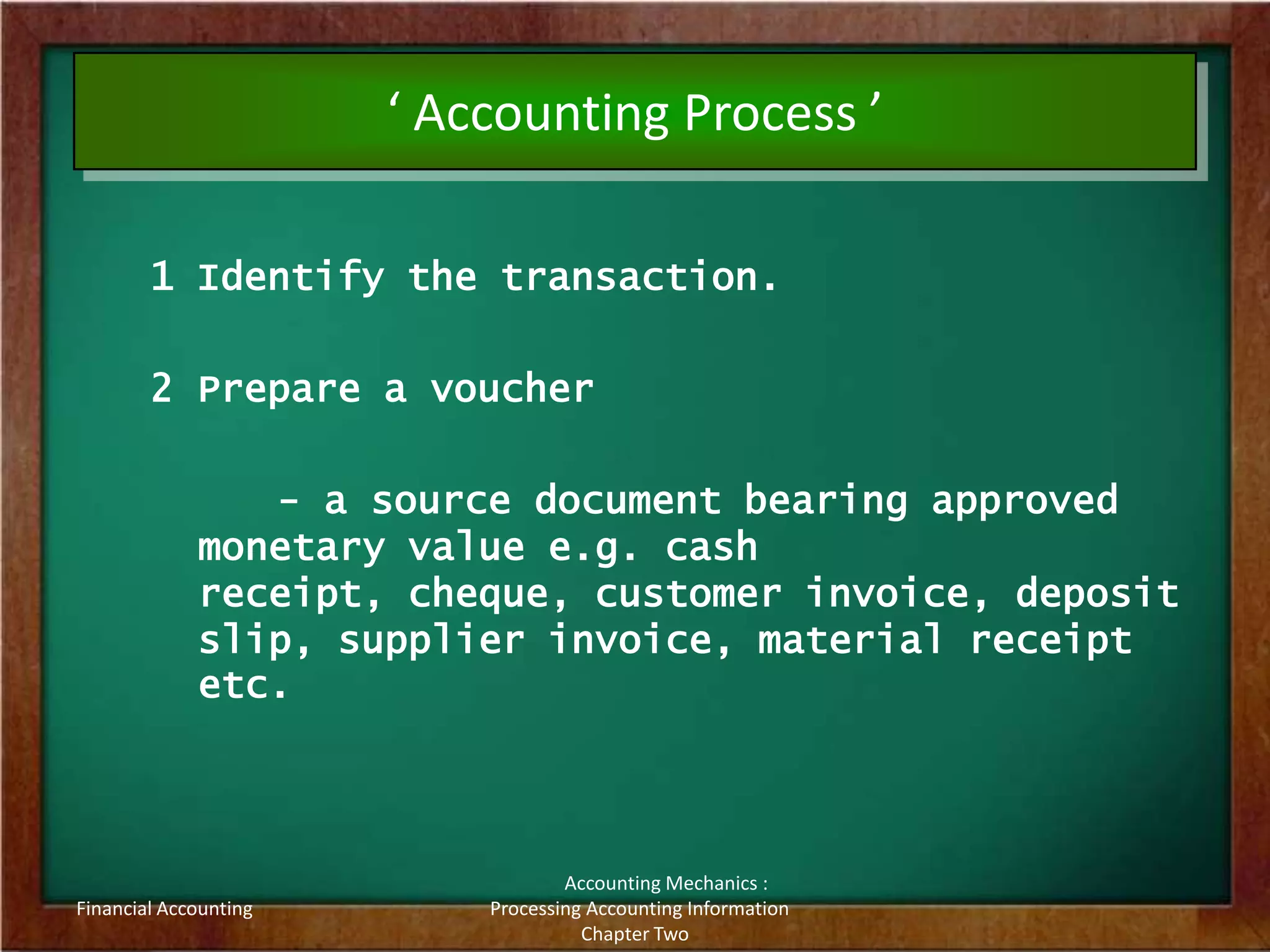
2 Prepare a voucher
- a source document bearing approved
monetary value e.g. cash
receipt, cheque, customer invoice, deposit
slip, supplier invoice, material receipt
etc.
Financial Accounting
Accounting Mechanics :
Processing Accounting Information
Chapter Two
‘ Accounting Process ’
1 Identify the transaction.
2 Prepare a voucher
3 Analyze and classify transaction
- identify accounts affected, find out
whether to be debited or credited & by
how much.
Financial Accounting
Accounting Mechanics :
Processing Accounting Information
Chapter Two
‘ Accounting Process ’
1 Identify the transaction.
2 Prepare a voucher
3 Analyze and classify transaction
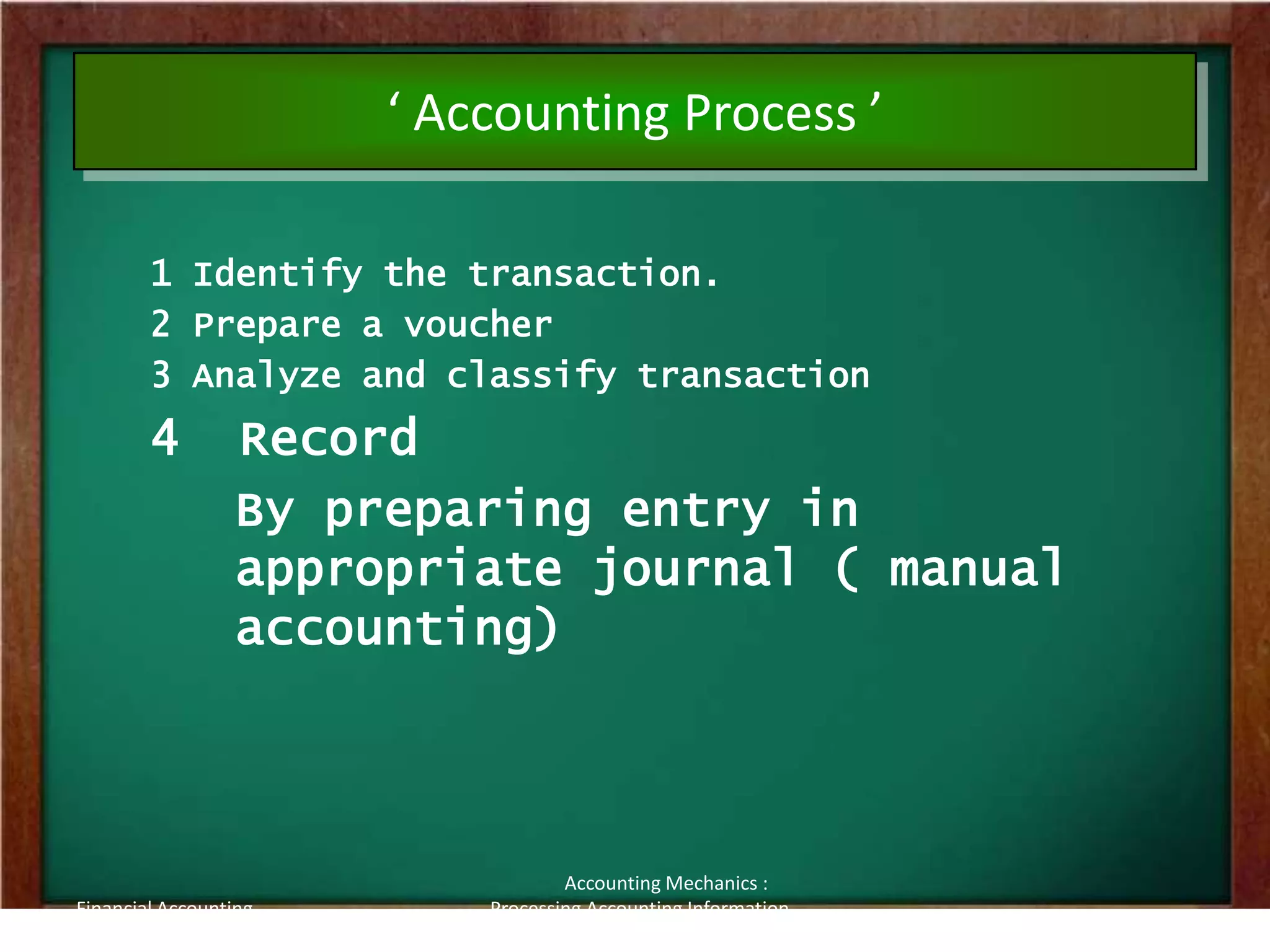
4 Record
By preparing entry in
appropriate journal ( manual
accounting)
Financial Accounting
Accounting Mechanics :
Processing Accounting Information
Chapter Two
‘ Accounting Process ’
1 Identify the transaction.
2 Prepare a voucher
3 Analyze and classify transaction
4 Record
5 Post journal entry into ledger
account
Thus all transactions on an account
are available at one place & net
balance can be arrived at
Financial Accounting
Accounting Mechanics :
Processing Accounting Information
Chapter Two
‘ Accounting Process ’
1 Identify the transaction.
2 Prepare a voucher
3 Analyze and classify transaction
4 Record
5 Post in the Ledger
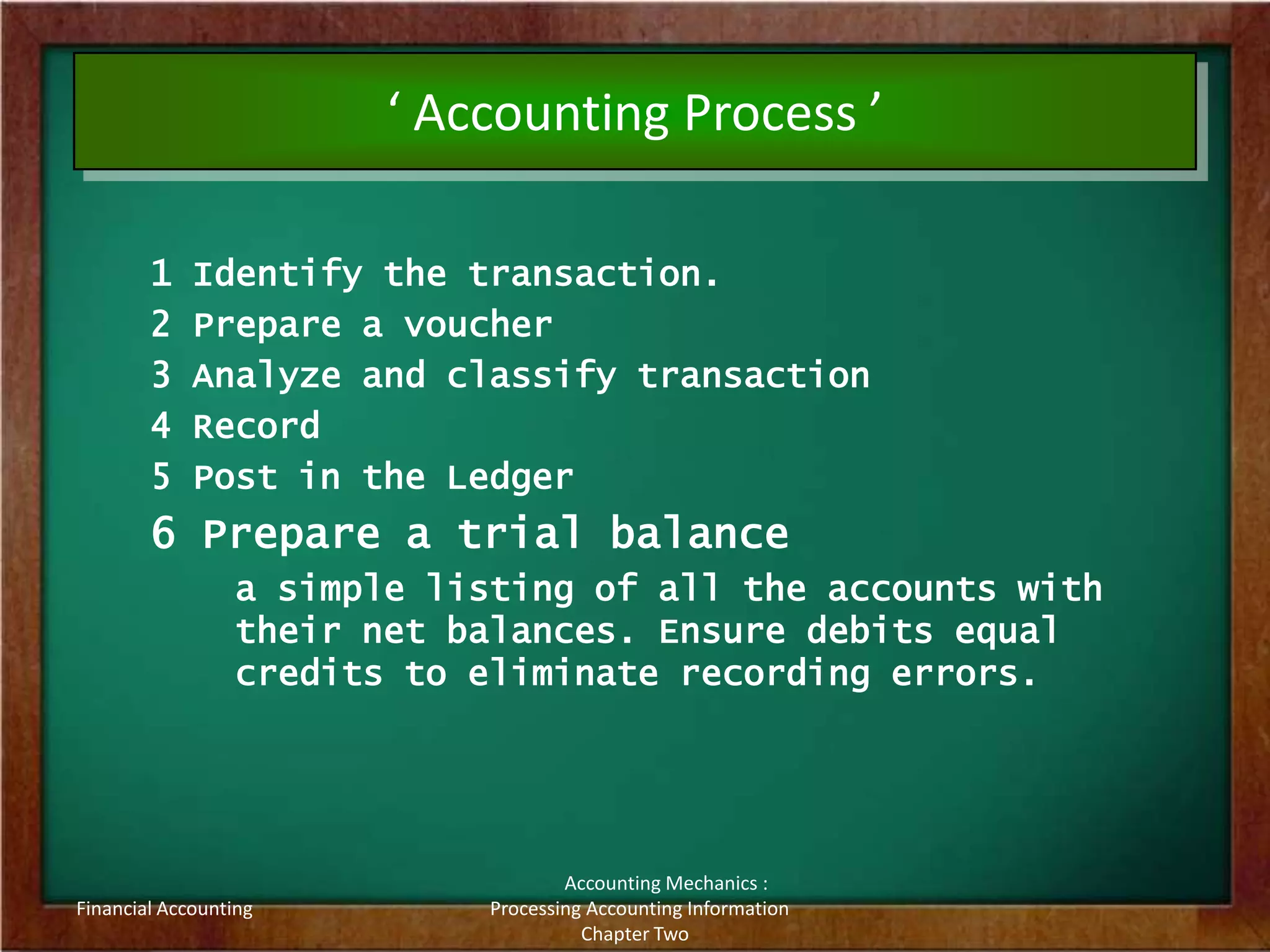
6 Prepare a trial balance
a simple listing of all the accounts with
their net balances. Ensure debits equal
credits to eliminate recording errors.
Financial Accounting
Accounting Mechanics :
Processing Accounting Information
Chapter Two
‘ Accounting Process ’
1 Identify the transaction.
2 Prepare a voucher
3 Analyze and classify transaction
4 Record
5 Post in the Ledger
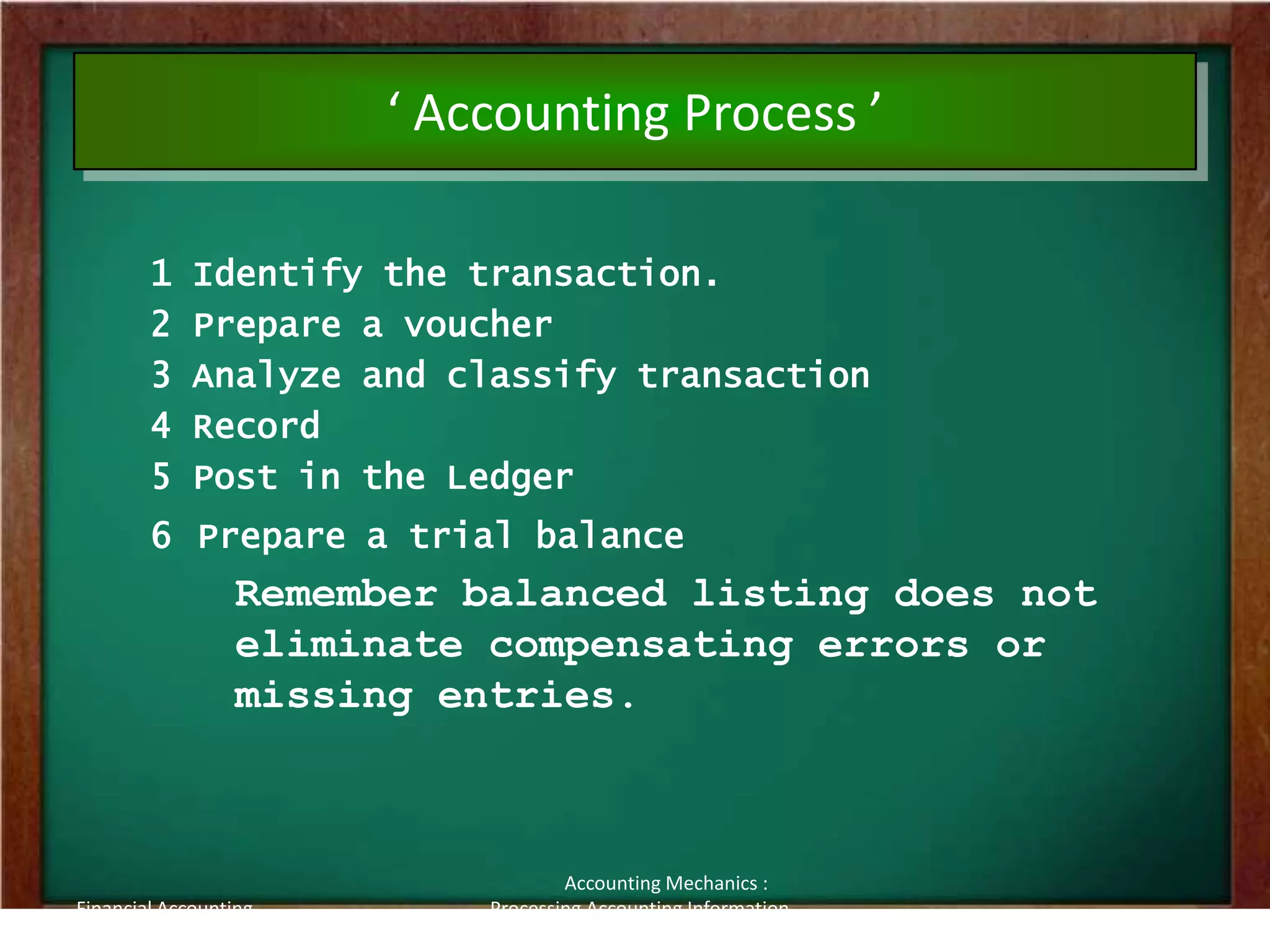
6 Prepare a trial balance
Remember balanced listing does not
eliminate compensating errors or
missing entries.
Financial Accounting
Accounting Mechanics :
Processing Accounting Information
Chapter Two
‘ Accounting Process ’
1 Identify the transaction.
2 Prepare a voucher
3 Analyze and classify transaction
4 Record
5 Post in the Ledger
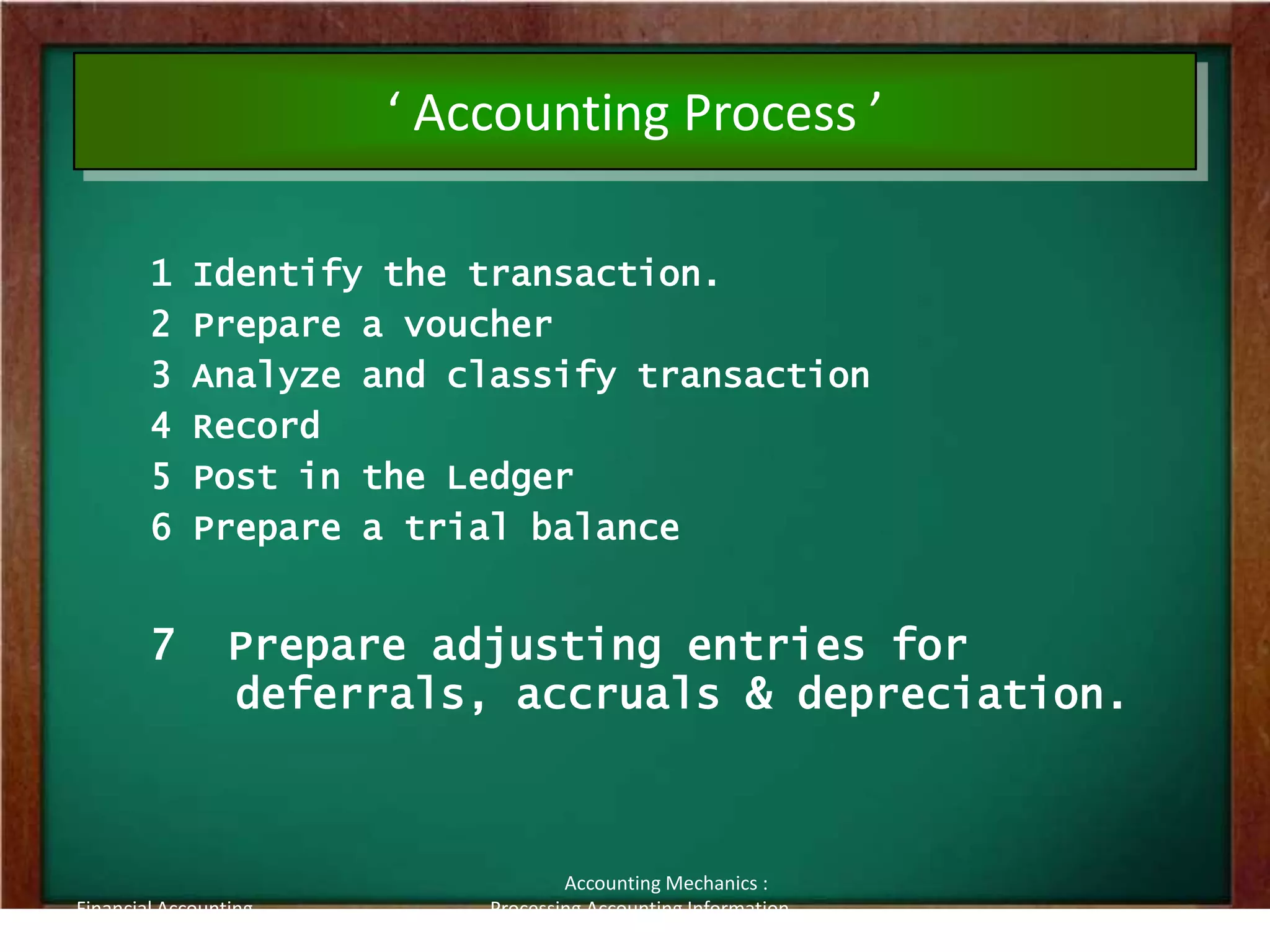
6 Prepare a trial balance
7 Prepare adjusting entries for
deferrals, accruals & depreciation.
Financial Accounting
Accounting Mechanics :
Processing Accounting Information
Chapter Two
‘ Accounting Process ’
7 Prepare adjusting entries for
deferrals, accruals & depreciation.
Deferral : An adjustment for which the business
paid or received cash in advance.
Financial Accounting
Accounting Mechanics :
Processing Accounting Information
Chapter Two
‘ Accounting Process ’
7 Prepare adjusting entries for
deferrals, accruals & depreciation.
Deferral : An adjustment for which the business
paid or received cash in advance.
Accrual : An expense or a revenue occurring
before the business pays or receives
cash.
Financial Accounting
Accounting Mechanics :
Processing Accounting Information
Chapter Two
‘ Accounting Process ’
7 Prepare adjusting entries for
deferrals, accruals & depreciation.
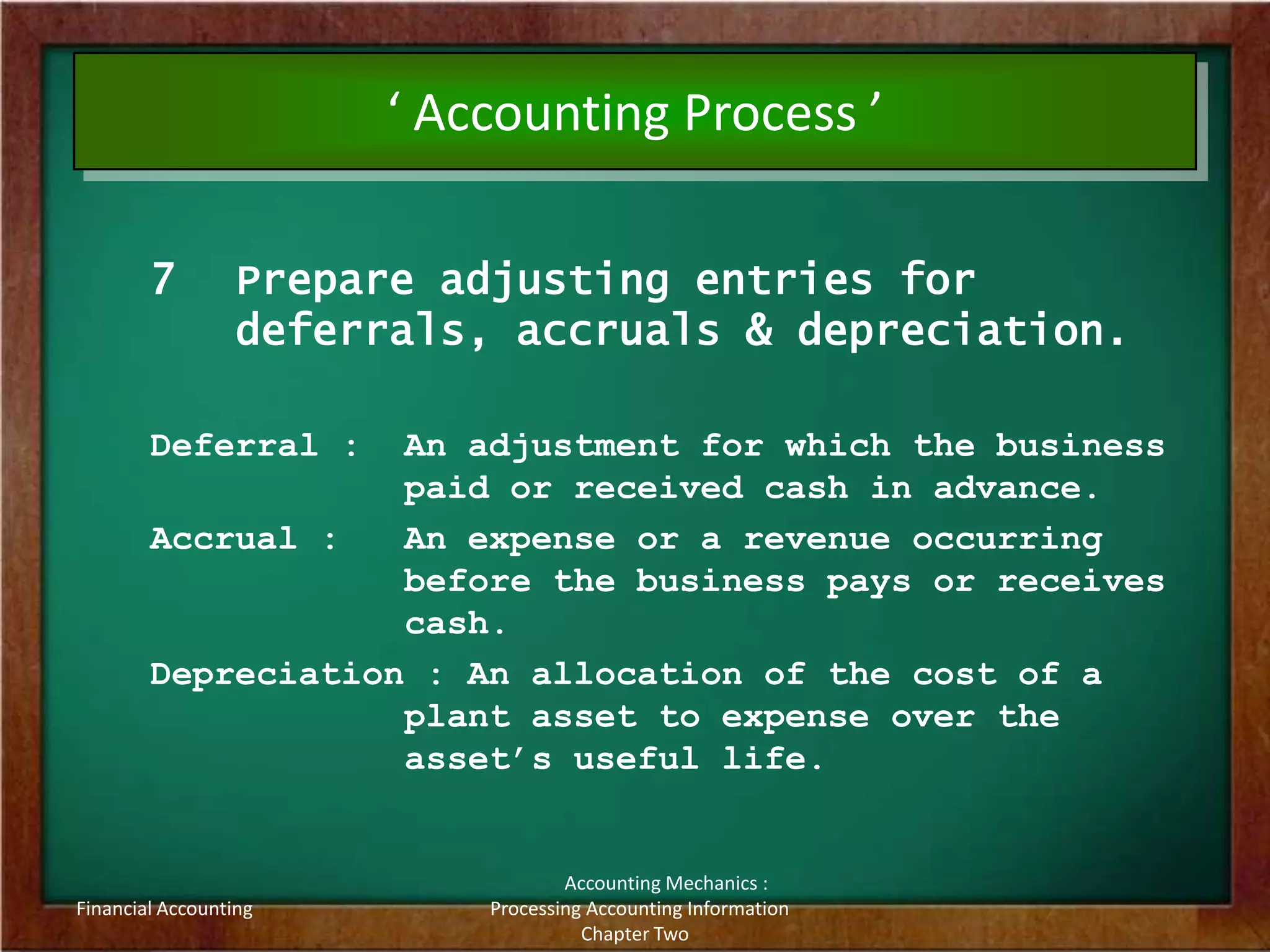
Deferral : An adjustment for which the business
paid or received cash in advance.
Accrual : An expense or a revenue occurring
before the business pays or receives
cash.
Depreciation : An allocation of the cost of a
plant asset to expense over the
asset’s useful life.
Financial Accounting
Accounting Mechanics :
Processing Accounting Information
Chapter Two
‘ Accounting Process ’
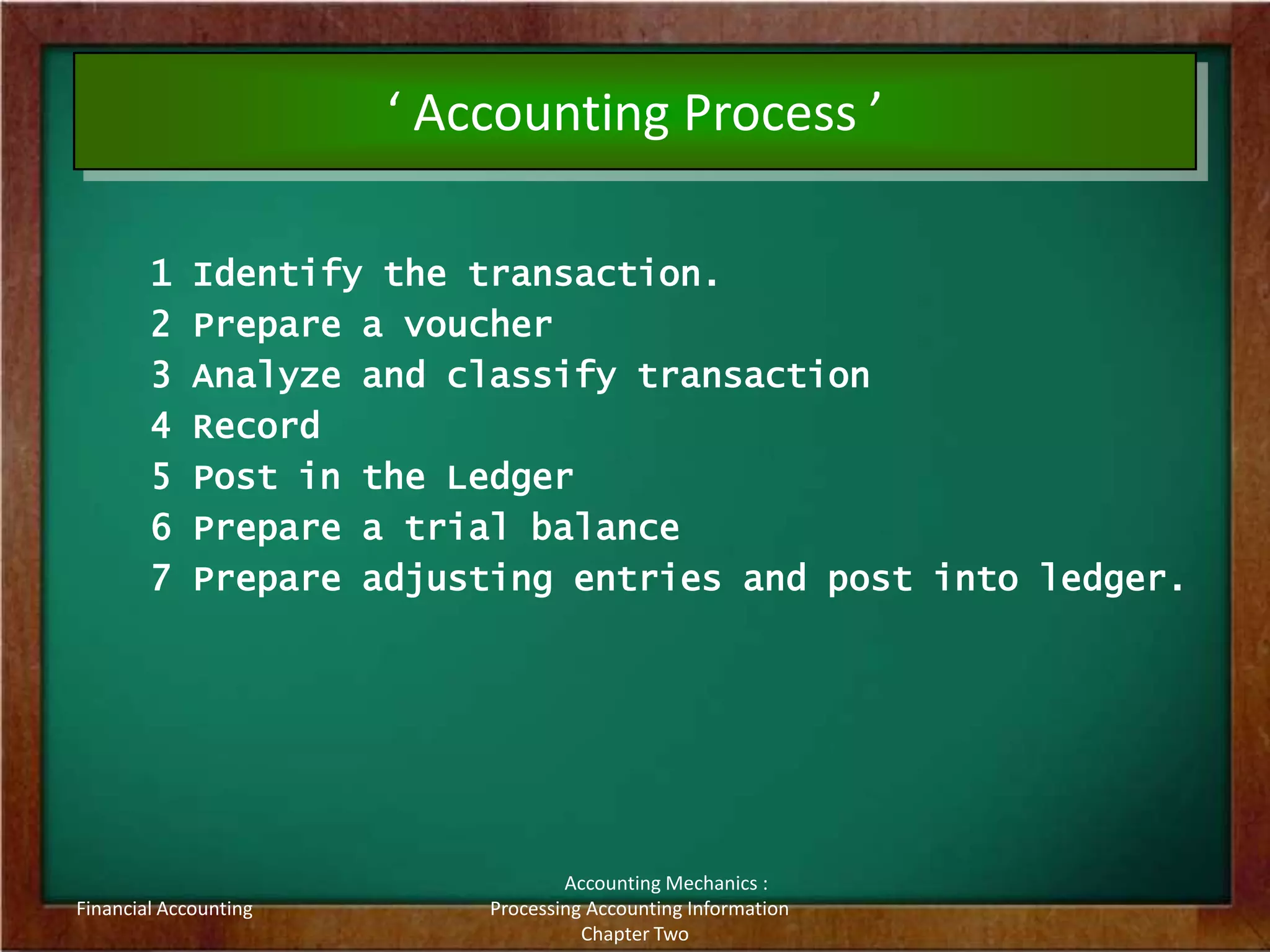
1 Identify the transaction.
2 Prepare a voucher
3 Analyze and classify transaction
4 Record
5 Post in the Ledger
6 Prepare a trial balance
7 Prepare adjusting entries and post into ledger.
Financial Accounting
Accounting Mechanics :
Processing Accounting Information
Chapter Two
‘ Accounting Process ’
1 Identify the transaction.
2 Prepare a voucher
3 Analyze and classify transaction
4 Record
5 Post in the Ledger
6 Prepare a trial balance
7 Prepare adjusting entries and post into ledger.
8 Prepare adjusted trial balance.
- include adjusting entries
Financial Accounting
Accounting Mechanics :
Processing Accounting Information
Chapter Two
‘ Accounting Process ’
1 Identify the transaction.
2 Prepare a voucher
3 Analyze and classify transaction
4 Record
5 Post in the Ledger
6 Prepare a trial balance
7 Prepare adjusting entries and post into ledger.
8 Prepare adjusted trial balance.
9 Prepare principal financial statements.
Financial Accounting
Accounting Mechanics :
Processing Accounting Information
Chapter Two
‘ Accounting Process ’
9 Prepare principal financial statements.
Income Statement
- from the
revenue, expenses, gains and
losses.
Financial Accounting
Accounting Mechanics :
Processing Accounting Information
Chapter Two
‘ Accounting Process ’
9 Prepare principal financial statements.
$ Income Statement
$ Balance Sheet
- prepared from the
assets, liabilities and equity
accounts.
Financial Accounting
Accounting Mechanics :
Processing Accounting Information
Chapter Two
‘ Accounting Process ’
9 Prepare principal financial statements.
$ Income Statement
$ Balance Sheet
$ Statement of Retained Earnings
- prepared from the net income and
dividend information.
Financial Accounting
Accounting Mechanics :
Processing Accounting Information
Chapter Two
‘ Accounting Process ’
9 Prepare principal financial statements.
$ Income Statement
$ Balance Sheet
$ Statement of Retained Earnings
$ Cash Flow Statement
- prepared from other financial
statements by direct or indirect
method ( discussed in Chapter Five
later).
Financial Accounting
Accounting Mechanics :
Processing Accounting Information
Chapter Two
‘ Accounting Process ’
9 Prepare principal financial statements.
$ Income Statement
$ Balance Sheet
$ Statement of Retained Earnings
$ Cash Flow Statement
With these four you are in compliance with GAAP.
Financial Accounting
Accounting Mechanics :
Processing Accounting Information
Chapter Two
‘ Accounting Process ’
1 Identify the transaction.
2 Prepare a voucher
3 Analyze and classify transaction
4 Record
5 Post in the Ledger
6 Prepare a trial balance
7 Prepare adjusting entries and post into ledger.
8 Prepare adjusted trial balance.
9 Prepare principal financial statements.
and the job is
complete!
Financial Accounting
Accounting Mechanics :
Processing Accounting Information
Chapter Two
‘ Accounting Process ’
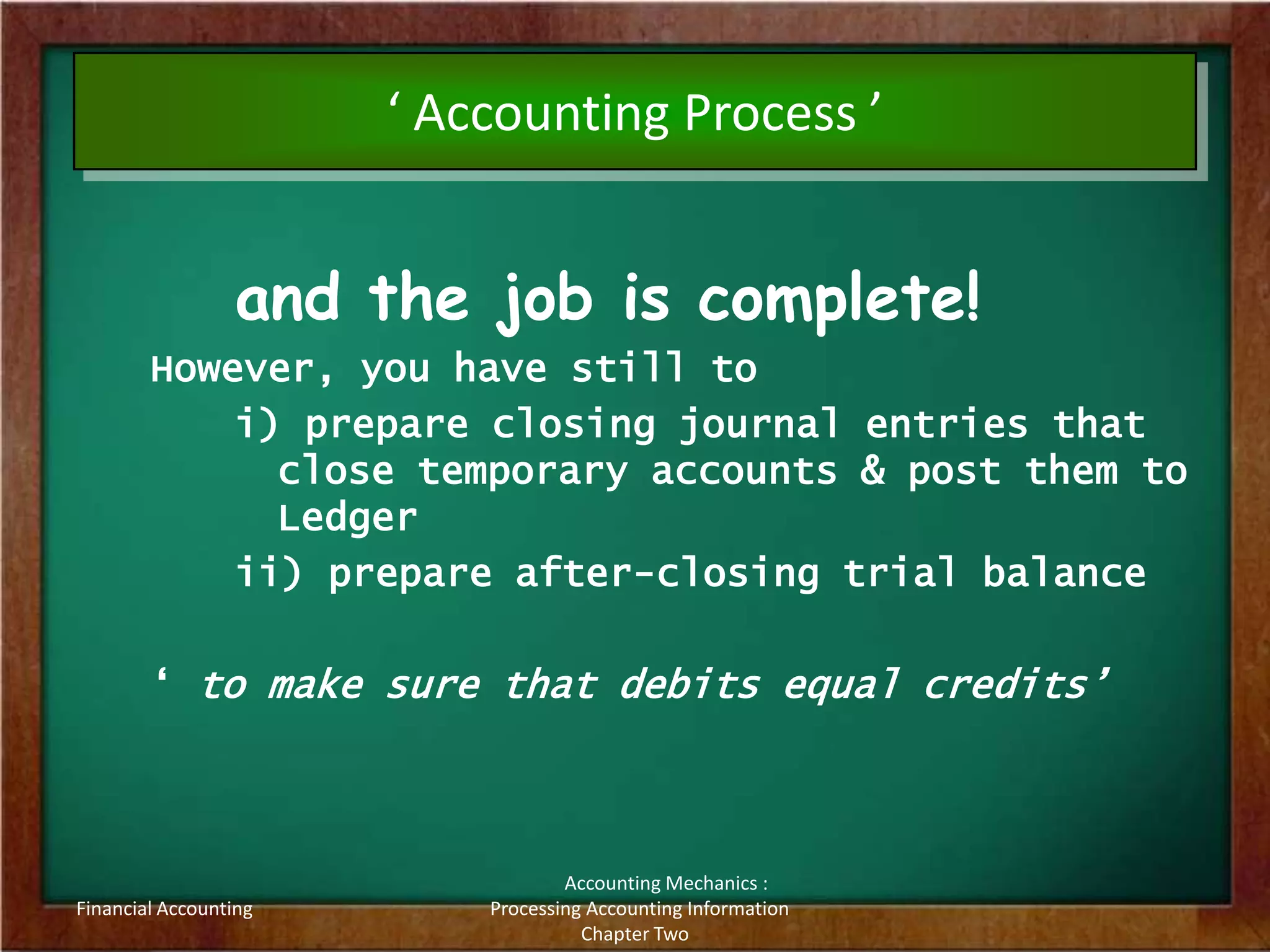
and the job is complete!
However, you have still to
i) prepare closing journal entries that
close temporary accounts & post them to
Ledger
Financial Accounting
Accounting Mechanics :
Processing Accounting Information
Chapter Two
‘ Accounting Process ’
and the job is complete!
However, you have still to
i) prepare closing journal entries that
close temporary accounts & post them to
Ledger
ii) prepare after-closing trial balance
‘ to make sure that debits equal credits’
Financial Accounting
Accounting Mechanics :
Processing Accounting Information
Chapter Two
‘ Accounting Process ’
and the job is complete!
However, you have still to
i) prepare closing journal entries that
close temporary accounts & post them to
Ledger
ii) prepare after-closing trial balance
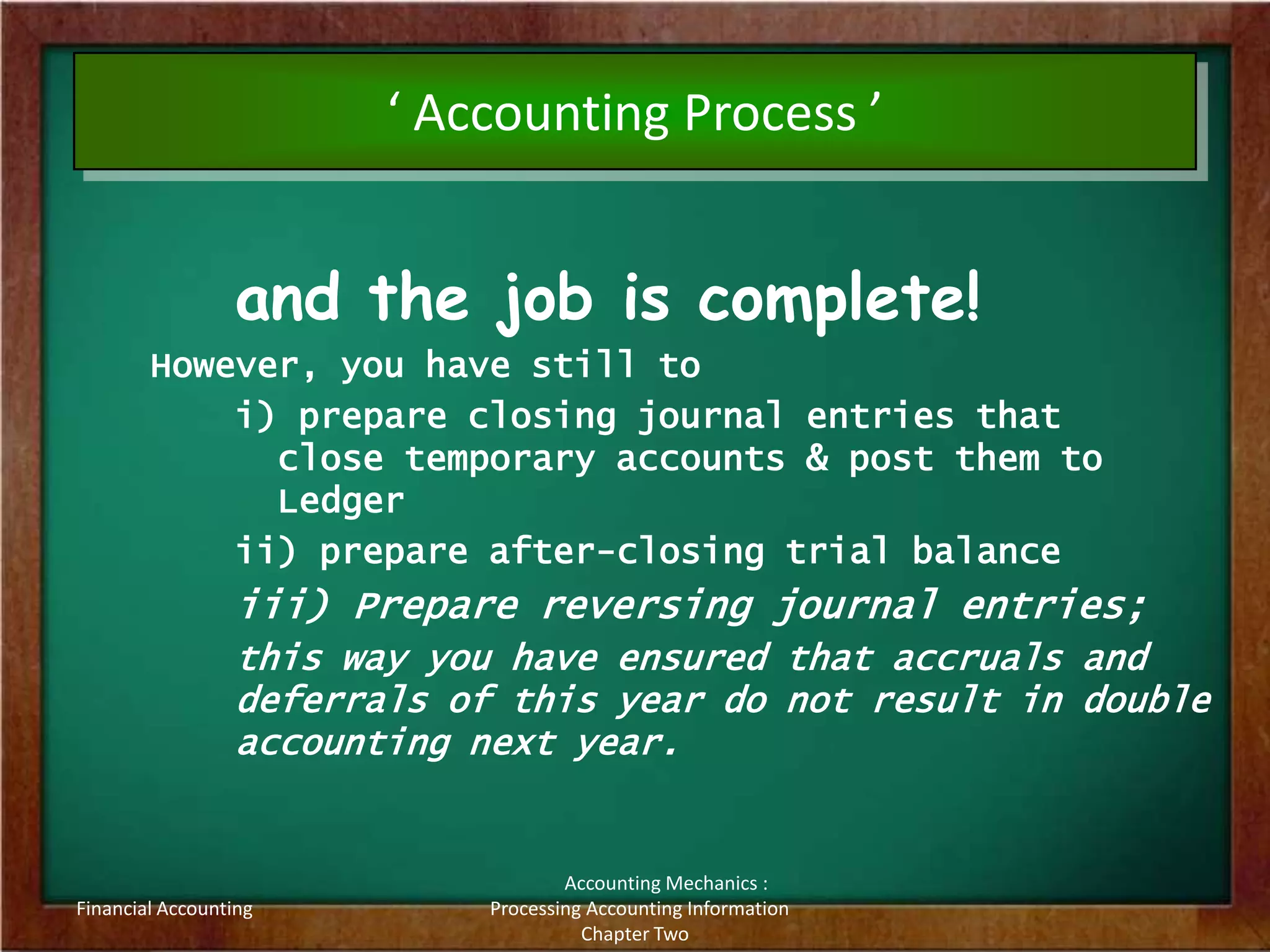
iii) Prepare reversing journal entries;
this way you have ensured that accruals and
deferrals of this year do not result in double
accounting next year.
Financial Accounting
Accounting Mechanics :
Processing Accounting Information
Chapter Two
“ The importance of “accounting
mechanics : processing accounting
information “ is to
collect, process, classify, compile, c
heck and present meaningful
financial data for decisions that
have to taken in the modern
business world!”

Basics of Accounting Mechanics-Processing Accounting Information

  • 1.
    Welingkar’s Distance LearningDivision Financial Accounting CHAPTER-1. Accounting Mechanics: Processing Accounting Information We Learn – A Continuous Learning Forum
  • 2.
    Financial Accounting Accounting Mechanics: Processing Accounting Information Chapter Two Importance ‘ Accounting Mechanics ’ shows us how Accountants collect and record accounting data for preparation of principal financial statements required by GAAP.
  • 3.
    Financial Accounting Accounting Mechanics: Processing Accounting Information Chapter Two Concept & Operation of ‘ Account ’ ‘ Account ’ is a summary device to record transactions in Company’s books of accounts. It is a label to record changes in assets, liabilities and shareholders’ equity. Account Head _________________________________________ Debit Credit The balance in an account is the difference between the totals of debits and credits.
  • 4.
    Financial Accounting Accounting Mechanics: Processing Accounting Information Chapter Two Cash vs. Accrual Accounting ‘ Accrual Accounting Cash Accounting Record Income When earned. When money received. Record Expense When Incurred When Paid. Use Universal Small units. Mandatory Yes. GAAP Not Recognized. Requirement. In this course we will use the accepted accrual system of accounting.
  • 5.
    Financial Accounting Accounting Mechanics: Processing Accounting Information Chapter Two Concept & Operation of ‘ Account ’ ‘ Accounts are classified as : Personal Accounts Real Accounts Non Personal Accounts } Nominal Accounts
  • 6.
    Financial Accounting Accounting Mechanics: Processing Accounting Information Chapter Two Concept & Operation of ‘ Account ’ ‘ Accounts are classified as : Personal Accounts – related to persons like debtor, creditor, supplier or customer.
  • 7.
    Financial Accounting Accounting Mechanics: Processing Accounting Information Chapter Two Concept & Operation of ‘ Account ’ ‘ Accounts are classified as : • Personal Accounts Real Accounts – related to assets, of the firm but not its debt. e.g. Land , Buildings, Plant, Cash etc.
  • 8.
    Financial Accounting Accounting Mechanics: Processing Accounting Information Chapter Two Concept & Operation of ‘ Account ’ ‘ Accounts are classified as : • Personal Accounts • Real Accounts Nominal Accounts – related to expenses, incomes, losses and gains. e.g. salaries, interest, travel etc.
  • 9.
    Financial Accounting Accounting Mechanics: Processing Accounting Information Chapter Two Concept & Operation of ‘ Account ’ ‘ Accounts are classified as : • Personal Accounts • Real Accounts • Nominal Accounts – related to expenses, incomes, losses and gains. e.g. salaries, interest, travel etc. ‘ net result of all the nominal accounts is reflected as P & L for the accounting year.’
  • 10.
    Financial Accounting Accounting Mechanics: Processing Accounting Information Chapter Two Concept & Operation of ‘ Account ’ ‘ Golden rules of double entry #1 For real accounts; debit (dr) what comes in, and credit (cr) what goes out. Purchased materials – dr Inventory. Issued cheque for it - cr Bank
  • 11.
    Financial Accounting Accounting Mechanics: Processing Accounting Information Chapter Two Concept & Operation of ‘ Account ’ ‘ Golden rules of double entry #1 - For real accounts; debit (dr) what comes in, and credit (cr) what goes out. # 2 - For personal accounts; debit (dr) the receiver, and credit (cr) the giver. Issued cheque to Sachin – dr Sachin Recd. cheque from Sachin – cr Sachin
  • 12.
    Financial Accounting Accounting Mechanics: Processing Accounting Information Chapter Two Concept & Operation of ‘ Account ’ Golden rules of double entry #1 - For real accounts; debit (dr) what comes in, and credit (cr) what goes out. #2 - For personal accounts; debit (dr) the receiver, and credit (cr) the giver. #3 - For nominal accounts; debit (dr) expenses / assets, and credit (cr) income /liabilities. Distributed salaries – dr Salaries Recd. Interest cheque – cr Interest
  • 13.
    Financial Accounting Accounting Mechanics: Processing Accounting Information Chapter Two Concept & Operation of ‘ Account ’ Golden rules of double entry : You buy a machine for Rs 15,000/- & issue cheque. Dr Machinery ( Rule # 3 – dr expenses ) Cr Bank ( Rule # 1 – cr what goes out )
  • 14.
    Financial Accounting Accounting Mechanics: Processing Accounting Information Chapter Two Concept & Operation of ‘ Account ’ Golden rules of double entry : You issue cheque of Rs 10,000/- for car hire. Dr Travel ( Rule # 3 – dr expense ) Cr Bank ( Rule # 1 – cr what goes out )
  • 15.
    Financial Accounting Accounting Mechanics: Processing Accounting Information Chapter Two Concept & Operation of ‘ Account ’ Golden rules of double entry : You receive cheque of Rs 10,000/- for interest on Fixed Deposit. Dr Bank ( Rule # 1 – dr what comes in ) Cr Interest ( Rule # 3 – cr incomes )
  • 16.
    Financial Accounting Accounting Mechanics: Processing Accounting Information Chapter Two Concept & Operation of ‘ Account ’ Golden rules of double entry : You sell goods worth Rs. 10,000/- and offer 5% quantity ( trade ) discount. You receive cheque. Dr Bank Rs 9,500/- Cr Sales Rs 9,500/- ‘trade discount is a reduction in market price. Market price is not relevant in accounting, & is ignored.
  • 17.
    Financial Accounting Accounting Mechanics: Processing Accounting Information Chapter Two Concept & Operation of ‘ Account ’ Golden rules of double entry : You sell goods worth Rs. 10,000/- and offer 5% cash discount. You receive cheque. Dr Bank Rs 9,500/- Dr Discount allowed Rs 500/- Cr Sales Rs 10,000/- Cash discount is an extra discount allowed (or earned) for early cash settlement, hence recorded in the books’
  • 18.
    Financial Accounting Accounting Mechanics: Processing Accounting Information Chapter Two ‘ Journal & Ledger’ The Journal ‘is the Book of Prime Entry where all entries are first recorded in a chronological order.’
  • 19.
    Financial Accounting Accounting Mechanics: Processing Accounting Information Chapter Two ‘ Journal & Ledger’ The Journal ‘is the Book of Prime Entry where all entries are first recorded in a chronological order.’ The General Ledger ‘ is the book where details of all accounts are maintained.’ Entries in the Journal are periodically posted to the respective accounts in the Ledger.
  • 20.
    Financial Accounting Accounting Mechanics: Processing Accounting Information Chapter Two ‘ Journal & Ledger’ The Journal ‘is the Book of Prime Entry where all entries are first recorded in a chronological order.’ The General Ledger ‘ is the book where details of all accounts are maintained.’ “ in computerized environment these two stages get rolled into one “
  • 21.
    Financial Accounting Accounting Mechanics: Processing Accounting Information Chapter Two ‘ Accounting Process ’ 1 Identify the transaction. - recognizable, recordable event with monetary impact.
  • 22.
    Financial Accounting Accounting Mechanics: Processing Accounting Information Chapter Two ‘ Accounting Process ’ 1 Identify the transaction. 2 Prepare a voucher - a source document bearing approved monetary value e.g. cash receipt, cheque, customer invoice, deposit slip, supplier invoice, material receipt etc.
  • 23.
    Financial Accounting Accounting Mechanics: Processing Accounting Information Chapter Two ‘ Accounting Process ’ 1 Identify the transaction. 2 Prepare a voucher 3 Analyze and classify transaction - identify accounts affected, find out whether to be debited or credited & by how much.
  • 24.
    Financial Accounting Accounting Mechanics: Processing Accounting Information Chapter Two ‘ Accounting Process ’ 1 Identify the transaction. 2 Prepare a voucher 3 Analyze and classify transaction 4 Record By preparing entry in appropriate journal ( manual accounting)
  • 25.
    Financial Accounting Accounting Mechanics: Processing Accounting Information Chapter Two ‘ Accounting Process ’ 1 Identify the transaction. 2 Prepare a voucher 3 Analyze and classify transaction 4 Record 5 Post journal entry into ledger account Thus all transactions on an account are available at one place & net balance can be arrived at
  • 26.
    Financial Accounting Accounting Mechanics: Processing Accounting Information Chapter Two ‘ Accounting Process ’ 1 Identify the transaction. 2 Prepare a voucher 3 Analyze and classify transaction 4 Record 5 Post in the Ledger 6 Prepare a trial balance a simple listing of all the accounts with their net balances. Ensure debits equal credits to eliminate recording errors.
  • 27.
    Financial Accounting Accounting Mechanics: Processing Accounting Information Chapter Two ‘ Accounting Process ’ 1 Identify the transaction. 2 Prepare a voucher 3 Analyze and classify transaction 4 Record 5 Post in the Ledger 6 Prepare a trial balance Remember balanced listing does not eliminate compensating errors or missing entries.
  • 28.
    Financial Accounting Accounting Mechanics: Processing Accounting Information Chapter Two ‘ Accounting Process ’ 1 Identify the transaction. 2 Prepare a voucher 3 Analyze and classify transaction 4 Record 5 Post in the Ledger 6 Prepare a trial balance 7 Prepare adjusting entries for deferrals, accruals & depreciation.
  • 29.
    Financial Accounting Accounting Mechanics: Processing Accounting Information Chapter Two ‘ Accounting Process ’ 7 Prepare adjusting entries for deferrals, accruals & depreciation. Deferral : An adjustment for which the business paid or received cash in advance.
  • 30.
    Financial Accounting Accounting Mechanics: Processing Accounting Information Chapter Two ‘ Accounting Process ’ 7 Prepare adjusting entries for deferrals, accruals & depreciation. Deferral : An adjustment for which the business paid or received cash in advance. Accrual : An expense or a revenue occurring before the business pays or receives cash.
  • 31.
    Financial Accounting Accounting Mechanics: Processing Accounting Information Chapter Two ‘ Accounting Process ’ 7 Prepare adjusting entries for deferrals, accruals & depreciation. Deferral : An adjustment for which the business paid or received cash in advance. Accrual : An expense or a revenue occurring before the business pays or receives cash. Depreciation : An allocation of the cost of a plant asset to expense over the asset’s useful life.
  • 32.
    Financial Accounting Accounting Mechanics: Processing Accounting Information Chapter Two ‘ Accounting Process ’ 1 Identify the transaction. 2 Prepare a voucher 3 Analyze and classify transaction 4 Record 5 Post in the Ledger 6 Prepare a trial balance 7 Prepare adjusting entries and post into ledger.
  • 33.
    Financial Accounting Accounting Mechanics: Processing Accounting Information Chapter Two ‘ Accounting Process ’ 1 Identify the transaction. 2 Prepare a voucher 3 Analyze and classify transaction 4 Record 5 Post in the Ledger 6 Prepare a trial balance 7 Prepare adjusting entries and post into ledger. 8 Prepare adjusted trial balance. - include adjusting entries
  • 34.
    Financial Accounting Accounting Mechanics: Processing Accounting Information Chapter Two ‘ Accounting Process ’ 1 Identify the transaction. 2 Prepare a voucher 3 Analyze and classify transaction 4 Record 5 Post in the Ledger 6 Prepare a trial balance 7 Prepare adjusting entries and post into ledger. 8 Prepare adjusted trial balance. 9 Prepare principal financial statements.
  • 35.
    Financial Accounting Accounting Mechanics: Processing Accounting Information Chapter Two ‘ Accounting Process ’ 9 Prepare principal financial statements. Income Statement - from the revenue, expenses, gains and losses.
  • 36.
    Financial Accounting Accounting Mechanics: Processing Accounting Information Chapter Two ‘ Accounting Process ’ 9 Prepare principal financial statements. $ Income Statement $ Balance Sheet - prepared from the assets, liabilities and equity accounts.
  • 37.
    Financial Accounting Accounting Mechanics: Processing Accounting Information Chapter Two ‘ Accounting Process ’ 9 Prepare principal financial statements. $ Income Statement $ Balance Sheet $ Statement of Retained Earnings - prepared from the net income and dividend information.
  • 38.
    Financial Accounting Accounting Mechanics: Processing Accounting Information Chapter Two ‘ Accounting Process ’ 9 Prepare principal financial statements. $ Income Statement $ Balance Sheet $ Statement of Retained Earnings $ Cash Flow Statement - prepared from other financial statements by direct or indirect method ( discussed in Chapter Five later).
  • 39.
    Financial Accounting Accounting Mechanics: Processing Accounting Information Chapter Two ‘ Accounting Process ’ 9 Prepare principal financial statements. $ Income Statement $ Balance Sheet $ Statement of Retained Earnings $ Cash Flow Statement With these four you are in compliance with GAAP.
  • 40.
    Financial Accounting Accounting Mechanics: Processing Accounting Information Chapter Two ‘ Accounting Process ’ 1 Identify the transaction. 2 Prepare a voucher 3 Analyze and classify transaction 4 Record 5 Post in the Ledger 6 Prepare a trial balance 7 Prepare adjusting entries and post into ledger. 8 Prepare adjusted trial balance. 9 Prepare principal financial statements. and the job is complete!
  • 41.
    Financial Accounting Accounting Mechanics: Processing Accounting Information Chapter Two ‘ Accounting Process ’ and the job is complete! However, you have still to i) prepare closing journal entries that close temporary accounts & post them to Ledger
  • 42.
    Financial Accounting Accounting Mechanics: Processing Accounting Information Chapter Two ‘ Accounting Process ’ and the job is complete! However, you have still to i) prepare closing journal entries that close temporary accounts & post them to Ledger ii) prepare after-closing trial balance ‘ to make sure that debits equal credits’
  • 43.
    Financial Accounting Accounting Mechanics: Processing Accounting Information Chapter Two ‘ Accounting Process ’ and the job is complete! However, you have still to i) prepare closing journal entries that close temporary accounts & post them to Ledger ii) prepare after-closing trial balance iii) Prepare reversing journal entries; this way you have ensured that accruals and deferrals of this year do not result in double accounting next year.
  • 44.
    Financial Accounting Accounting Mechanics: Processing Accounting Information Chapter Two “ The importance of “accounting mechanics : processing accounting information “ is to collect, process, classify, compile, c heck and present meaningful financial data for decisions that have to taken in the modern business world!”